
Public Administration applied to Foreign Policy &





Description: Public Administration applied to Foreign Policy regulatory European Governance Dimitrios V. Skiadas, MJur, PhD Professor of European Governance Department of International and European Studies University of Macedonia Public Administration
Related Topics
Download Presentation
"Public Administration applied to Foreign Policy &" is the property of its rightful owner. Permission is granted to download and print the materials on this website for personal, non-commercial use only, and to display it on your personal computer provided you do not modify the materials and that you retain all copyright notices contained in the materials. By downloading content from our website, you accept the terms of this agreement.
Presentation Transcript
slide1. Public Administration applied to Foreign Policy
& regulatory European Governance Dimitrios V. Skiadas, MJur, PhD
Professor of European Governance
Department of International and European Studies
University of Macedonia<br>
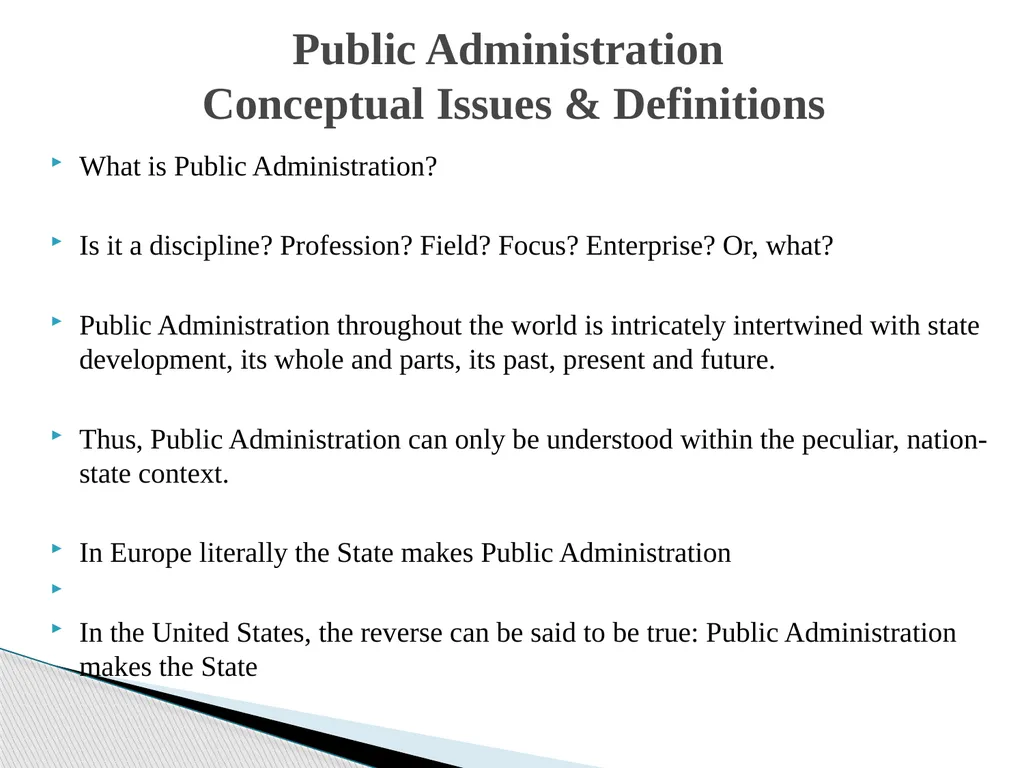
slide2. Public Administration Conceptual Issues & Definitions What is Public Administration?
Is it a discipline? Profession? Field? Focus? Enterprise? Or, what?
Public Administration throughout the world is intricately intertwined with state development, its whole and parts, its past, present and future.
Thus, Public Administration can only be understood within the peculiar, nation-state context.
In Europe literally the State makes Public Administration
In the United States, the reverse can be said to be true: Public Administration makes the State<br>
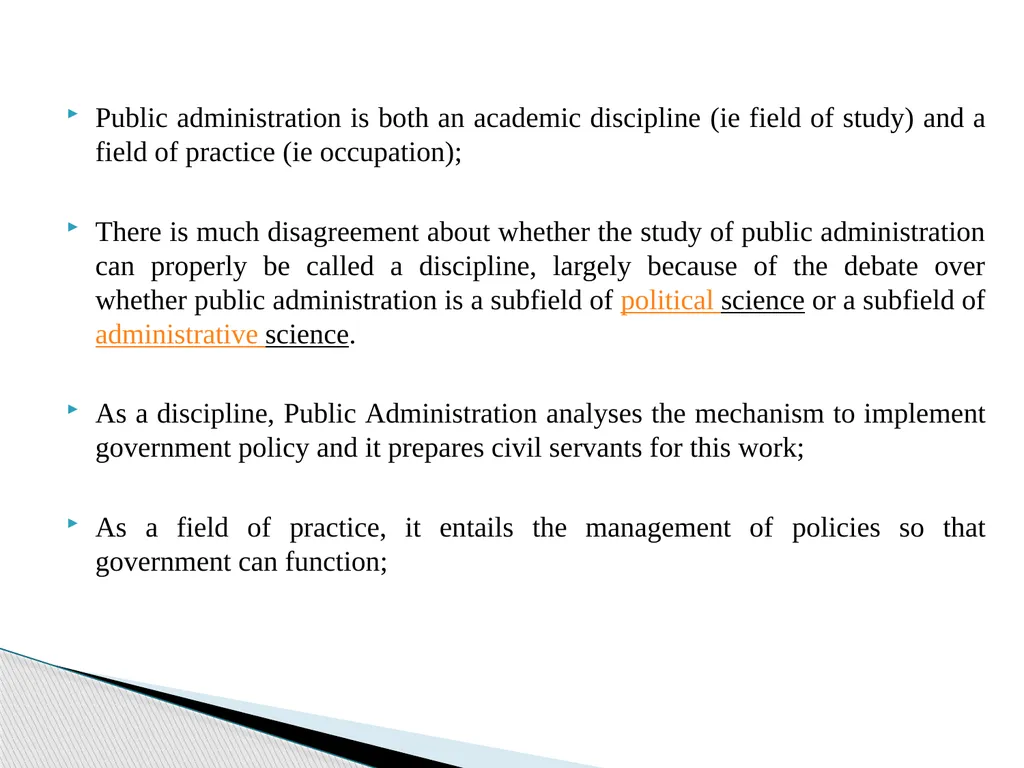
slide3. Public administration is both an academic discipline (ie field of study) and a field of practice (ie occupation);
There is much disagreement about whether the study of public administration can properly be called a discipline, largely because of the debate over whether public administration is a subfield of political science or a subfield of administrative science.
As a discipline, Public Administration analyses the mechanism to implement government policy and it prepares civil servants for this work;
As a field of practice, it entails the management of policies so that government can function;<br>
slide4. Public administration has no generally accepted definition, because the scope of the subject is so extended and so debatable that it is easier to explain than define. Some definitions are:
“The management of public programs"
“The translation of politics into the reality that citizens see every day"
“The study of government decision making, the analysis of the policies themselves, the various inputs that have produced them, and the inputs necessary to produce alternative policies”
According to the North American Industry Classification System, adopted by the USA Government, Public Administration comprises establishments primarily engaged in activities of a governmental nature, that is, the enactment and judicial interpretation of laws and their pursuant regulations, and the administration of programs based on them. This includes legislative activities, taxation, national defence, public order and safety, immigration services, foreign affairs and international assistance, and the administration of government programs, etc. All these are activities purely governmental in nature.<br>
slide5. Until the mid-20th century and the dissemination of the German sociologist Max Weber's theory of bureaucracy there was not much interest in a theory of public administration;
The field is multidisciplinary in character;
Among the various proposals for public administration's sub-fields, six pillars have been identified, including human resources, organizational theory, policy analysis and statistics, budgeting and ethics.
In an more academic approach the study of public administration is defined as a program that prepares individuals to serve as managers in the executive arm of local, state, and federal government and that focuses on the systematic study of executive organization and management.
It includes: instruction in the roles, development and principles of public administration; the management of public policy; executive-legislative relations; public budgetary processes and financial management; administrative law; public personnel management; professional ethics and research methods.<br>
slide6. Current views on Good Public Administration 1. Getting it right
Acting in accordance with the law and with regard for the rights of those concerned.
Acting in accordance with the PA’s policy and guidance (published or internal).
Taking proper account of established good practice.
Providing effective services, using appropriately trained and competent staff.
Taking reasonable decisions, based on all relevant considerations.
2. Being customer focused
Ensuring people can access services easily.
Informing customers what they can expect and what PA expects of them.
Keeping to its commitments, including any published service standards.
Dealing with people helpfully, promptly and sensitively, bearing in mind their individual circumstances.
Responding to customers’ needs flexibly, including, where appropriate, co-ordinating a response with other service providers.<br>
slide7. 3. Being open and accountable
Being open and clear about policies and procedures and ensuring that information, and any advice provided, is clear, accurate and complete.
Stating its criteria for decision making and giving reasons for decisions.
Handling information properly and appropriately.
Keeping proper and appropriate records.
Taking responsibility for its actions.
4. Acting fairly and proportionately
Treating people impartially, with respect and courtesy.
Treating people without unlawful discrimination or prejudice, and ensuring no conflict of interests.
Dealing with people and issues objectively and consistently.
Ensuring that decisions and actions are proportionate, appropriate and fair.<br>
slide8. 5. Putting things right
Acknowledging mistakes and apologising where appropriate.
Putting mistakes right quickly and effectively.
Providing clear and timely information on how and when to appeal or complain.
Operating an effective complaints procedure, which includes offering a fair and appropriate remedy when a complaint is upheld.
6. Seeking continuous improvement
Reviewing policies and procedures regularly to ensure they are effective.
Asking for feedback and using it to improve services and performance.
Ensuring that the public body learns lessons from complaints and uses these to improve services and performance.<br>
slide9. Principles of Public Administration By studying Public Administration, either as an academic or as an practitioner, one may identify a constant evolving process of developing the national, European and international administrative legal orders and administrative practices.
And this evolution is characterised by a significant degree of convergence among these factors.
There are several driving forces for this, such as economic pressures from individuals and firms, regular and continuous contacts between public officials of Member States and, finally and especially, the jurisprudence of the Courts at national, European and international level. Although constitutions and subsequent legislation convey general law principles and define standards for administrative actions, it is the courts that refine those standards, i.e. define levels of acceptability for public administration practices on a case-by-case basis.<br>
slide10. Traditionally, standards of administrative performance have been defined and refined within the national boundaries of sovereign states.
They have been the products of national constitutional arrangements, law-making activity of national parliaments, decisions of national administrative authorities and rulings of national courts.
In the EU context, as well as the international context, these processes are becoming increasingly supranational, thus formulating shared mandatory administrative standards, that should be adhered to.
However, stressing the harmonising potential of public administration standards is not to say that administrative institutions should be homogeneously set up across all states.
The important message is that, independently of institutional arrangements, all forms of public administration must recognise principles and adhere to certain common standards.<br>
slide11. In some countries the administrative law principles, setting standards and inspiring the behaviour of civil servants, usually appear scattered among different pieces of legislation ranking from the constitution to several acts of Parliament, and specific pieces of delegated legislation as well as case law of the courts dealing with litigation concerning public administration.
Other countries have put in force general codification on administrative procedures, which gather and attempt to systematise many of these principles.
These administrative principles are not simply ideas based on goodwill; they are embedded in institutions and administrative procedures at all levels.
Actors in the public sphere are legally obliged to comply with these legal principles, which must be upheld by independent control bodies, systems of justice and judicial enforcement, parliamentary scrutiny, and by ensuring opportunities for hearing and redress to individuals and legal persons.<br>
slide12. Administrative law principles and civil service are at times difficult to define. Frequently they seem to contradict each other in a given situation. (i.e. Efficiency seems to be at odds with due process; professional loyalty to the government seems to oppose professional integrity and political neutrality; discretionary decisions might seem to go against the rule of law, etc)
This elusive nature of administrative law principles is one of the reasons why “blank concepts” are so common in administrative law and civil service regulations. This is also one of the reasons why the courts , at national, European and international level, are so often invoked to solve conflicts and to continually refine these definitions in a doctrinal construction, adapted over time.
Perhaps it is useless, and even counterproductive at times, to aim to clearly define the boundaries of administrative law principles.
In terms of law-making, when such an attempt has been made, usually in the form of very detailed casuistic distinctions, the end result has frequently been more confusion. Confusion in this domain easily generates injustice.<br>
slide13. Exacerbated attempts to ensure detail in regulating such elusive matters tend to result in inconsistency and contradiction. Contradiction and discrepancy also cause difficulties in making these principles actual by adversely affecting law enforcement.
From the perspective of law making it is probably considered wise to resort to “blank concepts” because of their malleability to fit in disparate situations.
From the standpoint of civil servants’ and public authorities’ behaviour, relying on common sense and seeking inspiration from consolidated case law doctrine would be advisable.<br>
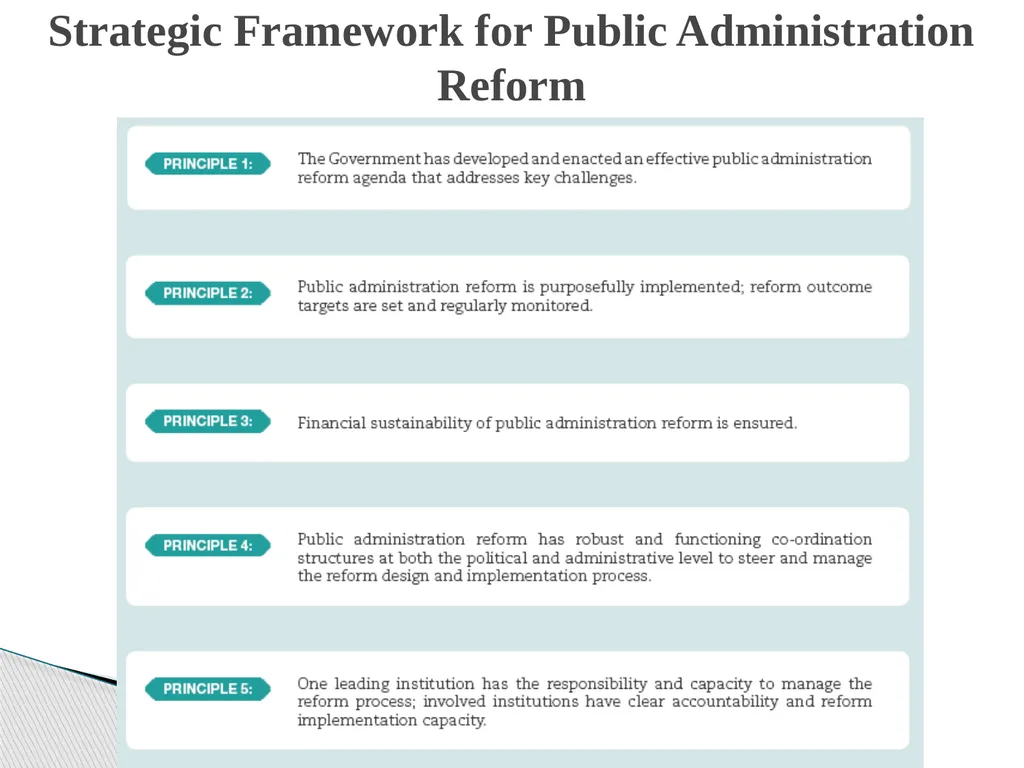
slide14. The Public Administration principles have been divided into six categories (OECD/EU – SIGMA Initiative):
Strategic Framework of Public Administration Reform
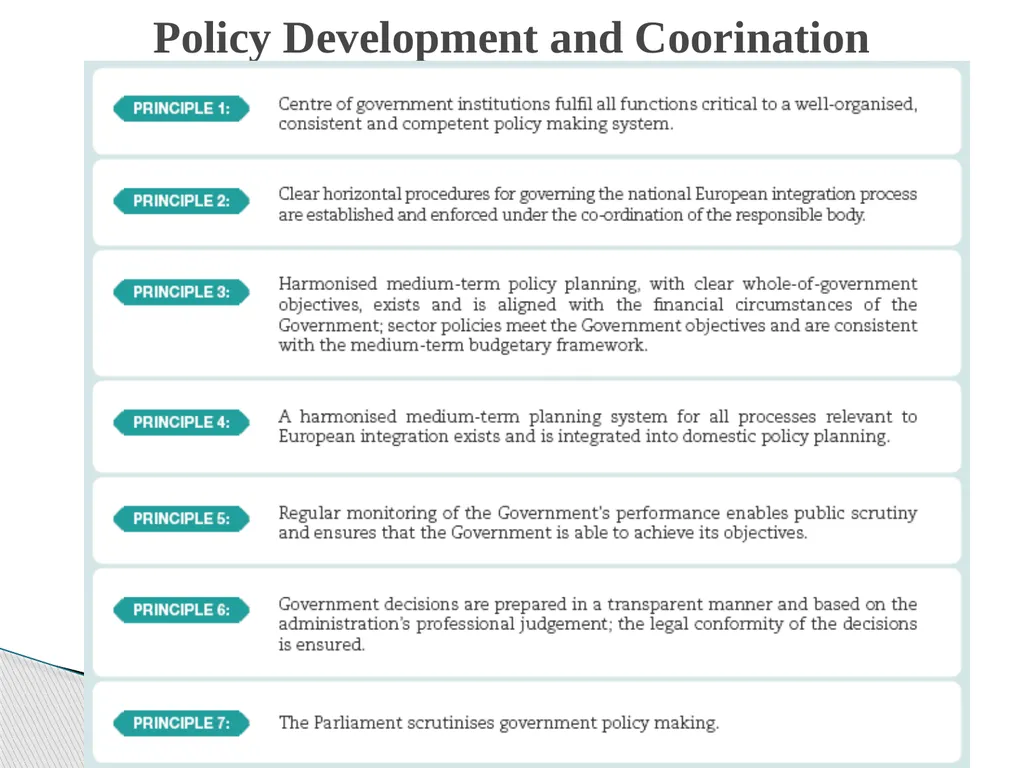
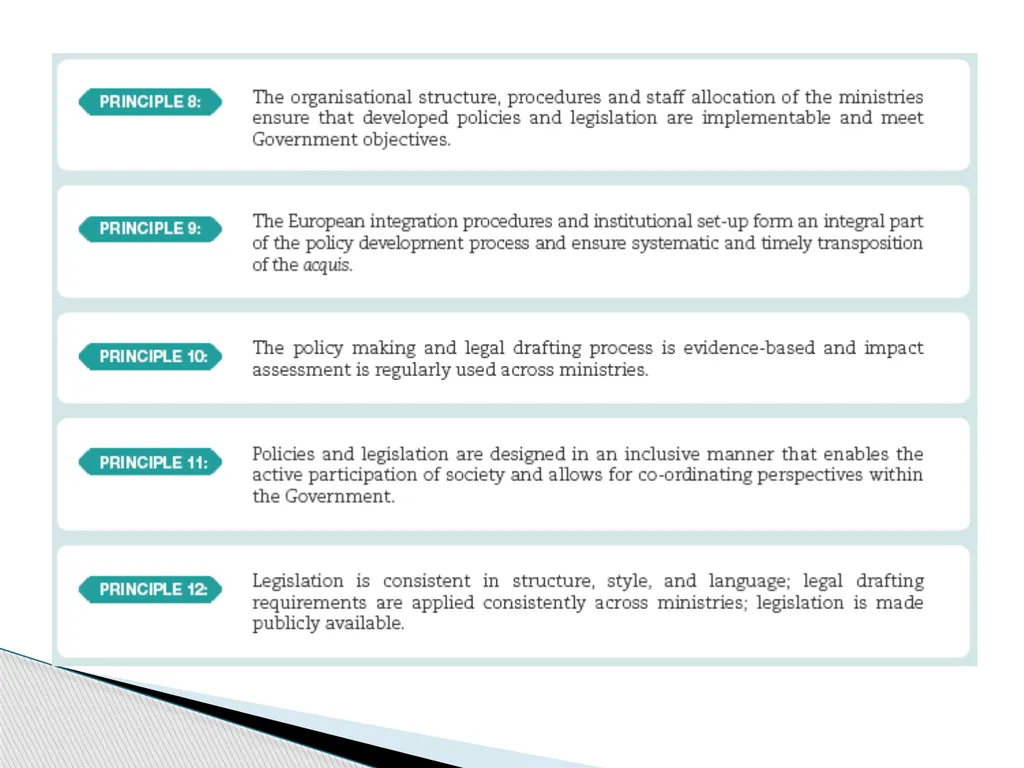
Policy Development and Co-ordination
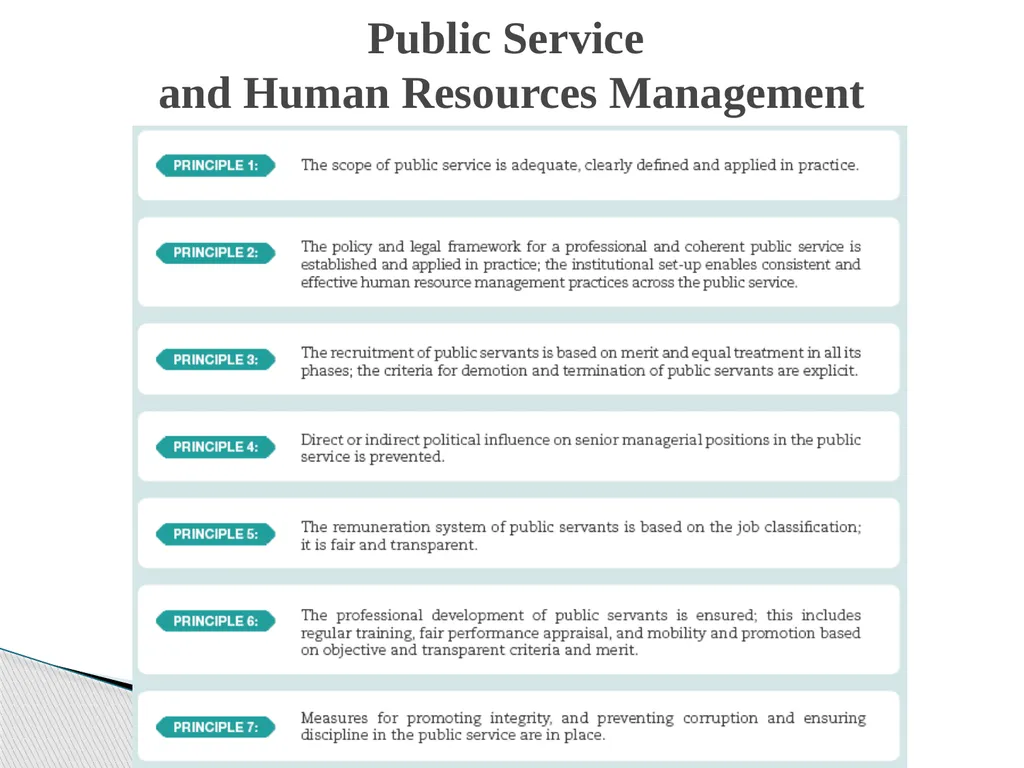
Public Service and Human Resources Management
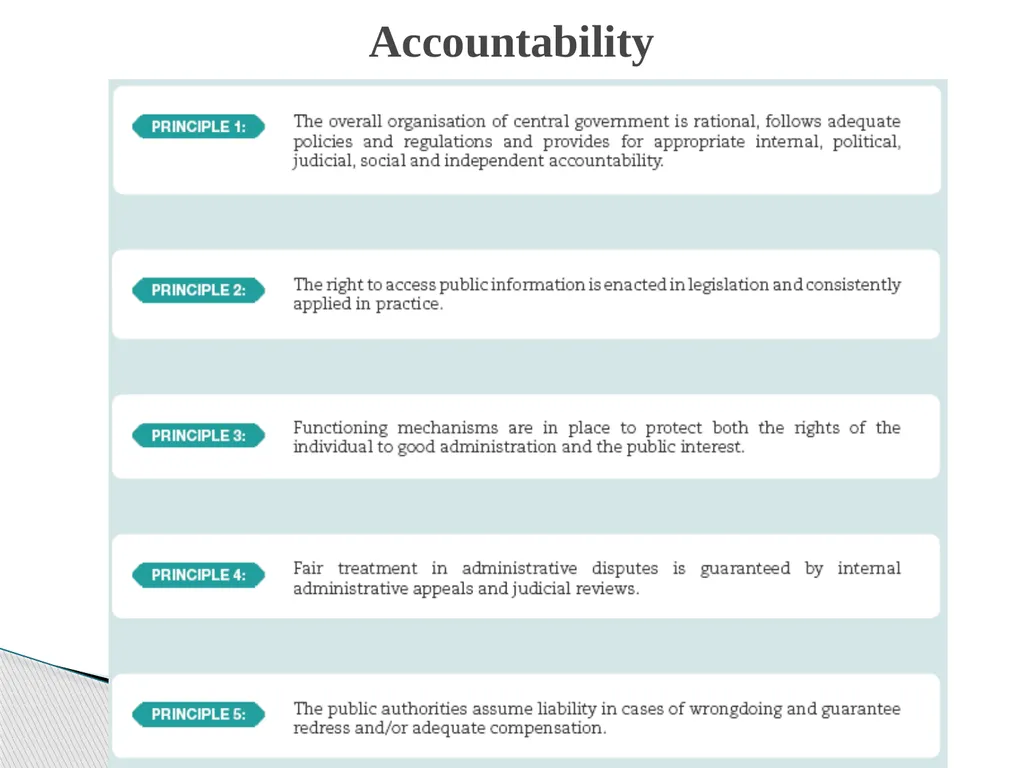
Accountability
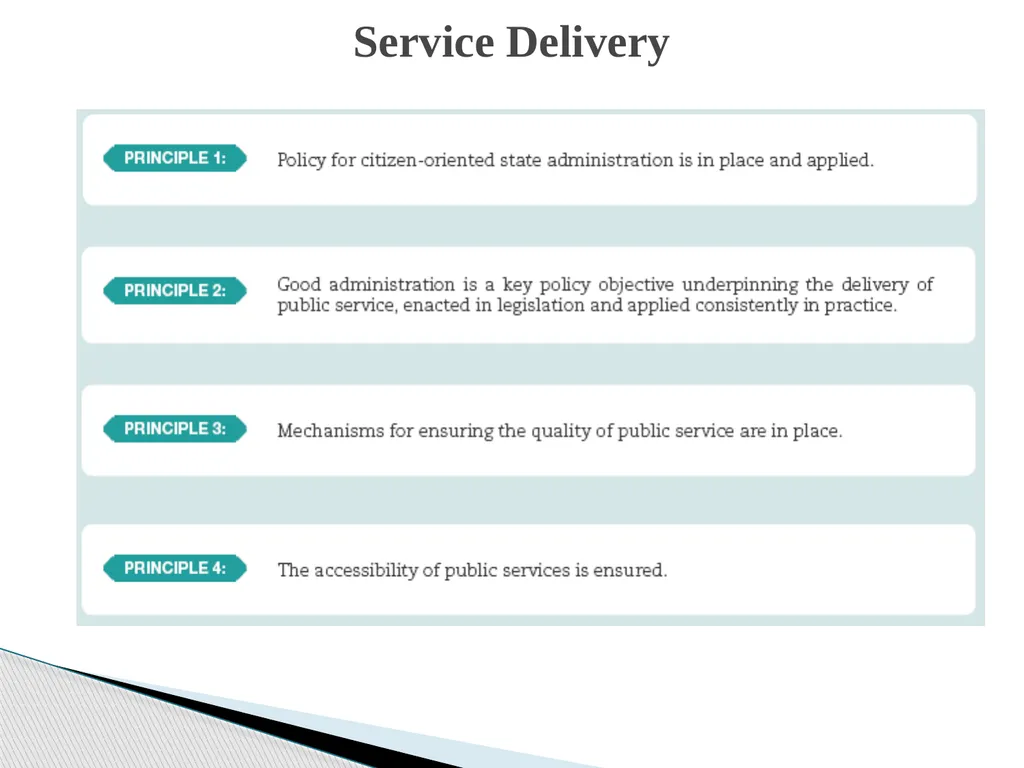
Service Delivery
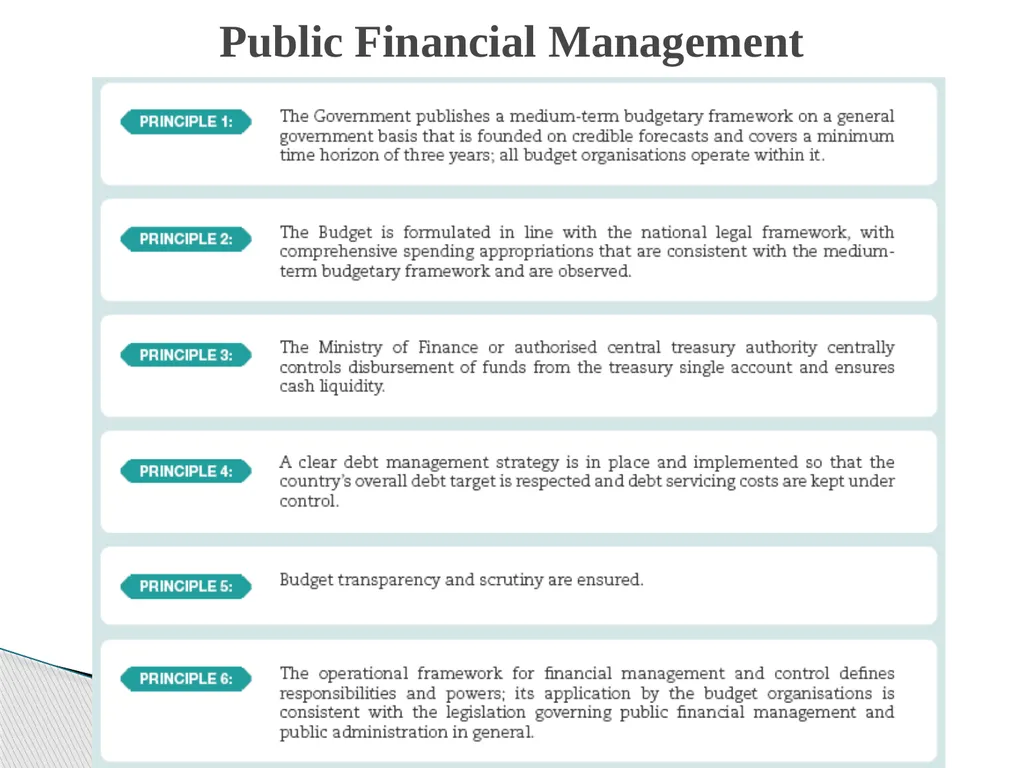
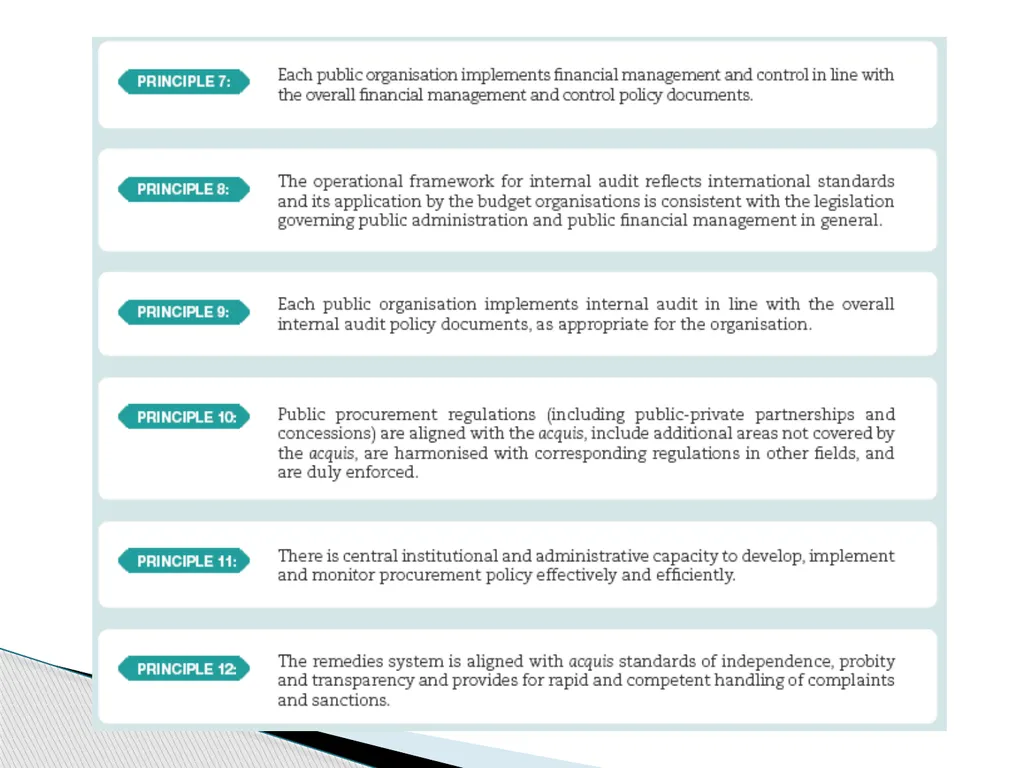
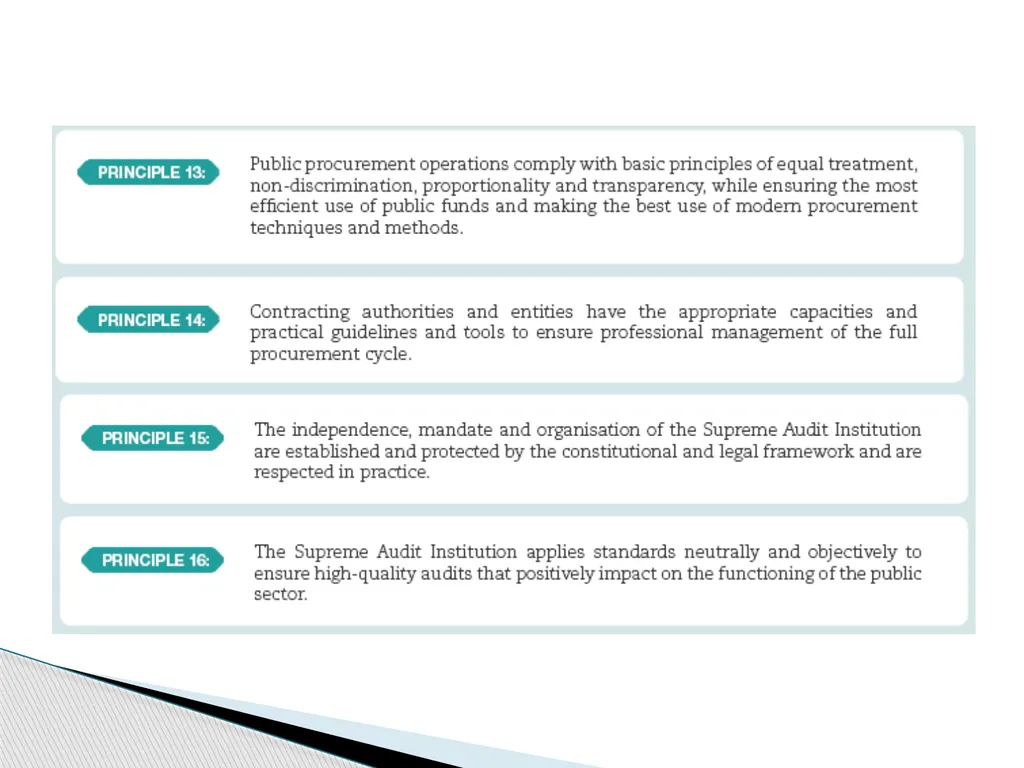
Public Financial Management
These Principles are not a checklist to be applied mechanically. Public bodies should use their judgment in applying the Principles to produce reasonable, fair and proportionate results in the circumstances.<br>
slide15. Strategic Framework for Public Administration Reform<br>
slide16. Policy Development and Coorination<br>
slide18. Public Service and Human Resources Management<br>
slide19. Accountability<br>
slide20. Service Delivery<br>
slide21. Public Financial Management<br>
slide24. The “Administration Through Law” Context This administrative context is made up of several factors, the more important of which are:
• The quality of substantive regulatory law: Regulatory law provides the framework for decision-making within a given policy field (for instance, in urban planning or on environmental issues). In other words, it represents a tool for officials and a source of information and prediction for the public.
• The quality of procedural administrative law: Procedural administrative law provides due procedures for administrative decision-making, for co-ordination and for balancing powers, for officials’ relations and communication with the public, and for enabling any interested party to be heard or to appeal.
• The quality of financial and administrative accountability and control mechanisms: These work for transparency, provide checks for financial and administrative decision-making, and provide means for correction, prosecution and redress.<br>
slide25. At the same time, these three factors provide the legal values and principles which contribute decisively to shaping the attitude and behaviour of public managers and the rest of the civil servants operating within that administrative context.
These legal principles will be essential as guiding principles for decision-making and behaviour; they will reduce the likelihood of arbitrary decisions by allowing discretionary decision-making within the legal administrative framework.
In the end, the principles of administrative law will strongly contribute to laying the foundation of a professional public administration.
The professionalisation of the public administration is, therefore, a much wider task than implementing civil service regulations and introducing personnel management improvements.
If the administrative context within which officials have to work is not also improved, they might still have to make arbitrary decisions, with insufficient communication with the public, and insufficient co-ordination with other institutions, even if they are in a situation where they have been selected on merit and are exposed to systematic training.<br>
slide26. Civil Service and Public Administration Civil Service Values are Legally Binding Principles : The civil service is bound by the principles enshrined in constitutional arrangements and in administrative law. From this viewpoint, it can be said that civil service values are legal values. Legal values are not the same as ethical values, even if they can broadly overlap. Ethical values are guides for action, and their breaching deserves social reproach. Legal values, when breached, have legal consequences through the civil service law’s disciplinary provisions. Civil servants are bound by the administrative principles established in legislation.
Civil Servants are not Mere Employees of the State: Civil servants are subject to legal principles and compulsory rules that derive from their specific location within the hierarchical structure of the state. This location shapes a profession, which deals with fundamental rights of their fellow citizens. Civil service regulations do not simply regulate the working relationships between an employer and its employees, as labour law does. Civil service regulations intend, a) to protect civil servants in performing their very special social role in democratic societies and, b) to tighten professional standards by virtue of the delicate issues which civil servants have to deal with. Civil servants are actors within the public sphere of society, the sphere which falls within the domain of public law.<br>
slide27. Administrative Law Principles Create Civil Service Behavioural Patterns: Nevertheless, a civil service system regulated by a civil service act is not sufficient to make a public administration professional, efficient, effective, impartial, abiding by the rule of law, and well-performing. It is also necessary to have substantive and procedural administrative legislation of sufficient quality. This legislation will not only provide civil servants with an important tool for performing their duties and for realising the public law principles described above, but also with clear procedures to guide their work and to render their actions and decisions predictable.
Additional procedural and substantive legislation is also needed to ensure sufficient internal and external control of public administration and the civil service, particularly in terms of public finance, quality control, procedural supervision, and above all, to ensure an independent, well-functioning judicial system able to effectively redress administrative actions and decisions by means of appeal. This requirement is not only for the sake of the legal certainty and reliability of public administration, but also to ensure the appropriate legal protection of individual rights and legitimate expectations.<br>
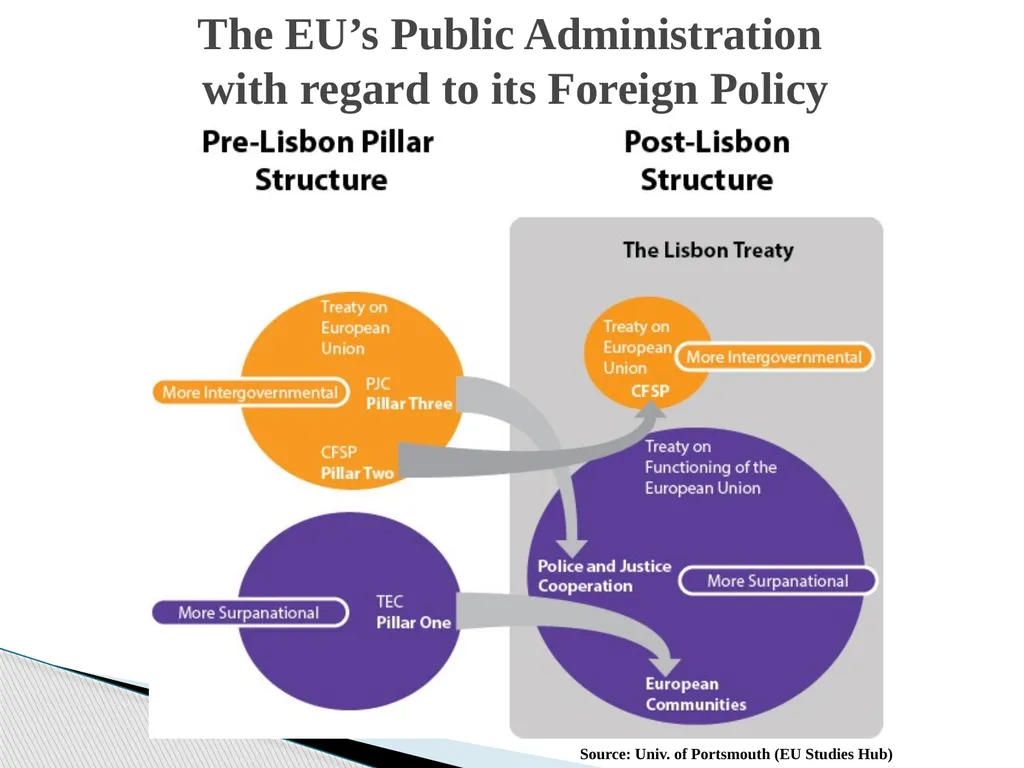
slide28. The EU’s Public Administration with regard to its Foreign Policy Source: Univ. of Portsmouth (EU Studies Hub)<br>
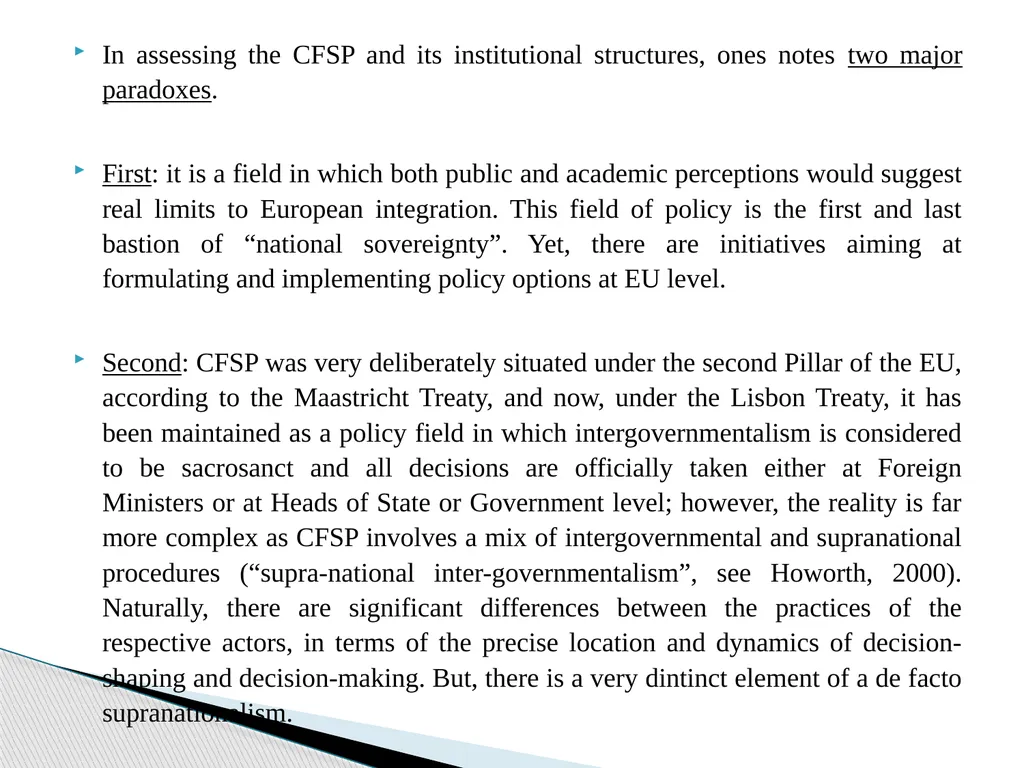
slide29. In assessing the CFSP and its institutional structures, ones notes two major paradoxes.
First: it is a field in which both public and academic perceptions would suggest real limits to European integration. This field of policy is the first and last bastion of “national sovereignty”. Yet, there are initiatives aiming at formulating and implementing policy options at EU level.
Second: CFSP was very deliberately situated under the second Pillar of the EU, according to the Maastricht Treaty, and now, under the Lisbon Treaty, it has been maintained as a policy field in which intergovernmentalism is considered to be sacrosanct and all decisions are officially taken either at Foreign Ministers or at Heads of State or Government level; however, the reality is far more complex as CFSP involves a mix of intergovernmental and supranational procedures (“supra-national inter-governmentalism”, see Howorth, 2000). Naturally, there are significant differences between the practices of the respective actors, in terms of the precise location and dynamics of decision-shaping and decision-making. But, there is a very dintinct element of a de facto supranationalism.<br>
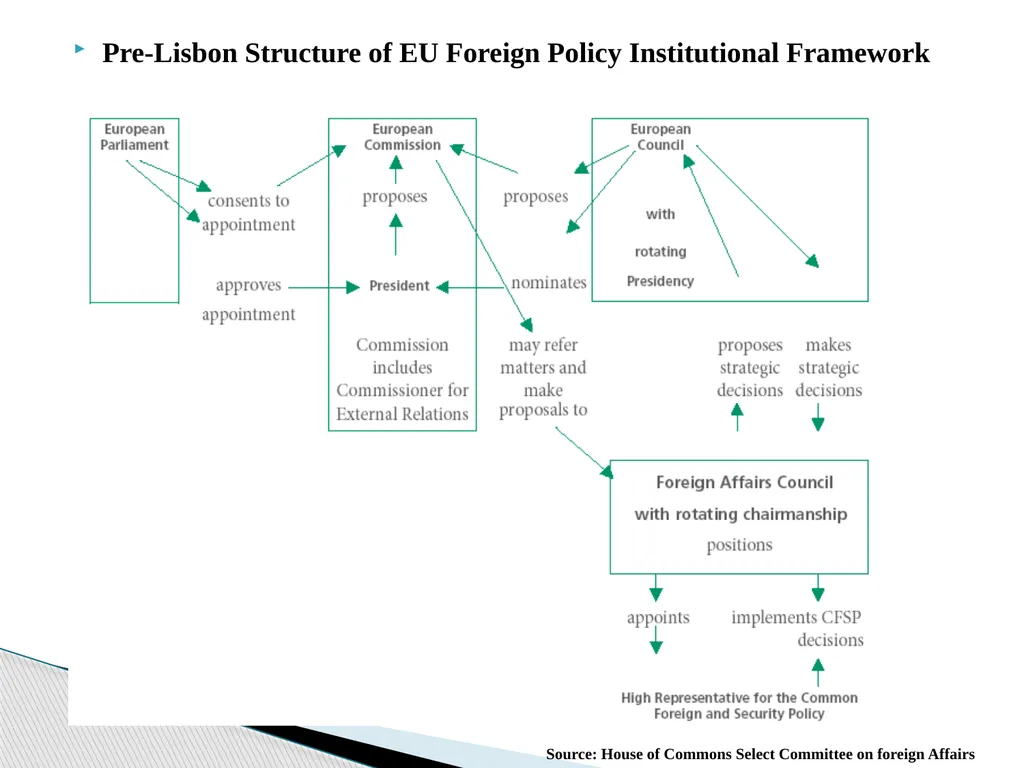
slide30. Pre-Lisbon Structure of EU Foreign Policy Institutional Framework Source: House of Commons Select Committee on foreign Affairs<br>
slide31. Seeing this framework of foreign policy formulation and implementation, three original “institutional sins” have been identified in the relevant system of governance (Vai, 2016):
1) an artificial separation within the architecture of the CFSP;
2) a lack of EU capabilities;
3) a democratic deficit in the CFSP policy cycles.<br>
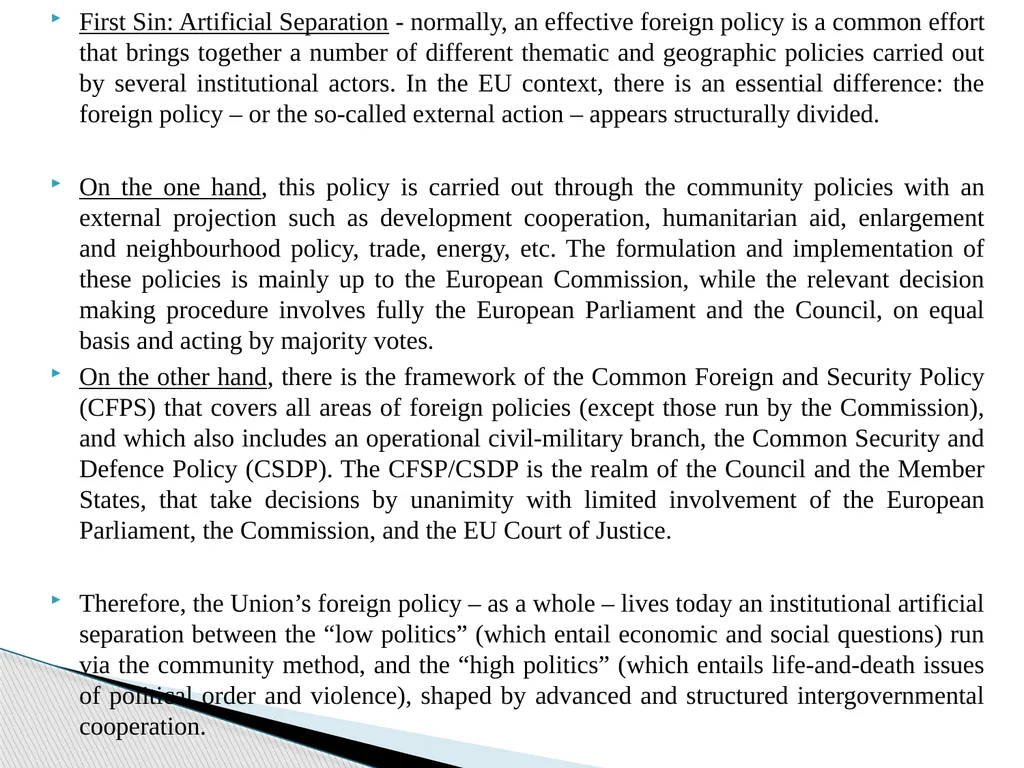
slide32. First Sin: Artificial Separation - normally, an effective foreign policy is a common effort that brings together a number of different thematic and geographic policies carried out by several institutional actors. In the EU context, there is an essential difference: the foreign policy – or the so-called external action – appears structurally divided.
On the one hand, this policy is carried out through the community policies with an external projection such as development cooperation, humanitarian aid, enlargement and neighbourhood policy, trade, energy, etc. The formulation and implementation of these policies is mainly up to the European Commission, while the relevant decision making procedure involves fully the European Parliament and the Council, on equal basis and acting by majority votes.
On the other hand, there is the framework of the Common Foreign and Security Policy (CFPS) that covers all areas of foreign policies (except those run by the Commission), and which also includes an operational civil-military branch, the Common Security and Defence Policy (CSDP). The CFSP/CSDP is the realm of the Council and the Member States, that take decisions by unanimity with limited involvement of the European Parliament, the Commission, and the EU Court of Justice.
Therefore, the Union’s foreign policy – as a whole – lives today an institutional artificial separation between the “low politics” (which entail economic and social questions) run via the community method, and the “high politics” (which entails life-and-death issues of political order and violence), shaped by advanced and structured intergovernmental cooperation.<br>
slide33. Second sin: Lack of capabilities - the resources and the instruments at the disposal of the EU are still not sufficient to reach its goals in the field of foreign policy, despite an improvement of the situation since the middle of the 1990s.
Due to the current tightness of the EU budget and the inexistence of a real system of generating its own resources, the financing of the community policies and of the CFSP has not always proved to be adequate. Concerning the instruments, the external action of the Union still largely relies on the Member States’ capabilities. This is especially true considering the EU ambitions to become a global security provider and looking to what the CSDP is able to offer today: the EU does not have its own intelligence agency, nor a permanent common European military force, while the European costal guard is still in its infancy, trying to sort out problems inherited from its predecessor, FRONTEX.
Deficiencies like these represent a clear limit for the implementation of the Union’s foreign policy and also cause difficulties to the decision making process. As an example, the CSDP military operations are mainly nationally-funded with direct involvement of national military and civilian personnel. This state of affairs can hardly incentivise the Member States to undertake such initiatives, or alternatively leads them to launch missions inadequate to the given targets.<br>
slide34. Third Sin: Democratic deficit in CFSP
The low level of democratic participation that still characterises European decision making in a large number of policy areas – that certainly includes the the CFSP/CSDP – can be considered a direct matter of concern for the expected results of EU external action. Abandoning for a moment the ethical justifications in favour of democracy, from a theoretical point of view the policy effectiveness could also be maximized by an autocratic regime.
Nevertheless, in the Union’s foreign policy institutional machinery the lack of democracy raises two core issues.
Firstly, the limited powers of the European Parliament in the field of foreign policy, and the exclusion of the Commission from the CSFP/CSDP policy cycle have generated a number of negative consequences (ie isolation).
Secondly, the question of legitimacy and respect within the EU of the same democratic values and procedures that the Union itself supports and tries to spread outside its borders must be taken into account. A discrepancy between what the EU says outside and what it does inside can became a potential stain on the EU’s international and domestic image.<br>
slide35. The amendments of the Lisbon Treaty introduced major innovations in the Union’s foreign policy governance. They attempted to mitigate the first sin, without however incorporating the CFSP in the supranationalist scheme of the Union (as such an endeavour would have required an answer to the EU’s teleological dilemma), offered some solutions for the second one, and made minor adjustments that have not dissipated the democratic deficit in the EFP. All in all, however, the post-Lisbon institutional architecture has not manage to fully overcome the three original sins and they still affect negatively the qualities that the EU should have in order to be effective.
In institutional terms, two significant changes were made:
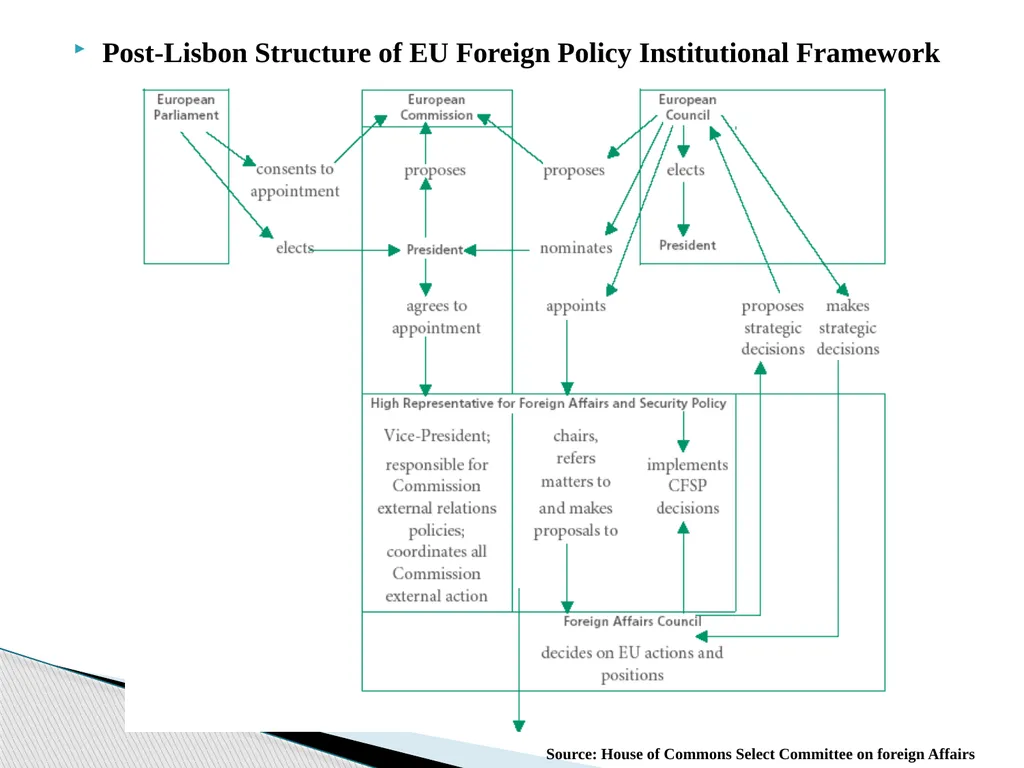
1) the post of the High Representative of the Union for Foreign Affairs and Security Policy (HR), who chairs the Foreign Affairs Council (FAC) and is also vice-president of the Commission (VP);
2) the European External Action Service (EEAS), a diplomatic service composed of European civil servants and national diplomats with a headquarters in Brussels and a network of delegations in third countries and international organisations.
Thus, the Lisbon Treaty, by solidifying formal intergovernmentalism in the decision-making process while including supranational dimensions into the CFSP/CSDP, contributed to the complex scheme that was indentified above between the intergovernmentalist and the supranationalist element of the Union. The Lisbon Treaty effects<br>
slide36. Post-Lisbon Structure of EU Foreign Policy Institutional Framework Source: House of Commons Select Committee on foreign Affairs<br>
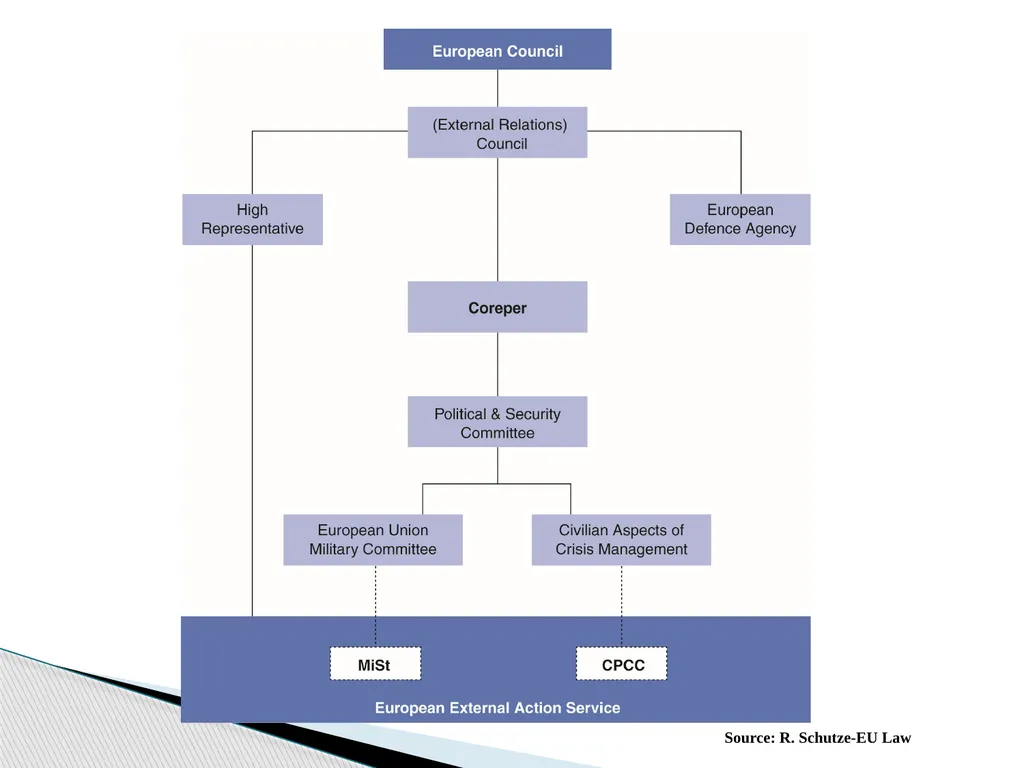
slide37. Source: R. Schutze-EU Law<br>
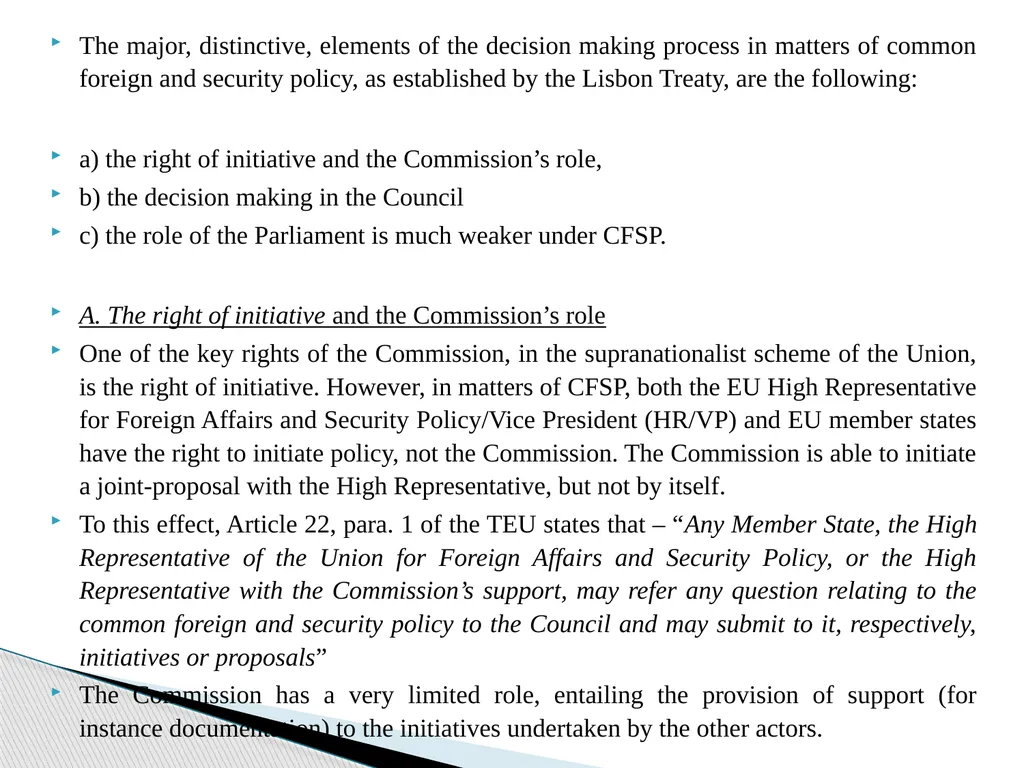
slide38. The major, distinctive, elements of the decision making process in matters of common foreign and security policy, as established by the Lisbon Treaty, are the following:
a) the right of initiative and the Commission’s role,
b) the decision making in the Council
c) the role of the Parliament is much weaker under CFSP.
A. The right of initiative and the Commission’s role
One of the key rights of the Commission, in the supranationalist scheme of the Union, is the right of initiative. However, in matters of CFSP, both the EU High Representative for Foreign Affairs and Security Policy/Vice President (HR/VP) and EU member states have the right to initiate policy, not the Commission. The Commission is able to initiate a joint-proposal with the High Representative, but not by itself.
To this effect, Article 22, para. 1 of the TEU states that – “Any Member State, the High Representative of the Union for Foreign Affairs and Security Policy, or the High Representative with the Commission’s support, may refer any question relating to the common foreign and security policy to the Council and may submit to it, respectively, initiatives or proposals”
The Commission has a very limited role, entailing the provision of support (for instance documentation) to the initiatives undertaken by the other actors.<br>
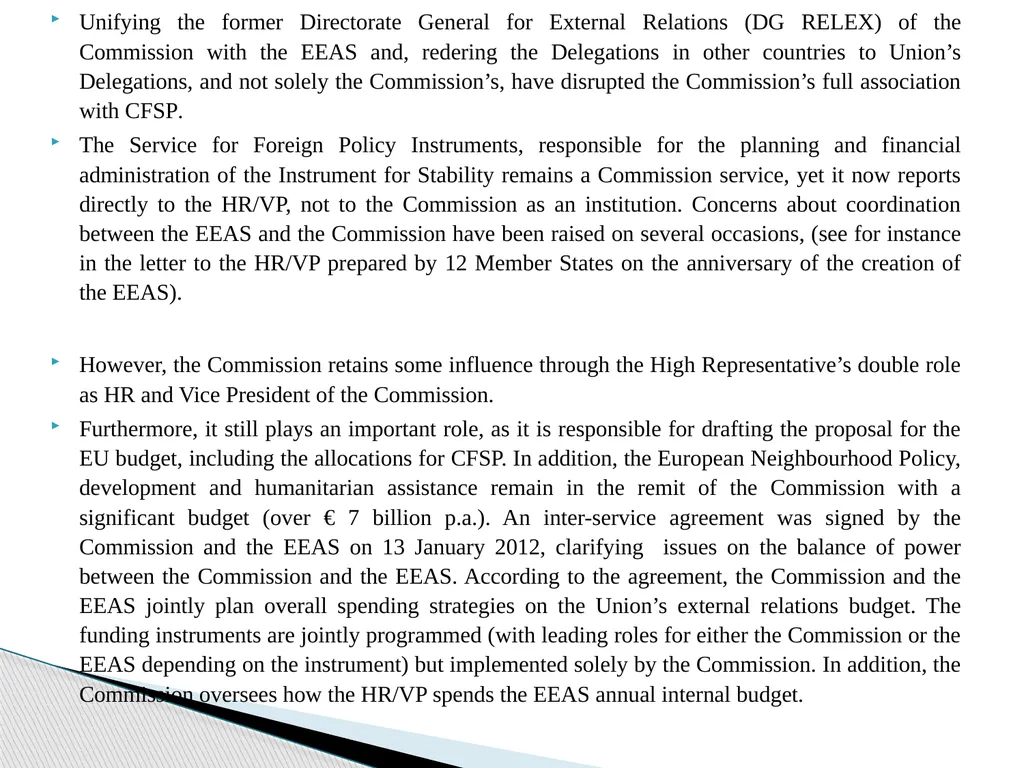
slide39. Unifying the former Directorate General for External Relations (DG RELEX) of the Commission with the EEAS and, redering the Delegations in other countries to Union’s Delegations, and not solely the Commission’s, have disrupted the Commission’s full association with CFSP.
The Service for Foreign Policy Instruments, responsible for the planning and financial administration of the Instrument for Stability remains a Commission service, yet it now reports directly to the HR/VP, not to the Commission as an institution. Concerns about coordination between the EEAS and the Commission have been raised on several occasions, (see for instance in the letter to the HR/VP prepared by 12 Member States on the anniversary of the creation of the EEAS).
However, the Commission retains some influence through the High Representative’s double role as HR and Vice President of the Commission.
Furthermore, it still plays an important role, as it is responsible for drafting the proposal for the EU budget, including the allocations for CFSP. In addition, the European Neighbourhood Policy, development and humanitarian assistance remain in the remit of the Commission with a significant budget (over € 7 billion p.a.). An inter-service agreement was signed by the Commission and the EEAS on 13 January 2012, clarifying issues on the balance of power between the Commission and the EEAS. According to the agreement, the Commission and the EEAS jointly plan overall spending strategies on the Union’s external relations budget. The funding instruments are jointly programmed (with leading roles for either the Commission or the EEAS depending on the instrument) but implemented solely by the Commission. In addition, the Commission oversees how the HR/VP spends the EEAS annual internal budget.<br>
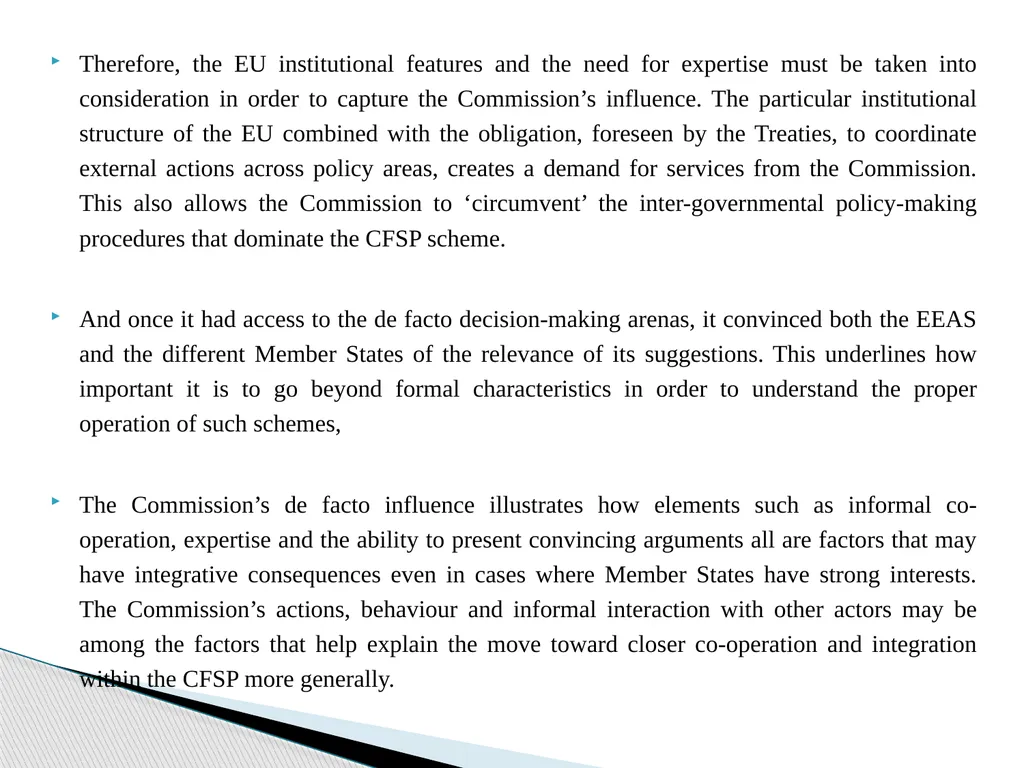
slide40. Therefore, the EU institutional features and the need for expertise must be taken into consideration in order to capture the Commission’s influence. The particular institutional structure of the EU combined with the obligation, foreseen by the Treaties, to coordinate external actions across policy areas, creates a demand for services from the Commission. This also allows the Commission to ‘circumvent’ the inter-governmental policy-making procedures that dominate the CFSP scheme.
And once it had access to the de facto decision-making arenas, it convinced both the EEAS and the different Member States of the relevance of its suggestions. This underlines how important it is to go beyond formal characteristics in order to understand the proper operation of such schemes,
The Commission’s de facto influence illustrates how elements such as informal co-operation, expertise and the ability to present convincing arguments all are factors that may have integrative consequences even in cases where Member States have strong interests. The Commission’s actions, behaviour and informal interaction with other actors may be among the factors that help explain the move toward closer co-operation and integration within the CFSP more generally.<br>
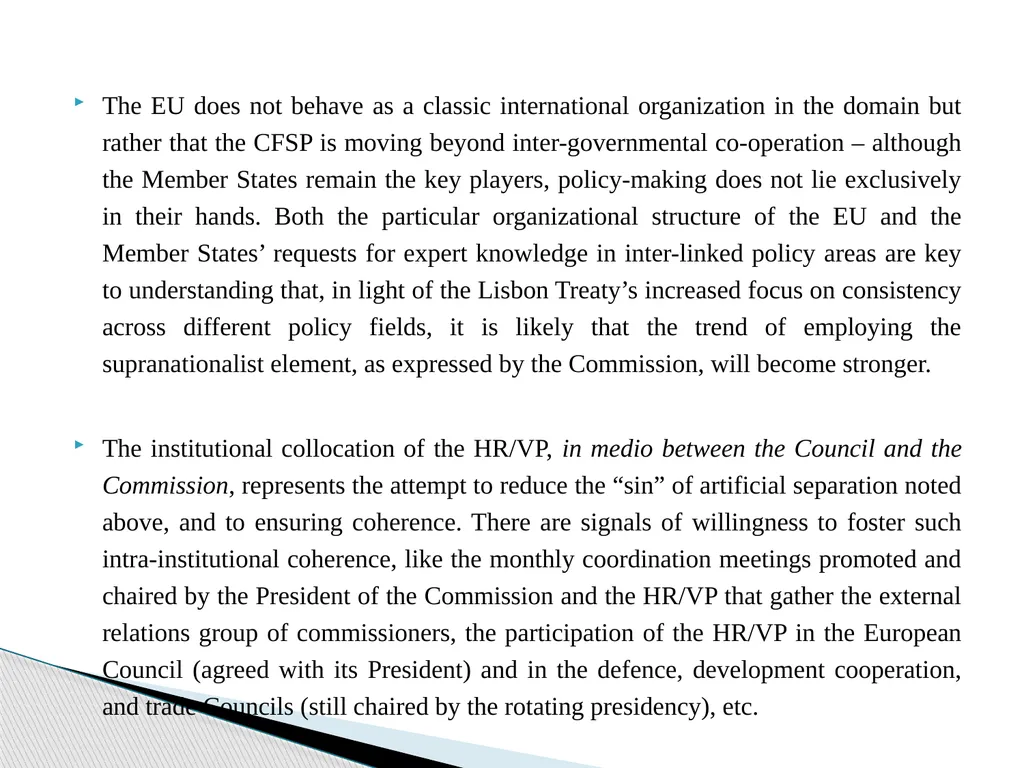
slide41. The EU does not behave as a classic international organization in the domain but rather that the CFSP is moving beyond inter-governmental co-operation – although the Member States remain the key players, policy-making does not lie exclusively in their hands. Both the particular organizational structure of the EU and the Member States’ requests for expert knowledge in inter-linked policy areas are key to understanding that, in light of the Lisbon Treaty’s increased focus on consistency across different policy fields, it is likely that the trend of employing the supranationalist element, as expressed by the Commission, will become stronger.
The institutional collocation of the HR/VP, in medio between the Council and the Commission, represents the attempt to reduce the “sin” of artificial separation noted above, and to ensuring coherence. There are signals of willingness to foster such intra-institutional coherence, like the monthly coordination meetings promoted and chaired by the President of the Commission and the HR/VP that gather the external relations group of commissioners, the participation of the HR/VP in the European Council (agreed with its President) and in the defence, development cooperation, and trade Councils (still chaired by the rotating presidency), etc.<br>
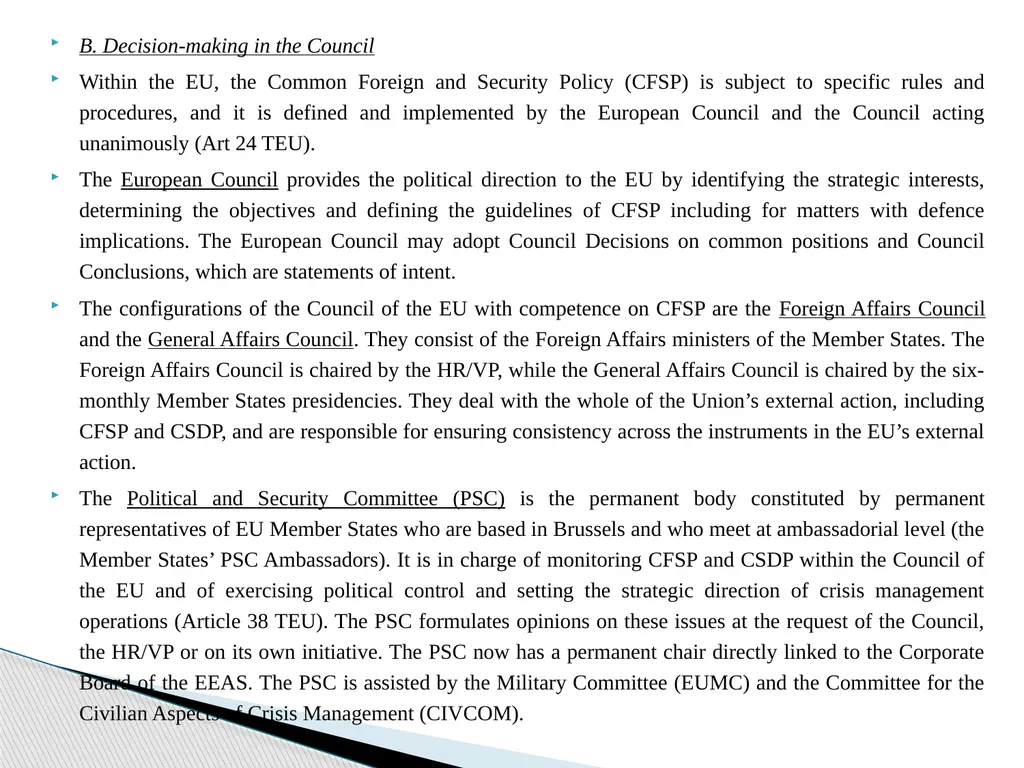
slide42. B. Decision-making in the Council
Within the EU, the Common Foreign and Security Policy (CFSP) is subject to specific rules and procedures, and it is defined and implemented by the European Council and the Council acting unanimously (Art 24 TEU).
The European Council provides the political direction to the EU by identifying the strategic interests, determining the objectives and defining the guidelines of CFSP including for matters with defence implications. The European Council may adopt Council Decisions on common positions and Council Conclusions, which are statements of intent.
The configurations of the Council of the EU with competence on CFSP are the Foreign Affairs Council and the General Affairs Council. They consist of the Foreign Affairs ministers of the Member States. The Foreign Affairs Council is chaired by the HR/VP, while the General Affairs Council is chaired by the six-monthly Member States presidencies. They deal with the whole of the Union’s external action, including CFSP and CSDP, and are responsible for ensuring consistency across the instruments in the EU’s external action.
The Political and Security Committee (PSC) is the permanent body constituted by permanent representatives of EU Member States who are based in Brussels and who meet at ambassadorial level (the Member States’ PSC Ambassadors). It is in charge of monitoring CFSP and CSDP within the Council of the EU and of exercising political control and setting the strategic direction of crisis management operations (Article 38 TEU). The PSC formulates opinions on these issues at the request of the Council, the HR/VP or on its own initiative. The PSC now has a permanent chair directly linked to the Corporate Board of the EEAS. The PSC is assisted by the Military Committee (EUMC) and the Committee for the Civilian Aspects of Crisis Management (CIVCOM).<br>
slide43. As for the legal instruments, under the pre-Lisbon regime, CFSP legal instruments could take five forms: a) principles and general guidelines, b) common strategies, c) joint actions, d) common positions or e) decisions.
These were (since Lisbon) replaced with one instrument, decisions, that incorporates all of the above and outlines the actions that states are supposed to take. The change in the wording did not cause any change in substance. Decisions on actions are usually the basis of CSDP missions and operations. Decisions on positions may refer to a particular matter of geographic or thematic nature.
As before Lisbon, there is no mechanism for the Commission to monitor the implementation of CFSP decisions and the ECJ has no jurisdiction to condemn or imposes any penalties on member states for non-implementation.<br>
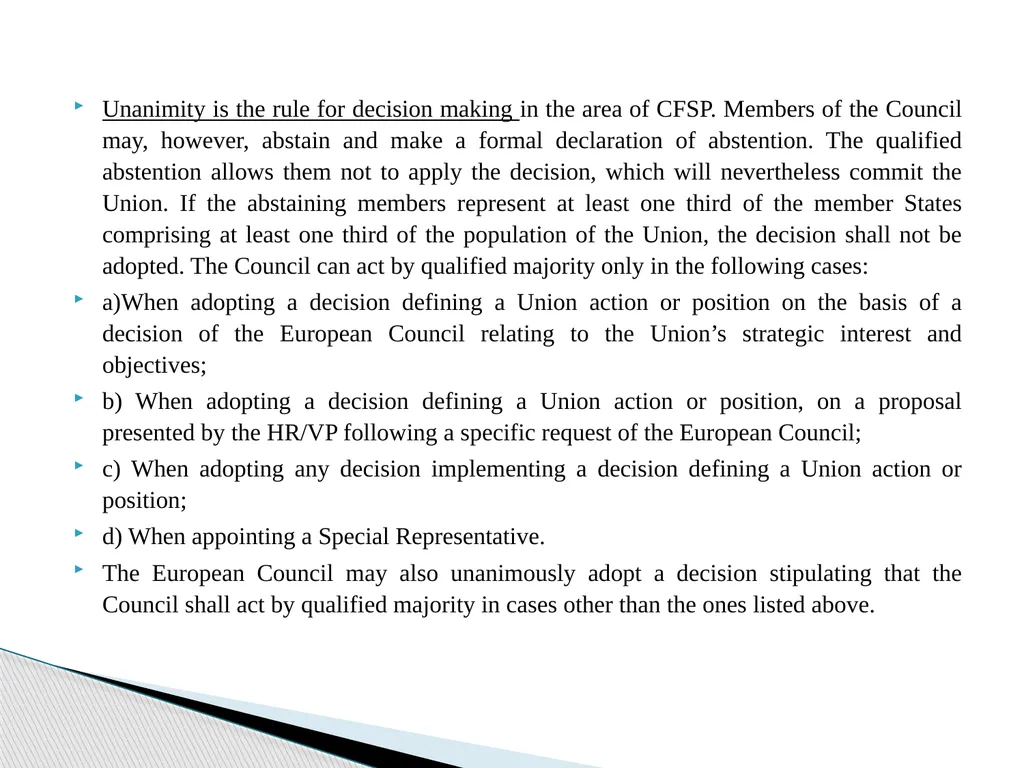
slide44. Unanimity is the rule for decision making in the area of CFSP. Members of the Council may, however, abstain and make a formal declaration of abstention. The qualified abstention allows them not to apply the decision, which will nevertheless commit the Union. If the abstaining members represent at least one third of the member States comprising at least one third of the population of the Union, the decision shall not be adopted. The Council can act by qualified majority only in the following cases:
a)When adopting a decision defining a Union action or position on the basis of a decision of the European Council relating to the Union’s strategic interest and objectives;
b) When adopting a decision defining a Union action or position, on a proposal presented by the HR/VP following a specific request of the European Council;
c) When adopting any decision implementing a decision defining a Union action or position;
d) When appointing a Special Representative.
The European Council may also unanimously adopt a decision stipulating that the Council shall act by qualified majority in cases other than the ones listed above.<br>
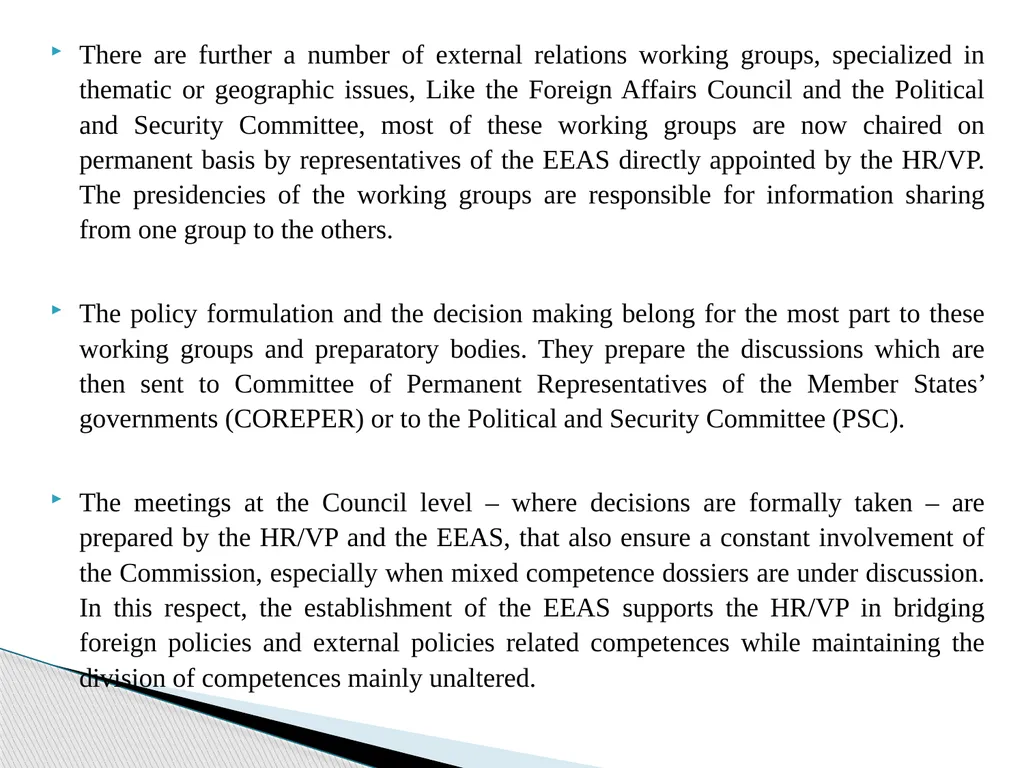
slide45. There are further a number of external relations working groups, specialized in thematic or geographic issues, Like the Foreign Affairs Council and the Political and Security Committee, most of these working groups are now chaired on permanent basis by representatives of the EEAS directly appointed by the HR/VP. The presidencies of the working groups are responsible for information sharing from one group to the others.
The policy formulation and the decision making belong for the most part to these working groups and preparatory bodies. They prepare the discussions which are then sent to Committee of Permanent Representatives of the Member States’ governments (COREPER) or to the Political and Security Committee (PSC).
The meetings at the Council level – where decisions are formally taken – are prepared by the HR/VP and the EEAS, that also ensure a constant involvement of the Commission, especially when mixed competence dossiers are under discussion. In this respect, the establishment of the EEAS supports the HR/VP in bridging foreign policies and external policies related competences while maintaining the division of competences mainly unaltered.<br>
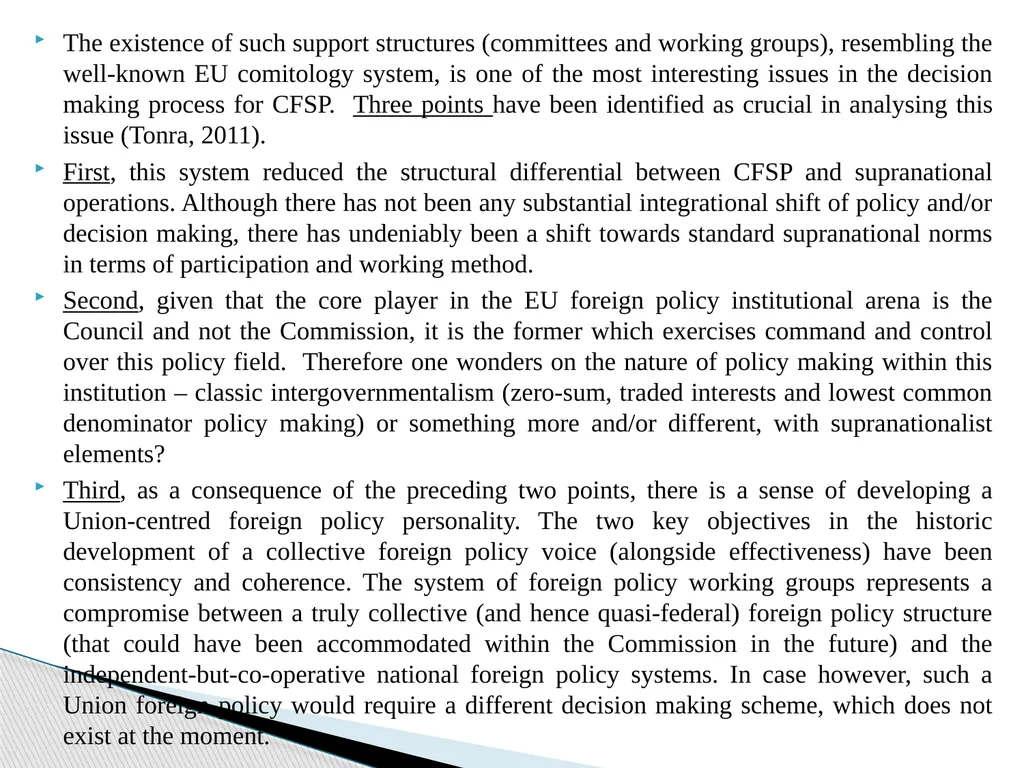
slide46. The existence of such support structures (committees and working groups), resembling the well-known EU comitology system, is one of the most interesting issues in the decision making process for CFSP. Three points have been identified as crucial in analysing this issue (Tonra, 2011).
First, this system reduced the structural differential between CFSP and supranational operations. Although there has not been any substantial integrational shift of policy and/or decision making, there has undeniably been a shift towards standard supranational norms in terms of participation and working method.
Second, given that the core player in the EU foreign policy institutional arena is the Council and not the Commission, it is the former which exercises command and control over this policy field. Therefore one wonders on the nature of policy making within this institution – classic intergovernmentalism (zero-sum, traded interests and lowest common denominator policy making) or something more and/or different, with supranationalist elements?
Third, as a consequence of the preceding two points, there is a sense of developing a Union-centred foreign policy personality. The two key objectives in the historic development of a collective foreign policy voice (alongside effectiveness) have been consistency and coherence. The system of foreign policy working groups represents a compromise between a truly collective (and hence quasi-federal) foreign policy structure (that could have been accommodated within the Commission in the future) and the independent-but-co-operative national foreign policy systems. In case however, such a Union foreign policy would require a different decision making scheme, which does not exist at the moment.<br>
slide47. The structure, itself, of the CFSP committees reflect the move from a strict intergovernmentalism towards a Brussels-based working method. The member states remain at the heart of the system, as member state diplomats comprise the core of the policy process. However, in the search for added value (and so as to overcome the intergovernmental dynamic of lowest-common-denominator politics) the member states have sought to develop a new institutional logic for CFSP.
The Commission sought to lead the CFSP scheme based on the argument that consistency and coherence in foreign policy cannot be achieved in a bicephalus institutional structure. It has gained only a seat as non-voting member in CFSP configurations, ableit with acknowledged special competences and a unique ability to present an integrated policy perspective to the member states.
The Council, through its Secretariat, was the main bureaucratic actor in CFSP, till Lisbon. Its structures allowed, for instance, smaller member states, during their presidencies, to rely upon it for administrative support and the skillful behind-the-scenes negotiations - even in charged atmospheres of crucial debates.
However, because the member states are uncomfortable in seeing such a sensitive area as foreign and security policy drawn within the “supranationalist” scheme of the Union, they have chosen to follow a bureaucratic logic which resembles an adapted intergovernmentalism.<br>
slide48. The CFSP working groups reflect this option, as they aim at the formulation of an effective, coherent and consistent European foreign policy. Such an achievement is difficult, using a strict intergovernmentalist approach. Thus, it has been decided to establish intergovernmental structures, assimilating a model of collective policy making that is premised upon intense, highly structured, regular, permanent and ever closer policy consultations. Crucially – and distinguishing this level of policy consultation from any other form of diplomatic activity – this framework is situated within the institutional structures of an integrative political project. This particular detail makes the entire scheme something other than an intergovernmental bureaucratisation of foreign policy and something more than a “Brusselsisation” of national foreign policy systems.
The workings of such groups have always been, albeit with varying intensity throughout the years, characterised by an informal sense of shared community and fellow-feeling. There is a constant development of a sense of common identity and sense of collective purpose. The informal “consultation reflex” in which Political Directors sought to accommodate the views of their fellows in almost a personalistic fashion has given way to what might be described as a formal internalisation of shared norms and precedents. This internalisation is in turn being strengthened and developed through its institutionalisation in the working groups structures.<br>
slide49. It must be noted that the participants in this process of internalisation are not national civil servants but national diplomats. As a result, the culture of national diplomatic corps may be significant. In all member states, recruitment to the diplomatic corps is distinct from that to the general civil service. While the openness of the diplomatic corps varies from state to state, it is nonetheless an institution of some distinction and set apart from the national civil service. In order to be effective diplomats must also have the capacity to understand and thus to empathise (at least to some degree) with their host government or diplomatic colleagues. It is for this reason that most national diplomatic corps insist that their officials rotate between national and overseas postings. Moreover, in some member states the model diplomats specialised on specific areas or subjects is being rejected in favour of a culture of “generalists” (diplomats with more general approaches). In sum, diplomats – as a category of national officials – share a culture and mode of thought which is at least distinct from that of national civil servants and is perhaps more open to the possibilities of shared and mutually beneficial interests.
Thus, between the evolving institutional and committee structures of CFSP – which have the effect of fostering the internalisation of norms and values – and the temperament of the national diplomatic corps, one may see a process of the national interests being transformed within a European context, and of the national foreign policies being Europeanised. In other words, the identity of national foreign policies is changing. This process is certainly most evident among smaller member states but in some larger member states as well. In any event, it certainly registers as being more significant than the actual relocation of decision making bodies to Brussels.<br>
slide50. The role of the Parliament in CFSP
On addressing the democratic deficit in CFSP, the Lisbon Treaty was not a turning point in the Union’s foreign policy field. By maintaining the intergovernmental decision-making processes and explicitly forbidding the use of legislative acts in CFSP and preserving the unanimity requirement, the European Parliament’s powers remain severely limited in this field, relative to its role as a co-legislator.
The Lisbon Treaty made some “concessions” with regard to the oversight role of the European Parliament vis-à-vis CFSP, by providing it with the right to be consulted regularly on the main aspects and basic choices of CFSP and CSDP. The HR/VP should also ensure that the Parliament’s views are taken into consideration. The stronger consultative role is dovetailed with a right of inquiry vis-à-vis the Council and an increased number of debates (twice-yearly as opposed to once per year) on progress in implementing CFSP and CSDP. The Parliament can also adopt non-legislative resolutions and recommendations and it issues a yearly report and recommendations on the development of CFSP. In term of actual binding actions, however, the Parliament remains a silent spectator.
The Lisbon Treaty states that the Parliament needs to be fully informed at all stages of the procedure during negotiations on international agreements and must give consent to Council decisions concluding international agreements (Art. 218 TEU). Also, a group of parliamentarians representing the major political groups and including the chairs of the Parliament Committee on Foreign Affairs and the Parliament’s sub-committee on Security and Defence has the right to access confidential information of the Council.<br>
slide51. Overall, the European Parliament may ask questions to the Council and the High Representative and make recommendations but these can be ignored.
However, the Parliament does have some power but only through its control over the EU budget.
More specifically, the Parliament exercises budgetary authority over CFSP and CSDP civilian missions (military missions are financed outside of the EU budget), which can be used as political leverage to hold the EU to account. The Parliament has on several occasions used its budgetary power to influence the substance of decisions such as the one on the establishment of the EEAS.
In relation to CFSP, all expenditure, other than that with military or defence implications, has to be approved by the Parliament. Although the Parliament is not included in the decision making process on CFSP and CSDP, it retains the last word as regards funding for these policy areas.<br>
slide52. Why do we need democracy and its parliamentary institutions in the various policy fields? There are two justifications.
The intrinsic justification argues that democracy is desirable in and of itself, since it amounts to a form of autonomy in which the people can see themselves as making their own decisions directly or through representatives. Put another way, it “is that set of institutions by which individuals are empowered as free and equal citizens to form and change the terms of their common life together” (Bohman 2007).
The consequential justification argues that democracy is not so much justified by its inherent qualities as by its likely effects. Thus, it has been variously claimed that democracies are more likely to maintain peaceful international relations, to sustain higher levels of economic and social development, to satisfy the needs of the governed, and to offer rights protections and guarantees against arbitrary government (Pettit 1997).<br>
slide53. Taking these arguments in the CFSP context, one argument that has been put forward is that citizens in a democratic regime, such as the EU, should be able to see themselves or through their representatives the action and the effects of the Union’s foreign policy, as this action, taken either at co-ordinated national levels, or at EU level, is paid for by taxes that these citizens are legally obliged to pay (the Union’s own resources system which provides money for the EU budget relies on national contributions by member states, which, at the end of the day, are made possible through the taxes paid by these states’ citizens).
Another argument focused on the issue of what values and identities a policy is intended to defend and of what rights conceptions it should observe. The core of the argument does not entail imposing European rights conceptions on others, nor does it presuppose universal rights exist. It does not even content that Europeans are agreed amongst themselves on the nature of rights. Rather, rights conceptions will shape and constrain what can be achieved within a policy co-ordination for foreign policy and security, even in so far as individual parties to that co-ordination feel obliged to follow their own beliefs about the rights of others in their own behaviour. This will set the basis for the Union’s behaviour towards its outside world, and such a basis is formulated within a democratic institutional framework, with parliamentary oversight.
Based on this approach a further argument has been developed. A promoter of democratic peace at the international must itself be able to demonstrate adequate public control of its own foreign policy formulation and implementation. Democratic legitimacy is the only form of legitimacy available to liberal societies such as the EU and its member States. It involves persuading actors in other states that one reason why they might select democracy for themselves is that it would help contribute to an international public good, such as democratic peace, that would prevent conflicts. If the EU is to convince others that it is possible to co-ordinate on the achievement of such a goal, it must avoid any impression that it may itself be depreciating the international public good characteristics of democratic control over foreign and security policy.<br>
slide54. However, these arguments, despite their compelling impact, have not prevailed in establishing a basis for an EU parliamentary oversight of CFSP.
The reason was that such a policy field is often characterised by considerable information asymmetry, with parliaments lacking the expertise or access to sensitive information necessary for effective scrutiny of government.
Events may move quickly, leaving parliaments able only to question their governments after actions have already been taken.
Based on their national parliamentary experience, the member states found that the parliamentary institutions are mainly concerned with domestic matters that are perceived as more important to voters, and usually do not put forward arguments aggressively in this field, being wary of undermining their governments’ standing abroad.
These problems are magnified in the case of CFSP/CSDP, where the urgency, opacity and secrecy of the ‘complex bargaining games’ involved in decision-making hinder the capacity of a parliamentary institution to control and oversee actions and decisions at European level.
The attitude of MEPs toward CFSP scrutiny constitutes the most important factor in explaining scrutiny outcomes. Given this policy’s non-legislative status means that scrutiny is rarely automatic and it will depends on MPs’ willingness to engage with the topic. Although formal powers and resources can constrain or empower MEPs, having a profound intervening effect on the ultimate quality and scope of scrutiny, whether they choose to make full use of their capacity is largely contingent on the broader normative context in which they operate, which in turn is influenced by parliamentary culture, political salience and party-political fault lines.<br>
slide55. Thus, the Lisbon Treaty implicitly maintained the intergovernmental model of oversight, whereby the democratic scrutiny of CFSP/CSDP is provided primarily by national parliaments monitoring the actions of their governments. This allows for a more or less anticipated operation of the parliamentary oversight scheme, which involves two very strong for scrutiny on behalf of the Parliament.
First, opposition parties have an incentive to initiate scrutiny to reduce their information deficit vis-ΰ-vis the government.
Second, coalition partners resort to parliamentary scrutiny to control the leading minister and counterbalance ministerial discretion in order to enforce the coalition agreement.
In order for the EU to benefit from these national parliamentary workings, the Lisbon Treaty provided for the establishment of an interparliamentary forum for debate on CFSP/CSDP issues (Art. 10 of Protocol 1 Treaty of Lisbon).
In general, interparliamentary institutions can play three main roles in political processes. First, they can constitute actors in their own right, with competences and capabilities, which contribute to policy-making. Secondly, they can function as focal points for the creation and maintenance of networks among participating parliamentarians. And, thirdly, they can serve as symbols in political discourse, signifying the importance of the parliamentary level and of various parliamentary in actors in a policy field.<br>
slide56. In the case of the CFSP Interparliamentary Conference, it has been found that it has informative and disseminating effects. Its institutional structure and practice has one main contribution to the process of CFSP: its enabling character for national MPs and MEPs. It is an actor in the field of CFSP whose primary capacity lies in the generation of information but which is also able to engage EU policy-makers, especially the Presidency and the High Representative in occasional public debate. It also provides the opportunity for MPs from different levels to create network linkages, even at interpersonal level, thus facilitating the flow of ideas and information across borders and parliamentary levels.
Through these mechanisms the potential of enhancing the scrutiny, monitoring and control of CFSP in national parliaments is increased. This Conference is not designed to promote transparency in this policy field and it is not an institution that would democratically "control" CFSP or CSDP, However, it can make an important contribution to the democratic process by enabling actors at other levels to do so in a better informed way.
On a symbolical level, the Conference has two important effects in the policy field. First, it makes the breadth of the parliamentary level visible for a group of actors who are usually less exposed to it, namely the EU executive, especially the HR and the EEAS. Secondly, it highlights the significance of the member state level in the democratic control of CFSP. Thus, it highlights the limited role of supranationalism in CFSP. While, in one respect, it undermines intergovernmentalism (not leaving CFSP and CSDP to governments alone), it bolsters it in another (reaffirming the importance of member states versus the European Parliament).<br>
slide57. In order to tackle the second “sin” (lack of capabilities), the Lisbon treaty provided for the creation of the EEAS, which with its internal new departments brought more expertise into the formulation and conduct of external action but cannot be taken as a game changer in this sense.
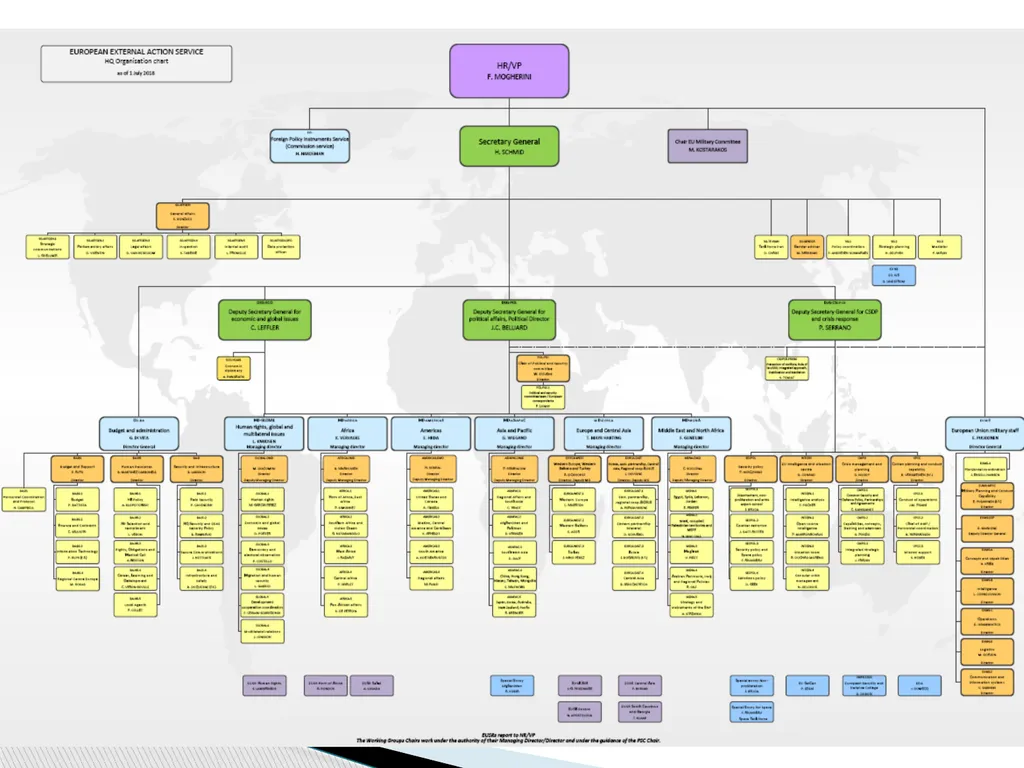
The European External Action Service (EEAS) assists the High Reprentative and works in co-operation with the diplomatic services of the Member States. The EEAS is also responsible for communication and public diplomacy in third countries, drafting country and regional strategy papers, and election observation missions. Furthermore, the EEAS, in co-operation with the Commission’s services, is involved in the programming, planning and management of relevant funding instruments, such as the Instrument for Stability and the European Instrument for Democracy and Human Rights.
The EEAS now includes all the Crisis Management Structures which were previously in the Council Secretariat. They fall under the direct authority of the High Representative. These entail a) the Crisis Management Planning Directorate (CMPD), which is responsible for the politico-strategic planning level of CSDP civilian missions and military operations, as well as for their strategic review. It comprises both military and civilian personnel, b) the Civilian Planning Conduct Capability (CPCC) which has the mandate to provide input into the Crisis Management Concepts of civilian CSDP missions, and to contribute to the development of the concepts, plans and procedures for civilian missions etc (the head of the CPCC is the Civilian Operations Commander who is the overall commander of all civilian Heads of Missions and reports directly to the HR/VP and, through the HR/VP, to the Council), c) The EU Military Staff (EUMS), which works under the direction of the Military Committee working group of the Member States Chiefs of Defence and under the authority of the High Representative, and it performs early warning, situation assessment and strategic planning for CSDP missions, while it liaises with the UN and NATO, d) The EU Situation Centre (SITCEN) is the EU “intelligence centre” and it monitors the international situation (focusing on particular geographic areas and sensitive issues such as terrorism and the proliferation of weapons of mass destruction), exchanges information with the foreign, intelligence, security and defence bodies of Member States, and provides early warning, situational awareness and intelligence analysis to inform timely policy decisions under CFSP and CSDP. The European External Action Service<br>
slide58. European Union Special Representatives (EUSRs) are responsible for developing a stronger and more effective CFSP. They may be appointed by the Council, following a proposal from the High Representative, with mandates covering particular transversal issues and/or geographic areas, and they report directly to the HR/VP. They are engaged in political dialogue in regions they cover and are committed to increasing the coherence of the EU’s action towards a particular region. Some of the mandates expressly cover the prevention of conflicts and the contribution to the peaceful settlement of conflicts.
Before the entry into force of the Lisbon Treaty, the European Commission’s delegations mainly dealt with trade, aid and development cooperation. With the entry into force of the Lisbon Treaty and the acquired legal personality of the EU however, they became European Union delegations with competencies for CFSP which previously fell under the competence of the rotating presidencies of the EU. They now represent the Union as a whole under the authority of the High Representative, and have the status and structures to contribute to steering and strategizing the political engagement of the EU with a third country. All EU delegations will now have a political and communication section, unlike before, and are allowed to co-ordinate and represent the EU’s position in third countries. EU Delegations in third countries now hold weekly meetings with representatives of the Member States in the country; these meetings were previously organized by the embassies of the rotating presidencies of the EU.<br>
slide60. Establishing the EEAS was a means of pooling resources, consolidating the EU’s existing external policy responsibilities and improving efficiency in the CFSP.
The Member States did not want to use the Commission’s institutional framework in that respect and they created a new bureaucratic actor. However, their interest in trying to control processes and influence outcomes does not mean they do not have an interest in delegating responsibilities and pooling resources. The EEAS and the officials who work there can be expected to seek opportunities for independent action where they can, escaping Member State, Commission and Parliamentary control.
Yet, the retention of intergovernmental decision-making over the EU’s strategic direction, the desire of member governments to be visibly influential on high-profile international events, Member State positioning of nationals in key senior positions and the Commission’s reluctance to relinquish policy competencies and budgetary control means that the potential for the EEAS to take independent policy positions is very limited. Indeed, the only way the Service will be able to build an autonomous role vis-a-vis Member States is to work closely with the Commission in areas in which the latter already has competence – essentially, for the EEAS to become an “extension” of the Commission with special responsibilities.<br>
slide61. Discussing the EEAS’ potential autonomy also has important implications for the EU’s international ‘actorness’ in a more general sense. The Service’s capacity for independent decision-making and implementation is an indicator of the European commitment to strengthen the supra-national aspect of the EU’s external relations, and to invest in ‘more EU’ in a traditionally sovereign state-dominated domain. Several scenarios are possible:
First: The EEAS sits at the centre of a whole-of-EU external policymaking system with clearly defined objectives and efficient division-of-labour arrangements.
Second: The new arrangements may fail to integrate important EU external policy actors, overlapping responsibilities may result in damaging jurisdictional conflicts, leaving the EEAS incapacitated, and individual actors may look for opportunities to pursue their own objectives at the expense of the system as a whole.
Third (and more likely): An imperfect system will function better in some policy areas than in others because certain decision-making procedures and means of delegation are more amenable to the new system and its actors than others.<br>
slide62. The EEAS is unlikely to be given sufficient autonomy to represent EU members on the world stage while there is little agreement on the concrete strategic objectives the Service should pursue and the appropriate division of responsibilities between the EU, Member State bilateral activities and other international actors like NATO. The EU remains divided over what kind of international actor it should be – whether it should limit itself to economic power, or whether it should pursue a broadly normative agenda and lead by example, whether it should develop its ability to coerce and punish other actors. Incoherence is built into the system because actors do not feel that they can risk ironing out sensitive issues, and in the short- to medium-term overlapping mandates are likely to limit the EEAS’ efficiency, although not necessarily its effectiveness.
In the longer term, the lack of strategy could present the EEAS with serious problems. Internally, senior management will find priority-setting difficult because they will not have a strong sense of the organization’s interests beyond maximizing its own bureaucratic responsibilities. Externally, if the EU cannot articulate a common position with regard to other international actors, such as China, Russia, Israel and Iran, then these actors will not take the Service (or the EU) seriously.<br>
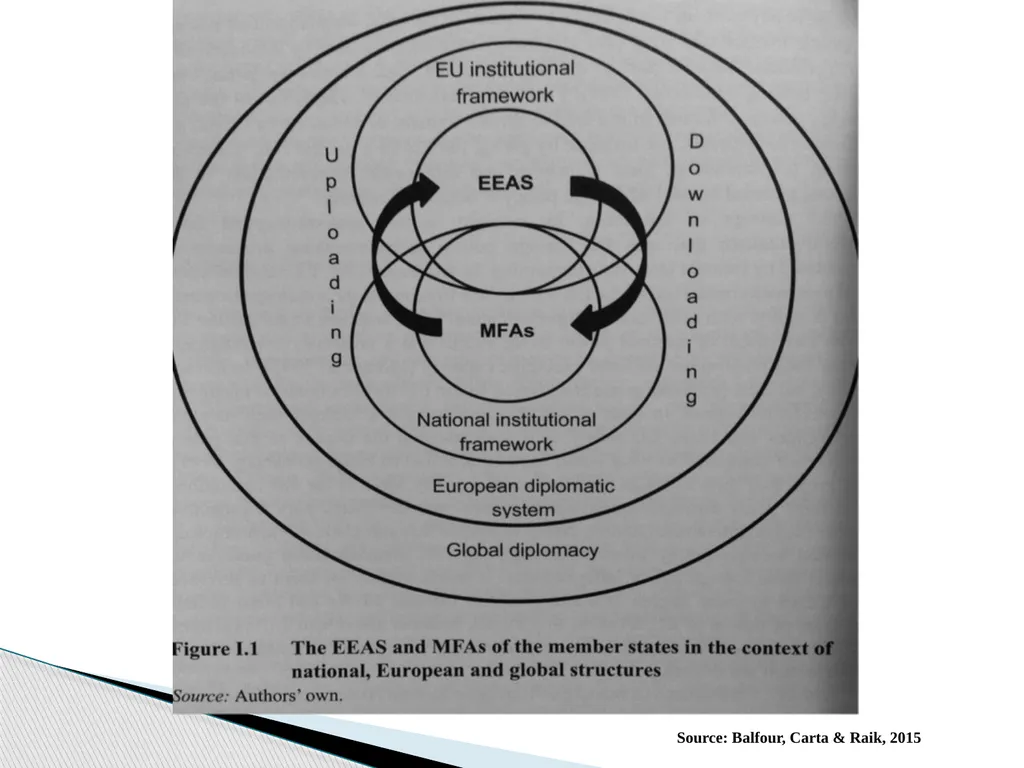
slide63. One characteristic particularity of the Union’s foreign policy governance is the interaction between the EU foreign policy and the national foreign policy of each Member State. This interaction is one of the key determinants of the EU’s ability for coherent and effective global action and of its position in the world stage.
European diplomacy is facing ‘outside in’ challenges due to the fragmentation of international relations (economic problems, new world order, intensification of globalization) and ‘inside out’ challenges in order to merging national with European interests.
Thus, there is a complex interplay in the foreign-policy making between the Union’s actors and the national actors, which may analysed through the following three interplays:
downloading, a top-down process from the EU to the Member States – such process can lead to greater transfer of power to Brussels at the expense of the MFAs and Member States;
uploading, a bottom-up process from the Member States to the EU – such process is much more embedded in the inter-state bargaining power logic. MS are pushing for their national interests and preferences at the EU level. The EEAS is perceived as an over-shadowing presence over the MFAs;
crossloading, a mutual constitution leading to convergence – such process leads to an elite socialization at the EU level, wherein national and european interests and preferences become intertwined and ultimately converge. CFSP interaction with national policies<br>
slide64. Source: Balfour, Carta & Raik, 2015<br>
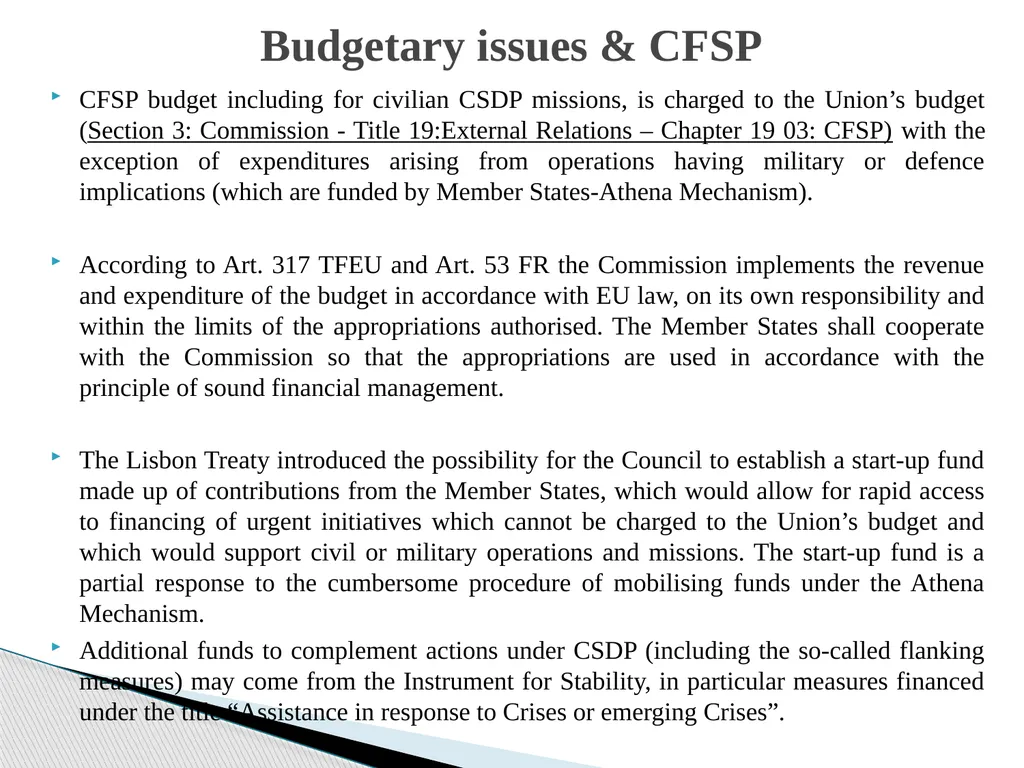
slide65. CFSP budget including for civilian CSDP missions, is charged to the Union’s budget (Section 3: Commission - Title 19:External Relations – Chapter 19 03: CFSP) with the exception of expenditures arising from operations having military or defence implications (which are funded by Member States-Athena Mechanism).
According to Art. 317 TFEU and Art. 53 FR the Commission implements the revenue and expenditure of the budget in accordance with EU law, on its own responsibility and within the limits of the appropriations authorised. The Member States shall cooperate with the Commission so that the appropriations are used in accordance with the principle of sound financial management.
The Lisbon Treaty introduced the possibility for the Council to establish a start-up fund made up of contributions from the Member States, which would allow for rapid access to financing of urgent initiatives which cannot be charged to the Union’s budget and which would support civil or military operations and missions. The start-up fund is a partial response to the cumbersome procedure of mobilising funds under the Athena Mechanism.
Additional funds to complement actions under CSDP (including the so-called flanking measures) may come from the Instrument for Stability, in particular measures financed under the title “Assistance in response to Crises or emerging Crises”. Budgetary issues & CFSP<br>
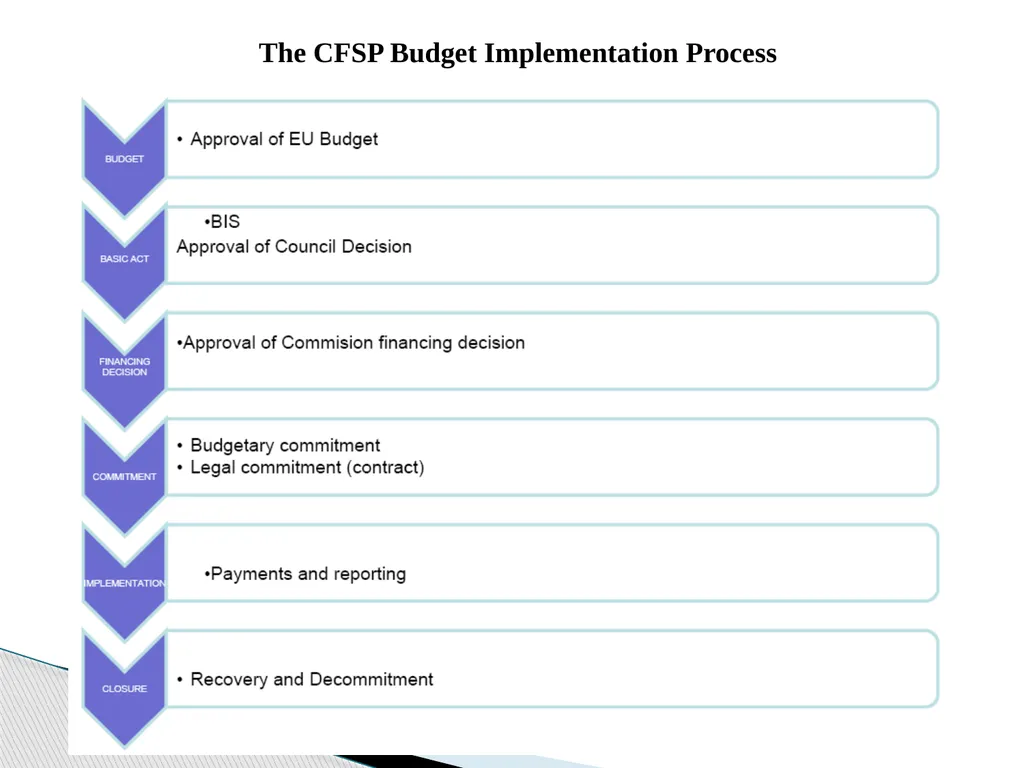
slide66. The CFSP Budget Implementation Process<br>
slide68. The three institutional sins may still be redressed by using the Lisbon Treaty provisions:
• launch an enhanced cooperation in the field of CFSP (the cooperation may cover distinct fields such as intelligence and information sharing, cybersecurity, research and development, defence market, or thematic and geographical dossiers). Because of their higher level of integration, the Member States of the Euro area should be considered the most suitable candidates for such cooperation;
• allow to the High Representative and his representatives to chair the remaining Council working groups dealing with external relations and some meetings of the Council, such as those with the ministers of defence, development cooperation and international trade;
• revaluate the role of the Foreign Affairs Coucil instead of pursuing the recent hyper-activism in the European Council. Where this is not be possible, the High Representative should be more involved in the European Council meetings by its president;
• establish a permanent structured cooperation or a lighter version of it, taking advantage of the legally binding nature of the commitments undertaken by the participating Member States (Art. 42 para 6, Art. 46, Protocol 10, TEU)
• reinforce the democratic scrutiny and accountability of the CFSP through an increased involvement of the European Parliament, operated on a voluntary basis by the High Representative (e.g. hearings, question time, common initiatives, etc.). Thanks to this kind of action, CFSP legitimacy would be enhanced as the degree of awareness and information about international affairs shown by members of the Parliament would be improved.
In short, the EU may have several problems and shortages, but it also has the tools to fix them. These tools are on the table, waiting for someone to use them. But here we return to the original question: “What do we want to do with this European Union?” Concluding Remarks<br>
slide69. Thank you for you attention
and your patience!!!!<br>
Professor of European Governance
Department of International and European Studies
University of Macedonia<br>
slide2. Public Administration Conceptual Issues & Definitions What is Public Administration?
Is it a discipline? Profession? Field? Focus? Enterprise? Or, what?
Public Administration throughout the world is intricately intertwined with state development, its whole and parts, its past, present and future.
Thus, Public Administration can only be understood within the peculiar, nation-state context.
In Europe literally the State makes Public Administration
In the United States, the reverse can be said to be true: Public Administration makes the State<br>
slide3. Public administration is both an academic discipline (ie field of study) and a field of practice (ie occupation);
There is much disagreement about whether the study of public administration can properly be called a discipline, largely because of the debate over whether public administration is a subfield of political science or a subfield of administrative science.
As a discipline, Public Administration analyses the mechanism to implement government policy and it prepares civil servants for this work;
As a field of practice, it entails the management of policies so that government can function;<br>
slide4. Public administration has no generally accepted definition, because the scope of the subject is so extended and so debatable that it is easier to explain than define. Some definitions are:
“The management of public programs"
“The translation of politics into the reality that citizens see every day"
“The study of government decision making, the analysis of the policies themselves, the various inputs that have produced them, and the inputs necessary to produce alternative policies”
According to the North American Industry Classification System, adopted by the USA Government, Public Administration comprises establishments primarily engaged in activities of a governmental nature, that is, the enactment and judicial interpretation of laws and their pursuant regulations, and the administration of programs based on them. This includes legislative activities, taxation, national defence, public order and safety, immigration services, foreign affairs and international assistance, and the administration of government programs, etc. All these are activities purely governmental in nature.<br>
slide5. Until the mid-20th century and the dissemination of the German sociologist Max Weber's theory of bureaucracy there was not much interest in a theory of public administration;
The field is multidisciplinary in character;
Among the various proposals for public administration's sub-fields, six pillars have been identified, including human resources, organizational theory, policy analysis and statistics, budgeting and ethics.
In an more academic approach the study of public administration is defined as a program that prepares individuals to serve as managers in the executive arm of local, state, and federal government and that focuses on the systematic study of executive organization and management.
It includes: instruction in the roles, development and principles of public administration; the management of public policy; executive-legislative relations; public budgetary processes and financial management; administrative law; public personnel management; professional ethics and research methods.<br>
slide6. Current views on Good Public Administration 1. Getting it right
Acting in accordance with the law and with regard for the rights of those concerned.
Acting in accordance with the PA’s policy and guidance (published or internal).
Taking proper account of established good practice.
Providing effective services, using appropriately trained and competent staff.
Taking reasonable decisions, based on all relevant considerations.
2. Being customer focused
Ensuring people can access services easily.
Informing customers what they can expect and what PA expects of them.
Keeping to its commitments, including any published service standards.
Dealing with people helpfully, promptly and sensitively, bearing in mind their individual circumstances.
Responding to customers’ needs flexibly, including, where appropriate, co-ordinating a response with other service providers.<br>
slide7. 3. Being open and accountable
Being open and clear about policies and procedures and ensuring that information, and any advice provided, is clear, accurate and complete.
Stating its criteria for decision making and giving reasons for decisions.
Handling information properly and appropriately.
Keeping proper and appropriate records.
Taking responsibility for its actions.
4. Acting fairly and proportionately
Treating people impartially, with respect and courtesy.
Treating people without unlawful discrimination or prejudice, and ensuring no conflict of interests.
Dealing with people and issues objectively and consistently.
Ensuring that decisions and actions are proportionate, appropriate and fair.<br>
slide8. 5. Putting things right
Acknowledging mistakes and apologising where appropriate.
Putting mistakes right quickly and effectively.
Providing clear and timely information on how and when to appeal or complain.
Operating an effective complaints procedure, which includes offering a fair and appropriate remedy when a complaint is upheld.
6. Seeking continuous improvement
Reviewing policies and procedures regularly to ensure they are effective.
Asking for feedback and using it to improve services and performance.
Ensuring that the public body learns lessons from complaints and uses these to improve services and performance.<br>
slide9. Principles of Public Administration By studying Public Administration, either as an academic or as an practitioner, one may identify a constant evolving process of developing the national, European and international administrative legal orders and administrative practices.
And this evolution is characterised by a significant degree of convergence among these factors.
There are several driving forces for this, such as economic pressures from individuals and firms, regular and continuous contacts between public officials of Member States and, finally and especially, the jurisprudence of the Courts at national, European and international level. Although constitutions and subsequent legislation convey general law principles and define standards for administrative actions, it is the courts that refine those standards, i.e. define levels of acceptability for public administration practices on a case-by-case basis.<br>
slide10. Traditionally, standards of administrative performance have been defined and refined within the national boundaries of sovereign states.
They have been the products of national constitutional arrangements, law-making activity of national parliaments, decisions of national administrative authorities and rulings of national courts.
In the EU context, as well as the international context, these processes are becoming increasingly supranational, thus formulating shared mandatory administrative standards, that should be adhered to.
However, stressing the harmonising potential of public administration standards is not to say that administrative institutions should be homogeneously set up across all states.
The important message is that, independently of institutional arrangements, all forms of public administration must recognise principles and adhere to certain common standards.<br>
slide11. In some countries the administrative law principles, setting standards and inspiring the behaviour of civil servants, usually appear scattered among different pieces of legislation ranking from the constitution to several acts of Parliament, and specific pieces of delegated legislation as well as case law of the courts dealing with litigation concerning public administration.
Other countries have put in force general codification on administrative procedures, which gather and attempt to systematise many of these principles.
These administrative principles are not simply ideas based on goodwill; they are embedded in institutions and administrative procedures at all levels.
Actors in the public sphere are legally obliged to comply with these legal principles, which must be upheld by independent control bodies, systems of justice and judicial enforcement, parliamentary scrutiny, and by ensuring opportunities for hearing and redress to individuals and legal persons.<br>
slide12. Administrative law principles and civil service are at times difficult to define. Frequently they seem to contradict each other in a given situation. (i.e. Efficiency seems to be at odds with due process; professional loyalty to the government seems to oppose professional integrity and political neutrality; discretionary decisions might seem to go against the rule of law, etc)
This elusive nature of administrative law principles is one of the reasons why “blank concepts” are so common in administrative law and civil service regulations. This is also one of the reasons why the courts , at national, European and international level, are so often invoked to solve conflicts and to continually refine these definitions in a doctrinal construction, adapted over time.
Perhaps it is useless, and even counterproductive at times, to aim to clearly define the boundaries of administrative law principles.
In terms of law-making, when such an attempt has been made, usually in the form of very detailed casuistic distinctions, the end result has frequently been more confusion. Confusion in this domain easily generates injustice.<br>
slide13. Exacerbated attempts to ensure detail in regulating such elusive matters tend to result in inconsistency and contradiction. Contradiction and discrepancy also cause difficulties in making these principles actual by adversely affecting law enforcement.
From the perspective of law making it is probably considered wise to resort to “blank concepts” because of their malleability to fit in disparate situations.
From the standpoint of civil servants’ and public authorities’ behaviour, relying on common sense and seeking inspiration from consolidated case law doctrine would be advisable.<br>
slide14. The Public Administration principles have been divided into six categories (OECD/EU – SIGMA Initiative):
Strategic Framework of Public Administration Reform
Policy Development and Co-ordination
Public Service and Human Resources Management
Accountability
Service Delivery
Public Financial Management
These Principles are not a checklist to be applied mechanically. Public bodies should use their judgment in applying the Principles to produce reasonable, fair and proportionate results in the circumstances.<br>
slide15. Strategic Framework for Public Administration Reform<br>
slide16. Policy Development and Coorination<br>
slide18. Public Service and Human Resources Management<br>
slide19. Accountability<br>
slide20. Service Delivery<br>
slide21. Public Financial Management<br>
slide24. The “Administration Through Law” Context This administrative context is made up of several factors, the more important of which are:
• The quality of substantive regulatory law: Regulatory law provides the framework for decision-making within a given policy field (for instance, in urban planning or on environmental issues). In other words, it represents a tool for officials and a source of information and prediction for the public.
• The quality of procedural administrative law: Procedural administrative law provides due procedures for administrative decision-making, for co-ordination and for balancing powers, for officials’ relations and communication with the public, and for enabling any interested party to be heard or to appeal.
• The quality of financial and administrative accountability and control mechanisms: These work for transparency, provide checks for financial and administrative decision-making, and provide means for correction, prosecution and redress.<br>
slide25. At the same time, these three factors provide the legal values and principles which contribute decisively to shaping the attitude and behaviour of public managers and the rest of the civil servants operating within that administrative context.
These legal principles will be essential as guiding principles for decision-making and behaviour; they will reduce the likelihood of arbitrary decisions by allowing discretionary decision-making within the legal administrative framework.
In the end, the principles of administrative law will strongly contribute to laying the foundation of a professional public administration.
The professionalisation of the public administration is, therefore, a much wider task than implementing civil service regulations and introducing personnel management improvements.
If the administrative context within which officials have to work is not also improved, they might still have to make arbitrary decisions, with insufficient communication with the public, and insufficient co-ordination with other institutions, even if they are in a situation where they have been selected on merit and are exposed to systematic training.<br>
slide26. Civil Service and Public Administration Civil Service Values are Legally Binding Principles : The civil service is bound by the principles enshrined in constitutional arrangements and in administrative law. From this viewpoint, it can be said that civil service values are legal values. Legal values are not the same as ethical values, even if they can broadly overlap. Ethical values are guides for action, and their breaching deserves social reproach. Legal values, when breached, have legal consequences through the civil service law’s disciplinary provisions. Civil servants are bound by the administrative principles established in legislation.
Civil Servants are not Mere Employees of the State: Civil servants are subject to legal principles and compulsory rules that derive from their specific location within the hierarchical structure of the state. This location shapes a profession, which deals with fundamental rights of their fellow citizens. Civil service regulations do not simply regulate the working relationships between an employer and its employees, as labour law does. Civil service regulations intend, a) to protect civil servants in performing their very special social role in democratic societies and, b) to tighten professional standards by virtue of the delicate issues which civil servants have to deal with. Civil servants are actors within the public sphere of society, the sphere which falls within the domain of public law.<br>
slide27. Administrative Law Principles Create Civil Service Behavioural Patterns: Nevertheless, a civil service system regulated by a civil service act is not sufficient to make a public administration professional, efficient, effective, impartial, abiding by the rule of law, and well-performing. It is also necessary to have substantive and procedural administrative legislation of sufficient quality. This legislation will not only provide civil servants with an important tool for performing their duties and for realising the public law principles described above, but also with clear procedures to guide their work and to render their actions and decisions predictable.
Additional procedural and substantive legislation is also needed to ensure sufficient internal and external control of public administration and the civil service, particularly in terms of public finance, quality control, procedural supervision, and above all, to ensure an independent, well-functioning judicial system able to effectively redress administrative actions and decisions by means of appeal. This requirement is not only for the sake of the legal certainty and reliability of public administration, but also to ensure the appropriate legal protection of individual rights and legitimate expectations.<br>
slide28. The EU’s Public Administration with regard to its Foreign Policy Source: Univ. of Portsmouth (EU Studies Hub)<br>
slide29. In assessing the CFSP and its institutional structures, ones notes two major paradoxes.
First: it is a field in which both public and academic perceptions would suggest real limits to European integration. This field of policy is the first and last bastion of “national sovereignty”. Yet, there are initiatives aiming at formulating and implementing policy options at EU level.
Second: CFSP was very deliberately situated under the second Pillar of the EU, according to the Maastricht Treaty, and now, under the Lisbon Treaty, it has been maintained as a policy field in which intergovernmentalism is considered to be sacrosanct and all decisions are officially taken either at Foreign Ministers or at Heads of State or Government level; however, the reality is far more complex as CFSP involves a mix of intergovernmental and supranational procedures (“supra-national inter-governmentalism”, see Howorth, 2000). Naturally, there are significant differences between the practices of the respective actors, in terms of the precise location and dynamics of decision-shaping and decision-making. But, there is a very dintinct element of a de facto supranationalism.<br>
slide30. Pre-Lisbon Structure of EU Foreign Policy Institutional Framework Source: House of Commons Select Committee on foreign Affairs<br>
slide31. Seeing this framework of foreign policy formulation and implementation, three original “institutional sins” have been identified in the relevant system of governance (Vai, 2016):
1) an artificial separation within the architecture of the CFSP;
2) a lack of EU capabilities;
3) a democratic deficit in the CFSP policy cycles.<br>
slide32. First Sin: Artificial Separation - normally, an effective foreign policy is a common effort that brings together a number of different thematic and geographic policies carried out by several institutional actors. In the EU context, there is an essential difference: the foreign policy – or the so-called external action – appears structurally divided.
On the one hand, this policy is carried out through the community policies with an external projection such as development cooperation, humanitarian aid, enlargement and neighbourhood policy, trade, energy, etc. The formulation and implementation of these policies is mainly up to the European Commission, while the relevant decision making procedure involves fully the European Parliament and the Council, on equal basis and acting by majority votes.
On the other hand, there is the framework of the Common Foreign and Security Policy (CFPS) that covers all areas of foreign policies (except those run by the Commission), and which also includes an operational civil-military branch, the Common Security and Defence Policy (CSDP). The CFSP/CSDP is the realm of the Council and the Member States, that take decisions by unanimity with limited involvement of the European Parliament, the Commission, and the EU Court of Justice.
Therefore, the Union’s foreign policy – as a whole – lives today an institutional artificial separation between the “low politics” (which entail economic and social questions) run via the community method, and the “high politics” (which entails life-and-death issues of political order and violence), shaped by advanced and structured intergovernmental cooperation.<br>
slide33. Second sin: Lack of capabilities - the resources and the instruments at the disposal of the EU are still not sufficient to reach its goals in the field of foreign policy, despite an improvement of the situation since the middle of the 1990s.
Due to the current tightness of the EU budget and the inexistence of a real system of generating its own resources, the financing of the community policies and of the CFSP has not always proved to be adequate. Concerning the instruments, the external action of the Union still largely relies on the Member States’ capabilities. This is especially true considering the EU ambitions to become a global security provider and looking to what the CSDP is able to offer today: the EU does not have its own intelligence agency, nor a permanent common European military force, while the European costal guard is still in its infancy, trying to sort out problems inherited from its predecessor, FRONTEX.
Deficiencies like these represent a clear limit for the implementation of the Union’s foreign policy and also cause difficulties to the decision making process. As an example, the CSDP military operations are mainly nationally-funded with direct involvement of national military and civilian personnel. This state of affairs can hardly incentivise the Member States to undertake such initiatives, or alternatively leads them to launch missions inadequate to the given targets.<br>
slide34. Third Sin: Democratic deficit in CFSP
The low level of democratic participation that still characterises European decision making in a large number of policy areas – that certainly includes the the CFSP/CSDP – can be considered a direct matter of concern for the expected results of EU external action. Abandoning for a moment the ethical justifications in favour of democracy, from a theoretical point of view the policy effectiveness could also be maximized by an autocratic regime.
Nevertheless, in the Union’s foreign policy institutional machinery the lack of democracy raises two core issues.
Firstly, the limited powers of the European Parliament in the field of foreign policy, and the exclusion of the Commission from the CSFP/CSDP policy cycle have generated a number of negative consequences (ie isolation).
Secondly, the question of legitimacy and respect within the EU of the same democratic values and procedures that the Union itself supports and tries to spread outside its borders must be taken into account. A discrepancy between what the EU says outside and what it does inside can became a potential stain on the EU’s international and domestic image.<br>
slide35. The amendments of the Lisbon Treaty introduced major innovations in the Union’s foreign policy governance. They attempted to mitigate the first sin, without however incorporating the CFSP in the supranationalist scheme of the Union (as such an endeavour would have required an answer to the EU’s teleological dilemma), offered some solutions for the second one, and made minor adjustments that have not dissipated the democratic deficit in the EFP. All in all, however, the post-Lisbon institutional architecture has not manage to fully overcome the three original sins and they still affect negatively the qualities that the EU should have in order to be effective.
In institutional terms, two significant changes were made:
1) the post of the High Representative of the Union for Foreign Affairs and Security Policy (HR), who chairs the Foreign Affairs Council (FAC) and is also vice-president of the Commission (VP);
2) the European External Action Service (EEAS), a diplomatic service composed of European civil servants and national diplomats with a headquarters in Brussels and a network of delegations in third countries and international organisations.
Thus, the Lisbon Treaty, by solidifying formal intergovernmentalism in the decision-making process while including supranational dimensions into the CFSP/CSDP, contributed to the complex scheme that was indentified above between the intergovernmentalist and the supranationalist element of the Union. The Lisbon Treaty effects<br>
slide36. Post-Lisbon Structure of EU Foreign Policy Institutional Framework Source: House of Commons Select Committee on foreign Affairs<br>
slide37. Source: R. Schutze-EU Law<br>
slide38. The major, distinctive, elements of the decision making process in matters of common foreign and security policy, as established by the Lisbon Treaty, are the following:
a) the right of initiative and the Commission’s role,
b) the decision making in the Council
c) the role of the Parliament is much weaker under CFSP.
A. The right of initiative and the Commission’s role
One of the key rights of the Commission, in the supranationalist scheme of the Union, is the right of initiative. However, in matters of CFSP, both the EU High Representative for Foreign Affairs and Security Policy/Vice President (HR/VP) and EU member states have the right to initiate policy, not the Commission. The Commission is able to initiate a joint-proposal with the High Representative, but not by itself.
To this effect, Article 22, para. 1 of the TEU states that – “Any Member State, the High Representative of the Union for Foreign Affairs and Security Policy, or the High Representative with the Commission’s support, may refer any question relating to the common foreign and security policy to the Council and may submit to it, respectively, initiatives or proposals”
The Commission has a very limited role, entailing the provision of support (for instance documentation) to the initiatives undertaken by the other actors.<br>
slide39. Unifying the former Directorate General for External Relations (DG RELEX) of the Commission with the EEAS and, redering the Delegations in other countries to Union’s Delegations, and not solely the Commission’s, have disrupted the Commission’s full association with CFSP.
The Service for Foreign Policy Instruments, responsible for the planning and financial administration of the Instrument for Stability remains a Commission service, yet it now reports directly to the HR/VP, not to the Commission as an institution. Concerns about coordination between the EEAS and the Commission have been raised on several occasions, (see for instance in the letter to the HR/VP prepared by 12 Member States on the anniversary of the creation of the EEAS).
However, the Commission retains some influence through the High Representative’s double role as HR and Vice President of the Commission.
Furthermore, it still plays an important role, as it is responsible for drafting the proposal for the EU budget, including the allocations for CFSP. In addition, the European Neighbourhood Policy, development and humanitarian assistance remain in the remit of the Commission with a significant budget (over € 7 billion p.a.). An inter-service agreement was signed by the Commission and the EEAS on 13 January 2012, clarifying issues on the balance of power between the Commission and the EEAS. According to the agreement, the Commission and the EEAS jointly plan overall spending strategies on the Union’s external relations budget. The funding instruments are jointly programmed (with leading roles for either the Commission or the EEAS depending on the instrument) but implemented solely by the Commission. In addition, the Commission oversees how the HR/VP spends the EEAS annual internal budget.<br>
slide40. Therefore, the EU institutional features and the need for expertise must be taken into consideration in order to capture the Commission’s influence. The particular institutional structure of the EU combined with the obligation, foreseen by the Treaties, to coordinate external actions across policy areas, creates a demand for services from the Commission. This also allows the Commission to ‘circumvent’ the inter-governmental policy-making procedures that dominate the CFSP scheme.
And once it had access to the de facto decision-making arenas, it convinced both the EEAS and the different Member States of the relevance of its suggestions. This underlines how important it is to go beyond formal characteristics in order to understand the proper operation of such schemes,
The Commission’s de facto influence illustrates how elements such as informal co-operation, expertise and the ability to present convincing arguments all are factors that may have integrative consequences even in cases where Member States have strong interests. The Commission’s actions, behaviour and informal interaction with other actors may be among the factors that help explain the move toward closer co-operation and integration within the CFSP more generally.<br>
slide41. The EU does not behave as a classic international organization in the domain but rather that the CFSP is moving beyond inter-governmental co-operation – although the Member States remain the key players, policy-making does not lie exclusively in their hands. Both the particular organizational structure of the EU and the Member States’ requests for expert knowledge in inter-linked policy areas are key to understanding that, in light of the Lisbon Treaty’s increased focus on consistency across different policy fields, it is likely that the trend of employing the supranationalist element, as expressed by the Commission, will become stronger.
The institutional collocation of the HR/VP, in medio between the Council and the Commission, represents the attempt to reduce the “sin” of artificial separation noted above, and to ensuring coherence. There are signals of willingness to foster such intra-institutional coherence, like the monthly coordination meetings promoted and chaired by the President of the Commission and the HR/VP that gather the external relations group of commissioners, the participation of the HR/VP in the European Council (agreed with its President) and in the defence, development cooperation, and trade Councils (still chaired by the rotating presidency), etc.<br>
slide42. B. Decision-making in the Council
Within the EU, the Common Foreign and Security Policy (CFSP) is subject to specific rules and procedures, and it is defined and implemented by the European Council and the Council acting unanimously (Art 24 TEU).
The European Council provides the political direction to the EU by identifying the strategic interests, determining the objectives and defining the guidelines of CFSP including for matters with defence implications. The European Council may adopt Council Decisions on common positions and Council Conclusions, which are statements of intent.
The configurations of the Council of the EU with competence on CFSP are the Foreign Affairs Council and the General Affairs Council. They consist of the Foreign Affairs ministers of the Member States. The Foreign Affairs Council is chaired by the HR/VP, while the General Affairs Council is chaired by the six-monthly Member States presidencies. They deal with the whole of the Union’s external action, including CFSP and CSDP, and are responsible for ensuring consistency across the instruments in the EU’s external action.
The Political and Security Committee (PSC) is the permanent body constituted by permanent representatives of EU Member States who are based in Brussels and who meet at ambassadorial level (the Member States’ PSC Ambassadors). It is in charge of monitoring CFSP and CSDP within the Council of the EU and of exercising political control and setting the strategic direction of crisis management operations (Article 38 TEU). The PSC formulates opinions on these issues at the request of the Council, the HR/VP or on its own initiative. The PSC now has a permanent chair directly linked to the Corporate Board of the EEAS. The PSC is assisted by the Military Committee (EUMC) and the Committee for the Civilian Aspects of Crisis Management (CIVCOM).<br>
slide43. As for the legal instruments, under the pre-Lisbon regime, CFSP legal instruments could take five forms: a) principles and general guidelines, b) common strategies, c) joint actions, d) common positions or e) decisions.
These were (since Lisbon) replaced with one instrument, decisions, that incorporates all of the above and outlines the actions that states are supposed to take. The change in the wording did not cause any change in substance. Decisions on actions are usually the basis of CSDP missions and operations. Decisions on positions may refer to a particular matter of geographic or thematic nature.
As before Lisbon, there is no mechanism for the Commission to monitor the implementation of CFSP decisions and the ECJ has no jurisdiction to condemn or imposes any penalties on member states for non-implementation.<br>
slide44. Unanimity is the rule for decision making in the area of CFSP. Members of the Council may, however, abstain and make a formal declaration of abstention. The qualified abstention allows them not to apply the decision, which will nevertheless commit the Union. If the abstaining members represent at least one third of the member States comprising at least one third of the population of the Union, the decision shall not be adopted. The Council can act by qualified majority only in the following cases:
a)When adopting a decision defining a Union action or position on the basis of a decision of the European Council relating to the Union’s strategic interest and objectives;
b) When adopting a decision defining a Union action or position, on a proposal presented by the HR/VP following a specific request of the European Council;
c) When adopting any decision implementing a decision defining a Union action or position;
d) When appointing a Special Representative.
The European Council may also unanimously adopt a decision stipulating that the Council shall act by qualified majority in cases other than the ones listed above.<br>
slide45. There are further a number of external relations working groups, specialized in thematic or geographic issues, Like the Foreign Affairs Council and the Political and Security Committee, most of these working groups are now chaired on permanent basis by representatives of the EEAS directly appointed by the HR/VP. The presidencies of the working groups are responsible for information sharing from one group to the others.
The policy formulation and the decision making belong for the most part to these working groups and preparatory bodies. They prepare the discussions which are then sent to Committee of Permanent Representatives of the Member States’ governments (COREPER) or to the Political and Security Committee (PSC).
The meetings at the Council level – where decisions are formally taken – are prepared by the HR/VP and the EEAS, that also ensure a constant involvement of the Commission, especially when mixed competence dossiers are under discussion. In this respect, the establishment of the EEAS supports the HR/VP in bridging foreign policies and external policies related competences while maintaining the division of competences mainly unaltered.<br>
slide46. The existence of such support structures (committees and working groups), resembling the well-known EU comitology system, is one of the most interesting issues in the decision making process for CFSP. Three points have been identified as crucial in analysing this issue (Tonra, 2011).
First, this system reduced the structural differential between CFSP and supranational operations. Although there has not been any substantial integrational shift of policy and/or decision making, there has undeniably been a shift towards standard supranational norms in terms of participation and working method.
Second, given that the core player in the EU foreign policy institutional arena is the Council and not the Commission, it is the former which exercises command and control over this policy field. Therefore one wonders on the nature of policy making within this institution – classic intergovernmentalism (zero-sum, traded interests and lowest common denominator policy making) or something more and/or different, with supranationalist elements?
Third, as a consequence of the preceding two points, there is a sense of developing a Union-centred foreign policy personality. The two key objectives in the historic development of a collective foreign policy voice (alongside effectiveness) have been consistency and coherence. The system of foreign policy working groups represents a compromise between a truly collective (and hence quasi-federal) foreign policy structure (that could have been accommodated within the Commission in the future) and the independent-but-co-operative national foreign policy systems. In case however, such a Union foreign policy would require a different decision making scheme, which does not exist at the moment.<br>
slide47. The structure, itself, of the CFSP committees reflect the move from a strict intergovernmentalism towards a Brussels-based working method. The member states remain at the heart of the system, as member state diplomats comprise the core of the policy process. However, in the search for added value (and so as to overcome the intergovernmental dynamic of lowest-common-denominator politics) the member states have sought to develop a new institutional logic for CFSP.
The Commission sought to lead the CFSP scheme based on the argument that consistency and coherence in foreign policy cannot be achieved in a bicephalus institutional structure. It has gained only a seat as non-voting member in CFSP configurations, ableit with acknowledged special competences and a unique ability to present an integrated policy perspective to the member states.
The Council, through its Secretariat, was the main bureaucratic actor in CFSP, till Lisbon. Its structures allowed, for instance, smaller member states, during their presidencies, to rely upon it for administrative support and the skillful behind-the-scenes negotiations - even in charged atmospheres of crucial debates.
However, because the member states are uncomfortable in seeing such a sensitive area as foreign and security policy drawn within the “supranationalist” scheme of the Union, they have chosen to follow a bureaucratic logic which resembles an adapted intergovernmentalism.<br>
slide48. The CFSP working groups reflect this option, as they aim at the formulation of an effective, coherent and consistent European foreign policy. Such an achievement is difficult, using a strict intergovernmentalist approach. Thus, it has been decided to establish intergovernmental structures, assimilating a model of collective policy making that is premised upon intense, highly structured, regular, permanent and ever closer policy consultations. Crucially – and distinguishing this level of policy consultation from any other form of diplomatic activity – this framework is situated within the institutional structures of an integrative political project. This particular detail makes the entire scheme something other than an intergovernmental bureaucratisation of foreign policy and something more than a “Brusselsisation” of national foreign policy systems.
The workings of such groups have always been, albeit with varying intensity throughout the years, characterised by an informal sense of shared community and fellow-feeling. There is a constant development of a sense of common identity and sense of collective purpose. The informal “consultation reflex” in which Political Directors sought to accommodate the views of their fellows in almost a personalistic fashion has given way to what might be described as a formal internalisation of shared norms and precedents. This internalisation is in turn being strengthened and developed through its institutionalisation in the working groups structures.<br>
slide49. It must be noted that the participants in this process of internalisation are not national civil servants but national diplomats. As a result, the culture of national diplomatic corps may be significant. In all member states, recruitment to the diplomatic corps is distinct from that to the general civil service. While the openness of the diplomatic corps varies from state to state, it is nonetheless an institution of some distinction and set apart from the national civil service. In order to be effective diplomats must also have the capacity to understand and thus to empathise (at least to some degree) with their host government or diplomatic colleagues. It is for this reason that most national diplomatic corps insist that their officials rotate between national and overseas postings. Moreover, in some member states the model diplomats specialised on specific areas or subjects is being rejected in favour of a culture of “generalists” (diplomats with more general approaches). In sum, diplomats – as a category of national officials – share a culture and mode of thought which is at least distinct from that of national civil servants and is perhaps more open to the possibilities of shared and mutually beneficial interests.
Thus, between the evolving institutional and committee structures of CFSP – which have the effect of fostering the internalisation of norms and values – and the temperament of the national diplomatic corps, one may see a process of the national interests being transformed within a European context, and of the national foreign policies being Europeanised. In other words, the identity of national foreign policies is changing. This process is certainly most evident among smaller member states but in some larger member states as well. In any event, it certainly registers as being more significant than the actual relocation of decision making bodies to Brussels.<br>
slide50. The role of the Parliament in CFSP
On addressing the democratic deficit in CFSP, the Lisbon Treaty was not a turning point in the Union’s foreign policy field. By maintaining the intergovernmental decision-making processes and explicitly forbidding the use of legislative acts in CFSP and preserving the unanimity requirement, the European Parliament’s powers remain severely limited in this field, relative to its role as a co-legislator.
The Lisbon Treaty made some “concessions” with regard to the oversight role of the European Parliament vis-à-vis CFSP, by providing it with the right to be consulted regularly on the main aspects and basic choices of CFSP and CSDP. The HR/VP should also ensure that the Parliament’s views are taken into consideration. The stronger consultative role is dovetailed with a right of inquiry vis-à-vis the Council and an increased number of debates (twice-yearly as opposed to once per year) on progress in implementing CFSP and CSDP. The Parliament can also adopt non-legislative resolutions and recommendations and it issues a yearly report and recommendations on the development of CFSP. In term of actual binding actions, however, the Parliament remains a silent spectator.
The Lisbon Treaty states that the Parliament needs to be fully informed at all stages of the procedure during negotiations on international agreements and must give consent to Council decisions concluding international agreements (Art. 218 TEU). Also, a group of parliamentarians representing the major political groups and including the chairs of the Parliament Committee on Foreign Affairs and the Parliament’s sub-committee on Security and Defence has the right to access confidential information of the Council.<br>
slide51. Overall, the European Parliament may ask questions to the Council and the High Representative and make recommendations but these can be ignored.
However, the Parliament does have some power but only through its control over the EU budget.
More specifically, the Parliament exercises budgetary authority over CFSP and CSDP civilian missions (military missions are financed outside of the EU budget), which can be used as political leverage to hold the EU to account. The Parliament has on several occasions used its budgetary power to influence the substance of decisions such as the one on the establishment of the EEAS.
In relation to CFSP, all expenditure, other than that with military or defence implications, has to be approved by the Parliament. Although the Parliament is not included in the decision making process on CFSP and CSDP, it retains the last word as regards funding for these policy areas.<br>
slide52. Why do we need democracy and its parliamentary institutions in the various policy fields? There are two justifications.
The intrinsic justification argues that democracy is desirable in and of itself, since it amounts to a form of autonomy in which the people can see themselves as making their own decisions directly or through representatives. Put another way, it “is that set of institutions by which individuals are empowered as free and equal citizens to form and change the terms of their common life together” (Bohman 2007).
The consequential justification argues that democracy is not so much justified by its inherent qualities as by its likely effects. Thus, it has been variously claimed that democracies are more likely to maintain peaceful international relations, to sustain higher levels of economic and social development, to satisfy the needs of the governed, and to offer rights protections and guarantees against arbitrary government (Pettit 1997).<br>
slide53. Taking these arguments in the CFSP context, one argument that has been put forward is that citizens in a democratic regime, such as the EU, should be able to see themselves or through their representatives the action and the effects of the Union’s foreign policy, as this action, taken either at co-ordinated national levels, or at EU level, is paid for by taxes that these citizens are legally obliged to pay (the Union’s own resources system which provides money for the EU budget relies on national contributions by member states, which, at the end of the day, are made possible through the taxes paid by these states’ citizens).
Another argument focused on the issue of what values and identities a policy is intended to defend and of what rights conceptions it should observe. The core of the argument does not entail imposing European rights conceptions on others, nor does it presuppose universal rights exist. It does not even content that Europeans are agreed amongst themselves on the nature of rights. Rather, rights conceptions will shape and constrain what can be achieved within a policy co-ordination for foreign policy and security, even in so far as individual parties to that co-ordination feel obliged to follow their own beliefs about the rights of others in their own behaviour. This will set the basis for the Union’s behaviour towards its outside world, and such a basis is formulated within a democratic institutional framework, with parliamentary oversight.
Based on this approach a further argument has been developed. A promoter of democratic peace at the international must itself be able to demonstrate adequate public control of its own foreign policy formulation and implementation. Democratic legitimacy is the only form of legitimacy available to liberal societies such as the EU and its member States. It involves persuading actors in other states that one reason why they might select democracy for themselves is that it would help contribute to an international public good, such as democratic peace, that would prevent conflicts. If the EU is to convince others that it is possible to co-ordinate on the achievement of such a goal, it must avoid any impression that it may itself be depreciating the international public good characteristics of democratic control over foreign and security policy.<br>
slide54. However, these arguments, despite their compelling impact, have not prevailed in establishing a basis for an EU parliamentary oversight of CFSP.
The reason was that such a policy field is often characterised by considerable information asymmetry, with parliaments lacking the expertise or access to sensitive information necessary for effective scrutiny of government.
Events may move quickly, leaving parliaments able only to question their governments after actions have already been taken.
Based on their national parliamentary experience, the member states found that the parliamentary institutions are mainly concerned with domestic matters that are perceived as more important to voters, and usually do not put forward arguments aggressively in this field, being wary of undermining their governments’ standing abroad.
These problems are magnified in the case of CFSP/CSDP, where the urgency, opacity and secrecy of the ‘complex bargaining games’ involved in decision-making hinder the capacity of a parliamentary institution to control and oversee actions and decisions at European level.
The attitude of MEPs toward CFSP scrutiny constitutes the most important factor in explaining scrutiny outcomes. Given this policy’s non-legislative status means that scrutiny is rarely automatic and it will depends on MPs’ willingness to engage with the topic. Although formal powers and resources can constrain or empower MEPs, having a profound intervening effect on the ultimate quality and scope of scrutiny, whether they choose to make full use of their capacity is largely contingent on the broader normative context in which they operate, which in turn is influenced by parliamentary culture, political salience and party-political fault lines.<br>
slide55. Thus, the Lisbon Treaty implicitly maintained the intergovernmental model of oversight, whereby the democratic scrutiny of CFSP/CSDP is provided primarily by national parliaments monitoring the actions of their governments. This allows for a more or less anticipated operation of the parliamentary oversight scheme, which involves two very strong for scrutiny on behalf of the Parliament.
First, opposition parties have an incentive to initiate scrutiny to reduce their information deficit vis-ΰ-vis the government.
Second, coalition partners resort to parliamentary scrutiny to control the leading minister and counterbalance ministerial discretion in order to enforce the coalition agreement.
In order for the EU to benefit from these national parliamentary workings, the Lisbon Treaty provided for the establishment of an interparliamentary forum for debate on CFSP/CSDP issues (Art. 10 of Protocol 1 Treaty of Lisbon).
In general, interparliamentary institutions can play three main roles in political processes. First, they can constitute actors in their own right, with competences and capabilities, which contribute to policy-making. Secondly, they can function as focal points for the creation and maintenance of networks among participating parliamentarians. And, thirdly, they can serve as symbols in political discourse, signifying the importance of the parliamentary level and of various parliamentary in actors in a policy field.<br>
slide56. In the case of the CFSP Interparliamentary Conference, it has been found that it has informative and disseminating effects. Its institutional structure and practice has one main contribution to the process of CFSP: its enabling character for national MPs and MEPs. It is an actor in the field of CFSP whose primary capacity lies in the generation of information but which is also able to engage EU policy-makers, especially the Presidency and the High Representative in occasional public debate. It also provides the opportunity for MPs from different levels to create network linkages, even at interpersonal level, thus facilitating the flow of ideas and information across borders and parliamentary levels.
Through these mechanisms the potential of enhancing the scrutiny, monitoring and control of CFSP in national parliaments is increased. This Conference is not designed to promote transparency in this policy field and it is not an institution that would democratically "control" CFSP or CSDP, However, it can make an important contribution to the democratic process by enabling actors at other levels to do so in a better informed way.
On a symbolical level, the Conference has two important effects in the policy field. First, it makes the breadth of the parliamentary level visible for a group of actors who are usually less exposed to it, namely the EU executive, especially the HR and the EEAS. Secondly, it highlights the significance of the member state level in the democratic control of CFSP. Thus, it highlights the limited role of supranationalism in CFSP. While, in one respect, it undermines intergovernmentalism (not leaving CFSP and CSDP to governments alone), it bolsters it in another (reaffirming the importance of member states versus the European Parliament).<br>
slide57. In order to tackle the second “sin” (lack of capabilities), the Lisbon treaty provided for the creation of the EEAS, which with its internal new departments brought more expertise into the formulation and conduct of external action but cannot be taken as a game changer in this sense.
The European External Action Service (EEAS) assists the High Reprentative and works in co-operation with the diplomatic services of the Member States. The EEAS is also responsible for communication and public diplomacy in third countries, drafting country and regional strategy papers, and election observation missions. Furthermore, the EEAS, in co-operation with the Commission’s services, is involved in the programming, planning and management of relevant funding instruments, such as the Instrument for Stability and the European Instrument for Democracy and Human Rights.
The EEAS now includes all the Crisis Management Structures which were previously in the Council Secretariat. They fall under the direct authority of the High Representative. These entail a) the Crisis Management Planning Directorate (CMPD), which is responsible for the politico-strategic planning level of CSDP civilian missions and military operations, as well as for their strategic review. It comprises both military and civilian personnel, b) the Civilian Planning Conduct Capability (CPCC) which has the mandate to provide input into the Crisis Management Concepts of civilian CSDP missions, and to contribute to the development of the concepts, plans and procedures for civilian missions etc (the head of the CPCC is the Civilian Operations Commander who is the overall commander of all civilian Heads of Missions and reports directly to the HR/VP and, through the HR/VP, to the Council), c) The EU Military Staff (EUMS), which works under the direction of the Military Committee working group of the Member States Chiefs of Defence and under the authority of the High Representative, and it performs early warning, situation assessment and strategic planning for CSDP missions, while it liaises with the UN and NATO, d) The EU Situation Centre (SITCEN) is the EU “intelligence centre” and it monitors the international situation (focusing on particular geographic areas and sensitive issues such as terrorism and the proliferation of weapons of mass destruction), exchanges information with the foreign, intelligence, security and defence bodies of Member States, and provides early warning, situational awareness and intelligence analysis to inform timely policy decisions under CFSP and CSDP. The European External Action Service<br>
slide58. European Union Special Representatives (EUSRs) are responsible for developing a stronger and more effective CFSP. They may be appointed by the Council, following a proposal from the High Representative, with mandates covering particular transversal issues and/or geographic areas, and they report directly to the HR/VP. They are engaged in political dialogue in regions they cover and are committed to increasing the coherence of the EU’s action towards a particular region. Some of the mandates expressly cover the prevention of conflicts and the contribution to the peaceful settlement of conflicts.
Before the entry into force of the Lisbon Treaty, the European Commission’s delegations mainly dealt with trade, aid and development cooperation. With the entry into force of the Lisbon Treaty and the acquired legal personality of the EU however, they became European Union delegations with competencies for CFSP which previously fell under the competence of the rotating presidencies of the EU. They now represent the Union as a whole under the authority of the High Representative, and have the status and structures to contribute to steering and strategizing the political engagement of the EU with a third country. All EU delegations will now have a political and communication section, unlike before, and are allowed to co-ordinate and represent the EU’s position in third countries. EU Delegations in third countries now hold weekly meetings with representatives of the Member States in the country; these meetings were previously organized by the embassies of the rotating presidencies of the EU.<br>
slide60. Establishing the EEAS was a means of pooling resources, consolidating the EU’s existing external policy responsibilities and improving efficiency in the CFSP.
The Member States did not want to use the Commission’s institutional framework in that respect and they created a new bureaucratic actor. However, their interest in trying to control processes and influence outcomes does not mean they do not have an interest in delegating responsibilities and pooling resources. The EEAS and the officials who work there can be expected to seek opportunities for independent action where they can, escaping Member State, Commission and Parliamentary control.
Yet, the retention of intergovernmental decision-making over the EU’s strategic direction, the desire of member governments to be visibly influential on high-profile international events, Member State positioning of nationals in key senior positions and the Commission’s reluctance to relinquish policy competencies and budgetary control means that the potential for the EEAS to take independent policy positions is very limited. Indeed, the only way the Service will be able to build an autonomous role vis-a-vis Member States is to work closely with the Commission in areas in which the latter already has competence – essentially, for the EEAS to become an “extension” of the Commission with special responsibilities.<br>
slide61. Discussing the EEAS’ potential autonomy also has important implications for the EU’s international ‘actorness’ in a more general sense. The Service’s capacity for independent decision-making and implementation is an indicator of the European commitment to strengthen the supra-national aspect of the EU’s external relations, and to invest in ‘more EU’ in a traditionally sovereign state-dominated domain. Several scenarios are possible:
First: The EEAS sits at the centre of a whole-of-EU external policymaking system with clearly defined objectives and efficient division-of-labour arrangements.
Second: The new arrangements may fail to integrate important EU external policy actors, overlapping responsibilities may result in damaging jurisdictional conflicts, leaving the EEAS incapacitated, and individual actors may look for opportunities to pursue their own objectives at the expense of the system as a whole.
Third (and more likely): An imperfect system will function better in some policy areas than in others because certain decision-making procedures and means of delegation are more amenable to the new system and its actors than others.<br>
slide62. The EEAS is unlikely to be given sufficient autonomy to represent EU members on the world stage while there is little agreement on the concrete strategic objectives the Service should pursue and the appropriate division of responsibilities between the EU, Member State bilateral activities and other international actors like NATO. The EU remains divided over what kind of international actor it should be – whether it should limit itself to economic power, or whether it should pursue a broadly normative agenda and lead by example, whether it should develop its ability to coerce and punish other actors. Incoherence is built into the system because actors do not feel that they can risk ironing out sensitive issues, and in the short- to medium-term overlapping mandates are likely to limit the EEAS’ efficiency, although not necessarily its effectiveness.
In the longer term, the lack of strategy could present the EEAS with serious problems. Internally, senior management will find priority-setting difficult because they will not have a strong sense of the organization’s interests beyond maximizing its own bureaucratic responsibilities. Externally, if the EU cannot articulate a common position with regard to other international actors, such as China, Russia, Israel and Iran, then these actors will not take the Service (or the EU) seriously.<br>
slide63. One characteristic particularity of the Union’s foreign policy governance is the interaction between the EU foreign policy and the national foreign policy of each Member State. This interaction is one of the key determinants of the EU’s ability for coherent and effective global action and of its position in the world stage.
European diplomacy is facing ‘outside in’ challenges due to the fragmentation of international relations (economic problems, new world order, intensification of globalization) and ‘inside out’ challenges in order to merging national with European interests.
Thus, there is a complex interplay in the foreign-policy making between the Union’s actors and the national actors, which may analysed through the following three interplays:
downloading, a top-down process from the EU to the Member States – such process can lead to greater transfer of power to Brussels at the expense of the MFAs and Member States;
uploading, a bottom-up process from the Member States to the EU – such process is much more embedded in the inter-state bargaining power logic. MS are pushing for their national interests and preferences at the EU level. The EEAS is perceived as an over-shadowing presence over the MFAs;
crossloading, a mutual constitution leading to convergence – such process leads to an elite socialization at the EU level, wherein national and european interests and preferences become intertwined and ultimately converge. CFSP interaction with national policies<br>
slide64. Source: Balfour, Carta & Raik, 2015<br>
slide65. CFSP budget including for civilian CSDP missions, is charged to the Union’s budget (Section 3: Commission - Title 19:External Relations – Chapter 19 03: CFSP) with the exception of expenditures arising from operations having military or defence implications (which are funded by Member States-Athena Mechanism).
According to Art. 317 TFEU and Art. 53 FR the Commission implements the revenue and expenditure of the budget in accordance with EU law, on its own responsibility and within the limits of the appropriations authorised. The Member States shall cooperate with the Commission so that the appropriations are used in accordance with the principle of sound financial management.
The Lisbon Treaty introduced the possibility for the Council to establish a start-up fund made up of contributions from the Member States, which would allow for rapid access to financing of urgent initiatives which cannot be charged to the Union’s budget and which would support civil or military operations and missions. The start-up fund is a partial response to the cumbersome procedure of mobilising funds under the Athena Mechanism.
Additional funds to complement actions under CSDP (including the so-called flanking measures) may come from the Instrument for Stability, in particular measures financed under the title “Assistance in response to Crises or emerging Crises”. Budgetary issues & CFSP<br>
slide66. The CFSP Budget Implementation Process<br>
slide68. The three institutional sins may still be redressed by using the Lisbon Treaty provisions:
• launch an enhanced cooperation in the field of CFSP (the cooperation may cover distinct fields such as intelligence and information sharing, cybersecurity, research and development, defence market, or thematic and geographical dossiers). Because of their higher level of integration, the Member States of the Euro area should be considered the most suitable candidates for such cooperation;
• allow to the High Representative and his representatives to chair the remaining Council working groups dealing with external relations and some meetings of the Council, such as those with the ministers of defence, development cooperation and international trade;
• revaluate the role of the Foreign Affairs Coucil instead of pursuing the recent hyper-activism in the European Council. Where this is not be possible, the High Representative should be more involved in the European Council meetings by its president;
• establish a permanent structured cooperation or a lighter version of it, taking advantage of the legally binding nature of the commitments undertaken by the participating Member States (Art. 42 para 6, Art. 46, Protocol 10, TEU)
• reinforce the democratic scrutiny and accountability of the CFSP through an increased involvement of the European Parliament, operated on a voluntary basis by the High Representative (e.g. hearings, question time, common initiatives, etc.). Thanks to this kind of action, CFSP legitimacy would be enhanced as the degree of awareness and information about international affairs shown by members of the Parliament would be improved.
In short, the EU may have several problems and shortages, but it also has the tools to fix them. These tools are on the table, waiting for someone to use them. But here we return to the original question: “What do we want to do with this European Union?” Concluding Remarks<br>
slide69. Thank you for you attention
and your patience!!!!<br>