
Session 20, 559 Green Hydrogen (Ammonia)






Description: Session 20, 559 Green Hydrogen (Ammonia) Outlook-Europe Egypt Case Opportunities and Challenges Techno-Economic, Geopolitical, Regulatory Filling the Gaps Study AHMED ABDELHADY, HAYTHEM KAMEL, MONA ELMESSERY, Formation et Sensibilisation de
Related Topics
Download Presentation
"Session 20, 559 Green Hydrogen (Ammonia)" is the property of its rightful owner. Permission is granted to download and print the materials on this website for personal, non-commercial use only, and to display it on your personal computer provided you do not modify the materials and that you retain all copyright notices contained in the materials. By downloading content from our website, you accept the terms of this agreement.
Presentation Transcript
slide1. Session 20, 559 Green Hydrogen (Ammonia) Outlook-Europe Egypt Case Opportunities and Challenges Techno-Economic, Geopolitical, Regulatory Filling the Gaps Study AHMED ABDELHADY, HAYTHEM KAMEL, MONA ELMESSERY, Formation et Sensibilisation de Luxembourg FSL<br>
slide2. EGYPS.COM AMMONIA PRICE TREND Surge peaked in the fertilizers and Ammonia due to Russian Ukrainian Conflict
Feedstock prices (Natural Gas)/Distribution and Supply Chain/ Russia, Ukraine, Europe are Major market players Cont. increasing demand for fertilizers, Ammonia and Urea prices met levels that did not reach ever before<br>
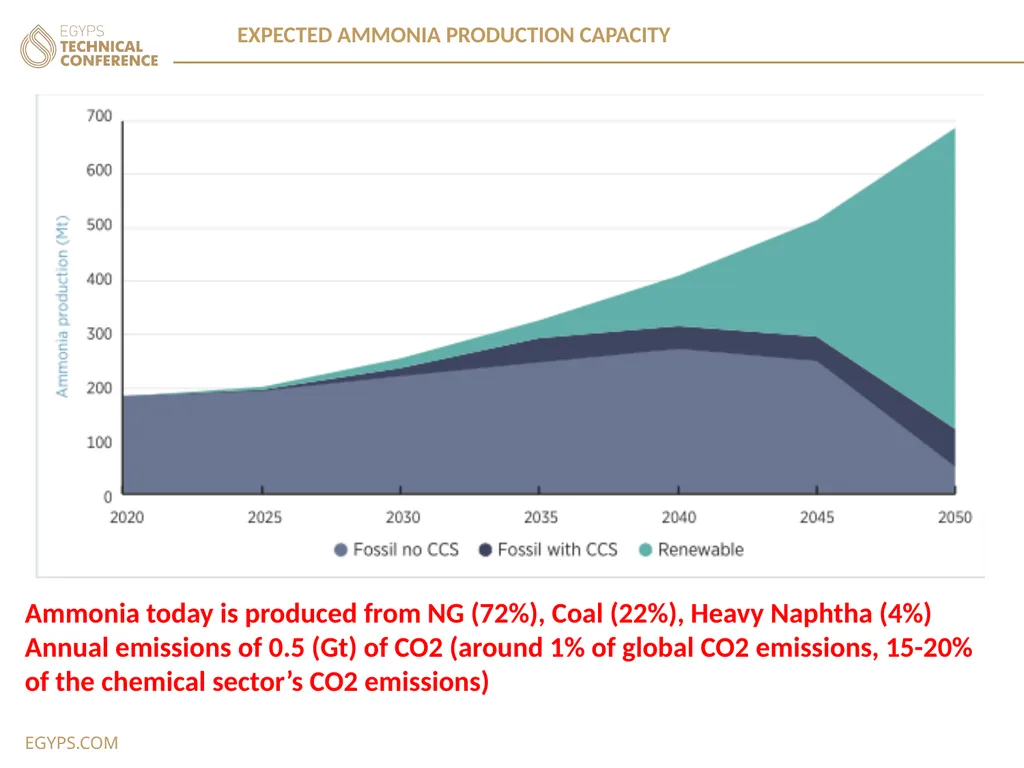
slide3. EGYPS.COM EXPECTED AMMONIA PRODUCTION CAPACITY Ammonia today is produced from NG (72%), Coal (22%), Heavy Naphtha (4%)
Annual emissions of 0.5 (Gt) of CO2 (around 1% of global CO2 emissions, 15-20% of the chemical sector’s CO2 emissions)<br>
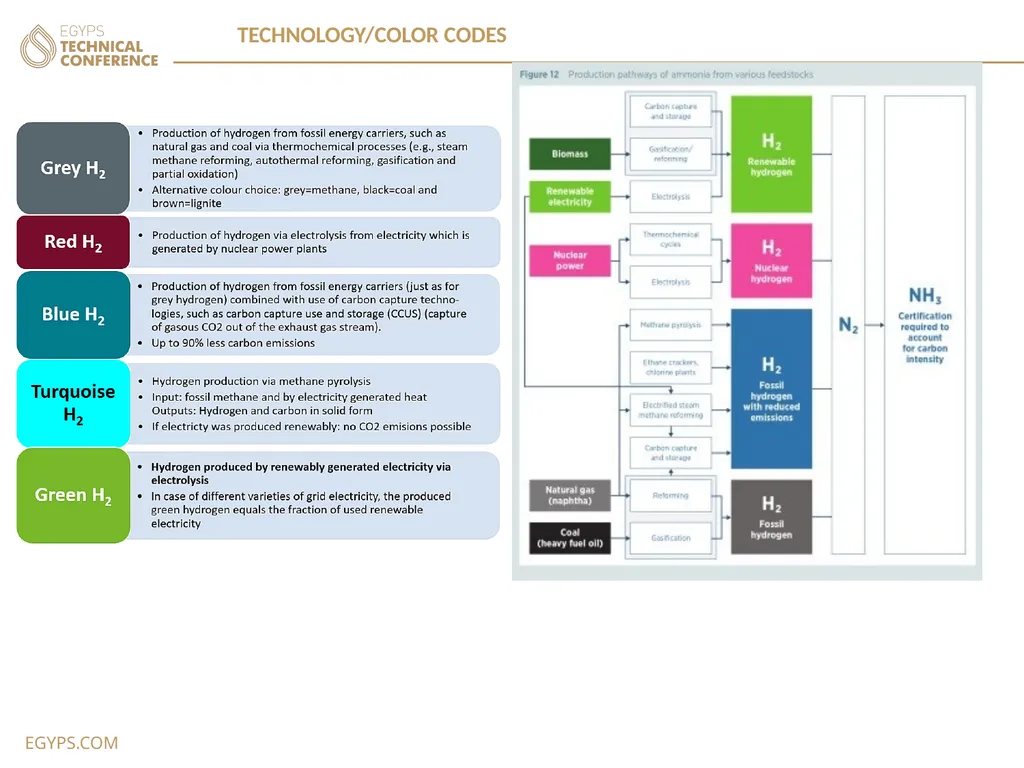
slide4. EGYPS.COM TECHNOLOGY/COLOR CODES<br>
slide5. EGYPS.COM ECONOMICAL In Solar Power No Country in Europe has similar potential
The bottom line: the electricity sector could save much by constructing solar farms, rather than fossil fuel alternatives. LCOE in constructing solar farms in optimum zones is 29.7% lower than investing in combined-gas turbines, and 37% lower than investing in diesel generators.<br>
slide6. EGYPS.COM LEGAL Many ammonia plants are integrated hybrids, incorporating more than one color
Some colors refer to carbon-free inputs or carbon abatement technologies
Colors lack legal definition and do not communicate the greenhouse gas emission intensity of the product,
Blue ammonia with a 70% carbon capture rate versus blue ammonia with a 98% carbon capture rate)
Robust certification schemes that can calculate and verify the emission intensity of ammonia will be essential, to distinguish between fossil-based ammonia, fossil-based ammonia with CCS, and renewable ammonia.
Separate markets will need to develop, supported by certification schemes, contracts for difference and other mechanisms<br>
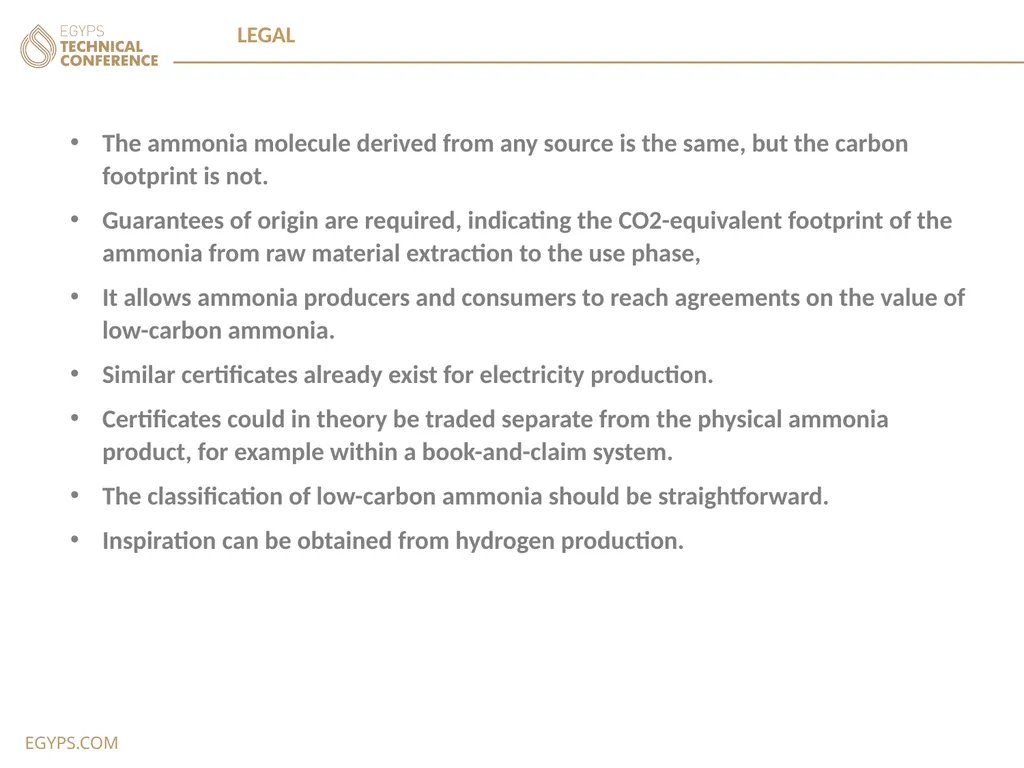
slide7. EGYPS.COM LEGAL The ammonia molecule derived from any source is the same, but the carbon footprint is not.
Guarantees of origin are required, indicating the CO2-equivalent footprint of the ammonia from raw material extraction to the use phase,
It allows ammonia producers and consumers to reach agreements on the value of low-carbon ammonia.
Similar certificates already exist for electricity production.
Certificates could in theory be traded separate from the physical ammonia product, for example within a book-and-claim system.
The classification of low-carbon ammonia should be straightforward.
Inspiration can be obtained from hydrogen production.<br>
slide8. EGYPS.COM LEGAL A system uses the term “low carbon” for hydrogen with a carbon footprint at least 60% lower than for SMR.
Comparison of lower-carbon fuels based on energy content rather than on mass basis allows for a level playing field among alternative fuels.
Focus should not only be on-site CO2 emissions but on all greenhouse gases as well as other criteria including water use and upstream emissions.
Various schemes are being pursued, including methodology development by IPHE (International Partnership for Hydrogen and Fuel Cells in the Economy) and an ammonia certification scheme under development by the Ammonia Energy Association.
Depending on the application, different ammonia purity levels may be required.
Certification schemes could provide both the CO2-equivalent footprint and the purity grade of the ammonia.<br>
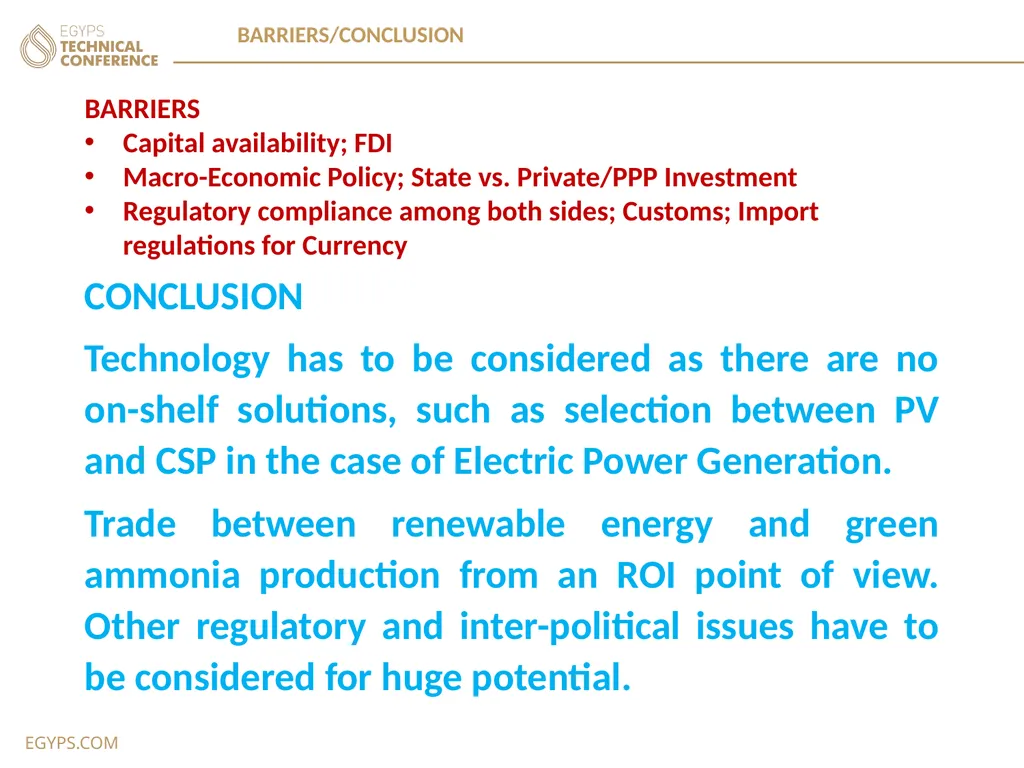
slide9. EGYPS.COM BARRIERS/CONCLUSION CONCLUSION
Technology has to be considered as there are no on-shelf solutions, such as selection between PV and CSP in the case of Electric Power Generation.
Trade between renewable energy and green ammonia production from an ROI point of view. Other regulatory and inter-political issues have to be considered for huge potential. BARRIERS
Capital availability; FDI
Macro-Economic Policy; State vs. Private/PPP Investment
Regulatory compliance among both sides; Customs; Import regulations for Currency<br>
slide10. AHMED ABDELHADY, HAYTHEM KAMEL, MONA ELMESSERY, Formation et Sensibilisation de Luxembourg-FSL
THANK YOU<br>
slide2. EGYPS.COM AMMONIA PRICE TREND Surge peaked in the fertilizers and Ammonia due to Russian Ukrainian Conflict
Feedstock prices (Natural Gas)/Distribution and Supply Chain/ Russia, Ukraine, Europe are Major market players Cont. increasing demand for fertilizers, Ammonia and Urea prices met levels that did not reach ever before<br>
slide3. EGYPS.COM EXPECTED AMMONIA PRODUCTION CAPACITY Ammonia today is produced from NG (72%), Coal (22%), Heavy Naphtha (4%)
Annual emissions of 0.5 (Gt) of CO2 (around 1% of global CO2 emissions, 15-20% of the chemical sector’s CO2 emissions)<br>
slide4. EGYPS.COM TECHNOLOGY/COLOR CODES<br>
slide5. EGYPS.COM ECONOMICAL In Solar Power No Country in Europe has similar potential
The bottom line: the electricity sector could save much by constructing solar farms, rather than fossil fuel alternatives. LCOE in constructing solar farms in optimum zones is 29.7% lower than investing in combined-gas turbines, and 37% lower than investing in diesel generators.<br>
slide6. EGYPS.COM LEGAL Many ammonia plants are integrated hybrids, incorporating more than one color
Some colors refer to carbon-free inputs or carbon abatement technologies
Colors lack legal definition and do not communicate the greenhouse gas emission intensity of the product,
Blue ammonia with a 70% carbon capture rate versus blue ammonia with a 98% carbon capture rate)
Robust certification schemes that can calculate and verify the emission intensity of ammonia will be essential, to distinguish between fossil-based ammonia, fossil-based ammonia with CCS, and renewable ammonia.
Separate markets will need to develop, supported by certification schemes, contracts for difference and other mechanisms<br>
slide7. EGYPS.COM LEGAL The ammonia molecule derived from any source is the same, but the carbon footprint is not.
Guarantees of origin are required, indicating the CO2-equivalent footprint of the ammonia from raw material extraction to the use phase,
It allows ammonia producers and consumers to reach agreements on the value of low-carbon ammonia.
Similar certificates already exist for electricity production.
Certificates could in theory be traded separate from the physical ammonia product, for example within a book-and-claim system.
The classification of low-carbon ammonia should be straightforward.
Inspiration can be obtained from hydrogen production.<br>
slide8. EGYPS.COM LEGAL A system uses the term “low carbon” for hydrogen with a carbon footprint at least 60% lower than for SMR.
Comparison of lower-carbon fuels based on energy content rather than on mass basis allows for a level playing field among alternative fuels.
Focus should not only be on-site CO2 emissions but on all greenhouse gases as well as other criteria including water use and upstream emissions.
Various schemes are being pursued, including methodology development by IPHE (International Partnership for Hydrogen and Fuel Cells in the Economy) and an ammonia certification scheme under development by the Ammonia Energy Association.
Depending on the application, different ammonia purity levels may be required.
Certification schemes could provide both the CO2-equivalent footprint and the purity grade of the ammonia.<br>
slide9. EGYPS.COM BARRIERS/CONCLUSION CONCLUSION
Technology has to be considered as there are no on-shelf solutions, such as selection between PV and CSP in the case of Electric Power Generation.
Trade between renewable energy and green ammonia production from an ROI point of view. Other regulatory and inter-political issues have to be considered for huge potential. BARRIERS
Capital availability; FDI
Macro-Economic Policy; State vs. Private/PPP Investment
Regulatory compliance among both sides; Customs; Import regulations for Currency<br>
slide10. AHMED ABDELHADY, HAYTHEM KAMEL, MONA ELMESSERY, Formation et Sensibilisation de Luxembourg-FSL
THANK YOU<br>