Session 7 International Trade: Comparative Advantage and Trade Barriers Disclaimer: The views expressed are those of the presenters and do not necessarily reflect those of the Federal Reserve Bank of Dallas or the Federal Reserve System.
Related Topics
Share
Embed code
Download this presentation From Below
"Session 7 International Trade: Comparative" is the property of its rightful owner. Permission is granted to
download and print the materials on this website for personal, non-commercial use only, and to display it
on your personal computer provided you do not modify the materials and that you retain all copyright
notices contained in the materials. By downloading content from our website, you accept the terms of this
agreement.
Presentation Transcript
01
Session 7 International Trade: Comparative Advantage and Trade Barriers Disclaimer: The views expressed are those of the presenters and do not necessarily reflect those of the Federal Reserve Bank of Dallas or the Federal Reserve System.<br>
02
TEKS (3) Economics. The student understands the reasons for international trade and its importance to the United States and the global economy. The student is expected to:
(A) explain the concepts of absolute and comparative advantages;
(B) apply the concept of comparative advantage to explain why and how countries trade; and
(C) analyze the impact of U.S. imports and exports on the United States and its trading partners.
(4) Economics. The student understands the issues of free trade and the effects of trade barriers. The student is expected to:
(A) compare the effects of free trade and trade barriers on economic activities;
evaluate the benefits and costs of participation in international free-trade agreements<br>
Why trade? All trade is voluntary
People trade because they believe that they will be better off by trading<br>
06
Absolute Advantage “The natural advantages which one country has over another in producing particular commodities are sometimes so great that it is acknowledged by all the world to be in vain to struggle with them.”
Adam Smith in “Wealth of Nations” Book IV, Chapter 2<br>
07
Comparative Advantage David Ricardo extended the ideas of Adam Smith
Nations could benefit from trade based on comparative advantage, not just absolute advantage
Comparative advantage refers to a country’s ability to produce a good at a lower opportunity cost than another country<br>
08
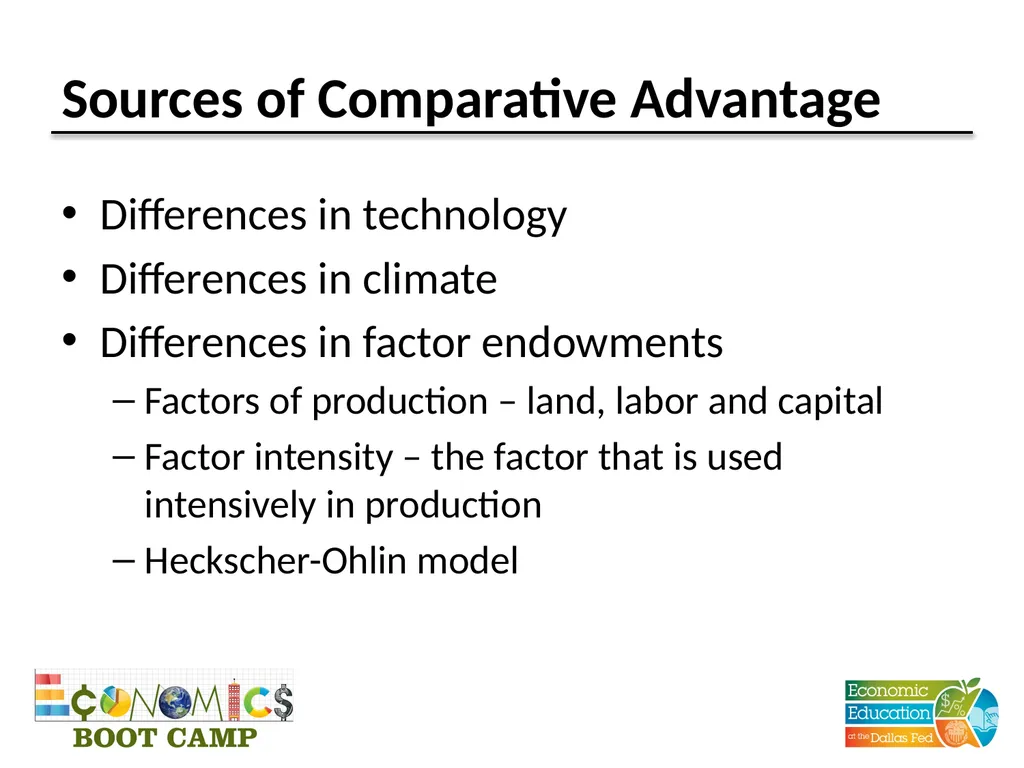
Sources of Comparative Advantage Differences in technology
Differences in climate
Differences in factor endowments
Factors of production – land, labor and capital
Factor intensity – the factor that is used intensively in production
Heckscher-Ohlin model<br>
09
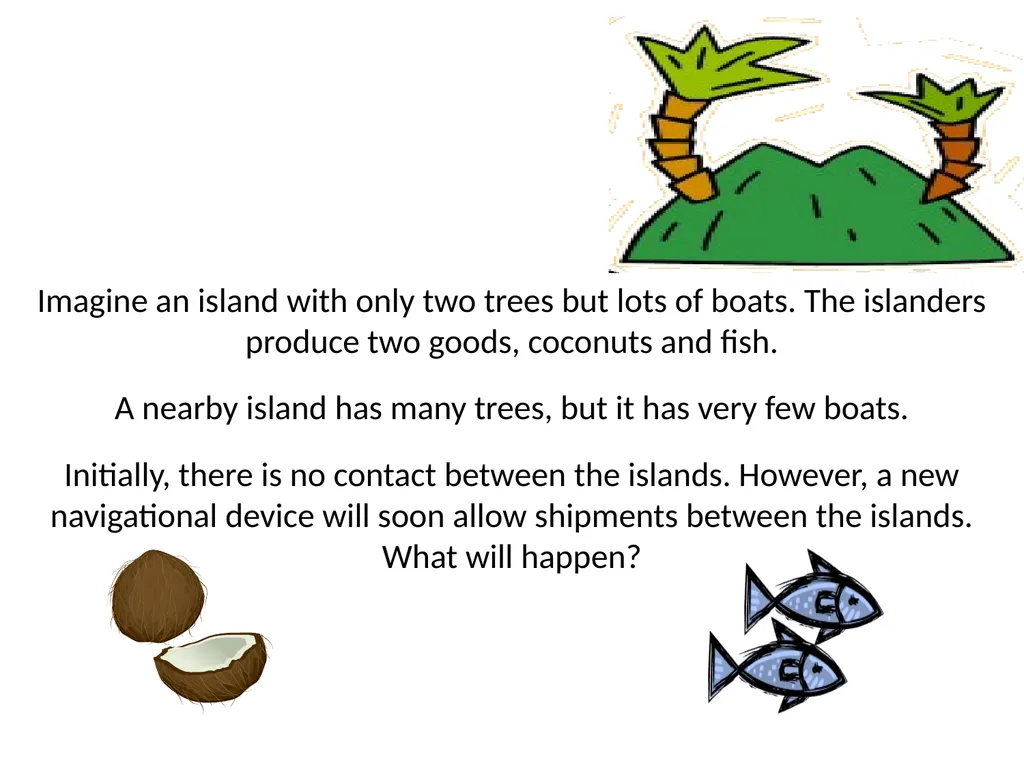
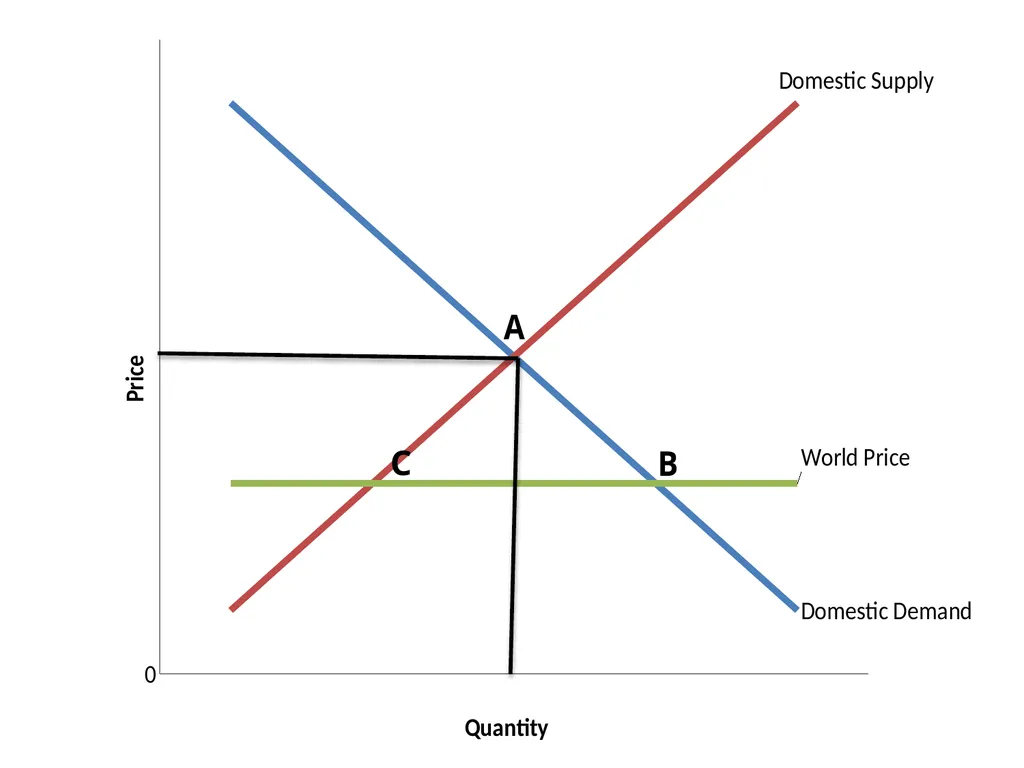
Imagine an island with only two trees but lots of boats. The islanders produce two goods, coconuts and fish.
A nearby island has many trees, but it has very few boats.
Initially, there is no contact between the islands. However, a new navigational device will soon allow shipments between the islands. What will happen?<br>
10
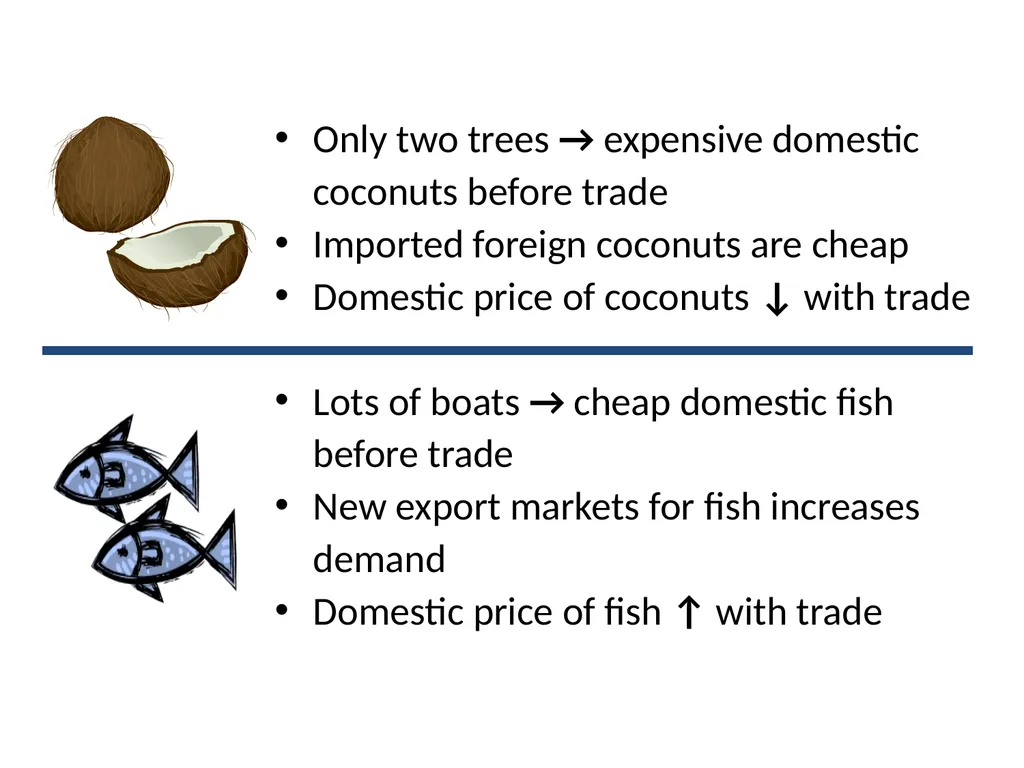
Only two trees → expensive domestic coconuts before trade
Imported foreign coconuts are cheap
Domestic price of coconuts ↓ with trade
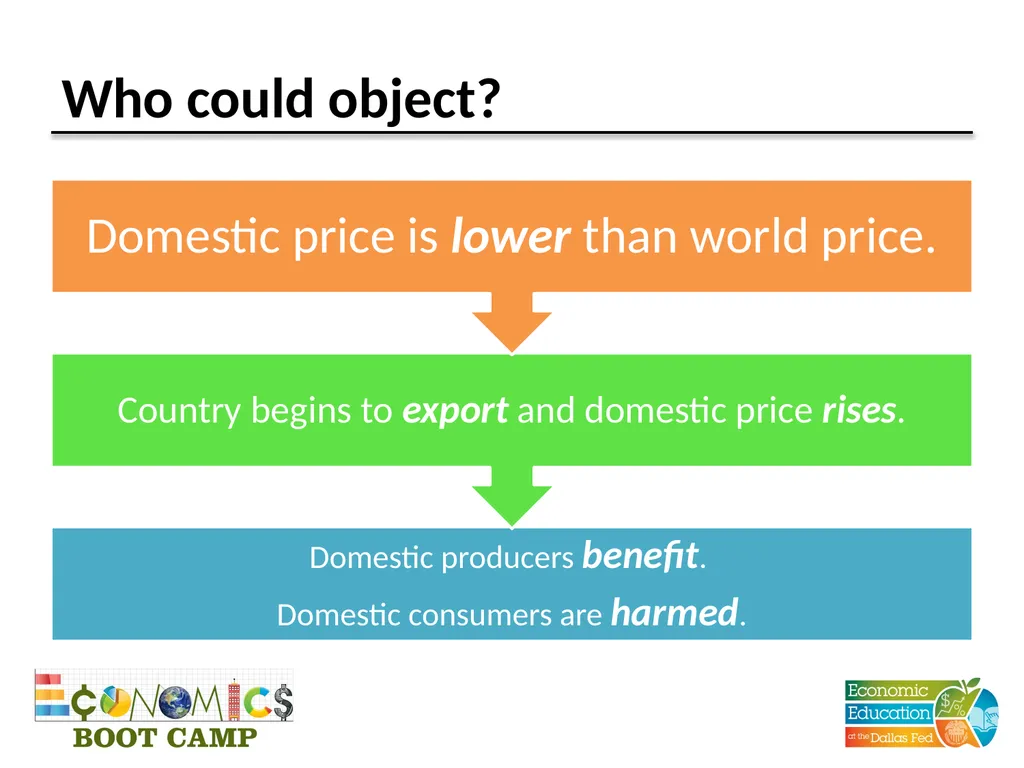
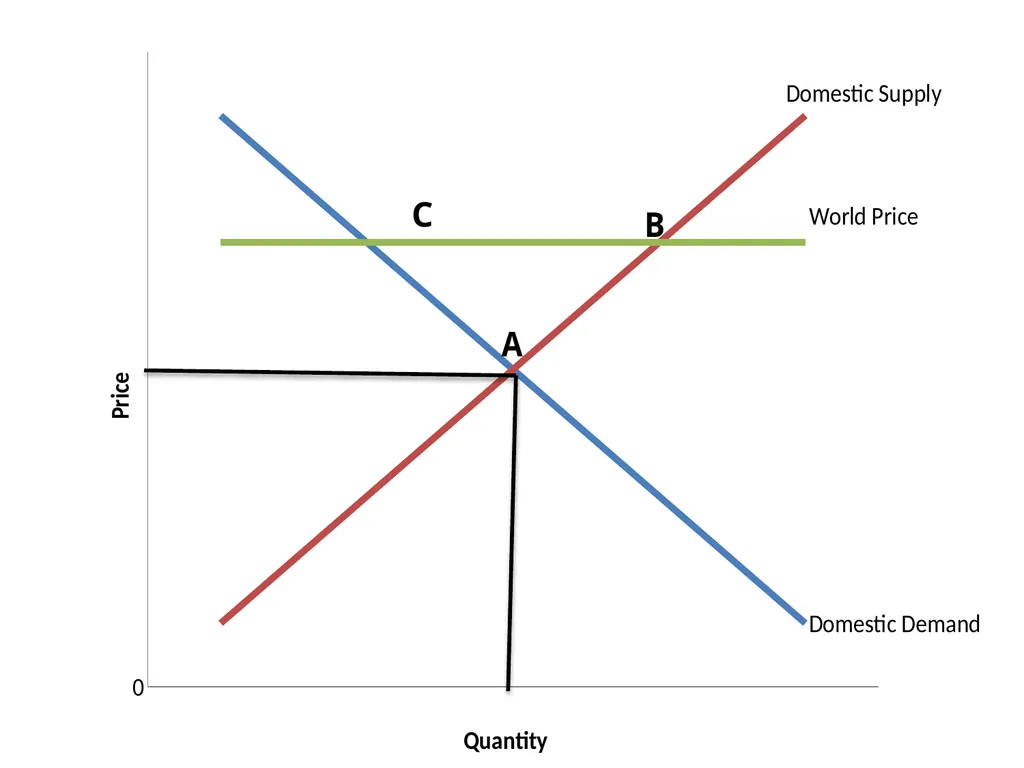
Lots of boats → cheap domestic fish before trade
New export markets for fish increases demand
Domestic price of fish ↑ with trade<br>
11
Who cares about the price of coconuts?
People who own trees (land)
People who climb trees (labor)
Who cares about the price of fish?
People who own boats (capital)
People who sail and fish (labor)<br>
12
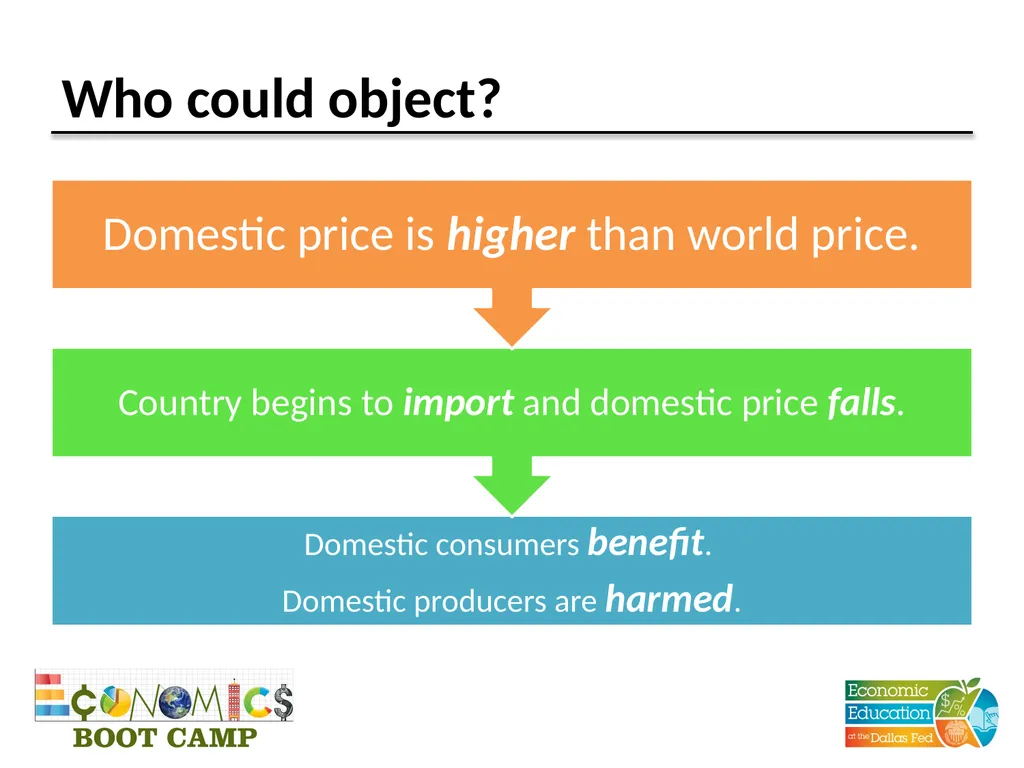
Who could object?<br>
13
C<br>
14
Who could object?<br>
15
C<br>
16
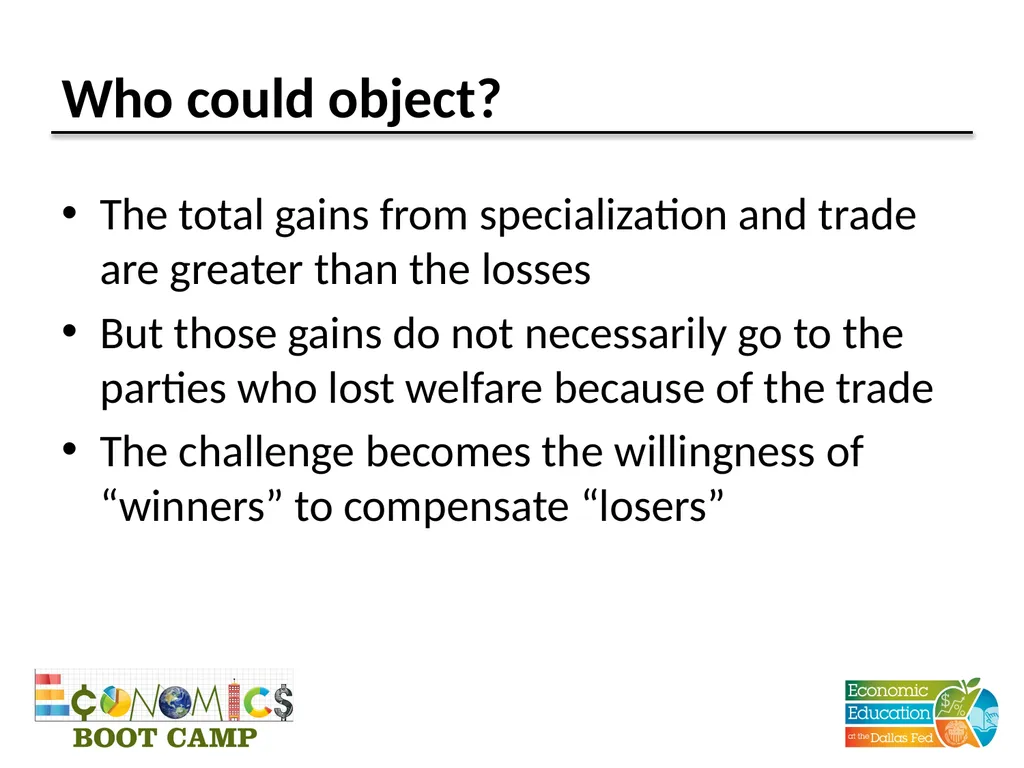
Who could object? The total gains from specialization and trade are greater than the losses
But those gains do not necessarily go to the parties who lost welfare because of the trade
The challenge becomes the willingness of “winners” to compensate “losers”<br>
17
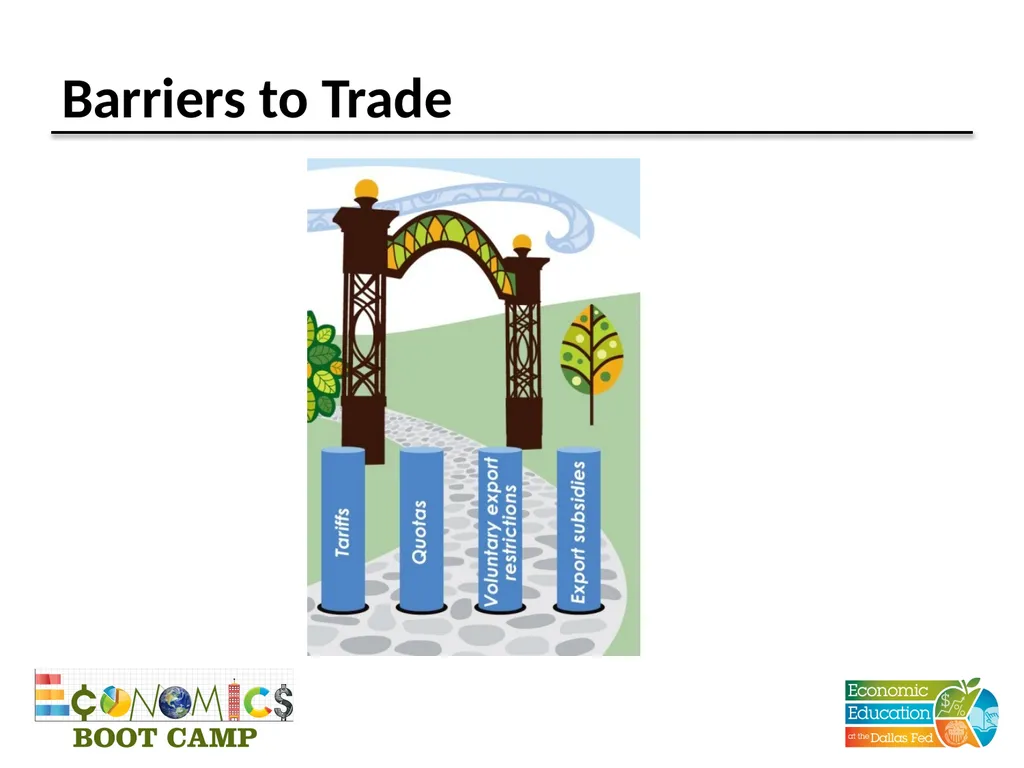
Barriers to Trade<br>
18
Tariff Tax on imported goods or services
Reasons for tariffs
Raise tax revenues
Reduce consumption of the imported good or service
Effect – Price of import rises, “cheaper” domestic goods become more attractive<br>
19
Quota Limits the amount of an imported good allowed into the country
Supply is decreased and price increases
Voluntary Export Restrictions (VER’s) are similar<br>
20
Export Subsidy Government financial assistance to a firm that allows a firm to sell its product at a reduced price
Benefits and harms
Consumers (both at home and abroad) benefit from lower prices
Foreign producers are harmed because of lower world prices
Taxpayers in the producing country pay the subsidy<br>
21
Product Standards A type of “hidden” trade barrier
Types of standards
Product safety
Content
Packaging<br>
22
Trade Agreements General Agreement on Trade and Tariffs (GATT) and World Trade Organization (WTO)
Regional trade agreements<br>
23
GATT “Provisional” agreement (1948 – 1994)
Dramatic tariff reductions were negotiated in a series of trade rounds
Grew from 23 to 123 countries<br>
24
WTO WTO created in the Uruguay trade round
Established in Geneva in 1995
153 member countries
GATT was updated and still forms the legal framework for WTO negotiations on the goods trade<br>
25
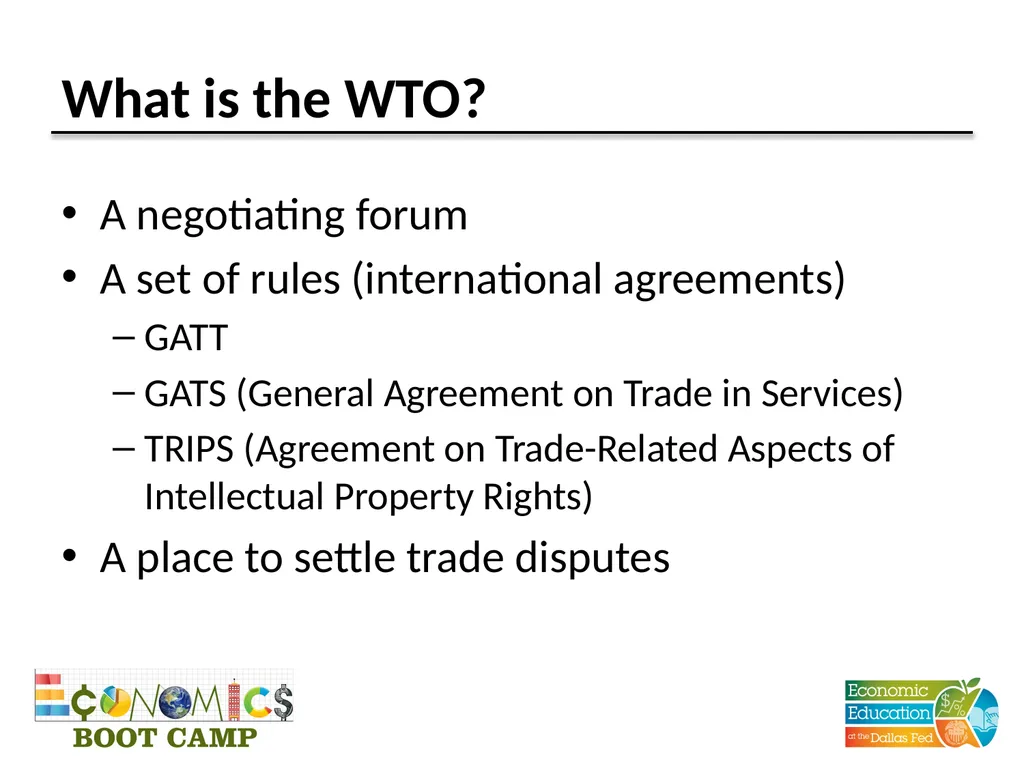
What is the WTO? A negotiating forum
A set of rules (international agreements)
GATT
GATS (General Agreement on Trade in Services)
TRIPS (Agreement on Trade-Related Aspects of Intellectual Property Rights)
A place to settle trade disputes<br>
26
Regional Trade Agreements Examples include
North American Free Trade Agreement
Association of Southeast Asian Nations
Common Market of the South (MERCOSUR)
European Union
Regional agreements have been praised and criticized<br>