
SHARING ECONOMY Partner: IDP Objectives & Goals At
MJ
Published · 17 slides · 0 views

1 / 1



Description
SHARING ECONOMY Partner: IDP Objectives Goals At the end of this module you will be able to: Understand the values and main features of sharing economy Know the differences between traditional and sharing economy Launch a business in
Related Topics
Share
Embed code
Download this presentation From Below
"SHARING ECONOMY Partner: IDP Objectives & Goals At" is the property of its rightful owner. Permission is granted to download and print the materials on this website for personal, non-commercial use only, and to display it on your personal computer provided you do not modify the materials and that you retain all copyright notices contained in the materials. By downloading content from our website, you accept the terms of this agreement.
Presentation Transcript
01
SHARING ECONOMY
Partner: IDP<br>
Partner: IDP<br>
02
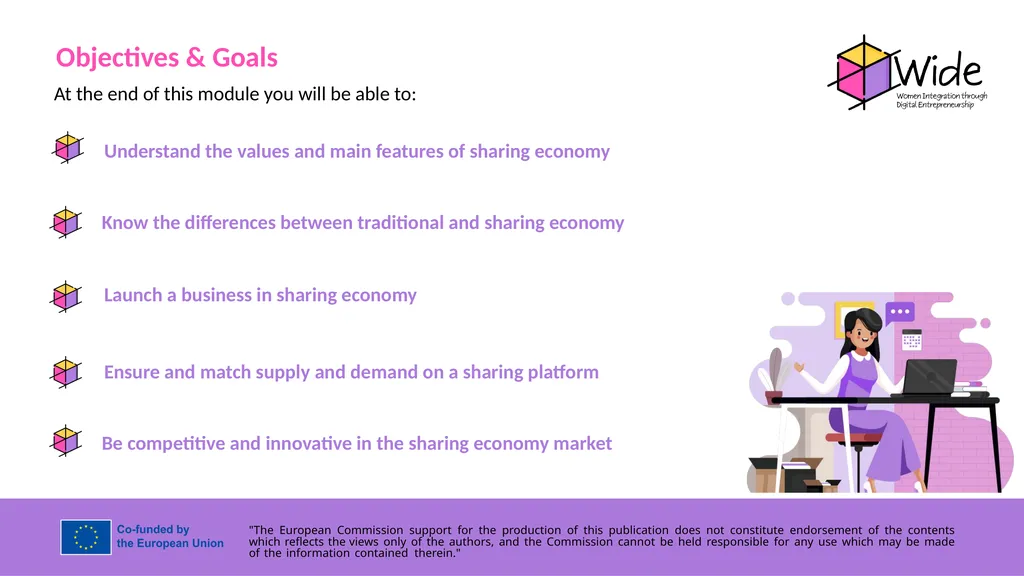
Objectives & Goals At the end of this module you will be able to: Understand the values and main features of sharing economy Know the differences between traditional and sharing economy Launch a business in sharing economy Ensure and match supply and demand on a sharing platform Be competitive and innovative in the sharing economy market<br>
03
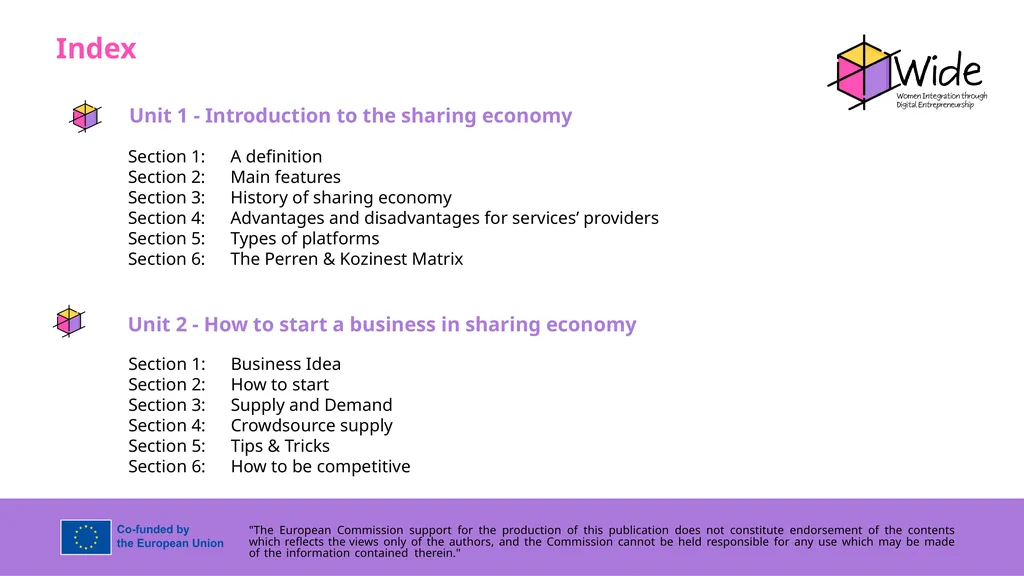
Index Unit 1 - Introduction to the sharing economy Section 1: A definition
Section 2: Main features
Section 3: History of sharing economy
Section 4: Advantages and disadvantages for services’ providers
Section 5: Types of platforms
Section 6: The Perren & Kozinest Matrix Unit 2 - How to start a business in sharing economy Section 1: Business Idea
Section 2: How to start
Section 3: Supply and Demand
Section 4: Crowdsource supply
Section 5: Tips & Tricks
Section 6: How to be competitive<br>
Section 2: Main features
Section 3: History of sharing economy
Section 4: Advantages and disadvantages for services’ providers
Section 5: Types of platforms
Section 6: The Perren & Kozinest Matrix Unit 2 - How to start a business in sharing economy Section 1: Business Idea
Section 2: How to start
Section 3: Supply and Demand
Section 4: Crowdsource supply
Section 5: Tips & Tricks
Section 6: How to be competitive<br>
04
1. Sharing economy – A definition Sharing economy can be described as a new economic model in which goods and resources are exchanged or shared among individuals and groups in a collaborative way, such that physical assets become services. Sharing economy is strictly relayed to the development of new technologies of information and communication, which are combined with everlasting communal modes of operation.
Here some of the most famous examples:<br>
Here some of the most famous examples:<br>
05
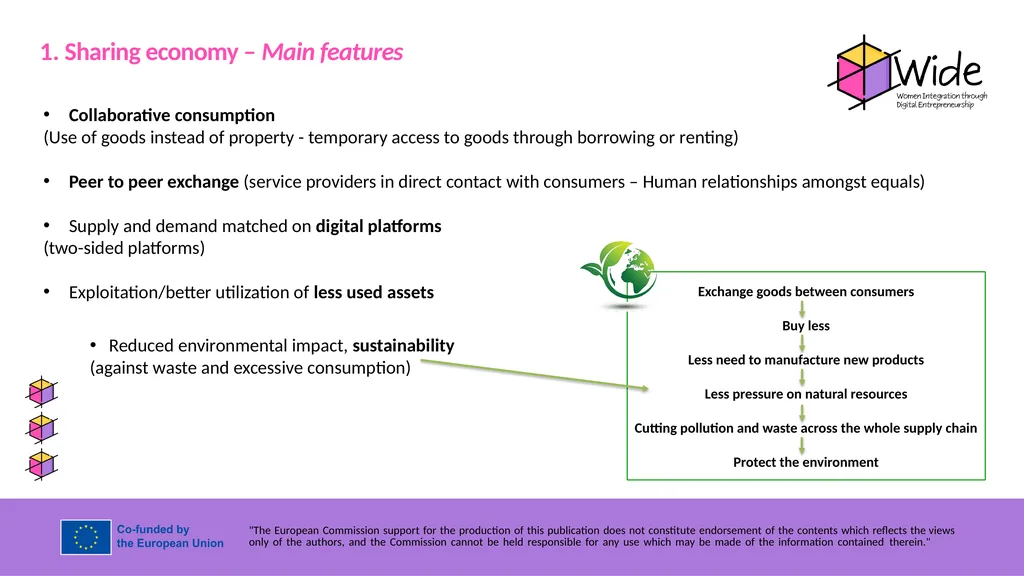
1. Sharing economy – Main features Collaborative consumption
(Use of goods instead of property - temporary access to goods through borrowing or renting)
Peer to peer exchange (service providers in direct contact with consumers – Human relationships amongst equals)
Supply and demand matched on digital platforms
(two-sided platforms)
Exploitation/better utilization of less used assets Reduced environmental impact, sustainability
(against waste and excessive consumption) Exchange goods between consumers
Buy less
Less need to manufacture new products
Less pressure on natural resources
Cutting pollution and waste across the whole supply chain
Protect the environment<br>
(Use of goods instead of property - temporary access to goods through borrowing or renting)
Peer to peer exchange (service providers in direct contact with consumers – Human relationships amongst equals)
Supply and demand matched on digital platforms
(two-sided platforms)
Exploitation/better utilization of less used assets Reduced environmental impact, sustainability
(against waste and excessive consumption) Exchange goods between consumers
Buy less
Less need to manufacture new products
Less pressure on natural resources
Cutting pollution and waste across the whole supply chain
Protect the environment<br>
06
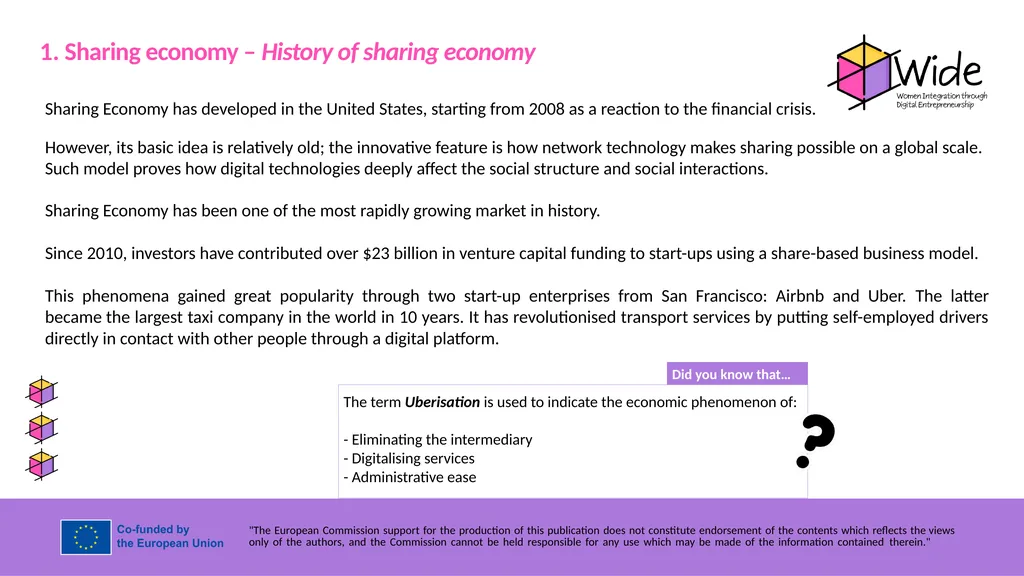
1. Sharing economy – History of sharing economy Sharing Economy has developed in the United States, starting from 2008 as a reaction to the financial crisis. Sharing Economy has been one of the most rapidly growing market in history.
Since 2010, investors have contributed over $23 billion in venture capital funding to start-ups using a share-based business model.
This phenomena gained great popularity through two start-up enterprises from San Francisco: Airbnb and Uber. The latter became the largest taxi company in the world in 10 years. It has revolutionised transport services by putting self-employed drivers directly in contact with other people through a digital platform. Did you know that… The term Uberisation is used to indicate the economic phenomenon of:
- Eliminating the intermediary
- Digitalising services
- Administrative ease However, its basic idea is relatively old; the innovative feature is how network technology makes sharing possible on a global scale.
Such model proves how digital technologies deeply affect the social structure and social interactions.<br>
Since 2010, investors have contributed over $23 billion in venture capital funding to start-ups using a share-based business model.
This phenomena gained great popularity through two start-up enterprises from San Francisco: Airbnb and Uber. The latter became the largest taxi company in the world in 10 years. It has revolutionised transport services by putting self-employed drivers directly in contact with other people through a digital platform. Did you know that… The term Uberisation is used to indicate the economic phenomenon of:
- Eliminating the intermediary
- Digitalising services
- Administrative ease However, its basic idea is relatively old; the innovative feature is how network technology makes sharing possible on a global scale.
Such model proves how digital technologies deeply affect the social structure and social interactions.<br>
07
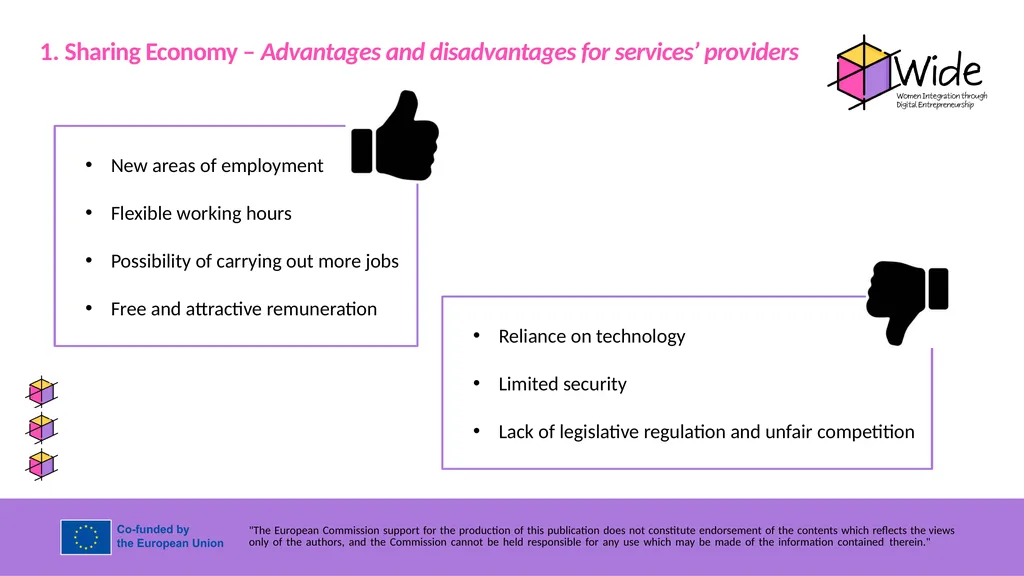
1. Sharing Economy – Advantages and disadvantages for services’ providers New areas of employment
Flexible working hours
Possibility of carrying out more jobs
Free and attractive remuneration Reliance on technology
Limited security
Lack of legislative regulation and unfair competition<br>
Flexible working hours
Possibility of carrying out more jobs
Free and attractive remuneration Reliance on technology
Limited security
Lack of legislative regulation and unfair competition<br>
08
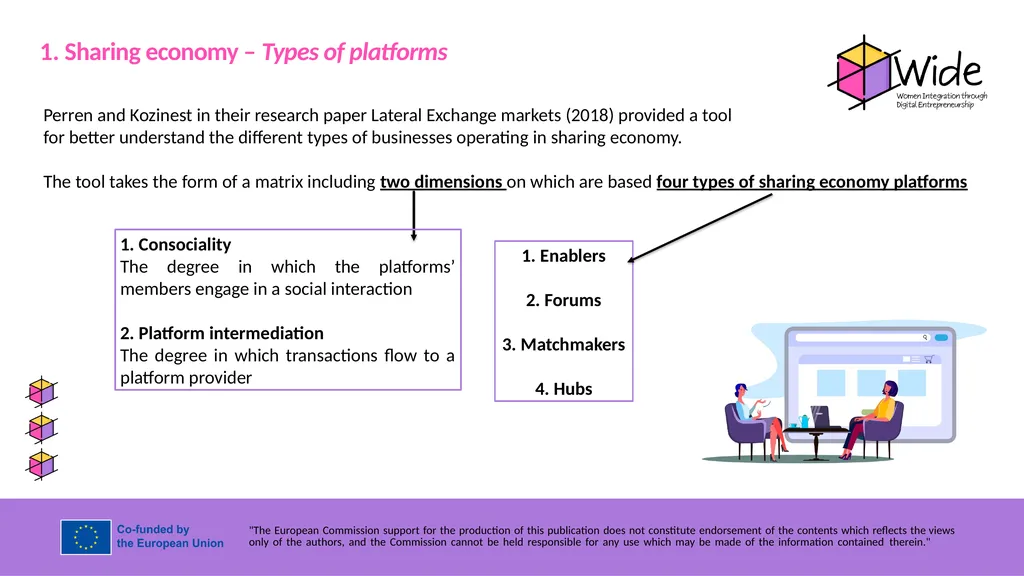
1. Sharing economy – Types of platforms Perren and Kozinest in their research paper Lateral Exchange markets (2018) provided a tool
for better understand the different types of businesses operating in sharing economy.
The tool takes the form of a matrix including two dimensions on which are based four types of sharing economy platforms 1. Consociality
The degree in which the platforms’ members engage in a social interaction
2. Platform intermediation
The degree in which transactions flow to a platform provider 1. Enablers
2. Forums
3. Matchmakers
4. Hubs<br>
for better understand the different types of businesses operating in sharing economy.
The tool takes the form of a matrix including two dimensions on which are based four types of sharing economy platforms 1. Consociality
The degree in which the platforms’ members engage in a social interaction
2. Platform intermediation
The degree in which transactions flow to a platform provider 1. Enablers
2. Forums
3. Matchmakers
4. Hubs<br>
09
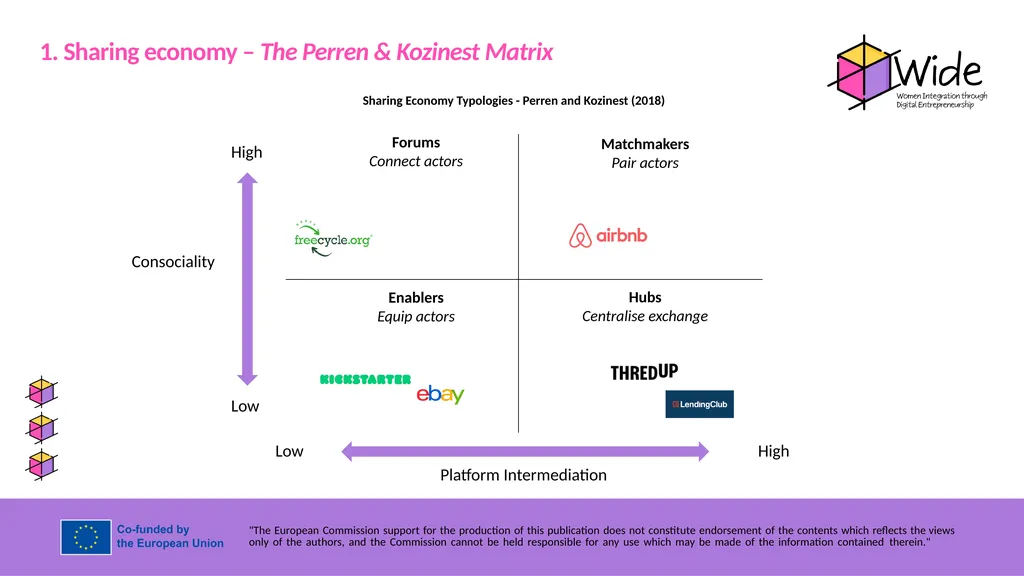
1. Sharing economy – The Perren & Kozinest Matrix Sharing Economy Typologies - Perren and Kozinest (2018) Consociality Platform Intermediation High Low High Low Forums
Connect actors Enablers
Equip actors Matchmakers
Pair actors Hubs
Centralise exchange<br>
Connect actors Enablers
Equip actors Matchmakers
Pair actors Hubs
Centralise exchange<br>
10
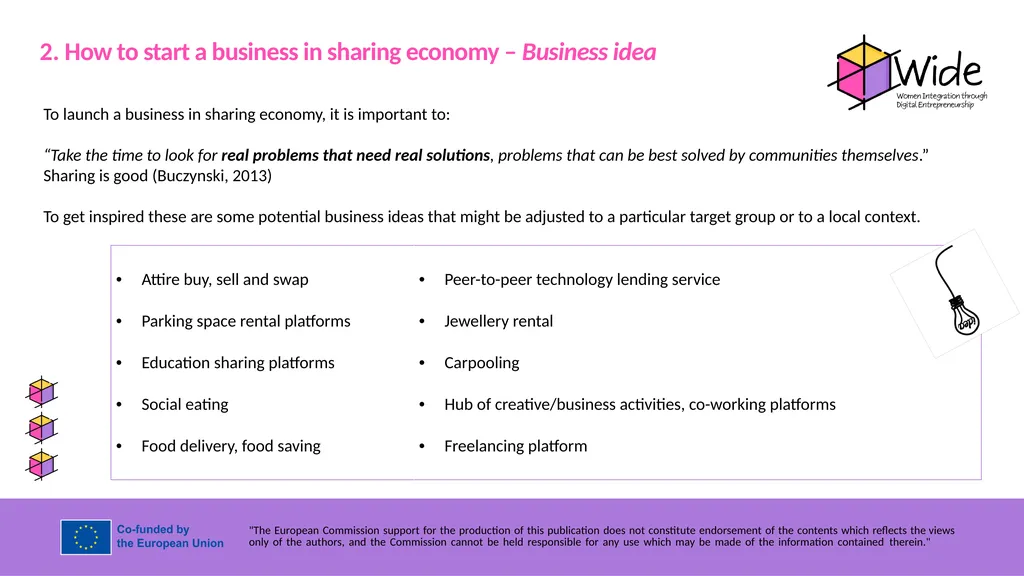
2. How to start a business in sharing economy – Business idea To launch a business in sharing economy, it is important to:
“Take the time to look for real problems that need real solutions, problems that can be best solved by communities themselves.” Sharing is good (Buczynski, 2013)
To get inspired these are some potential business ideas that might be adjusted to a particular target group or to a local context.<br>
“Take the time to look for real problems that need real solutions, problems that can be best solved by communities themselves.” Sharing is good (Buczynski, 2013)
To get inspired these are some potential business ideas that might be adjusted to a particular target group or to a local context.<br>
11
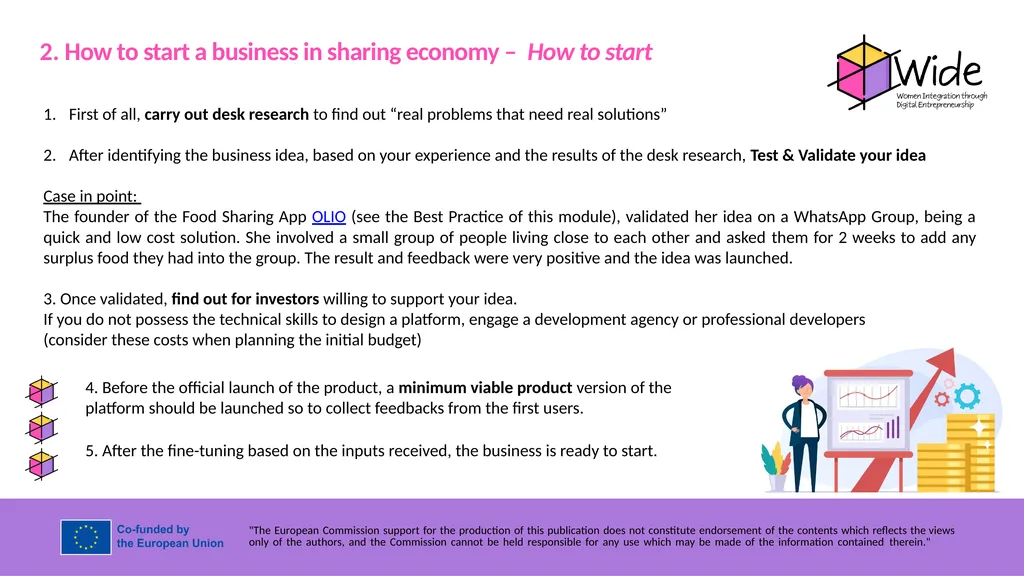
2. How to start a business in sharing economy – How to start First of all, carry out desk research to find out “real problems that need real solutions”
After identifying the business idea, based on your experience and the results of the desk research, Test & Validate your idea
Case in point:
The founder of the Food Sharing App OLIO (see the Best Practice of this module), validated her idea on a WhatsApp Group, being a quick and low cost solution. She involved a small group of people living close to each other and asked them for 2 weeks to add any surplus food they had into the group. The result and feedback were very positive and the idea was launched.
3. Once validated, find out for investors willing to support your idea.
If you do not possess the technical skills to design a platform, engage a development agency or professional developers
(consider these costs when planning the initial budget) 4. Before the official launch of the product, a minimum viable product version of the platform should be launched so to collect feedbacks from the first users. 5. After the fine-tuning based on the inputs received, the business is ready to start.<br>
After identifying the business idea, based on your experience and the results of the desk research, Test & Validate your idea
Case in point:
The founder of the Food Sharing App OLIO (see the Best Practice of this module), validated her idea on a WhatsApp Group, being a quick and low cost solution. She involved a small group of people living close to each other and asked them for 2 weeks to add any surplus food they had into the group. The result and feedback were very positive and the idea was launched.
3. Once validated, find out for investors willing to support your idea.
If you do not possess the technical skills to design a platform, engage a development agency or professional developers
(consider these costs when planning the initial budget) 4. Before the official launch of the product, a minimum viable product version of the platform should be launched so to collect feedbacks from the first users. 5. After the fine-tuning based on the inputs received, the business is ready to start.<br>
12
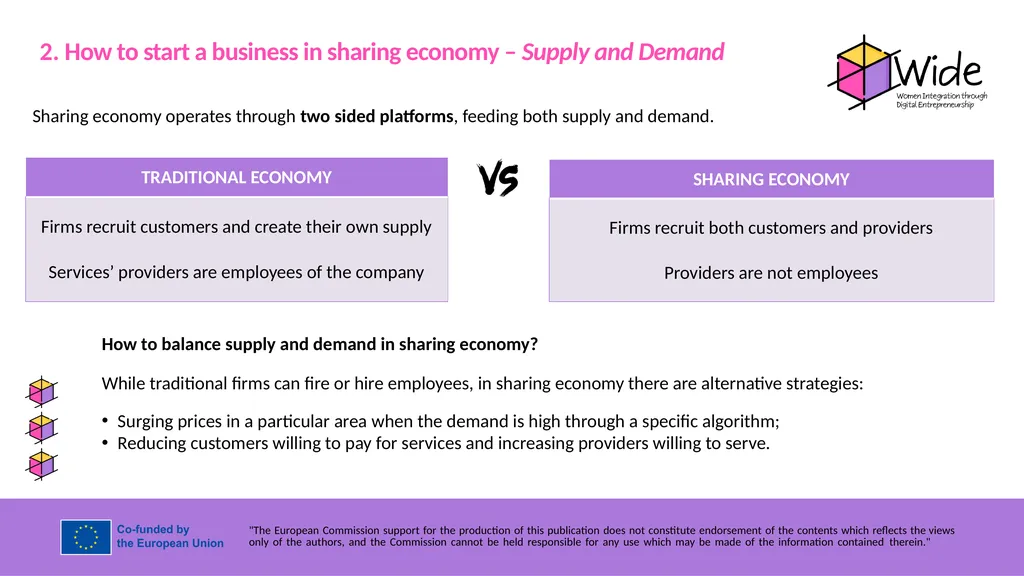
2. How to start a business in sharing economy – Supply and Demand How to balance supply and demand in sharing economy?
While traditional firms can fire or hire employees, in sharing economy there are alternative strategies: Surging prices in a particular area when the demand is high through a specific algorithm;
Reducing customers willing to pay for services and increasing providers willing to serve. Sharing economy operates through two sided platforms, feeding both supply and demand.<br>
While traditional firms can fire or hire employees, in sharing economy there are alternative strategies: Surging prices in a particular area when the demand is high through a specific algorithm;
Reducing customers willing to pay for services and increasing providers willing to serve. Sharing economy operates through two sided platforms, feeding both supply and demand.<br>
13
2. How to start a business in sharing economy – Crowdsource supply To leverage supply and demand different strategies should be adopted.
Example
A service that allows cars’ owners parking at the airport to rent out their cars to other travelers:
Secures renters through paid acquisition, such as display advertising or rental search aggregators;
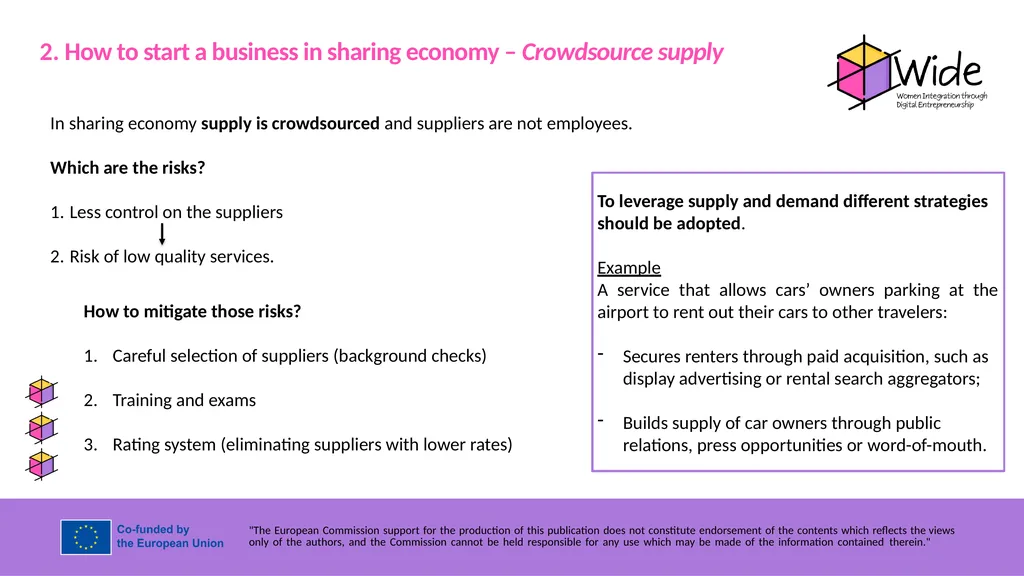
Builds supply of car owners through public relations, press opportunities or word-of-mouth. In sharing economy supply is crowdsourced and suppliers are not employees.
Which are the risks?
Less control on the suppliers
Risk of low quality services. How to mitigate those risks?
Careful selection of suppliers (background checks)
Training and exams
Rating system (eliminating suppliers with lower rates)<br>
Example
A service that allows cars’ owners parking at the airport to rent out their cars to other travelers:
Secures renters through paid acquisition, such as display advertising or rental search aggregators;
Builds supply of car owners through public relations, press opportunities or word-of-mouth. In sharing economy supply is crowdsourced and suppliers are not employees.
Which are the risks?
Less control on the suppliers
Risk of low quality services. How to mitigate those risks?
Careful selection of suppliers (background checks)
Training and exams
Rating system (eliminating suppliers with lower rates)<br>
14
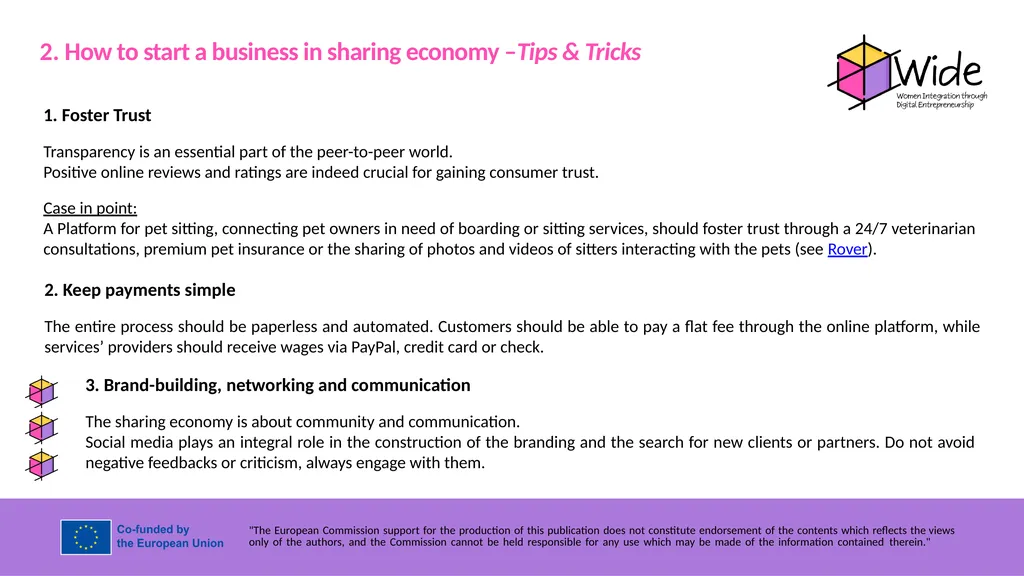
2. How to start a business in sharing economy –Tips & Tricks 1. Foster Trust
Transparency is an essential part of the peer-to-peer world.
Positive online reviews and ratings are indeed crucial for gaining consumer trust.
Case in point:
A Platform for pet sitting, connecting pet owners in need of boarding or sitting services, should foster trust through a 24/7 veterinarian consultations, premium pet insurance or the sharing of photos and videos of sitters interacting with the pets (see Rover). 2. Keep payments simple
The entire process should be paperless and automated. Customers should be able to pay a flat fee through the online platform, while services’ providers should receive wages via PayPal, credit card or check. 3. Brand-building, networking and communication
The sharing economy is about community and communication.
Social media plays an integral role in the construction of the branding and the search for new clients or partners. Do not avoid negative feedbacks or criticism, always engage with them.<br>
Transparency is an essential part of the peer-to-peer world.
Positive online reviews and ratings are indeed crucial for gaining consumer trust.
Case in point:
A Platform for pet sitting, connecting pet owners in need of boarding or sitting services, should foster trust through a 24/7 veterinarian consultations, premium pet insurance or the sharing of photos and videos of sitters interacting with the pets (see Rover). 2. Keep payments simple
The entire process should be paperless and automated. Customers should be able to pay a flat fee through the online platform, while services’ providers should receive wages via PayPal, credit card or check. 3. Brand-building, networking and communication
The sharing economy is about community and communication.
Social media plays an integral role in the construction of the branding and the search for new clients or partners. Do not avoid negative feedbacks or criticism, always engage with them.<br>
15
2. How to start a business in sharing economy – How to be competitive Today, there are plenty of sharing services and platforms available.
People choose those services mainly because of lower prices; in order to keep the offer attractive, it is therefore necessary to be competitive in the price positioning.
However, if the final goal is to create innovative solutions, there is much more to be done:
Lack of regulation in sharing economy often results in the exploitation of the suppliers or negatively affects the traditional economy.
There is an increasing awareness of the “dark sides” of sharing economy; for this reason, people are more and more in search for fairer and sustainable ways of consumption. New businesses should bring back sharing economy to its original meaning, to the creation and development of:
Sustainable consumption practices
Sense of belonging to a community<br>
People choose those services mainly because of lower prices; in order to keep the offer attractive, it is therefore necessary to be competitive in the price positioning.
However, if the final goal is to create innovative solutions, there is much more to be done:
Lack of regulation in sharing economy often results in the exploitation of the suppliers or negatively affects the traditional economy.
There is an increasing awareness of the “dark sides” of sharing economy; for this reason, people are more and more in search for fairer and sustainable ways of consumption. New businesses should bring back sharing economy to its original meaning, to the creation and development of:
Sustainable consumption practices
Sense of belonging to a community<br>
16
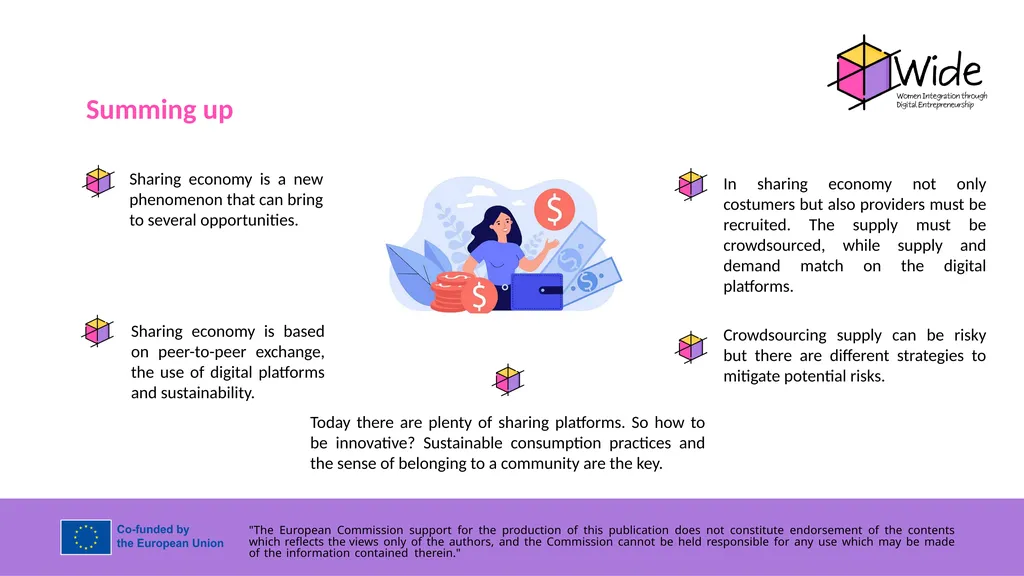
Summing up Sharing economy is a new phenomenon that can bring to several opportunities. Sharing economy is based on peer-to-peer exchange, the use of digital platforms and sustainability. In sharing economy not only costumers but also providers must be recruited. The supply must be crowdsourced, while supply and demand match on the digital platforms. Crowdsourcing supply can be risky but there are different strategies to mitigate potential risks. Today there are plenty of sharing platforms. So how to be innovative? Sustainable consumption practices and the sense of belonging to a community are the key.<br>
17
Thank you! Partner: IDP<br>