
SPTel: harnessing the power of software-defined
NS
Published · 12 slides · 0 views

1 / 1


Description
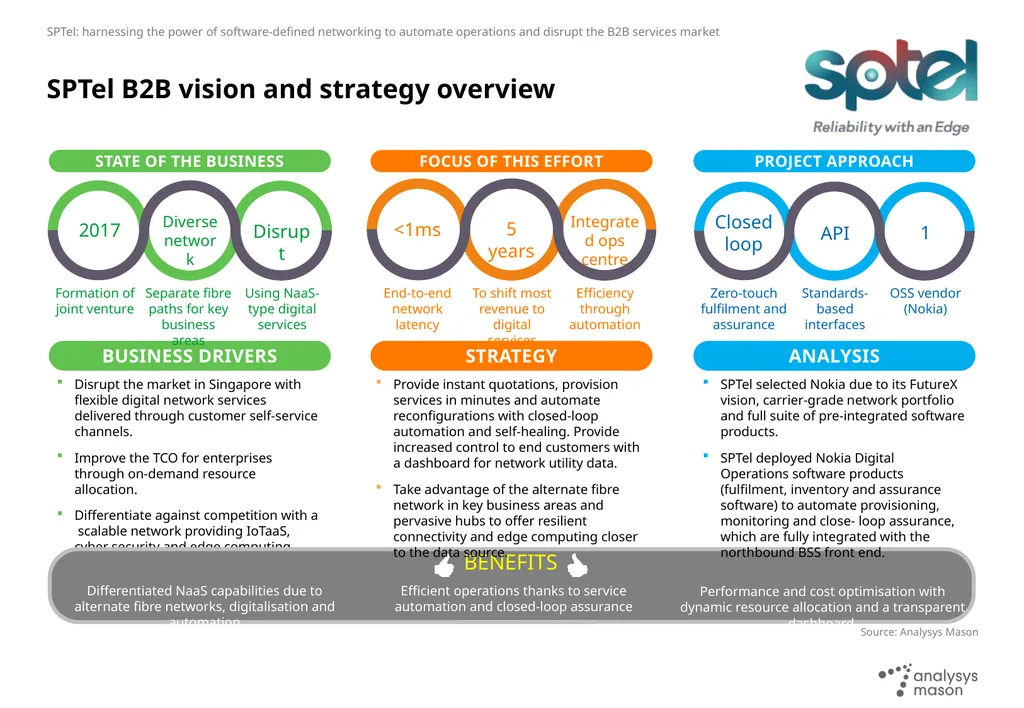
SPTel: harnessing the power of software-defined networking to automate operations and disrupt the B2B services market Anil Rao SPTel B2B vision and strategy overview FOCUS OF THIS EFFORT PROJECT APPROACH STATE OF THE BUSINESS STRATEGY
Related Topics
Share
Embed code
Download this presentation From Below
"SPTel: harnessing the power of software-defined" is the property of its rightful owner. Permission is granted to download and print the materials on this website for personal, non-commercial use only, and to display it on your personal computer provided you do not modify the materials and that you retain all copyright notices contained in the materials. By downloading content from our website, you accept the terms of this agreement.
Presentation Transcript
01
SPTel: harnessing the power of software-defined networking to automate operations and disrupt the B2B services market Anil Rao<br>
02
SPTel B2B vision and strategy overview FOCUS OF THIS EFFORT PROJECT APPROACH STATE OF THE BUSINESS STRATEGY ANALYSIS BUSINESS DRIVERS Formation of joint venture Separate fibre paths for key business areas Using NaaS-type digital services End-to-end network latency To shift most revenue to digital services Efficiency through automation Zero-touch fulfilment and assurance Standards-based interfaces OSS vendor (Nokia) Disrupt the market in Singapore with flexible digital network services delivered through customer self-service channels.
Improve the TCO for enterprises through on-demand resource allocation.
Differentiate against competition with a scalable network providing IoTaaS, cyber security and edge computing. BENEFITS Performance and cost optimisation with dynamic resource allocation and a transparent dashboard Provide instant quotations, provision services in minutes and automate reconfigurations with closed-loop automation and self-healing. Provide increased control to end customers with a dashboard for network utility data.
Take advantage of the alternate fibre network in key business areas and pervasive hubs to offer resilient connectivity and edge computing closer to the data source. SPTel selected Nokia due to its FutureX vision, carrier-grade network portfolio and full suite of pre-integrated software products.
SPTel deployed Nokia Digital Operations software products (fulfilment, inventory and assurance software) to automate provisioning, monitoring and close- loop assurance, which are fully integrated with the northbound BSS front end. 2017 Diverse network Disrupt <1ms 5 years Integrated ops centre Closed loop API 1 Differentiated NaaS capabilities due to alternate fibre networks, digitalisation and automation Efficient operations thanks to service automation and closed-loop assurance Source: Analysys Mason<br>
Improve the TCO for enterprises through on-demand resource allocation.
Differentiate against competition with a scalable network providing IoTaaS, cyber security and edge computing. BENEFITS Performance and cost optimisation with dynamic resource allocation and a transparent dashboard Provide instant quotations, provision services in minutes and automate reconfigurations with closed-loop automation and self-healing. Provide increased control to end customers with a dashboard for network utility data.
Take advantage of the alternate fibre network in key business areas and pervasive hubs to offer resilient connectivity and edge computing closer to the data source. SPTel selected Nokia due to its FutureX vision, carrier-grade network portfolio and full suite of pre-integrated software products.
SPTel deployed Nokia Digital Operations software products (fulfilment, inventory and assurance software) to automate provisioning, monitoring and close- loop assurance, which are fully integrated with the northbound BSS front end. 2017 Diverse network Disrupt <1ms 5 years Integrated ops centre Closed loop API 1 Differentiated NaaS capabilities due to alternate fibre networks, digitalisation and automation Efficient operations thanks to service automation and closed-loop assurance Source: Analysys Mason<br>
03
SPTel recognised an opportunity to disrupt the enterprise services market in Singapore by providing on-demand network services based on a fully automated SDN-based fibre network.
SPTel’s infrastructure uses an alternative fibre network that is highly resilient and provides network diversity. It uses unique fibre pathways that combine leased SP Group infrastructure and its own fibre pipes, which are laid alongside the power network cables. SPTel launched IoT-aaS (2018), SDN (June 2020), an SD-WAN extension to the home (September 2020) and NFV for cloud-based network and security services (December 2020) in order to address the growing demand for dynamic connectivity services and as-a-service business models.
SPTel is also deploying several edge cloud locations across Singapore to enable data processing closer to the source. Edge clouds are more responsive than public clouds, and are more cost effective and scalable than on-premises deployments. SPTel’s service portfolio positions it as a strong disruptor in the mature enterprise market in Singapore, which is currently dominated by the large converged operators.
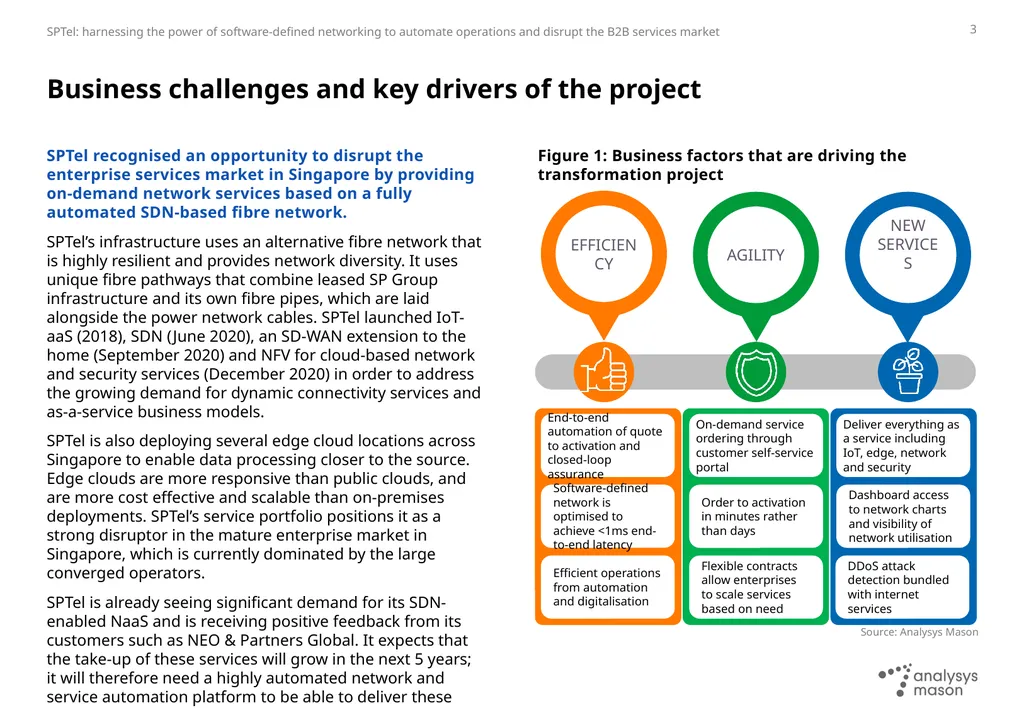
SPTel is already seeing significant demand for its SDN-enabled NaaS and is receiving positive feedback from its customers such as NEO & Partners Global. It expects that the take-up of these services will grow in the next 5 years; it will therefore need a highly automated network and service automation platform to be able to deliver these services at scale and offer superior end-to-end digital experiences. Figure 1: Business factors that are driving the transformation project 3 Business challenges and key drivers of the project EFFICIENCY NEW SERVICES AGILITY End-to-end automation of quote to activation and closed-loop assurance Software-defined network is optimised to achieve <1ms end-to-end latency Efficient operations from automation and digitalisation On-demand service ordering through customer self-service portal Order to activation in minutes rather than days Flexible contracts allow enterprises to scale services based on need Deliver everything as a service including IoT, edge, network and security Dashboard access to network charts and visibility of network utilisation DDoS attack detection bundled with internet services Source: Analysys Mason<br>
SPTel’s infrastructure uses an alternative fibre network that is highly resilient and provides network diversity. It uses unique fibre pathways that combine leased SP Group infrastructure and its own fibre pipes, which are laid alongside the power network cables. SPTel launched IoT-aaS (2018), SDN (June 2020), an SD-WAN extension to the home (September 2020) and NFV for cloud-based network and security services (December 2020) in order to address the growing demand for dynamic connectivity services and as-a-service business models.
SPTel is also deploying several edge cloud locations across Singapore to enable data processing closer to the source. Edge clouds are more responsive than public clouds, and are more cost effective and scalable than on-premises deployments. SPTel’s service portfolio positions it as a strong disruptor in the mature enterprise market in Singapore, which is currently dominated by the large converged operators.
SPTel is already seeing significant demand for its SDN-enabled NaaS and is receiving positive feedback from its customers such as NEO & Partners Global. It expects that the take-up of these services will grow in the next 5 years; it will therefore need a highly automated network and service automation platform to be able to deliver these services at scale and offer superior end-to-end digital experiences. Figure 1: Business factors that are driving the transformation project 3 Business challenges and key drivers of the project EFFICIENCY NEW SERVICES AGILITY End-to-end automation of quote to activation and closed-loop assurance Software-defined network is optimised to achieve <1ms end-to-end latency Efficient operations from automation and digitalisation On-demand service ordering through customer self-service portal Order to activation in minutes rather than days Flexible contracts allow enterprises to scale services based on need Deliver everything as a service including IoT, edge, network and security Dashboard access to network charts and visibility of network utilisation DDoS attack detection bundled with internet services Source: Analysys Mason<br>
04
Service agility and zero-touch operations are the key cornerstones of SPTel’s strategy.
SPTel conducted an extensive competitive process during which it assessed multiple vendors on their technical abilities, product roadmaps and visions. At the end of the process, SPTel chose Nokia because its FutureX vision aligned well with the operator’s own digital networks strategy. Nokia’s software portfolio also provided the requisite technical capabilities to achieve the expected level of service agility and efficient operations, especially around closed-loop automation.
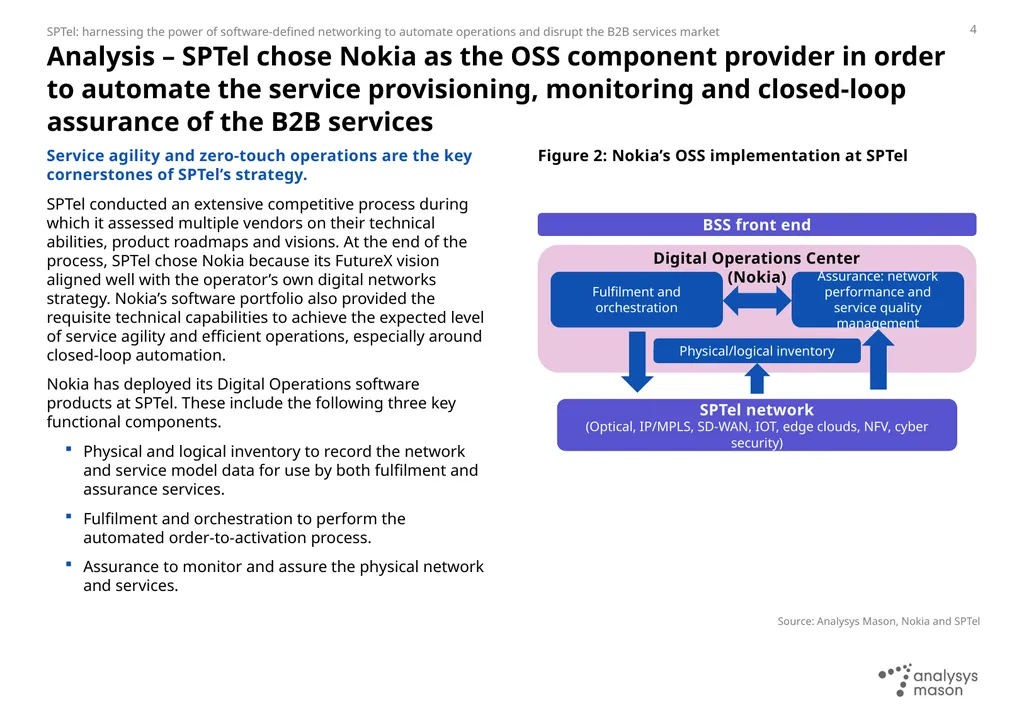
Nokia has deployed its Digital Operations software products at SPTel. These include the following three key functional components.
Physical and logical inventory to record the network and service model data for use by both fulfilment and assurance services.
Fulfilment and orchestration to perform the automated order-to-activation process.
Assurance to monitor and assure the physical network and services. Figure 2: Nokia’s OSS implementation at SPTel 4 Analysis – SPTel chose Nokia as the OSS component provider in order to automate the service provisioning, monitoring and closed-loop assurance of the B2B services SPTel network
(Optical, IP/MPLS, SD-WAN, IOT, edge clouds, NFV, cyber security) Fulfilment and orchestration Physical/logical inventory Assurance: network performance and service quality management BSS front end Digital Operations Center (Nokia) Source: Analysys Mason, Nokia and SPTel<br>
SPTel conducted an extensive competitive process during which it assessed multiple vendors on their technical abilities, product roadmaps and visions. At the end of the process, SPTel chose Nokia because its FutureX vision aligned well with the operator’s own digital networks strategy. Nokia’s software portfolio also provided the requisite technical capabilities to achieve the expected level of service agility and efficient operations, especially around closed-loop automation.
Nokia has deployed its Digital Operations software products at SPTel. These include the following three key functional components.
Physical and logical inventory to record the network and service model data for use by both fulfilment and assurance services.
Fulfilment and orchestration to perform the automated order-to-activation process.
Assurance to monitor and assure the physical network and services. Figure 2: Nokia’s OSS implementation at SPTel 4 Analysis – SPTel chose Nokia as the OSS component provider in order to automate the service provisioning, monitoring and closed-loop assurance of the B2B services SPTel network
(Optical, IP/MPLS, SD-WAN, IOT, edge clouds, NFV, cyber security) Fulfilment and orchestration Physical/logical inventory Assurance: network performance and service quality management BSS front end Digital Operations Center (Nokia) Source: Analysys Mason, Nokia and SPTel<br>
05
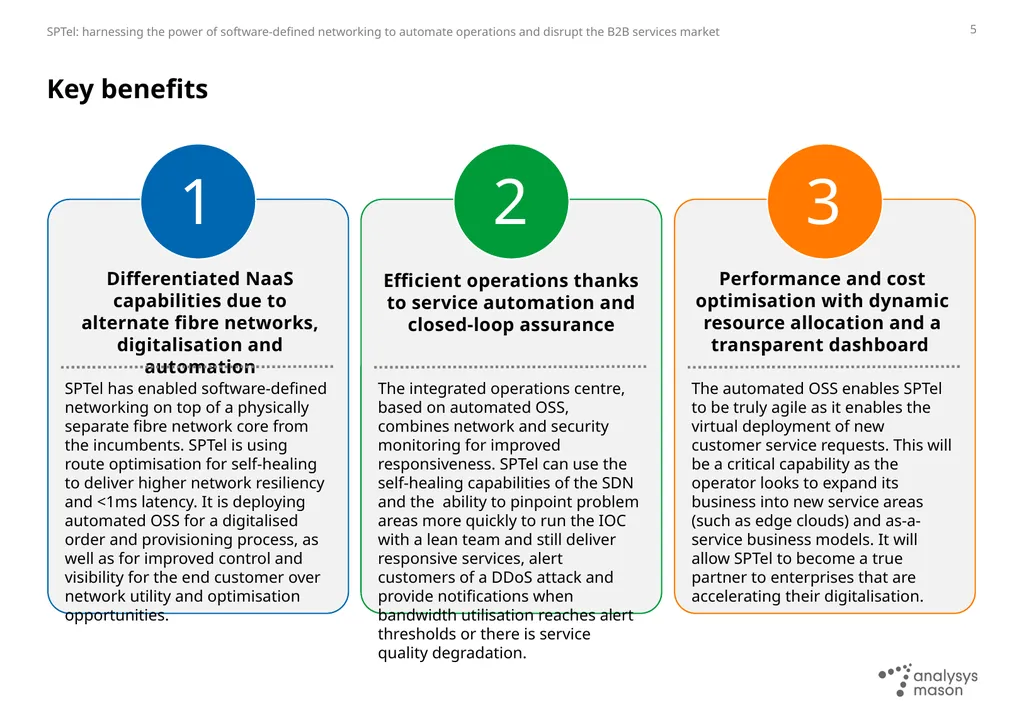
Key benefits 5 2 SPTel has enabled software-defined networking on top of a physically separate fibre network core from the incumbents. SPTel is using route optimisation for self-healing to deliver higher network resiliency and <1ms latency. It is deploying automated OSS for a digitalised order and provisioning process, as well as for improved control and visibility for the end customer over network utility and optimisation opportunities. 3 1 The integrated operations centre, based on automated OSS, combines network and security monitoring for improved responsiveness. SPTel can use the self-healing capabilities of the SDN and the ability to pinpoint problem areas more quickly to run the IOC with a lean team and still deliver responsive services, alert customers of a DDoS attack and provide notifications when bandwidth utilisation reaches alert thresholds or there is service quality degradation. The automated OSS enables SPTel to be truly agile as it enables the virtual deployment of new customer service requests. This will be a critical capability as the operator looks to expand its business into new service areas (such as edge clouds) and as-a-service business models. It will allow SPTel to become a true partner to enterprises that are accelerating their digitalisation. Differentiated NaaS capabilities due to alternate fibre networks, digitalisation and automation Efficient operations thanks to service automation and closed-loop assurance Performance and cost optimisation with dynamic resource allocation and a transparent dashboard<br>
06
FURTHER INFORMATION<br>
07
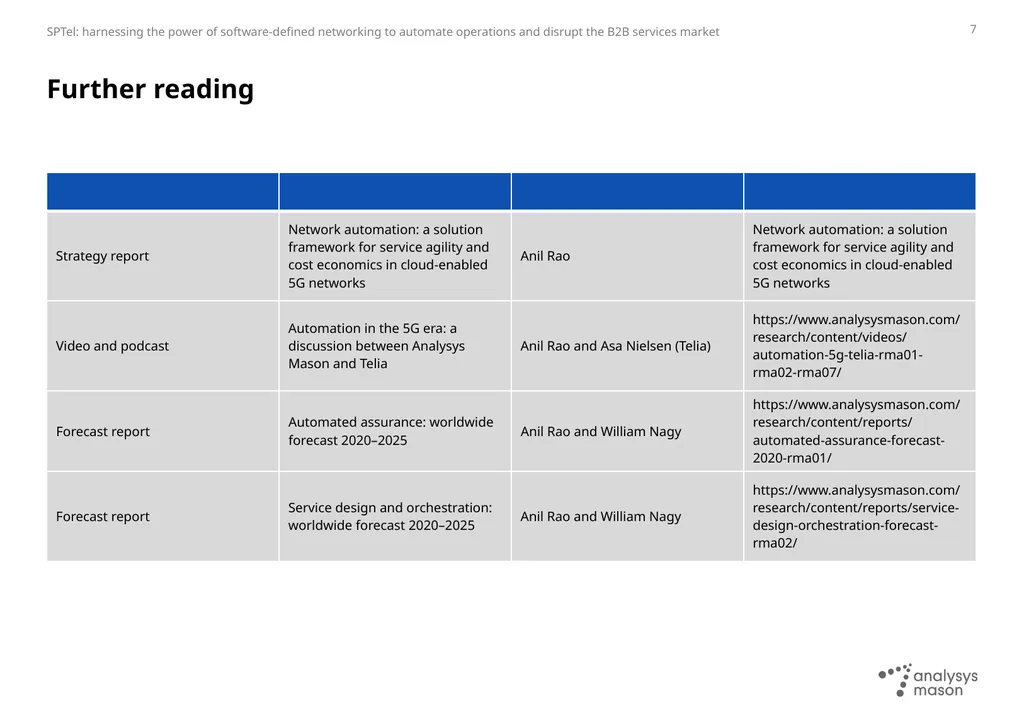
7 Further reading<br>
08
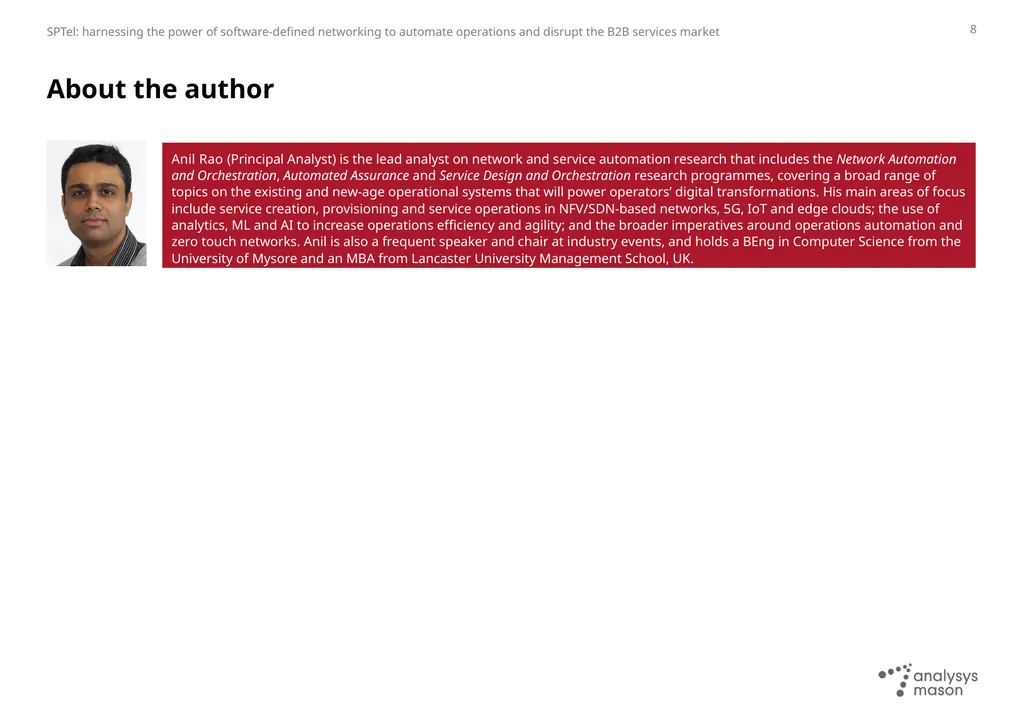
About the author 8 Anil Rao (Principal Analyst) is the lead analyst on network and service automation research that includes the Network Automation and Orchestration, Automated Assurance and Service Design and Orchestration research programmes, covering a broad range of topics on the existing and new-age operational systems that will power operators’ digital transformations. His main areas of focus include service creation, provisioning and service operations in NFV/SDN-based networks, 5G, IoT and edge clouds; the use of analytics, ML and AI to increase operations efficiency and agility; and the broader imperatives around operations automation and zero touch networks. Anil is also a frequent speaker and chair at industry events, and holds a BEng in Computer Science from the University of Mysore and an MBA from Lancaster University Management School, UK.<br>
09
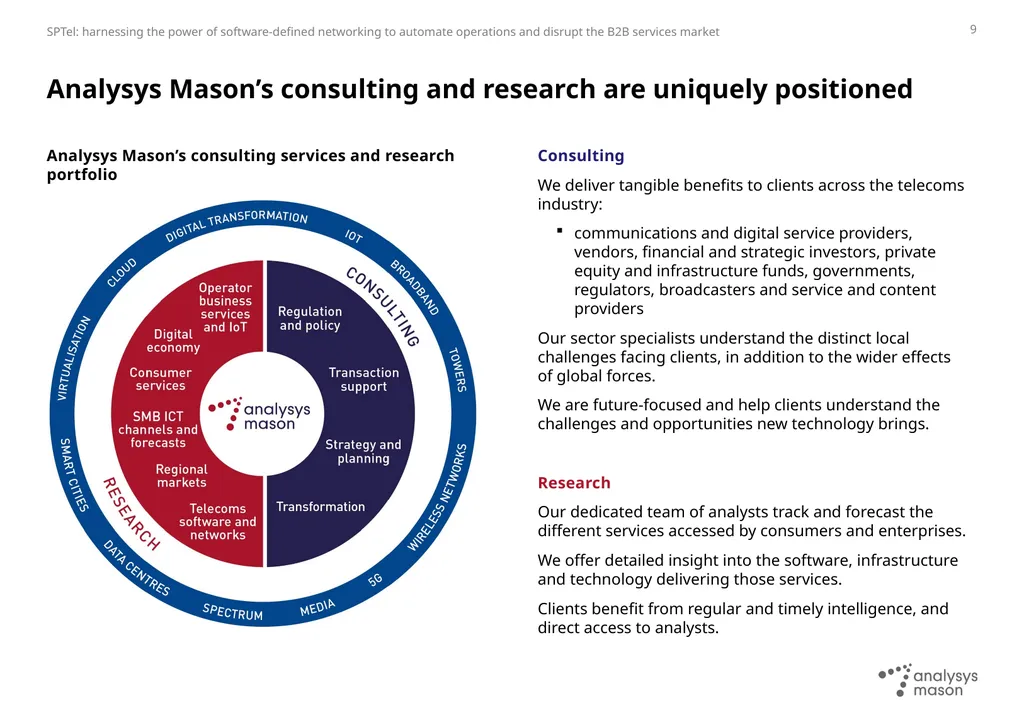
Consulting
We deliver tangible benefits to clients across the telecoms industry:
communications and digital service providers, vendors, financial and strategic investors, private equity and infrastructure funds, governments, regulators, broadcasters and service and content providers
Our sector specialists understand the distinct local challenges facing clients, in addition to the wider effects of global forces.
We are future-focused and help clients understand the challenges and opportunities new technology brings.
Research
Our dedicated team of analysts track and forecast the different services accessed by consumers and enterprises.
We offer detailed insight into the software, infrastructure and technology delivering those services.
Clients benefit from regular and timely intelligence, and direct access to analysts. 9 Analysys Mason’s consulting and research are uniquely positioned Analysys Mason’s consulting services and research portfolio<br>
We deliver tangible benefits to clients across the telecoms industry:
communications and digital service providers, vendors, financial and strategic investors, private equity and infrastructure funds, governments, regulators, broadcasters and service and content providers
Our sector specialists understand the distinct local challenges facing clients, in addition to the wider effects of global forces.
We are future-focused and help clients understand the challenges and opportunities new technology brings.
Research
Our dedicated team of analysts track and forecast the different services accessed by consumers and enterprises.
We offer detailed insight into the software, infrastructure and technology delivering those services.
Clients benefit from regular and timely intelligence, and direct access to analysts. 9 Analysys Mason’s consulting and research are uniquely positioned Analysys Mason’s consulting services and research portfolio<br>
10
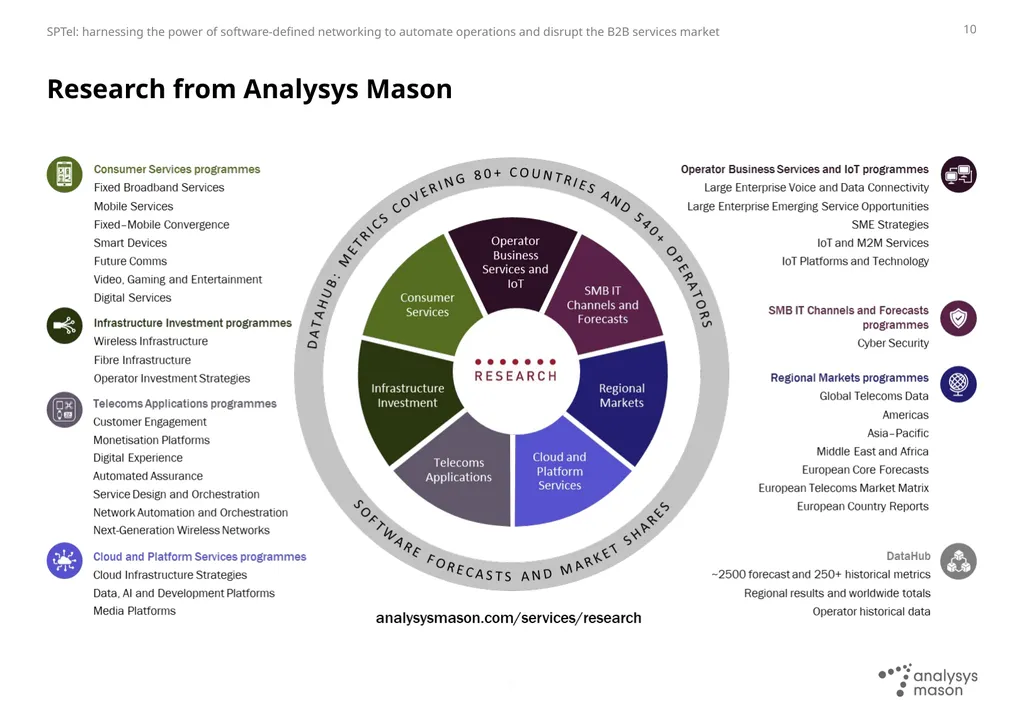
Research from Analysys Mason 10<br>
11
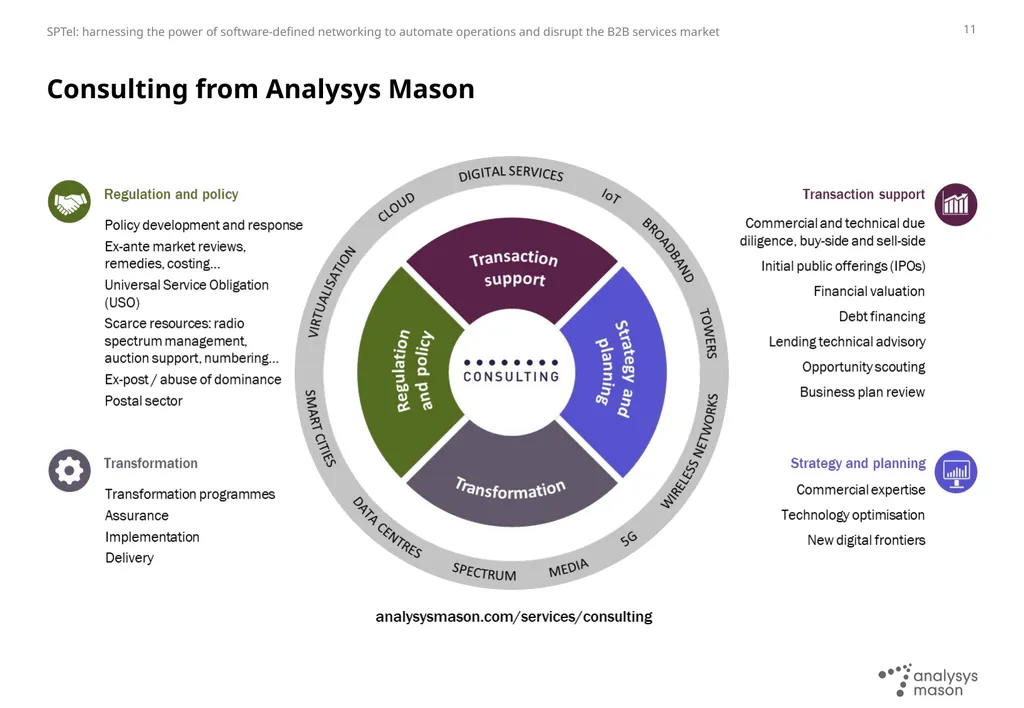
Consulting from Analysys Mason 11<br>
12
JANUARY 2021<br>