
STRATEGIC PLAN 2021-2024 AND ANNUAL PERFORMANCE
CP
Published · 37 slides · 0 views

1 / 1





Description
STRATEGIC PLAN 2021-2024 AND ANNUAL PERFORMANCE PLAN 202122 04 MAY 2021 STRATEGIC PLAN 2021-2024 VISION MISSION Vision A Commission of excellence that ensures effective, efficient and speedy redress to victims of racially based land
Related Topics
Share
Embed code
Download this presentation From Below
"STRATEGIC PLAN 2021-2024 AND ANNUAL PERFORMANCE" is the property of its rightful owner. Permission is granted to download and print the materials on this website for personal, non-commercial use only, and to display it on your personal computer provided you do not modify the materials and that you retain all copyright notices contained in the materials. By downloading content from our website, you accept the terms of this agreement.
Presentation Transcript
01
STRATEGIC PLAN 2021-2024
AND
ANNUAL PERFORMANCE PLAN 2021/22
04 MAY 2021<br>
02
STRATEGIC PLAN 2021-2024<br>
03
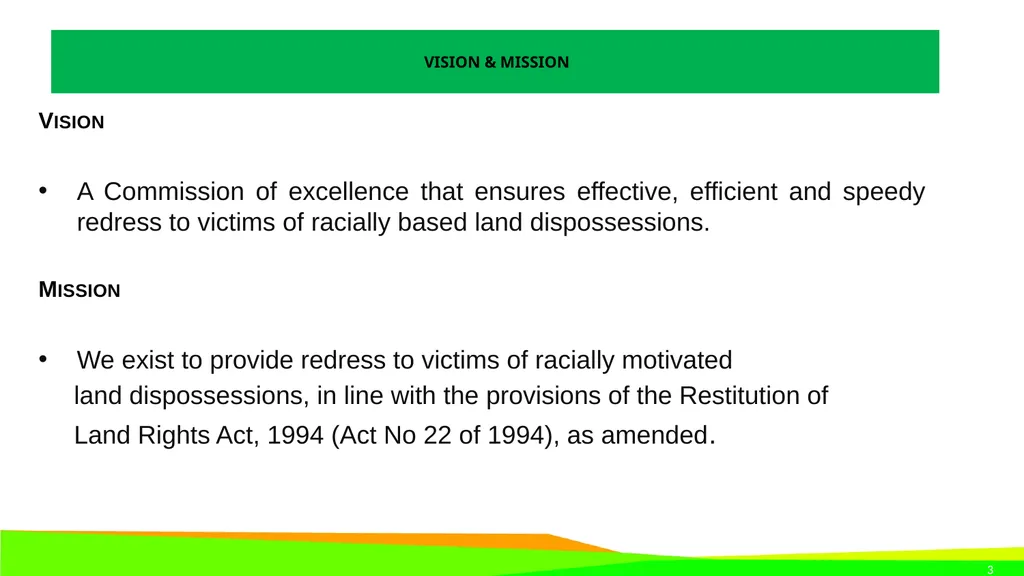
VISION & MISSION Vision
A Commission of excellence that ensures effective, efficient and speedy redress to victims of racially based land dispossessions.
Mission
We exist to provide redress to victims of racially motivated
land dispossessions, in line with the provisions of the Restitution of
Land Rights Act, 1994 (Act No 22 of 1994), as amended.<br>
A Commission of excellence that ensures effective, efficient and speedy redress to victims of racially based land dispossessions.
Mission
We exist to provide redress to victims of racially motivated
land dispossessions, in line with the provisions of the Restitution of
Land Rights Act, 1994 (Act No 22 of 1994), as amended.<br>
04
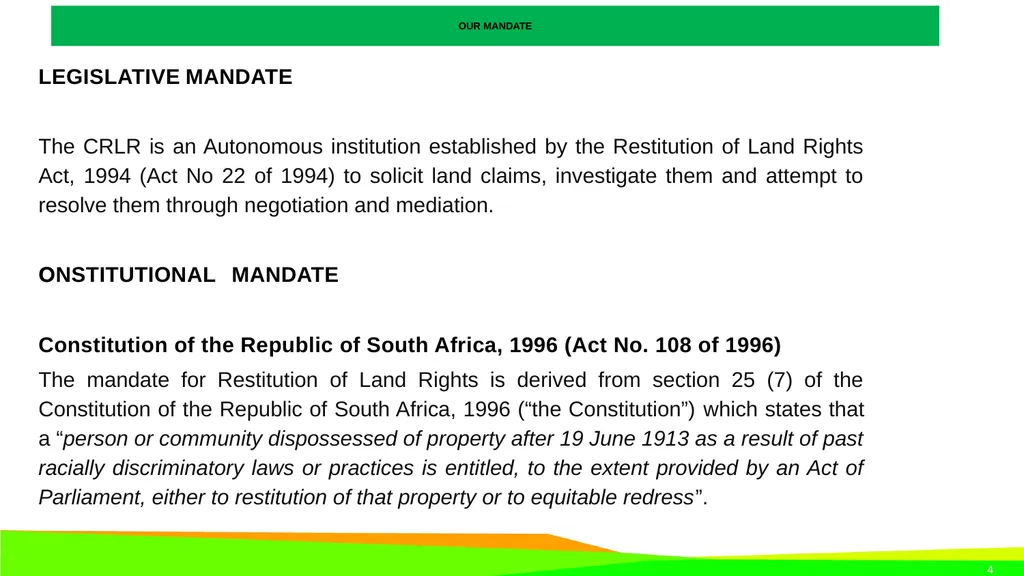
OUR MANDATE LEGISLATIVE MANDATE
The CRLR is an Autonomous institution established by the Restitution of Land Rights Act, 1994 (Act No 22 of 1994) to solicit land claims, investigate them and attempt to resolve them through negotiation and mediation.
CONSTITUTIONAL MANDATE
Constitution of the Republic of South Africa, 1996 (Act No. 108 of 1996)
The mandate for Restitution of Land Rights is derived from section 25 (7) of the Constitution of the Republic of South Africa, 1996 (“the Constitution”) which states that a “person or community dispossessed of property after 19 June 1913 as a result of past racially discriminatory laws or practices is entitled, to the extent provided by an Act of Parliament, either to restitution of that property or to equitable redress”.<br>
The CRLR is an Autonomous institution established by the Restitution of Land Rights Act, 1994 (Act No 22 of 1994) to solicit land claims, investigate them and attempt to resolve them through negotiation and mediation.
CONSTITUTIONAL MANDATE
Constitution of the Republic of South Africa, 1996 (Act No. 108 of 1996)
The mandate for Restitution of Land Rights is derived from section 25 (7) of the Constitution of the Republic of South Africa, 1996 (“the Constitution”) which states that a “person or community dispossessed of property after 19 June 1913 as a result of past racially discriminatory laws or practices is entitled, to the extent provided by an Act of Parliament, either to restitution of that property or to equitable redress”.<br>
05
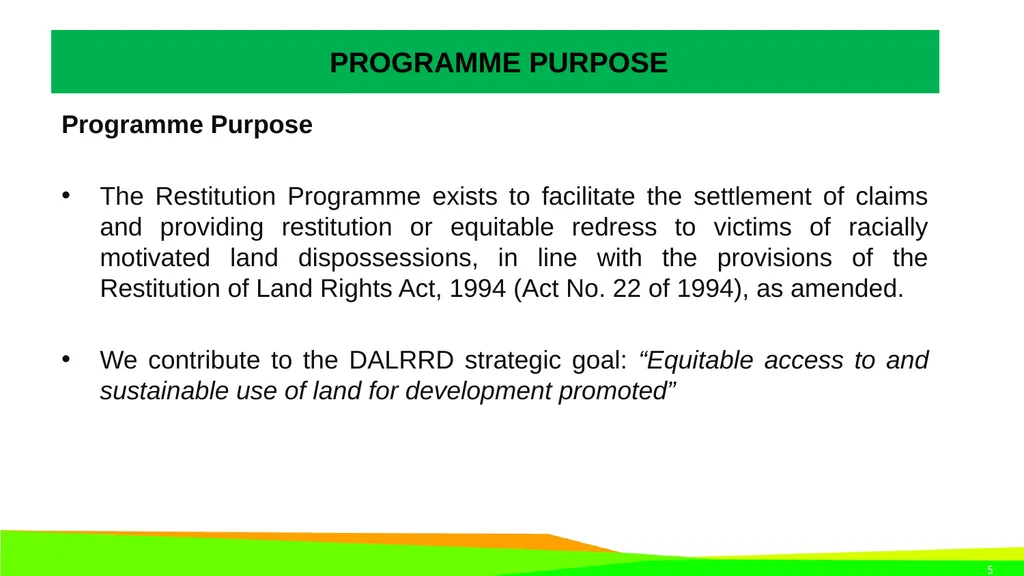
PROGRAMME PURPOSE Programme Purpose
The Restitution Programme exists to facilitate the settlement of claims and providing restitution or equitable redress to victims of racially motivated land dispossessions, in line with the provisions of the Restitution of Land Rights Act, 1994 (Act No. 22 of 1994), as amended.
We contribute to the DALRRD strategic goal: “Equitable access to and sustainable use of land for development promoted”<br>
The Restitution Programme exists to facilitate the settlement of claims and providing restitution or equitable redress to victims of racially motivated land dispossessions, in line with the provisions of the Restitution of Land Rights Act, 1994 (Act No. 22 of 1994), as amended.
We contribute to the DALRRD strategic goal: “Equitable access to and sustainable use of land for development promoted”<br>
06
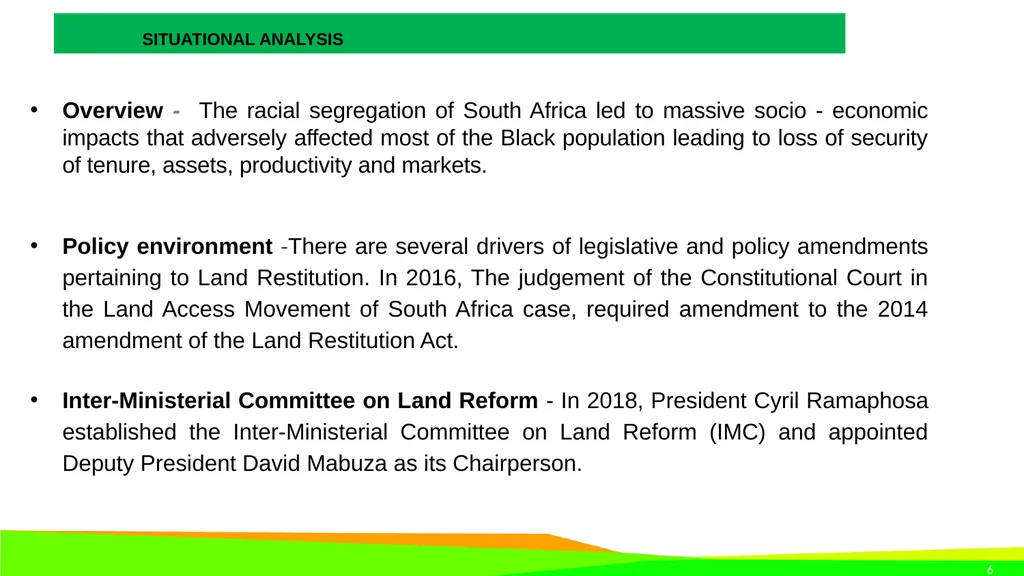
SITUATIONAL ANALYSIS Overview - The racial segregation of South Africa led to massive socio - economic impacts that adversely affected most of the Black population leading to loss of security of tenure, assets, productivity and markets.
Policy environment -There are several drivers of legislative and policy amendments pertaining to Land Restitution. In 2016, The judgement of the Constitutional Court in the Land Access Movement of South Africa case, required amendment to the 2014 amendment of the Land Restitution Act.
Inter-Ministerial Committee on Land Reform - In 2018, President Cyril Ramaphosa established the Inter-Ministerial Committee on Land Reform (IMC) and appointed Deputy President David Mabuza as its Chairperson.<br>
Policy environment -There are several drivers of legislative and policy amendments pertaining to Land Restitution. In 2016, The judgement of the Constitutional Court in the Land Access Movement of South Africa case, required amendment to the 2014 amendment of the Land Restitution Act.
Inter-Ministerial Committee on Land Reform - In 2018, President Cyril Ramaphosa established the Inter-Ministerial Committee on Land Reform (IMC) and appointed Deputy President David Mabuza as its Chairperson.<br>
07
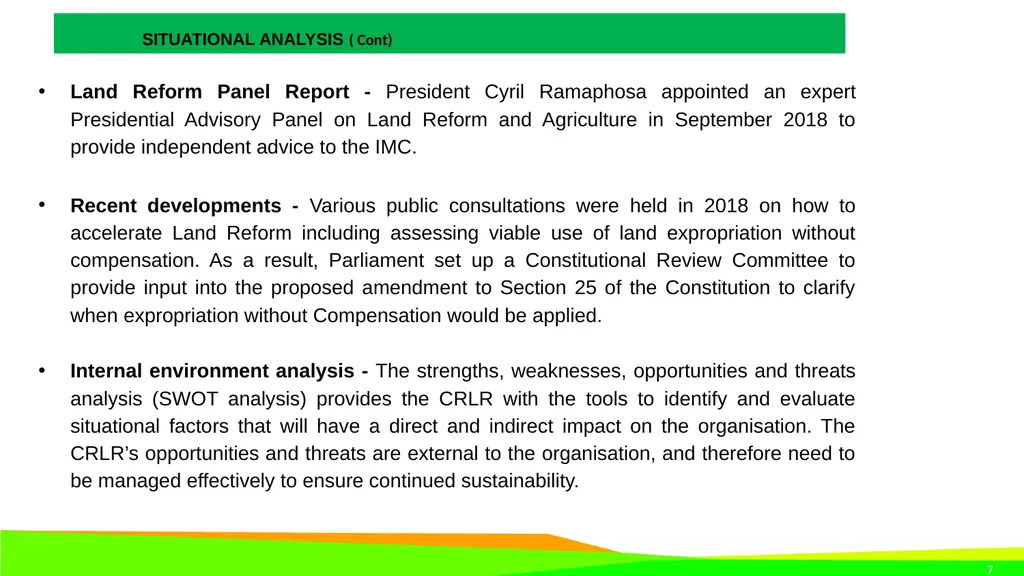
SITUATIONAL ANALYSIS ( Cont) Land Reform Panel Report - President Cyril Ramaphosa appointed an expert Presidential Advisory Panel on Land Reform and Agriculture in September 2018 to provide independent advice to the IMC.
Recent developments - Various public consultations were held in 2018 on how to accelerate Land Reform including assessing viable use of land expropriation without compensation. As a result, Parliament set up a Constitutional Review Committee to provide input into the proposed amendment to Section 25 of the Constitution to clarify when expropriation without Compensation would be applied.
Internal environment analysis - The strengths, weaknesses, opportunities and threats analysis (SWOT analysis) provides the CRLR with the tools to identify and evaluate situational factors that will have a direct and indirect impact on the organisation. The CRLR’s opportunities and threats are external to the organisation, and therefore need to be managed effectively to ensure continued sustainability.<br>
Recent developments - Various public consultations were held in 2018 on how to accelerate Land Reform including assessing viable use of land expropriation without compensation. As a result, Parliament set up a Constitutional Review Committee to provide input into the proposed amendment to Section 25 of the Constitution to clarify when expropriation without Compensation would be applied.
Internal environment analysis - The strengths, weaknesses, opportunities and threats analysis (SWOT analysis) provides the CRLR with the tools to identify and evaluate situational factors that will have a direct and indirect impact on the organisation. The CRLR’s opportunities and threats are external to the organisation, and therefore need to be managed effectively to ensure continued sustainability.<br>
08
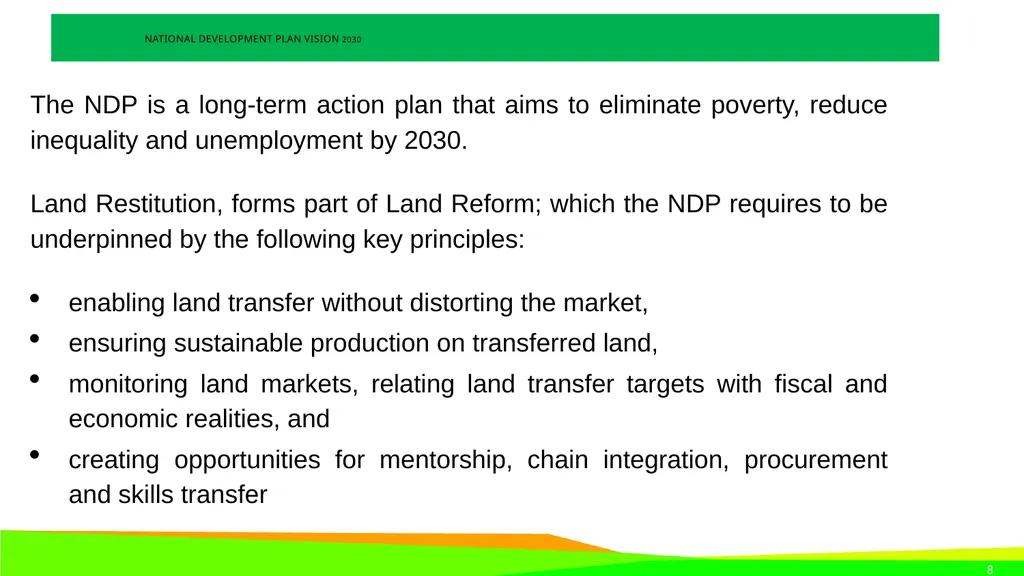
NATIONAL DEVELOPMENT PLAN VISION 2030 The NDP is a long-term action plan that aims to eliminate poverty, reduce inequality and unemployment by 2030.
Land Restitution, forms part of Land Reform; which the NDP requires to be underpinned by the following key principles:
enabling land transfer without distorting the market,
ensuring sustainable production on transferred land,
monitoring land markets, relating land transfer targets with fiscal and economic realities, and
creating opportunities for mentorship, chain integration, procurement and skills transfer<br>
Land Restitution, forms part of Land Reform; which the NDP requires to be underpinned by the following key principles:
enabling land transfer without distorting the market,
ensuring sustainable production on transferred land,
monitoring land markets, relating land transfer targets with fiscal and economic realities, and
creating opportunities for mentorship, chain integration, procurement and skills transfer<br>
09
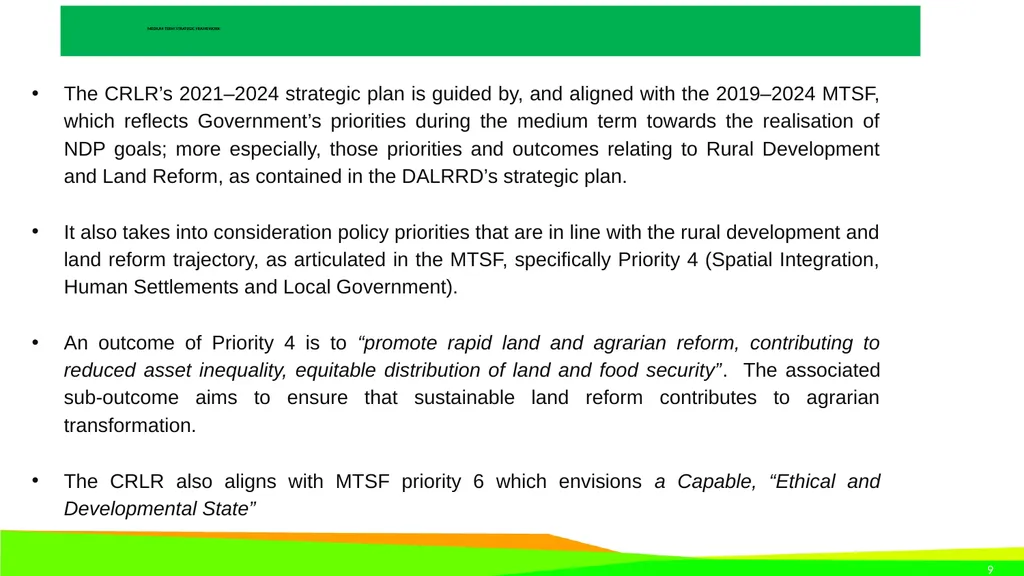
MEDIUM TERM STRATEGIC FRAMEWORK The CRLR’s 2021–2024 strategic plan is guided by, and aligned with the 2019–2024 MTSF, which reflects Government’s priorities during the medium term towards the realisation of NDP goals; more especially, those priorities and outcomes relating to Rural Development and Land Reform, as contained in the DALRRD’s strategic plan.
It also takes into consideration policy priorities that are in line with the rural development and land reform trajectory, as articulated in the MTSF, specifically Priority 4 (Spatial Integration, Human Settlements and Local Government).
An outcome of Priority 4 is to “promote rapid land and agrarian reform, contributing to reduced asset inequality, equitable distribution of land and food security”. The associated sub-outcome aims to ensure that sustainable land reform contributes to agrarian transformation.
The CRLR also aligns with MTSF priority 6 which envisions a Capable, “Ethical and Developmental State”<br>
It also takes into consideration policy priorities that are in line with the rural development and land reform trajectory, as articulated in the MTSF, specifically Priority 4 (Spatial Integration, Human Settlements and Local Government).
An outcome of Priority 4 is to “promote rapid land and agrarian reform, contributing to reduced asset inequality, equitable distribution of land and food security”. The associated sub-outcome aims to ensure that sustainable land reform contributes to agrarian transformation.
The CRLR also aligns with MTSF priority 6 which envisions a Capable, “Ethical and Developmental State”<br>
10
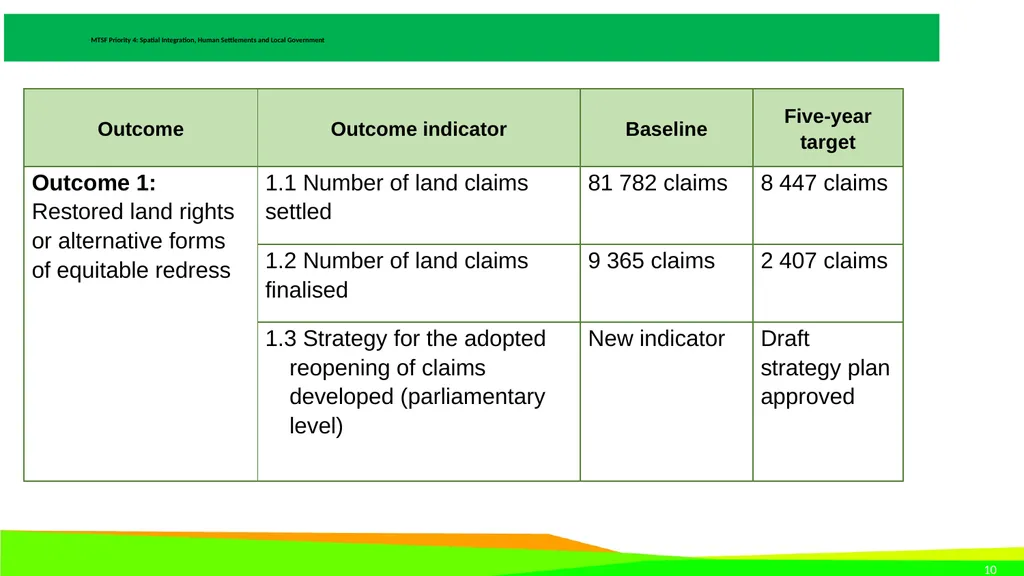
MTSF Priority 4: Spatial Integration, Human Settlements and Local Government<br>
11
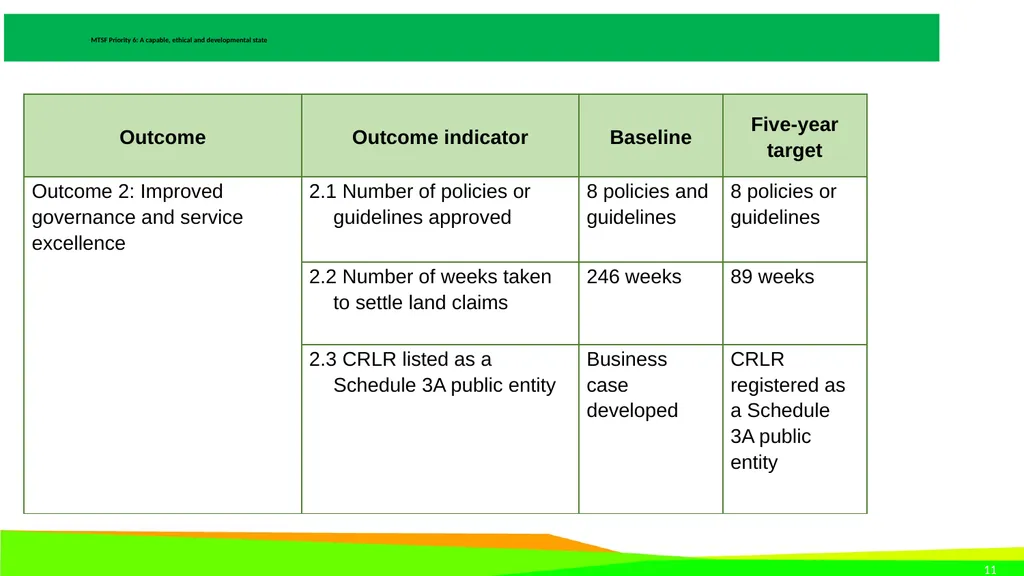
MTSF Priority 6: A capable, ethical and developmental state<br>
12
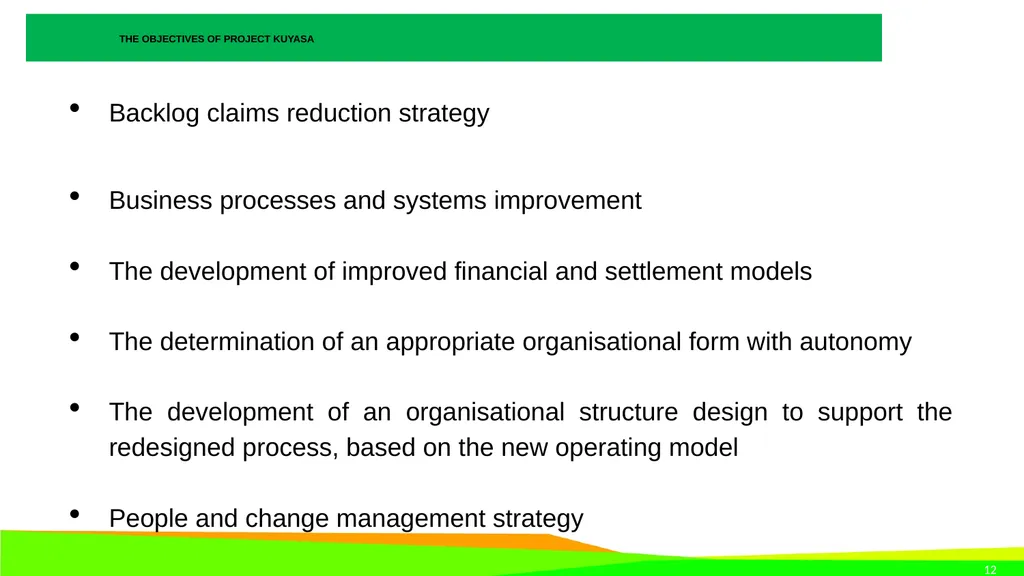
The objectives of project Kuyasa Backlog claims reduction strategy
Business processes and systems improvement
The development of improved financial and settlement models
The determination of an appropriate organisational form with autonomy
The development of an organisational structure design to support the redesigned process, based on the new operating model
People and change management strategy<br>
Business processes and systems improvement
The development of improved financial and settlement models
The determination of an appropriate organisational form with autonomy
The development of an organisational structure design to support the redesigned process, based on the new operating model
People and change management strategy<br>
13
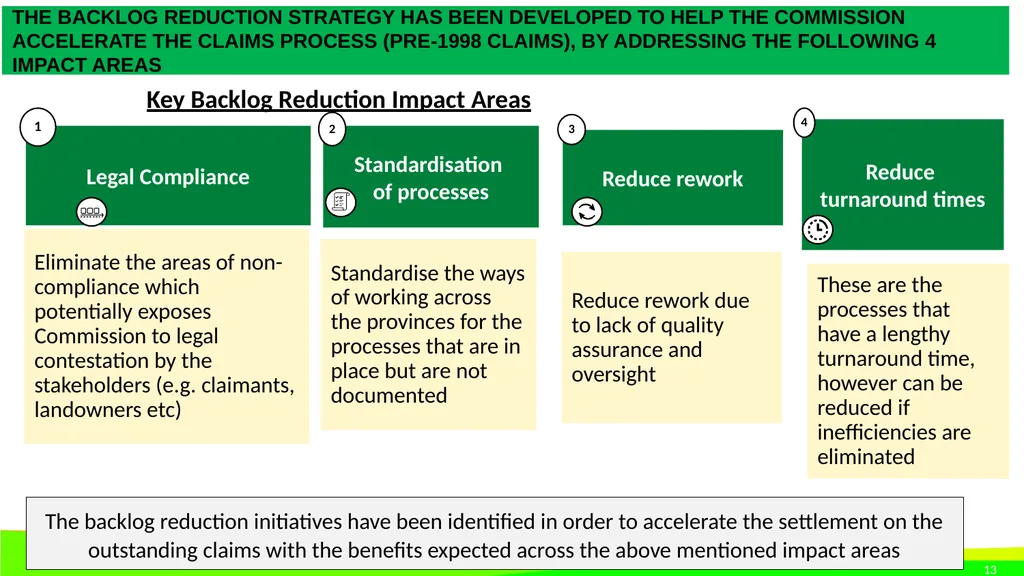
The backlog reduction strategy has been developed to help the commission accelerate the claims process (pre-1998 Claims), by addressing the following 4 impact areas Key Backlog Reduction Impact Areas The backlog reduction initiatives have been identified in order to accelerate the settlement on the outstanding claims with the benefits expected across the above mentioned impact areas<br>
14
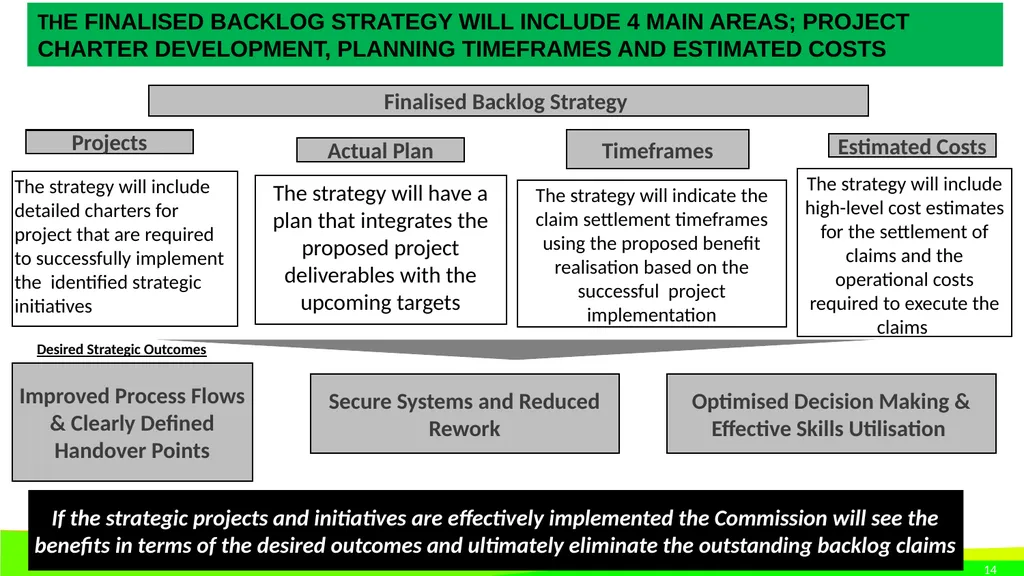
The finalised backlog strategy will include 4 main areas; project charter development, planning timeframes and estimated costs If the strategic projects and initiatives are effectively implemented the Commission will see the benefits in terms of the desired outcomes and ultimately eliminate the outstanding backlog claims Finalised Backlog Strategy Improved Process Flows & Clearly Defined Handover Points Secure Systems and Reduced Rework Optimised Decision Making & Effective Skills Utilisation Desired Strategic Outcomes<br>
15
MEDIUM TERM EXPENDITURE FRAMEWORK 2021-24<br>
16
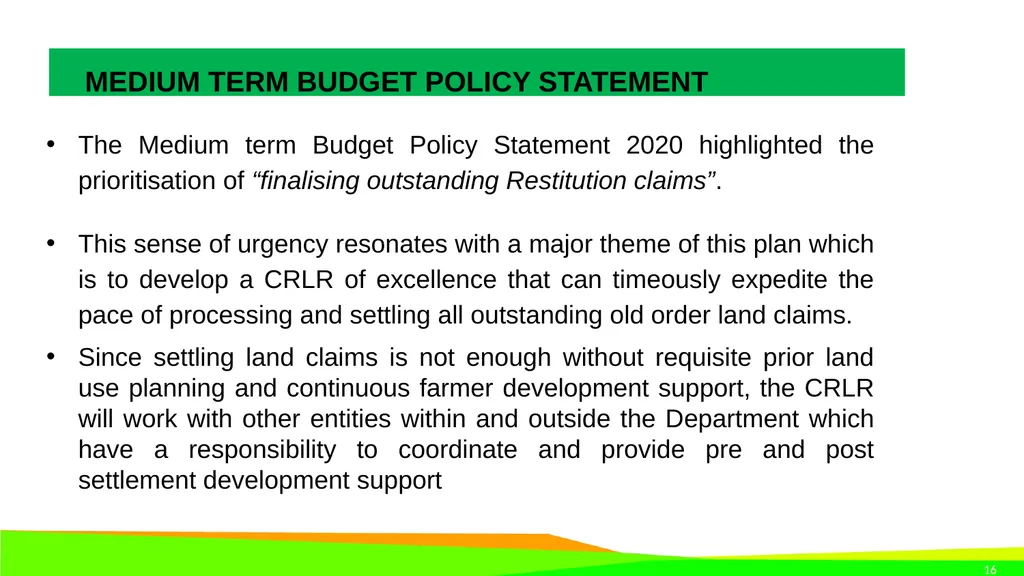
MEDIUM TERM BUDGET POLICY STATEMENT The Medium term Budget Policy Statement 2020 highlighted the prioritisation of “finalising outstanding Restitution claims”.
This sense of urgency resonates with a major theme of this plan which is to develop a CRLR of excellence that can timeously expedite the pace of processing and settling all outstanding old order land claims.
Since settling land claims is not enough without requisite prior land use planning and continuous farmer development support, the CRLR will work with other entities within and outside the Department which have a responsibility to coordinate and provide pre and post settlement development support<br>
This sense of urgency resonates with a major theme of this plan which is to develop a CRLR of excellence that can timeously expedite the pace of processing and settling all outstanding old order land claims.
Since settling land claims is not enough without requisite prior land use planning and continuous farmer development support, the CRLR will work with other entities within and outside the Department which have a responsibility to coordinate and provide pre and post settlement development support<br>
17
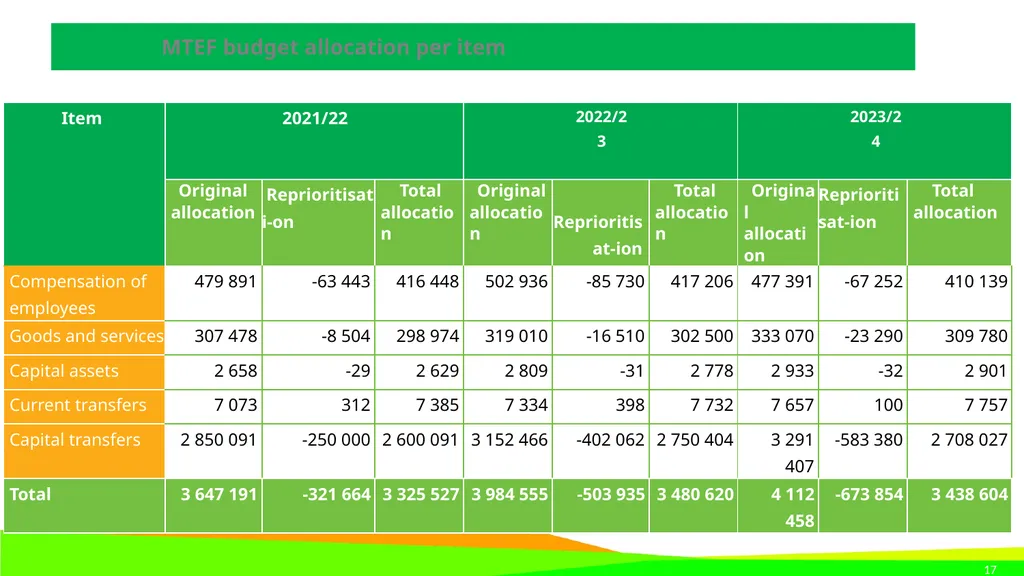
MTEF budget allocation per item<br>
18
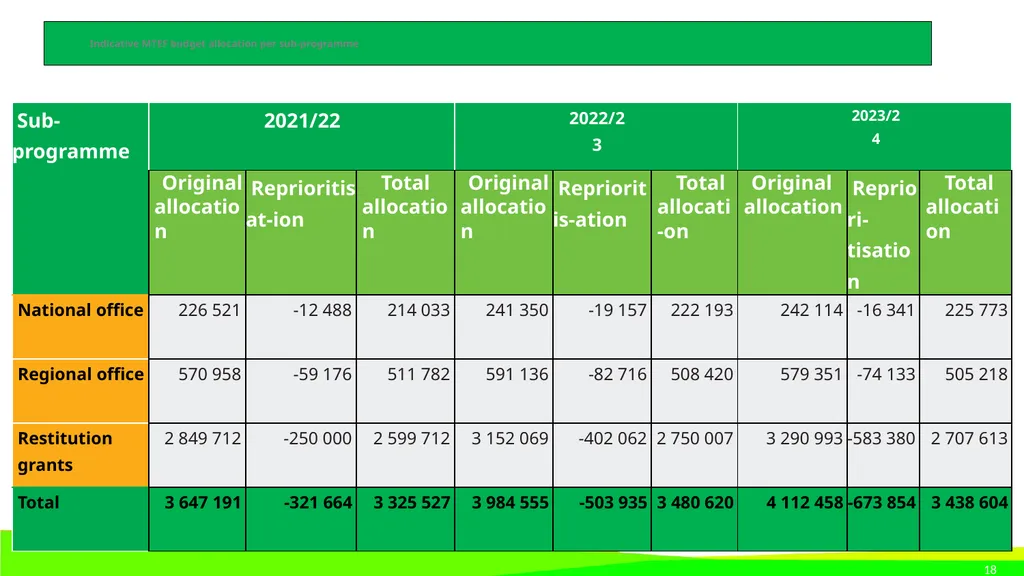
Indicative MTEF budget allocation per sub-programme<br>
19
TRANSACTION TOWARDS AUTONOMY<br>
20
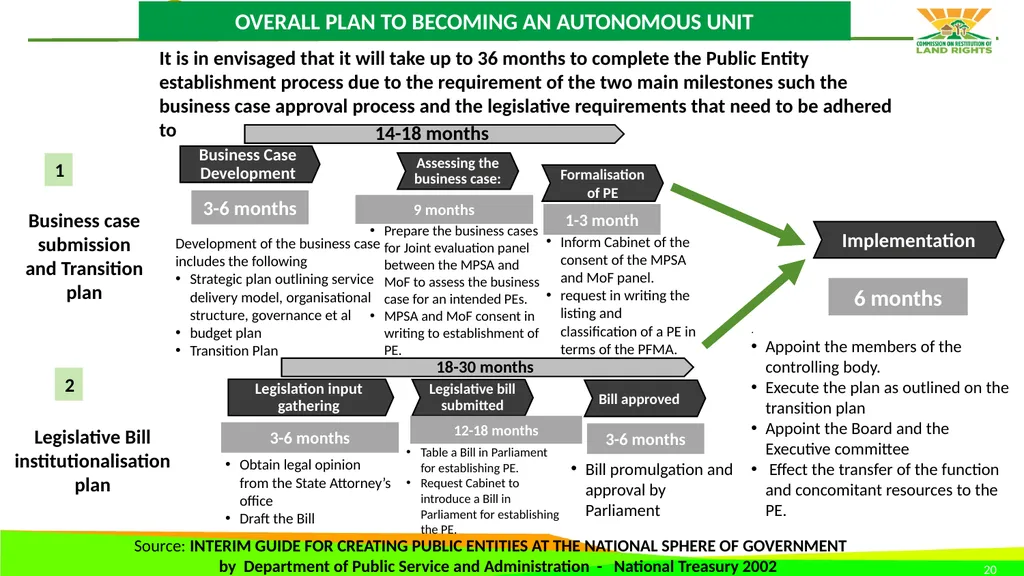
It is in envisaged that it will take up to 36 months to complete the Public Entity establishment process due to the requirement of the two main milestones such the business case approval process and the legislative requirements that need to be adhered to Business Case Development Formalisation of PE Assessing the business case: Implementation Business case submission and Transition plan Prepare the business cases for Joint evaluation panel between the MPSA and MoF to assess the business case for an intended PEs.
MPSA and MoF consent in writing to establishment of PE. Inform Cabinet of the consent of the MPSA and MoF panel.
request in writing the listing and classification of a PE in terms of the PFMA. .
Appoint the members of the controlling body.
Execute the plan as outlined on the transition plan
Appoint the Board and the Executive committee
Effect the transfer of the function and concomitant resources to the PE. Source: INTERIM GUIDE FOR CREATING PUBLIC ENTITIES AT THE NATIONAL SPHERE OF GOVERNMENT
by Department of Public Service and Administration - National Treasury 2002 14-18 months 18-30 months Legislation input gathering Bill approved Legislative bill submitted Development of the business case includes the following
Strategic plan outlining service delivery model, organisational structure, governance et al
budget plan
Transition Plan Legislative Bill institutionalisation
plan Table a Bill in Parliament for establishing PE.
Request Cabinet to introduce a Bill in Parliament for establishing the PE. Bill promulgation and approval by Parliament Obtain legal opinion from the State Attorney’s office
Draft the Bill 3-6 months 9 months 1-3 month 3-6 months 12-18 months 3-6 months 6 months 1 2 Overall plan to becoming an Autonomous Unit<br>
MPSA and MoF consent in writing to establishment of PE. Inform Cabinet of the consent of the MPSA and MoF panel.
request in writing the listing and classification of a PE in terms of the PFMA. .
Appoint the members of the controlling body.
Execute the plan as outlined on the transition plan
Appoint the Board and the Executive committee
Effect the transfer of the function and concomitant resources to the PE. Source: INTERIM GUIDE FOR CREATING PUBLIC ENTITIES AT THE NATIONAL SPHERE OF GOVERNMENT
by Department of Public Service and Administration - National Treasury 2002 14-18 months 18-30 months Legislation input gathering Bill approved Legislative bill submitted Development of the business case includes the following
Strategic plan outlining service delivery model, organisational structure, governance et al
budget plan
Transition Plan Legislative Bill institutionalisation
plan Table a Bill in Parliament for establishing PE.
Request Cabinet to introduce a Bill in Parliament for establishing the PE. Bill promulgation and approval by Parliament Obtain legal opinion from the State Attorney’s office
Draft the Bill 3-6 months 9 months 1-3 month 3-6 months 12-18 months 3-6 months 6 months 1 2 Overall plan to becoming an Autonomous Unit<br>
21
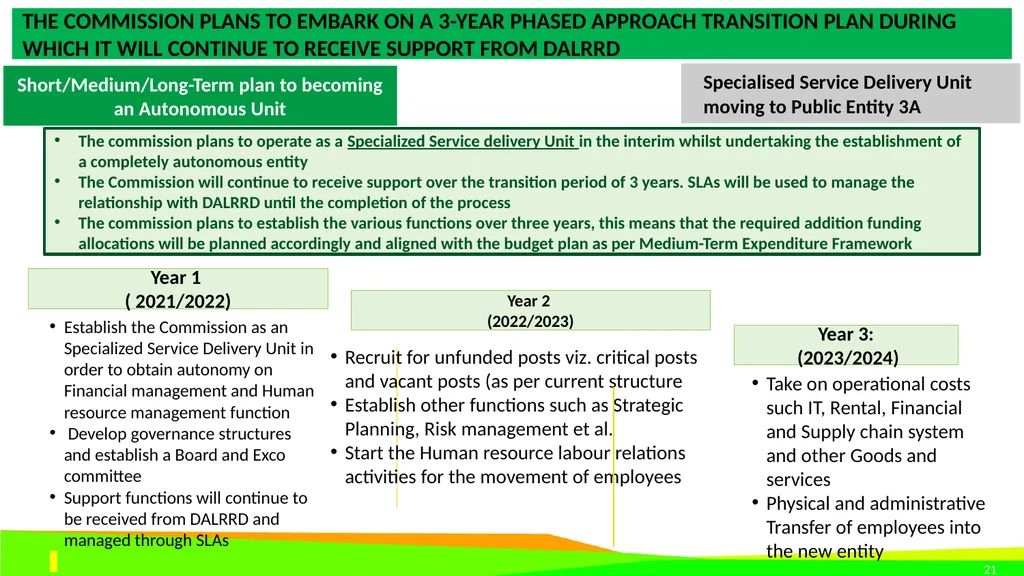
The commission plans to embark on a 3-year phased approach transition plan during which it will continue to receive support from DALRRD Year 1
( 2021/2022) Year 2
(2022/2023) Year 3:
(2023/2024) Establish the Commission as an Specialized Service Delivery Unit in order to obtain autonomy on Financial management and Human resource management function
Develop governance structures and establish a Board and Exco committee
Support functions will continue to be received from DALRRD and managed through SLAs Recruit for unfunded posts viz. critical posts and vacant posts (as per current structure
Establish other functions such as Strategic Planning, Risk management et al.
Start the Human resource labour relations activities for the movement of employees The commission plans to operate as a Specialized Service delivery Unit in the interim whilst undertaking the establishment of a completely autonomous entity
The Commission will continue to receive support over the transition period of 3 years. SLAs will be used to manage the relationship with DALRRD until the completion of the process
The commission plans to establish the various functions over three years, this means that the required addition funding allocations will be planned accordingly and aligned with the budget plan as per Medium-Term Expenditure Framework Take on operational costs such IT, Rental, Financial and Supply chain system and other Goods and services
Physical and administrative Transfer of employees into the new entity Short/Medium/Long-Term plan to becoming an Autonomous Unit Specialised Service Delivery Unit moving to Public Entity 3A<br>
( 2021/2022) Year 2
(2022/2023) Year 3:
(2023/2024) Establish the Commission as an Specialized Service Delivery Unit in order to obtain autonomy on Financial management and Human resource management function
Develop governance structures and establish a Board and Exco committee
Support functions will continue to be received from DALRRD and managed through SLAs Recruit for unfunded posts viz. critical posts and vacant posts (as per current structure
Establish other functions such as Strategic Planning, Risk management et al.
Start the Human resource labour relations activities for the movement of employees The commission plans to operate as a Specialized Service delivery Unit in the interim whilst undertaking the establishment of a completely autonomous entity
The Commission will continue to receive support over the transition period of 3 years. SLAs will be used to manage the relationship with DALRRD until the completion of the process
The commission plans to establish the various functions over three years, this means that the required addition funding allocations will be planned accordingly and aligned with the budget plan as per Medium-Term Expenditure Framework Take on operational costs such IT, Rental, Financial and Supply chain system and other Goods and services
Physical and administrative Transfer of employees into the new entity Short/Medium/Long-Term plan to becoming an Autonomous Unit Specialised Service Delivery Unit moving to Public Entity 3A<br>
22
ANNUAL PERFORMANCE PLAN 2021/22<br>
23
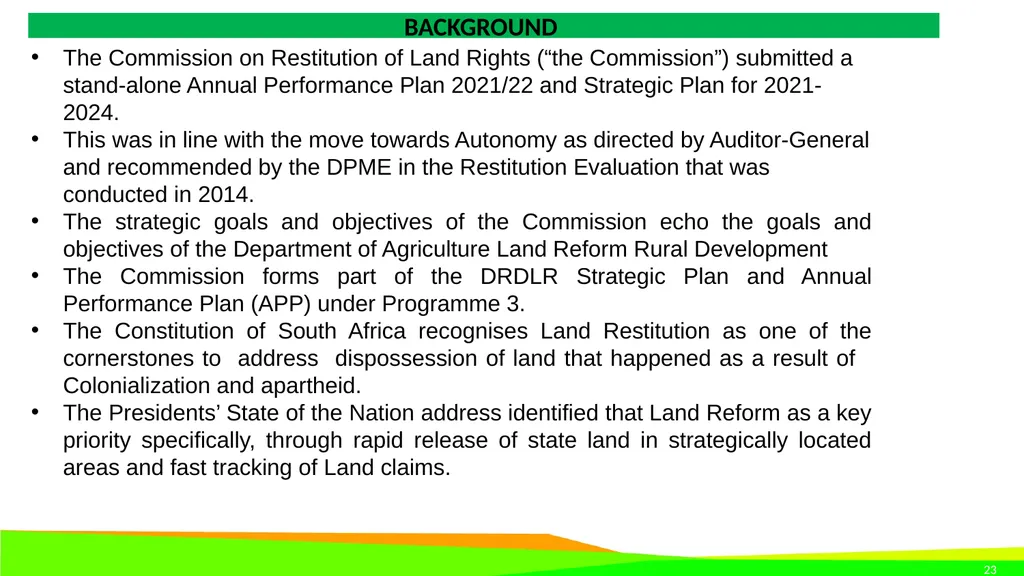
BACKGROUND The Commission on Restitution of Land Rights (“the Commission”) submitted a stand-alone Annual Performance Plan 2021/22 and Strategic Plan for 2021-2024.
This was in line with the move towards Autonomy as directed by Auditor-General and recommended by the DPME in the Restitution Evaluation that was conducted in 2014.
The strategic goals and objectives of the Commission echo the goals and objectives of the Department of Agriculture Land Reform Rural Development
The Commission forms part of the DRDLR Strategic Plan and Annual Performance Plan (APP) under Programme 3.
The Constitution of South Africa recognises Land Restitution as one of the cornerstones to address dispossession of land that happened as a result of Colonialization and apartheid.
The Presidents’ State of the Nation address identified that Land Reform as a key priority specifically, through rapid release of state land in strategically located areas and fast tracking of Land claims.<br>
This was in line with the move towards Autonomy as directed by Auditor-General and recommended by the DPME in the Restitution Evaluation that was conducted in 2014.
The strategic goals and objectives of the Commission echo the goals and objectives of the Department of Agriculture Land Reform Rural Development
The Commission forms part of the DRDLR Strategic Plan and Annual Performance Plan (APP) under Programme 3.
The Constitution of South Africa recognises Land Restitution as one of the cornerstones to address dispossession of land that happened as a result of Colonialization and apartheid.
The Presidents’ State of the Nation address identified that Land Reform as a key priority specifically, through rapid release of state land in strategically located areas and fast tracking of Land claims.<br>
24
PERFORMANCE DELIVERY ENVIRONMENT<br>
25
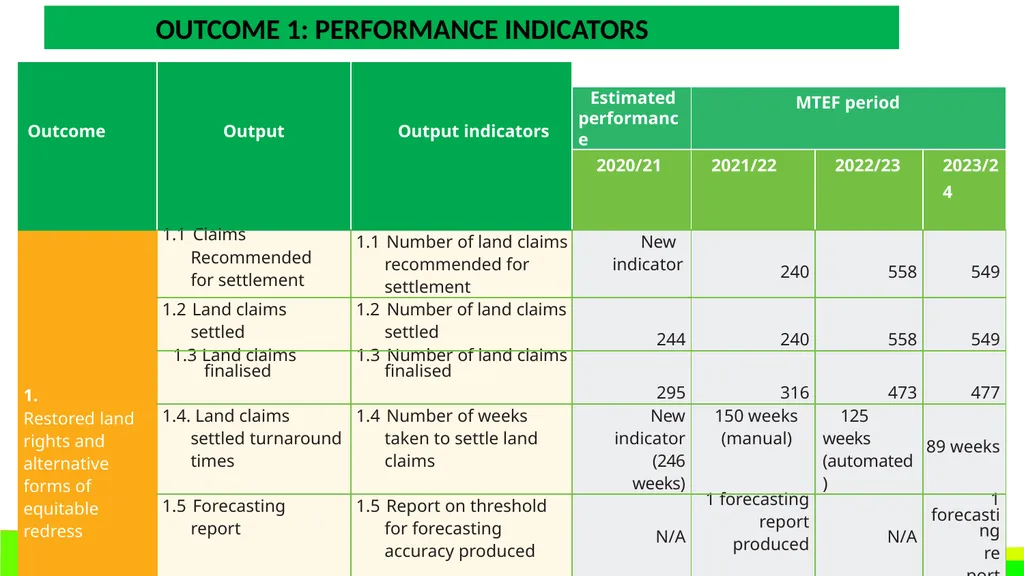
OUTCOME 1: PERFORMANCE INDICATORS<br>
26
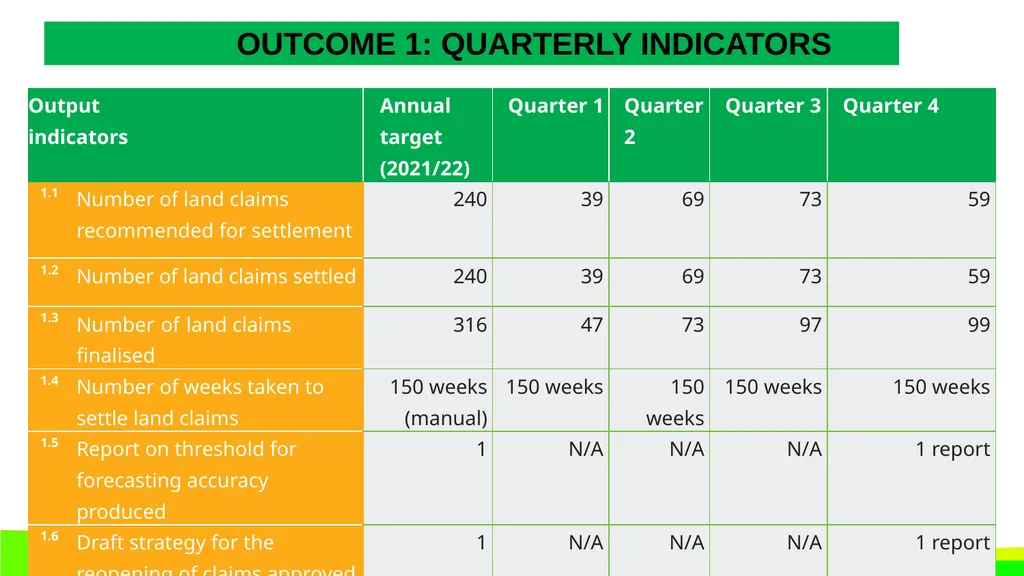
PERFORMANCE INDICATORS OUTCOME 1: QUARTERLY INDICATORS<br>
27
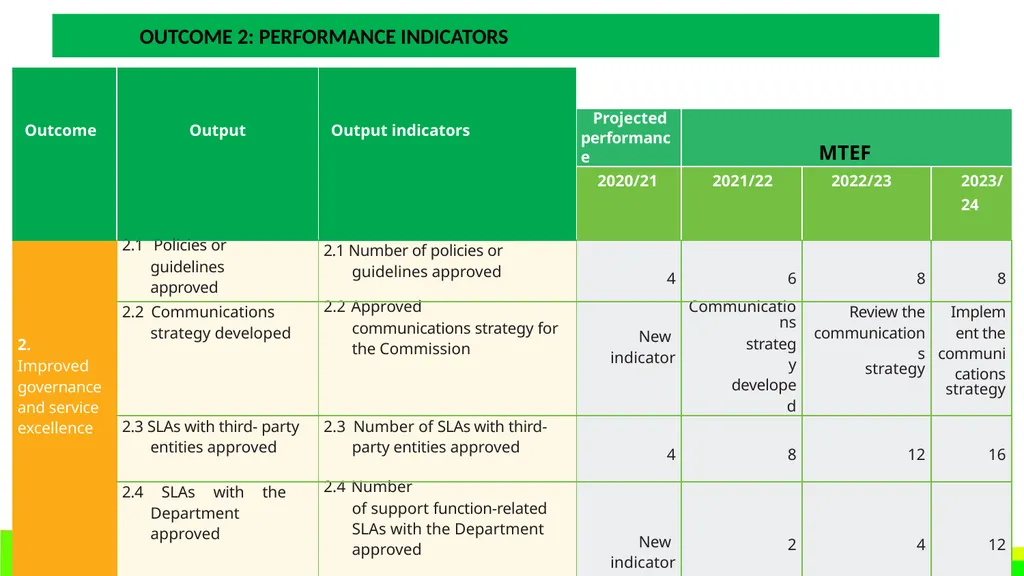
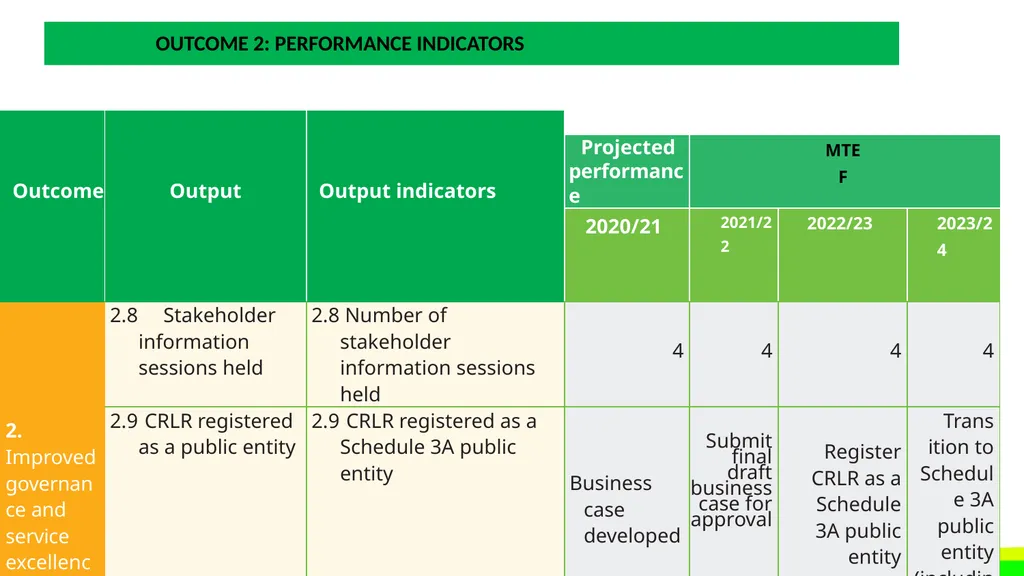
OUTCOME 2: PERFORMANCE INDICATORS<br>
28
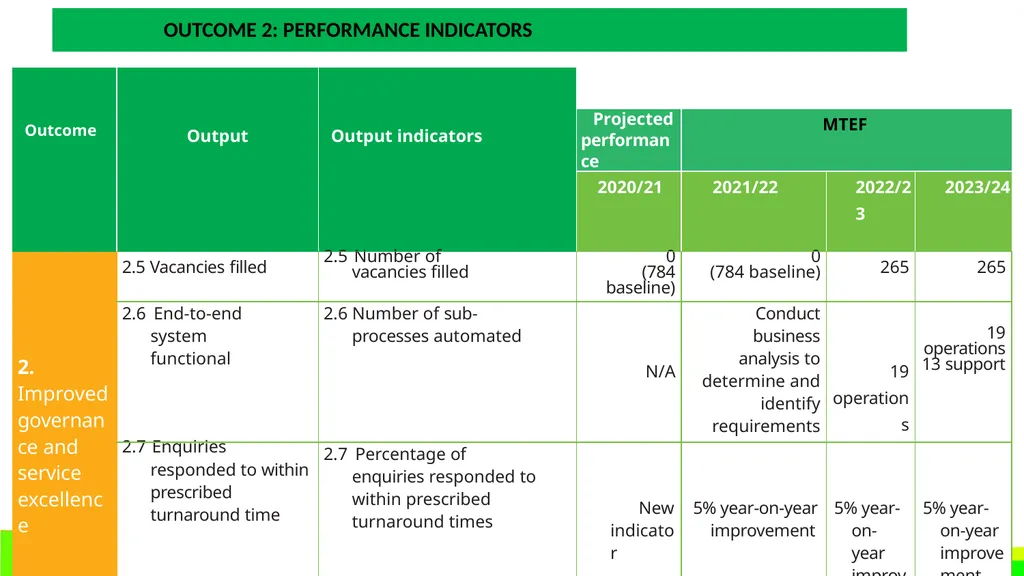
OUTCOME 2: PERFORMANCE INDICATORS<br>
29
OUTCOME 2: PERFORMANCE INDICATORS<br>
30
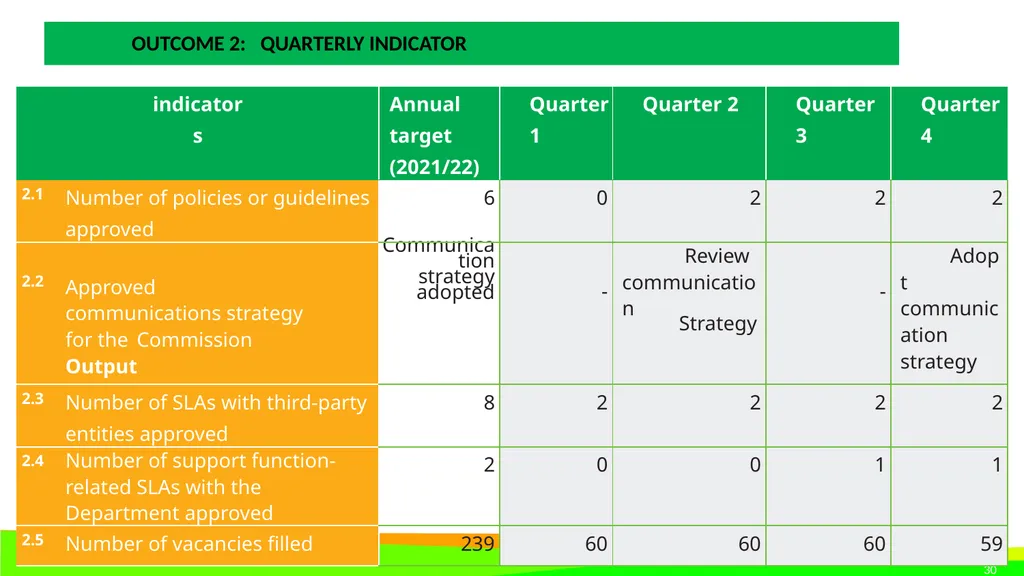
OUTCOME 2: QUARTERLY INDICATOR<br>
31
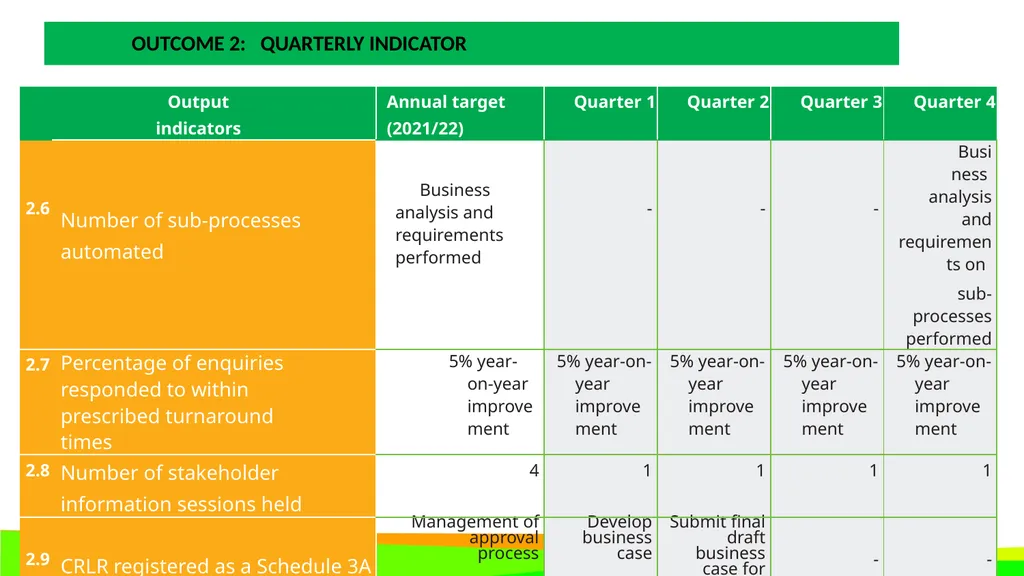
OUTCOME 2: QUARTERLY INDICATOR<br>
32
ORGANISATIONAL STRUCTURE<br>
33
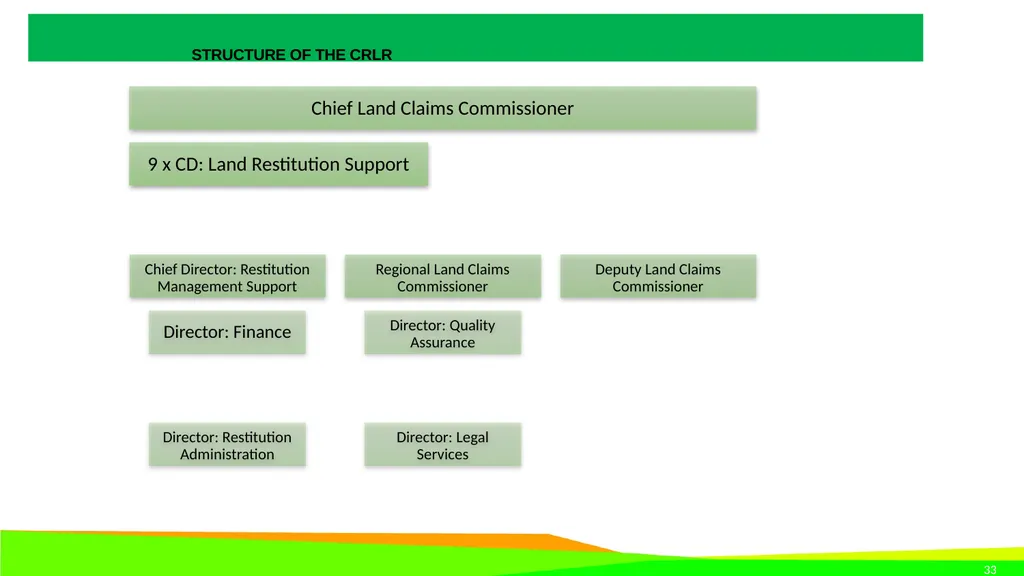
STRUCTURE OF THE CRLR<br>
34
ORGANISATIONAL ENVIRONMENT The Commission consists of the Chief Land Claims Commissioner, a Deputy Land Claims Commissioner and a Regional Land Claims Commissioner who are all based at National office. The Commissioners are assisted by staff employed in terms of the Public Service Act and seconded by the DRDLR to the Commission.
There are 15 Provincial Offices located in all 9 Provinces. The Provincial Offices are led by Chief Directors: Land Restitution Support, who report directly to the Chief Land Claims Commissioner.
In 2017, The Minister approved the re-appointment of the Chief Land Claims Commissioner as well as the Regional Land Claims Commissioner. The post of the Deputy Land Claims Commissioner has become vacant.<br>
There are 15 Provincial Offices located in all 9 Provinces. The Provincial Offices are led by Chief Directors: Land Restitution Support, who report directly to the Chief Land Claims Commissioner.
In 2017, The Minister approved the re-appointment of the Chief Land Claims Commissioner as well as the Regional Land Claims Commissioner. The post of the Deputy Land Claims Commissioner has become vacant.<br>
35
ORGANISATIONAL ENVIRONMENT The future structure and concomitant human resources will only be developed after the business process mapping has been finalised and the structure determined following an investigation into the most appropriate organisational structure and form. It is envisaged that the CRLR’s staff will only carry out functions related to the CRLR’s mandate.
The average age of all staff members is just over 41 years. The average age of senior management service members is slightly higher, at 49 years. The age composition is therefore relatively young, considering the high number of skilled and highly skilled staff members. There are 13 staff members with disabilities, which constitutes 1.85% of the total.
Female staff members comprise 56% or 361 of all staff, while 44% of the staff component is male.<br>
The average age of all staff members is just over 41 years. The average age of senior management service members is slightly higher, at 49 years. The age composition is therefore relatively young, considering the high number of skilled and highly skilled staff members. There are 13 staff members with disabilities, which constitutes 1.85% of the total.
Female staff members comprise 56% or 361 of all staff, while 44% of the staff component is male.<br>
36
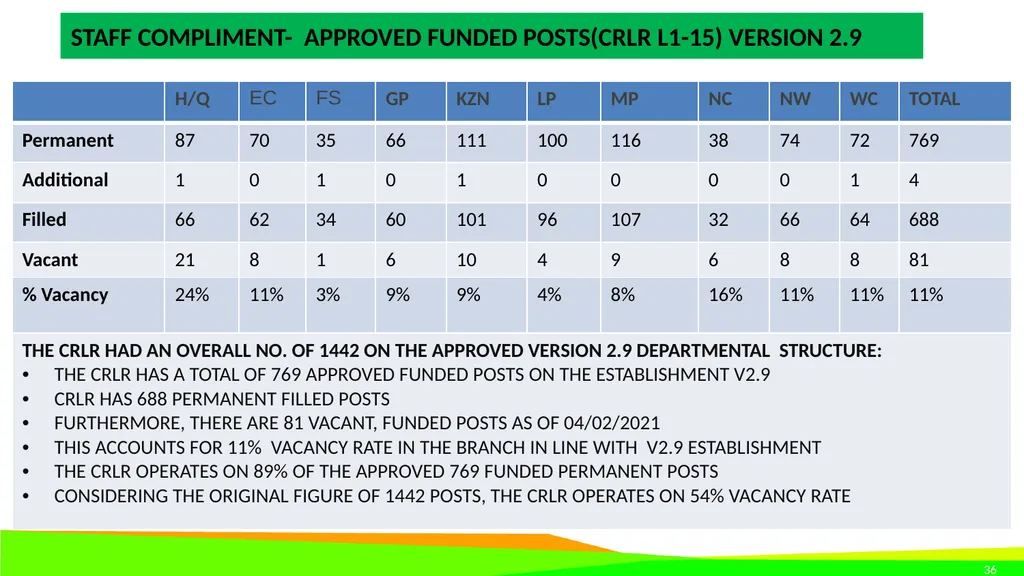
STAFF COMPLIMENT- APPROVED FUNDED POSTS(CRLR L1-15) VERSION 2.9<br>
37
THANK YOU<br>