
Structuring Mergers, Acquisitions, and Private
KB
Published · 95 slides · 0 views
1 / 1




Description
Structuring Mergers, Acquisitions, and Private Equity Recaps When the Target is an S Corporation NYU School of Professional Studies NYU Summer Tax Webcast July 24, 2020 Jerald D. August, Partner, Fox Rothschild LLP , Philadelphia, PA C.
Related Topics
Share
Embed code
Download this presentation From Below
"Structuring Mergers, Acquisitions, and Private" is the property of its rightful owner. Permission is granted to download and print the materials on this website for personal, non-commercial use only, and to display it on your personal computer provided you do not modify the materials and that you retain all copyright notices contained in the materials. By downloading content from our website, you accept the terms of this agreement.
Presentation Transcript
01
Structuring Mergers, Acquisitions, and
Private Equity Recaps When the Target
is an S Corporation NYU School of Professional Studies
NYU Summer Tax Webcast July 24, 2020
Jerald D. August, Partner, Fox Rothschild LLP , Philadelphia, PA
C. Wells Hall III, Partner, Nelson Mullins Riley & Scarborough, LLP, Charlotte, NC and Charleston, SC<br>
NYU Summer Tax Webcast July 24, 2020
Jerald D. August, Partner, Fox Rothschild LLP , Philadelphia, PA
C. Wells Hall III, Partner, Nelson Mullins Riley & Scarborough, LLP, Charlotte, NC and Charleston, SC<br>
02
Structuring Mergers, Acquisitions, and Private Equity Recaps When the Target is an S Corporation Business Tax Provisions of the TCJA of 2017 2<br>
03
Structuring Mergers, Acquisitions, and Private Equity Recaps When the Target is an S Corporations –TCJA Income Tax Rate Changes Before the Tax Cuts and Jobs Act (the “TCJA”), corporations were subject to graduated rates of income tax that resulted in a 35% corporate rate for taxable income over $10M, with a phase out of the lower rate for taxable income over $100,000. Certain personal service corporations were subject to a maximum rate of tax at 35%. The maximum rate of a corporation’s net capital gain was also 35%.
The new law reduces the corporate income tax to 21% and repeals the maximum corporate tax rate on net capital gain as obsolete. 3<br>
The new law reduces the corporate income tax to 21% and repeals the maximum corporate tax rate on net capital gain as obsolete. 3<br>
04
The 2017 Tax Act reduces the dividends received deduction (the “DRD,” in general, applicable to corporate shareholders receiving a dividend from certain domestic corporations) for the 70 percent and 80 percent brackets, to 50 percent and 65 percent, respectively, for taxable years beginning after December 31, 2017.
The 100 percent DRD remains intact for dividends from affiliated group members.
Section 245 provides for a 100% DRD from 10% owned foreign corporations and section 965 provides for a transition tax on foreign earnings reduces the tax cost of repatriating offshore earnings. 4 Structuring Mergers, Acquisitions, and Private Equity Recaps When the Target is an S Corporation - Dividends Received Deduction<br>
The 100 percent DRD remains intact for dividends from affiliated group members.
Section 245 provides for a 100% DRD from 10% owned foreign corporations and section 965 provides for a transition tax on foreign earnings reduces the tax cost of repatriating offshore earnings. 4 Structuring Mergers, Acquisitions, and Private Equity Recaps When the Target is an S Corporation - Dividends Received Deduction<br>
05
Structuring Mergers, Acquisitions, and Private Equity Recaps When the Target is an S Corporation - The Corporate AMT Prior to the TCJA, corporations were subject to the C-AMT to the extent that the tentative minimum tax exceeds its regular tax. The tentative minimum tax is computed at the rate of 20% on the AMTI in excess of an exemption amount AMTI is the taxpayer’s taxable income increased by certain preference items.
A major item included in the corporation’s AMT base is the “adjusted current earning (“ACE”) adjustment. The ACE adjustment is equal to 75% of the amount by which adjusted current earnings of a corporation exceed AMTI. The NOL carryover of a corporation cannot reduce the AMT base by more than 90% of the NOL. Nonrefundable business credits allowed for regular tax purposes are not allowable for C-AMT. Where a corporation is subject to the C-AMT, the amount of C-AMT is a credit for use in any subsequent tax year where the taxpayer’s regular tax liability exceeds its tentative minimum tax in such later year. 5<br>
A major item included in the corporation’s AMT base is the “adjusted current earning (“ACE”) adjustment. The ACE adjustment is equal to 75% of the amount by which adjusted current earnings of a corporation exceed AMTI. The NOL carryover of a corporation cannot reduce the AMT base by more than 90% of the NOL. Nonrefundable business credits allowed for regular tax purposes are not allowable for C-AMT. Where a corporation is subject to the C-AMT, the amount of C-AMT is a credit for use in any subsequent tax year where the taxpayer’s regular tax liability exceeds its tentative minimum tax in such later year. 5<br>
06
Structuring Mergers, Acquisitions, and Private Equity Recaps When the Target is an S Corporation – Repeal of the Corporate AMT The corporate AMT is repealed by the TCJA.
Existing C-AMT credits are refundable for any tax year beginning after 2017 and prior to 2022 in an amount equal to 50% (100% for tax years beginning in 2021) of the excess of the minimum tax credit for the taxable year over the amount of the credit allowable for the year against regular tax liability.
In place of the corporate alternative minimum tax, the TCJA enacted a base erosion minimum tax to prevent companies from stripping earnings out of the U.S. through payments to foreign affiliates that are deductible for U.S. tax purposes. 6<br>
Existing C-AMT credits are refundable for any tax year beginning after 2017 and prior to 2022 in an amount equal to 50% (100% for tax years beginning in 2021) of the excess of the minimum tax credit for the taxable year over the amount of the credit allowable for the year against regular tax liability.
In place of the corporate alternative minimum tax, the TCJA enacted a base erosion minimum tax to prevent companies from stripping earnings out of the U.S. through payments to foreign affiliates that are deductible for U.S. tax purposes. 6<br>
07
Structuring Mergers, Acquisitions, and Private Equity Recaps When the Target is an S Corporation – the BEAT The BEAT is structured as an alternative minimum tax that applies when a multinational company reduces its regular U.S. tax liability to less than a specified percentage of its taxable income, after adding back deductible base eroding payments and a percentage of tax losses claimed that were carried from another year.
The “base erosion minimum tax” is 10% (5% for years beginning in 2018) of the “modified taxable income” of the taxpayer over an amount equal the regular tax liability reduced by applicable credits of the corporation. The rate climbs to 12.5% for taxable years beginning after 2025.
The tax applies to deductible payments to foreign affiliates from domestic corporations, as well as on foreign corporations engaged in a U.S. trade or business in computing the tax on their effectively connected income (ECI). 7<br>
The “base erosion minimum tax” is 10% (5% for years beginning in 2018) of the “modified taxable income” of the taxpayer over an amount equal the regular tax liability reduced by applicable credits of the corporation. The rate climbs to 12.5% for taxable years beginning after 2025.
The tax applies to deductible payments to foreign affiliates from domestic corporations, as well as on foreign corporations engaged in a U.S. trade or business in computing the tax on their effectively connected income (ECI). 7<br>
08
The BEAT is applicable to a corporation other than a regulated investment company (RIC); real estate investment trust (REIT) or an S corporation.
Generally, the BEAT applies to large C corporations with average annual gross receipts for the immediately preceding 3 year period of at least $500M and its “base erosion percentage” for the taxable year is 3% (and possibly in some instances 2%) or higher. 8 Structuring Mergers, Acquisitions, and Private Equity Recaps When the Target is an S Corporation – the BEAT (cont’d)<br>
Generally, the BEAT applies to large C corporations with average annual gross receipts for the immediately preceding 3 year period of at least $500M and its “base erosion percentage” for the taxable year is 3% (and possibly in some instances 2%) or higher. 8 Structuring Mergers, Acquisitions, and Private Equity Recaps When the Target is an S Corporation – the BEAT (cont’d)<br>
09
POLLING QUESTION #1 What is the best flavor of ice cream?
Chocolate
Vanilla
Strawberry
For those seeking NYS CLE credit the code is D2D6VP. Please record all attendance verification codes announced during the program. Record the codes on the affirmation form available on the CLE Board website at: http://ww2.nycourts.gov/attorneys/cle/affirmation_sample.pdf and email the form to sps.tax@nyu.edu. For all other CLE inquires please email sps.tax@nyu.edu 9<br>
Chocolate
Vanilla
Strawberry
For those seeking NYS CLE credit the code is D2D6VP. Please record all attendance verification codes announced during the program. Record the codes on the affirmation form available on the CLE Board website at: http://ww2.nycourts.gov/attorneys/cle/affirmation_sample.pdf and email the form to sps.tax@nyu.edu. For all other CLE inquires please email sps.tax@nyu.edu 9<br>
10
Special Deduction for Qualified Business Income of Non-Corporate Entities (New Section 199A) The Purpose - Attempt at Parity with C Corporations. Congress enacted new Section 199A to offer a tax deduction from the “qualified business income” of non-corporate entities to match, at least in certain respects, the lower tax rates for corporations.
Basic Rule. A 20% deduction is allowed in determining the amount of taxable income from qualified business income. For higher income taxpayers (e.g. joint filers with more than $315,000 of taxable income), the amount of the deduction may be reduced. There are other significant limitations. For example, as enacted, the Section 199A deduction applied only for tax years after 2017 and before 2026.
Who Benefits? The Section 199A deduction is available with respect to qualified business income of: partnerships, limited liability companies, S Corporations, and sole proprietorships. A special rule confirms that this same benefit is available to specified agricultural and horticultural cooperatives. Notably, this benefit is unavailable to C Corporations. Their alternative benefit is the reduced corporate income tax rates. 10<br>
Basic Rule. A 20% deduction is allowed in determining the amount of taxable income from qualified business income. For higher income taxpayers (e.g. joint filers with more than $315,000 of taxable income), the amount of the deduction may be reduced. There are other significant limitations. For example, as enacted, the Section 199A deduction applied only for tax years after 2017 and before 2026.
Who Benefits? The Section 199A deduction is available with respect to qualified business income of: partnerships, limited liability companies, S Corporations, and sole proprietorships. A special rule confirms that this same benefit is available to specified agricultural and horticultural cooperatives. Notably, this benefit is unavailable to C Corporations. Their alternative benefit is the reduced corporate income tax rates. 10<br>
11
Qualified Business Income Nature of qualified Income
First, the income must be derived from a U.S. domestic trade or business. Excluded are:
investment-related income, such as dividends, interest income, (net) gain from commodities transactions other than those engaged in by commodities dealers, and
compensation for services, including guaranteed payments for services rendered by partners and members. 11<br>
First, the income must be derived from a U.S. domestic trade or business. Excluded are:
investment-related income, such as dividends, interest income, (net) gain from commodities transactions other than those engaged in by commodities dealers, and
compensation for services, including guaranteed payments for services rendered by partners and members. 11<br>
12
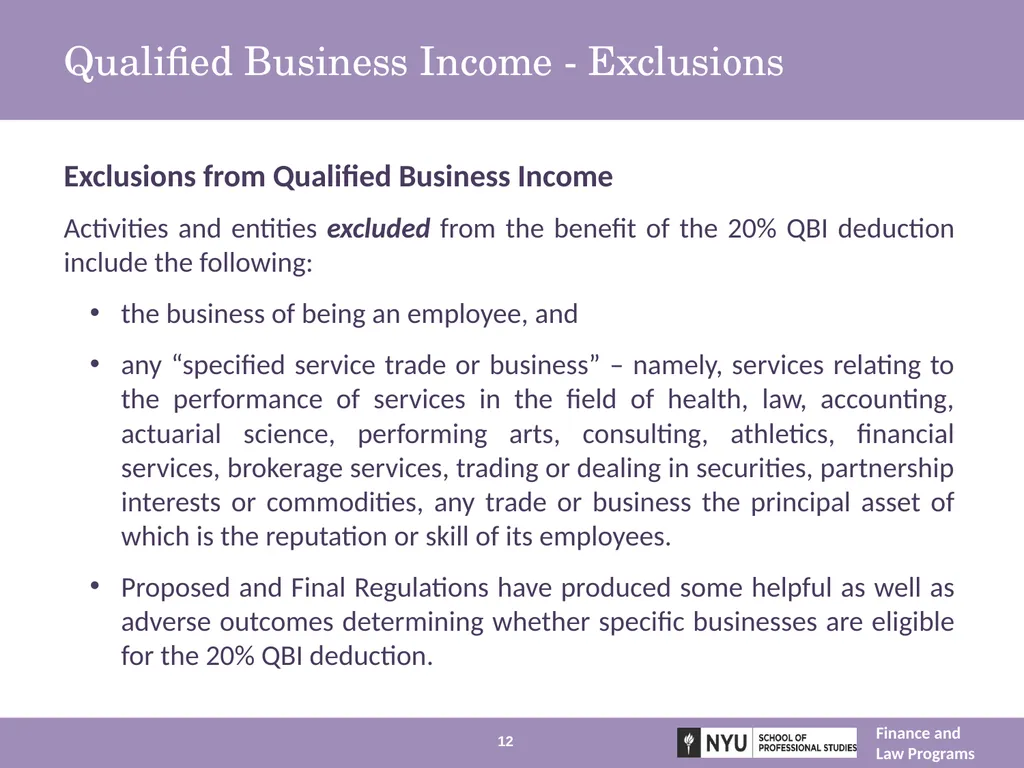
Qualified Business Income - Exclusions Exclusions from Qualified Business Income
Activities and entities excluded from the benefit of the 20% QBI deduction include the following:
the business of being an employee, and
any “specified service trade or business” – namely, services relating to the performance of services in the field of health, law, accounting, actuarial science, performing arts, consulting, athletics, financial services, brokerage services, trading or dealing in securities, partnership interests or commodities, any trade or business the principal asset of which is the reputation or skill of its employees.
Proposed and Final Regulations have produced some helpful as well as adverse outcomes determining whether specific businesses are eligible for the 20% QBI deduction. 12<br>
Activities and entities excluded from the benefit of the 20% QBI deduction include the following:
the business of being an employee, and
any “specified service trade or business” – namely, services relating to the performance of services in the field of health, law, accounting, actuarial science, performing arts, consulting, athletics, financial services, brokerage services, trading or dealing in securities, partnership interests or commodities, any trade or business the principal asset of which is the reputation or skill of its employees.
Proposed and Final Regulations have produced some helpful as well as adverse outcomes determining whether specific businesses are eligible for the 20% QBI deduction. 12<br>
13
The QBI 20% Pass-Thru Tax Deduction As the 2017 Tax Act moved through Congress, efforts were made to reduce its overall tax cost, such as Section 199A(b)(2) which provides that the amount of the deduction (as determined for each qualified trade or business) is the lesser of:
(a) 20% of the taxpayer’s qualified business income with respect to the qualified trade or business, and
(b) the greater of: (i) 50% of its W-2 wages and (ii) the sum of 25% of its W-2 wages and 2.5% of the unadjusted basis of all qualified property that is used in that trade or business. (Such property must be tangible and depreciable).
Observation – In sum, this added limitation will have the effect of substantially reducing the tax benefit for businesses with lower levels of W-2 wages, particularly those that are not capital intensive. With this in mind, taxpayers have already or must engage in modeling to determine the optimal level of W-2 wages, in some cases shifting of income toward W-2 wages and away from business profits. 13<br>
(a) 20% of the taxpayer’s qualified business income with respect to the qualified trade or business, and
(b) the greater of: (i) 50% of its W-2 wages and (ii) the sum of 25% of its W-2 wages and 2.5% of the unadjusted basis of all qualified property that is used in that trade or business. (Such property must be tangible and depreciable).
Observation – In sum, this added limitation will have the effect of substantially reducing the tax benefit for businesses with lower levels of W-2 wages, particularly those that are not capital intensive. With this in mind, taxpayers have already or must engage in modeling to determine the optimal level of W-2 wages, in some cases shifting of income toward W-2 wages and away from business profits. 13<br>
14
The QBI 20% Pass-Thru Tax Deduction Income Ceiling for Specified Trades or Businesses in which
Taxpayer-Owners’ Taxable Income Do Not Exceed Ceiling Amount
For taxpayers filing joint returns, the ceiling amount is $315,000. Thus, taxpayer-owners of specified trades with incomes below that ceiling amount and derive the same Section 199A deduction as owners of other qualified businesses. The benefit is phased out as income exceeds the ceiling amount, by as much as $100,000 in the case of joint filers. 14<br>
For taxpayers filing joint returns, the ceiling amount is $315,000. Thus, taxpayer-owners of specified trades with incomes below that ceiling amount and derive the same Section 199A deduction as owners of other qualified businesses. The benefit is phased out as income exceeds the ceiling amount, by as much as $100,000 in the case of joint filers. 14<br>
15
The QBI 20% Pass-Thru Tax Deduction Application to “Lower Income” Business Owners
For single filers with taxable income below $157,500, and for joint filers with taxable income below $315,000, the only major wrinkle in the calculation of the 20% pass-thru deduction is the lesser-of-eligible-business-income-or taxable-income rule.
If a business owner’s taxable income is below their applicable threshold, then their chosen profession has no impact on their ability to claim the pass-thru deduction. That means that a reasonable number of doctors, lawyers, accountants, performers, athletes and financial advisors may be eligible for the 20% pass-thru deduction.
Furthermore, for these “low income” filers, there is no need to evaluate the amount of W-2 wages their business has paid, nor the amount of depreciable assets the business owns. They simply get the deduction at the lesser of 20% of their eligible business income, or taxable income less capital gains. 15<br>
For single filers with taxable income below $157,500, and for joint filers with taxable income below $315,000, the only major wrinkle in the calculation of the 20% pass-thru deduction is the lesser-of-eligible-business-income-or taxable-income rule.
If a business owner’s taxable income is below their applicable threshold, then their chosen profession has no impact on their ability to claim the pass-thru deduction. That means that a reasonable number of doctors, lawyers, accountants, performers, athletes and financial advisors may be eligible for the 20% pass-thru deduction.
Furthermore, for these “low income” filers, there is no need to evaluate the amount of W-2 wages their business has paid, nor the amount of depreciable assets the business owns. They simply get the deduction at the lesser of 20% of their eligible business income, or taxable income less capital gains. 15<br>
16
The QBI 20% Pass-Thru Tax Deduction Application to “Higher Income” Business Owners Engaged in a
“Specialized Service Trade or Business”
For business owners that fall into this category, after a brief phase-out range ($157,500 – $207,500 for single filers, and $315,000 - $415,000 for joint filers), in which business owners receive a deduction for a prorated amount of their business income, the 20% pass-thru deduction is completely eliminated.
Specialized trade or business income includes income stemming from performance of services in the fields of health, law, accounting, actuarial science, performing arts, consulting, athletics, financial services, brokerage services, or any business where the principal asset of the business is the reputation or skill of one or more of its employees.
If the business owner is a single filer with more than $207,500 of taxable income, or a joint filer with more than $415,000 of taxable income AND their business income stems from one of the above professions, they get no 20% pass-thru deduction — for any of their business income. 16<br>
“Specialized Service Trade or Business”
For business owners that fall into this category, after a brief phase-out range ($157,500 – $207,500 for single filers, and $315,000 - $415,000 for joint filers), in which business owners receive a deduction for a prorated amount of their business income, the 20% pass-thru deduction is completely eliminated.
Specialized trade or business income includes income stemming from performance of services in the fields of health, law, accounting, actuarial science, performing arts, consulting, athletics, financial services, brokerage services, or any business where the principal asset of the business is the reputation or skill of one or more of its employees.
If the business owner is a single filer with more than $207,500 of taxable income, or a joint filer with more than $415,000 of taxable income AND their business income stems from one of the above professions, they get no 20% pass-thru deduction — for any of their business income. 16<br>
17
The QBI 20% Pass-Thru Tax Deduction Application of the Deduction for High Income Clients NOT Engaged in a “Specialized Service Trade or Business”
For business owners with high income who also have business income from an activity that is not a specialized service trade or business, another limitation kicks in. Once the business owner’s income exceeds the thresholds noted above, the deduction may not exceed the greater of:
50% of the W-2 wages paid by the business, or
25% of the W-2 wages paid by the business, plus 2.5% of the unadjusted basis of qualified depreciable property owned by the business. 17<br>
For business owners with high income who also have business income from an activity that is not a specialized service trade or business, another limitation kicks in. Once the business owner’s income exceeds the thresholds noted above, the deduction may not exceed the greater of:
50% of the W-2 wages paid by the business, or
25% of the W-2 wages paid by the business, plus 2.5% of the unadjusted basis of qualified depreciable property owned by the business. 17<br>
18
The QBI 20% Pass-Thru Tax Deduction Tax Planning Considerations
Entity choice should consider all facts and circumstances. Pass-thru status may still be the best choice in many cases, with or without the 20% pass-thru deduction.
W-2 wages includes all W-2 wages, not just those paid to the owner(s). Thus, converting a 1099 independent contractor to a W-2 employee might be beneficial.
Only corporations can pay W-2 wages to owners and partners may not be treated as employees.
For partnerships and LLCs, self-employment taxes will still be calculated on the net business income before the 20% pass-thru deduction. This would not apply to pass-thru income from an S corporation, since S corporation dividends are not subject to self-employment tax although passive S corporation shareholders may be subject to the 3.8% tax on net investment income. 18<br>
Entity choice should consider all facts and circumstances. Pass-thru status may still be the best choice in many cases, with or without the 20% pass-thru deduction.
W-2 wages includes all W-2 wages, not just those paid to the owner(s). Thus, converting a 1099 independent contractor to a W-2 employee might be beneficial.
Only corporations can pay W-2 wages to owners and partners may not be treated as employees.
For partnerships and LLCs, self-employment taxes will still be calculated on the net business income before the 20% pass-thru deduction. This would not apply to pass-thru income from an S corporation, since S corporation dividends are not subject to self-employment tax although passive S corporation shareholders may be subject to the 3.8% tax on net investment income. 18<br>
19
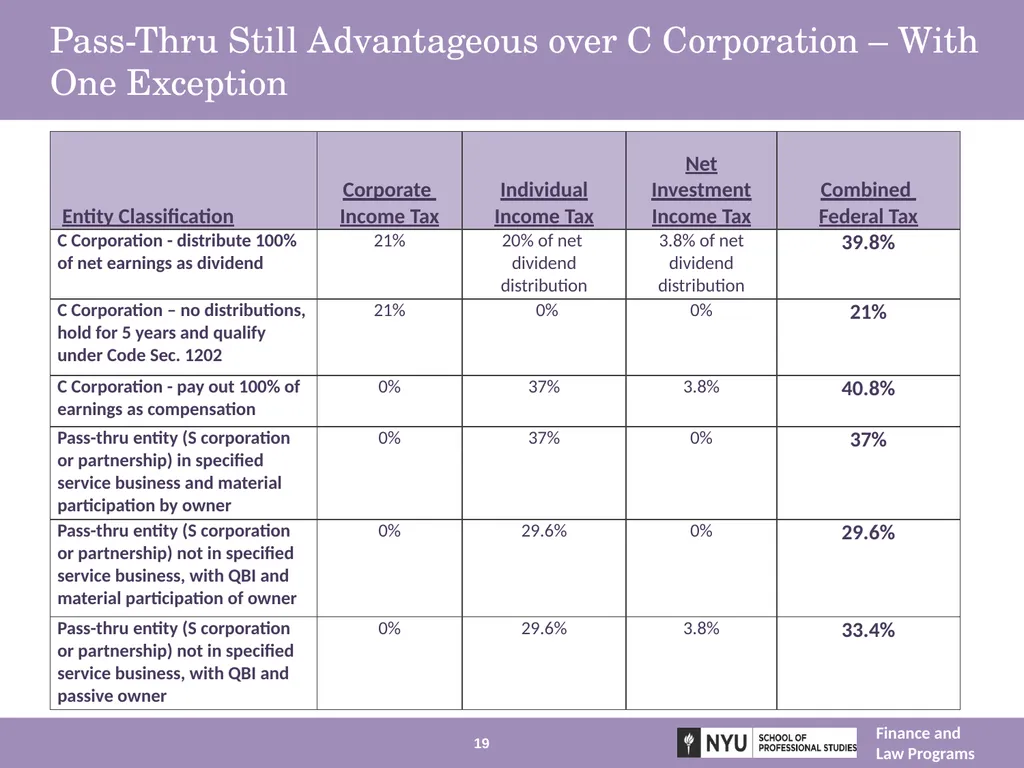
Pass-Thru Still Advantageous over C Corporation – With One Exception 19<br>
20
Limitation on the Deduction of Business Interest – Section 163(j) In general, new Section 163(j) finds its origin in old Section 163(j), which was aimed to prevent “dividend stripping” – a practice by which foreign corporations with U.S. subsidiaries capitalized their subsidiaries with "excessive" debt which was held by the foreign parent or affiliate or held by another foreign entity exempt from U.S. taxation and guaranteed by the foreign parent or related entity. These practices reduced the U.S. tax liability of U.S. persons while “shifting income – in the form of interest income – to non-taxable entities for U.S. tax purposes.
The aim of new Section 163(j) is much broader. It is to defer or disallow interest expense deductions which are deemed to be excessive in relation to the adjusted taxable income of the borrower. Unlike old Section 163(j) or new Section 199A, new Section 163(j) applies to virtually all categories, with a few exceptions. This limitation must be considered in certain leveraged acquisitions.
The new interest deduction limitation is permanent. Unlike the Section 199A Deduction, it does not "sunset" in 2026. 20<br>
The aim of new Section 163(j) is much broader. It is to defer or disallow interest expense deductions which are deemed to be excessive in relation to the adjusted taxable income of the borrower. Unlike old Section 163(j) or new Section 199A, new Section 163(j) applies to virtually all categories, with a few exceptions. This limitation must be considered in certain leveraged acquisitions.
The new interest deduction limitation is permanent. Unlike the Section 199A Deduction, it does not "sunset" in 2026. 20<br>
21
Limitation on the Deduction of Business Interest – Section 163(j) The General Rule – The deduction for “business interest” of a taxpayer for any taxable year may not exceed 30% of the taxpayer’s adjusted taxable income – which item is determined without regard to business interest expense deductions. This limitation is applied at the entity level, even for pass through entities, such as partnerships.
What is Business Interest?
Interest on indebtedness incurred for purposes of the trade or business. This does not include investment interest expense incurred to purchase or carry passive investments, such as stock or other securities.
Interest is given the same meaning as for general income tax purposes. Thus, it includes original issue discount. 21<br>
What is Business Interest?
Interest on indebtedness incurred for purposes of the trade or business. This does not include investment interest expense incurred to purchase or carry passive investments, such as stock or other securities.
Interest is given the same meaning as for general income tax purposes. Thus, it includes original issue discount. 21<br>
22
Limitation on the Deduction of Business Interest- Exclusions What is Not Business Interest?
Special rules exempt certain businesses from this interest expense limitation. They include –
interest on floor plan financing for motor vehicle dealers,
any electing real property trade or businesses,
any electing farming business,
certain investor-owned utilities (excluding water utilities), the rates for which are regulated; and
smaller enterprises that are authorized to utilize the cash method of accounting because their gross receipts, on average, have not exceeded $25 million. 22<br>
Special rules exempt certain businesses from this interest expense limitation. They include –
interest on floor plan financing for motor vehicle dealers,
any electing real property trade or businesses,
any electing farming business,
certain investor-owned utilities (excluding water utilities), the rates for which are regulated; and
smaller enterprises that are authorized to utilize the cash method of accounting because their gross receipts, on average, have not exceeded $25 million. 22<br>
23
Limitation on the Deduction of Business Interest-Exclusions An electing real property trade or business is defined as any real property development, redevelopment, construction, acquisition, conversion, rental, operation, management, leasing, or brokerage trade or business.
Required to use alternative depreciation system.
Business interest expense limitation is applied at entity level, and each trade or business treated separately.
Presumably separate real property trades or businesses can be aggregated? 23<br>
Required to use alternative depreciation system.
Business interest expense limitation is applied at entity level, and each trade or business treated separately.
Presumably separate real property trades or businesses can be aggregated? 23<br>
24
Limitation on the Deduction of Business Interest-Exclusions An electing farming business includes the traditional family business as well as a nursery or sod farm, the raising or harvesting of fruit bearing trees or ornamented trees, and trades or businesses of agricultural and horticultural cooperatives covered by Section 199A(g)(2).
In other words, whichever cooperatives benefit from special treatment under Section 199A are exempt from the limitation on the deductibility of business interest expense. Beyond that, the relevant legislative history provides leeway for administrative relief to certain agriculture–related enterprises, even if not conducted by a cooperative.
More specifically, the legislative history indicates that in certain circumstances a farming business for this purpose should be viewed broadly: “A farming business also includes processing that are normally incident to the growing, raising or harvesting of agricultural . . . products . . . . A farming business does not include contract harvesting . . . or merely buying and reselling plants or animals grown or raised by others . . .” 24<br>
In other words, whichever cooperatives benefit from special treatment under Section 199A are exempt from the limitation on the deductibility of business interest expense. Beyond that, the relevant legislative history provides leeway for administrative relief to certain agriculture–related enterprises, even if not conducted by a cooperative.
More specifically, the legislative history indicates that in certain circumstances a farming business for this purpose should be viewed broadly: “A farming business also includes processing that are normally incident to the growing, raising or harvesting of agricultural . . . products . . . . A farming business does not include contract harvesting . . . or merely buying and reselling plants or animals grown or raised by others . . .” 24<br>
25
Limitation on the Deduction of Business Interest – Pass-Through Entities The 30% limitation on the deduction of business interest applies at the partnership level.
Generally, the rule requires a partnership to calculate its taxable income in the following manner:
separately determine (i) business income determined without regard to interest expense; and (ii) investment income, if any; and
apply interest expense first to offset interest income.
Net interest expense remains a currently deductible expense to the extent that it does not exceed 30% of business income. Any excess is treated as disallowed interest expense. 25<br>
Generally, the rule requires a partnership to calculate its taxable income in the following manner:
separately determine (i) business income determined without regard to interest expense; and (ii) investment income, if any; and
apply interest expense first to offset interest income.
Net interest expense remains a currently deductible expense to the extent that it does not exceed 30% of business income. Any excess is treated as disallowed interest expense. 25<br>
26
Limitation on the Deduction of Business Interest – Pass-Through Entities To the extent that the capacity for interest deductions is not fully utilized by the partnership, it has what is now referred to as “excess taxable income”. This item may be carried forward to “absorb” otherwise disallowed interest expense in subsequent years.
Partnerships will allocate to their partners (on K-1s or successor forms) items of income, gain, loss, and credits as previously. In addition, however, disallowed interest expense will also be an allocated item, as will be the new concept of “excess taxable income” which may be offset by previously allocated disallowed interest expense of that same partnership. 26<br>
Partnerships will allocate to their partners (on K-1s or successor forms) items of income, gain, loss, and credits as previously. In addition, however, disallowed interest expense will also be an allocated item, as will be the new concept of “excess taxable income” which may be offset by previously allocated disallowed interest expense of that same partnership. 26<br>
27
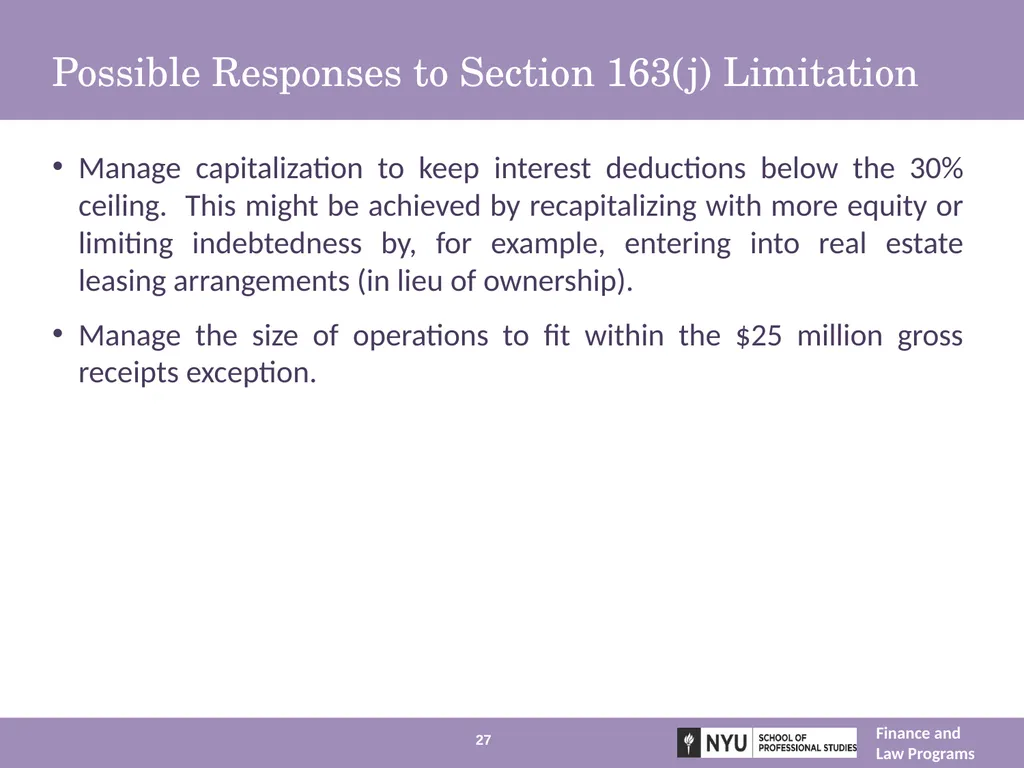
Possible Responses to Section 163(j) Limitation Manage capitalization to keep interest deductions below the 30% ceiling. This might be achieved by recapitalizing with more equity or limiting indebtedness by, for example, entering into real estate leasing arrangements (in lieu of ownership).
Manage the size of operations to fit within the $25 million gross receipts exception. 27<br>
Manage the size of operations to fit within the $25 million gross receipts exception. 27<br>
28
POLLING QUESTION #2 What is your favorite vegetable?
Broccoli
String beans
What’s a vegetable? I like meat.
For those seeking NYS CLE credit the code is W3RY9K
Please record all attendance verification codes announced during the program. Record the codes on the affirmation form available on the CLE Board website at: http://ww2.nycourts.gov/attorneys/cle/affirmation_sample.pdf and email the form to sps.tax@nyu.edu. For all other CLE inquires please email sps.tax@nyu.edu 28<br>
Broccoli
String beans
What’s a vegetable? I like meat.
For those seeking NYS CLE credit the code is W3RY9K
Please record all attendance verification codes announced during the program. Record the codes on the affirmation form available on the CLE Board website at: http://ww2.nycourts.gov/attorneys/cle/affirmation_sample.pdf and email the form to sps.tax@nyu.edu. For all other CLE inquires please email sps.tax@nyu.edu 28<br>
29
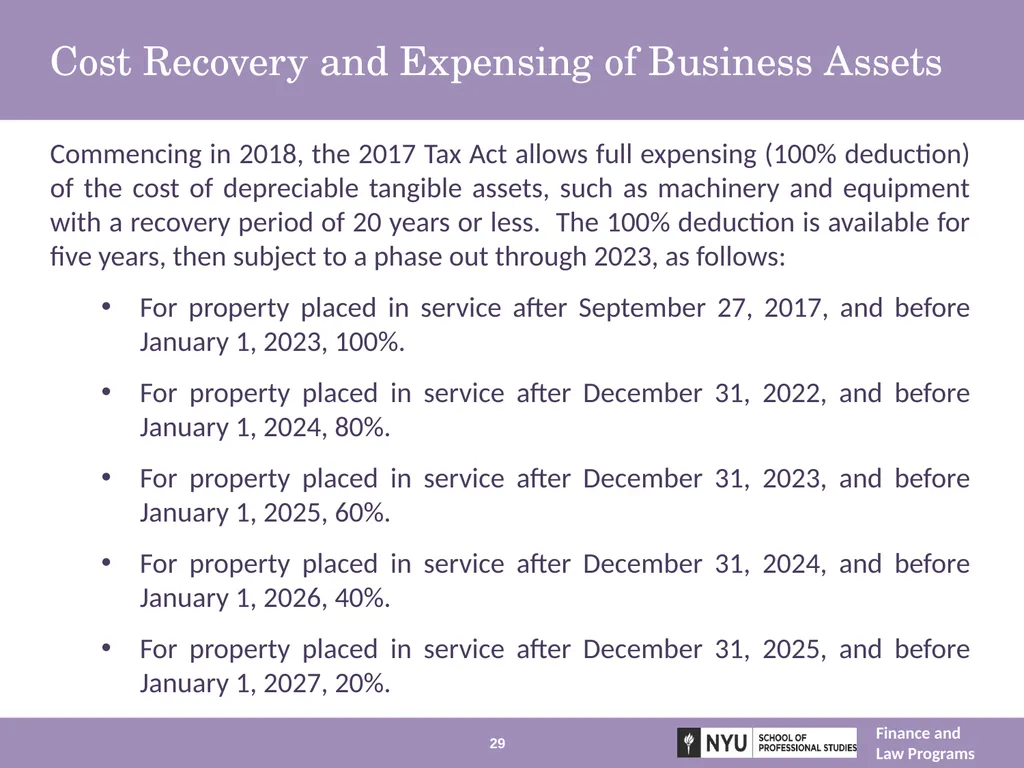
Cost Recovery and Expensing of Business Assets Commencing in 2018, the 2017 Tax Act allows full expensing (100% deduction) of the cost of depreciable tangible assets, such as machinery and equipment with a recovery period of 20 years or less. The 100% deduction is available for five years, then subject to a phase out through 2023, as follows:
For property placed in service after September 27, 2017, and before January 1, 2023, 100%.
For property placed in service after December 31, 2022, and before January 1, 2024, 80%.
For property placed in service after December 31, 2023, and before January 1, 2025, 60%.
For property placed in service after December 31, 2024, and before January 1, 2026, 40%.
For property placed in service after December 31, 2025, and before January 1, 2027, 20%. 29<br>
For property placed in service after September 27, 2017, and before January 1, 2023, 100%.
For property placed in service after December 31, 2022, and before January 1, 2024, 80%.
For property placed in service after December 31, 2023, and before January 1, 2025, 60%.
For property placed in service after December 31, 2024, and before January 1, 2026, 40%.
For property placed in service after December 31, 2025, and before January 1, 2027, 20%. 29<br>
30
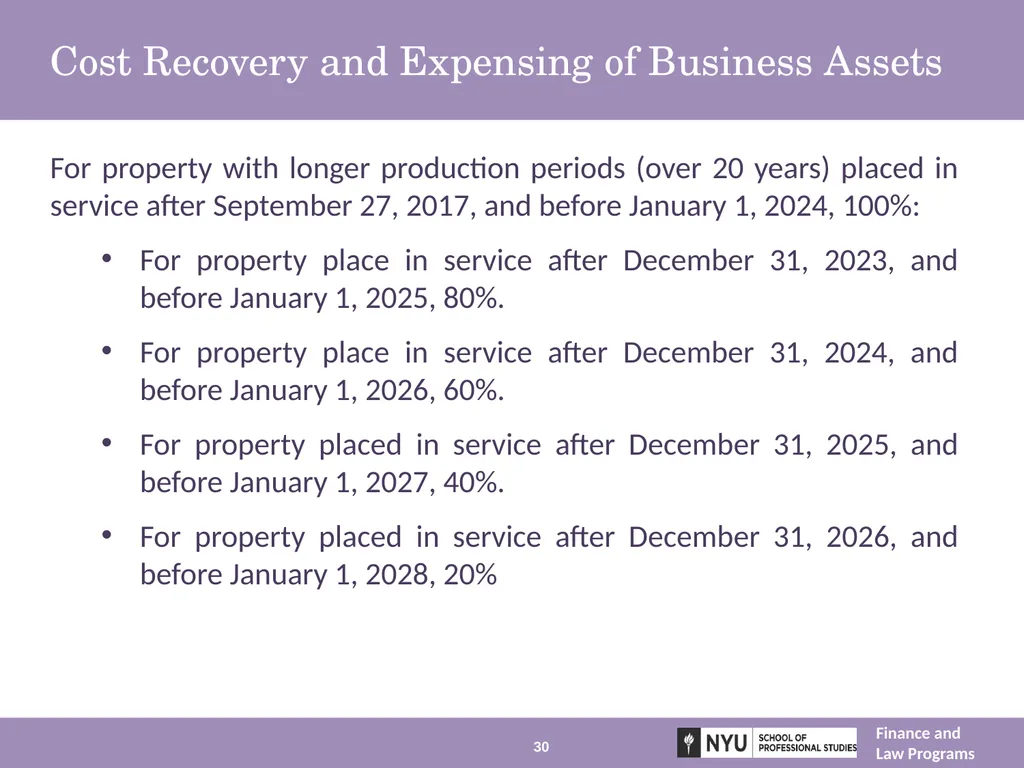
Cost Recovery and Expensing of Business Assets For property with longer production periods (over 20 years) placed in service after September 27, 2017, and before January 1, 2024, 100%:
For property place in service after December 31, 2023, and before January 1, 2025, 80%.
For property place in service after December 31, 2024, and before January 1, 2026, 60%.
For property placed in service after December 31, 2025, and before January 1, 2027, 40%.
For property placed in service after December 31, 2026, and before January 1, 2028, 20% 30<br>
For property place in service after December 31, 2023, and before January 1, 2025, 80%.
For property place in service after December 31, 2024, and before January 1, 2026, 60%.
For property placed in service after December 31, 2025, and before January 1, 2027, 40%.
For property placed in service after December 31, 2026, and before January 1, 2028, 20% 30<br>
31
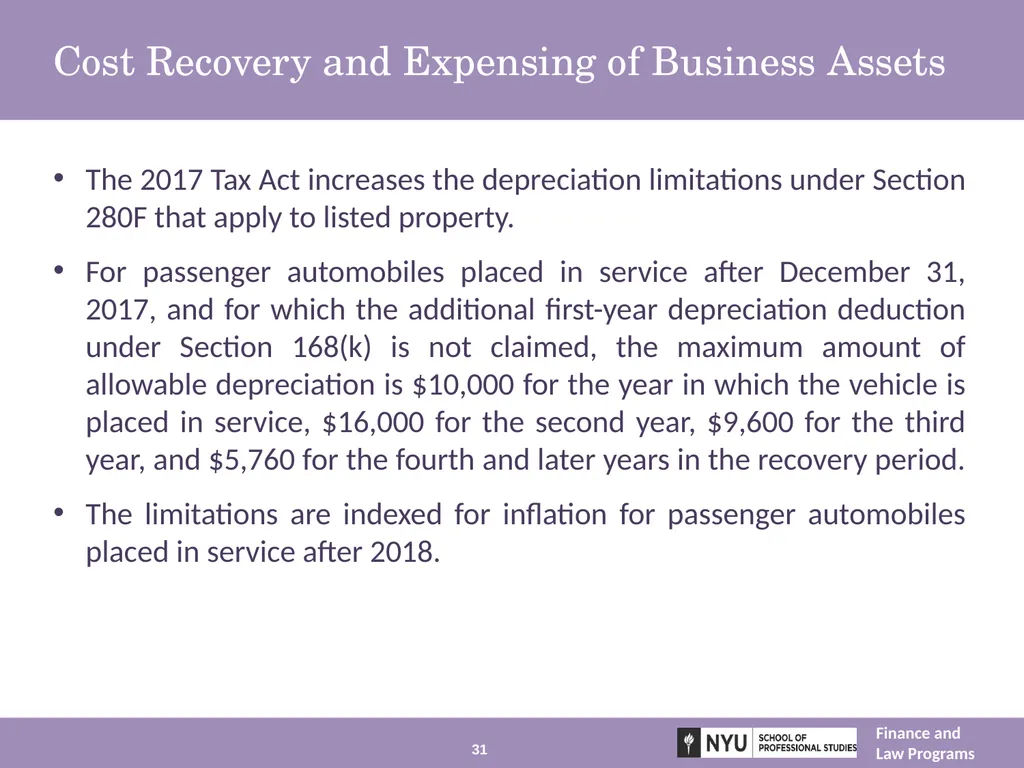
Cost Recovery and Expensing of Business Assets The 2017 Tax Act increases the depreciation limitations under Section 280F that apply to listed property.
For passenger automobiles placed in service after December 31, 2017, and for which the additional first-year depreciation deduction under Section 168(k) is not claimed, the maximum amount of allowable depreciation is $10,000 for the year in which the vehicle is placed in service, $16,000 for the second year, $9,600 for the third year, and $5,760 for the fourth and later years in the recovery period.
The limitations are indexed for inflation for passenger automobiles placed in service after 2018. 31<br>
For passenger automobiles placed in service after December 31, 2017, and for which the additional first-year depreciation deduction under Section 168(k) is not claimed, the maximum amount of allowable depreciation is $10,000 for the year in which the vehicle is placed in service, $16,000 for the second year, $9,600 for the third year, and $5,760 for the fourth and later years in the recovery period.
The limitations are indexed for inflation for passenger automobiles placed in service after 2018. 31<br>
32
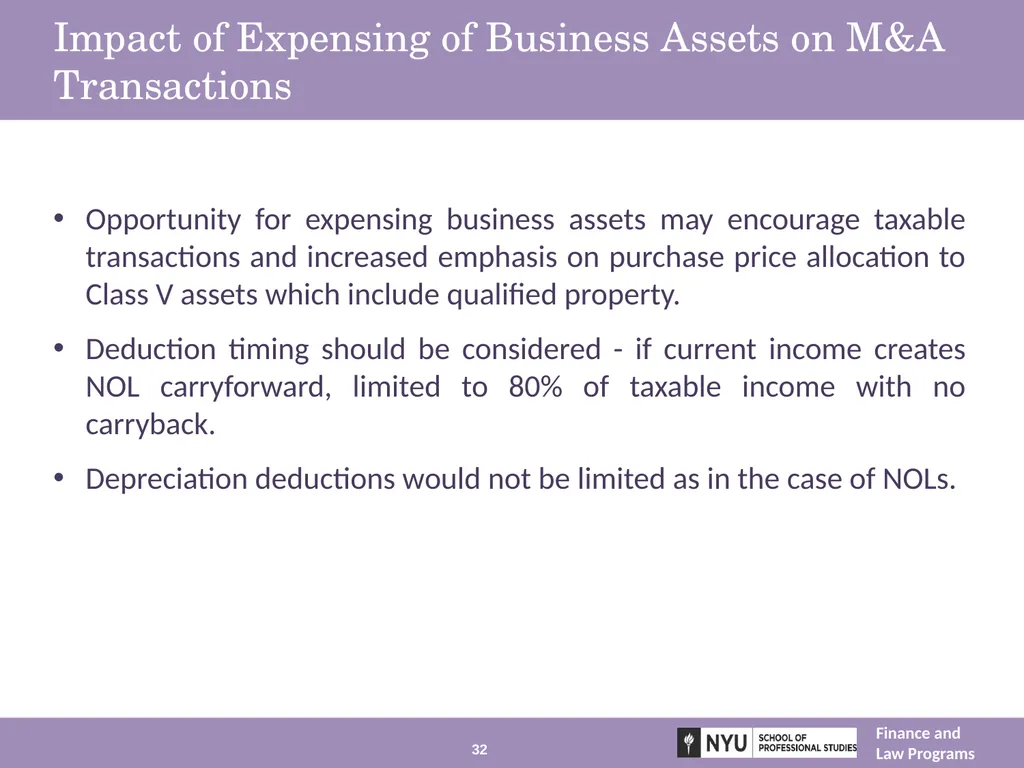
Impact of Expensing of Business Assets on M&A Transactions Opportunity for expensing business assets may encourage taxable transactions and increased emphasis on purchase price allocation to Class V assets which include qualified property.
Deduction timing should be considered - if current income creates NOL carryforward, limited to 80% of taxable income with no carryback.
Depreciation deductions would not be limited as in the case of NOLs. 32<br>
Deduction timing should be considered - if current income creates NOL carryforward, limited to 80% of taxable income with no carryback.
Depreciation deductions would not be limited as in the case of NOLs. 32<br>
33
MACRS Continued for Nonresidential and Residential Real Property The 2017 Tax Act maintains the present law modified accelerated cost recovery system (“MACRS”) recovery periods of 39 and 27.5 years for nonresidential real and residential rental property, respectively.
While the Conference Report indicates that qualified leasehold improvement property, generally recovered using the straight-line method and a half-year convention, is eligible under the 2017 Tax Act for the additional first-year depreciation deduction if the other requirements of Section 168(k) are met.
However, as a result of a drafting glitch, the statute failed to reduce the useful life of qualified leasehold improvement property to less than 20 years and did not accomplish the intended result. This glitch was fixed in the CARES Act, discussed further below. 33<br>
While the Conference Report indicates that qualified leasehold improvement property, generally recovered using the straight-line method and a half-year convention, is eligible under the 2017 Tax Act for the additional first-year depreciation deduction if the other requirements of Section 168(k) are met.
However, as a result of a drafting glitch, the statute failed to reduce the useful life of qualified leasehold improvement property to less than 20 years and did not accomplish the intended result. This glitch was fixed in the CARES Act, discussed further below. 33<br>
34
Cost Recovery and Expensing of Business Assets –Section 179 Limits Increased While apparently mooted by the general rules for expensing business assets until they expire in 2027 and 2028 (which are unlimited in amount), the 2017 Tax Act increases the maximum amount a taxpayer may expense under Section 179 to $1,000,000, and increases the phase-out threshold amount to $2,500,000.
Thus, the provision provides that the maximum amount a taxpayer may expense, for taxable years beginning after 2017, is $1,000,000 of the cost of qualifying property placed in service for the taxable year. The $1,000,000 amount is reduced (but not below zero) by the amount by which the cost of qualifying property placed in service during the taxable year exceeds $2,500,000.
The $1,000,000 and $2,500,000 amounts, as well as the $25,000 sport utility vehicle limitation, are indexed for inflation for taxable years beginning after 2018. 34<br>
Thus, the provision provides that the maximum amount a taxpayer may expense, for taxable years beginning after 2017, is $1,000,000 of the cost of qualifying property placed in service for the taxable year. The $1,000,000 amount is reduced (but not below zero) by the amount by which the cost of qualifying property placed in service during the taxable year exceeds $2,500,000.
The $1,000,000 and $2,500,000 amounts, as well as the $25,000 sport utility vehicle limitation, are indexed for inflation for taxable years beginning after 2018. 34<br>
35
NOL Carryforwards Indefinite, But No Carrybacks under 2017 Tax Act Under prior law, net operating losses (“NOLs”) generally had a carryback period of two years and a carryforward period of 20 years.
For taxable years beginning after December 31, 2017, the 2017 Tax Act generally eliminated the NOL carryback period and makes the carryforward period indefinite. The amount of the NOL deduction allowed is limited to 80 percent of taxable income computed without regard to the NOL deduction. This provision was modified by the CARES Act, discussed further below.
Special rules apply to certain farming and insurance losses.
Conforming amendments include, but are not limited to: (1) the repeal of carrybacks of specified liability losses defined in Section 172(f) and (2) excess interest losses related to corporate equity reduction transactions under Section 172(g). 35<br>
For taxable years beginning after December 31, 2017, the 2017 Tax Act generally eliminated the NOL carryback period and makes the carryforward period indefinite. The amount of the NOL deduction allowed is limited to 80 percent of taxable income computed without regard to the NOL deduction. This provision was modified by the CARES Act, discussed further below.
Special rules apply to certain farming and insurance losses.
Conforming amendments include, but are not limited to: (1) the repeal of carrybacks of specified liability losses defined in Section 172(f) and (2) excess interest losses related to corporate equity reduction transactions under Section 172(g). 35<br>
36
Other Income Tax Changes For Businesses Like-Kind Exchanges Under Section 1031
The deferral of gain resulting from like-kind exchanges under Section 1031 are now limited to include only real property not held primarily for sale.
Personal property, animals of same sex, etc., no longer qualify for tax free exchange.
A “trade in” of used business equipment for new equipment will now trigger taxable gain.
The gain on the taxable exchange may be offset by more generous expensing rules. 36<br>
The deferral of gain resulting from like-kind exchanges under Section 1031 are now limited to include only real property not held primarily for sale.
Personal property, animals of same sex, etc., no longer qualify for tax free exchange.
A “trade in” of used business equipment for new equipment will now trigger taxable gain.
The gain on the taxable exchange may be offset by more generous expensing rules. 36<br>
37
POLLING QUESTION #3 What is your favorite pet?
Dog
Cat
Great White Shark
For those seeking NYS CLE credit the code is JEM1932 Please record all attendance verification codes announced during the program. Record the codes on the affirmation form available on the CLE Board website at: http://ww2.nycourts.gov/attorneys/cle/affirmation_sample.pdf and email the form to sps.tax@nyu.edu. For all other CLE inquires please email sps.tax@nyu.edu 37<br>
Dog
Cat
Great White Shark
For those seeking NYS CLE credit the code is JEM1932 Please record all attendance verification codes announced during the program. Record the codes on the affirmation form available on the CLE Board website at: http://ww2.nycourts.gov/attorneys/cle/affirmation_sample.pdf and email the form to sps.tax@nyu.edu. For all other CLE inquires please email sps.tax@nyu.edu 37<br>
38
Structuring Mergers, Acquisitions, and Private Equity Recaps When the Target is an S Corporation Business Tax Provisions of the Coronavirus Aid, Relief, and Economic Security Act (the “CARES Act”) 38<br>
39
CARES Act - NOL Carrybacks The CARES Act in effect reversed the provisions of the TCJA which eliminated carrybacks of net operating losses (“NOLs”) and limited the use of NOL carryforwards to 80% of taxable income.
The new provision allows business taxpayers to aggregate NOLs from tax years 2018, 2019, and 2020 and carry them back up to five years.
Notably, the five-year carryback would allow corporations to apply losses to years in which the corporate tax rate was 35%, which has the effect of increasing the value of NOLs carried back. 39<br>
The new provision allows business taxpayers to aggregate NOLs from tax years 2018, 2019, and 2020 and carry them back up to five years.
Notably, the five-year carryback would allow corporations to apply losses to years in which the corporate tax rate was 35%, which has the effect of increasing the value of NOLs carried back. 39<br>
40
CARES Act - NOL Carrybacks Additionally, the provision temporarily removes the 80% taxable income limitation, allowing NOLs to fully offset taxable income for tax years beginning before January 1, 2021.
Special rules apply to NOLs incurred by REITs and life insurance companies and with respect to the availability of credits for prior year alternative minimum tax liability of corporations. 40<br>
Special rules apply to NOLs incurred by REITs and life insurance companies and with respect to the availability of credits for prior year alternative minimum tax liability of corporations. 40<br>
41
CARES Act -NOL Carrybacks For U.S. corporations with foreign-source and foreign-derived income, including those owning 10% or more of the shares of non-U.S. corporations that are treated as controlled foreign corporations (“CFCs”), the carryback provisions of the Act must be analyzed in light of the global intangible low-taxed income (“GILTI”) and foreign-derived intangible income (“FDII”) provisions enacted by the TCJA.
In certain circumstances, this interplay of these provisions may vitiate the tax benefits of the new NOL carryback provisions since Section 951A on GILTI accelerates foreign source (non-Subpart F) income that could be blocked income under prior law. 41<br>
In certain circumstances, this interplay of these provisions may vitiate the tax benefits of the new NOL carryback provisions since Section 951A on GILTI accelerates foreign source (non-Subpart F) income that could be blocked income under prior law. 41<br>
42
CARES Act – AMT Credit Refunds The TCJA repealed the corporate alternative minimum tax (“AMT”). As part of this repeal, corporations who were previously subject to the tax received refundable credits which were made available over several years ending in 2021.
The CARES Act repeals the 2021 timeline and allows eligible companies to apply for an immediate refund of AMT amounts that would otherwise be deferred under the TCJA. 42<br>
The CARES Act repeals the 2021 timeline and allows eligible companies to apply for an immediate refund of AMT amounts that would otherwise be deferred under the TCJA. 42<br>
43
CARES Act – Deductible Interest Expense The TCJA limited the amount of deductible business interest expense to 30% of the taxpayer’s adjustable taxable income (“ATI”) for the tax year.
Increase in deductibility of interest. The CARES Act relaxes this amount and enables taxpayers to elect to increase the section 163(j) limitation from 30% to 50% for any taxable year beginning in 2019 or 2020. Additionally, for tax years beginning in 2020, businesses may use their 2019 ATI to calculate the interest expense limitation which will likely be higher due to the economic downturn. 43<br>
Increase in deductibility of interest. The CARES Act relaxes this amount and enables taxpayers to elect to increase the section 163(j) limitation from 30% to 50% for any taxable year beginning in 2019 or 2020. Additionally, for tax years beginning in 2020, businesses may use their 2019 ATI to calculate the interest expense limitation which will likely be higher due to the economic downturn. 43<br>
44
CARES Act – Deductible Interest Expense While partnerships are still subject to the 30% limitation for 2019. The Act provides that 50% of any interest deductions that are suspended by the 30% income limitation in 2019 can be applied or “freed up” in 2020 without regard to any income limitations.
The remaining 50% will continue to be subject to the normal section 163(j) limitations.
Real estate businesses that elected out of the section 163(j) limitations and as a result were required to transition to longer depreciation methods for their assets, will not benefit from the new provisions. 44<br>
The remaining 50% will continue to be subject to the normal section 163(j) limitations.
Real estate businesses that elected out of the section 163(j) limitations and as a result were required to transition to longer depreciation methods for their assets, will not benefit from the new provisions. 44<br>
45
CARES Act - Qualified Improvement Property The CARES Act includes a technical correction to the TCJA and enables businesses to immediately deduct costs associated with improving facilities or “qualified improvement property” as opposed to depreciating those improvements over 39 years.
The Act makes this correction retroactive to January 1, 2018 (allowing companies to file amended returns for 2018 or 2019 when beneficial).
The 100% deduction for qualified improvement property may generate net operating losses that are now, pursuant to the Act, permitted to be carried back for up to five years. 45<br>
The Act makes this correction retroactive to January 1, 2018 (allowing companies to file amended returns for 2018 or 2019 when beneficial).
The 100% deduction for qualified improvement property may generate net operating losses that are now, pursuant to the Act, permitted to be carried back for up to five years. 45<br>
46
POLLING QUESTION #4 Who is your favorite Star Wars character?
Luke Skywalker
Han Solo
Yoda
For those seeking NYS CLE credit the code is ITI2020
Please record all attendance verification codes announced during the program. Record the codes on the affirmation form available on the CLE Board website at: http://ww2.nycourts.gov/attorneys/cle/affirmation_sample.pdf and email the form to sps.tax@nyu.edu. For all other CLE inquires please email sps.tax@nyu.edu 46<br>
Luke Skywalker
Han Solo
Yoda
For those seeking NYS CLE credit the code is ITI2020
Please record all attendance verification codes announced during the program. Record the codes on the affirmation form available on the CLE Board website at: http://ww2.nycourts.gov/attorneys/cle/affirmation_sample.pdf and email the form to sps.tax@nyu.edu. For all other CLE inquires please email sps.tax@nyu.edu 46<br>
47
S Corporation Mergers and Acquisitions – Basic Structures Covered in Webinar Tax Free Reorganizations
Taxable Asset Acquisitions and Stock Purchases and Dispositions Treated as Asset Acquisitions - Section 338(h)(10) and Section 336(e)
Private Equity Recapitalizations 47<br>
Taxable Asset Acquisitions and Stock Purchases and Dispositions Treated as Asset Acquisitions - Section 338(h)(10) and Section 336(e)
Private Equity Recapitalizations 47<br>
48
S Corporation Mergers and Acquisitions – Basic Structures Covered in Webinar Tax Free Reorganizations 48<br>
49
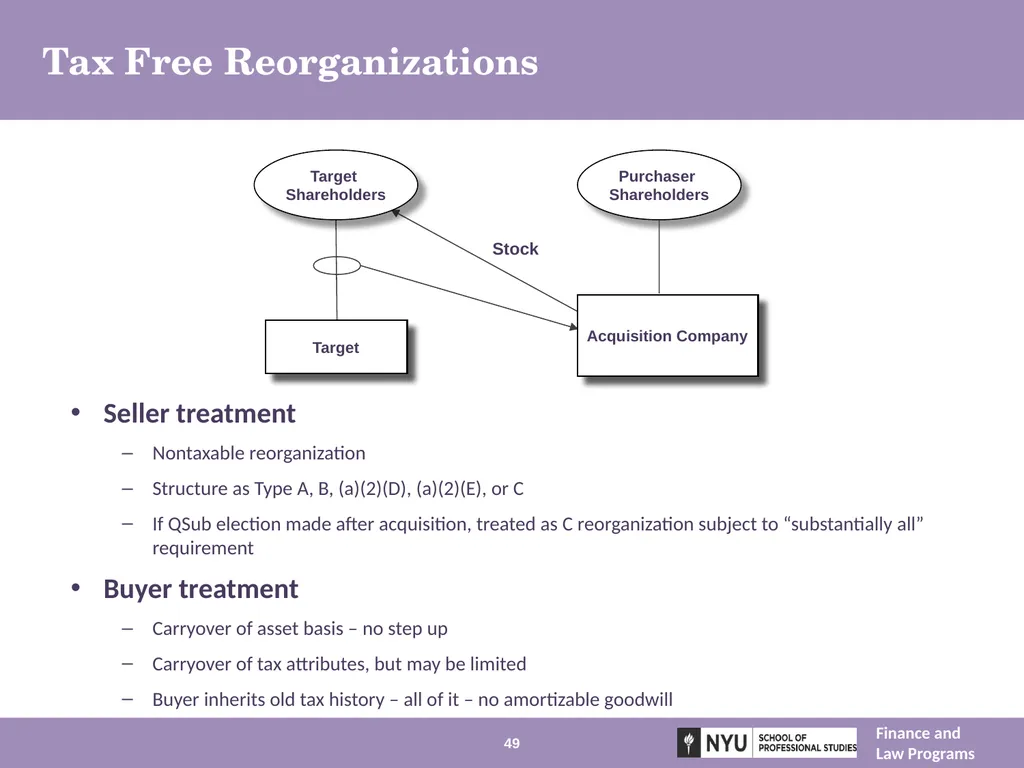
Tax Free Reorganizations Seller treatment
Nontaxable reorganization
Structure as Type A, B, (a)(2)(D), (a)(2)(E), or C
If QSub election made after acquisition, treated as C reorganization subject to “substantially all” requirement
Buyer treatment
Carryover of asset basis – no step up
Carryover of tax attributes, but may be limited
Buyer inherits old tax history – all of it – no amortizable goodwill Target
Shareholders 49<br>
Nontaxable reorganization
Structure as Type A, B, (a)(2)(D), (a)(2)(E), or C
If QSub election made after acquisition, treated as C reorganization subject to “substantially all” requirement
Buyer treatment
Carryover of asset basis – no step up
Carryover of tax attributes, but may be limited
Buyer inherits old tax history – all of it – no amortizable goodwill Target
Shareholders 49<br>
50
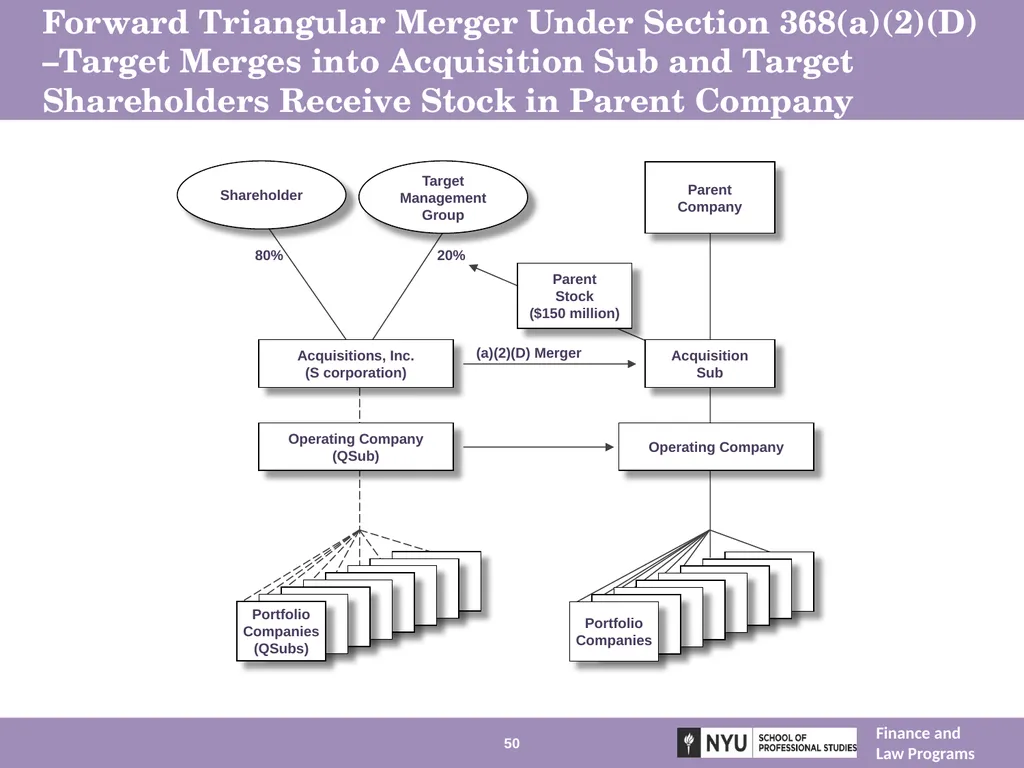
Forward Triangular Merger Under Section 368(a)(2)(D) –Target Merges into Acquisition Sub and Target Shareholders Receive Stock in Parent Company 50<br>
51
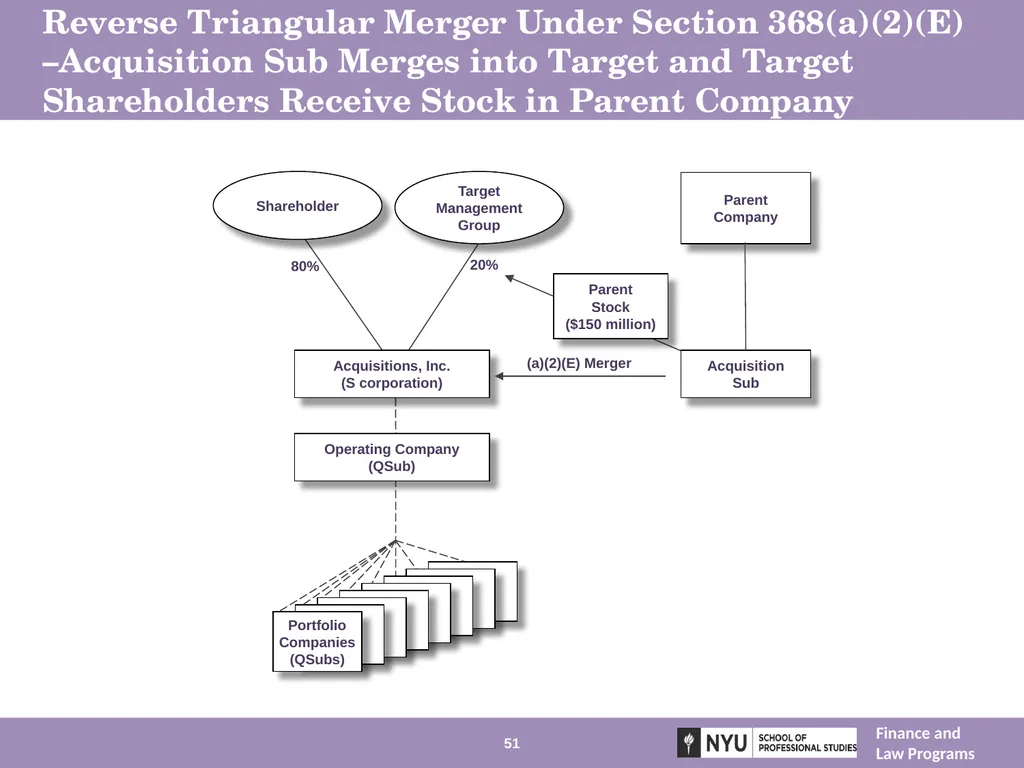
Reverse Triangular Merger Under Section 368(a)(2)(E) –Acquisition Sub Merges into Target and Target Shareholders Receive Stock in Parent Company 51<br>
52
Mergers Involving DREs – 2000 Proposed Regulations 2000 Proposed Regulations. On May 17, 2000, the Service issued a proposed rulemaking on mergers involving disregarded entities. Under the Proposed Regulations, the merger of a disregarded entity (“DRE”) (including a QSub or qualified REIT subsidiary) into a tax corporation would not be a Type A reorganization because the merging entity is not a tax corporation.
In Rev. Rul. 2000-5, the Service held that a Type A merger must involve the transfer of the assets of a target corporation to a single transferee corporation ceasing to exist as a result of the “merger.” Rev. Rul. 2000-5 implied that a merger of a DRE (single member) owned by a corporation (including a QSub), cannot be a Type A reorganization because it will be divisive and will not necessarily result in the termination or liquidation of the member.
Due to the additional requirements for a Type C (“substantially all of the transferor’s assets,” no more than 20% boot, including liability assumptions, and “solely for voting stock” requirements) and Type D (“substantially all”/liabilities in excess of basis) reorganization, many of the DRE mergers would constitute taxable transactions under the 2000 proposed regulations. 52<br>
In Rev. Rul. 2000-5, the Service held that a Type A merger must involve the transfer of the assets of a target corporation to a single transferee corporation ceasing to exist as a result of the “merger.” Rev. Rul. 2000-5 implied that a merger of a DRE (single member) owned by a corporation (including a QSub), cannot be a Type A reorganization because it will be divisive and will not necessarily result in the termination or liquidation of the member.
Due to the additional requirements for a Type C (“substantially all of the transferor’s assets,” no more than 20% boot, including liability assumptions, and “solely for voting stock” requirements) and Type D (“substantially all”/liabilities in excess of basis) reorganization, many of the DRE mergers would constitute taxable transactions under the 2000 proposed regulations. 52<br>
53
Mergers Involving DREs – 2003 Final Regulations The final regulations, issued in 2003, retain the conceptual background and definitions of the proposed regulations, including the definition of a disregarded entity.
Defined terms included the following:
(i) Disregarded Entity; a business entity that is disregarded as an entity separate from its owner for Federal tax purposes;
(ii) Combining Entity; a business entity that is a corporation that is not a disregarded entity;
(iii) Combining Unit; is composed solely of a combining entity and all disregarded entities, if any, the assets of which are treated as owned by such entity for Federal tax purposes;
(iv) Transferor Unit; and
(v) Transferee Unit. 53<br>
Defined terms included the following:
(i) Disregarded Entity; a business entity that is disregarded as an entity separate from its owner for Federal tax purposes;
(ii) Combining Entity; a business entity that is a corporation that is not a disregarded entity;
(iii) Combining Unit; is composed solely of a combining entity and all disregarded entities, if any, the assets of which are treated as owned by such entity for Federal tax purposes;
(iv) Transferor Unit; and
(v) Transferee Unit. 53<br>
54
Merger involving DREs – Example: Type A Merger Under a Type A reorganization under the Final Regulations (i.e., a statutory merger or consolidation effected pursuant to the statute or statutes necessary to effect the merger or consolidation), the following events occur simultaneously at the effective time of the transaction:
(i) all of the assets (other than those distributed in the transaction) and liabilities (except to the extent such liabilities are satisfied or discharged in the transaction or are nonrecourse liabilities to which assets distributed in the transaction are subject) of each member of one or more combining units (each a transferor unit) become the assets and liabilities of one or more members of one other combining unit (the transferee unit); and
(ii) the combining entity of each transferor unit ceases its separate legal existence for all purposes. 54<br>
(i) all of the assets (other than those distributed in the transaction) and liabilities (except to the extent such liabilities are satisfied or discharged in the transaction or are nonrecourse liabilities to which assets distributed in the transaction are subject) of each member of one or more combining units (each a transferor unit) become the assets and liabilities of one or more members of one other combining unit (the transferee unit); and
(ii) the combining entity of each transferor unit ceases its separate legal existence for all purposes. 54<br>
55
S Corporation Mergers and Acquisitions – Basic Structures Covered in Webinar Taxable Asset Acquisitions and Stock Purchases and Dispositions Treated as Asset Acquisitions -
Section 338(h)(10) and Section 336(e) 55<br>
56
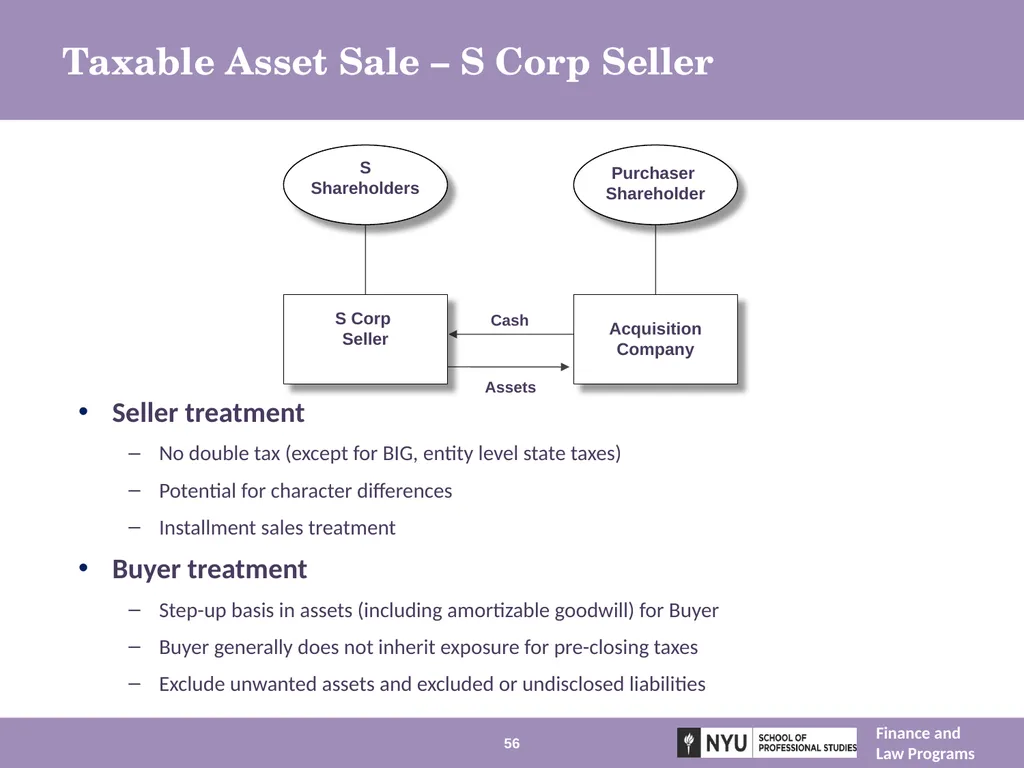
Taxable Asset Sale – S Corp Seller Seller treatment
No double tax (except for BIG, entity level state taxes)
Potential for character differences
Installment sales treatment
Buyer treatment
Step-up basis in assets (including amortizable goodwill) for Buyer
Buyer generally does not inherit exposure for pre-closing taxes
Exclude unwanted assets and excluded or undisclosed liabilities 56<br>
No double tax (except for BIG, entity level state taxes)
Potential for character differences
Installment sales treatment
Buyer treatment
Step-up basis in assets (including amortizable goodwill) for Buyer
Buyer generally does not inherit exposure for pre-closing taxes
Exclude unwanted assets and excluded or undisclosed liabilities 56<br>
57
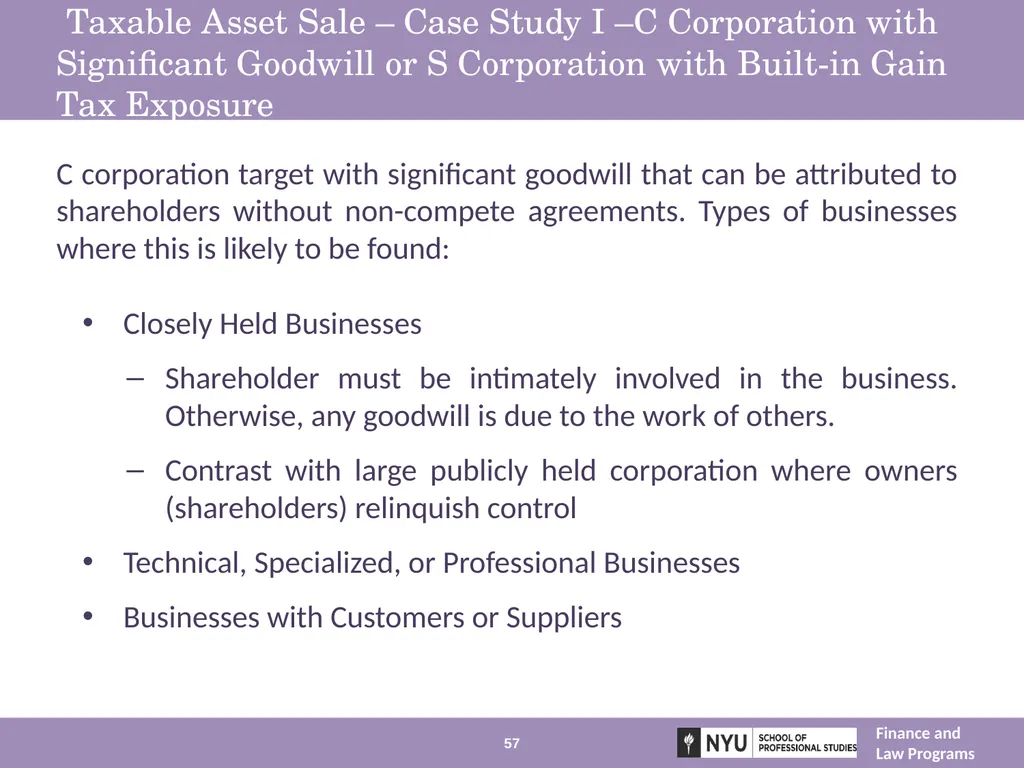
Taxable Asset Sale – Case Study I –C Corporation with Significant Goodwill or S Corporation with Built-in Gain Tax Exposure C corporation target with significant goodwill that can be attributed to shareholders without non-compete agreements. Types of businesses where this is likely to be found:
Closely Held Businesses
Shareholder must be intimately involved in the business. Otherwise, any goodwill is due to the work of others.
Contrast with large publicly held corporation where owners (shareholders) relinquish control
Technical, Specialized, or Professional Businesses
Businesses with Customers or Suppliers 57<br>
Closely Held Businesses
Shareholder must be intimately involved in the business. Otherwise, any goodwill is due to the work of others.
Contrast with large publicly held corporation where owners (shareholders) relinquish control
Technical, Specialized, or Professional Businesses
Businesses with Customers or Suppliers 57<br>
58
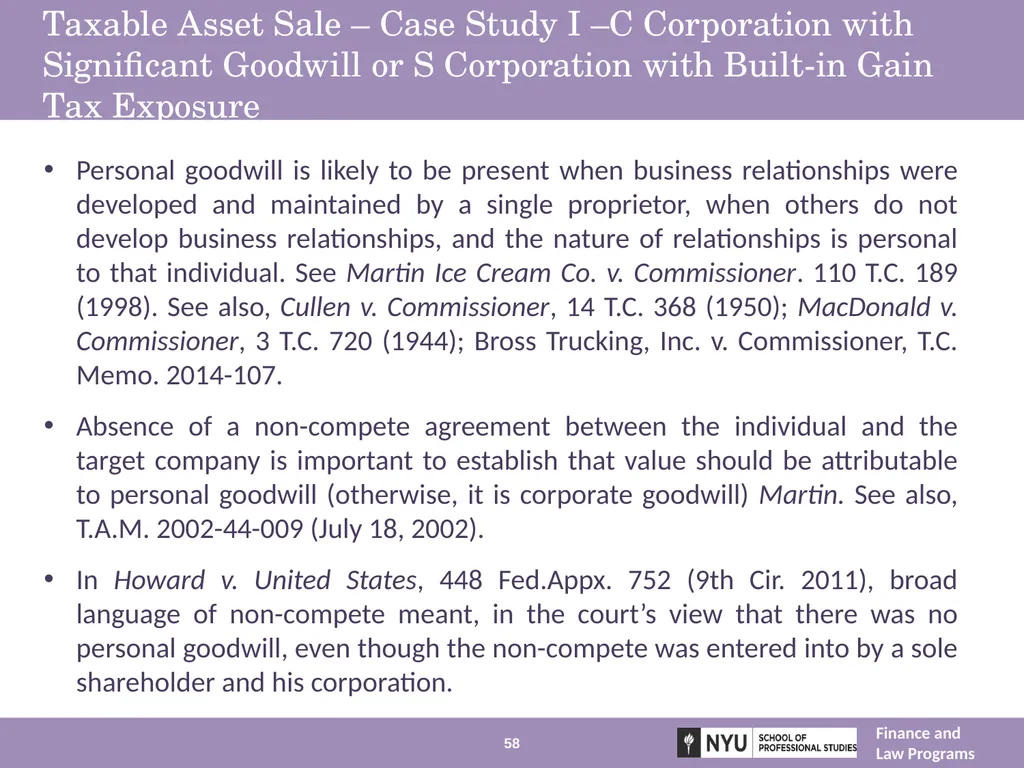
Taxable Asset Sale – Case Study I –C Corporation with Significant Goodwill or S Corporation with Built-in Gain Tax Exposure Personal goodwill is likely to be present when business relationships were developed and maintained by a single proprietor, when others do not develop business relationships, and the nature of relationships is personal to that individual. See Martin Ice Cream Co. v. Commissioner. 110 T.C. 189 (1998). See also, Cullen v. Commissioner, 14 T.C. 368 (1950); MacDonald v. Commissioner, 3 T.C. 720 (1944); Bross Trucking, Inc. v. Commissioner, T.C. Memo. 2014-107.
Absence of a non-compete agreement between the individual and the target company is important to establish that value should be attributable to personal goodwill (otherwise, it is corporate goodwill) Martin. See also, T.A.M. 2002-44-009 (July 18, 2002).
In Howard v. United States, 448 Fed.Appx. 752 (9th Cir. 2011), broad language of non-compete meant, in the court’s view that there was no personal goodwill, even though the non-compete was entered into by a sole shareholder and his corporation. 58<br>
Absence of a non-compete agreement between the individual and the target company is important to establish that value should be attributable to personal goodwill (otherwise, it is corporate goodwill) Martin. See also, T.A.M. 2002-44-009 (July 18, 2002).
In Howard v. United States, 448 Fed.Appx. 752 (9th Cir. 2011), broad language of non-compete meant, in the court’s view that there was no personal goodwill, even though the non-compete was entered into by a sole shareholder and his corporation. 58<br>
59
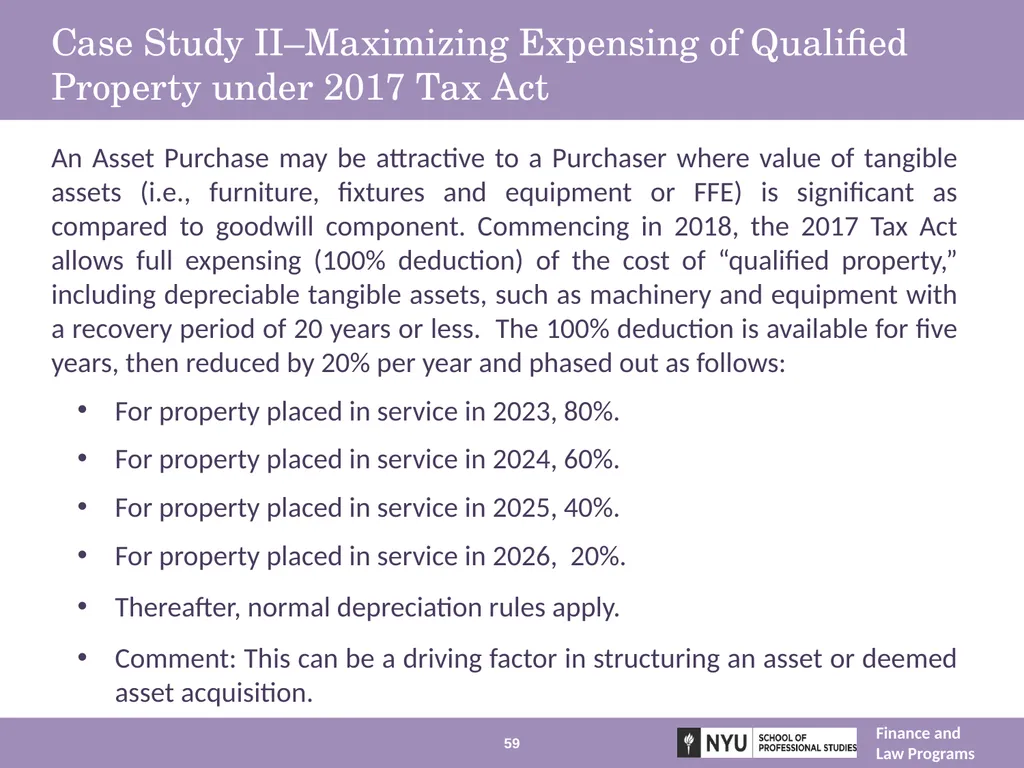
Case Study II–Maximizing Expensing of Qualified Property under 2017 Tax Act An Asset Purchase may be attractive to a Purchaser where value of tangible assets (i.e., furniture, fixtures and equipment or FFE) is significant as compared to goodwill component. Commencing in 2018, the 2017 Tax Act allows full expensing (100% deduction) of the cost of “qualified property,” including depreciable tangible assets, such as machinery and equipment with a recovery period of 20 years or less. The 100% deduction is available for five years, then reduced by 20% per year and phased out as follows:
For property placed in service in 2023, 80%.
For property placed in service in 2024, 60%.
For property placed in service in 2025, 40%.
For property placed in service in 2026, 20%.
Thereafter, normal depreciation rules apply.
Comment: This can be a driving factor in structuring an asset or deemed asset acquisition. 59<br>
For property placed in service in 2023, 80%.
For property placed in service in 2024, 60%.
For property placed in service in 2025, 40%.
For property placed in service in 2026, 20%.
Thereafter, normal depreciation rules apply.
Comment: This can be a driving factor in structuring an asset or deemed asset acquisition. 59<br>
60
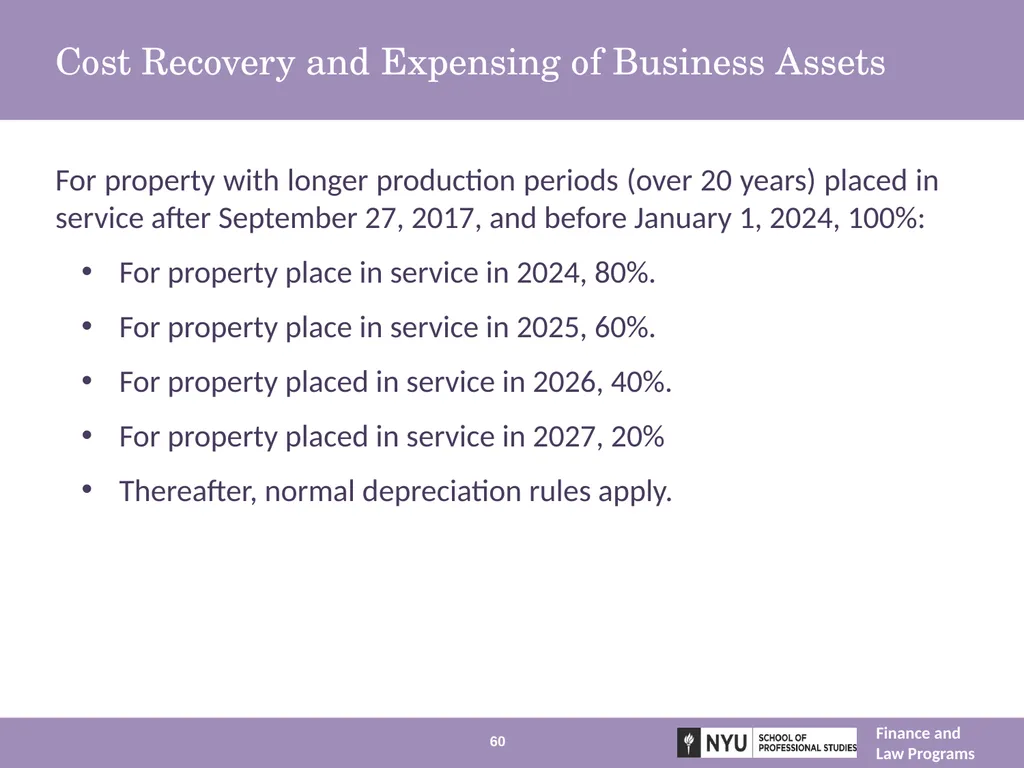
Cost Recovery and Expensing of Business Assets For property with longer production periods (over 20 years) placed in service after September 27, 2017, and before January 1, 2024, 100%:
For property place in service in 2024, 80%.
For property place in service in 2025, 60%.
For property placed in service in 2026, 40%.
For property placed in service in 2027, 20%
Thereafter, normal depreciation rules apply. 60<br>
For property place in service in 2024, 80%.
For property place in service in 2025, 60%.
For property placed in service in 2026, 40%.
For property placed in service in 2027, 20%
Thereafter, normal depreciation rules apply. 60<br>
61
POLLING QUESTION #5 What is your favorite pizza topping?
Pepperoni
Mushroom
Eggplant
For those seeking NYS CLE credit the code is E3W9TJ Please record all attendance verification codes announced during the program. Record the codes on the affirmation form available on the CLE Board website at: http://ww2.nycourts.gov/attorneys/cle/affirmation_sample.pdf and email the form to sps.tax@nyu.edu. For all other CLE inquires please email sps.tax@nyu.edu 61<br>
Pepperoni
Mushroom
Eggplant
For those seeking NYS CLE credit the code is E3W9TJ Please record all attendance verification codes announced during the program. Record the codes on the affirmation form available on the CLE Board website at: http://ww2.nycourts.gov/attorneys/cle/affirmation_sample.pdf and email the form to sps.tax@nyu.edu. For all other CLE inquires please email sps.tax@nyu.edu 61<br>
62
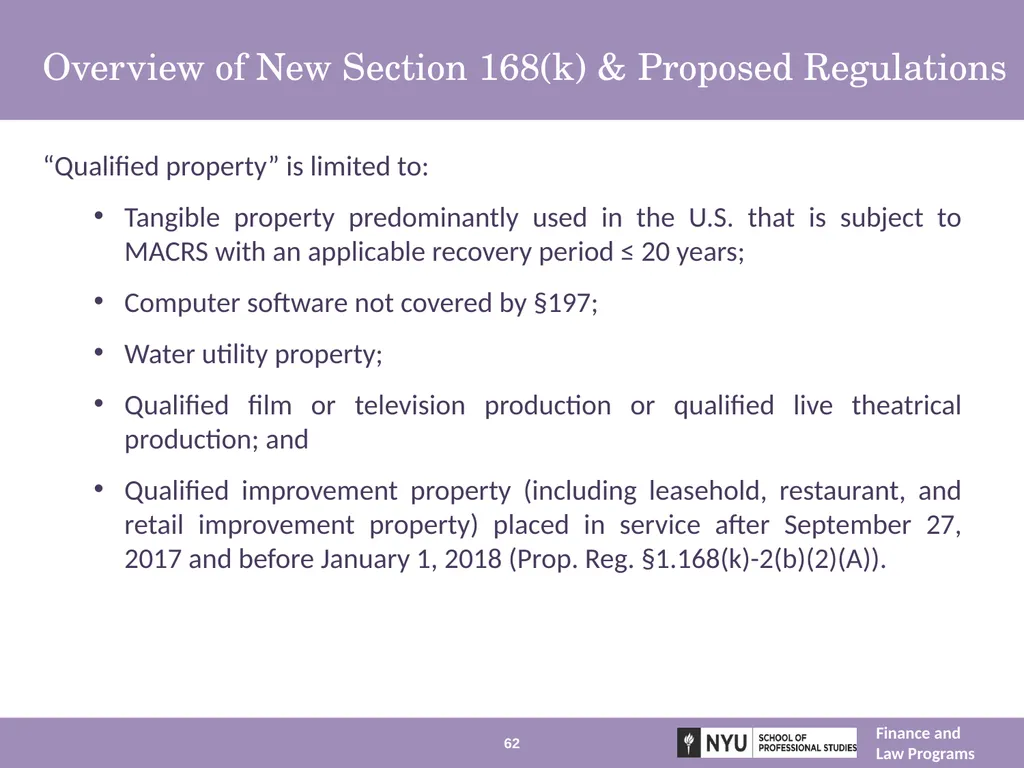
Overview of New Section 168(k) & Proposed Regulations “Qualified property” is limited to:
Tangible property predominantly used in the U.S. that is subject to MACRS with an applicable recovery period ≤ 20 years;
Computer software not covered by §197;
Water utility property;
Qualified film or television production or qualified live theatrical production; and
Qualified improvement property (including leasehold, restaurant, and retail improvement property) placed in service after September 27, 2017 and before January 1, 2018 (Prop. Reg. §1.168(k)-2(b)(2)(A)). 62<br>
Tangible property predominantly used in the U.S. that is subject to MACRS with an applicable recovery period ≤ 20 years;
Computer software not covered by §197;
Water utility property;
Qualified film or television production or qualified live theatrical production; and
Qualified improvement property (including leasehold, restaurant, and retail improvement property) placed in service after September 27, 2017 and before January 1, 2018 (Prop. Reg. §1.168(k)-2(b)(2)(A)). 62<br>
63
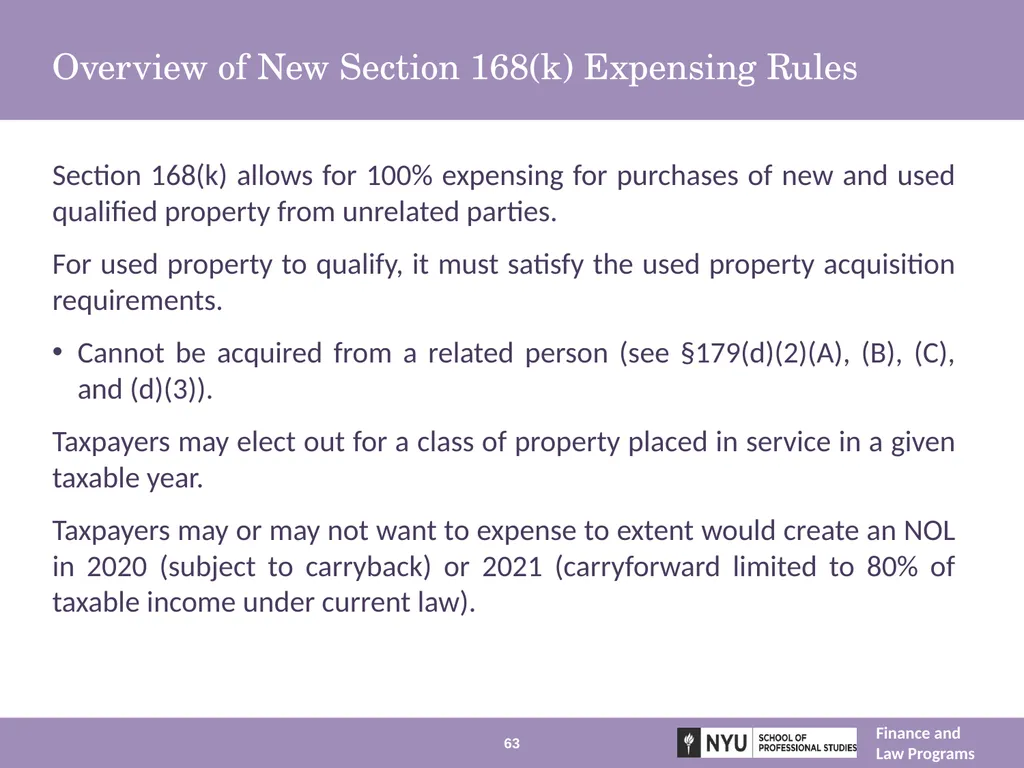
Overview of New Section 168(k) Expensing Rules Section 168(k) allows for 100% expensing for purchases of new and used qualified property from unrelated parties.
For used property to qualify, it must satisfy the used property acquisition requirements.
Cannot be acquired from a related person (see §179(d)(2)(A), (B), (C), and (d)(3)).
Taxpayers may elect out for a class of property placed in service in a given taxable year.
Taxpayers may or may not want to expense to extent would create an NOL in 2020 (subject to carryback) or 2021 (carryforward limited to 80% of taxable income under current law). 63<br>
For used property to qualify, it must satisfy the used property acquisition requirements.
Cannot be acquired from a related person (see §179(d)(2)(A), (B), (C), and (d)(3)).
Taxpayers may elect out for a class of property placed in service in a given taxable year.
Taxpayers may or may not want to expense to extent would create an NOL in 2020 (subject to carryback) or 2021 (carryforward limited to 80% of taxable income under current law). 63<br>
64
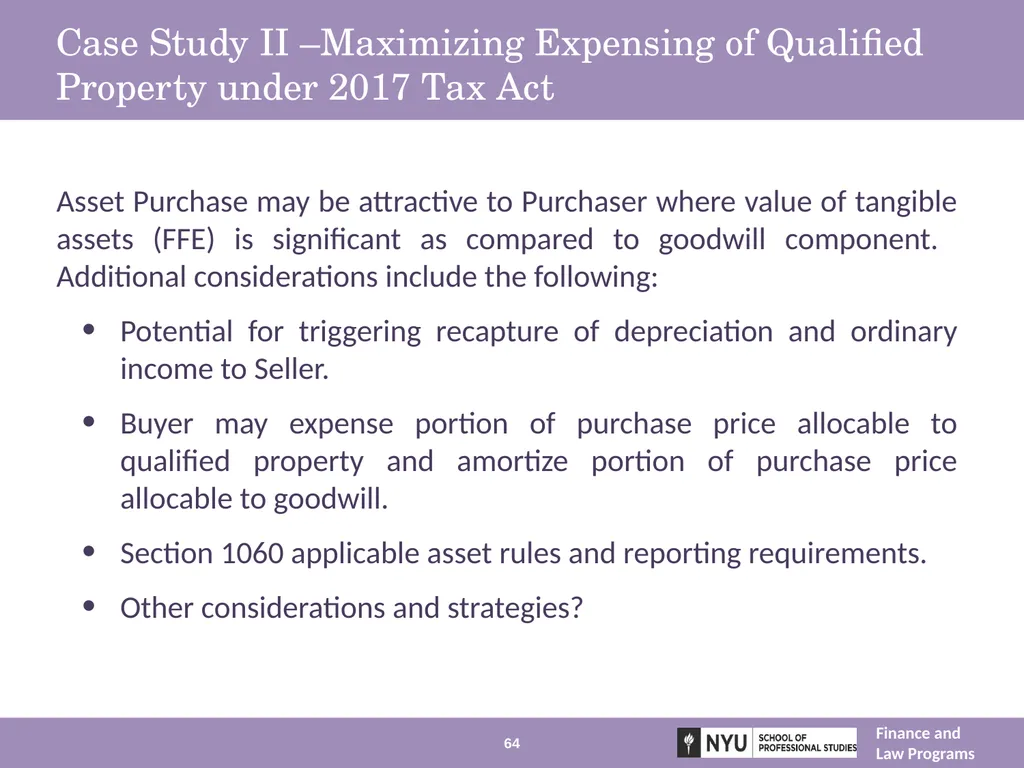
Case Study II –Maximizing Expensing of Qualified Property under 2017 Tax Act Asset Purchase may be attractive to Purchaser where value of tangible assets (FFE) is significant as compared to goodwill component. Additional considerations include the following:
Potential for triggering recapture of depreciation and ordinary income to Seller.
Buyer may expense portion of purchase price allocable to qualified property and amortize portion of purchase price allocable to goodwill.
Section 1060 applicable asset rules and reporting requirements.
Other considerations and strategies? 64<br>
Potential for triggering recapture of depreciation and ordinary income to Seller.
Buyer may expense portion of purchase price allocable to qualified property and amortize portion of purchase price allocable to goodwill.
Section 1060 applicable asset rules and reporting requirements.
Other considerations and strategies? 64<br>
65
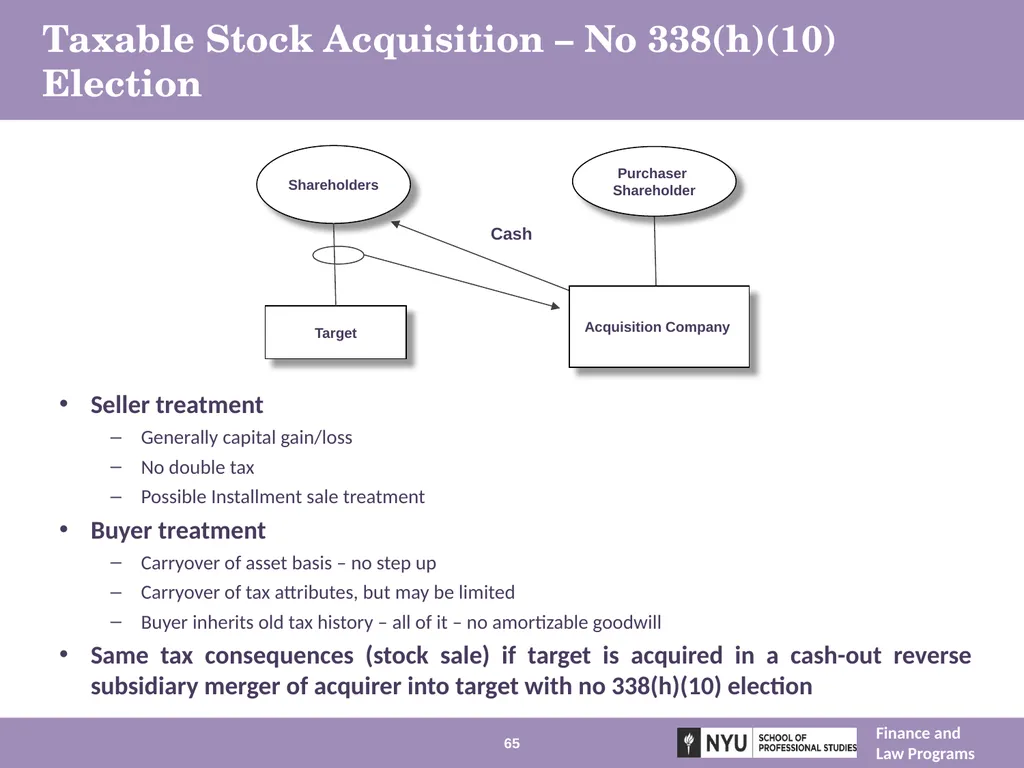
Taxable Stock Acquisition – No 338(h)(10) Election Seller treatment
Generally capital gain/loss
No double tax
Possible Installment sale treatment
Buyer treatment
Carryover of asset basis – no step up
Carryover of tax attributes, but may be limited
Buyer inherits old tax history – all of it – no amortizable goodwill
Same tax consequences (stock sale) if target is acquired in a cash-out reverse subsidiary merger of acquirer into target with no 338(h)(10) election 65<br>
Generally capital gain/loss
No double tax
Possible Installment sale treatment
Buyer treatment
Carryover of asset basis – no step up
Carryover of tax attributes, but may be limited
Buyer inherits old tax history – all of it – no amortizable goodwill
Same tax consequences (stock sale) if target is acquired in a cash-out reverse subsidiary merger of acquirer into target with no 338(h)(10) election 65<br>
66
History Lesson: Qualified Stock Purchase Involving S Corporations? Old Section 1371(a)(2): “S corporation treated as an individual in its capacity as a shareholder of another corporation”
TAM 9245004: “Section 1371(a)(2) does not prevent an S corporation from being treated [in its capacity as a shareholder of T] as a corporation for purposes of applying Sections 338 and 332” but clearly not for purposes of Sections 243, 245 or 245A.
SBJPA of 1996:
Repealed Section 1371(a)(2)
Permitted S corporation to hold 80% - 100% subsidiaries
QSub – DRE treatment of 100% subsidiary 66<br>
TAM 9245004: “Section 1371(a)(2) does not prevent an S corporation from being treated [in its capacity as a shareholder of T] as a corporation for purposes of applying Sections 338 and 332” but clearly not for purposes of Sections 243, 245 or 245A.
SBJPA of 1996:
Repealed Section 1371(a)(2)
Permitted S corporation to hold 80% - 100% subsidiaries
QSub – DRE treatment of 100% subsidiary 66<br>
67
Taxable Acquisition of Stock Treated as Purchase of Assets- Section 338(h)(10) Requirements:
Target is S corporation or member of affiliated group
Need a purchasing corporation (C or S)
QSP
80% of vote and value within 12 months
Treas. Reg. §1.338(h)(10)-1(c)(2) - turn-off step transaction and Rev. Rul. 2001-46, 2001-2 CB 321.
Joint Election (Form 8023) to treat purchase of stock as purchase of assets for tax purposes. Treas. Reg. §1.338(h)(10)-1(c)(3). 67<br>
Target is S corporation or member of affiliated group
Need a purchasing corporation (C or S)
QSP
80% of vote and value within 12 months
Treas. Reg. §1.338(h)(10)-1(c)(2) - turn-off step transaction and Rev. Rul. 2001-46, 2001-2 CB 321.
Joint Election (Form 8023) to treat purchase of stock as purchase of assets for tax purposes. Treas. Reg. §1.338(h)(10)-1(c)(3). 67<br>
68
Taxable Acquisition of Stock of S Corp
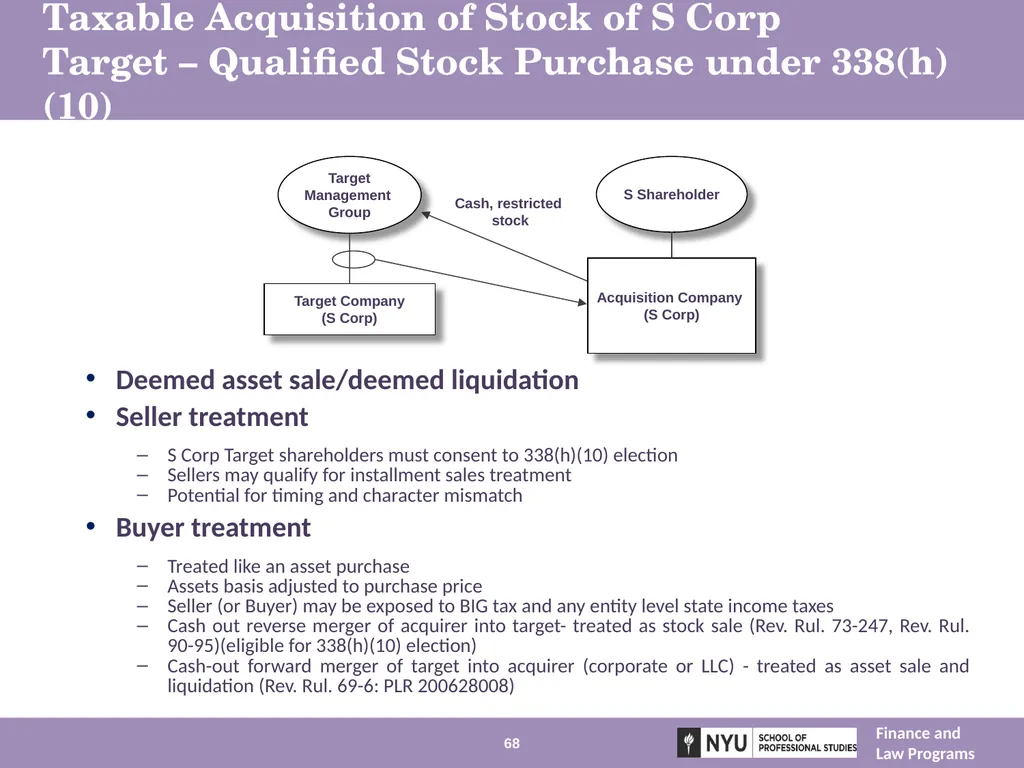
Target – Qualified Stock Purchase under 338(h)(10) Deemed asset sale/deemed liquidation
Seller treatment
S Corp Target shareholders must consent to 338(h)(10) election
Sellers may qualify for installment sales treatment
Potential for timing and character mismatch
Buyer treatment
Treated like an asset purchase
Assets basis adjusted to purchase price
Seller (or Buyer) may be exposed to BIG tax and any entity level state income taxes
Cash out reverse merger of acquirer into target- treated as stock sale (Rev. Rul. 73-247, Rev. Rul. 90-95)(eligible for 338(h)(10) election)
Cash-out forward merger of target into acquirer (corporate or LLC) - treated as asset sale and liquidation (Rev. Rul. 69-6: PLR 200628008) 68<br>
Seller treatment
S Corp Target shareholders must consent to 338(h)(10) election
Sellers may qualify for installment sales treatment
Potential for timing and character mismatch
Buyer treatment
Treated like an asset purchase
Assets basis adjusted to purchase price
Seller (or Buyer) may be exposed to BIG tax and any entity level state income taxes
Cash out reverse merger of acquirer into target- treated as stock sale (Rev. Rul. 73-247, Rev. Rul. 90-95)(eligible for 338(h)(10) election)
Cash-out forward merger of target into acquirer (corporate or LLC) - treated as asset sale and liquidation (Rev. Rul. 69-6: PLR 200628008) 68<br>
69
POLLING QUESTION #6 What is your favorite movie?
The Godfather
The Godfather II
Frozen
For those seeking NYS CLE credit the code is MB5C9A Please record all attendance verification codes announced during the program. Record the codes on the affirmation form available on the CLE Board website at: http://ww2.nycourts.gov/attorneys/cle/affirmation_sample.pdf and email the form to sps.tax@nyu.edu. For all other CLE inquires please email sps.tax@nyu.edu 69<br>
The Godfather
The Godfather II
Frozen
For those seeking NYS CLE credit the code is MB5C9A Please record all attendance verification codes announced during the program. Record the codes on the affirmation form available on the CLE Board website at: http://ww2.nycourts.gov/attorneys/cle/affirmation_sample.pdf and email the form to sps.tax@nyu.edu. For all other CLE inquires please email sps.tax@nyu.edu 69<br>
70
Taxable Acquisition of S Corp Target –
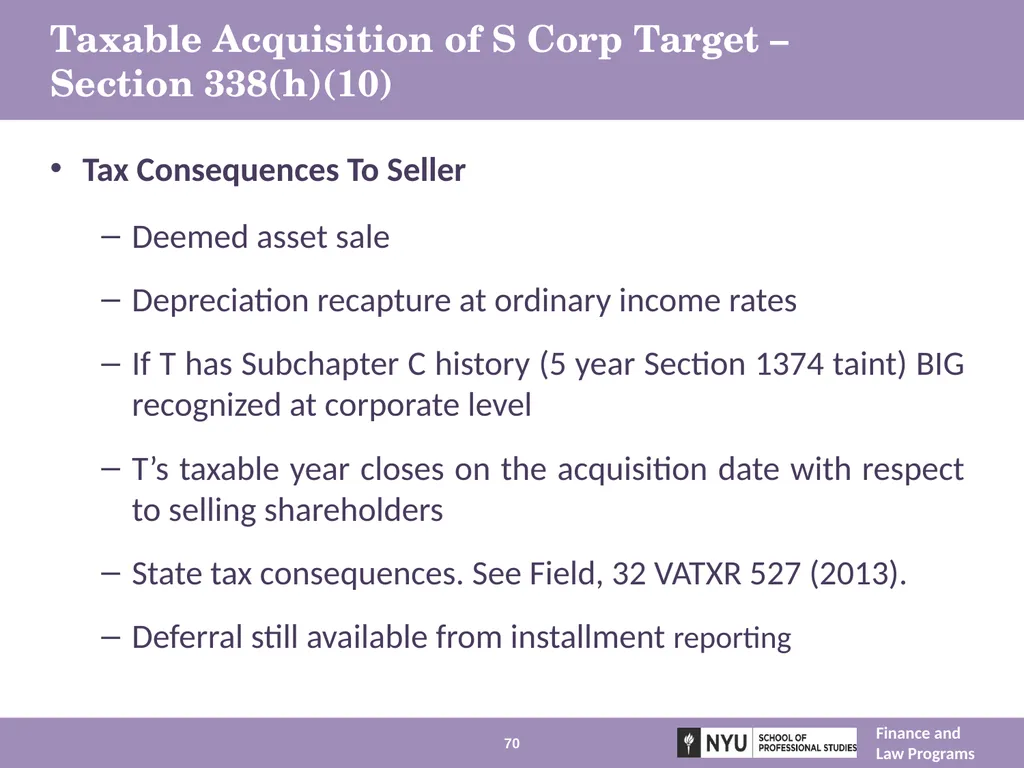
Section 338(h)(10) Tax Consequences To Seller
Deemed asset sale
Depreciation recapture at ordinary income rates
If T has Subchapter C history (5 year Section 1374 taint) BIG recognized at corporate level
T’s taxable year closes on the acquisition date with respect to selling shareholders
State tax consequences. See Field, 32 VATXR 527 (2013).
Deferral still available from installment reporting 70<br>
Deemed asset sale
Depreciation recapture at ordinary income rates
If T has Subchapter C history (5 year Section 1374 taint) BIG recognized at corporate level
T’s taxable year closes on the acquisition date with respect to selling shareholders
State tax consequences. See Field, 32 VATXR 527 (2013).
Deferral still available from installment reporting 70<br>
71
Taxable Acquisition of S Corp Target –
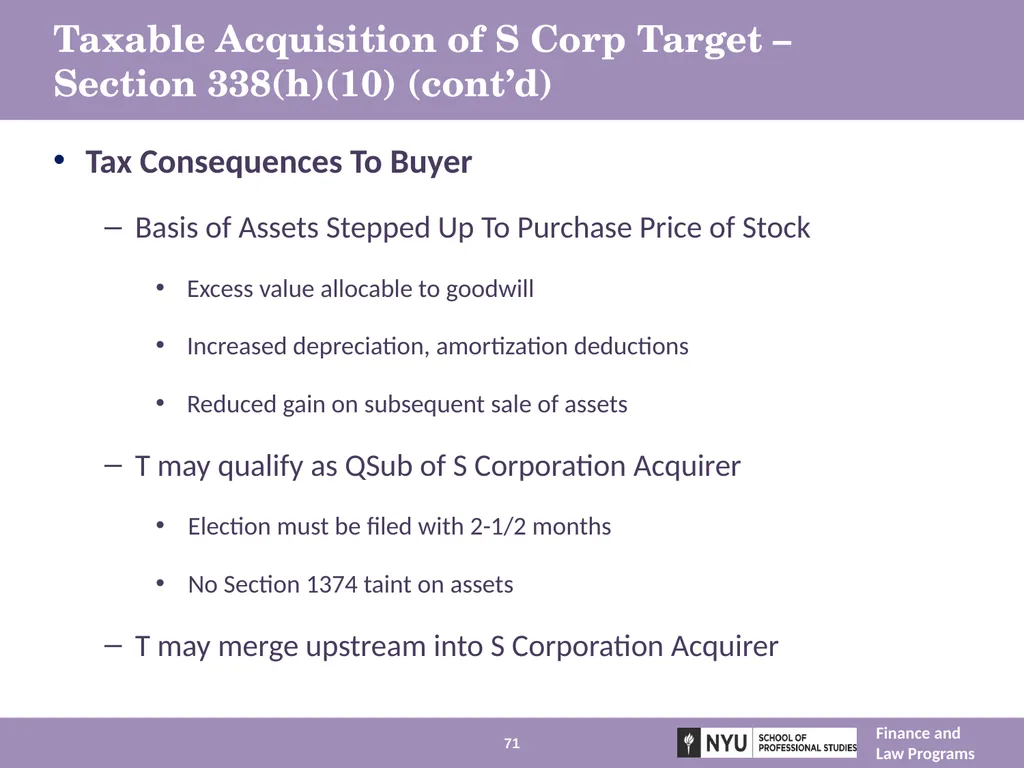
Section 338(h)(10) (cont’d) Tax Consequences To Buyer
Basis of Assets Stepped Up To Purchase Price of Stock
Excess value allocable to goodwill
Increased depreciation, amortization deductions
Reduced gain on subsequent sale of assets
T may qualify as QSub of S Corporation Acquirer
Election must be filed with 2-1/2 months
No Section 1374 taint on assets
T may merge upstream into S Corporation Acquirer 71<br>
Basis of Assets Stepped Up To Purchase Price of Stock
Excess value allocable to goodwill
Increased depreciation, amortization deductions
Reduced gain on subsequent sale of assets
T may qualify as QSub of S Corporation Acquirer
Election must be filed with 2-1/2 months
No Section 1374 taint on assets
T may merge upstream into S Corporation Acquirer 71<br>
72
Taxable Acquisition of S Corp Target –
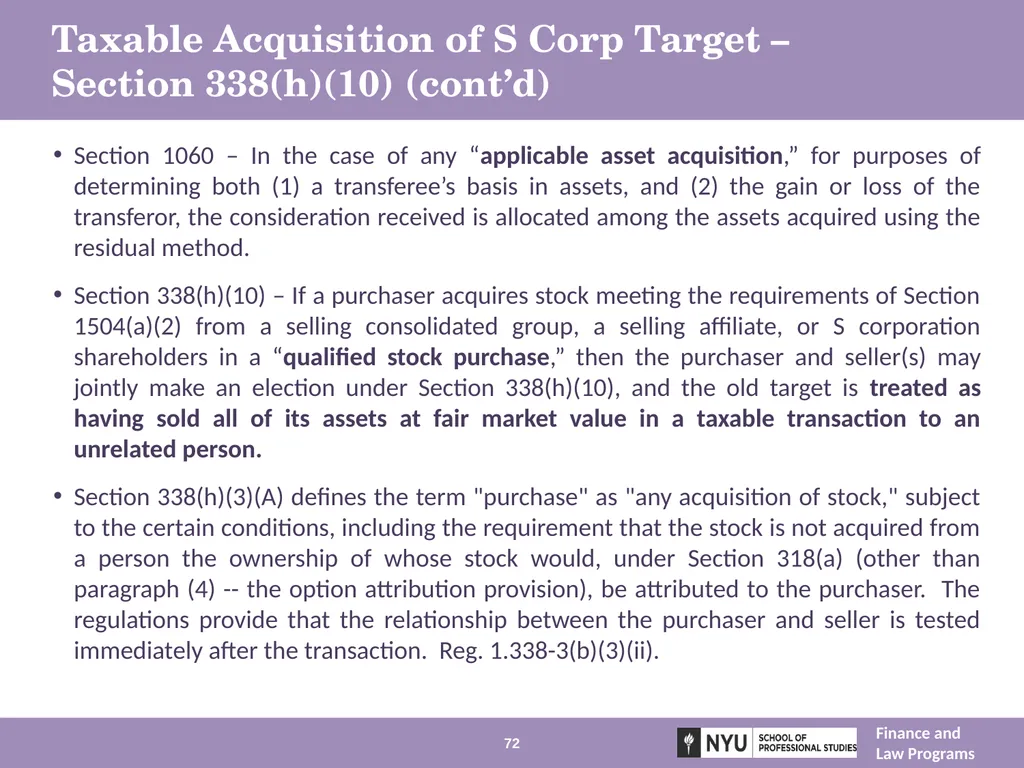
Section 338(h)(10) (cont’d) Section 1060 – In the case of any “applicable asset acquisition,” for purposes of determining both (1) a transferee’s basis in assets, and (2) the gain or loss of the transferor, the consideration received is allocated among the assets acquired using the residual method.
Section 338(h)(10) – If a purchaser acquires stock meeting the requirements of Section 1504(a)(2) from a selling consolidated group, a selling affiliate, or S corporation shareholders in a “qualified stock purchase,” then the purchaser and seller(s) may jointly make an election under Section 338(h)(10), and the old target is treated as having sold all of its assets at fair market value in a taxable transaction to an unrelated person.
Section 338(h)(3)(A) defines the term "purchase" as "any acquisition of stock," subject to the certain conditions, including the requirement that the stock is not acquired from a person the ownership of whose stock would, under Section 318(a) (other than paragraph (4) -- the option attribution provision), be attributed to the purchaser. The regulations provide that the relationship between the purchaser and seller is tested immediately after the transaction. Reg. 1.338-3(b)(3)(ii). 72<br>
Section 338(h)(10) – If a purchaser acquires stock meeting the requirements of Section 1504(a)(2) from a selling consolidated group, a selling affiliate, or S corporation shareholders in a “qualified stock purchase,” then the purchaser and seller(s) may jointly make an election under Section 338(h)(10), and the old target is treated as having sold all of its assets at fair market value in a taxable transaction to an unrelated person.
Section 338(h)(3)(A) defines the term "purchase" as "any acquisition of stock," subject to the certain conditions, including the requirement that the stock is not acquired from a person the ownership of whose stock would, under Section 318(a) (other than paragraph (4) -- the option attribution provision), be attributed to the purchaser. The regulations provide that the relationship between the purchaser and seller is tested immediately after the transaction. Reg. 1.338-3(b)(3)(ii). 72<br>
73
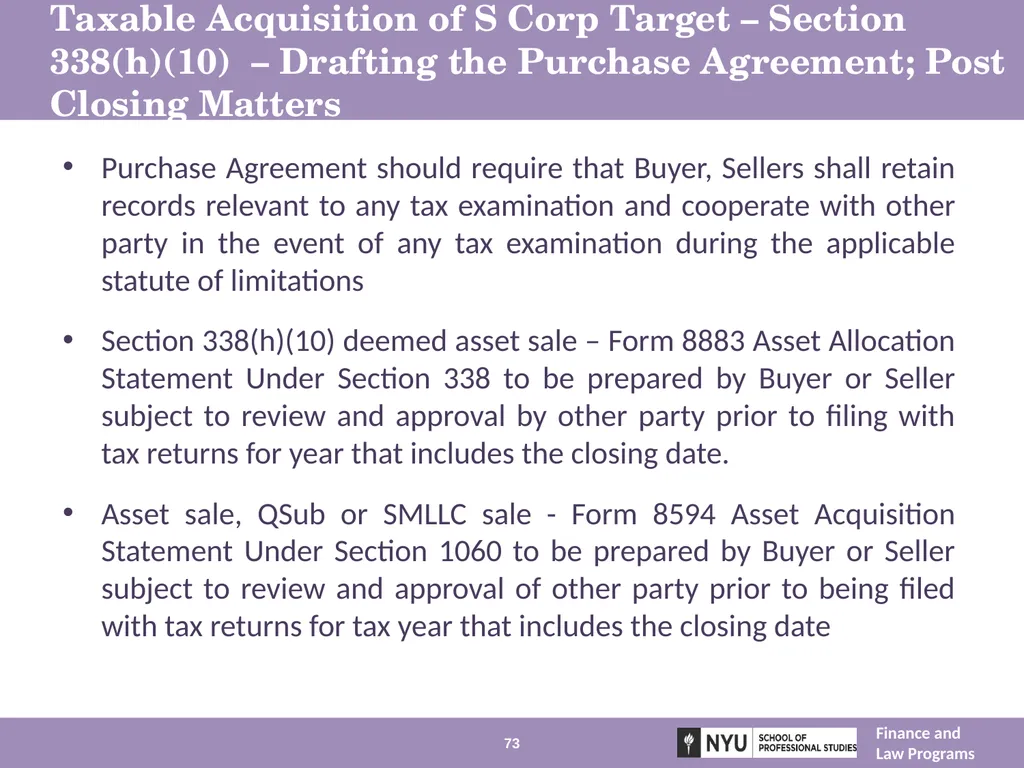
Taxable Acquisition of S Corp Target – Section 338(h)(10) – Drafting the Purchase Agreement; Post Closing Matters Purchase Agreement should require that Buyer, Sellers shall retain records relevant to any tax examination and cooperate with other party in the event of any tax examination during the applicable statute of limitations
Section 338(h)(10) deemed asset sale – Form 8883 Asset Allocation Statement Under Section 338 to be prepared by Buyer or Seller subject to review and approval by other party prior to filing with tax returns for year that includes the closing date.
Asset sale, QSub or SMLLC sale - Form 8594 Asset Acquisition Statement Under Section 1060 to be prepared by Buyer or Seller subject to review and approval of other party prior to being filed with tax returns for tax year that includes the closing date 73<br>
Section 338(h)(10) deemed asset sale – Form 8883 Asset Allocation Statement Under Section 338 to be prepared by Buyer or Seller subject to review and approval by other party prior to filing with tax returns for year that includes the closing date.
Asset sale, QSub or SMLLC sale - Form 8594 Asset Acquisition Statement Under Section 1060 to be prepared by Buyer or Seller subject to review and approval of other party prior to being filed with tax returns for tax year that includes the closing date 73<br>
74
Section 338(h)(10) or Asset Sale vs. Traditional Stock Sale – Pro - Seller Purchase Price Adjustments Purpose – make Sellers whole for extra tax costs of asset sale or deemed asset sale over stock sale
Sources of differences
Character of gain – pass through ordinary income, LTCG, Section 1250 gain as compared with capital gain on sale of stock
Corporate level liabilities included in the calculation of the ADSP, including trade payables
Outside/inside basis disparities
State tax apportionment of gain vs. tax rate of shareholder’s domicile
BIG tax, entity level state taxes
Reallocation of purchase price in the event of an audit
Installment sale gain recognition 74<br>
Sources of differences
Character of gain – pass through ordinary income, LTCG, Section 1250 gain as compared with capital gain on sale of stock
Corporate level liabilities included in the calculation of the ADSP, including trade payables
Outside/inside basis disparities
State tax apportionment of gain vs. tax rate of shareholder’s domicile
BIG tax, entity level state taxes
Reallocation of purchase price in the event of an audit
Installment sale gain recognition 74<br>
75
Seller Financing of QSP -Sections 453(h) and 453B(h) Section 453B(h) - S gain not triggered on distribution of installment note to Seller shareholders
Reg. §1.453-11 implementing section 453(h)
Reg. §§1.338(h)(10)-1(d)(8) and -1(e), Ex.10
Trigger of recapture income in year of sale
Interest charge on deferred tax liability if Seller has ›$5 million face amount of obligations arising from installment sales during the tax year
Seller must receive obligation that is not payable on demand or readily tradable – section 453(f)
The one day note strategy – more favorable gross profit percentage calculation for Seller. But see TNT 216-7 (11/9/2010). 75<br>
Reg. §1.453-11 implementing section 453(h)
Reg. §§1.338(h)(10)-1(d)(8) and -1(e), Ex.10
Trigger of recapture income in year of sale
Interest charge on deferred tax liability if Seller has ›$5 million face amount of obligations arising from installment sales during the tax year
Seller must receive obligation that is not payable on demand or readily tradable – section 453(f)
The one day note strategy – more favorable gross profit percentage calculation for Seller. But see TNT 216-7 (11/9/2010). 75<br>
76
Case Study III- QSP and Installment Sale-Sections 453(h) and 453B(h) – the One Day Note Strategy Example 1- Sale of assets for $1 million cash (distributed to Shareholder), $1 million debt assumption, and $3 million 5 year ISO, maintain existence of S for 5 years.
$750,000 gain in year of sale, $2,250,000 in year 5
Example 2- Sale of assets on same terms as Example 1, followed by distribution of $2 million cash and $3 million ISO to Shareholder in liquidation of S.
$1,650,000 gain in year of sale, $1,650,000 in year 5
Example 3- Distribution of $1 million cash to Shareholder, sale of assets for $4 million ISO ($1 million payable 1 day later and $4 million after 5 years), followed by distribution of ISO to Shareholder.
$750,000 gain in year of sale, $2,250,000 in year 5 76<br>
$750,000 gain in year of sale, $2,250,000 in year 5
Example 2- Sale of assets on same terms as Example 1, followed by distribution of $2 million cash and $3 million ISO to Shareholder in liquidation of S.
$1,650,000 gain in year of sale, $1,650,000 in year 5
Example 3- Distribution of $1 million cash to Shareholder, sale of assets for $4 million ISO ($1 million payable 1 day later and $4 million after 5 years), followed by distribution of ISO to Shareholder.
$750,000 gain in year of sale, $2,250,000 in year 5 76<br>
77
History Lesson -Step Transaction Doctrine Does Not Apply to QSP and Valid Section 338(h)(10) Election The Regulations provide that the step transaction doctrine will not apply if a corporation (i) engages in a qualified stock purchase ("QSP"), and (ii) makes a valid Section 338(h)(10) election.
The Regulations reflect the general principles of Rev. Rul. 2001-46, 2001-2 C.B. 321.
Application to multi-step transactions: If a Section 338(h)(10) election is made in a case where the acquisition of T stock followed by a merger or liquidation of T into P qualifies as a reorganization described in Section 368(a), for all Federal tax purposes, P's acquisition of T stock is treated as a QSP and is not treated as part of a reorganization described in Section 368(a). Reg. § 1.338(h)(10)-1(c)(2). 77<br>
The Regulations reflect the general principles of Rev. Rul. 2001-46, 2001-2 C.B. 321.
Application to multi-step transactions: If a Section 338(h)(10) election is made in a case where the acquisition of T stock followed by a merger or liquidation of T into P qualifies as a reorganization described in Section 368(a), for all Federal tax purposes, P's acquisition of T stock is treated as a QSP and is not treated as part of a reorganization described in Section 368(a). Reg. § 1.338(h)(10)-1(c)(2). 77<br>
78
Taxable Acquisition of Stock of S Corp
Target –Qualified Stock Disposition under 336(e) Deemed asset sale/deemed liquidation
Seller treatment
S Corp Target shareholders must consent to 336(e) election
The purchaser in a qualified stock disposition is not required to be a corporation, as in the case of a qualified stock purchase under section 338(h)(10)
Potential for timing and character mismatch
Buyer treatment
Treated like an asset purchase
Assets basis adjusted to purchase price
Seller (or Buyer) may be exposed to BIG tax and any entity level state income taxes
Issues:
Step transaction doctrine should not apply to QSD for same reasons as it does not apply to QSP
Common ownership between Target and Purchaser may preclude qualification for QSD
Relaxation of the “related party” definition allows two partnerships with a common partner owning less than 5% in each to be treated as unrelated Partnership
or LLC 78<br>
Seller treatment
S Corp Target shareholders must consent to 336(e) election
The purchaser in a qualified stock disposition is not required to be a corporation, as in the case of a qualified stock purchase under section 338(h)(10)
Potential for timing and character mismatch
Buyer treatment
Treated like an asset purchase
Assets basis adjusted to purchase price
Seller (or Buyer) may be exposed to BIG tax and any entity level state income taxes
Issues:
Step transaction doctrine should not apply to QSD for same reasons as it does not apply to QSP
Common ownership between Target and Purchaser may preclude qualification for QSD
Relaxation of the “related party” definition allows two partnerships with a common partner owning less than 5% in each to be treated as unrelated Partnership
or LLC 78<br>
79
Case Study IV - Section 336(e) and Section 336(h)(10) Case Study IV - Situation where section 336(e) works and section 338(h)(10) does not
Purchaser is a partnership or LLC, for example a private equity fund structured as a partnership or a special purpose LLC.
QSD available if (i) Target and Target shareholders are affiliated (but not necessarily consolidated) corporations for tax purposes, or (ii) Target is an S corporation.
The purchaser in a qualified stock disposition is not required to be a corporation, as in the case of a qualified stock purchase under section 338(h)(10).
Purchaser must purchase at least 80% of Target stock (by vote and value) within 12 months.
S Corp Target and all shareholders must consent to 336(e) election. 79<br>
Purchaser is a partnership or LLC, for example a private equity fund structured as a partnership or a special purpose LLC.
QSD available if (i) Target and Target shareholders are affiliated (but not necessarily consolidated) corporations for tax purposes, or (ii) Target is an S corporation.
The purchaser in a qualified stock disposition is not required to be a corporation, as in the case of a qualified stock purchase under section 338(h)(10).
Purchaser must purchase at least 80% of Target stock (by vote and value) within 12 months.
S Corp Target and all shareholders must consent to 336(e) election. 79<br>
80
Case Study V– Selective Section 336(h)(10) Election for Parent and Subsidiaries Case Study V – Target corporation qualifies for section 338(h)(10) election but there are one or more subs of target which purchaser may choose not to make 338(h)(10) election for some reason, such as high inside basis of assets that exceeds the amount of consideration to be allocated to subsidiary
Section 338(h)(10) election may be made selectively for target and subsidiaries of target.
Results in differences in stock basis and inside asset basis. 80<br>
Section 338(h)(10) election may be made selectively for target and subsidiaries of target.
Results in differences in stock basis and inside asset basis. 80<br>
81
POLLING QUESTION #7 Who is your favorite Stooge?
Larry
Moe
Curly
For those seeking NYS CLE credit the code is P4G6ED
Please record all attendance verification codes announced during the program. Record the codes on the affirmation form available on the CLE Board website at: http://ww2.nycourts.gov/attorneys/cle/affirmation_sample.pdf and email the form to sps.tax@nyu.edu. For all other CLE inquires please email sps.tax@nyu.edu 81<br>
Larry
Moe
Curly
For those seeking NYS CLE credit the code is P4G6ED
Please record all attendance verification codes announced during the program. Record the codes on the affirmation form available on the CLE Board website at: http://ww2.nycourts.gov/attorneys/cle/affirmation_sample.pdf and email the form to sps.tax@nyu.edu. For all other CLE inquires please email sps.tax@nyu.edu 81<br>
82
S Election Must be Valid for QSP or QSD to Apply to Target Corporation Since the target must be either an S corporation or a member of an affiliated group to qualify as a QSP, due diligence will be conducted by the buyer to ensure that a target corporation owned by individual shareholders has a valid S election in effect.
Corporate tax liability of transferee also a concern.
Proof that the S election was filed and accepted by the IRS does not establish that the S election is valid if the eligibility requirements have not been satisfied at all times since the election was effective.
Due Diligence inquiries may be exhaustive, leading to consideration of request for inadvertent termination relief from the IRS, or hold back of purchase price to back up shareholder representations and indemnities. 82<br>
Corporate tax liability of transferee also a concern.
Proof that the S election was filed and accepted by the IRS does not establish that the S election is valid if the eligibility requirements have not been satisfied at all times since the election was effective.
Due Diligence inquiries may be exhaustive, leading to consideration of request for inadvertent termination relief from the IRS, or hold back of purchase price to back up shareholder representations and indemnities. 82<br>
83
Case Study VI–S Corporation Target With Eligibility Issues Discovered Through Due Diligence S corporation target may have questionable eligibility for S election as a result of:
Single Class of Stock Requirement
QSST or ESBT Elections
Disproportionate Distributions to shareholders
Other eligibility issues identified through due diligence.
Strategy:
F reorganization to convert old S to LLC owned 100% by new S
Purchaser acquired 100% of membership of LLC, treated as purchase and sale of assets
Risk of eligibility for S status remains with Seller
Transferee liability of Purchaser? 83<br>
Single Class of Stock Requirement
QSST or ESBT Elections
Disproportionate Distributions to shareholders
Other eligibility issues identified through due diligence.
Strategy:
F reorganization to convert old S to LLC owned 100% by new S
Purchaser acquired 100% of membership of LLC, treated as purchase and sale of assets
Risk of eligibility for S status remains with Seller
Transferee liability of Purchaser? 83<br>
84
Case Study VI -Transfer of S Corporation Shares of Target to New S Corporation (F Reorg) and Conversion of Target to LLC, Followed by Sale of Membership Interests in LLC (Treated as Sale of Assets) . Target
S Corp Newly Formed S Corp (Newco S) Newco S Transfer of 100% of Shares of Target S Corp to Newco (F Reorg) Target S Corp (QSub Election) Target
SMLLC 84 Convert Target QSub to SMLLC under State Law Conversion Statute<br>
S Corp Newly Formed S Corp (Newco S) Newco S Transfer of 100% of Shares of Target S Corp to Newco (F Reorg) Target S Corp (QSub Election) Target
SMLLC 84 Convert Target QSub to SMLLC under State Law Conversion Statute<br>
85
F Reorganization and Conversions From Corporation to Qsub or LLC Taxed as Disregarded Entity Conversion of Corporation to Disregarded Entity. The conversion of a corporation to disregarded entity status constitutes a complete liquidation of the corporation pursuant to sections 331 and 336 and is taxable to the corporation and its shareholders. Exception from taxable treatment is provided where the liquidation meets of the requirements for the liquidation of a controlled subsidiary pursuant to sections 332 and 337. The conversion of an eligible entity to a disregarded entity can be accomplished by election. An election should be treated as a distribution of the assets in liquidation of a corporation. In general, the tax consequences of the conversion are deemed to occur at the end of the day preceding the election. 85<br>
86
Conversion of QSub to SMLLC To Maintain Pass-Through Treatment after Sale of Interest - Reg.§1.1361-5(b)(3), Example 2 21% S Corp Cash QSub 100% S Corp Merger QSub 100% Cash S Corp 21% Use of SMLLC in Lieu of QSub Buyer Buyer SMLLC SMLLC C Corporation Partnership 86<br>
87
Sale of QSub Treated as Sale of Assets Followed by Transfer to New Corporation - Reg.§1.1361-5(b)(3), Example 9 Seller
S Corp Buyer QSUB Buyer New Corporation Cash Sale of Assets Assets 87<br>
S Corp Buyer QSUB Buyer New Corporation Cash Sale of Assets Assets 87<br>
88
Case Study VI - Transfer of S Corporation Shares of Target to New S Corporation and Conversion of Target to LLC, Followed by Sale of Membership Interests in LLC (Treated as Sale of Assets) Newco S Buyer Buyer Cash Sale of Assets Assets Target
SMLLC SMLLC 88<br>
SMLLC SMLLC 88<br>
89
Target S Corp Target QSub 100% Newco S Conversion or Merger Target
QSub 100% Cash S Corp 80% Conversion of Target QSub to SMLLC Followed by Sale of Less Than 100% of Membership Interests Newco S Buyer SMLLC SMLLC Partnership 89 Case Study VII - Tax Free Rollover - Transfer of S Corporation Shares of Target to New S Corporation (F Reorg) and Conversion of Target to LLC, Followed by Sale of Less Than 100% of Membership Interests and Retention or Rollover of Remaining Equity Transfer of 100% of Shares of Target S Corp to Newco (F Reorg) 20% 80%<br>
QSub 100% Cash S Corp 80% Conversion of Target QSub to SMLLC Followed by Sale of Less Than 100% of Membership Interests Newco S Buyer SMLLC SMLLC Partnership 89 Case Study VII - Tax Free Rollover - Transfer of S Corporation Shares of Target to New S Corporation (F Reorg) and Conversion of Target to LLC, Followed by Sale of Less Than 100% of Membership Interests and Retention or Rollover of Remaining Equity Transfer of 100% of Shares of Target S Corp to Newco (F Reorg) 20% 80%<br>
90
Corporate Acquisitions and Dispositions – Basic Structures Private Equity Recapitalizations 90<br>
91
Equity Recapitalization with Private Equity Investment in Operating Company Purpose: funding required by operating company to:
Fuel expansion
Provide equity to support borrowing
Buyout senior or minority shareholders
Structure of investment by private equity investor
Subordinated debt
Warrants
Convertible preferred stock
Preferred interest in partnership or LLC 91<br>
Fuel expansion
Provide equity to support borrowing
Buyout senior or minority shareholders
Structure of investment by private equity investor
Subordinated debt
Warrants
Convertible preferred stock
Preferred interest in partnership or LLC 91<br>
92
Case Study VIII- Equity Recapitalization of S Corporation By Issuing Minority Interest in Operating Business to Private Equity Group under Rev. Rul. 94-43 92 S Corp Shareholder Operating Business -Partnership or LLC 51% Controlling Interest 49% or Preferred
Interest Cash Infusion Transfer
Operating
Business Private Equity Group S Corp<br>
Interest Cash Infusion Transfer
Operating
Business Private Equity Group S Corp<br>
93
93 Equity Recapitalization through Leveraged Purchase of 80 Percent of Operating Business<br>
94
Case Study IX-Use of Section 351 to Structure Rollover of Minority Shareholder Equity into Acquiring Corporation – National Starch Structure 94<br>
95
Use of Section 351 to Structure Rollover into Acquiring Corporation – National Starch Structure 95 Acquisition
Sub Rollover shares contributed to Newco by Rollover Shareholders Reverse Subsidiary Merger with cash or debentures to Cash-Out shareholders Cash or debentures Cash infusion by Purchaser Group (Section 351 control with Rollover Shareholders) Newco<br>
Sub Rollover shares contributed to Newco by Rollover Shareholders Reverse Subsidiary Merger with cash or debentures to Cash-Out shareholders Cash or debentures Cash infusion by Purchaser Group (Section 351 control with Rollover Shareholders) Newco<br>