
The Commercial P/C Insurance Industry: Issues &
BR
Published · 52 slides · 0 views

1 / 1






Description
The Commercial PC Insurance Industry: Issues Outlook Midwest Actuarial Forum Spring Meeting Chicago, IL March 20, 2015 Steven N. Weisbart, Ph.D., CLU, Senior Vice President Chief Economist Insurance Information Institute 110 William
Related Topics
Share
Embed code
Download this presentation From Below
"The Commercial P/C Insurance Industry: Issues &" is the property of its rightful owner. Permission is granted to download and print the materials on this website for personal, non-commercial use only, and to display it on your personal computer provided you do not modify the materials and that you retain all copyright notices contained in the materials. By downloading content from our website, you accept the terms of this agreement.
Presentation Transcript
01
The Commercial P/C Insurance Industry: Issues & Outlook Midwest Actuarial Forum Spring Meeting
Chicago, IL
March 20, 2015 Steven N. Weisbart, Ph.D., CLU, Senior Vice President & Chief Economist
Insurance Information Institute 110 William Street New York, NY 10038
Tel: 212.346.5540 Cell: 917.494.5945 stevenw@iii.org www.iii.org<br>
Insurance Information Institute 110 William Street New York, NY 10038
Tel: 212.346.5540 Cell: 917.494.5945 stevenw@iii.org www.iii.org<br>
02
2 Insurance Industry:
Financial Update & Outlook 2014 Was a Reasonably Good Year
2013 Was the Industry’s Best Year in the Post-Crisis Era 12/01/09 - 9pm 2<br>
2013 Was the Industry’s Best Year in the Post-Crisis Era 12/01/09 - 9pm 2<br>
03
P/C Industry Net Income After Taxes
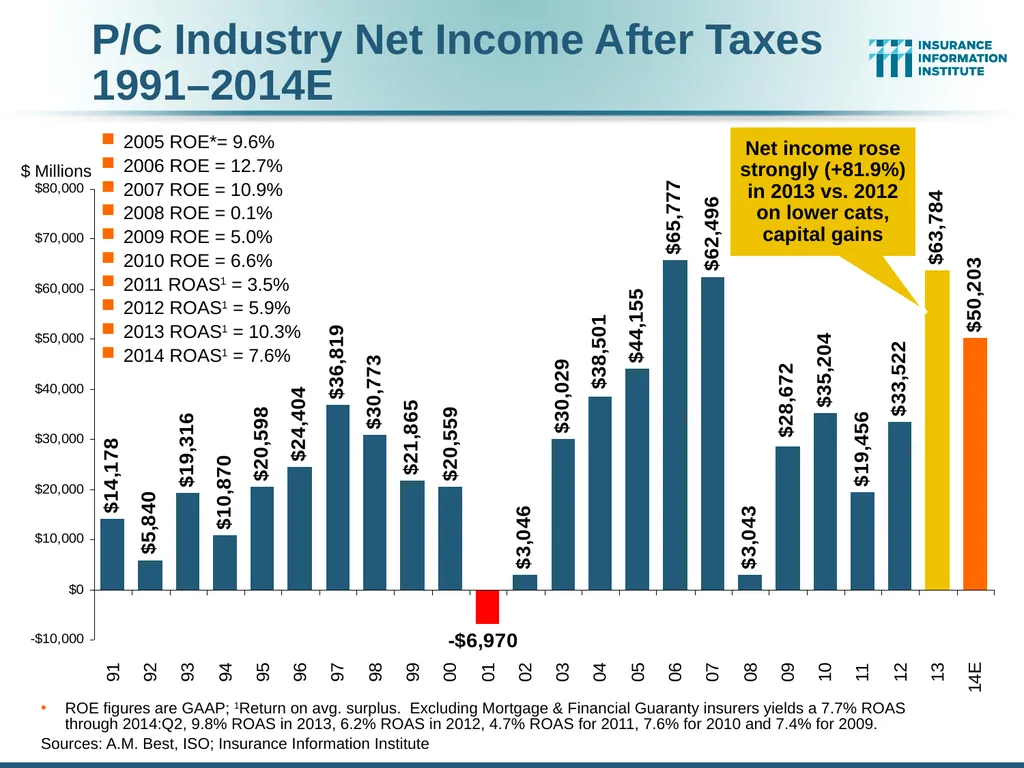
1991–2014E 2005 ROE*= 9.6%
2006 ROE = 12.7%
2007 ROE = 10.9%
2008 ROE = 0.1%
2009 ROE = 5.0%
2010 ROE = 6.6%
2011 ROAS1 = 3.5%
2012 ROAS1 = 5.9%
2013 ROAS1 = 10.3%
2014 ROAS1 = 7.6% ROE figures are GAAP; 1Return on avg. surplus. Excluding Mortgage & Financial Guaranty insurers yields a 7.7% ROAS through 2014:Q2, 9.8% ROAS in 2013, 6.2% ROAS in 2012, 4.7% ROAS for 2011, 7.6% for 2010 and 7.4% for 2009.
Sources: A.M. Best, ISO; Insurance Information Institute Net income rose strongly (+81.9%) in 2013 vs. 2012 on lower cats, capital gains $ Millions<br>
2006 ROE = 12.7%
2007 ROE = 10.9%
2008 ROE = 0.1%
2009 ROE = 5.0%
2010 ROE = 6.6%
2011 ROAS1 = 3.5%
2012 ROAS1 = 5.9%
2013 ROAS1 = 10.3%
2014 ROAS1 = 7.6% ROE figures are GAAP; 1Return on avg. surplus. Excluding Mortgage & Financial Guaranty insurers yields a 7.7% ROAS through 2014:Q2, 9.8% ROAS in 2013, 6.2% ROAS in 2012, 4.7% ROAS for 2011, 7.6% for 2010 and 7.4% for 2009.
Sources: A.M. Best, ISO; Insurance Information Institute Net income rose strongly (+81.9%) in 2013 vs. 2012 on lower cats, capital gains $ Millions<br>
04
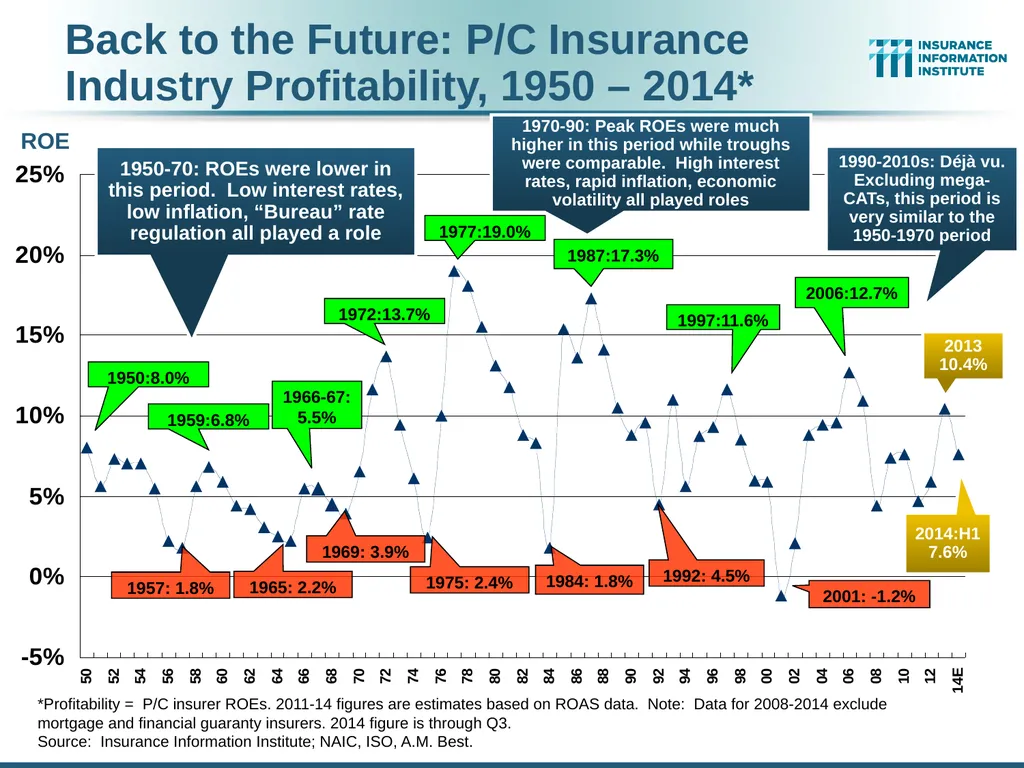
*Profitability = P/C insurer ROEs. 2011-14 figures are estimates based on ROAS data. Note: Data for 2008-2014 exclude mortgage and financial guaranty insurers. 2014 figure is through Q3.
Source: Insurance Information Institute; NAIC, ISO, A.M. Best. 1977:19.0% 1987:17.3% 1997:11.6% 2006:12.7% 1984: 1.8% 1992: 4.5% 2001: -1.2% ROE 1975: 2.4% 2013 10.4% 2014:H1 7.6% Back to the Future: P/C Insurance Industry Profitability, 1950 – 2014* 1969: 3.9% 1965: 2.2% 1957: 1.8% 1972:13.7% 1966-67: 5.5% 1959:6.8% 1950:8.0% 1950-70: ROEs were lower in this period. Low interest rates, low inflation, “Bureau” rate regulation all played a role 1970-90: Peak ROEs were much higher in this period while troughs were comparable. High interest rates, rapid inflation, economic volatility all played roles 1990-2010s: Déjà vu. Excluding mega-CATs, this period is very similar to the 1950-1970 period<br>
Source: Insurance Information Institute; NAIC, ISO, A.M. Best. 1977:19.0% 1987:17.3% 1997:11.6% 2006:12.7% 1984: 1.8% 1992: 4.5% 2001: -1.2% ROE 1975: 2.4% 2013 10.4% 2014:H1 7.6% Back to the Future: P/C Insurance Industry Profitability, 1950 – 2014* 1969: 3.9% 1965: 2.2% 1957: 1.8% 1972:13.7% 1966-67: 5.5% 1959:6.8% 1950:8.0% 1950-70: ROEs were lower in this period. Low interest rates, low inflation, “Bureau” rate regulation all played a role 1970-90: Peak ROEs were much higher in this period while troughs were comparable. High interest rates, rapid inflation, economic volatility all played roles 1990-2010s: Déjà vu. Excluding mega-CATs, this period is very similar to the 1950-1970 period<br>
05
12/01/09 - 9pm eSlide – P6466 – The Financial Crisis and the Future of the P/C 5 P/C Insurance Industry
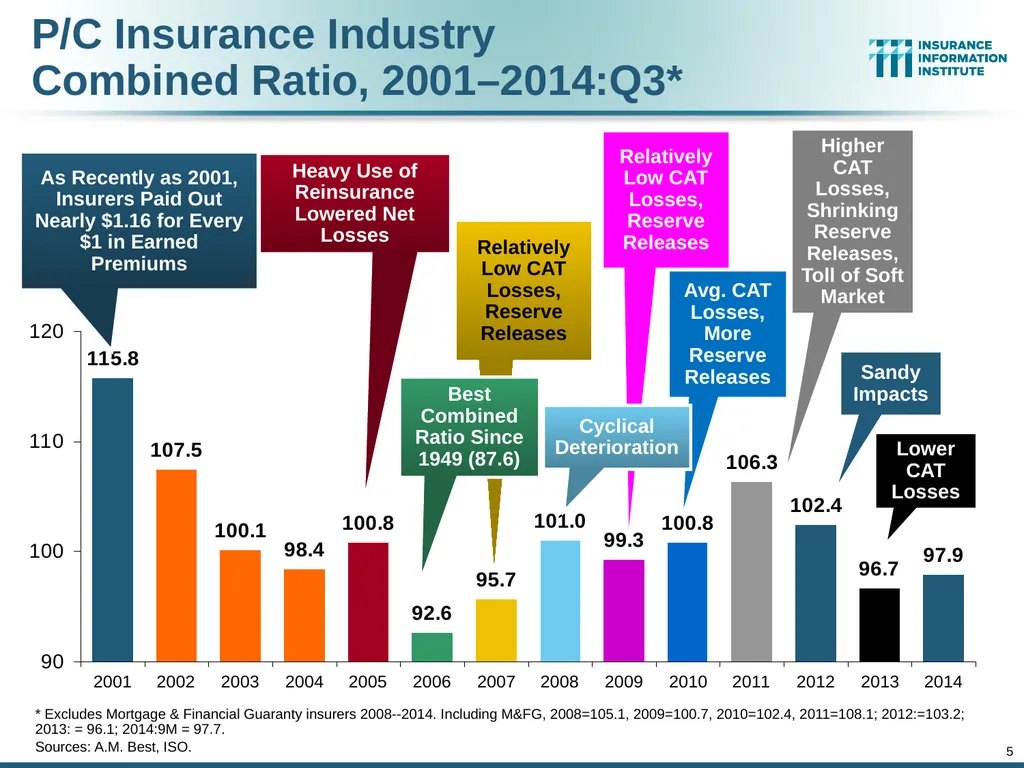
Combined Ratio, 2001–2014:Q3* * Excludes Mortgage & Financial Guaranty insurers 2008--2014. Including M&FG, 2008=105.1, 2009=100.7, 2010=102.4, 2011=108.1; 2012:=103.2; 2013: = 96.1; 2014:9M = 97.7.
Sources: A.M. Best, ISO. As Recently as 2001, Insurers Paid Out Nearly $1.16 for Every $1 in Earned Premiums Relatively Low CAT Losses, Reserve Releases Heavy Use of Reinsurance Lowered Net Losses Relatively Low CAT Losses, Reserve Releases Avg. CAT Losses, More Reserve Releases Higher CAT Losses, Shrinking Reserve Releases, Toll of Soft Market Cyclical Deterioration Sandy Impacts Lower CAT Losses Best Combined Ratio Since 1949 (87.6)<br>
Sources: A.M. Best, ISO. As Recently as 2001, Insurers Paid Out Nearly $1.16 for Every $1 in Earned Premiums Relatively Low CAT Losses, Reserve Releases Heavy Use of Reinsurance Lowered Net Losses Relatively Low CAT Losses, Reserve Releases Avg. CAT Losses, More Reserve Releases Higher CAT Losses, Shrinking Reserve Releases, Toll of Soft Market Cyclical Deterioration Sandy Impacts Lower CAT Losses Best Combined Ratio Since 1949 (87.6)<br>
06
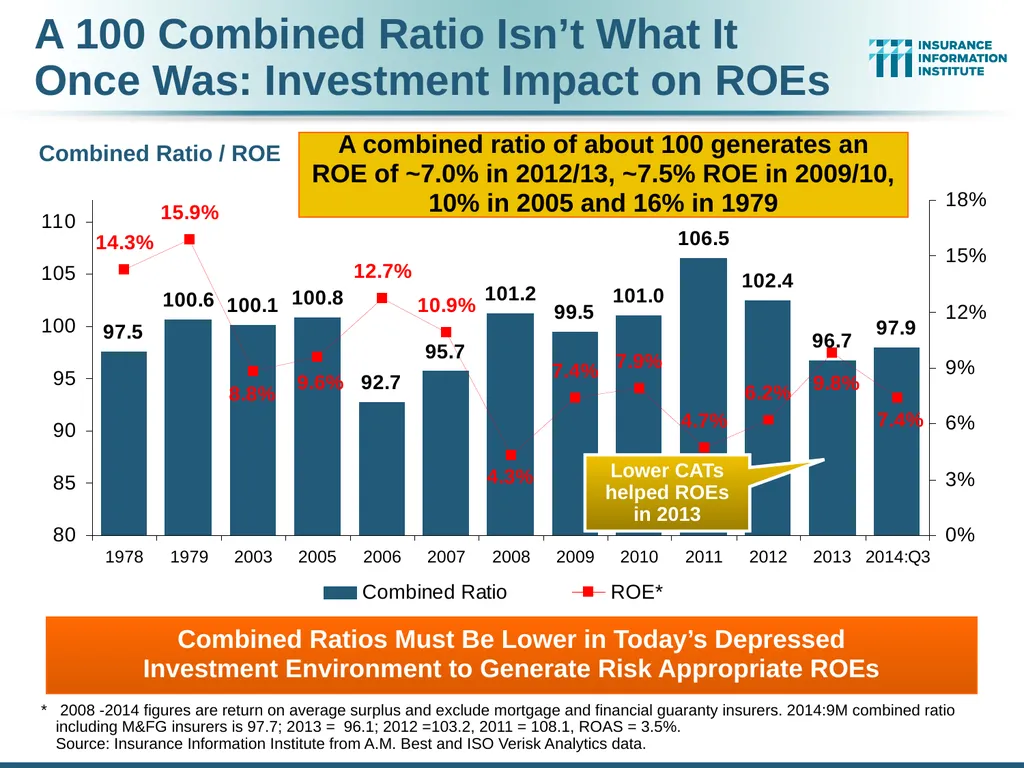
A 100 Combined Ratio Isn’t What It
Once Was: Investment Impact on ROEs Combined Ratio / ROE * 2008 -2014 figures are return on average surplus and exclude mortgage and financial guaranty insurers. 2014:9M combined ratio including M&FG insurers is 97.7; 2013 = 96.1; 2012 =103.2, 2011 = 108.1, ROAS = 3.5%.
Source: Insurance Information Institute from A.M. Best and ISO Verisk Analytics data. Combined Ratios Must Be Lower in Today’s Depressed Investment Environment to Generate Risk Appropriate ROEs A combined ratio of about 100 generates an ROE of ~7.0% in 2012/13, ~7.5% ROE in 2009/10, 10% in 2005 and 16% in 1979 Lower CATs helped ROEs in 2013<br>
Source: Insurance Information Institute from A.M. Best and ISO Verisk Analytics data. Combined Ratios Must Be Lower in Today’s Depressed Investment Environment to Generate Risk Appropriate ROEs A combined ratio of about 100 generates an ROE of ~7.0% in 2012/13, ~7.5% ROE in 2009/10, 10% in 2005 and 16% in 1979 Lower CATs helped ROEs in 2013<br>
07
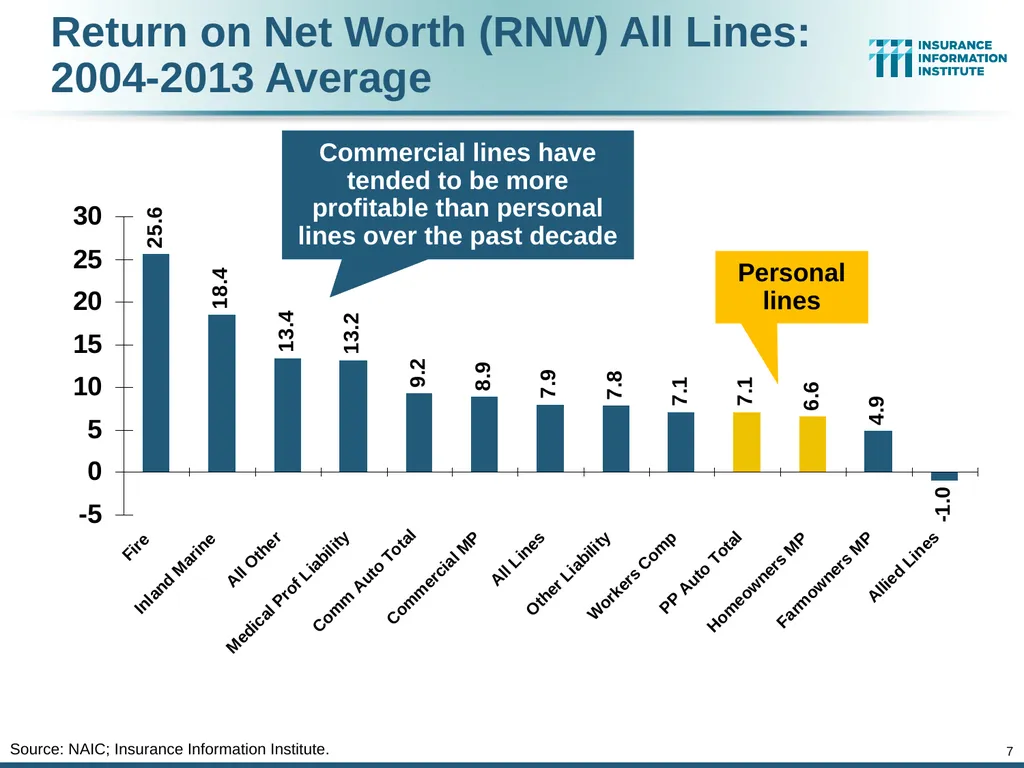
7 Return on Net Worth (RNW) All Lines: 2004-2013 Average Source: NAIC; Insurance Information Institute. Commercial lines have tended to be more profitable than personal lines over the past decade Personal lines<br>
08
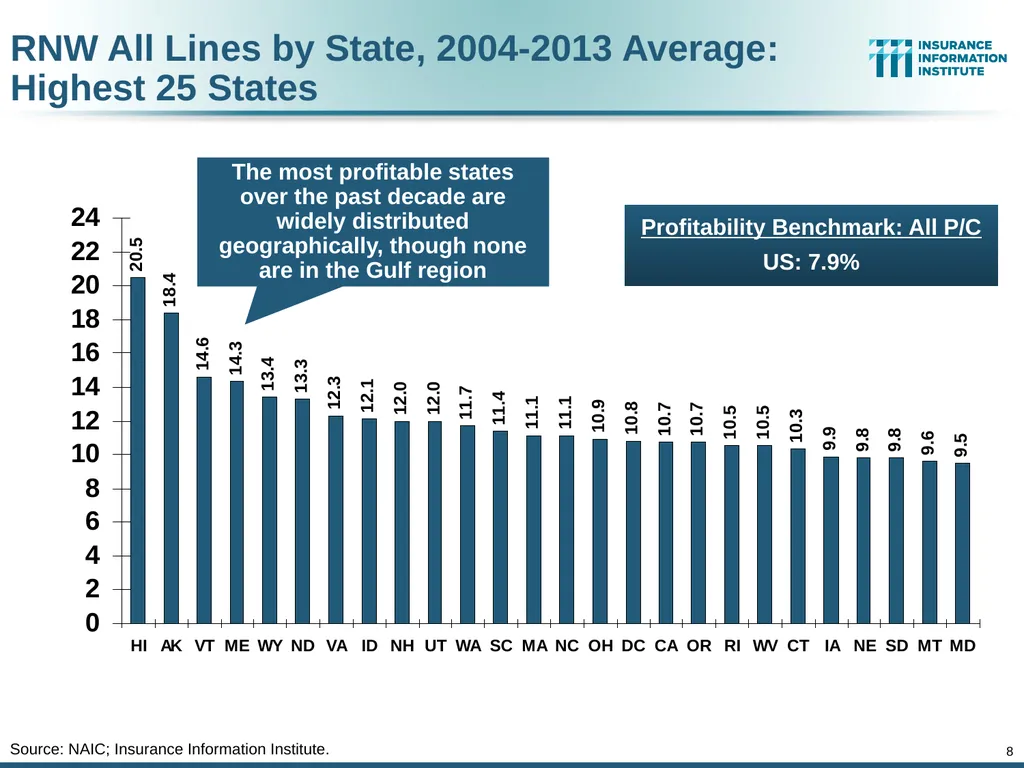
8 RNW All Lines by State, 2004-2013 Average:
Highest 25 States The most profitable states over the past decade are widely distributed geographically, though none are in the Gulf region Source: NAIC; Insurance Information Institute. Profitability Benchmark: All P/C
US: 7.9%<br>
US: 7.9%<br>
09
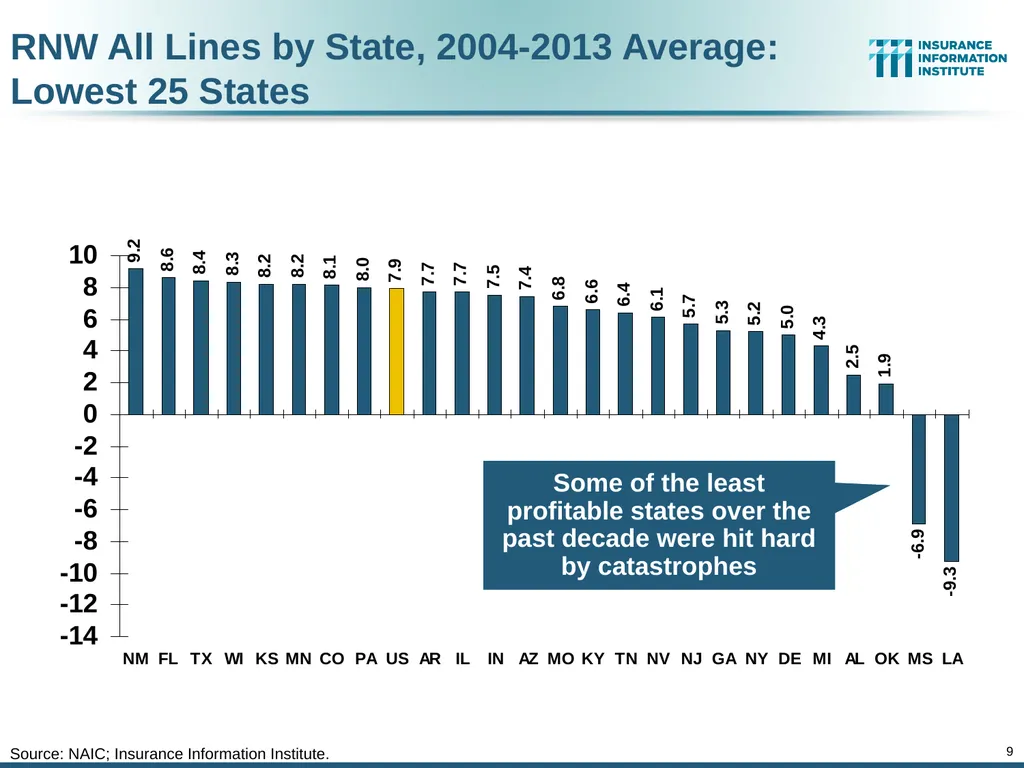
9 RNW All Lines by State, 2004-2013 Average:
Lowest 25 States Source: NAIC; Insurance Information Institute. Some of the least profitable states over the past decade were hit hard by catastrophes<br>
Lowest 25 States Source: NAIC; Insurance Information Institute. Some of the least profitable states over the past decade were hit hard by catastrophes<br>
10
10 Performance by Segment and by State 12/01/09 - 9pm 10<br>
11
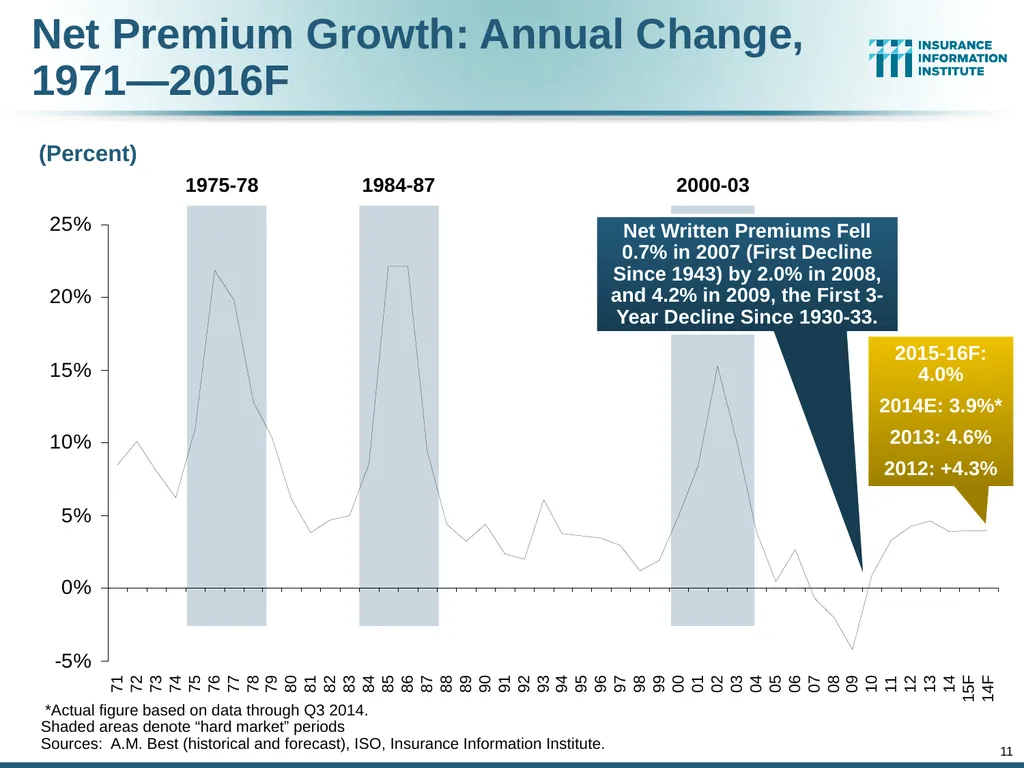
12/01/09 - 9pm eSlide – P6466 – The Financial Crisis and the Future of the P/C 11 Net Premium Growth: Annual Change,
1971—2016F (Percent) 1975-78 1984-87 2000-03 *Actual figure based on data through Q3 2014.
Shaded areas denote “hard market” periods
Sources: A.M. Best (historical and forecast), ISO, Insurance Information Institute. Net Written Premiums Fell 0.7% in 2007 (First Decline Since 1943) by 2.0% in 2008, and 4.2% in 2009, the First 3-Year Decline Since 1930-33. 2015-16F: 4.0%
2014E: 3.9%*
2013: 4.6%
2012: +4.3%<br>
Shaded areas denote “hard market” periods
Sources: A.M. Best (historical and forecast), ISO, Insurance Information Institute. Net Written Premiums Fell 0.7% in 2007 (First Decline Since 1943) by 2.0% in 2008, and 4.2% in 2009, the First 3-Year Decline Since 1930-33. 2015-16F: 4.0%
2014E: 3.9%*
2013: 4.6%
2012: +4.3%<br>
12
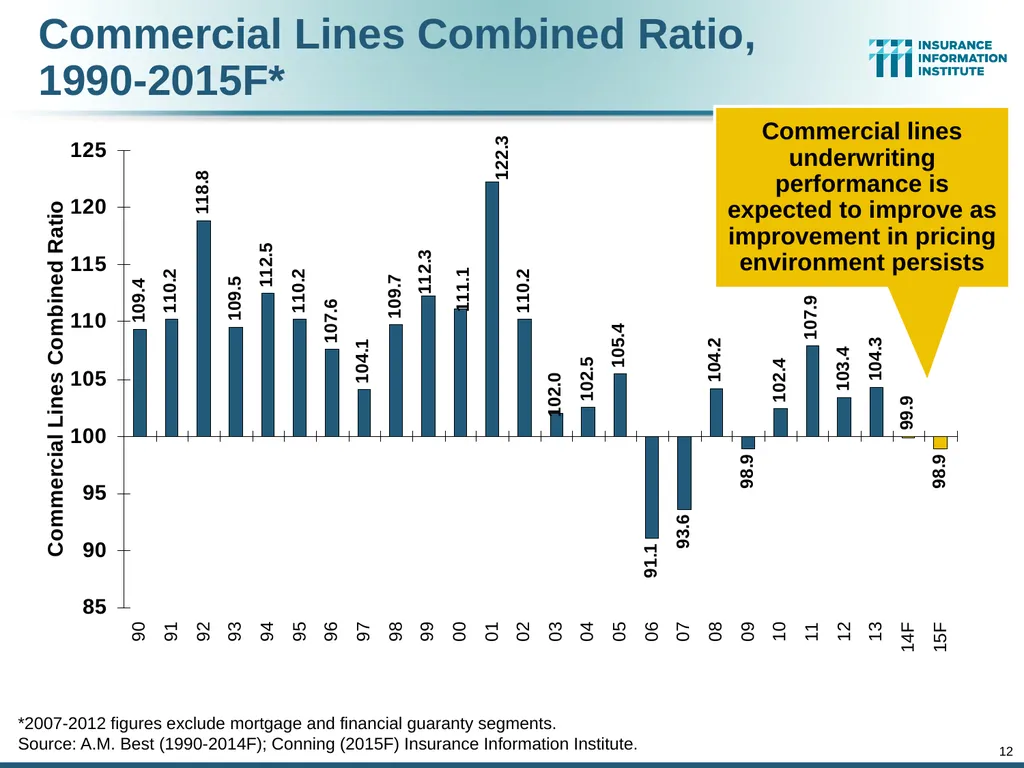
*2007-2012 figures exclude mortgage and financial guaranty segments.
Source: A.M. Best (1990-2014F); Conning (2015F) Insurance Information Institute. Commercial Lines Combined Ratio, 1990-2015F* Commercial lines underwriting performance is expected to improve as improvement in pricing environment persists 12/01/09 - 9pm 12<br>
Source: A.M. Best (1990-2014F); Conning (2015F) Insurance Information Institute. Commercial Lines Combined Ratio, 1990-2015F* Commercial lines underwriting performance is expected to improve as improvement in pricing environment persists 12/01/09 - 9pm 12<br>
13
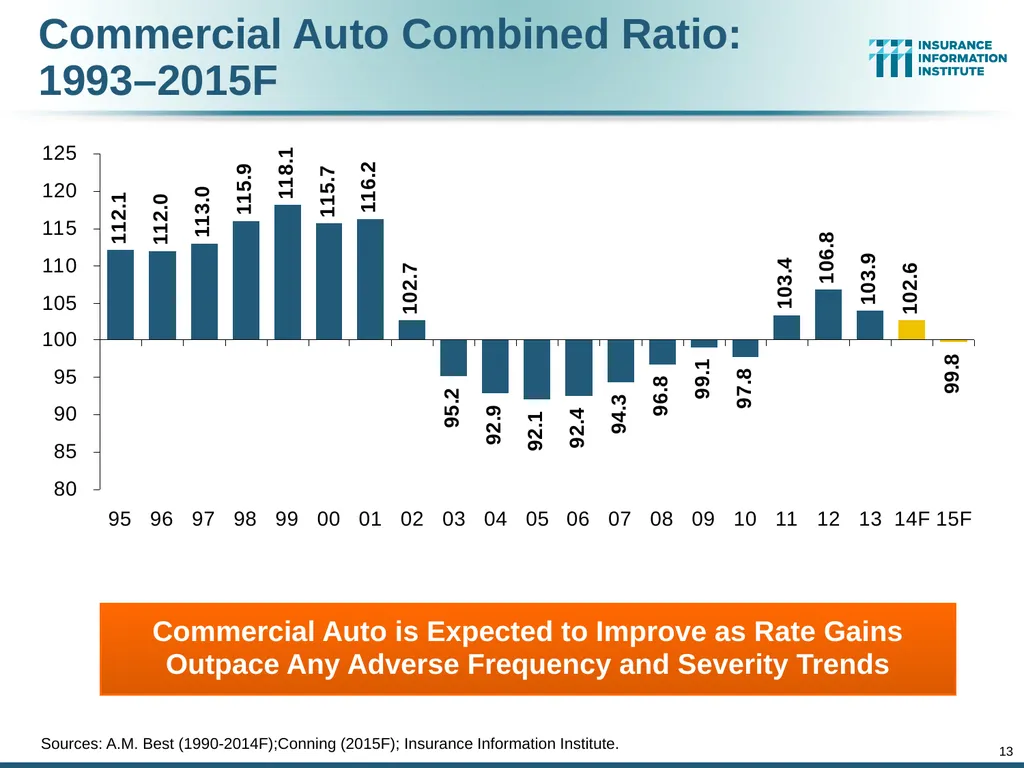
Commercial Auto Combined Ratio: 1993–2015F Commercial Auto is Expected to Improve as Rate Gains Outpace Any Adverse Frequency and Severity Trends 12/01/09 - 9pm 13 Sources: A.M. Best (1990-2014F);Conning (2015F); Insurance Information Institute.<br>
14
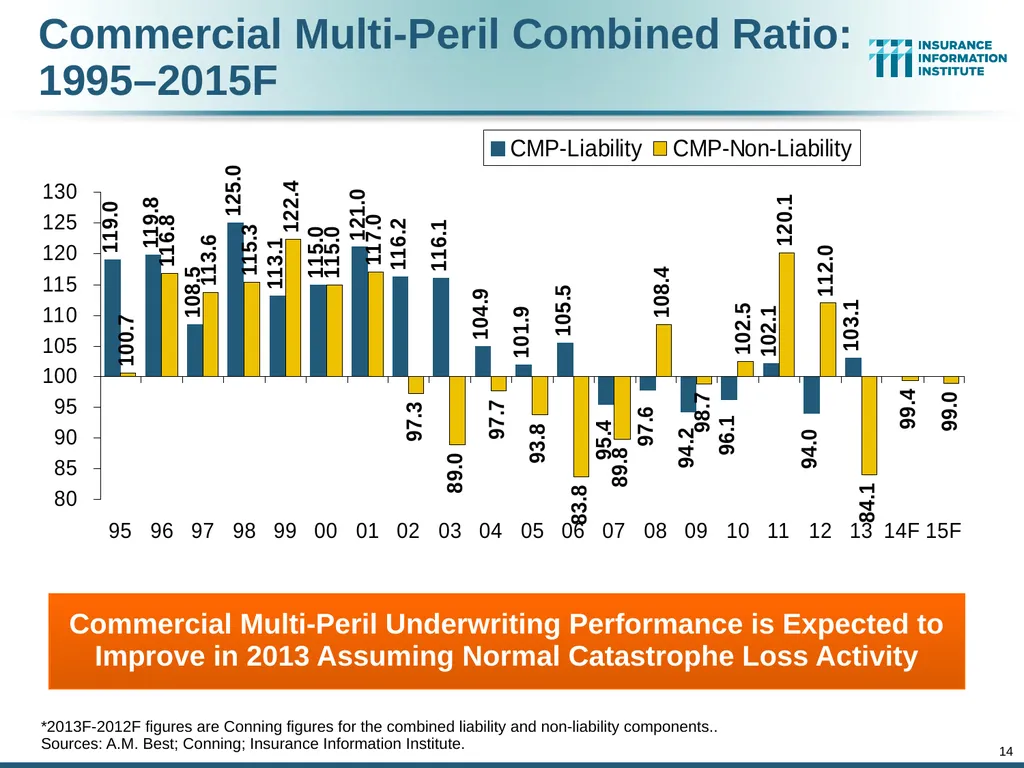
Commercial Multi-Peril Combined Ratio: 1995–2015F Commercial Multi-Peril Underwriting Performance is Expected to Improve in 2013 Assuming Normal Catastrophe Loss Activity *2013F-2012F figures are Conning figures for the combined liability and non-liability components..
Sources: A.M. Best; Conning; Insurance Information Institute. 12/01/09 - 9pm 14<br>
Sources: A.M. Best; Conning; Insurance Information Institute. 12/01/09 - 9pm 14<br>
15
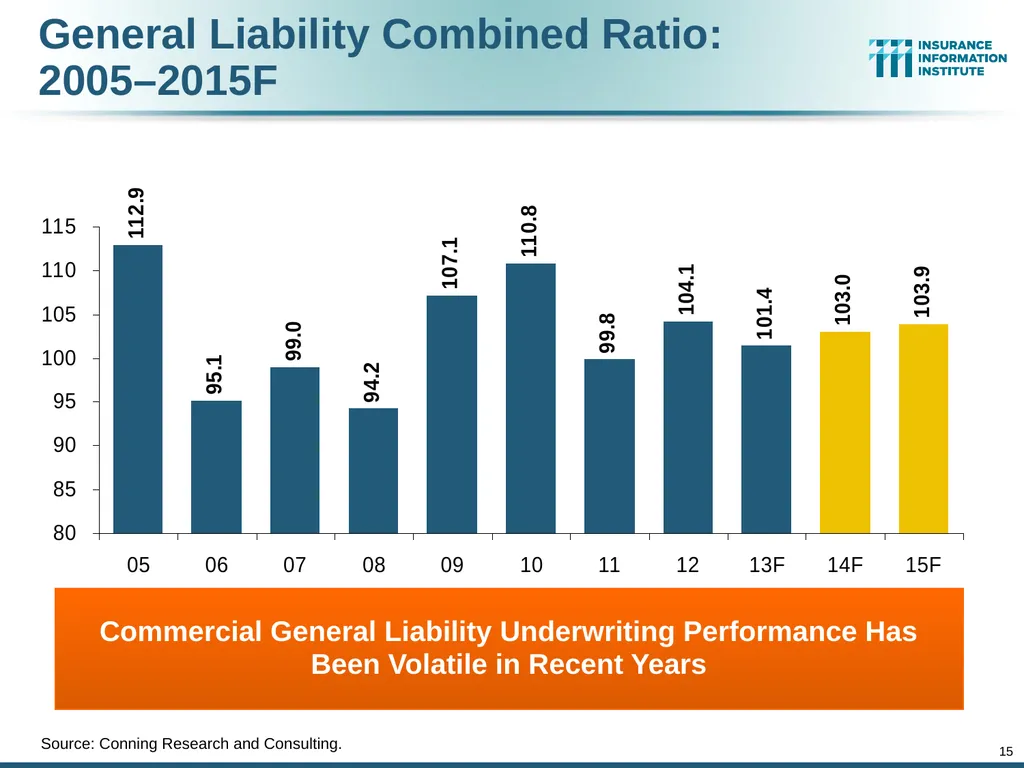
General Liability Combined Ratio:
2005–2015F Commercial General Liability Underwriting Performance Has Been Volatile in Recent Years Source: Conning Research and Consulting. 12/01/09 - 9pm 15<br>
16
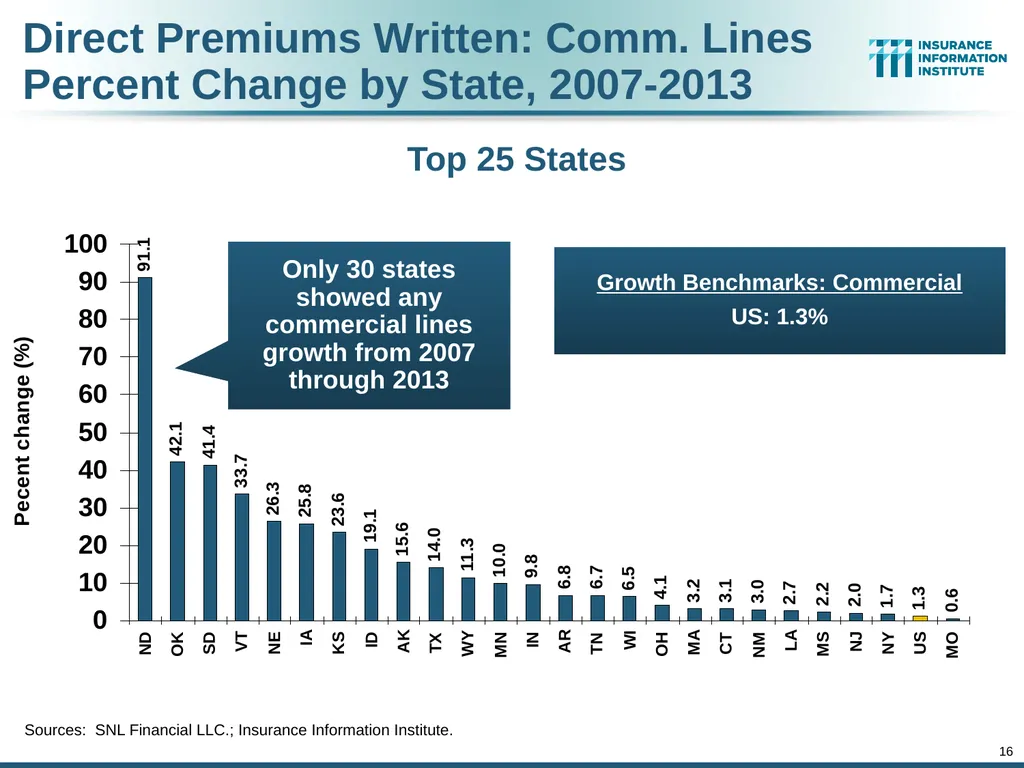
16 Direct Premiums Written: Comm. Lines
Percent Change by State, 2007-2013 Sources: SNL Financial LLC.; Insurance Information Institute. Top 25 States 12/01/09 - 9pm Only 30 states showed any commercial lines growth from 2007 through 2013 Growth Benchmarks: Commercial
US: 1.3%<br>
US: 1.3%<br>
17
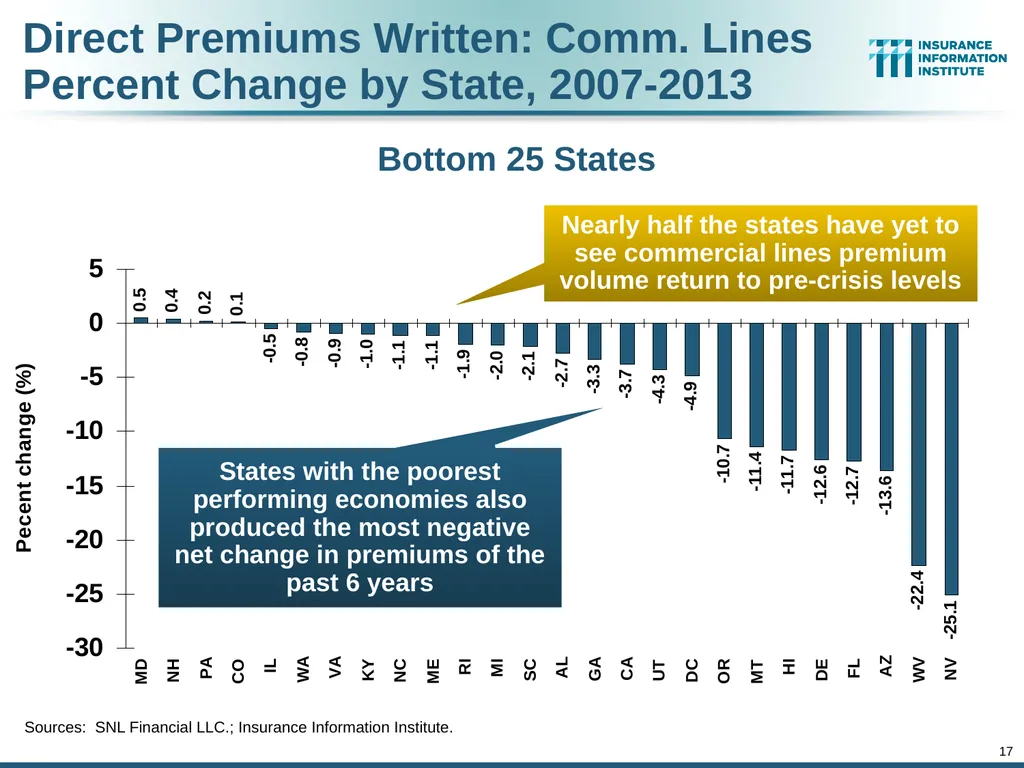
17 Direct Premiums Written: Comm. Lines
Percent Change by State, 2007-2013 Bottom 25 States Sources: SNL Financial LLC.; Insurance Information Institute. 12/01/09 - 9pm States with the poorest performing economies also produced the most negative net change in premiums of the past 6 years Nearly half the states have yet to see commercial lines premium volume return to pre-crisis levels<br>
18
Cyber Risk: a Rapidly Emerging Exposure for Businesses 18 Also Growing Interest from
Media & Public Policymakers 12/01/09 - 9pm 18<br>
19
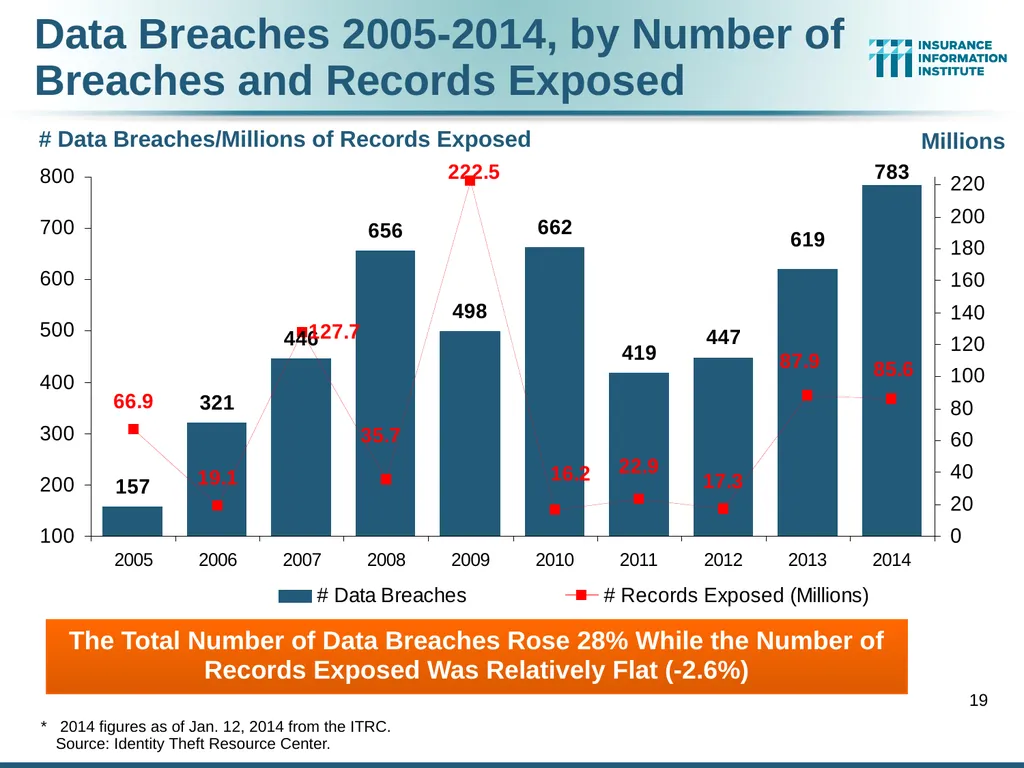
Data Breaches 2005-2014, by Number of Breaches and Records Exposed # Data Breaches/Millions of Records Exposed * 2014 figures as of Jan. 12, 2014 from the ITRC.
Source: Identity Theft Resource Center. The Total Number of Data Breaches Rose 28% While the Number of Records Exposed Was Relatively Flat (-2.6%) Millions 19<br>
Source: Identity Theft Resource Center. The Total Number of Data Breaches Rose 28% While the Number of Records Exposed Was Relatively Flat (-2.6%) Millions 19<br>
20
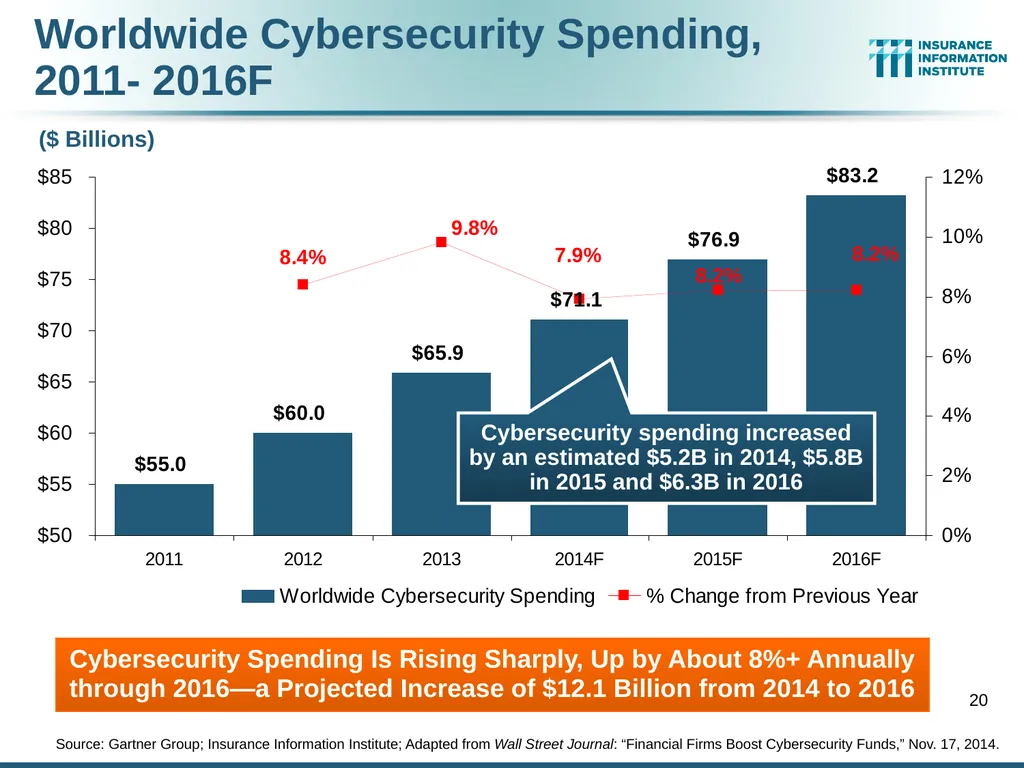
Worldwide Cybersecurity Spending, 2011- 2016F ($ Billions) Cybersecurity Spending Is Rising Sharply, Up by About 8%+ Annually through 2016—a Projected Increase of $12.1 Billion from 2014 to 2016 Cybersecurity spending increased by an estimated $5.2B in 2014, $5.8B in 2015 and $6.3B in 2016 Source: Gartner Group; Insurance Information Institute; Adapted from Wall Street Journal: “Financial Firms Boost Cybersecurity Funds,” Nov. 17, 2014. 20<br>
21
12/01/09 - 9pm eSlide – P6466 – The Financial Crisis and the Future of the P/C Data/Privacy Breach:
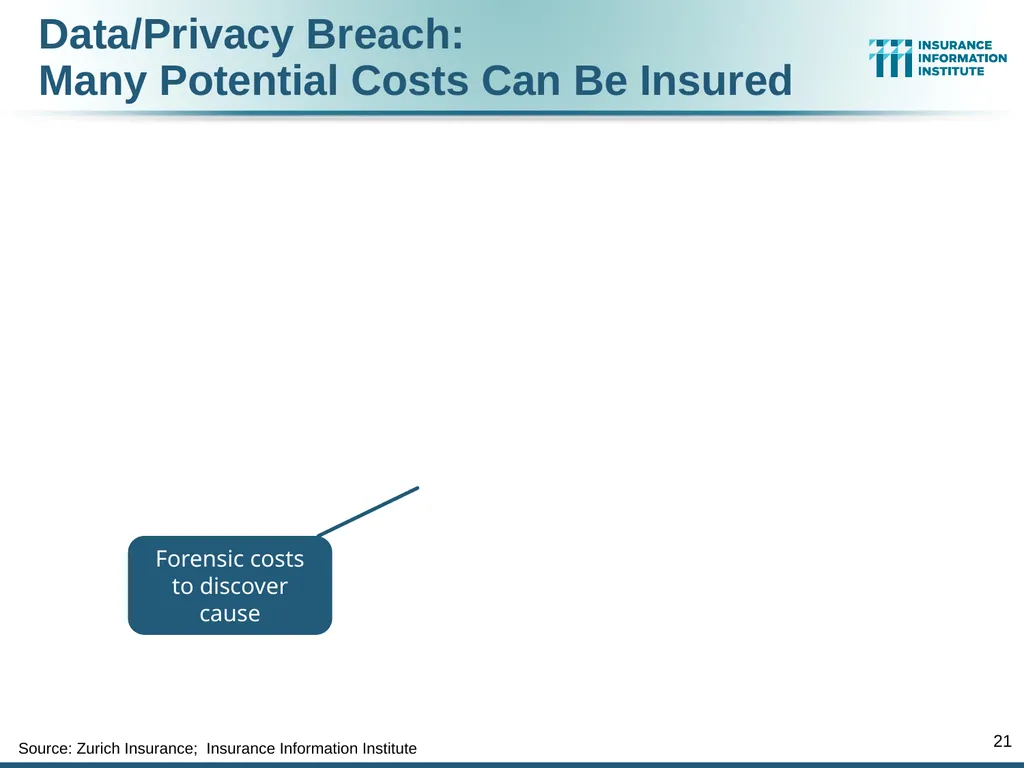
Many Potential Costs Can Be Insured Source: Zurich Insurance; Insurance Information Institute Forensic costs to discover cause 21<br>
22
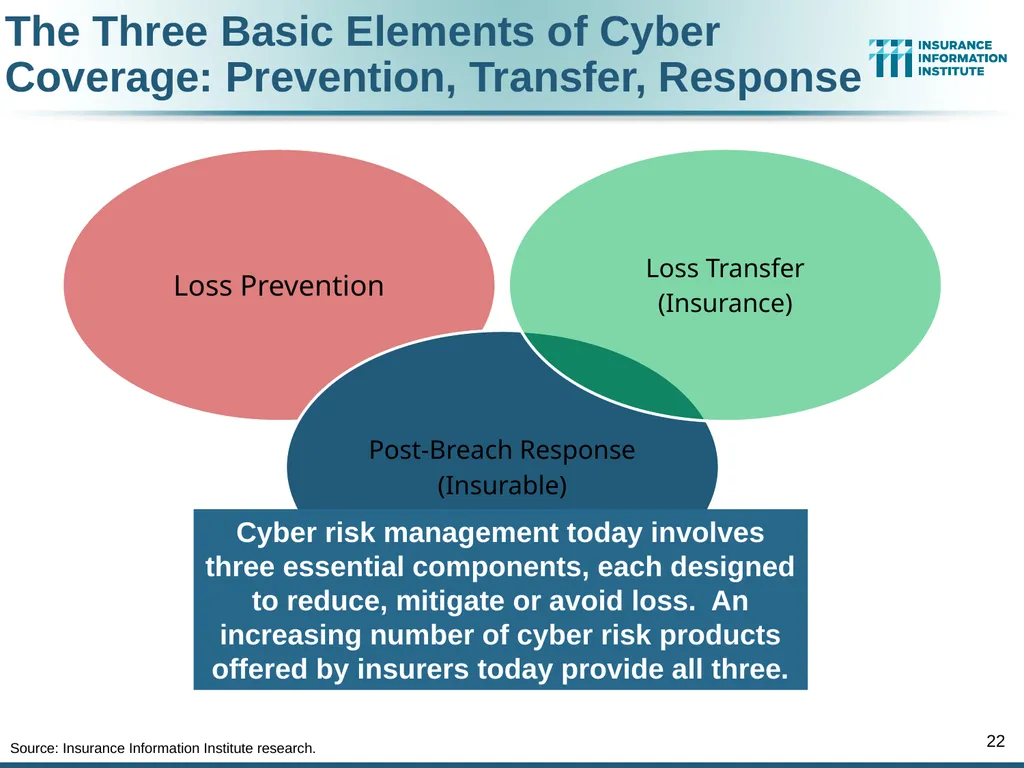
Source: Insurance Information Institute research. The Three Basic Elements of Cyber Coverage: Prevention, Transfer, Response Cyber risk management today involves three essential components, each designed to reduce, mitigate or avoid loss. An increasing number of cyber risk products offered by insurers today provide all three. 22<br>
23
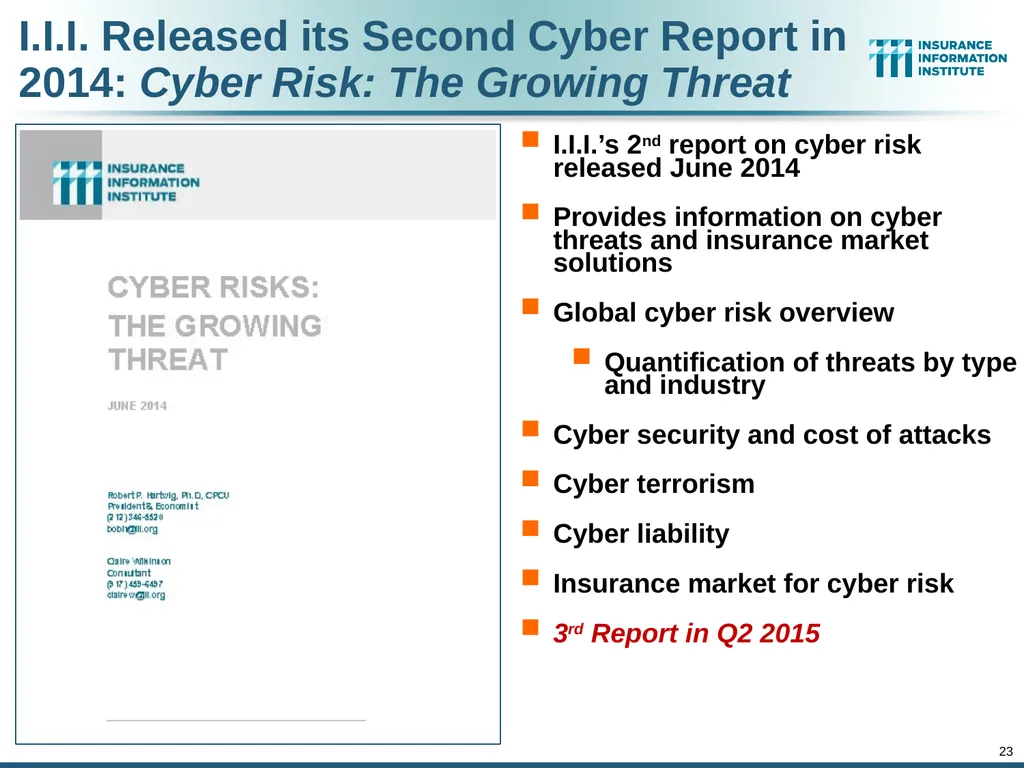
12/01/09 - 9pm eSlide – P6466 – The Financial Crisis and the Future of the P/C 23 I.I.I. Released its Second Cyber Report in 2014: Cyber Risk: The Growing Threat I.I.I.’s 2nd report on cyber risk released June 2014
Provides information on cyber threats and insurance market solutions
Global cyber risk overview
Quantification of threats by type and industry
Cyber security and cost of attacks
Cyber terrorism
Cyber liability
Insurance market for cyber risk
3rd Report in Q2 2015<br>
Provides information on cyber threats and insurance market solutions
Global cyber risk overview
Quantification of threats by type and industry
Cyber security and cost of attacks
Cyber terrorism
Cyber liability
Insurance market for cyber risk
3rd Report in Q2 2015<br>
24
Investment Performance:
A Key Driver of Profitability 24 Depressed Yields Will Continue
to Affect Underwriting & Pricing 12/01/09 - 9pm 24<br>
25
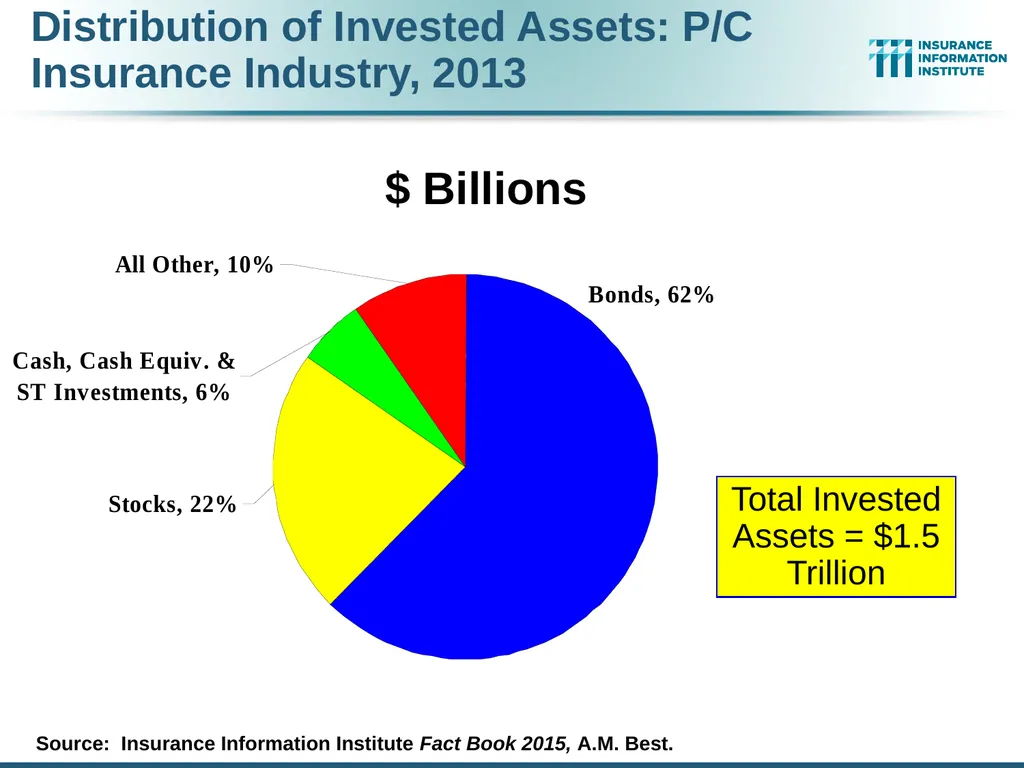
Distribution of Invested Assets: P/C Insurance Industry, 2013 Source: Insurance Information Institute Fact Book 2015, A.M. Best. Total Invested Assets = $1.5 Trillion $ Billions<br>
26
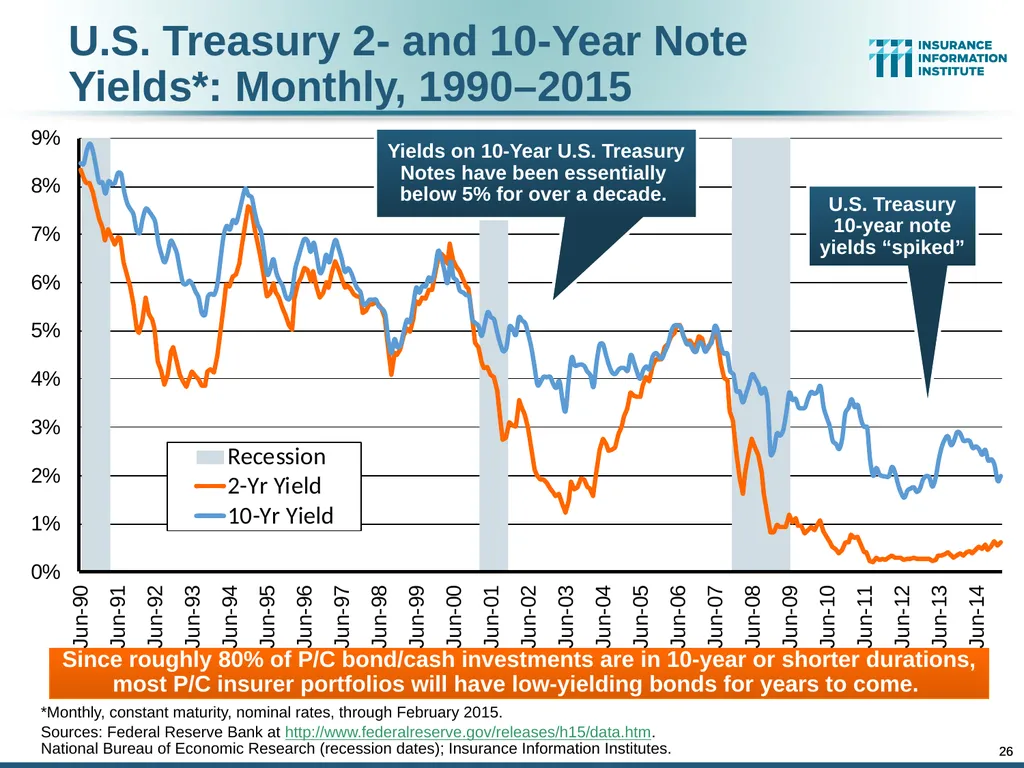
12/01/09 - 9pm eSlide – P6466 – The Financial Crisis and the Future of the P/C 26 U.S. Treasury 2- and 10-Year Note Yields*: Monthly, 1990–2015 *Monthly, constant maturity, nominal rates, through February 2015.
Sources: Federal Reserve Bank at http://www.federalreserve.gov/releases/h15/data.htm. National Bureau of Economic Research (recession dates); Insurance Information Institutes. Yields on 10-Year U.S. Treasury Notes have been essentially below 5% for over a decade. Since roughly 80% of P/C bond/cash investments are in 10-year or shorter durations, most P/C insurer portfolios will have low-yielding bonds for years to come. U.S. Treasury 10-year note yields “spiked” 12/01/09 - 9pm 26<br>
Sources: Federal Reserve Bank at http://www.federalreserve.gov/releases/h15/data.htm. National Bureau of Economic Research (recession dates); Insurance Information Institutes. Yields on 10-Year U.S. Treasury Notes have been essentially below 5% for over a decade. Since roughly 80% of P/C bond/cash investments are in 10-year or shorter durations, most P/C insurer portfolios will have low-yielding bonds for years to come. U.S. Treasury 10-year note yields “spiked” 12/01/09 - 9pm 26<br>
27
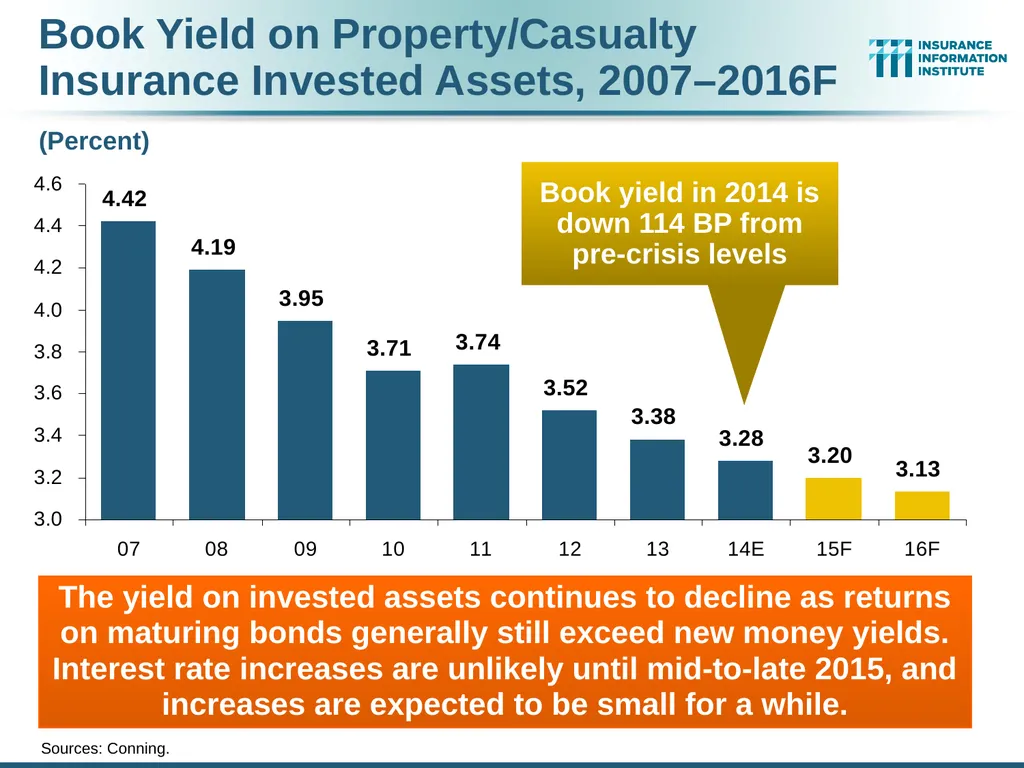
Book Yield on Property/Casualty Insurance Invested Assets, 2007–2016F The yield on invested assets continues to decline as returns on maturing bonds generally still exceed new money yields. Interest rate increases are unlikely until mid-to-late 2015, and increases are expected to be small for a while. Sources: Conning. (Percent) Book yield in 2014 is down 114 BP from pre-crisis levels<br>
28
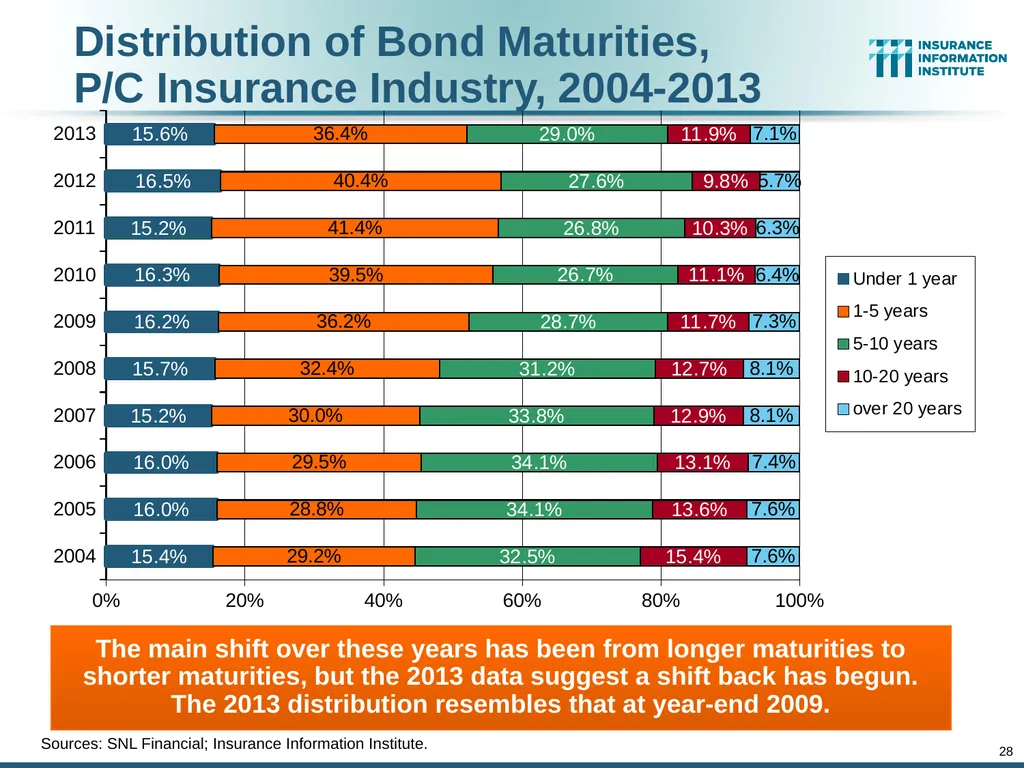
12/01/09 - 9pm eSlide – P6466 – The Financial Crisis and the Future of the P/C 28 Distribution of Bond Maturities,
P/C Insurance Industry, 2004-2013 Sources: SNL Financial; Insurance Information Institute. The main shift over these years has been from longer maturities to shorter maturities, but the 2013 data suggest a shift back has begun. The 2013 distribution resembles that at year-end 2009.<br>
29
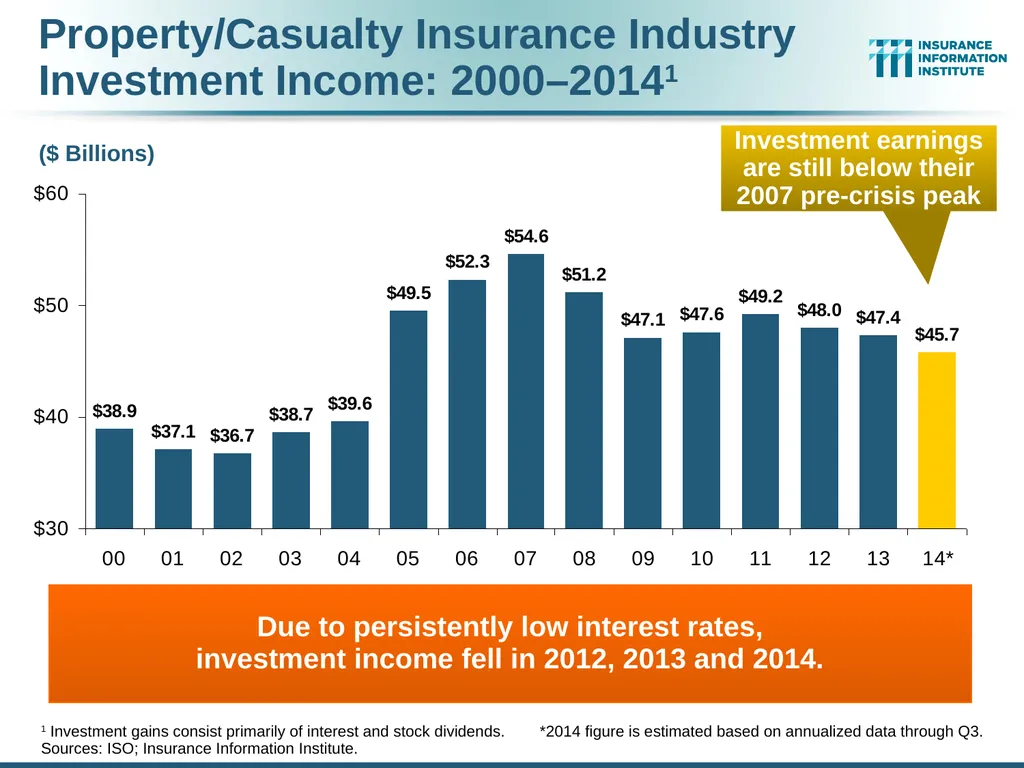
Property/Casualty Insurance Industry Investment Income: 2000–20141 Due to persistently low interest rates,
investment income fell in 2012, 2013 and 2014. 1 Investment gains consist primarily of interest and stock dividends. *2014 figure is estimated based on annualized data through Q3.
Sources: ISO; Insurance Information Institute. ($ Billions) Investment earnings are still below their 2007 pre-crisis peak<br>
Sources: ISO; Insurance Information Institute. ($ Billions) Investment earnings are still below their 2007 pre-crisis peak<br>
30
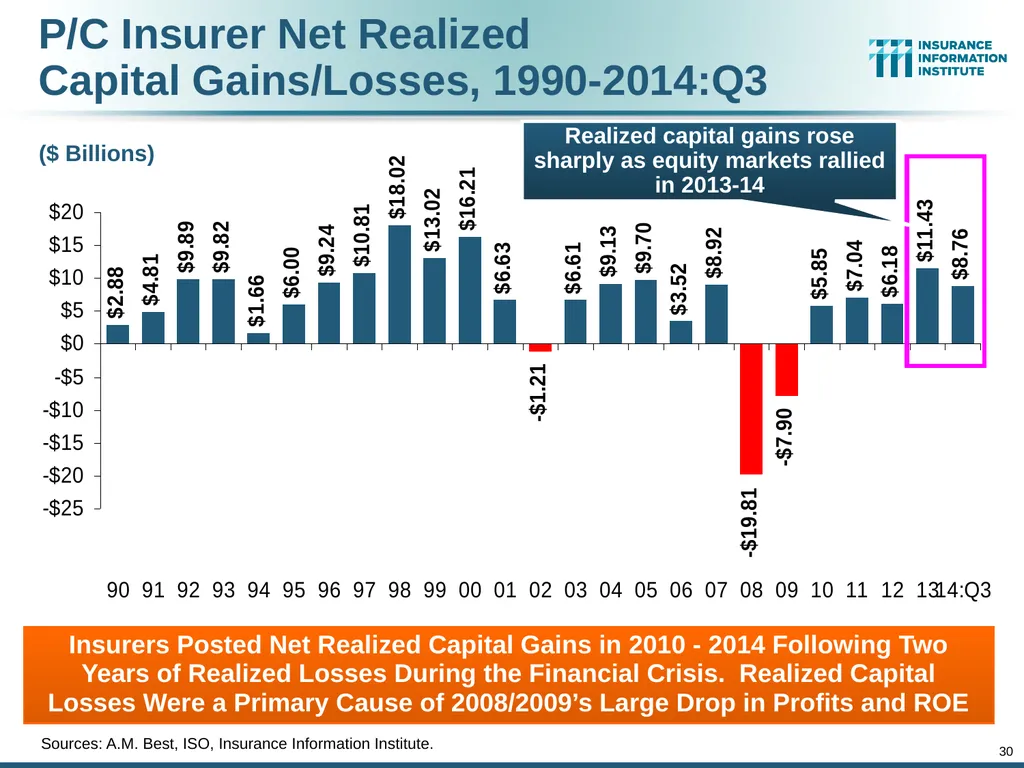
12/01/09 - 9pm eSlide – P6466 – The Financial Crisis and the Future of the P/C 30 P/C Insurer Net Realized
Capital Gains/Losses, 1990-2014:Q3 Sources: A.M. Best, ISO, Insurance Information Institute. Insurers Posted Net Realized Capital Gains in 2010 - 2014 Following Two Years of Realized Losses During the Financial Crisis. Realized Capital Losses Were a Primary Cause of 2008/2009’s Large Drop in Profits and ROE ($ Billions) Realized capital gains rose sharply as equity markets rallied in 2013-14<br>
31
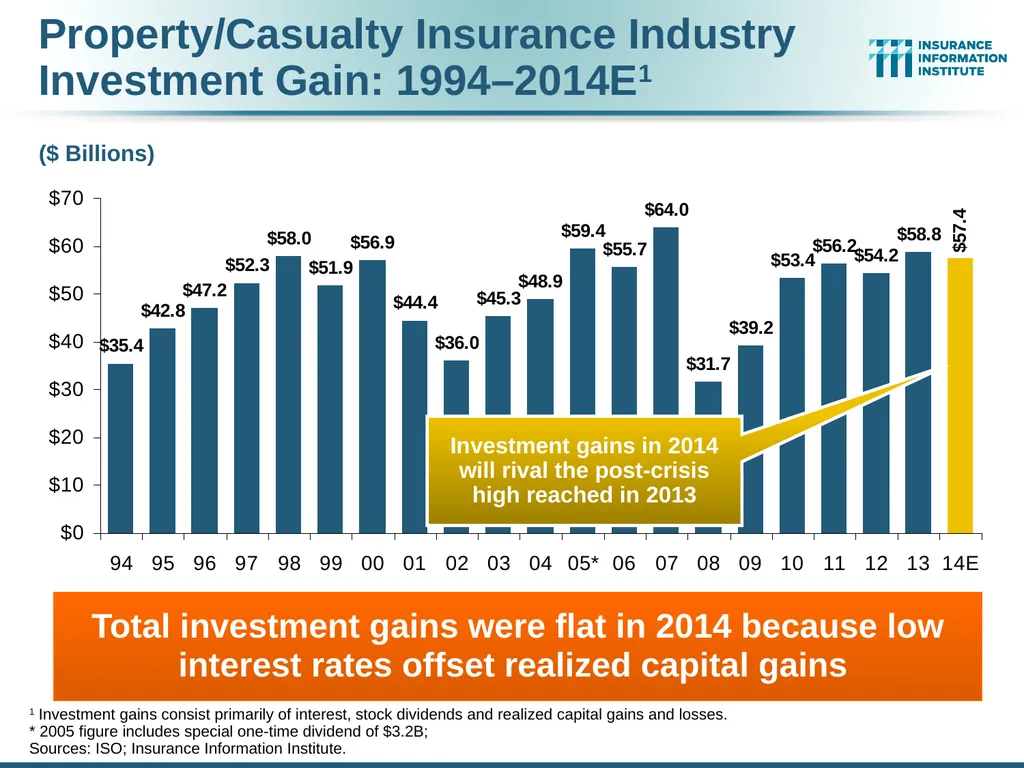
Property/Casualty Insurance Industry Investment Gain: 1994–2014E1 Total investment gains were flat in 2014 because low interest rates offset realized capital gains 1 Investment gains consist primarily of interest, stock dividends and realized capital gains and losses.
* 2005 figure includes special one-time dividend of $3.2B;
Sources: ISO; Insurance Information Institute. ($ Billions) Investment gains in 2014 will rival the post-crisis high reached in 2013<br>
* 2005 figure includes special one-time dividend of $3.2B;
Sources: ISO; Insurance Information Institute. ($ Billions) Investment gains in 2014 will rival the post-crisis high reached in 2013<br>
32
12/01/09 - 9pm eSlide – P6466 – The Financial Crisis and the Future of the P/C 32 Lower Investment Earnings Place a Greater Burden on Underwriting and Pricing Discipline *Based on 2008 Invested Assets and Earned Premiums
**US domestic reinsurance only
Source: A.M. Best; Insurance Information Institute. Reduction in Combined Ratio Necessary to Offset 1% Decline in Investment Yield to Maintain Constant ROE, by Line* 12/01/09 - 9pm 32<br>
**US domestic reinsurance only
Source: A.M. Best; Insurance Information Institute. Reduction in Combined Ratio Necessary to Offset 1% Decline in Investment Yield to Maintain Constant ROE, by Line* 12/01/09 - 9pm 32<br>
33
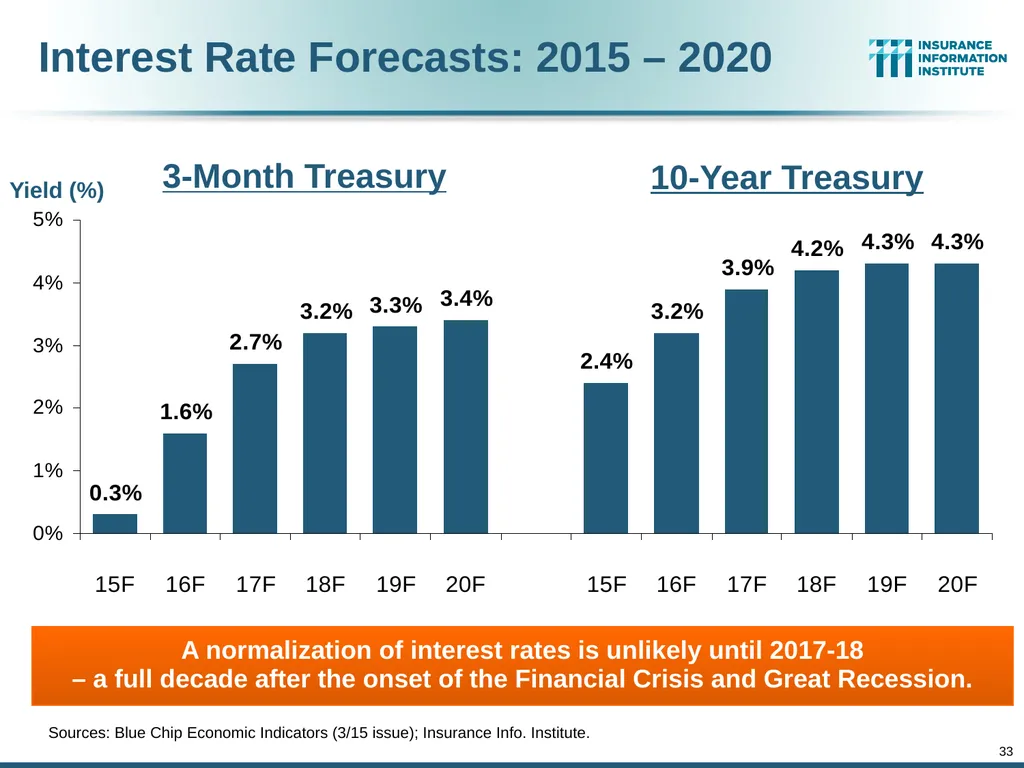
12/01/09 - 9pm 33 Interest Rate Forecasts: 2015 – 2020 A normalization of interest rates is unlikely until 2017-18
– a full decade after the onset of the Financial Crisis and Great Recession. Yield (%) Sources: Blue Chip Economic Indicators (3/15 issue); Insurance Info. Institute. 3-Month Treasury 10-Year Treasury<br>
34
CAPITAL/CAPACITY 34 Capital Accumulation Has Multiple Impacts 12/01/09 - 9pm 34<br>
35
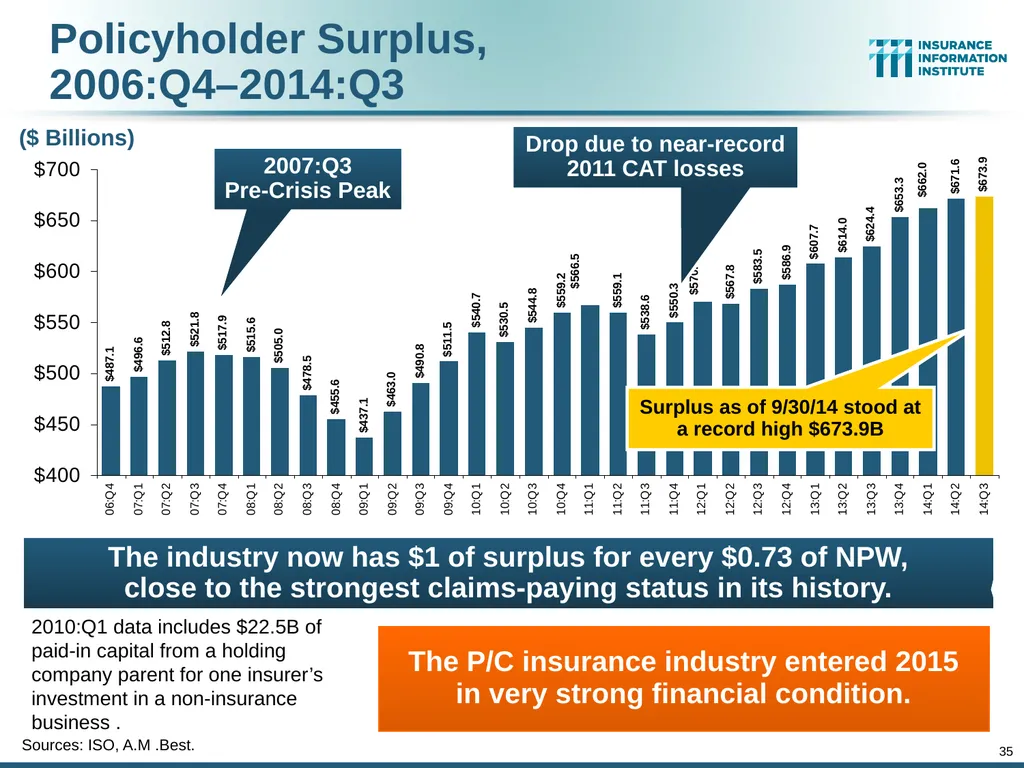
12/01/09 - 9pm eSlide – P6466 – The Financial Crisis and the Future of the P/C 35 Policyholder Surplus,
2006:Q4–2014:Q3 Sources: ISO, A.M .Best. ($ Billions) 2007:Q3
Pre-Crisis Peak Surplus as of 9/30/14 stood at a record high $673.9B 2010:Q1 data includes $22.5B of paid-in capital from a holding company parent for one insurer’s investment in a non-insurance business . The industry now has $1 of surplus for every $0.73 of NPW,
close to the strongest claims-paying status in its history. Drop due to near-record 2011 CAT losses The P/C insurance industry entered 2015
in very strong financial condition.<br>
36
Premium-to-Surplus Ratio:
1985–2014* * As of 9/30/14.
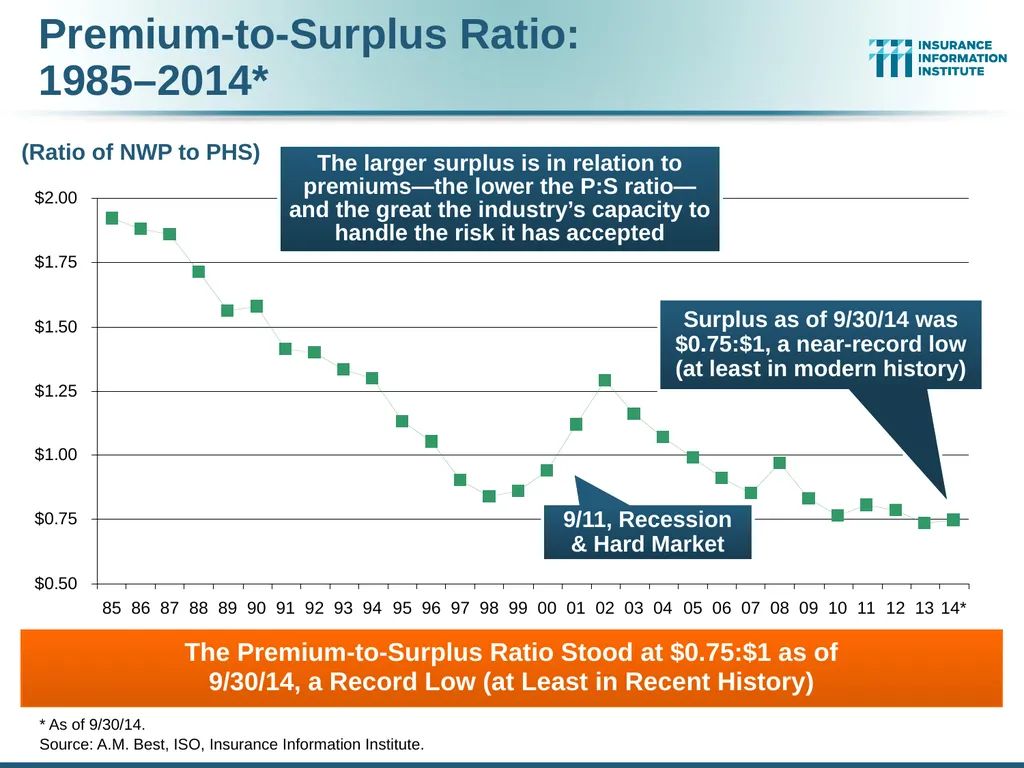
Source: A.M. Best, ISO, Insurance Information Institute. The larger surplus is in relation to premiums—the lower the P:S ratio—and the great the industry’s capacity to handle the risk it has accepted (Ratio of NWP to PHS) The Premium-to-Surplus Ratio Stood at $0.75:$1 as of 9/30/14, a Record Low (at Least in Recent History) Surplus as of 9/30/14 was $0.75:$1, a near-record low (at least in modern history) 9/11, Recession & Hard Market<br>
Source: A.M. Best, ISO, Insurance Information Institute. The larger surplus is in relation to premiums—the lower the P:S ratio—and the great the industry’s capacity to handle the risk it has accepted (Ratio of NWP to PHS) The Premium-to-Surplus Ratio Stood at $0.75:$1 as of 9/30/14, a Record Low (at Least in Recent History) Surplus as of 9/30/14 was $0.75:$1, a near-record low (at least in modern history) 9/11, Recession & Hard Market<br>
37
US P/C Insurance Industry Excess Capital Position: 1994–2016E Source: Barclays Research estimates. Surplus Redundancy (Deficiency) The Industry’s Strong Capital Position Suggests Insurers Are in a Good Position to Increase Risk Appetite, Repurchase Shares and Pursue Acqusitions Percent Redundancy (Deficiency) Barclay’s suggests that excess is about $200B (~30%)<br>
38
38 Alternative Capital 12/01/09 - 9pm 38 New Investors Continue to Change the Reinsurance Landscape First I.I.I. White Paper on Issue Will Be Released Q1 2015<br>
39
Global Reinsurance Capital (Traditional and Alternative), 2006 - 2014 2014 data is as of June 30, 2014.
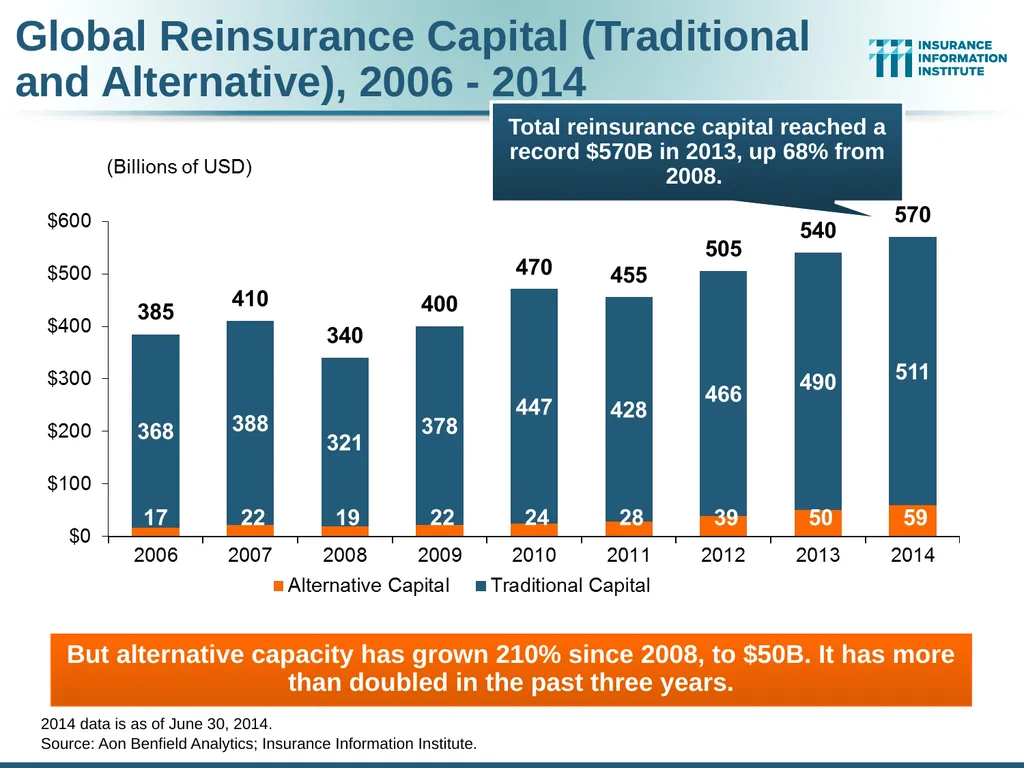
Source: Aon Benfield Analytics; Insurance Information Institute. Total reinsurance capital reached a record $570B in 2013, up 68% from 2008. But alternative capacity has grown 210% since 2008, to $50B. It has more than doubled in the past three years.<br>
Source: Aon Benfield Analytics; Insurance Information Institute. Total reinsurance capital reached a record $570B in 2013, up 68% from 2008. But alternative capacity has grown 210% since 2008, to $50B. It has more than doubled in the past three years.<br>
40
Growth of Alternative Capital Structures, 2002 - 2014 2014 data is as of June 30, 2014.
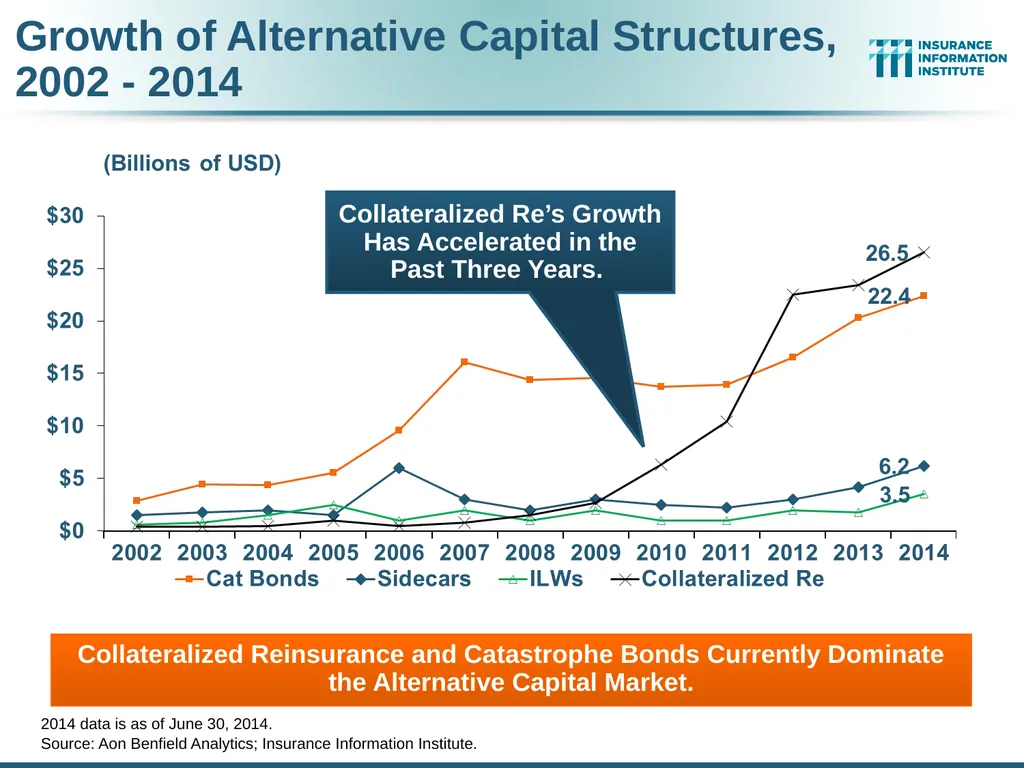
Source: Aon Benfield Analytics; Insurance Information Institute. Collateralized Re’s Growth Has Accelerated in the Past Three Years. Collateralized Reinsurance and Catastrophe Bonds Currently Dominate the Alternative Capital Market.<br>
Source: Aon Benfield Analytics; Insurance Information Institute. Collateralized Re’s Growth Has Accelerated in the Past Three Years. Collateralized Reinsurance and Catastrophe Bonds Currently Dominate the Alternative Capital Market.<br>
41
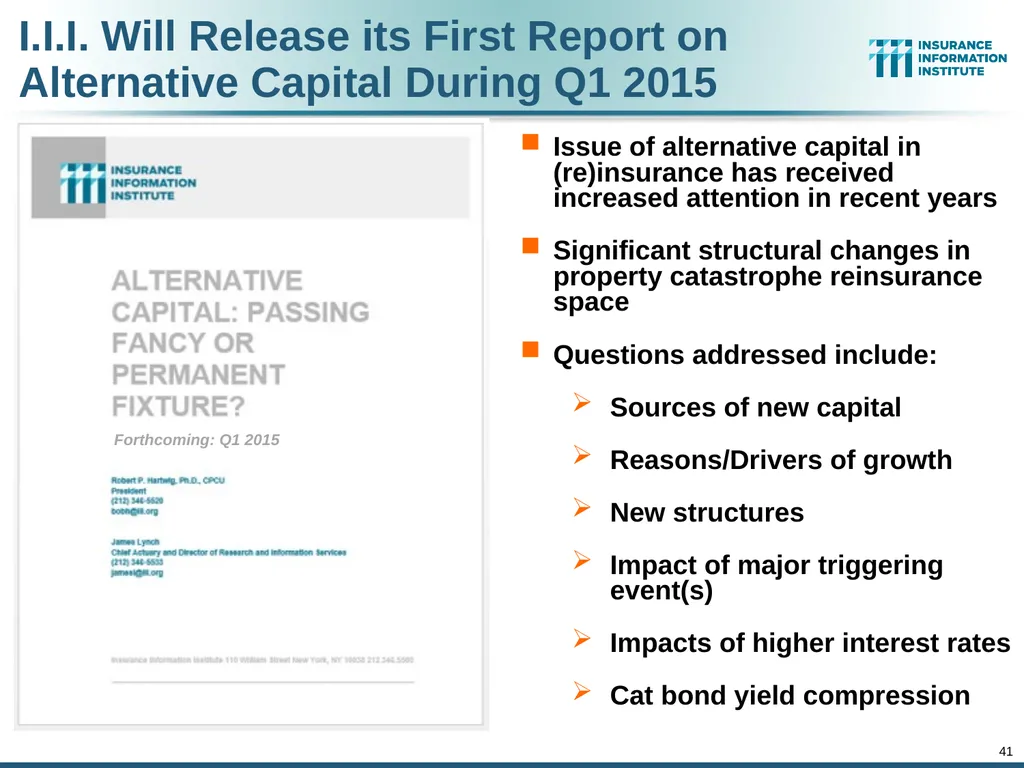
12/01/09 - 9pm eSlide – P6466 – The Financial Crisis and the Future of the P/C 41 I.I.I. Will Release its First Report on Alternative Capital During Q1 2015 Issue of alternative capital in (re)insurance has received increased attention in recent years
Significant structural changes in property catastrophe reinsurance space
Questions addressed include:
Sources of new capital
Reasons/Drivers of growth
New structures
Impact of major triggering event(s)
Impacts of higher interest rates
Cat bond yield compression Forthcoming: Q1 2015<br>
Significant structural changes in property catastrophe reinsurance space
Questions addressed include:
Sources of new capital
Reasons/Drivers of growth
New structures
Impact of major triggering event(s)
Impacts of higher interest rates
Cat bond yield compression Forthcoming: Q1 2015<br>
42
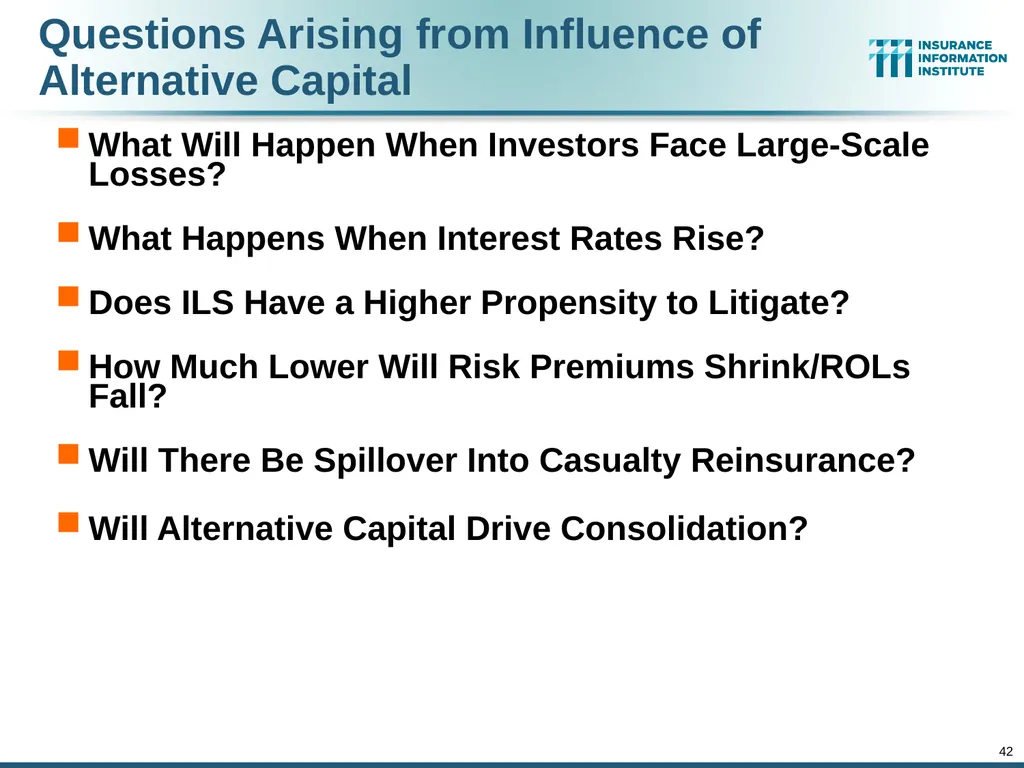
12/01/09 - 9pm eSlide – P6466 – The Financial Crisis and the Future of the P/C 42 Questions Arising from Influence of Alternative Capital What Will Happen When Investors Face Large-Scale Losses?
What Happens When Interest Rates Rise?
Does ILS Have a Higher Propensity to Litigate?
How Much Lower Will Risk Premiums Shrink/ROLs Fall?
Will There Be Spillover Into Casualty Reinsurance?
Will Alternative Capital Drive Consolidation?<br>
What Happens When Interest Rates Rise?
Does ILS Have a Higher Propensity to Litigate?
How Much Lower Will Risk Premiums Shrink/ROLs Fall?
Will There Be Spillover Into Casualty Reinsurance?
Will Alternative Capital Drive Consolidation?<br>
43
The Strength of the Economy Will Influence P/C Insurer Growth Opportunities 43 Growth Will Expand Insurer Exposure Base Across Most Lines 12/01/09 - 9pm 43<br>
44
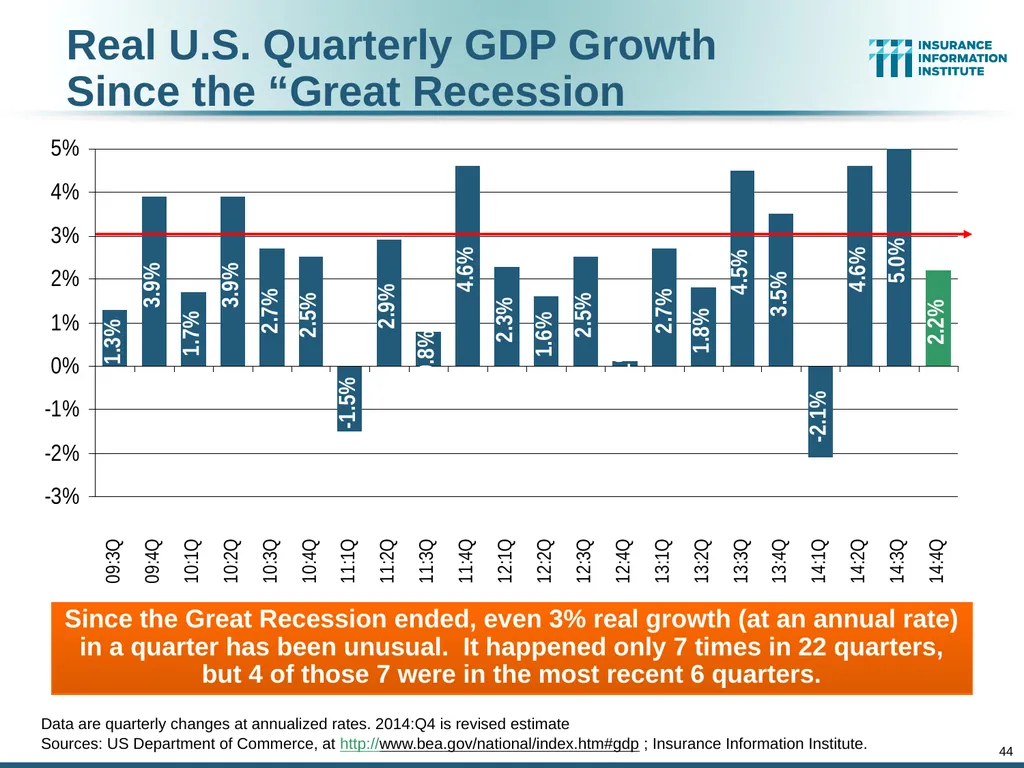
12/01/09 - 9pm 44 Real U.S. Quarterly GDP Growth
Since the “Great Recession Data are quarterly changes at annualized rates. 2014:Q4 is revised estimate
Sources: US Department of Commerce, at http://www.bea.gov/national/index.htm#gdp ; Insurance Information Institute. Since the Great Recession ended, even 3% real growth (at an annual rate) in a quarter has been unusual. It happened only 7 times in 22 quarters, but 4 of those 7 were in the most recent 6 quarters.<br>
Sources: US Department of Commerce, at http://www.bea.gov/national/index.htm#gdp ; Insurance Information Institute. Since the Great Recession ended, even 3% real growth (at an annual rate) in a quarter has been unusual. It happened only 7 times in 22 quarters, but 4 of those 7 were in the most recent 6 quarters.<br>
45
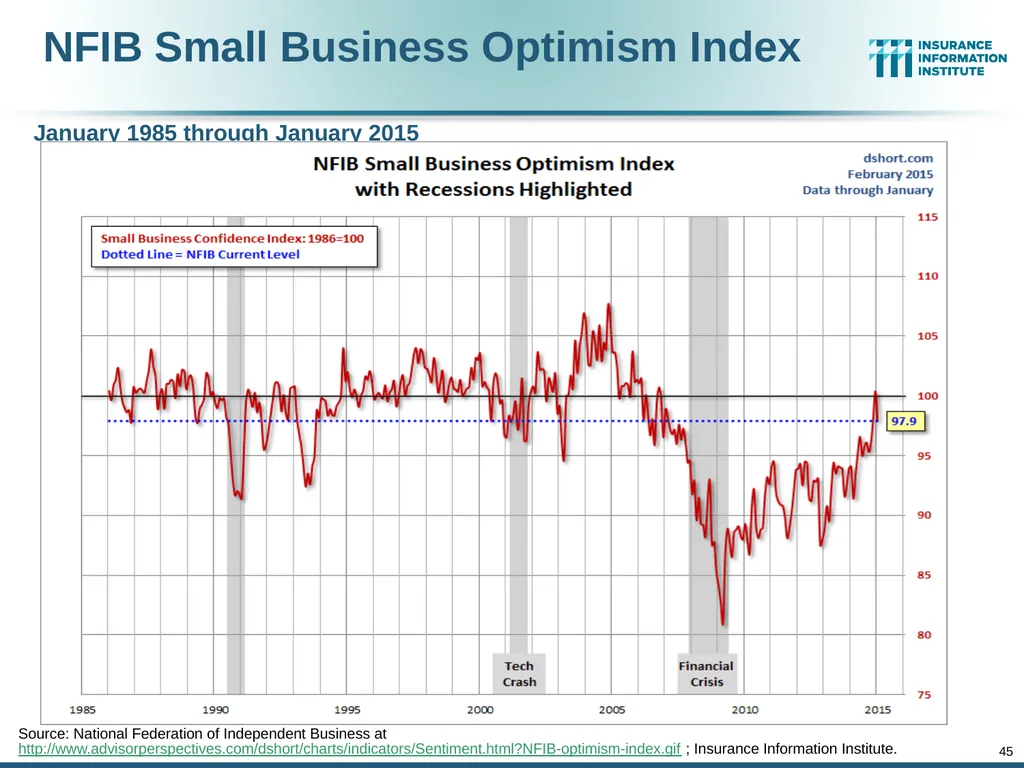
NFIB Small Business Optimism Index January 1985 through January 2015 Source: National Federation of Independent Business at http://www.advisorperspectives.com/dshort/charts/indicators/Sentiment.html?NFIB-optimism-index.gif ; Insurance Information Institute. 12/01/09 - 9pm 45<br>
46
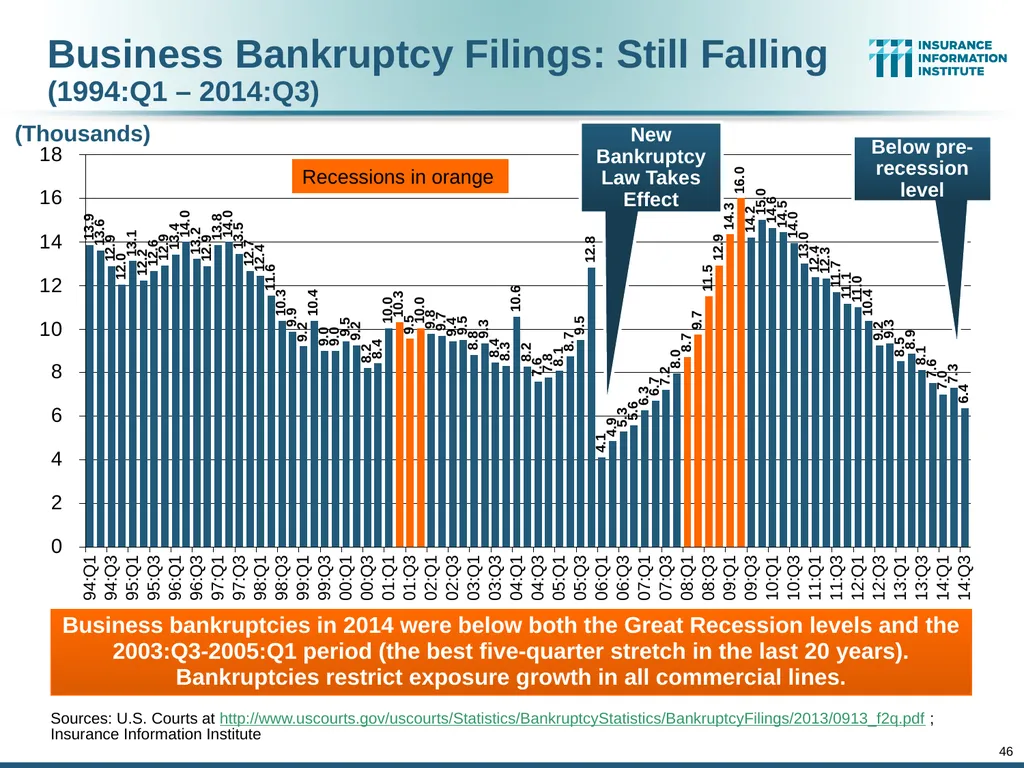
12/01/09 - 9pm eSlide – P6466 – The Financial Crisis and the Future of the P/C 46 Business Bankruptcy Filings: Still Falling
(1994:Q1 – 2014:Q3) Business bankruptcies in 2014 were below both the Great Recession levels and the 2003:Q3-2005:Q1 period (the best five-quarter stretch in the last 20 years). Bankruptcies restrict exposure growth in all commercial lines. Sources: U.S. Courts at http://www.uscourts.gov/uscourts/Statistics/BankruptcyStatistics/BankruptcyFilings/2013/0913_f2q.pdf ; Insurance Information Institute (Thousands) New Bankruptcy Law Takes Effect Recessions in orange Below pre-recession level<br>
47
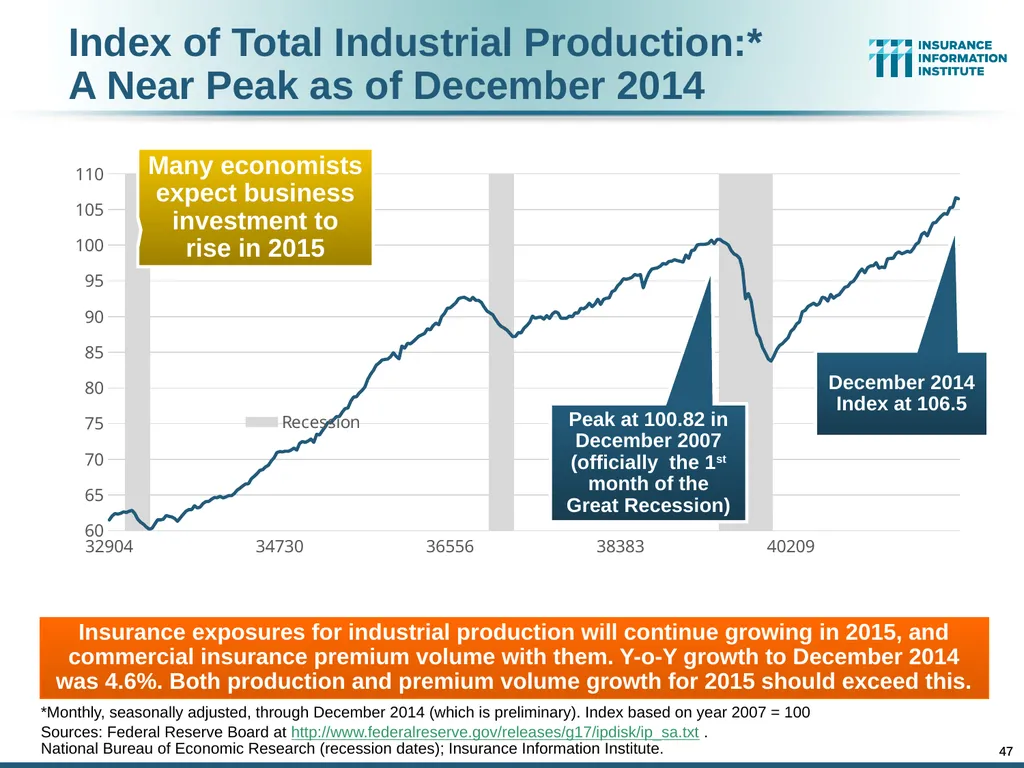
12/01/09 - 9pm eSlide – P6466 – The Financial Crisis and the Future of the P/C 47 Index of Total Industrial Production:*
A Near Peak as of December 2014 *Monthly, seasonally adjusted, through December 2014 (which is preliminary). Index based on year 2007 = 100
Sources: Federal Reserve Board at http://www.federalreserve.gov/releases/g17/ipdisk/ip_sa.txt . National Bureau of Economic Research (recession dates); Insurance Information Institute. Peak at 100.82 in December 2007 (officially the 1st month of the Great Recession) Insurance exposures for industrial production will continue growing in 2015, and commercial insurance premium volume with them. Y-o-Y growth to December 2014 was 4.6%. Both production and premium volume growth for 2015 should exceed this. 12/01/09 - 9pm 47 December 2014 Index at 106.5 Many economists expect business investment to rise in 2015<br>
Sources: Federal Reserve Board at http://www.federalreserve.gov/releases/g17/ipdisk/ip_sa.txt . National Bureau of Economic Research (recession dates); Insurance Information Institute. Peak at 100.82 in December 2007 (officially the 1st month of the Great Recession) Insurance exposures for industrial production will continue growing in 2015, and commercial insurance premium volume with them. Y-o-Y growth to December 2014 was 4.6%. Both production and premium volume growth for 2015 should exceed this. 12/01/09 - 9pm 47 December 2014 Index at 106.5 Many economists expect business investment to rise in 2015<br>
48
48 Business Fixed Investment is Forecast to Grow Steadily in 2015-16, Fueling Commercial Exposure Growth Business investment will drive commercial property and liability insurance exposures and should drive employment and WC payroll exposures as well (with a lag) Sources: Wells Fargo Economic Group; Insurance Information Institute. Growth Rate<br>
49
49 Labor Market Trends We’re Now Gaining Jobs at a Strong Pace, Mainly in the Private Sector 12/01/09 - 9pm 49<br>
50
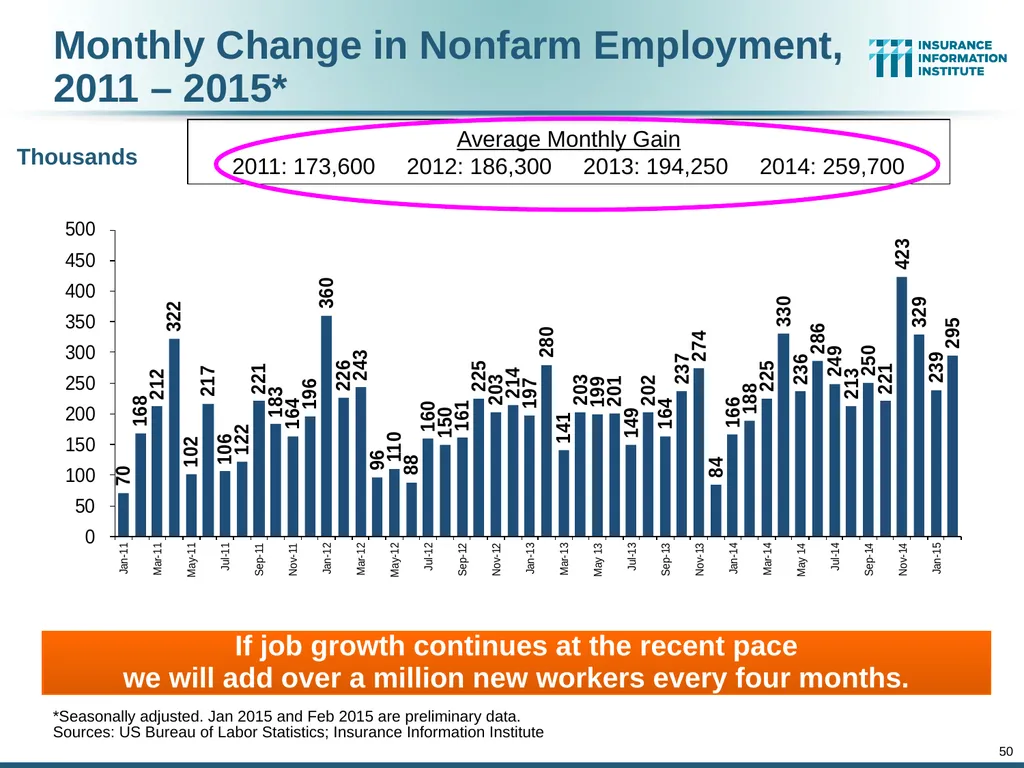
Monthly Change in Nonfarm Employment, 2011 – 2015* Thousands If job growth continues at the recent pace
we will add over a million new workers every four months. *Seasonally adjusted. Jan 2015 and Feb 2015 are preliminary data.
Sources: US Bureau of Labor Statistics; Insurance Information Institute 12/01/09 - 9pm 50 Average Monthly Gain
2011: 173,600 2012: 186,300 2013: 194,250 2014: 259,700<br>
51
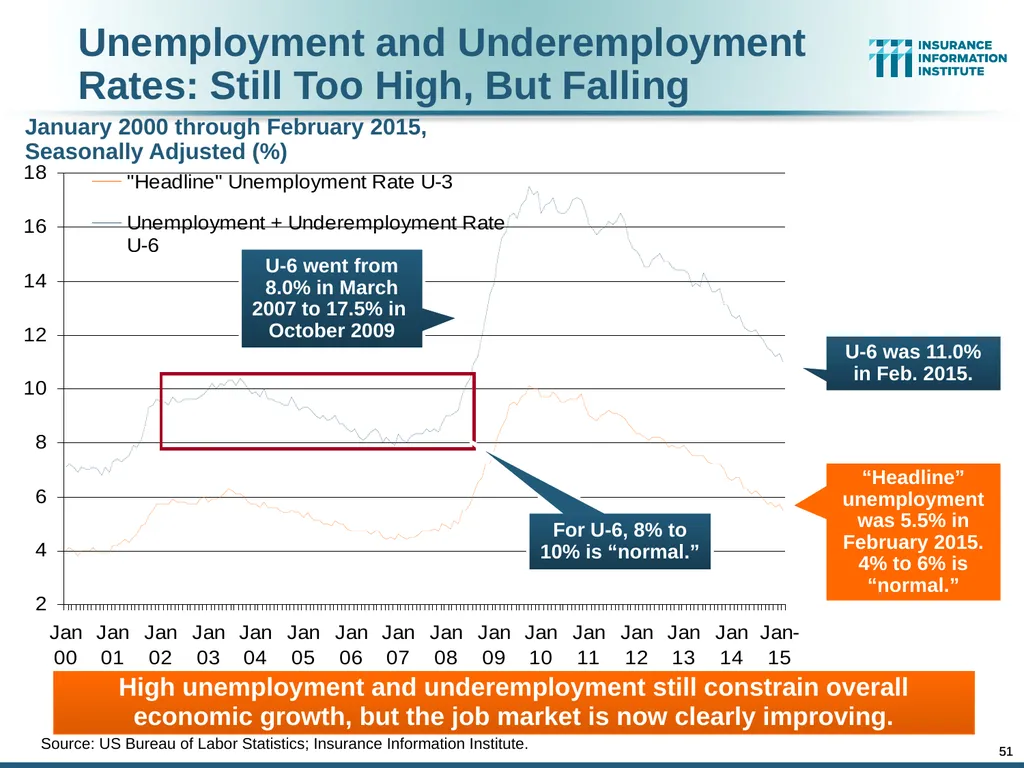
12/01/09 - 9pm eSlide – P6466 – The Financial Crisis and the Future of the P/C 51 Unemployment and Underemployment Rates: Still Too High, But Falling “Headline” unemployment was 5.5% in February 2015. 4% to 6% is “normal.” Source: US Bureau of Labor Statistics; Insurance Information Institute. U-6 was 11.0% in Feb. 2015. January 2000 through February 2015, Seasonally Adjusted (%) High unemployment and underemployment still constrain overall economic growth, but the job market is now clearly improving. 12/01/09 - 9pm 51 U-6 went from 8.0% in March 2007 to 17.5% in
October 2009 For U-6, 8% to 10% is “normal.”<br>
52
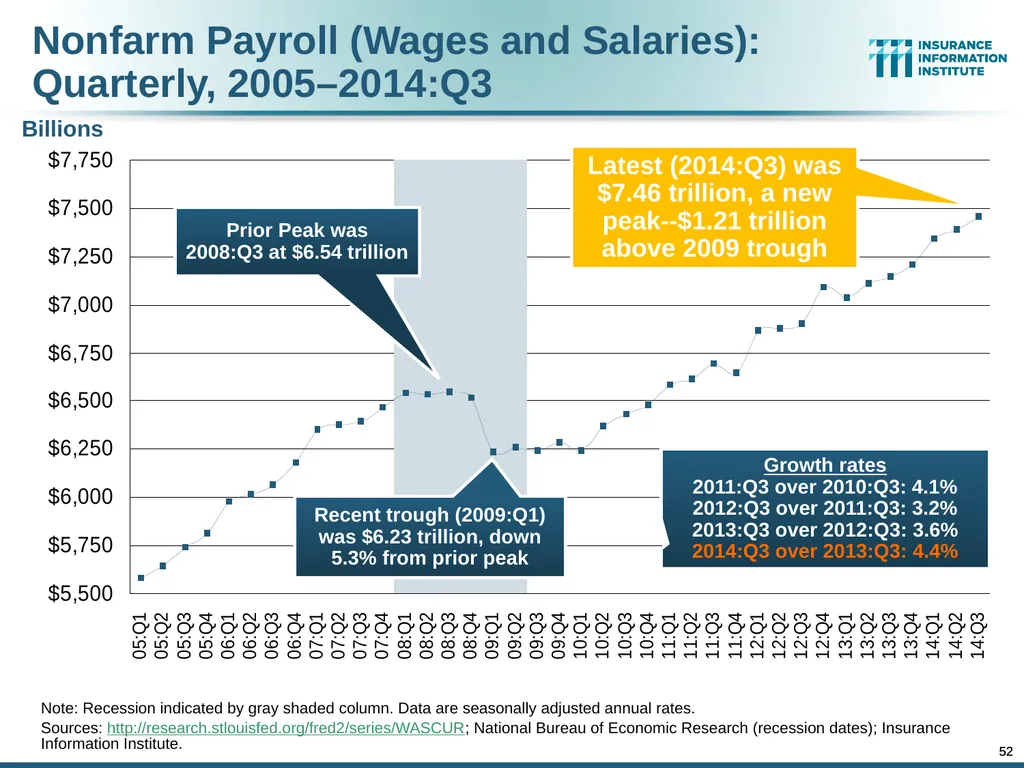
12/01/09 - 9pm eSlide – P6466 – The Financial Crisis and the Future of the P/C 52 Nonfarm Payroll (Wages and Salaries):
Quarterly, 2005–2014:Q3 Note: Recession indicated by gray shaded column. Data are seasonally adjusted annual rates.
Sources: http://research.stlouisfed.org/fred2/series/WASCUR; National Bureau of Economic Research (recession dates); Insurance Information Institute. Billions Prior Peak was 2008:Q3 at $6.54 trillion Recent trough (2009:Q1) was $6.23 trillion, down 5.3% from prior peak Growth rates 2011:Q3 over 2010:Q3: 4.1% 2012:Q3 over 2011:Q3: 3.2% 2013:Q3 over 2012:Q3: 3.6% 2014:Q3 over 2013:Q3: 4.4% 12/01/09 - 9pm 52 Latest (2014:Q3) was $7.46 trillion, a new peak--$1.21 trillion above 2009 trough<br>
Sources: http://research.stlouisfed.org/fred2/series/WASCUR; National Bureau of Economic Research (recession dates); Insurance Information Institute. Billions Prior Peak was 2008:Q3 at $6.54 trillion Recent trough (2009:Q1) was $6.23 trillion, down 5.3% from prior peak Growth rates 2011:Q3 over 2010:Q3: 4.1% 2012:Q3 over 2011:Q3: 3.2% 2013:Q3 over 2012:Q3: 3.6% 2014:Q3 over 2013:Q3: 4.4% 12/01/09 - 9pm 52 Latest (2014:Q3) was $7.46 trillion, a new peak--$1.21 trillion above 2009 trough<br>
53
12/01/09 - 9pm 53 Payroll Base* WC NWP Payroll vs. Workers Comp Net Written Premiums, 1990-2014P *Private employment; Shaded areas indicate recessions. WC premiums for 2014 are I.I.I. estimates..
Sources: NBER (recessions); Federal Reserve Bank of St. Louis at http://research.stlouisfed.org/fred2/series/WASCUR ; NCCI; I.I.I. Continued Payroll Growth and Rate Gains Suggest WC NWP Will Grow Again in 2015 7/90-3/91 3/01-11/01 12/07-6/09 $Billions $Billions WC premium volume dropped two years before the recession began WC net premiums written were down $14B or 29.3% to $33.8B in 2010 after peaking at $47.8B in 2005<br>
Sources: NBER (recessions); Federal Reserve Bank of St. Louis at http://research.stlouisfed.org/fred2/series/WASCUR ; NCCI; I.I.I. Continued Payroll Growth and Rate Gains Suggest WC NWP Will Grow Again in 2015 7/90-3/91 3/01-11/01 12/07-6/09 $Billions $Billions WC premium volume dropped two years before the recession began WC net premiums written were down $14B or 29.3% to $33.8B in 2010 after peaking at $47.8B in 2005<br>
54
54 U.S. Insured Catastrophe Loss Update 2014 Had Below-Average CAT Activity 12/01/09 - 9pm 54<br>
55
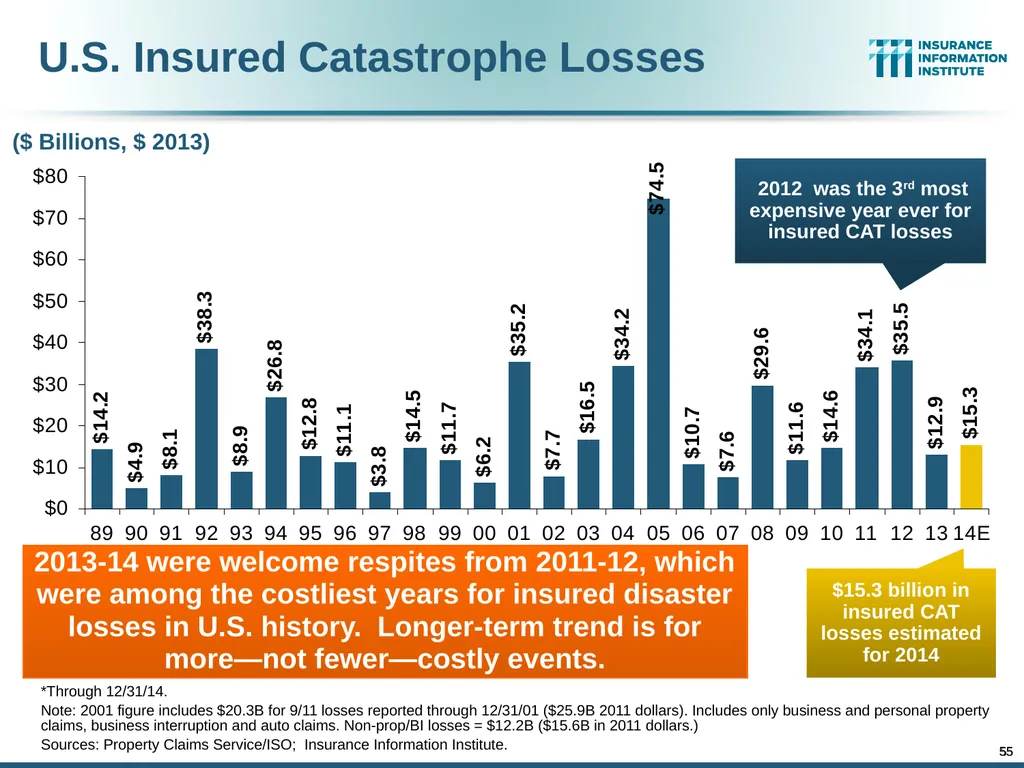
12/01/09 - 9pm eSlide – P6466 – The Financial Crisis and the Future of the P/C 55 U.S. Insured Catastrophe Losses *Through 12/31/14.
Note: 2001 figure includes $20.3B for 9/11 losses reported through 12/31/01 ($25.9B 2011 dollars). Includes only business and personal property claims, business interruption and auto claims. Non-prop/BI losses = $12.2B ($15.6B in 2011 dollars.)
Sources: Property Claims Service/ISO; Insurance Information Institute. 2013-14 were welcome respites from 2011-12, which were among the costliest years for insured disaster losses in U.S. history. Longer-term trend is for more—not fewer—costly events. 2012 was the 3rd most expensive year ever for insured CAT losses $15.3 billion in insured CAT losses estimated for 2014 ($ Billions, $ 2013) 12/01/09 - 9pm 55<br>
Note: 2001 figure includes $20.3B for 9/11 losses reported through 12/31/01 ($25.9B 2011 dollars). Includes only business and personal property claims, business interruption and auto claims. Non-prop/BI losses = $12.2B ($15.6B in 2011 dollars.)
Sources: Property Claims Service/ISO; Insurance Information Institute. 2013-14 were welcome respites from 2011-12, which were among the costliest years for insured disaster losses in U.S. history. Longer-term trend is for more—not fewer—costly events. 2012 was the 3rd most expensive year ever for insured CAT losses $15.3 billion in insured CAT losses estimated for 2014 ($ Billions, $ 2013) 12/01/09 - 9pm 55<br>
56
12/01/09 - 9pm 56 Inflation Adjusted U.S. Catastrophe Losses by Cause of Loss, 1994–20131 Catastrophes are defined as events causing direct insured losses to property of $25 million or more in 2013 dollars.
Excludes snow.
Does not include NFIP flood losses
Includes wildland fires
Includes civil disorders, water damage, utility disruptions and non-property losses such as those covered by workers compensation.
Source: ISO’s Property Claim Services Unit. Hurricanes & Tropical Storms, $159.1 Fires (4), $5.5 Events Involving Tornadoes (2), $139.3 Winter Storms, $24.7 Terrorism, $24.8 Geological Events, $18.4 Wind/Hail/Flood (3), $14.6 Other (5), $0.2 Wind losses are by far cause the most catastrophe losses, even if hurricanes/TS are excluded. Tornado share of CAT losses is rising Insured cat losses from 1993-2012 totaled $386.7B, an average of $19.3B per year or $1.6B per month<br>
Excludes snow.
Does not include NFIP flood losses
Includes wildland fires
Includes civil disorders, water damage, utility disruptions and non-property losses such as those covered by workers compensation.
Source: ISO’s Property Claim Services Unit. Hurricanes & Tropical Storms, $159.1 Fires (4), $5.5 Events Involving Tornadoes (2), $139.3 Winter Storms, $24.7 Terrorism, $24.8 Geological Events, $18.4 Wind/Hail/Flood (3), $14.6 Other (5), $0.2 Wind losses are by far cause the most catastrophe losses, even if hurricanes/TS are excluded. Tornado share of CAT losses is rising Insured cat losses from 1993-2012 totaled $386.7B, an average of $19.3B per year or $1.6B per month<br>
57
12/01/09 - 9pm 57 Top 16 Most Costly Disasters
in U.S. History (Insured Losses, 2013 Dollars, $ Billions) Superstorm Sandy in 2012 was the last mega-CAT to hit the US Includes Tuscaloosa, AL, tornado Includes Joplin, MO, tornado 12 of the 16 most expensive events in U.S. history have occurred over the past decade Sources: PCS; Insurance Information Institute inflation adjustments to 2013 dollars using the CPI.<br>
58
www.iii.org Thank you for your time
and your attention! Insurance Information Institute Online: 12/01/09 - 9pm 58<br>
59
P/C Industry: Loss Reserve-to-Surplus Ratio, 1971-2014:Q3 Source: Calculations from A.M. Best data by Insurance Information Institute. The Property/Casualty Industry Adjusted Its Risk Portfolio in Response to Risk-Based Capital Requirements Implemented in 1994. Inflation, Liability Crisis Increased Reserves, Plunging Stock Prices Depleted Surplus<br>
60
Recovery in Capacity Utilization is a Positive Sign for Commercial Exposures Source: Federal Reserve Board statistical releases at http://www.federalreserve.gov/releases/g17/Current/default.htm. 60 Percent of Industrial Capacity Hurricane Katrina March 2001-November 2001 recession “Full Capacity” The US operated at 79.7% of industrial capacity in Dec. 2014, well above the June 2009 low of 66.9% but is still below pre-recession levels. March 2001 through Dec. 2014 12/01/09 - 9pm 60 December 2007-
June 2009 Recession The closer the economy is to operating at “full capacity,” the greater the inflationary pressure<br>