
The Corporate Environment William J. Frey College
NS
Published · 28 slides · 0 views

1 / 1











Description
The Corporate Environment William J. Frey College of Business Administration University of Puerto Rico at Mayaguez Some sources Stone, C. D. (1975) Where the Law Ends: The Social Control of Corporate Behavior. Prospect Heights, IL: Waveland
Related Topics
Share
Embed code
Download this presentation From Below
"The Corporate Environment William J. Frey College" is the property of its rightful owner. Permission is granted to download and print the materials on this website for personal, non-commercial use only, and to display it on your personal computer provided you do not modify the materials and that you retain all copyright notices contained in the materials. By downloading content from our website, you accept the terms of this agreement.
Presentation Transcript
01
The Corporate Environment William J. Frey
College of Business Administration
University of Puerto Rico at Mayaguez<br>
College of Business Administration
University of Puerto Rico at Mayaguez<br>
02
Some sources Stone, C. D. (1975) Where the Law Ends: The Social Control of Corporate Behavior. Prospect Heights, IL: Waveland Press, INC: 1-30. (History of Corporation)
French, P.A. (1984) Collective and Corporate Responsibility. New York: Columbia University Press. (Corporate Responsibility based on CIDS)
Fisse, B. and French, P.A., eds. (1985) Corrigible Corporations and Unruly Law. San Antonio, TX: Trinity University Press. (Corporate Punishment)
P.T. Leeson. (2009). The Invisible Hook: The Hidden Economics of Pirates. Princeton: Princeton University Press: 44-81. (Pirate Articles of Agreement)<br>
French, P.A. (1984) Collective and Corporate Responsibility. New York: Columbia University Press. (Corporate Responsibility based on CIDS)
Fisse, B. and French, P.A., eds. (1985) Corrigible Corporations and Unruly Law. San Antonio, TX: Trinity University Press. (Corporate Punishment)
P.T. Leeson. (2009). The Invisible Hook: The Hidden Economics of Pirates. Princeton: Princeton University Press: 44-81. (Pirate Articles of Agreement)<br>
03
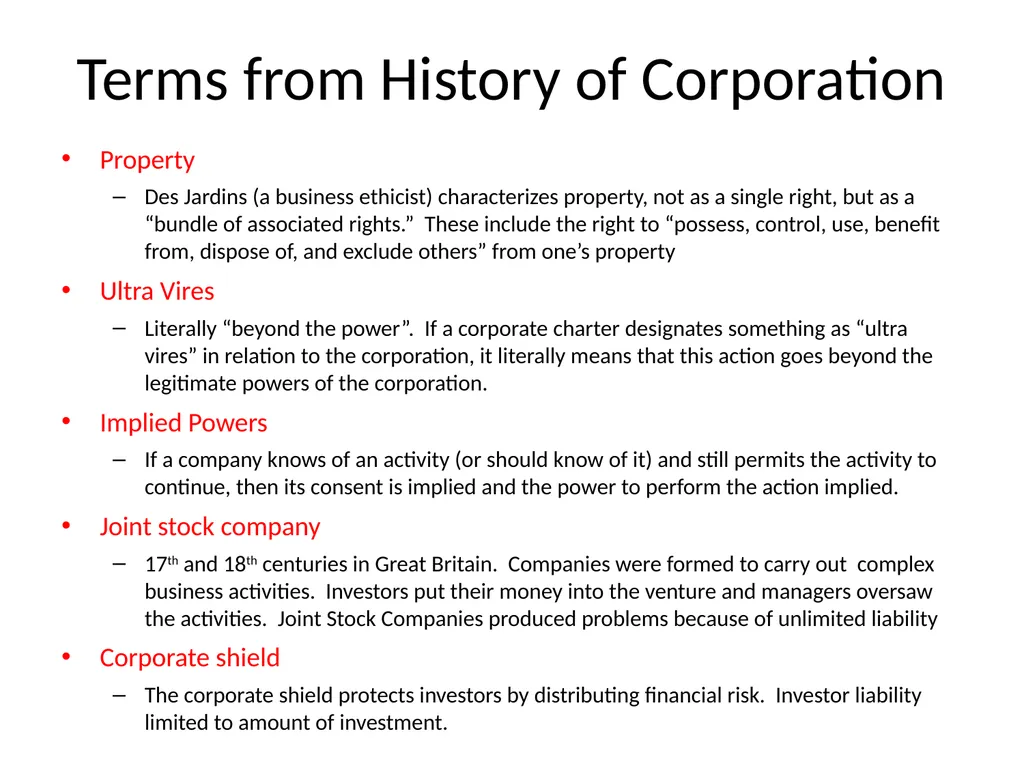
Terms from History of Corporation Property
Des Jardins (a business ethicist) characterizes property, not as a single right, but as a “bundle of associated rights.” These include the right to “possess, control, use, benefit from, dispose of, and exclude others” from one’s property
Ultra Vires
Literally “beyond the power”. If a corporate charter designates something as “ultra vires” in relation to the corporation, it literally means that this action goes beyond the legitimate powers of the corporation.
Implied Powers
If a company knows of an activity (or should know of it) and still permits the activity to continue, then its consent is implied and the power to perform the action implied.
Joint stock company
17th and 18th centuries in Great Britain. Companies were formed to carry out complex business activities. Investors put their money into the venture and managers oversaw the activities. Joint Stock Companies produced problems because of unlimited liability
Corporate shield
The corporate shield protects investors by distributing financial risk. Investor liability limited to amount of investment.<br>
Des Jardins (a business ethicist) characterizes property, not as a single right, but as a “bundle of associated rights.” These include the right to “possess, control, use, benefit from, dispose of, and exclude others” from one’s property
Ultra Vires
Literally “beyond the power”. If a corporate charter designates something as “ultra vires” in relation to the corporation, it literally means that this action goes beyond the legitimate powers of the corporation.
Implied Powers
If a company knows of an activity (or should know of it) and still permits the activity to continue, then its consent is implied and the power to perform the action implied.
Joint stock company
17th and 18th centuries in Great Britain. Companies were formed to carry out complex business activities. Investors put their money into the venture and managers oversaw the activities. Joint Stock Companies produced problems because of unlimited liability
Corporate shield
The corporate shield protects investors by distributing financial risk. Investor liability limited to amount of investment.<br>
04
Agency and Charters Law of Agency
Responsibility of agents to remain faithful to the interests of principals
Principal
Originate action and determine its goal. Delegate executive authority to agent if unable to execute action working alone
Agent
Carries out or completes action originated by another. Responsible to principal to remain faithful to the principal’s goals and interests
Corporate Charter
Founding document of corporation
Originally the charter was a device of corporate control because it outlined what the corporation could and could not do. If not permitted by charter it was ultra vires (=beyond the power).
Charter Mongering
Charters allow incorporation for all legal activities. Charter no longer defines boundaries for legitimate and illegitimate corporate activities<br>
Responsibility of agents to remain faithful to the interests of principals
Principal
Originate action and determine its goal. Delegate executive authority to agent if unable to execute action working alone
Agent
Carries out or completes action originated by another. Responsible to principal to remain faithful to the principal’s goals and interests
Corporate Charter
Founding document of corporation
Originally the charter was a device of corporate control because it outlined what the corporation could and could not do. If not permitted by charter it was ultra vires (=beyond the power).
Charter Mongering
Charters allow incorporation for all legal activities. Charter no longer defines boundaries for legitimate and illegitimate corporate activities<br>
05
Corporate legal and moral responsibility Corporation Internal Decision Structure or CIDS
Corporate goals, decision recognition rules, roles, and organizational flow chart
Licenses re-describing individual actions as corporate actions.
Corporate Responsibility
Holding corporations legally and morally responsible for actions performed in their name. Creates philosophical problems concerning the meaning of “personhood” and “agency.”
Legal Person
Created in and through the law. A legal person has legal standing: it can sue and be sued. Legal persons also have legal rights and duties.
Natural Person
Primarily human beings. Natural persons act through the medium of their bodies. Natural persons also have minds which form intentions (goals, purposes). Criminal law applies to natural persons who have minds (that form intentions), bodies (that act to realize intentions) and a connection between the two such that minds direct the activities of bodies.
Principle of Responsive Adjustment
Moral agents have an obligation to adjust their actions and habits to respond to lessons learned from the past.
Stock Dilution
A corporate punishment (a fine) that goes beyond the deterrence trap by tapping into the future earnings of a corporation. The stock of a company is divided (or diluted) and the additional shares are distributed to the victims of corporate wrongdoing or to the state. These shares are, then, liquidated at some future date.<br>
Corporate goals, decision recognition rules, roles, and organizational flow chart
Licenses re-describing individual actions as corporate actions.
Corporate Responsibility
Holding corporations legally and morally responsible for actions performed in their name. Creates philosophical problems concerning the meaning of “personhood” and “agency.”
Legal Person
Created in and through the law. A legal person has legal standing: it can sue and be sued. Legal persons also have legal rights and duties.
Natural Person
Primarily human beings. Natural persons act through the medium of their bodies. Natural persons also have minds which form intentions (goals, purposes). Criminal law applies to natural persons who have minds (that form intentions), bodies (that act to realize intentions) and a connection between the two such that minds direct the activities of bodies.
Principle of Responsive Adjustment
Moral agents have an obligation to adjust their actions and habits to respond to lessons learned from the past.
Stock Dilution
A corporate punishment (a fine) that goes beyond the deterrence trap by tapping into the future earnings of a corporation. The stock of a company is divided (or diluted) and the additional shares are distributed to the victims of corporate wrongdoing or to the state. These shares are, then, liquidated at some future date.<br>
06
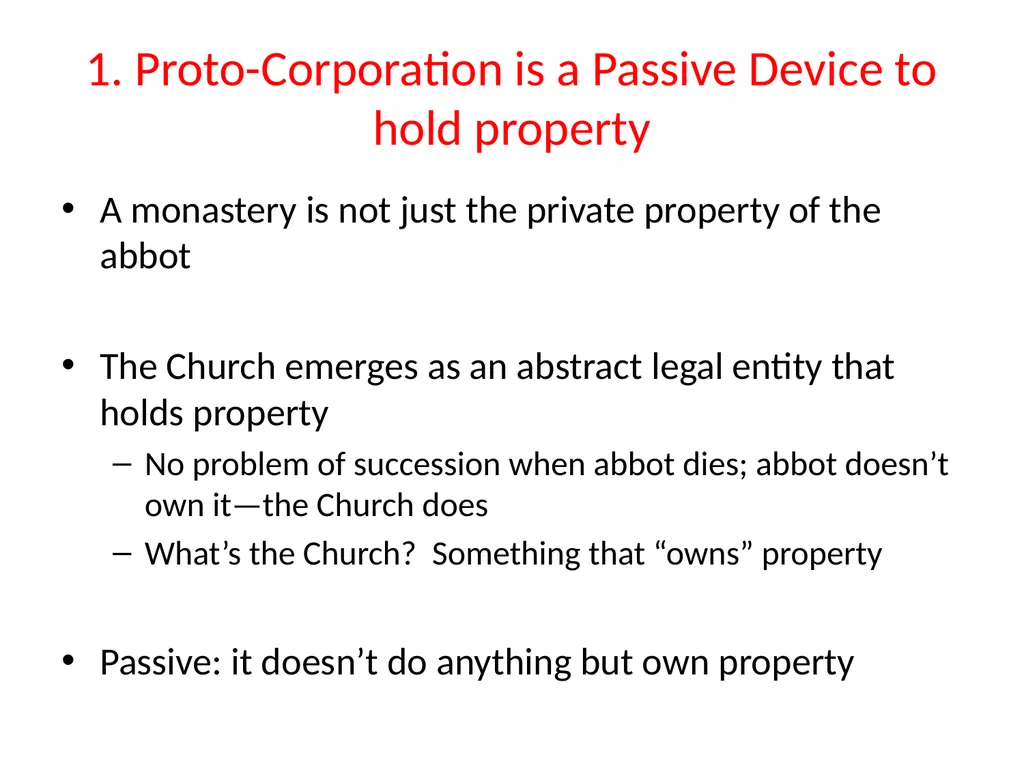
1. Proto-Corporation is a Passive Device to hold property A monastery is not just the private property of the abbot
The Church emerges as an abstract legal entity that holds property
No problem of succession when abbot dies; abbot doesn’t own it—the Church does
What’s the Church? Something that “owns” property
Passive: it doesn’t do anything but own property<br>
The Church emerges as an abstract legal entity that holds property
No problem of succession when abbot dies; abbot doesn’t own it—the Church does
What’s the Church? Something that “owns” property
Passive: it doesn’t do anything but own property<br>
07
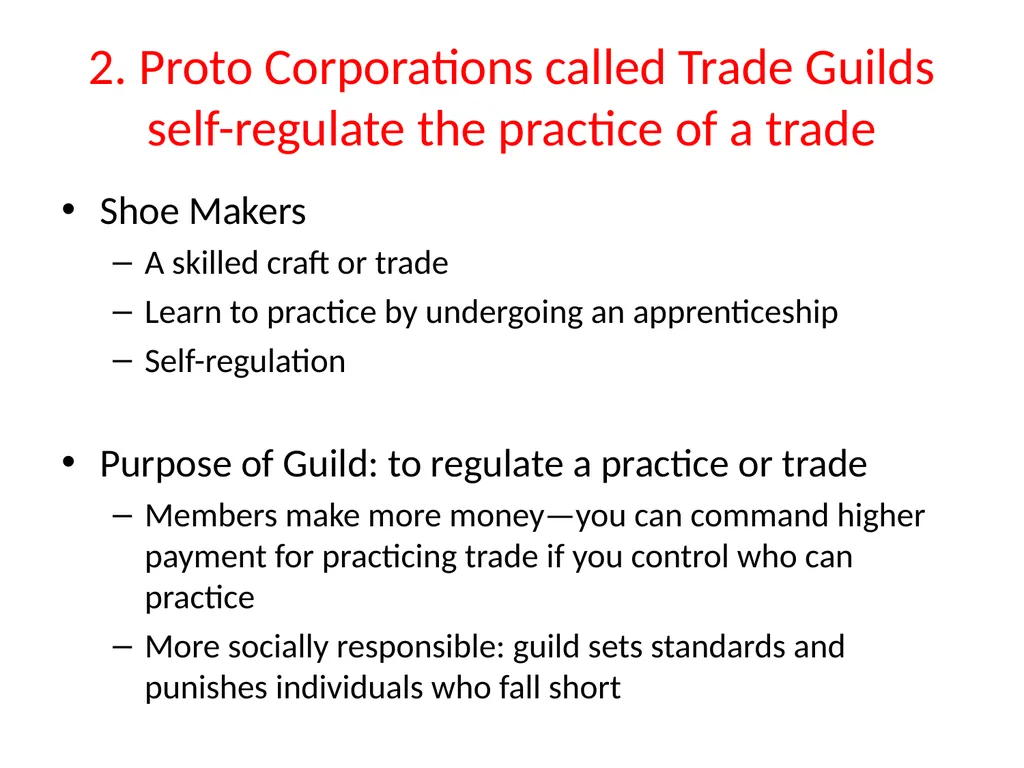
2. Proto Corporations called Trade Guilds self-regulate the practice of a trade Shoe Makers
A skilled craft or trade
Learn to practice by undergoing an apprenticeship
Self-regulation
Purpose of Guild: to regulate a practice or trade
Members make more money—you can command higher payment for practicing trade if you control who can practice
More socially responsible: guild sets standards and punishes individuals who fall short<br>
A skilled craft or trade
Learn to practice by undergoing an apprenticeship
Self-regulation
Purpose of Guild: to regulate a practice or trade
Members make more money—you can command higher payment for practicing trade if you control who can practice
More socially responsible: guild sets standards and punishes individuals who fall short<br>
08
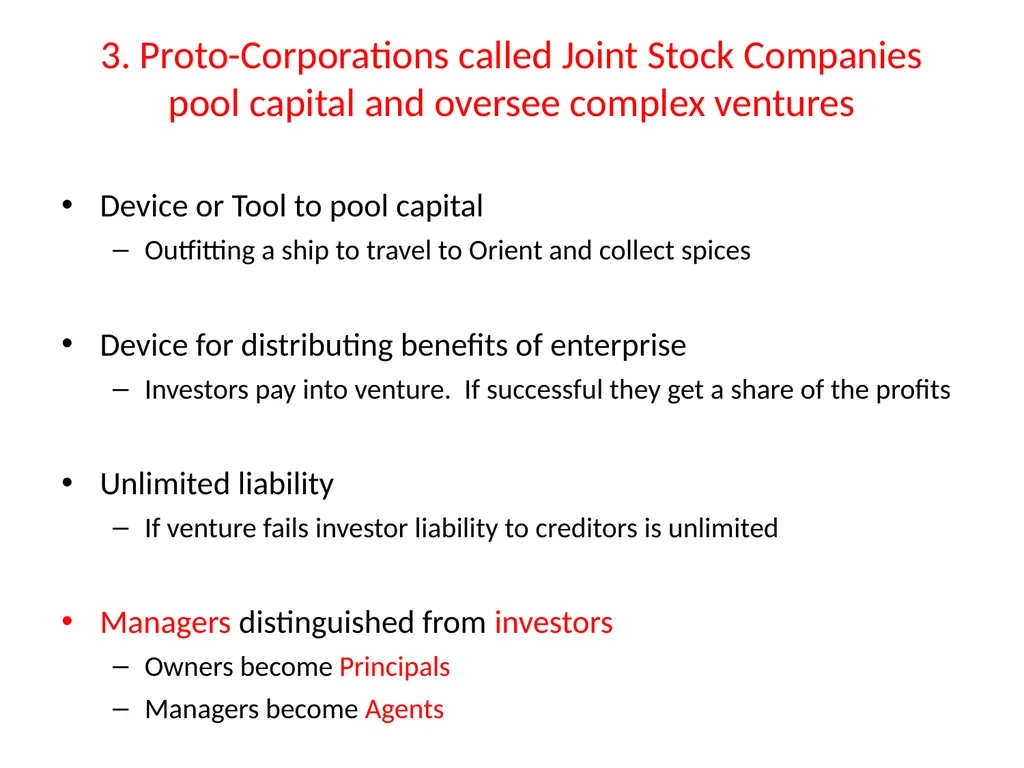
3. Proto-Corporations called Joint Stock Companies pool capital and oversee complex ventures Device or Tool to pool capital
Outfitting a ship to travel to Orient and collect spices
Device for distributing benefits of enterprise
Investors pay into venture. If successful they get a share of the profits
Unlimited liability
If venture fails investor liability to creditors is unlimited
Managers distinguished from investors
Owners become Principals
Managers become Agents<br>
Outfitting a ship to travel to Orient and collect spices
Device for distributing benefits of enterprise
Investors pay into venture. If successful they get a share of the profits
Unlimited liability
If venture fails investor liability to creditors is unlimited
Managers distinguished from investors
Owners become Principals
Managers become Agents<br>
09
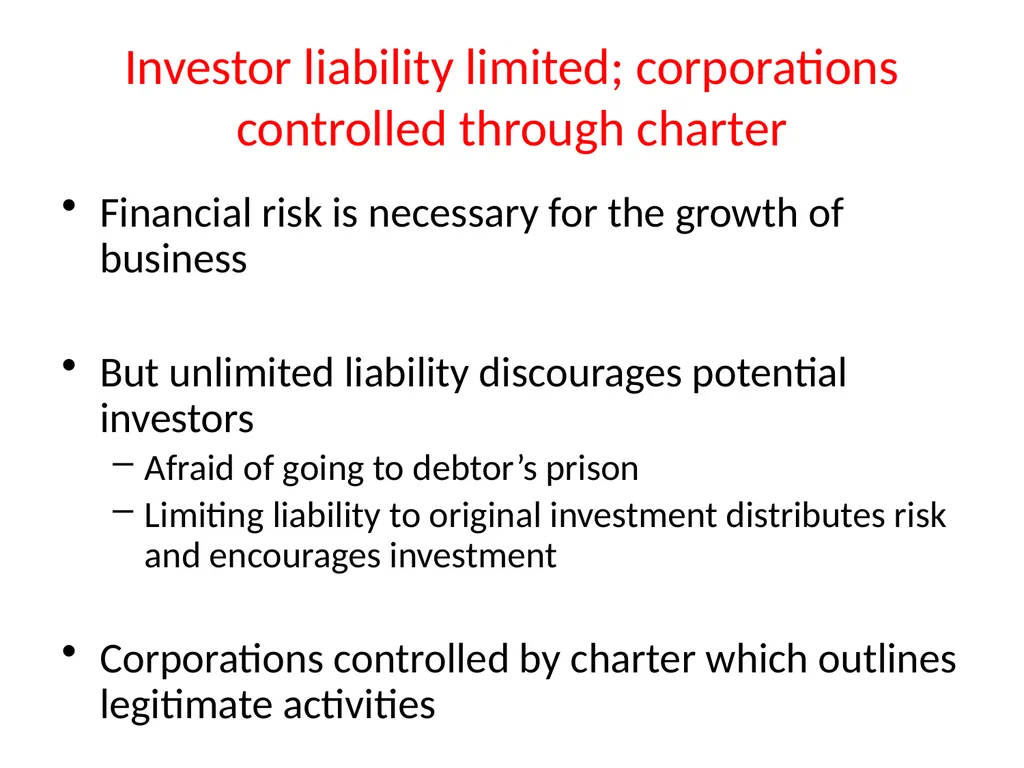
Investor liability limited; corporations controlled through charter Financial risk is necessary for the growth of business
But unlimited liability discourages potential investors
Afraid of going to debtor’s prison
Limiting liability to original investment distributes risk and encourages investment
Corporations controlled by charter which outlines legitimate activities<br>
But unlimited liability discourages potential investors
Afraid of going to debtor’s prison
Limiting liability to original investment distributes risk and encourages investment
Corporations controlled by charter which outlines legitimate activities<br>
10
Corporations become legal persons A series of legal decisions have given corporations legal rights
Right to due process under the law (e.g., trial by jury)
Commercial Speech (Can advertise products and services)
Non-commercial Speech (Can take out political advertisements)
Dissenting opinion in First National Bank of Boston v. Bellotti
Corporate non-commercial speech can drown out the speech of natural/individual persons
As powerful artificial persons they could supplant natural persons<br>
Right to due process under the law (e.g., trial by jury)
Commercial Speech (Can advertise products and services)
Non-commercial Speech (Can take out political advertisements)
Dissenting opinion in First National Bank of Boston v. Bellotti
Corporate non-commercial speech can drown out the speech of natural/individual persons
As powerful artificial persons they could supplant natural persons<br>
11
Problem of Agency Separation of owners/investors from managers
Principals: Owners/investors provide funds to finance corporate activity. They determine the fundamental goals of the corporation
Agents: Managers are agents of the owners who delegate to them the responsibility of overseeing the day to day operation of the corporation
Faithful agency
Managers (as agents) must remain faithful to the interests set forth by the owners (principals)
But if managers are rational, self-interest maximizers, then…
Why should their interests coincide with those of owners?
What prevents them from setting aside owner interests and pursuing their own?
Corporate governance then becomes a matter of institutionalizing external measures that compel managers to remain true to owner interests
Set corporate directives
Monitor management compliance
Punish non-compliance (Business Judgment Rule)<br>
Principals: Owners/investors provide funds to finance corporate activity. They determine the fundamental goals of the corporation
Agents: Managers are agents of the owners who delegate to them the responsibility of overseeing the day to day operation of the corporation
Faithful agency
Managers (as agents) must remain faithful to the interests set forth by the owners (principals)
But if managers are rational, self-interest maximizers, then…
Why should their interests coincide with those of owners?
What prevents them from setting aside owner interests and pursuing their own?
Corporate governance then becomes a matter of institutionalizing external measures that compel managers to remain true to owner interests
Set corporate directives
Monitor management compliance
Punish non-compliance (Business Judgment Rule)<br>
12
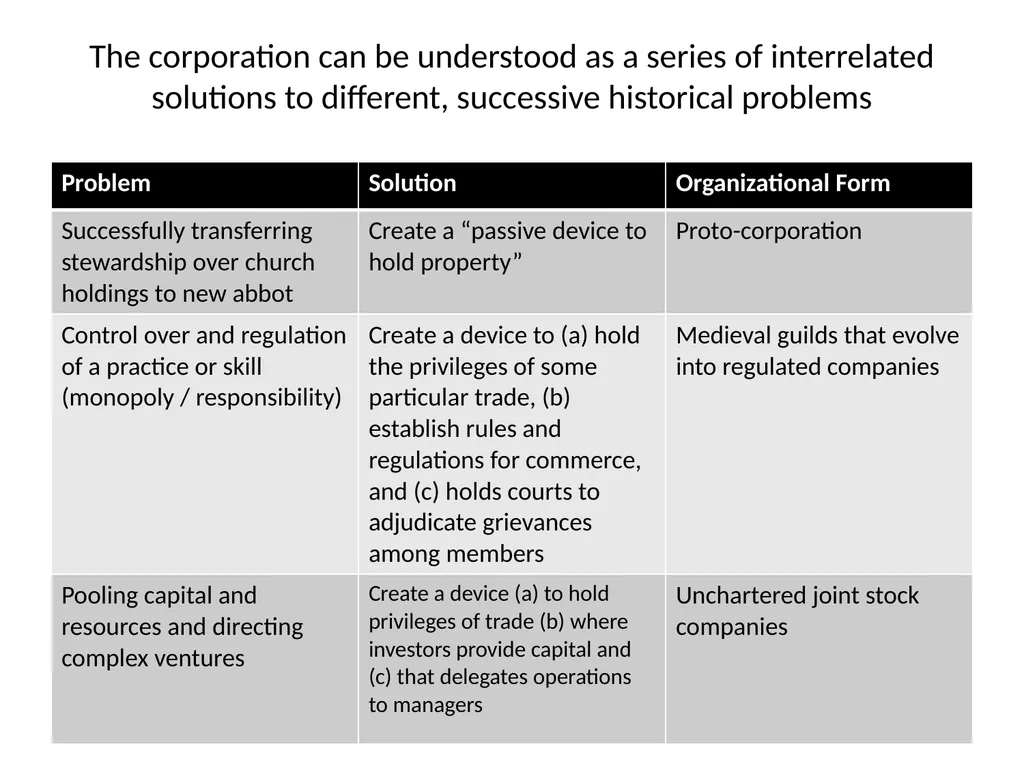
The corporation can be understood as a series of interrelated solutions to different, successive historical problems<br>
13
As modern corporation emerges, limiting but fixing liability becomes central concern<br>
14
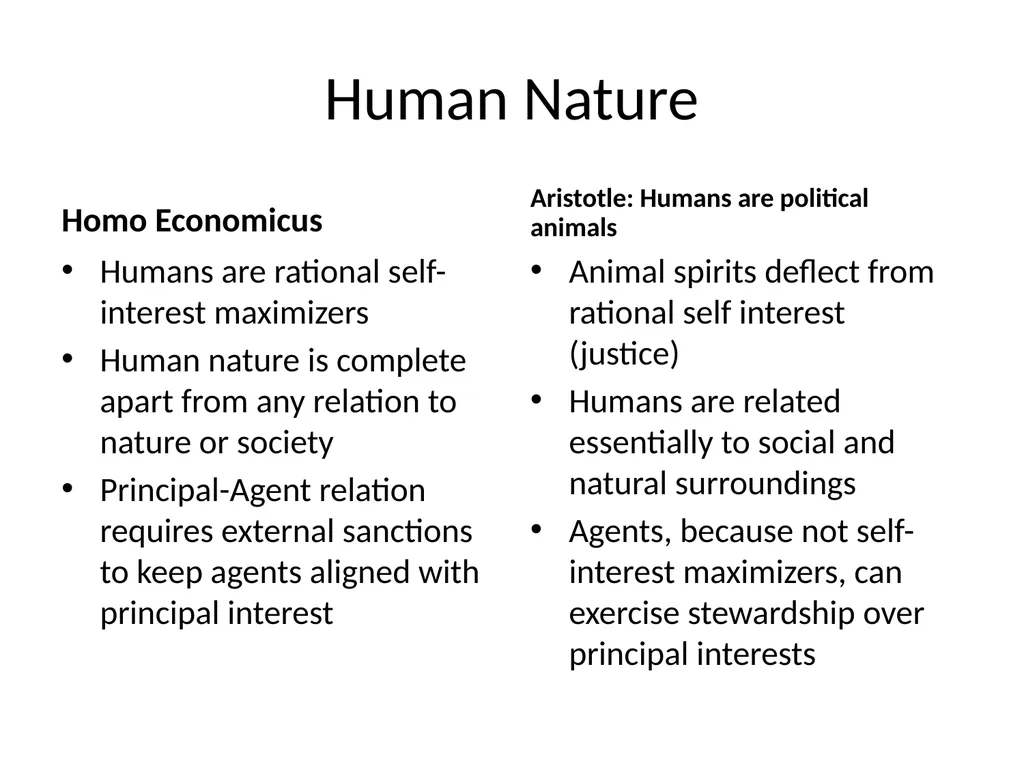
Human Nature Homo Economicus Humans are rational self-interest maximizers
Human nature is complete apart from any relation to nature or society
Principal-Agent relation requires external sanctions to keep agents aligned with principal interest Aristotle: Humans are political animals Animal spirits deflect from rational self interest (justice)
Humans are related essentially to social and natural surroundings
Agents, because not self-interest maximizers, can exercise stewardship over principal interests<br>
Human nature is complete apart from any relation to nature or society
Principal-Agent relation requires external sanctions to keep agents aligned with principal interest Aristotle: Humans are political animals Animal spirits deflect from rational self interest (justice)
Humans are related essentially to social and natural surroundings
Agents, because not self-interest maximizers, can exercise stewardship over principal interests<br>
15
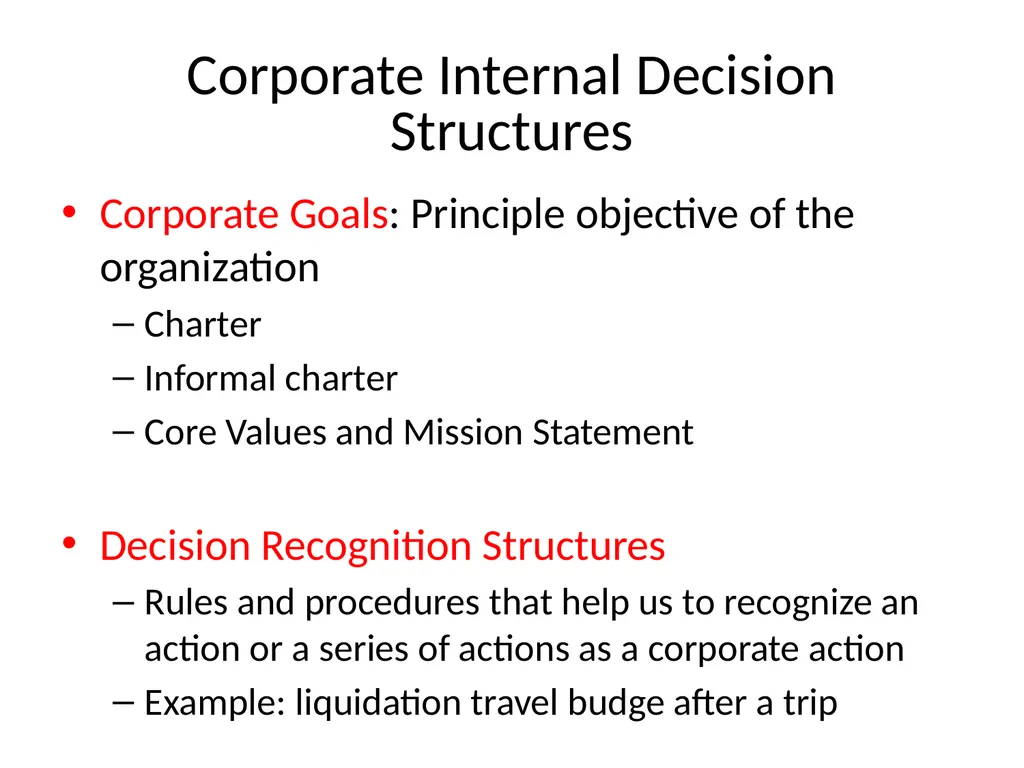
Corporate Internal Decision Structures Corporate Goals: Principle objective of the organization
Charter
Informal charter
Core Values and Mission Statement
Decision Recognition Structures
Rules and procedures that help us to recognize an action or a series of actions as a corporate action
Example: liquidation travel budge after a trip<br>
Charter
Informal charter
Core Values and Mission Statement
Decision Recognition Structures
Rules and procedures that help us to recognize an action or a series of actions as a corporate action
Example: liquidation travel budge after a trip<br>
16
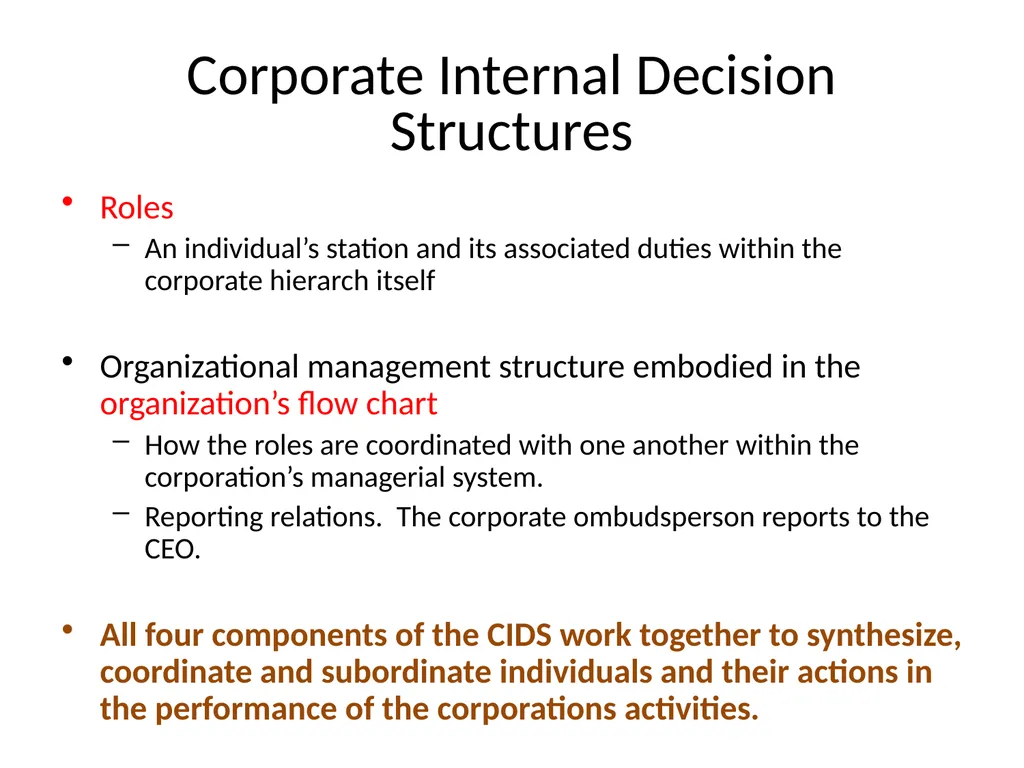
Corporate Internal Decision Structures Roles
An individual’s station and its associated duties within the corporate hierarch itself
Organizational management structure embodied in the organization’s flow chart
How the roles are coordinated with one another within the corporation’s managerial system.
Reporting relations. The corporate ombudsperson reports to the CEO.
All four components of the CIDS work together to synthesize, coordinate and subordinate individuals and their actions in the performance of the corporations activities.<br>
An individual’s station and its associated duties within the corporate hierarch itself
Organizational management structure embodied in the organization’s flow chart
How the roles are coordinated with one another within the corporation’s managerial system.
Reporting relations. The corporate ombudsperson reports to the CEO.
All four components of the CIDS work together to synthesize, coordinate and subordinate individuals and their actions in the performance of the corporations activities.<br>
17
Pirate Charter Articles of Agreement
Signed by each member of the pirate crew
Outline the ship’s hierarchical structure
Detail the different roles of the pirate community
Recruitment and Public Relations
Democratic election of captain offered alternative to authoritarian captains of military and merchant marine
Attempted to overcome anti-pirate propaganda and portray pirates more as responders to injustice than parasitic thieves.
Pirate crew, itself, plays the role of directors of the pirate corporation when it holds an election of captain and quartermaster<br>
Signed by each member of the pirate crew
Outline the ship’s hierarchical structure
Detail the different roles of the pirate community
Recruitment and Public Relations
Democratic election of captain offered alternative to authoritarian captains of military and merchant marine
Attempted to overcome anti-pirate propaganda and portray pirates more as responders to injustice than parasitic thieves.
Pirate crew, itself, plays the role of directors of the pirate corporation when it holds an election of captain and quartermaster<br>
18
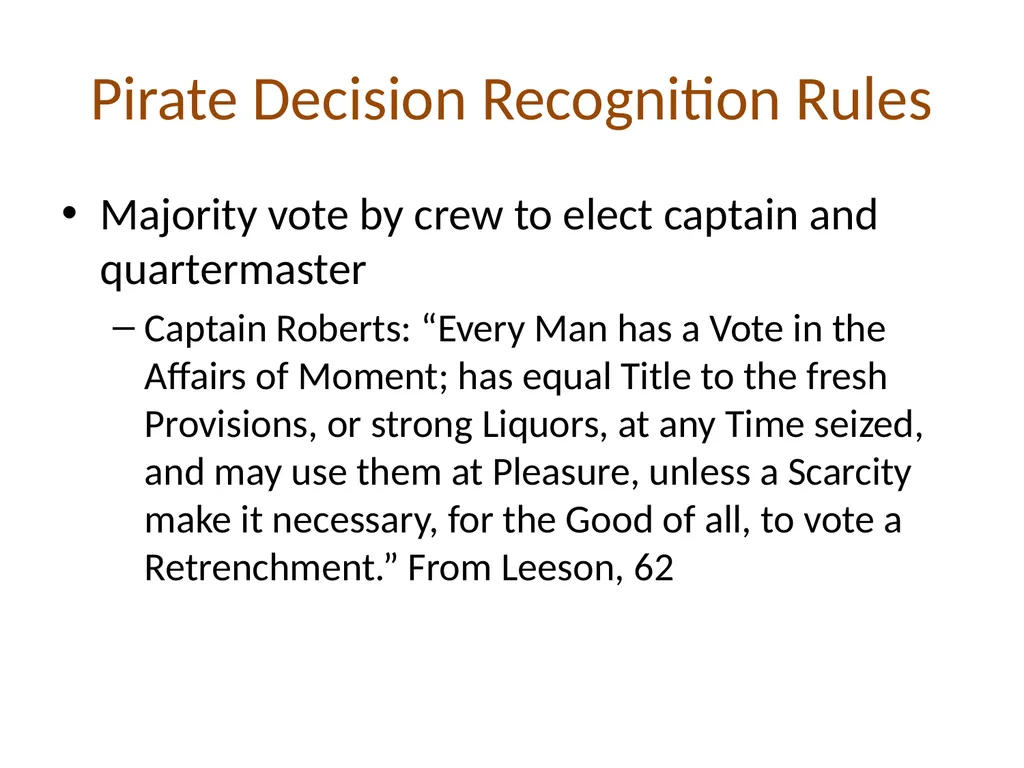
Pirate Decision Recognition Rules Majority vote by crew to elect captain and quartermaster
Captain Roberts: “Every Man has a Vote in the Affairs of Moment; has equal Title to the fresh Provisions, or strong Liquors, at any Time seized, and may use them at Pleasure, unless a Scarcity make it necessary, for the Good of all, to vote a Retrenchment.” From Leeson, 62<br>
Captain Roberts: “Every Man has a Vote in the Affairs of Moment; has equal Title to the fresh Provisions, or strong Liquors, at any Time seized, and may use them at Pleasure, unless a Scarcity make it necessary, for the Good of all, to vote a Retrenchment.” From Leeson, 62<br>
19
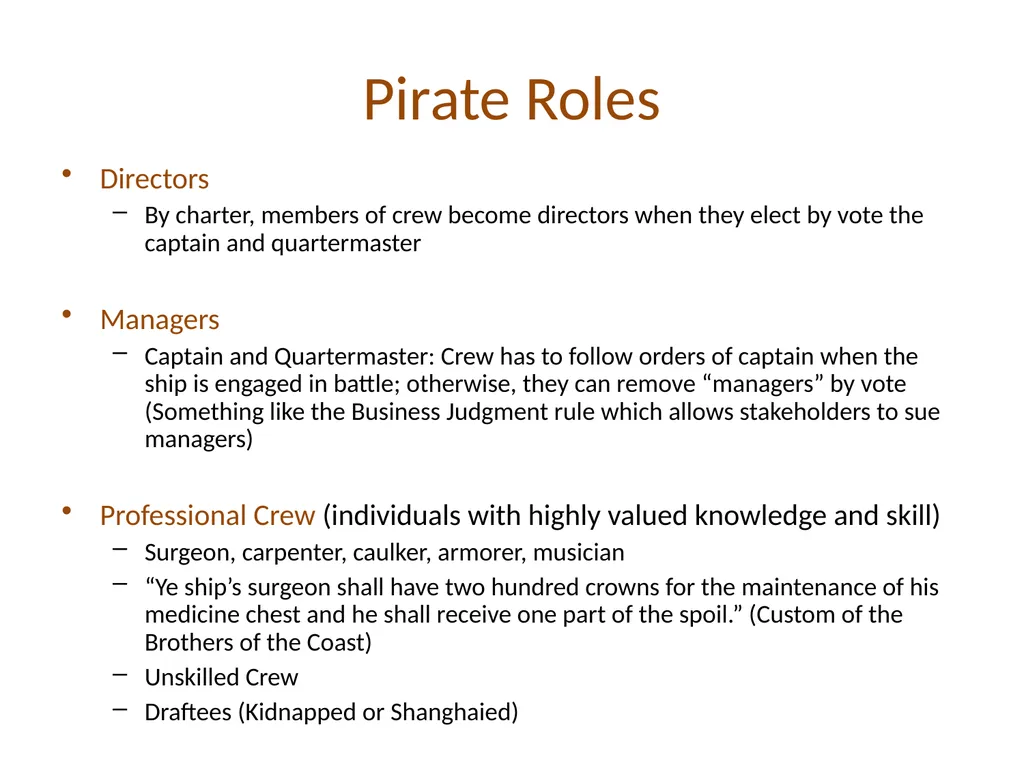
Pirate Roles Directors
By charter, members of crew become directors when they elect by vote the captain and quartermaster
Managers
Captain and Quartermaster: Crew has to follow orders of captain when the ship is engaged in battle; otherwise, they can remove “managers” by vote (Something like the Business Judgment rule which allows stakeholders to sue managers)
Professional Crew (individuals with highly valued knowledge and skill)
Surgeon, carpenter, caulker, armorer, musician
“Ye ship’s surgeon shall have two hundred crowns for the maintenance of his medicine chest and he shall receive one part of the spoil.” (Custom of the Brothers of the Coast)
Unskilled Crew
Draftees (Kidnapped or Shanghaied)<br>
By charter, members of crew become directors when they elect by vote the captain and quartermaster
Managers
Captain and Quartermaster: Crew has to follow orders of captain when the ship is engaged in battle; otherwise, they can remove “managers” by vote (Something like the Business Judgment rule which allows stakeholders to sue managers)
Professional Crew (individuals with highly valued knowledge and skill)
Surgeon, carpenter, caulker, armorer, musician
“Ye ship’s surgeon shall have two hundred crowns for the maintenance of his medicine chest and he shall receive one part of the spoil.” (Custom of the Brothers of the Coast)
Unskilled Crew
Draftees (Kidnapped or Shanghaied)<br>
20
Pirate Flow Chart<br>
21
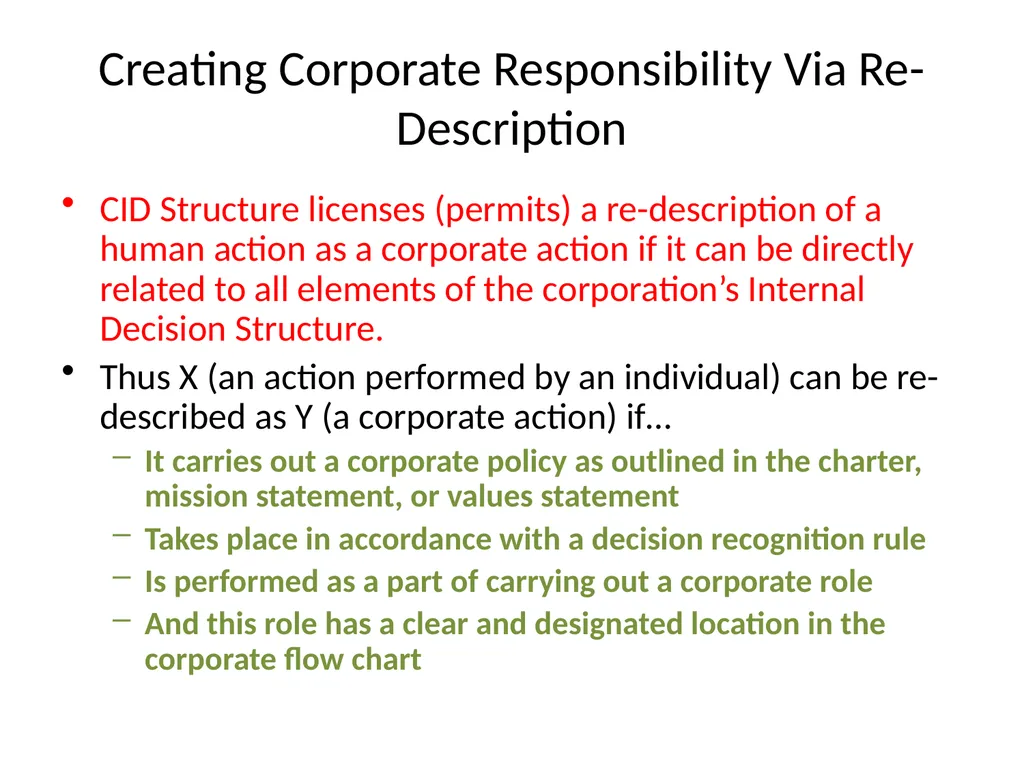
Creating Corporate Responsibility Via Re-Description CID Structure licenses (permits) a re-description of a human action as a corporate action if it can be directly related to all elements of the corporation’s Internal Decision Structure.
Thus X (an action performed by an individual) can be re-described as Y (a corporate action) if…
It carries out a corporate policy as outlined in the charter, mission statement, or values statement
Takes place in accordance with a decision recognition rule
Is performed as a part of carrying out a corporate role
And this role has a clear and designated location in the corporate flow chart<br>
Thus X (an action performed by an individual) can be re-described as Y (a corporate action) if…
It carries out a corporate policy as outlined in the charter, mission statement, or values statement
Takes place in accordance with a decision recognition rule
Is performed as a part of carrying out a corporate role
And this role has a clear and designated location in the corporate flow chart<br>
22
Example from Pirate World Setting aside 200 crowns for the maintenance of the surgeon’s medicine chest…
Contributes to the pirate ship’s overall objective of maintaining a healthy crew
Conforms to a decision recognition rule spelled out in the pirate ship “Articles of Agreement”
Carries out a role responsibility (It’s the quartermaster’s job who has the overall responsibility of distributing spoils)
And the quartermaster role has a clearly designated place in the overall pirate ship hierarchy (Quartermaster is selected by the crew serving as directors, reports to the captain, etc.)<br>
Contributes to the pirate ship’s overall objective of maintaining a healthy crew
Conforms to a decision recognition rule spelled out in the pirate ship “Articles of Agreement”
Carries out a role responsibility (It’s the quartermaster’s job who has the overall responsibility of distributing spoils)
And the quartermaster role has a clearly designated place in the overall pirate ship hierarchy (Quartermaster is selected by the crew serving as directors, reports to the captain, etc.)<br>
23
Example from Business Arthur Andersen (consulting, not accounting) shred documents to coverup accounting irregularities with Enron
AA charter (any corporate charter) stipulates that illegal activities are ultra vires (beyond the power of the corporation)
So blame our employees who were acting alone without corporate sanction or authority
Nevertheless the U.S. prosecutor decided to prosecute AA to the fullest extent of the law
Their actions, for a time, benefitted the corporation
Supervisors did not stop them (=implied powers)
AA no longer exists
Corporate death sentence<br>
AA charter (any corporate charter) stipulates that illegal activities are ultra vires (beyond the power of the corporation)
So blame our employees who were acting alone without corporate sanction or authority
Nevertheless the U.S. prosecutor decided to prosecute AA to the fullest extent of the law
Their actions, for a time, benefitted the corporation
Supervisors did not stop them (=implied powers)
AA no longer exists
Corporate death sentence<br>
24
Schedule April
8—Finish corporate responsibility
10—Group day to prepare for town meeting
12—Burger Man town meeting
April
16 and 17—Pirate Code of Ethics and ADEM SOV Challenge
April
22—Hughes Aircraft Case (Summary)
24—Drama Preparation Class
26—Hughes Dramas
April and May
29—Review for Exam
1—Third Exam
3—Meeting with groups 1 and 2
May
6—Meeting with groups 3 and 4
8—Meeting with groups 5 and 6
10—Open class
13—Evaluation and Closure<br>
8—Finish corporate responsibility
10—Group day to prepare for town meeting
12—Burger Man town meeting
April
16 and 17—Pirate Code of Ethics and ADEM SOV Challenge
April
22—Hughes Aircraft Case (Summary)
24—Drama Preparation Class
26—Hughes Dramas
April and May
29—Review for Exam
1—Third Exam
3—Meeting with groups 1 and 2
May
6—Meeting with groups 3 and 4
8—Meeting with groups 5 and 6
10—Open class
13—Evaluation and Closure<br>
25
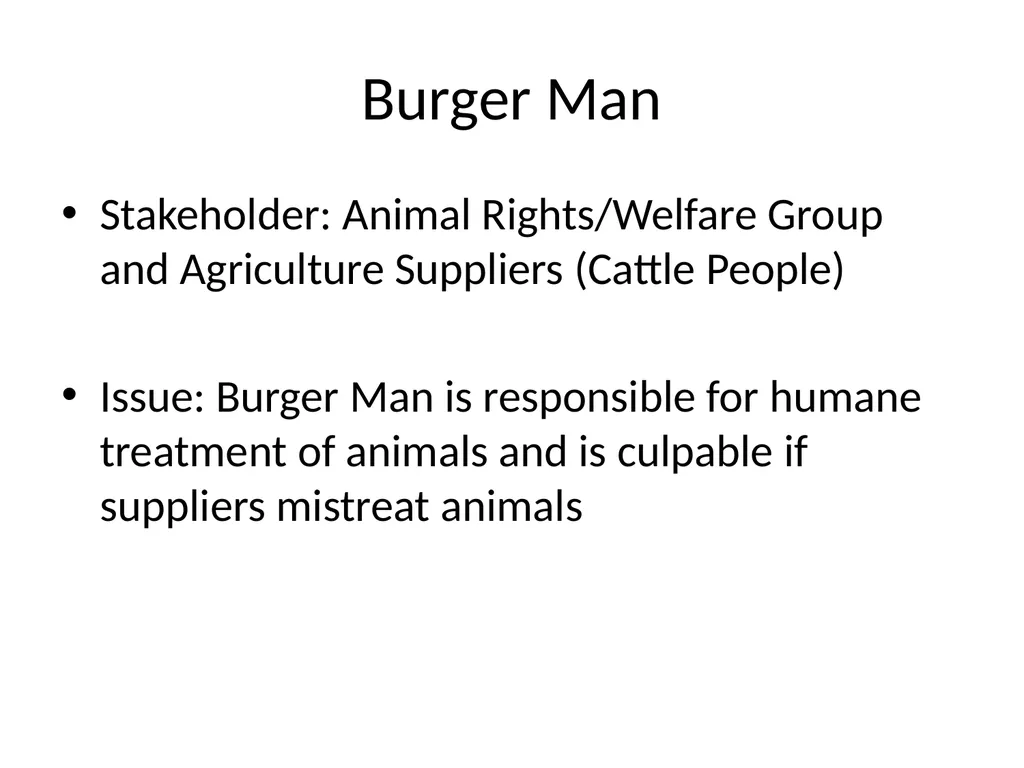
Burger Man Stakeholder: Animal Rights/Welfare Group and Agriculture Suppliers (Cattle People)
Issue: Burger Man is responsible for humane treatment of animals and is culpable if suppliers mistreat animals<br>
Issue: Burger Man is responsible for humane treatment of animals and is culpable if suppliers mistreat animals<br>
26
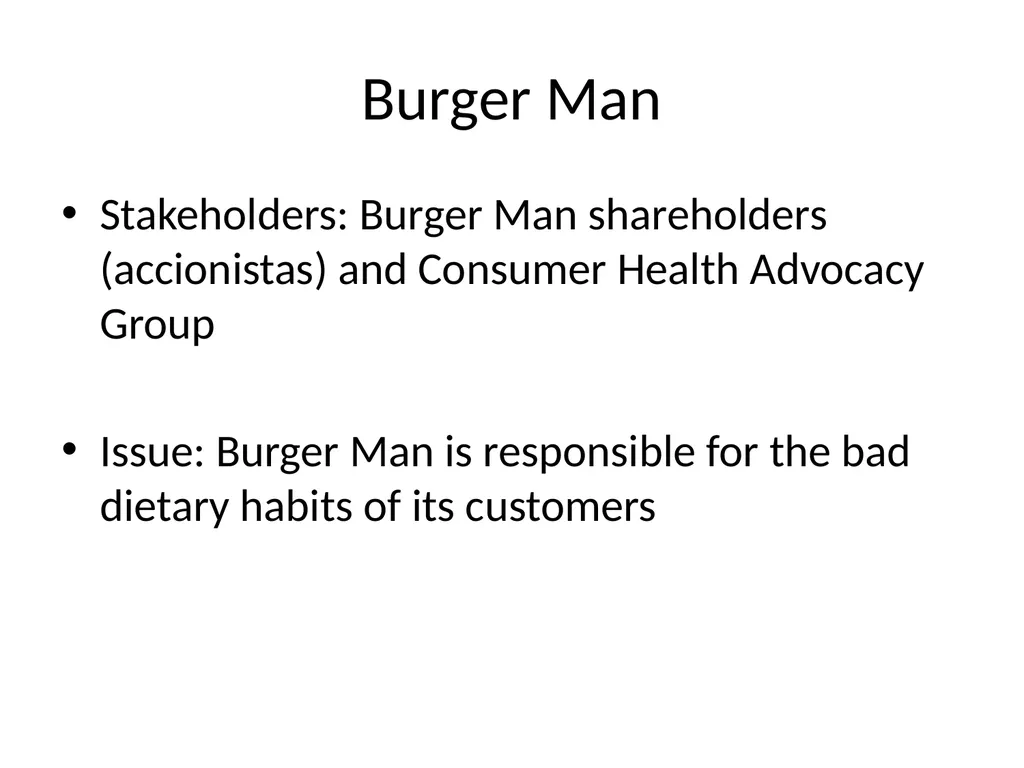
Burger Man Stakeholders: Burger Man shareholders (accionistas) and Consumer Health Advocacy Group
Issue: Burger Man is responsible for the bad dietary habits of its customers<br>
Issue: Burger Man is responsible for the bad dietary habits of its customers<br>
27
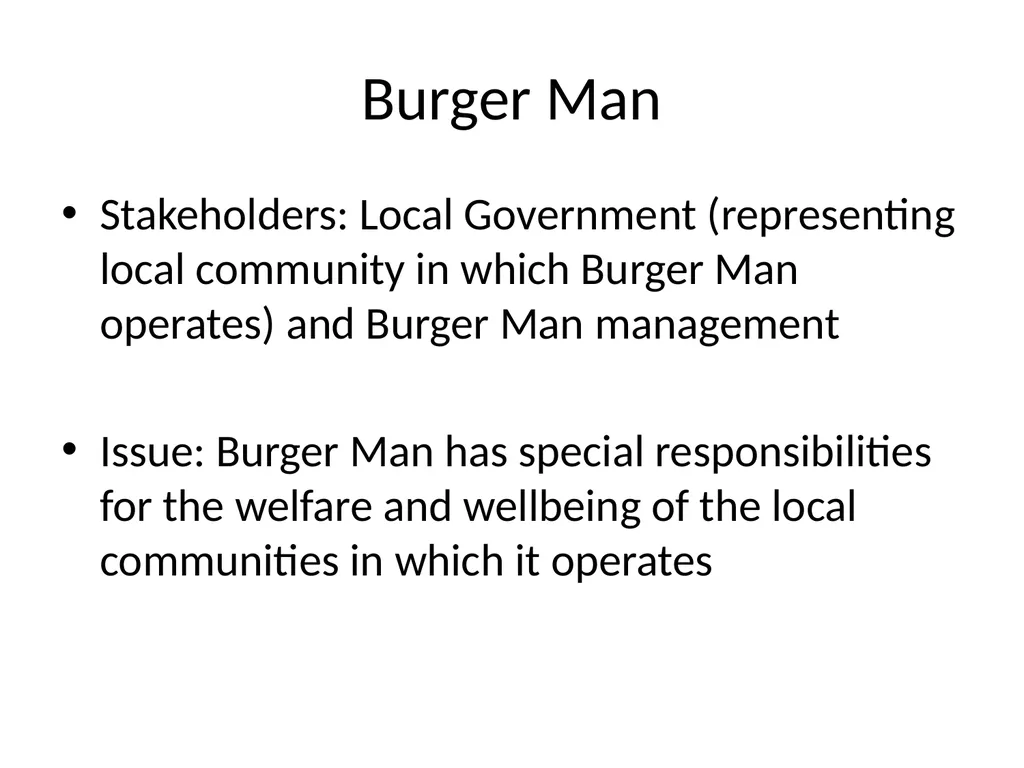
Burger Man Stakeholders: Local Government (representing local community in which Burger Man operates) and Burger Man management
Issue: Burger Man has special responsibilities for the welfare and wellbeing of the local communities in which it operates<br>
Issue: Burger Man has special responsibilities for the welfare and wellbeing of the local communities in which it operates<br>
28
Your task Assess and/or outline Burger Man’s social responsibilities as a corporation
Make arguments with premises (evidence) and conclusions (Take a position and state it at the beginning and end of your presentaiton)
Your arguments must support a position on corporate responsibility
Your arguments must have ethical content (tests, values, concepts)
Address responsibility specifically in the context of your issue from the point of view of your stakeholder
Be civil and make a special effort to listen carefully and respond thoughtfully to the arguments of other groups<br>
Make arguments with premises (evidence) and conclusions (Take a position and state it at the beginning and end of your presentaiton)
Your arguments must support a position on corporate responsibility
Your arguments must have ethical content (tests, values, concepts)
Address responsibility specifically in the context of your issue from the point of view of your stakeholder
Be civil and make a special effort to listen carefully and respond thoughtfully to the arguments of other groups<br>