
The Intra-domain BGP Scaling Problem Danny
AS
Published · 35 slides · 0 views
1 / 1






Description
The Intra-domain BGP Scaling Problem Danny McPherson dannyarbor.net Shane Amante shanelevel3.net Lixia Zhang lixiacs.ucla.edu 2 Agenda Objective main focus on intra-domain outline issues with BGP scalability caused by network path
Related Topics
Share
Embed code
Download this presentation From Below
"The Intra-domain BGP Scaling Problem Danny" is the property of its rightful owner. Permission is granted to download and print the materials on this website for personal, non-commercial use only, and to display it on your personal computer provided you do not modify the materials and that you retain all copyright notices contained in the materials. By downloading content from our website, you accept the terms of this agreement.
Presentation Transcript
01
The Intra-domain BGP Scaling Problem Danny McPherson danny@arbor.net
Shane Amante shane@level3.net
Lixia Zhang lixia@cs.ucla.edu<br>
Shane Amante shane@level3.net
Lixia Zhang lixia@cs.ucla.edu<br>
02
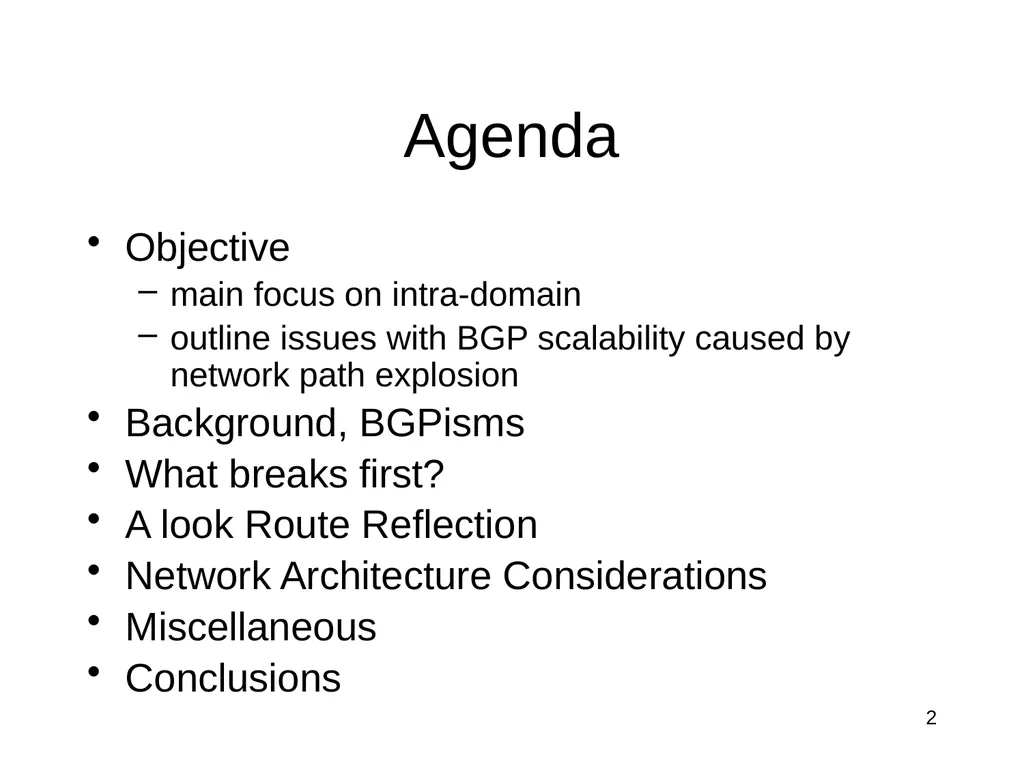
2 Agenda Objective
main focus on intra-domain
outline issues with BGP scalability caused by network path explosion
Background, BGPisms
What breaks first?
A look Route Reflection
Network Architecture Considerations
Miscellaneous
Conclusions<br>
main focus on intra-domain
outline issues with BGP scalability caused by network path explosion
Background, BGPisms
What breaks first?
A look Route Reflection
Network Architecture Considerations
Miscellaneous
Conclusions<br>
03
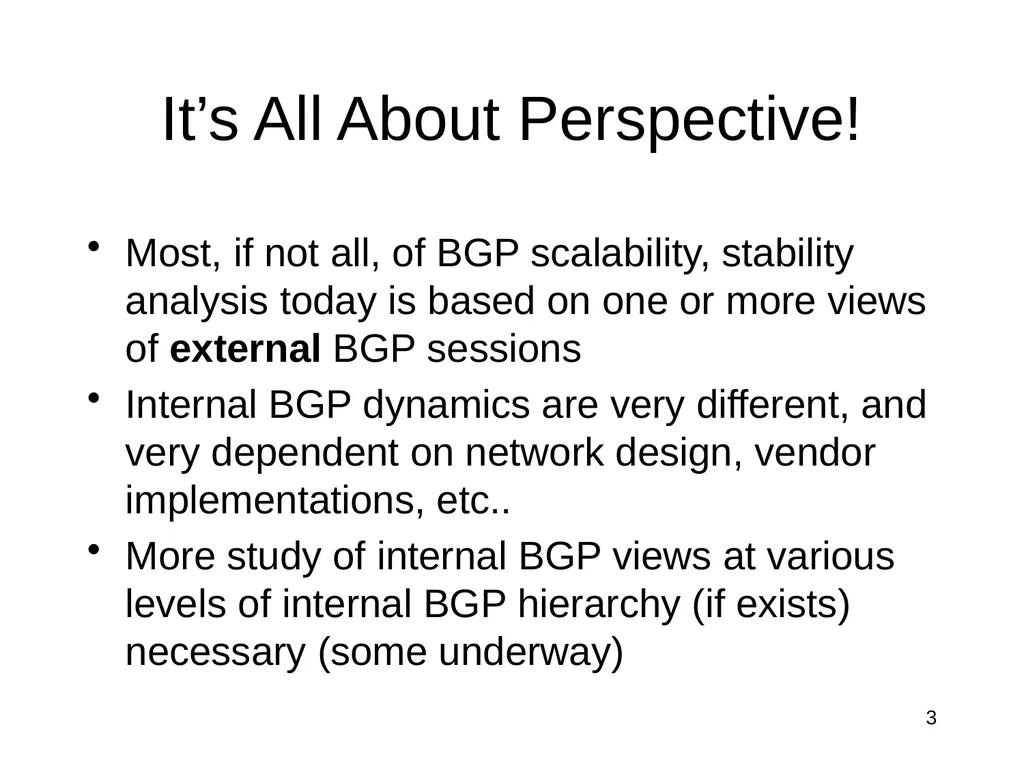
3 It’s All About Perspective! Most, if not all, of BGP scalability, stability analysis today is based on one or more views of external BGP sessions
Internal BGP dynamics are very different, and very dependent on network design, vendor implementations, etc..
More study of internal BGP views at various levels of internal BGP hierarchy (if exists) necessary (some underway)<br>
Internal BGP dynamics are very different, and very dependent on network design, vendor implementations, etc..
More study of internal BGP views at various levels of internal BGP hierarchy (if exists) necessary (some underway)<br>
04
BGPisms, Background Slides<br>
05
5 Topology: The Bogey Man! BGP behavior dependent on topology
Making connectivity (internal & external) richer SHOULD result in improved reliability
but instead may cause convergence delays of multiple minutes when routes flap
even in the absence of flap dampening
This is a path hunting problem which won’t go away until it is solved
Until then, it causes escalation of BGP update counts and convergence delay<br>
Making connectivity (internal & external) richer SHOULD result in improved reliability
but instead may cause convergence delays of multiple minutes when routes flap
even in the absence of flap dampening
This is a path hunting problem which won’t go away until it is solved
Until then, it causes escalation of BGP update counts and convergence delay<br>
06
6 eBGP - iBGP - eBGP Multiple offset update receipt or processing variance can trigger withdraw + new announcement where just new announcement would have otherwise been sufficient
Can cause cascade of unnecessary path hunting
Rich topological connectivity (internal or external) can result in badly behaved path selection and announcement, in race conditions prior to new correct state while withdrawals flood the global DFZ
Behaves badly because of limited local knowledge - with exponential badness based on N^M, (where N is number of paths from a given AS to the end site, and M is the number of ASes in the path). M typically 4-6, N can be double digits<br>
Can cause cascade of unnecessary path hunting
Rich topological connectivity (internal or external) can result in badly behaved path selection and announcement, in race conditions prior to new correct state while withdrawals flood the global DFZ
Behaves badly because of limited local knowledge - with exponential badness based on N^M, (where N is number of paths from a given AS to the end site, and M is the number of ASes in the path). M typically 4-6, N can be double digits<br>
07
7 Minimum Route Advertisement Interval (MRAI) Needed to prevent runaway melt-down of router CPUs
Has adverse effects when doing path hunting (legitimately)
Need for negotiated and configurable timers for external and internal BGP, per peer and AFI/SAFI - environment-specific
Interaction between successive run timers whose values differ can make things worse!
Common default MRAI - 0 seconds<br>
Has adverse effects when doing path hunting (legitimately)
Need for negotiated and configurable timers for external and internal BGP, per peer and AFI/SAFI - environment-specific
Interaction between successive run timers whose values differ can make things worse!
Common default MRAI - 0 seconds<br>
08
8 BGP Impacting Factors Only best routes sent (currently)
Even if multiple routes sent, only best installed in FIB
Lack of information on alternative paths prevents look-ahead, also leads to update flooding whenever the best path changes
Regardless of other improvements, delay of updates will be bounded above by speed of light in fiber (NVP ~200 km/s) && packet regeneration time
Intermediate states in path hunting may be (and often are) completely bogus<br>
Even if multiple routes sent, only best installed in FIB
Lack of information on alternative paths prevents look-ahead, also leads to update flooding whenever the best path changes
Regardless of other improvements, delay of updates will be bounded above by speed of light in fiber (NVP ~200 km/s) && packet regeneration time
Intermediate states in path hunting may be (and often are) completely bogus<br>
09
9 IGP & BGP Interaction IGPs typically carry only NEXT_HOP and session reachability information for BGP
iBGP NEXT_HOP is often ingress router loopback, ideally keep external interfaces out of IGP for stability reasons
No use of IGP/BGP synchronization, using this would mean each router has to have full set of BGP routes in their IGP in order to preserve destination reachability
IGP metrics often uses to populate BGP MEDs - or determine best ‘hot-potato’ location<br>
iBGP NEXT_HOP is often ingress router loopback, ideally keep external interfaces out of IGP for stability reasons
No use of IGP/BGP synchronization, using this would mean each router has to have full set of BGP routes in their IGP in order to preserve destination reachability
IGP metrics often uses to populate BGP MEDs - or determine best ‘hot-potato’ location<br>
10
10 iBGP Route Advertisement Rules iBGP rule: a route learned from one iBGP speaker can’t be propagated to another iBGP speaker - else routing information loops will occur
As such, iBGP full mesh required:: N(N-1)/2 sessions
This iBGP rule can be relaxed, however (with introduction of new path vectors)
route reflection; introduces cluster ID, cluster lists and originator ID attributes (serve as path vector)
AS Confederations; partition AS into sub-ASes, full mesh still required within sub-AS, introduces AS_CONFED_* attributes (serve as path vector)
Some ISPs use both RR and Confederations, some one, some neither
RRs can be used hierarchically within a routing domain<br>
As such, iBGP full mesh required:: N(N-1)/2 sessions
This iBGP rule can be relaxed, however (with introduction of new path vectors)
route reflection; introduces cluster ID, cluster lists and originator ID attributes (serve as path vector)
AS Confederations; partition AS into sub-ASes, full mesh still required within sub-AS, introduces AS_CONFED_* attributes (serve as path vector)
Some ISPs use both RR and Confederations, some one, some neither
RRs can be used hierarchically within a routing domain<br>
11
What Breaks First?<br>
12
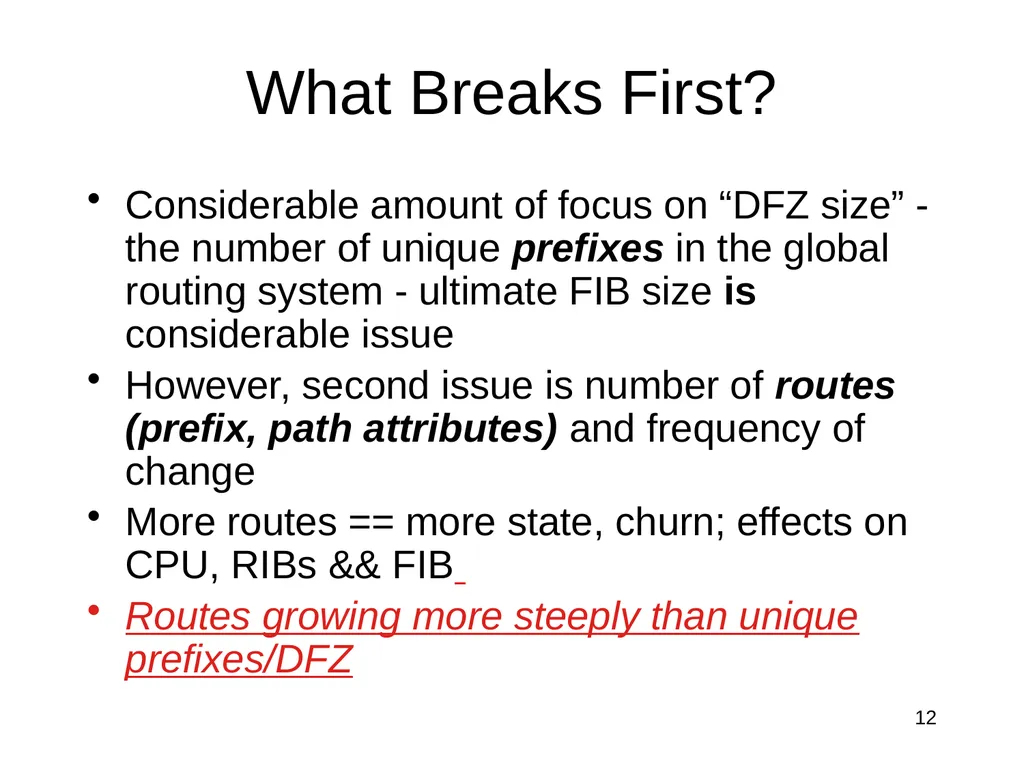
12 What Breaks First? Considerable amount of focus on “DFZ size” - the number of unique prefixes in the global routing system - ultimate FIB size is considerable issue
However, second issue is number of routes (prefix, path attributes) and frequency of change
More routes == more state, churn; effects on CPU, RIBs && FIB
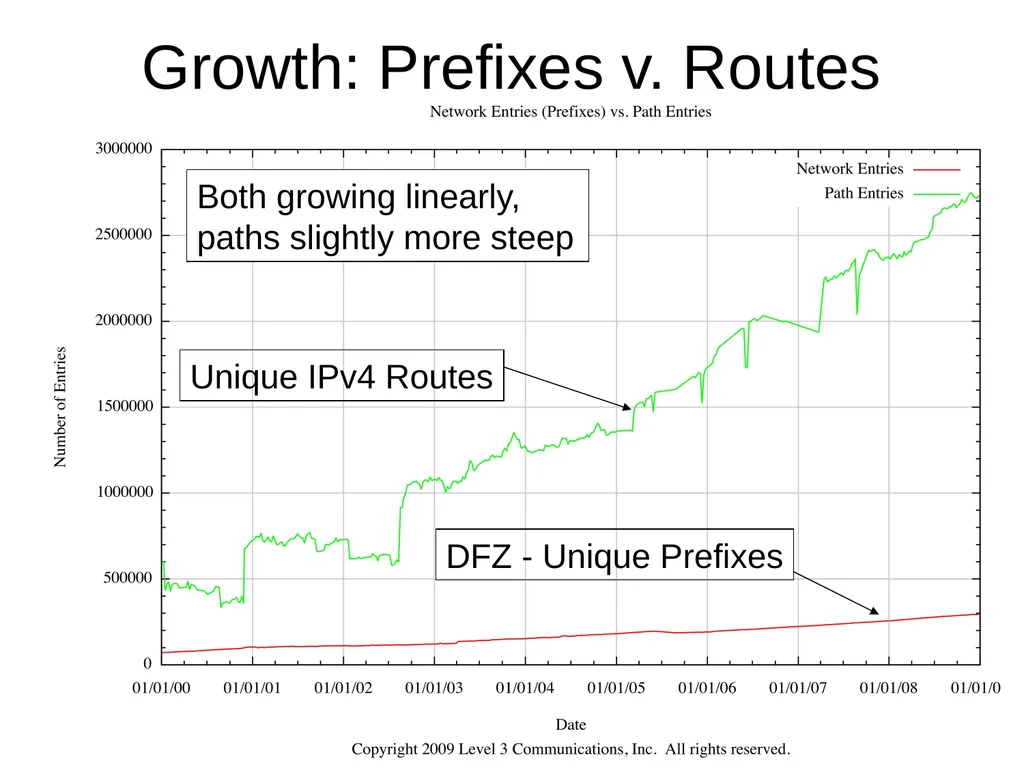
Routes growing more steeply than unique prefixes/DFZ<br>
However, second issue is number of routes (prefix, path attributes) and frequency of change
More routes == more state, churn; effects on CPU, RIBs && FIB
Routes growing more steeply than unique prefixes/DFZ<br>
13
13 Growth: Prefixes v. Routes DFZ - Unique Prefixes Unique IPv4 Routes Both growing linearly, paths slightly more steep<br>
14
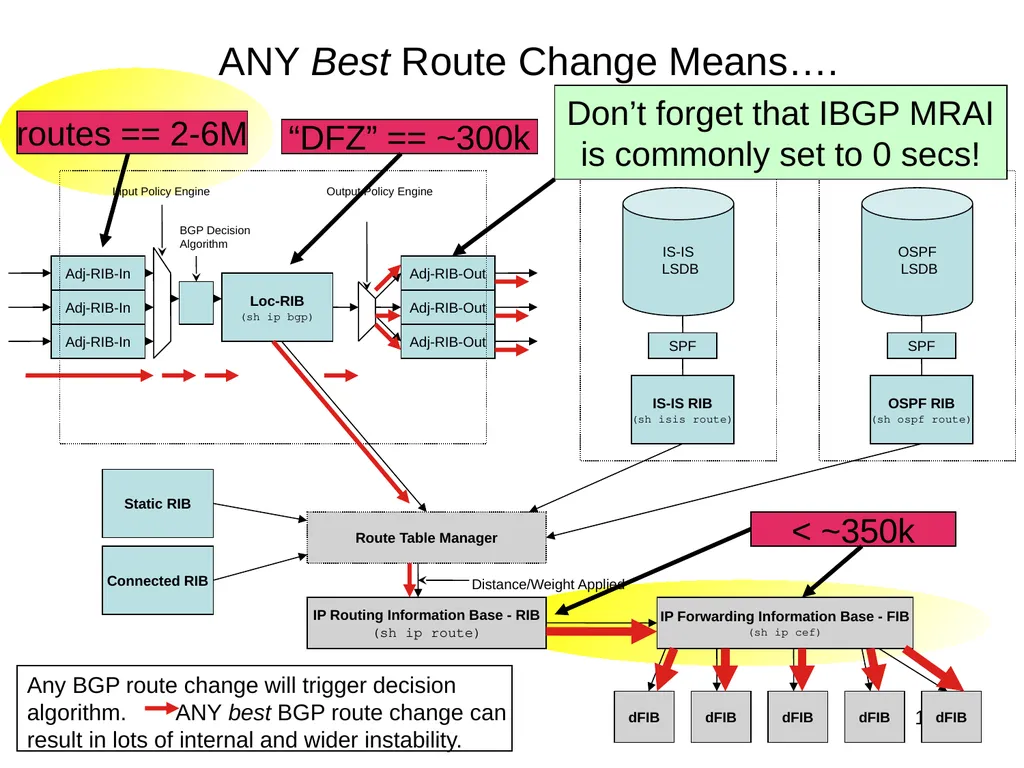
14 ANY Best Route Change Means…. Adj-RIB-In Adj-RIB-In Adj-RIB-In Adj-RIB-Out Adj-RIB-Out Adj-RIB-Out Loc-RIB
(sh ip bgp) Input Policy Engine BGP Decision
Algorithm Output Policy Engine Route Table Manager Static RIB Connected RIB IS-IS
LSDB SPF IS-IS RIB
(sh isis route) IP Routing Information Base - RIB
(sh ip route) Distance/Weight Applied IP Forwarding Information Base - FIB
(sh ip cef) dFIB dFIB dFIB dFIB dFIB OSPF
LSDB SPF OSPF RIB
(sh ospf route) “DFZ” == ~300k routes == 2-6M < ~350k Any BGP route change will trigger decision algorithm. ANY best BGP route change can result in lots of internal and wider instability. Don’t forget that IBGP MRAI
is commonly set to 0 secs!<br>
(sh ip bgp) Input Policy Engine BGP Decision
Algorithm Output Policy Engine Route Table Manager Static RIB Connected RIB IS-IS
LSDB SPF IS-IS RIB
(sh isis route) IP Routing Information Base - RIB
(sh ip route) Distance/Weight Applied IP Forwarding Information Base - FIB
(sh ip cef) dFIB dFIB dFIB dFIB dFIB OSPF
LSDB SPF OSPF RIB
(sh ospf route) “DFZ” == ~300k routes == 2-6M < ~350k Any BGP route change will trigger decision algorithm. ANY best BGP route change can result in lots of internal and wider instability. Don’t forget that IBGP MRAI
is commonly set to 0 secs!<br>
15
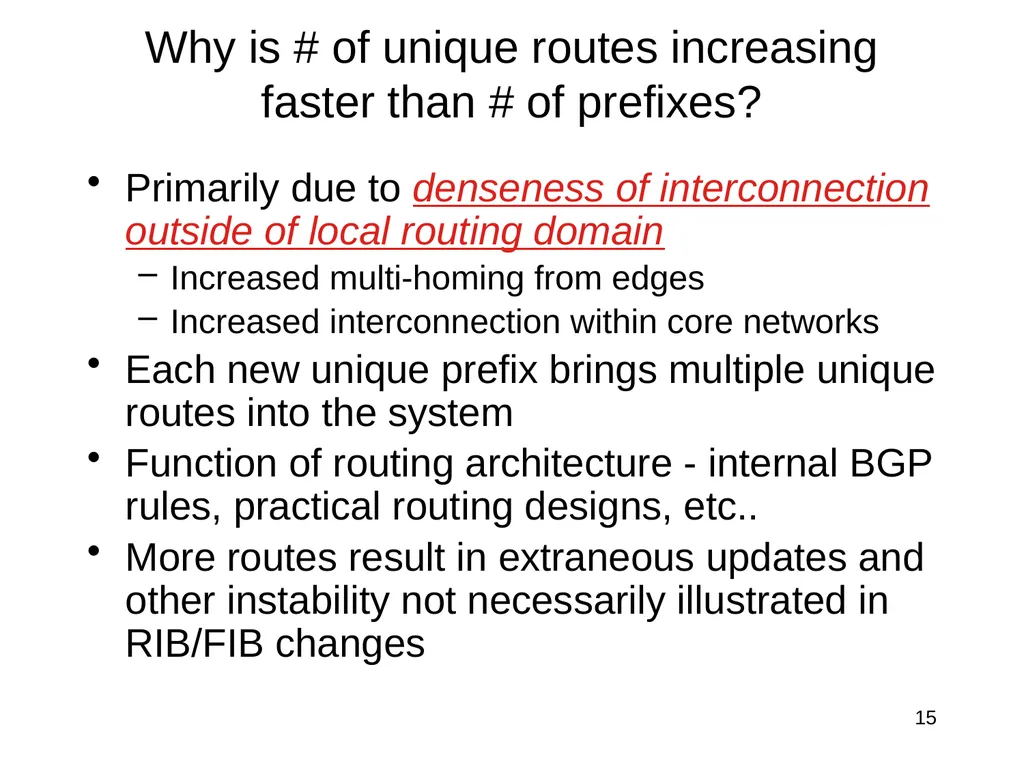
15 Why is # of unique routes increasing faster than # of prefixes? Primarily due to denseness of interconnection outside of local routing domain
Increased multi-homing from edges
Increased interconnection within core networks
Each new unique prefix brings multiple unique routes into the system
Function of routing architecture - internal BGP rules, practical routing designs, etc..
More routes result in extraneous updates and other instability not necessarily illustrated in RIB/FIB changes<br>
Increased multi-homing from edges
Increased interconnection within core networks
Each new unique prefix brings multiple unique routes into the system
Function of routing architecture - internal BGP rules, practical routing designs, etc..
More routes result in extraneous updates and other instability not necessarily illustrated in RIB/FIB changes<br>
16
16 External Interconnection Denseness More networks interconnecting directly to avoid transit costs, reduce transaction latency, forwarding path security (e.g., avoid hostile countries / “cyberlock”),
More networks building their own backbones (e.g., CDNs), have presence in multiple locations
More end-sites and lower-tier SPs provisioning additional interconnections
SPs adding more interconnections in general to local traffic exchange and accommodate high-bandwidth capacity requirements
The “peer with everybody” paradigm
Increased interconnections made feasible by excess fiber capacity and decreasing cost, offset transit costs
More interconnections means more unique routes for a given prefix<br>
More networks building their own backbones (e.g., CDNs), have presence in multiple locations
More end-sites and lower-tier SPs provisioning additional interconnections
SPs adding more interconnections in general to local traffic exchange and accommodate high-bandwidth capacity requirements
The “peer with everybody” paradigm
Increased interconnections made feasible by excess fiber capacity and decreasing cost, offset transit costs
More interconnections means more unique routes for a given prefix<br>
17
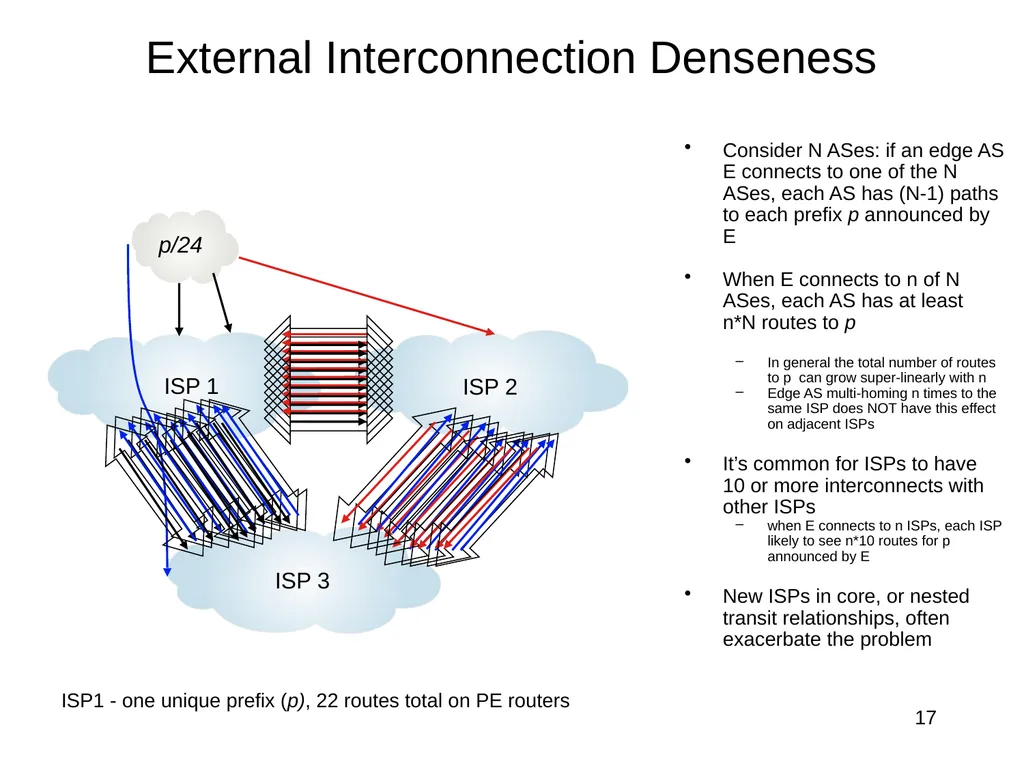
17 External Interconnection Denseness p/24 ISP 1 ISP 2 ISP 3 Consider N ASes: if an edge AS E connects to one of the N ASes, each AS has (N-1) paths to each prefix p announced by E
When E connects to n of N ASes, each AS has at least n*N routes to p
In general the total number of routes to p can grow super-linearly with n
Edge AS multi-homing n times to the same ISP does NOT have this effect on adjacent ISPs
It’s common for ISPs to have 10 or more interconnects with other ISPs
when E connects to n ISPs, each ISP likely to see n*10 routes for p announced by E
New ISPs in core, or nested transit relationships, often exacerbate the problem ISP1 - one unique prefix (p), 22 routes total on PE routers<br>
When E connects to n of N ASes, each AS has at least n*N routes to p
In general the total number of routes to p can grow super-linearly with n
Edge AS multi-homing n times to the same ISP does NOT have this effect on adjacent ISPs
It’s common for ISPs to have 10 or more interconnects with other ISPs
when E connects to n ISPs, each ISP likely to see n*10 routes for p announced by E
New ISPs in core, or nested transit relationships, often exacerbate the problem ISP1 - one unique prefix (p), 22 routes total on PE routers<br>
18
18 Effects of Attribute Growth More unique attributes means more unique routes
Results in less efficient update packing; more BGP updates, more BGP packets
Common expanding attribute types
AS path
Communities
MEDs
Others (AFI/SAFIs, route reflection attributes)<br>
Results in less efficient update packing; more BGP updates, more BGP packets
Common expanding attribute types
AS path
Communities
MEDs
Others (AFI/SAFIs, route reflection attributes)<br>
19
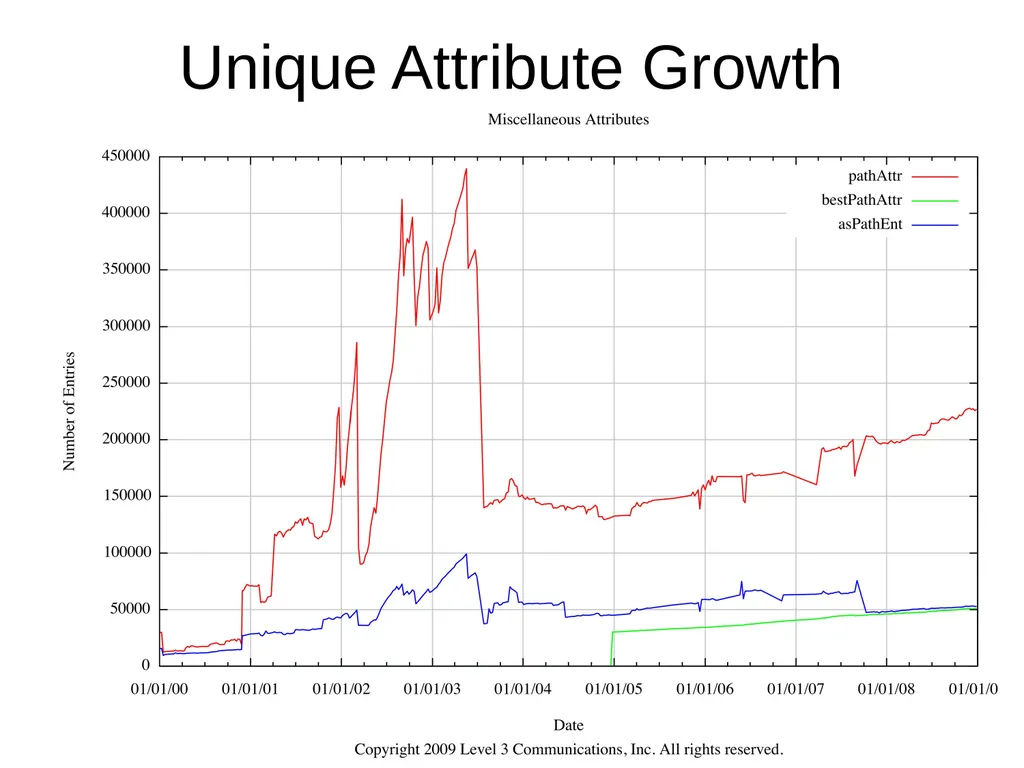
19 Unique Attribute Growth<br>
20
A Peek Into Route Reflection<br>
21
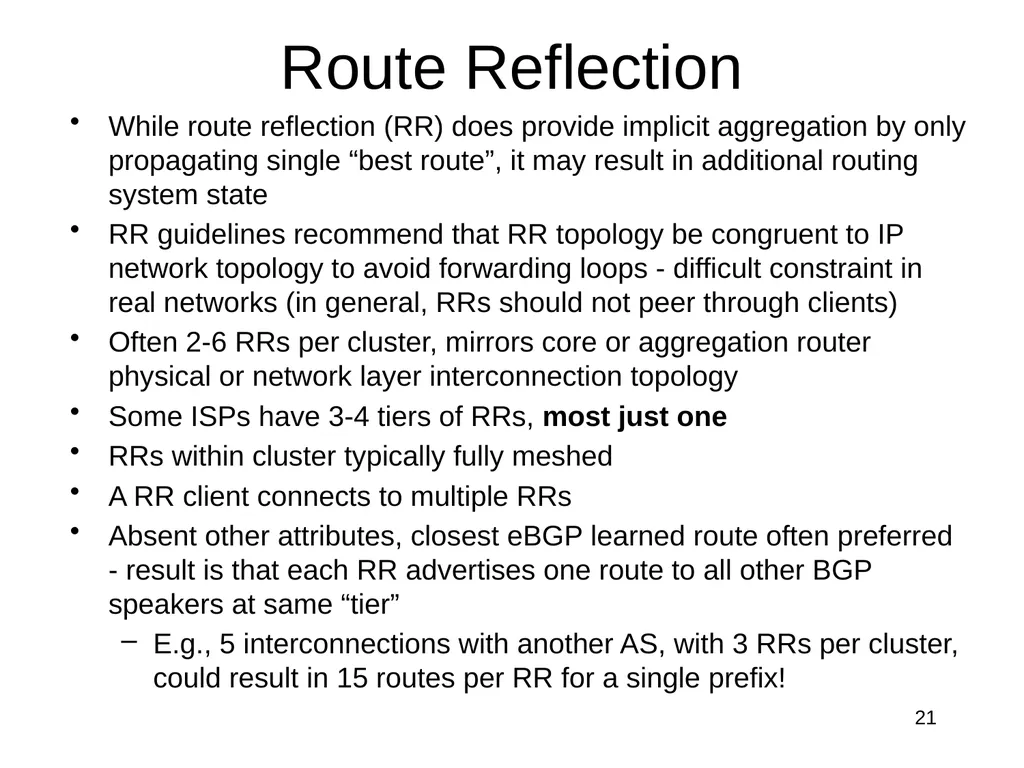
21 Route Reflection While route reflection (RR) does provide implicit aggregation by only propagating single “best route”, it may result in additional routing system state
RR guidelines recommend that RR topology be congruent to IP network topology to avoid forwarding loops - difficult constraint in real networks (in general, RRs should not peer through clients)
Often 2-6 RRs per cluster, mirrors core or aggregation router physical or network layer interconnection topology
Some ISPs have 3-4 tiers of RRs, most just one
RRs within cluster typically fully meshed
A RR client connects to multiple RRs
Absent other attributes, closest eBGP learned route often preferred - result is that each RR advertises one route to all other BGP speakers at same “tier”
E.g., 5 interconnections with another AS, with 3 RRs per cluster, could result in 15 routes per RR for a single prefix!<br>
RR guidelines recommend that RR topology be congruent to IP network topology to avoid forwarding loops - difficult constraint in real networks (in general, RRs should not peer through clients)
Often 2-6 RRs per cluster, mirrors core or aggregation router physical or network layer interconnection topology
Some ISPs have 3-4 tiers of RRs, most just one
RRs within cluster typically fully meshed
A RR client connects to multiple RRs
Absent other attributes, closest eBGP learned route often preferred - result is that each RR advertises one route to all other BGP speakers at same “tier”
E.g., 5 interconnections with another AS, with 3 RRs per cluster, could result in 15 routes per RR for a single prefix!<br>
22
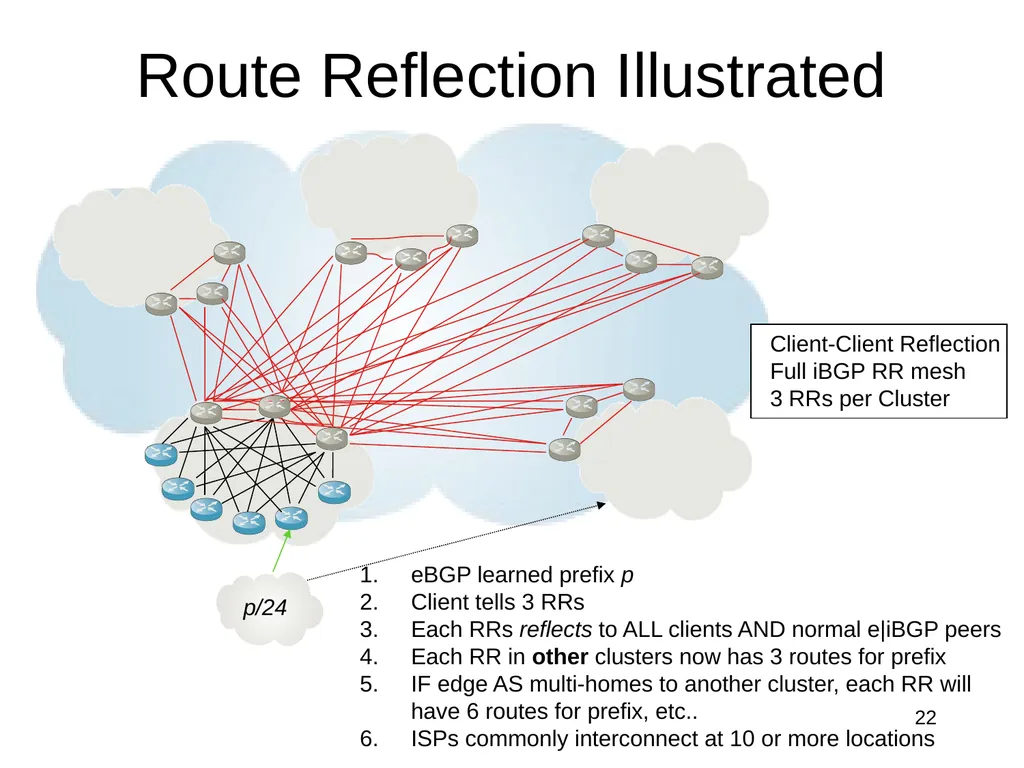
22 Route Reflection Illustrated p/24 eBGP learned prefix p
Client tells 3 RRs
Each RRs reflects to ALL clients AND normal e|iBGP peers
Each RR in other clusters now has 3 routes for prefix
IF edge AS multi-homes to another cluster, each RR will have 6 routes for prefix, etc..
ISPs commonly interconnect at 10 or more locations Client-Client Reflection
Full iBGP RR mesh
3 RRs per Cluster<br>
Client tells 3 RRs
Each RRs reflects to ALL clients AND normal e|iBGP peers
Each RR in other clusters now has 3 routes for prefix
IF edge AS multi-homes to another cluster, each RR will have 6 routes for prefix, etc..
ISPs commonly interconnect at 10 or more locations Client-Client Reflection
Full iBGP RR mesh
3 RRs per Cluster<br>
23
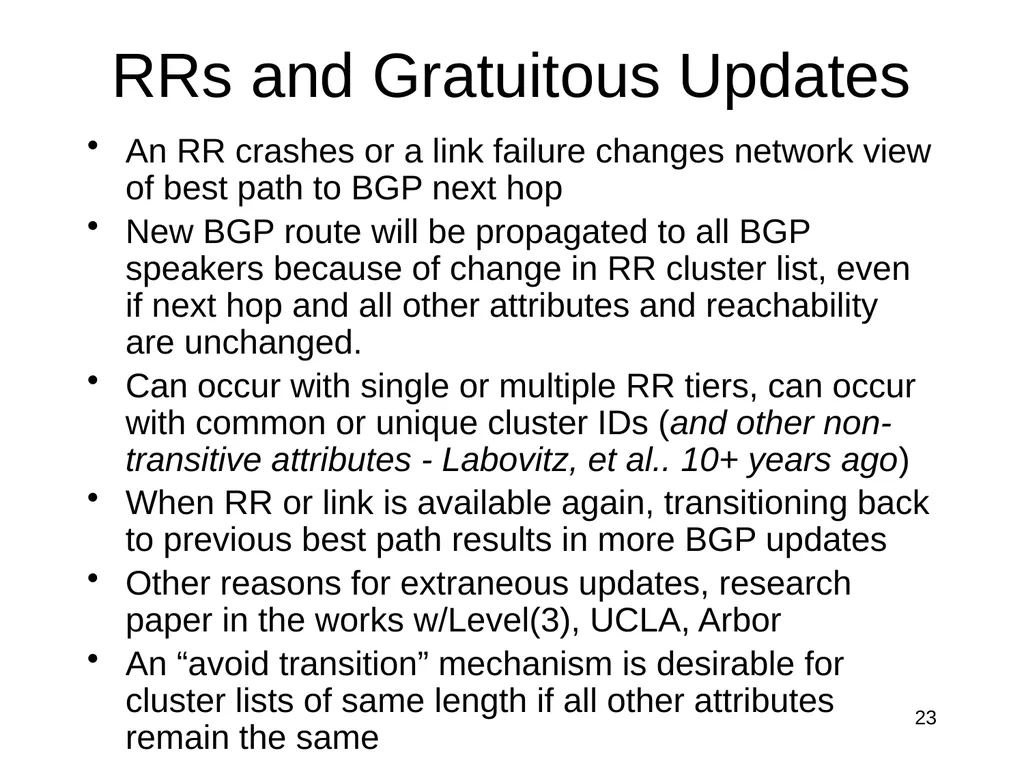
23 RRs and Gratuitous Updates An RR crashes or a link failure changes network view of best path to BGP next hop
New BGP route will be propagated to all BGP speakers because of change in RR cluster list, even if next hop and all other attributes and reachability are unchanged.
Can occur with single or multiple RR tiers, can occur with common or unique cluster IDs (and other non-transitive attributes - Labovitz, et al.. 10+ years ago)
When RR or link is available again, transitioning back to previous best path results in more BGP updates
Other reasons for extraneous updates, research paper in the works w/Level(3), UCLA, Arbor
An “avoid transition” mechanism is desirable for cluster lists of same length if all other attributes remain the same<br>
New BGP route will be propagated to all BGP speakers because of change in RR cluster list, even if next hop and all other attributes and reachability are unchanged.
Can occur with single or multiple RR tiers, can occur with common or unique cluster IDs (and other non-transitive attributes - Labovitz, et al.. 10+ years ago)
When RR or link is available again, transitioning back to previous best path results in more BGP updates
Other reasons for extraneous updates, research paper in the works w/Level(3), UCLA, Arbor
An “avoid transition” mechanism is desirable for cluster lists of same length if all other attributes remain the same<br>
24
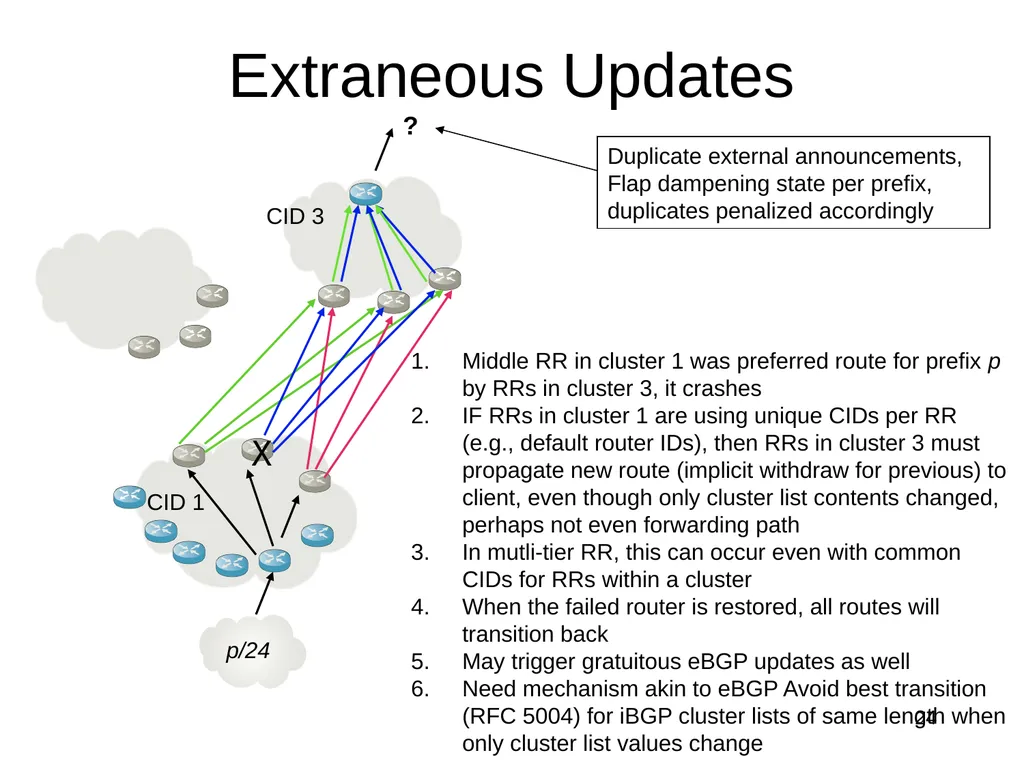
24 Extraneous Updates p/24 Middle RR in cluster 1 was preferred route for prefix p by RRs in cluster 3, it crashes
IF RRs in cluster 1 are using unique CIDs per RR (e.g., default router IDs), then RRs in cluster 3 must propagate new route (implicit withdraw for previous) to client, even though only cluster list contents changed, perhaps not even forwarding path
In mutli-tier RR, this can occur even with common CIDs for RRs within a cluster
When the failed router is restored, all routes will transition back
May trigger gratuitous eBGP updates as well
Need mechanism akin to eBGP Avoid best transition (RFC 5004) for iBGP cluster lists of same length when only cluster list values change CID 3 CID 1 X ? Duplicate external announcements, Flap dampening state per prefix, duplicates penalized accordingly<br>
IF RRs in cluster 1 are using unique CIDs per RR (e.g., default router IDs), then RRs in cluster 3 must propagate new route (implicit withdraw for previous) to client, even though only cluster list contents changed, perhaps not even forwarding path
In mutli-tier RR, this can occur even with common CIDs for RRs within a cluster
When the failed router is restored, all routes will transition back
May trigger gratuitous eBGP updates as well
Need mechanism akin to eBGP Avoid best transition (RFC 5004) for iBGP cluster lists of same length when only cluster list values change CID 3 CID 1 X ? Duplicate external announcements, Flap dampening state per prefix, duplicates penalized accordingly<br>
25
Implementations Focus on Optimizing Local rather than System-Wide Resources<br>
26
26 RR Advertisement Rules Change in specification from RFC 1966 to RFC 2796:
Change allowed an RR to reflect a route learned from a client back to that client
Change made to optimize local implementation (copying of updates task); no care given to system-wide effects
Client now has to know it’s a client and “poison” received routes where Originator ID added by RR is equal to local BGP Router ID
Consider example with 100k best routes from client with 3 RRs - client now has to discard 300k routes received from RRs that were reflected back to client, whether common or unique cluster IDs on RRs
The updates are not benign - processing may delay legitimate update processing<br>
Change allowed an RR to reflect a route learned from a client back to that client
Change made to optimize local implementation (copying of updates task); no care given to system-wide effects
Client now has to know it’s a client and “poison” received routes where Originator ID added by RR is equal to local BGP Router ID
Consider example with 100k best routes from client with 3 RRs - client now has to discard 300k routes received from RRs that were reflected back to client, whether common or unique cluster IDs on RRs
The updates are not benign - processing may delay legitimate update processing<br>
27
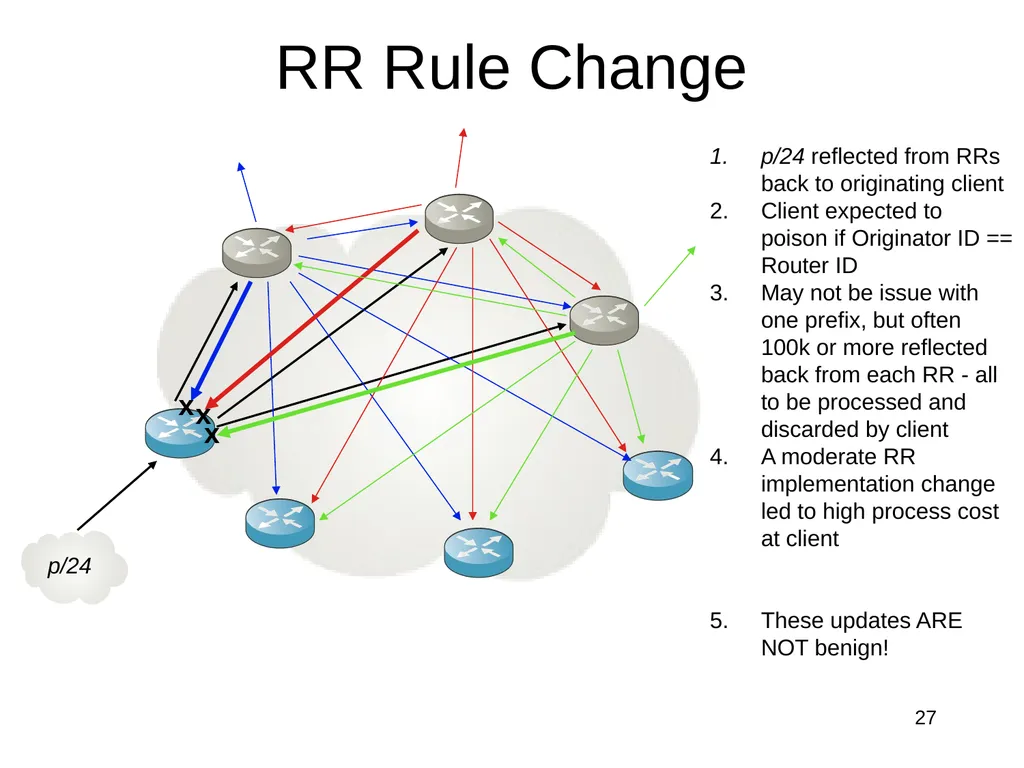
27 RR Rule Change p/24 p/24 reflected from RRs back to originating client
Client expected to poison if Originator ID == Router ID
May not be issue with one prefix, but often 100k or more reflected back from each RR - all to be processed and discarded by client
A moderate RR implementation change led to high process cost at client
These updates ARE NOT benign! x x x<br>
Client expected to poison if Originator ID == Router ID
May not be issue with one prefix, but often 100k or more reflected back from each RR - all to be processed and discarded by client
A moderate RR implementation change led to high process cost at client
These updates ARE NOT benign! x x x<br>
28
28 And furthermore… Proposed IP VPN technique aims to exploit this behavior to minimize *local* configuration
Define community (ACCEPT_OWN) to allow acceptance of routes (not poison) by client, even if Originator ID equals local Router ID, if community present
Allows upstream RR to distribute routes between VRFs on local PE
Saves having to configure local inter-VRF redistribution policies on each PE
In fairness, different overlay RRs are often used for IP-VPN address families…
draft-ietf-l3vpn-acceptown-community<br>
Define community (ACCEPT_OWN) to allow acceptance of routes (not poison) by client, even if Originator ID equals local Router ID, if community present
Allows upstream RR to distribute routes between VRFs on local PE
Saves having to configure local inter-VRF redistribution policies on each PE
In fairness, different overlay RRs are often used for IP-VPN address families…
draft-ietf-l3vpn-acceptown-community<br>
29
Network Architecture Considerations<br>
30
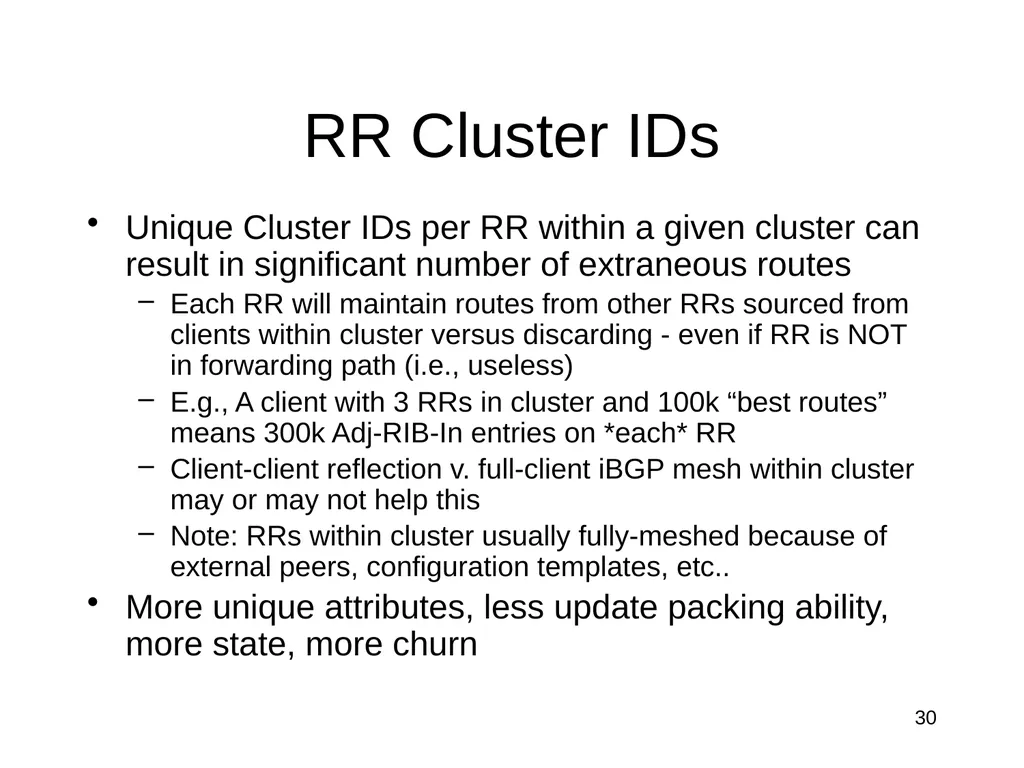
30 RR Cluster IDs Unique Cluster IDs per RR within a given cluster can result in significant number of extraneous routes
Each RR will maintain routes from other RRs sourced from clients within cluster versus discarding - even if RR is NOT in forwarding path (i.e., useless)
E.g., A client with 3 RRs in cluster and 100k “best routes” means 300k Adj-RIB-In entries on *each* RR
Client-client reflection v. full-client iBGP mesh within cluster may or may not help this
Note: RRs within cluster usually fully-meshed because of external peers, configuration templates, etc..
More unique attributes, less update packing ability, more state, more churn<br>
Each RR will maintain routes from other RRs sourced from clients within cluster versus discarding - even if RR is NOT in forwarding path (i.e., useless)
E.g., A client with 3 RRs in cluster and 100k “best routes” means 300k Adj-RIB-In entries on *each* RR
Client-client reflection v. full-client iBGP mesh within cluster may or may not help this
Note: RRs within cluster usually fully-meshed because of external peers, configuration templates, etc..
More unique attributes, less update packing ability, more state, more churn<br>
31
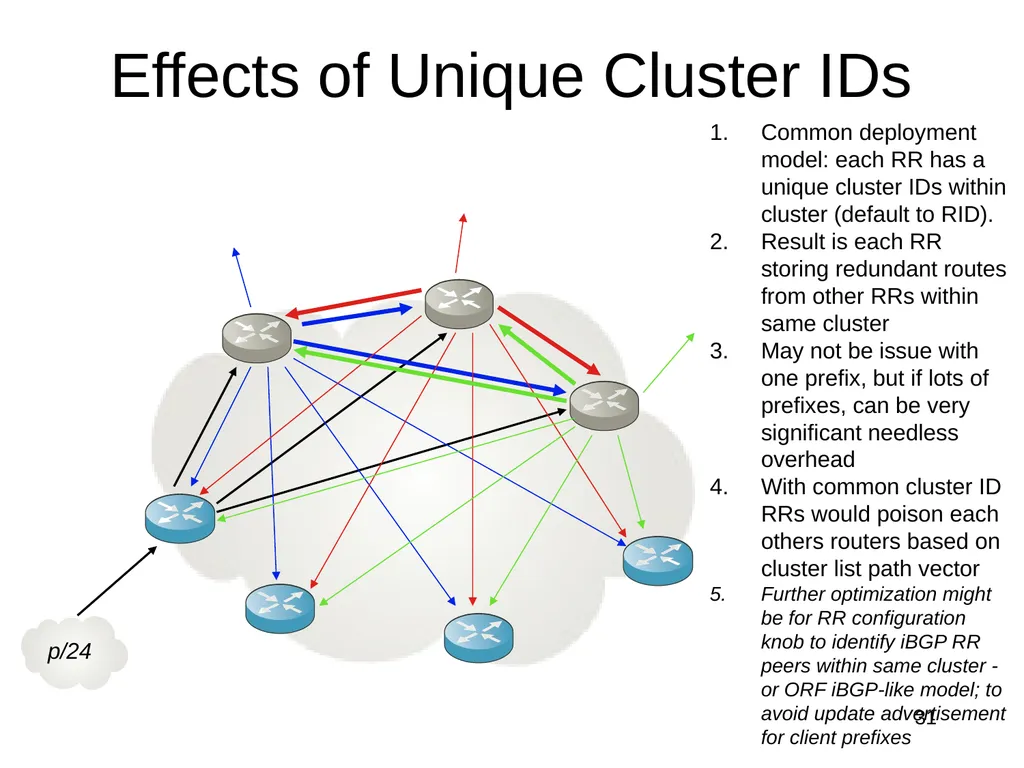
31 Effects of Unique Cluster IDs p/24 Common deployment model: each RR has a unique cluster IDs within cluster (default to RID).
Result is each RR storing redundant routes from other RRs within same cluster
May not be issue with one prefix, but if lots of prefixes, can be very significant needless overhead
With common cluster ID RRs would poison each others routers based on cluster list path vector
Further optimization might be for RR configuration knob to identify iBGP RR peers within same cluster - or ORF iBGP-like model; to avoid update advertisement for client prefixes<br>
Result is each RR storing redundant routes from other RRs within same cluster
May not be issue with one prefix, but if lots of prefixes, can be very significant needless overhead
With common cluster ID RRs would poison each others routers based on cluster list path vector
Further optimization might be for RR configuration knob to identify iBGP RR peers within same cluster - or ORF iBGP-like model; to avoid update advertisement for client prefixes<br>
32
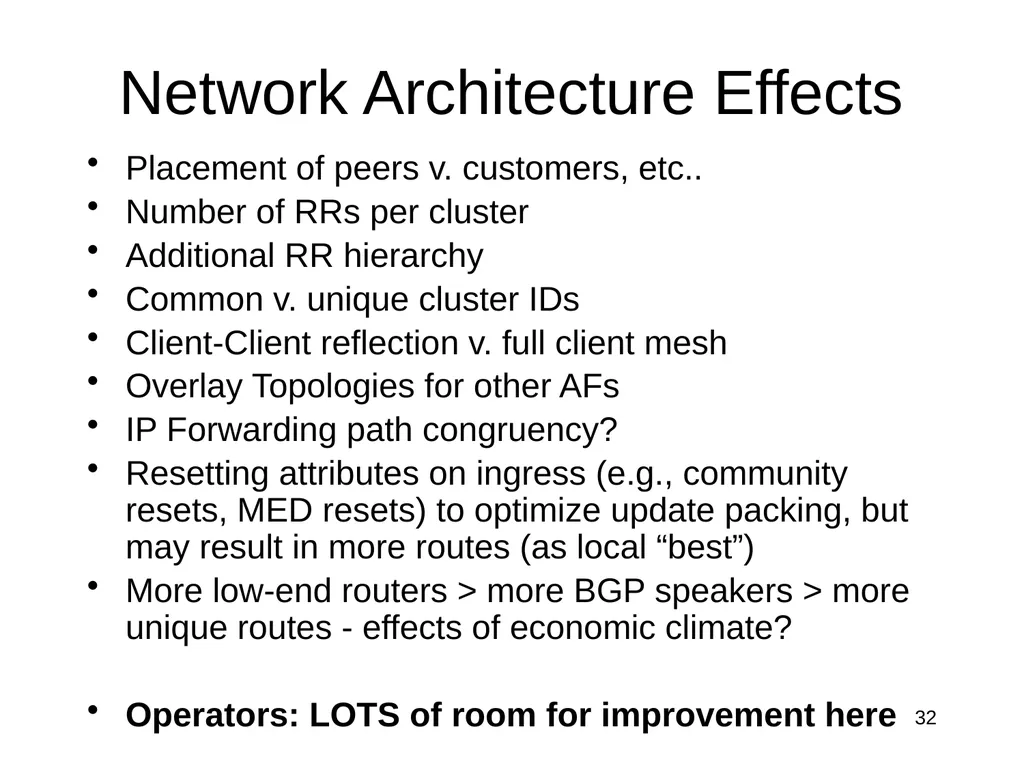
32 Network Architecture Effects Placement of peers v. customers, etc..
Number of RRs per cluster
Additional RR hierarchy
Common v. unique cluster IDs
Client-Client reflection v. full client mesh
Overlay Topologies for other AFs
IP Forwarding path congruency?
Resetting attributes on ingress (e.g., community resets, MED resets) to optimize update packing, but may result in more routes (as local “best”)
More low-end routers > more BGP speakers > more unique routes - effects of economic climate?
Operators: LOTS of room for improvement here<br>
Number of RRs per cluster
Additional RR hierarchy
Common v. unique cluster IDs
Client-Client reflection v. full client mesh
Overlay Topologies for other AFs
IP Forwarding path congruency?
Resetting attributes on ingress (e.g., community resets, MED resets) to optimize update packing, but may result in more routes (as local “best”)
More low-end routers > more BGP speakers > more unique routes - effects of economic climate?
Operators: LOTS of room for improvement here<br>
33
Miscellaneous<br>
34
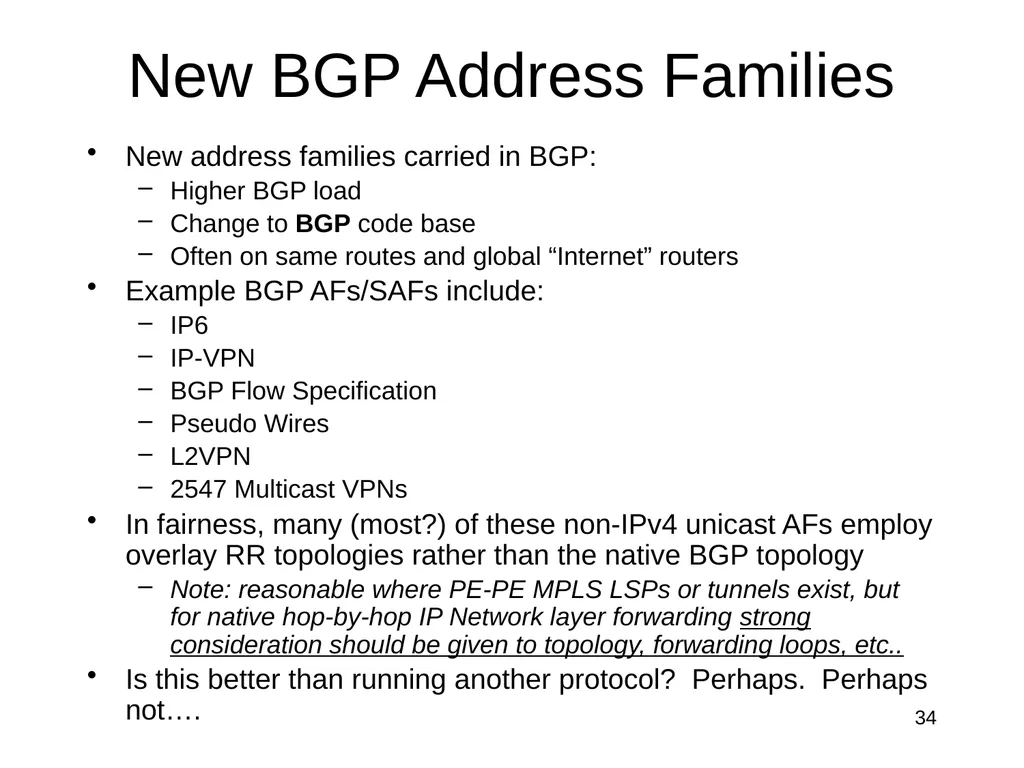
34 New BGP Address Families New address families carried in BGP:
Higher BGP load
Change to BGP code base
Often on same routes and global “Internet” routers
Example BGP AFs/SAFs include:
IP6
IP-VPN
BGP Flow Specification
Pseudo Wires
L2VPN
2547 Multicast VPNs
In fairness, many (most?) of these non-IPv4 unicast AFs employ overlay RR topologies rather than the native BGP topology
Note: reasonable where PE-PE MPLS LSPs or tunnels exist, but for native hop-by-hop IP Network layer forwarding strong consideration should be given to topology, forwarding loops, etc..
Is this better than running another protocol? Perhaps. Perhaps not….<br>
Higher BGP load
Change to BGP code base
Often on same routes and global “Internet” routers
Example BGP AFs/SAFs include:
IP6
IP-VPN
BGP Flow Specification
Pseudo Wires
L2VPN
2547 Multicast VPNs
In fairness, many (most?) of these non-IPv4 unicast AFs employ overlay RR topologies rather than the native BGP topology
Note: reasonable where PE-PE MPLS LSPs or tunnels exist, but for native hop-by-hop IP Network layer forwarding strong consideration should be given to topology, forwarding loops, etc..
Is this better than running another protocol? Perhaps. Perhaps not….<br>
35
35 Effects on Routing Security Each route has to be authorized on per-peer basis, all viable routes need to be pre-enumerated
Ideally, policy considers both AS_PATH and prefix per-peer; today most policy only prefix per-peer (prefix-based ACLs) IF at all
Origin AS filtering alone provides very little benefit (can be spoofed, permits route leaks)
Very little to no inter-provider filtering
More routes means more policies that need to be configured, more routes that need to be authorized
Explicit BCP 38 or anti-spoofing must factor feasible routes as well, else asymmetry will break forwarding<br>
Ideally, policy considers both AS_PATH and prefix per-peer; today most policy only prefix per-peer (prefix-based ACLs) IF at all
Origin AS filtering alone provides very little benefit (can be spoofed, permits route leaks)
Very little to no inter-provider filtering
More routes means more policies that need to be configured, more routes that need to be authorized
Explicit BCP 38 or anti-spoofing must factor feasible routes as well, else asymmetry will break forwarding<br>
36
36 Additional IDR Work Work on ways to add new paths (versus remove extraneous ones)
In order to enable route analytics (e.g., draft-ietf-grow-bmp)
Mitigate BGP route oscillation (RFC 3345)
iBGP Multi-path
Trade-off is expense of extra state versus oscillation reduction and iBGP multi-path support<br>
In order to enable route analytics (e.g., draft-ietf-grow-bmp)
Mitigate BGP route oscillation (RFC 3345)
iBGP Multi-path
Trade-off is expense of extra state versus oscillation reduction and iBGP multi-path support<br>
37
37 Other BGP Issues BGP Wedgies
Non-transitive attributes result in best path change, duplicate update propagation to eBGP peers
Persistent Route Oscillation Condition
RR topology congruency guidelines
Per-AF topologies changing mindset
Multiple RRs makes difficulty
IGP Metric constraints<br>
Non-transitive attributes result in best path change, duplicate update propagation to eBGP peers
Persistent Route Oscillation Condition
RR topology congruency guidelines
Per-AF topologies changing mindset
Multiple RRs makes difficulty
IGP Metric constraints<br>
38
38 Conclusions # routes (v. unique prefixes) effects everything, increasing over time and more steeply than DFZ
This is where things will break first
Just because an update doesn’t make it into the RIB doesn’t mean it’s benign
Possibilities for protocol, implementation, network architecture improvements
Operators, implementers, scalable routing designs need to consider these factors<br>
This is where things will break first
Just because an update doesn’t make it into the RIB doesn’t mean it’s benign
Possibilities for protocol, implementation, network architecture improvements
Operators, implementers, scalable routing designs need to consider these factors<br>
39
39 Acknowledgements Level(3) Communications
Ricardo Oliveira, Dan Jen, Jonathan Park & rest of UCLA team
Keyur Patel @Cisco
Craig Labovitz & Abha Ahuja (early work on stability)
Halpern, Morrow, Rekhter, Scudder, BD for new and previously agreeing and dissenting views on the content in the slides, and recommended improvements<br>
Ricardo Oliveira, Dan Jen, Jonathan Park & rest of UCLA team
Keyur Patel @Cisco
Craig Labovitz & Abha Ahuja (early work on stability)
Halpern, Morrow, Rekhter, Scudder, BD for new and previously agreeing and dissenting views on the content in the slides, and recommended improvements<br>
40
EOF<br>
41
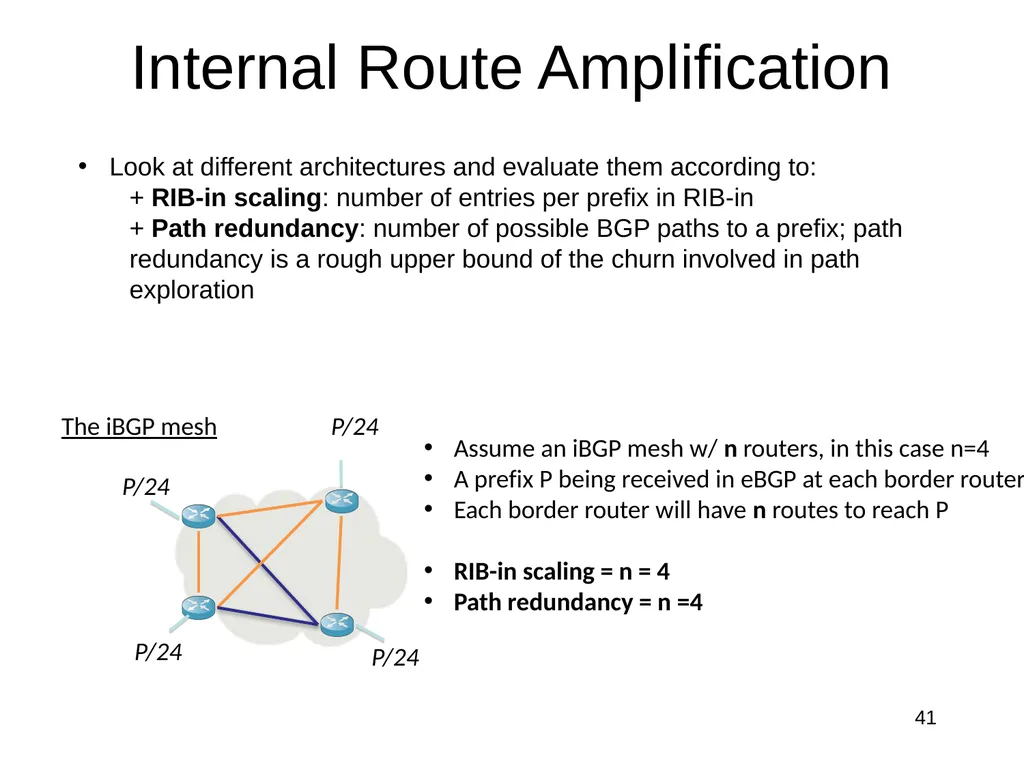
41 Internal Route Amplification Assume an iBGP mesh w/ n routers, in this case n=4
A prefix P being received in eBGP at each border router
Each border router will have n routes to reach P
RIB-in scaling = n = 4
Path redundancy = n =4 Look at different architectures and evaluate them according to:
+ RIB-in scaling: number of entries per prefix in RIB-in
+ Path redundancy: number of possible BGP paths to a prefix; path redundancy is a rough upper bound of the churn involved in path exploration<br>
A prefix P being received in eBGP at each border router
Each border router will have n routes to reach P
RIB-in scaling = n = 4
Path redundancy = n =4 Look at different architectures and evaluate them according to:
+ RIB-in scaling: number of entries per prefix in RIB-in
+ Path redundancy: number of possible BGP paths to a prefix; path redundancy is a rough upper bound of the churn involved in path exploration<br>
42
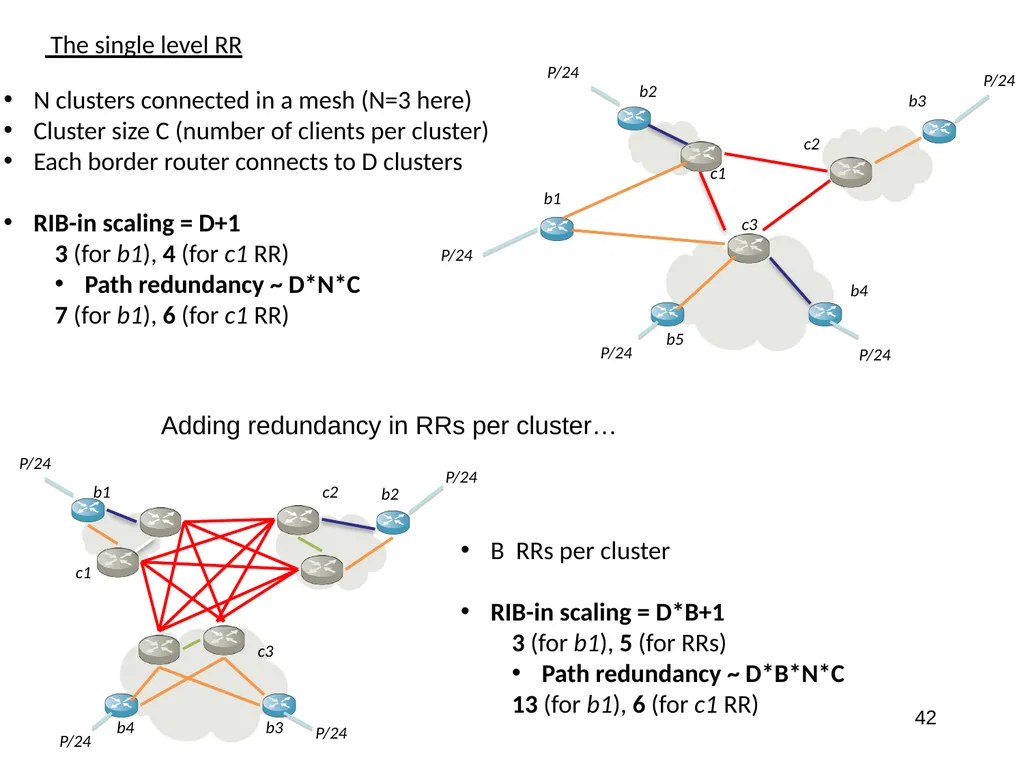
42 P/24 P/24 P/24 P/24 P/24 P/24 P/24 P/24 P/24 b1 b4 b2 b3 c1 c2 c3 c3 c2 c1 N clusters connected in a mesh (N=3 here)
Cluster size C (number of clients per cluster)
Each border router connects to D clusters
RIB-in scaling = D+1
3 (for b1), 4 (for c1 RR)
Path redundancy ~ D*N*C
7 (for b1), 6 (for c1 RR) The single level RR B RRs per cluster
RIB-in scaling = D*B+1
3 (for b1), 5 (for RRs)
Path redundancy ~ D*B*N*C
13 (for b1), 6 (for c1 RR) Adding redundancy in RRs per cluster… b1 b2 b3 b4 b5<br>
Cluster size C (number of clients per cluster)
Each border router connects to D clusters
RIB-in scaling = D+1
3 (for b1), 4 (for c1 RR)
Path redundancy ~ D*N*C
7 (for b1), 6 (for c1 RR) The single level RR B RRs per cluster
RIB-in scaling = D*B+1
3 (for b1), 5 (for RRs)
Path redundancy ~ D*B*N*C
13 (for b1), 6 (for c1 RR) Adding redundancy in RRs per cluster… b1 b2 b3 b4 b5<br>