The U.S. Army and Nuclear Deterrence, 1955 1991 A European historical context David R. Dorondo, Western Carolina University; STRATCOM Academic Alliance 1 2 Volcanoes thought extinct turned out not to be. Jonathan Glover, Humanity: A Moral
"The U.S. Army and Nuclear Deterrence, 1955 – 1991" is the property of its rightful owner. Permission is granted to
download and print the materials on this website for personal, non-commercial use only, and to display it
on your personal computer provided you do not modify the materials and that you retain all copyright
notices contained in the materials. By downloading content from our website, you accept the terms of this
agreement.
Presentation Transcript
01
The U.S. Army and Nuclear Deterrence, 1955 – 1991 A European historical context David R. Dorondo, Western Carolina University; STRATCOM Academic Alliance 1<br>
02
2 Volcanoes thought extinct turned out not to be.
Jonathan Glover,
Humanity: A Moral History of the Twentieth Century
Russia has demonstrated its willingness to use force to alter the map of Europe and impose its will on its neighbors, backed by implicit and explicit nuclear first-use threats.
2018 U.S. Nuclear Posture Review<br>
03
Rationale for historical context while avoiding historical determinism 3<br>
04
From victory in Europe in 1945… 8 May 1945 – V-E Day
Approx. 589,269 US Army/USAAF casualties in the ETO (not including Italy)
Approx. 383,000 UK total military fatalities (of approx. 450,000 total fatalities, military and civilian)
Approx. 9,750,000 Soviet military fatalities (of approx. 26 million total fatalities, military and civilian)
European Axis destroyed; Germany occupied and divided de facto (though not de jure before 1948) 4<br>
05
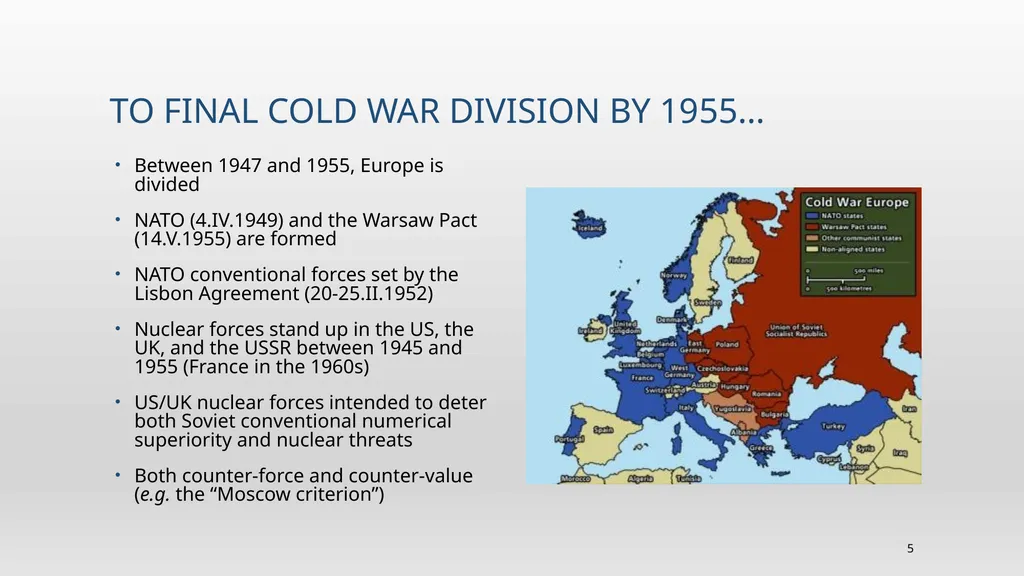
To final Cold War division by 1955… Between 1947 and 1955, Europe is divided
NATO (4.IV.1949) and the Warsaw Pact (14.V.1955) are formed
NATO conventional forces set by the Lisbon Agreement (20-25.II.1952)
Nuclear forces stand up in the US, the UK, and the USSR between 1945 and 1955 (France in the 1960s)
US/UK nuclear forces intended to deter both Soviet conventional numerical superiority and nuclear threats
Both counter-force and counter-value (e.g. the “Moscow criterion”) 5<br>
06
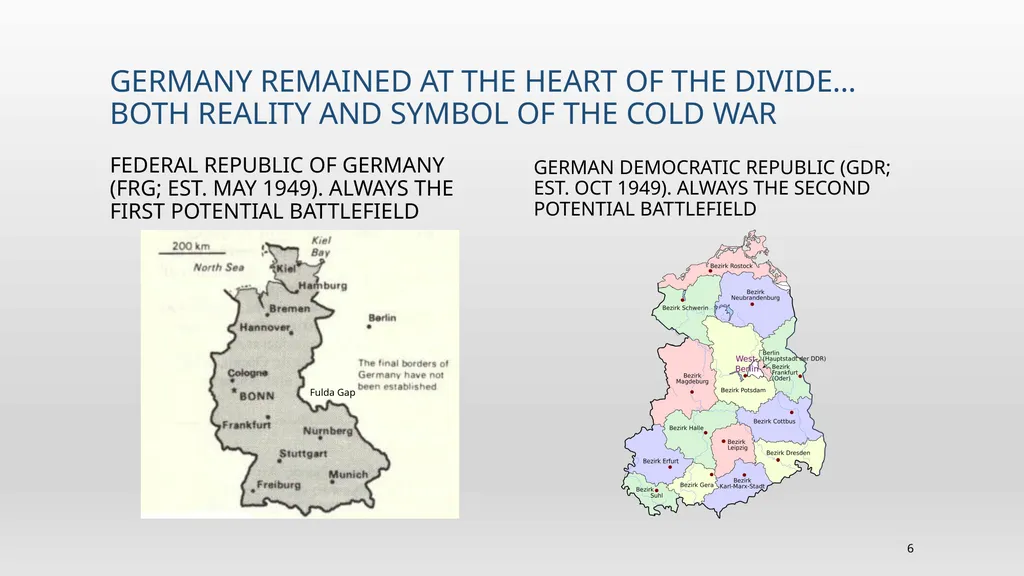
Germany remained at the heart of the divide… both reality and symbol of the cold war Federal Republic of Germany (FRG; est. May 1949). always the first potential battlefield German democratic republic (GDR; est. oct 1949). always the second potential battlefield 6 Fulda Gap<br>
07
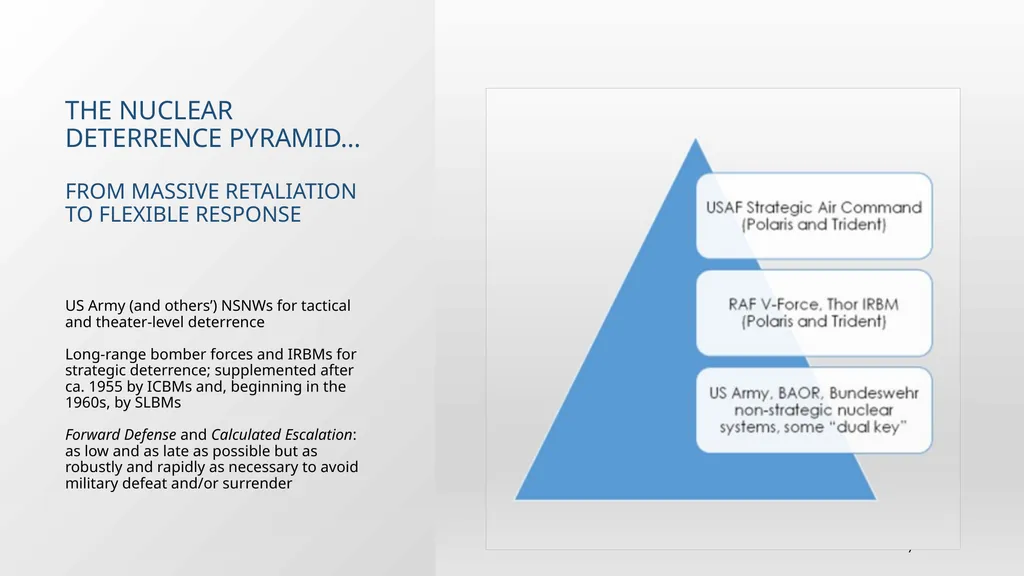
The nuclear deterrence pyramid… from massive retaliation to flexible response US Army (and others’) NSNWs for tactical and theater-level deterrence
Long-range bomber forces and IRBMs for strategic deterrence; supplemented after ca. 1955 by ICBMs and, beginning in the 1960s, by SLBMs
Forward Defense and Calculated Escalation: as low and as late as possible but as robustly and rapidly as necessary to avoid military defeat and/or surrender 7<br>
08
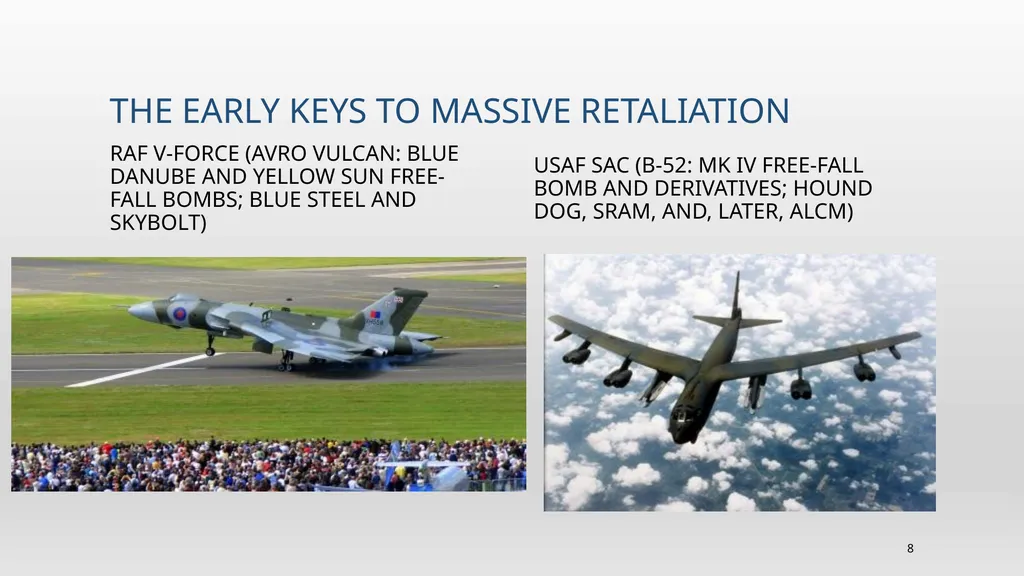
The early keys to massive retaliation RAF V-Force (avro Vulcan: Blue Danube and yellow sun free-fall bombs; blue steel and Skybolt) USAF SAC (B-52: MK IV free-fall bomb and derivatives; hound dog, sram, and, later, alcm) 8<br>
09
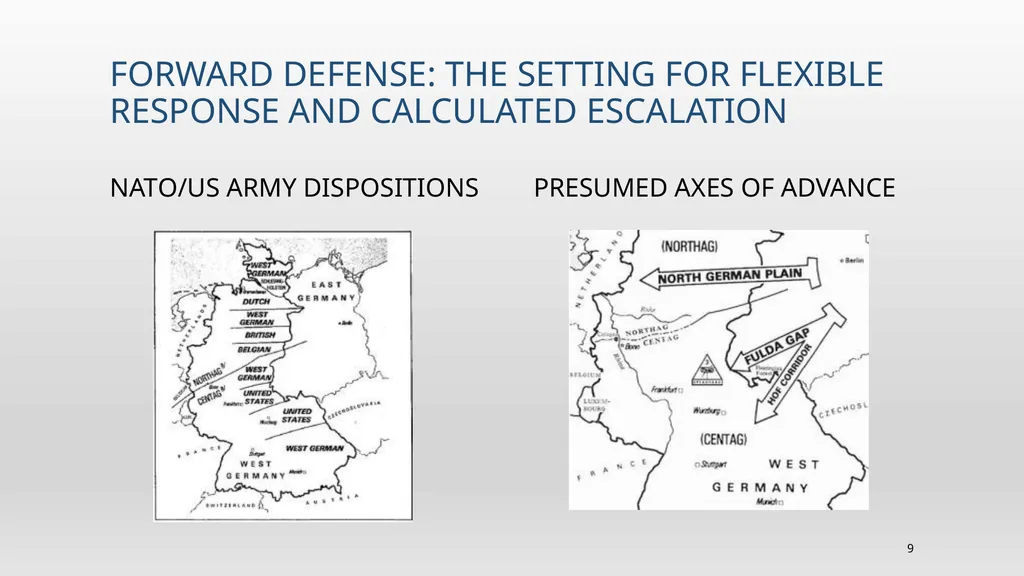
Forward defense: the setting for flexible response and calculated escalation NATO/US ARMY DISPOSITIONS PRESUMED AXES OF ADVANCE 9<br>
10
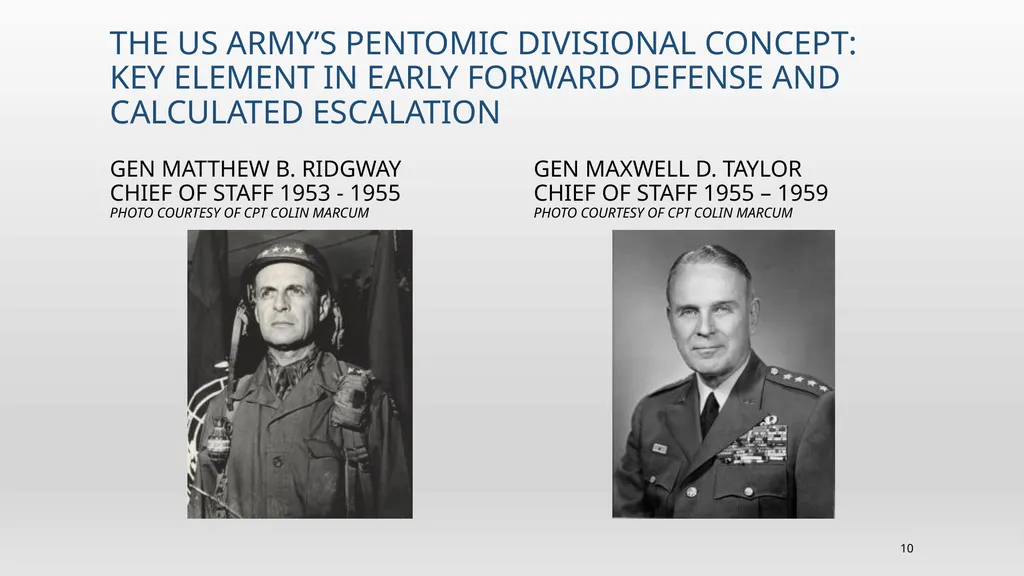
the us army’s pentomic divisional concept: key element in early forward defense and calculated escalation GEN Matthew B. Ridgway
Chief of staff 1953 - 1955
Photo courtesy of CPT Colin Marcum GEN Maxwell D. Taylor
Chief of staff 1955 – 1959
Photo courtesy of CPT Colin Marcum 10<br>
11
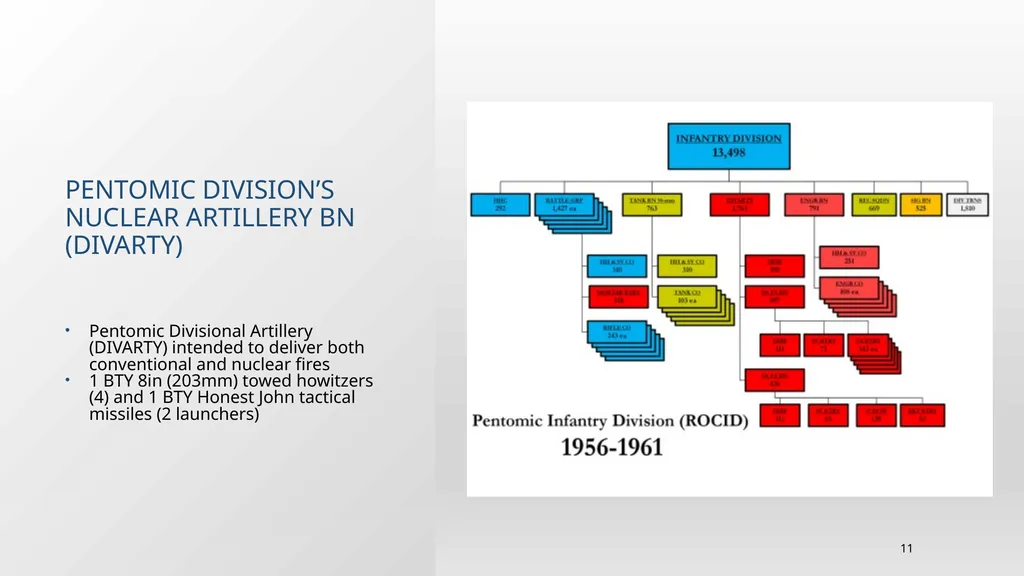
pentomic division’s Nuclear artillery BN (divarty) Pentomic Divisional Artillery (DIVARTY) intended to deliver both conventional and nuclear fires
1 BTY 8in (203mm) towed howitzers (4) and 1 BTY Honest John tactical missiles (2 launchers) 11<br>
12
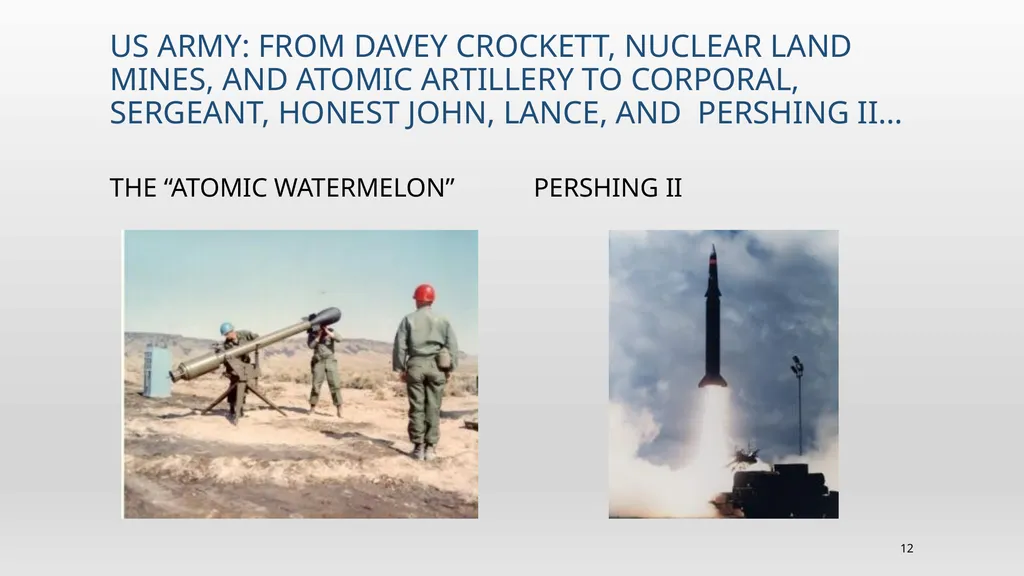
US Army: From davey crockett, nuclear land mines, and atomic artillery to corporal, sergeant, honest john, lance, and pershing II… The “Atomic watermelon” Pershing II 12<br>
13
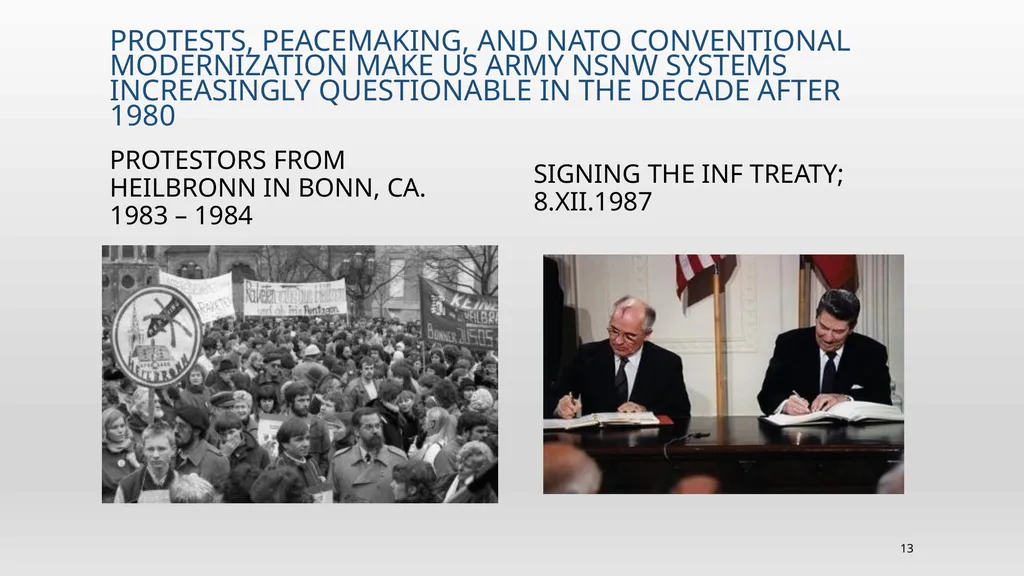
Protests, peacemaking, and nato conventional modernization make US army nsnw systems increasingly questionable in the decade after 1980 Protestors from Heilbronn in bonn, ca. 1983 – 1984 Signing the inf treaty; 8.XII.1987 13<br>
14
conclusion “Planning deterrence means thinking through the possible reasoning of an adversary and the way in which alternative courses of action might appear to him in advance. It also means doing this in his terms, and not in ours; and allowing for how he might think in future circumstances, not just in today’s. In essence we seek to ensure that, whatever military aggression or political bullying a future [Russian] leader might contemplate, he could not foresee any likely situation in which the West would be left with no realistic alternative….No safer system than deterrence is yet in view, and impatience would be a catastrophic guide in the search. To tear down the present structure, imperfect but effective, before a better one is firmly within our grasp would be an immensely dangerous and irresponsible act.” Statement on the Defence Estimates 1981 (Cmnd. 8212-1, pp 13-14) See Quinlan, Thinking About Nuclear Weapons (2009/2013) 14<br>
15
Further reading Bacevich, A. J. The Pentomic Era: The U.S. Army Between Korea and Vietnam (Washington: NDU Press, 1986)
Frankel, Michael, et al. Nonstrategic Nuclear Weapons at an Inflection Point: National Security Perspective (Baltimore: JHUP/APL, 2017)
Glover, Jonathan. Humanity: A Moral History of the Twentieth Century (New Haven: Yale University Press, 1999)
Hennessey, Peter. Cabinets and the Bomb (Oxford: Oxford University Press, 2007)
Krüger, Dieter and Volker Bausch, eds. Fulda Gap: Battlefield of the Cold War Alliances. Trans. David R. Dorondo (New York: Lexington Books, 2018)
Quinlan, Michael. Thinking About Nuclear Weapons: Principles, Prospects, Prospects (Oxford, Oxford University Press, 2009) 15<br>