
Therapeutic Communication in Psychiatric Nursing



Description: Therapeutic Communication in Psychiatric Nursing PREPARED PRESENTED BY Instructor Safi Dakhil Nawam University of Karbala college of nursing 2016-2017 PsychiatricMental Health Nursing department 11 November 2017 1 Introduction The
Related Topics
Download Presentation
"Therapeutic Communication in Psychiatric Nursing" is the property of its rightful owner. Permission is granted to download and print the materials on this website for personal, non-commercial use only, and to display it on your personal computer provided you do not modify the materials and that you retain all copyright notices contained in the materials. By downloading content from our website, you accept the terms of this agreement.
Presentation Transcript
slide1. Therapeutic Communication in Psychiatric Nursing PREPARED & PRESENTED BY
Instructor /Safi Dakhil Nawam
University of Karbala / college of nursing
2016-2017
Psychiatric–Mental Health Nursing
department 11 November 2017 1<br>
slide2. Introduction The nurse-client relationship is the foundation on which psychiatric nursing is established.
The therapeutic interpersonal relationship is the process by which nurses provide care for clients in need of psychosocial intervention.
Mental health providers need to know how to gain trust and gather information from the patient, the patient's family, friends and relevant social relations, and to involve them in an effective treatment plan.
Therapeutic use of self is the instrument for delivery of care to clients in need of psychosocial intervention.
Interpersonal communication techniques are the “tools” of psychosocial intervention 11 November 2017 2<br>
slide3. THERAPEUTIC NURSE-CLIENT RELATIONSHIP Therapeutic relationships are goal-oriented and directed at learning and growth promotion.
Therapeutic Use of Self
Definition - therapeutic nurse-client relationship is the ability to use one’s personality consciously and in full awareness in an attempt to establish relatedness and to structure nursing interventions.
Nurses must possess self-awareness, self-understanding, and a philosophical belief about life, death, and the overall human condition for effective therapeutic use of self. 11 November 2017 3<br>
slide4. Requirements for Therapeutic Relationship Rapport
Trust
Respect
Genuineness
Empathy 11 November 2017 4<br>
slide5. Phases of a Therapeutic Nurse-Client Relationship Pre-orientation phase
2. Orientation phase
3. Working phase
4. Termination phase 11 November 2017 5<br>
slide6. Interpersonal Communication Interpersonal communication is a transaction between the sender and the receiver. Both persons participate simultaneously.
In the transactional model, both participants perceive each other, listen to each other, and simultaneously engage in the process of creating meaning in a relationship, focusing on the patients issues and assisting them learn new coping skills.
Both sender and receiver bring certain preexisting conditions to the exchange that influence the intended message and the way in which message is interpreted. 11 November 2017 6<br>
slide7. Context of therapeutic communication Values, attitudes, and beliefs.
Example: attitudes of prejudice are expressed through negative stereotyping.
Culture or religion
Cultural mores, norms, ideas, and customs provide the basis for ways of thinking.
Social status
High-status persons often convey their high-power position with gestures of hands on hips, power dressing, greater height, and more distance when communicating with individuals considered to be of lower social status.
Gender
Masculine and feminine gestures influence messages conveyed in communication with others.
Age or developmental level
Example: The influence of developmental level on communication is especially evident during adolescence, with words such as “cool,” “awesome,” and others. 11 November 2017 7<br>
slide8. The environment Territoriality, density, and distance are aspects of environment that communicate messages.
Territoriality - the innate tendency to own space
Density - the number of people within a given environmental space
Distance - the means by which various cultures use space to communicate 11 November 2017 8<br>
slide9. Proxemics: Use of Space Intimate distance - the closest distance that individuals allow between themselves and other
Personal distance -the distance for interactions that are personal in nature, such as close conversation with friends
Social distance - the distance for conversation with strangers or acquaintances
Public distance - the distance for speaking in public or yelling to someone some distance away 11 November 2017 9<br>
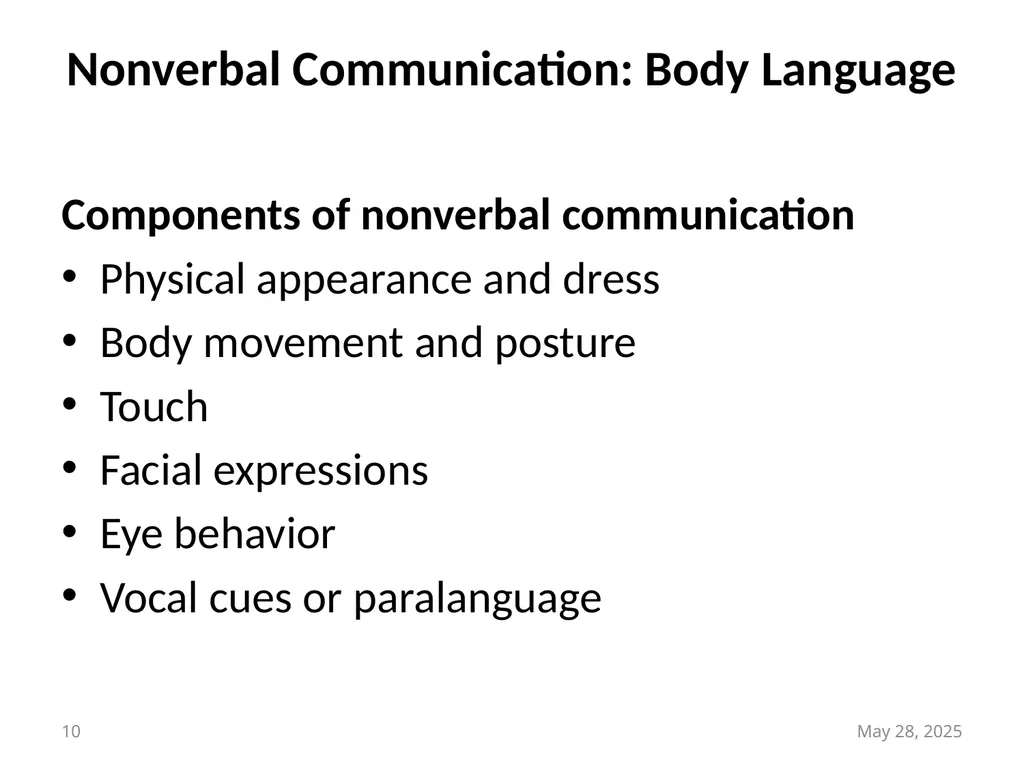
slide10. Nonverbal Communication: Body Language Components of nonverbal communication
Physical appearance and dress
Body movement and posture
Touch
Facial expressions
Eye behavior
Vocal cues or paralanguage 11 November 2017 10<br>
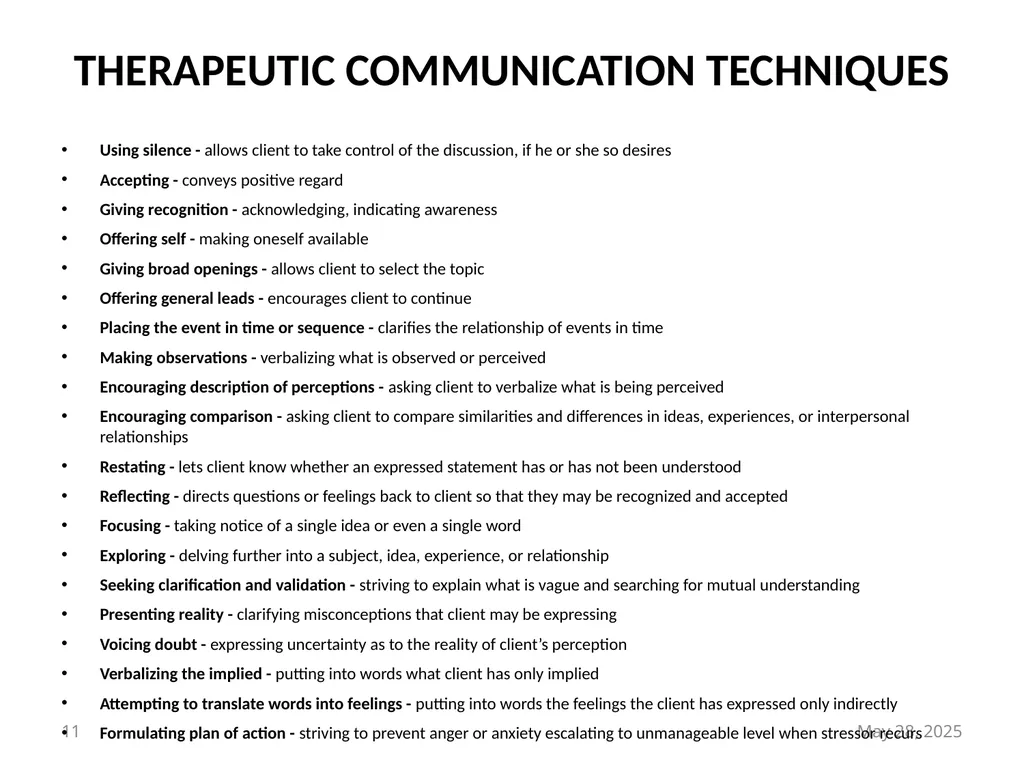
slide11. THERAPEUTIC COMMUNICATION TECHNIQUES Using silence - allows client to take control of the discussion, if he or she so desires
Accepting - conveys positive regard
Giving recognition - acknowledging, indicating awareness
Offering self - making oneself available
Giving broad openings - allows client to select the topic
Offering general leads - encourages client to continue
Placing the event in time or sequence - clarifies the relationship of events in time
Making observations - verbalizing what is observed or perceived
Encouraging description of perceptions - asking client to verbalize what is being perceived
Encouraging comparison - asking client to compare similarities and differences in ideas, experiences, or interpersonal relationships
Restating - lets client know whether an expressed statement has or has not been understood
Reflecting - directs questions or feelings back to client so that they may be recognized and accepted
Focusing - taking notice of a single idea or even a single word
Exploring - delving further into a subject, idea, experience, or relationship
Seeking clarification and validation - striving to explain what is vague and searching for mutual understanding
Presenting reality - clarifying misconceptions that client may be expressing
Voicing doubt - expressing uncertainty as to the reality of client’s perception
Verbalizing the implied - putting into words what client has only implied
Attempting to translate words into feelings - putting into words the feelings the client has expressed only indirectly
Formulating plan of action - striving to prevent anger or anxiety escalating to unmanageable level when stressor recurs 11 November 2017 11<br>
slide12. Therapeutic communication and problem-solving Goals are often achieved through use of the problem-solving model:
Identify the client’s problem.
Promote discussion of desired changes.
Discuss alternative strategies for creating changes the client desires to make.
Evaluate benefits and consequences of each alternatives.
Help client select an alternatives.
Encourage client to implement the change.
Provide positive feedback for client’s attempts to create change.
Help client evaluate outcomes of the change and make modifications as required. 11 November 2017 12<br>
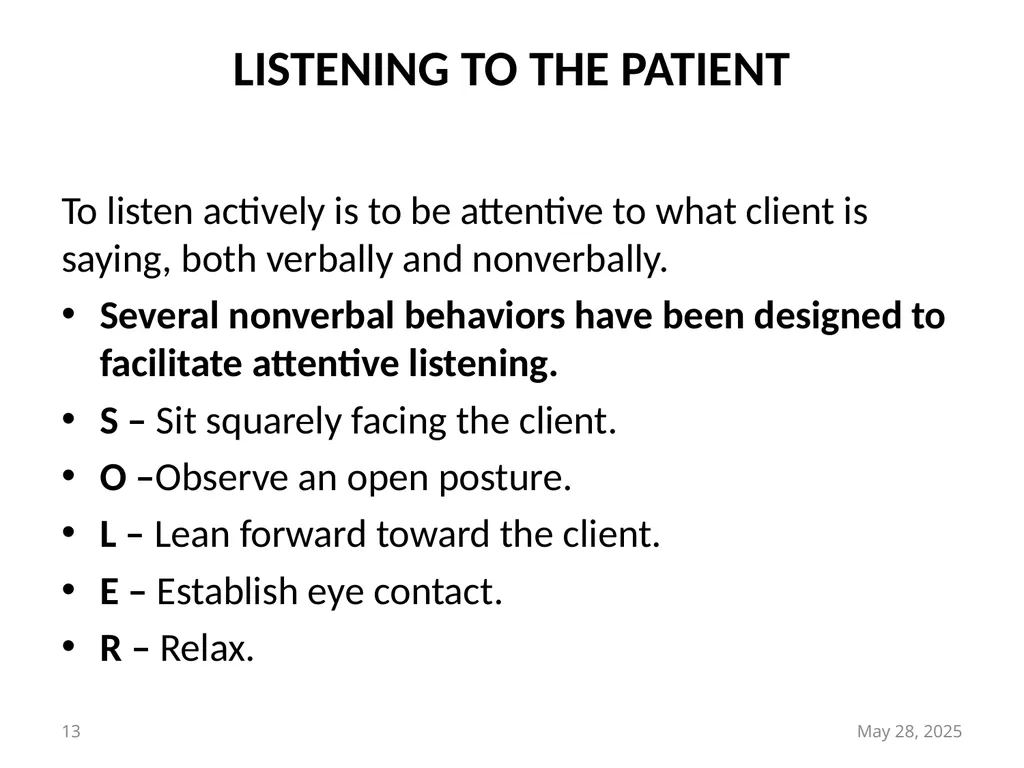
slide13. LISTENING TO THE PATIENT To listen actively is to be attentive to what client is saying, both verbally and nonverbally.
Several nonverbal behaviors have been designed to facilitate attentive listening.
S – Sit squarely facing the client.
O –Observe an open posture.
L – Lean forward toward the client.
E – Establish eye contact.
R – Relax. 11 November 2017 13<br>
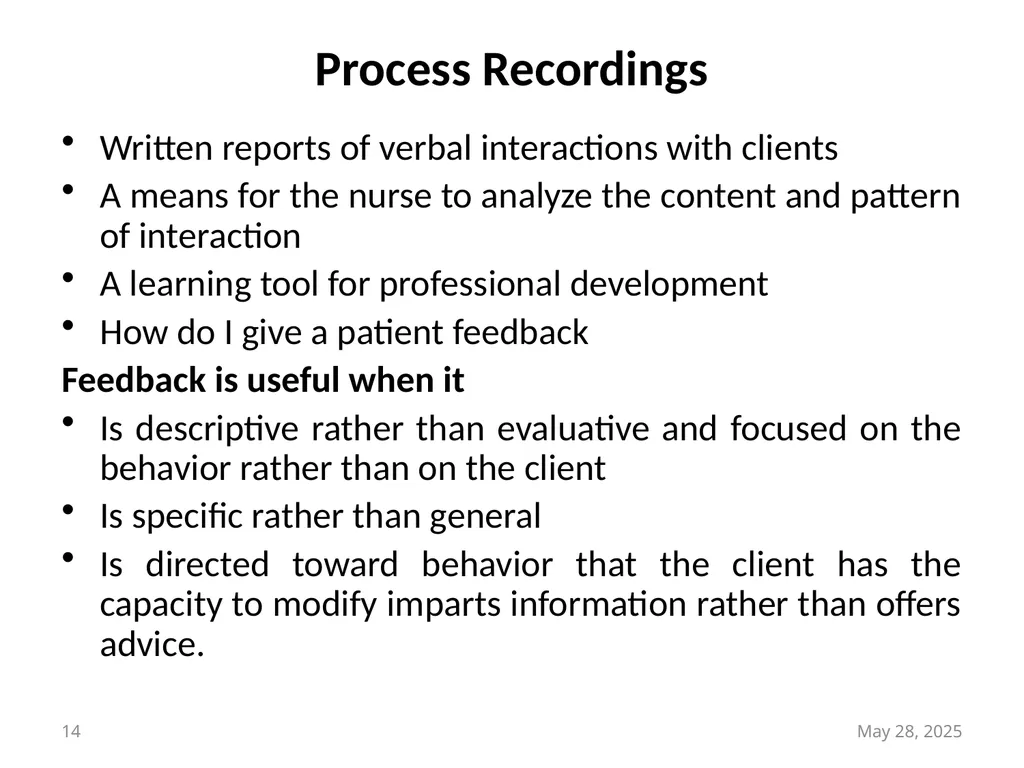
slide14. Process Recordings Written reports of verbal interactions with clients
A means for the nurse to analyze the content and pattern of interaction
A learning tool for professional development
How do I give a patient feedback
Feedback is useful when it
Is descriptive rather than evaluative and focused on the behavior rather than on the client
Is specific rather than general
Is directed toward behavior that the client has the capacity to modify imparts information rather than offers advice. 11 November 2017 14<br>
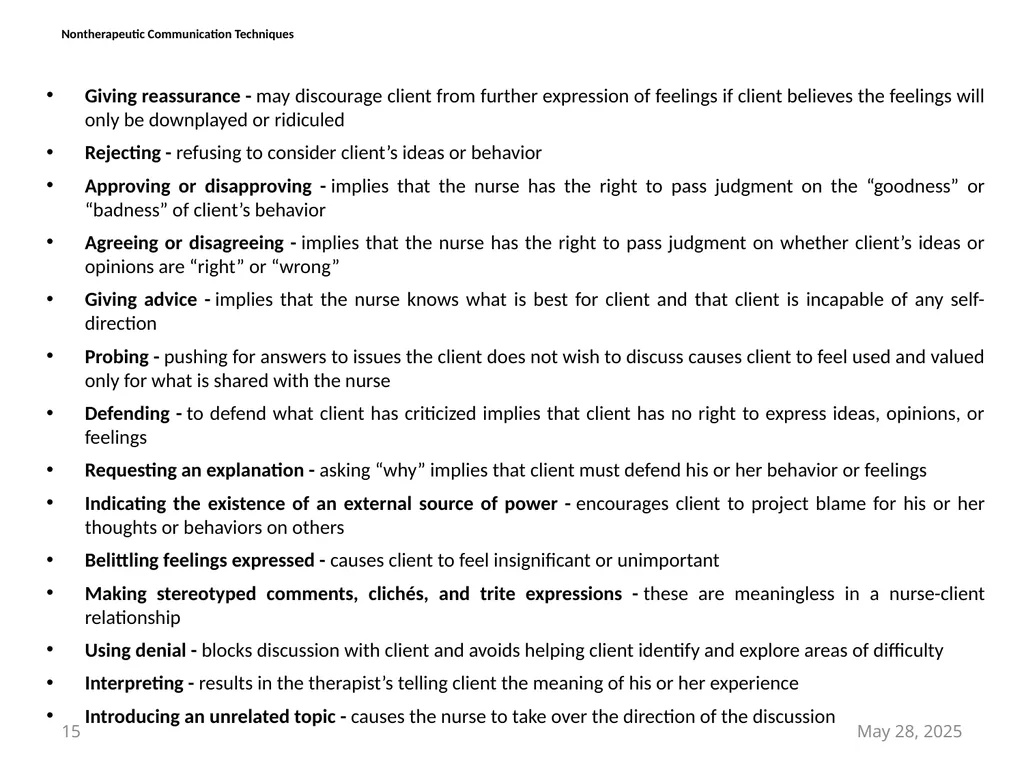
slide15. Nontherapeutic Communication Techniques Giving reassurance - may discourage client from further expression of feelings if client believes the feelings will only be downplayed or ridiculed
Rejecting - refusing to consider client’s ideas or behavior
Approving or disapproving - implies that the nurse has the right to pass judgment on the “goodness” or “badness” of client’s behavior
Agreeing or disagreeing - implies that the nurse has the right to pass judgment on whether client’s ideas or opinions are “right” or “wrong”
Giving advice - implies that the nurse knows what is best for client and that client is incapable of any self-direction
Probing - pushing for answers to issues the client does not wish to discuss causes client to feel used and valued only for what is shared with the nurse
Defending - to defend what client has criticized implies that client has no right to express ideas, opinions, or feelings
Requesting an explanation - asking “why” implies that client must defend his or her behavior or feelings
Indicating the existence of an external source of power - encourages client to project blame for his or her thoughts or behaviors on others
Belittling feelings expressed - causes client to feel insignificant or unimportant
Making stereotyped comments, clichés, and trite expressions - these are meaningless in a nurse-client relationship
Using denial - blocks discussion with client and avoids helping client identify and explore areas of difficulty
Interpreting - results in the therapist’s telling client the meaning of his or her experience
Introducing an unrelated topic - causes the nurse to take over the direction of the discussion 11 November 2017 15<br>
slide16. CONCLUSION Effective communication is the core skill in mental health care in primary care settings.
Self-awareness and ability to collaborate with other health care providers are also skills that will facilitate accurate inquiry into the patient's true concerns and the context in which they occur. 11 November 2017 16<br>
Instructor /Safi Dakhil Nawam
University of Karbala / college of nursing
2016-2017
Psychiatric–Mental Health Nursing
department 11 November 2017 1<br>
slide2. Introduction The nurse-client relationship is the foundation on which psychiatric nursing is established.
The therapeutic interpersonal relationship is the process by which nurses provide care for clients in need of psychosocial intervention.
Mental health providers need to know how to gain trust and gather information from the patient, the patient's family, friends and relevant social relations, and to involve them in an effective treatment plan.
Therapeutic use of self is the instrument for delivery of care to clients in need of psychosocial intervention.
Interpersonal communication techniques are the “tools” of psychosocial intervention 11 November 2017 2<br>
slide3. THERAPEUTIC NURSE-CLIENT RELATIONSHIP Therapeutic relationships are goal-oriented and directed at learning and growth promotion.
Therapeutic Use of Self
Definition - therapeutic nurse-client relationship is the ability to use one’s personality consciously and in full awareness in an attempt to establish relatedness and to structure nursing interventions.
Nurses must possess self-awareness, self-understanding, and a philosophical belief about life, death, and the overall human condition for effective therapeutic use of self. 11 November 2017 3<br>
slide4. Requirements for Therapeutic Relationship Rapport
Trust
Respect
Genuineness
Empathy 11 November 2017 4<br>
slide5. Phases of a Therapeutic Nurse-Client Relationship Pre-orientation phase
2. Orientation phase
3. Working phase
4. Termination phase 11 November 2017 5<br>
slide6. Interpersonal Communication Interpersonal communication is a transaction between the sender and the receiver. Both persons participate simultaneously.
In the transactional model, both participants perceive each other, listen to each other, and simultaneously engage in the process of creating meaning in a relationship, focusing on the patients issues and assisting them learn new coping skills.
Both sender and receiver bring certain preexisting conditions to the exchange that influence the intended message and the way in which message is interpreted. 11 November 2017 6<br>
slide7. Context of therapeutic communication Values, attitudes, and beliefs.
Example: attitudes of prejudice are expressed through negative stereotyping.
Culture or religion
Cultural mores, norms, ideas, and customs provide the basis for ways of thinking.
Social status
High-status persons often convey their high-power position with gestures of hands on hips, power dressing, greater height, and more distance when communicating with individuals considered to be of lower social status.
Gender
Masculine and feminine gestures influence messages conveyed in communication with others.
Age or developmental level
Example: The influence of developmental level on communication is especially evident during adolescence, with words such as “cool,” “awesome,” and others. 11 November 2017 7<br>
slide8. The environment Territoriality, density, and distance are aspects of environment that communicate messages.
Territoriality - the innate tendency to own space
Density - the number of people within a given environmental space
Distance - the means by which various cultures use space to communicate 11 November 2017 8<br>
slide9. Proxemics: Use of Space Intimate distance - the closest distance that individuals allow between themselves and other
Personal distance -the distance for interactions that are personal in nature, such as close conversation with friends
Social distance - the distance for conversation with strangers or acquaintances
Public distance - the distance for speaking in public or yelling to someone some distance away 11 November 2017 9<br>
slide10. Nonverbal Communication: Body Language Components of nonverbal communication
Physical appearance and dress
Body movement and posture
Touch
Facial expressions
Eye behavior
Vocal cues or paralanguage 11 November 2017 10<br>
slide11. THERAPEUTIC COMMUNICATION TECHNIQUES Using silence - allows client to take control of the discussion, if he or she so desires
Accepting - conveys positive regard
Giving recognition - acknowledging, indicating awareness
Offering self - making oneself available
Giving broad openings - allows client to select the topic
Offering general leads - encourages client to continue
Placing the event in time or sequence - clarifies the relationship of events in time
Making observations - verbalizing what is observed or perceived
Encouraging description of perceptions - asking client to verbalize what is being perceived
Encouraging comparison - asking client to compare similarities and differences in ideas, experiences, or interpersonal relationships
Restating - lets client know whether an expressed statement has or has not been understood
Reflecting - directs questions or feelings back to client so that they may be recognized and accepted
Focusing - taking notice of a single idea or even a single word
Exploring - delving further into a subject, idea, experience, or relationship
Seeking clarification and validation - striving to explain what is vague and searching for mutual understanding
Presenting reality - clarifying misconceptions that client may be expressing
Voicing doubt - expressing uncertainty as to the reality of client’s perception
Verbalizing the implied - putting into words what client has only implied
Attempting to translate words into feelings - putting into words the feelings the client has expressed only indirectly
Formulating plan of action - striving to prevent anger or anxiety escalating to unmanageable level when stressor recurs 11 November 2017 11<br>
slide12. Therapeutic communication and problem-solving Goals are often achieved through use of the problem-solving model:
Identify the client’s problem.
Promote discussion of desired changes.
Discuss alternative strategies for creating changes the client desires to make.
Evaluate benefits and consequences of each alternatives.
Help client select an alternatives.
Encourage client to implement the change.
Provide positive feedback for client’s attempts to create change.
Help client evaluate outcomes of the change and make modifications as required. 11 November 2017 12<br>
slide13. LISTENING TO THE PATIENT To listen actively is to be attentive to what client is saying, both verbally and nonverbally.
Several nonverbal behaviors have been designed to facilitate attentive listening.
S – Sit squarely facing the client.
O –Observe an open posture.
L – Lean forward toward the client.
E – Establish eye contact.
R – Relax. 11 November 2017 13<br>
slide14. Process Recordings Written reports of verbal interactions with clients
A means for the nurse to analyze the content and pattern of interaction
A learning tool for professional development
How do I give a patient feedback
Feedback is useful when it
Is descriptive rather than evaluative and focused on the behavior rather than on the client
Is specific rather than general
Is directed toward behavior that the client has the capacity to modify imparts information rather than offers advice. 11 November 2017 14<br>
slide15. Nontherapeutic Communication Techniques Giving reassurance - may discourage client from further expression of feelings if client believes the feelings will only be downplayed or ridiculed
Rejecting - refusing to consider client’s ideas or behavior
Approving or disapproving - implies that the nurse has the right to pass judgment on the “goodness” or “badness” of client’s behavior
Agreeing or disagreeing - implies that the nurse has the right to pass judgment on whether client’s ideas or opinions are “right” or “wrong”
Giving advice - implies that the nurse knows what is best for client and that client is incapable of any self-direction
Probing - pushing for answers to issues the client does not wish to discuss causes client to feel used and valued only for what is shared with the nurse
Defending - to defend what client has criticized implies that client has no right to express ideas, opinions, or feelings
Requesting an explanation - asking “why” implies that client must defend his or her behavior or feelings
Indicating the existence of an external source of power - encourages client to project blame for his or her thoughts or behaviors on others
Belittling feelings expressed - causes client to feel insignificant or unimportant
Making stereotyped comments, clichés, and trite expressions - these are meaningless in a nurse-client relationship
Using denial - blocks discussion with client and avoids helping client identify and explore areas of difficulty
Interpreting - results in the therapist’s telling client the meaning of his or her experience
Introducing an unrelated topic - causes the nurse to take over the direction of the discussion 11 November 2017 15<br>
slide16. CONCLUSION Effective communication is the core skill in mental health care in primary care settings.
Self-awareness and ability to collaborate with other health care providers are also skills that will facilitate accurate inquiry into the patient's true concerns and the context in which they occur. 11 November 2017 16<br>