
VCH 602 : ORGANIZATION AND REGULATION OF
TD
Published · 21 slides · 0 views

1 / 1



Description
VCH 602 : ORGANIZATION AND REGULATION OF VETERINARY SERVICES (2UNITS) Organization of Veterinary Services in Nigeria; - Public sector, private sector and International opportunities Veterinary Ethics Veterinary Practicing Licence
Related Topics
Share
Embed code
Download this presentation From Below
"VCH 602 : ORGANIZATION AND REGULATION OF" is the property of its rightful owner. Permission is granted to download and print the materials on this website for personal, non-commercial use only, and to display it on your personal computer provided you do not modify the materials and that you retain all copyright notices contained in the materials. By downloading content from our website, you accept the terms of this agreement.
Presentation Transcript
01
VCH 602 :
ORGANIZATION AND REGULATION OF VETERINARY SERVICES (2UNITS) Organization of Veterinary Services in Nigeria;
- Public sector, private sector and
International opportunities
Veterinary Ethics
Veterinary Practicing Licence
Registration of practicing premises<br>
- Public sector, private sector and
International opportunities
Veterinary Ethics
Veterinary Practicing Licence
Registration of practicing premises<br>
02
Organization of Veterinary Services in Nigeria Veterinary services in Nigeria started in 1914
Organizational structure based mainly on public and private sector
Public structure
Employment of Veterinarians by the government
(Federal, State and to a lesser extent, Local government)
Private sector
Set-up of practice by Veterinarians for the purpose of conducting business within the confines of Veterinary profession<br>
Organizational structure based mainly on public and private sector
Public structure
Employment of Veterinarians by the government
(Federal, State and to a lesser extent, Local government)
Private sector
Set-up of practice by Veterinarians for the purpose of conducting business within the confines of Veterinary profession<br>
03
Private Sector Private practice
Self-practice (formally designated area for the practice of Veterinary Medicine
Work for others in the set-up
Veterinarians can combine resources to jointly have a practice (based on trust; integrity is the watchword)
Veterinary Doctors can do locum i.e. work on agreed hrs/wk/practice. Allows for flexibility and expertise can be transferred between practices. (enrich Veterinarians and the profession)
Pest control services
House calls and consultancy services
Pet shop/mart, meat mart
Kernels for dog breeding (may include dog training)
Veterinary Diagnostic Centres<br>
Self-practice (formally designated area for the practice of Veterinary Medicine
Work for others in the set-up
Veterinarians can combine resources to jointly have a practice (based on trust; integrity is the watchword)
Veterinary Doctors can do locum i.e. work on agreed hrs/wk/practice. Allows for flexibility and expertise can be transferred between practices. (enrich Veterinarians and the profession)
Pest control services
House calls and consultancy services
Pet shop/mart, meat mart
Kernels for dog breeding (may include dog training)
Veterinary Diagnostic Centres<br>
04
Private Sector Farms
Veterinarians can have livestock, poultry farms
Be employed by others in the sector
Fish farming (against the background knowledge of fish diseases and management)
The organised Private Sector
Banks
loan section and scrutinizing feasibility reports
Pharmaceutical companies
Employed for the production of Veterinary drugs
Marketing and distribution of Veterinary drugs
Feed-mill
Veterinarians can have their own feed mills
Consultant to feed millers
Employed in the feed milling industry<br>
Veterinarians can have livestock, poultry farms
Be employed by others in the sector
Fish farming (against the background knowledge of fish diseases and management)
The organised Private Sector
Banks
loan section and scrutinizing feasibility reports
Pharmaceutical companies
Employed for the production of Veterinary drugs
Marketing and distribution of Veterinary drugs
Feed-mill
Veterinarians can have their own feed mills
Consultant to feed millers
Employed in the feed milling industry<br>
05
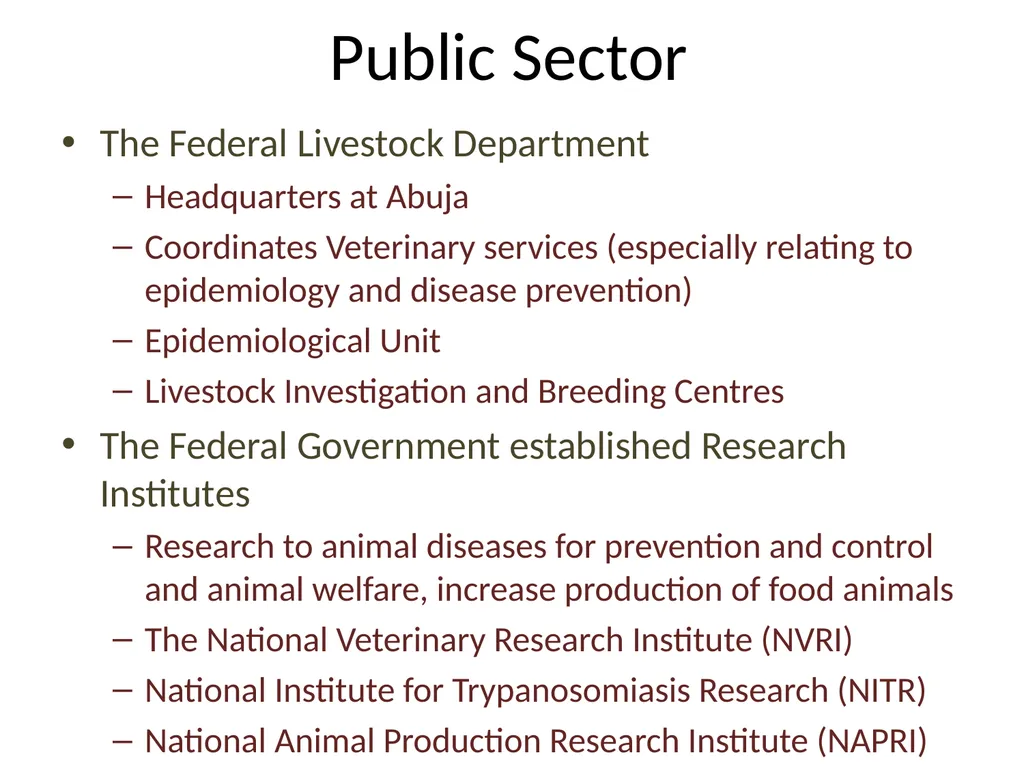
Public Sector The Federal Livestock Department
Headquarters at Abuja
Coordinates Veterinary services (especially relating to epidemiology and disease prevention)
Epidemiological Unit
Livestock Investigation and Breeding Centres
The Federal Government established Research Institutes
Research to animal diseases for prevention and control and animal welfare, increase production of food animals
The National Veterinary Research Institute (NVRI)
National Institute for Trypanosomiasis Research (NITR)
National Animal Production Research Institute (NAPRI)<br>
Headquarters at Abuja
Coordinates Veterinary services (especially relating to epidemiology and disease prevention)
Epidemiological Unit
Livestock Investigation and Breeding Centres
The Federal Government established Research Institutes
Research to animal diseases for prevention and control and animal welfare, increase production of food animals
The National Veterinary Research Institute (NVRI)
National Institute for Trypanosomiasis Research (NITR)
National Animal Production Research Institute (NAPRI)<br>
06
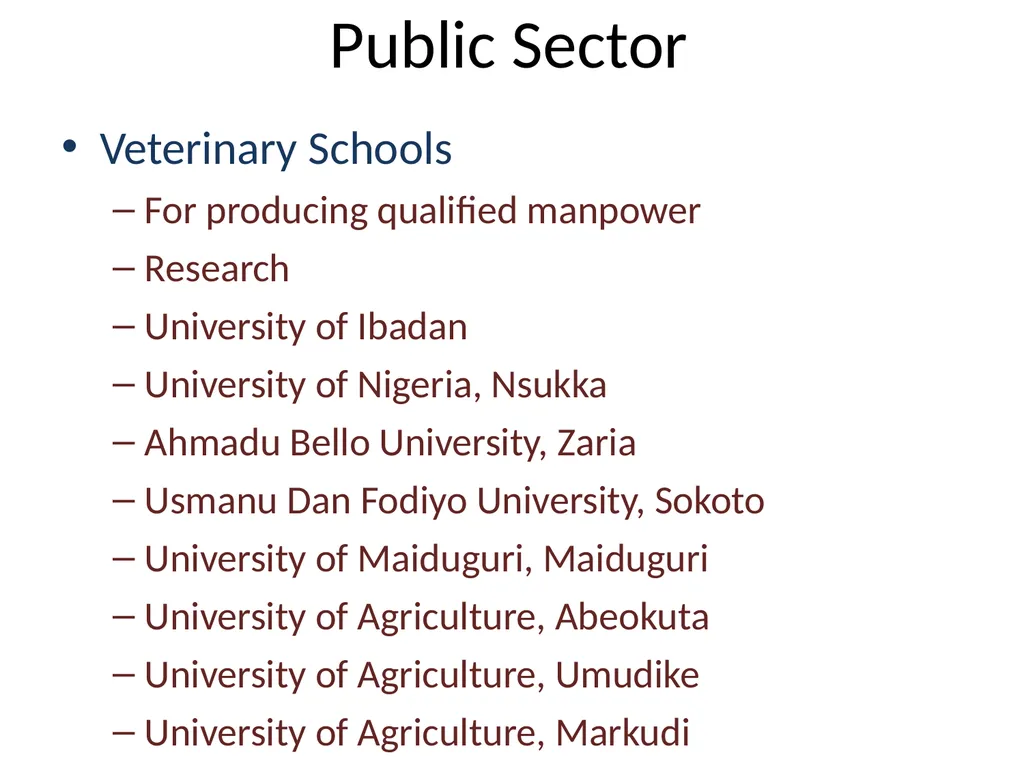
Public Sector Veterinary Schools
For producing qualified manpower
Research
University of Ibadan
University of Nigeria, Nsukka
Ahmadu Bello University, Zaria
Usmanu Dan Fodiyo University, Sokoto
University of Maiduguri, Maiduguri
University of Agriculture, Abeokuta
University of Agriculture, Umudike
University of Agriculture, Markudi<br>
For producing qualified manpower
Research
University of Ibadan
University of Nigeria, Nsukka
Ahmadu Bello University, Zaria
Usmanu Dan Fodiyo University, Sokoto
University of Maiduguri, Maiduguri
University of Agriculture, Abeokuta
University of Agriculture, Umudike
University of Agriculture, Markudi<br>
07
The Military
Care for dogs and horses used at the Military base
Airport
Prevention and transmission of diseases across borders
Animals imported must have authenticated documents of disease-free status
If not available, quarantine procedures must be put in place for certification
National Agency for Food and Drug Administration and Control (NAFDAC)
Polo
Zoological Parks<br>
Care for dogs and horses used at the Military base
Airport
Prevention and transmission of diseases across borders
Animals imported must have authenticated documents of disease-free status
If not available, quarantine procedures must be put in place for certification
National Agency for Food and Drug Administration and Control (NAFDAC)
Polo
Zoological Parks<br>
08
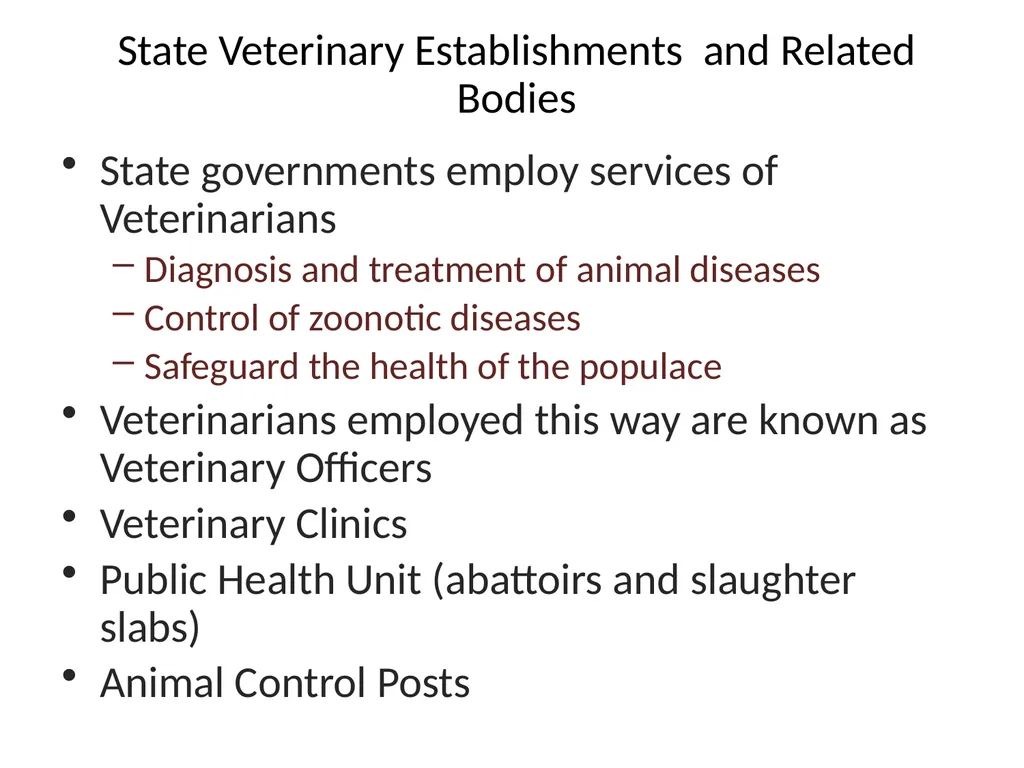
State Veterinary Establishments and Related Bodies State governments employ services of Veterinarians
Diagnosis and treatment of animal diseases
Control of zoonotic diseases
Safeguard the health of the populace
Veterinarians employed this way are known as Veterinary Officers
Veterinary Clinics
Public Health Unit (abattoirs and slaughter slabs)
Animal Control Posts<br>
Diagnosis and treatment of animal diseases
Control of zoonotic diseases
Safeguard the health of the populace
Veterinarians employed this way are known as Veterinary Officers
Veterinary Clinics
Public Health Unit (abattoirs and slaughter slabs)
Animal Control Posts<br>
09
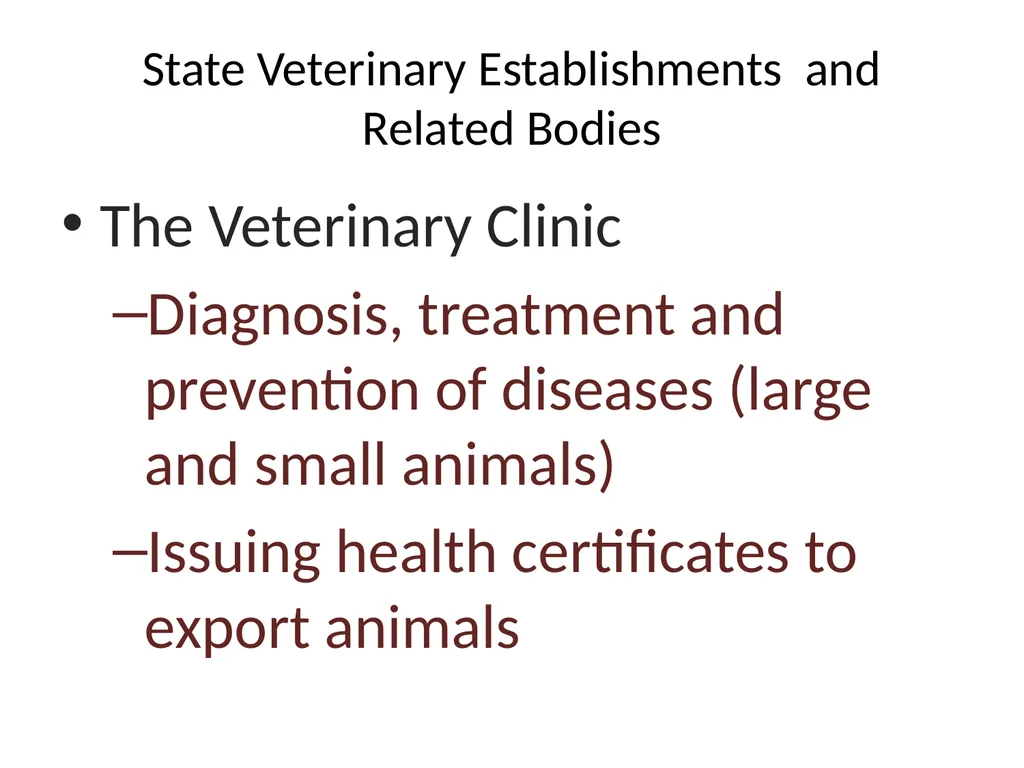
State Veterinary Establishments and Related Bodies The Veterinary Clinic
Diagnosis, treatment and prevention of diseases (large and small animals)
Issuing health certificates to export animals<br>
Diagnosis, treatment and prevention of diseases (large and small animals)
Issuing health certificates to export animals<br>
10
The Public Health Unit
Abattoirs and slaughter slabs
Inspection of food animals prior to and after slaughter
Safe and wholesome meats are produced for the consuming populace<br>
Abattoirs and slaughter slabs
Inspection of food animals prior to and after slaughter
Safe and wholesome meats are produced for the consuming populace<br>
11
Animal Control Post
State Ministry designated areas manned by Veterinarians for inspection of trade animals
To ensure that healthy animals are brought to the state
To prevent the transmission of diseases from one locality to the other<br>
State Ministry designated areas manned by Veterinarians for inspection of trade animals
To ensure that healthy animals are brought to the state
To prevent the transmission of diseases from one locality to the other<br>
12
Opportunities for employment outside the shores of the country Essentials
Need to sit for qualifying examinations for registration
E.g. England; Royal College of Veterinary Surgeons (RCVS)
U.S.A ; examination depends on each state of the country i.e. State by State
Need for some months of acclimatization prior to sitting for examination<br>
Need to sit for qualifying examinations for registration
E.g. England; Royal College of Veterinary Surgeons (RCVS)
U.S.A ; examination depends on each state of the country i.e. State by State
Need for some months of acclimatization prior to sitting for examination<br>
13
Opportunities for employment outside the shores of the country RCVS qualified Veterinarian can work in any of the following places in the U.K
Veterinary General Practice
Urban and Rural Practice
Government Services
State Veterinary Service
Veterinary Field Service
Veterinary Investigation Service
Executive Agencies
Central Veterinary Laboratory (research and consultative support fields)
Veterinary Medicines Directorate (licensing of Veterinary Medicines<br>
Veterinary General Practice
Urban and Rural Practice
Government Services
State Veterinary Service
Veterinary Field Service
Veterinary Investigation Service
Executive Agencies
Central Veterinary Laboratory (research and consultative support fields)
Veterinary Medicines Directorate (licensing of Veterinary Medicines<br>
14
Veterinary Ethics Science of healthy relationships
Veterinary Code of Ethics is concerned with the professional’s relationships
His colleagues, patients, clients, other professionals, the legal authorities, the law enforcement agents and public at large
Ethical approaches ensure orderliness, durable, honourable, peace and great sense of responsibility in the discharge of professional function towards meeting the overall well-being of the society
Code provides an essential link between what is strictly legal and what is simply equitable in contemporary and ultimate social sense and in accordance with the principles of natural justice<br>
Veterinary Code of Ethics is concerned with the professional’s relationships
His colleagues, patients, clients, other professionals, the legal authorities, the law enforcement agents and public at large
Ethical approaches ensure orderliness, durable, honourable, peace and great sense of responsibility in the discharge of professional function towards meeting the overall well-being of the society
Code provides an essential link between what is strictly legal and what is simply equitable in contemporary and ultimate social sense and in accordance with the principles of natural justice<br>
15
Veterinary Ethics Ethics in matters relating to the reputation of the profession
A Veterinarian’s behaviour is said to be unethical if it has fallen short of standards set for the profession
Standards articulated in the Veterinary Oath which places every Veterinarian under an obligation to maintain the interests, honour and dignity of the Veterinary profession<br>
A Veterinarian’s behaviour is said to be unethical if it has fallen short of standards set for the profession
Standards articulated in the Veterinary Oath which places every Veterinarian under an obligation to maintain the interests, honour and dignity of the Veterinary profession<br>
16
Veterinary Ethics Professional premises
Professional premises of a Veterinarian should at all times be in a proper condition for carrying out professional duties
Staffing, facilities and equipment should be maintained at an appropriate standard
Canvassing and Touting for Practice
It is unethical for a Veterinarian to canvas directly or indirectly or tout for practice.
This does not in any way preclude a Veterinarian from applying for any professional appointments or consultancy positions advertised as vacant
Professional appointments should however not be the subject of tendering, as this may lower the image of the profession<br>
Professional premises of a Veterinarian should at all times be in a proper condition for carrying out professional duties
Staffing, facilities and equipment should be maintained at an appropriate standard
Canvassing and Touting for Practice
It is unethical for a Veterinarian to canvas directly or indirectly or tout for practice.
This does not in any way preclude a Veterinarian from applying for any professional appointments or consultancy positions advertised as vacant
Professional appointments should however not be the subject of tendering, as this may lower the image of the profession<br>
17
Veterinary Ethics Ethical relationships amongst Veterinarians
Veterinarians should always make deliberate efforts to be on good terms with one another.
Avoidance of rancour is essential for the maintenance of the reputation of members
Careful consideration should be always be given to all forms of relationships with a view to ensuring common and honourable, peaceful and harmonious dealings
In accordance with the rule of law and the dictates of healthy conscience
It is unethical for a Veterinarian to be involved in the generation and propagation of falsehood about his colleague or any client at all
Courtesy is also an integral part of ethical relationships between Veterinarians
Mutual respect between Veterinarians is thus considered ethical and part of good education<br>
Veterinarians should always make deliberate efforts to be on good terms with one another.
Avoidance of rancour is essential for the maintenance of the reputation of members
Careful consideration should be always be given to all forms of relationships with a view to ensuring common and honourable, peaceful and harmonious dealings
In accordance with the rule of law and the dictates of healthy conscience
It is unethical for a Veterinarian to be involved in the generation and propagation of falsehood about his colleague or any client at all
Courtesy is also an integral part of ethical relationships between Veterinarians
Mutual respect between Veterinarians is thus considered ethical and part of good education<br>
18
Veterinary Ethics Ethical aspects of the use of Titles, Degrees and Descriptions
Only persons that has acquired Veterinary degrees and qualifications and has been registered by the Veterinary Council of Nigeria has the right to use the title VETERINARIAN
This is in accordance with the Veterinary Surgeons Degree No. 37 of 1969
An unregistered or “deregistered” person cannot legally arrogate to himself the title VETERINARIAN or VETERINARY SURGEON in Nigeria; this will not only be unethical but also illegal<br>
Only persons that has acquired Veterinary degrees and qualifications and has been registered by the Veterinary Council of Nigeria has the right to use the title VETERINARIAN
This is in accordance with the Veterinary Surgeons Degree No. 37 of 1969
An unregistered or “deregistered” person cannot legally arrogate to himself the title VETERINARIAN or VETERINARY SURGEON in Nigeria; this will not only be unethical but also illegal<br>
19
Veterinary Ethics Ethical relations between a Veterinarian and his clients
Good human relationship and work ethics would be of immense importance to the general image of the profession in the eyes of the public
Relationship between the Veterinarian and his client is thus a major subject of ethical consideration
Professionally satisfactory service will obviously be enhanced by sustained good relationship between him and his client.
An atmosphere conducive to professional practice, prompt attention, except in unavoidable situations and refusal to be provoked in tense or difficult situations will all contribute to the satisfaction given to the client
The interest of the public is always paramount in the estimations of a good professional<br>
Good human relationship and work ethics would be of immense importance to the general image of the profession in the eyes of the public
Relationship between the Veterinarian and his client is thus a major subject of ethical consideration
Professionally satisfactory service will obviously be enhanced by sustained good relationship between him and his client.
An atmosphere conducive to professional practice, prompt attention, except in unavoidable situations and refusal to be provoked in tense or difficult situations will all contribute to the satisfaction given to the client
The interest of the public is always paramount in the estimations of a good professional<br>
20
Veterinary Ethics Ethical relations between Veterinarians and their patients
Ethical considerations make the relationship between a Veterinarian and his patient very important especially as communication between the two is limited
The Veterinarians’ knowledge of animal psychology should enable him cope with an un-cooperative patient without reflecting anger or harshness in the handling
The laws of the country allow the Veterinary profession to have a virtual monopoly of the diagnosis and treatment of animals in order to protect the animals against incompetent and unqualified persons
This priviledge should be justified<br>
Ethical considerations make the relationship between a Veterinarian and his patient very important especially as communication between the two is limited
The Veterinarians’ knowledge of animal psychology should enable him cope with an un-cooperative patient without reflecting anger or harshness in the handling
The laws of the country allow the Veterinary profession to have a virtual monopoly of the diagnosis and treatment of animals in order to protect the animals against incompetent and unqualified persons
This priviledge should be justified<br>
21
Veterinary Ethics Ethical relationships relating to the Veterinarian as a witness in a law court
The Veterinarian may be a witness under two different and unrelated circumstances
In one instance, he may be called upon in his capacity as a citizen to give evidence relating to his personal knowledge or as an eye-witness
Here there seems to be no problems, provided the Vet is convinced that he is acting as required by law
On the other, he may be invited to act as an expert witness because of his professional status
Before agreeing to act as a witness, he will be advised to consider whether his knowledge and experience are within the subject. He is advised to be convinced that the evidence that he will be asked to interpret has a sufficiently sound scientific basis to enable a well-founded opinion to be made
In either instance, the evidence of the Vet must always be given fairly and with the paramount intention that justice shall be done<br>
The Veterinarian may be a witness under two different and unrelated circumstances
In one instance, he may be called upon in his capacity as a citizen to give evidence relating to his personal knowledge or as an eye-witness
Here there seems to be no problems, provided the Vet is convinced that he is acting as required by law
On the other, he may be invited to act as an expert witness because of his professional status
Before agreeing to act as a witness, he will be advised to consider whether his knowledge and experience are within the subject. He is advised to be convinced that the evidence that he will be asked to interpret has a sufficiently sound scientific basis to enable a well-founded opinion to be made
In either instance, the evidence of the Vet must always be given fairly and with the paramount intention that justice shall be done<br>