
Verifying Periodic Programs with Priority
PT
Published · 25 slides · 0 views

1 / 1


Description
Verifying Periodic Programs with Priority Inheritance Locks Sagar Chaki1, Arie Gurfinkel1, Ofer Strichman2 FMCAD, October 22, 2013 1Software Engineering Institute, CMU 2Technion, Israel Institute of Technology Copyright 2013 Carnegie Mellon
Related Topics
Share
Embed code
Download this presentation From Below
"Verifying Periodic Programs with Priority" is the property of its rightful owner. Permission is granted to download and print the materials on this website for personal, non-commercial use only, and to display it on your personal computer provided you do not modify the materials and that you retain all copyright notices contained in the materials. By downloading content from our website, you accept the terms of this agreement.
Presentation Transcript
01
Verifying Periodic Programs with Priority Inheritance Locks Sagar Chaki1, Arie Gurfinkel1,
Ofer Strichman2
FMCAD, October 22, 2013
1Software Engineering Institute, CMU
2Technion, Israel Institute of Technology<br>
Ofer Strichman2
FMCAD, October 22, 2013
1Software Engineering Institute, CMU
2Technion, Israel Institute of Technology<br>
02
Copyright 2013 Carnegie Mellon University
This material is based upon work funded and supported by the Department of Defense under Contract No. FA8721-05-C-0003 with Carnegie Mellon University for the operation of the Software Engineering Institute, a federally funded research and development center.
Any opinions, findings and conclusions or recommendations expressed in this material are those of the author(s) and do not necessarily reflect the views of the United States Department of Defense.
NO WARRANTY. THIS CARNEGIE MELLON UNIVERSITY AND SOFTWARE ENGINEERING INSTITUTE MATERIAL IS FURNISHEDON AN “AS-IS” BASIS. CARNEGIE MELLON UNIVERSITY MAKES NO WARRANTIES OF ANY KIND, EITHER EXPRESSED OR IMPLIED, AS TO ANY MATTER INCLUDING, BUT NOT LIMITED TO, WARRANTY OF FITNESS FOR PURPOSE OR MERCHANTABILITY, EXCLUSIVITY, OR RESULTS OBTAINED FROM USE OF THE MATERIAL. CARNEGIE MELLON UNIVERSITY DOES NOT MAKE ANY WARRANTY OF ANY KIND WITH RESPECT TO FREEDOM FROM PATENT, TRADEMARK, OR COPYRIGHT INFRINGEMENT.
This material has been approved for public release and unlimited distribution except as restricted below.
This material may be reproduced in its entirety, without modification, and freely distributed in written or electronic form without requesting formal permission. Permission is required for any other use. Requests for permission should be directed to the Software Engineering Institute at permission@sei.cmu.edu.
DM-0000695<br>
03
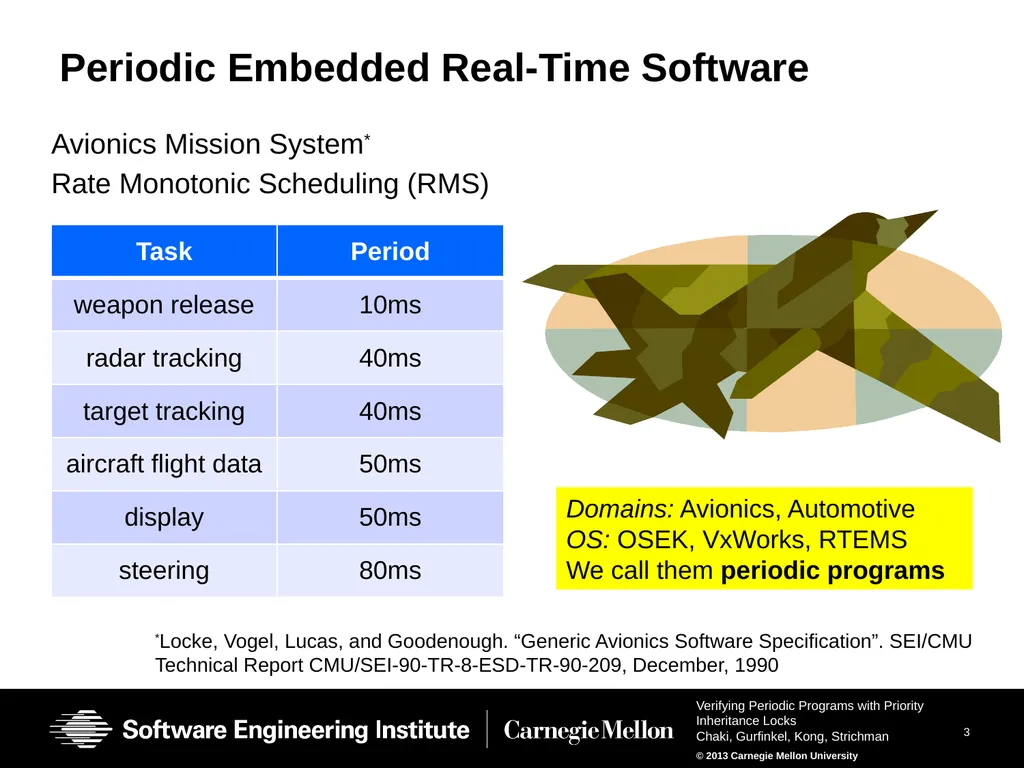
Periodic Embedded Real-Time Software Avionics Mission System*
Rate Monotonic Scheduling (RMS) *Locke, Vogel, Lucas, and Goodenough. “Generic Avionics Software Specification”. SEI/CMU Technical Report CMU/SEI-90-TR-8-ESD-TR-90-209, December, 1990 Domains: Avionics, Automotive
OS: OSEK, VxWorks, RTEMS
We call them periodic programs<br>
Rate Monotonic Scheduling (RMS) *Locke, Vogel, Lucas, and Goodenough. “Generic Avionics Software Specification”. SEI/CMU Technical Report CMU/SEI-90-TR-8-ESD-TR-90-209, December, 1990 Domains: Avionics, Automotive
OS: OSEK, VxWorks, RTEMS
We call them periodic programs<br>
04
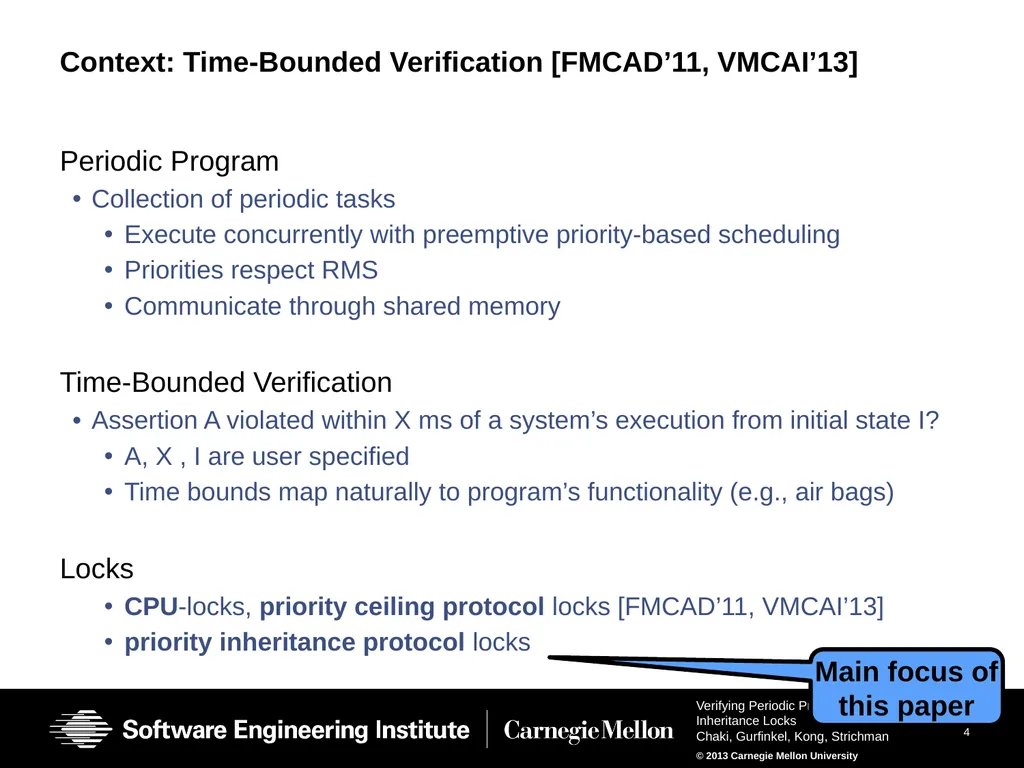
Context: Time-Bounded Verification [FMCAD’11, VMCAI’13] Periodic Program
Collection of periodic tasks
Execute concurrently with preemptive priority-based scheduling
Priorities respect RMS
Communicate through shared memory
Time-Bounded Verification
Assertion A violated within X ms of a system’s execution from initial state I?
A, X , I are user specified
Time bounds map naturally to program’s functionality (e.g., air bags)
Locks
CPU-locks, priority ceiling protocol locks [FMCAD’11, VMCAI’13]
priority inheritance protocol locks Main focus of this paper<br>
05
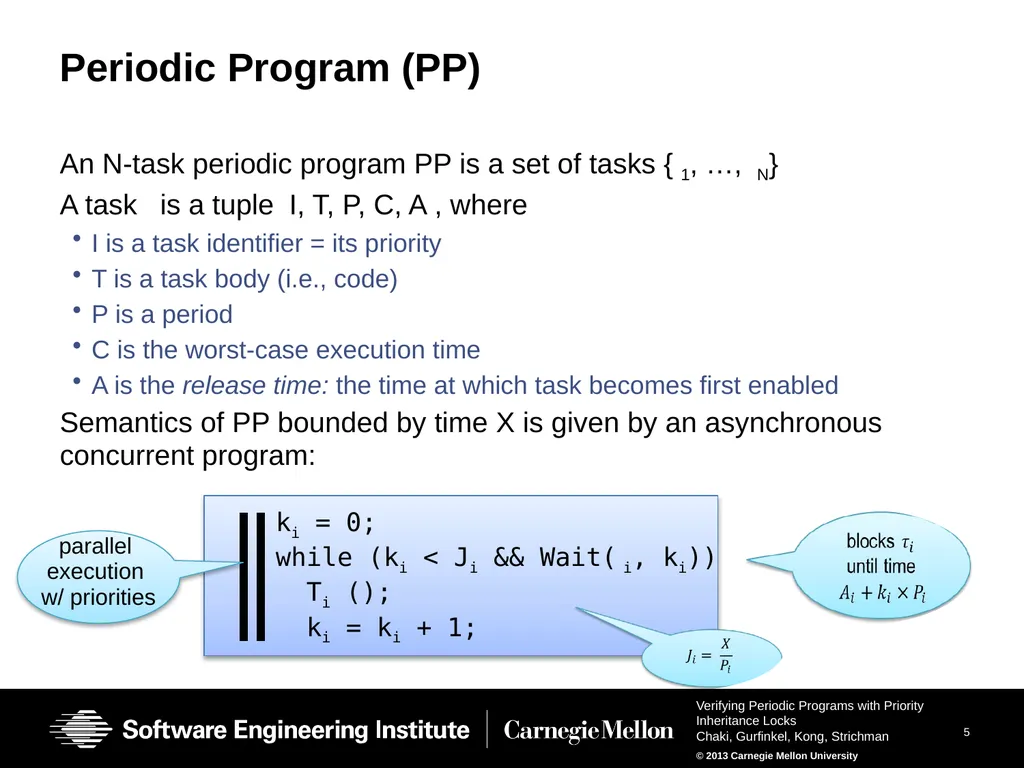
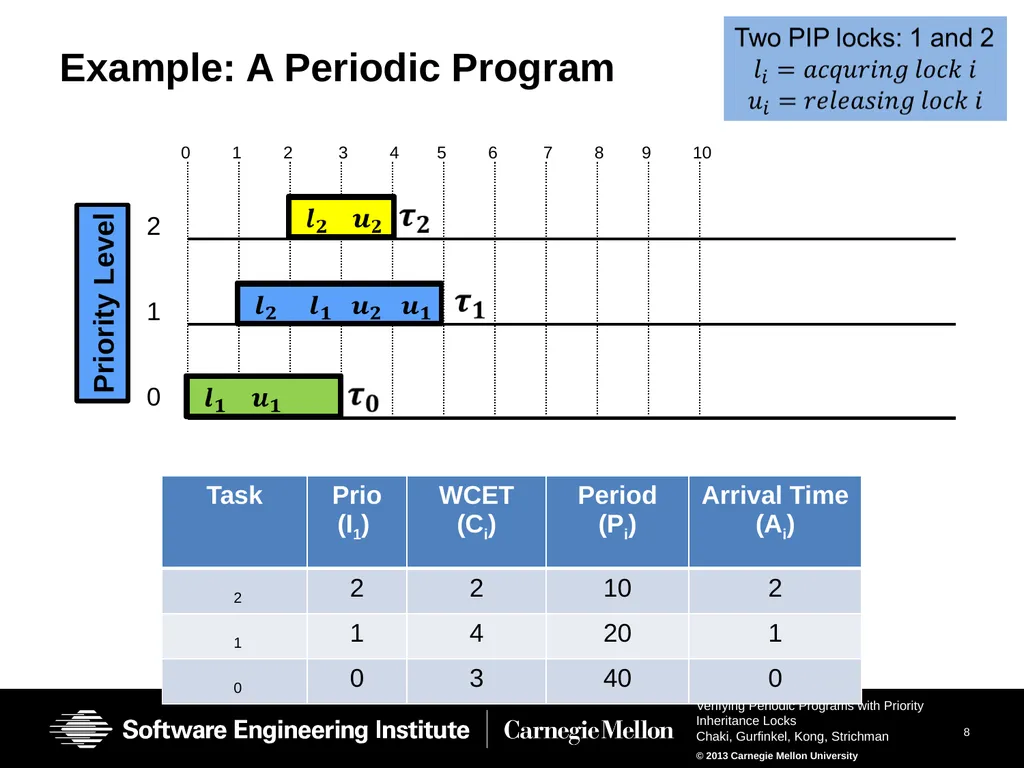
Periodic Program (PP) An N-task periodic program PP is a set of tasks {1, …, N}
A task is a tuple I, T, P, C, A, where
I is a task identifier = its priority
T is a task body (i.e., code)
P is a period
C is the worst-case execution time
A is the release time: the time at which task becomes first enabled
Semantics of PP bounded by time X is given by an asynchronous concurrent program: ki = 0;
while (ki < Ji && Wait(i, ki))
Ti ();
ki = ki + 1; parallel
execution
w/ priorities<br>
06
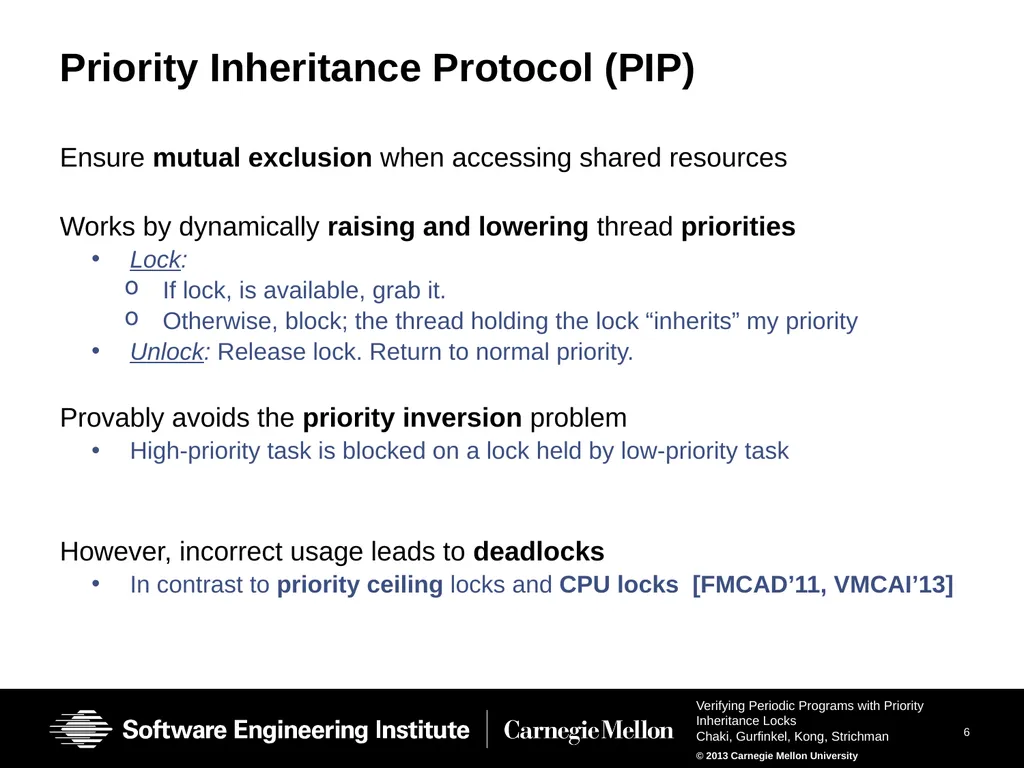
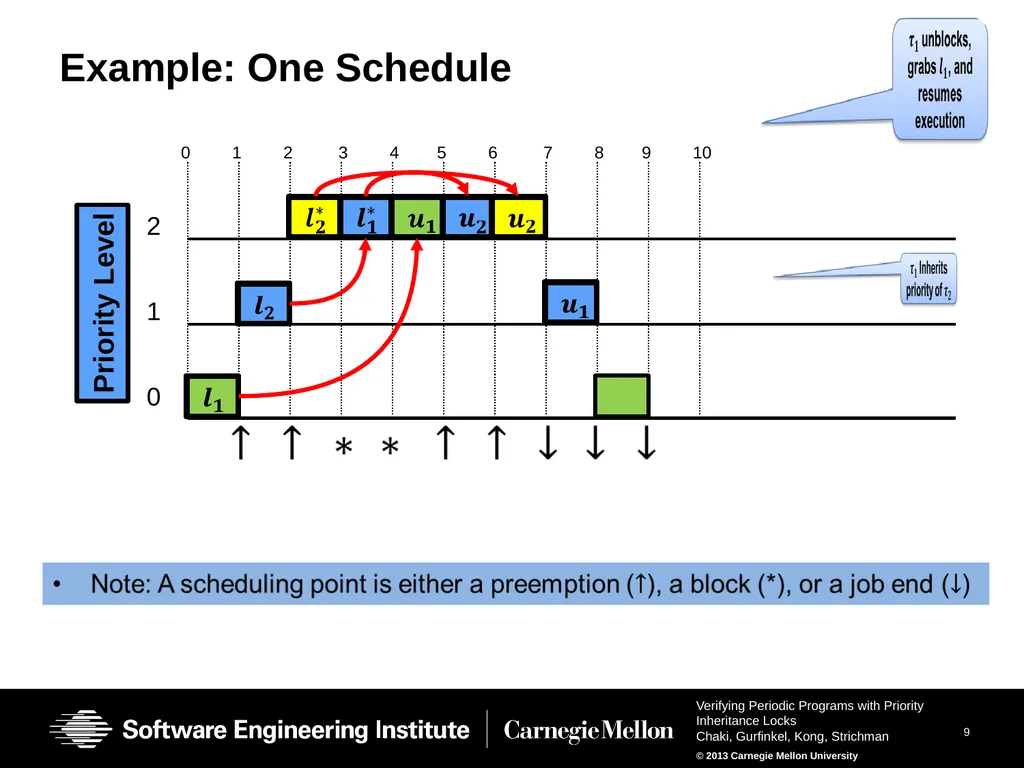
Priority Inheritance Protocol (PIP) Ensure mutual exclusion when accessing shared resources
Works by dynamically raising and lowering thread priorities
Lock:
If lock, is available, grab it.
Otherwise, block; the thread holding the lock “inherits” my priority
Unlock: Release lock. Return to normal priority.
Provably avoids the priority inversion problem
High-priority task is blocked on a lock held by low-priority task
However, incorrect usage leads to deadlocks
In contrast to priority ceiling locks and CPU locks [FMCAD’11, VMCAI’13]<br>
07
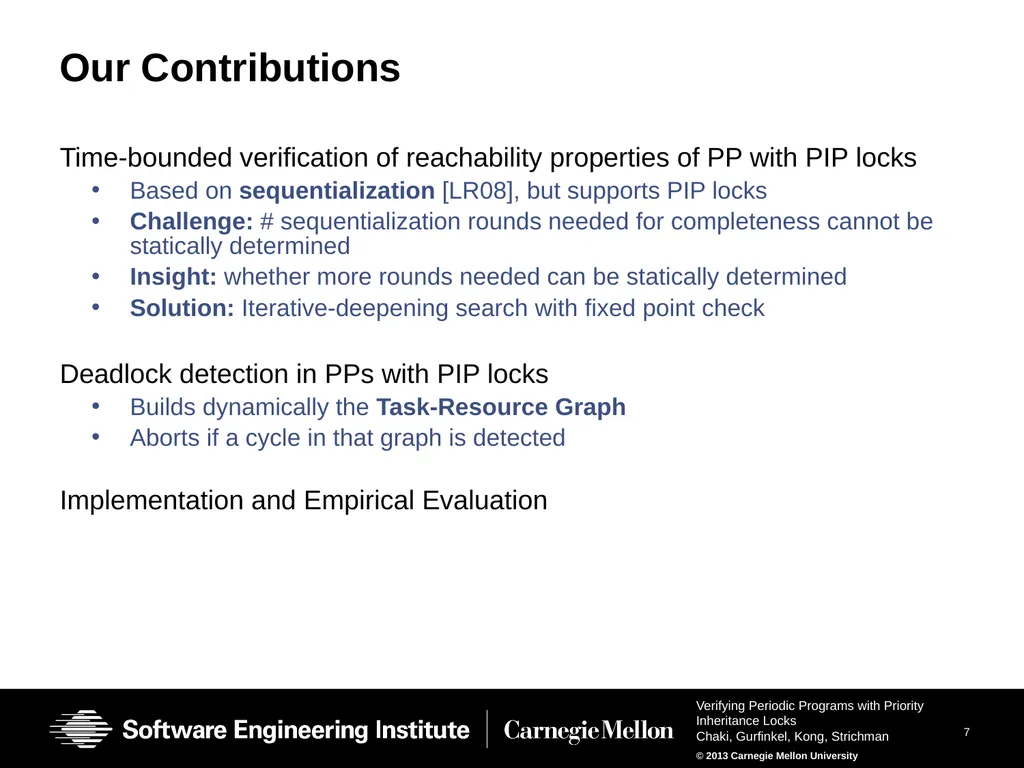
Our Contributions Time-bounded verification of reachability properties of PP with PIP locks
Based on sequentialization [LR08], but supports PIP locks
Challenge: # sequentialization rounds needed for completeness cannot be statically determined
Insight: whether more rounds needed can be statically determined
Solution: Iterative-deepening search with fixed point check
Deadlock detection in PPs with PIP locks
Builds dynamically the Task-Resource Graph
Aborts if a cycle in that graph is detected
Implementation and Empirical Evaluation<br>
08
Example: A Periodic Program 4 2 0 1 Priority Level 3 2 1 0 8 7 6 5 10 9<br>
09
Example: One Schedule 4 2 0 1 Priority Level 3 2 1 0 8 7 6 5 10 9<br>
10
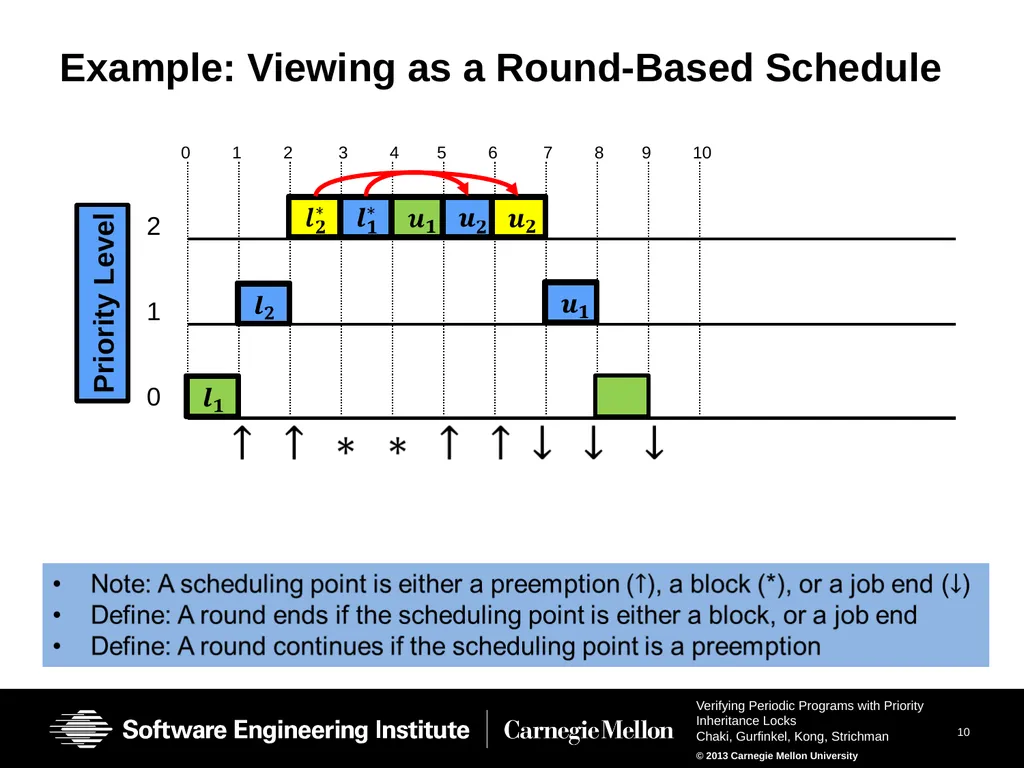
Example: Viewing as a Round-Based Schedule 4 2 0 1 Priority Level 3 2 1 0 8 7 6 5 10 9<br>
11
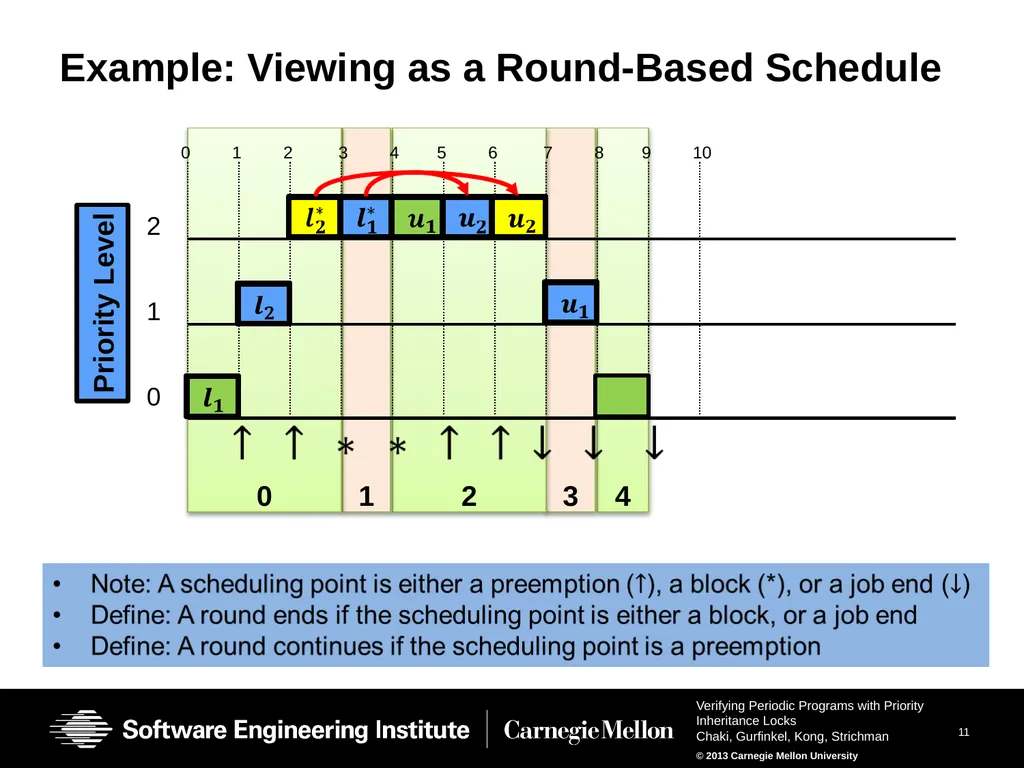
4 3 2 1 0 Example: Viewing as a Round-Based Schedule 4 2 0 1 Priority Level 3 2 1 0 8 7 6 5 10 9<br>
12
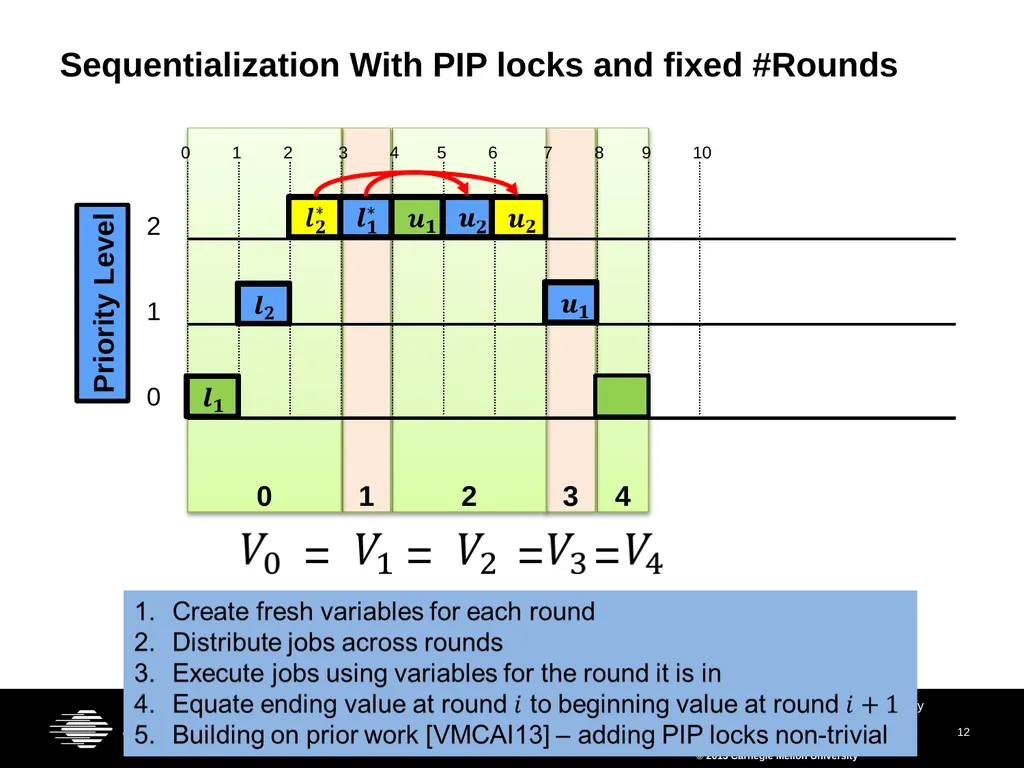
4 3 2 1 0 Sequentialization With PIP locks and fixed #Rounds 4 2 0 1 Priority Level 3 2 1 0 8 7 6 5 10 9 = = = =<br>
13
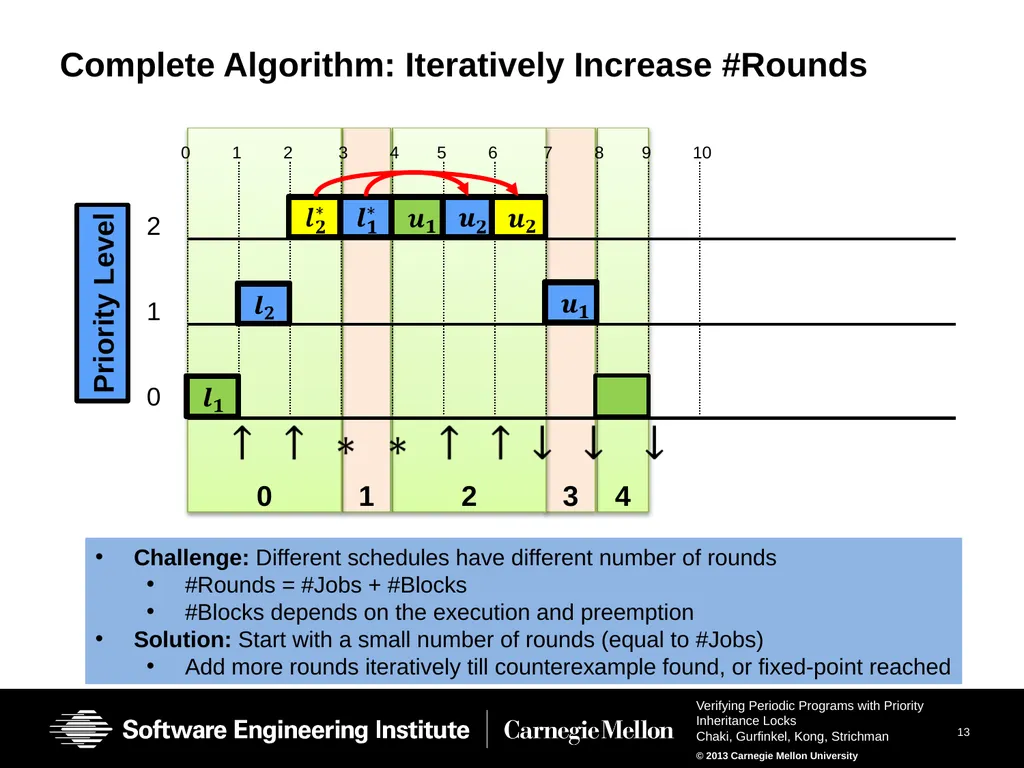
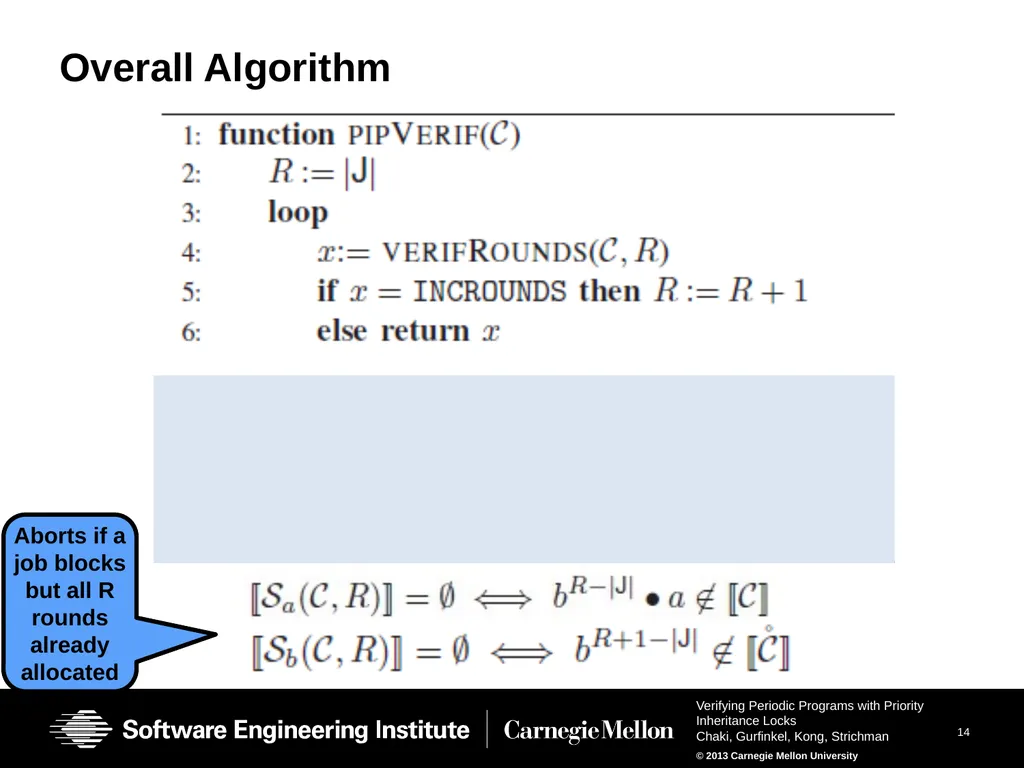
4 3 2 1 0 Complete Algorithm: Iteratively Increase #Rounds 4 2 0 1 Priority Level 3 2 1 0 8 7 6 5 10 9 Challenge: Different schedules have different number of rounds
#Rounds = #Jobs + #Blocks
#Blocks depends on the execution and preemption
Solution: Start with a small number of rounds (equal to #Jobs)
Add more rounds iteratively till counterexample found, or fixed-point reached<br>
#Rounds = #Jobs + #Blocks
#Blocks depends on the execution and preemption
Solution: Start with a small number of rounds (equal to #Jobs)
Add more rounds iteratively till counterexample found, or fixed-point reached<br>
14
Overall Algorithm Aborts if a job blocks but all R rounds already allocated<br>
15
Supports C programs w/ tasks, priorities, priority ceiling protocol, shared variables
Works in two stages:
Sequentialization – reduction to sequential program w/ prophecy variables
Bounded program analysis: bounded C model checker (CBMC, HAVOC, …) Periodic Program in C Sequentialization SAFE UNSAFE
+ CEX Periods, WCETs, Initial Condition, Time bound Uses non-determinism (prophecy variables) to allow all possible interleavings between jobs and R – |J| job block events CBMC INCROUNDS<br>
16
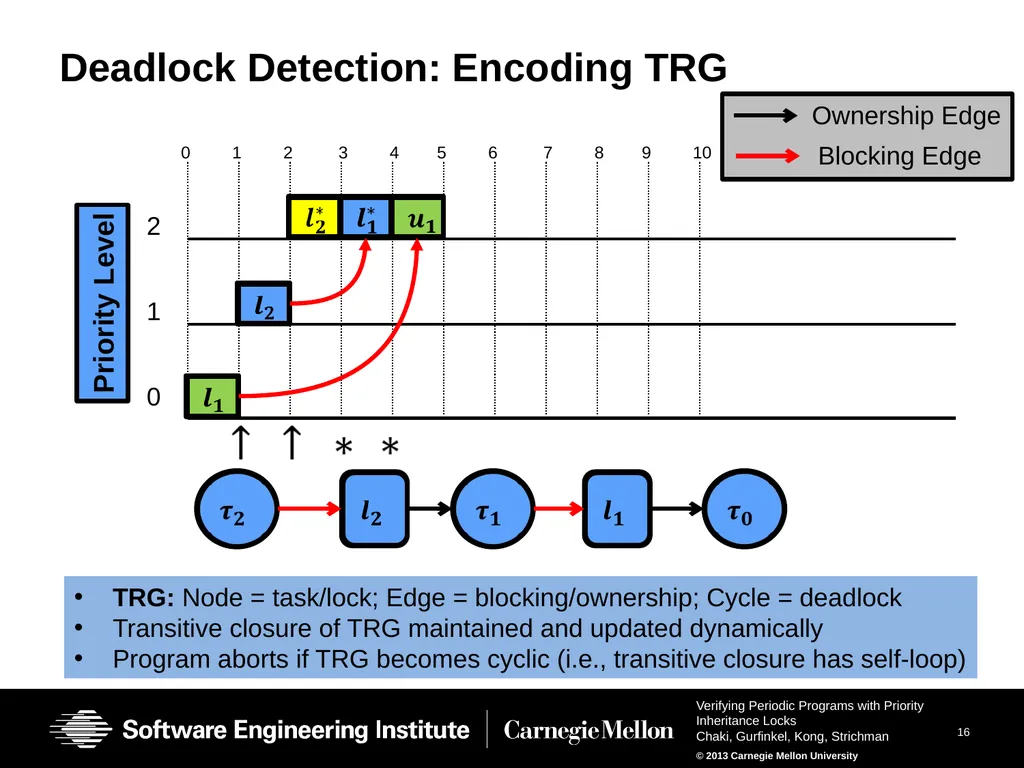
Deadlock Detection: Encoding TRG 4 2 0 1 Priority Level 3 2 1 0 8 7 6 5 10 9 TRG: Node = task/lock; Edge = blocking/ownership; Cycle = deadlock
Transitive closure of TRG maintained and updated dynamically
Program aborts if TRG becomes cyclic (i.e., transitive closure has self-loop) Ownership Edge Blocking Edge<br>
Transitive closure of TRG maintained and updated dynamically
Program aborts if TRG becomes cyclic (i.e., transitive closure has self-loop) Ownership Edge Blocking Edge<br>
17
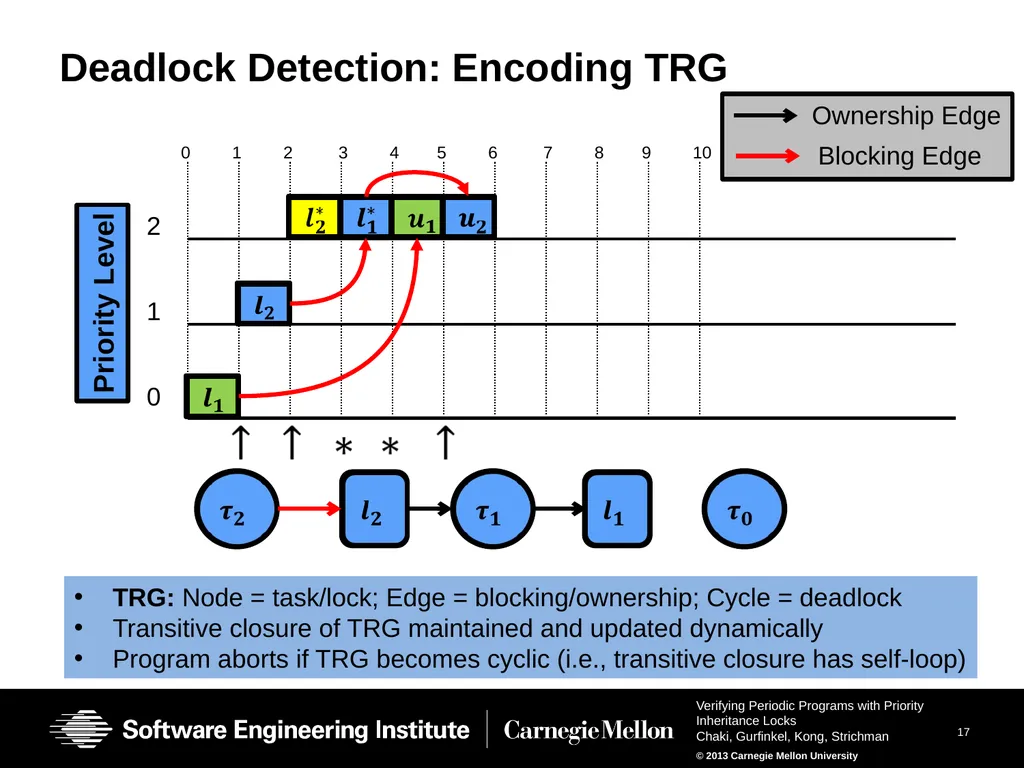
Deadlock Detection: Encoding TRG 4 2 0 1 Priority Level 3 2 1 0 8 7 6 5 10 9 TRG: Node = task/lock; Edge = blocking/ownership; Cycle = deadlock
Transitive closure of TRG maintained and updated dynamically
Program aborts if TRG becomes cyclic (i.e., transitive closure has self-loop) Ownership Edge Blocking Edge<br>
Transitive closure of TRG maintained and updated dynamically
Program aborts if TRG becomes cyclic (i.e., transitive closure has self-loop) Ownership Edge Blocking Edge<br>
18
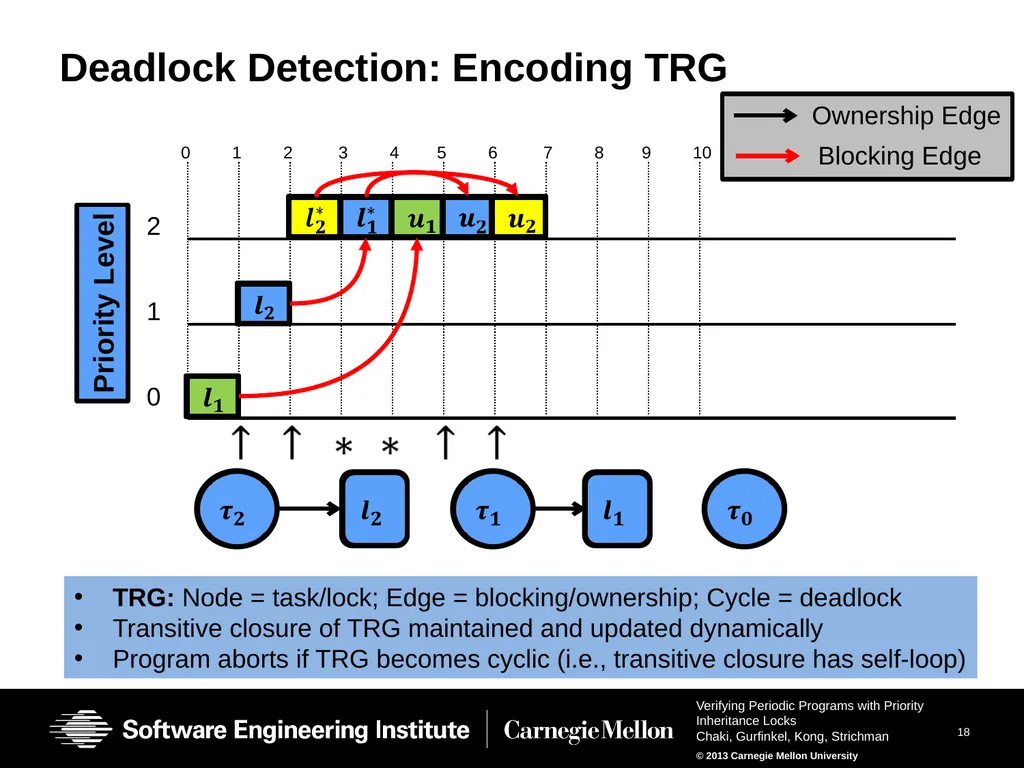
Deadlock Detection: Encoding TRG 4 2 0 1 Priority Level 3 2 1 0 8 7 6 5 10 9 TRG: Node = task/lock; Edge = blocking/ownership; Cycle = deadlock
Transitive closure of TRG maintained and updated dynamically
Program aborts if TRG becomes cyclic (i.e., transitive closure has self-loop) Ownership Edge Blocking Edge<br>
Transitive closure of TRG maintained and updated dynamically
Program aborts if TRG becomes cyclic (i.e., transitive closure has self-loop) Ownership Edge Blocking Edge<br>
19
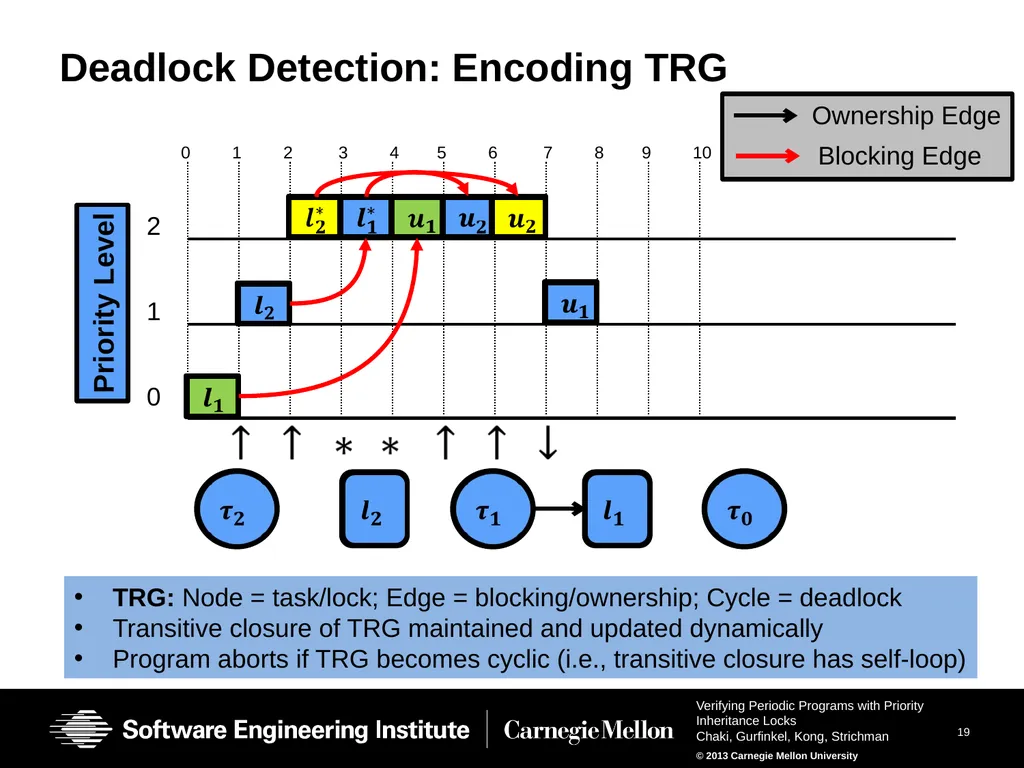
Deadlock Detection: Encoding TRG 4 2 0 1 Priority Level 3 2 1 0 8 7 6 5 10 9 TRG: Node = task/lock; Edge = blocking/ownership; Cycle = deadlock
Transitive closure of TRG maintained and updated dynamically
Program aborts if TRG becomes cyclic (i.e., transitive closure has self-loop) Ownership Edge Blocking Edge<br>
Transitive closure of TRG maintained and updated dynamically
Program aborts if TRG becomes cyclic (i.e., transitive closure has self-loop) Ownership Edge Blocking Edge<br>
20
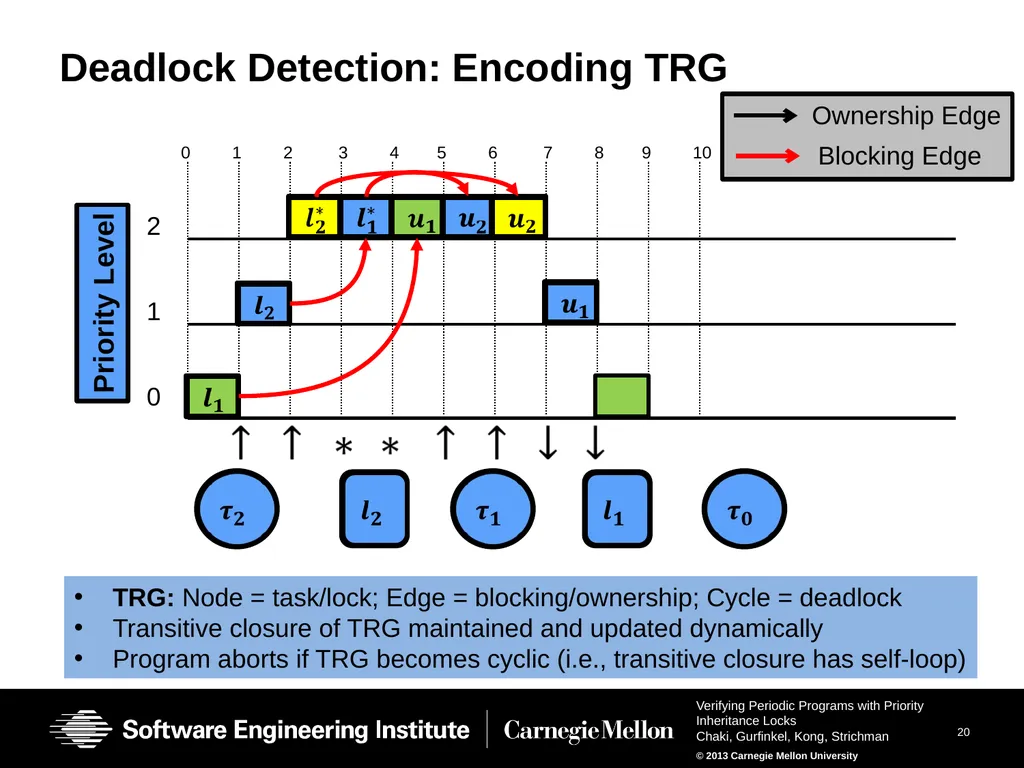
Deadlock Detection: Encoding TRG 4 2 0 1 Priority Level 3 2 1 0 8 7 6 5 10 9 TRG: Node = task/lock; Edge = blocking/ownership; Cycle = deadlock
Transitive closure of TRG maintained and updated dynamically
Program aborts if TRG becomes cyclic (i.e., transitive closure has self-loop) Ownership Edge Blocking Edge<br>
Transitive closure of TRG maintained and updated dynamically
Program aborts if TRG becomes cyclic (i.e., transitive closure has self-loop) Ownership Edge Blocking Edge<br>
21
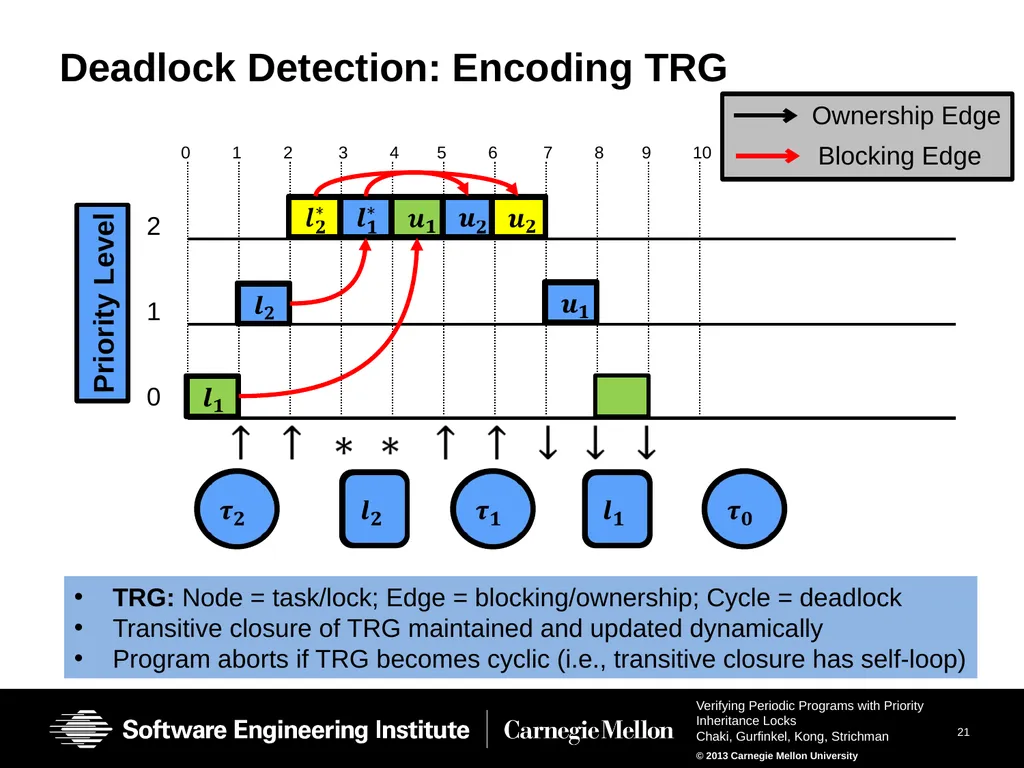
Deadlock Detection: Encoding TRG 4 2 0 1 Priority Level 3 2 1 0 8 7 6 5 10 9 TRG: Node = task/lock; Edge = blocking/ownership; Cycle = deadlock
Transitive closure of TRG maintained and updated dynamically
Program aborts if TRG becomes cyclic (i.e., transitive closure has self-loop) Ownership Edge Blocking Edge<br>
Transitive closure of TRG maintained and updated dynamically
Program aborts if TRG becomes cyclic (i.e., transitive closure has self-loop) Ownership Edge Blocking Edge<br>
22
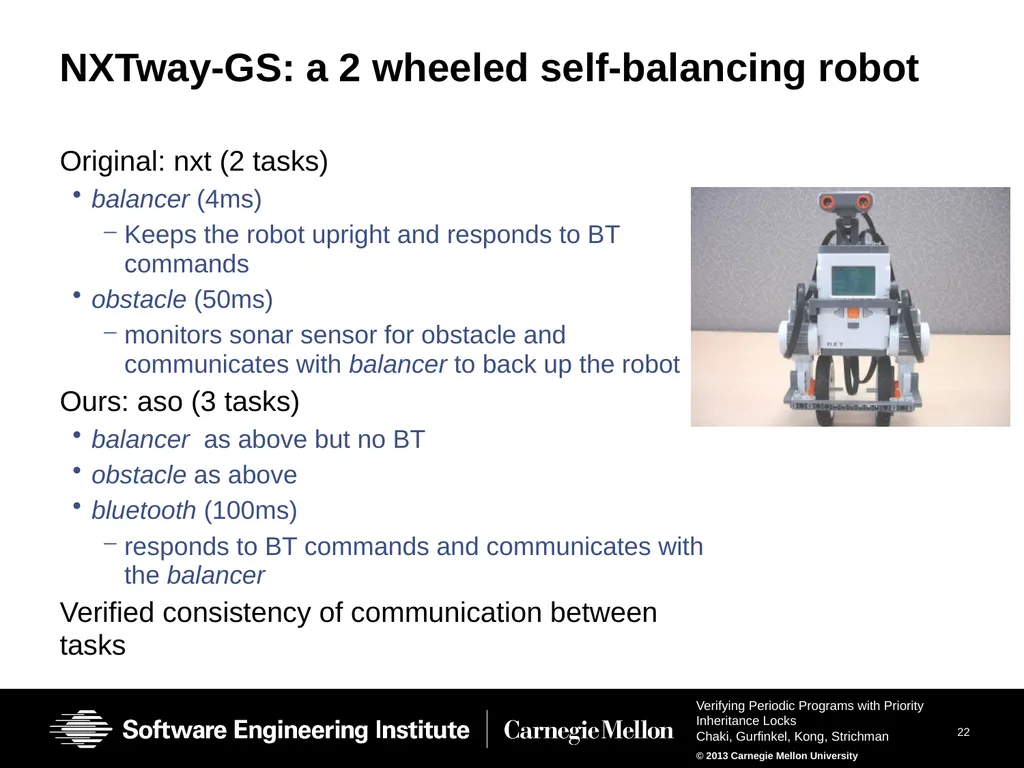
NXTway-GS: a 2 wheeled self-balancing robot Original: nxt (2 tasks)
balancer (4ms)
Keeps the robot upright and responds to BT commands
obstacle (50ms)
monitors sonar sensor for obstacle and communicates with balancer to back up the robot
Ours: aso (3 tasks)
balancer as above but no BT
obstacle as above
bluetooth (100ms)
responds to BT commands and communicates with the balancer
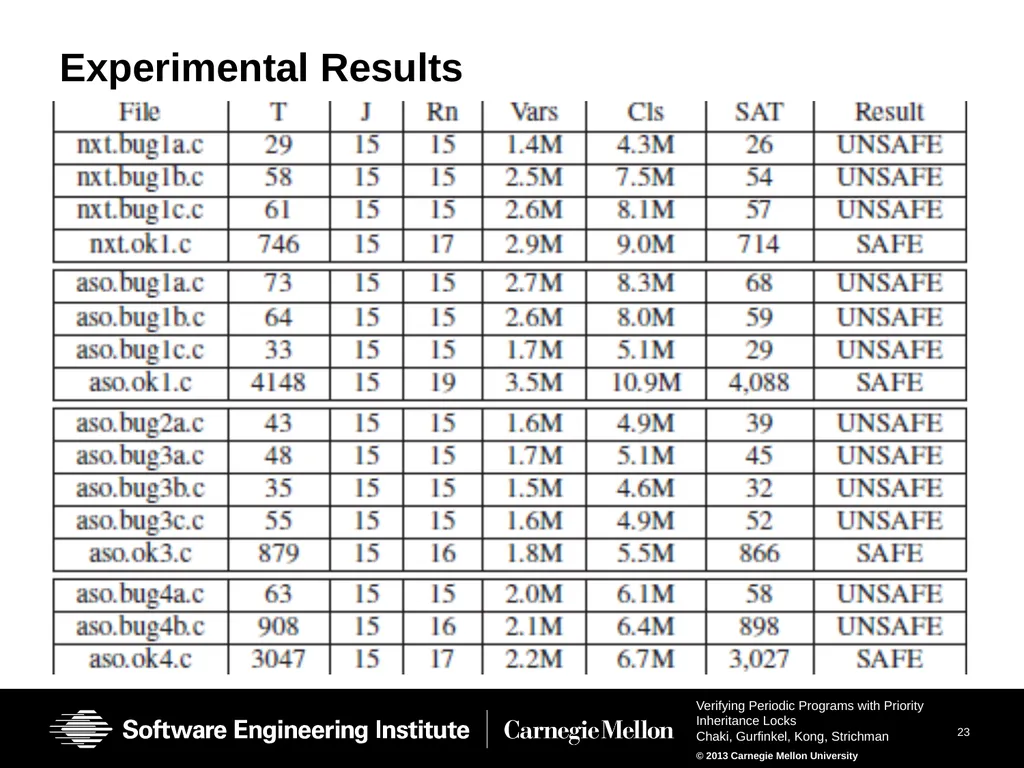
Verified consistency of communication between tasks<br>
23
Experimental Results<br>
24
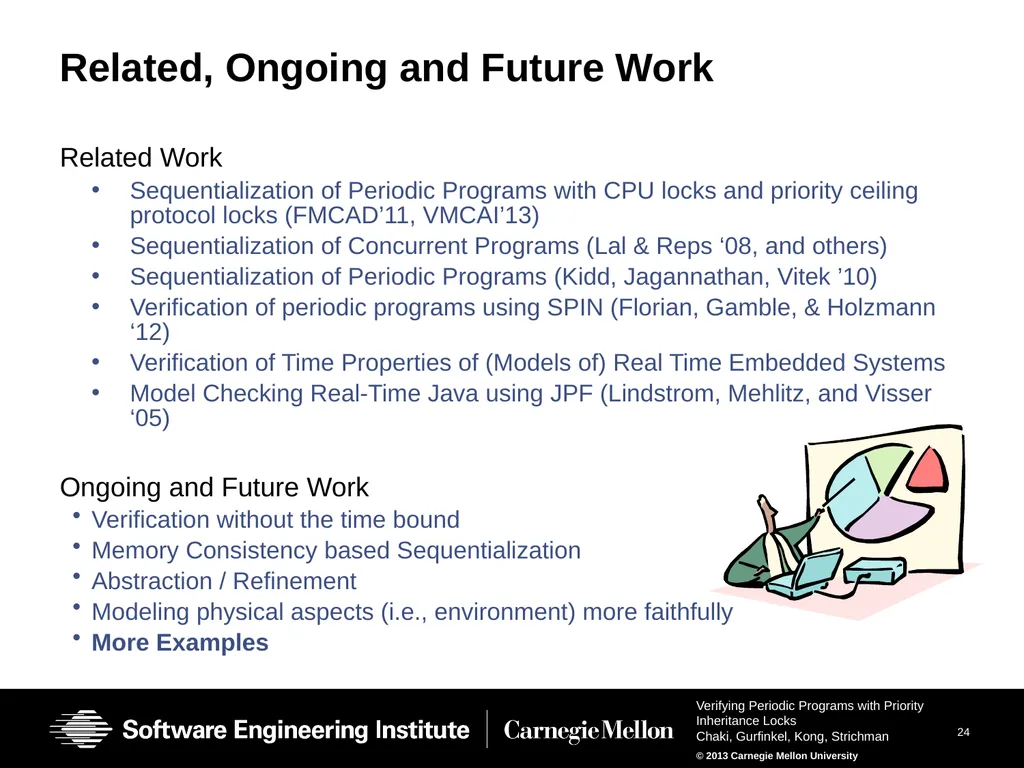
Related, Ongoing and Future Work Related Work
Sequentialization of Periodic Programs with CPU locks and priority ceiling protocol locks (FMCAD’11, VMCAI’13)
Sequentialization of Concurrent Programs (Lal & Reps ‘08, and others)
Sequentialization of Periodic Programs (Kidd, Jagannathan, Vitek ’10)
Verification of periodic programs using SPIN (Florian, Gamble, & Holzmann ‘12)
Verification of Time Properties of (Models of) Real Time Embedded Systems
Model Checking Real-Time Java using JPF (Lindstrom, Mehlitz, and Visser ‘05)
Ongoing and Future Work
Verification without the time bound
Memory Consistency based Sequentialization
Abstraction / Refinement
Modeling physical aspects (i.e., environment) more faithfully
More Examples<br>
25
Contact Information<br>
26
QUESTIONS?<br>