04
QM General Standard 1.9 Section: Course Overview and Introduction
Standard: Learners are asked to introduce themselves to the class.
Specific Review Standards from the QM Higher Education Rubric, Sixth Edition https://www.qualitymatters.org/sites/default/files/PDFs/StandardsfromtheQMHigherEducationRubric.pdf<br>
05
Why is the Introduction Important?��Consulting the literature<br>
06
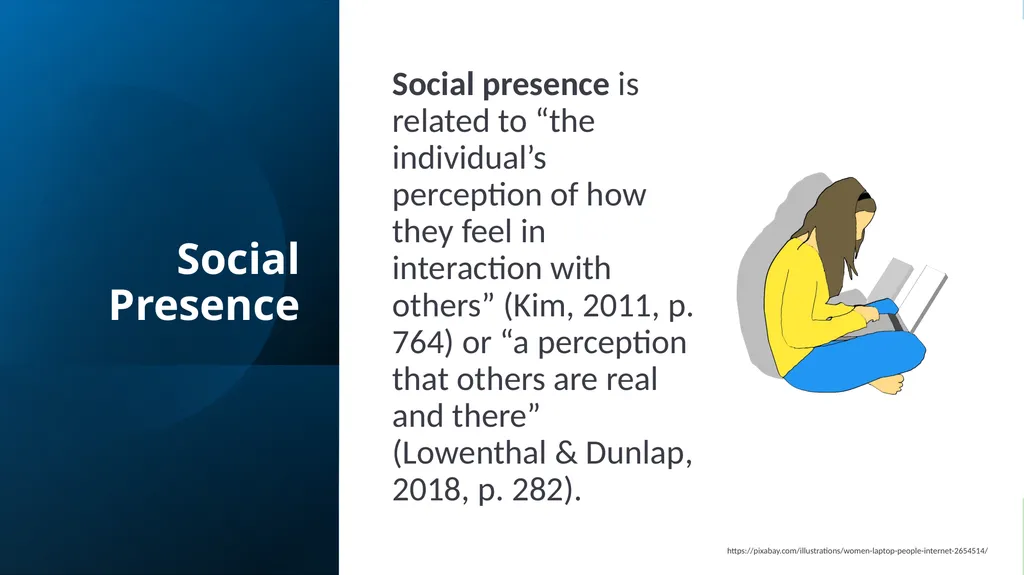
Social Presence Social presence is related to “the individual’s perception of how they feel in interaction with others” (Kim, 2011, p. 764) or “a perception that others are real and there” (Lowenthal & Dunlap, 2018, p. 282). https://pixabay.com/illustrations/women-laptop-people-internet-2654514/<br>
07
Social Presence “Social presence seemed to contribute the most in predicting the level of course satisfaction amongst the students,” (Nasir, 2020, p.485) and “significantly contributes to the success or failure of e-learning” (p. 489). https://pixabay.com/illustrations/women-laptop-people-internet-2654514/<br>
09
Social Capital “Because you have so little time to socialise with your friends and family, socialisation within the course takes on an added significance” and “graduates used this social network to keep each other going, to rekindle their motivation when the going got tough or they felt particularly isolated.” (Delaney & Brown, 2018, p. 219) https://pixabay.com/illustrations/women-laptop-people-internet-2654514/<br>
10
Retention “78.05% are more likely to remain at their institution and persist to graduation if a sense of belonging is established,” (Lee, 2017, p. 13) https://pixabay.com/illustrations/women-laptop-people-internet-2654514/<br>
11
Retention and Belonging Connect early and stay connected (Feldman, 2021)
Build a sense of community (Eriksen, 2020) https://pixabay.com/illustrations/women-laptop-people-internet-2654514/<br>
12
Prompts��Three Categories<br>
13
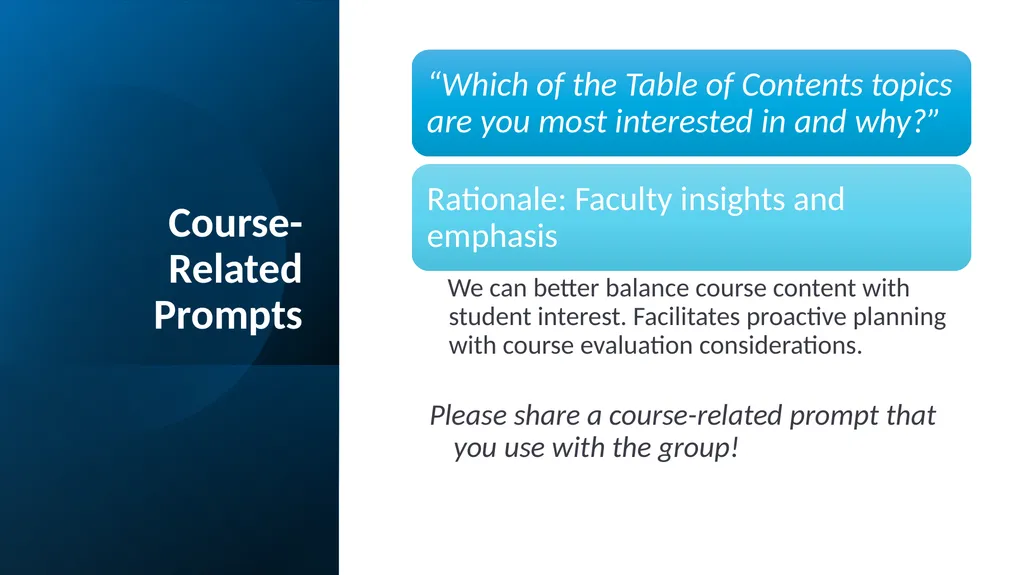
Our Three Categories of Prompts Course-related
Course-related fun
Just plain fun
Intentional selection of prompts for each course with judicious use of audio/video introductions.<br>
14
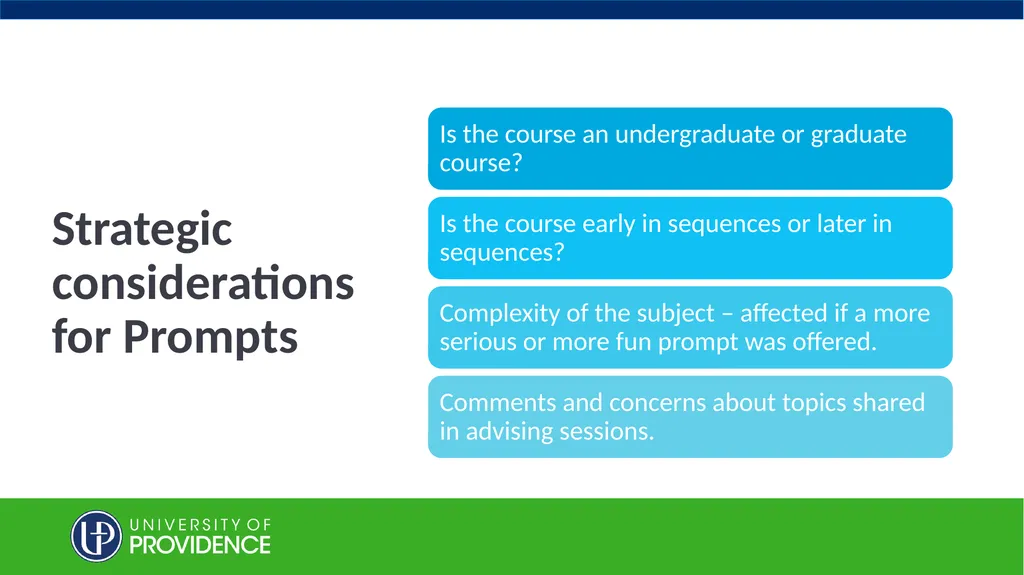
Strategic considerations for Prompts<br>
15
Course-Related Prompts<br>
16
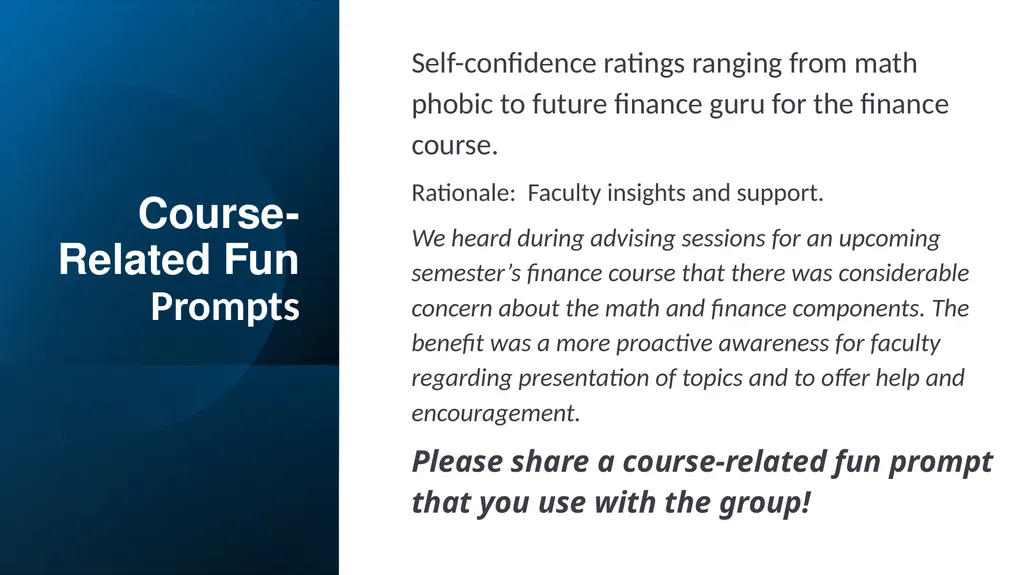
Course-Related Fun Prompts Self-confidence ratings ranging from math phobic to future finance guru for the finance course.
Rationale: Faculty insights and support.
We heard during advising sessions for an upcoming semester’s finance course that there was considerable concern about the math and finance components. The benefit was a more proactive awareness for faculty regarding presentation of topics and to offer help and encouragement.
Please share a course-related fun prompt that you use with the group!<br>
17
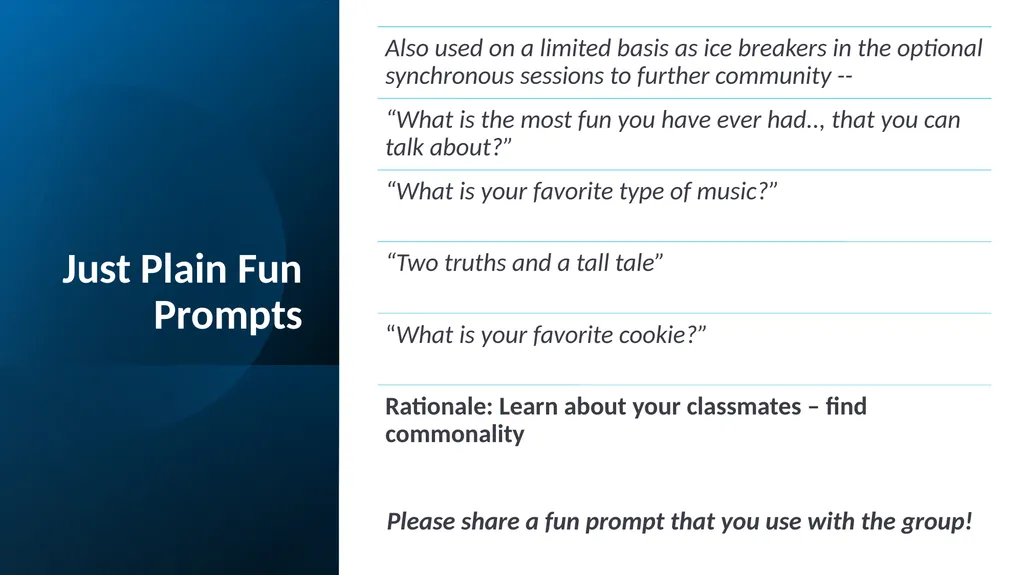
Just Plain Fun Prompts Please share a fun prompt that you use with the group!<br>
18
But Does it Work?��Pilot survey<br>
20
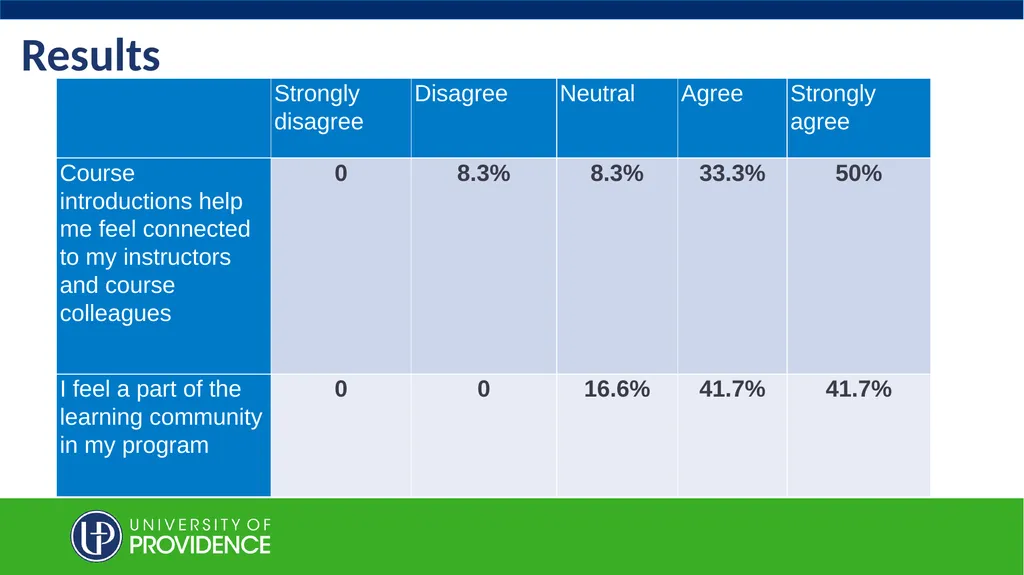
Methods (continued) One section focused on perceptions regarding instructional techniques (i.e., synchronous sessions, group projects, discussions, peer review of projects and assignments, introductions) and feeling a part of the learning community.<br>
22
Follow Up: What is the best introductory question an instructor has ever asked and why? What’s your family holiday tradition? - It made the class more personal.
What would you bring to a potluck? -
The question and answers made me relax and feel more connected.
Are you a dog or cat person? - It gave me a connection with peers, and I liked hearing the stories of other people’s pets.
Do you have any prompts to share with our group?<br>
23
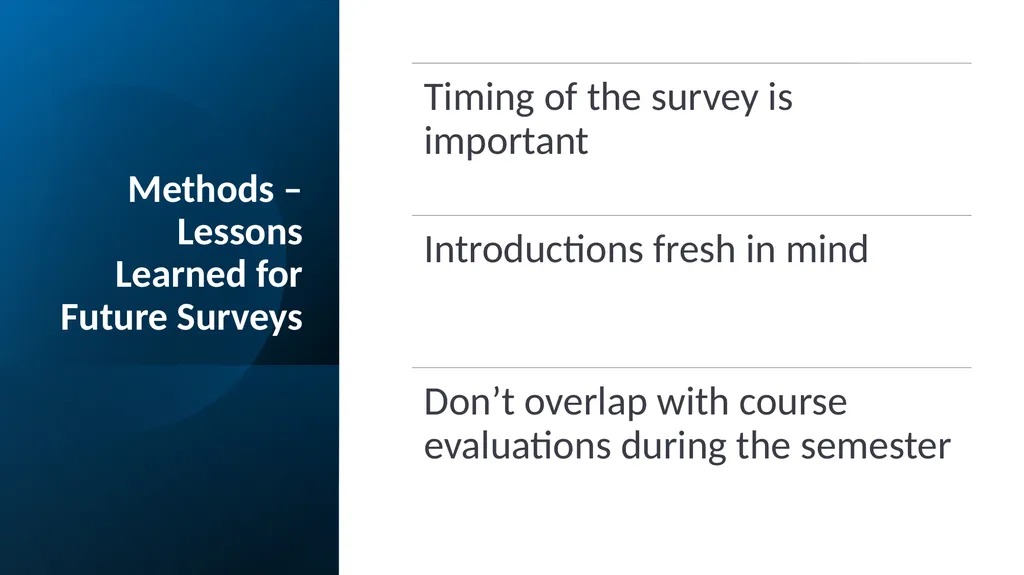
Methods – Lessons Learned for Future Surveys<br>
24
Methods (Lessons Learned Timing ) IRB internal process (allow time to complete and submit the application and receive approval) – Exempt and part of program evaluation Distribution: Who will send it to all students in the program/classes? Will this be done by your department’s office or a particular support team/person?<br>
25
Methods (Lessons Learned Timing ) Reminders are important to increase participation
Ask faculty to reiterate participation Who will send reminders to all students in the program/classes? Will this be done by your department’s office or a particular support team/person?<br>
26
Encouragement : Our message Survey covered: Synchronous sessions, group projects, discussions, peer review of projects and assignments, introductions) and feeling a part of the learning community Research
What has had the most impact on helping you feel connected to instructors and course colleagues? Why?
Help us enhance the program<br>
28
Conclusion 1 While further investigation is needed preliminary data suggest that QM introductions offer benefit in building social presence and social capital.<br>
29
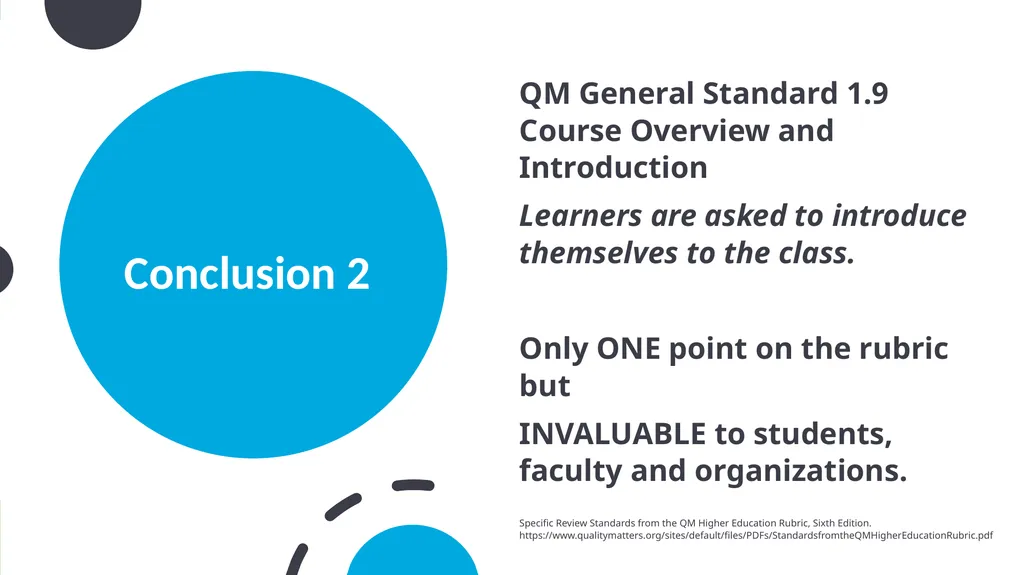
Conclusion 2 QM General Standard 1.9 Course Overview and Introduction
Learners are asked to introduce themselves to the class.
Only ONE point on the rubric but
INVALUABLE to students, faculty and organizations.
Specific Review Standards from the QM Higher Education Rubric, Sixth Edition. https://www.qualitymatters.org/sites/default/files/PDFs/StandardsfromtheQMHigherEducationRubric.pdf<br>
30
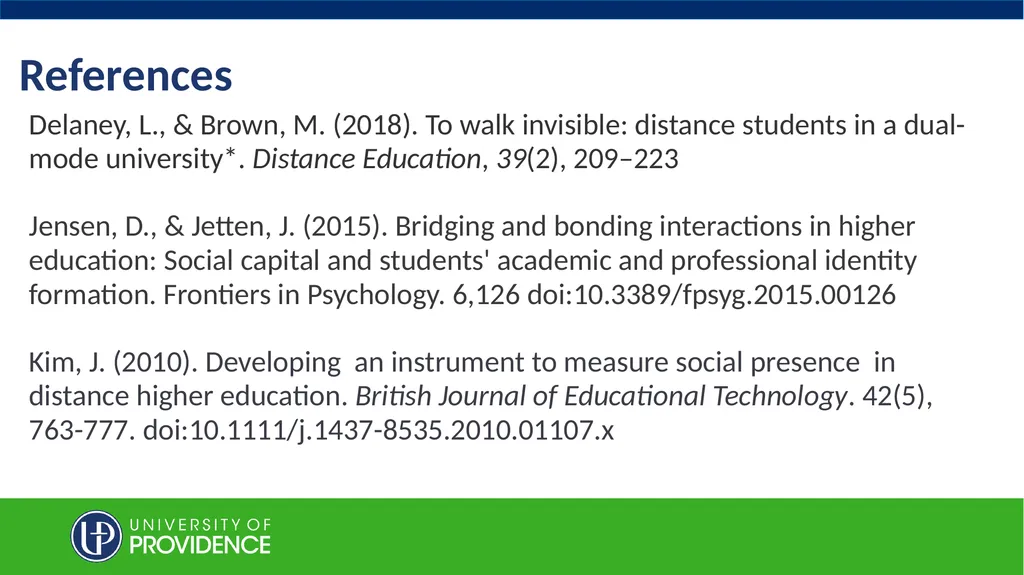
References Delaney, L., & Brown, M. (2018). To walk invisible: distance students in a dual-mode university*. Distance Education, 39(2), 209–223
Jensen, D., & Jetten, J. (2015). Bridging and bonding interactions in higher education: Social capital and students' academic and professional identity formation. Frontiers in Psychology. 6,126 doi:10.3389/fpsyg.2015.00126
Kim, J. (2010). Developing an instrument to measure social presence in distance higher education. British Journal of Educational Technology. 42(5), 763-777. doi:10.1111/j.1437-8535.2010.01107.x<br>
31
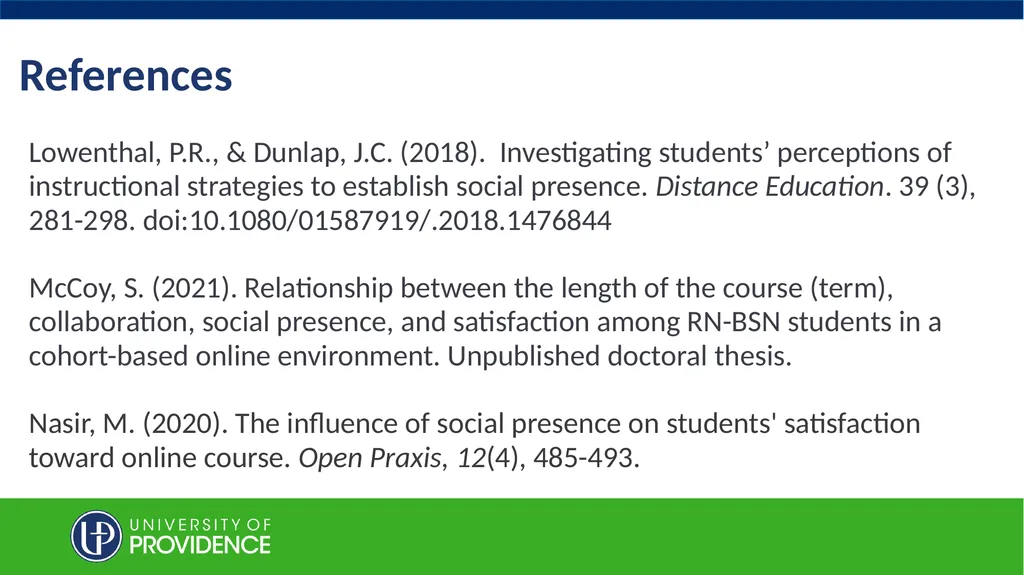
References Lowenthal, P.R., & Dunlap, J.C. (2018). Investigating students’ perceptions of instructional strategies to establish social presence. Distance Education. 39 (3), 281-298. doi:10.1080/01587919/.2018.1476844
McCoy, S. (2021). Relationship between the length of the course (term), collaboration, social presence, and satisfaction among RN-BSN students in a cohort-based online environment. Unpublished doctoral thesis.
Nasir, M. (2020). The influence of social presence on students' satisfaction toward online course. Open Praxis, 12(4), 485-493.<br>
32
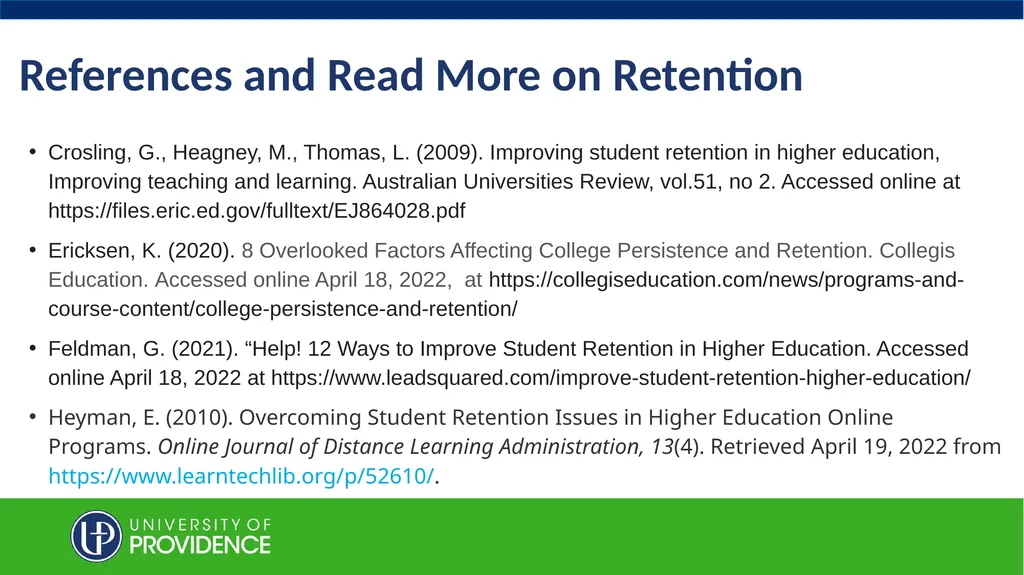
References and Read More on Retention Crosling, G., Heagney, M., Thomas, L. (2009). Improving student retention in higher education, Improving teaching and learning. Australian Universities Review, vol.51, no 2. Accessed online at https://files.eric.ed.gov/fulltext/EJ864028.pdf
Ericksen, K. (2020). 8 Overlooked Factors Affecting College Persistence and Retention. Collegis Education. Accessed online April 18, 2022, at https://collegiseducation.com/news/programs-and-course-content/college-persistence-and-retention/
Feldman, G. (2021). “Help! 12 Ways to Improve Student Retention in Higher Education. Accessed online April 18, 2022 at https://www.leadsquared.com/improve-student-retention-higher-education/
Heyman, E. (2010). Overcoming Student Retention Issues in Higher Education Online Programs. Online Journal of Distance Learning Administration, 13(4). Retrieved April 19, 2022 from https://www.learntechlib.org/p/52610/.<br>
33
Questions? �����Collaborations�Vicki.Mason@uprovidence.edu�Mary.Amick@uprovidence.edu<br>
35
www.uprovidence.edu<br>