
0 EFFECTIVE BUDGETING: TRANSLATING YOUR
Description: 0 EFFECTIVE BUDGETING: TRANSLATING YOUR DEVELOPMENT PLANS INTO ACTION Presentation at the JPBNCDP meeting on Accelerating the Implementation of Economic Recovery and Growth Plan: The Role of Stakeholders, held at Abeokuta, Ogun State
Related Topics
Download Presentation
"0 EFFECTIVE BUDGETING: TRANSLATING YOUR" is the property of its rightful owner. Permission is granted to download and print the materials on this website for personal, non-commercial use only, and to display it on your personal computer provided you do not modify the materials and that you retain all copyright notices contained in the materials. By downloading content from our website, you accept the terms of this agreement.
Presentation Transcript
slide1. 0 EFFECTIVE BUDGETING: TRANSLATING YOUR DEVELOPMENT PLANS INTO ACTION Presentation at the JPB/NCDP meeting on Accelerating the Implementation of Economic Recovery and Growth Plan: The Role of Stakeholders, held at Abeokuta, Ogun State
Wednesday, 29th August, 2018 Ben Akabueze
Director-General
BUDGET OFFICE OF THE FEDERATION<br>
slide2. Outline 1 1.0 Introduction
2.0 Budget, a Short-Term Development Plan
3.0 The Linkage: From Plan to Budget
4.0 Some Budgeting Issues that affect Plan Implementation
5.0 Translating Development Plans into Actions
6.0 Critical Success Factors<br>
slide3. INTRODUCTION 2 An economic development plan is a carefully built framework with a long-term in scope.
It provides a comprehensive overview of the economy, sets policy direction for economic growth, and identifies strategies, programs, and projects to improve the economy.
A development plan is usually based on a determined model, and made up of five components: Vision, Mission, Goals, Strategies, and Actions.
It is basically about deciding in advance what to do, how to do it, when to do it and who is to do it. It is therefore a blueprint for action.
Actions are the life wire of any development plan.
Without actions or actionable activities, a development plan is as good as dead Development Plan and Annual Budgets<br>
slide4. INTRODUCTION…/2 3 Development planning has been a consistent phenomenon in Nigeria since the mid-1940s. However, we can argue that it has not been as successful as expected.
This implies two things: either the correct plan had not always been made or correct plans made were not effectively implemented.
It is important to underscore that development planning is not easy since it deals with many complex and futuristic events.
This highlights the need to deliberately pursue short-term activities that are geared to the achievement of the long-term development plan.
Annual Budgets are short-term development plans/activities that target at set development objectives. Development Plan and Annual Budgets<br>
slide5. BUDGET,
A SHORT-TERM DEVELOPMENT PLAN 4<br>
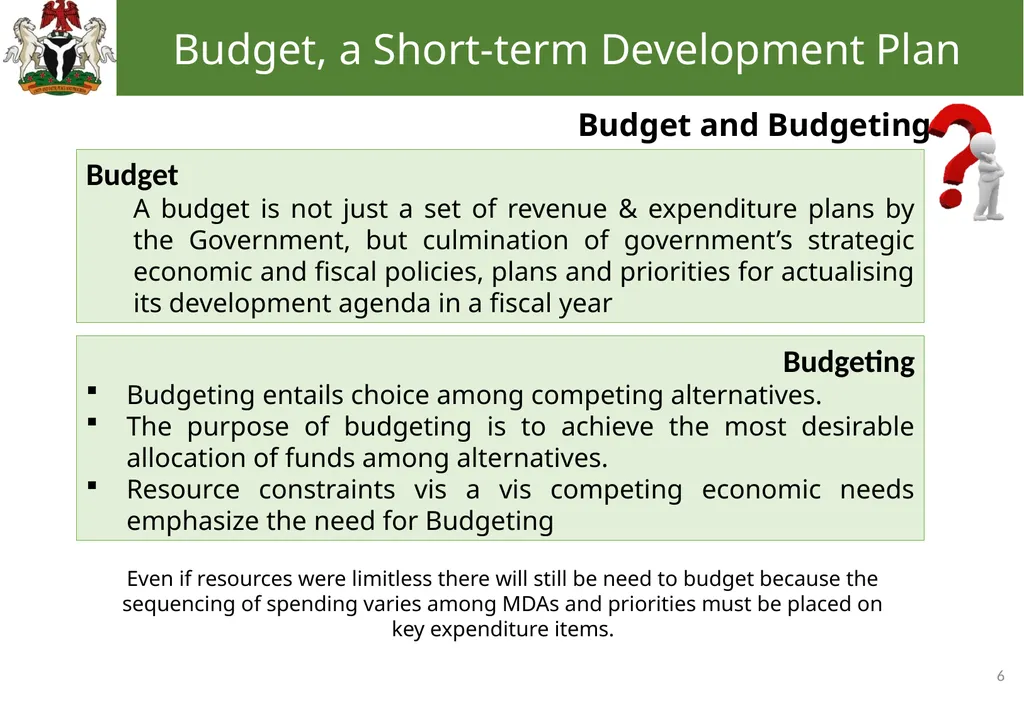
slide6. Budget, a Short-term Development Plan 5 Budget and Budgeting Budget
A budget is not just a set of revenue & expenditure plans by the Government, but culmination of government’s strategic economic and fiscal policies, plans and priorities for actualising its development agenda in a fiscal year Budgeting
Budgeting entails choice among competing alternatives.
The purpose of budgeting is to achieve the most desirable allocation of funds among alternatives.
Resource constraints vis a vis competing economic needs emphasize the need for Budgeting Even if resources were limitless there will still be need to budget because the sequencing of spending varies among MDAs and priorities must be placed on key expenditure items.<br>
slide7. Budget, a Short-term Development Plan…/2 6 Investments in economic and social infrastructure like power, transportation, roads, health and education are critical for the long-term productivity, growth and development of any Nation.
However, when this Administration came into Office in 2015, revenues were down due to the collapse in oil price which began by mid-2014.
Clearly, the economy was already headed for an economic recession.
As a result, the core priority of the Administration was to halt the slide and return the economy to the path of growth through an expansionary fiscal policy.<br>
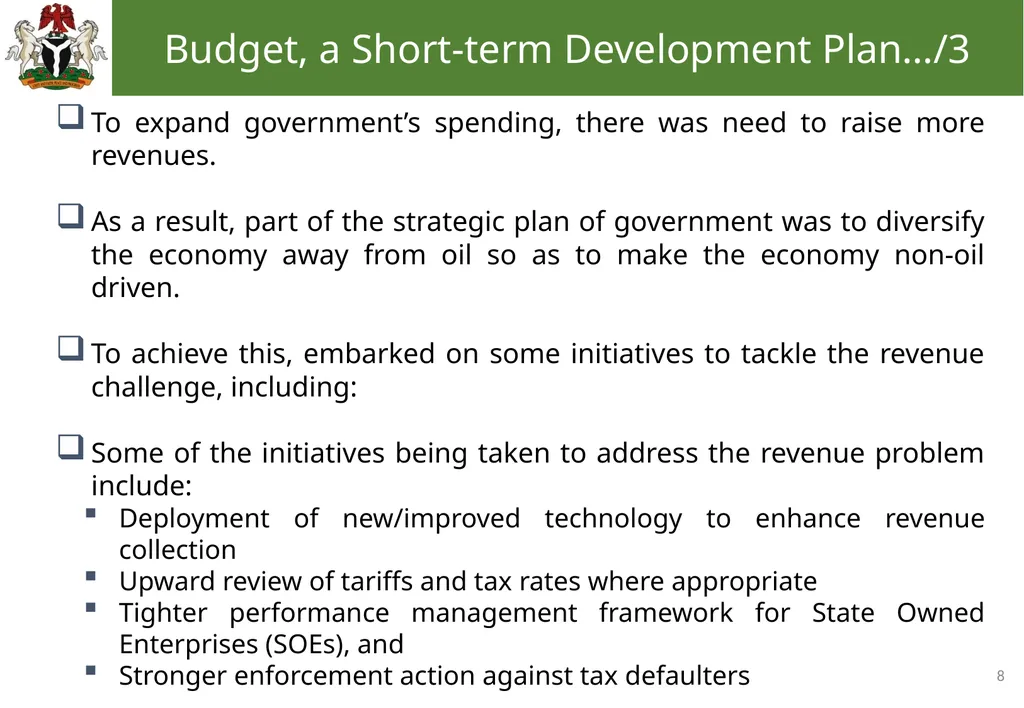
slide8. Budget, a Short-term Development Plan…/3 7 To expand government’s spending, there was need to raise more revenues.
As a result, part of the strategic plan of government was to diversify the economy away from oil so as to make the economy non-oil driven.
To achieve this, embarked on some initiatives to tackle the revenue challenge, including:
Some of the initiatives being taken to address the revenue problem include:
Deployment of new/improved technology to enhance revenue collection
Upward review of tariffs and tax rates where appropriate
Tighter performance management framework for State Owned Enterprises (SOEs), and
Stronger enforcement action against tax defaulters<br>
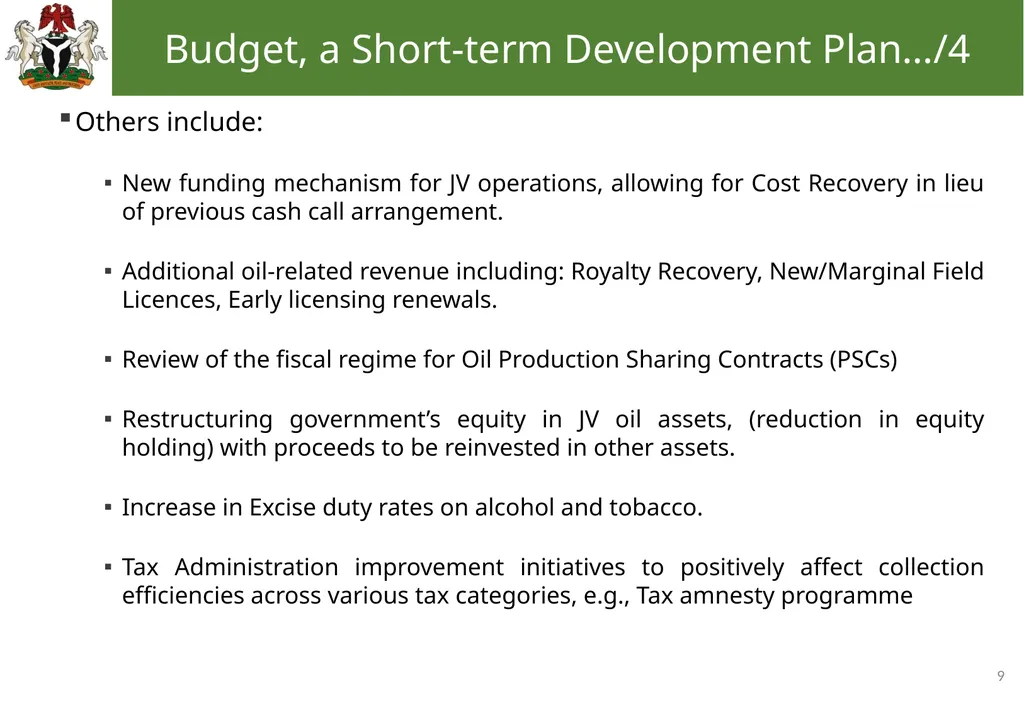
slide9. Budget, a Short-term Development Plan…/4 8 Others include:
New funding mechanism for JV operations, allowing for Cost Recovery in lieu of previous cash call arrangement.
Additional oil-related revenue including: Royalty Recovery, New/Marginal Field Licences, Early licensing renewals.
Review of the fiscal regime for Oil Production Sharing Contracts (PSCs)
Restructuring government’s equity in JV oil assets, (reduction in equity holding) with proceeds to be reinvested in other assets.
Increase in Excise duty rates on alcohol and tobacco.
Tax Administration improvement initiatives to positively affect collection efficiencies across various tax categories, e.g., Tax amnesty programme<br>
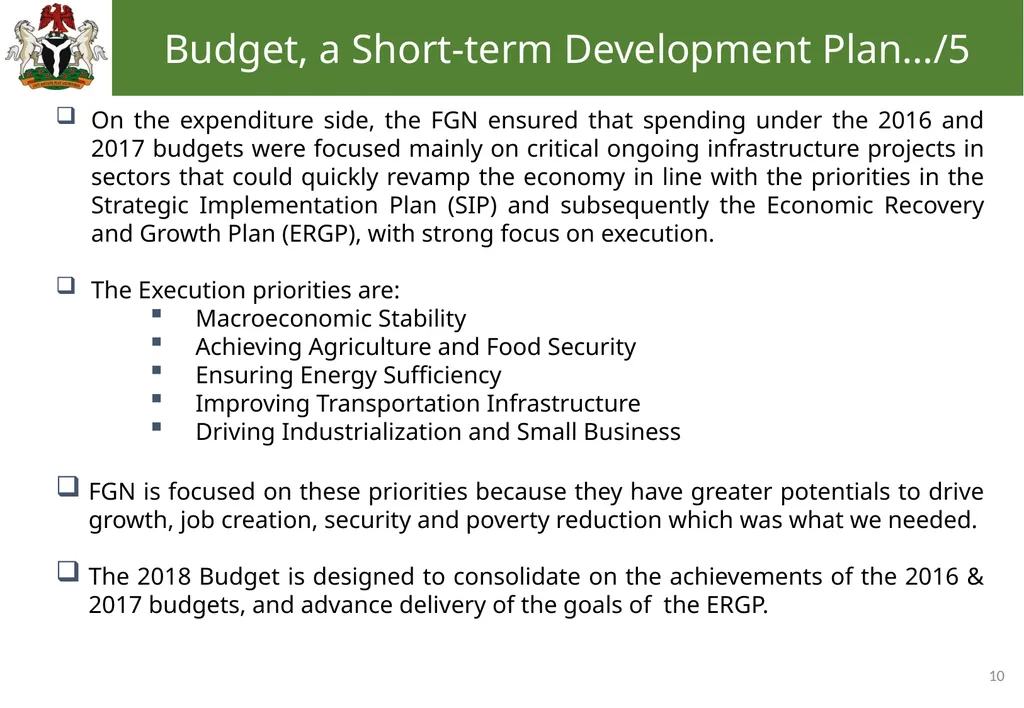
slide10. Budget, a Short-term Development Plan…/5 9 On the expenditure side, the FGN ensured that spending under the 2016 and 2017 budgets were focused mainly on critical ongoing infrastructure projects in sectors that could quickly revamp the economy in line with the priorities in the Strategic Implementation Plan (SIP) and subsequently the Economic Recovery and Growth Plan (ERGP), with strong focus on execution.
The Execution priorities are:
Macroeconomic Stability
Achieving Agriculture and Food Security
Ensuring Energy Sufficiency
Improving Transportation Infrastructure
Driving Industrialization and Small Business
FGN is focused on these priorities because they have greater potentials to drive growth, job creation, security and poverty reduction which was what we needed.
The 2018 Budget is designed to consolidate on the achievements of the 2016 & 2017 budgets, and advance delivery of the goals of the ERGP.<br>
slide11. THE LINKAGE :
FROM PLAN TO BUDGET 10<br>
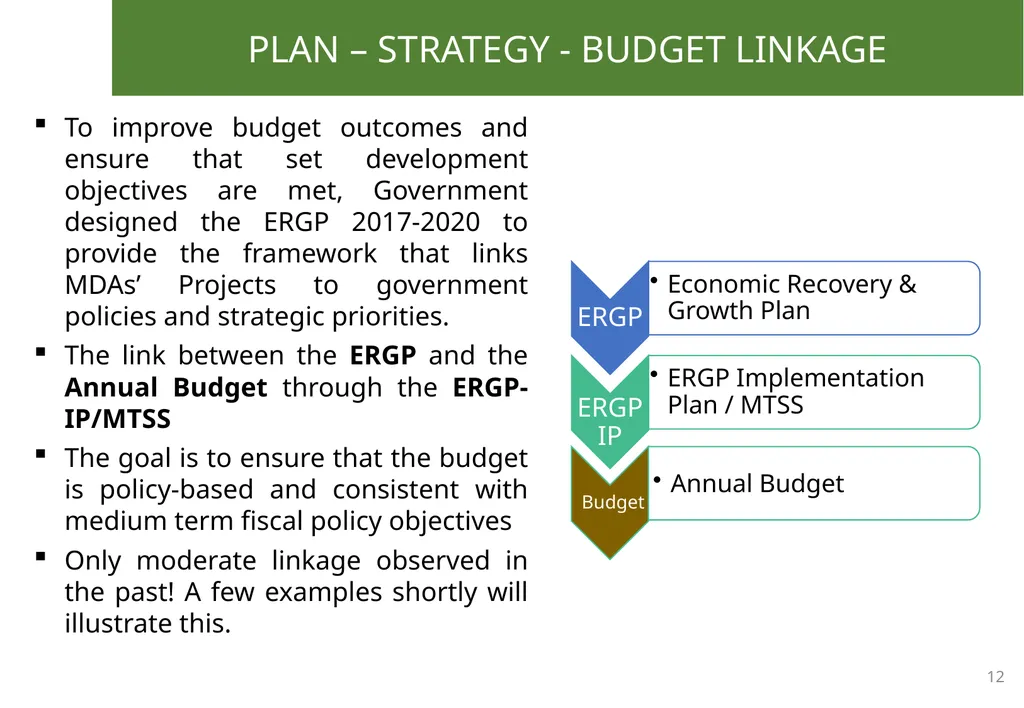
slide12. To improve budget outcomes and ensure that set development objectives are met, Government designed the ERGP 2017-2020 to provide the framework that links MDAs’ Projects to government policies and strategic priorities.
The link between the ERGP and the Annual Budget through the ERGP-IP/MTSS
The goal is to ensure that the budget is policy-based and consistent with medium term fiscal policy objectives
Only moderate linkage observed in the past! A few examples shortly will illustrate this. 11 Budget Annual Budget PLAN – STRATEGY - BUDGET LINKAGE<br>
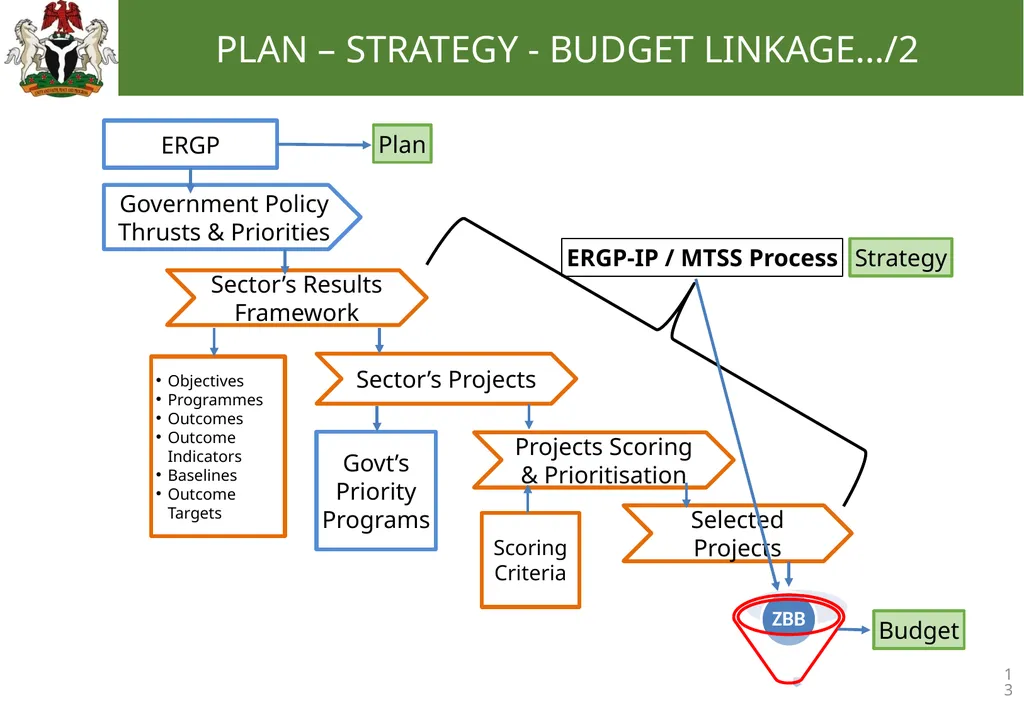
slide13. ERGP-IP / MTSS Process Plan Strategy Budget 12<br>
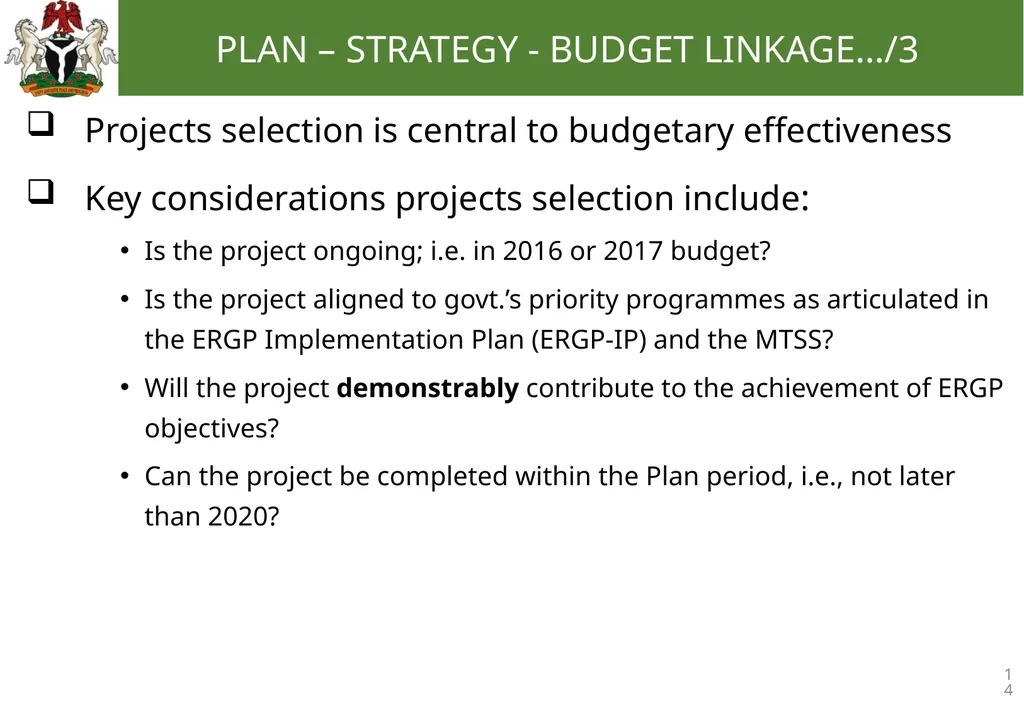
slide14. Projects selection is central to budgetary effectiveness
Key considerations projects selection include:
Is the project ongoing; i.e. in 2016 or 2017 budget?
Is the project aligned to govt.’s priority programmes as articulated in the ERGP Implementation Plan (ERGP-IP) and the MTSS?
Will the project demonstrably contribute to the achievement of ERGP objectives?
Can the project be completed within the Plan period, i.e., not later than 2020? 13<br>
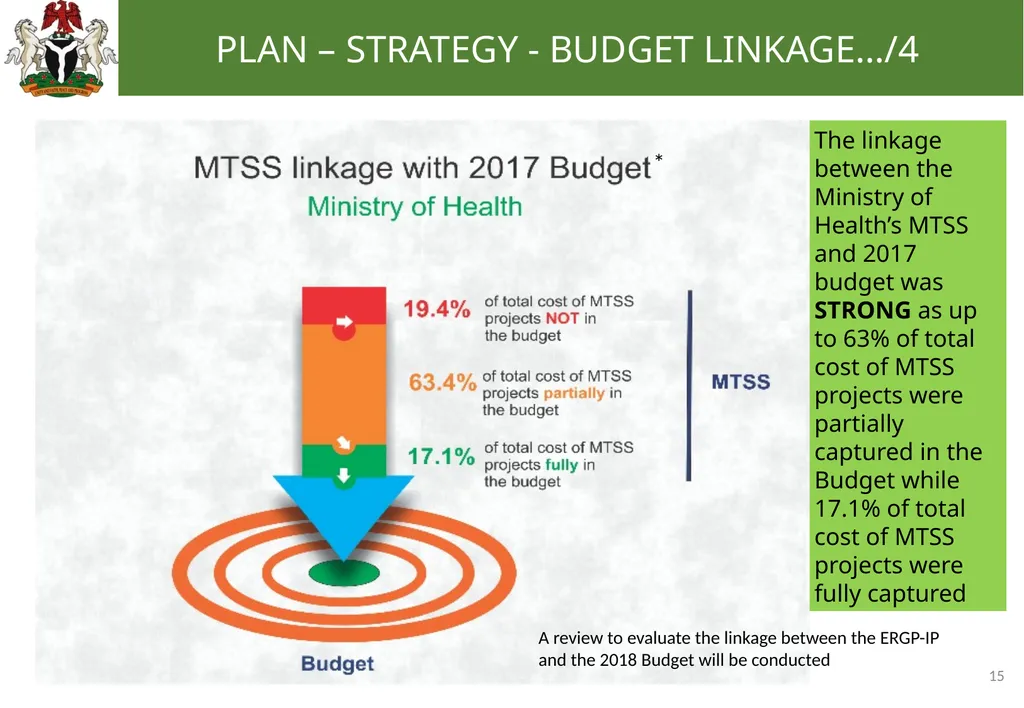
slide15. The linkage between the Ministry of Health’s MTSS and 2017 budget was STRONG as up to 63% of total cost of MTSS projects were partially captured in the Budget while 17.1% of total cost of MTSS projects were fully captured 14 * A review to evaluate the linkage between the ERGP-IP and the 2018 Budget will be conducted<br>
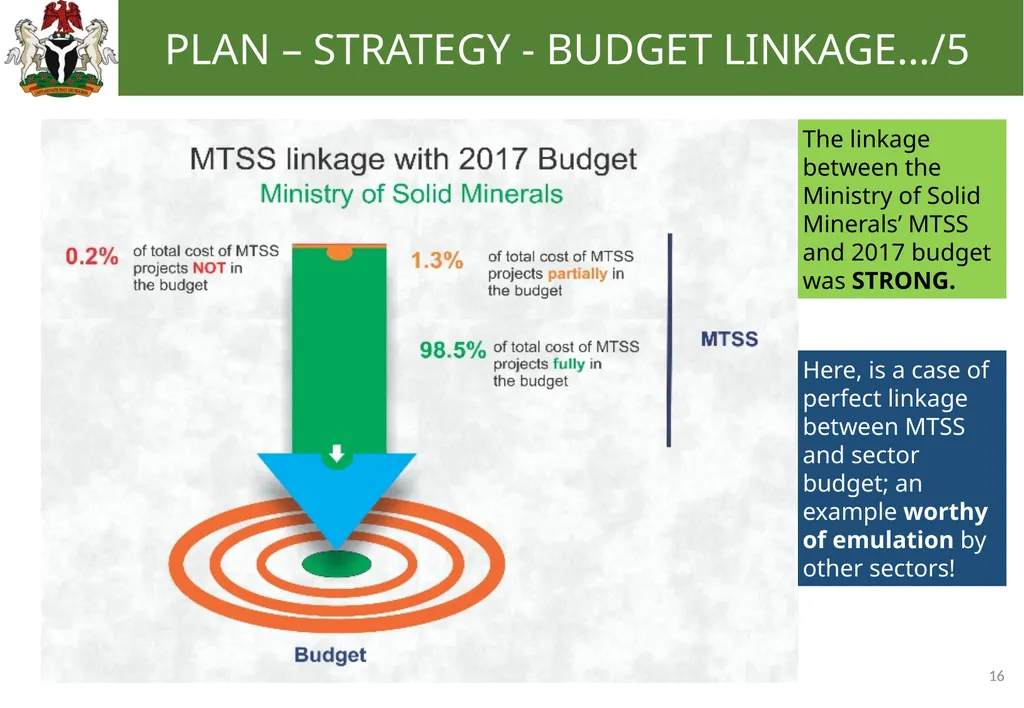
slide16. The linkage between the Ministry of Solid Minerals’ MTSS and 2017 budget was STRONG. Here, is a case of perfect linkage between MTSS and sector budget; an example worthy of emulation by other sectors! 15<br>
slide17. SOME BUDGETING ISSUES THAT AFFECT
PLAN IMPLEMNETATION 16<br>
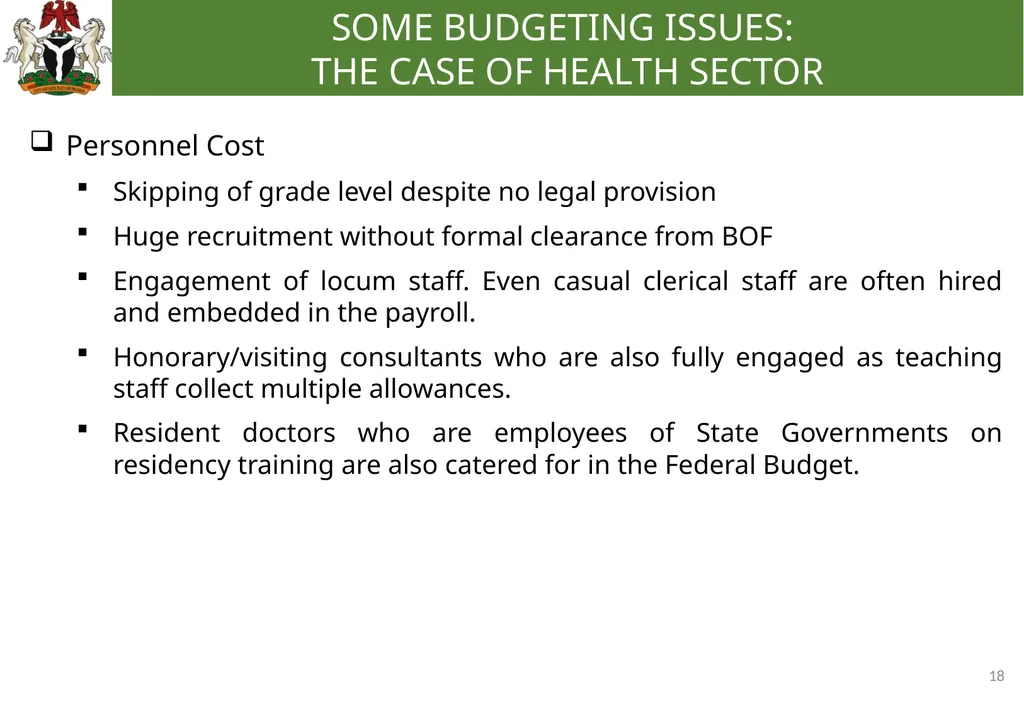
slide18. Personnel Cost
Skipping of grade level despite no legal provision
Huge recruitment without formal clearance from BOF
Engagement of locum staff. Even casual clerical staff are often hired and embedded in the payroll.
Honorary/visiting consultants who are also fully engaged as teaching staff collect multiple allowances.
Resident doctors who are employees of State Governments on residency training are also catered for in the Federal Budget. 17 SOME BUDGETING ISSUES:
THE CASE OF HEALTH SECTOR<br>
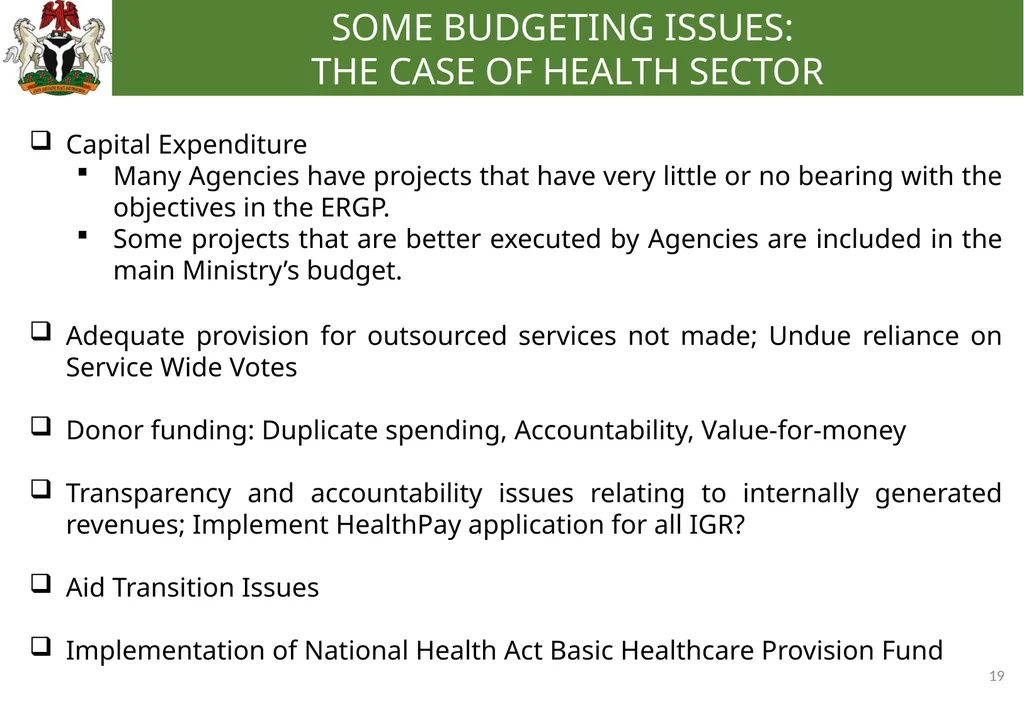
slide19. Capital Expenditure
Many Agencies have projects that have very little or no bearing with the objectives in the ERGP.
Some projects that are better executed by Agencies are included in the main Ministry’s budget.
Adequate provision for outsourced services not made; Undue reliance on Service Wide Votes
Donor funding: Duplicate spending, Accountability, Value-for-money
Transparency and accountability issues relating to internally generated revenues; Implement HealthPay application for all IGR?
Aid Transition Issues
Implementation of National Health Act Basic Healthcare Provision Fund 18 SOME BUDGETING ISSUES:
THE CASE OF HEALTH SECTOR<br>
slide20. TRANSLATING DEVELOPMENT PLANS
INTO ACTION (OUTPUT AND OUTCOMES) 19<br>
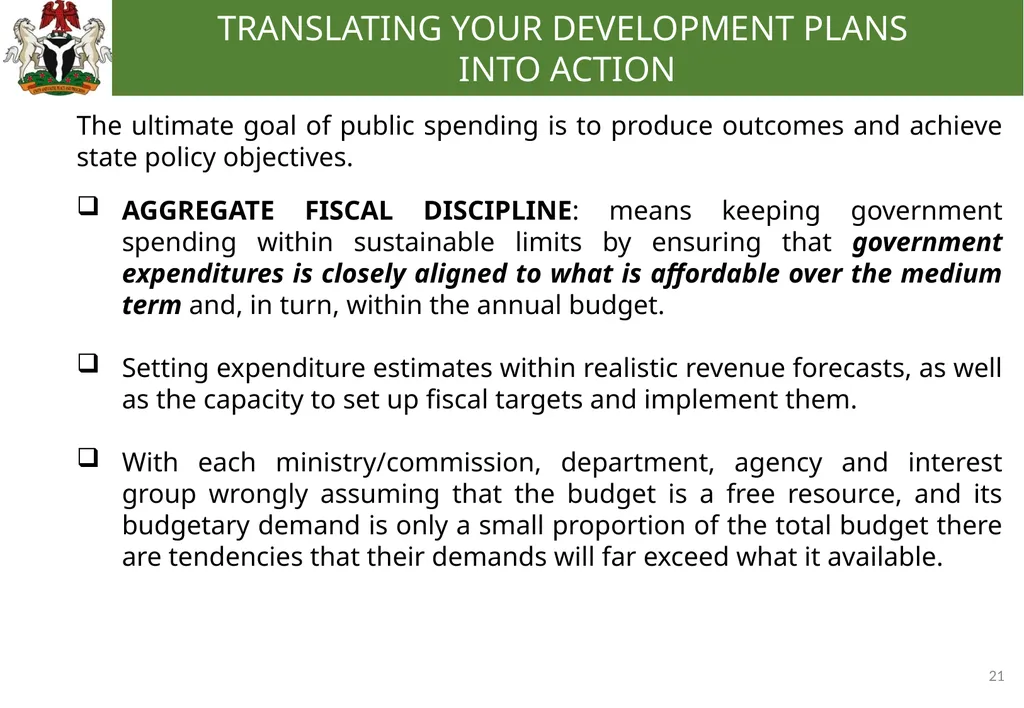
slide21. The ultimate goal of public spending is to produce outcomes and achieve state policy objectives.
AGGREGATE FISCAL DISCIPLINE: means keeping government spending within sustainable limits by ensuring that government expenditures is closely aligned to what is affordable over the medium term and, in turn, within the annual budget.
Setting expenditure estimates within realistic revenue forecasts, as well as the capacity to set up fiscal targets and implement them.
With each ministry/commission, department, agency and interest group wrongly assuming that the budget is a free resource, and its budgetary demand is only a small proportion of the total budget there are tendencies that their demands will far exceed what it available. 20 TRANSLATING YOUR DEVELOPMENT PLANS
INTO ACTION<br>
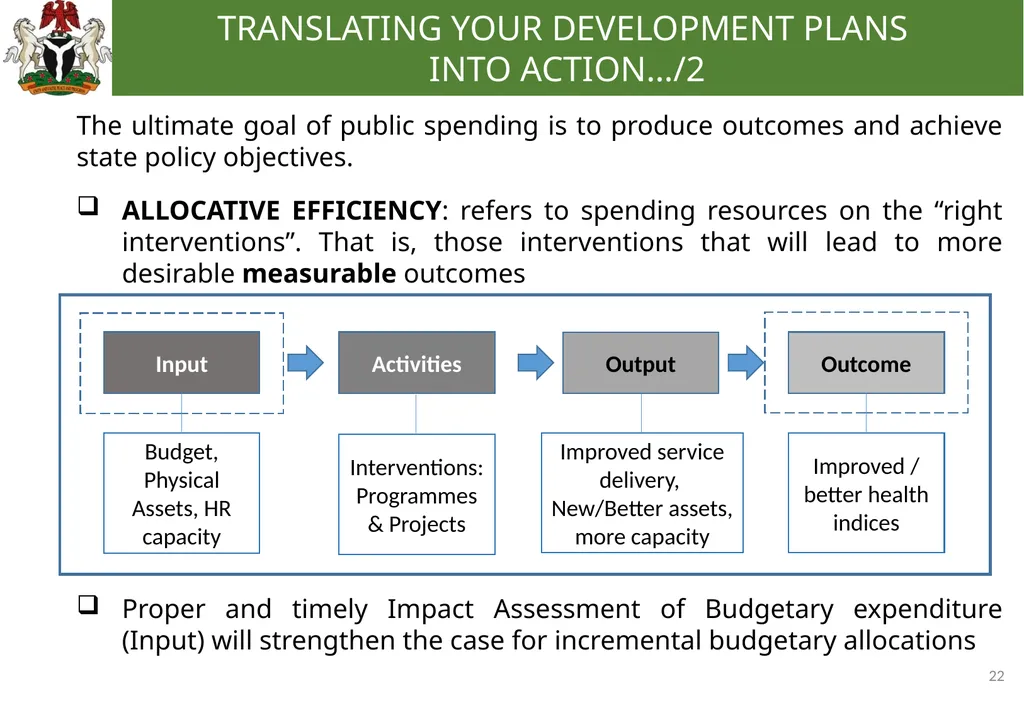
slide22. The ultimate goal of public spending is to produce outcomes and achieve state policy objectives.
ALLOCATIVE EFFICIENCY: refers to spending resources on the “right interventions”. That is, those interventions that will lead to more desirable measurable outcomes 21 TRANSLATING YOUR DEVELOPMENT PLANS
INTO ACTION…/2 Input Activities Output Outcome Proper and timely Impact Assessment of Budgetary expenditure (Input) will strengthen the case for incremental budgetary allocations Budget, Physical Assets, HR capacity Interventions:
Programmes & Projects Improved service delivery,
New/Better assets, more capacity Improved / better health indices<br>
slide23. 22 TRANSLATING YOUR DEVELOPMENT PLANS
INTO ACTION…/3<br>
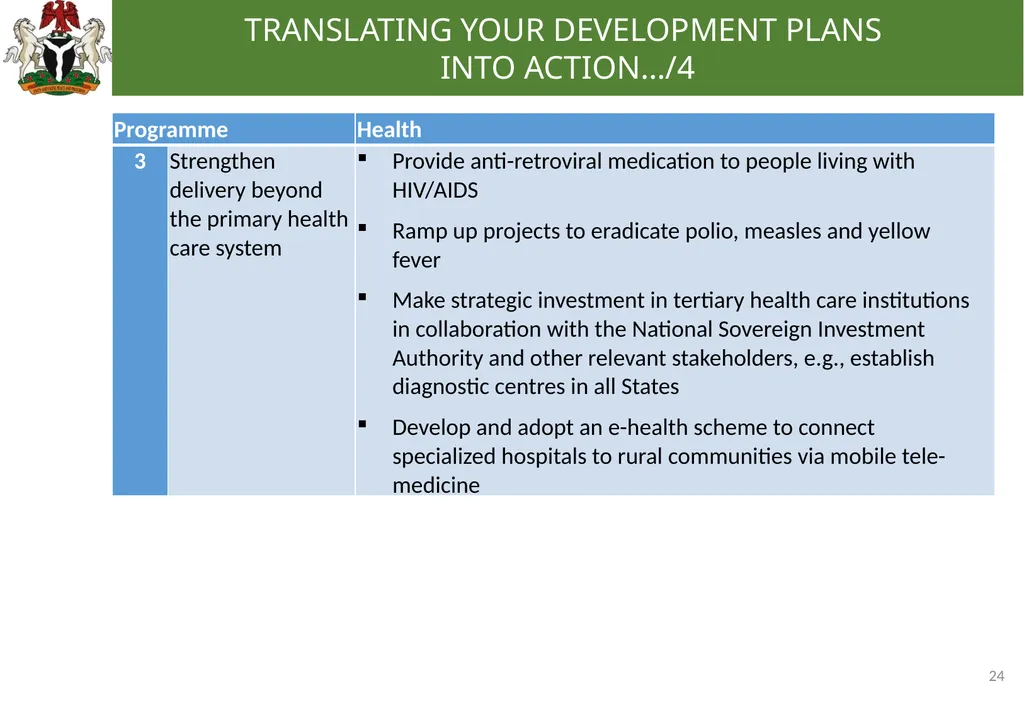
slide24. 23 TRANSLATING YOUR DEVELOPMENT PLANS
INTO ACTION…/4<br>
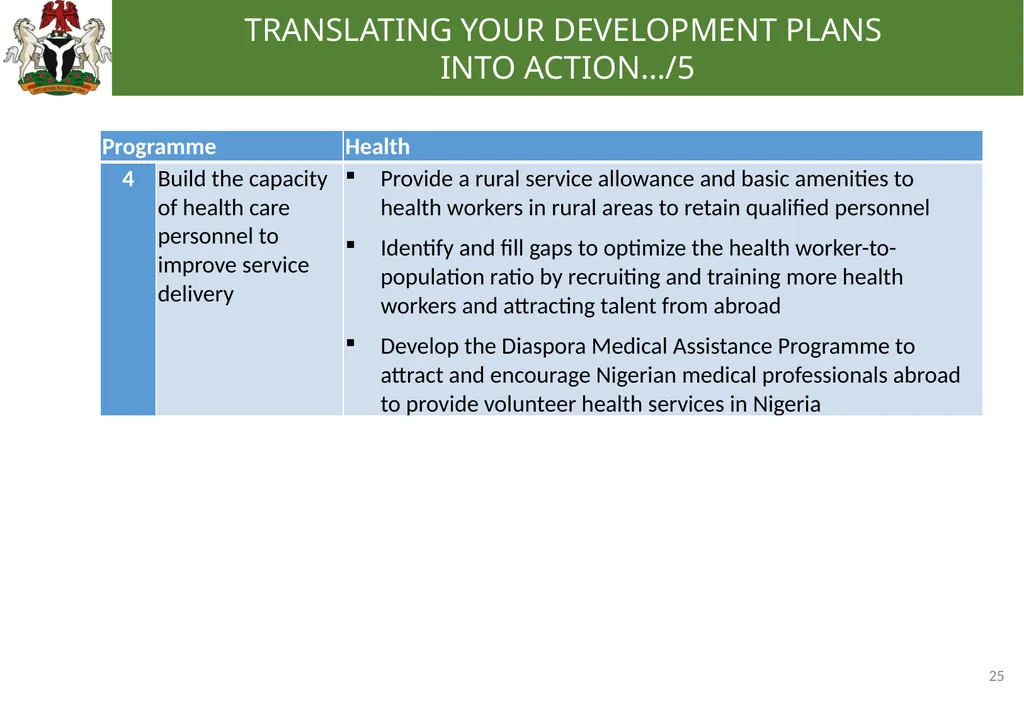
slide25. 24 TRANSLATING YOUR DEVELOPMENT PLANS
INTO ACTION…/5<br>
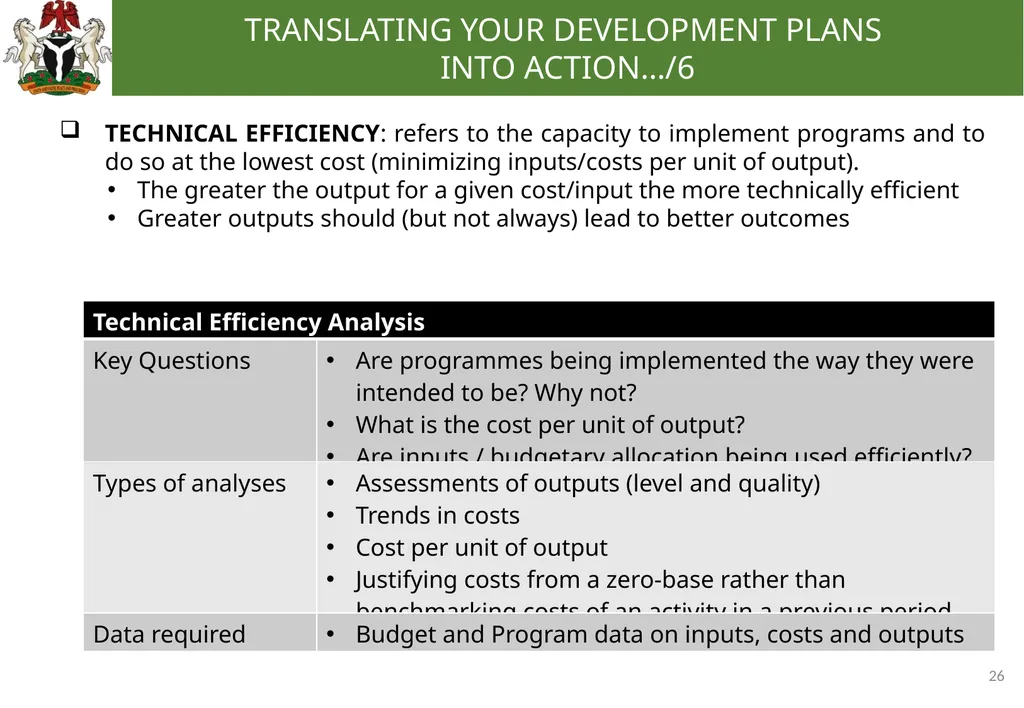
slide26. 25 TRANSLATING YOUR DEVELOPMENT PLANS
INTO ACTION…/6 TECHNICAL EFFICIENCY: refers to the capacity to implement programs and to do so at the lowest cost (minimizing inputs/costs per unit of output).
The greater the output for a given cost/input the more technically efficient
Greater outputs should (but not always) lead to better outcomes<br>
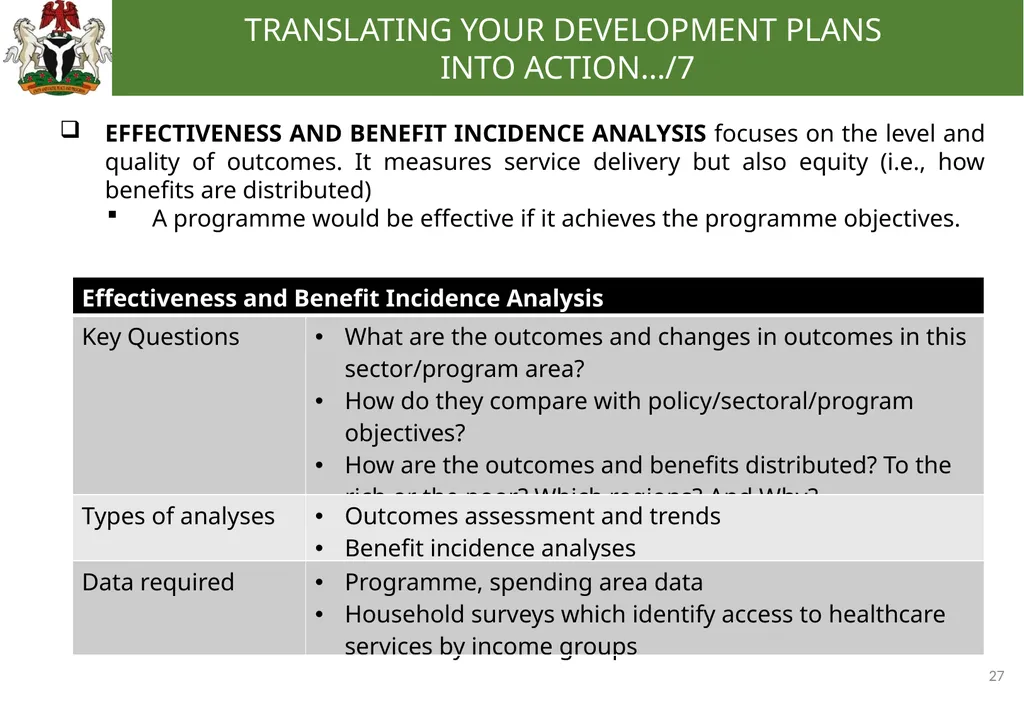
slide27. 26 TRANSLATING YOUR DEVELOPMENT PLANS
INTO ACTION…/7 EFFECTIVENESS AND BENEFIT INCIDENCE ANALYSIS focuses on the level and quality of outcomes. It measures service delivery but also equity (i.e., how benefits are distributed)
A programme would be effective if it achieves the programme objectives.<br>
slide28. WAY TO GO:
CRITICAL SUCCESS FACTORS 27<br>
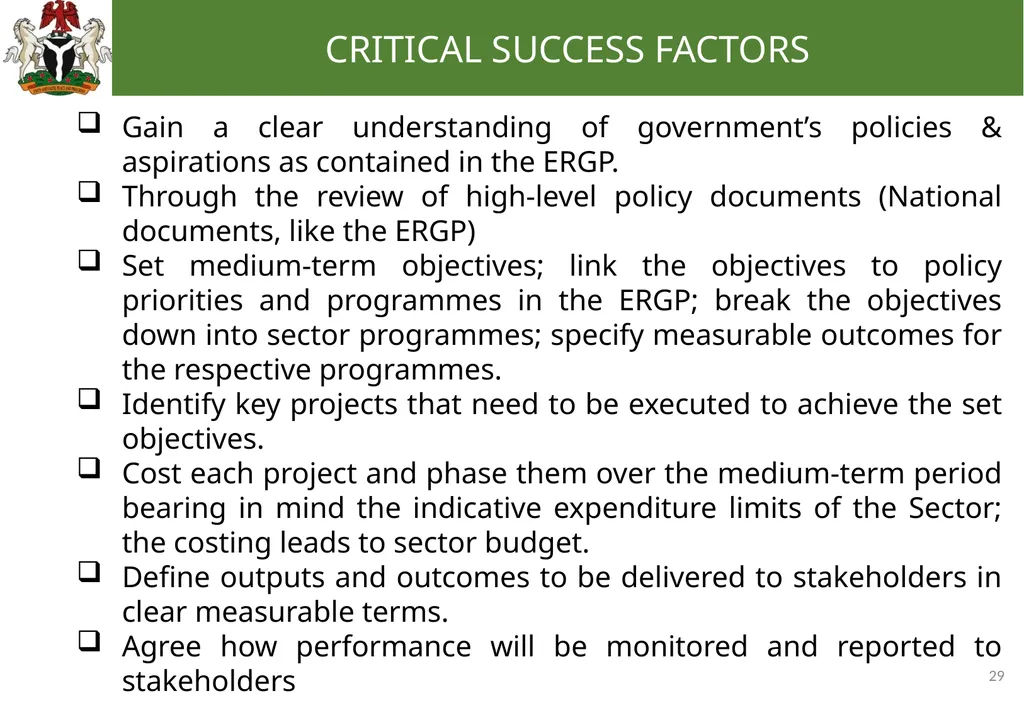
slide29. Gain a clear understanding of government’s policies & aspirations as contained in the ERGP.
Through the review of high-level policy documents (National documents, like the ERGP)
Set medium-term objectives; link the objectives to policy priorities and programmes in the ERGP; break the objectives down into sector programmes; specify measurable outcomes for the respective programmes.
Identify key projects that need to be executed to achieve the set objectives.
Cost each project and phase them over the medium-term period bearing in mind the indicative expenditure limits of the Sector; the costing leads to sector budget.
Define outputs and outcomes to be delivered to stakeholders in clear measurable terms.
Agree how performance will be monitored and reported to stakeholders 28 CRITICAL SUCCESS FACTORS<br>
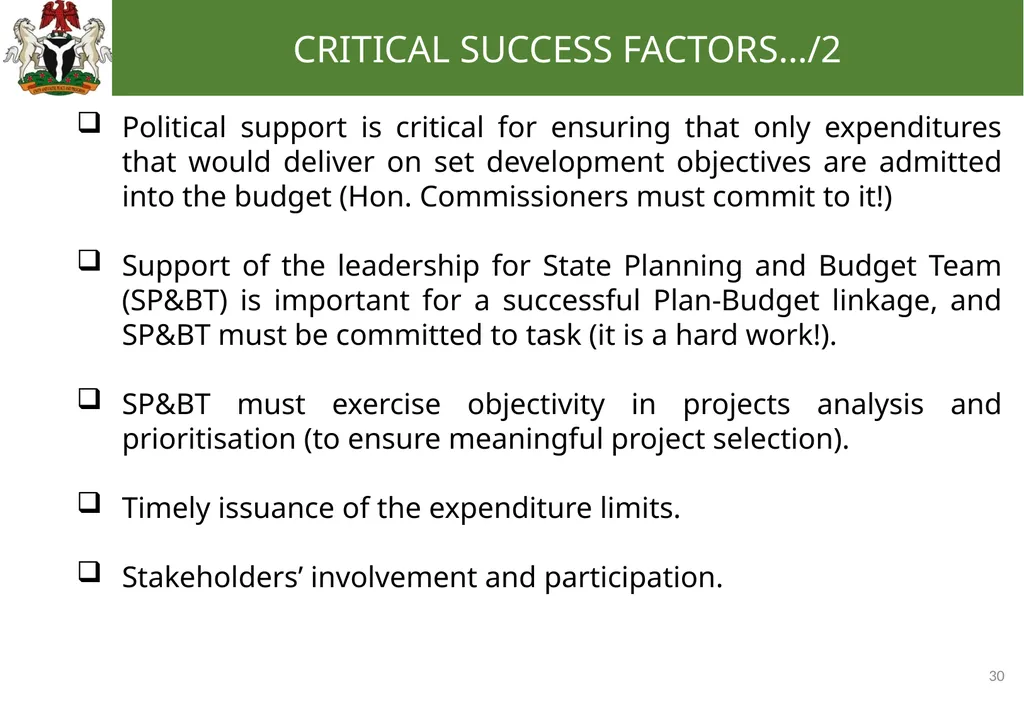
slide30. Political support is critical for ensuring that only expenditures that would deliver on set development objectives are admitted into the budget (Hon. Commissioners must commit to it!)
Support of the leadership for State Planning and Budget Team (SP&BT) is important for a successful Plan-Budget linkage, and SP&BT must be committed to task (it is a hard work!).
SP&BT must exercise objectivity in projects analysis and prioritisation (to ensure meaningful project selection).
Timely issuance of the expenditure limits.
Stakeholders’ involvement and participation. 29 CRITICAL SUCCESS FACTORS…/2<br>
slide31. END THANK
YOU ! 30 www.budgetoffice.gov.ng “Don't tell me what you value, show me your budget, and I'll tell you what you value.”
Joe Biden<br>
Wednesday, 29th August, 2018 Ben Akabueze
Director-General
BUDGET OFFICE OF THE FEDERATION<br>
slide2. Outline 1 1.0 Introduction
2.0 Budget, a Short-Term Development Plan
3.0 The Linkage: From Plan to Budget
4.0 Some Budgeting Issues that affect Plan Implementation
5.0 Translating Development Plans into Actions
6.0 Critical Success Factors<br>
slide3. INTRODUCTION 2 An economic development plan is a carefully built framework with a long-term in scope.
It provides a comprehensive overview of the economy, sets policy direction for economic growth, and identifies strategies, programs, and projects to improve the economy.
A development plan is usually based on a determined model, and made up of five components: Vision, Mission, Goals, Strategies, and Actions.
It is basically about deciding in advance what to do, how to do it, when to do it and who is to do it. It is therefore a blueprint for action.
Actions are the life wire of any development plan.
Without actions or actionable activities, a development plan is as good as dead Development Plan and Annual Budgets<br>
slide4. INTRODUCTION…/2 3 Development planning has been a consistent phenomenon in Nigeria since the mid-1940s. However, we can argue that it has not been as successful as expected.
This implies two things: either the correct plan had not always been made or correct plans made were not effectively implemented.
It is important to underscore that development planning is not easy since it deals with many complex and futuristic events.
This highlights the need to deliberately pursue short-term activities that are geared to the achievement of the long-term development plan.
Annual Budgets are short-term development plans/activities that target at set development objectives. Development Plan and Annual Budgets<br>
slide5. BUDGET,
A SHORT-TERM DEVELOPMENT PLAN 4<br>
slide6. Budget, a Short-term Development Plan 5 Budget and Budgeting Budget
A budget is not just a set of revenue & expenditure plans by the Government, but culmination of government’s strategic economic and fiscal policies, plans and priorities for actualising its development agenda in a fiscal year Budgeting
Budgeting entails choice among competing alternatives.
The purpose of budgeting is to achieve the most desirable allocation of funds among alternatives.
Resource constraints vis a vis competing economic needs emphasize the need for Budgeting Even if resources were limitless there will still be need to budget because the sequencing of spending varies among MDAs and priorities must be placed on key expenditure items.<br>
slide7. Budget, a Short-term Development Plan…/2 6 Investments in economic and social infrastructure like power, transportation, roads, health and education are critical for the long-term productivity, growth and development of any Nation.
However, when this Administration came into Office in 2015, revenues were down due to the collapse in oil price which began by mid-2014.
Clearly, the economy was already headed for an economic recession.
As a result, the core priority of the Administration was to halt the slide and return the economy to the path of growth through an expansionary fiscal policy.<br>
slide8. Budget, a Short-term Development Plan…/3 7 To expand government’s spending, there was need to raise more revenues.
As a result, part of the strategic plan of government was to diversify the economy away from oil so as to make the economy non-oil driven.
To achieve this, embarked on some initiatives to tackle the revenue challenge, including:
Some of the initiatives being taken to address the revenue problem include:
Deployment of new/improved technology to enhance revenue collection
Upward review of tariffs and tax rates where appropriate
Tighter performance management framework for State Owned Enterprises (SOEs), and
Stronger enforcement action against tax defaulters<br>
slide9. Budget, a Short-term Development Plan…/4 8 Others include:
New funding mechanism for JV operations, allowing for Cost Recovery in lieu of previous cash call arrangement.
Additional oil-related revenue including: Royalty Recovery, New/Marginal Field Licences, Early licensing renewals.
Review of the fiscal regime for Oil Production Sharing Contracts (PSCs)
Restructuring government’s equity in JV oil assets, (reduction in equity holding) with proceeds to be reinvested in other assets.
Increase in Excise duty rates on alcohol and tobacco.
Tax Administration improvement initiatives to positively affect collection efficiencies across various tax categories, e.g., Tax amnesty programme<br>
slide10. Budget, a Short-term Development Plan…/5 9 On the expenditure side, the FGN ensured that spending under the 2016 and 2017 budgets were focused mainly on critical ongoing infrastructure projects in sectors that could quickly revamp the economy in line with the priorities in the Strategic Implementation Plan (SIP) and subsequently the Economic Recovery and Growth Plan (ERGP), with strong focus on execution.
The Execution priorities are:
Macroeconomic Stability
Achieving Agriculture and Food Security
Ensuring Energy Sufficiency
Improving Transportation Infrastructure
Driving Industrialization and Small Business
FGN is focused on these priorities because they have greater potentials to drive growth, job creation, security and poverty reduction which was what we needed.
The 2018 Budget is designed to consolidate on the achievements of the 2016 & 2017 budgets, and advance delivery of the goals of the ERGP.<br>
slide11. THE LINKAGE :
FROM PLAN TO BUDGET 10<br>
slide12. To improve budget outcomes and ensure that set development objectives are met, Government designed the ERGP 2017-2020 to provide the framework that links MDAs’ Projects to government policies and strategic priorities.
The link between the ERGP and the Annual Budget through the ERGP-IP/MTSS
The goal is to ensure that the budget is policy-based and consistent with medium term fiscal policy objectives
Only moderate linkage observed in the past! A few examples shortly will illustrate this. 11 Budget Annual Budget PLAN – STRATEGY - BUDGET LINKAGE<br>
slide13. ERGP-IP / MTSS Process Plan Strategy Budget 12<br>
slide14. Projects selection is central to budgetary effectiveness
Key considerations projects selection include:
Is the project ongoing; i.e. in 2016 or 2017 budget?
Is the project aligned to govt.’s priority programmes as articulated in the ERGP Implementation Plan (ERGP-IP) and the MTSS?
Will the project demonstrably contribute to the achievement of ERGP objectives?
Can the project be completed within the Plan period, i.e., not later than 2020? 13<br>
slide15. The linkage between the Ministry of Health’s MTSS and 2017 budget was STRONG as up to 63% of total cost of MTSS projects were partially captured in the Budget while 17.1% of total cost of MTSS projects were fully captured 14 * A review to evaluate the linkage between the ERGP-IP and the 2018 Budget will be conducted<br>
slide16. The linkage between the Ministry of Solid Minerals’ MTSS and 2017 budget was STRONG. Here, is a case of perfect linkage between MTSS and sector budget; an example worthy of emulation by other sectors! 15<br>
slide17. SOME BUDGETING ISSUES THAT AFFECT
PLAN IMPLEMNETATION 16<br>
slide18. Personnel Cost
Skipping of grade level despite no legal provision
Huge recruitment without formal clearance from BOF
Engagement of locum staff. Even casual clerical staff are often hired and embedded in the payroll.
Honorary/visiting consultants who are also fully engaged as teaching staff collect multiple allowances.
Resident doctors who are employees of State Governments on residency training are also catered for in the Federal Budget. 17 SOME BUDGETING ISSUES:
THE CASE OF HEALTH SECTOR<br>
slide19. Capital Expenditure
Many Agencies have projects that have very little or no bearing with the objectives in the ERGP.
Some projects that are better executed by Agencies are included in the main Ministry’s budget.
Adequate provision for outsourced services not made; Undue reliance on Service Wide Votes
Donor funding: Duplicate spending, Accountability, Value-for-money
Transparency and accountability issues relating to internally generated revenues; Implement HealthPay application for all IGR?
Aid Transition Issues
Implementation of National Health Act Basic Healthcare Provision Fund 18 SOME BUDGETING ISSUES:
THE CASE OF HEALTH SECTOR<br>
slide20. TRANSLATING DEVELOPMENT PLANS
INTO ACTION (OUTPUT AND OUTCOMES) 19<br>
slide21. The ultimate goal of public spending is to produce outcomes and achieve state policy objectives.
AGGREGATE FISCAL DISCIPLINE: means keeping government spending within sustainable limits by ensuring that government expenditures is closely aligned to what is affordable over the medium term and, in turn, within the annual budget.
Setting expenditure estimates within realistic revenue forecasts, as well as the capacity to set up fiscal targets and implement them.
With each ministry/commission, department, agency and interest group wrongly assuming that the budget is a free resource, and its budgetary demand is only a small proportion of the total budget there are tendencies that their demands will far exceed what it available. 20 TRANSLATING YOUR DEVELOPMENT PLANS
INTO ACTION<br>
slide22. The ultimate goal of public spending is to produce outcomes and achieve state policy objectives.
ALLOCATIVE EFFICIENCY: refers to spending resources on the “right interventions”. That is, those interventions that will lead to more desirable measurable outcomes 21 TRANSLATING YOUR DEVELOPMENT PLANS
INTO ACTION…/2 Input Activities Output Outcome Proper and timely Impact Assessment of Budgetary expenditure (Input) will strengthen the case for incremental budgetary allocations Budget, Physical Assets, HR capacity Interventions:
Programmes & Projects Improved service delivery,
New/Better assets, more capacity Improved / better health indices<br>
slide23. 22 TRANSLATING YOUR DEVELOPMENT PLANS
INTO ACTION…/3<br>
slide24. 23 TRANSLATING YOUR DEVELOPMENT PLANS
INTO ACTION…/4<br>
slide25. 24 TRANSLATING YOUR DEVELOPMENT PLANS
INTO ACTION…/5<br>
slide26. 25 TRANSLATING YOUR DEVELOPMENT PLANS
INTO ACTION…/6 TECHNICAL EFFICIENCY: refers to the capacity to implement programs and to do so at the lowest cost (minimizing inputs/costs per unit of output).
The greater the output for a given cost/input the more technically efficient
Greater outputs should (but not always) lead to better outcomes<br>
slide27. 26 TRANSLATING YOUR DEVELOPMENT PLANS
INTO ACTION…/7 EFFECTIVENESS AND BENEFIT INCIDENCE ANALYSIS focuses on the level and quality of outcomes. It measures service delivery but also equity (i.e., how benefits are distributed)
A programme would be effective if it achieves the programme objectives.<br>
slide28. WAY TO GO:
CRITICAL SUCCESS FACTORS 27<br>
slide29. Gain a clear understanding of government’s policies & aspirations as contained in the ERGP.
Through the review of high-level policy documents (National documents, like the ERGP)
Set medium-term objectives; link the objectives to policy priorities and programmes in the ERGP; break the objectives down into sector programmes; specify measurable outcomes for the respective programmes.
Identify key projects that need to be executed to achieve the set objectives.
Cost each project and phase them over the medium-term period bearing in mind the indicative expenditure limits of the Sector; the costing leads to sector budget.
Define outputs and outcomes to be delivered to stakeholders in clear measurable terms.
Agree how performance will be monitored and reported to stakeholders 28 CRITICAL SUCCESS FACTORS<br>
slide30. Political support is critical for ensuring that only expenditures that would deliver on set development objectives are admitted into the budget (Hon. Commissioners must commit to it!)
Support of the leadership for State Planning and Budget Team (SP&BT) is important for a successful Plan-Budget linkage, and SP&BT must be committed to task (it is a hard work!).
SP&BT must exercise objectivity in projects analysis and prioritisation (to ensure meaningful project selection).
Timely issuance of the expenditure limits.
Stakeholders’ involvement and participation. 29 CRITICAL SUCCESS FACTORS…/2<br>
slide31. END THANK
YOU ! 30 www.budgetoffice.gov.ng “Don't tell me what you value, show me your budget, and I'll tell you what you value.”
Joe Biden<br>