
01 02 - UMES Middle States Self-Study Update
MS
Published · 20 slides · 0 views
1 / 1
Description
01 02 - UMES Middle States Self-Study Update February 18, 2025 MSCHE Standards of Accreditation The institution is authorized or licensed to operate as a postsecondary educational institution and to award postsecondary degrees. The
Related Topics
Share
Embed code
Download this presentation From Below
"01 02 - UMES Middle States Self-Study Update" is the property of its rightful owner. Permission is granted to download and print the materials on this website for personal, non-commercial use only, and to display it on your personal computer provided you do not modify the materials and that you retain all copyright notices contained in the materials. By downloading content from our website, you accept the terms of this agreement.
Presentation Transcript
01
01 02 - UMES Middle States Self-Study Update February 18, 2025<br>
02
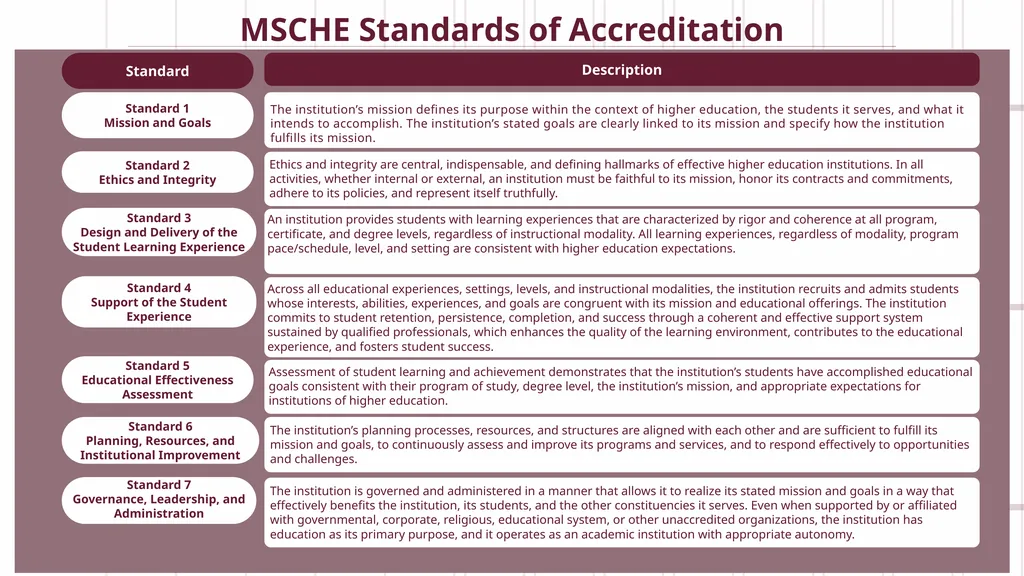
MSCHE Standards of Accreditation<br>
03
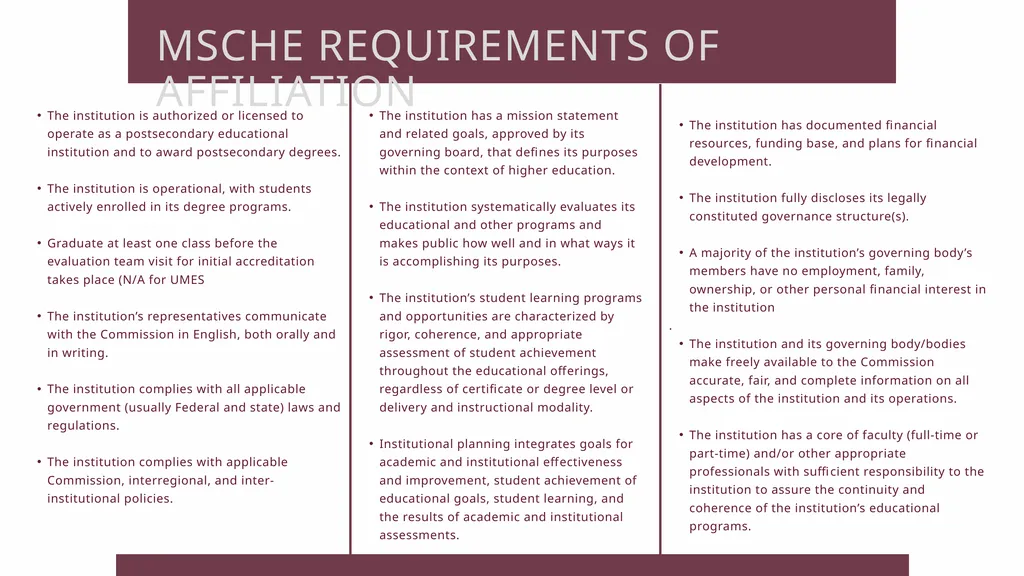
The institution is authorized or licensed to operate as a postsecondary educational institution and to award postsecondary degrees.
The institution is operational, with students actively enrolled in its degree programs.
Graduate at least one class before the evaluation team visit for initial accreditation takes place (N/A for UMES
The institution’s representatives communicate with the Commission in English, both orally and in writing.
The institution complies with all applicable government (usually Federal and state) laws and regulations.
The institution complies with applicable Commission, interregional, and inter-institutional policies. MSCHE REQUIREMENTS OF AFFILIATION The institution has a mission statement and related goals, approved by its governing board, that defines its purposes within the context of higher education.
The institution systematically evaluates its educational and other programs and makes public how well and in what ways it is accomplishing its purposes.
The institution’s student learning programs and opportunities are characterized by rigor, coherence, and appropriate assessment of student achievement throughout the educational offerings, regardless of certificate or degree level or delivery and instructional modality.
Institutional planning integrates goals for academic and institutional effectiveness and improvement, student achievement of educational goals, student learning, and the results of academic and institutional assessments. The institution has documented financial resources, funding base, and plans for financial development.
The institution fully discloses its legally constituted governance structure(s).
A majority of the institution’s governing body’s members have no employment, family, ownership, or other personal financial interest in the institution
.
The institution and its governing body/bodies make freely available to the Commission accurate, fair, and complete information on all aspects of the institution and its operations.
The institution has a core of faculty (full-time or part-time) and/or other appropriate professionals with sufficient responsibility to the institution to assure the continuity and coherence of the institution’s educational programs.<br>
The institution is operational, with students actively enrolled in its degree programs.
Graduate at least one class before the evaluation team visit for initial accreditation takes place (N/A for UMES
The institution’s representatives communicate with the Commission in English, both orally and in writing.
The institution complies with all applicable government (usually Federal and state) laws and regulations.
The institution complies with applicable Commission, interregional, and inter-institutional policies. MSCHE REQUIREMENTS OF AFFILIATION The institution has a mission statement and related goals, approved by its governing board, that defines its purposes within the context of higher education.
The institution systematically evaluates its educational and other programs and makes public how well and in what ways it is accomplishing its purposes.
The institution’s student learning programs and opportunities are characterized by rigor, coherence, and appropriate assessment of student achievement throughout the educational offerings, regardless of certificate or degree level or delivery and instructional modality.
Institutional planning integrates goals for academic and institutional effectiveness and improvement, student achievement of educational goals, student learning, and the results of academic and institutional assessments. The institution has documented financial resources, funding base, and plans for financial development.
The institution fully discloses its legally constituted governance structure(s).
A majority of the institution’s governing body’s members have no employment, family, ownership, or other personal financial interest in the institution
.
The institution and its governing body/bodies make freely available to the Commission accurate, fair, and complete information on all aspects of the institution and its operations.
The institution has a core of faculty (full-time or part-time) and/or other appropriate professionals with sufficient responsibility to the institution to assure the continuity and coherence of the institution’s educational programs.<br>
04
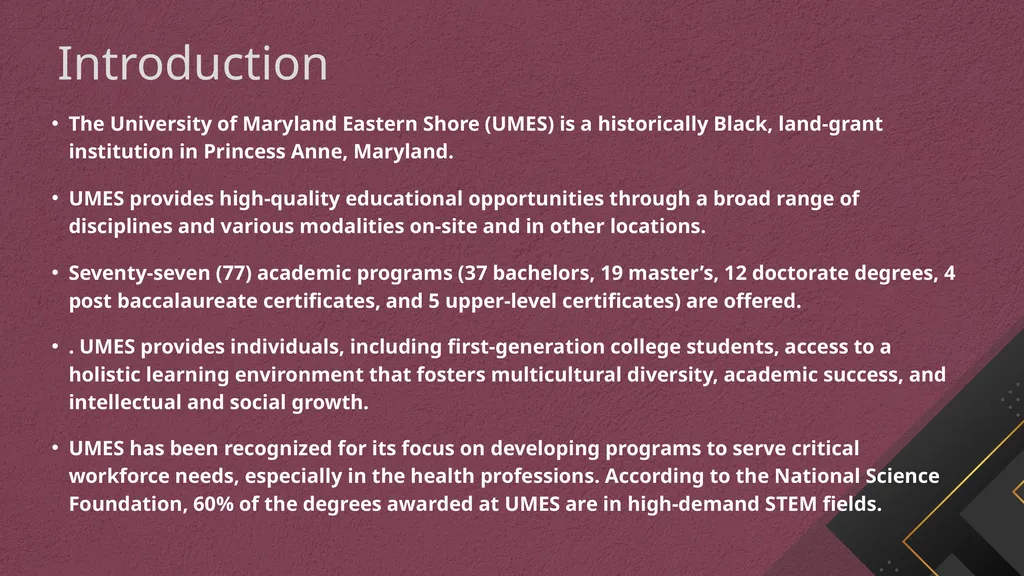
Introduction The University of Maryland Eastern Shore (UMES) is a historically Black, land-grant institution in Princess Anne, Maryland.
UMES provides high-quality educational opportunities through a broad range of disciplines and various modalities on-site and in other locations.
Seventy-seven (77) academic programs (37 bachelors, 19 master’s, 12 doctorate degrees, 4 post baccalaureate certificates, and 5 upper-level certificates) are offered.
. UMES provides individuals, including first-generation college students, access to a holistic learning environment that fosters multicultural diversity, academic success, and intellectual and social growth.
UMES has been recognized for its focus on developing programs to serve critical workforce needs, especially in the health professions. According to the National Science Foundation, 60% of the degrees awarded at UMES are in high-demand STEM fields.<br>
UMES provides high-quality educational opportunities through a broad range of disciplines and various modalities on-site and in other locations.
Seventy-seven (77) academic programs (37 bachelors, 19 master’s, 12 doctorate degrees, 4 post baccalaureate certificates, and 5 upper-level certificates) are offered.
. UMES provides individuals, including first-generation college students, access to a holistic learning environment that fosters multicultural diversity, academic success, and intellectual and social growth.
UMES has been recognized for its focus on developing programs to serve critical workforce needs, especially in the health professions. According to the National Science Foundation, 60% of the degrees awarded at UMES are in high-demand STEM fields.<br>
05
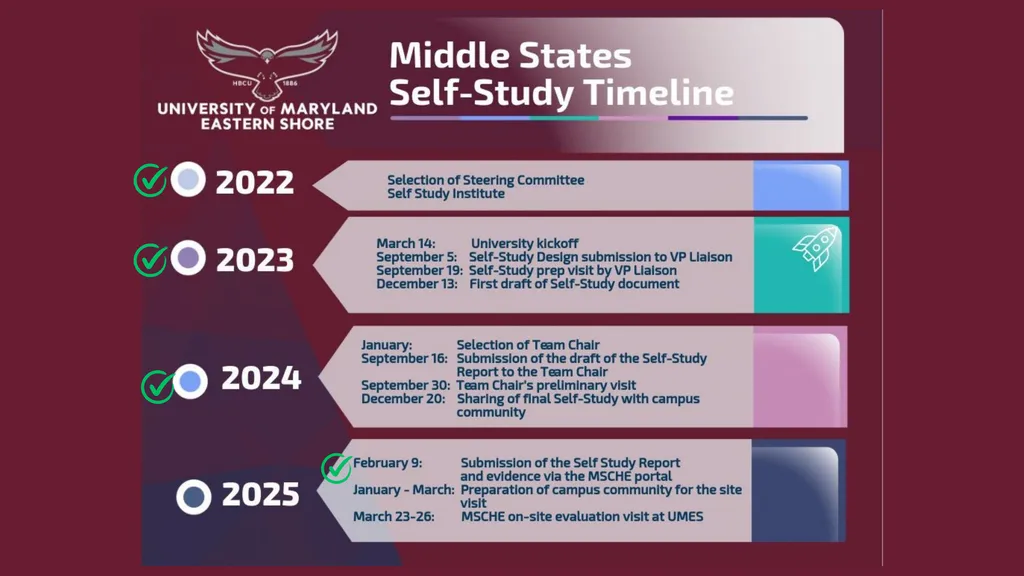
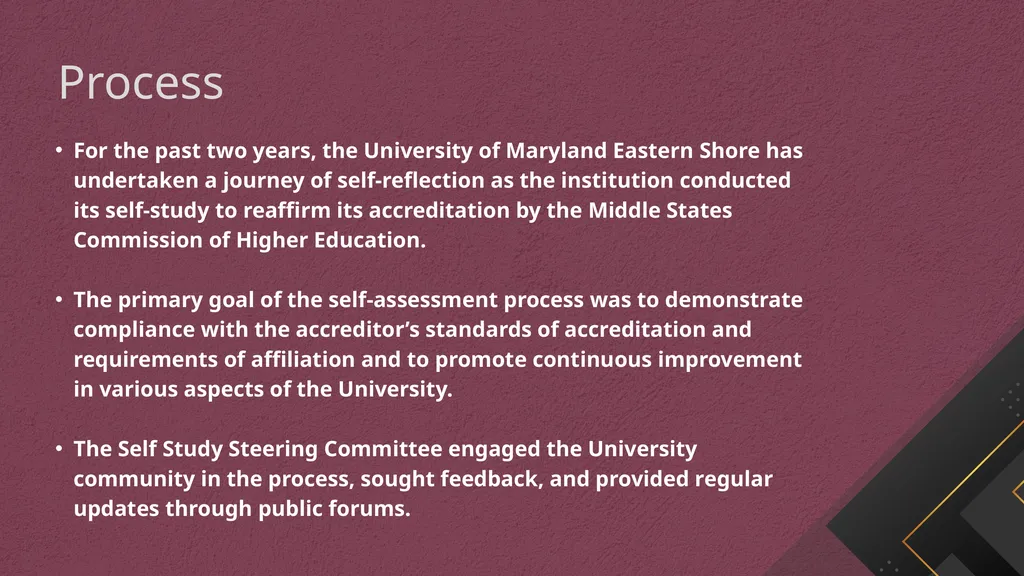
Process For the past two years, the University of Maryland Eastern Shore has undertaken a journey of self-reflection as the institution conducted its self-study to reaffirm its accreditation by the Middle States Commission of Higher Education.
The primary goal of the self-assessment process was to demonstrate compliance with the accreditor’s standards of accreditation and requirements of affiliation and to promote continuous improvement in various aspects of the University.
The Self Study Steering Committee engaged the University community in the process, sought feedback, and provided regular updates through public forums.<br>
The primary goal of the self-assessment process was to demonstrate compliance with the accreditor’s standards of accreditation and requirements of affiliation and to promote continuous improvement in various aspects of the University.
The Self Study Steering Committee engaged the University community in the process, sought feedback, and provided regular updates through public forums.<br>
06
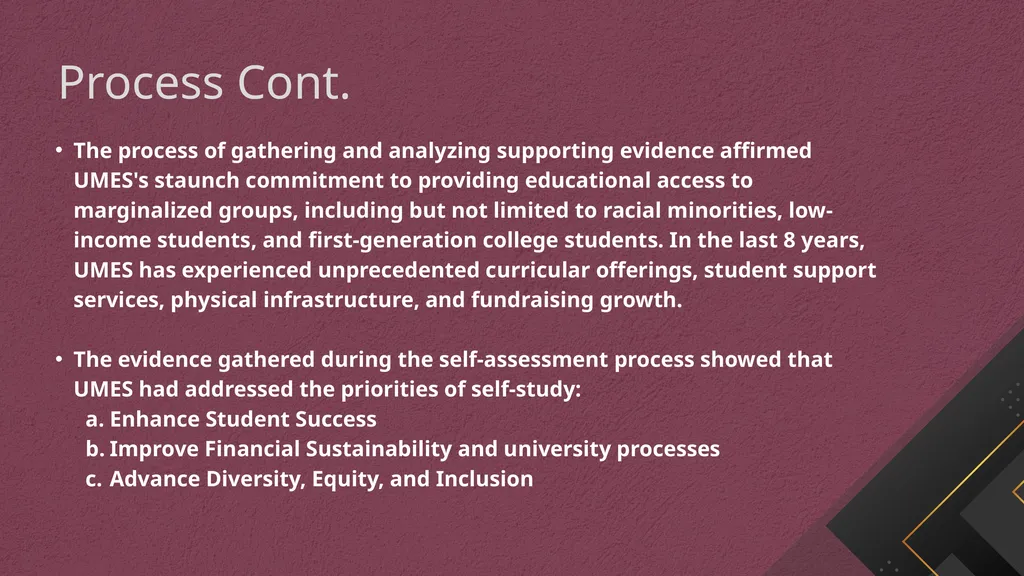
Process Cont. The process of gathering and analyzing supporting evidence affirmed UMES's staunch commitment to providing educational access to marginalized groups, including but not limited to racial minorities, low-income students, and first-generation college students. In the last 8 years, UMES has experienced unprecedented curricular offerings, student support services, physical infrastructure, and fundraising growth.
The evidence gathered during the self-assessment process showed that UMES had addressed the priorities of self-study:
Enhance Student Success
Improve Financial Sustainability and university processes
Advance Diversity, Equity, and Inclusion<br>
The evidence gathered during the self-assessment process showed that UMES had addressed the priorities of self-study:
Enhance Student Success
Improve Financial Sustainability and university processes
Advance Diversity, Equity, and Inclusion<br>
07
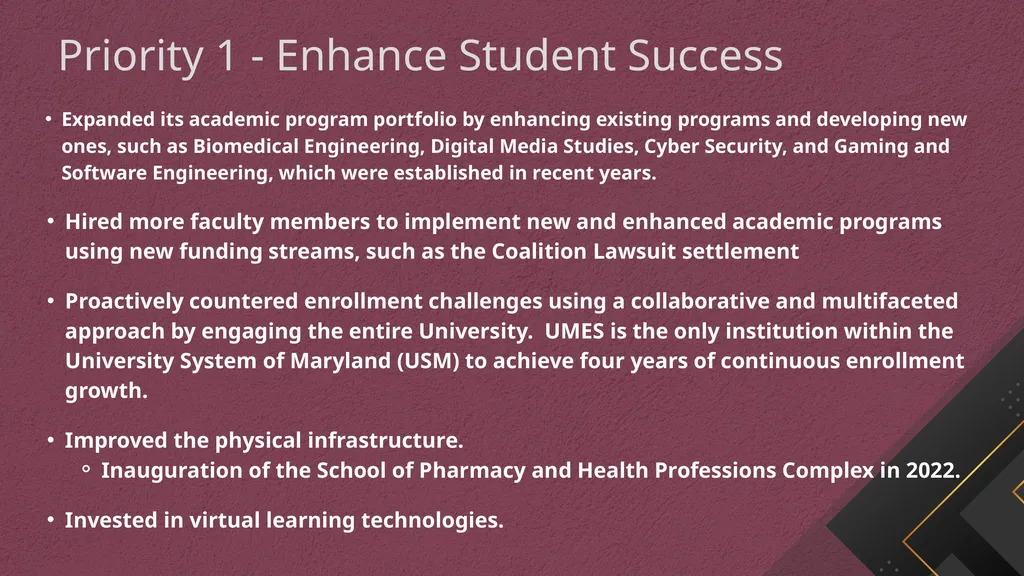
Priority 1 - Enhance Student Success Expanded its academic program portfolio by enhancing existing programs and developing new ones, such as Biomedical Engineering, Digital Media Studies, Cyber Security, and Gaming and Software Engineering, which were established in recent years.
Hired more faculty members to implement new and enhanced academic programs using new funding streams, such as the Coalition Lawsuit settlement
Proactively countered enrollment challenges using a collaborative and multifaceted approach by engaging the entire University. UMES is the only institution within the University System of Maryland (USM) to achieve four years of continuous enrollment growth.
Improved the physical infrastructure.
Inauguration of the School of Pharmacy and Health Professions Complex in 2022.
Invested in virtual learning technologies.<br>
Hired more faculty members to implement new and enhanced academic programs using new funding streams, such as the Coalition Lawsuit settlement
Proactively countered enrollment challenges using a collaborative and multifaceted approach by engaging the entire University. UMES is the only institution within the University System of Maryland (USM) to achieve four years of continuous enrollment growth.
Improved the physical infrastructure.
Inauguration of the School of Pharmacy and Health Professions Complex in 2022.
Invested in virtual learning technologies.<br>
08
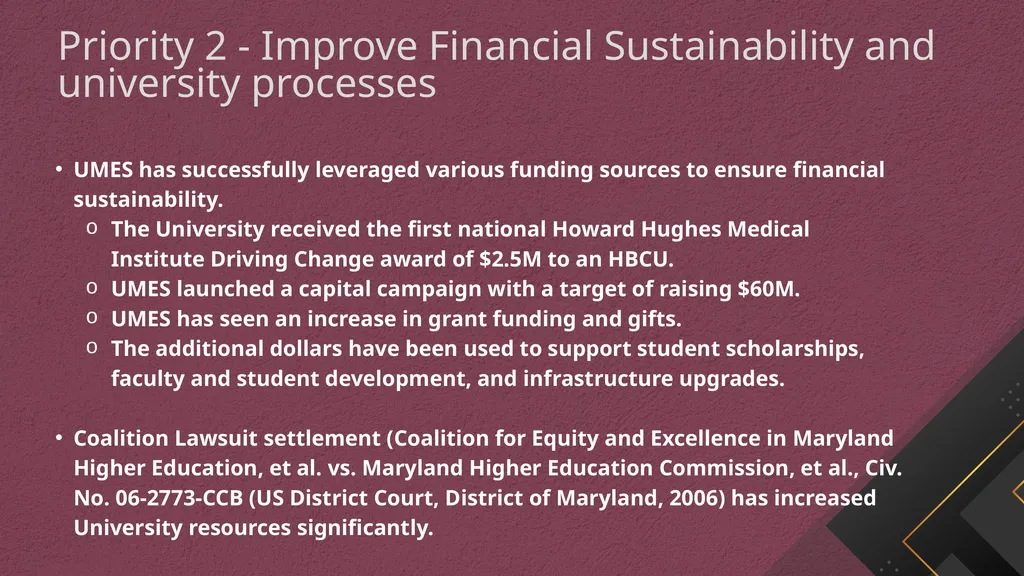
Priority 2 - Improve Financial Sustainability and university processes UMES has successfully leveraged various funding sources to ensure financial sustainability.
The University received the first national Howard Hughes Medical Institute Driving Change award of $2.5M to an HBCU.
UMES launched a capital campaign with a target of raising $60M.
UMES has seen an increase in grant funding and gifts.
The additional dollars have been used to support student scholarships, faculty and student development, and infrastructure upgrades.
Coalition Lawsuit settlement (Coalition for Equity and Excellence in Maryland Higher Education, et al. vs. Maryland Higher Education Commission, et al., Civ. No. 06-2773-CCB (US District Court, District of Maryland, 2006) has increased University resources significantly.<br>
The University received the first national Howard Hughes Medical Institute Driving Change award of $2.5M to an HBCU.
UMES launched a capital campaign with a target of raising $60M.
UMES has seen an increase in grant funding and gifts.
The additional dollars have been used to support student scholarships, faculty and student development, and infrastructure upgrades.
Coalition Lawsuit settlement (Coalition for Equity and Excellence in Maryland Higher Education, et al. vs. Maryland Higher Education Commission, et al., Civ. No. 06-2773-CCB (US District Court, District of Maryland, 2006) has increased University resources significantly.<br>
09
Priority 3 - Advance Diversity, Equity, and Inclusion The revamping of the General Education Curriculum clearly illustrates UMES' commitment to diversity and inclusion. UMES added a Justice, Equity, Diversity, and Inclusion (JEDI)requirement to the curriculum. Several departments are providing a menu of JEDI courses for students to choose from.<br>
10
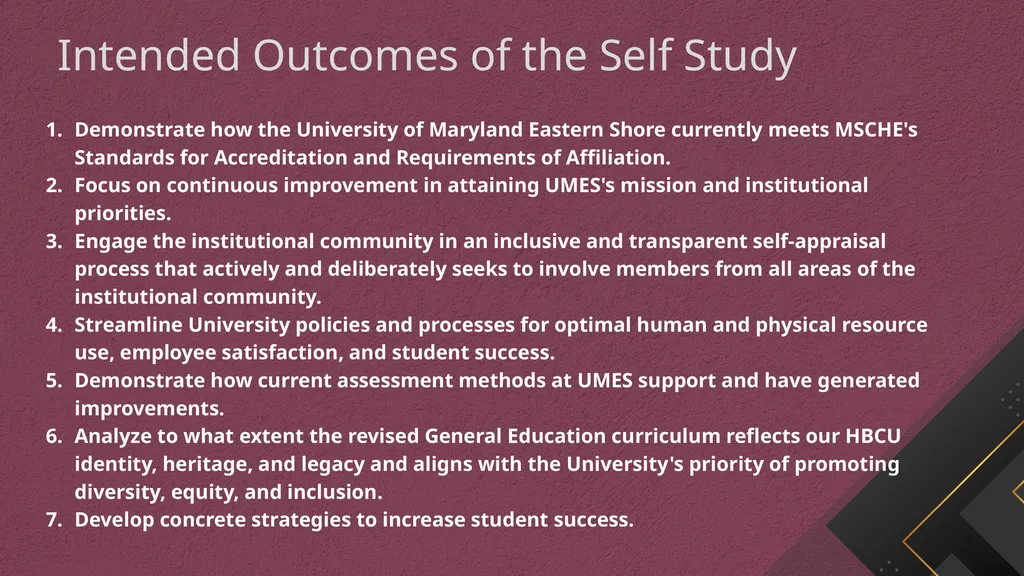
Intended Outcomes of the Self Study Demonstrate how the University of Maryland Eastern Shore currently meets MSCHE's Standards for Accreditation and Requirements of Affiliation.
Focus on continuous improvement in attaining UMES's mission and institutional priorities.
Engage the institutional community in an inclusive and transparent self-appraisal process that actively and deliberately seeks to involve members from all areas of the institutional community.
Streamline University policies and processes for optimal human and physical resource use, employee satisfaction, and student success.
Demonstrate how current assessment methods at UMES support and have generated improvements.
Analyze to what extent the revised General Education curriculum reflects our HBCU identity, heritage, and legacy and aligns with the University's priority of promoting diversity, equity, and inclusion.
Develop concrete strategies to increase student success.<br>
Focus on continuous improvement in attaining UMES's mission and institutional priorities.
Engage the institutional community in an inclusive and transparent self-appraisal process that actively and deliberately seeks to involve members from all areas of the institutional community.
Streamline University policies and processes for optimal human and physical resource use, employee satisfaction, and student success.
Demonstrate how current assessment methods at UMES support and have generated improvements.
Analyze to what extent the revised General Education curriculum reflects our HBCU identity, heritage, and legacy and aligns with the University's priority of promoting diversity, equity, and inclusion.
Develop concrete strategies to increase student success.<br>
11
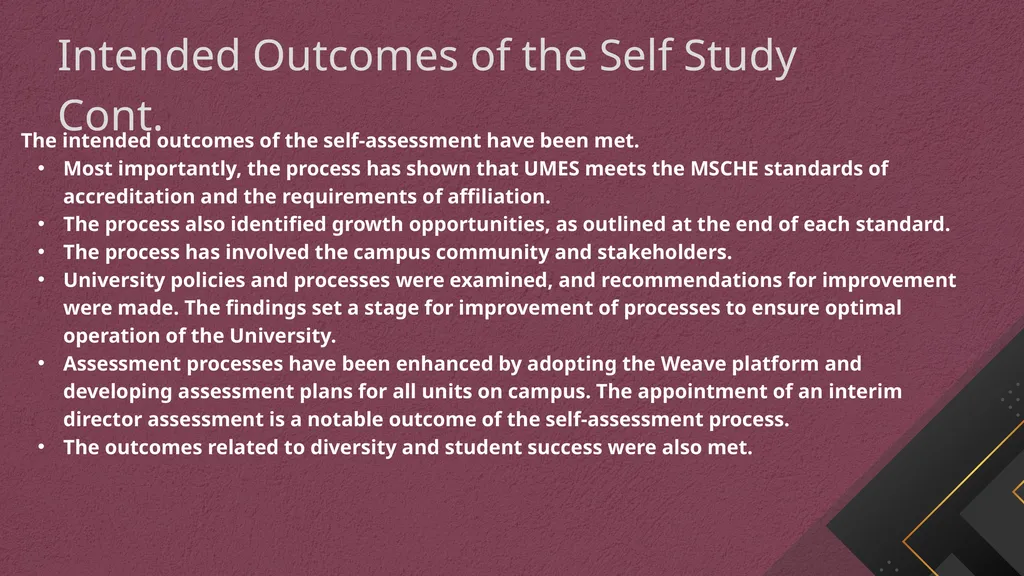
Intended Outcomes of the Self Study Cont. The intended outcomes of the self-assessment have been met.
Most importantly, the process has shown that UMES meets the MSCHE standards of accreditation and the requirements of affiliation.
The process also identified growth opportunities, as outlined at the end of each standard.
The process has involved the campus community and stakeholders.
University policies and processes were examined, and recommendations for improvement were made. The findings set a stage for improvement of processes to ensure optimal operation of the University.
Assessment processes have been enhanced by adopting the Weave platform and developing assessment plans for all units on campus. The appointment of an interim director assessment is a notable outcome of the self-assessment process.
The outcomes related to diversity and student success were also met.<br>
Most importantly, the process has shown that UMES meets the MSCHE standards of accreditation and the requirements of affiliation.
The process also identified growth opportunities, as outlined at the end of each standard.
The process has involved the campus community and stakeholders.
University policies and processes were examined, and recommendations for improvement were made. The findings set a stage for improvement of processes to ensure optimal operation of the University.
Assessment processes have been enhanced by adopting the Weave platform and developing assessment plans for all units on campus. The appointment of an interim director assessment is a notable outcome of the self-assessment process.
The outcomes related to diversity and student success were also met.<br>
12
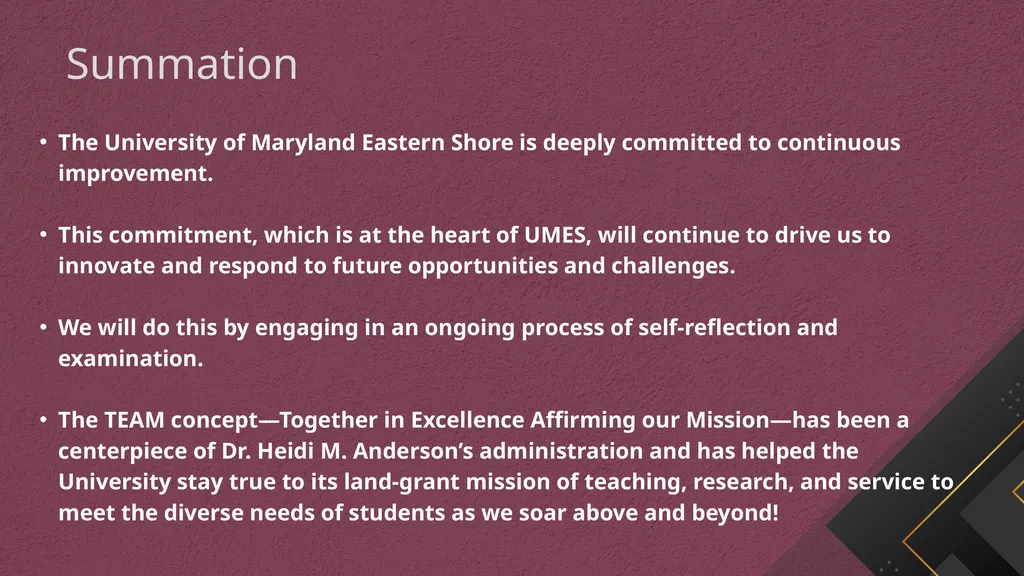
The University of Maryland Eastern Shore is deeply committed to continuous improvement.
This commitment, which is at the heart of UMES, will continue to drive us to innovate and respond to future opportunities and challenges.
We will do this by engaging in an ongoing process of self-reflection and examination.
The TEAM concept—Together in Excellence Affirming our Mission—has been a centerpiece of Dr. Heidi M. Anderson’s administration and has helped the University stay true to its land-grant mission of teaching, research, and service to meet the diverse needs of students as we soar above and beyond! Summation<br>
This commitment, which is at the heart of UMES, will continue to drive us to innovate and respond to future opportunities and challenges.
We will do this by engaging in an ongoing process of self-reflection and examination.
The TEAM concept—Together in Excellence Affirming our Mission—has been a centerpiece of Dr. Heidi M. Anderson’s administration and has helped the University stay true to its land-grant mission of teaching, research, and service to meet the diverse needs of students as we soar above and beyond! Summation<br>
13
Self Study Report Highlights<br>
14
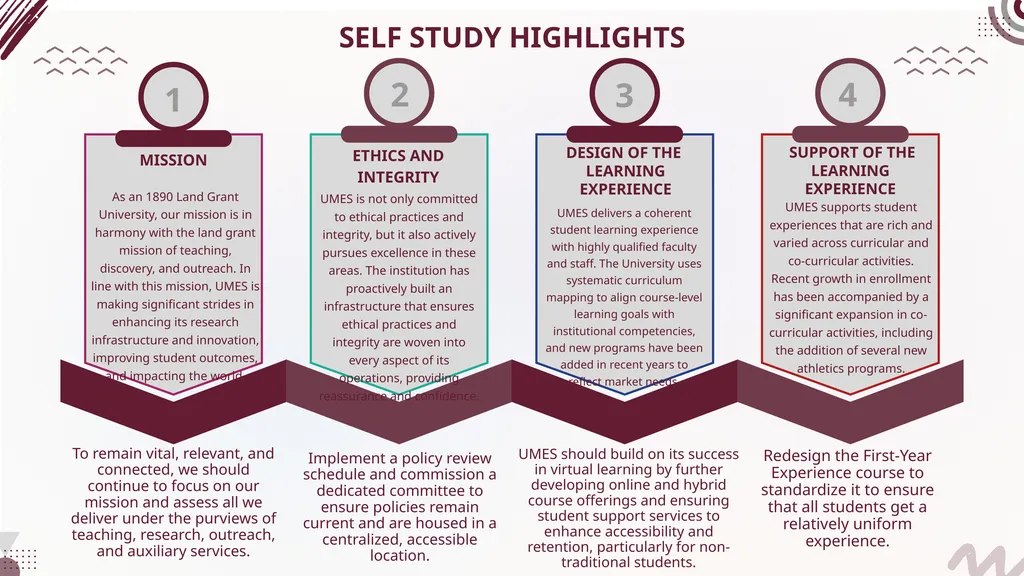
SELF STUDY HIGHLIGHTS MISSION As an 1890 Land Grant University, our mission is in harmony with the land grant mission of teaching, discovery, and outreach. In line with this mission, UMES is making significant strides in enhancing its research infrastructure and innovation, improving student outcomes, and impacting the world. ETHICS AND INTEGRITY UMES is not only committed to ethical practices and integrity, but it also actively pursues excellence in these areas. The institution has proactively built an infrastructure that ensures ethical practices and integrity are woven into every aspect of its operations, providing reassurance and confidence. DESIGN OF THE
LEARNING
EXPERIENCE UMES delivers a coherent student learning experience with highly qualified faculty and staff. The University uses systematic curriculum mapping to align course-level learning goals with institutional competencies, and new programs have been added in recent years to reflect market needs. SUPPORT OF THE LEARNING EXPERIENCE UMES supports student experiences that are rich and varied across curricular and co-curricular activities. Recent growth in enrollment has been accompanied by a significant expansion in co-curricular activities, including the addition of several new athletics programs. 1 4 3 2 Redesign the First-Year Experience course to standardize it to ensure that all students get a relatively uniform experience. UMES should build on its success in virtual learning by further developing online and hybrid course offerings and ensuring student support services to enhance accessibility and retention, particularly for non-traditional students. Implement a policy review schedule and commission a dedicated committee to ensure policies remain current and are housed in a centralized, accessible location. To remain vital, relevant, and connected, we should continue to focus on our mission and assess all we deliver under the purviews of teaching, research, outreach, and auxiliary services.<br>
LEARNING
EXPERIENCE UMES delivers a coherent student learning experience with highly qualified faculty and staff. The University uses systematic curriculum mapping to align course-level learning goals with institutional competencies, and new programs have been added in recent years to reflect market needs. SUPPORT OF THE LEARNING EXPERIENCE UMES supports student experiences that are rich and varied across curricular and co-curricular activities. Recent growth in enrollment has been accompanied by a significant expansion in co-curricular activities, including the addition of several new athletics programs. 1 4 3 2 Redesign the First-Year Experience course to standardize it to ensure that all students get a relatively uniform experience. UMES should build on its success in virtual learning by further developing online and hybrid course offerings and ensuring student support services to enhance accessibility and retention, particularly for non-traditional students. Implement a policy review schedule and commission a dedicated committee to ensure policies remain current and are housed in a centralized, accessible location. To remain vital, relevant, and connected, we should continue to focus on our mission and assess all we deliver under the purviews of teaching, research, outreach, and auxiliary services.<br>
15
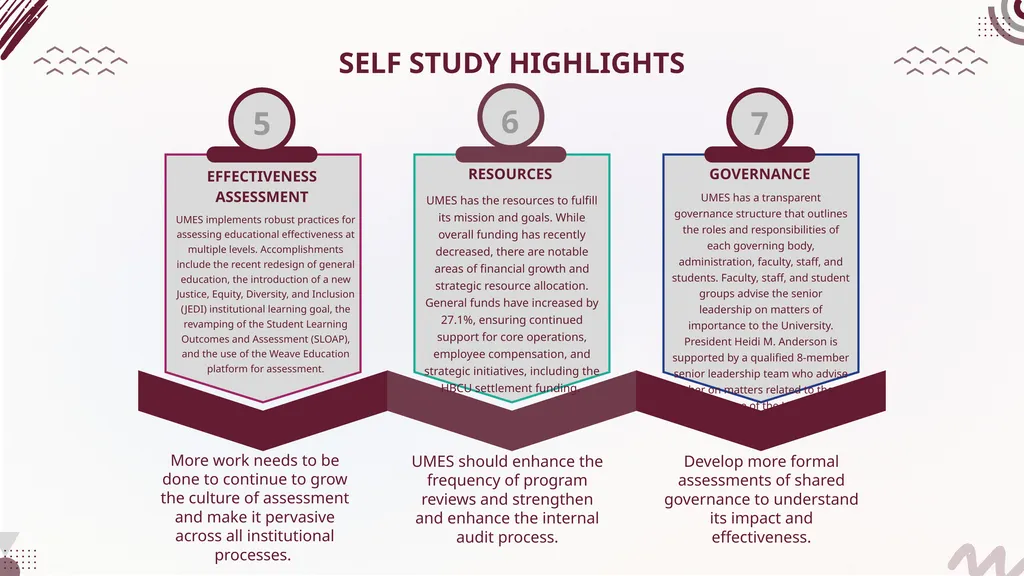
SELF STUDY HIGHLIGHTS Develop more formal assessments of shared governance to understand its impact and effectiveness. EFFECTIVENESS ASSESSMENT UMES implements robust practices for assessing educational effectiveness at multiple levels. Accomplishments include the recent redesign of general education, the introduction of a new Justice, Equity, Diversity, and Inclusion (JEDI) institutional learning goal, the revamping of the Student Learning Outcomes and Assessment (SLOAP), and the use of the Weave Education platform for assessment. RESOURCES UMES has the resources to fulfill its mission and goals. While overall funding has recently decreased, there are notable areas of financial growth and strategic resource allocation. General funds have increased by 27.1%, ensuring continued support for core operations, employee compensation, and strategic initiatives, including the HBCU settlement funding. GOVERNANCE UMES has a transparent governance structure that outlines the roles and responsibilities of each governing body, administration, faculty, staff, and students. Faculty, staff, and student groups advise the senior leadership on matters of importance to the University. President Heidi M. Anderson is supported by a qualified 8-member senior leadership team who advise her on matters related to the governance of the University. 5 7 6 UMES should enhance the frequency of program reviews and strengthen and enhance the internal audit process. More work needs to be done to continue to grow the culture of assessment and make it pervasive across all institutional processes.<br>
16
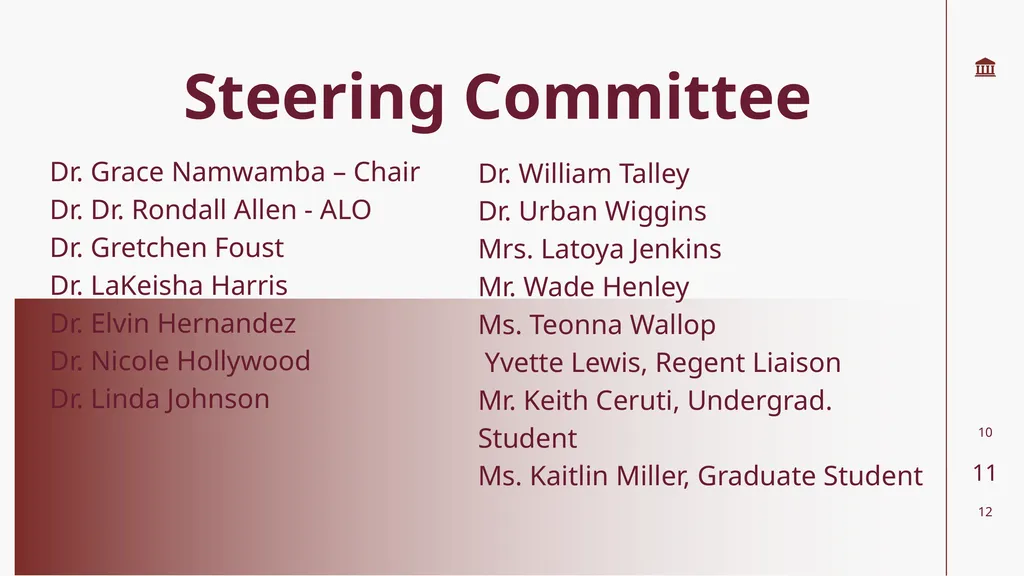
11 12 10 Steering Committee Dr. Grace Namwamba – Chair
Dr. Dr. Rondall Allen - ALO
Dr. Gretchen Foust
Dr. LaKeisha Harris
Dr. Elvin Hernandez
Dr. Nicole Hollywood
Dr. Linda Johnson Dr. William Talley
Dr. Urban Wiggins
Mrs. Latoya Jenkins
Mr. Wade Henley
Ms. Teonna Wallop
Yvette Lewis, Regent Liaison
Mr. Keith Ceruti, Undergrad. Student
Ms. Kaitlin Miller, Graduate Student<br>
Dr. Dr. Rondall Allen - ALO
Dr. Gretchen Foust
Dr. LaKeisha Harris
Dr. Elvin Hernandez
Dr. Nicole Hollywood
Dr. Linda Johnson Dr. William Talley
Dr. Urban Wiggins
Mrs. Latoya Jenkins
Mr. Wade Henley
Ms. Teonna Wallop
Yvette Lewis, Regent Liaison
Mr. Keith Ceruti, Undergrad. Student
Ms. Kaitlin Miller, Graduate Student<br>
17
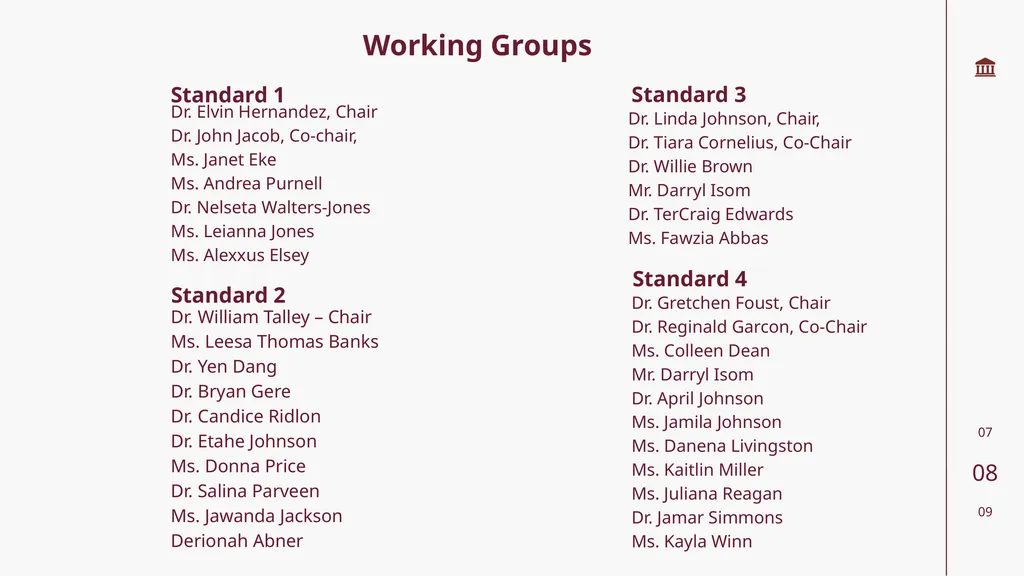
08 09 07 Working Groups Dr. Elvin Hernandez, Chair
Dr. John Jacob, Co-chair,
Ms. Janet Eke
Ms. Andrea Purnell
Dr. Nelseta Walters-Jones
Ms. Leianna Jones
Ms. Alexxus Elsey Dr. William Talley – Chair
Ms. Leesa Thomas Banks
Dr. Yen Dang
Dr. Bryan Gere
Dr. Candice Ridlon
Dr. Etahe Johnson
Ms. Donna Price
Dr. Salina Parveen
Ms. Jawanda Jackson
Derionah Abner Dr. Linda Johnson, Chair,
Dr. Tiara Cornelius, Co-Chair
Dr. Willie Brown
Mr. Darryl Isom
Dr. TerCraig Edwards
Ms. Fawzia Abbas Standard 1 Standard 2 Standard 3 Dr. Gretchen Foust, Chair
Dr. Reginald Garcon, Co-Chair
Ms. Colleen Dean
Mr. Darryl Isom
Dr. April Johnson
Ms. Jamila Johnson
Ms. Danena Livingston
Ms. Kaitlin Miller
Ms. Juliana Reagan
Dr. Jamar Simmons
Ms. Kayla Winn Standard 4<br>
Dr. John Jacob, Co-chair,
Ms. Janet Eke
Ms. Andrea Purnell
Dr. Nelseta Walters-Jones
Ms. Leianna Jones
Ms. Alexxus Elsey Dr. William Talley – Chair
Ms. Leesa Thomas Banks
Dr. Yen Dang
Dr. Bryan Gere
Dr. Candice Ridlon
Dr. Etahe Johnson
Ms. Donna Price
Dr. Salina Parveen
Ms. Jawanda Jackson
Derionah Abner Dr. Linda Johnson, Chair,
Dr. Tiara Cornelius, Co-Chair
Dr. Willie Brown
Mr. Darryl Isom
Dr. TerCraig Edwards
Ms. Fawzia Abbas Standard 1 Standard 2 Standard 3 Dr. Gretchen Foust, Chair
Dr. Reginald Garcon, Co-Chair
Ms. Colleen Dean
Mr. Darryl Isom
Dr. April Johnson
Ms. Jamila Johnson
Ms. Danena Livingston
Ms. Kaitlin Miller
Ms. Juliana Reagan
Dr. Jamar Simmons
Ms. Kayla Winn Standard 4<br>
18
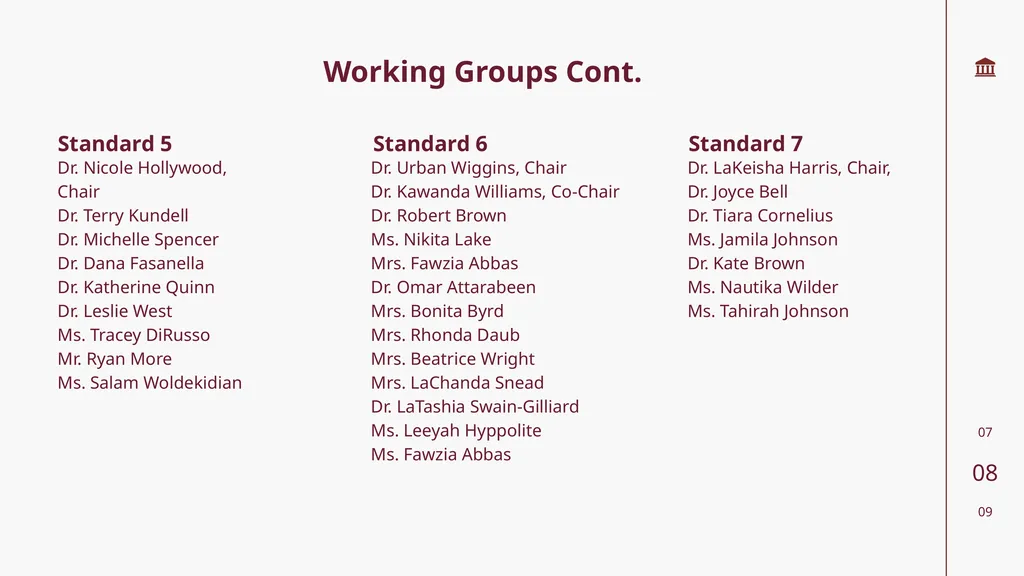
08 09 07 Working Groups Cont. Dr. Nicole Hollywood, Chair
Dr. Terry Kundell
Dr. Michelle Spencer
Dr. Dana Fasanella
Dr. Katherine Quinn
Dr. Leslie West
Ms. Tracey DiRusso
Mr. Ryan More
Ms. Salam Woldekidian Standard 5 Dr. Urban Wiggins, Chair
Dr. Kawanda Williams, Co-Chair
Dr. Robert Brown
Ms. Nikita Lake
Mrs. Fawzia Abbas
Dr. Omar Attarabeen
Mrs. Bonita Byrd
Mrs. Rhonda Daub
Mrs. Beatrice Wright
Mrs. LaChanda Snead
Dr. LaTashia Swain-Gilliard
Ms. Leeyah Hyppolite
Ms. Fawzia Abbas Standard 6 Dr. LaKeisha Harris, Chair,
Dr. Joyce Bell
Dr. Tiara Cornelius
Ms. Jamila Johnson
Dr. Kate Brown
Ms. Nautika Wilder
Ms. Tahirah Johnson Standard 7<br>
Dr. Terry Kundell
Dr. Michelle Spencer
Dr. Dana Fasanella
Dr. Katherine Quinn
Dr. Leslie West
Ms. Tracey DiRusso
Mr. Ryan More
Ms. Salam Woldekidian Standard 5 Dr. Urban Wiggins, Chair
Dr. Kawanda Williams, Co-Chair
Dr. Robert Brown
Ms. Nikita Lake
Mrs. Fawzia Abbas
Dr. Omar Attarabeen
Mrs. Bonita Byrd
Mrs. Rhonda Daub
Mrs. Beatrice Wright
Mrs. LaChanda Snead
Dr. LaTashia Swain-Gilliard
Ms. Leeyah Hyppolite
Ms. Fawzia Abbas Standard 6 Dr. LaKeisha Harris, Chair,
Dr. Joyce Bell
Dr. Tiara Cornelius
Ms. Jamila Johnson
Dr. Kate Brown
Ms. Nautika Wilder
Ms. Tahirah Johnson Standard 7<br>
19
15 - 14 Self-Study Information https://wwwcp.umes.edu/middlestates/<br>