
1 1 Host Nation Support Guidelines for Foreign
Description: 1 1 Host Nation Support Guidelines for Foreign Assistance to Pakistan During Disasters Aim To acquaint the participants with the Host Nation Support Guidelines (HNSG), developed for clear understanding of the rules, roles, responsibilities
Related Topics
Download Presentation
"1 1 Host Nation Support Guidelines for Foreign" is the property of its rightful owner. Permission is granted to download and print the materials on this website for personal, non-commercial use only, and to display it on your personal computer provided you do not modify the materials and that you retain all copyright notices contained in the materials. By downloading content from our website, you accept the terms of this agreement.
Presentation Transcript
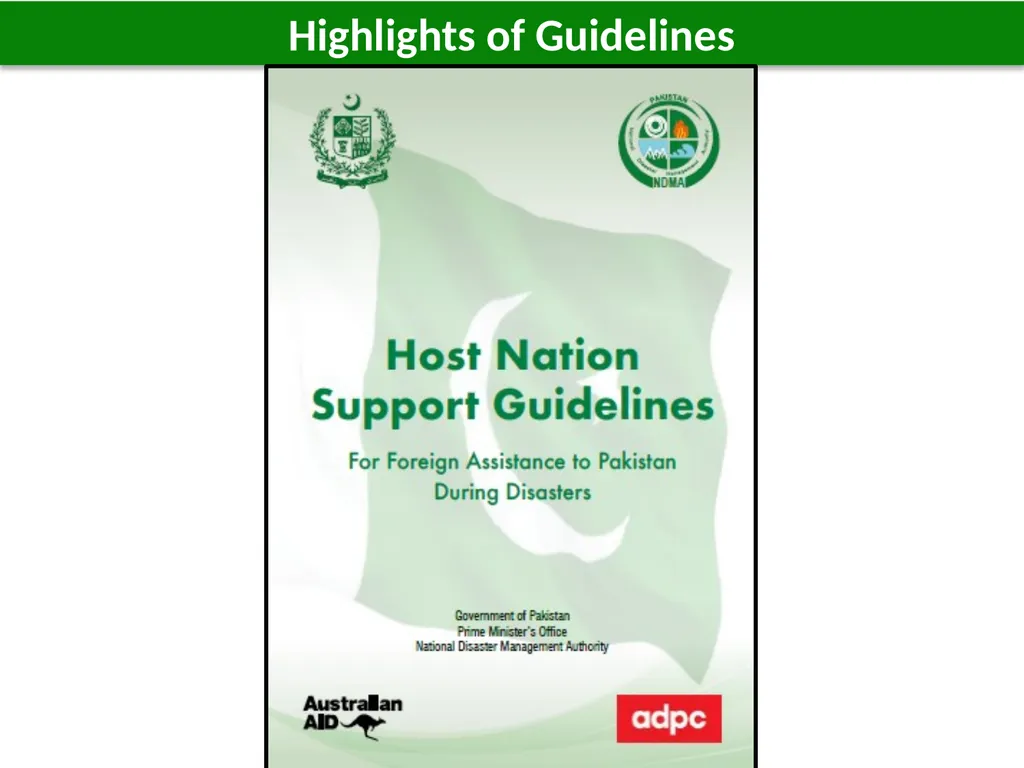
slide1. 1 1 Host Nation Support Guidelines
for Foreign Assistance to Pakistan
During Disasters<br>
slide2. Aim To acquaint the participants with the Host Nation Support Guidelines (HNSG), developed for clear understanding of the rules, roles, responsibilities & procedures for all stakeholders, to expedite assistance and timely deployment of international disaster response resources<br>
slide3. Background In recent past Pakistan has been struck by number massive disasters
Frequent and extreme events likely to increase which warrants enhanced coordination and effective procedures
International assistance has been and will remain a reality during mega disaster
In absence of proper procedures, during 2010 super floods, flow of international assistance got hampered<br>
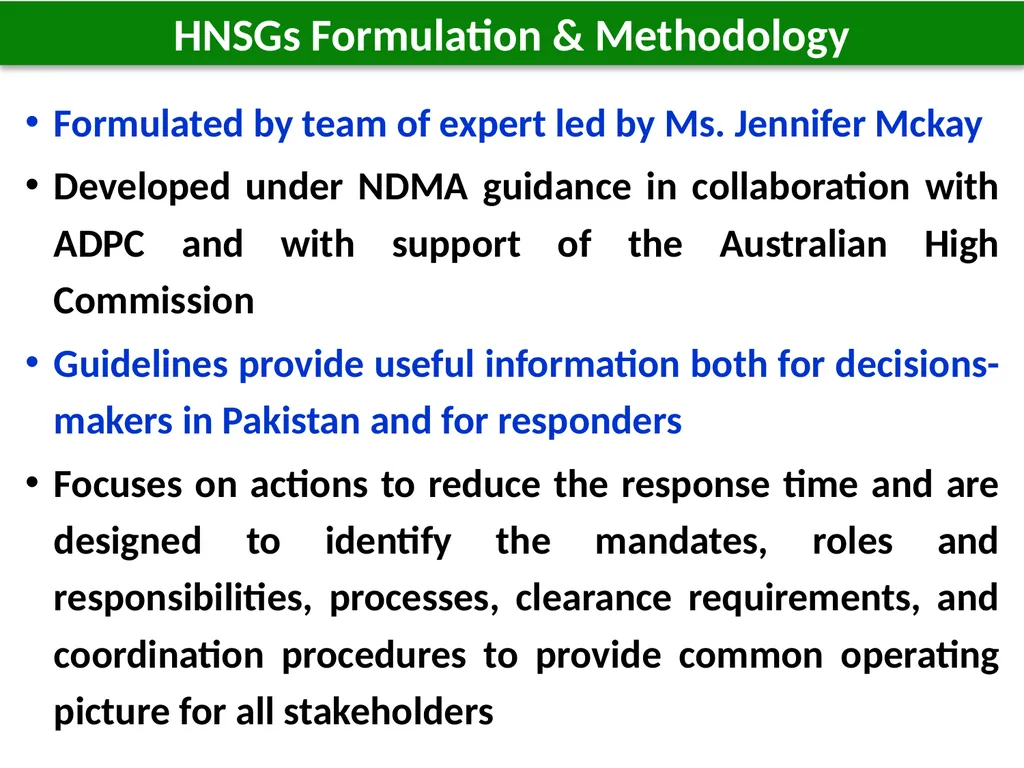
slide4. HNSGs Formulation & Methodology Formulated by team of expert led by Ms. Jennifer Mckay
Developed under NDMA guidance in collaboration with ADPC and with support of the Australian High Commission
Guidelines provide useful information both for decisions-makers in Pakistan and for responders
Focuses on actions to reduce the response time and are designed to identify the mandates, roles and responsibilities, processes, clearance requirements, and coordination procedures to provide common operating picture for all stakeholders<br>
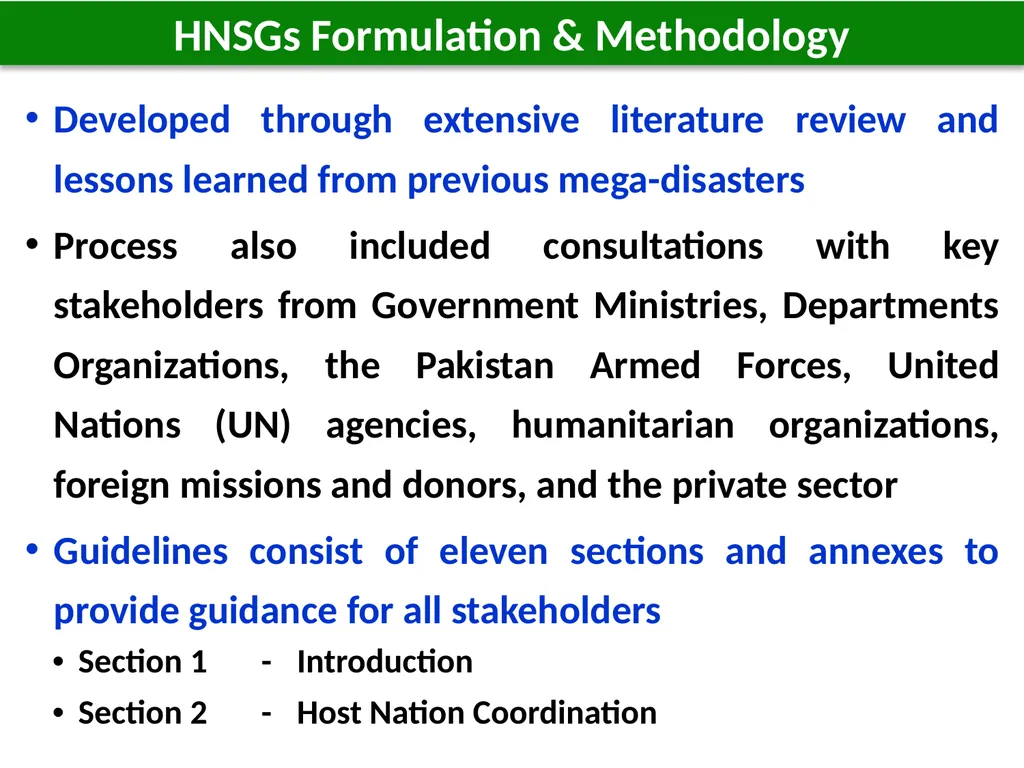
slide5. HNSGs Formulation & Methodology Developed through extensive literature review and lessons learned from previous mega-disasters
Process also included consultations with key stakeholders from Government Ministries, Departments Organizations, the Pakistan Armed Forces, United Nations (UN) agencies, humanitarian organizations, foreign missions and donors, and the private sector
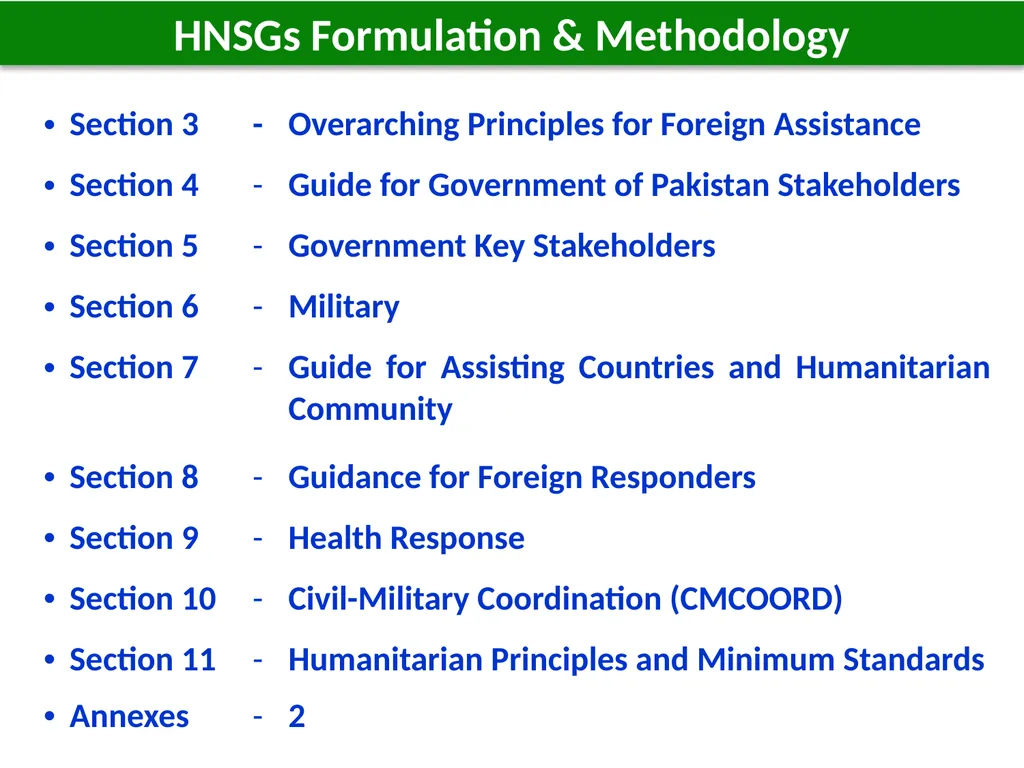
Guidelines consist of eleven sections and annexes to provide guidance for all stakeholders<br>
slide6. HNSGs Formulation & Methodology<br>
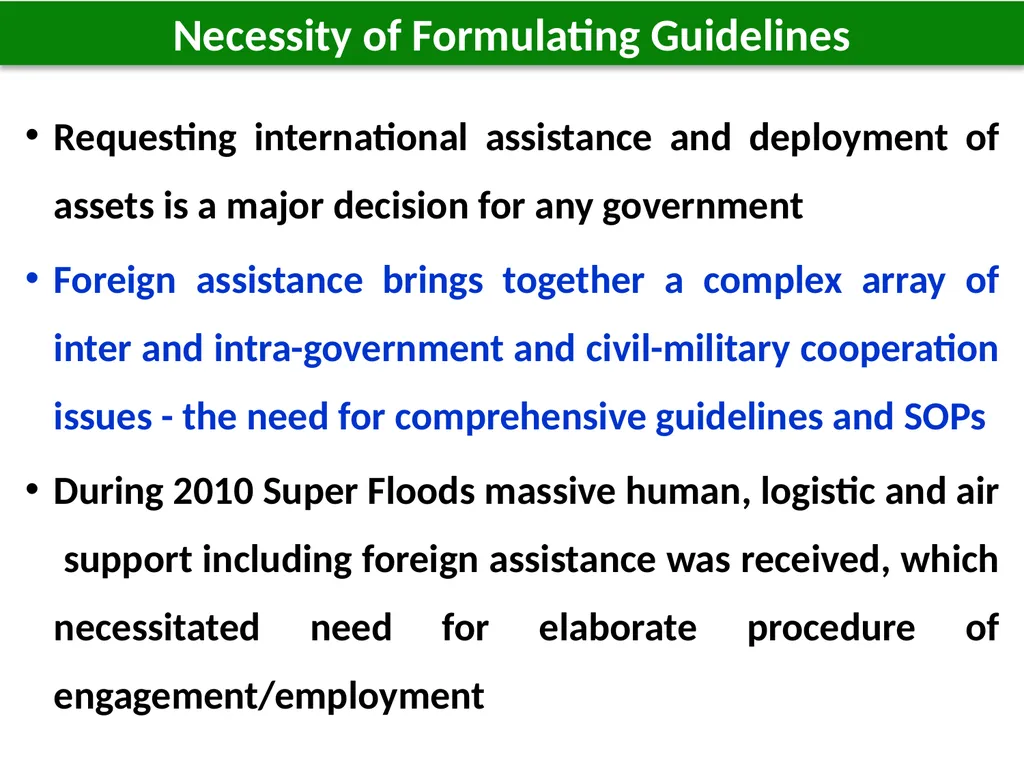
slide7. Necessity of Formulating Guidelines Requesting international assistance and deployment of assets is a major decision for any government
Foreign assistance brings together a complex array of inter and intra-government and civil-military cooperation issues - the need for comprehensive guidelines and SOPs
During 2010 Super Floods massive human, logistic and air support including foreign assistance was received, which necessitated need for elaborate procedure of engagement/employment<br>
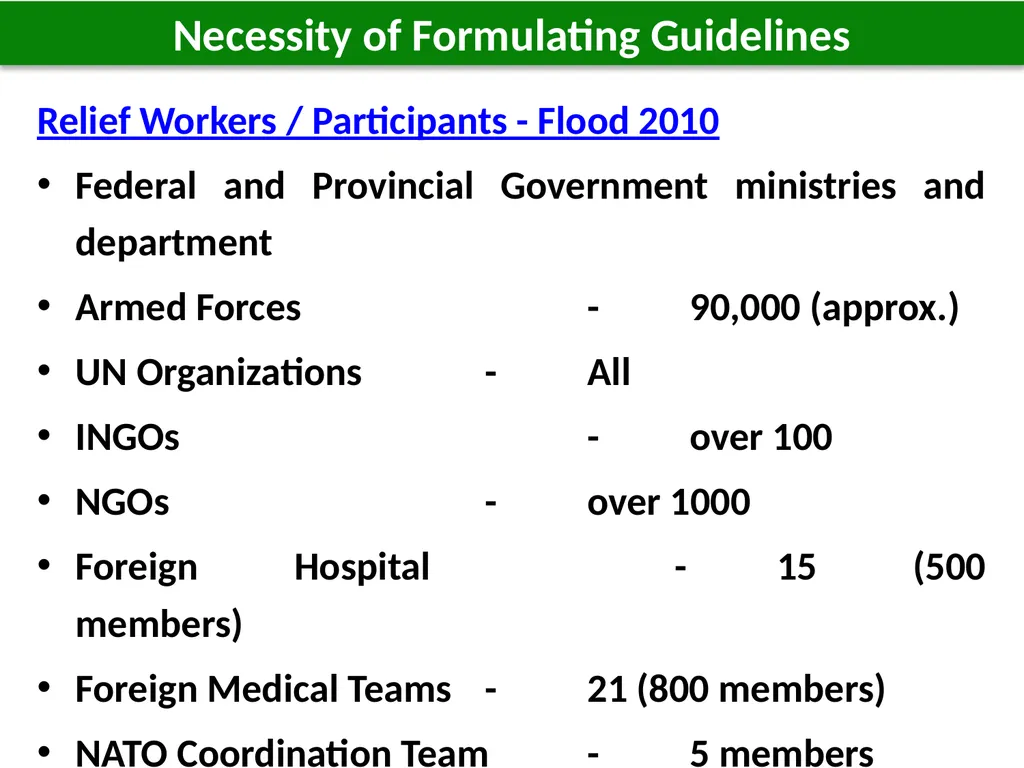
slide8. Relief Workers / Participants - Flood 2010
Federal and Provincial Government ministries and department
Armed Forces - 90,000 (approx.)
UN Organizations - All
INGOs - over 100
NGOs - over 1000
Foreign Hospital - 15 (500 members)
Foreign Medical Teams - 21 (800 members)
NATO Coordination Team - 5 members Necessity of Formulating Guidelines<br>
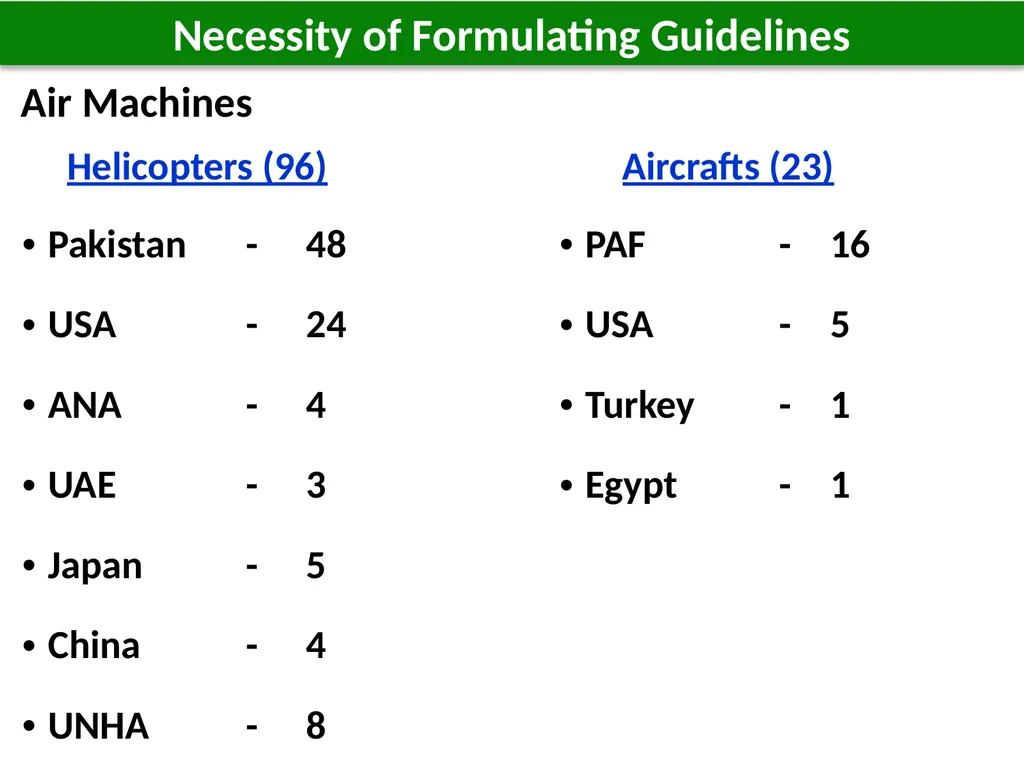
slide9. Necessity of Formulating Guidelines<br>
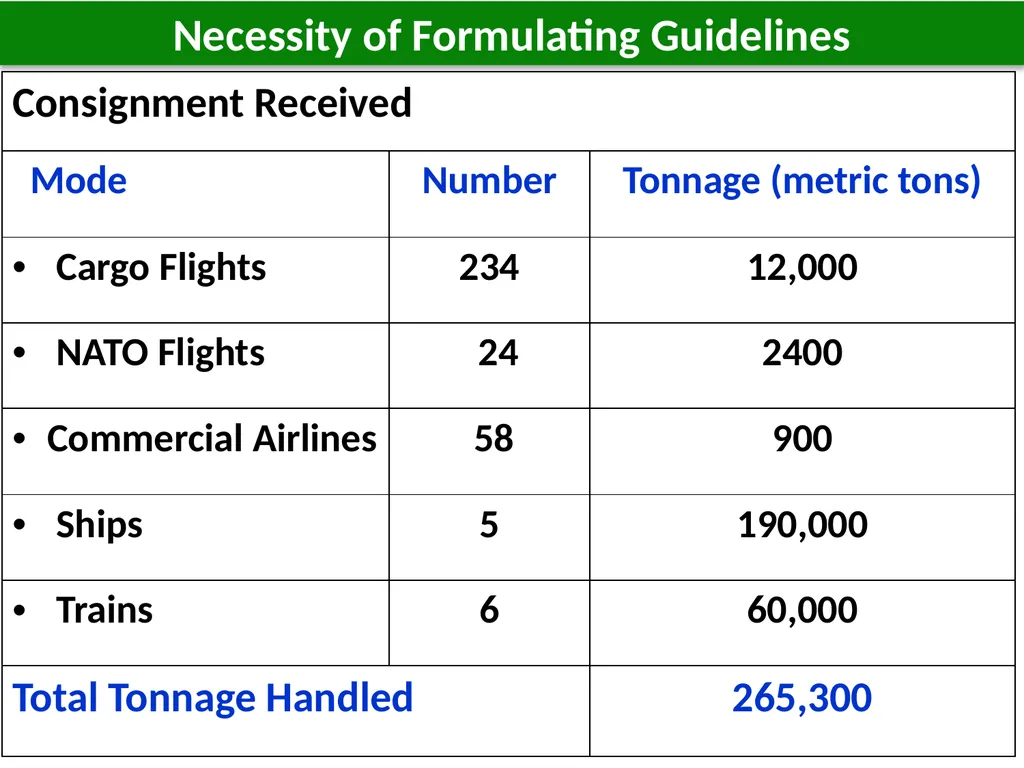
slide10. Necessity of Formulating Guidelines<br>
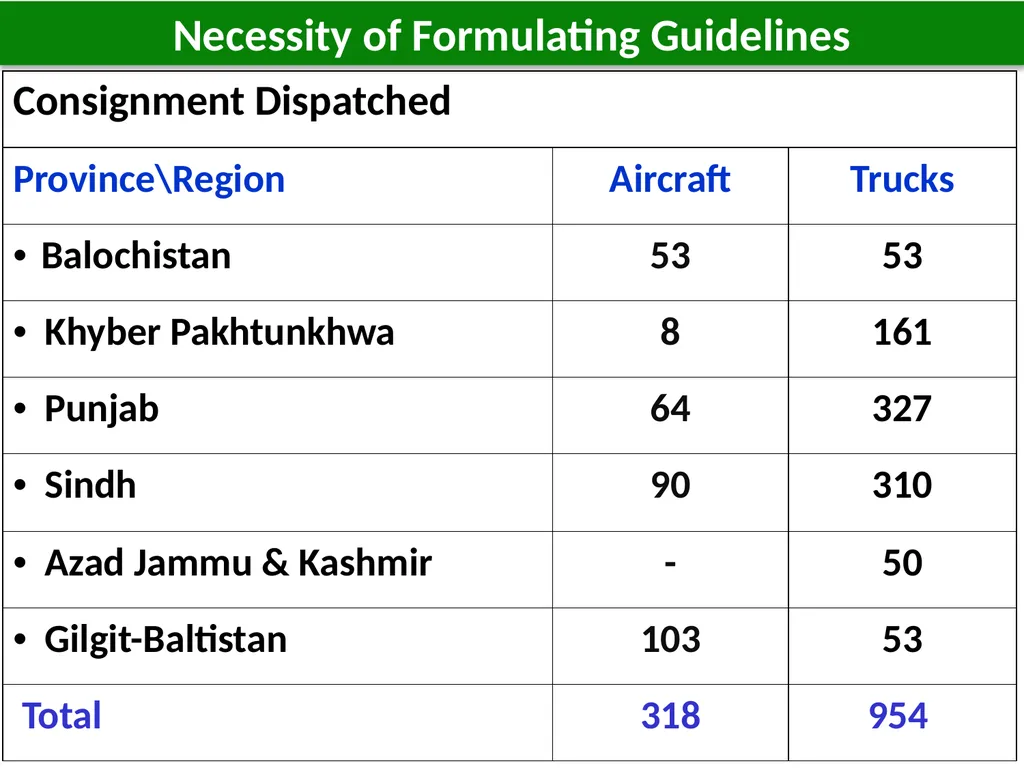
slide11. Necessity of Formulating Guidelines<br>
slide12. Necessity of Formulating Guidelines Super Floods 2010 highlighted need for enhanced understanding of the complexities of massive logistics and coordination efforts required including those for managing foreign assistance<br>
slide13. Highlights of Guidelines<br>
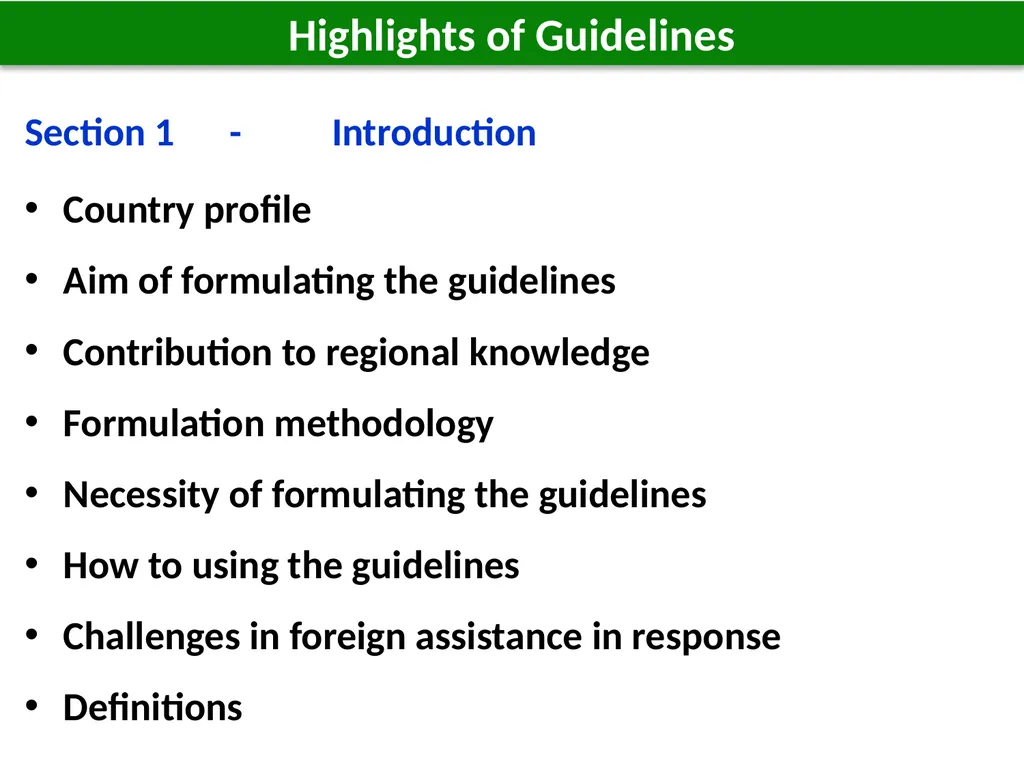
slide14. Highlights of Guidelines Section 1 - Introduction
Country profile
Aim of formulating the guidelines
Contribution to regional knowledge
Formulation methodology
Necessity of formulating the guidelines
How to using the guidelines
Challenges in foreign assistance in response
Definitions<br>
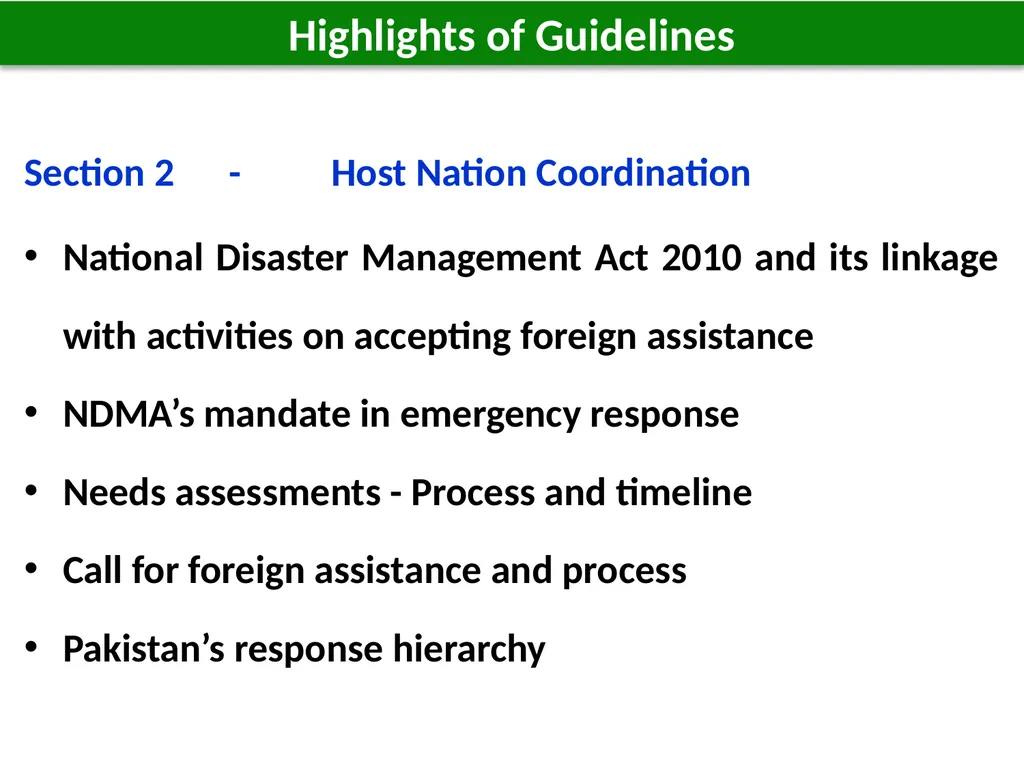
slide15. Highlights of Guidelines Section 2 - Host Nation Coordination
National Disaster Management Act 2010 and its linkage with activities on accepting foreign assistance
NDMA’s mandate in emergency response
Needs assessments - Process and timeline
Call for foreign assistance and process
Pakistan’s response hierarchy<br>
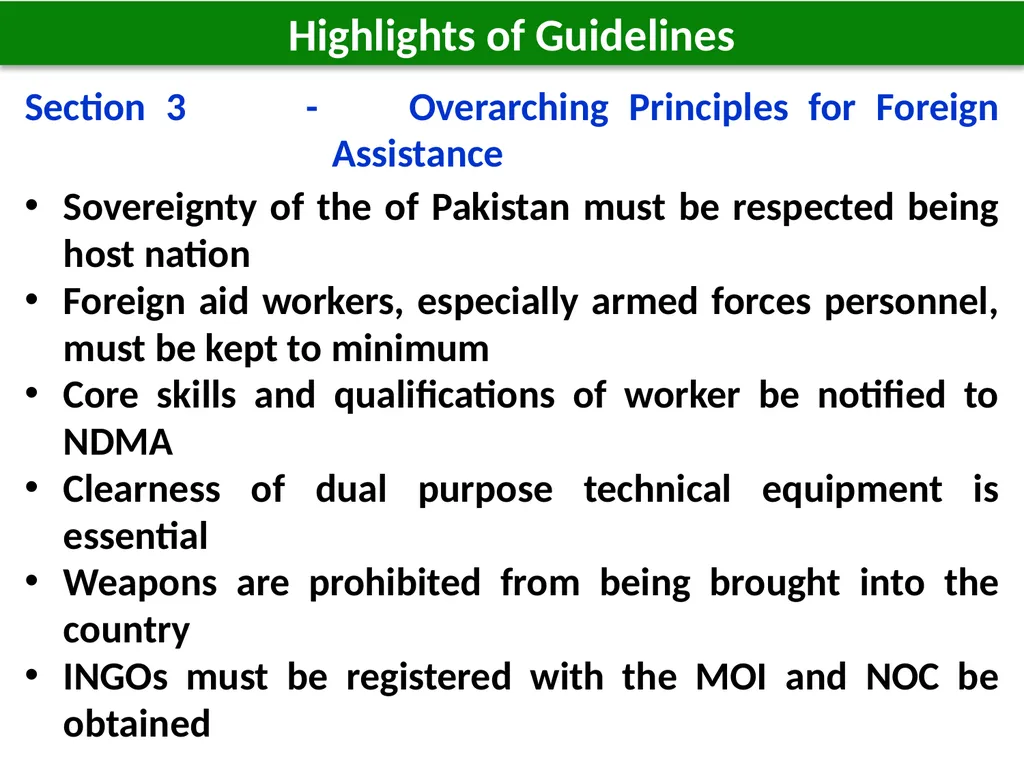
slide16. Highlights of Guidelines Section 3 - Overarching Principles for Foreign Assistance
Sovereignty of the of Pakistan must be respected being host nation
Foreign aid workers, especially armed forces personnel, must be kept to minimum
Core skills and qualifications of worker be notified to NDMA
Clearness of dual purpose technical equipment is essential
Weapons are prohibited from being brought into the country
INGOs must be registered with the MOI and NOC be obtained<br>
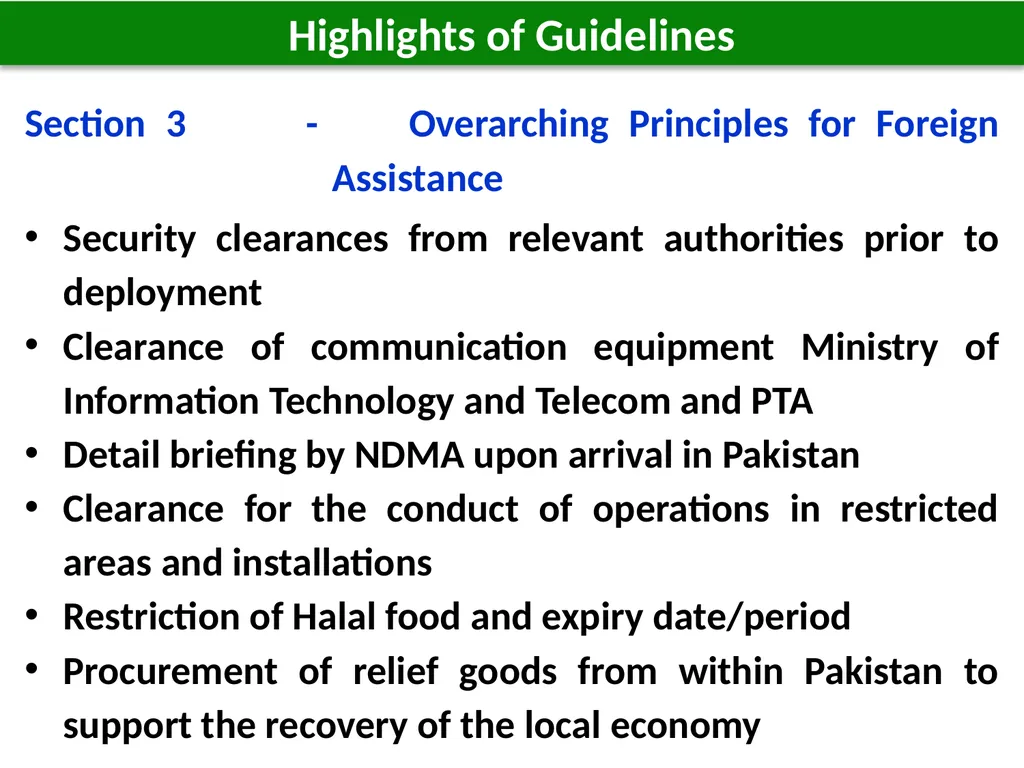
slide17. Highlights of Guidelines Section 3 - Overarching Principles for Foreign Assistance
Security clearances from relevant authorities prior to deployment
Clearance of communication equipment Ministry of Information Technology and Telecom and PTA
Detail briefing by NDMA upon arrival in Pakistan
Clearance for the conduct of operations in restricted areas and installations
Restriction of Halal food and expiry date/period
Procurement of relief goods from within Pakistan to support the recovery of the local economy<br>
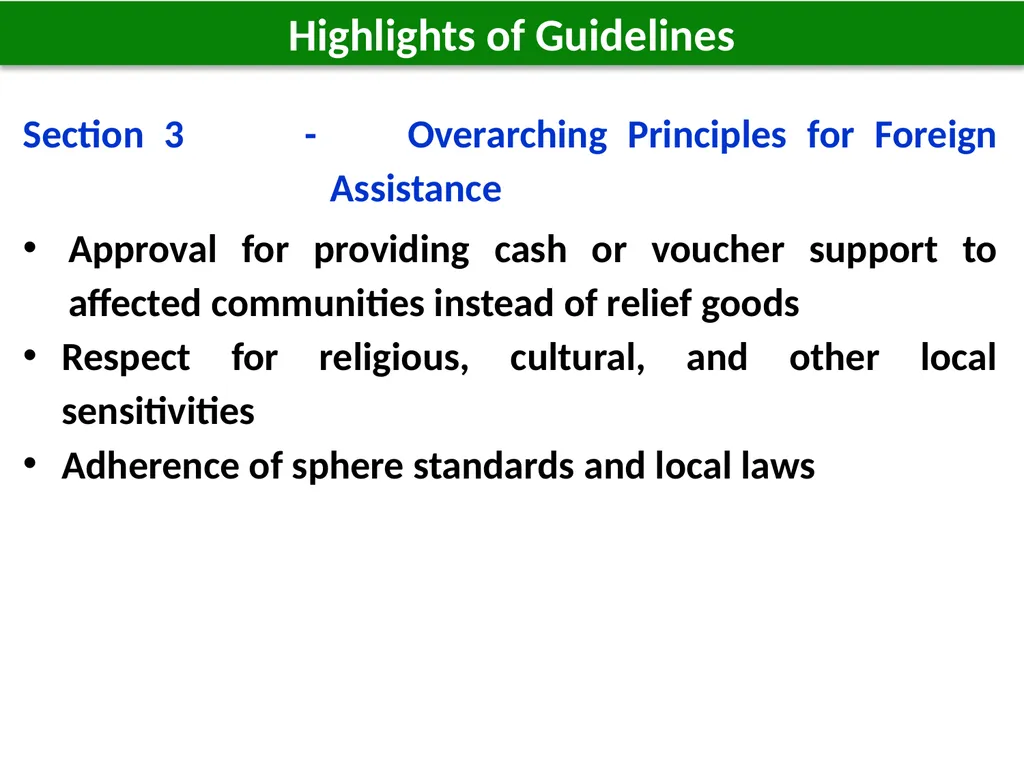
slide18. Highlights of Guidelines Section 3 - Overarching Principles for Foreign Assistance
Approval for providing cash or voucher support to affected communities instead of relief goods
Respect for religious, cultural, and other local sensitivities
Adherence of sphere standards and local laws<br>
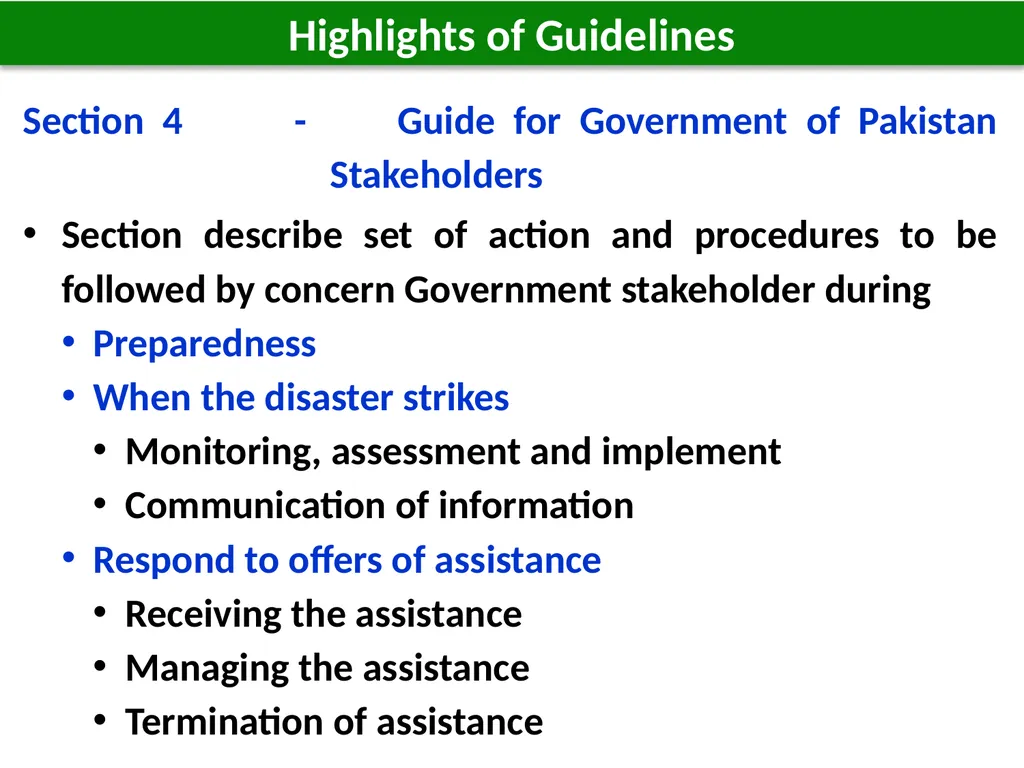
slide19. Highlights of Guidelines Section 4 - Guide for Government of Pakistan Stakeholders
Section describe set of action and procedures to be followed by concern Government stakeholder during
Preparedness
When the disaster strikes
Monitoring, assessment and implement
Communication of information
Respond to offers of assistance
Receiving the assistance
Managing the assistance
Termination of assistance<br>
slide20. Highlights of Guidelines Section 5 - Government Key Stakeholders
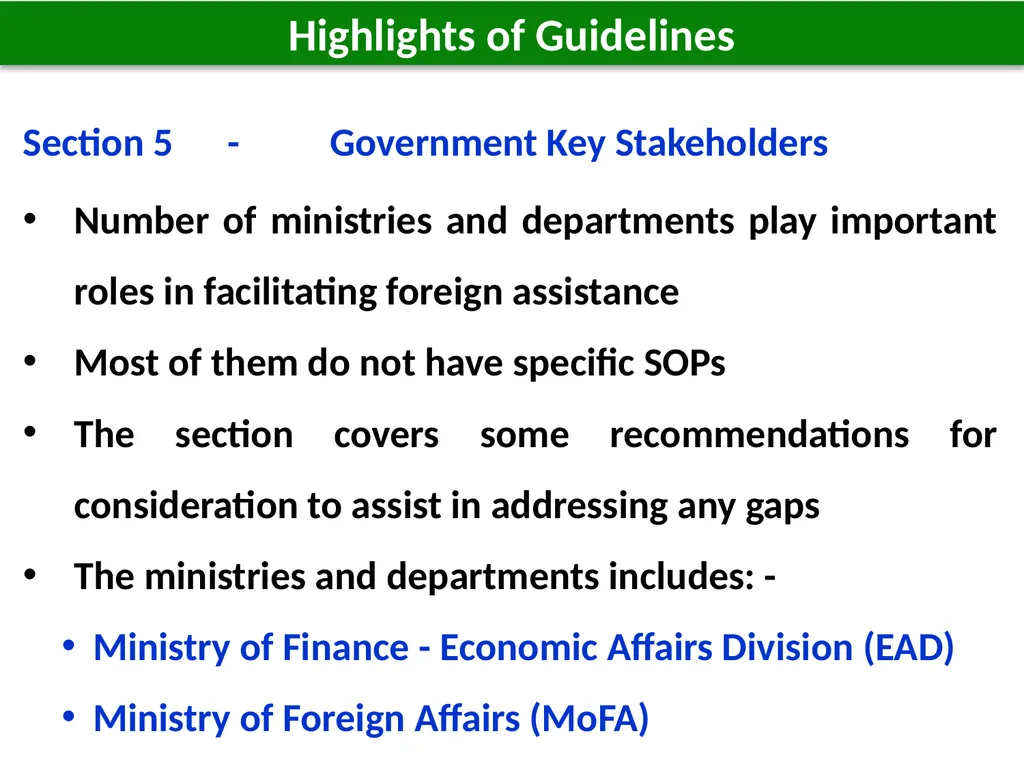
Number of ministries and departments play important roles in facilitating foreign assistance
Most of them do not have specific SOPs
The section covers some recommendations for consideration to assist in addressing any gaps
The ministries and departments includes: -
Ministry of Finance - Economic Affairs Division (EAD)
Ministry of Foreign Affairs (MoFA)<br>
slide21. Highlights of Guidelines Section 5 - Government Key Stakeholders
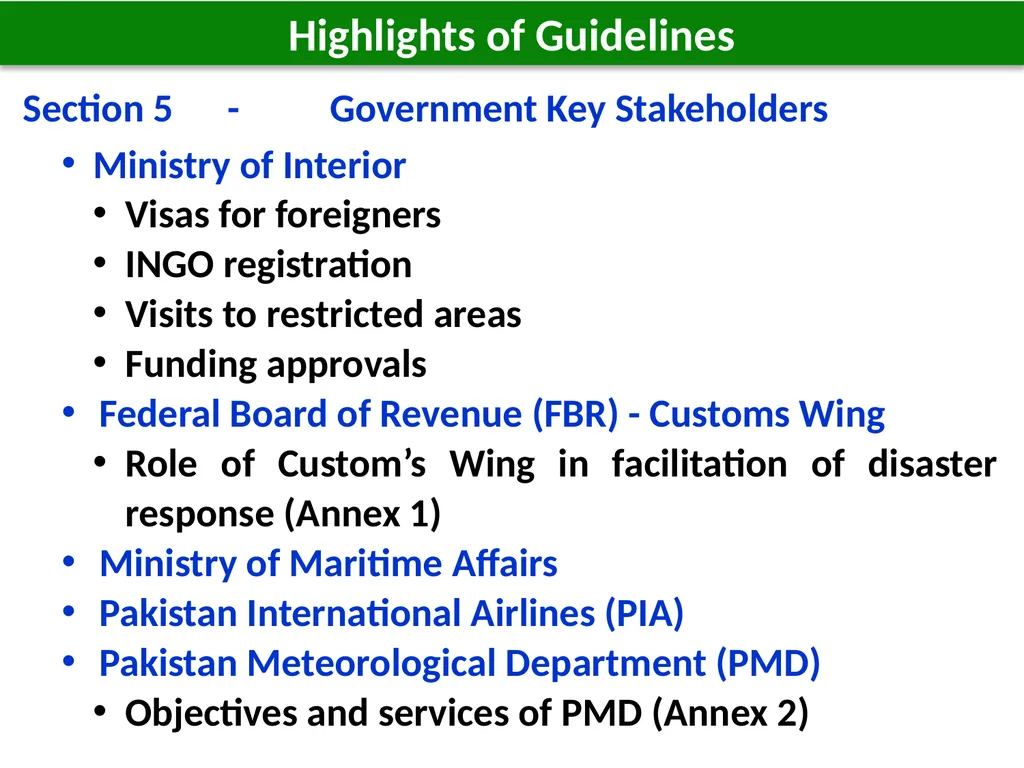
Ministry of Interior
Visas for foreigners
INGO registration
Visits to restricted areas
Funding approvals
Federal Board of Revenue (FBR) - Customs Wing
Role of Custom’s Wing in facilitation of disaster response (Annex 1)
Ministry of Maritime Affairs
Pakistan International Airlines (PIA)
Pakistan Meteorological Department (PMD)
Objectives and services of PMD (Annex 2)<br>
slide22. Section 5 - Government Key Stakeholders
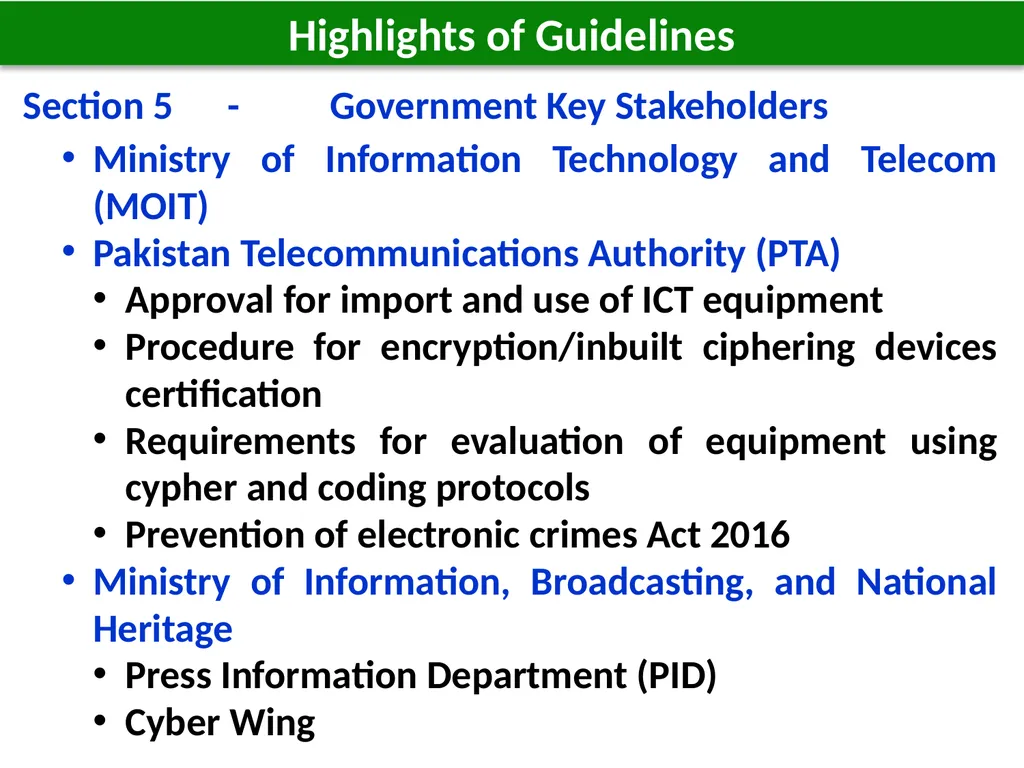
Ministry of Information Technology and Telecom (MOIT)
Pakistan Telecommunications Authority (PTA)
Approval for import and use of ICT equipment
Procedure for encryption/inbuilt ciphering devices certification
Requirements for evaluation of equipment using cypher and coding protocols
Prevention of electronic crimes Act 2016
Ministry of Information, Broadcasting, and National Heritage
Press Information Department (PID)
Cyber Wing Highlights of Guidelines<br>
slide23. Highlights of Guidelines Section 5 - Government Key Stakeholders
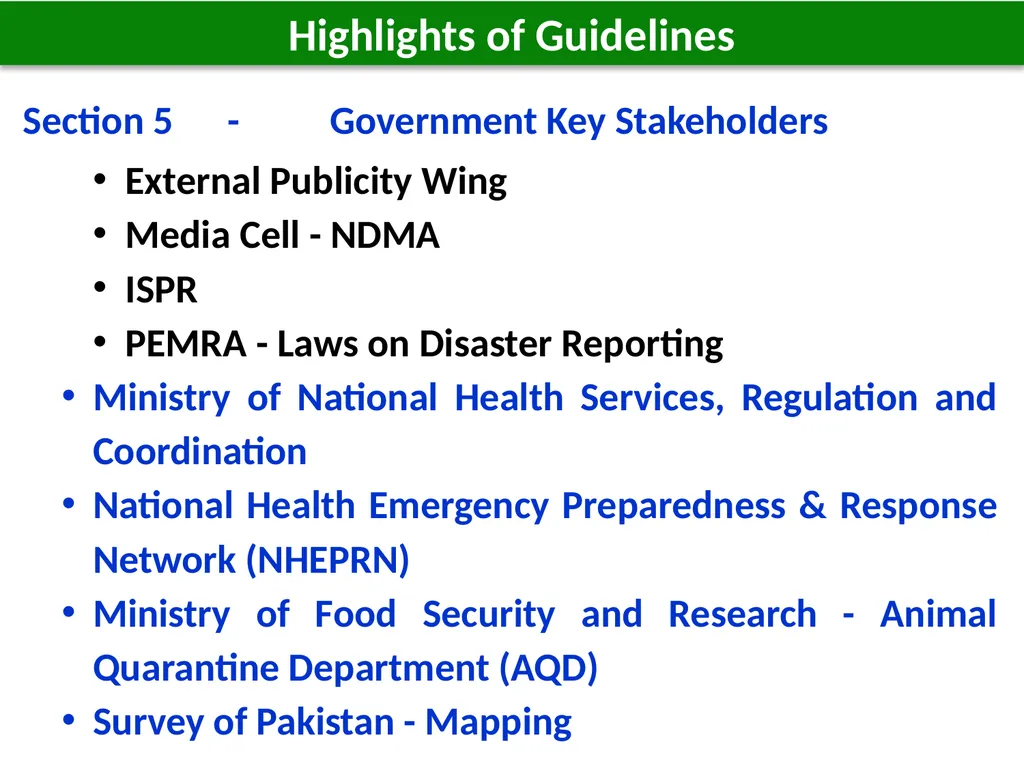
External Publicity Wing
Media Cell - NDMA
ISPR
PEMRA - Laws on Disaster Reporting
Ministry of National Health Services, Regulation and Coordination
National Health Emergency Preparedness & Response Network (NHEPRN)
Ministry of Food Security and Research - Animal Quarantine Department (AQD)
Survey of Pakistan - Mapping<br>
slide24. Highlights of Guidelines Section 5 - Government Key Stakeholders
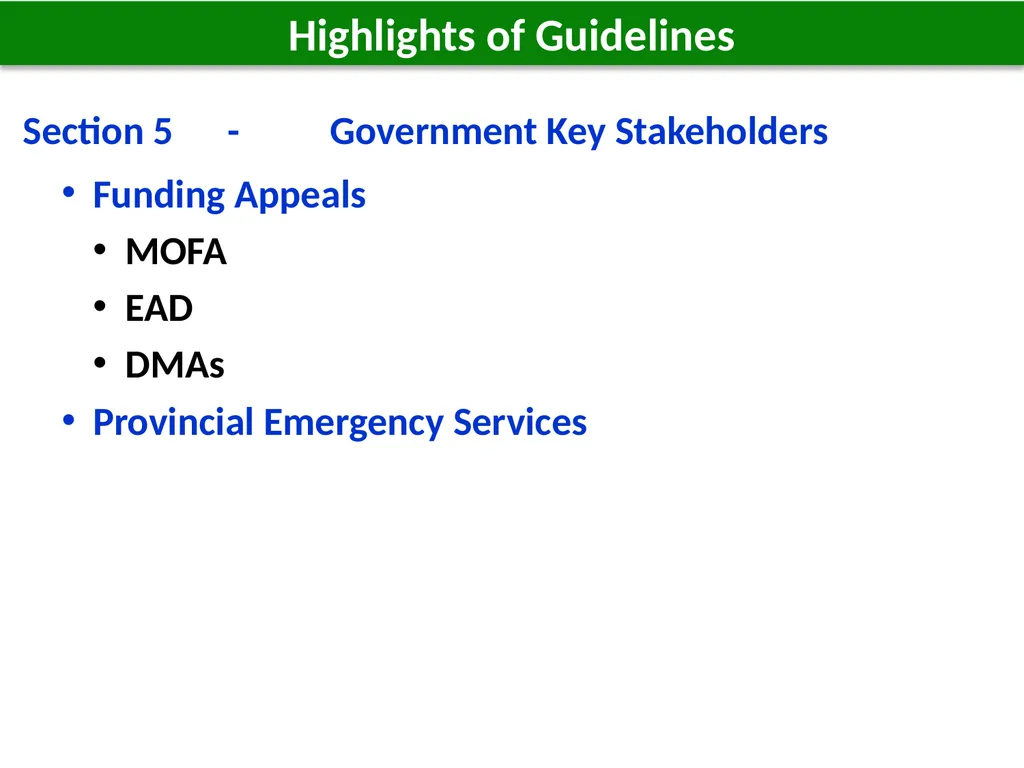
Funding Appeals
MOFA
EAD
DMAs
Provincial Emergency Services<br>
slide25. Highlights of Guidelines Section 6 - Military
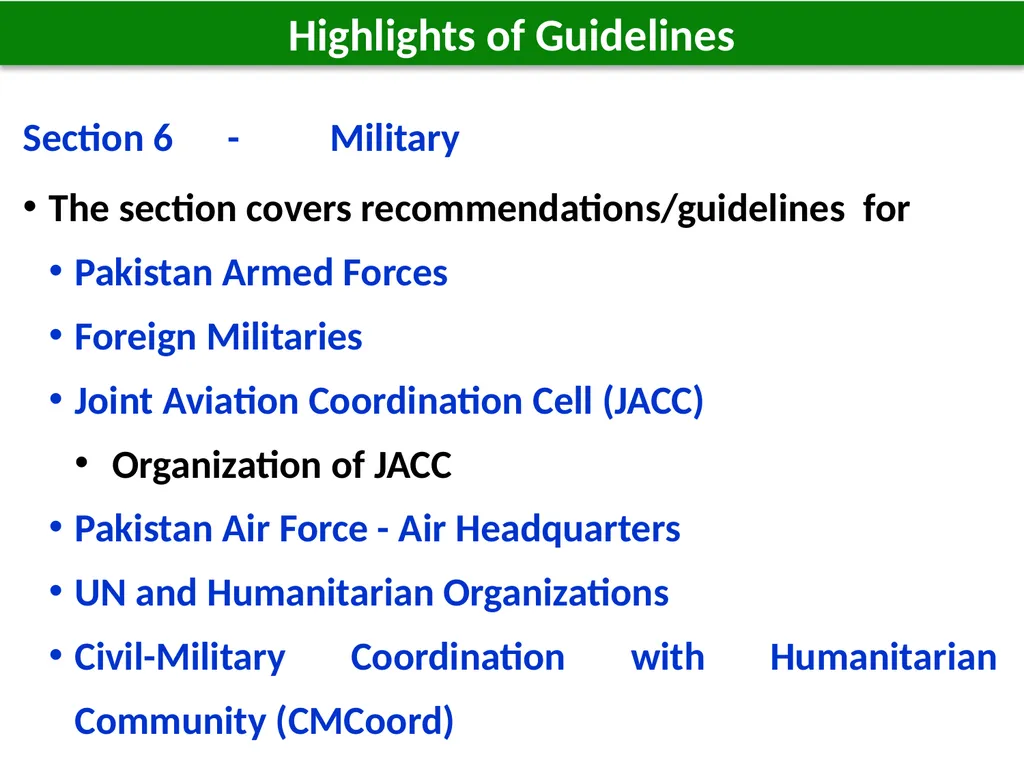
The section covers recommendations/guidelines for
Pakistan Armed Forces
Foreign Militaries
Joint Aviation Coordination Cell (JACC)
Organization of JACC
Pakistan Air Force - Air Headquarters
UN and Humanitarian Organizations
Civil-Military Coordination with Humanitarian Community (CMCoord)<br>
slide26. Section 7 - Guide for Assisting Countries & Humanitarian Community
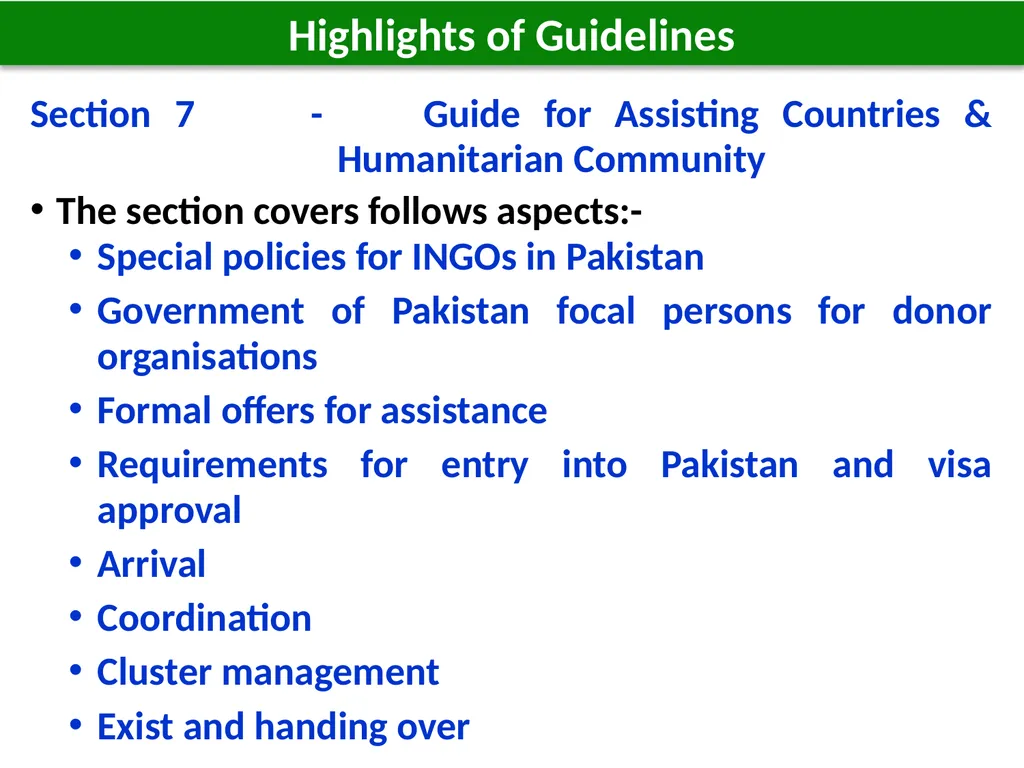
The section covers follows aspects:-
Special policies for INGOs in Pakistan
Government of Pakistan focal persons for donor organisations
Formal offers for assistance
Requirements for entry into Pakistan and visa approval
Arrival
Coordination
Cluster management
Exist and handing over Highlights of Guidelines<br>
slide27. Section 8 - Guidance for Foreign Responders
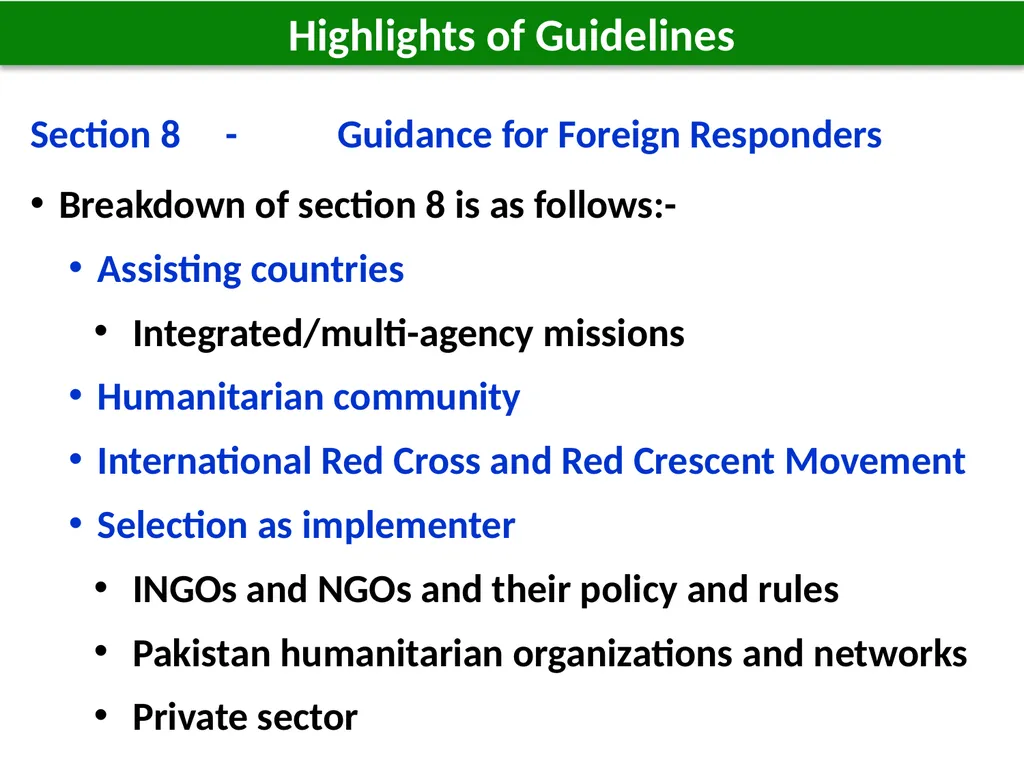
Breakdown of section 8 is as follows:-
Assisting countries
Integrated/multi-agency missions
Humanitarian community
International Red Cross and Red Crescent Movement
Selection as implementer
INGOs and NGOs and their policy and rules
Pakistan humanitarian organizations and networks
Private sector Highlights of Guidelines<br>
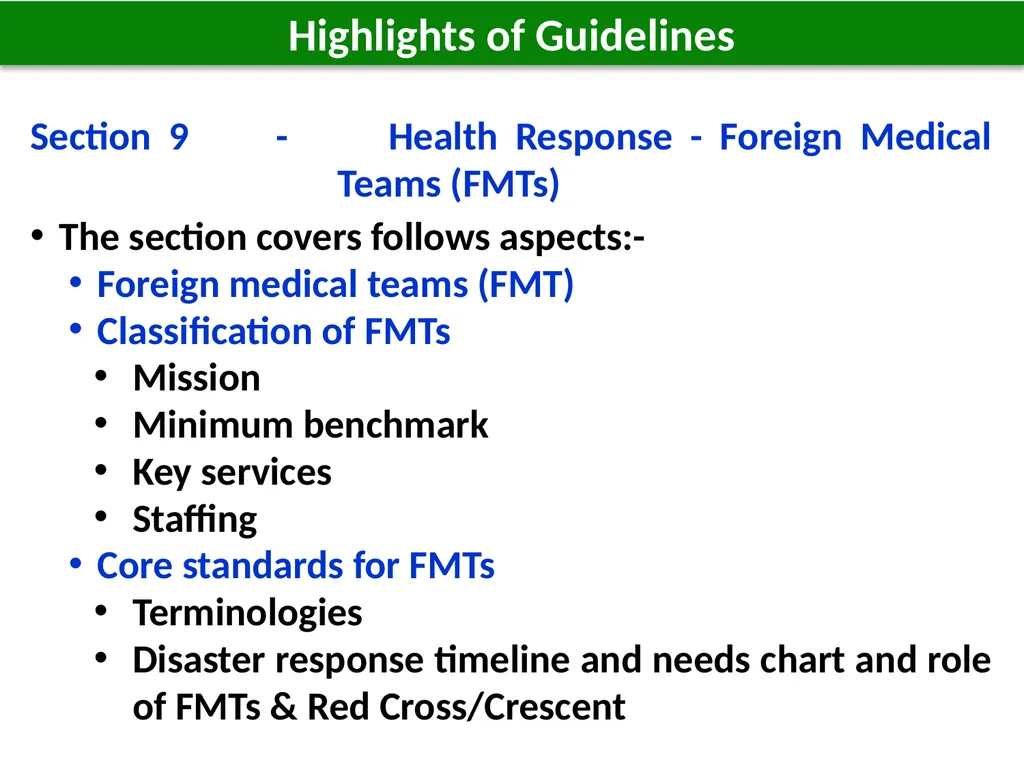
slide28. Section 9 - Health Response - Foreign Medical Teams (FMTs)
The section covers follows aspects:-
Foreign medical teams (FMT)
Classification of FMTs
Mission
Minimum benchmark
Key services
Staffing
Core standards for FMTs
Terminologies
Disaster response timeline and needs chart and role of FMTs & Red Cross/Crescent Highlights of Guidelines<br>
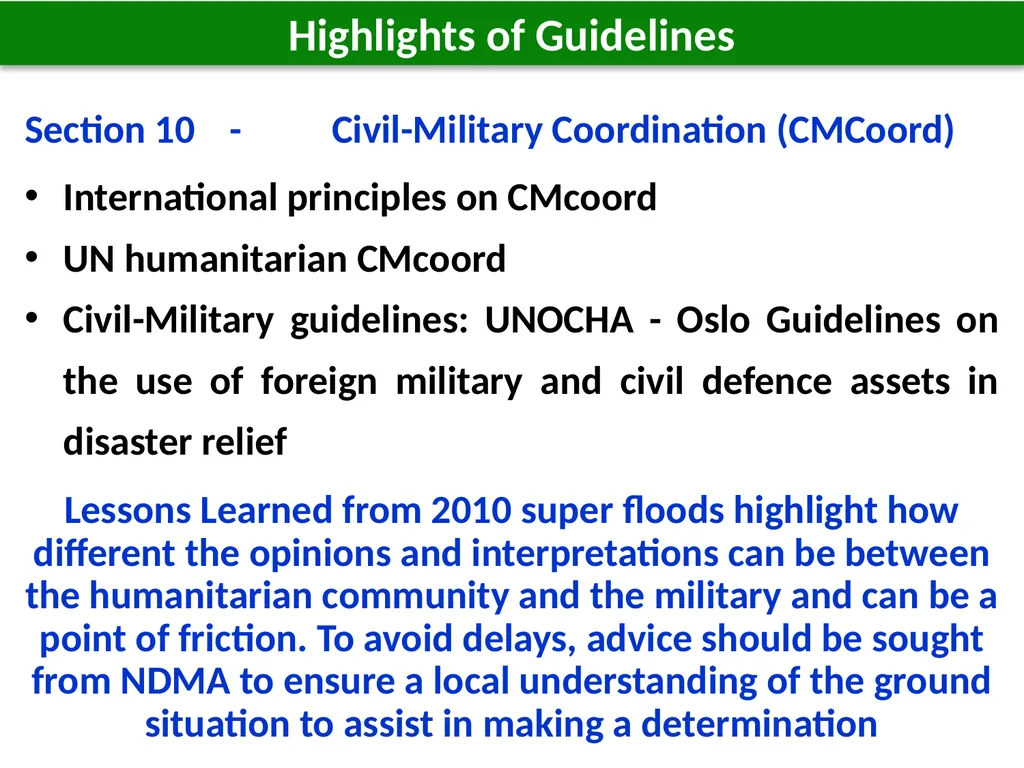
slide29. Highlights of Guidelines Section 10 - Civil-Military Coordination (CMCoord)
International principles on CMcoord
UN humanitarian CMcoord
Civil-Military guidelines: UNOCHA - Oslo Guidelines on the use of foreign military and civil defence assets in disaster relief Lessons Learned from 2010 super floods highlight how different the opinions and interpretations can be between the humanitarian community and the military and can be a point of friction. To avoid delays, advice should be sought from NDMA to ensure a local understanding of the ground situation to assist in making a determination<br>
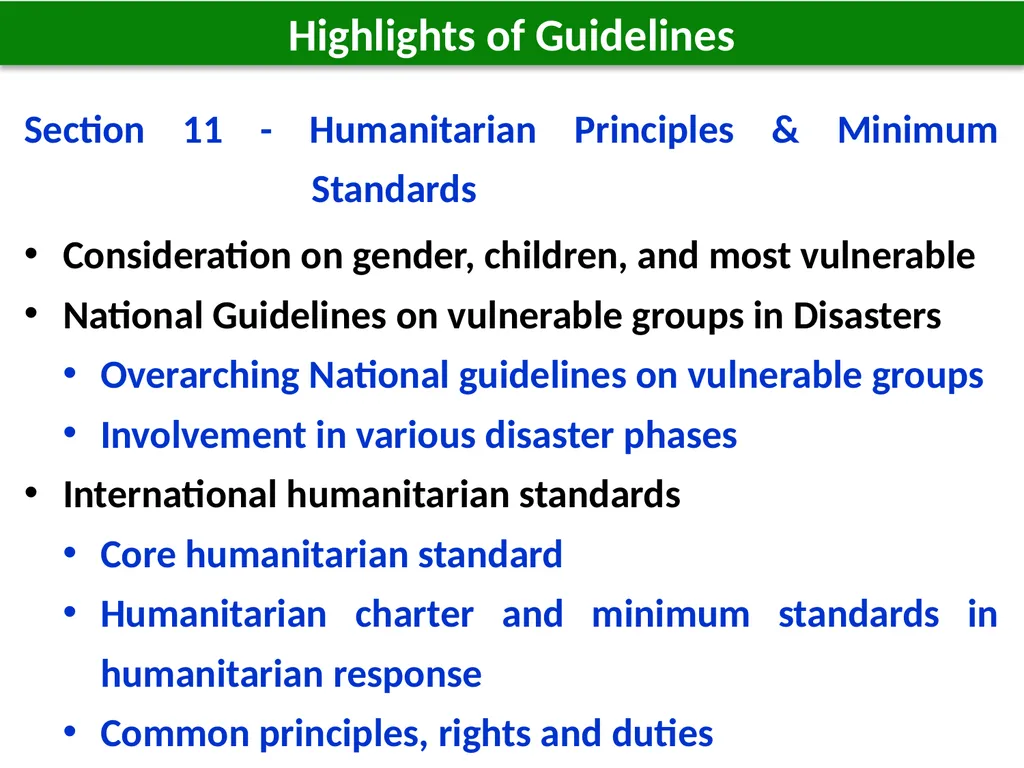
slide30. Highlights of Guidelines Section 11 - Humanitarian Principles & Minimum Standards
Consideration on gender, children, and most vulnerable
National Guidelines on vulnerable groups in Disasters
Overarching National guidelines on vulnerable groups
Involvement in various disaster phases
International humanitarian standards
Core humanitarian standard
Humanitarian charter and minimum standards in humanitarian response
Common principles, rights and duties<br>
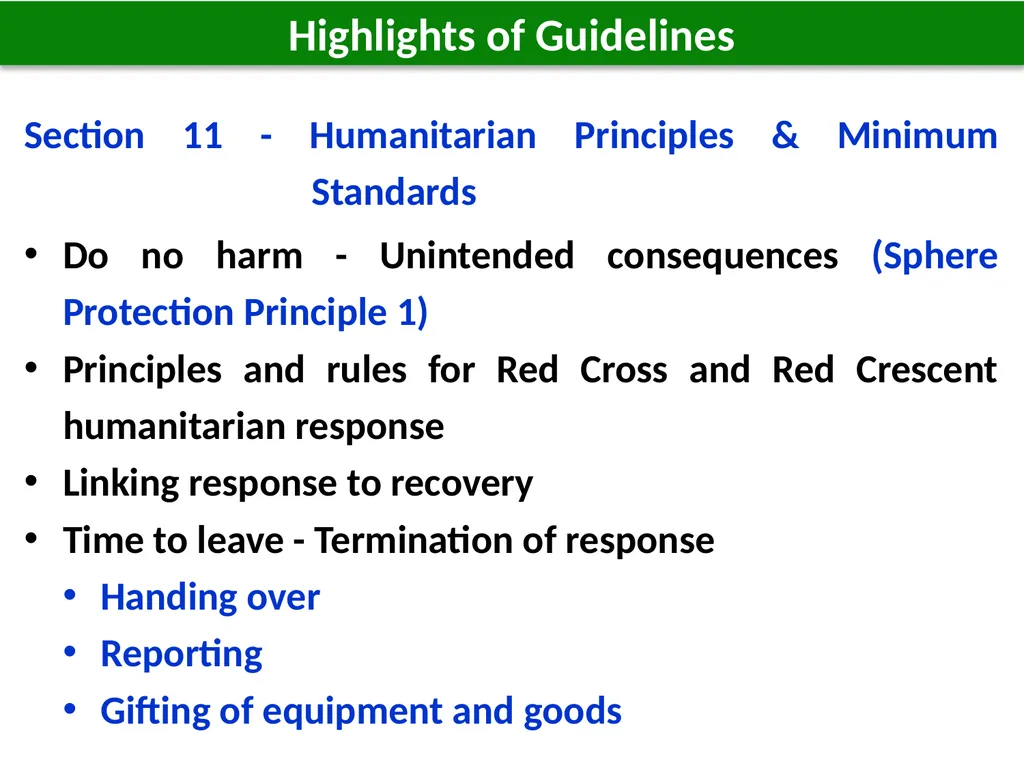
slide31. Highlights of Guidelines Section 11 - Humanitarian Principles & Minimum Standards
Do no harm - Unintended consequences (Sphere Protection Principle 1)
Principles and rules for Red Cross and Red Crescent humanitarian response
Linking response to recovery
Time to leave - Termination of response
Handing over
Reporting
Gifting of equipment and goods<br>
slide32. Thank You<br>
slide2. Aim To acquaint the participants with the Host Nation Support Guidelines (HNSG), developed for clear understanding of the rules, roles, responsibilities & procedures for all stakeholders, to expedite assistance and timely deployment of international disaster response resources<br>
slide3. Background In recent past Pakistan has been struck by number massive disasters
Frequent and extreme events likely to increase which warrants enhanced coordination and effective procedures
International assistance has been and will remain a reality during mega disaster
In absence of proper procedures, during 2010 super floods, flow of international assistance got hampered<br>
slide4. HNSGs Formulation & Methodology Formulated by team of expert led by Ms. Jennifer Mckay
Developed under NDMA guidance in collaboration with ADPC and with support of the Australian High Commission
Guidelines provide useful information both for decisions-makers in Pakistan and for responders
Focuses on actions to reduce the response time and are designed to identify the mandates, roles and responsibilities, processes, clearance requirements, and coordination procedures to provide common operating picture for all stakeholders<br>
slide5. HNSGs Formulation & Methodology Developed through extensive literature review and lessons learned from previous mega-disasters
Process also included consultations with key stakeholders from Government Ministries, Departments Organizations, the Pakistan Armed Forces, United Nations (UN) agencies, humanitarian organizations, foreign missions and donors, and the private sector
Guidelines consist of eleven sections and annexes to provide guidance for all stakeholders<br>
slide6. HNSGs Formulation & Methodology<br>
slide7. Necessity of Formulating Guidelines Requesting international assistance and deployment of assets is a major decision for any government
Foreign assistance brings together a complex array of inter and intra-government and civil-military cooperation issues - the need for comprehensive guidelines and SOPs
During 2010 Super Floods massive human, logistic and air support including foreign assistance was received, which necessitated need for elaborate procedure of engagement/employment<br>
slide8. Relief Workers / Participants - Flood 2010
Federal and Provincial Government ministries and department
Armed Forces - 90,000 (approx.)
UN Organizations - All
INGOs - over 100
NGOs - over 1000
Foreign Hospital - 15 (500 members)
Foreign Medical Teams - 21 (800 members)
NATO Coordination Team - 5 members Necessity of Formulating Guidelines<br>
slide9. Necessity of Formulating Guidelines<br>
slide10. Necessity of Formulating Guidelines<br>
slide11. Necessity of Formulating Guidelines<br>
slide12. Necessity of Formulating Guidelines Super Floods 2010 highlighted need for enhanced understanding of the complexities of massive logistics and coordination efforts required including those for managing foreign assistance<br>
slide13. Highlights of Guidelines<br>
slide14. Highlights of Guidelines Section 1 - Introduction
Country profile
Aim of formulating the guidelines
Contribution to regional knowledge
Formulation methodology
Necessity of formulating the guidelines
How to using the guidelines
Challenges in foreign assistance in response
Definitions<br>
slide15. Highlights of Guidelines Section 2 - Host Nation Coordination
National Disaster Management Act 2010 and its linkage with activities on accepting foreign assistance
NDMA’s mandate in emergency response
Needs assessments - Process and timeline
Call for foreign assistance and process
Pakistan’s response hierarchy<br>
slide16. Highlights of Guidelines Section 3 - Overarching Principles for Foreign Assistance
Sovereignty of the of Pakistan must be respected being host nation
Foreign aid workers, especially armed forces personnel, must be kept to minimum
Core skills and qualifications of worker be notified to NDMA
Clearness of dual purpose technical equipment is essential
Weapons are prohibited from being brought into the country
INGOs must be registered with the MOI and NOC be obtained<br>
slide17. Highlights of Guidelines Section 3 - Overarching Principles for Foreign Assistance
Security clearances from relevant authorities prior to deployment
Clearance of communication equipment Ministry of Information Technology and Telecom and PTA
Detail briefing by NDMA upon arrival in Pakistan
Clearance for the conduct of operations in restricted areas and installations
Restriction of Halal food and expiry date/period
Procurement of relief goods from within Pakistan to support the recovery of the local economy<br>
slide18. Highlights of Guidelines Section 3 - Overarching Principles for Foreign Assistance
Approval for providing cash or voucher support to affected communities instead of relief goods
Respect for religious, cultural, and other local sensitivities
Adherence of sphere standards and local laws<br>
slide19. Highlights of Guidelines Section 4 - Guide for Government of Pakistan Stakeholders
Section describe set of action and procedures to be followed by concern Government stakeholder during
Preparedness
When the disaster strikes
Monitoring, assessment and implement
Communication of information
Respond to offers of assistance
Receiving the assistance
Managing the assistance
Termination of assistance<br>
slide20. Highlights of Guidelines Section 5 - Government Key Stakeholders
Number of ministries and departments play important roles in facilitating foreign assistance
Most of them do not have specific SOPs
The section covers some recommendations for consideration to assist in addressing any gaps
The ministries and departments includes: -
Ministry of Finance - Economic Affairs Division (EAD)
Ministry of Foreign Affairs (MoFA)<br>
slide21. Highlights of Guidelines Section 5 - Government Key Stakeholders
Ministry of Interior
Visas for foreigners
INGO registration
Visits to restricted areas
Funding approvals
Federal Board of Revenue (FBR) - Customs Wing
Role of Custom’s Wing in facilitation of disaster response (Annex 1)
Ministry of Maritime Affairs
Pakistan International Airlines (PIA)
Pakistan Meteorological Department (PMD)
Objectives and services of PMD (Annex 2)<br>
slide22. Section 5 - Government Key Stakeholders
Ministry of Information Technology and Telecom (MOIT)
Pakistan Telecommunications Authority (PTA)
Approval for import and use of ICT equipment
Procedure for encryption/inbuilt ciphering devices certification
Requirements for evaluation of equipment using cypher and coding protocols
Prevention of electronic crimes Act 2016
Ministry of Information, Broadcasting, and National Heritage
Press Information Department (PID)
Cyber Wing Highlights of Guidelines<br>
slide23. Highlights of Guidelines Section 5 - Government Key Stakeholders
External Publicity Wing
Media Cell - NDMA
ISPR
PEMRA - Laws on Disaster Reporting
Ministry of National Health Services, Regulation and Coordination
National Health Emergency Preparedness & Response Network (NHEPRN)
Ministry of Food Security and Research - Animal Quarantine Department (AQD)
Survey of Pakistan - Mapping<br>
slide24. Highlights of Guidelines Section 5 - Government Key Stakeholders
Funding Appeals
MOFA
EAD
DMAs
Provincial Emergency Services<br>
slide25. Highlights of Guidelines Section 6 - Military
The section covers recommendations/guidelines for
Pakistan Armed Forces
Foreign Militaries
Joint Aviation Coordination Cell (JACC)
Organization of JACC
Pakistan Air Force - Air Headquarters
UN and Humanitarian Organizations
Civil-Military Coordination with Humanitarian Community (CMCoord)<br>
slide26. Section 7 - Guide for Assisting Countries & Humanitarian Community
The section covers follows aspects:-
Special policies for INGOs in Pakistan
Government of Pakistan focal persons for donor organisations
Formal offers for assistance
Requirements for entry into Pakistan and visa approval
Arrival
Coordination
Cluster management
Exist and handing over Highlights of Guidelines<br>
slide27. Section 8 - Guidance for Foreign Responders
Breakdown of section 8 is as follows:-
Assisting countries
Integrated/multi-agency missions
Humanitarian community
International Red Cross and Red Crescent Movement
Selection as implementer
INGOs and NGOs and their policy and rules
Pakistan humanitarian organizations and networks
Private sector Highlights of Guidelines<br>
slide28. Section 9 - Health Response - Foreign Medical Teams (FMTs)
The section covers follows aspects:-
Foreign medical teams (FMT)
Classification of FMTs
Mission
Minimum benchmark
Key services
Staffing
Core standards for FMTs
Terminologies
Disaster response timeline and needs chart and role of FMTs & Red Cross/Crescent Highlights of Guidelines<br>
slide29. Highlights of Guidelines Section 10 - Civil-Military Coordination (CMCoord)
International principles on CMcoord
UN humanitarian CMcoord
Civil-Military guidelines: UNOCHA - Oslo Guidelines on the use of foreign military and civil defence assets in disaster relief Lessons Learned from 2010 super floods highlight how different the opinions and interpretations can be between the humanitarian community and the military and can be a point of friction. To avoid delays, advice should be sought from NDMA to ensure a local understanding of the ground situation to assist in making a determination<br>
slide30. Highlights of Guidelines Section 11 - Humanitarian Principles & Minimum Standards
Consideration on gender, children, and most vulnerable
National Guidelines on vulnerable groups in Disasters
Overarching National guidelines on vulnerable groups
Involvement in various disaster phases
International humanitarian standards
Core humanitarian standard
Humanitarian charter and minimum standards in humanitarian response
Common principles, rights and duties<br>
slide31. Highlights of Guidelines Section 11 - Humanitarian Principles & Minimum Standards
Do no harm - Unintended consequences (Sphere Protection Principle 1)
Principles and rules for Red Cross and Red Crescent humanitarian response
Linking response to recovery
Time to leave - Termination of response
Handing over
Reporting
Gifting of equipment and goods<br>
slide32. Thank You<br>