04
Session 1: Agenda Overview of the course outline
Introduction to Business Activities
Managers as an intelligent user of financial statements
An overview of financial statements 1-4<br>
05
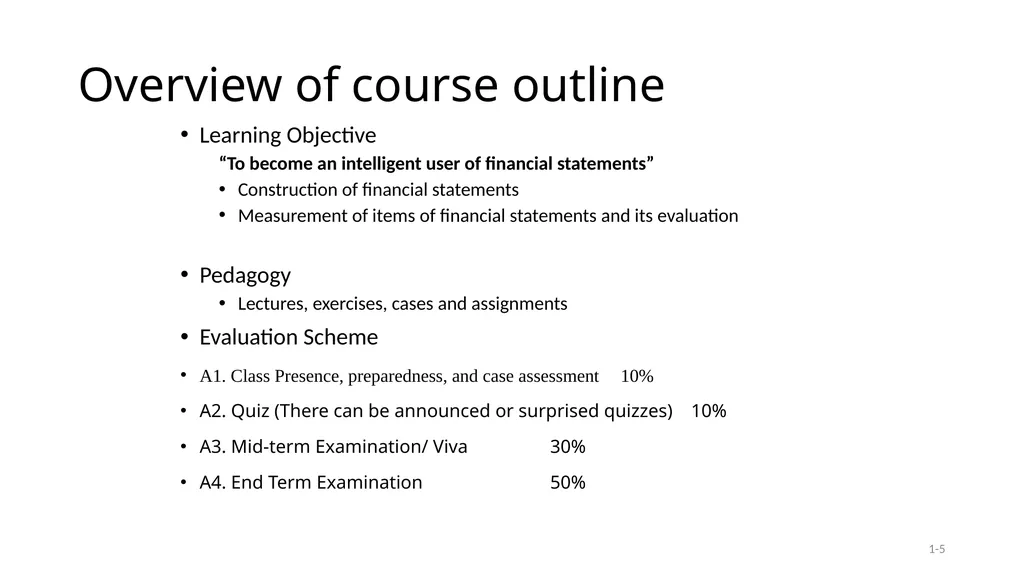
Overview of course outline Learning Objective
“To become an intelligent user of financial statements”
Construction of financial statements
Measurement of items of financial statements and its evaluation
Pedagogy
Lectures, exercises, cases and assignments
Evaluation Scheme
A1. Class Presence, preparedness, and case assessment 10%
A2. Quiz (There can be announced or surprised quizzes) 10%
A3. Mid-term Examination/ Viva 30%
A4. End Term Examination 50% 1-5<br>
06
Overview of course outline Approaches to Study Accounting:
Viewpoint of accountant (preparer).
Collecting, summarizing and reporting accounting information.
Viewpoint of user.
Understanding, analyzing, and interpreting accounting reports to make decisions. 1-6<br>
07
Prescribed Text, Suggested Readings and References Prescribed Text:
Accounting Text and Cases by Robert N Anthony, David F Hawkins, Kenneth A Merchant, Tata McGraw Hill Publishers (AHM)
Suggested Readings:
Financial Accounting for Management by Ramachandran and Kakani, Tata McGraw Hill
Financial Accounting: An introduction to concepts, methods, and uses by Stickney and Weil.
Financial Accounting: A Managerial Perspective by R Narayanaswamy, PHI publications.
Indian Accounting Standards from www.icai.org
http://www.icai.org/post.html?post_id=474 1-7<br>
08
Additional Readings, References and Databases Text books for reference:
Corporate Financial Reporting: Text and Cases by Brownlee, Ferris and Haskins, Published by McGraw Hill.
Financial Accounting: Reporting and Analysis by Stice and Stice, Published by Cengage Learning.
The Analysis and Use of Financial Statements by White, Sondhi and Fried.
Journals for reference:
Journal of Accounting and Economics
Journal of Finance
The Accounting Review
Journal of Accounting Research
Indian Journal of Accounting
The Chartered Accountant by ICAI
CPA Journal
Related Databases
Bloomberg
Thomson Reuters
Prowess (CMIE)<br>
09
Main contents and flow Balance Sheet
Income Statement
Accounting Records
Cash Flow Statement
Measurement of material cost and inventory
Measurement of Depreciation
Understanding Annual Report
Introduction to Financial Statement Analysis
Review 1-9<br>
10
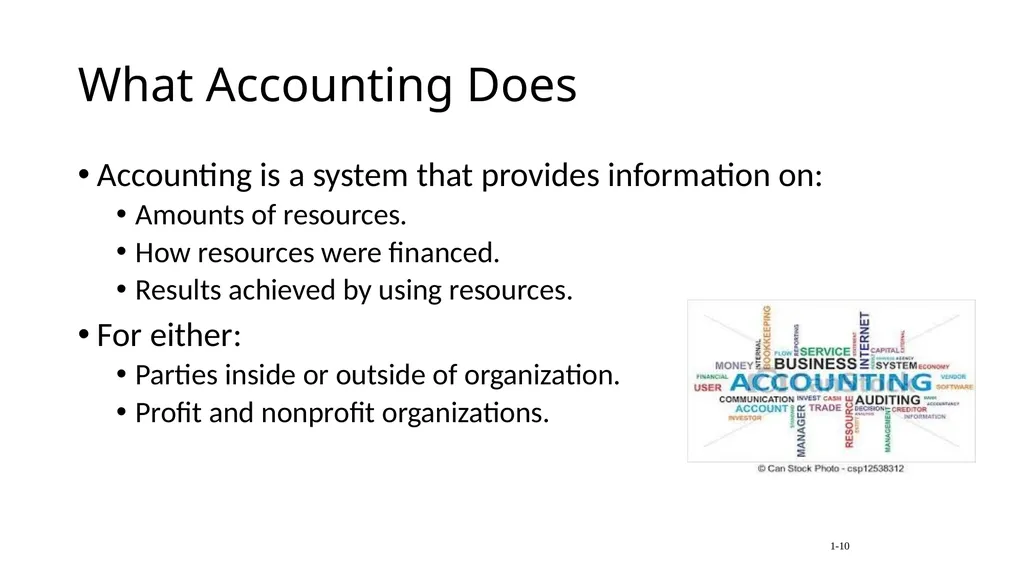
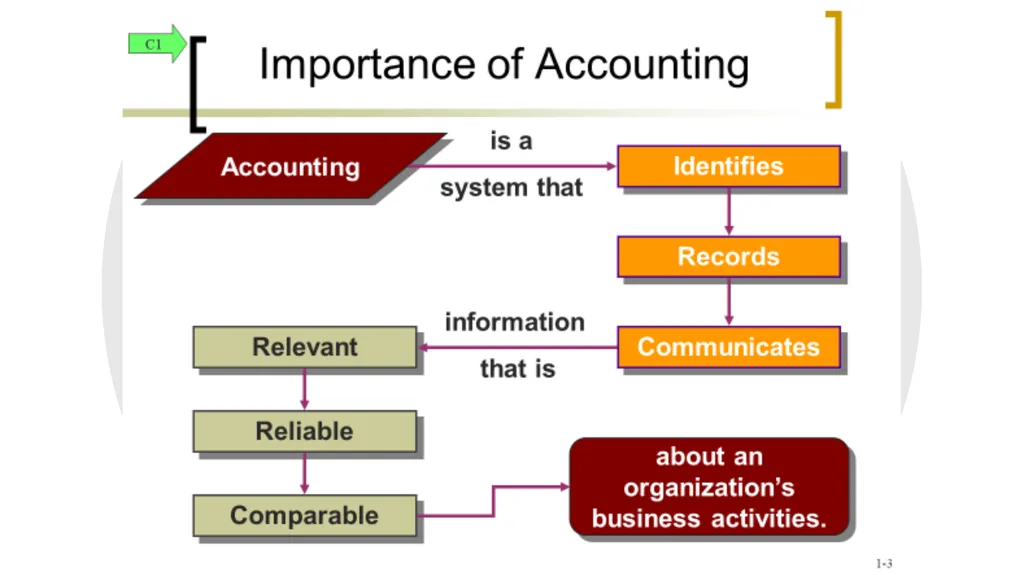
What Accounting Does Accounting is a system that provides information on:
Amounts of resources.
How resources were financed.
Results achieved by using resources.
For either:
Parties inside or outside of organization.
Profit and nonprofit organizations. 1-10<br>
11
Let’s start a business entity
Varsity Motors<br>
12
Categories of Accounting Information Operating
Financial accounting.
Management accounting.
Tax accounting. 1-12<br>
13
Operating Information Needed to conduct day-to-day activities.
Largest quantity of accounting data.
Examples:
Hours worked by employees.
Inventory on hand.
Amounts owed by customers.
Amount of money in bank.
Amount payable to others 1-13<br>
14
Financial Accounting Information For external users (investors) and managers.
Used by investors to make decisions to buy, sell, or hold shares of a company.
Annual report and its financial statements.
Common rules used so investors can compare with other companies’ financial statements.
No “tailor-made” information 1-14<br>
15
Management Accounting Information For internal users such as president, marketing manager, production manager, etc.
Used for three management functions:
Planning.
Implementation.
Control. 1-15<br>
16
Tax Accounting Information Prepare returns for taxing authorities:
Federal
State
Local
International
Tax accounting rules can differ from financial accounting rules. 1-16<br>
17
Definition of Accounting Process of:
Identifying
Measuring
Communicating
Economic information.
To make decisions. 1-17<br>
18
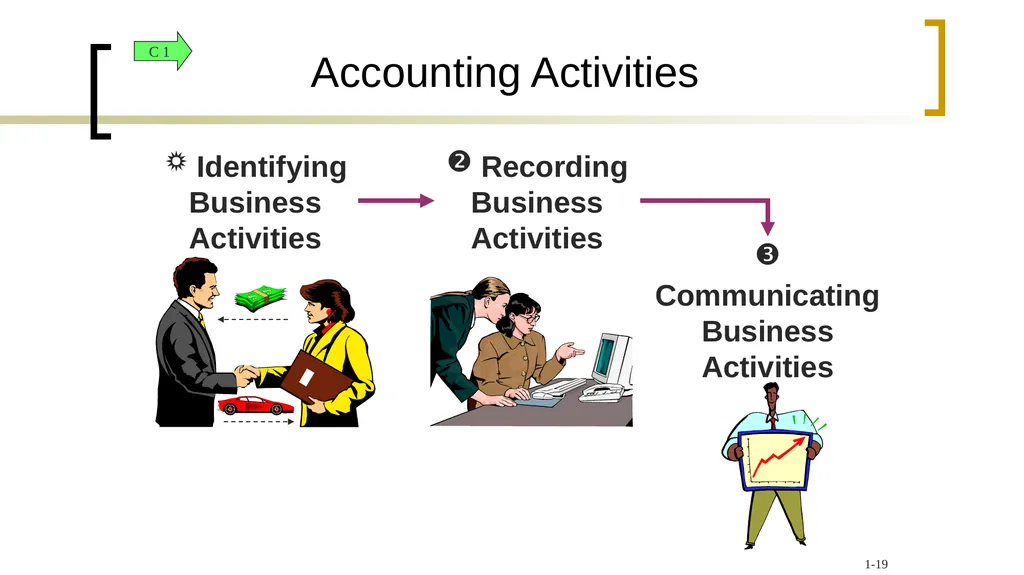
Identifying Business Activities Recording Business Activities Communicating Business Activities Accounting Activities C 1 1-19<br>
19
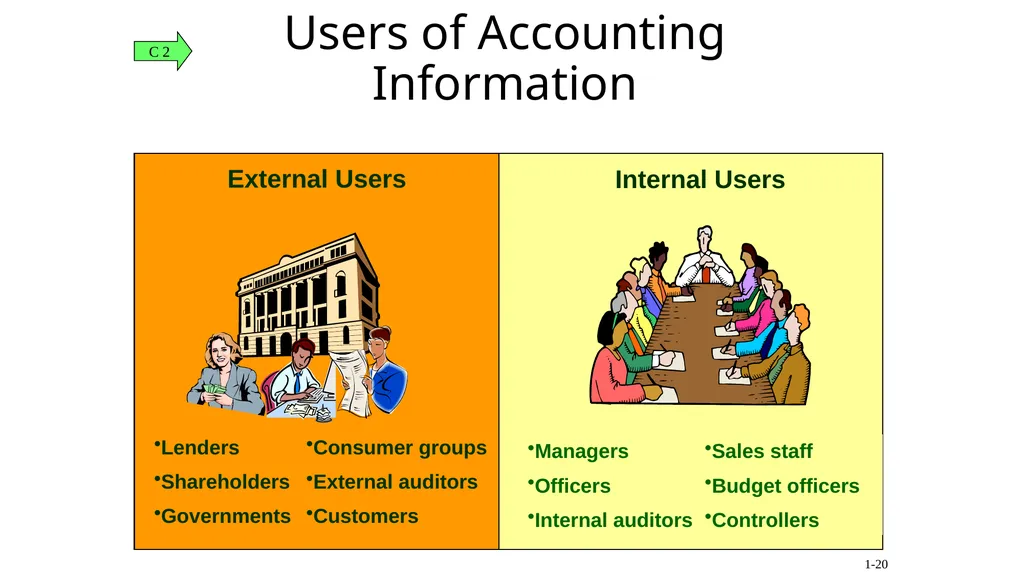
Users of Accounting Information C 2 1-20<br>
20
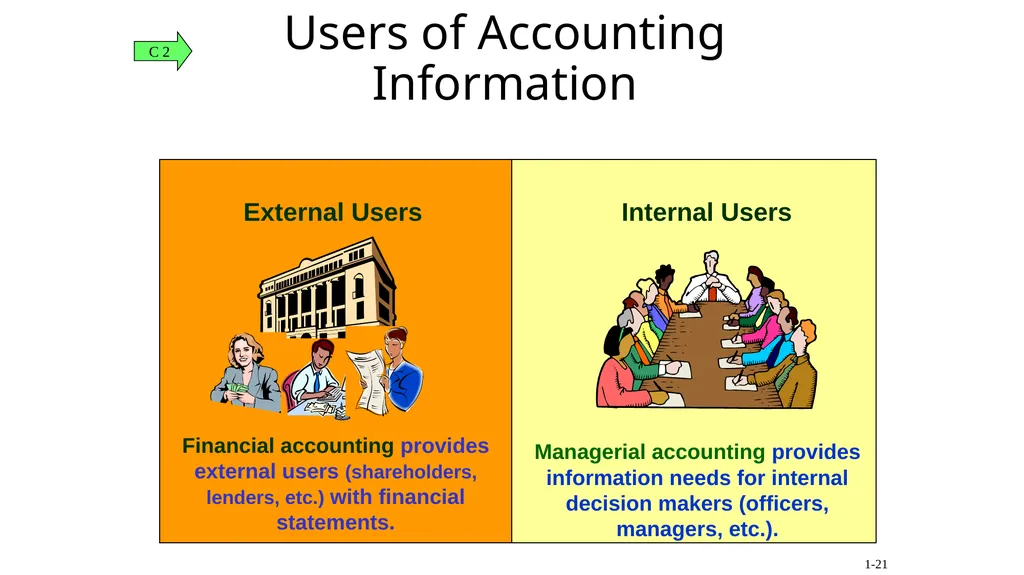
Users of Accounting Information Internal Users Managerial accounting provides information needs for internal decision makers (officers, managers, etc.). C 2 1-21<br>
22
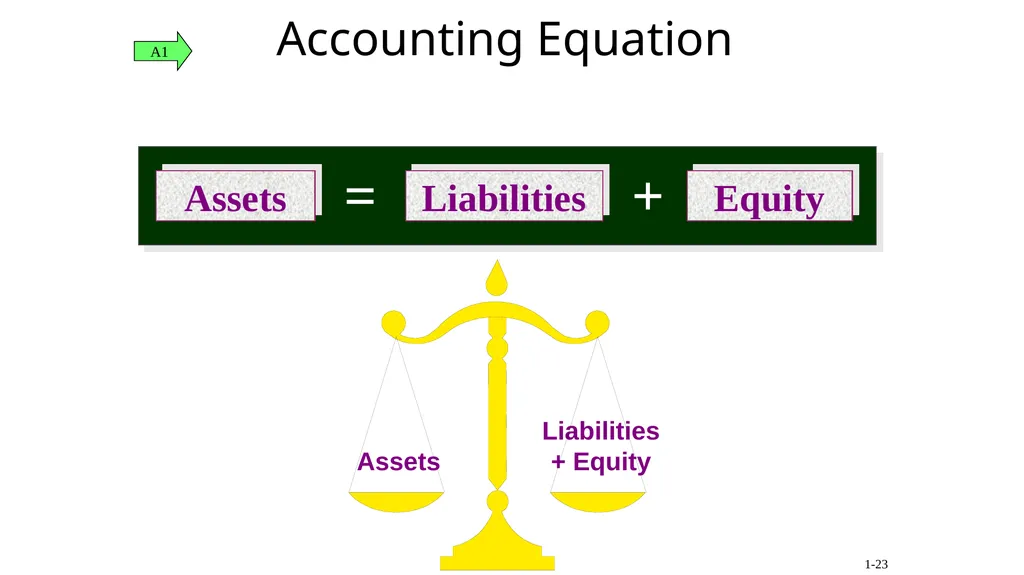
Assets Liabilities + Equity Accounting Equation A1 1-23<br>
23
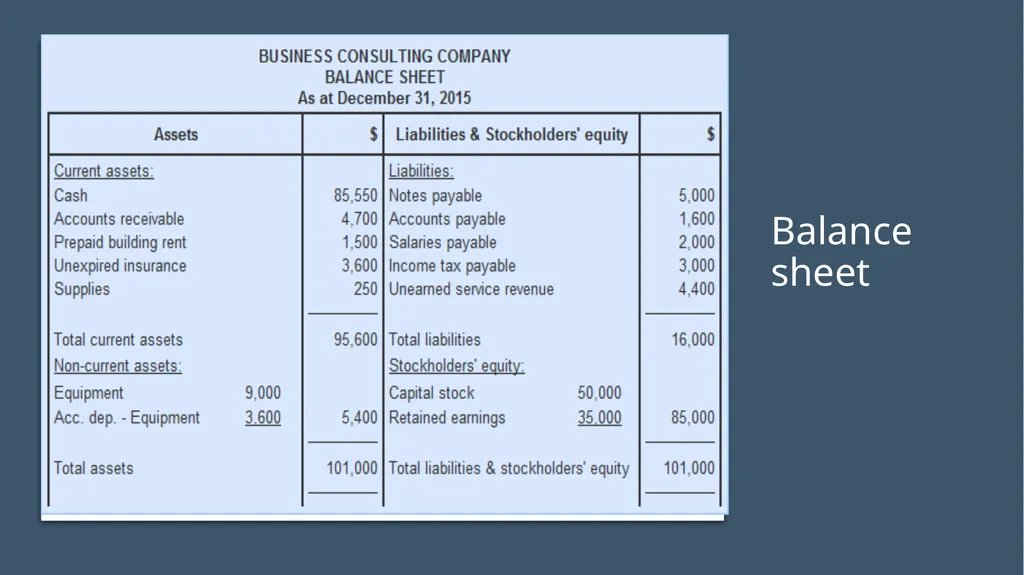
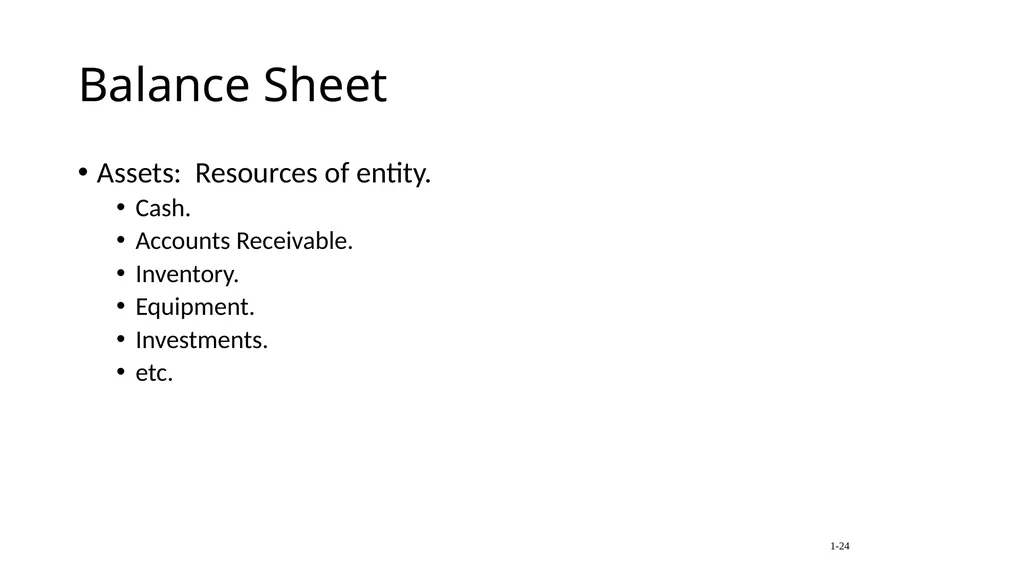
Balance Sheet Assets: Resources of entity.
Cash.
Accounts Receivable.
Inventory.
Equipment.
Investments.
etc. 1-24<br>
24
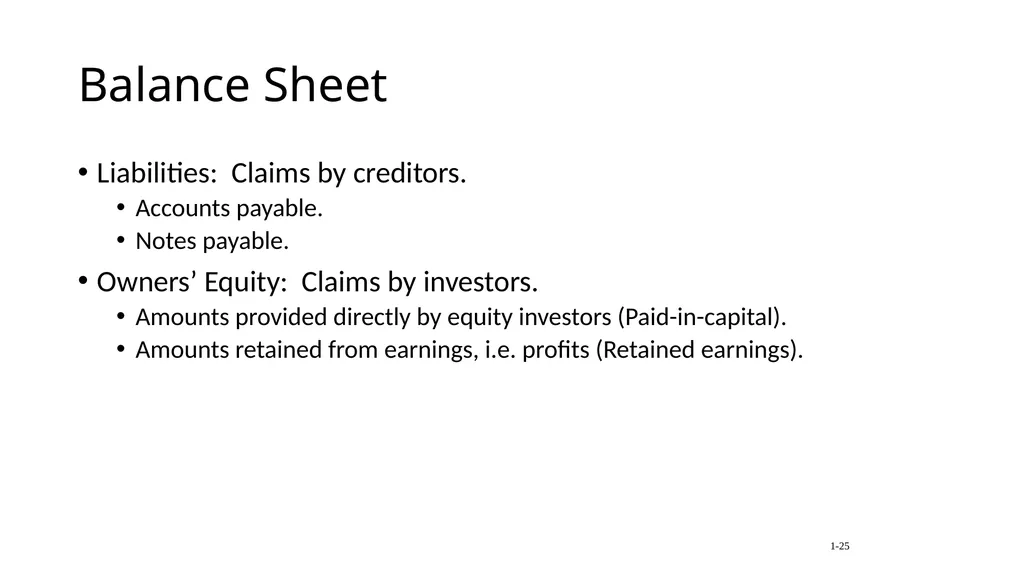
Balance Sheet Liabilities: Claims by creditors.
Accounts payable.
Notes payable.
Owners’ Equity: Claims by investors.
Amounts provided directly by equity investors (Paid-in-capital).
Amounts retained from earnings, i.e. profits (Retained earnings). 1-25<br>
25
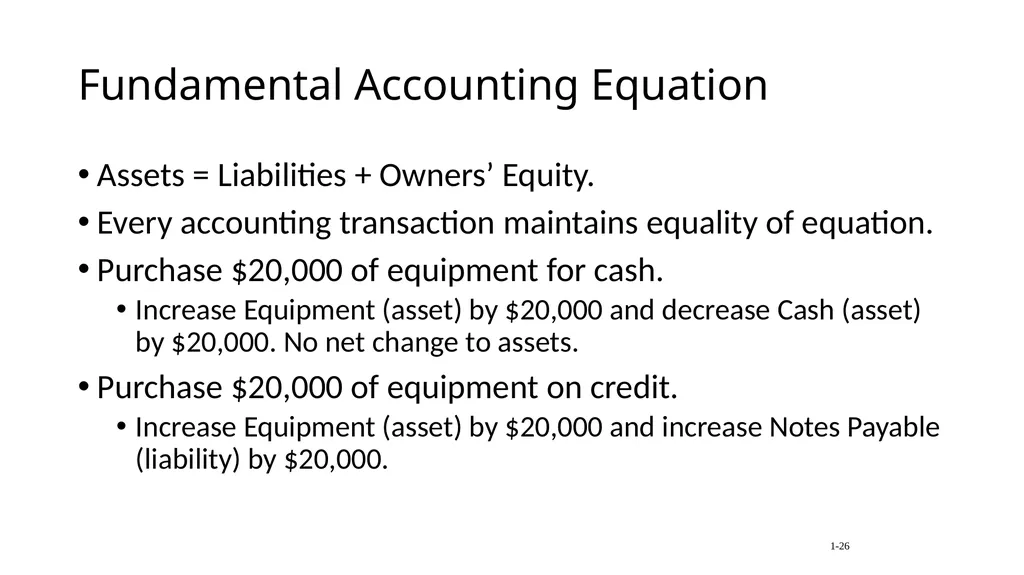
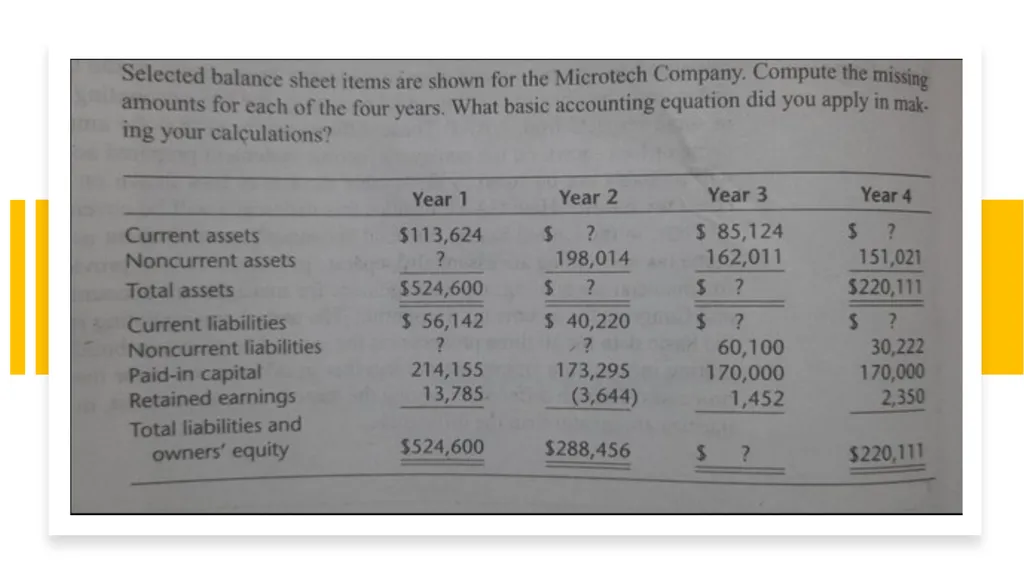
Fundamental Accounting Equation Assets = Liabilities + Owners’ Equity.
Every accounting transaction maintains equality of equation.
Purchase $20,000 of equipment for cash.
Increase Equipment (asset) by $20,000 and decrease Cash (asset) by $20,000. No net change to assets.
Purchase $20,000 of equipment on credit.
Increase Equipment (asset) by $20,000 and increase Notes Payable (liability) by $20,000. 1-26<br>
26
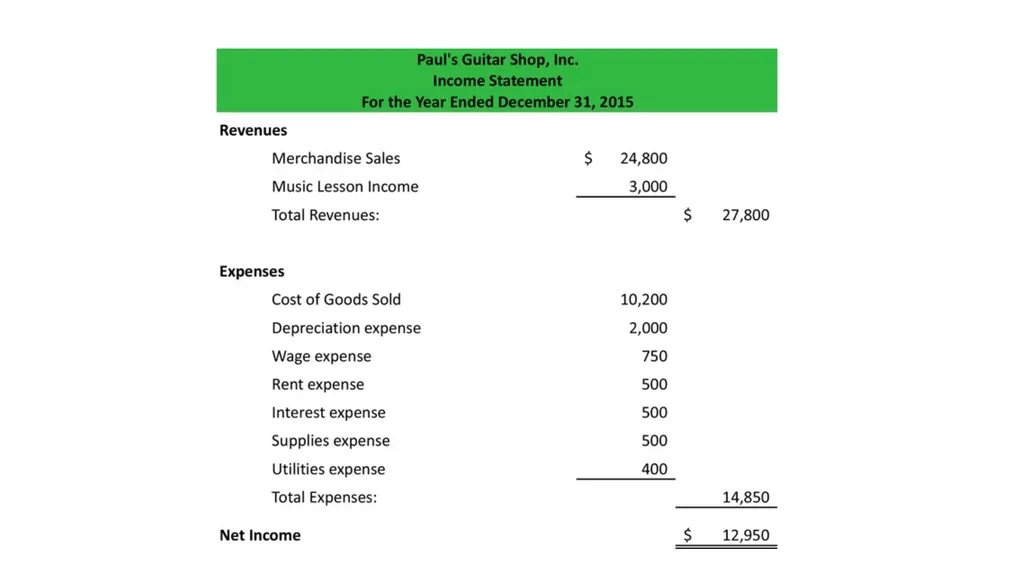
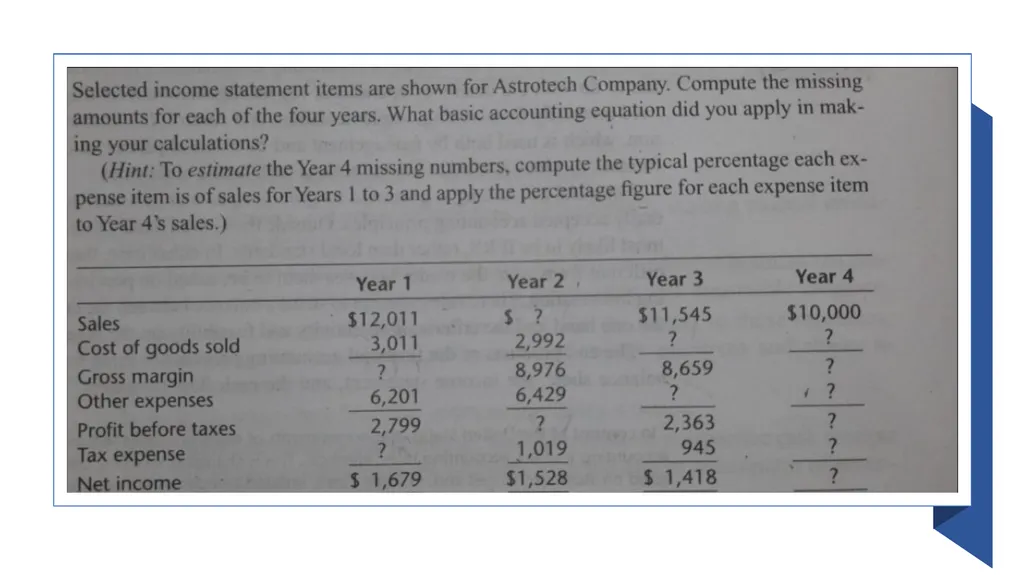
Income Statement Summaries results of operating activity over a period of time.
Revenues – Expenses = Net Income.
Net income (or net loss) is the amount added to (subtracted from) Retained earnings. 1-28<br>
27
Accounting Income= Revenues-Expenses
Cost of sales or goods sold= Reports the cost of the goods or services whose revenues is reported in the first line<br>
28
Question As of December 31, Charles company had $12,000 in cash, held stock(inventory) worth $ 95,000. They owned other items amounting $13,000. Company also borrowed from UBL Bank $40,000. Prepare a balance sheet as of December 31.<br>
29
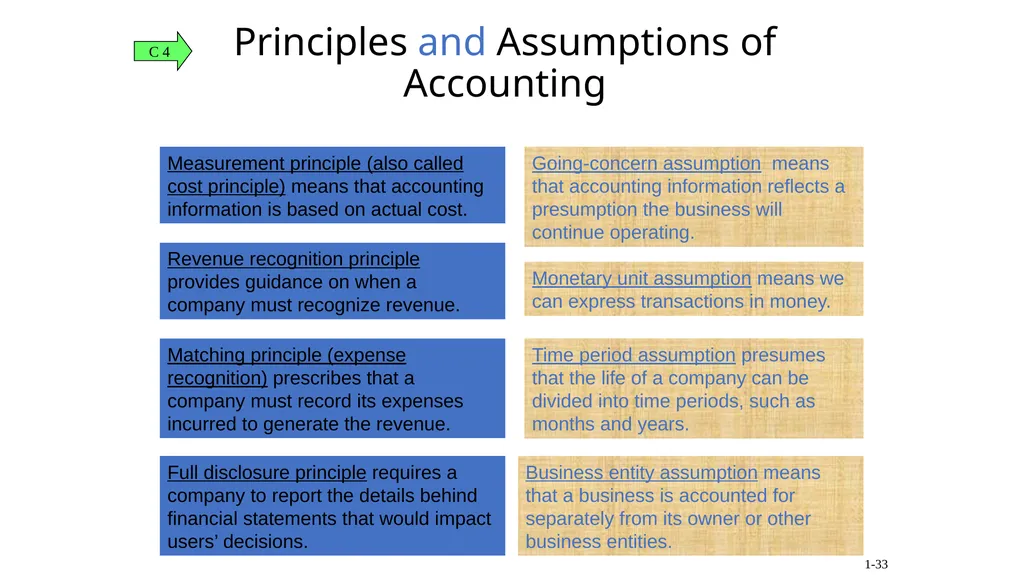
Principles and Assumptions of Accounting C 4 Measurement principle (also called cost principle) means that accounting information is based on actual cost. Going-concern assumption means that accounting information reflects a presumption the business will continue operating. Monetary unit assumption means we can express transactions in money. Revenue recognition principle provides guidance on when a company must recognize revenue. Business entity assumption means that a business is accounted for separately from its owner or other business entities. Matching principle (expense recognition) prescribes that a company must record its expenses incurred to generate the revenue. Full disclosure principle requires a company to report the details behind financial statements that would impact users’ decisions. 1-33 Time period assumption presumes that the life of a company can be divided into time periods, such as months and years.<br>
30
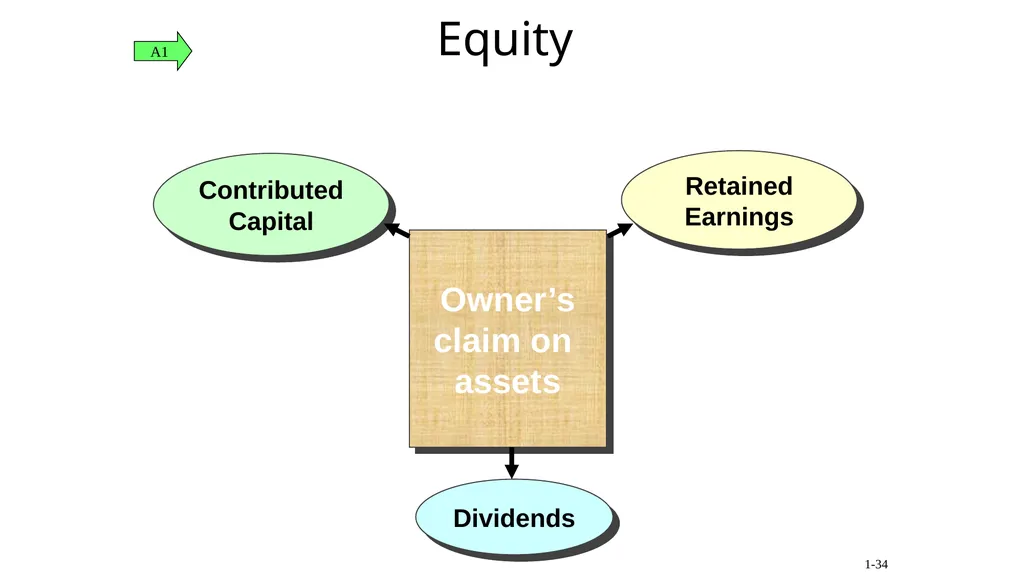
Owner’s
claim on
assets Dividends Contributed Capital Retained Earnings Equity A1 1-34<br>
31
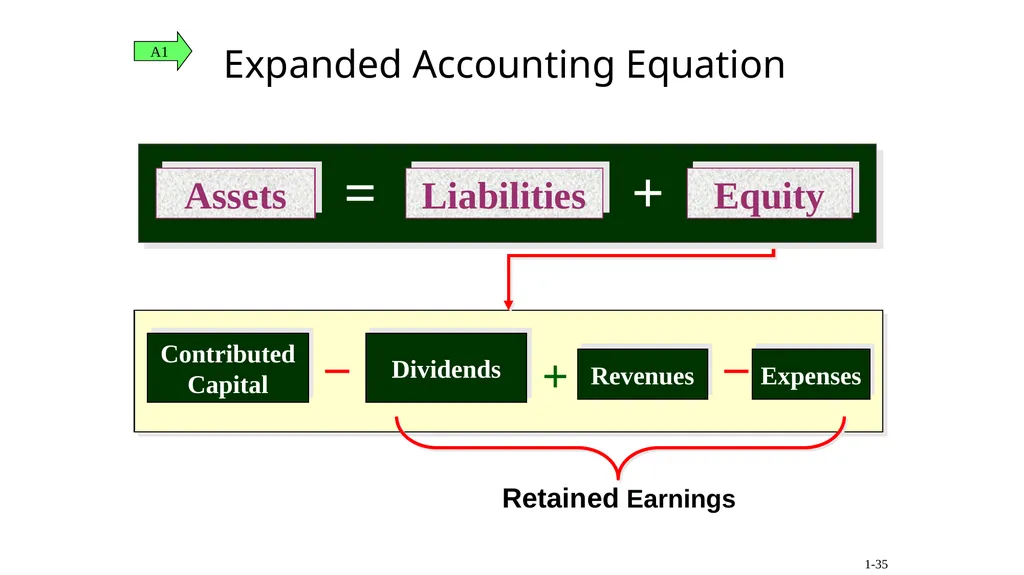
Expanded Accounting Equation A1 1-35<br>