
1 Chapter Three Lecture Notes Additional Budgeting
Description: 1 Chapter Three Lecture Notes Additional Budgeting Concepts Finkler: Financial Management For Public, Health, And Not-For-Profit Organizations, 3rd Ed. Pearson Education 2010 2 Budgeting Formats Line item or object of expense - e.g.,
Related Topics
Download Presentation
"1 Chapter Three Lecture Notes Additional Budgeting" is the property of its rightful owner. Permission is granted to download and print the materials on this website for personal, non-commercial use only, and to display it on your personal computer provided you do not modify the materials and that you retain all copyright notices contained in the materials. By downloading content from our website, you accept the terms of this agreement.
Presentation Transcript
slide1. 1 Chapter Three
Lecture Notes Additional Budgeting Concepts Finkler: Financial Management For Public, Health, And Not-For-Profit Organizations, 3rd Ed. © Pearson Education 2010<br>
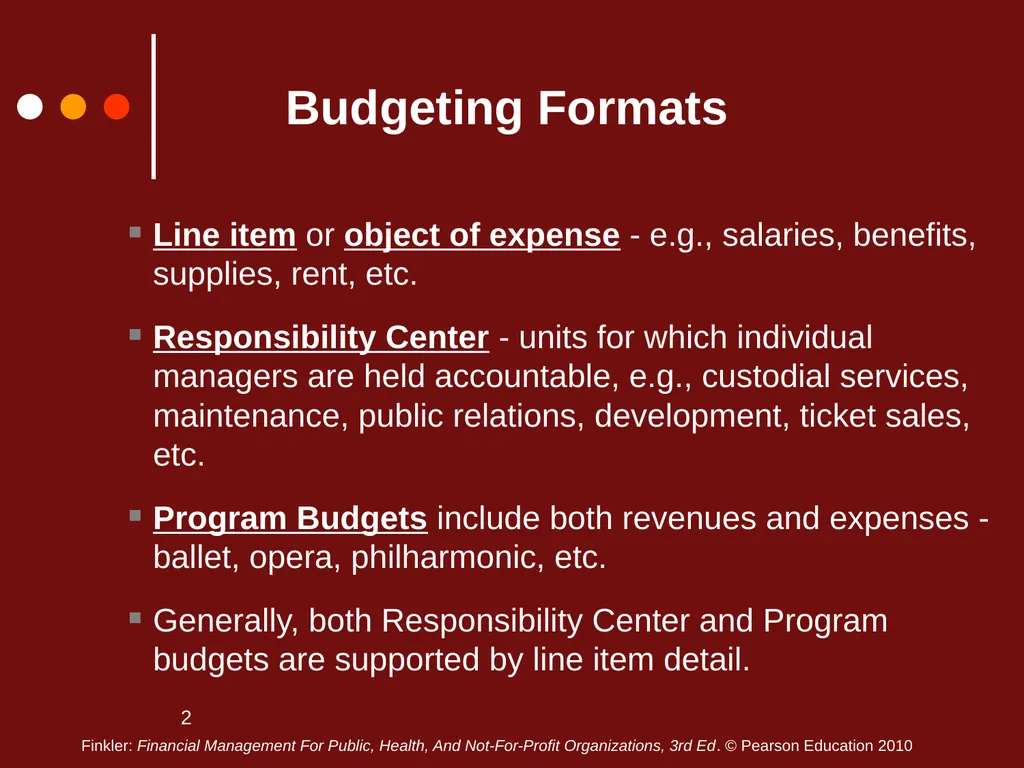
slide2. 2 Budgeting Formats Line item or object of expense - e.g., salaries, benefits, supplies, rent, etc.
Responsibility Center - units for which individual managers are held accountable, e.g., custodial services, maintenance, public relations, development, ticket sales, etc.
Program Budgets include both revenues and expenses - ballet, opera, philharmonic, etc.
Generally, both Responsibility Center and Program budgets are supported by line item detail. Finkler: Financial Management For Public, Health, And Not-For-Profit Organizations, 3rd Ed. © Pearson Education 2010<br>
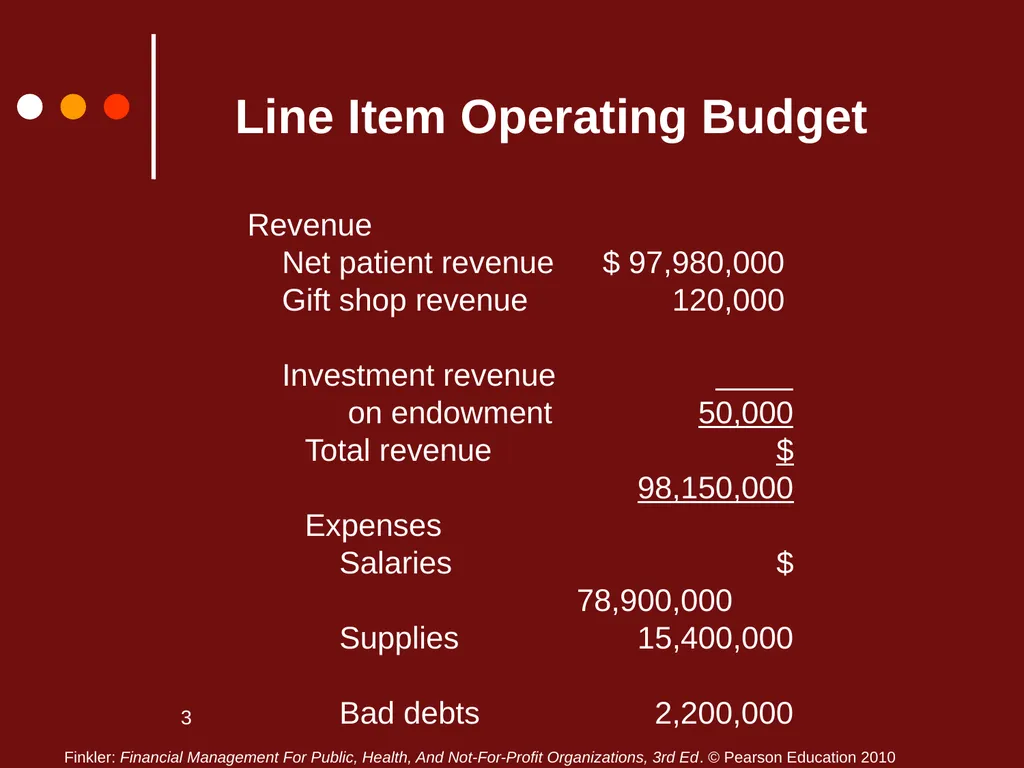
slide3. 3 Line Item Operating Budget Revenue
Net patient revenue
Gift shop revenue
Investment revenue
on endowment
Total revenue
Expenses
Salaries
Supplies
Bad debts
Interest
Rent
Total expenses
Profit/(loss) $ 97,980,000
120,000
50,000
$ 98,150,000
$ 78,900,000 15,400,000
2,200,000
400,000
3,100,000
$100,000,000
$ (1,850,000) Finkler: Financial Management For Public, Health, And Not-For-Profit Organizations, 3rd Ed. © Pearson Education 2010<br>
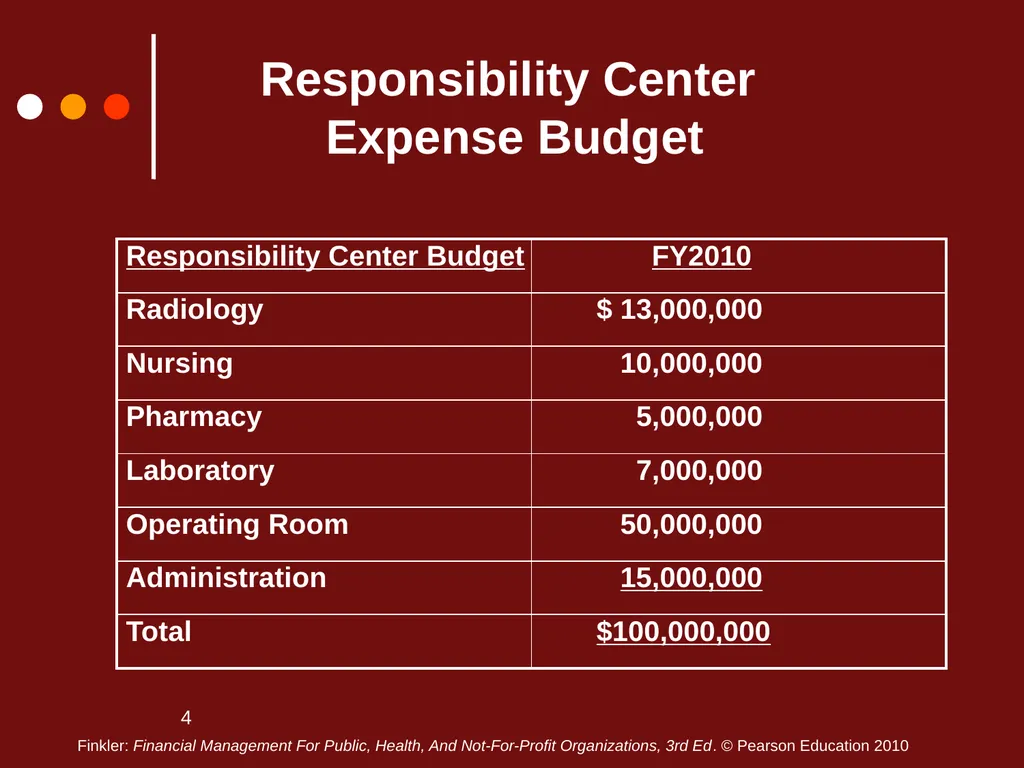
slide4. 4 Responsibility Center
Expense Budget Finkler: Financial Management For Public, Health, And Not-For-Profit Organizations, 3rd Ed. © Pearson Education 2010<br>
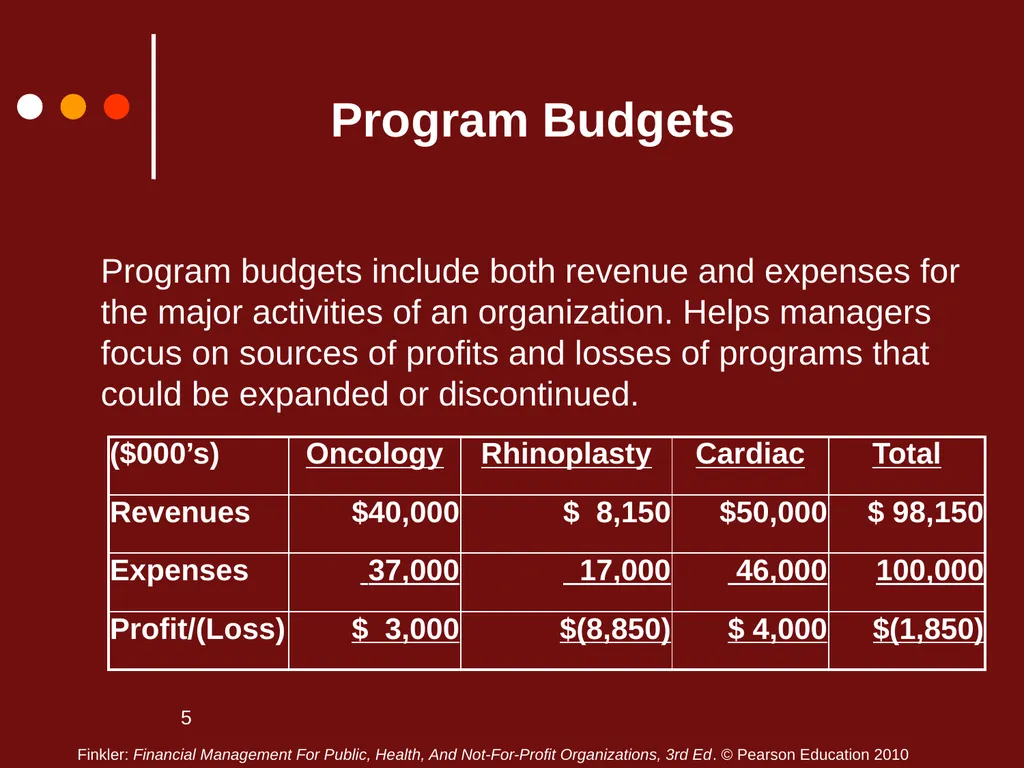
slide5. 5 Program Budgets Program budgets include both revenue and expenses for the major activities of an organization. Helps managers focus on sources of profits and losses of programs that could be expanded or discontinued. Finkler: Financial Management For Public, Health, And Not-For-Profit Organizations, 3rd Ed. © Pearson Education 2010<br>
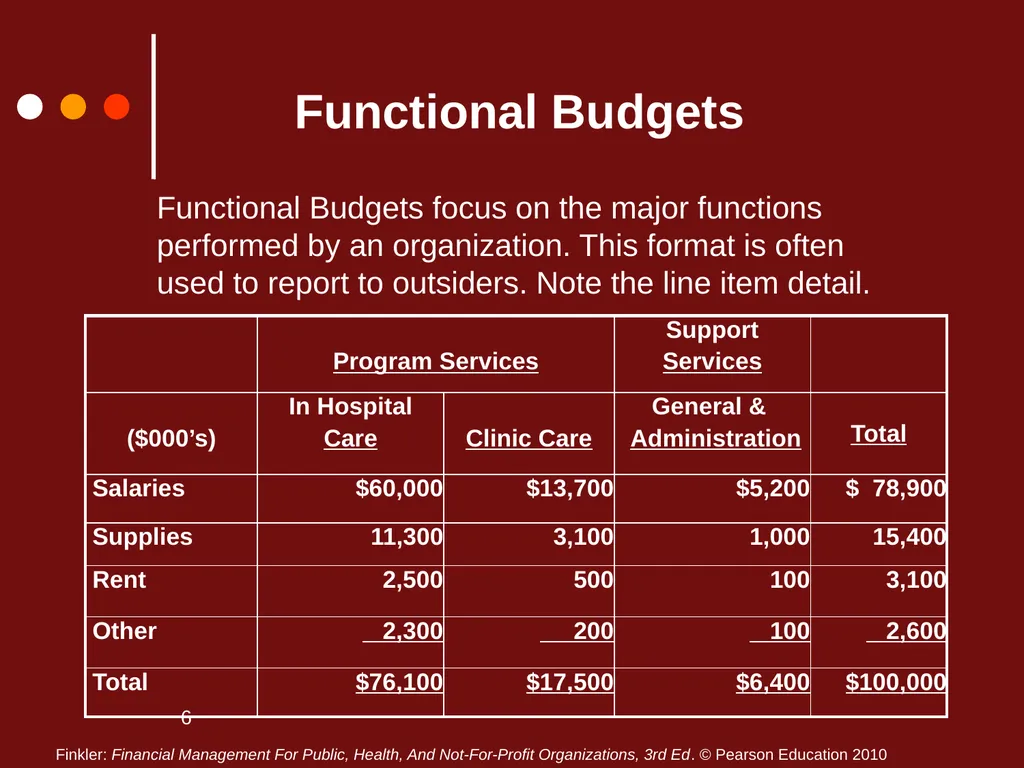
slide6. 6 Functional Budgets Functional Budgets focus on the major functions
performed by an organization. This format is often
used to report to outsiders. Note the line item detail. Finkler: Financial Management For Public, Health, And Not-For-Profit Organizations, 3rd Ed. © Pearson Education 2010<br>
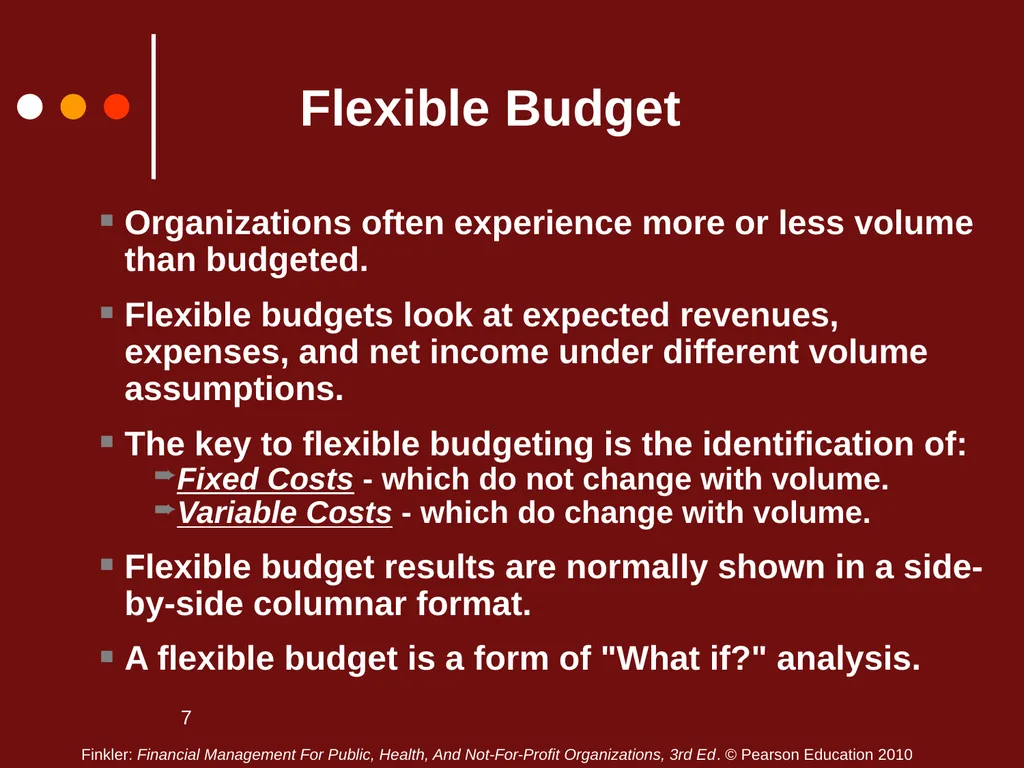
slide7. 7 Organizations often experience more or less volume than budgeted.
Flexible budgets look at expected revenues, expenses, and net income under different volume assumptions.
The key to flexible budgeting is the identification of:
Fixed Costs - which do not change with volume.
Variable Costs - which do change with volume.
Flexible budget results are normally shown in a side-by-side columnar format.
A flexible budget is a form of "What if?" analysis. Flexible Budget Finkler: Financial Management For Public, Health, And Not-For-Profit Organizations, 3rd Ed. © Pearson Education 2010<br>
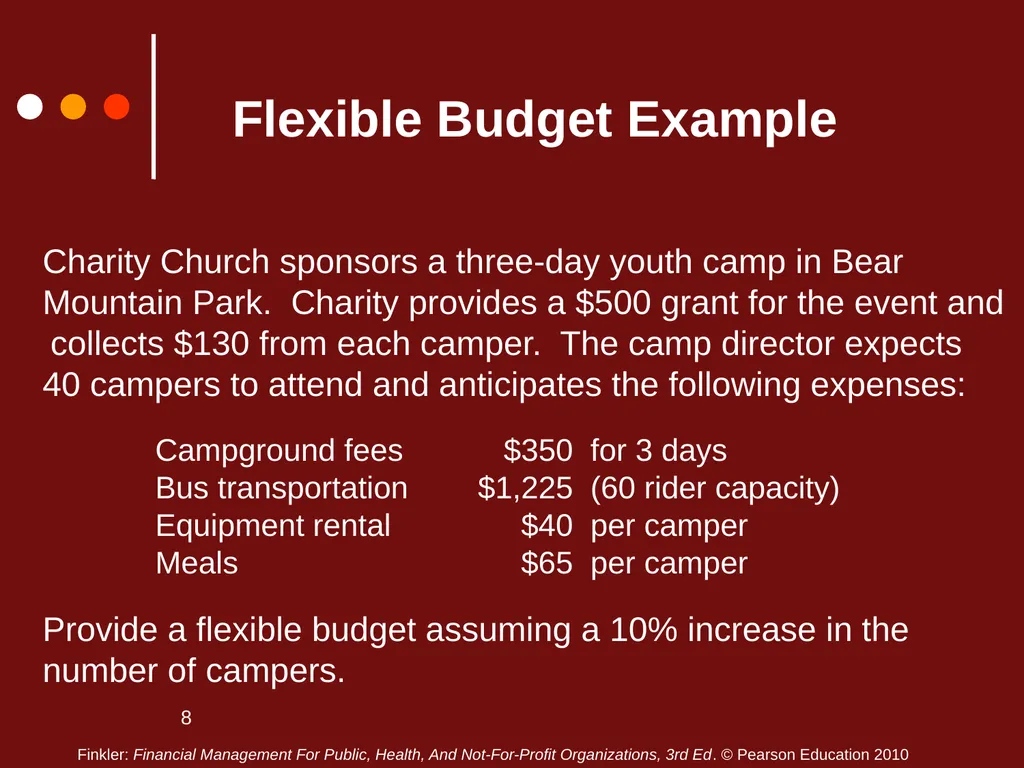
slide8. 8 Flexible Budget Example
Charity Church sponsors a three-day youth camp in Bear
Mountain Park. Charity provides a $500 grant for the event and collects $130 from each camper. The camp director expects
40 campers to attend and anticipates the following expenses:
Campground fees $350 for 3 days
Bus transportation $1,225 (60 rider capacity)
Equipment rental $40 per camper
Meals $65 per camper
Provide a flexible budget assuming a 10% increase in the
number of campers. Finkler: Financial Management For Public, Health, And Not-For-Profit Organizations, 3rd Ed. © Pearson Education 2010<br>
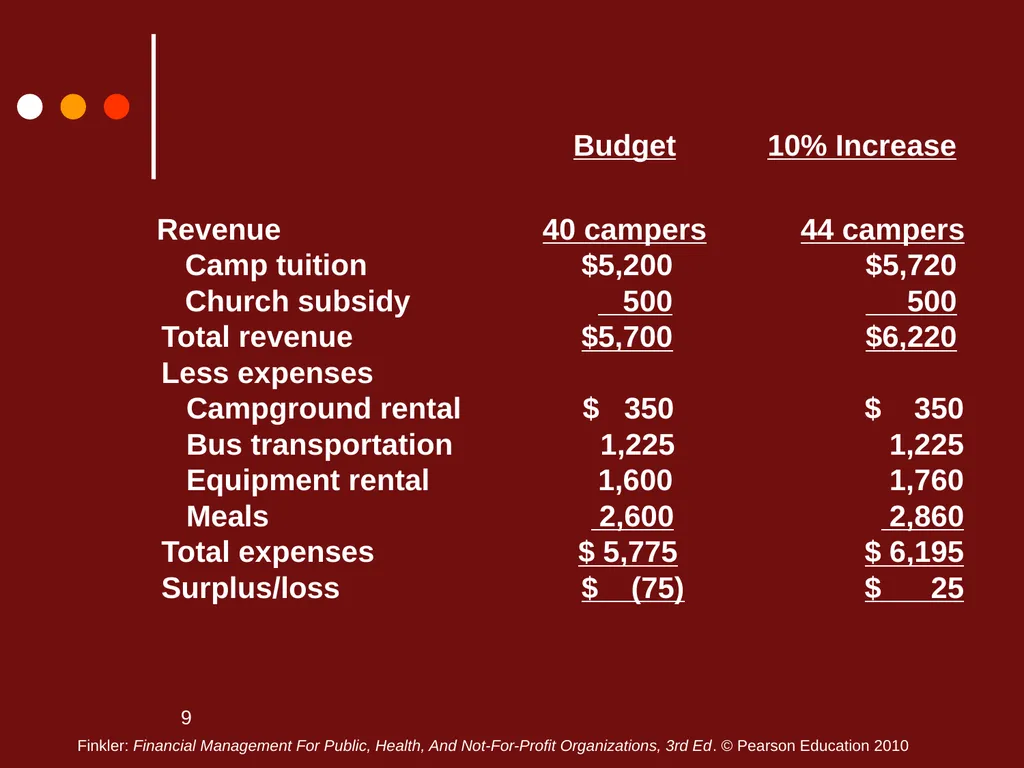
slide9. 9 Budget 10% Increase
Revenue 40 campers 44 campers
Camp tuition $5,200 $5,720
Church subsidy 500 500
Total revenue $5,700 $6,220
Less expenses
Campground rental $ 350 $ 350
Bus transportation 1,225 1,225
Equipment rental 1,600 1,760
Meals 2,600 2,860
Total expenses $ 5,775 $ 6,195
Surplus/loss $ (75) $ 25 Finkler: Financial Management For Public, Health, And Not-For-Profit Organizations, 3rd Ed. © Pearson Education 2010<br>
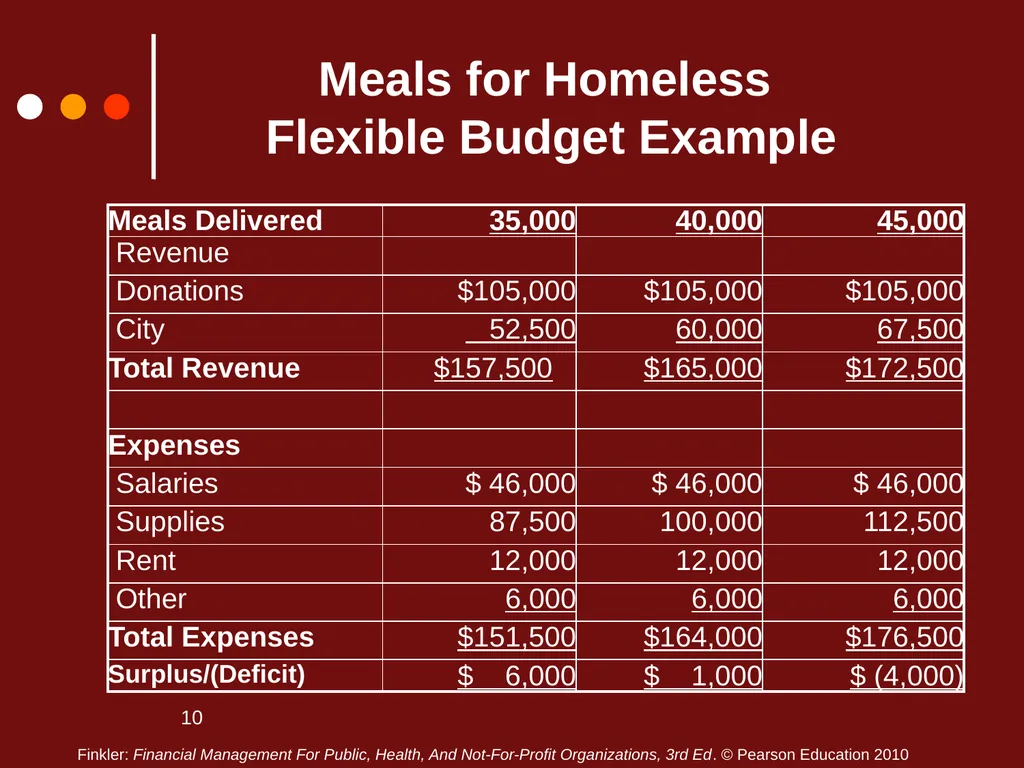
slide10. 10 Meals for Homeless
Flexible Budget Example Finkler: Financial Management For Public, Health, And Not-For-Profit Organizations, 3rd Ed. © Pearson Education 2010<br>
slide11. 11 Supplemental Notes The remaining pages in this set of notes are supplemental notes. These notes highlight areas in the text that are important, but are either descriptive rather than analytical, or relatively basic.
If time permits, these slides will be covered in class. However, if there is not enough time, you should read these slides and the book on your own.
You may ask questions about these notes during office hours. Finkler: Financial Management For Public, Health, And Not-For-Profit Organizations, 3rd Ed. © Pearson Education 2010<br>
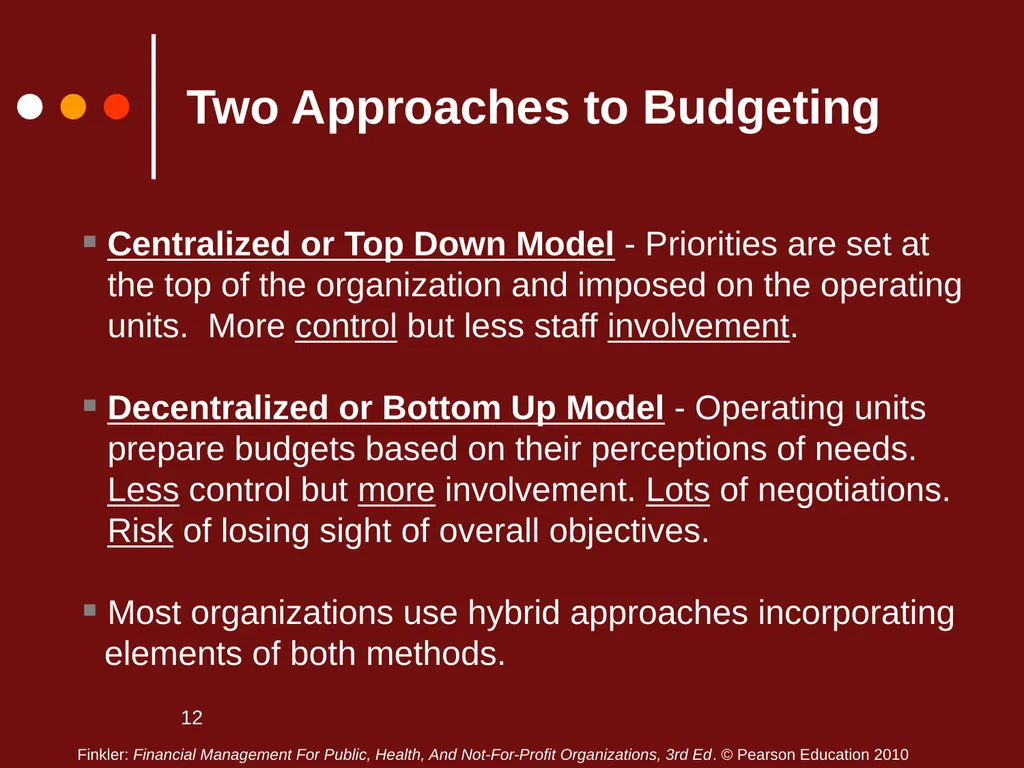
slide12. 12 Two Approaches to Budgeting Centralized or Top Down Model - Priorities are set at the top of the organization and imposed on the operating units. More control but less staff involvement.
Decentralized or Bottom Up Model - Operating units prepare budgets based on their perceptions of needs. Less control but more involvement. Lots of negotiations. Risk of losing sight of overall objectives.
Most organizations use hybrid approaches incorporating
elements of both methods. Finkler: Financial Management For Public, Health, And Not-For-Profit Organizations, 3rd Ed. © Pearson Education 2010<br>
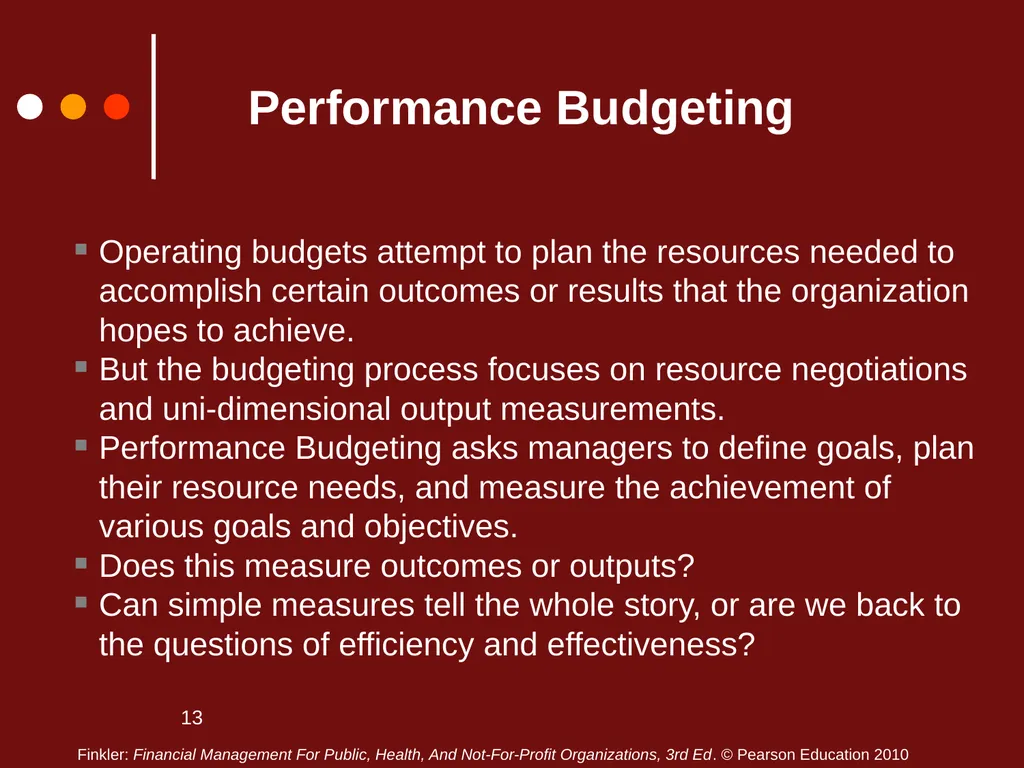
slide13. 13 Performance Budgeting Operating budgets attempt to plan the resources needed to
accomplish certain outcomes or results that the organization
hopes to achieve.
But the budgeting process focuses on resource negotiations and uni-dimensional output measurements.
Performance Budgeting asks managers to define goals, plan
their resource needs, and measure the achievement of
various goals and objectives.
Does this measure outcomes or outputs?
Can simple measures tell the whole story, or are we back to
the questions of efficiency and effectiveness? Finkler: Financial Management For Public, Health, And Not-For-Profit Organizations, 3rd Ed. © Pearson Education 2010<br>
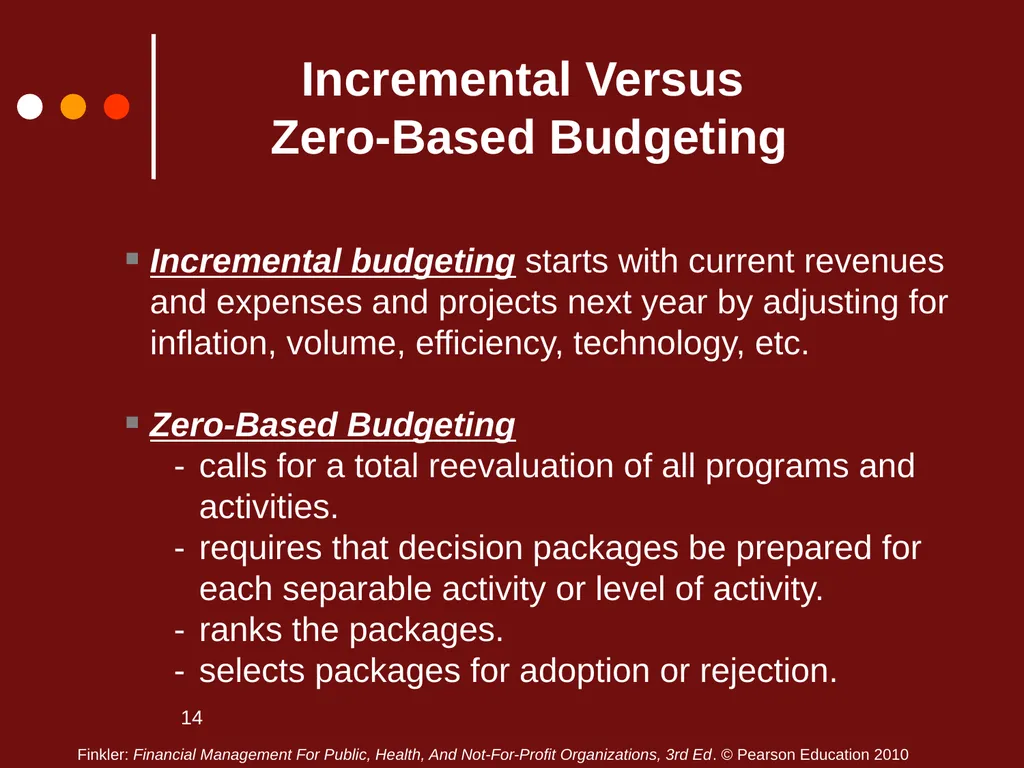
slide14. 14 Incremental Versus
Zero-Based Budgeting Incremental budgeting starts with current revenues and expenses and projects next year by adjusting for inflation, volume, efficiency, technology, etc.
Zero-Based Budgeting
- calls for a total reevaluation of all programs and activities.
- requires that decision packages be prepared for each separable activity or level of activity.
- ranks the packages.
- selects packages for adoption or rejection. Finkler: Financial Management For Public, Health, And Not-For-Profit Organizations, 3rd Ed. © Pearson Education 2010<br>
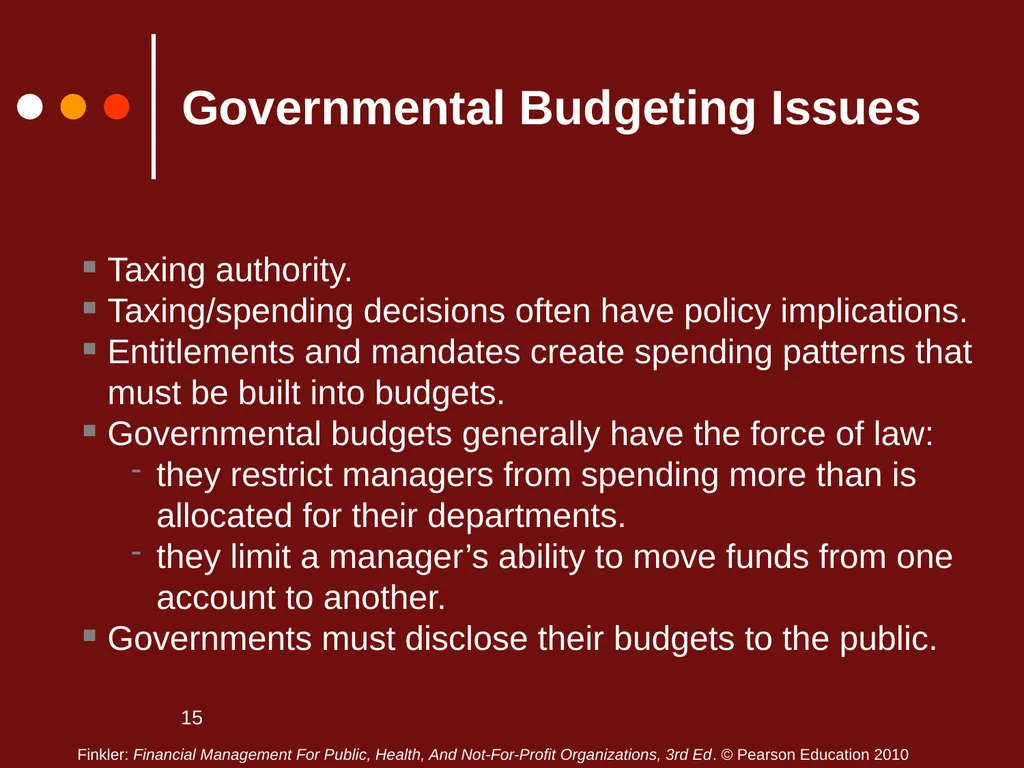
slide15. 15 Governmental Budgeting Issues Taxing authority.
Taxing/spending decisions often have policy implications.
Entitlements and mandates create spending patterns that
must be built into budgets.
Governmental budgets generally have the force of law:
they restrict managers from spending more than is
allocated for their departments.
they limit a manager’s ability to move funds from one
account to another.
Governments must disclose their budgets to the public. Finkler: Financial Management For Public, Health, And Not-For-Profit Organizations, 3rd Ed. © Pearson Education 2010<br>
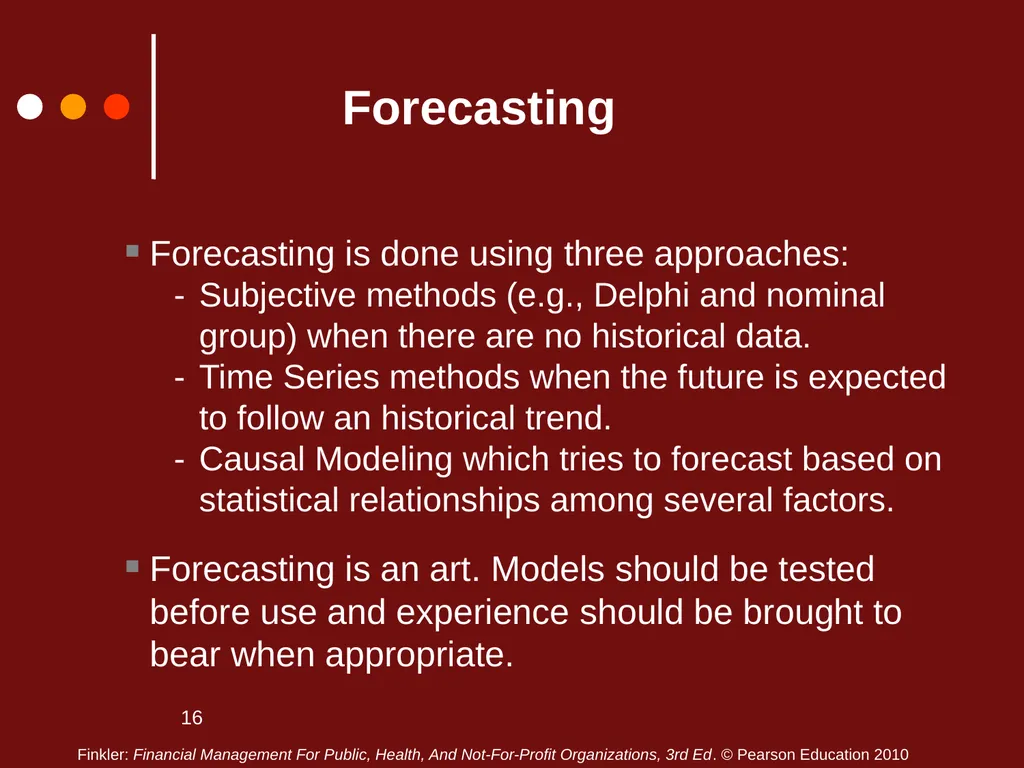
slide16. 16 Forecasting Forecasting is done using three approaches:
- Subjective methods (e.g., Delphi and nominal group) when there are no historical data.
- Time Series methods when the future is expected to follow an historical trend.
- Causal Modeling which tries to forecast based on statistical relationships among several factors.
Forecasting is an art. Models should be tested before use and experience should be brought to bear when appropriate. Finkler: Financial Management For Public, Health, And Not-For-Profit Organizations, 3rd Ed. © Pearson Education 2010<br>
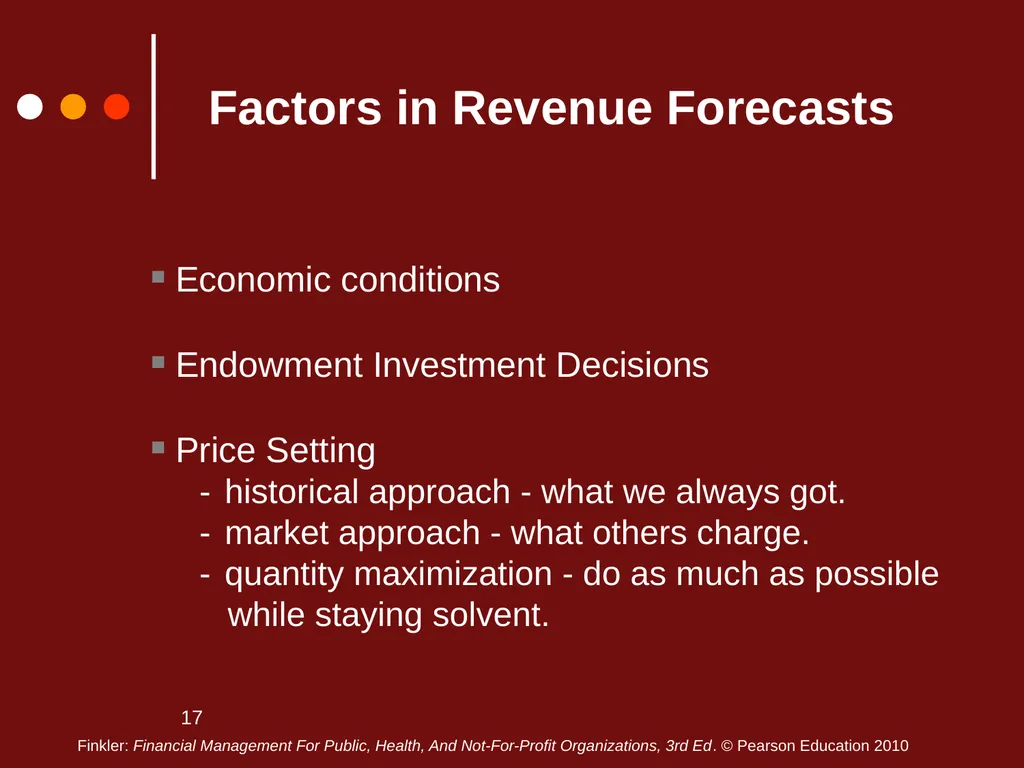
slide17. 17 Factors in Revenue Forecasts Economic conditions
Endowment Investment Decisions
Price Setting
- historical approach - what we always got.
- market approach - what others charge.
- quantity maximization - do as much as possible
while staying solvent. Finkler: Financial Management For Public, Health, And Not-For-Profit Organizations, 3rd Ed. © Pearson Education 2010<br>
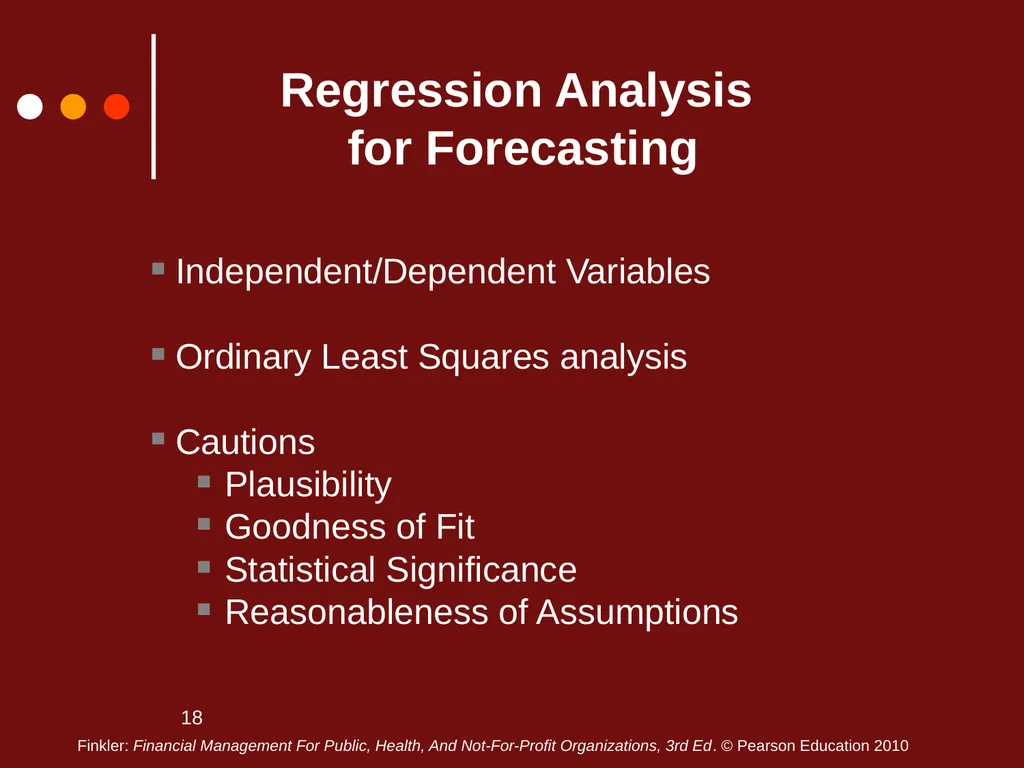
slide18. 18 Regression Analysis
for Forecasting Independent/Dependent Variables
Ordinary Least Squares analysis
Cautions
Plausibility
Goodness of Fit
Statistical Significance
Reasonableness of Assumptions Finkler: Financial Management For Public, Health, And Not-For-Profit Organizations, 3rd Ed. © Pearson Education 2010<br>
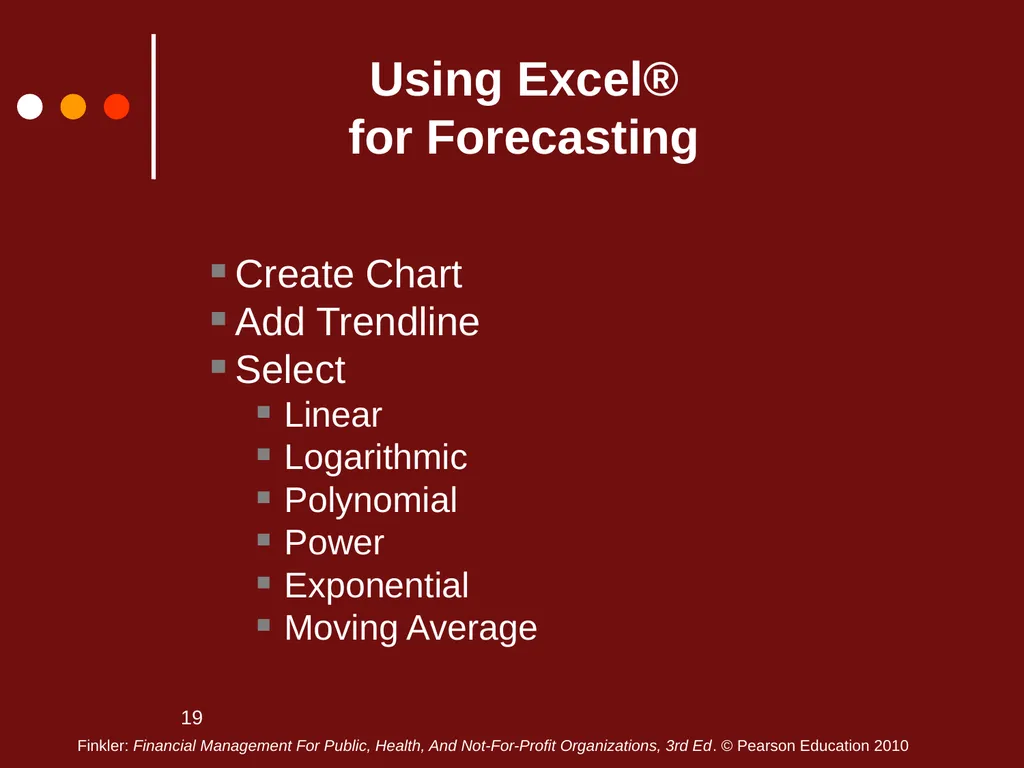
slide19. 19 Using Excel®
for Forecasting Create Chart
Add Trendline
Select
Linear
Logarithmic
Polynomial
Power
Exponential
Moving Average Finkler: Financial Management For Public, Health, And Not-For-Profit Organizations, 3rd Ed. © Pearson Education 2010<br>
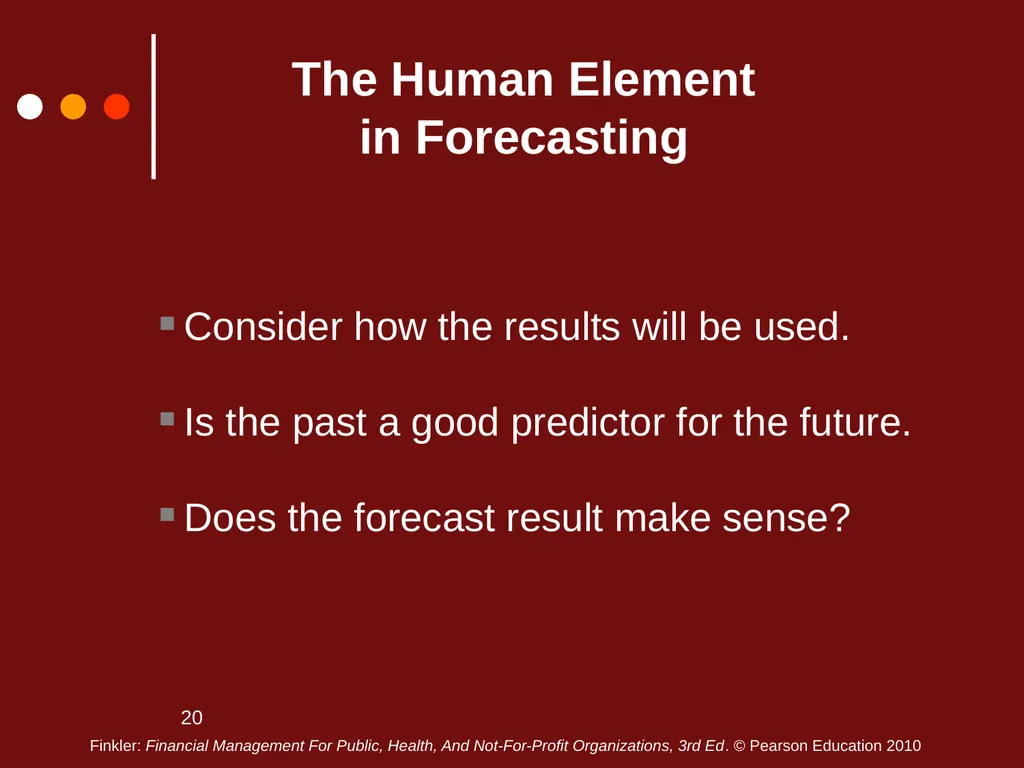
slide20. 20 The Human Element
in Forecasting Consider how the results will be used.
Is the past a good predictor for the future.
Does the forecast result make sense? Finkler: Financial Management For Public, Health, And Not-For-Profit Organizations, 3rd Ed. © Pearson Education 2010<br>
Lecture Notes Additional Budgeting Concepts Finkler: Financial Management For Public, Health, And Not-For-Profit Organizations, 3rd Ed. © Pearson Education 2010<br>
slide2. 2 Budgeting Formats Line item or object of expense - e.g., salaries, benefits, supplies, rent, etc.
Responsibility Center - units for which individual managers are held accountable, e.g., custodial services, maintenance, public relations, development, ticket sales, etc.
Program Budgets include both revenues and expenses - ballet, opera, philharmonic, etc.
Generally, both Responsibility Center and Program budgets are supported by line item detail. Finkler: Financial Management For Public, Health, And Not-For-Profit Organizations, 3rd Ed. © Pearson Education 2010<br>
slide3. 3 Line Item Operating Budget Revenue
Net patient revenue
Gift shop revenue
Investment revenue
on endowment
Total revenue
Expenses
Salaries
Supplies
Bad debts
Interest
Rent
Total expenses
Profit/(loss) $ 97,980,000
120,000
50,000
$ 98,150,000
$ 78,900,000 15,400,000
2,200,000
400,000
3,100,000
$100,000,000
$ (1,850,000) Finkler: Financial Management For Public, Health, And Not-For-Profit Organizations, 3rd Ed. © Pearson Education 2010<br>
slide4. 4 Responsibility Center
Expense Budget Finkler: Financial Management For Public, Health, And Not-For-Profit Organizations, 3rd Ed. © Pearson Education 2010<br>
slide5. 5 Program Budgets Program budgets include both revenue and expenses for the major activities of an organization. Helps managers focus on sources of profits and losses of programs that could be expanded or discontinued. Finkler: Financial Management For Public, Health, And Not-For-Profit Organizations, 3rd Ed. © Pearson Education 2010<br>
slide6. 6 Functional Budgets Functional Budgets focus on the major functions
performed by an organization. This format is often
used to report to outsiders. Note the line item detail. Finkler: Financial Management For Public, Health, And Not-For-Profit Organizations, 3rd Ed. © Pearson Education 2010<br>
slide7. 7 Organizations often experience more or less volume than budgeted.
Flexible budgets look at expected revenues, expenses, and net income under different volume assumptions.
The key to flexible budgeting is the identification of:
Fixed Costs - which do not change with volume.
Variable Costs - which do change with volume.
Flexible budget results are normally shown in a side-by-side columnar format.
A flexible budget is a form of "What if?" analysis. Flexible Budget Finkler: Financial Management For Public, Health, And Not-For-Profit Organizations, 3rd Ed. © Pearson Education 2010<br>
slide8. 8 Flexible Budget Example
Charity Church sponsors a three-day youth camp in Bear
Mountain Park. Charity provides a $500 grant for the event and collects $130 from each camper. The camp director expects
40 campers to attend and anticipates the following expenses:
Campground fees $350 for 3 days
Bus transportation $1,225 (60 rider capacity)
Equipment rental $40 per camper
Meals $65 per camper
Provide a flexible budget assuming a 10% increase in the
number of campers. Finkler: Financial Management For Public, Health, And Not-For-Profit Organizations, 3rd Ed. © Pearson Education 2010<br>
slide9. 9 Budget 10% Increase
Revenue 40 campers 44 campers
Camp tuition $5,200 $5,720
Church subsidy 500 500
Total revenue $5,700 $6,220
Less expenses
Campground rental $ 350 $ 350
Bus transportation 1,225 1,225
Equipment rental 1,600 1,760
Meals 2,600 2,860
Total expenses $ 5,775 $ 6,195
Surplus/loss $ (75) $ 25 Finkler: Financial Management For Public, Health, And Not-For-Profit Organizations, 3rd Ed. © Pearson Education 2010<br>
slide10. 10 Meals for Homeless
Flexible Budget Example Finkler: Financial Management For Public, Health, And Not-For-Profit Organizations, 3rd Ed. © Pearson Education 2010<br>
slide11. 11 Supplemental Notes The remaining pages in this set of notes are supplemental notes. These notes highlight areas in the text that are important, but are either descriptive rather than analytical, or relatively basic.
If time permits, these slides will be covered in class. However, if there is not enough time, you should read these slides and the book on your own.
You may ask questions about these notes during office hours. Finkler: Financial Management For Public, Health, And Not-For-Profit Organizations, 3rd Ed. © Pearson Education 2010<br>
slide12. 12 Two Approaches to Budgeting Centralized or Top Down Model - Priorities are set at the top of the organization and imposed on the operating units. More control but less staff involvement.
Decentralized or Bottom Up Model - Operating units prepare budgets based on their perceptions of needs. Less control but more involvement. Lots of negotiations. Risk of losing sight of overall objectives.
Most organizations use hybrid approaches incorporating
elements of both methods. Finkler: Financial Management For Public, Health, And Not-For-Profit Organizations, 3rd Ed. © Pearson Education 2010<br>
slide13. 13 Performance Budgeting Operating budgets attempt to plan the resources needed to
accomplish certain outcomes or results that the organization
hopes to achieve.
But the budgeting process focuses on resource negotiations and uni-dimensional output measurements.
Performance Budgeting asks managers to define goals, plan
their resource needs, and measure the achievement of
various goals and objectives.
Does this measure outcomes or outputs?
Can simple measures tell the whole story, or are we back to
the questions of efficiency and effectiveness? Finkler: Financial Management For Public, Health, And Not-For-Profit Organizations, 3rd Ed. © Pearson Education 2010<br>
slide14. 14 Incremental Versus
Zero-Based Budgeting Incremental budgeting starts with current revenues and expenses and projects next year by adjusting for inflation, volume, efficiency, technology, etc.
Zero-Based Budgeting
- calls for a total reevaluation of all programs and activities.
- requires that decision packages be prepared for each separable activity or level of activity.
- ranks the packages.
- selects packages for adoption or rejection. Finkler: Financial Management For Public, Health, And Not-For-Profit Organizations, 3rd Ed. © Pearson Education 2010<br>
slide15. 15 Governmental Budgeting Issues Taxing authority.
Taxing/spending decisions often have policy implications.
Entitlements and mandates create spending patterns that
must be built into budgets.
Governmental budgets generally have the force of law:
they restrict managers from spending more than is
allocated for their departments.
they limit a manager’s ability to move funds from one
account to another.
Governments must disclose their budgets to the public. Finkler: Financial Management For Public, Health, And Not-For-Profit Organizations, 3rd Ed. © Pearson Education 2010<br>
slide16. 16 Forecasting Forecasting is done using three approaches:
- Subjective methods (e.g., Delphi and nominal group) when there are no historical data.
- Time Series methods when the future is expected to follow an historical trend.
- Causal Modeling which tries to forecast based on statistical relationships among several factors.
Forecasting is an art. Models should be tested before use and experience should be brought to bear when appropriate. Finkler: Financial Management For Public, Health, And Not-For-Profit Organizations, 3rd Ed. © Pearson Education 2010<br>
slide17. 17 Factors in Revenue Forecasts Economic conditions
Endowment Investment Decisions
Price Setting
- historical approach - what we always got.
- market approach - what others charge.
- quantity maximization - do as much as possible
while staying solvent. Finkler: Financial Management For Public, Health, And Not-For-Profit Organizations, 3rd Ed. © Pearson Education 2010<br>
slide18. 18 Regression Analysis
for Forecasting Independent/Dependent Variables
Ordinary Least Squares analysis
Cautions
Plausibility
Goodness of Fit
Statistical Significance
Reasonableness of Assumptions Finkler: Financial Management For Public, Health, And Not-For-Profit Organizations, 3rd Ed. © Pearson Education 2010<br>
slide19. 19 Using Excel®
for Forecasting Create Chart
Add Trendline
Select
Linear
Logarithmic
Polynomial
Power
Exponential
Moving Average Finkler: Financial Management For Public, Health, And Not-For-Profit Organizations, 3rd Ed. © Pearson Education 2010<br>
slide20. 20 The Human Element
in Forecasting Consider how the results will be used.
Is the past a good predictor for the future.
Does the forecast result make sense? Finkler: Financial Management For Public, Health, And Not-For-Profit Organizations, 3rd Ed. © Pearson Education 2010<br>