
1 CONTENTS STRATEGIC OVERVIEW PERFORMANCE OVERVIEW
MJ
Published · 45 slides · 0 views

1 / 1

Description
1 CONTENTS STRATEGIC OVERVIEW PERFORMANCE OVERVIEW FINANCIAL OVERVIEW AUDIT OVERVIEW CONCLUSION 2 STRATEGIC OVERVIEW Executive Summary Strategic Transformation Initiatives Strategic Outcome Orientated Goals 3 20152016 financial year
Related Topics
Share
Embed code
Download this presentation From Below
"1 CONTENTS STRATEGIC OVERVIEW PERFORMANCE OVERVIEW" is the property of its rightful owner. Permission is granted to download and print the materials on this website for personal, non-commercial use only, and to display it on your personal computer provided you do not modify the materials and that you retain all copyright notices contained in the materials. By downloading content from our website, you accept the terms of this agreement.
Presentation Transcript
01
1<br>
02
CONTENTS
STRATEGIC OVERVIEW
PERFORMANCE OVERVIEW
FINANCIAL OVERVIEW
AUDIT OVERVIEW
CONCLUSION 2<br>
STRATEGIC OVERVIEW
PERFORMANCE OVERVIEW
FINANCIAL OVERVIEW
AUDIT OVERVIEW
CONCLUSION 2<br>
03
STRATEGIC OVERVIEW Executive Summary
Strategic Transformation Initiatives
Strategic Outcome Orientated Goals 3<br>
Strategic Transformation Initiatives
Strategic Outcome Orientated Goals 3<br>
04
2015/2016 financial year represented a special and positive turning point in the history and future of SITA.
SITA created programmes that laid the foundation for better insight into the operational environments in finance, supply chain and certain technical operations, enabling management to implement certain improvements.
SITA launched a campaign that provided an attractive and cost effective incentive for its customers to upgrade their bandwidth. As at the end of the financial year, 504 proposals were sent to clients, of which 252 have been accepted.
The organisation assisted the Western Cape Government with their requirement to provide a high-speed broadband telecommunications network and provide connectivity for the transmission of data, voice and video. 1,090 Layer 2 sites and 1,001 Layer 3 sites were activated.
SITA has successfully connected the eight (8) banking sites making it easier for the public to attain the new ID cards through the Department of Home Affairs Modernisation Project. Executive Summary 4<br>
SITA created programmes that laid the foundation for better insight into the operational environments in finance, supply chain and certain technical operations, enabling management to implement certain improvements.
SITA launched a campaign that provided an attractive and cost effective incentive for its customers to upgrade their bandwidth. As at the end of the financial year, 504 proposals were sent to clients, of which 252 have been accepted.
The organisation assisted the Western Cape Government with their requirement to provide a high-speed broadband telecommunications network and provide connectivity for the transmission of data, voice and video. 1,090 Layer 2 sites and 1,001 Layer 3 sites were activated.
SITA has successfully connected the eight (8) banking sites making it easier for the public to attain the new ID cards through the Department of Home Affairs Modernisation Project. Executive Summary 4<br>
05
SITA together with the Department of Higher Education and Training(DHET) implemented robust collaborative service delivery mechanisms to significantly reduce the National Certificates backlog.
The organisation adopted a new programme that will accelerate the changes in the procurement processes through the introduction of extensive automation in almost all aspects of the supply chain of goods and services for both SITA’s internal consumption and on behalf of our customers.
SITA participated in the training and development of 210 youth. The programme emphasized women empowerment; with 60% of the learners and interns being young female candidates.
SITA achieved the EE target for Africans, where the actual performance was 72.1% against a target of 70%. Programmes to address women in leadership are being initiated.
SITA has adopted a risk management approach in the prevention, detection and investigation of suspected fraudulent activities, this approach is incorporated into the business processes, management practices, internal controls and related activities. Executive Summary 5<br>
The organisation adopted a new programme that will accelerate the changes in the procurement processes through the introduction of extensive automation in almost all aspects of the supply chain of goods and services for both SITA’s internal consumption and on behalf of our customers.
SITA participated in the training and development of 210 youth. The programme emphasized women empowerment; with 60% of the learners and interns being young female candidates.
SITA achieved the EE target for Africans, where the actual performance was 72.1% against a target of 70%. Programmes to address women in leadership are being initiated.
SITA has adopted a risk management approach in the prevention, detection and investigation of suspected fraudulent activities, this approach is incorporated into the business processes, management practices, internal controls and related activities. Executive Summary 5<br>
06
Goal 1: To provide high-quality IT services to enable Government to deliver efficient and convenient services through the use of ICT.
Goal 2: To optimise the provision of SITA’s IT infrastructure services in order increase availability, flexibility, scalability, predictability and security
Goal 3: To address all issues relating to delayed procurement turnaround times, removing customer pain points, and transforming the procurement function
Goal 4: To ensure an effective and efficient financial management and ensure financial growth and sustainability.
Goal 5: To build and maintain organisational capability to enable SITA to achieve its strategic imperatives and becomes an employer of choice within the ICT industry.
Goal 6: To provide leadership, strategic management, governance, risk and resource management in line with government-accepted norms and standards. The organisation has defined six strategic
outcome orientated goals to be achieved within the medium term strategic cycle 6<br>
Goal 2: To optimise the provision of SITA’s IT infrastructure services in order increase availability, flexibility, scalability, predictability and security
Goal 3: To address all issues relating to delayed procurement turnaround times, removing customer pain points, and transforming the procurement function
Goal 4: To ensure an effective and efficient financial management and ensure financial growth and sustainability.
Goal 5: To build and maintain organisational capability to enable SITA to achieve its strategic imperatives and becomes an employer of choice within the ICT industry.
Goal 6: To provide leadership, strategic management, governance, risk and resource management in line with government-accepted norms and standards. The organisation has defined six strategic
outcome orientated goals to be achieved within the medium term strategic cycle 6<br>
07
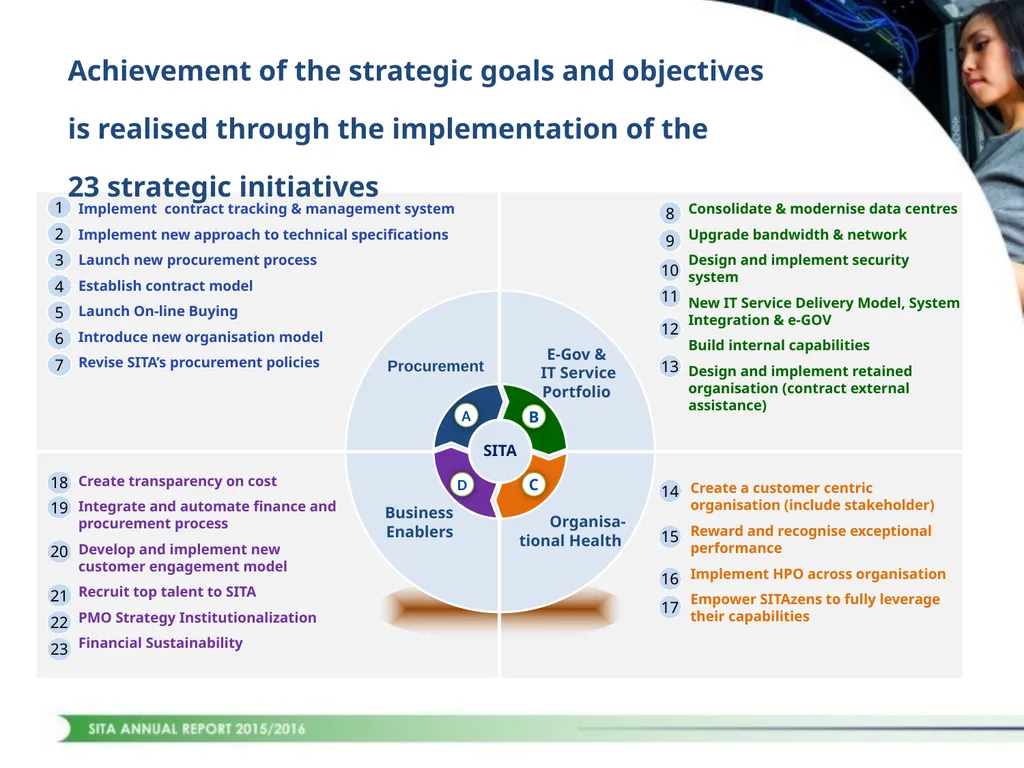
Achievement of the strategic goals and objectives
is realised through the implementation of the
23 strategic initiatives 7<br>
is realised through the implementation of the
23 strategic initiatives 7<br>
08
PERFORMANCE OVERVIEW Service Delivery Environment
Organisation Environment
Annual Performance Results
Strategies to Overcome Areas of Non-Performance 8<br>
Organisation Environment
Annual Performance Results
Strategies to Overcome Areas of Non-Performance 8<br>
09
The e-Government programme has taken momentum with delivery through various streams, twenty four (24) e-services were developed by the end of the financial year.
SITA has developed an application architecture definition which is used for the development of all transversal e-services in alignment with the Government MTSF outcomes.
SITA is leading the Western cape Government broadband connectivity and has connected fifteen (15) additional sites to the targets at layer three (3).
SITA has deployed the Health System for the South African Military Health Service(SAMHS) which provides an offline capability for officials of the Department of Defence (DoD) involved in South African National Defence Force (SANDF) military missions to manage the clinical and health data.
The procurement environment has been re-engineered with policies, processes and procedures to ensure quicker turnaround times; reduction of backlogs and provision of qualitative bid information to enable decision making.
A new SMME strategy has been adopted, this promotes the growth of ICT industry from a BEE and provincial perspective to have more dynamism in the local ICT sector. The service delivery environment has been
stabilised and revitilised to improve performance 9<br>
SITA has developed an application architecture definition which is used for the development of all transversal e-services in alignment with the Government MTSF outcomes.
SITA is leading the Western cape Government broadband connectivity and has connected fifteen (15) additional sites to the targets at layer three (3).
SITA has deployed the Health System for the South African Military Health Service(SAMHS) which provides an offline capability for officials of the Department of Defence (DoD) involved in South African National Defence Force (SANDF) military missions to manage the clinical and health data.
The procurement environment has been re-engineered with policies, processes and procedures to ensure quicker turnaround times; reduction of backlogs and provision of qualitative bid information to enable decision making.
A new SMME strategy has been adopted, this promotes the growth of ICT industry from a BEE and provincial perspective to have more dynamism in the local ICT sector. The service delivery environment has been
stabilised and revitilised to improve performance 9<br>
10
The internal organisational environment has
been optimised to generate value and
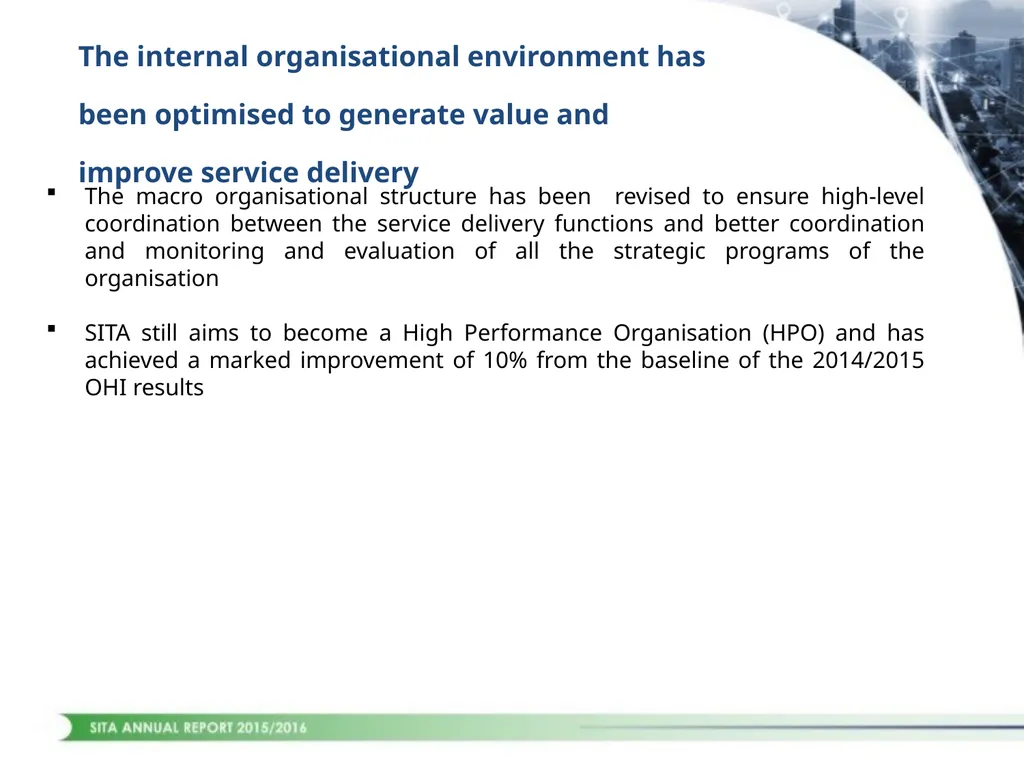
improve service delivery The macro organisational structure has been revised to ensure high-level coordination between the service delivery functions and better coordination and monitoring and evaluation of all the strategic programs of the organisation
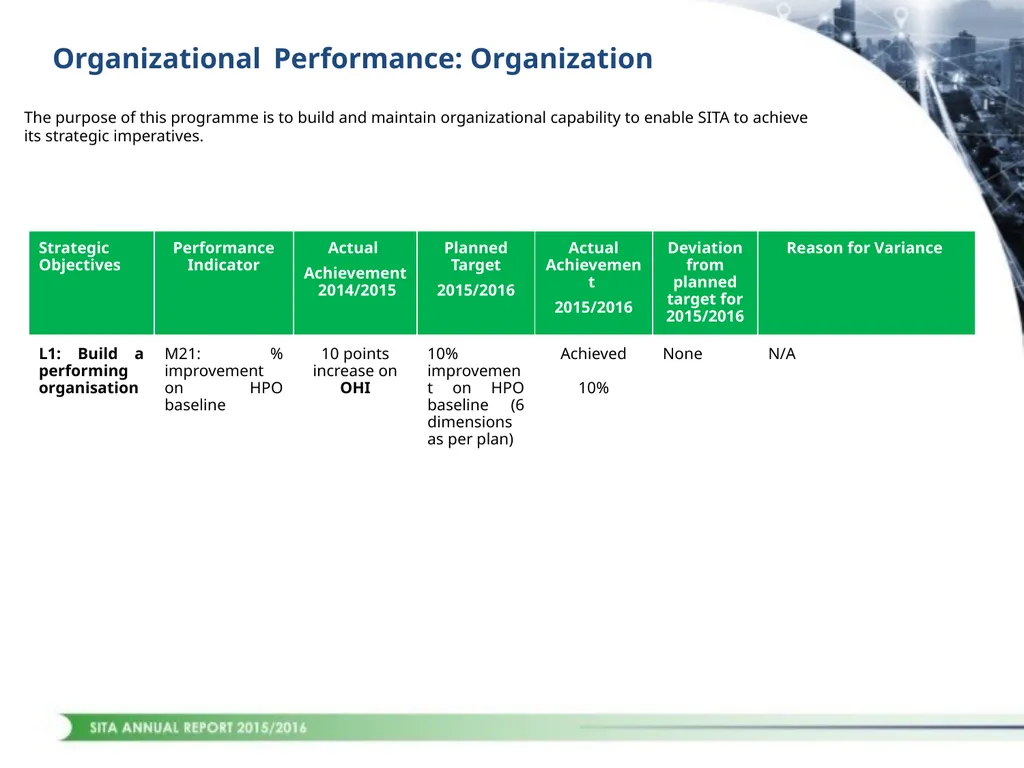
SITA still aims to become a High Performance Organisation (HPO) and has achieved a marked improvement of 10% from the baseline of the 2014/2015 OHI results 10<br>
been optimised to generate value and
improve service delivery The macro organisational structure has been revised to ensure high-level coordination between the service delivery functions and better coordination and monitoring and evaluation of all the strategic programs of the organisation
SITA still aims to become a High Performance Organisation (HPO) and has achieved a marked improvement of 10% from the baseline of the 2014/2015 OHI results 10<br>
11
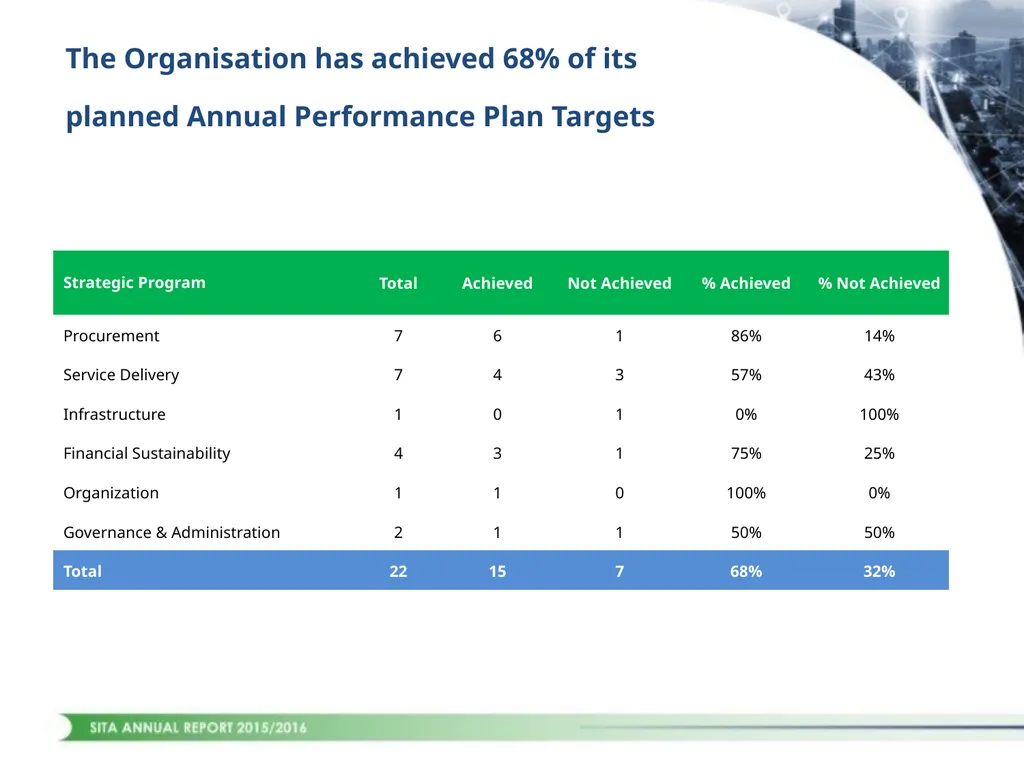
The Organisation has achieved 68% of its
planned Annual Performance Plan Targets 11<br>
planned Annual Performance Plan Targets 11<br>
12
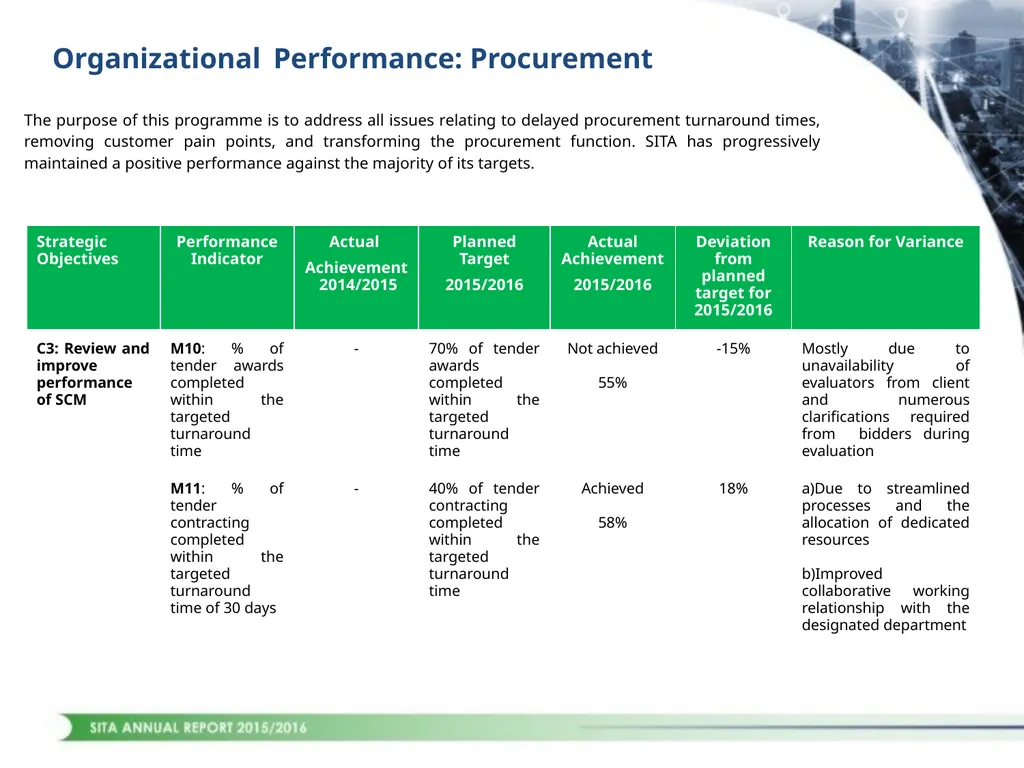
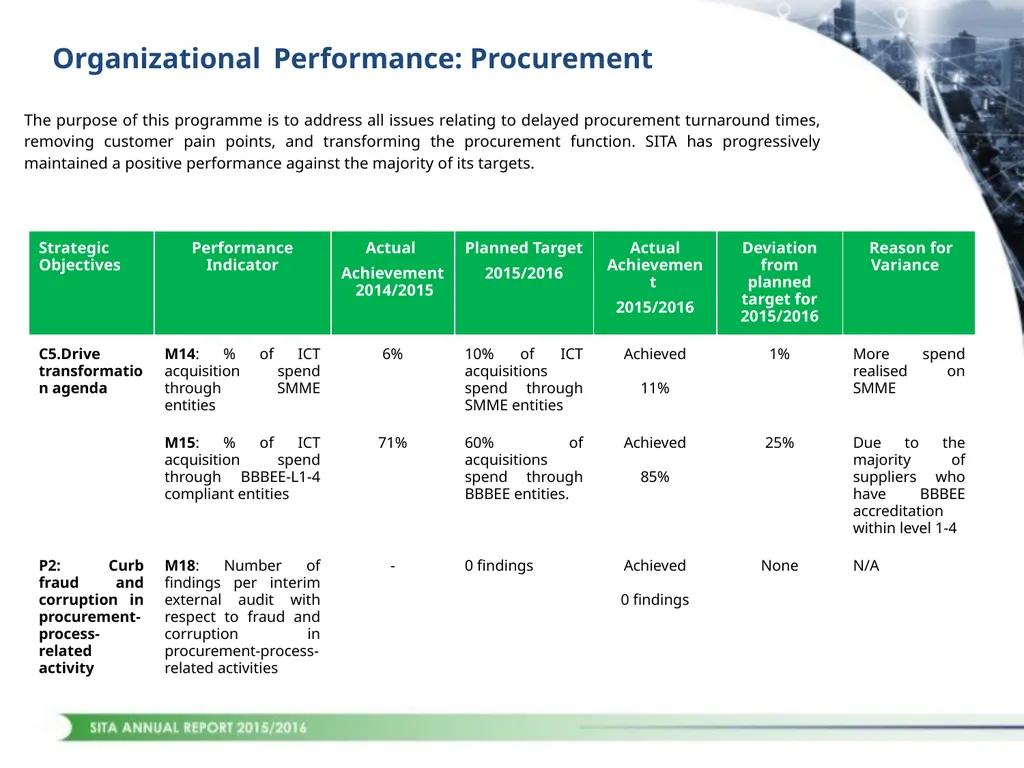
Organizational Performance: Procurement 12 The purpose of this programme is to address all issues relating to delayed procurement turnaround times, removing customer pain points, and transforming the procurement function. SITA has progressively maintained a positive performance against the majority of its targets.<br>
13
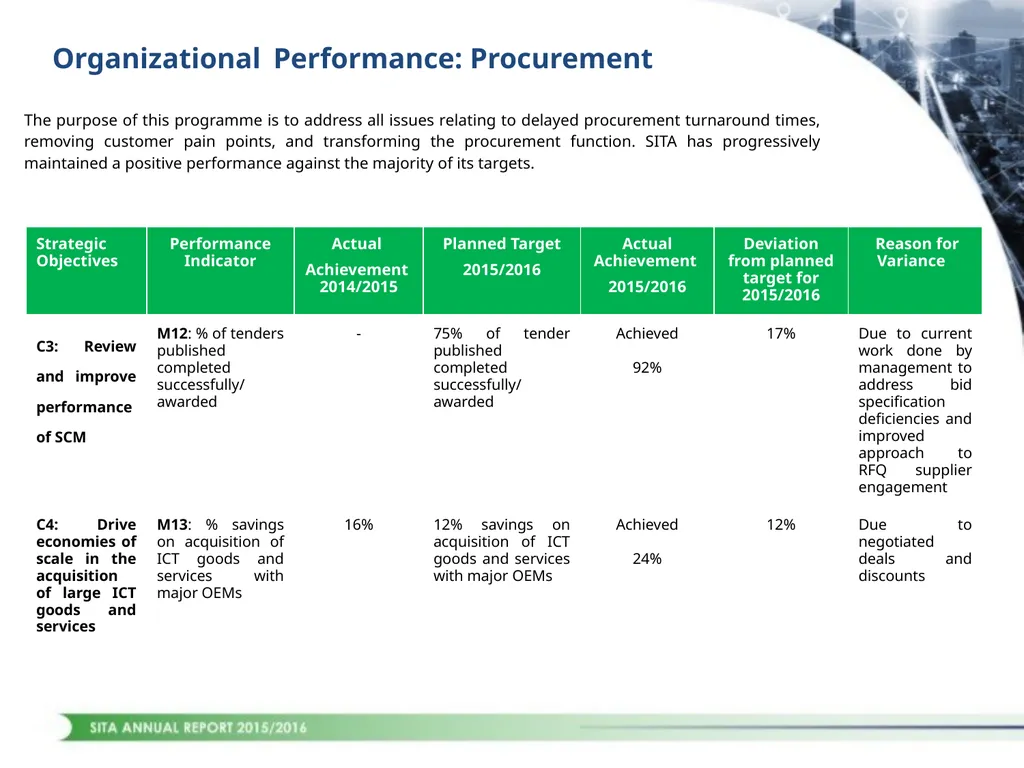
Organizational Performance: Procurement 13 The purpose of this programme is to address all issues relating to delayed procurement turnaround times, removing customer pain points, and transforming the procurement function. SITA has progressively maintained a positive performance against the majority of its targets.<br>
14
Organizational Performance: Procurement 14 The purpose of this programme is to address all issues relating to delayed procurement turnaround times, removing customer pain points, and transforming the procurement function. SITA has progressively maintained a positive performance against the majority of its targets.<br>
15
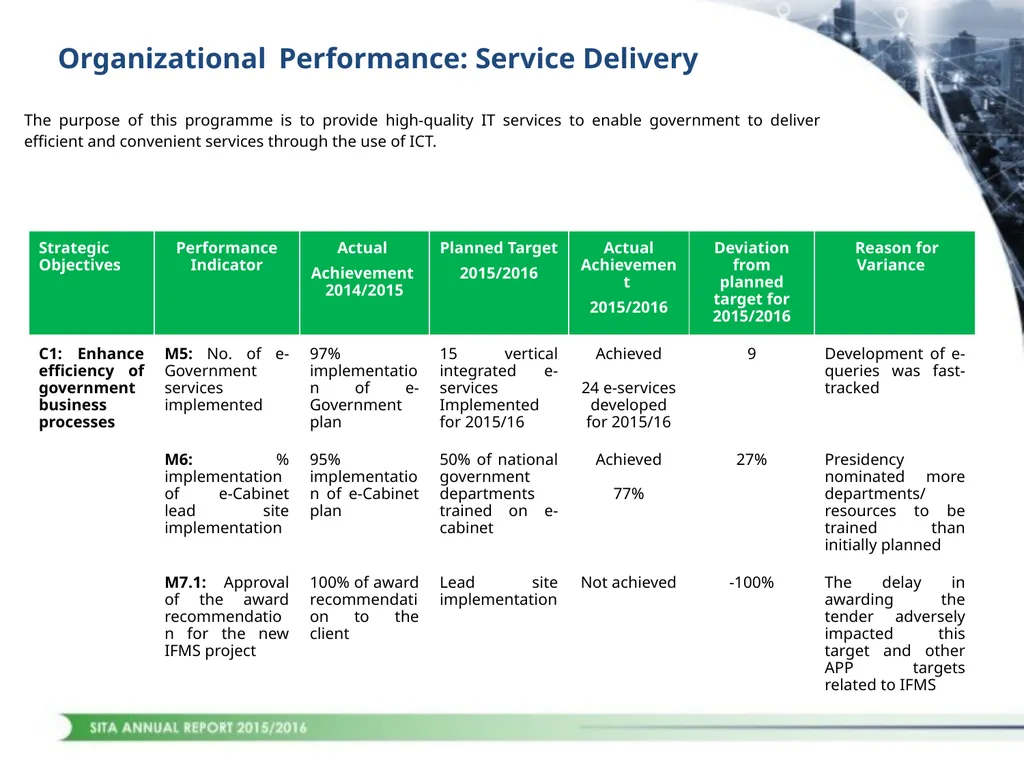
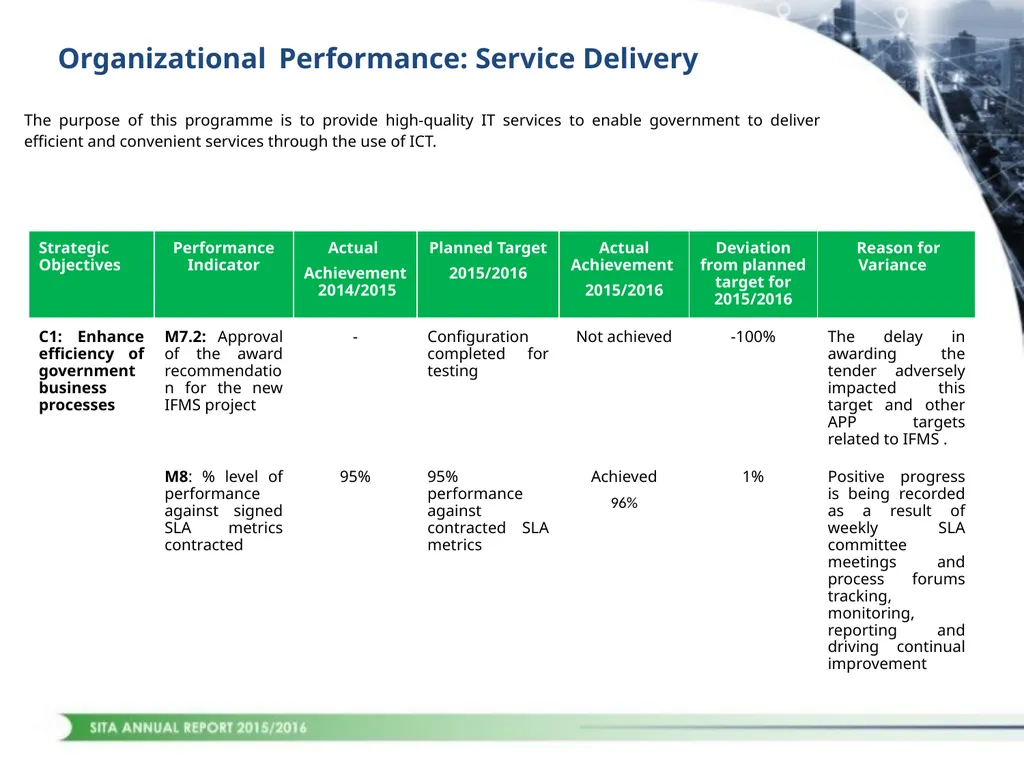
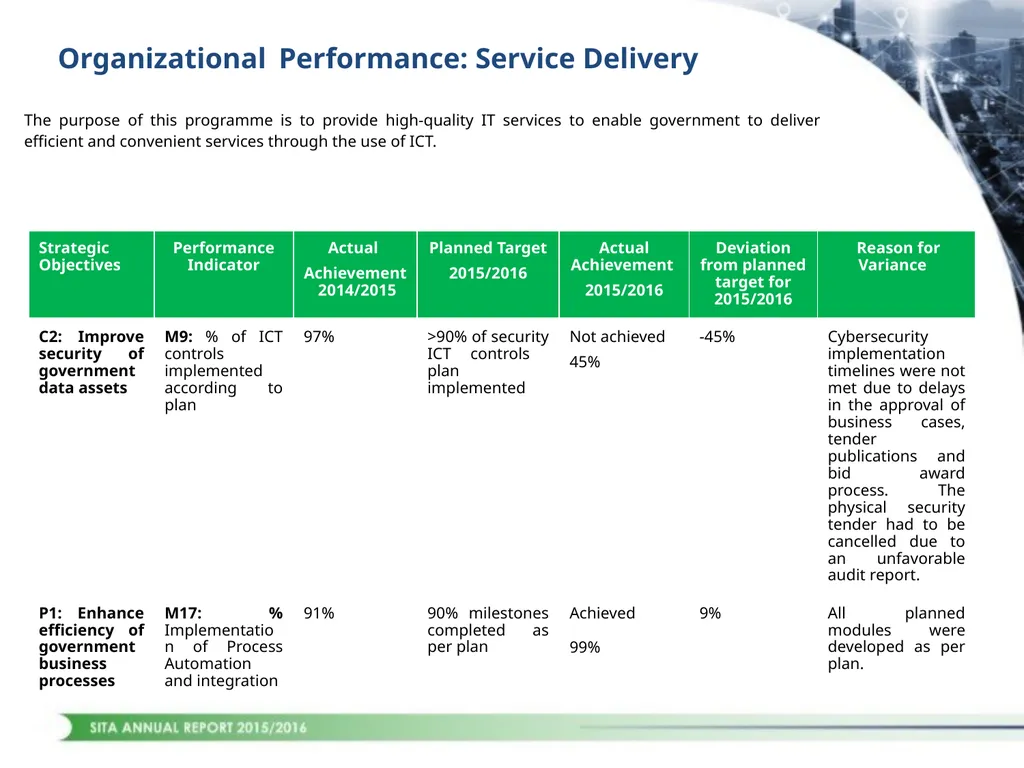
Organizational Performance: Service Delivery 15 The purpose of this programme is to provide high-quality IT services to enable government to deliver efficient and convenient services through the use of ICT.<br>
16
Organizational Performance: Service Delivery 16 The purpose of this programme is to provide high-quality IT services to enable government to deliver efficient and convenient services through the use of ICT.<br>
17
Organizational Performance: Service Delivery 17 The purpose of this programme is to provide high-quality IT services to enable government to deliver efficient and convenient services through the use of ICT.<br>
18
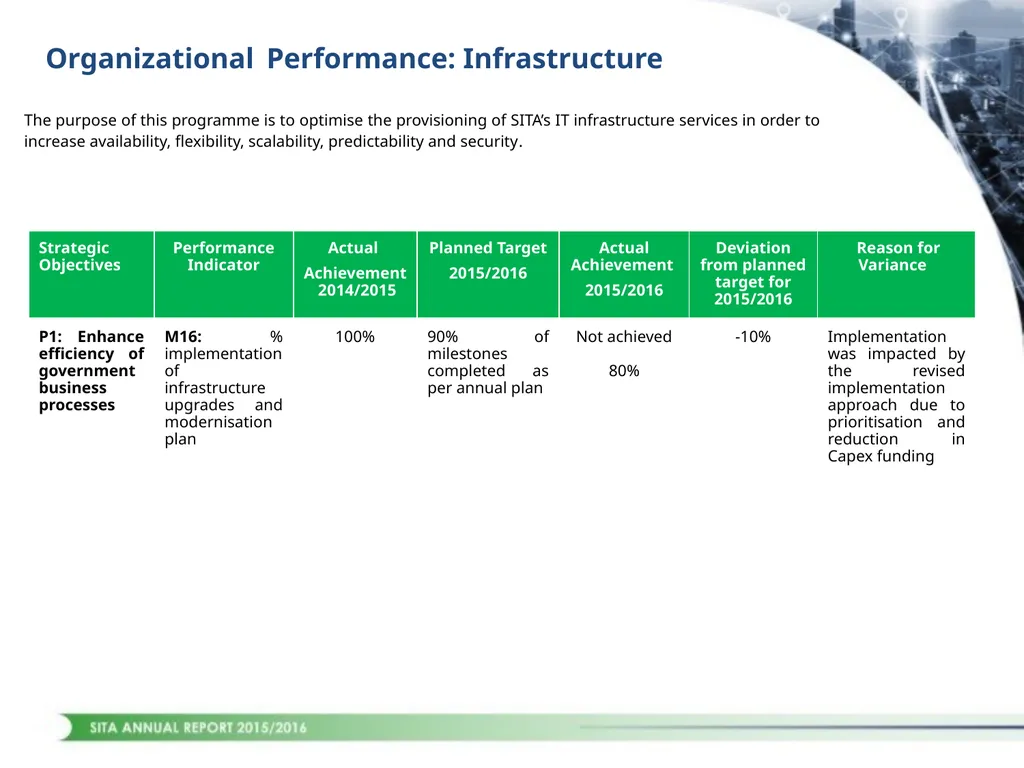
Organizational Performance: Infrastructure 18 The purpose of this programme is to optimise the provisioning of SITA’s IT infrastructure services in order to increase availability, flexibility, scalability, predictability and security.<br>
19
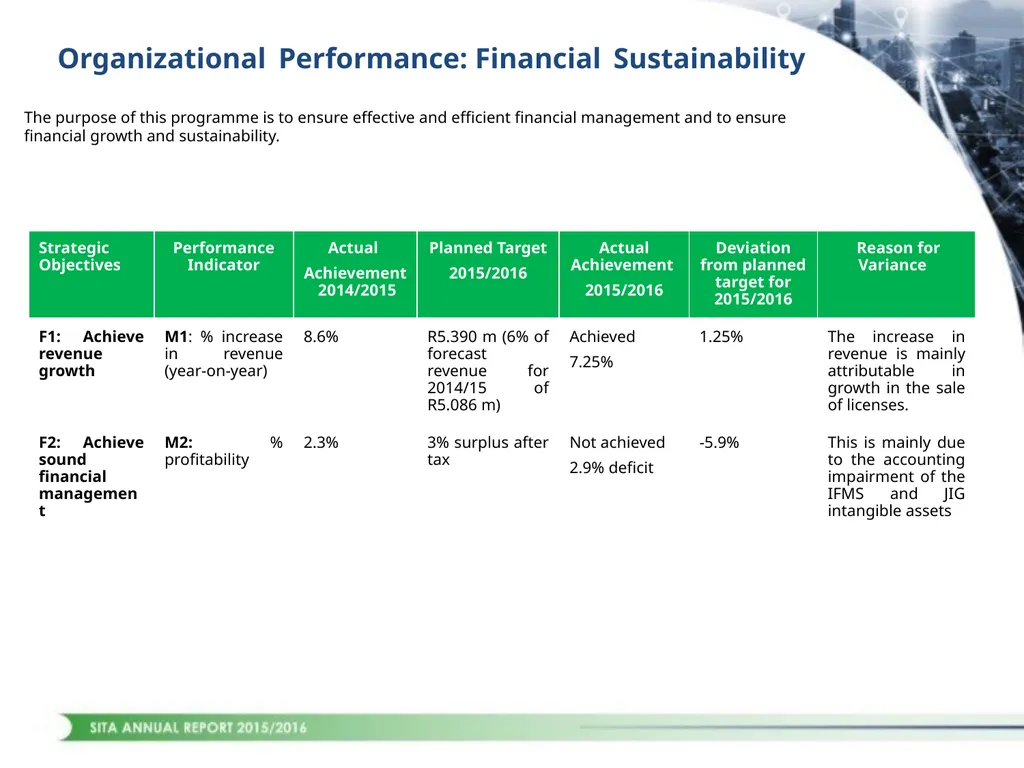
Organizational Performance: Financial Sustainability 19 The purpose of this programme is to ensure effective and efficient financial management and to ensure financial growth and sustainability.<br>
20
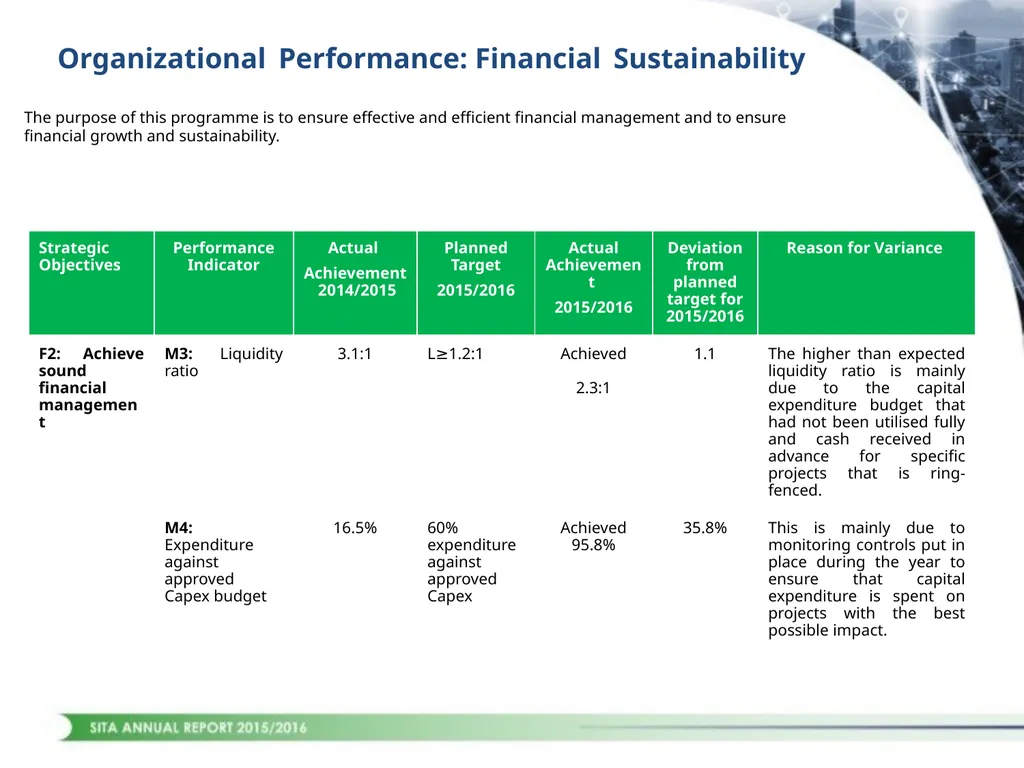
Organizational Performance: Financial Sustainability 20 The purpose of this programme is to ensure effective and efficient financial management and to ensure financial growth and sustainability.<br>
21
Organizational Performance: Organization 21 The purpose of this programme is to build and maintain organizational capability to enable SITA to achieve its strategic imperatives.<br>
22
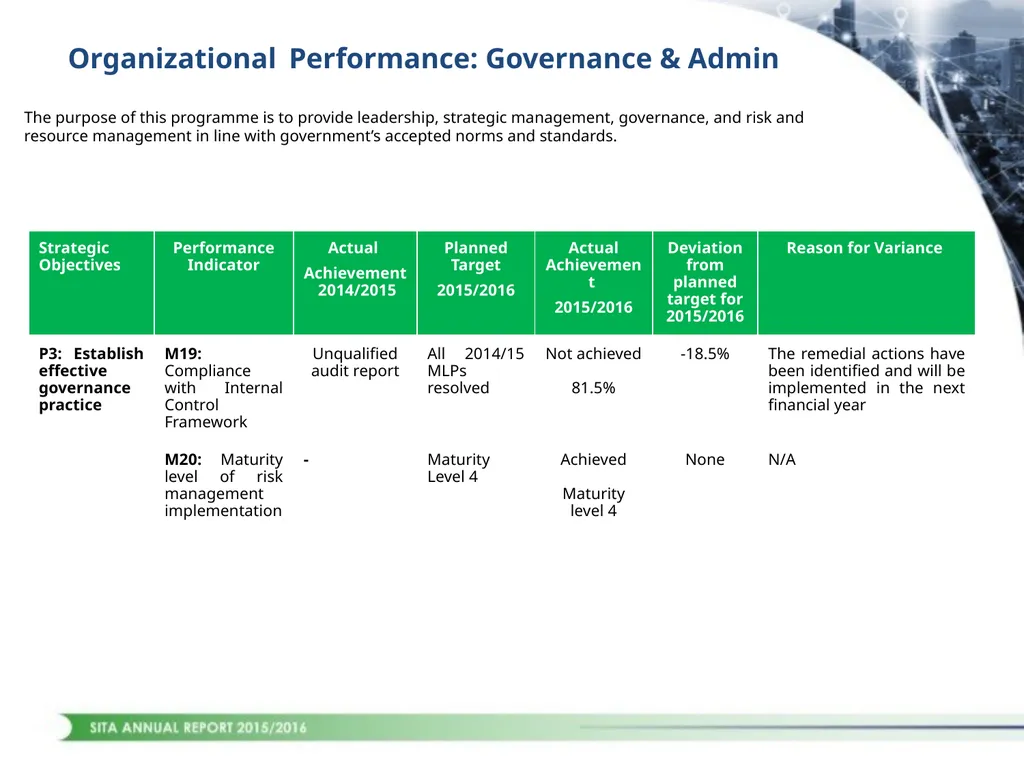
Organizational Performance: Governance & Admin 22 The purpose of this programme is to provide leadership, strategic management, governance, and risk and resource management in line with government’s accepted norms and standards.<br>
23
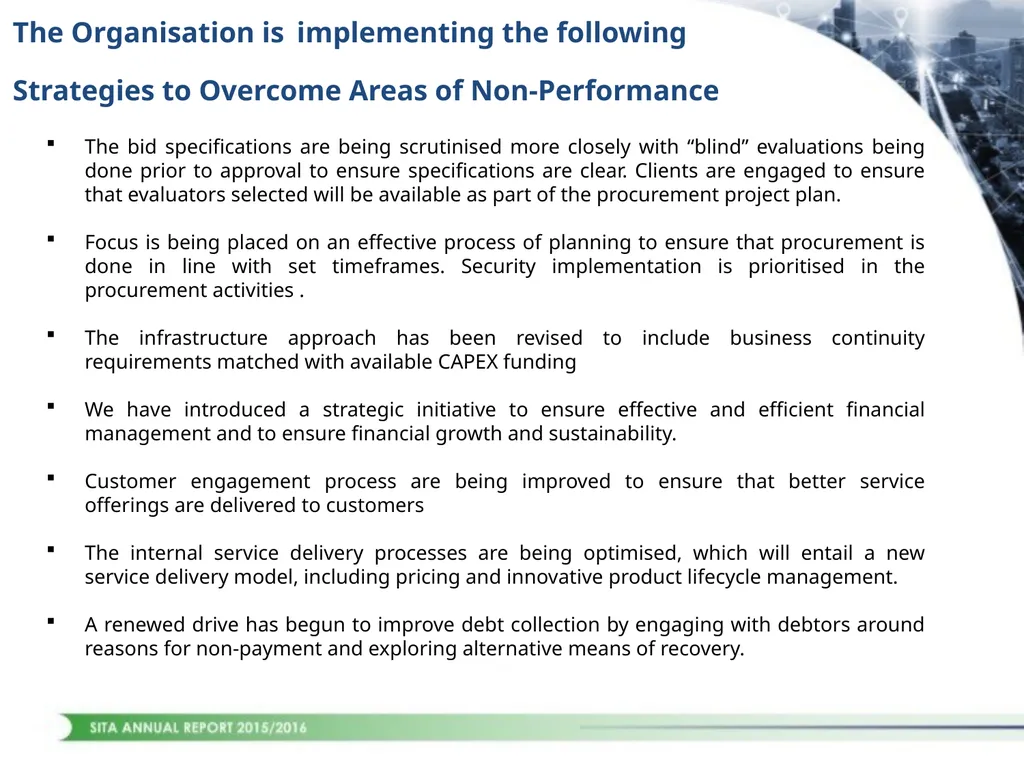
The Organisation is implementing the following Strategies to Overcome Areas of Non-Performance The bid specifications are being scrutinised more closely with “blind” evaluations being done prior to approval to ensure specifications are clear. Clients are engaged to ensure that evaluators selected will be available as part of the procurement project plan.
Focus is being placed on an effective process of planning to ensure that procurement is done in line with set timeframes. Security implementation is prioritised in the procurement activities .
The infrastructure approach has been revised to include business continuity requirements matched with available CAPEX funding
We have introduced a strategic initiative to ensure effective and efficient financial management and to ensure financial growth and sustainability.
Customer engagement process are being improved to ensure that better service offerings are delivered to customers
The internal service delivery processes are being optimised, which will entail a new service delivery model, including pricing and innovative product lifecycle management.
A renewed drive has begun to improve debt collection by engaging with debtors around reasons for non-payment and exploring alternative means of recovery. 23<br>
Focus is being placed on an effective process of planning to ensure that procurement is done in line with set timeframes. Security implementation is prioritised in the procurement activities .
The infrastructure approach has been revised to include business continuity requirements matched with available CAPEX funding
We have introduced a strategic initiative to ensure effective and efficient financial management and to ensure financial growth and sustainability.
Customer engagement process are being improved to ensure that better service offerings are delivered to customers
The internal service delivery processes are being optimised, which will entail a new service delivery model, including pricing and innovative product lifecycle management.
A renewed drive has begun to improve debt collection by engaging with debtors around reasons for non-payment and exploring alternative means of recovery. 23<br>
24
FINANCIAL OVERVIEW Overview
Statement of Financial Position
Statement of Financial Performance
Statement of Cash Flow 24<br>
Statement of Financial Position
Statement of Financial Performance
Statement of Cash Flow 24<br>
25
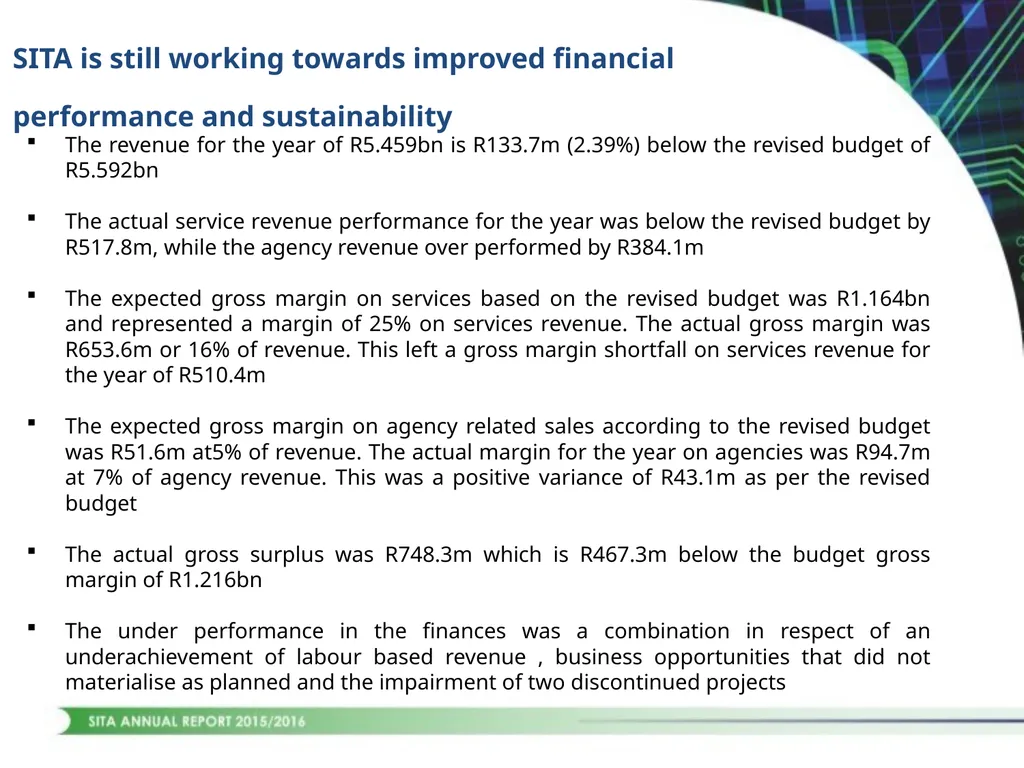
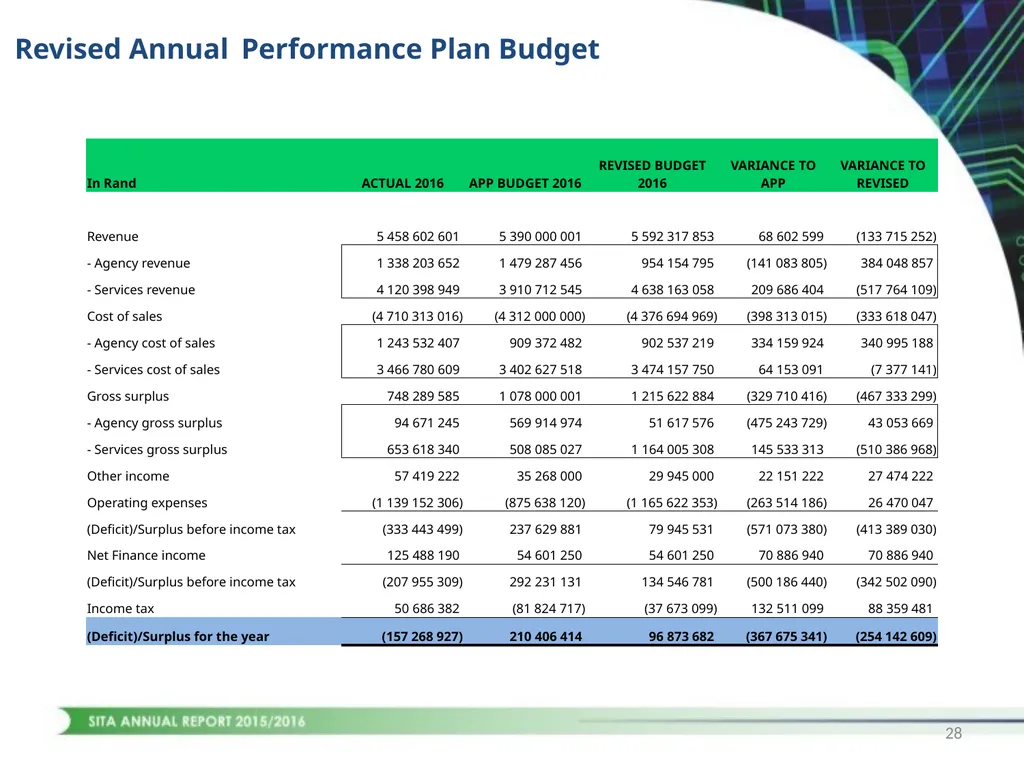
SITA is still working towards improved financial performance and sustainability The revenue for the year of R5.459bn is R133.7m (2.39%) below the revised budget of R5.592bn
The actual service revenue performance for the year was below the revised budget by R517.8m, while the agency revenue over performed by R384.1m
The expected gross margin on services based on the revised budget was R1.164bn and represented a margin of 25% on services revenue. The actual gross margin was R653.6m or 16% of revenue. This left a gross margin shortfall on services revenue for the year of R510.4m
The expected gross margin on agency related sales according to the revised budget was R51.6m at5% of revenue. The actual margin for the year on agencies was R94.7m at 7% of agency revenue. This was a positive variance of R43.1m as per the revised budget
The actual gross surplus was R748.3m which is R467.3m below the budget gross margin of R1.216bn
The under performance in the finances was a combination in respect of an underachievement of labour based revenue , business opportunities that did not materialise as planned and the impairment of two discontinued projects 25<br>
The actual service revenue performance for the year was below the revised budget by R517.8m, while the agency revenue over performed by R384.1m
The expected gross margin on services based on the revised budget was R1.164bn and represented a margin of 25% on services revenue. The actual gross margin was R653.6m or 16% of revenue. This left a gross margin shortfall on services revenue for the year of R510.4m
The expected gross margin on agency related sales according to the revised budget was R51.6m at5% of revenue. The actual margin for the year on agencies was R94.7m at 7% of agency revenue. This was a positive variance of R43.1m as per the revised budget
The actual gross surplus was R748.3m which is R467.3m below the budget gross margin of R1.216bn
The under performance in the finances was a combination in respect of an underachievement of labour based revenue , business opportunities that did not materialise as planned and the impairment of two discontinued projects 25<br>
26
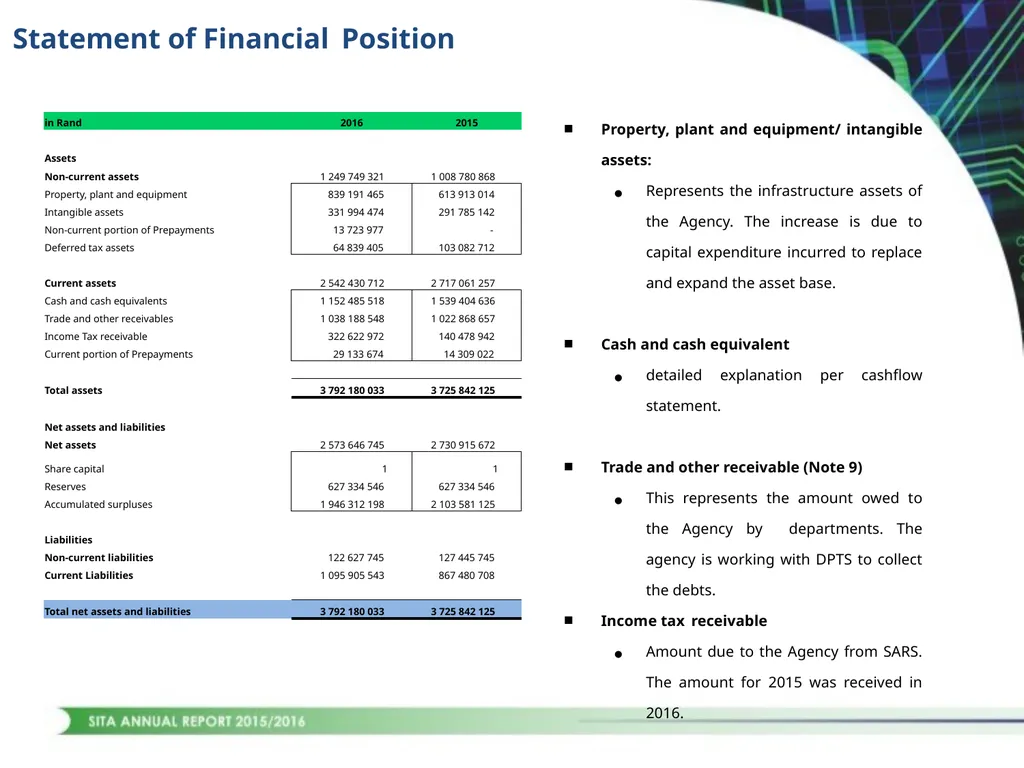
Statement of Financial Position 26 Property, plant and equipment/ intangible assets:
Represents the infrastructure assets of the Agency. The increase is due to capital expenditure incurred to replace and expand the asset base.
Cash and cash equivalent
detailed explanation per cashflow statement.
Trade and other receivable (Note 9)
This represents the amount owed to the Agency by departments. The agency is working with DPTS to collect the debts.
Income tax receivable
Amount due to the Agency from SARS. The amount for 2015 was received in 2016.
Trade and other payables (Note 14)
The increase is mainly licences invoiced at year end that were subsequently paid in April.<br>
Represents the infrastructure assets of the Agency. The increase is due to capital expenditure incurred to replace and expand the asset base.
Cash and cash equivalent
detailed explanation per cashflow statement.
Trade and other receivable (Note 9)
This represents the amount owed to the Agency by departments. The agency is working with DPTS to collect the debts.
Income tax receivable
Amount due to the Agency from SARS. The amount for 2015 was received in 2016.
Trade and other payables (Note 14)
The increase is mainly licences invoiced at year end that were subsequently paid in April.<br>
27
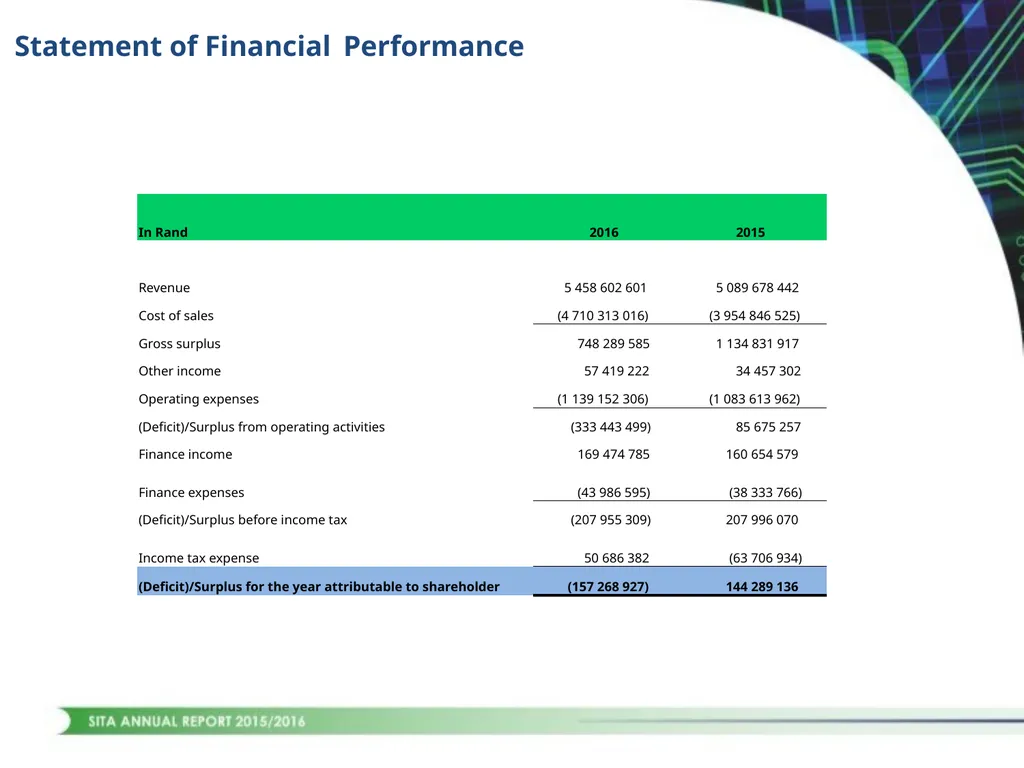
Statement of Financial Performance 27<br>
28
Revised Annual Performance Plan Budget 28<br>
29
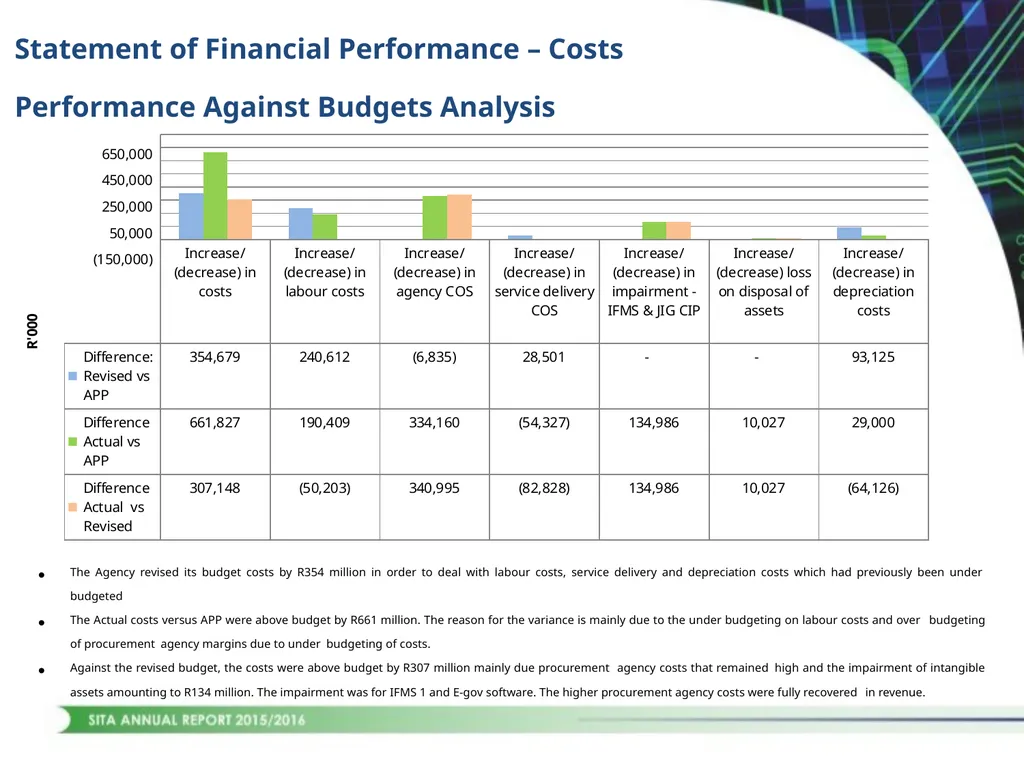
Statement of Financial Performance – Costs Performance Against Budgets Analysis 29 The Agency revised its budget costs by R354 million in order to deal with labour costs, service delivery and depreciation costs which had previously been under budgeted
The Actual costs versus APP were above budget by R661 million. The reason for the variance is mainly due to the under budgeting on labour costs and over budgeting of procurement agency margins due to under budgeting of costs.
Against the revised budget, the costs were above budget by R307 million mainly due procurement agency costs that remained high and the impairment of intangible assets amounting to R134 million. The impairment was for IFMS 1 and E-gov software. The higher procurement agency costs were fully recovered in revenue.<br>
The Actual costs versus APP were above budget by R661 million. The reason for the variance is mainly due to the under budgeting on labour costs and over budgeting of procurement agency margins due to under budgeting of costs.
Against the revised budget, the costs were above budget by R307 million mainly due procurement agency costs that remained high and the impairment of intangible assets amounting to R134 million. The impairment was for IFMS 1 and E-gov software. The higher procurement agency costs were fully recovered in revenue.<br>
30
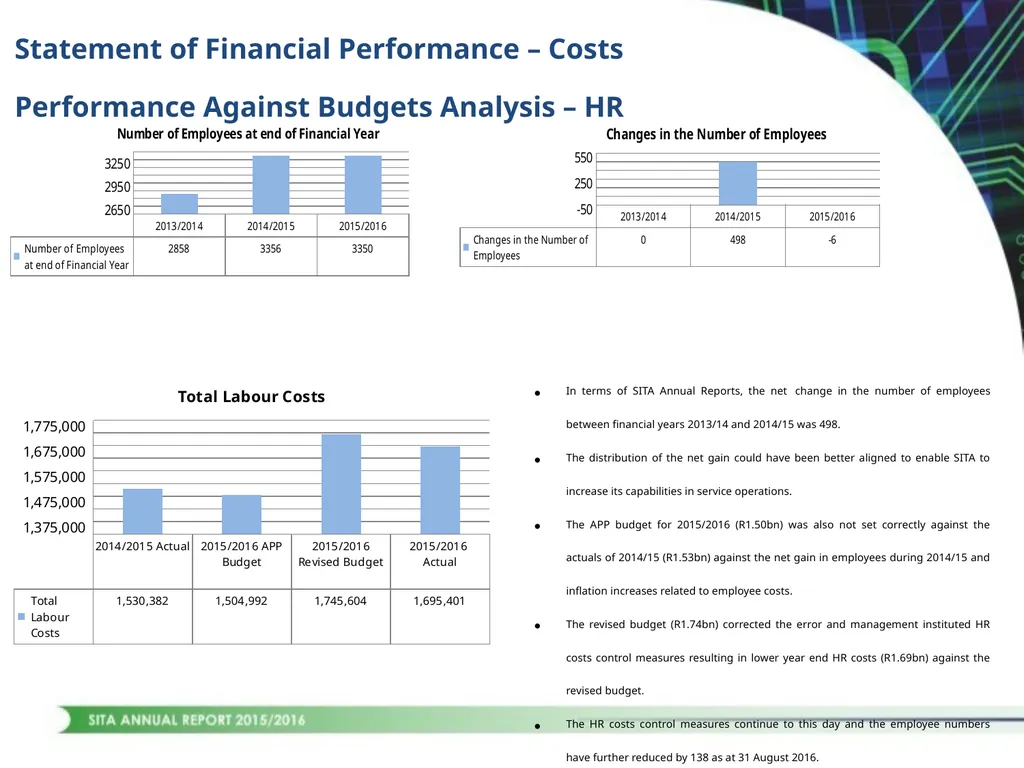
Statement of Financial Performance – Costs Performance Against Budgets Analysis – HR 30 In terms of SITA Annual Reports, the net change in the number of employees between financial years 2013/14 and 2014/15 was 498.
The distribution of the net gain could have been better aligned to enable SITA to increase its capabilities in service operations.
The APP budget for 2015/2016 (R1.50bn) was also not set correctly against the actuals of 2014/15 (R1.53bn) against the net gain in employees during 2014/15 and inflation increases related to employee costs.
The revised budget (R1.74bn) corrected the error and management instituted HR costs control measures resulting in lower year end HR costs (R1.69bn) against the revised budget.
The HR costs control measures continue to this day and the employee numbers have further reduced by 138 as at 31 August 2016.<br>
The distribution of the net gain could have been better aligned to enable SITA to increase its capabilities in service operations.
The APP budget for 2015/2016 (R1.50bn) was also not set correctly against the actuals of 2014/15 (R1.53bn) against the net gain in employees during 2014/15 and inflation increases related to employee costs.
The revised budget (R1.74bn) corrected the error and management instituted HR costs control measures resulting in lower year end HR costs (R1.69bn) against the revised budget.
The HR costs control measures continue to this day and the employee numbers have further reduced by 138 as at 31 August 2016.<br>
31
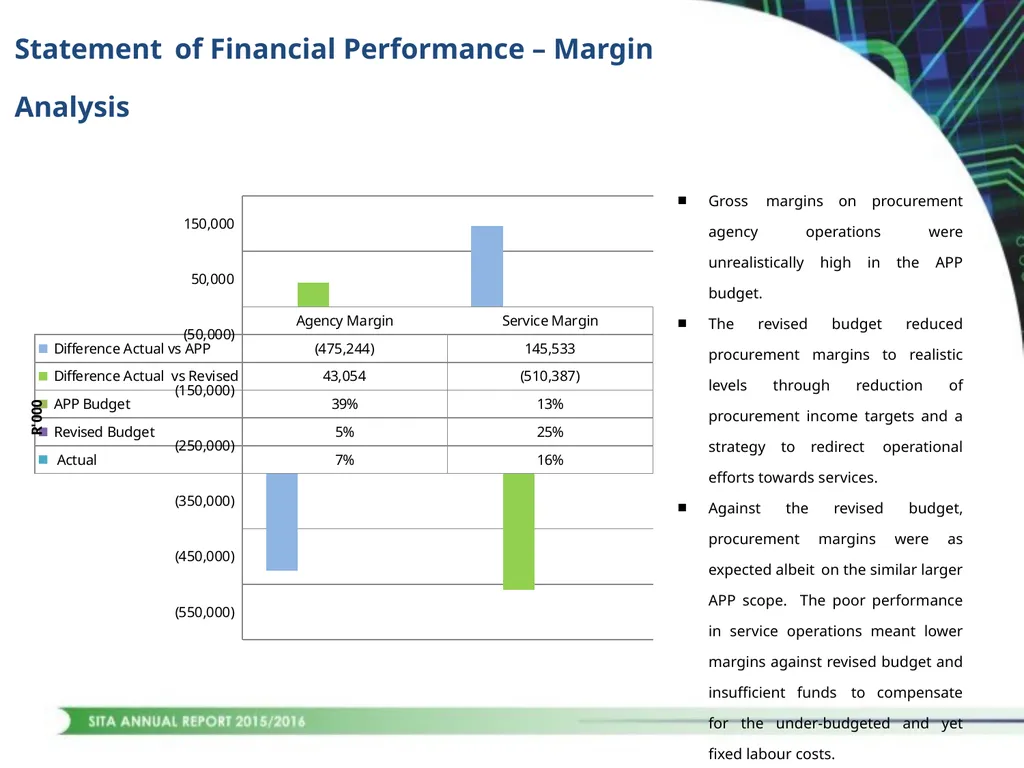
Statement of Financial Performance – Margin Analysis 31 Gross margins on procurement agency operations were unrealistically high in the APP budget.
The revised budget reduced procurement margins to realistic levels through reduction of procurement income targets and a strategy to redirect operational efforts towards services.
Against the revised budget, procurement margins were as expected albeit on the similar larger APP scope. The poor performance in service operations meant lower margins against revised budget and insufficient funds to compensate for the under-budgeted and yet fixed labour costs.<br>
The revised budget reduced procurement margins to realistic levels through reduction of procurement income targets and a strategy to redirect operational efforts towards services.
Against the revised budget, procurement margins were as expected albeit on the similar larger APP scope. The poor performance in service operations meant lower margins against revised budget and insufficient funds to compensate for the under-budgeted and yet fixed labour costs.<br>
32
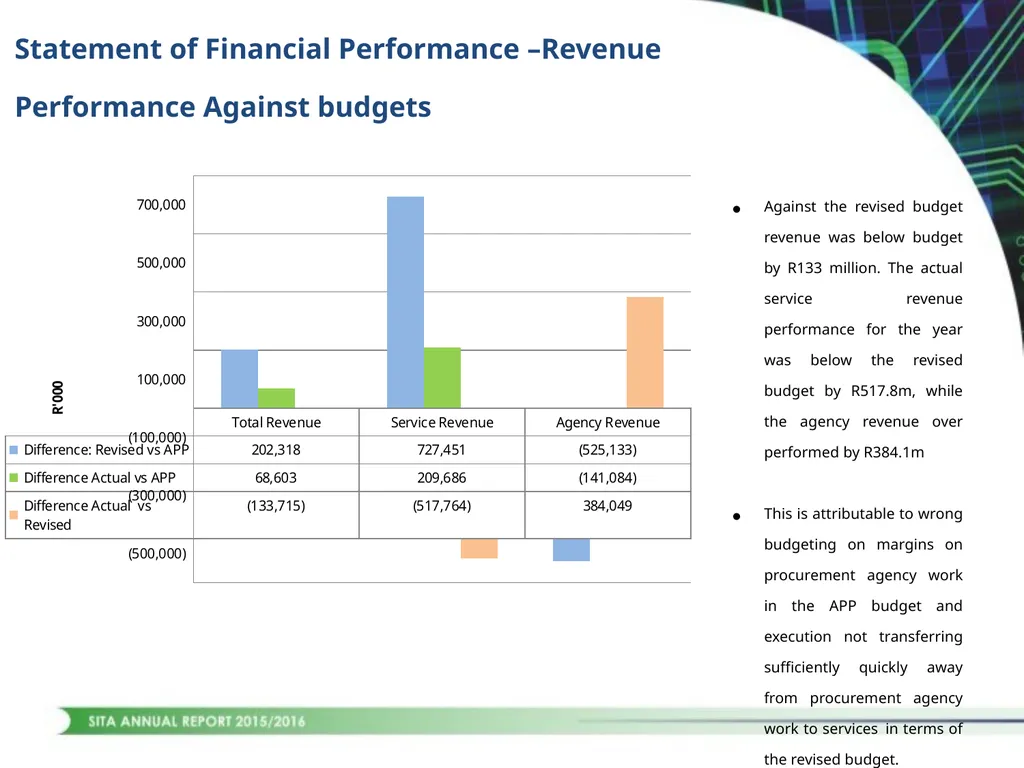
Statement of Financial Performance –Revenue Performance Against budgets 32 Against the revised budget revenue was below budget by R133 million. The actual service revenue performance for the year was below the revised budget by R517.8m, while the agency revenue over performed by R384.1m
This is attributable to wrong budgeting on margins on procurement agency work in the APP budget and execution not transferring sufficiently quickly away from procurement agency work to services in terms of the revised budget.<br>
This is attributable to wrong budgeting on margins on procurement agency work in the APP budget and execution not transferring sufficiently quickly away from procurement agency work to services in terms of the revised budget.<br>
33
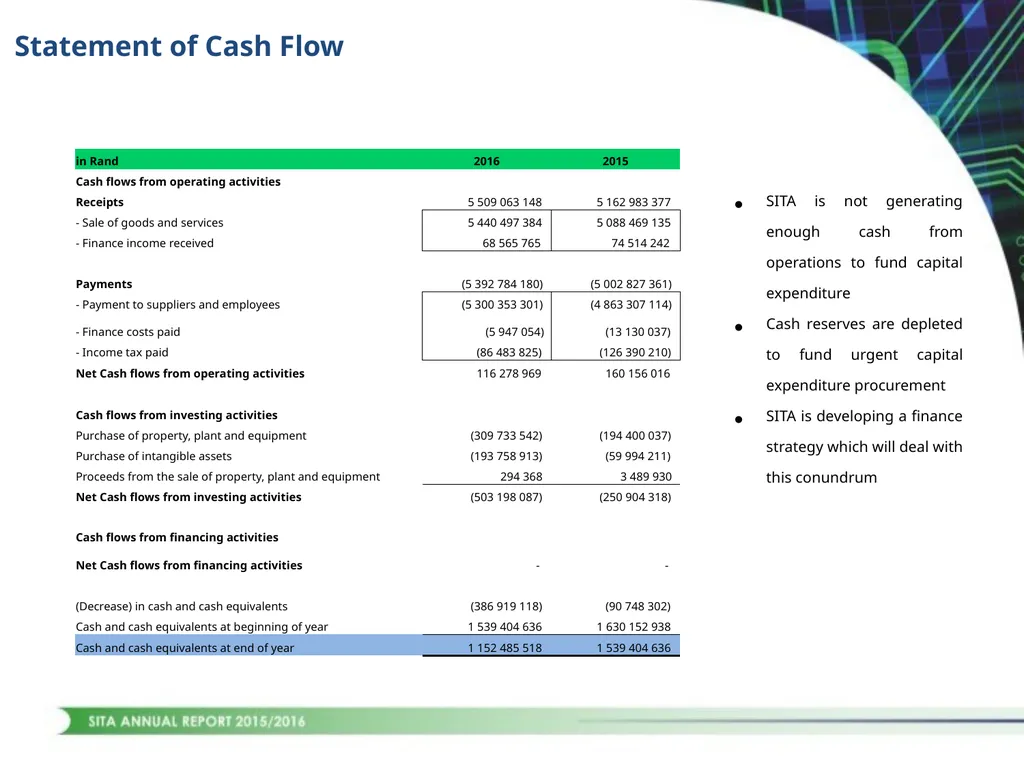
Statement of Cash Flow SITA is not generating enough cash from operations to fund capital expenditure
Cash reserves are depleted to fund urgent capital expenditure procurement
SITA is developing a finance strategy which will deal with this conundrum 33<br>
Cash reserves are depleted to fund urgent capital expenditure procurement
SITA is developing a finance strategy which will deal with this conundrum 33<br>
34
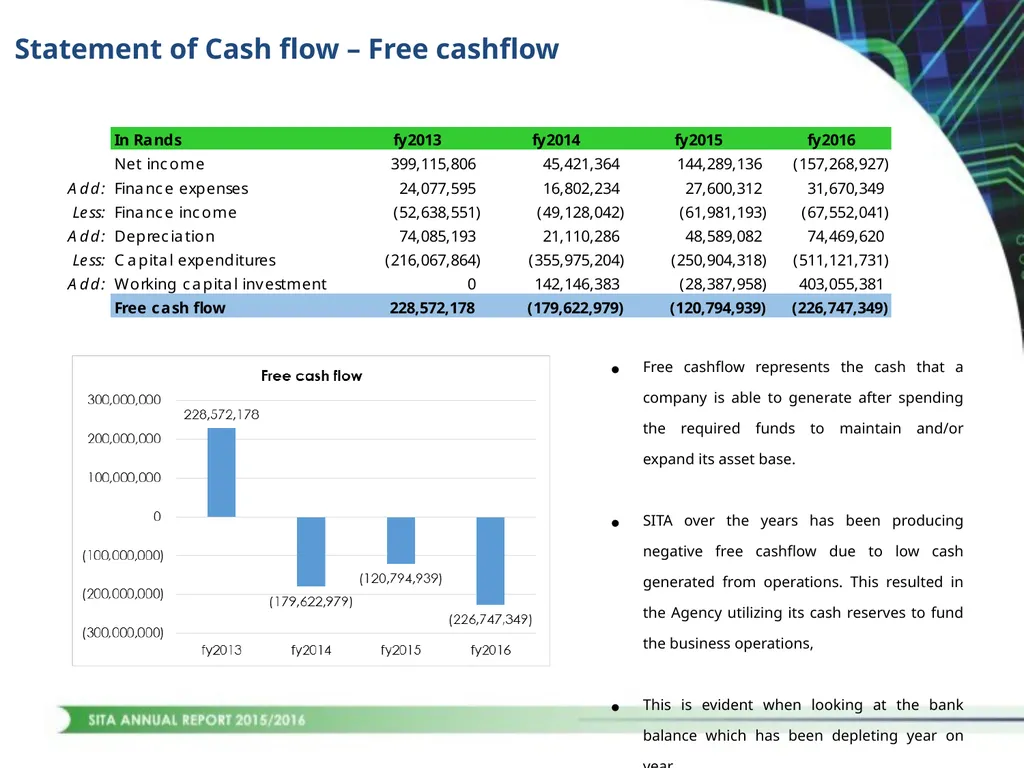
Statement of Cash flow – Free cashflow 34 Free cashflow represents the cash that a company is able to generate after spending the required funds to maintain and/or expand its asset base.
SITA over the years has been producing negative free cashflow due to low cash generated from operations. This resulted in the Agency utilizing its cash reserves to fund the business operations,
This is evident when looking at the bank balance which has been depleting year on year<br>
SITA over the years has been producing negative free cashflow due to low cash generated from operations. This resulted in the Agency utilizing its cash reserves to fund the business operations,
This is evident when looking at the bank balance which has been depleting year on year<br>
35
AUDIT OVERVIEW Summary of Audit Findings
Fruitless & Wasteful and Irregular Expenditure Summary 35<br>
Fruitless & Wasteful and Irregular Expenditure Summary 35<br>
36
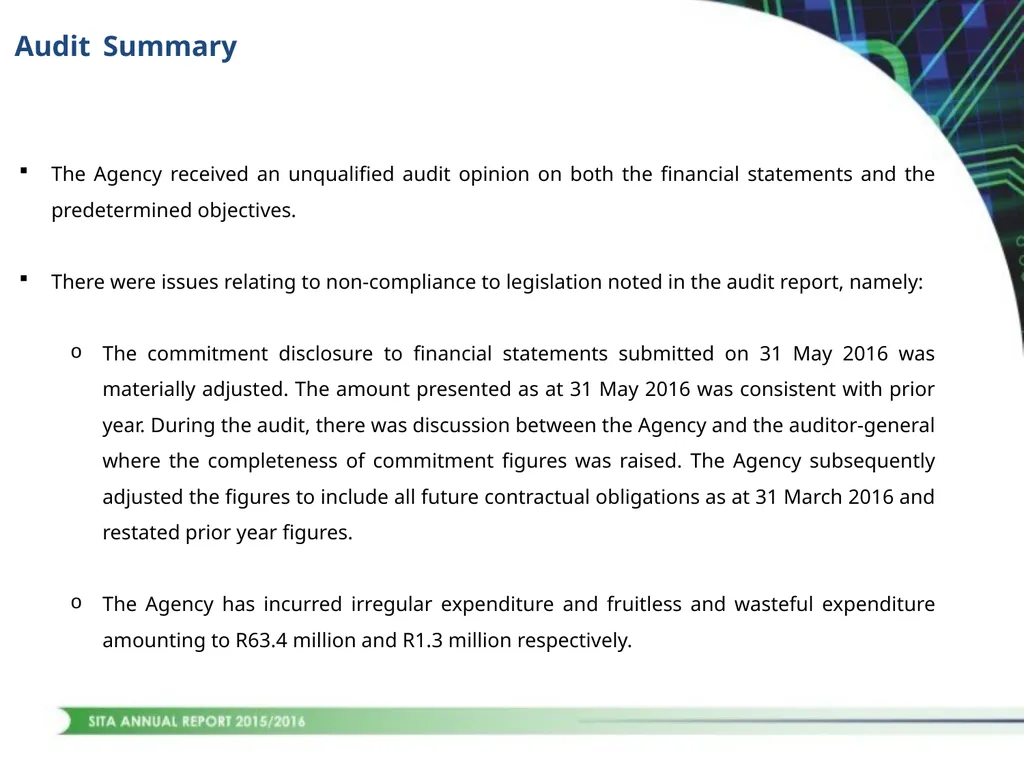
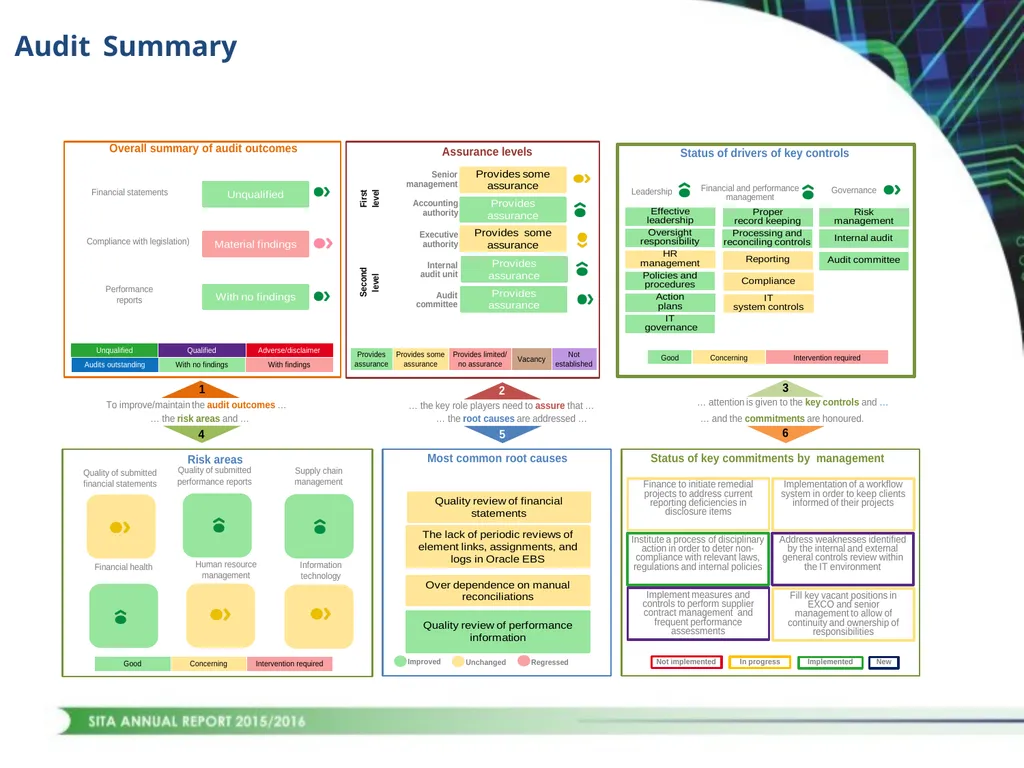
Audit Summary 36 The Agency received an unqualified audit opinion on both the financial statements and the predetermined objectives.
There were issues relating to non-compliance to legislation noted in the audit report, namely:
The commitment disclosure to financial statements submitted on 31 May 2016 was materially adjusted. The amount presented as at 31 May 2016 was consistent with prior year. During the audit, there was discussion between the Agency and the auditor-general where the completeness of commitment figures was raised. The Agency subsequently adjusted the figures to include all future contractual obligations as at 31 March 2016 and restated prior year figures.
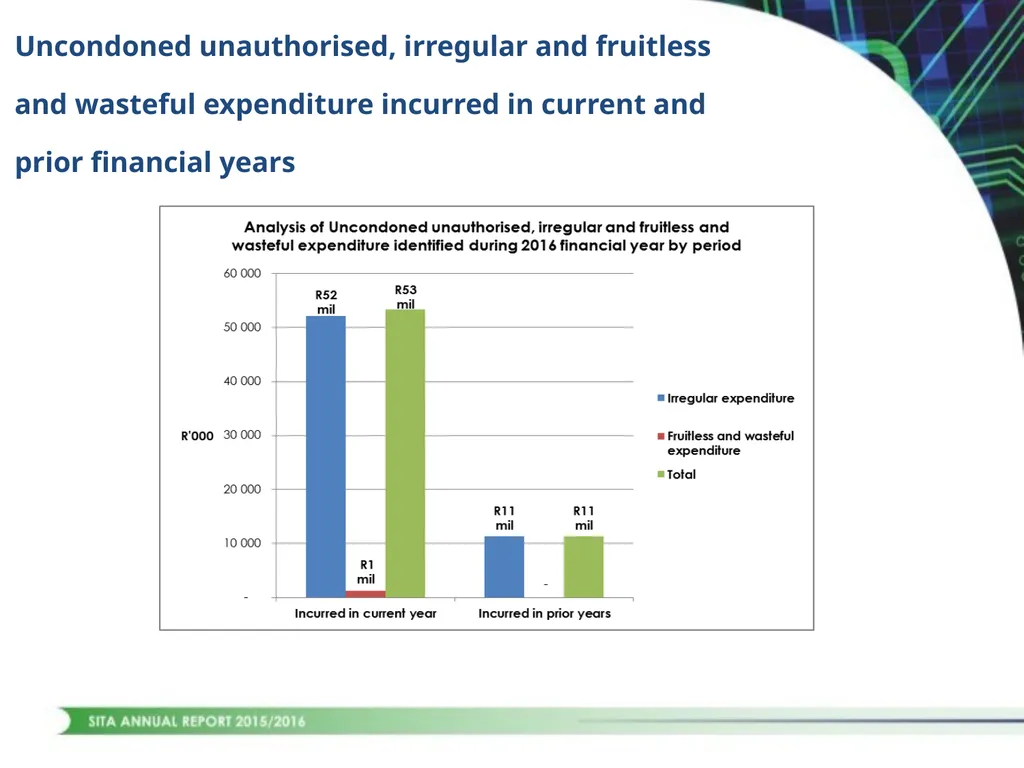
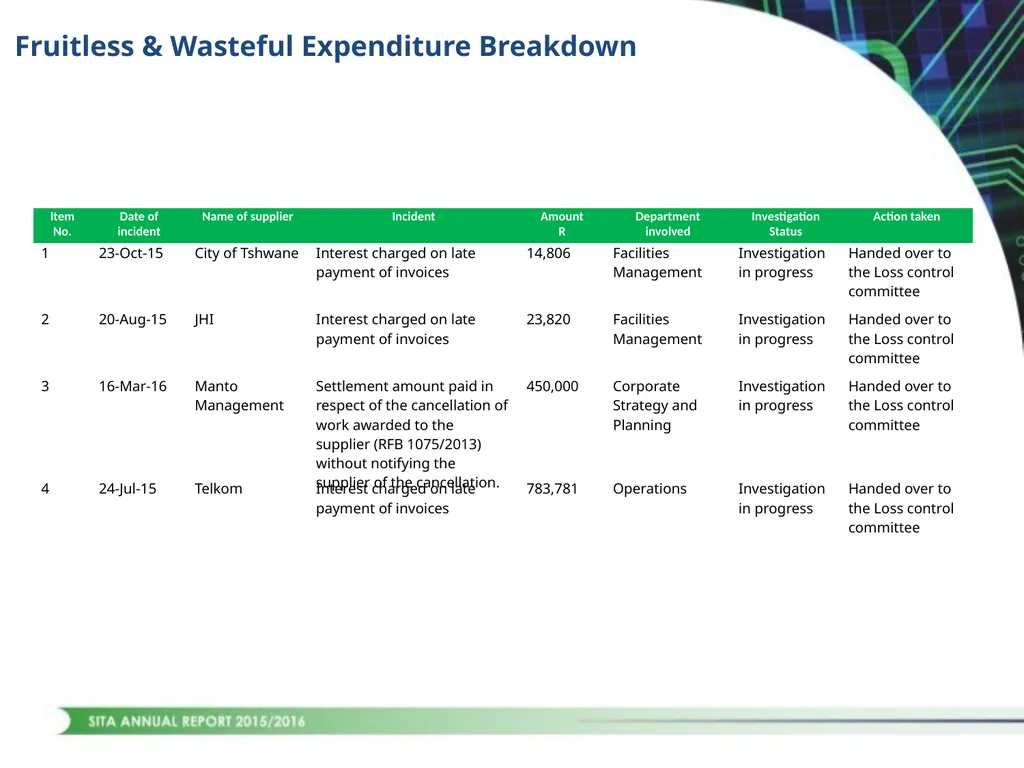
The Agency has incurred irregular expenditure and fruitless and wasteful expenditure amounting to R63.4 million and R1.3 million respectively.<br>
There were issues relating to non-compliance to legislation noted in the audit report, namely:
The commitment disclosure to financial statements submitted on 31 May 2016 was materially adjusted. The amount presented as at 31 May 2016 was consistent with prior year. During the audit, there was discussion between the Agency and the auditor-general where the completeness of commitment figures was raised. The Agency subsequently adjusted the figures to include all future contractual obligations as at 31 March 2016 and restated prior year figures.
The Agency has incurred irregular expenditure and fruitless and wasteful expenditure amounting to R63.4 million and R1.3 million respectively.<br>
37
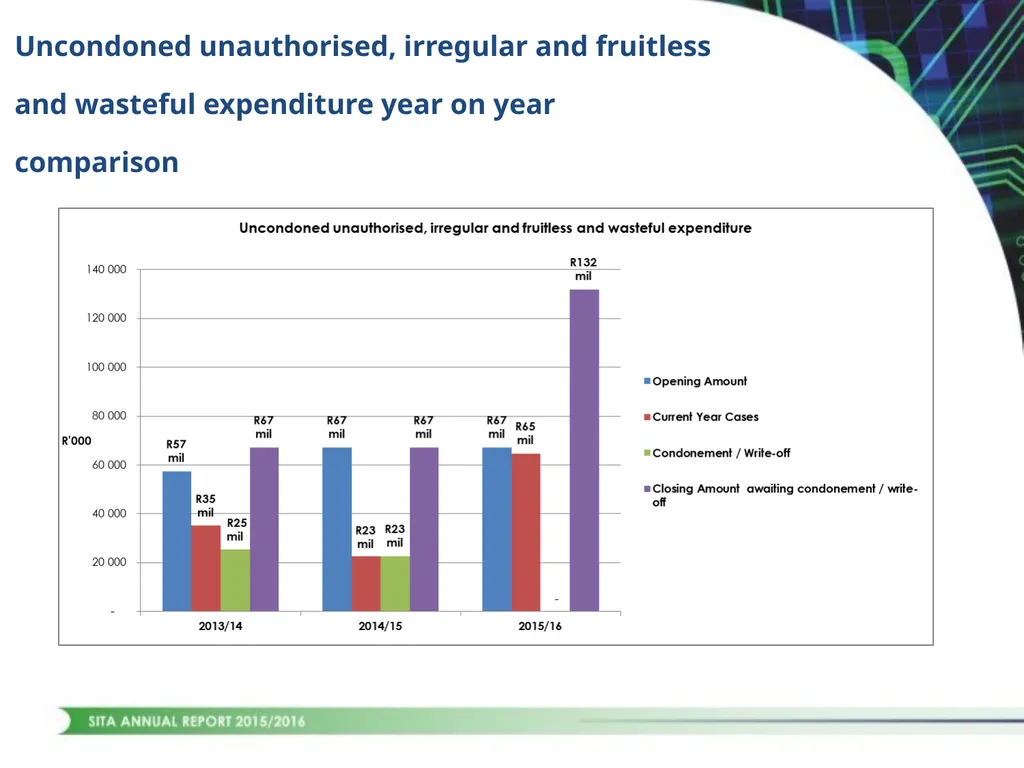
Uncondoned unauthorised, irregular and fruitless and wasteful expenditure year on year comparison 37<br>
38
Uncondoned unauthorised, irregular and fruitless and wasteful expenditure incurred in current and prior financial years 38<br>
39
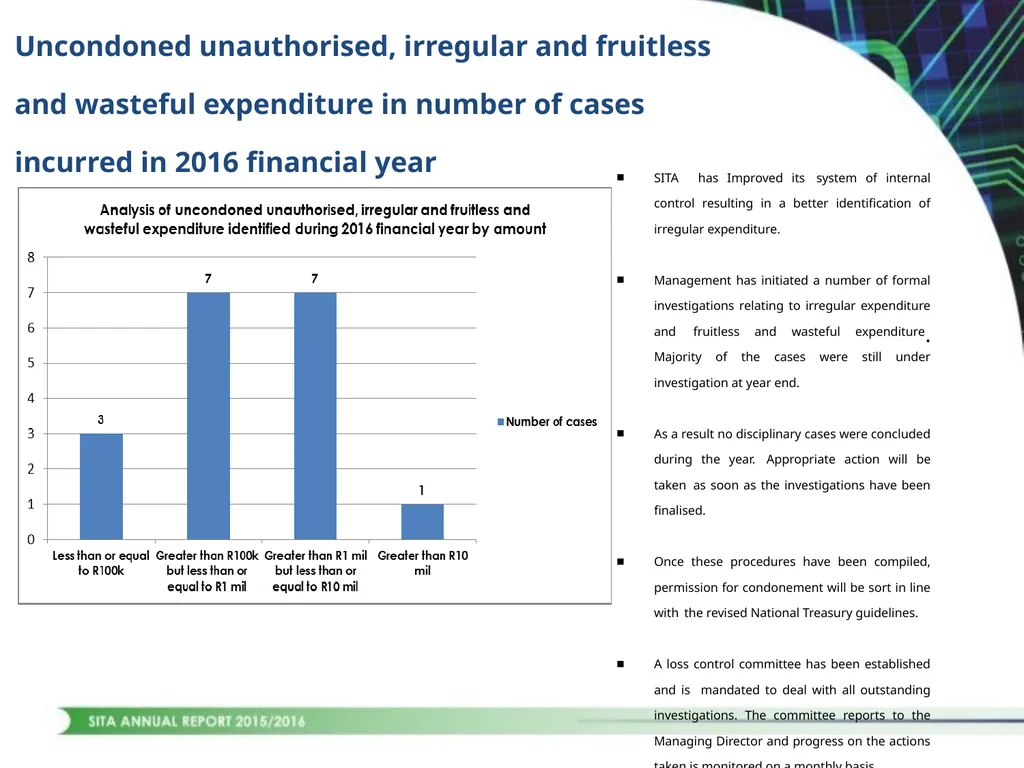
Uncondoned unauthorised, irregular and fruitless and wasteful expenditure in number of cases incurred in 2016 financial year 39 SITA has Improved its system of internal control resulting in a better identification of irregular expenditure.
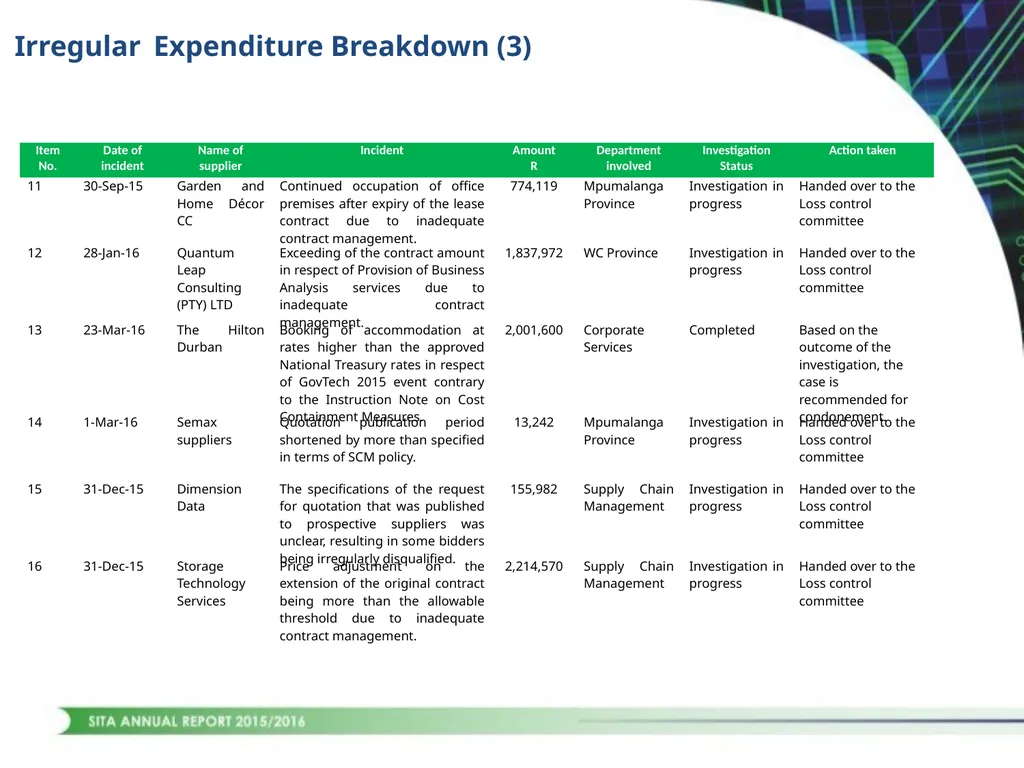
Management has initiated a number of formal investigations relating to irregular expenditure and fruitless and wasteful expenditure. Majority of the cases were still under investigation at year end.
As a result no disciplinary cases were concluded during the year. Appropriate action will be taken as soon as the investigations have been finalised.
Once these procedures have been compiled, permission for condonement will be sort in line with the revised National Treasury guidelines.
A loss control committee has been established and is mandated to deal with all outstanding investigations. The committee reports to the Managing Director and progress on the actions taken is monitored on a monthly basis<br>
Management has initiated a number of formal investigations relating to irregular expenditure and fruitless and wasteful expenditure. Majority of the cases were still under investigation at year end.
As a result no disciplinary cases were concluded during the year. Appropriate action will be taken as soon as the investigations have been finalised.
Once these procedures have been compiled, permission for condonement will be sort in line with the revised National Treasury guidelines.
A loss control committee has been established and is mandated to deal with all outstanding investigations. The committee reports to the Managing Director and progress on the actions taken is monitored on a monthly basis<br>
40
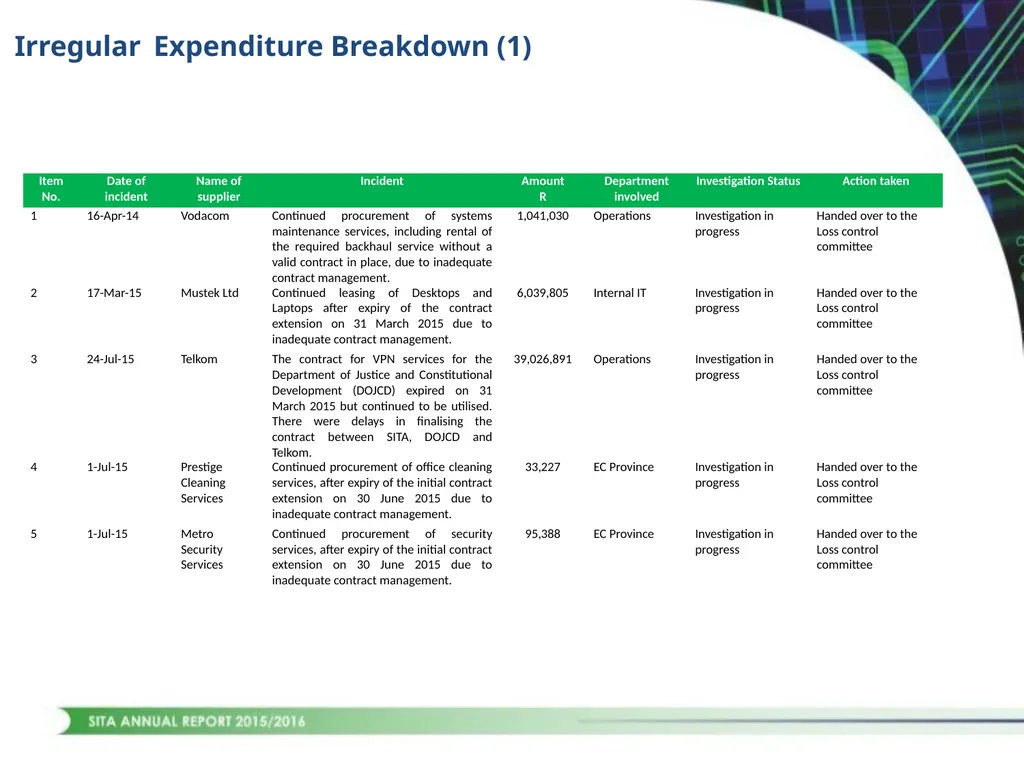
Irregular Expenditure Breakdown (1) 40<br>
41
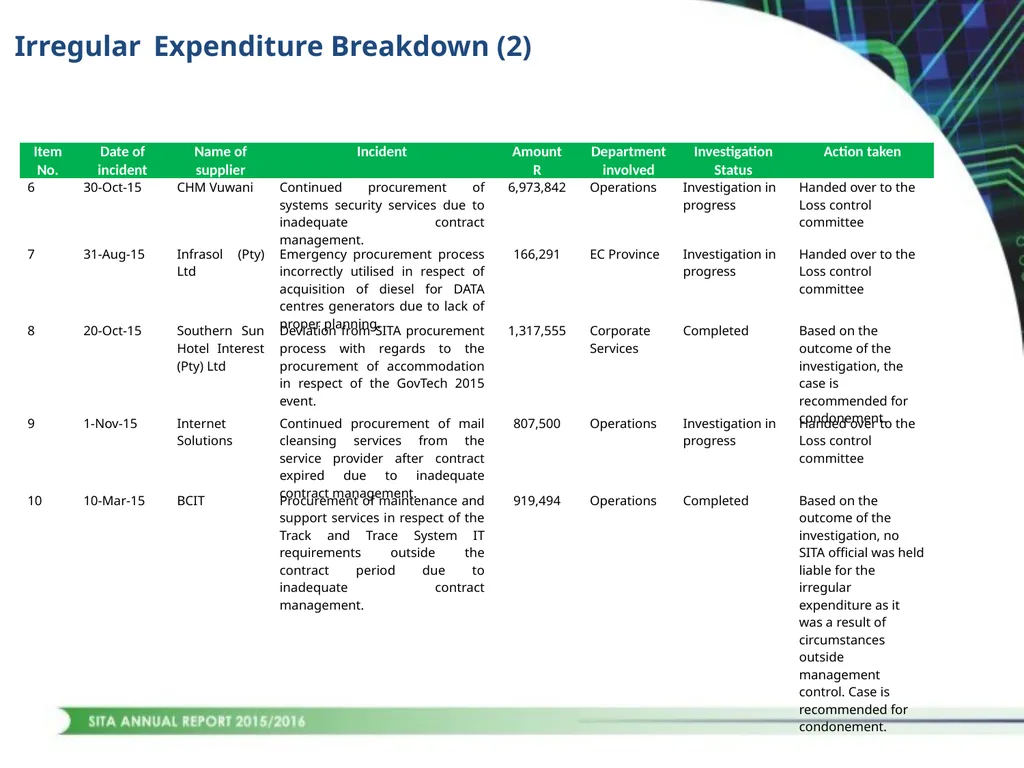
Irregular Expenditure Breakdown (2) 41<br>
42
Irregular Expenditure Breakdown (3) 42<br>
43
Fruitless & Wasteful Expenditure Breakdown 43<br>
44
Audit Summary 44<br>
45
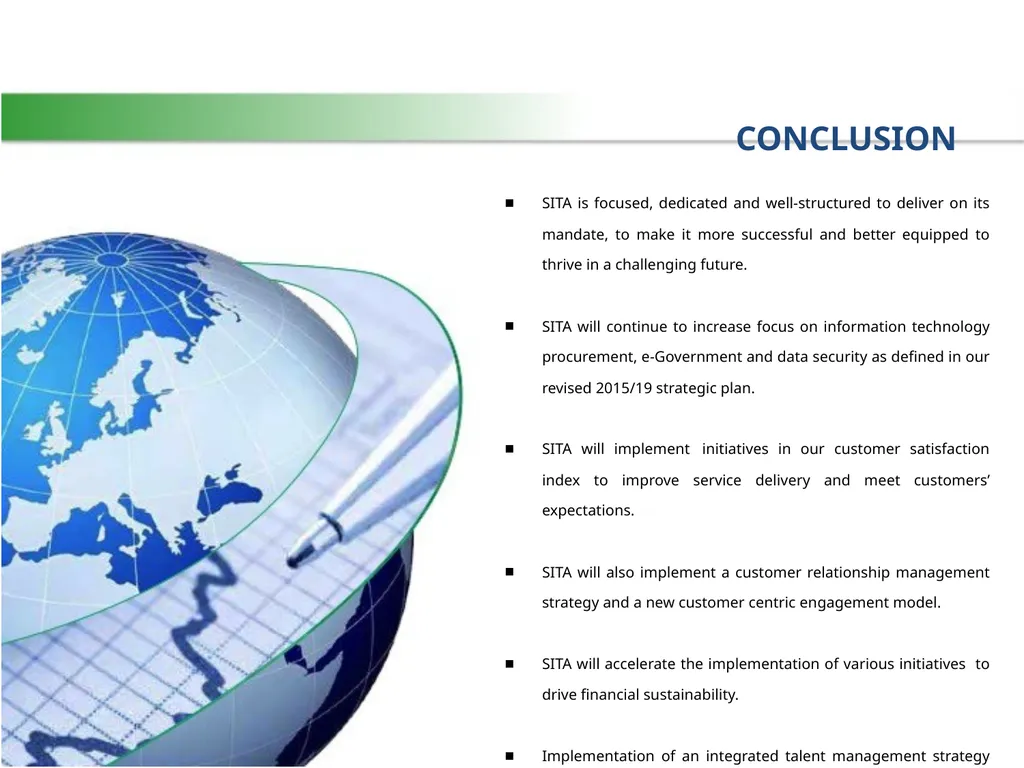
CONCLUSION SITA is focused, dedicated and well-structured to deliver on its mandate, to make it more successful and better equipped to thrive in a challenging future.
SITA will continue to increase focus on information technology procurement, e-Government and data security as defined in our revised 2015/19 strategic plan.
SITA will implement initiatives in our customer satisfaction index to improve service delivery and meet customers’ expectations.
SITA will also implement a customer relationship management strategy and a new customer centric engagement model.
SITA will accelerate the implementation of various initiatives to drive financial sustainability.
Implementation of an integrated talent management strategy to position SITA as a premier employment destination within the ICT industry is our destination and will continue as planned. 45<br>
SITA will continue to increase focus on information technology procurement, e-Government and data security as defined in our revised 2015/19 strategic plan.
SITA will implement initiatives in our customer satisfaction index to improve service delivery and meet customers’ expectations.
SITA will also implement a customer relationship management strategy and a new customer centric engagement model.
SITA will accelerate the implementation of various initiatives to drive financial sustainability.
Implementation of an integrated talent management strategy to position SITA as a premier employment destination within the ICT industry is our destination and will continue as planned. 45<br>