
1 Cooperative Language Training Programme
Description: 1 Cooperative Language Training Programme Assessments Mapping the Road: Success in Language Training Keith L. Wert Associate BILC Secretary for Programme Assessment Director, Partner Language Training Center Europe George C. Marshall
Related Topics
Download Presentation
"1 Cooperative Language Training Programme" is the property of its rightful owner. Permission is granted to download and print the materials on this website for personal, non-commercial use only, and to display it on your personal computer provided you do not modify the materials and that you retain all copyright notices contained in the materials. By downloading content from our website, you accept the terms of this agreement.
Presentation Transcript
slide1. 1 Cooperative
Language Training Programme Assessments “Mapping the Road: Success in Language Training”
Keith L. Wert
Associate BILC Secretary for Programme Assessment
Director, Partner Language Training Center Europe
George C. Marshall European Center for Security Studies
wertk@marshallcenter.org<br>
slide2. 2 Cooperative Language Training Programme Assessments History:
2000:
Requested by a NATO Assistant Secretary General to Chair, Nato Training Group who wrote BILC secretariat
2001
Conducted first assessment
2001-2010
Before Accession:
Slovakia , Latvia, Slovenia, Estonia,
After Accession:
Czech Rep ., Bulgaria , Romania
PfP and IPAP countries
Macedonia, Georgia , Serbia
Countries that have asked for follow up visits: Czech Republic, Bulgaria, Slovakia, Georgia, Macedonia and Serbia.<br>
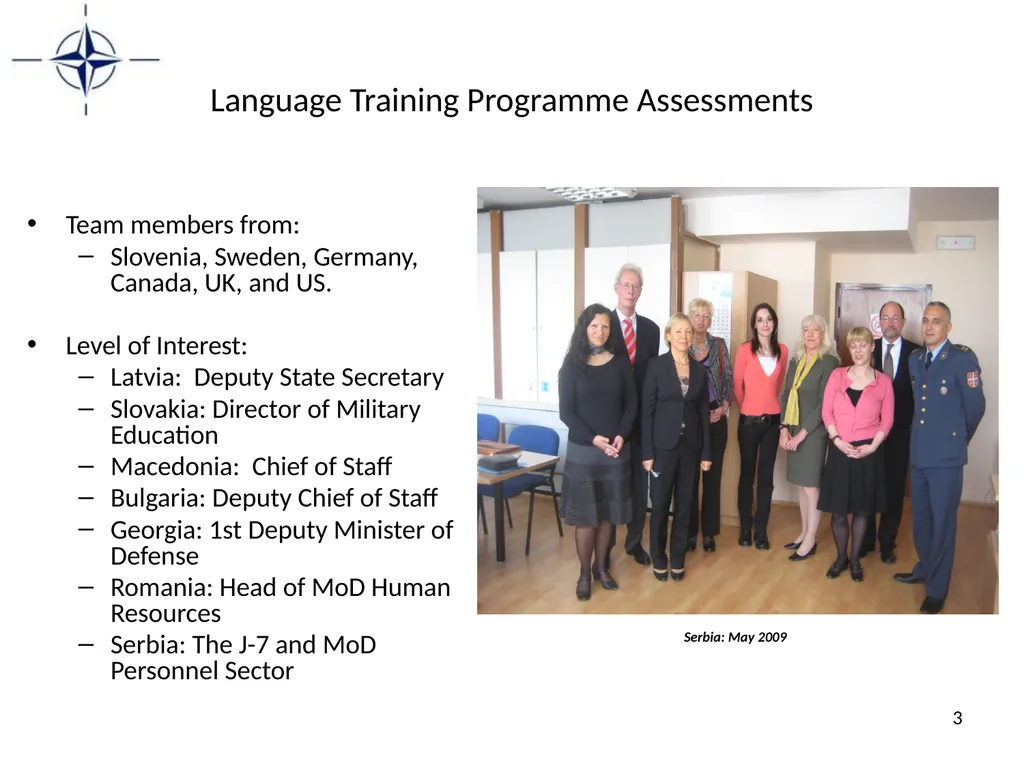
slide3. 3 Language Training Programme Assessments Team members from:
Slovenia, Sweden, Germany, Canada, UK, and US.
Level of Interest:
Latvia: Deputy State Secretary
Slovakia: Director of Military Education
Macedonia: Chief of Staff
Bulgaria: Deputy Chief of Staff
Georgia: 1st Deputy Minister of Defense
Romania: Head of MoD Human Resources
Serbia: The J-7 and MoD Personnel Sector Serbia: May 2009<br>
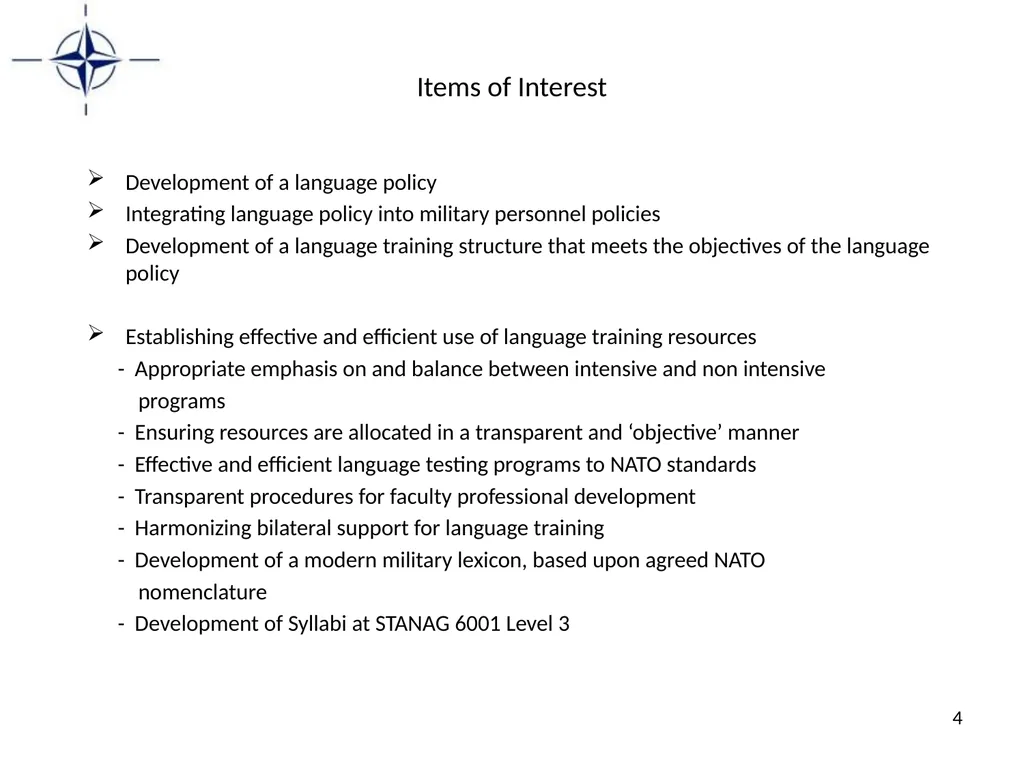
slide4. 4 Items of Interest Development of a language policy
Integrating language policy into military personnel policies
Development of a language training structure that meets the objectives of the language policy
Establishing effective and efficient use of language training resources
- Appropriate emphasis on and balance between intensive and non intensive
programs
- Ensuring resources are allocated in a transparent and ‘objective’ manner
- Effective and efficient language testing programs to NATO standards
- Transparent procedures for faculty professional development
- Harmonizing bilateral support for language training
- Development of a modern military lexicon, based upon agreed NATO
nomenclature
- Development of Syllabi at STANAG 6001 Level 3<br>
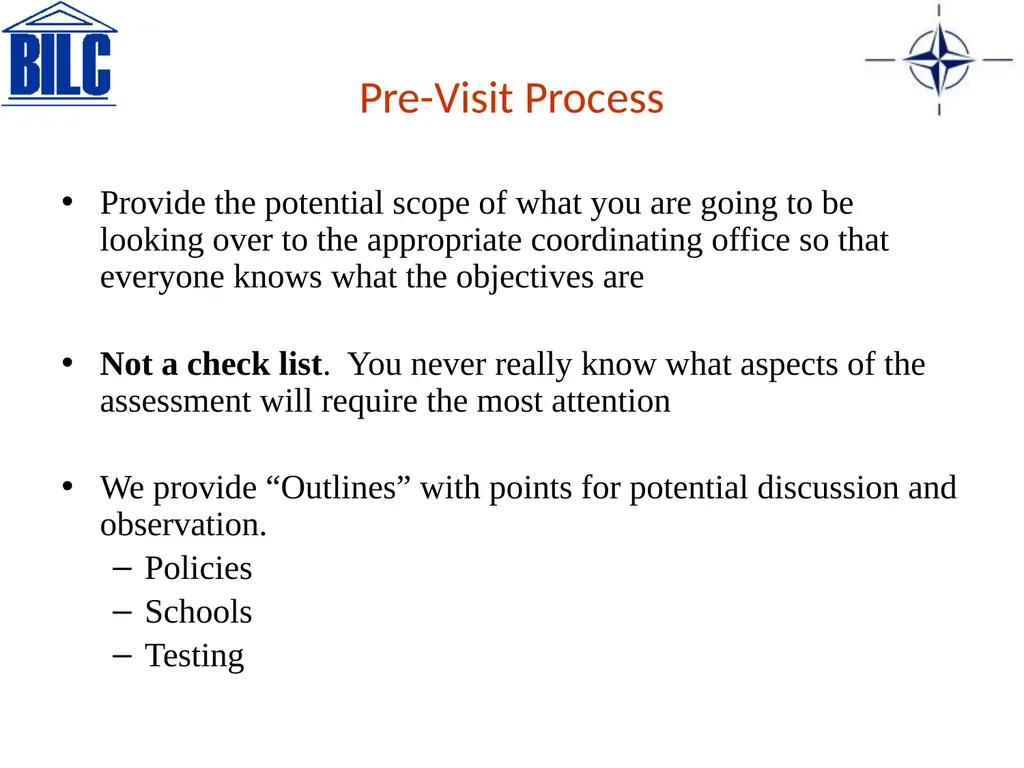
slide5. Pre-Visit Process Provide the potential scope of what you are going to be looking over to the appropriate coordinating office so that everyone knows what the objectives are
Not a check list. You never really know what aspects of the assessment will require the most attention
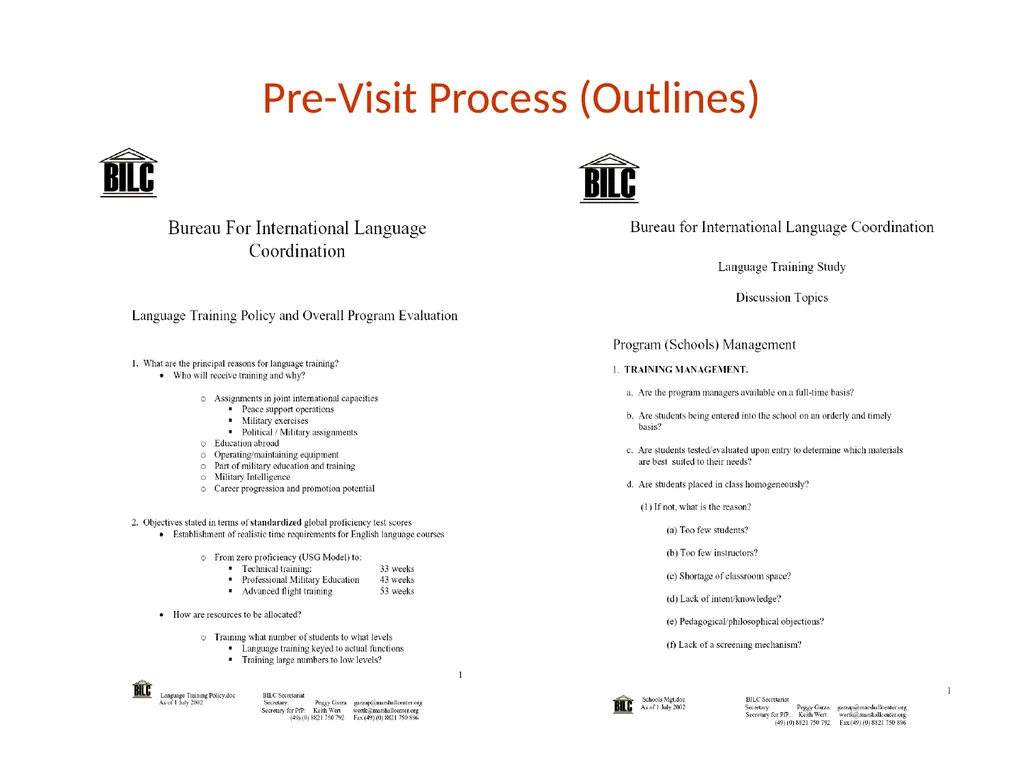
We provide “Outlines” with points for potential discussion and observation.
Policies
Schools
Testing<br>
slide6. Pre-Visit Process (Outlines)<br>
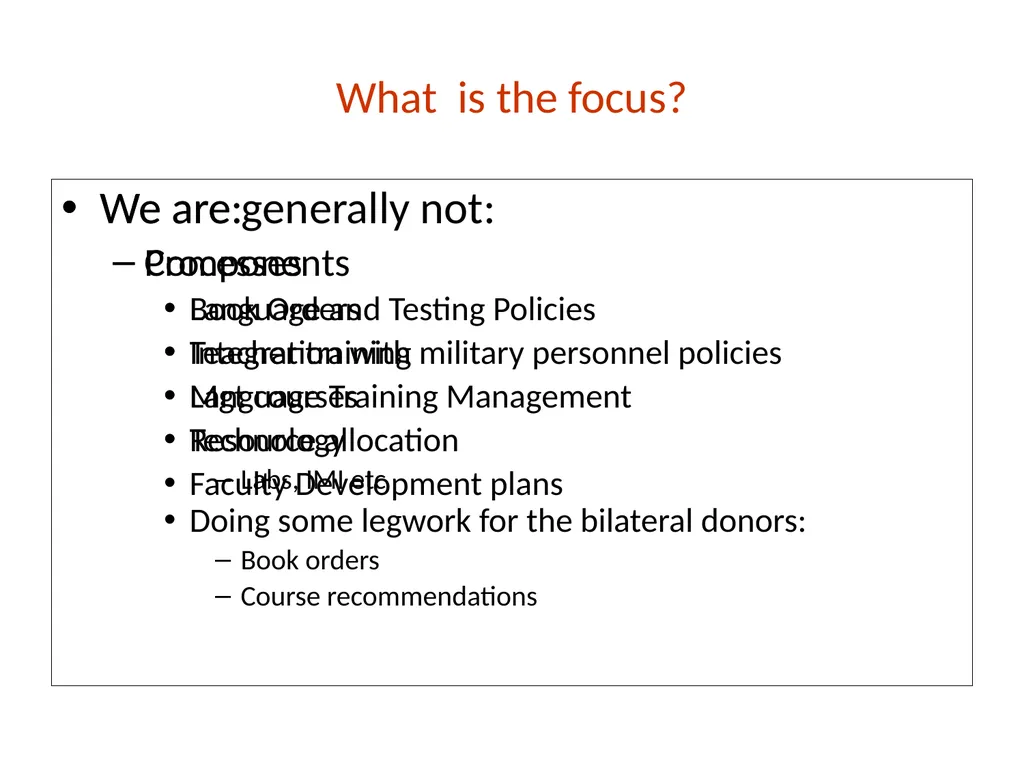
slide7. What is the focus? We are generally not:
Components
Book Orders
Teacher training
Mgt courses
Technology
Labs, IMI etc
Doing some legwork for the bilateral donors:
Book orders
Course recommendations We are:
Processes
Language and Testing Policies
Integration with military personnel policies
Language Training Management
Resource allocation
Faculty Development plans<br>
slide8. Visit Process Extensive orientation briefings by MoD/General Staff
Policy and organization explained
Visits to schools
Classroom observations
Discussions with management
Discussions with faculty and students
Meetings with bilateral language assistance responsibles, e.g. British Council, Offices of Defense Cooperation. (“Donor countries”)<br>
slide9. Analytical Process: Overarching Objective To review how the language policy fits with military personnel policies.
To see if the language training structure meets the policy objectives.
To see if the structure can produce the required numbers of graduates at the required proficiency levels in a somewhat predictable manner.<br>
slide10. Areas of Interest Language Policy (Personnel policies)
Language resources allocation
Language laboratories and self-access centers
Testing policies and processes
Syllabi standardization or how long does a student take to reach Level 1,2,3? (and now4!!!!!)
Teachers contra management
Management contra teachers
Military language instruction
Professional Development (transparency thereof)
Intensive vs. non intensive language programs<br>
slide11. Language Policy A language policy must be an inseparable component of personnel policy. If it is not, that is the first sign that there is a problem.
Does the language policy exist in a vacuum?
Were the schools involved in making the policy?
Is the policy realistic?
Do the policy makers ever check to see if the policy is successful?
Are personnel assigned to language training for a reason?<br>
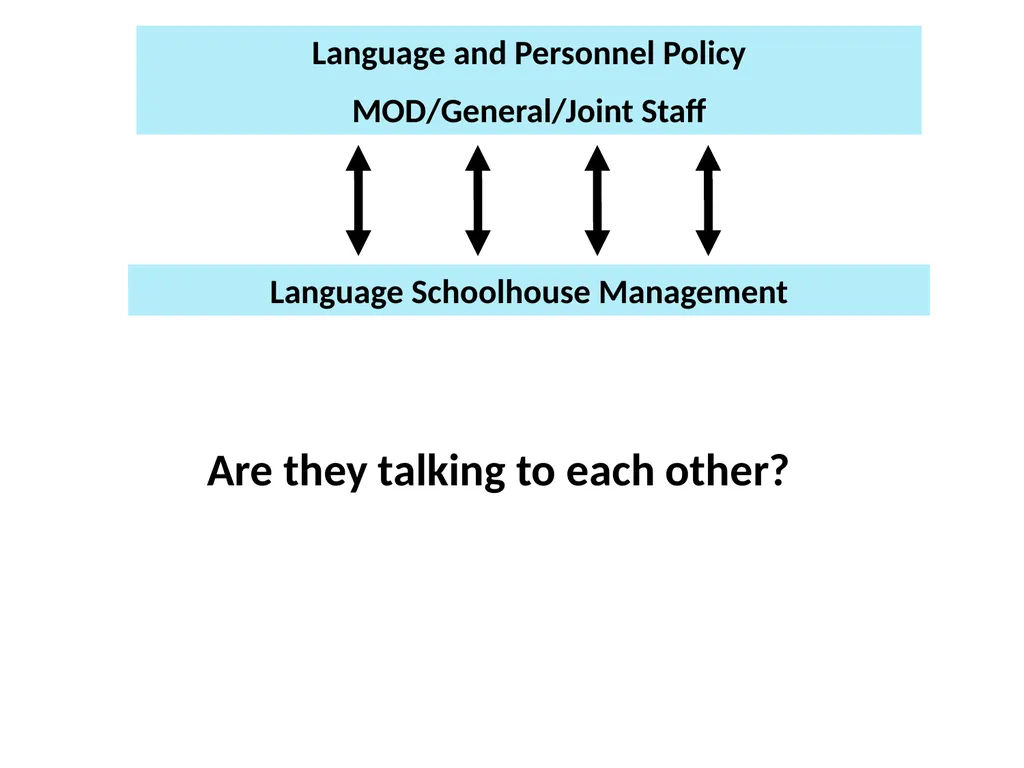
slide12. Language and Personnel Policy
MOD/General/Joint Staff Language Schoolhouse Management Are they talking to each other?<br>
slide13. Language Policy Simple reality test:
Visit several classrooms in different locations and ask a range of teachers and students the same question:
“Why are you in this classroom?”<br>
slide14. Language Resources Allocation Why are some locations well resourced and others not?
Is a language lab at a military unit as important as one at a school house with a full time intensive language program?
Who is in charge of language training resources?
Is the allocation process “transparent”?<br>
slide15. Testing Policies and Processes Is there a STANAG 6001 Testing Frenzy?
Overused STANAG tests?
Simpler ways to determine Level 1?
Is testing focus on particular assignments? (Personnel policy loop)
Don’t test more than necessary<br>
slide16. Language Labs and Self-Access Centers They have a life of their own: I know this because they keep reproducing themselves everywhere we go
Great in concept, difficult in execution
Tend to draw resources away from more fundamental needs: like books<br>
slide17. Syllabi Standardization There should be evidence of language training predictability, especially at the lower levels
If no one knows how long it takes the normal language student to reach Levels 1 and 2, there is a problem
If it is known how long it takes and authorities shorten course lengths anyway, there is a problem
Course lengths determined arbitrarily
Stability and predictability at lower levels is important<br>
slide18. “ If you can’t measure it, you can’t manage it.”
Dr. Ray Clifford, Sweden
October, 2001<br>
slide19. Syllabi Standardization Certificates from different courses do not tell you anything
The students passed the “test” and received credit
No comparability across classrooms
No comparability across institutions in the same country<br>
slide20. Teachers contra management Highly educated and professional teachers don’t always grasp the larger scale training management issues and confuse higher level management with the wrong input:
“These books are boring, that is why the students are not succeeding!”
“The test is bad, not a truly professional test.” (I don’t like this test format.)<br>
slide21. Management contra teachers Senior management has to pay attention to the real results teachers and school houses produce
If it is working, leave it alone and let the language professionals improve it incrementally
Stability is important
Having the power to do something is not synonymous with knowing what to do<br>
slide22. Military language Primary warning signs are:
Teachers who do not feel it is in their profession to teach it
Courses that introduce highly technical language at low levels of language ability
Leaders who think that just the language and terms of the specialty need to be learned
Intensive basic courses that rely on military language as the primary component<br>
slide23. Teacher Professional Development There are limited numbers of opportunities for teachers and these opportunities must be handled in a rational and transparent manner
Professional institutions everywhere have application procedures and published standards for awarding teachers with research grants and development opportunities
There should be a well-thought out process controlled by the country, not the bilateral (donor) providers<br>
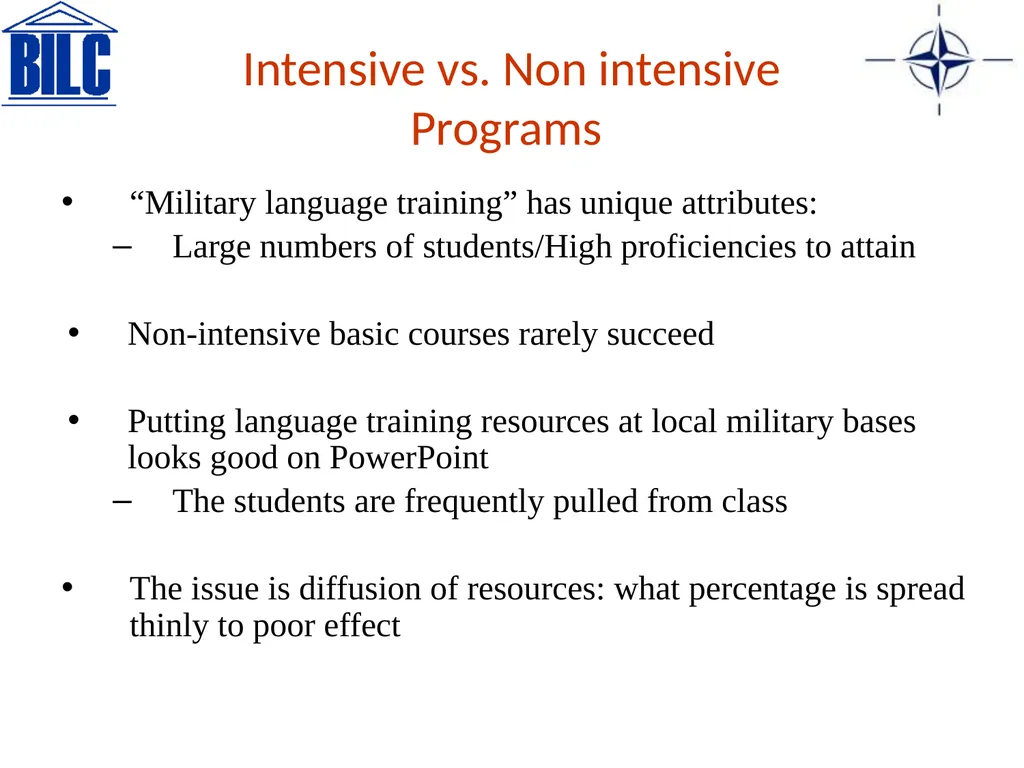
slide24. Intensive vs. Non intensive Programs “Military language training” has unique attributes:
Large numbers of students/High proficiencies to attain
Non-intensive basic courses rarely succeed
Putting language training resources at local military bases looks good on PowerPoint
The students are frequently pulled from class
The issue is diffusion of resources: what percentage is spread thinly to poor effect<br>
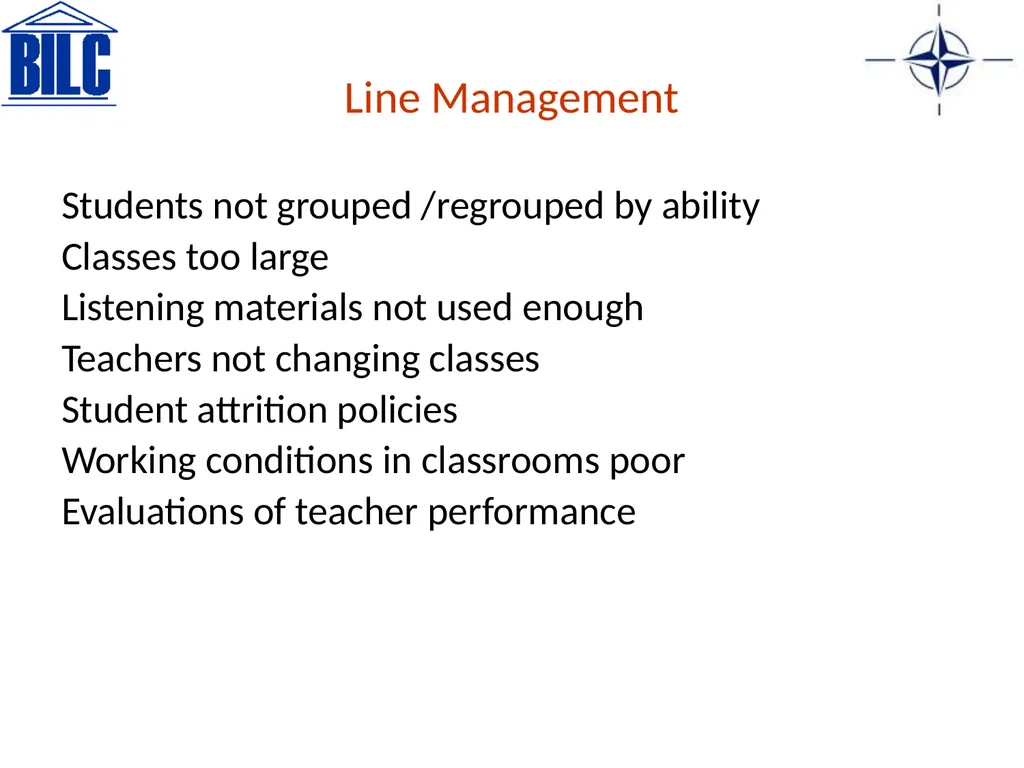
slide25. Line Management Students not grouped /regrouped by ability
Classes too large
Listening materials not used enough
Teachers not changing classes
Student attrition policies
Working conditions in classrooms poor
Evaluations of teacher performance<br>
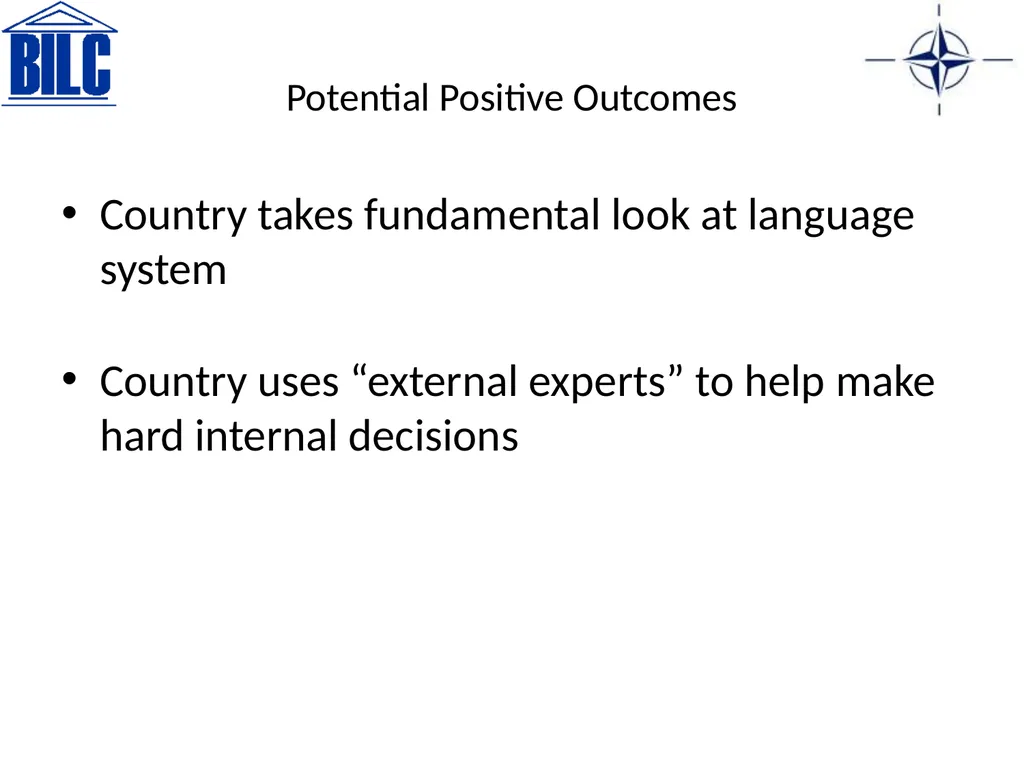
slide26. Potential Positive Outcomes Country takes fundamental look at language system
Country uses “external experts” to help make hard internal decisions<br>
slide27. Questions?<br>
Keith L. Wert
Associate BILC Secretary for Programme Assessment
Director, Partner Language Training Center Europe
George C. Marshall European Center for Security Studies
wertk@marshallcenter.org<br>
slide2. 2 Cooperative Language Training Programme Assessments History:
2000:
Requested by a NATO Assistant Secretary General to Chair, Nato Training Group who wrote BILC secretariat
2001
Conducted first assessment
2001-2010
Before Accession:
Slovakia , Latvia, Slovenia, Estonia,
After Accession:
Czech Rep ., Bulgaria , Romania
PfP and IPAP countries
Macedonia, Georgia , Serbia
Countries that have asked for follow up visits: Czech Republic, Bulgaria, Slovakia, Georgia, Macedonia and Serbia.<br>
slide3. 3 Language Training Programme Assessments Team members from:
Slovenia, Sweden, Germany, Canada, UK, and US.
Level of Interest:
Latvia: Deputy State Secretary
Slovakia: Director of Military Education
Macedonia: Chief of Staff
Bulgaria: Deputy Chief of Staff
Georgia: 1st Deputy Minister of Defense
Romania: Head of MoD Human Resources
Serbia: The J-7 and MoD Personnel Sector Serbia: May 2009<br>
slide4. 4 Items of Interest Development of a language policy
Integrating language policy into military personnel policies
Development of a language training structure that meets the objectives of the language policy
Establishing effective and efficient use of language training resources
- Appropriate emphasis on and balance between intensive and non intensive
programs
- Ensuring resources are allocated in a transparent and ‘objective’ manner
- Effective and efficient language testing programs to NATO standards
- Transparent procedures for faculty professional development
- Harmonizing bilateral support for language training
- Development of a modern military lexicon, based upon agreed NATO
nomenclature
- Development of Syllabi at STANAG 6001 Level 3<br>
slide5. Pre-Visit Process Provide the potential scope of what you are going to be looking over to the appropriate coordinating office so that everyone knows what the objectives are
Not a check list. You never really know what aspects of the assessment will require the most attention
We provide “Outlines” with points for potential discussion and observation.
Policies
Schools
Testing<br>
slide6. Pre-Visit Process (Outlines)<br>
slide7. What is the focus? We are generally not:
Components
Book Orders
Teacher training
Mgt courses
Technology
Labs, IMI etc
Doing some legwork for the bilateral donors:
Book orders
Course recommendations We are:
Processes
Language and Testing Policies
Integration with military personnel policies
Language Training Management
Resource allocation
Faculty Development plans<br>
slide8. Visit Process Extensive orientation briefings by MoD/General Staff
Policy and organization explained
Visits to schools
Classroom observations
Discussions with management
Discussions with faculty and students
Meetings with bilateral language assistance responsibles, e.g. British Council, Offices of Defense Cooperation. (“Donor countries”)<br>
slide9. Analytical Process: Overarching Objective To review how the language policy fits with military personnel policies.
To see if the language training structure meets the policy objectives.
To see if the structure can produce the required numbers of graduates at the required proficiency levels in a somewhat predictable manner.<br>
slide10. Areas of Interest Language Policy (Personnel policies)
Language resources allocation
Language laboratories and self-access centers
Testing policies and processes
Syllabi standardization or how long does a student take to reach Level 1,2,3? (and now4!!!!!)
Teachers contra management
Management contra teachers
Military language instruction
Professional Development (transparency thereof)
Intensive vs. non intensive language programs<br>
slide11. Language Policy A language policy must be an inseparable component of personnel policy. If it is not, that is the first sign that there is a problem.
Does the language policy exist in a vacuum?
Were the schools involved in making the policy?
Is the policy realistic?
Do the policy makers ever check to see if the policy is successful?
Are personnel assigned to language training for a reason?<br>
slide12. Language and Personnel Policy
MOD/General/Joint Staff Language Schoolhouse Management Are they talking to each other?<br>
slide13. Language Policy Simple reality test:
Visit several classrooms in different locations and ask a range of teachers and students the same question:
“Why are you in this classroom?”<br>
slide14. Language Resources Allocation Why are some locations well resourced and others not?
Is a language lab at a military unit as important as one at a school house with a full time intensive language program?
Who is in charge of language training resources?
Is the allocation process “transparent”?<br>
slide15. Testing Policies and Processes Is there a STANAG 6001 Testing Frenzy?
Overused STANAG tests?
Simpler ways to determine Level 1?
Is testing focus on particular assignments? (Personnel policy loop)
Don’t test more than necessary<br>
slide16. Language Labs and Self-Access Centers They have a life of their own: I know this because they keep reproducing themselves everywhere we go
Great in concept, difficult in execution
Tend to draw resources away from more fundamental needs: like books<br>
slide17. Syllabi Standardization There should be evidence of language training predictability, especially at the lower levels
If no one knows how long it takes the normal language student to reach Levels 1 and 2, there is a problem
If it is known how long it takes and authorities shorten course lengths anyway, there is a problem
Course lengths determined arbitrarily
Stability and predictability at lower levels is important<br>
slide18. “ If you can’t measure it, you can’t manage it.”
Dr. Ray Clifford, Sweden
October, 2001<br>
slide19. Syllabi Standardization Certificates from different courses do not tell you anything
The students passed the “test” and received credit
No comparability across classrooms
No comparability across institutions in the same country<br>
slide20. Teachers contra management Highly educated and professional teachers don’t always grasp the larger scale training management issues and confuse higher level management with the wrong input:
“These books are boring, that is why the students are not succeeding!”
“The test is bad, not a truly professional test.” (I don’t like this test format.)<br>
slide21. Management contra teachers Senior management has to pay attention to the real results teachers and school houses produce
If it is working, leave it alone and let the language professionals improve it incrementally
Stability is important
Having the power to do something is not synonymous with knowing what to do<br>
slide22. Military language Primary warning signs are:
Teachers who do not feel it is in their profession to teach it
Courses that introduce highly technical language at low levels of language ability
Leaders who think that just the language and terms of the specialty need to be learned
Intensive basic courses that rely on military language as the primary component<br>
slide23. Teacher Professional Development There are limited numbers of opportunities for teachers and these opportunities must be handled in a rational and transparent manner
Professional institutions everywhere have application procedures and published standards for awarding teachers with research grants and development opportunities
There should be a well-thought out process controlled by the country, not the bilateral (donor) providers<br>
slide24. Intensive vs. Non intensive Programs “Military language training” has unique attributes:
Large numbers of students/High proficiencies to attain
Non-intensive basic courses rarely succeed
Putting language training resources at local military bases looks good on PowerPoint
The students are frequently pulled from class
The issue is diffusion of resources: what percentage is spread thinly to poor effect<br>
slide25. Line Management Students not grouped /regrouped by ability
Classes too large
Listening materials not used enough
Teachers not changing classes
Student attrition policies
Working conditions in classrooms poor
Evaluations of teacher performance<br>
slide26. Potential Positive Outcomes Country takes fundamental look at language system
Country uses “external experts” to help make hard internal decisions<br>
slide27. Questions?<br>