
1 Corinthians 7 The Overview The Setting The
MJ
Published · 38 slides · 0 views

1 / 1
Description
1 Corinthians 7 The Overview The Setting The Confusion The Lessons 1 Corinthians 7 The Overview The Overview Questions about marriage Is marriage lawful? Must those who are married continue in marriage? What about continuing with an
Related Topics
Share
Embed code
Download this presentation From Below
"1 Corinthians 7 The Overview The Setting The" is the property of its rightful owner. Permission is granted to download and print the materials on this website for personal, non-commercial use only, and to display it on your personal computer provided you do not modify the materials and that you retain all copyright notices contained in the materials. By downloading content from our website, you accept the terms of this agreement.
Presentation Transcript
01
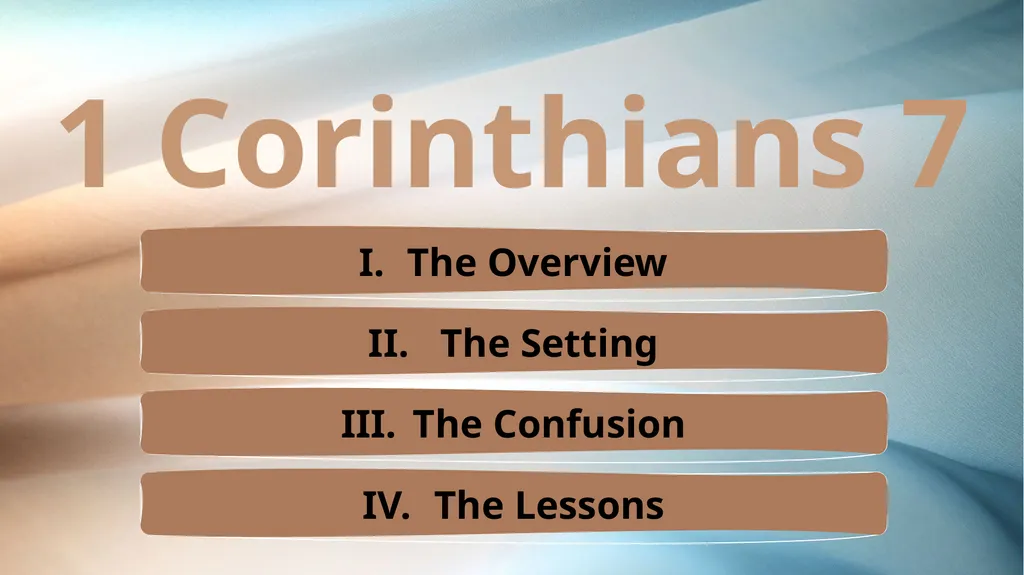
1 Corinthians 7 The Overview The Setting The Confusion The Lessons<br>
02
1 Corinthians 7 The Overview<br>
03
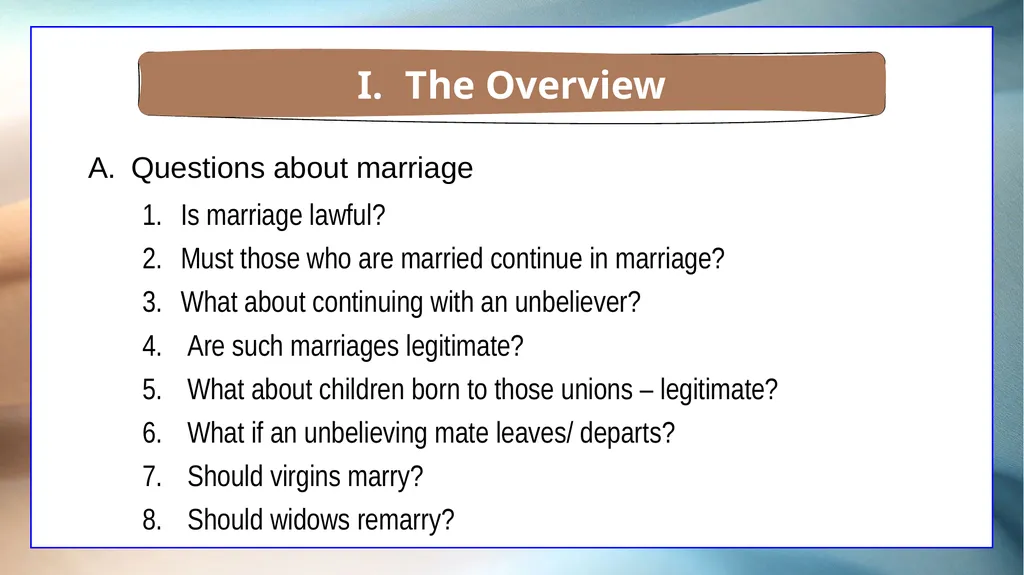
The Overview Questions about marriage Is marriage lawful?
Must those who are married continue in marriage?
What about continuing with an unbeliever?
Are such marriages legitimate?
What about children born to those unions – legitimate?
What if an unbelieving mate leaves/ departs?
Should virgins marry?
Should widows remarry?<br>
Must those who are married continue in marriage?
What about continuing with an unbeliever?
Are such marriages legitimate?
What about children born to those unions – legitimate?
What if an unbelieving mate leaves/ departs?
Should virgins marry?
Should widows remarry?<br>
04
The Overview Questions about marriage
Outline of the chapter<br>
Outline of the chapter<br>
05
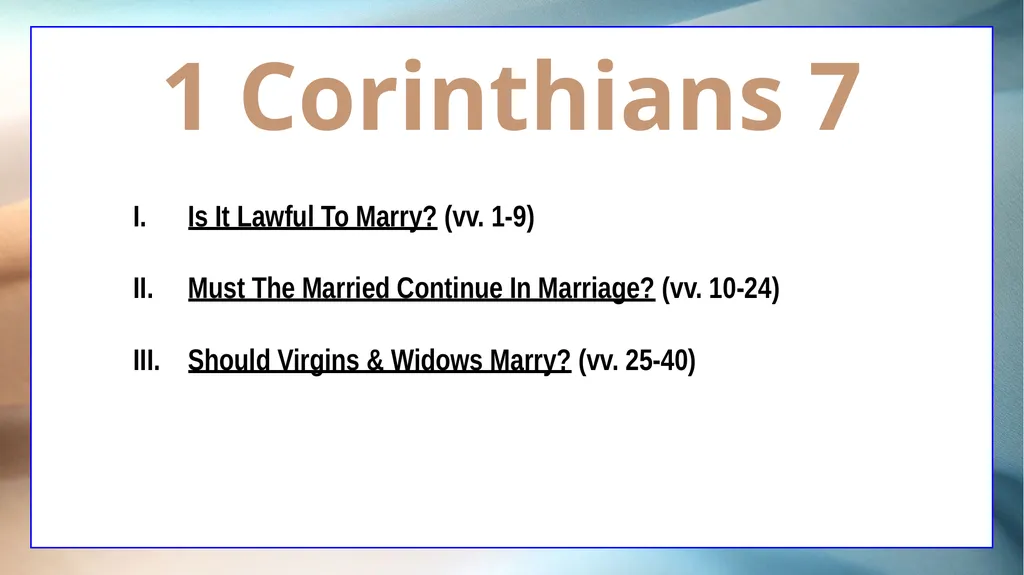
Is It Lawful To Marry? (vv. 1-9)
Must The Married Continue In Marriage? (vv. 10-24)
Should Virgins & Widows Marry? (vv. 25-40) 1 Corinthians 7<br>
Must The Married Continue In Marriage? (vv. 10-24)
Should Virgins & Widows Marry? (vv. 25-40) 1 Corinthians 7<br>
06
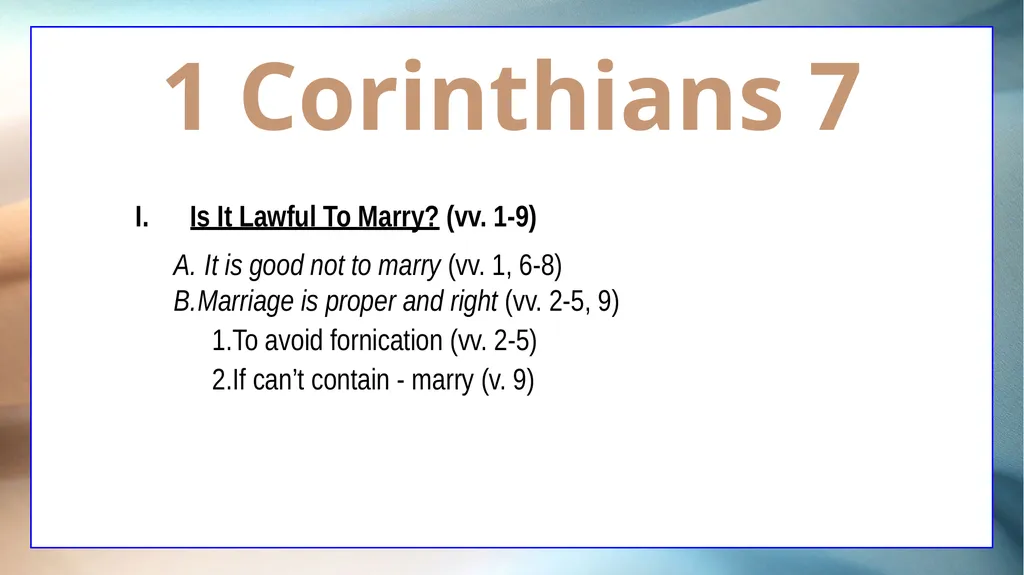
Is It Lawful To Marry? (vv. 1-9)
It is good not to marry (vv. 1, 6-8)
Marriage is proper and right (vv. 2-5, 9)
To avoid fornication (vv. 2-5)
If can’t contain - marry (v. 9) 1 Corinthians 7<br>
It is good not to marry (vv. 1, 6-8)
Marriage is proper and right (vv. 2-5, 9)
To avoid fornication (vv. 2-5)
If can’t contain - marry (v. 9) 1 Corinthians 7<br>
07
Is It Lawful To Marry? (vv. 1-9)
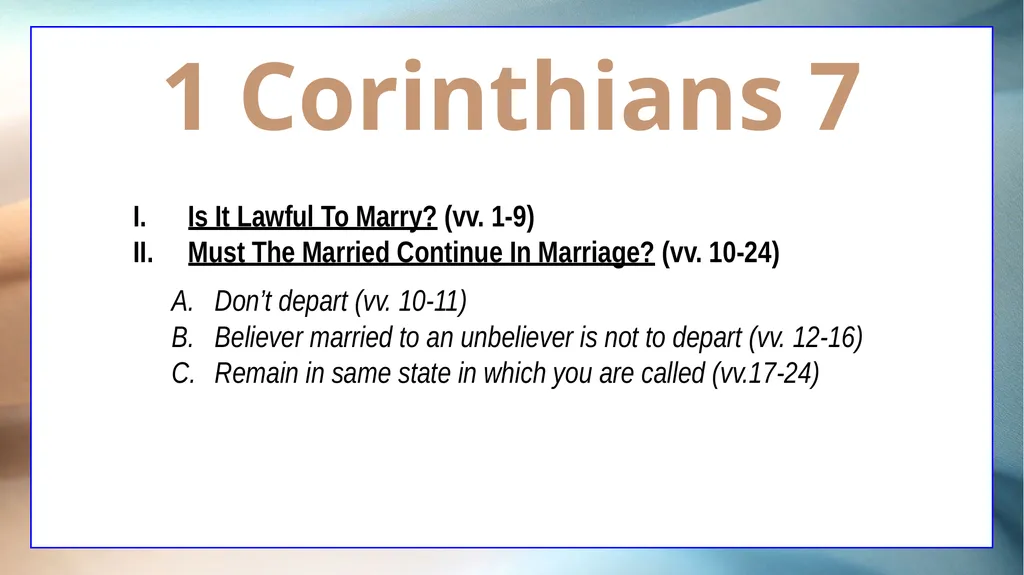
Must The Married Continue In Marriage? (vv. 10-24)
Don’t depart (vv. 10-11)
Believer married to an unbeliever is not to depart (vv. 12-16)
Remain in same state in which you are called (vv.17-24) 1 Corinthians 7<br>
Must The Married Continue In Marriage? (vv. 10-24)
Don’t depart (vv. 10-11)
Believer married to an unbeliever is not to depart (vv. 12-16)
Remain in same state in which you are called (vv.17-24) 1 Corinthians 7<br>
08
Is It Lawful To Marry? (vv. 1-9)
Must The Married Continue In Marriage? (vv. 10-24)
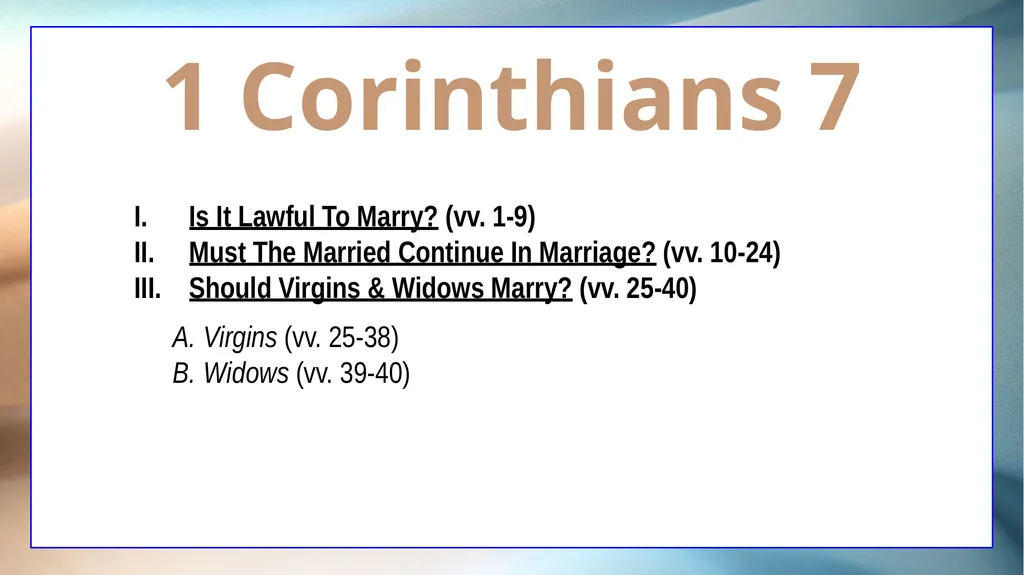
Should Virgins & Widows Marry? (vv. 25-40)
Virgins (vv. 25-38)
Widows (vv. 39-40) 1 Corinthians 7<br>
Must The Married Continue In Marriage? (vv. 10-24)
Should Virgins & Widows Marry? (vv. 25-40)
Virgins (vv. 25-38)
Widows (vv. 39-40) 1 Corinthians 7<br>
09
1 Corinthians 7 The Overview The Setting<br>
10
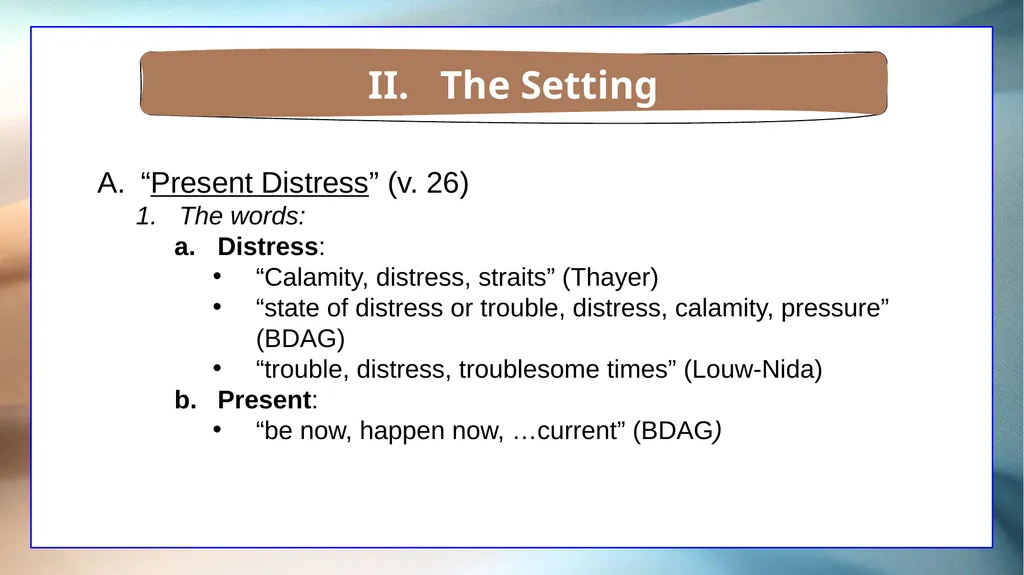
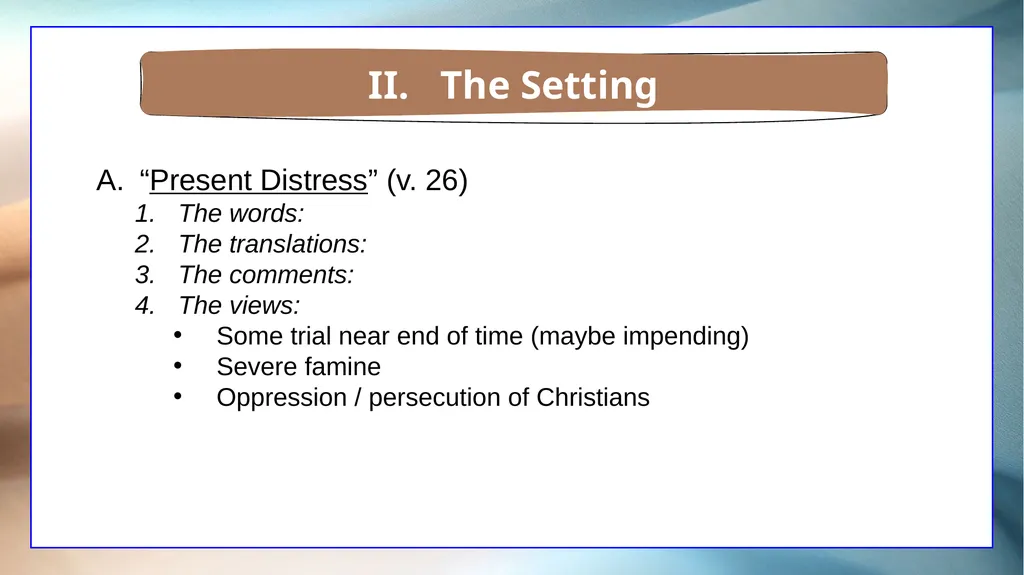
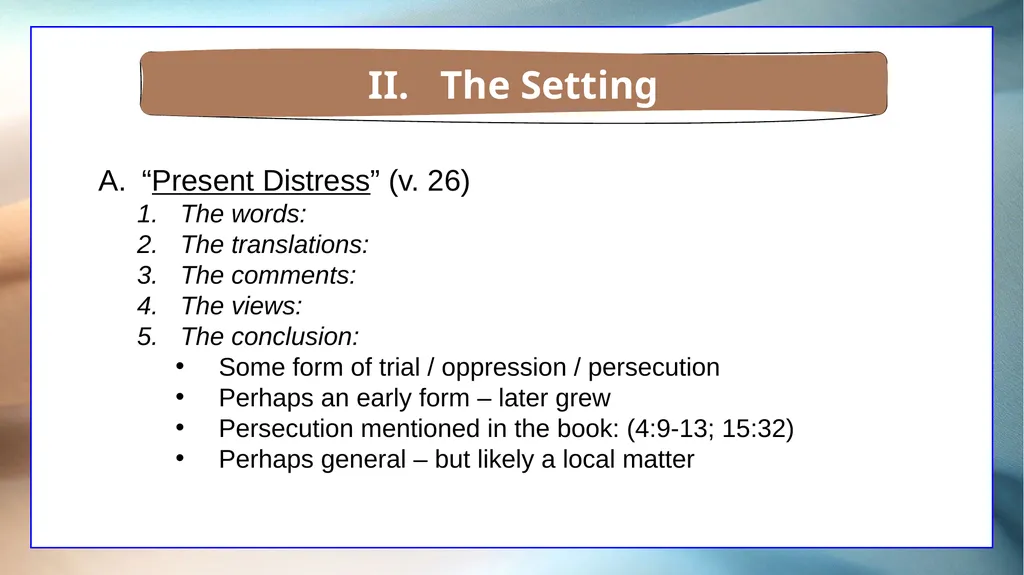
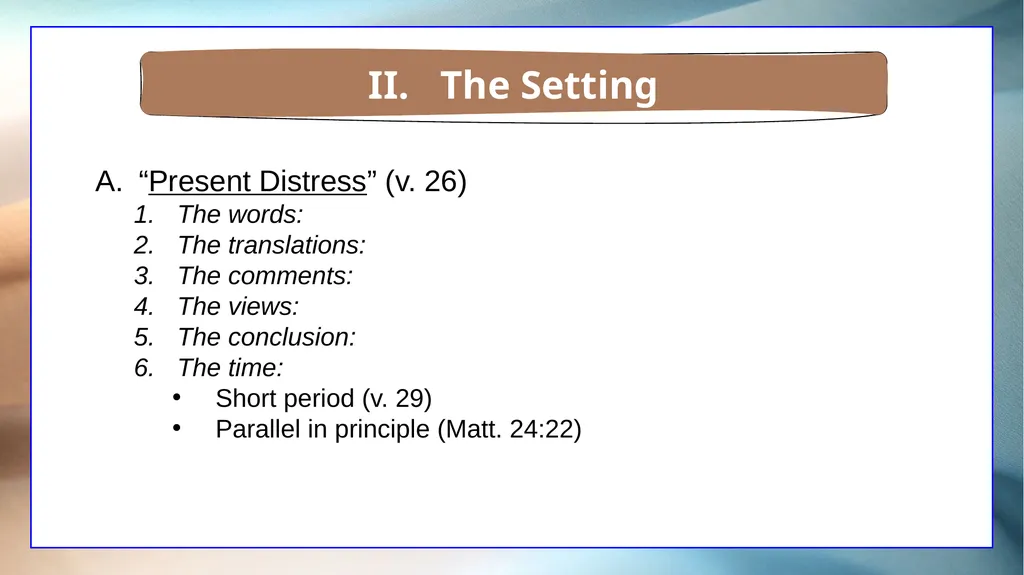
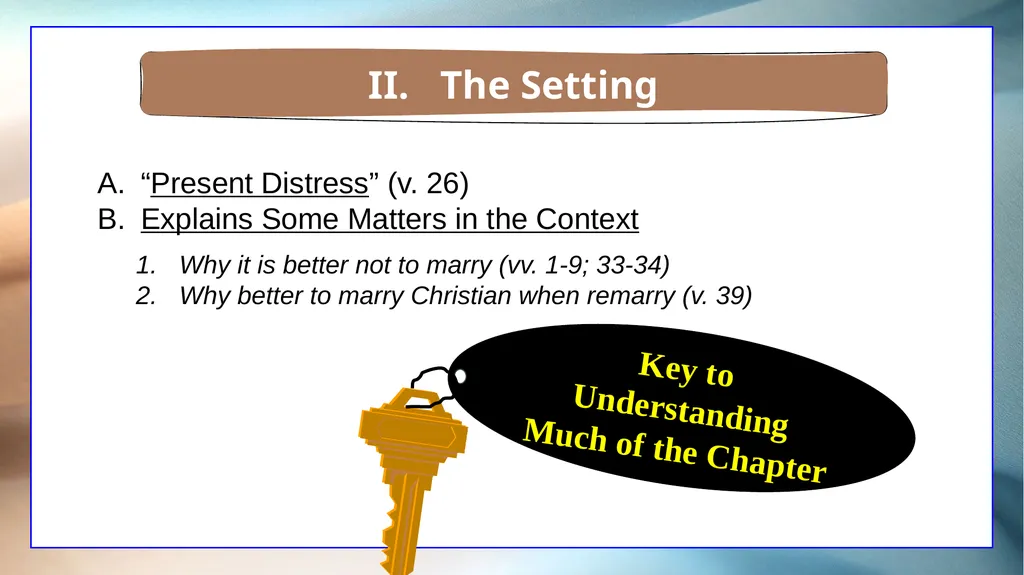
The Setting “Present Distress” (v. 26)
The words:
Distress:
“Calamity, distress, straits” (Thayer)
“state of distress or trouble, distress, calamity, pressure” (BDAG)
“trouble, distress, troublesome times” (Louw-Nida)
Present:
“be now, happen now, …current” (BDAG)<br>
The words:
Distress:
“Calamity, distress, straits” (Thayer)
“state of distress or trouble, distress, calamity, pressure” (BDAG)
“trouble, distress, troublesome times” (Louw-Nida)
Present:
“be now, happen now, …current” (BDAG)<br>
11
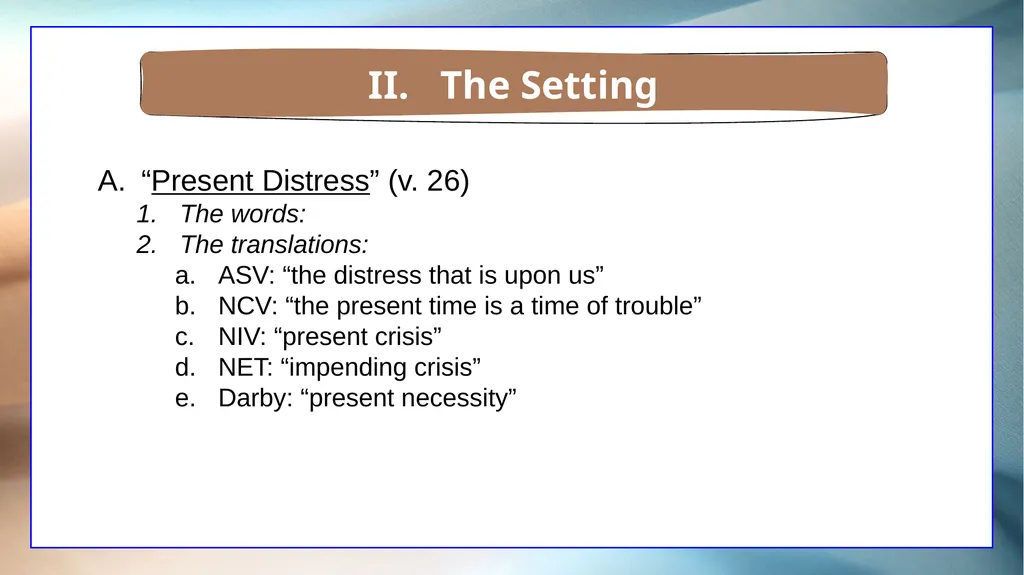
The Setting “Present Distress” (v. 26)
The words:
The translations:
ASV: “the distress that is upon us”
NCV: “the present time is a time of trouble”
NIV: “present crisis”
NET: “impending crisis”
Darby: “present necessity”<br>
The words:
The translations:
ASV: “the distress that is upon us”
NCV: “the present time is a time of trouble”
NIV: “present crisis”
NET: “impending crisis”
Darby: “present necessity”<br>
12
The Setting “Present Distress” (v. 26)
The words:
The translations:
The comments:<br>
The words:
The translations:
The comments:<br>
13
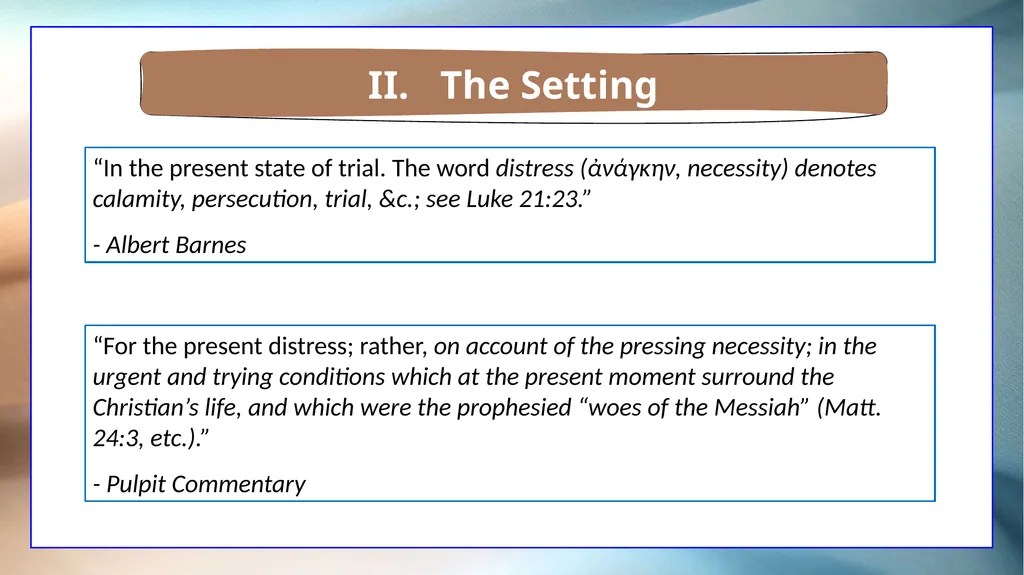
The Setting “In the present state of trial. The word distress (ἀνάγκην, necessity) denotes calamity, persecution, trial, &c.; see Luke 21:23.”
- Albert Barnes “For the present distress; rather, on account of the pressing necessity; in the urgent and trying conditions which at the present moment surround the Christian’s life, and which were the prophesied “woes of the Messiah” (Matt. 24:3, etc.).”
- Pulpit Commentary<br>
- Albert Barnes “For the present distress; rather, on account of the pressing necessity; in the urgent and trying conditions which at the present moment surround the Christian’s life, and which were the prophesied “woes of the Messiah” (Matt. 24:3, etc.).”
- Pulpit Commentary<br>
14
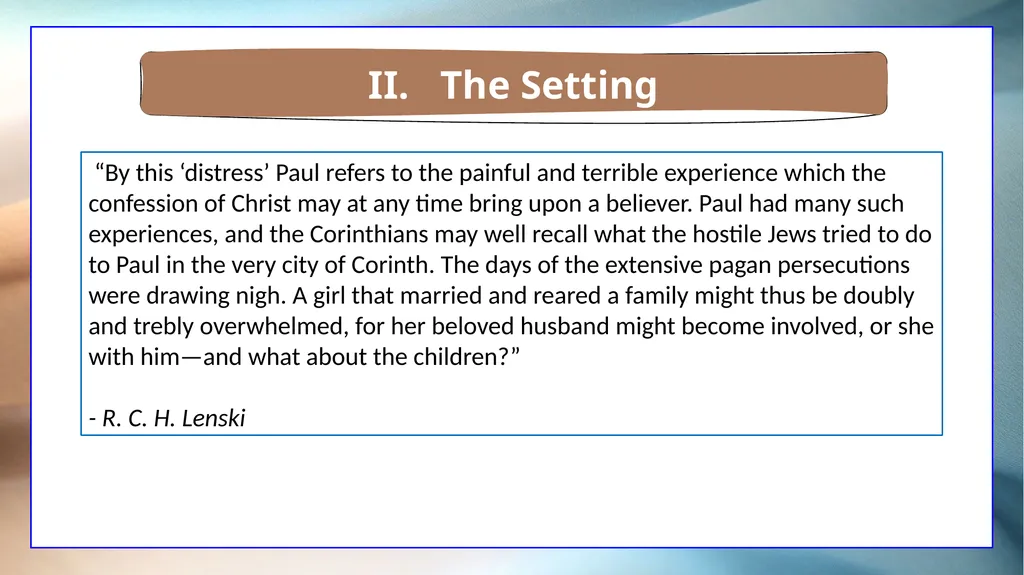
The Setting “By this ‘distress’ Paul refers to the painful and terrible experience which the confession of Christ may at any time bring upon a believer. Paul had many such experiences, and the Corinthians may well recall what the hostile Jews tried to do to Paul in the very city of Corinth. The days of the extensive pagan persecutions were drawing nigh. A girl that married and reared a family might thus be doubly and trebly overwhelmed, for her beloved husband might become involved, or she with him—and what about the children?”
- R. C. H. Lenski<br>
- R. C. H. Lenski<br>
15
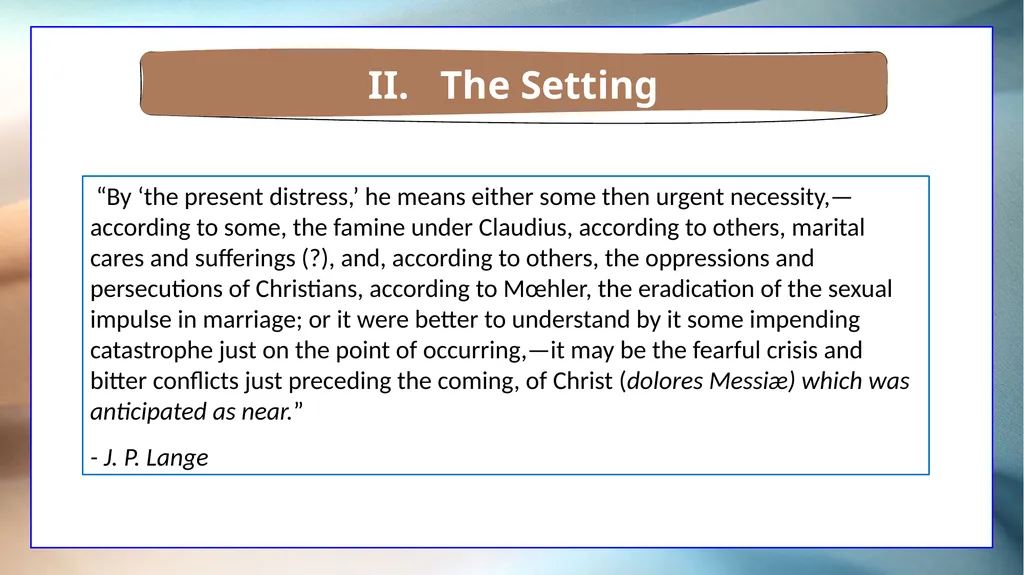
The Setting “By ‘the present distress,’ he means either some then urgent necessity,—according to some, the famine under Claudius, according to others, marital cares and sufferings (?), and, according to others, the oppressions and persecutions of Christians, according to Mœhler, the eradication of the sexual impulse in marriage; or it were better to understand by it some impending catastrophe just on the point of occurring,—it may be the fearful crisis and bitter conflicts just preceding the coming, of Christ (dolores Messiæ) which was anticipated as near.”
- J. P. Lange<br>
- J. P. Lange<br>
16
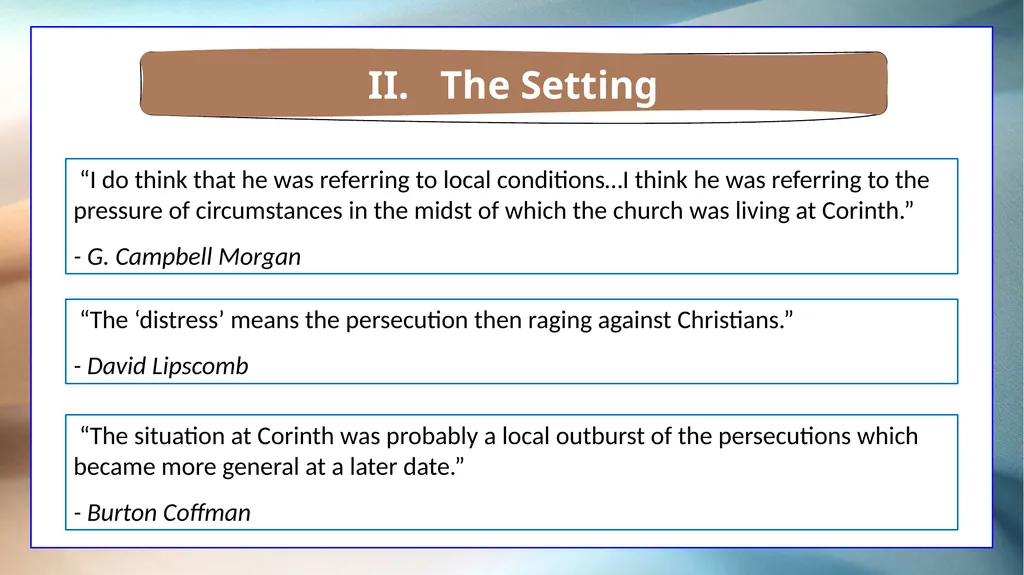
The Setting “I do think that he was referring to local conditions…I think he was referring to the pressure of circumstances in the midst of which the church was living at Corinth.”
- G. Campbell Morgan “The ‘distress’ means the persecution then raging against Christians.”
- David Lipscomb “The situation at Corinth was probably a local outburst of the persecutions which became more general at a later date.”
- Burton Coffman<br>
- G. Campbell Morgan “The ‘distress’ means the persecution then raging against Christians.”
- David Lipscomb “The situation at Corinth was probably a local outburst of the persecutions which became more general at a later date.”
- Burton Coffman<br>
17
The Setting “Present Distress” (v. 26)
The words:
The translations:
The comments:
The views:
Some trial near end of time (maybe impending)
Severe famine
Oppression / persecution of Christians<br>
The words:
The translations:
The comments:
The views:
Some trial near end of time (maybe impending)
Severe famine
Oppression / persecution of Christians<br>
18
The Setting “Present Distress” (v. 26)
The words:
The translations:
The comments:
The views:
The conclusion:
Some form of trial / oppression / persecution
Perhaps an early form – later grew
Persecution mentioned in the book: (4:9-13; 15:32)
Perhaps general – but likely a local matter<br>
The words:
The translations:
The comments:
The views:
The conclusion:
Some form of trial / oppression / persecution
Perhaps an early form – later grew
Persecution mentioned in the book: (4:9-13; 15:32)
Perhaps general – but likely a local matter<br>
19
The Setting “Present Distress” (v. 26)
The words:
The translations:
The comments:
The views:
The conclusion:
The time:
Short period (v. 29)
Parallel in principle (Matt. 24:22)<br>
The words:
The translations:
The comments:
The views:
The conclusion:
The time:
Short period (v. 29)
Parallel in principle (Matt. 24:22)<br>
20
The Setting “Present Distress” (v. 26)
Explains Some Matters in the Context
Why it is better not to marry (vv. 1-9; 33-34)
Why better to marry Christian when remarry (v. 39) Key to
Understanding
Much of the Chapter<br>
Explains Some Matters in the Context
Why it is better not to marry (vv. 1-9; 33-34)
Why better to marry Christian when remarry (v. 39) Key to
Understanding
Much of the Chapter<br>
21
1 Corinthians 7 The Overview The Setting The Confusion<br>
22
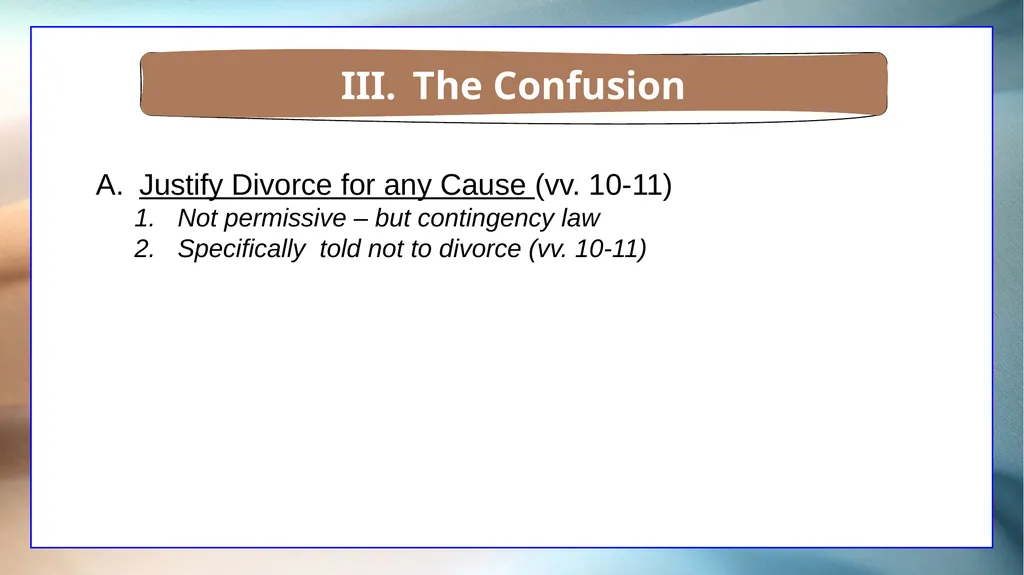
The Confusion Justify Divorce for any Cause (vv. 10-11)
Not permissive – but contingency law
Specifically told not to divorce (vv. 10-11)<br>
Not permissive – but contingency law
Specifically told not to divorce (vv. 10-11)<br>
23
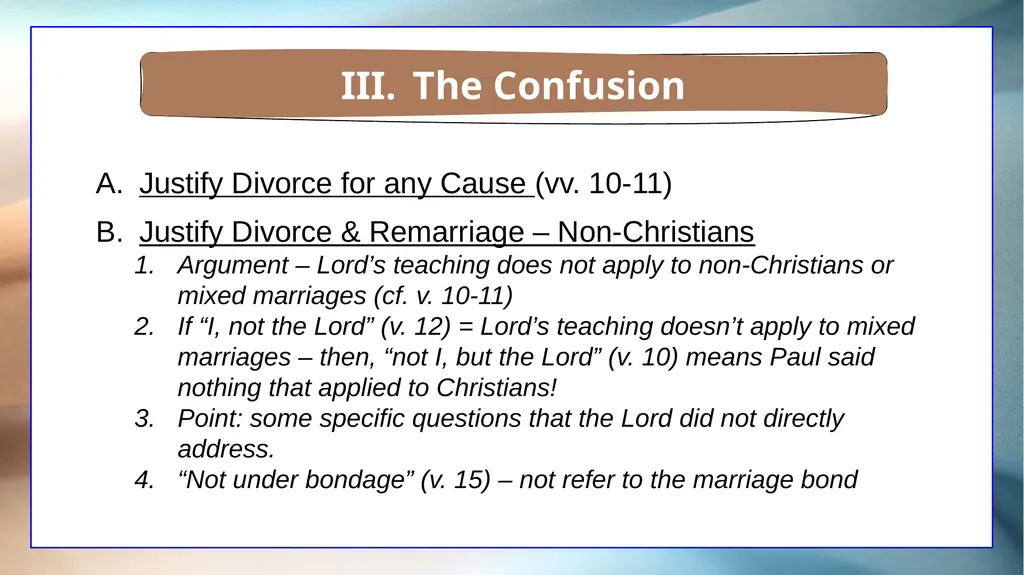
The Confusion Justify Divorce for any Cause (vv. 10-11)
Justify Divorce & Remarriage – Non-Christians
Argument – Lord’s teaching does not apply to non-Christians or mixed marriages (cf. v. 10-11)
If “I, not the Lord” (v. 12) = Lord’s teaching doesn’t apply to mixed marriages – then, “not I, but the Lord” (v. 10) means Paul said nothing that applied to Christians!
Point: some specific questions that the Lord did not directly address.
“Not under bondage” (v. 15) – not refer to the marriage bond<br>
Justify Divorce & Remarriage – Non-Christians
Argument – Lord’s teaching does not apply to non-Christians or mixed marriages (cf. v. 10-11)
If “I, not the Lord” (v. 12) = Lord’s teaching doesn’t apply to mixed marriages – then, “not I, but the Lord” (v. 10) means Paul said nothing that applied to Christians!
Point: some specific questions that the Lord did not directly address.
“Not under bondage” (v. 15) – not refer to the marriage bond<br>
24
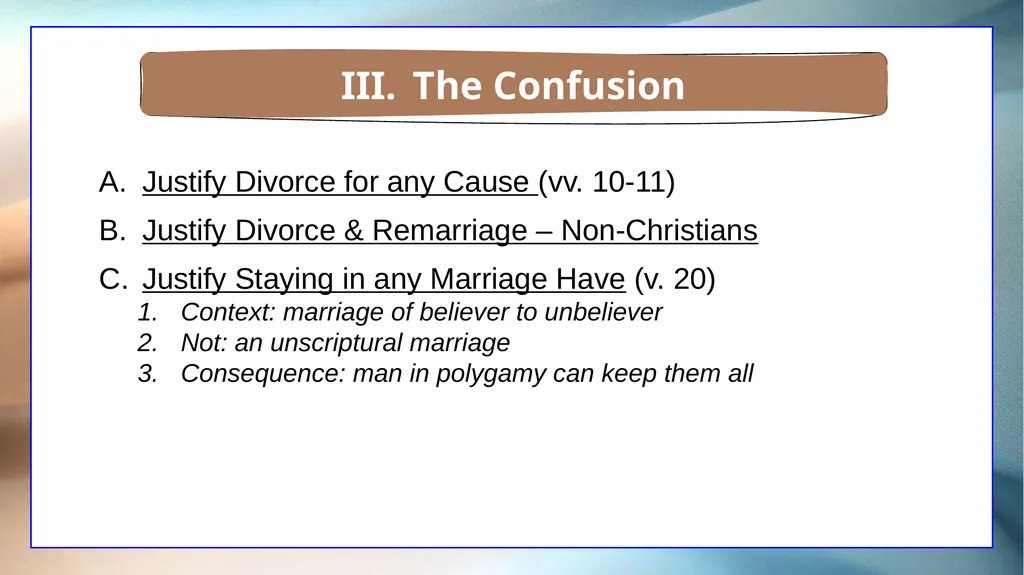
The Confusion Justify Divorce for any Cause (vv. 10-11)
Justify Divorce & Remarriage – Non-Christians
Justify Staying in any Marriage Have (v. 20)
Context: marriage of believer to unbeliever
Not: an unscriptural marriage
Consequence: man in polygamy can keep them all<br>
Justify Divorce & Remarriage – Non-Christians
Justify Staying in any Marriage Have (v. 20)
Context: marriage of believer to unbeliever
Not: an unscriptural marriage
Consequence: man in polygamy can keep them all<br>
25
1 Corinthians 7 The Overview The Setting The Confusion The Lessons<br>
26
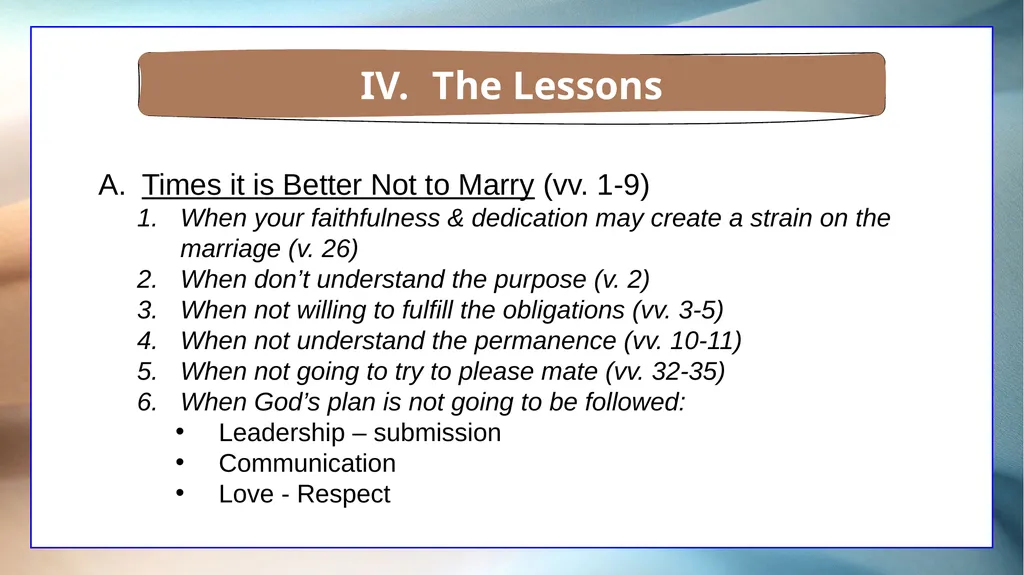
The Lessons Times it is Better Not to Marry (vv. 1-9)
When your faithfulness & dedication may create a strain on the marriage (v. 26)
When don’t understand the purpose (v. 2)
When not willing to fulfill the obligations (vv. 3-5)
When not understand the permanence (vv. 10-11)
When not going to try to please mate (vv. 32-35)
When God’s plan is not going to be followed:
Leadership – submission
Communication
Love - Respect<br>
When your faithfulness & dedication may create a strain on the marriage (v. 26)
When don’t understand the purpose (v. 2)
When not willing to fulfill the obligations (vv. 3-5)
When not understand the permanence (vv. 10-11)
When not going to try to please mate (vv. 32-35)
When God’s plan is not going to be followed:
Leadership – submission
Communication
Love - Respect<br>
27
The Lessons Times it is Better Not to Marry (vv. 1-9)
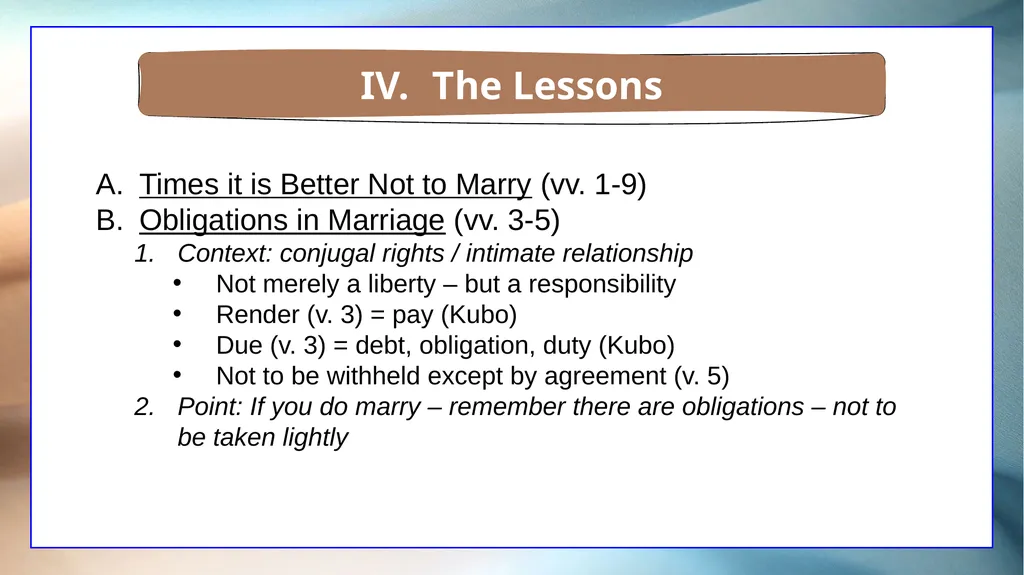
Obligations in Marriage (vv. 3-5)
Context: conjugal rights / intimate relationship
Not merely a liberty – but a responsibility
Render (v. 3) = pay (Kubo)
Due (v. 3) = debt, obligation, duty (Kubo)
Not to be withheld except by agreement (v. 5)
Point: If you do marry – remember there are obligations – not to be taken lightly<br>
Obligations in Marriage (vv. 3-5)
Context: conjugal rights / intimate relationship
Not merely a liberty – but a responsibility
Render (v. 3) = pay (Kubo)
Due (v. 3) = debt, obligation, duty (Kubo)
Not to be withheld except by agreement (v. 5)
Point: If you do marry – remember there are obligations – not to be taken lightly<br>
28
The Lessons Times it is Better Not to Marry (vv. 1-9)
Obligations in Marriage (vv. 3-5)
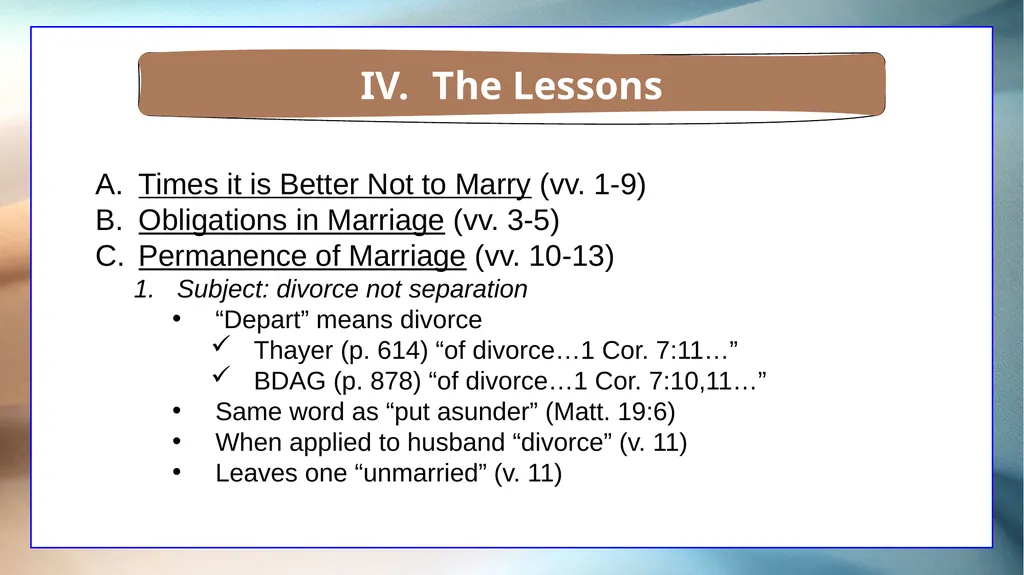
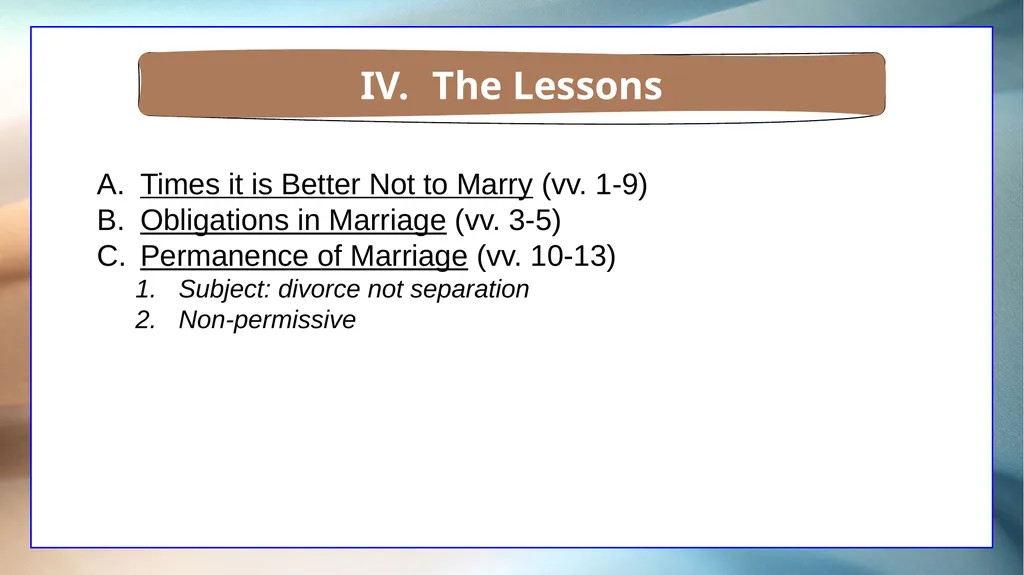
Permanence of Marriage (vv. 10-13)
Subject: divorce not separation
“Depart” means divorce
Thayer (p. 614) “of divorce…1 Cor. 7:11…”
BDAG (p. 878) “of divorce…1 Cor. 7:10,11…”
Same word as “put asunder” (Matt. 19:6)
When applied to husband “divorce” (v. 11)
Leaves one “unmarried” (v. 11)<br>
Obligations in Marriage (vv. 3-5)
Permanence of Marriage (vv. 10-13)
Subject: divorce not separation
“Depart” means divorce
Thayer (p. 614) “of divorce…1 Cor. 7:11…”
BDAG (p. 878) “of divorce…1 Cor. 7:10,11…”
Same word as “put asunder” (Matt. 19:6)
When applied to husband “divorce” (v. 11)
Leaves one “unmarried” (v. 11)<br>
29
The Lessons Times it is Better Not to Marry (vv. 1-9)
Obligations in Marriage (vv. 3-5)
Permanence of Marriage (vv. 10-13)
Subject: divorce not separation
Non-permissive<br>
Obligations in Marriage (vv. 3-5)
Permanence of Marriage (vv. 10-13)
Subject: divorce not separation
Non-permissive<br>
30
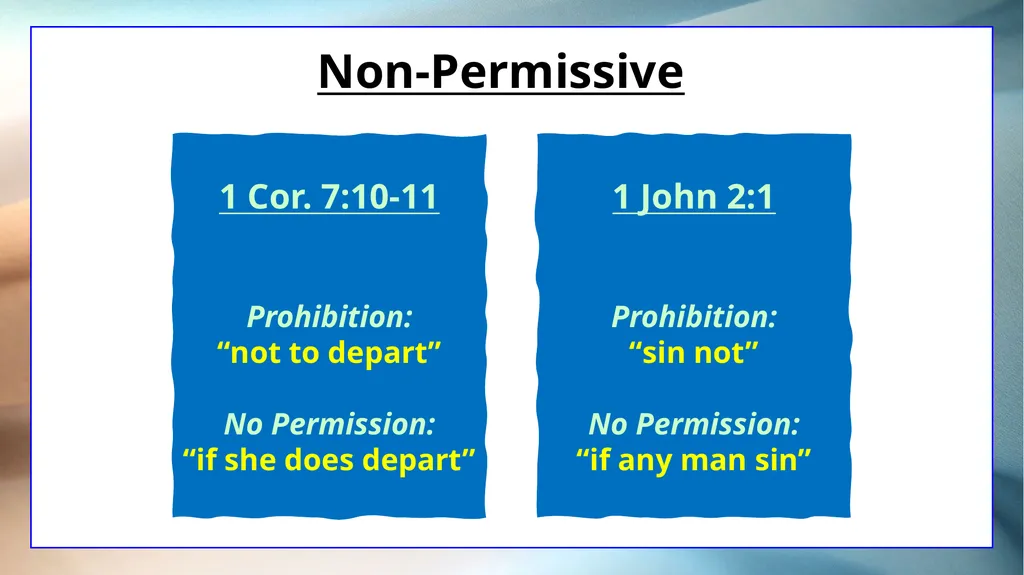
Non-Permissive 1 Cor. 7:10-11
Prohibition:
“not to depart”
No Permission:
“if she does depart” 1 John 2:1
Prohibition:
“sin not”
No Permission:
“if any man sin”<br>
Prohibition:
“not to depart”
No Permission:
“if she does depart” 1 John 2:1
Prohibition:
“sin not”
No Permission:
“if any man sin”<br>
31
The Lessons Times it is Better Not to Marry (vv. 1-9)
Obligations in Marriage (vv. 3-5)
Permanence of Marriage (vv. 10-13)
Subject: divorce not separation
Non-permissive
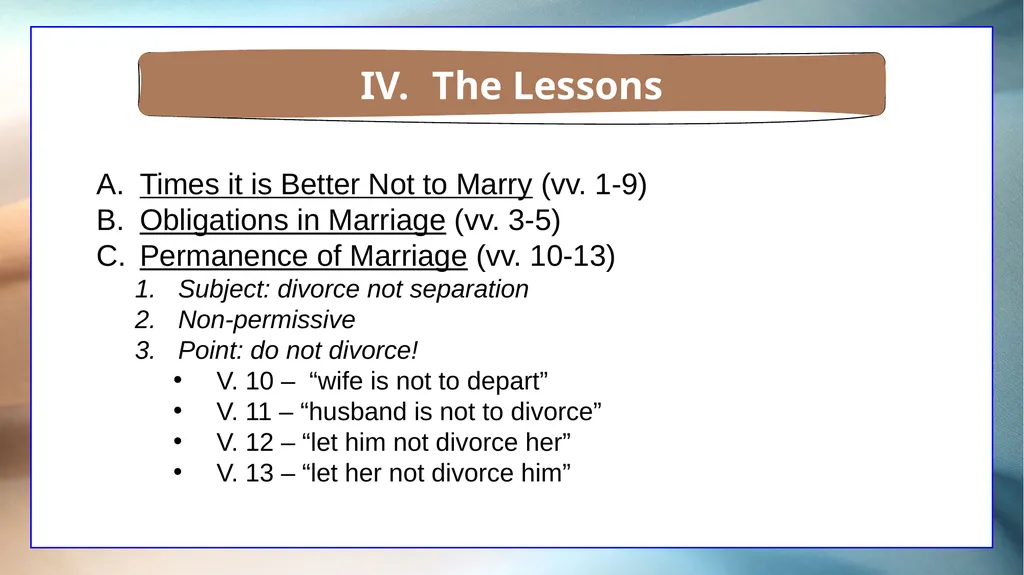
Point: do not divorce!
V. 10 – “wife is not to depart”
V. 11 – “husband is not to divorce”
V. 12 – “let him not divorce her”
V. 13 – “let her not divorce him”<br>
Obligations in Marriage (vv. 3-5)
Permanence of Marriage (vv. 10-13)
Subject: divorce not separation
Non-permissive
Point: do not divorce!
V. 10 – “wife is not to depart”
V. 11 – “husband is not to divorce”
V. 12 – “let him not divorce her”
V. 13 – “let her not divorce him”<br>
32
The Lessons Times it is Better Not to Marry (vv. 1-9)
Obligations in Marriage (vv. 3-5)
Permanence of Marriage (vv. 10-13)
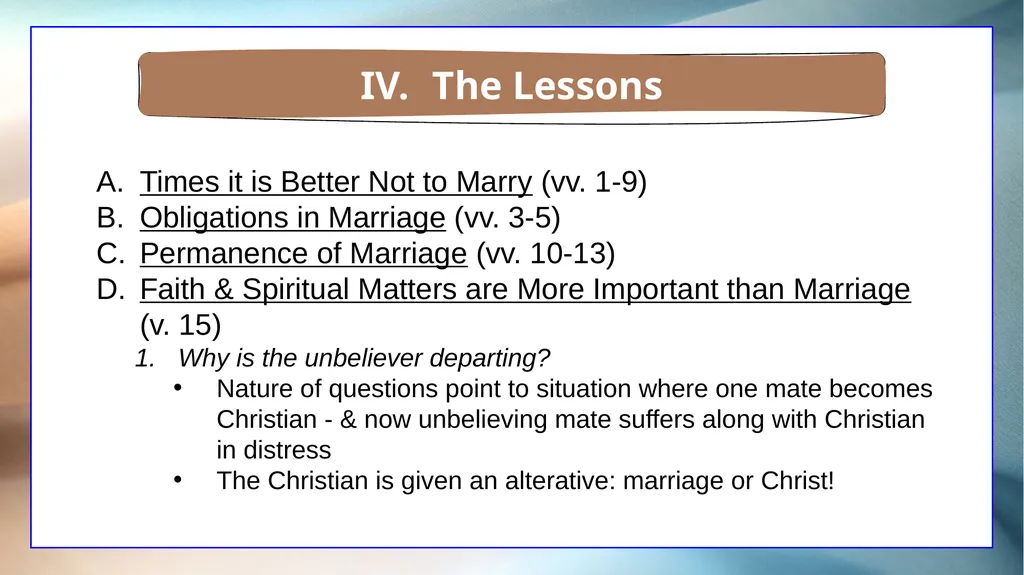
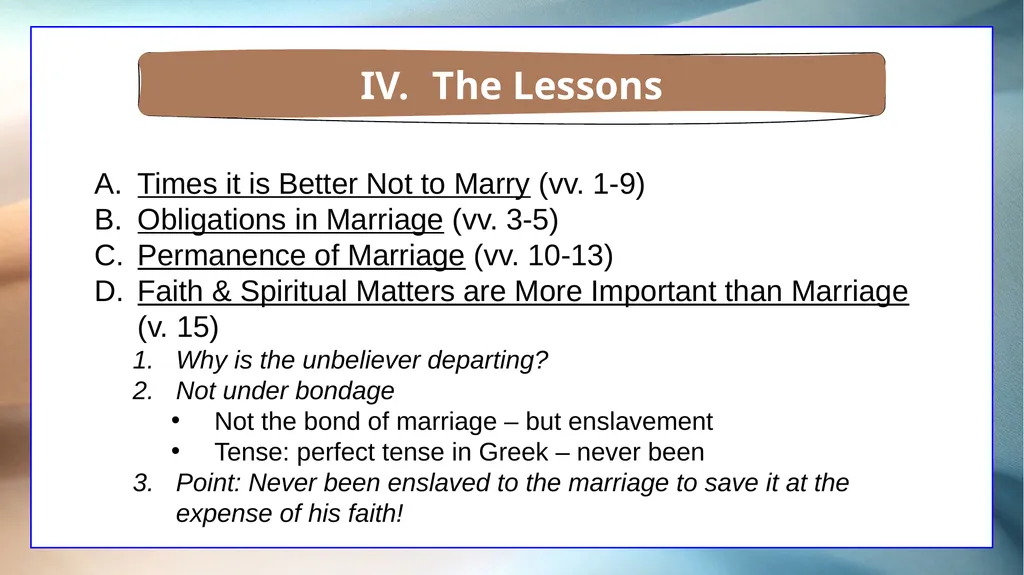
Faith & Spiritual Matters are More Important than Marriage (v. 15)
Why is the unbeliever departing?
Nature of questions point to situation where one mate becomes Christian - & now unbelieving mate suffers along with Christian in distress
The Christian is given an alterative: marriage or Christ!<br>
Obligations in Marriage (vv. 3-5)
Permanence of Marriage (vv. 10-13)
Faith & Spiritual Matters are More Important than Marriage (v. 15)
Why is the unbeliever departing?
Nature of questions point to situation where one mate becomes Christian - & now unbelieving mate suffers along with Christian in distress
The Christian is given an alterative: marriage or Christ!<br>
33
The Lessons Times it is Better Not to Marry (vv. 1-9)
Obligations in Marriage (vv. 3-5)
Permanence of Marriage (vv. 10-13)
Faith & Spiritual Matters are More Important than Marriage (v. 15)
Why is the unbeliever departing?
Not under bondage
Not the bond of marriage – but enslavement
Tense: perfect tense in Greek – never been
Point: Never been enslaved to the marriage to save it at the expense of his faith!<br>
Obligations in Marriage (vv. 3-5)
Permanence of Marriage (vv. 10-13)
Faith & Spiritual Matters are More Important than Marriage (v. 15)
Why is the unbeliever departing?
Not under bondage
Not the bond of marriage – but enslavement
Tense: perfect tense in Greek – never been
Point: Never been enslaved to the marriage to save it at the expense of his faith!<br>
34
The Lessons Times it is Better Not to Marry (vv. 1-9)
Obligations in Marriage (vv. 3-5)
Permanence of Marriage (vv. 10-13)
Faith & Spiritual Matters are More Important than Marriage (v. 15)
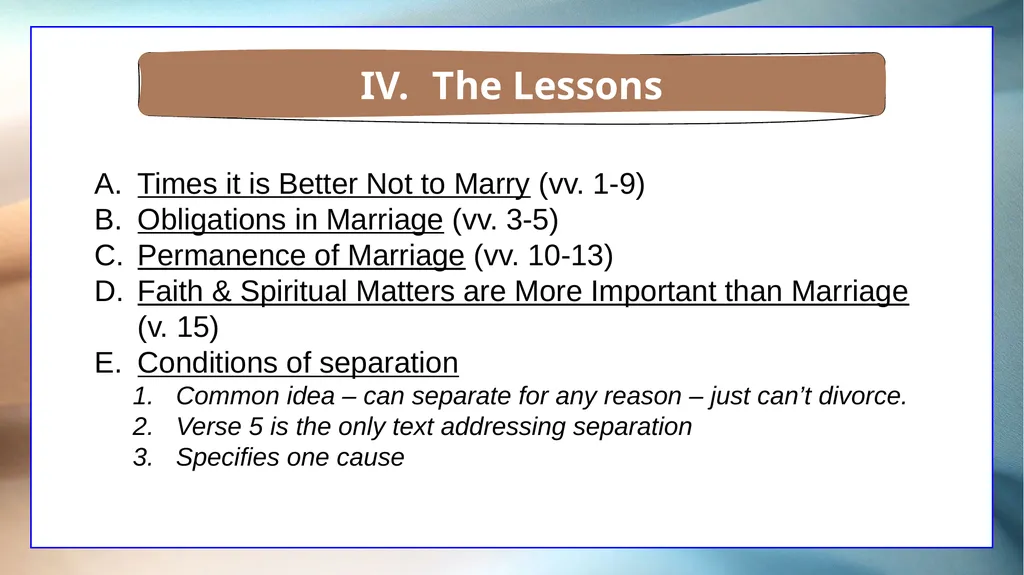
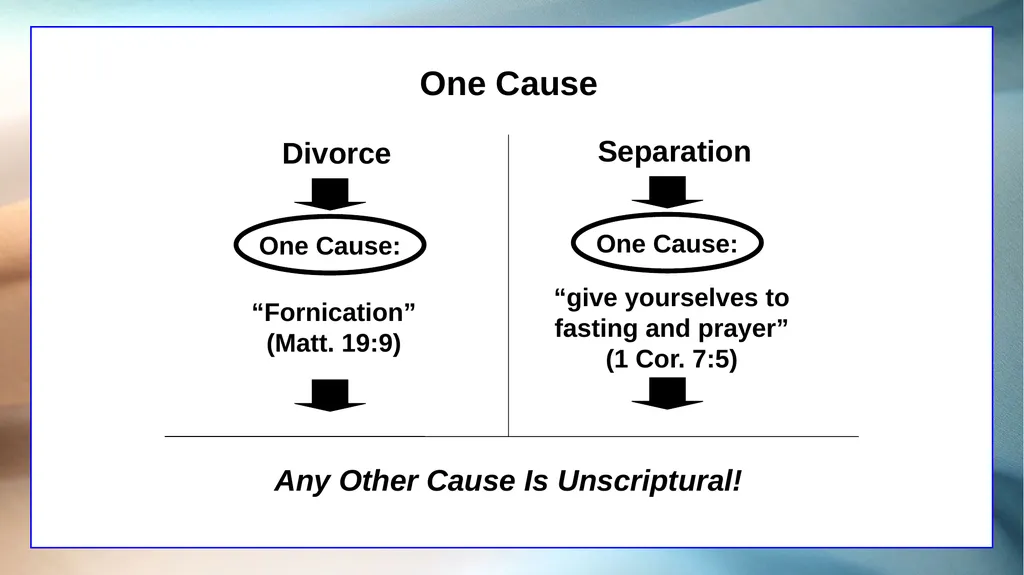
Conditions of separation
Common idea – can separate for any reason – just can’t divorce.
Verse 5 is the only text addressing separation
Specifies one cause<br>
Obligations in Marriage (vv. 3-5)
Permanence of Marriage (vv. 10-13)
Faith & Spiritual Matters are More Important than Marriage (v. 15)
Conditions of separation
Common idea – can separate for any reason – just can’t divorce.
Verse 5 is the only text addressing separation
Specifies one cause<br>
35
The Lessons Times it is Better Not to Marry (vv. 1-9)
Obligations in Marriage (vv. 3-5)
Permanence of Marriage (vv. 10-13)
Faith & Spiritual Matters are More Important than Marriage (v. 15)
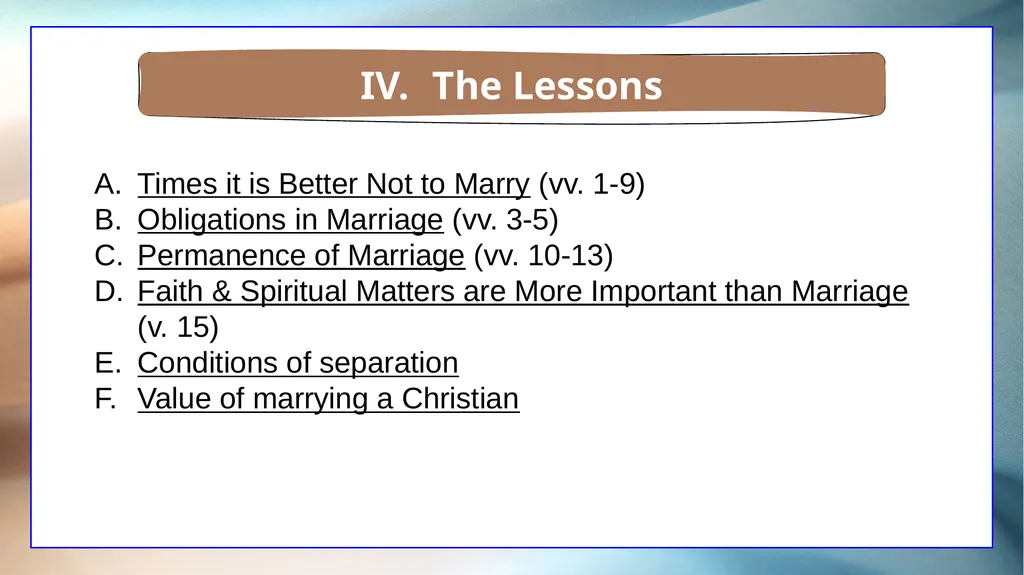
Conditions of separation
Value of marrying a Christian<br>
Obligations in Marriage (vv. 3-5)
Permanence of Marriage (vv. 10-13)
Faith & Spiritual Matters are More Important than Marriage (v. 15)
Conditions of separation
Value of marrying a Christian<br>
36
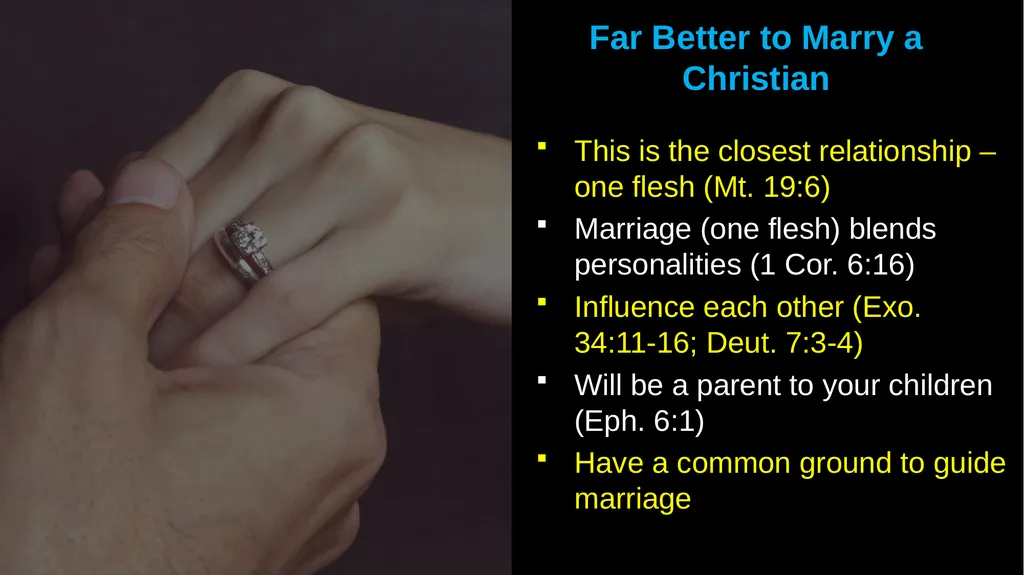
This is the closest relationship – one flesh (Mt. 19:6)
Marriage (one flesh) blends personalities (1 Cor. 6:16)
Influence each other (Exo. 34:11-16; Deut. 7:3-4)
Will be a parent to your children (Eph. 6:1)
Have a common ground to guide marriage Far Better to Marry a Christian<br>
Marriage (one flesh) blends personalities (1 Cor. 6:16)
Influence each other (Exo. 34:11-16; Deut. 7:3-4)
Will be a parent to your children (Eph. 6:1)
Have a common ground to guide marriage Far Better to Marry a Christian<br>
37
1 Corinthians 7 The Overview The Setting The Confusion The Lessons<br>