1 Cybersecurity (Security) and P4 Programmable Switches Escalating Privileges and Installing a Backdoor Ali AlSabeh, Jorge Crichigno University of South Carolina http:ce.sc.educyberinfra Western Academy Support and Training Center
"1 Cybersecurity (Security+) and P4 Programmable" is the property of its rightful owner. Permission is granted to
download and print the materials on this website for personal, non-commercial use only, and to display it
on your personal computer provided you do not modify the materials and that you retain all copyright
notices contained in the materials. By downloading content from our website, you accept the terms of this
agreement.
Presentation Transcript
01
1 Cybersecurity (Security+) and P4
Programmable Switches
Escalating Privileges and Installing a Backdoor
Ali AlSabeh, Jorge Crichigno
University of South Carolina
http://ce.sc.edu/cyberinfra
Western Academy Support and Training Center (WASTC)
University of South Carolina (USC)
Energy Sciences Network (ESnet)
June 19th, 2023<br>
02
Lab 3: Escalating Privileges and Installing a Backdoor 2<br>
03
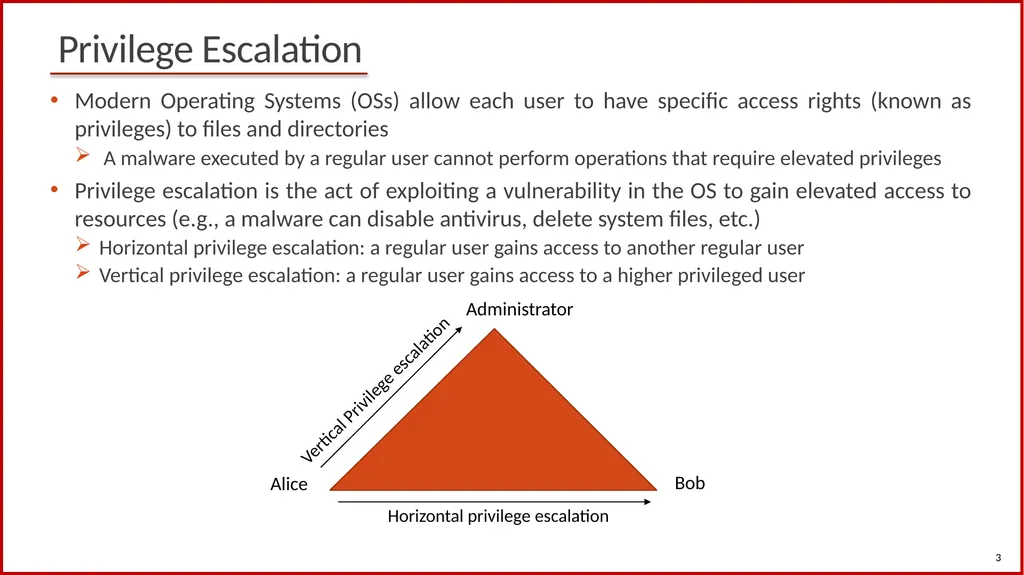
Privilege Escalation Modern Operating Systems (OSs) allow each user to have specific access rights (known as privileges) to files and directories
A malware executed by a regular user cannot perform operations that require elevated privileges
Privilege escalation is the act of exploiting a vulnerability in the OS to gain elevated access to resources (e.g., a malware can disable antivirus, delete system files, etc.)
Horizontal privilege escalation: a regular user gains access to another regular user
Vertical privilege escalation: a regular user gains access to a higher privileged user 3 Administrator Alice Bob Vertical Privilege escalation Horizontal privilege escalation<br>
04
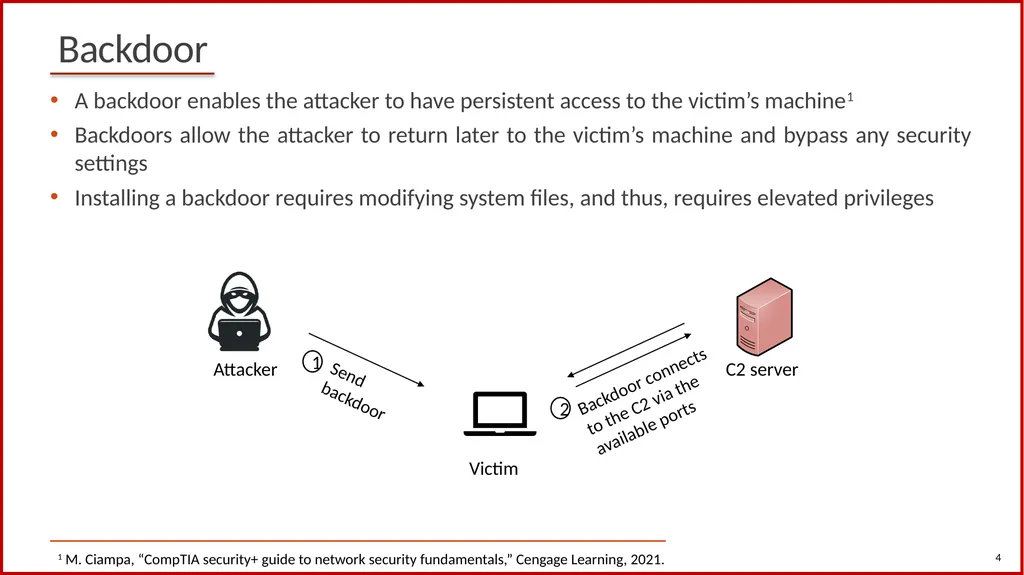
Backdoor A backdoor enables the attacker to have persistent access to the victim’s machine1
Backdoors allow the attacker to return later to the victim’s machine and bypass any security settings
Installing a backdoor requires modifying system files, and thus, requires elevated privileges 4 1 M. Ciampa, “CompTIA security+ guide to network security fundamentals,” Cengage Learning, 2021. Victim Attacker C2 server Send backdoor Backdoor connects to the C2 via the available ports 1 2<br>
05
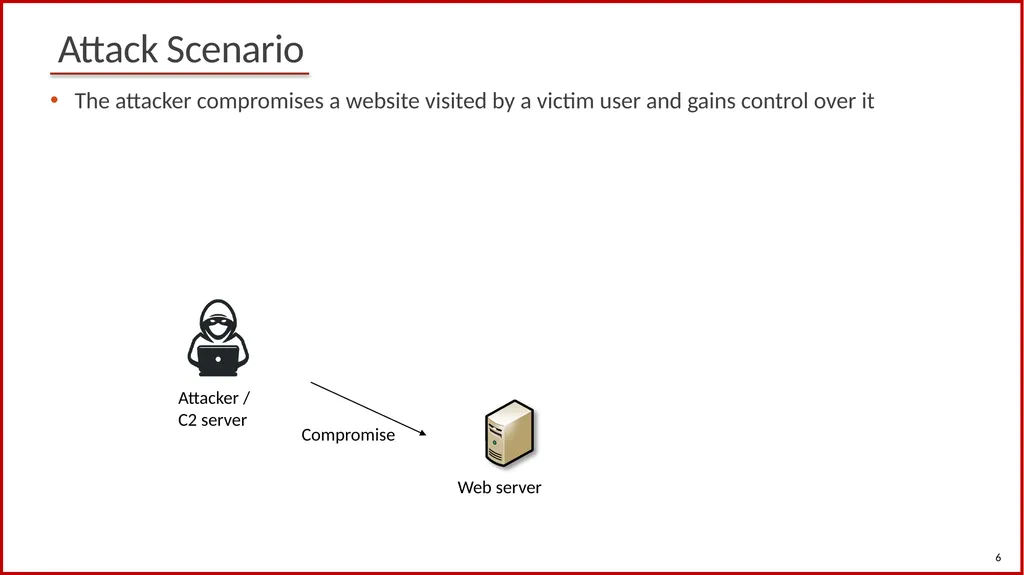
Attack Scenario The attacker compromises a website visited by a victim user and gains control over it
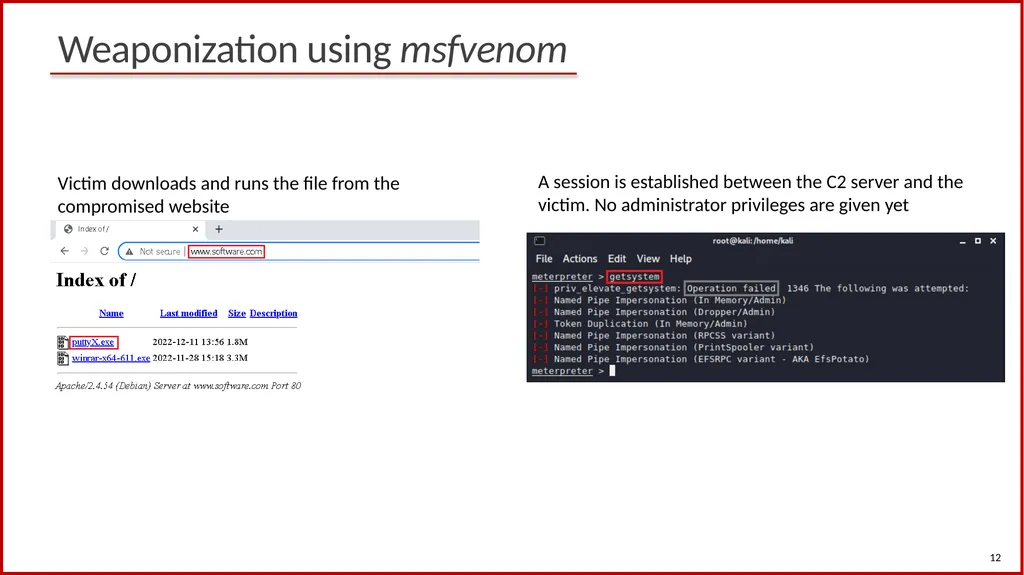
The victim visits the compromised website and downloads the malicious file
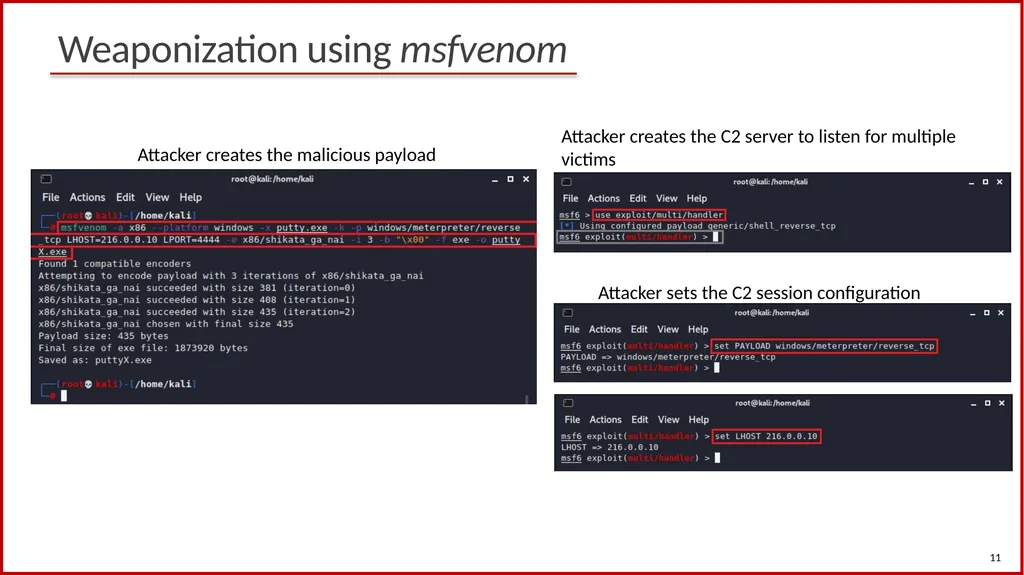
The downloaded file is a Remote Access Trojan (RAT) that is crafted by the attacker using msfvenom1 tool
The crafted payload is a “reverse TCP meterpreter” that allows the attacker to establish a reverse shell to the victim’s device
The attacker keeps listening to incoming connections from the RAT (using msfconsole2 tool). The listening process is the C2 server
Once the victim executes the malicious file (RAT), a connection is initiated to the C2 server
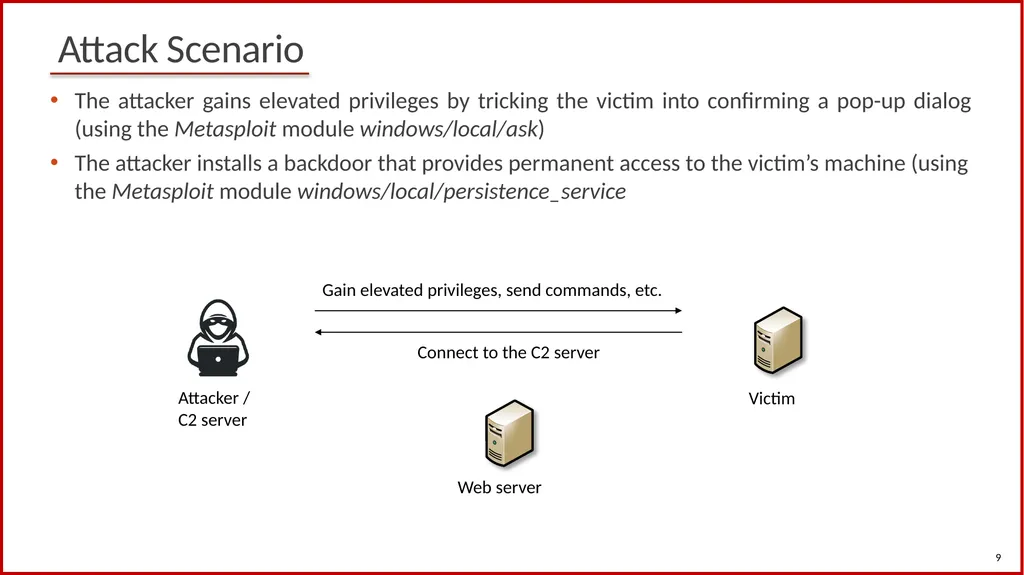
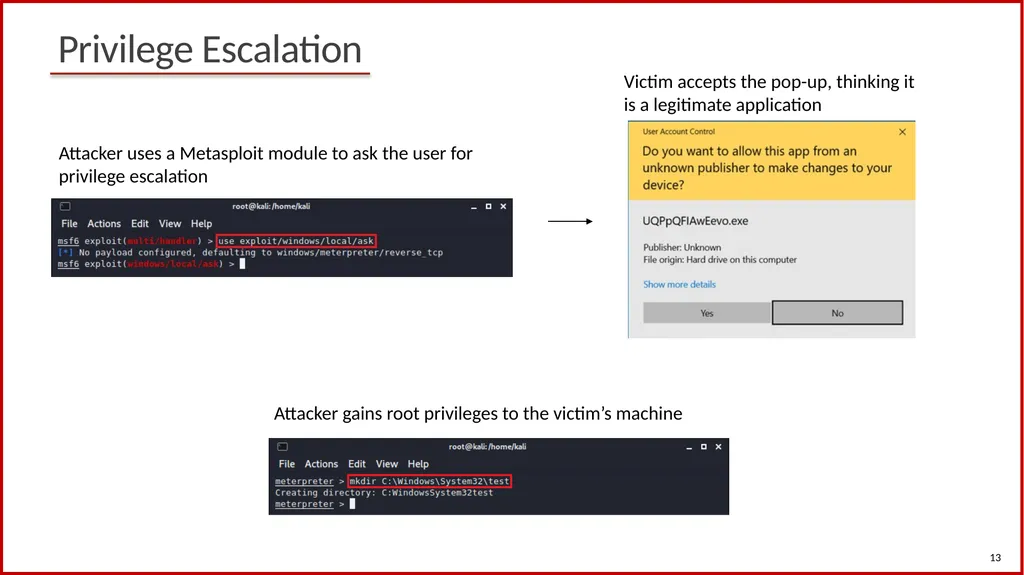
The attacker gains elevated privileges by tricking the victim into confirming a pop-up dialog (using the Metasploit module windows/local/ask)
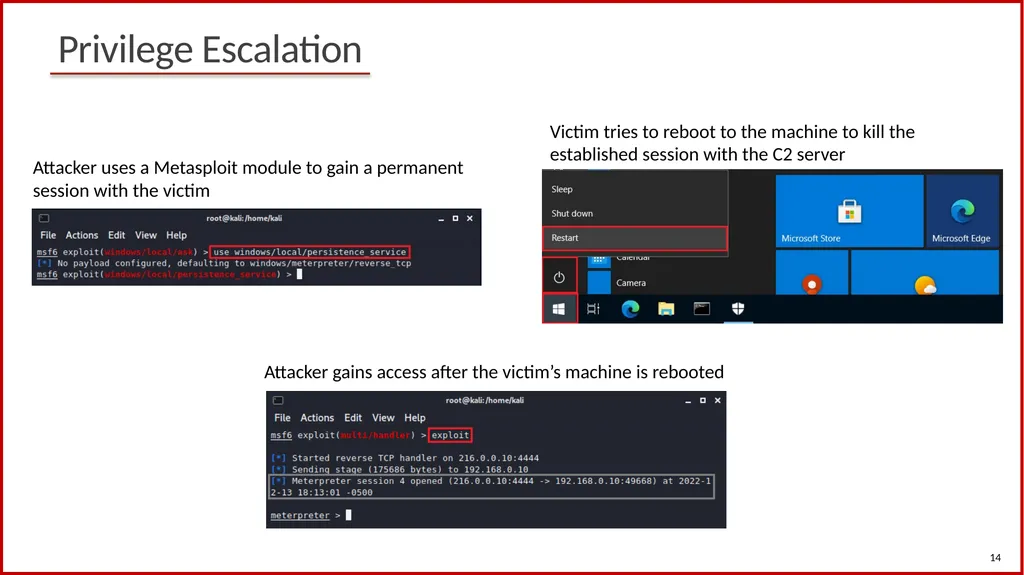
The attacker installs a backdoor that provides permanent access to the victim’s machine (using the Metasploit module windows/local/persistence_service 5 1 Metasploit Documentation, “How to use msfvenom,” [Online]. Available: https://tinyurl.com/3mskkvax
2 Rapid7, “Metasploit Framework,” [Online]. Available: https://tinyurl.com/5c8drz3b<br>
06
Attack Scenario The attacker compromises a website visited by a victim user and gains control over it 6 Attacker / C2 server Web server Compromise<br>
07
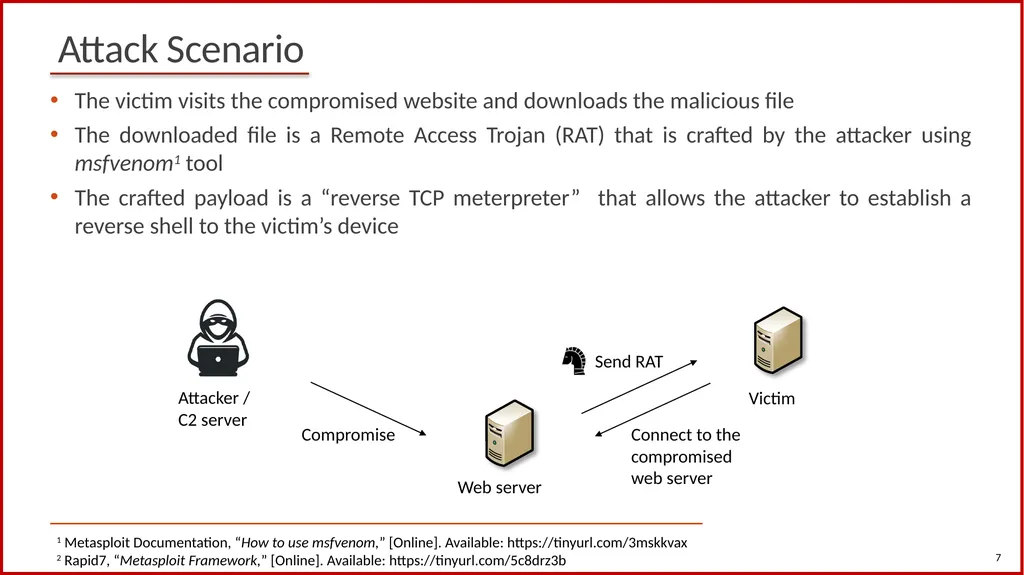
Attack Scenario The victim visits the compromised website and downloads the malicious file
The downloaded file is a Remote Access Trojan (RAT) that is crafted by the attacker using msfvenom1 tool
The crafted payload is a “reverse TCP meterpreter” that allows the attacker to establish a reverse shell to the victim’s device 7 Attacker / C2 server Compromise Connect to the compromised
web server 1 Metasploit Documentation, “How to use msfvenom,” [Online]. Available: https://tinyurl.com/3mskkvax
2 Rapid7, “Metasploit Framework,” [Online]. Available: https://tinyurl.com/5c8drz3b Web server Victim Send RAT<br>
08
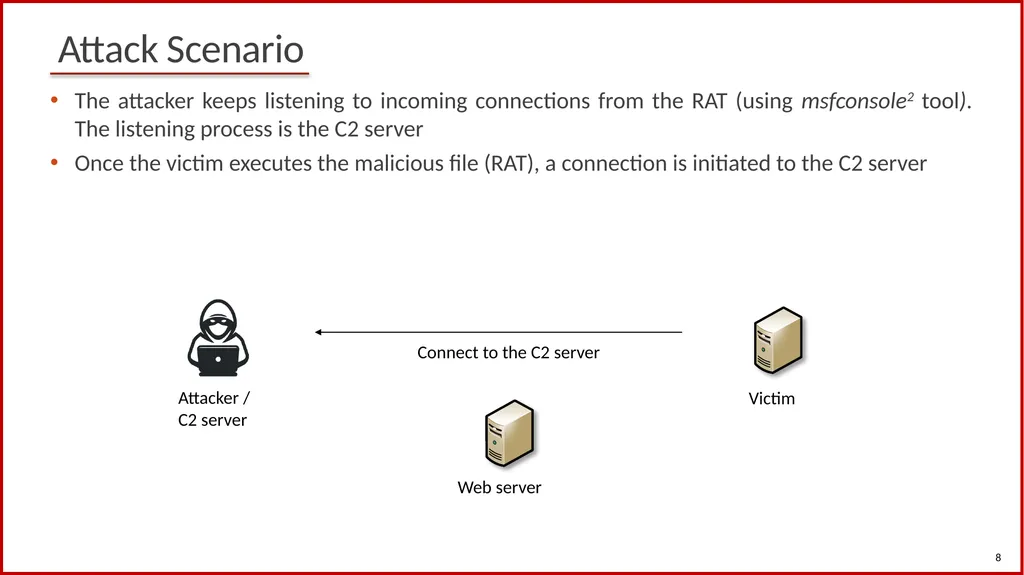
Attack Scenario The attacker keeps listening to incoming connections from the RAT (using msfconsole2 tool). The listening process is the C2 server
Once the victim executes the malicious file (RAT), a connection is initiated to the C2 server 8 Attacker / C2 server Web server Victim Connect to the C2 server<br>
09
Attack Scenario The attacker gains elevated privileges by tricking the victim into confirming a pop-up dialog (using the Metasploit module windows/local/ask)
The attacker installs a backdoor that provides permanent access to the victim’s machine (using the Metasploit module windows/local/persistence_service 9 Attacker / C2 server Web server Victim Connect to the C2 server Gain elevated privileges, send commands, etc.<br>
10
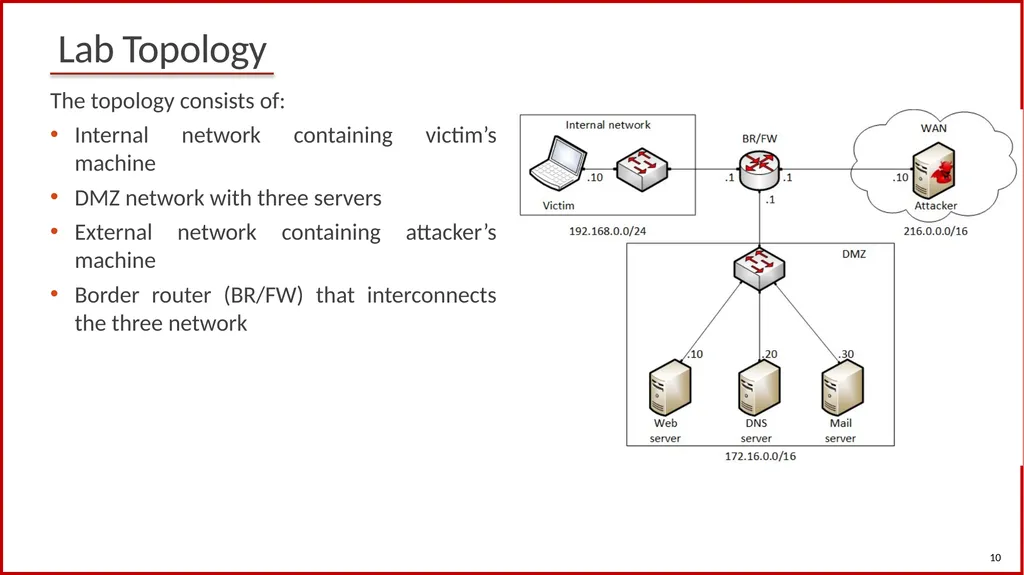
Lab Topology The topology consists of:
Internal network containing victim’s machine
DMZ network with three servers
External network containing attacker’s machine
Border router (BR/FW) that interconnects the three network 10<br>
11
Weaponization using msfvenom 11 Attacker creates the malicious payload Attacker creates the C2 server to listen for multiple victims Attacker sets the C2 session configuration<br>
12
Weaponization using msfvenom 12 Victim downloads and runs the file from the compromised website A session is established between the C2 server and the victim. No administrator privileges are given yet<br>
13
Privilege Escalation 13 Attacker uses a Metasploit module to ask the user for privilege escalation Victim accepts the pop-up, thinking it is a legitimate application Attacker gains root privileges to the victim’s machine<br>
14
Privilege Escalation 14 Attacker uses a Metasploit module to gain a permanent session with the victim Attacker gains access after the victim’s machine is rebooted Victim tries to reboot to the machine to kill the established session with the C2 server<br>