04
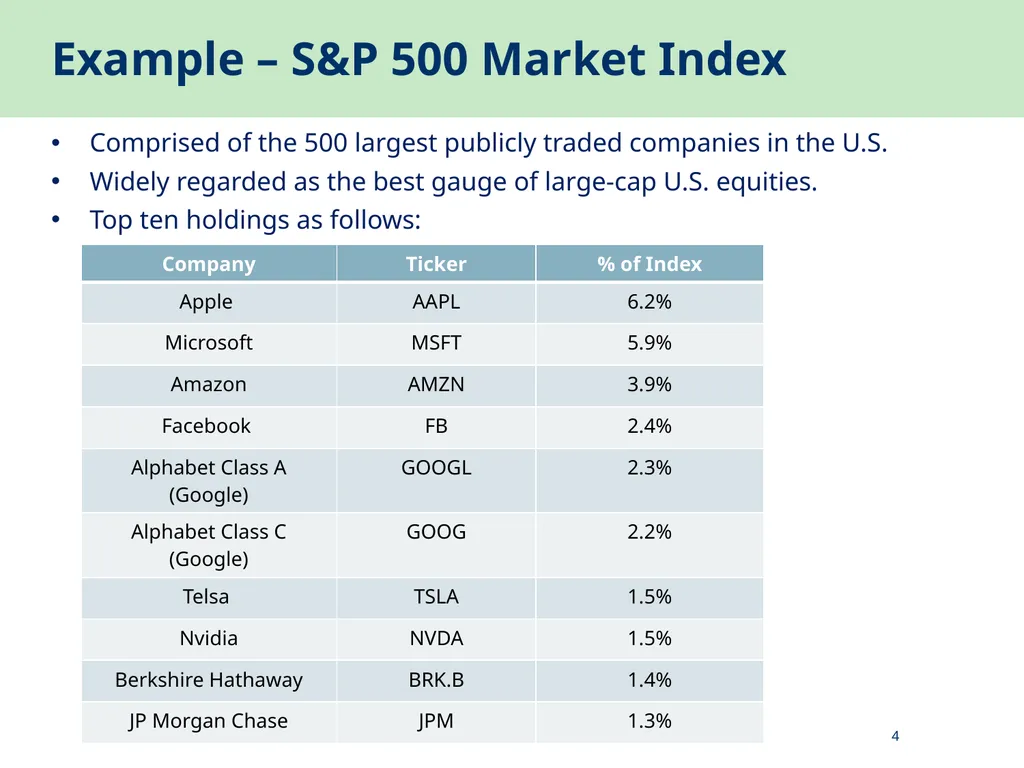
4 Comprised of the 500 largest publicly traded companies in the U.S.
Widely regarded as the best gauge of large-cap U.S. equities.
Top ten holdings as follows: Example – S&P 500 Market Index<br>
05
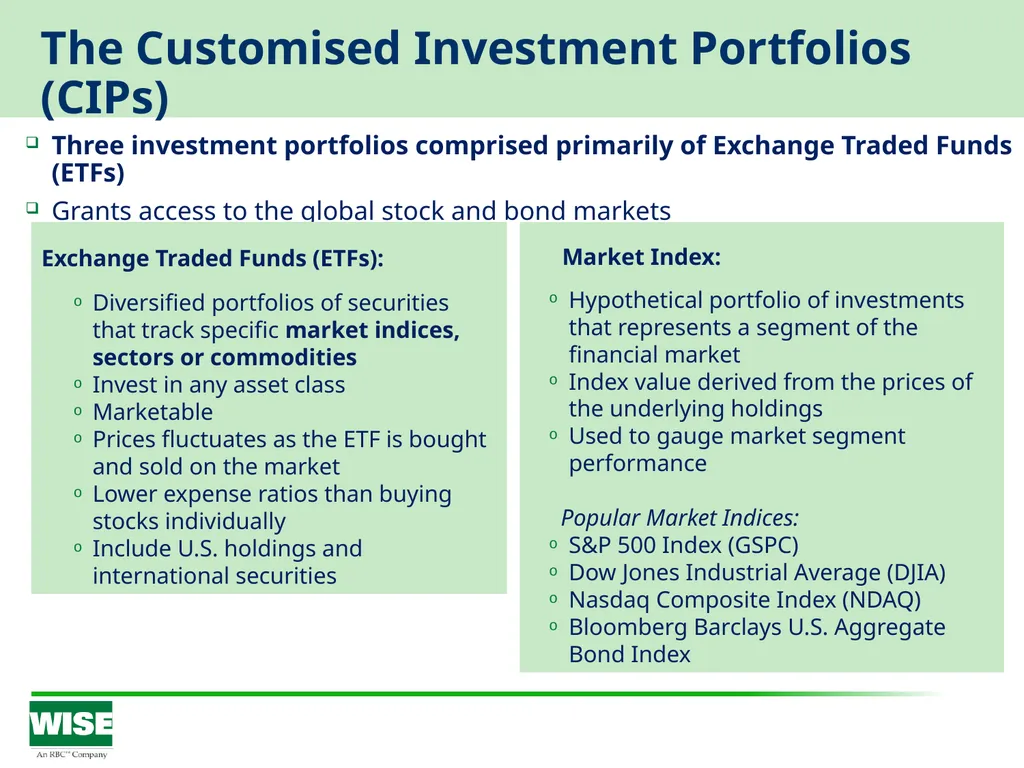
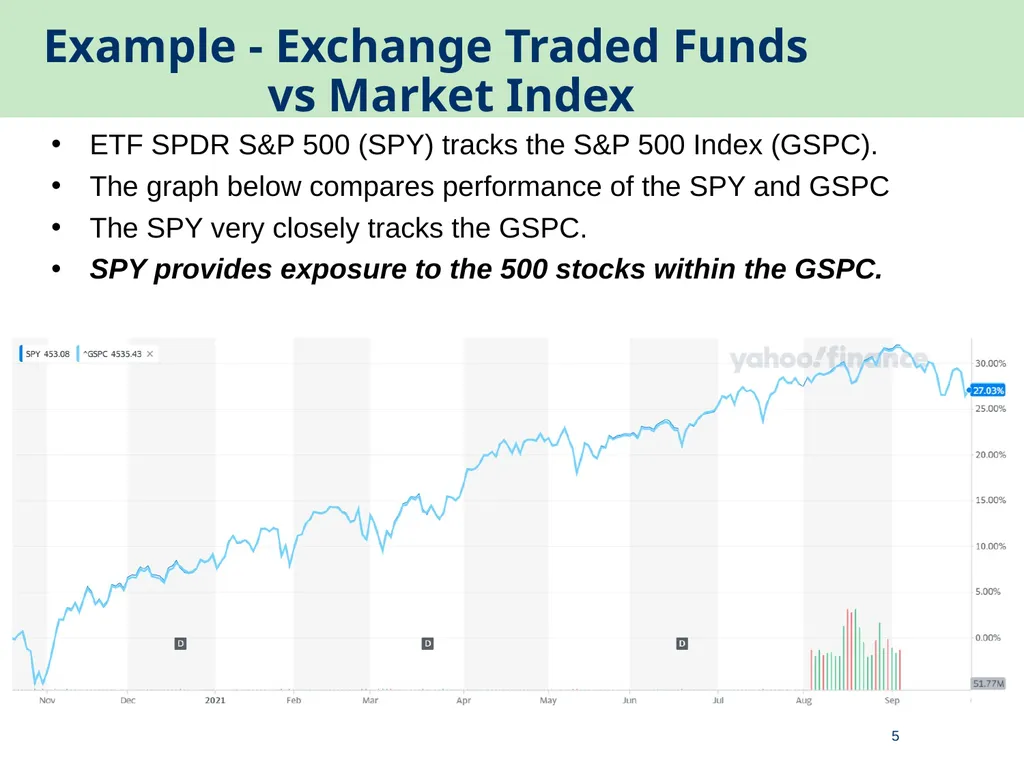
5 ETF SPDR S&P 500 (SPY) tracks the S&P 500 Index (GSPC).
The graph below compares performance of the SPY and GSPC
The SPY very closely tracks the GSPC.
SPY provides exposure to the 500 stocks within the GSPC. Example - Exchange Traded Funds vs Market Index<br>
06
Benefits of Investing in CIP Diversification to a wide range of securities and industry sectors through various ETFs
Portfolio allocation decisions are made under the advice of RBC Investment Management (Caribbean) Limited, one of the leading asset managers in Trinidad & Tobago
The ability to switch among or withdraw from the portfolios as your investment objectives change
Transparency of cost and holdings
Easy and low cost access to global equity, fixed income and real estate markets
Automatic cash management and portfolio rebalancing<br>
07
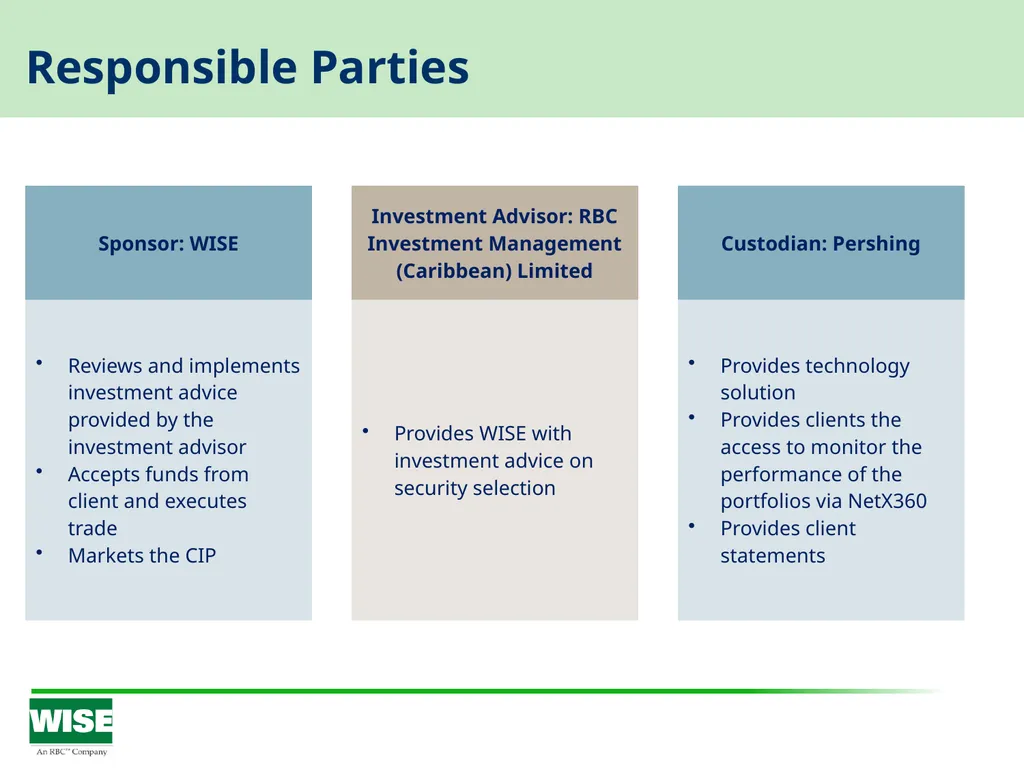
Responsible Parties<br>
08
8 Factors Considered in ETF selection Size: Market Capitalization > US$ 1 Billion
Liquidity: Liquidity of the Fund itself as well as of the underlying securities
The Underlying Index: A good reflection of the desired exposure without excessive concentration
Tracking Error: Small difference between the returns of the ETF and its benchmark index
Small Bid / Ask Spread: Funds with higher average daily trading volumes and more assets under management tend to trade at tighter spreads
Adequate disclosure<br>
09
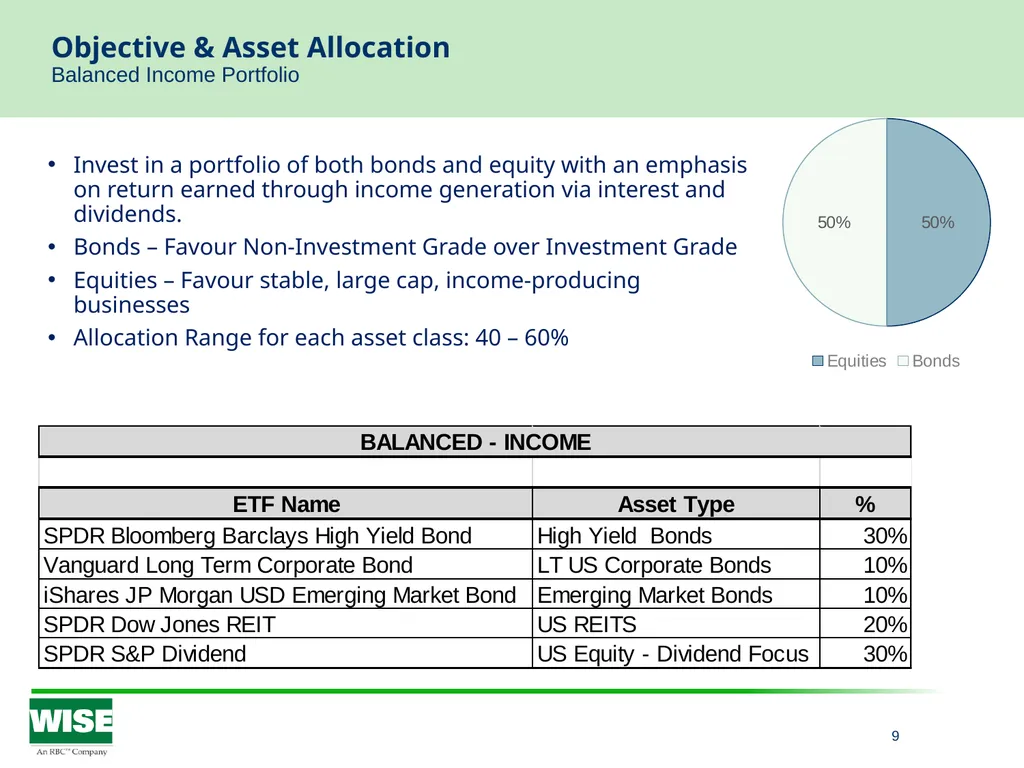
9 Objective & Asset Allocation�Balanced Income Portfolio Invest in a portfolio of both bonds and equity with an emphasis on return earned through income generation via interest and dividends.
Bonds – Favour Non-Investment Grade over Investment Grade
Equities – Favour stable, large cap, income-producing businesses
Allocation Range for each asset class: 40 – 60%<br>
10
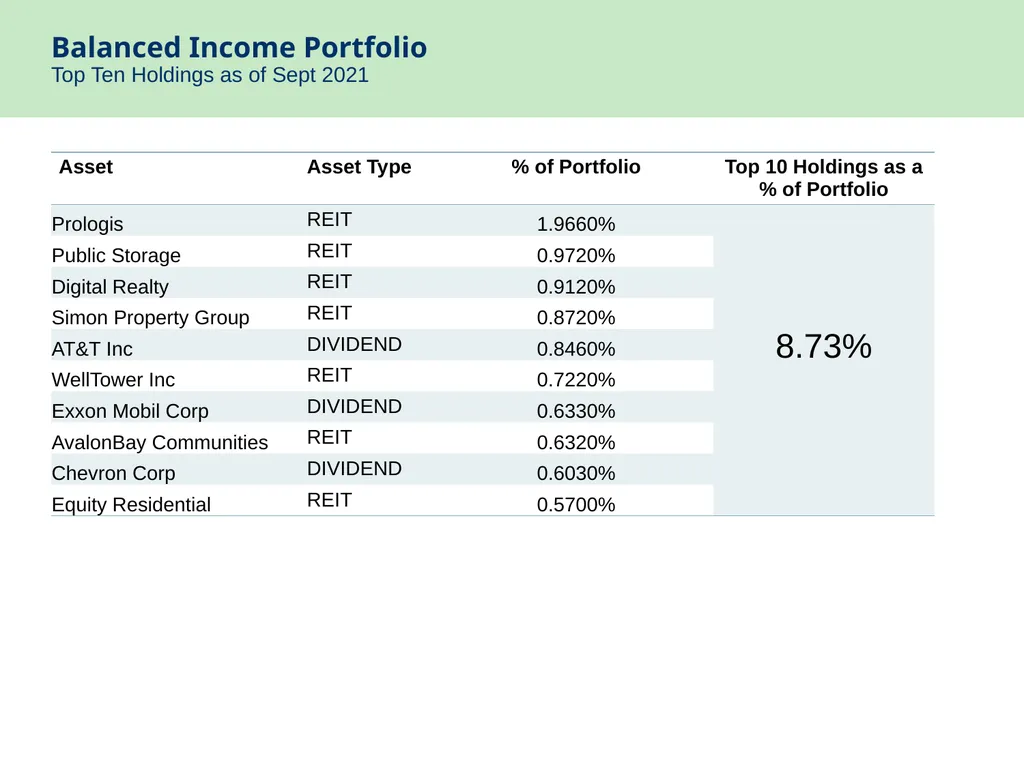
Balanced Income Portfolio�Top Ten Holdings as of Sept 2021<br>
11
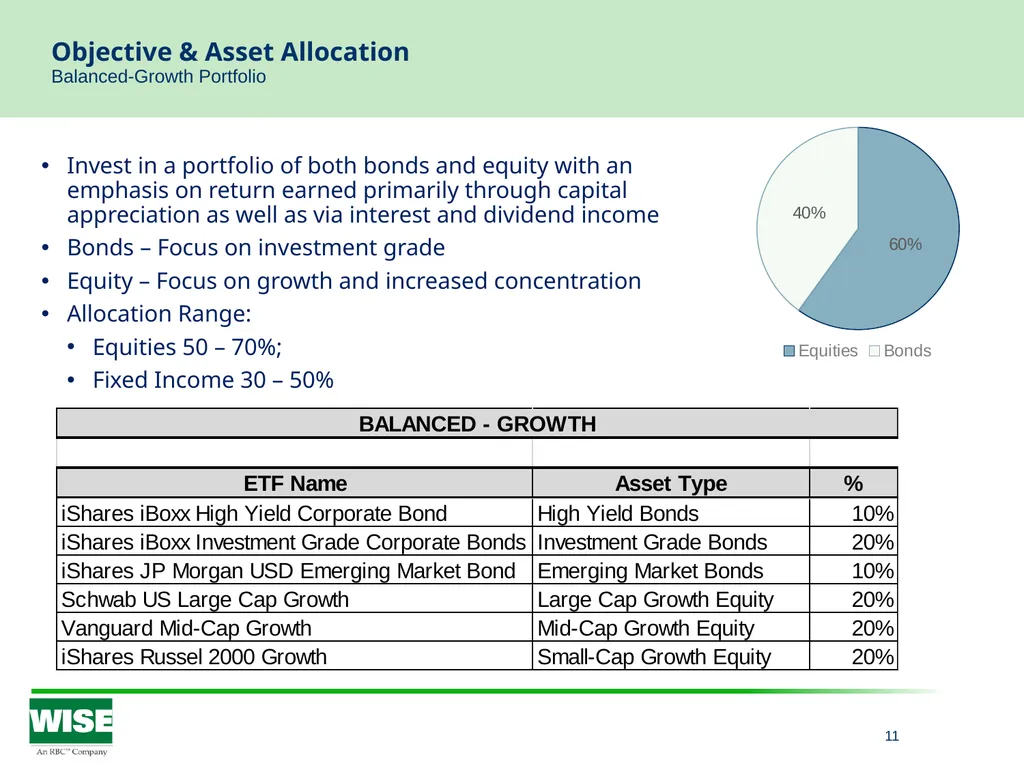
11 Objective & Asset Allocation �Balanced-Growth Portfolio Invest in a portfolio of both bonds and equity with an emphasis on return earned primarily through capital appreciation as well as via interest and dividend income
Bonds – Focus on investment grade
Equity – Focus on growth and increased concentration
Allocation Range:
Equities 50 – 70%;
Fixed Income 30 – 50%<br>
12
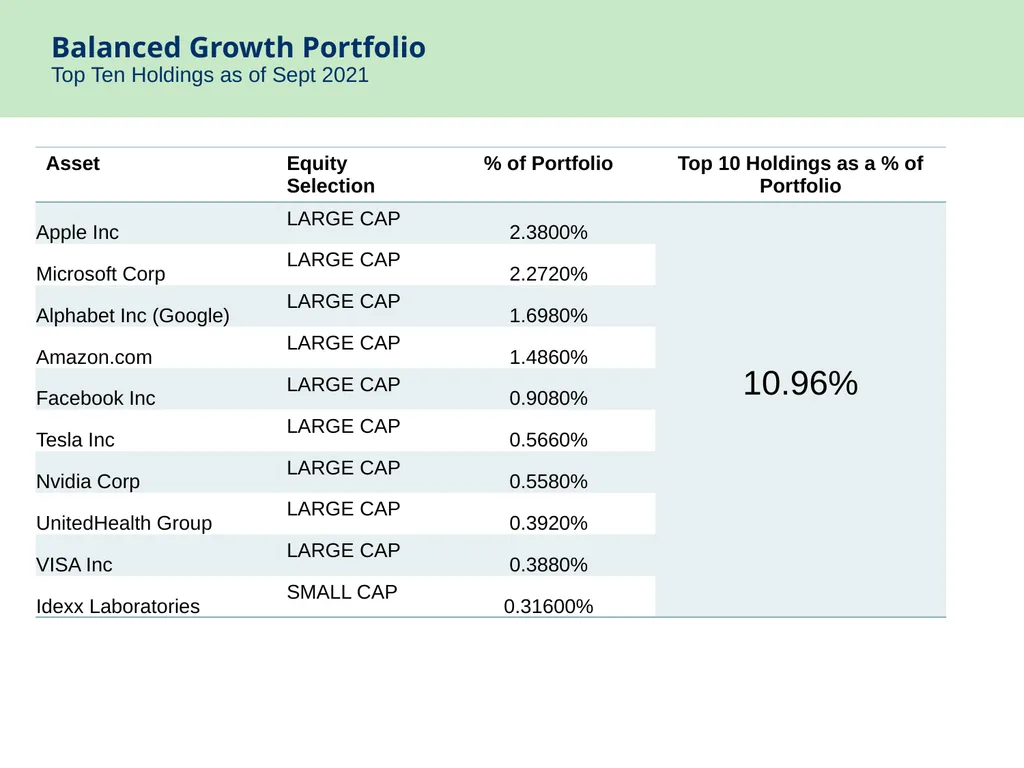
Balanced Growth Portfolio�Top Ten Holdings as of Sept 2021<br>
13
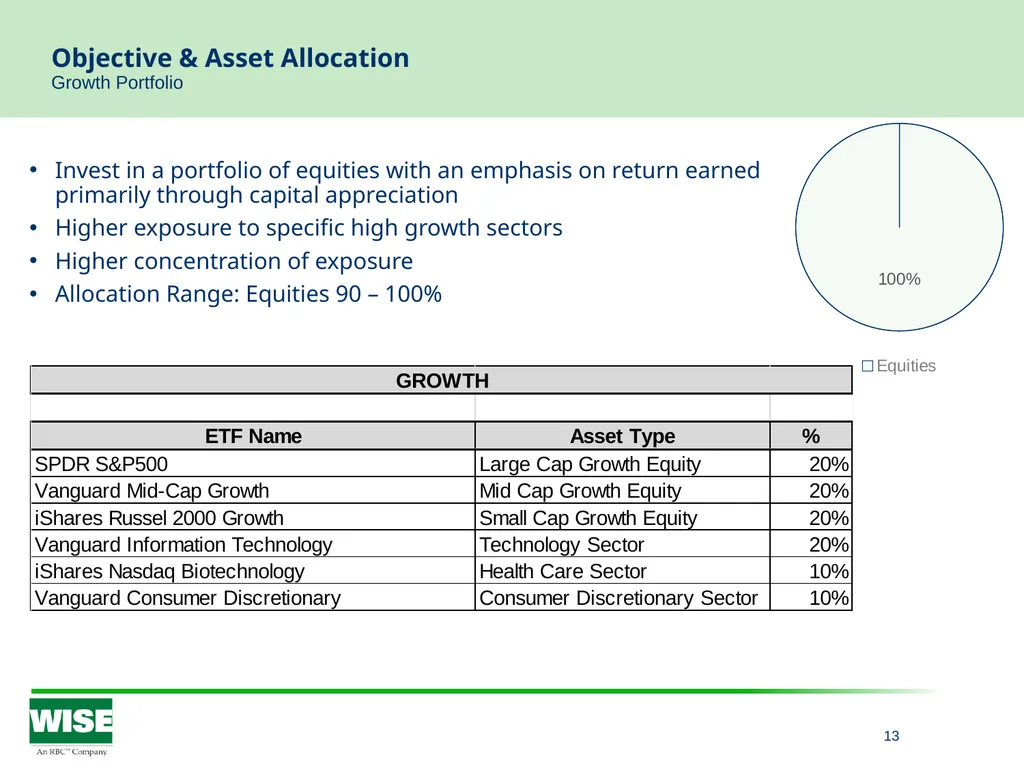
13 Objective & Asset Allocation �Growth Portfolio Invest in a portfolio of equities with an emphasis on return earned primarily through capital appreciation
Higher exposure to specific high growth sectors
Higher concentration of exposure
Allocation Range: Equities 90 – 100%<br>
14
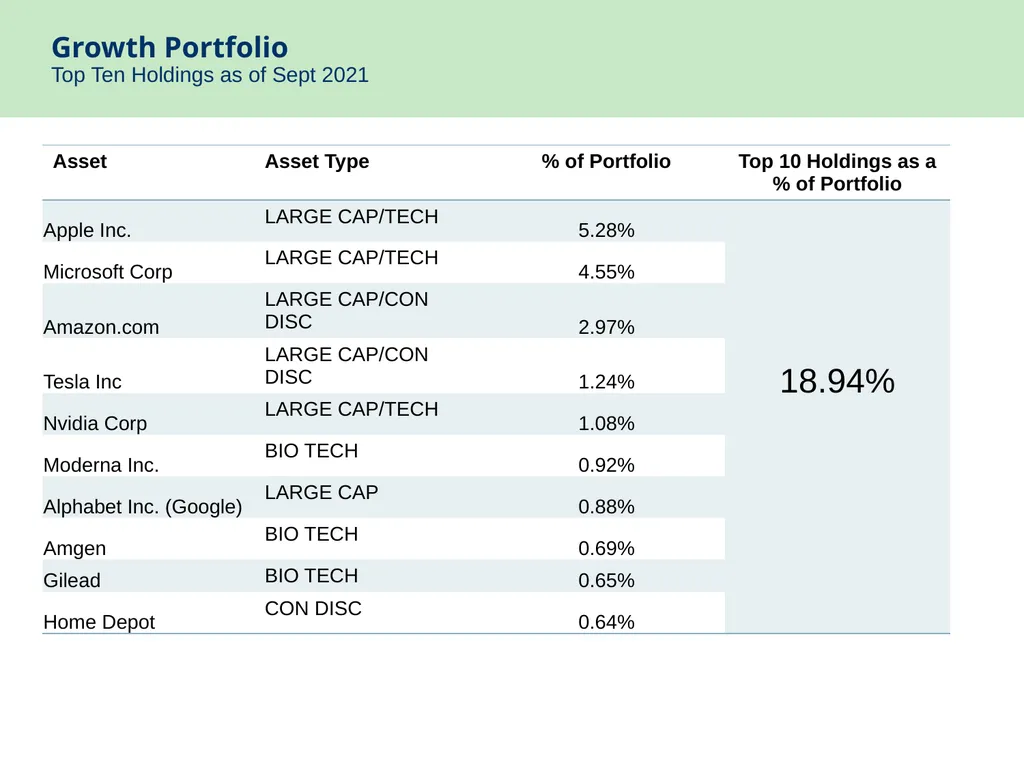
Growth Portfolio�Top Ten Holdings as of Sept 2021<br>
15
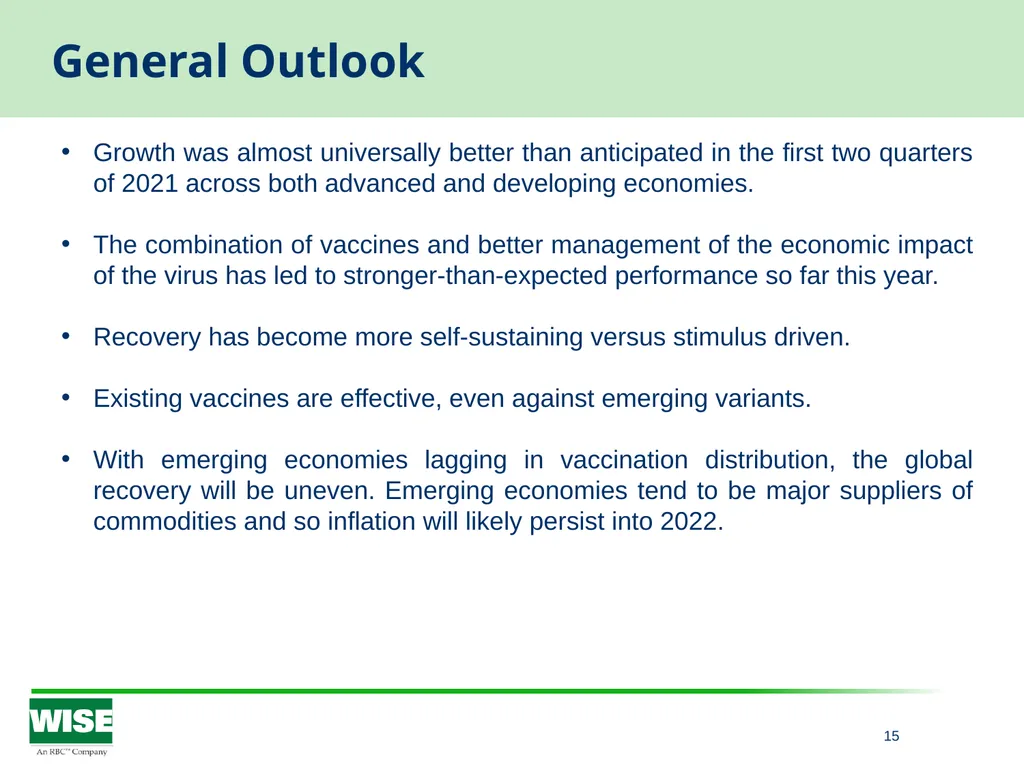
15 General Outlook Growth was almost universally better than anticipated in the first two quarters of 2021 across both advanced and developing economies.
The combination of vaccines and better management of the economic impact of the virus has led to stronger-than-expected performance so far this year.
Recovery has become more self-sustaining versus stimulus driven.
Existing vaccines are effective, even against emerging variants.
With emerging economies lagging in vaccination distribution, the global recovery will be uneven. Emerging economies tend to be major suppliers of commodities and so inflation will likely persist into 2022.<br>
16
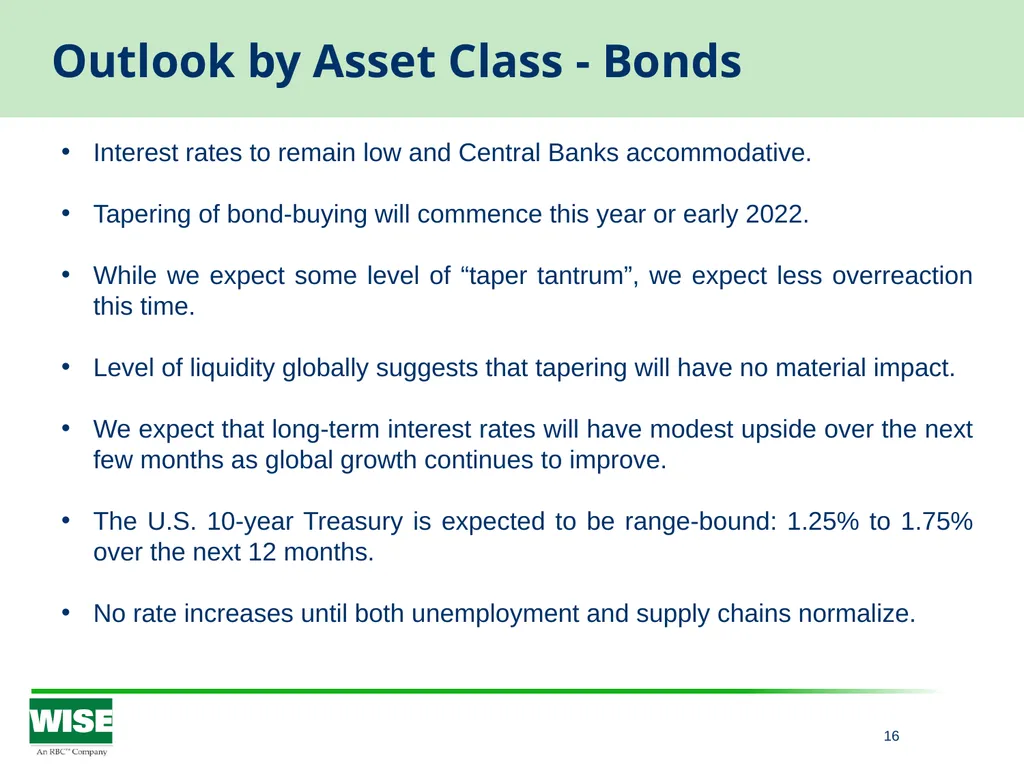
16 Outlook by Asset Class - Bonds Interest rates to remain low and Central Banks accommodative.
Tapering of bond-buying will commence this year or early 2022.
While we expect some level of “taper tantrum”, we expect less overreaction this time.
Level of liquidity globally suggests that tapering will have no material impact.
We expect that long-term interest rates will have modest upside over the next few months as global growth continues to improve.
The U.S. 10-year Treasury is expected to be range-bound: 1.25% to 1.75% over the next 12 months.
No rate increases until both unemployment and supply chains normalize.<br>
17
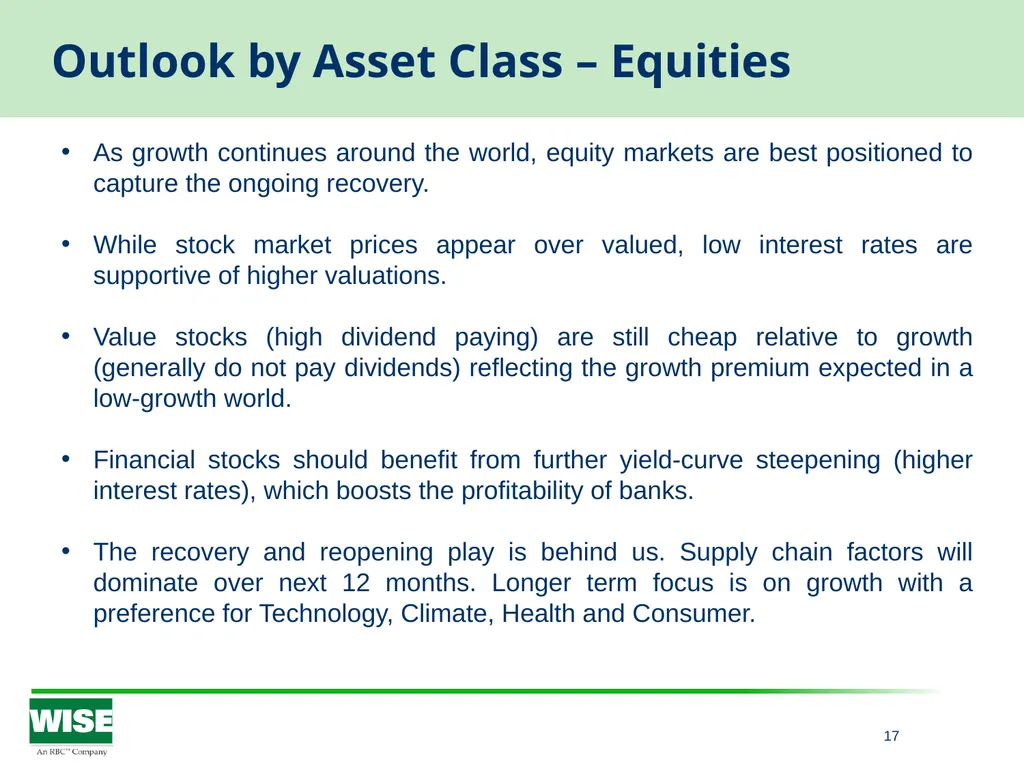
17 Outlook by Asset Class – Equities As growth continues around the world, equity markets are best positioned to capture the ongoing recovery.
While stock market prices appear over valued, low interest rates are supportive of higher valuations.
Value stocks (high dividend paying) are still cheap relative to growth (generally do not pay dividends) reflecting the growth premium expected in a low-growth world.
Financial stocks should benefit from further yield-curve steepening (higher interest rates), which boosts the profitability of banks.
The recovery and reopening play is behind us. Supply chain factors will dominate over next 12 months. Longer term focus is on growth with a preference for Technology, Climate, Health and Consumer.<br>
18
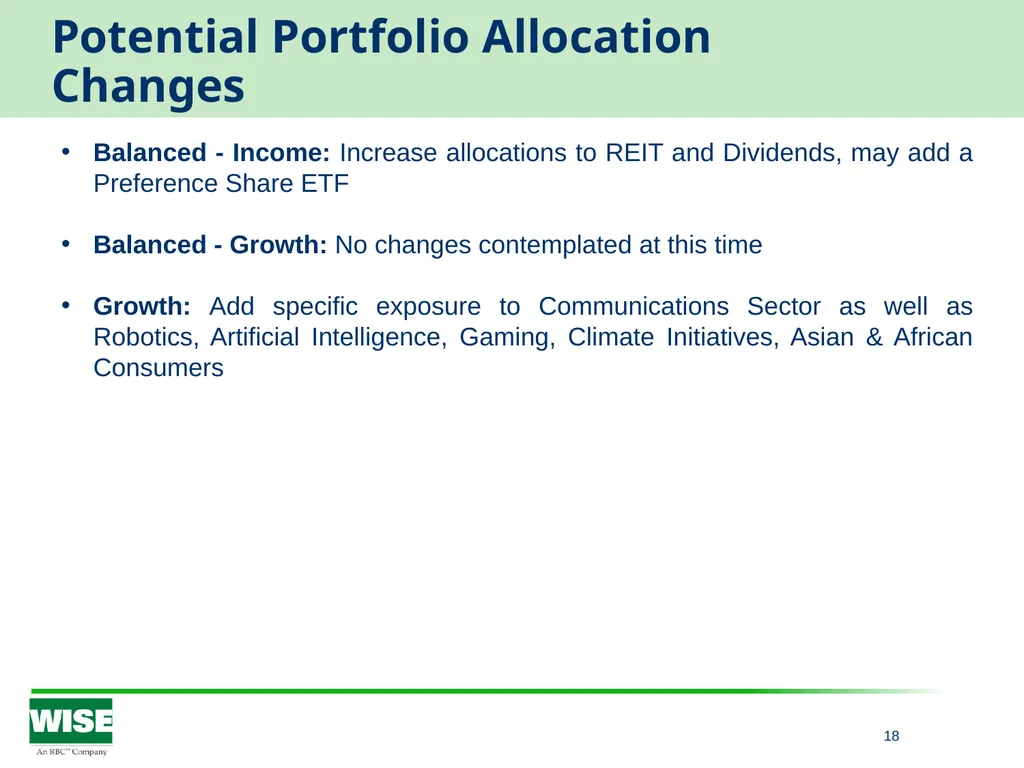
18 Potential Portfolio Allocation Changes Balanced - Income: Increase allocations to REIT and Dividends, may add a Preference Share ETF
Balanced - Growth: No changes contemplated at this time
Growth: Add specific exposure to Communications Sector as well as Robotics, Artificial Intelligence, Gaming, Climate Initiatives, Asian & African Consumers<br>
19
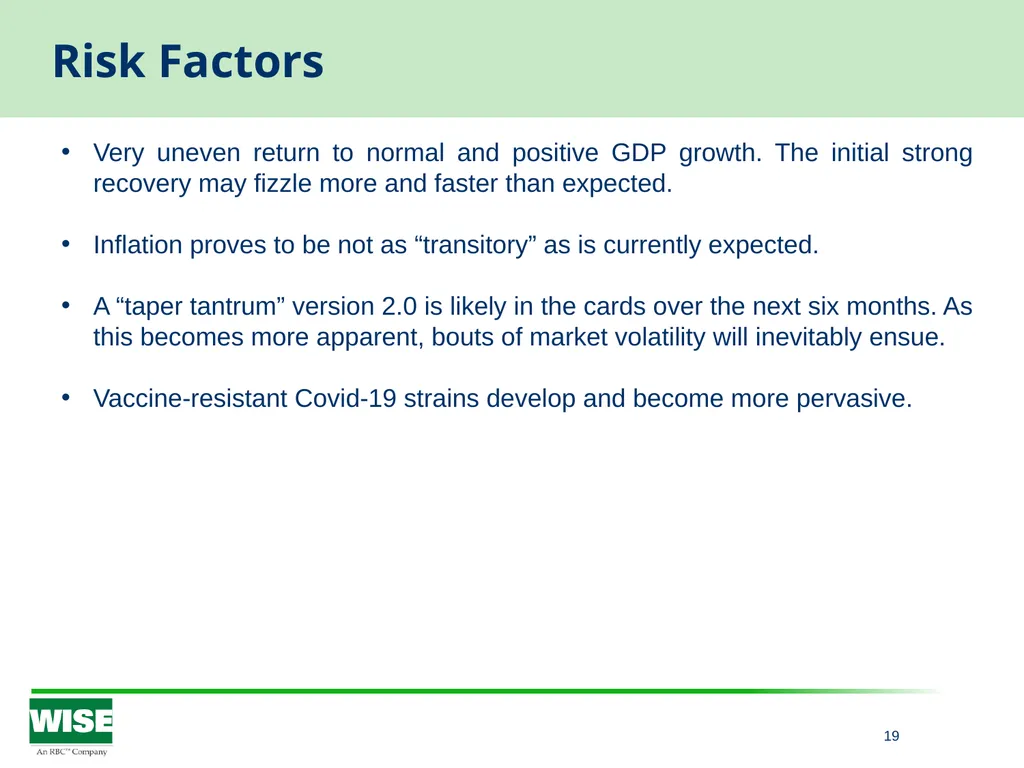
19 Risk Factors Very uneven return to normal and positive GDP growth. The initial strong recovery may fizzle more and faster than expected.
Inflation proves to be not as “transitory” as is currently expected.
A “taper tantrum” version 2.0 is likely in the cards over the next six months. As this becomes more apparent, bouts of market volatility will inevitably ensue.
Vaccine-resistant Covid-19 strains develop and become more pervasive.<br>
20
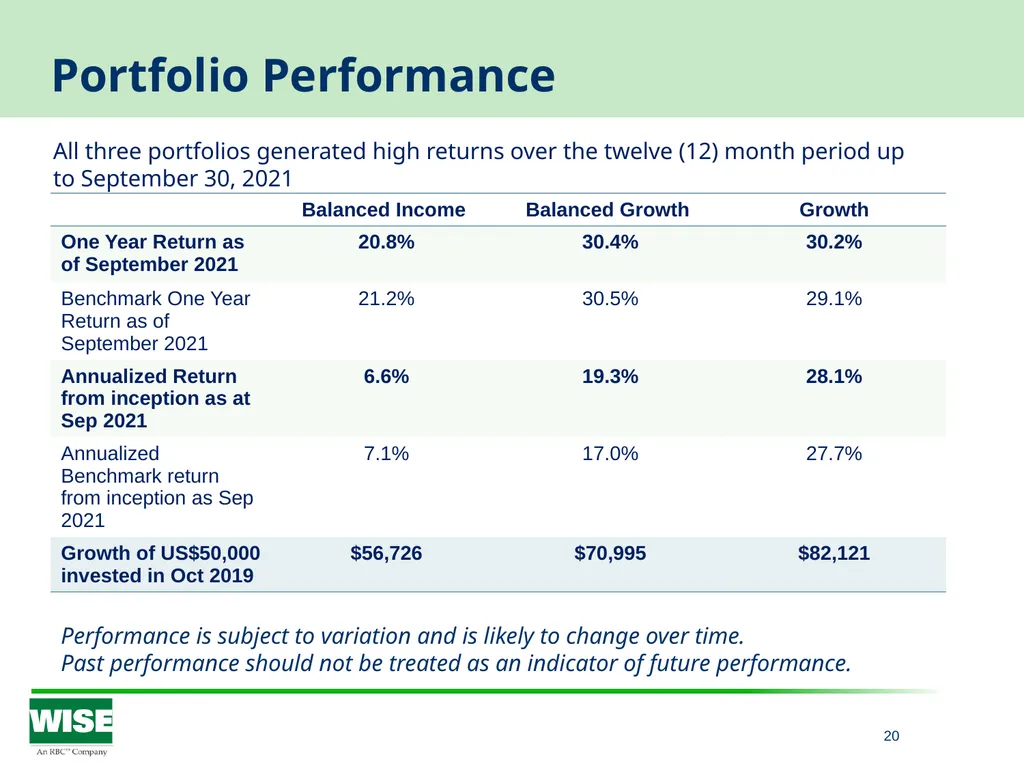
20 Portfolio Performance All three portfolios generated high returns over the twelve (12) month period up to September 30, 2021 Performance is subject to variation and is likely to change over time.
Past performance should not be treated as an indicator of future performance.<br>
21
21 Suitability Clients with a long-term investment horizon (5 years or more)
Clients with a Medium to High investment risk appetite
Clients with a preference for passive investment<br>
22
22 Next Steps to Start Investing Contact your WISE representative
Complete the WISE Investor Account Application form to invest in the Customised Investment Portfolios
Sign to having read and understood the Statement of Investment Policy of each portfolio.
Provide written instructions for each trade in the Customised Investment Portfolio Trade Request form
Provide USD to invest
Comply with minimum investment amounts as follows:
Minimum initial investment: US$10,000
Minimum subsequent investment: US$5,000
For more information, contact WISE at 628-9473 or wiseinfo@wisett.com or visit our website at https://wiseequities.com/home/<br>
23
23 Other WISE Offerings Fixed Income Trading – Domestic
Fixed Income Trading – International
Equity Trading – Domestic: Online trading via local trading platform (TOP) or WISE assisted
Equity Trading – International: Online trading via NetX360 or WISE assisted
New Offerings Coming Soon!
Margin Accounts
Options Trading
After-hours Trading<br>
24
Questions To ask a question please use the
‘raise hand’ function on the right of your Webex screen<br>