
1 DCWEB-SOBA: Deep Contextual Word
CP
Published · 34 slides · 0 views
1 / 1
Description
1 DCWEB-SOBA: Deep Contextual Word Embeddings-Based Semi-Automatic Ontology Building for Aspect-Based Sentiment Classification Flavius Frasincar frasincarese.eur.nl Joint work with Roos van Lookeren Campagne, David van Ommen, Mark
Related Topics
Share
Embed code
Download this presentation From Below
"1 DCWEB-SOBA: Deep Contextual Word" is the property of its rightful owner. Permission is granted to download and print the materials on this website for personal, non-commercial use only, and to display it on your personal computer provided you do not modify the materials and that you retain all copyright notices contained in the materials. By downloading content from our website, you accept the terms of this agreement.
Presentation Transcript
01
1 DCWEB-SOBA: Deep Contextual Word Embeddings-Based Semi-Automatic Ontology Building for Aspect-Based Sentiment Classification Flavius Frasincar*
frasincar@ese.eur.nl * Joint work with Roos van Lookeren Campagne, David van Ommen, Mark Rademaker, and Tom Teurlings<br>
frasincar@ese.eur.nl * Joint work with Roos van Lookeren Campagne, David van Ommen, Mark Rademaker, and Tom Teurlings<br>
02
Contents Motivation
Related Work
Data
Methodology
Evaluation
Conclusion 2<br>
Related Work
Data
Methodology
Evaluation
Conclusion 2<br>
03
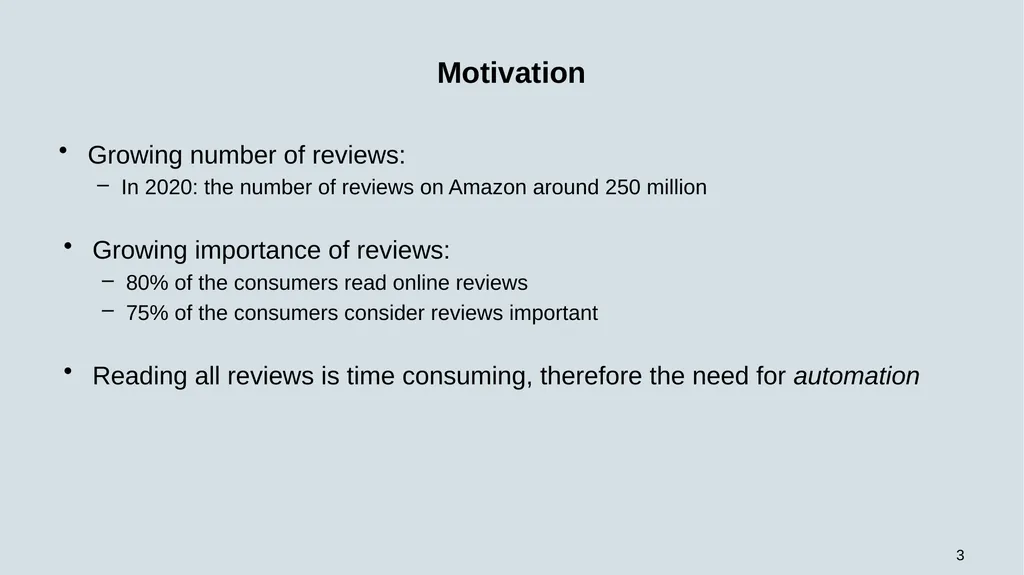
Motivation Growing number of reviews:
In 2020: the number of reviews on Amazon around 250 million
Growing importance of reviews:
80% of the consumers read online reviews
75% of the consumers consider reviews important
Reading all reviews is time consuming, therefore the need for automation 3<br>
In 2020: the number of reviews on Amazon around 250 million
Growing importance of reviews:
80% of the consumers read online reviews
75% of the consumers consider reviews important
Reading all reviews is time consuming, therefore the need for automation 3<br>
04
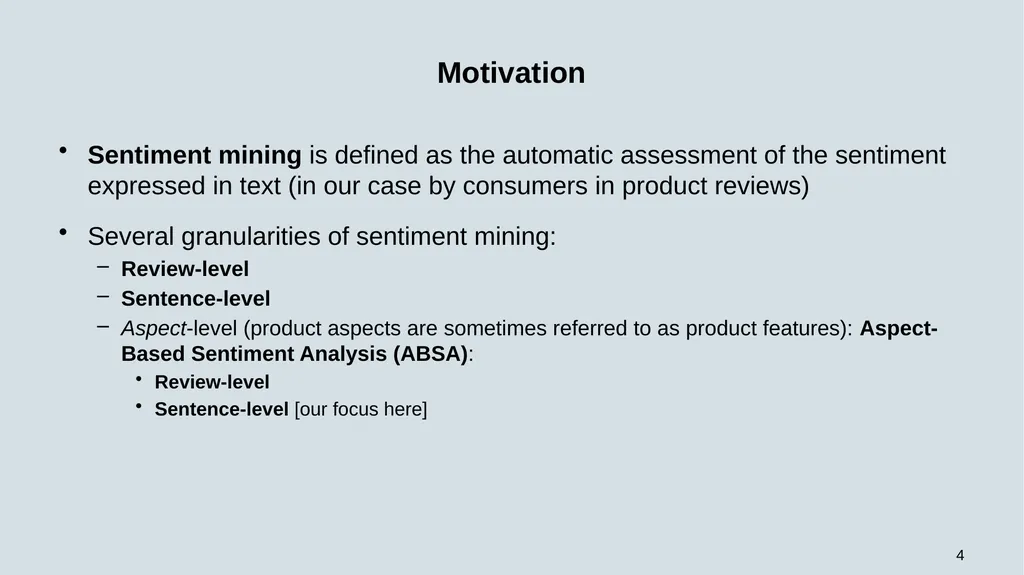
Motivation Sentiment mining is defined as the automatic assessment of the sentiment expressed in text (in our case by consumers in product reviews)
Several granularities of sentiment mining:
Review-level
Sentence-level
Aspect-level (product aspects are sometimes referred to as product features): Aspect-Based Sentiment Analysis (ABSA):
Review-level
Sentence-level [our focus here] 4<br>
Several granularities of sentiment mining:
Review-level
Sentence-level
Aspect-level (product aspects are sometimes referred to as product features): Aspect-Based Sentiment Analysis (ABSA):
Review-level
Sentence-level [our focus here] 4<br>
05
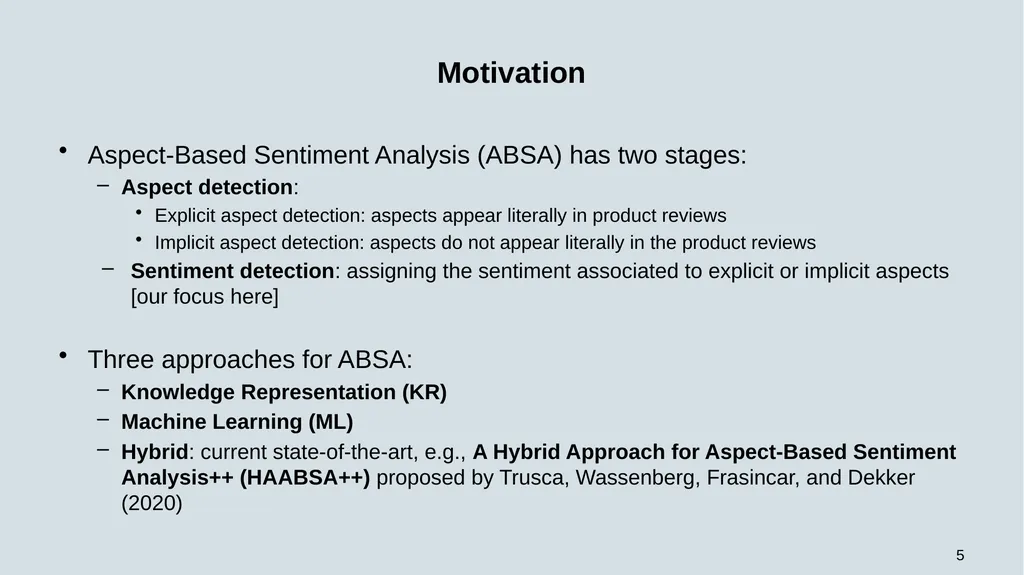
Motivation Aspect-Based Sentiment Analysis (ABSA) has two stages:
Aspect detection:
Explicit aspect detection: aspects appear literally in product reviews
Implicit aspect detection: aspects do not appear literally in the product reviews
Sentiment detection: assigning the sentiment associated to explicit or implicit aspects [our focus here]
Three approaches for ABSA:
Knowledge Representation (KR)
Machine Learning (ML)
Hybrid: current state-of-the-art, e.g., A Hybrid Approach for Aspect-Based Sentiment Analysis++ (HAABSA++) proposed by Trusca, Wassenberg, Frasincar, and Dekker (2020) 5<br>
Aspect detection:
Explicit aspect detection: aspects appear literally in product reviews
Implicit aspect detection: aspects do not appear literally in the product reviews
Sentiment detection: assigning the sentiment associated to explicit or implicit aspects [our focus here]
Three approaches for ABSA:
Knowledge Representation (KR)
Machine Learning (ML)
Hybrid: current state-of-the-art, e.g., A Hybrid Approach for Aspect-Based Sentiment Analysis++ (HAABSA++) proposed by Trusca, Wassenberg, Frasincar, and Dekker (2020) 5<br>
06
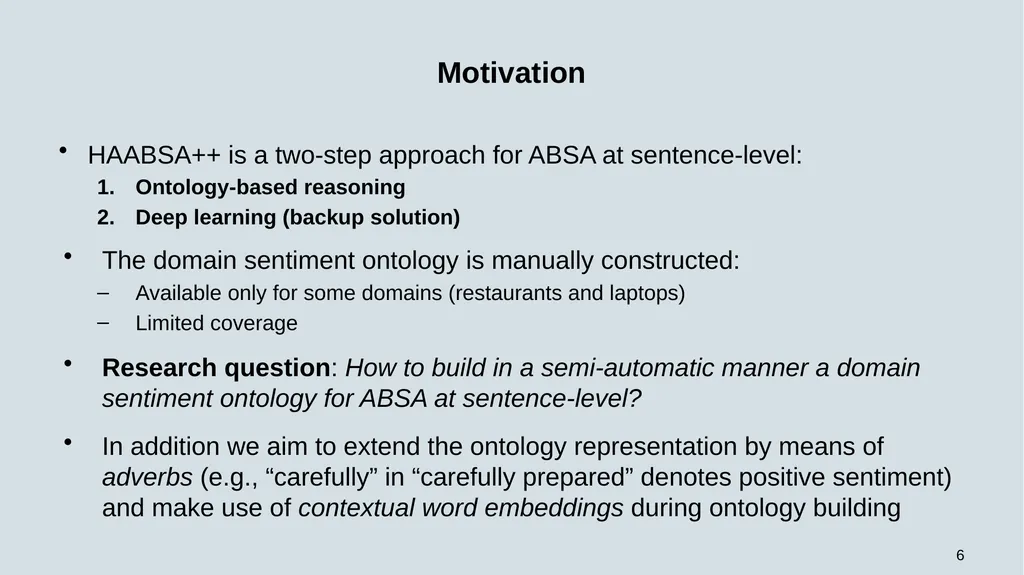
Motivation HAABSA++ is a two-step approach for ABSA at sentence-level:
Ontology-based reasoning
Deep learning (backup solution)
The domain sentiment ontology is manually constructed:
Available only for some domains (restaurants and laptops)
Limited coverage
Research question: How to build in a semi-automatic manner a domain sentiment ontology for ABSA at sentence-level?
In addition we aim to extend the ontology representation by means of adverbs (e.g., “carefully” in “carefully prepared” denotes positive sentiment) and make use of contextual word embeddings during ontology building 6<br>
Ontology-based reasoning
Deep learning (backup solution)
The domain sentiment ontology is manually constructed:
Available only for some domains (restaurants and laptops)
Limited coverage
Research question: How to build in a semi-automatic manner a domain sentiment ontology for ABSA at sentence-level?
In addition we aim to extend the ontology representation by means of adverbs (e.g., “carefully” in “carefully prepared” denotes positive sentiment) and make use of contextual word embeddings during ontology building 6<br>
07
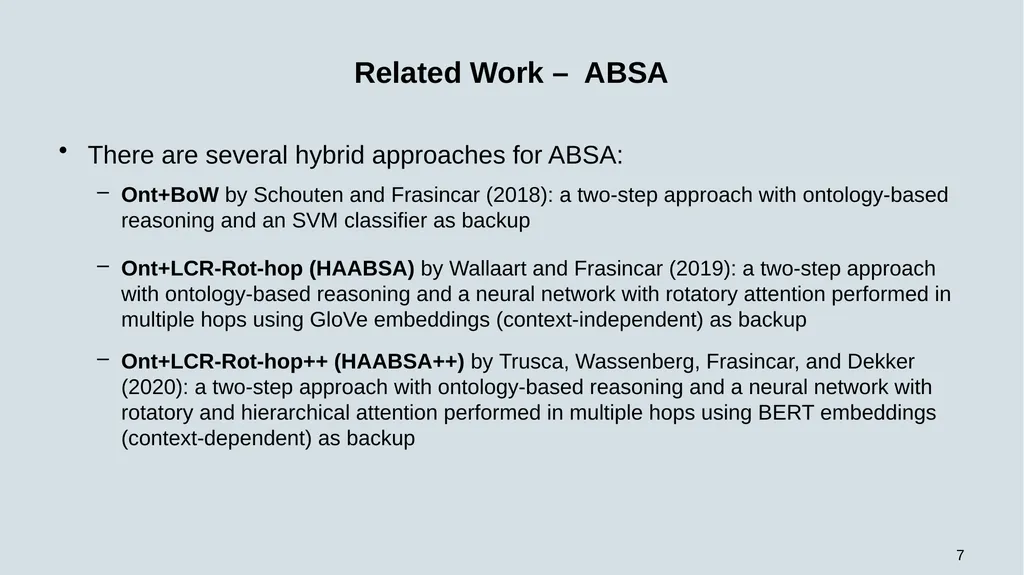
Related Work – ABSA There are several hybrid approaches for ABSA:
Ont+BoW by Schouten and Frasincar (2018): a two-step approach with ontology-based reasoning and an SVM classifier as backup
Ont+LCR-Rot-hop (HAABSA) by Wallaart and Frasincar (2019): a two-step approach with ontology-based reasoning and a neural network with rotatory attention performed in multiple hops using GloVe embeddings (context-independent) as backup
Ont+LCR-Rot-hop++ (HAABSA++) by Trusca, Wassenberg, Frasincar, and Dekker (2020): a two-step approach with ontology-based reasoning and a neural network with rotatory and hierarchical attention performed in multiple hops using BERT embeddings (context-dependent) as backup 7<br>
Ont+BoW by Schouten and Frasincar (2018): a two-step approach with ontology-based reasoning and an SVM classifier as backup
Ont+LCR-Rot-hop (HAABSA) by Wallaart and Frasincar (2019): a two-step approach with ontology-based reasoning and a neural network with rotatory attention performed in multiple hops using GloVe embeddings (context-independent) as backup
Ont+LCR-Rot-hop++ (HAABSA++) by Trusca, Wassenberg, Frasincar, and Dekker (2020): a two-step approach with ontology-based reasoning and a neural network with rotatory and hierarchical attention performed in multiple hops using BERT embeddings (context-dependent) as backup 7<br>
08
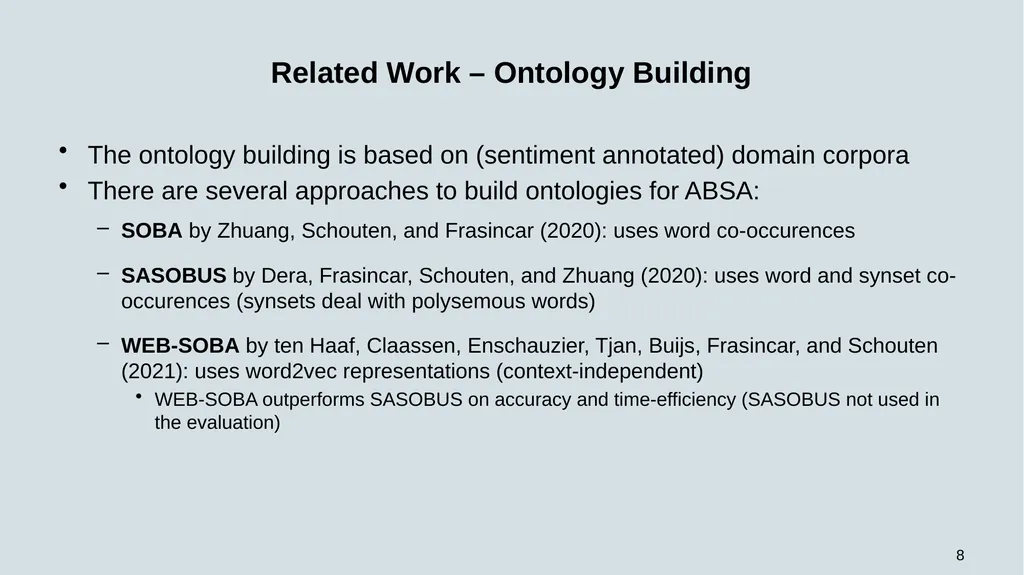
Related Work – Ontology Building The ontology building is based on (sentiment annotated) domain corpora
There are several approaches to build ontologies for ABSA:
SOBA by Zhuang, Schouten, and Frasincar (2020): uses word co-occurences
SASOBUS by Dera, Frasincar, Schouten, and Zhuang (2020): uses word and synset co-occurences (synsets deal with polysemous words)
WEB-SOBA by ten Haaf, Claassen, Enschauzier, Tjan, Buijs, Frasincar, and Schouten (2021): uses word2vec representations (context-independent)
WEB-SOBA outperforms SASOBUS on accuracy and time-efficiency (SASOBUS not used in the evaluation) 8<br>
There are several approaches to build ontologies for ABSA:
SOBA by Zhuang, Schouten, and Frasincar (2020): uses word co-occurences
SASOBUS by Dera, Frasincar, Schouten, and Zhuang (2020): uses word and synset co-occurences (synsets deal with polysemous words)
WEB-SOBA by ten Haaf, Claassen, Enschauzier, Tjan, Buijs, Frasincar, and Schouten (2021): uses word2vec representations (context-independent)
WEB-SOBA outperforms SASOBUS on accuracy and time-efficiency (SASOBUS not used in the evaluation) 8<br>
09
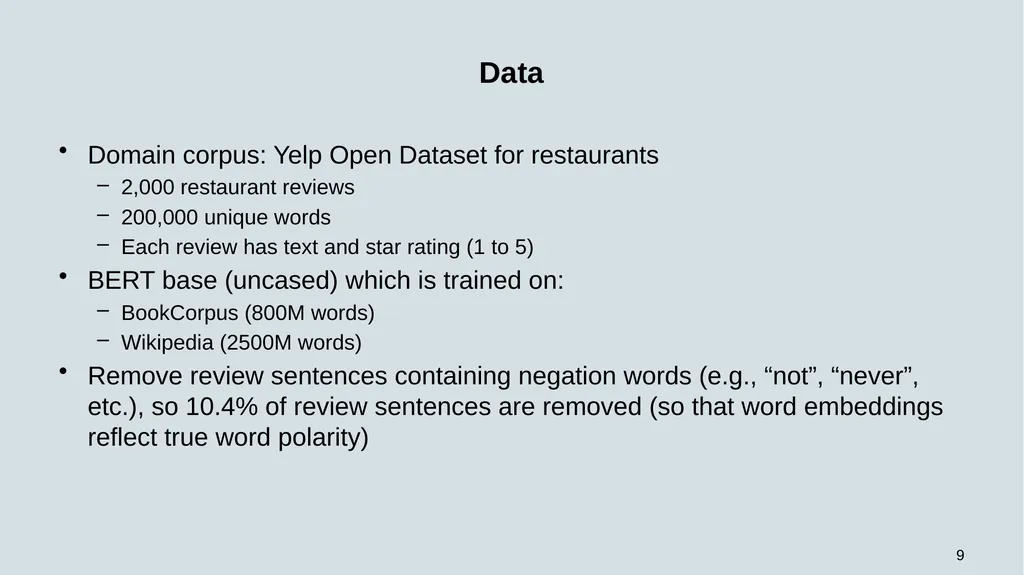
Data Domain corpus: Yelp Open Dataset for restaurants
2,000 restaurant reviews
200,000 unique words
Each review has text and star rating (1 to 5)
BERT base (uncased) which is trained on:
BookCorpus (800M words)
Wikipedia (2500M words)
Remove review sentences containing negation words (e.g., “not”, “never”, etc.), so 10.4% of review sentences are removed (so that word embeddings reflect true word polarity) 9<br>
2,000 restaurant reviews
200,000 unique words
Each review has text and star rating (1 to 5)
BERT base (uncased) which is trained on:
BookCorpus (800M words)
Wikipedia (2500M words)
Remove review sentences containing negation words (e.g., “not”, “never”, etc.), so 10.4% of review sentences are removed (so that word embeddings reflect true word polarity) 9<br>
10
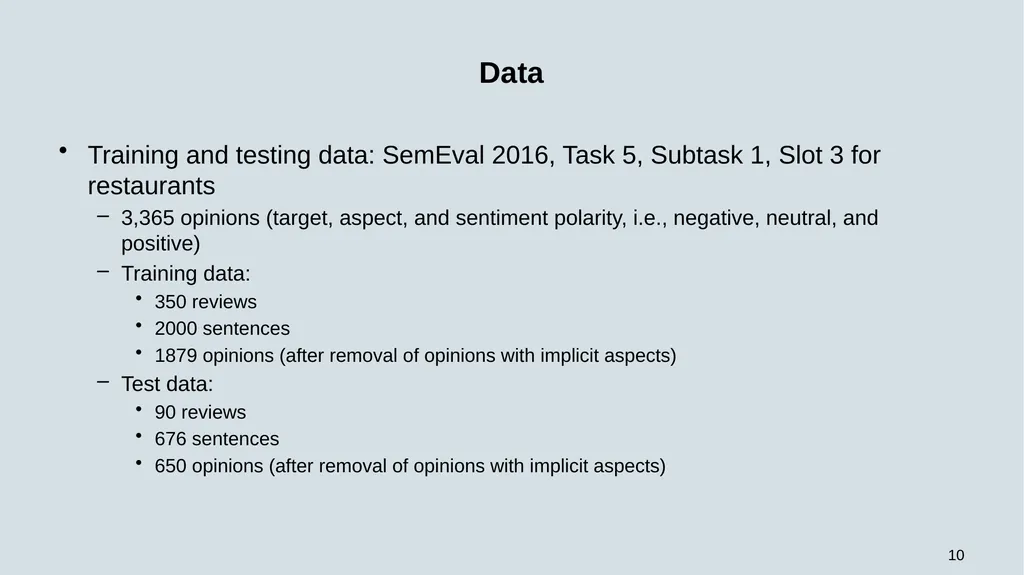
Data Training and testing data: SemEval 2016, Task 5, Subtask 1, Slot 3 for restaurants
3,365 opinions (target, aspect, and sentiment polarity, i.e., negative, neutral, and positive)
Training data:
350 reviews
2000 sentences
1879 opinions (after removal of opinions with implicit aspects)
Test data:
90 reviews
676 sentences
650 opinions (after removal of opinions with implicit aspects) 10<br>
3,365 opinions (target, aspect, and sentiment polarity, i.e., negative, neutral, and positive)
Training data:
350 reviews
2000 sentences
1879 opinions (after removal of opinions with implicit aspects)
Test data:
90 reviews
676 sentences
650 opinions (after removal of opinions with implicit aspects) 10<br>
11
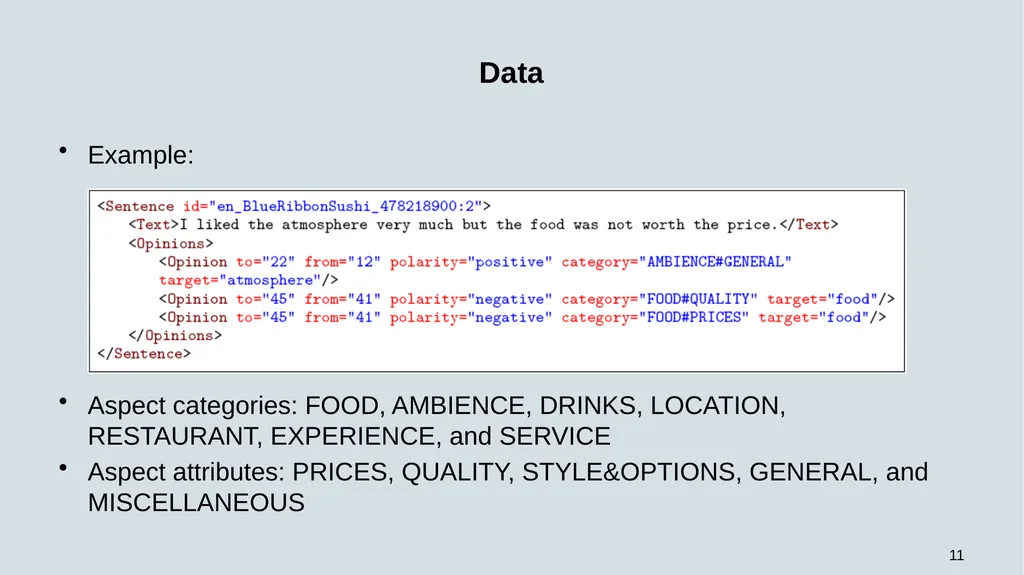
Data Example:
Aspect categories: FOOD, AMBIENCE, DRINKS, LOCATION, RESTAURANT, EXPERIENCE, and SERVICE
Aspect attributes: PRICES, QUALITY, STYLE&OPTIONS, GENERAL, and MISCELLANEOUS 11<br>
Aspect categories: FOOD, AMBIENCE, DRINKS, LOCATION, RESTAURANT, EXPERIENCE, and SERVICE
Aspect attributes: PRICES, QUALITY, STYLE&OPTIONS, GENERAL, and MISCELLANEOUS 11<br>
12
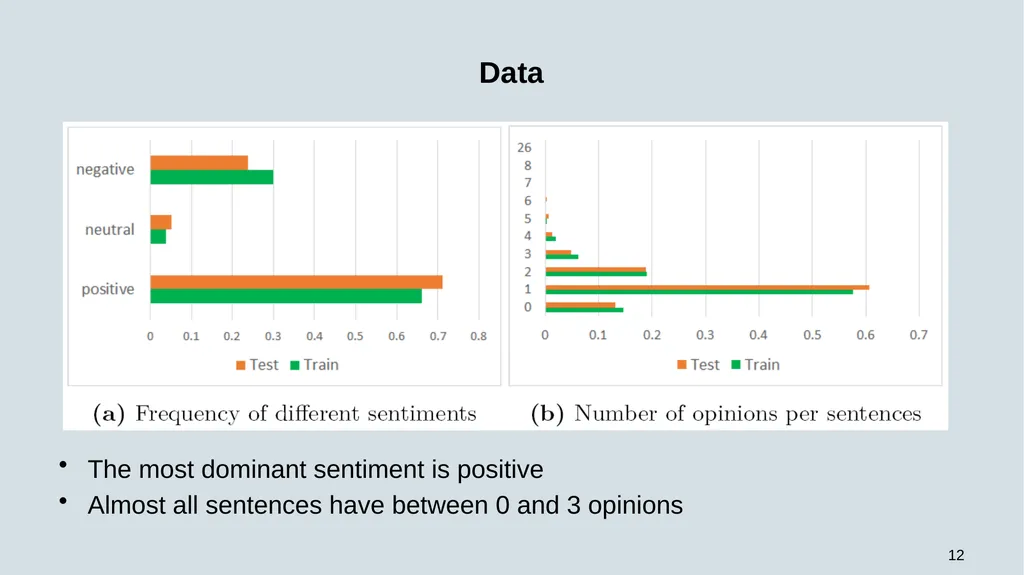
Data The most dominant sentiment is positive
Almost all sentences have between 0 and 3 opinions 12<br>
Almost all sentences have between 0 and 3 opinions 12<br>
13
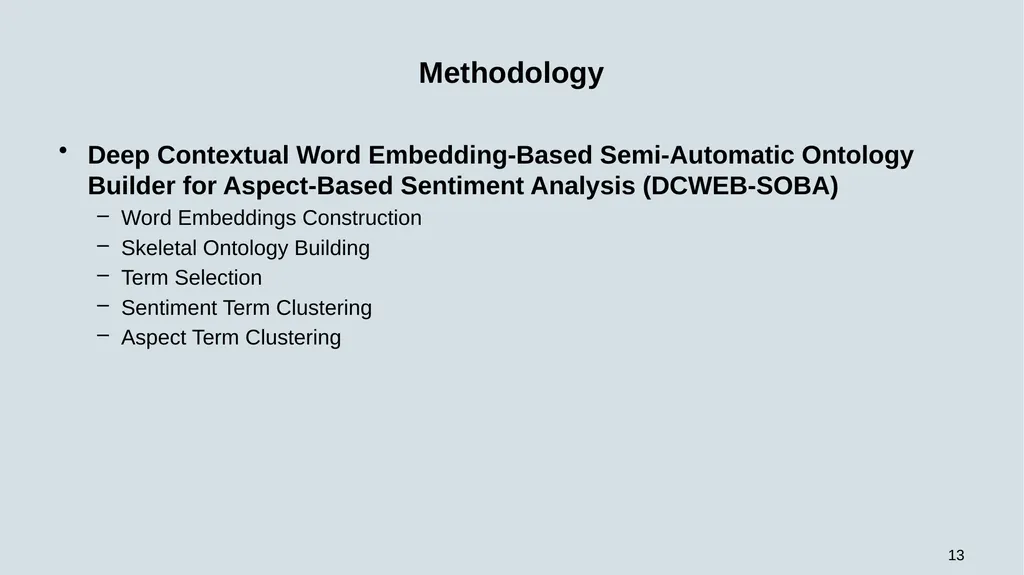
Methodology Deep Contextual Word Embedding-Based Semi-Automatic Ontology Builder for Aspect-Based Sentiment Analysis (DCWEB-SOBA)
Word Embeddings Construction
Skeletal Ontology Building
Term Selection
Sentiment Term Clustering
Aspect Term Clustering 13<br>
Word Embeddings Construction
Skeletal Ontology Building
Term Selection
Sentiment Term Clustering
Aspect Term Clustering 13<br>
14
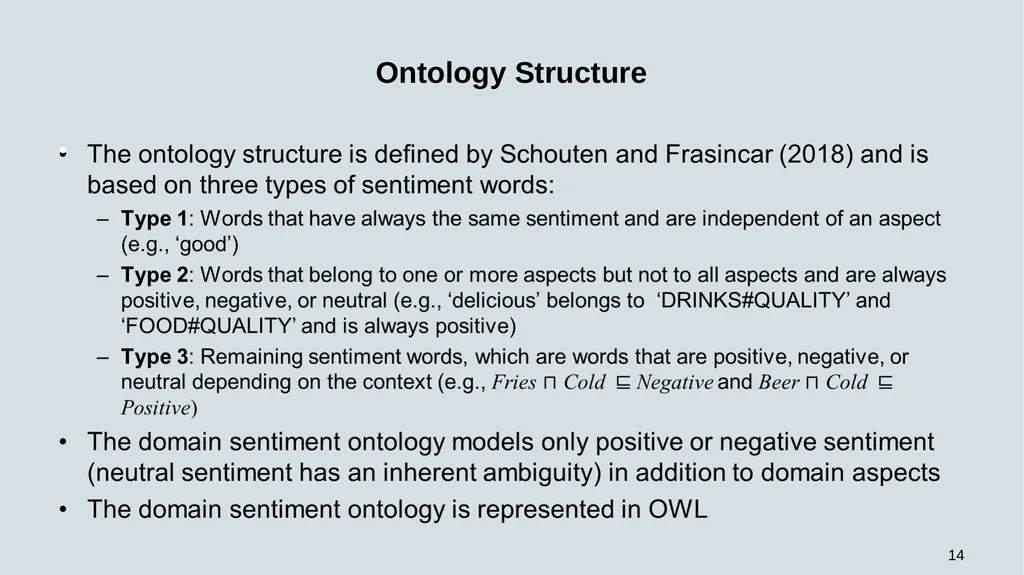
Ontology Structure 14<br>
15
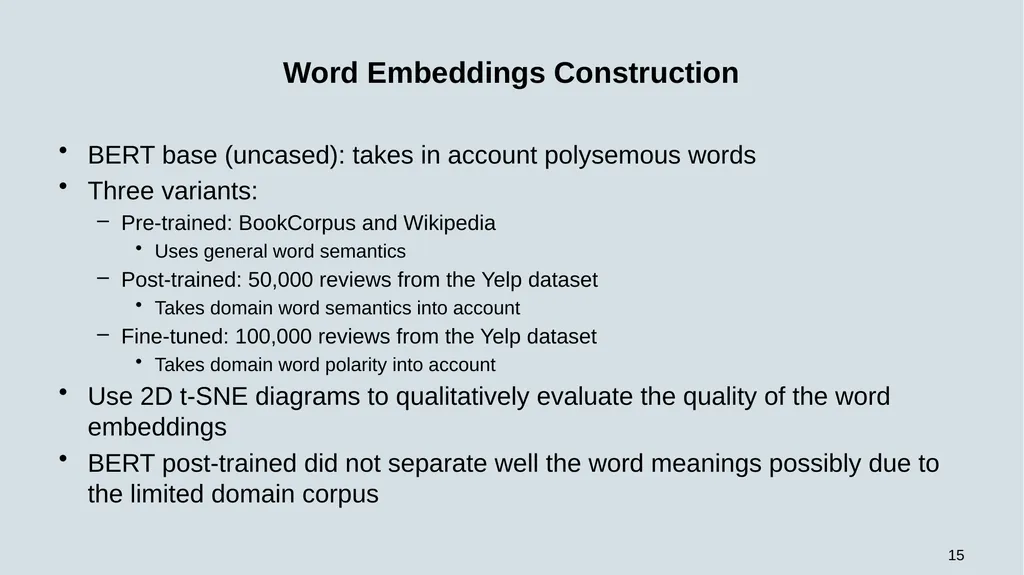
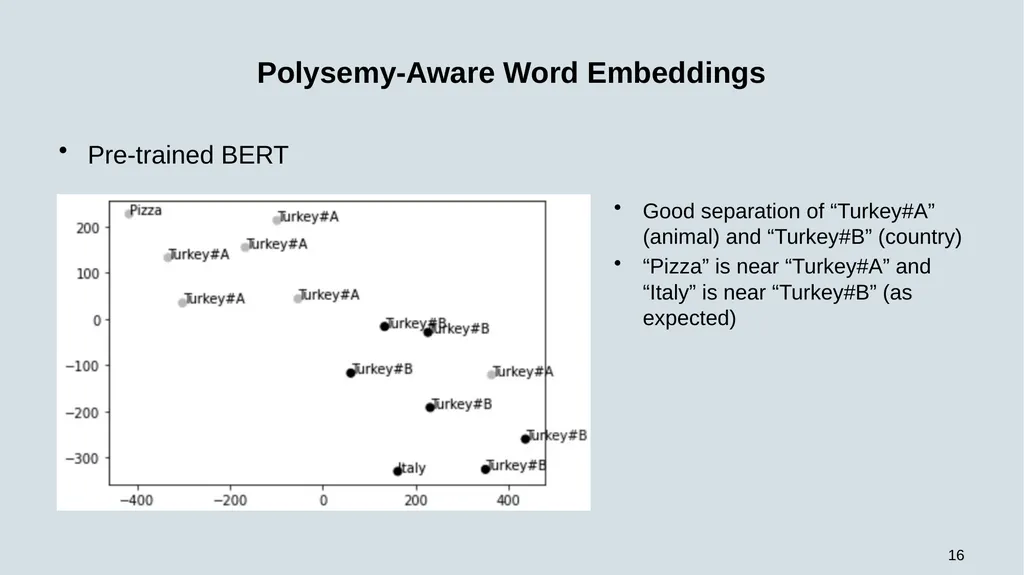
Word Embeddings Construction BERT base (uncased): takes in account polysemous words
Three variants:
Pre-trained: BookCorpus and Wikipedia
Uses general word semantics
Post-trained: 50,000 reviews from the Yelp dataset
Takes domain word semantics into account
Fine-tuned: 100,000 reviews from the Yelp dataset
Takes domain word polarity into account
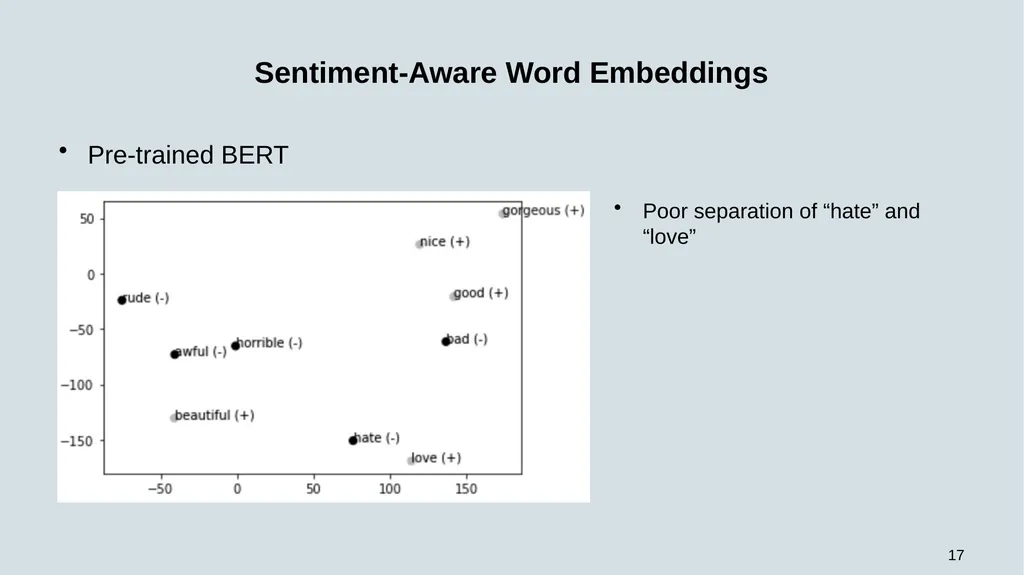
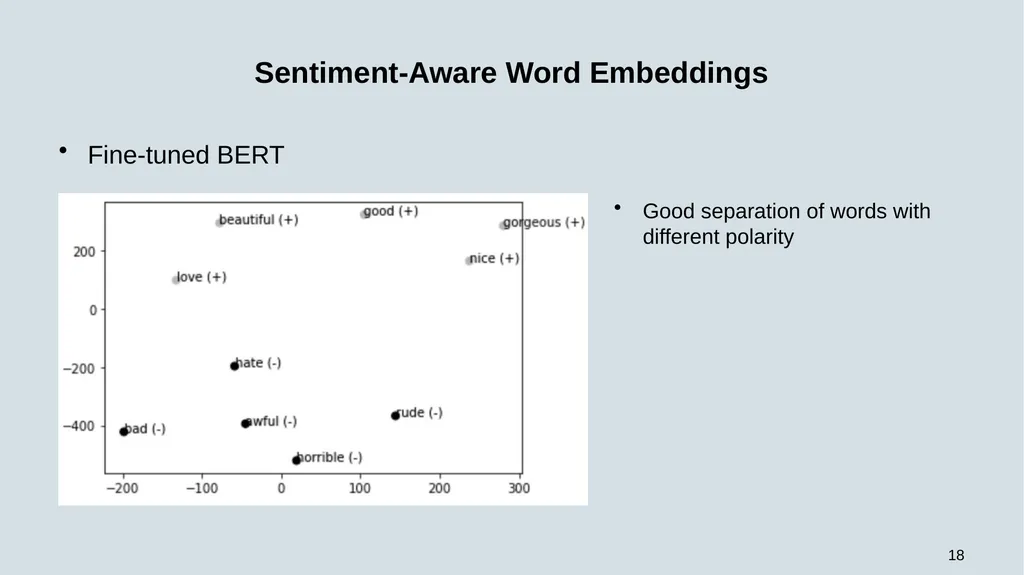
Use 2D t-SNE diagrams to qualitatively evaluate the quality of the word embeddings
BERT post-trained did not separate well the word meanings possibly due to the limited domain corpus 15<br>
Three variants:
Pre-trained: BookCorpus and Wikipedia
Uses general word semantics
Post-trained: 50,000 reviews from the Yelp dataset
Takes domain word semantics into account
Fine-tuned: 100,000 reviews from the Yelp dataset
Takes domain word polarity into account
Use 2D t-SNE diagrams to qualitatively evaluate the quality of the word embeddings
BERT post-trained did not separate well the word meanings possibly due to the limited domain corpus 15<br>
16
Polysemy-Aware Word Embeddings Pre-trained BERT 16 Good separation of “Turkey#A” (animal) and “Turkey#B” (country)
“Pizza” is near “Turkey#A” and “Italy” is near “Turkey#B” (as expected)<br>
“Pizza” is near “Turkey#A” and “Italy” is near “Turkey#B” (as expected)<br>
17
Sentiment-Aware Word Embeddings Pre-trained BERT 17 Poor separation of “hate” and “love”<br>
18
Sentiment-Aware Word Embeddings Fine-tuned BERT 18 Good separation of words with different polarity<br>
19
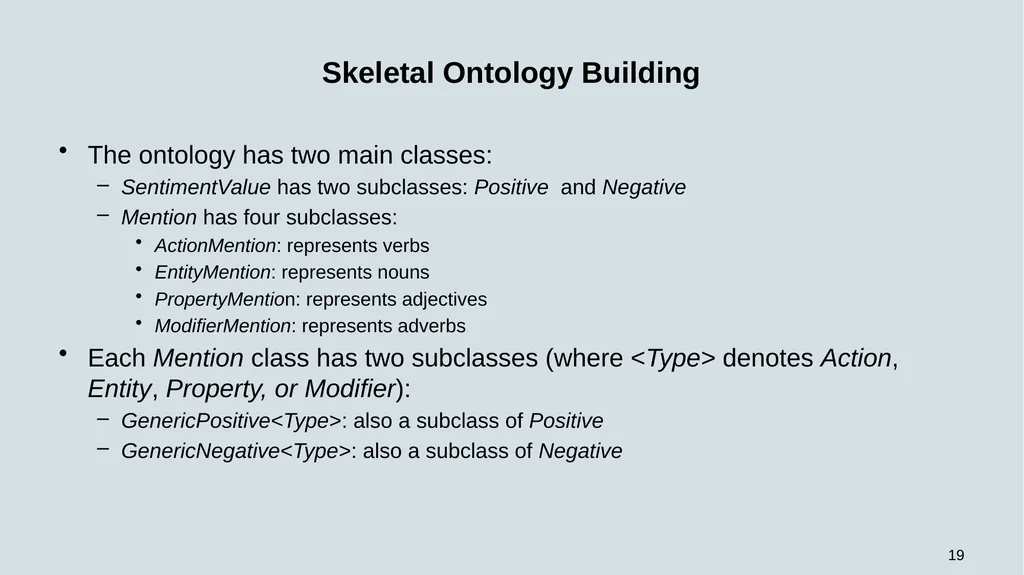
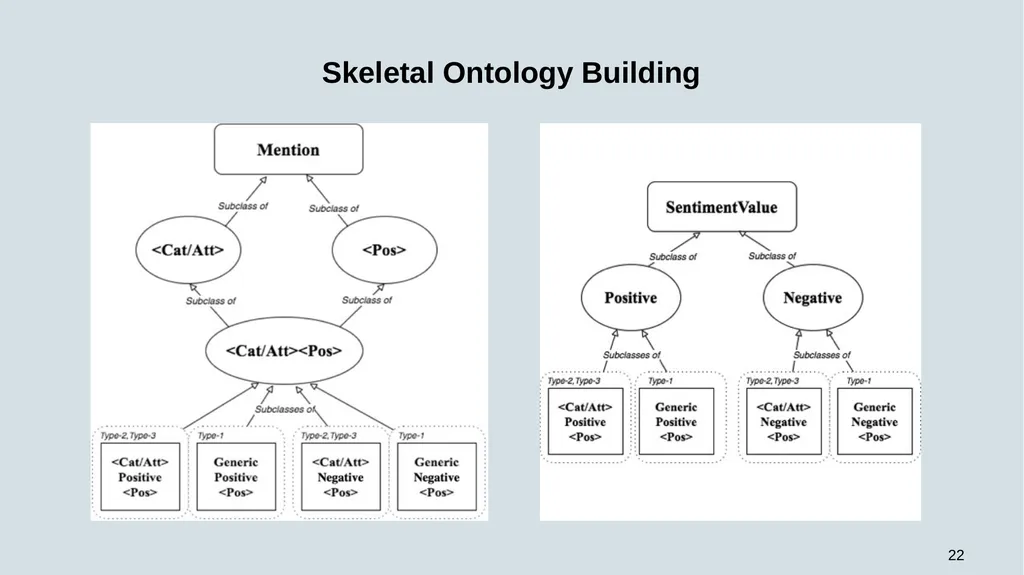
Skeletal Ontology Building The ontology has two main classes:
SentimentValue has two subclasses: Positive and Negative
Mention has four subclasses:
ActionMention: represents verbs
EntityMention: represents nouns
PropertyMention: represents adjectives
ModifierMention: represents adverbs
Each Mention class has two subclasses (where <Type> denotes Action, Entity, Property, or Modifier):
GenericPositive<Type>: also a subclass of Positive
GenericNegative<Type>: also a subclass of Negative 19<br>
SentimentValue has two subclasses: Positive and Negative
Mention has four subclasses:
ActionMention: represents verbs
EntityMention: represents nouns
PropertyMention: represents adjectives
ModifierMention: represents adverbs
Each Mention class has two subclasses (where <Type> denotes Action, Entity, Property, or Modifier):
GenericPositive<Type>: also a subclass of Positive
GenericNegative<Type>: also a subclass of Negative 19<br>
20
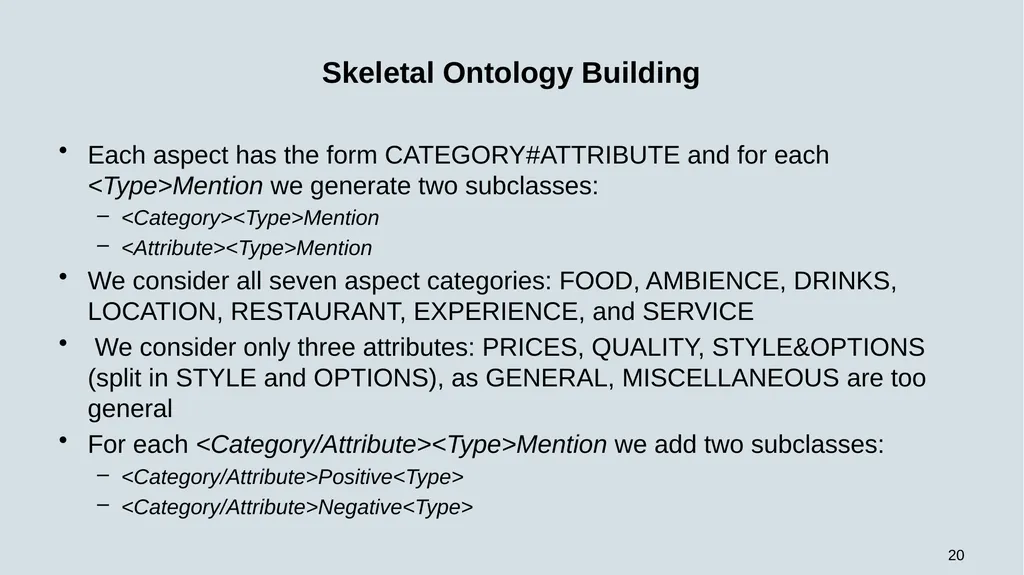
Skeletal Ontology Building Each aspect has the form CATEGORY#ATTRIBUTE and for each <Type>Mention we generate two subclasses:
<Category><Type>Mention
<Attribute><Type>Mention
We consider all seven aspect categories: FOOD, AMBIENCE, DRINKS, LOCATION, RESTAURANT, EXPERIENCE, and SERVICE
We consider only three attributes: PRICES, QUALITY, STYLE&OPTIONS (split in STYLE and OPTIONS), as GENERAL, MISCELLANEOUS are too general
For each <Category/Attribute><Type>Mention we add two subclasses:
<Category/Attribute>Positive<Type>
<Category/Attribute>Negative<Type> 20<br>
<Category><Type>Mention
<Attribute><Type>Mention
We consider all seven aspect categories: FOOD, AMBIENCE, DRINKS, LOCATION, RESTAURANT, EXPERIENCE, and SERVICE
We consider only three attributes: PRICES, QUALITY, STYLE&OPTIONS (split in STYLE and OPTIONS), as GENERAL, MISCELLANEOUS are too general
For each <Category/Attribute><Type>Mention we add two subclasses:
<Category/Attribute>Positive<Type>
<Category/Attribute>Negative<Type> 20<br>
21
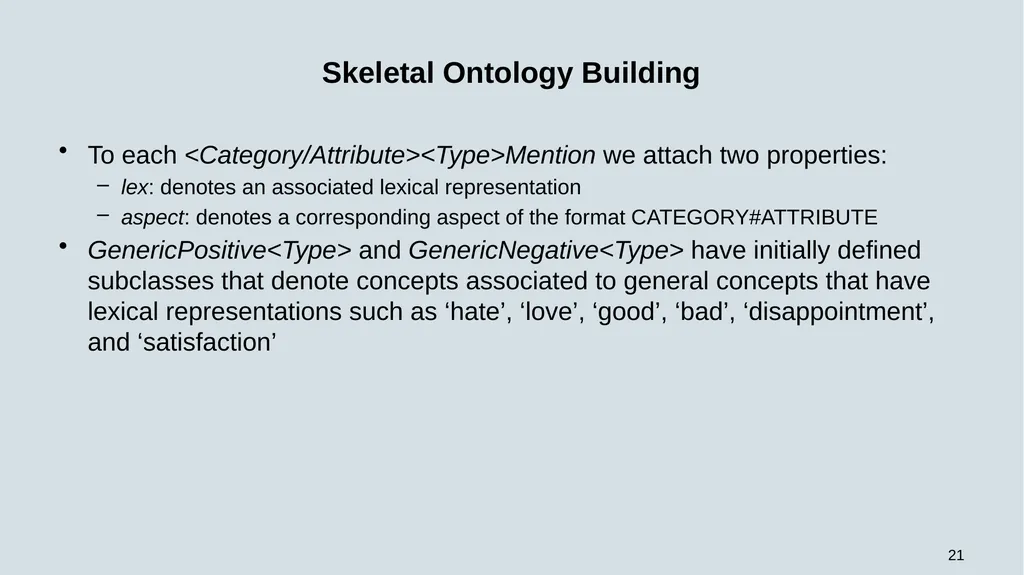
Skeletal Ontology Building To each <Category/Attribute><Type>Mention we attach two properties:
lex: denotes an associated lexical representation
aspect: denotes a corresponding aspect of the format CATEGORY#ATTRIBUTE
GenericPositive<Type> and GenericNegative<Type> have initially defined subclasses that denote concepts associated to general concepts that have lexical representations such as ‘hate’, ‘love’, ‘good’, ‘bad’, ‘disappointment’, and ‘satisfaction’ 21<br>
lex: denotes an associated lexical representation
aspect: denotes a corresponding aspect of the format CATEGORY#ATTRIBUTE
GenericPositive<Type> and GenericNegative<Type> have initially defined subclasses that denote concepts associated to general concepts that have lexical representations such as ‘hate’, ‘love’, ‘good’, ‘bad’, ‘disappointment’, and ‘satisfaction’ 21<br>
22
Skeletal Ontology Building 22<br>
23
Term Selection 23<br>
24
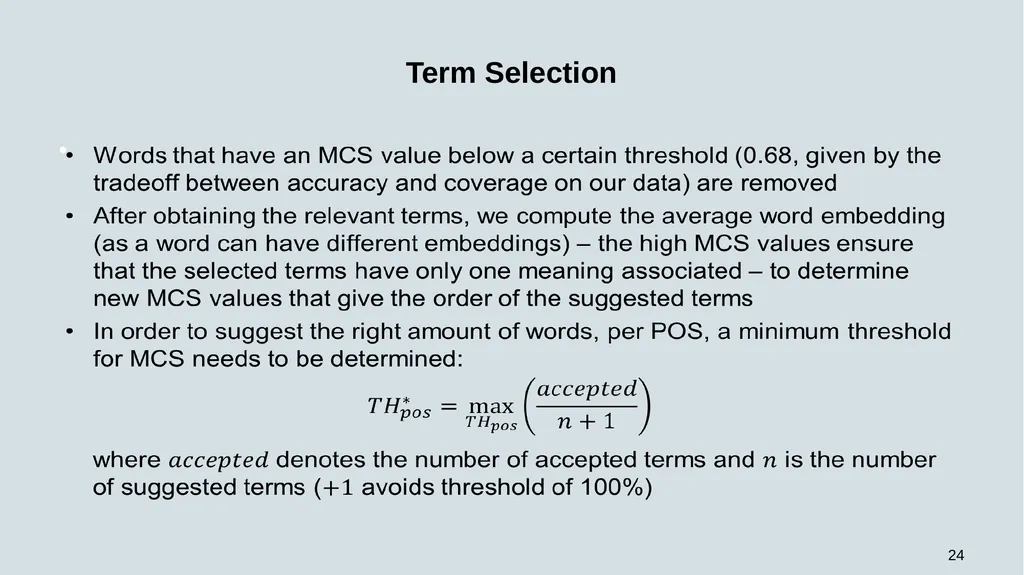
Term Selection 24<br>
25
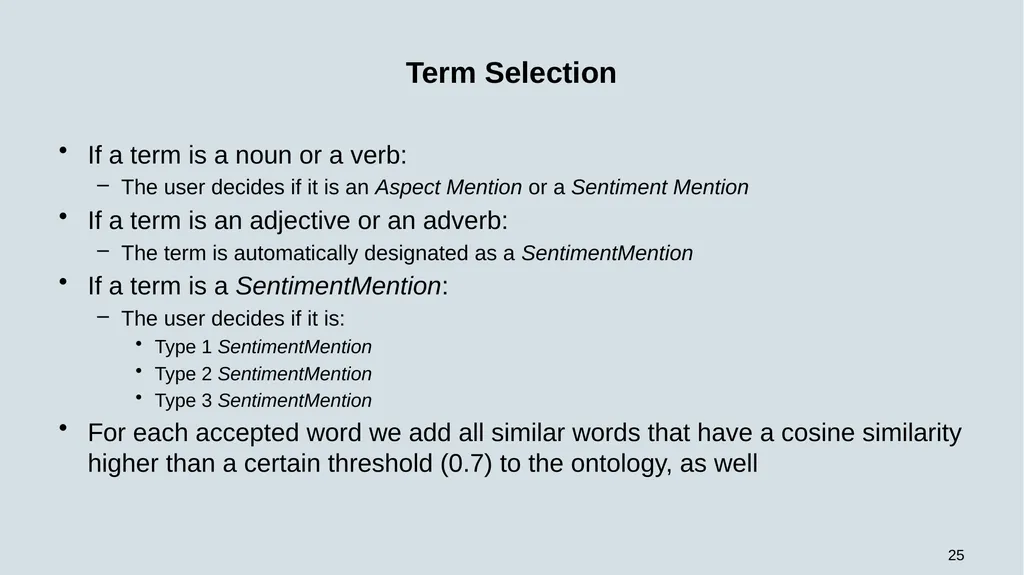
Term Selection If a term is a noun or a verb:
The user decides if it is an Aspect Mention or a Sentiment Mention
If a term is an adjective or an adverb:
The term is automatically designated as a SentimentMention
If a term is a SentimentMention:
The user decides if it is:
Type 1 SentimentMention
Type 2 SentimentMention
Type 3 SentimentMention
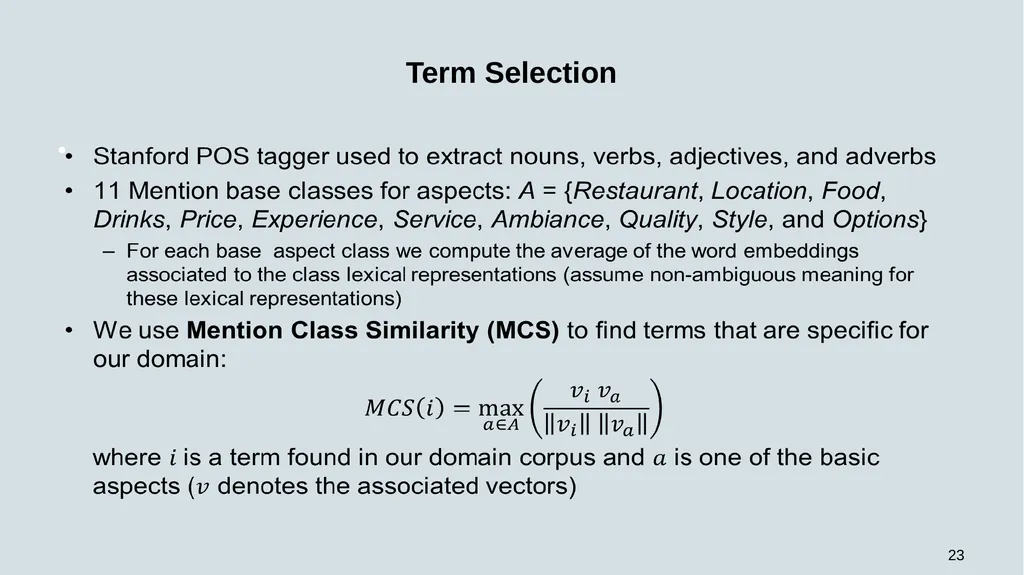
For each accepted word we add all similar words that have a cosine similarity higher than a certain threshold (0.7) to the ontology, as well 25<br>
The user decides if it is an Aspect Mention or a Sentiment Mention
If a term is an adjective or an adverb:
The term is automatically designated as a SentimentMention
If a term is a SentimentMention:
The user decides if it is:
Type 1 SentimentMention
Type 2 SentimentMention
Type 3 SentimentMention
For each accepted word we add all similar words that have a cosine similarity higher than a certain threshold (0.7) to the ontology, as well 25<br>
26
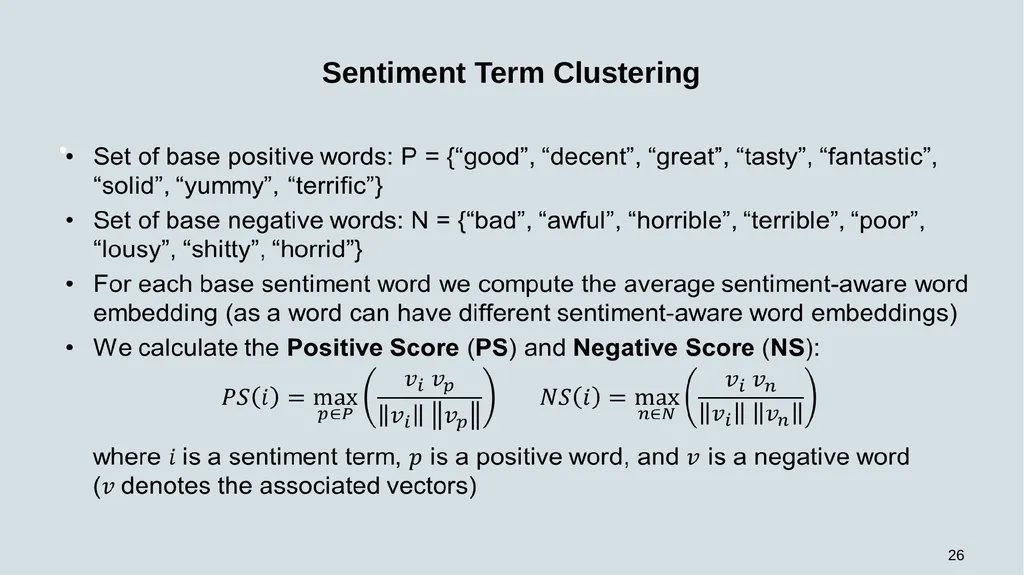
Sentiment Term Clustering 26<br>
27
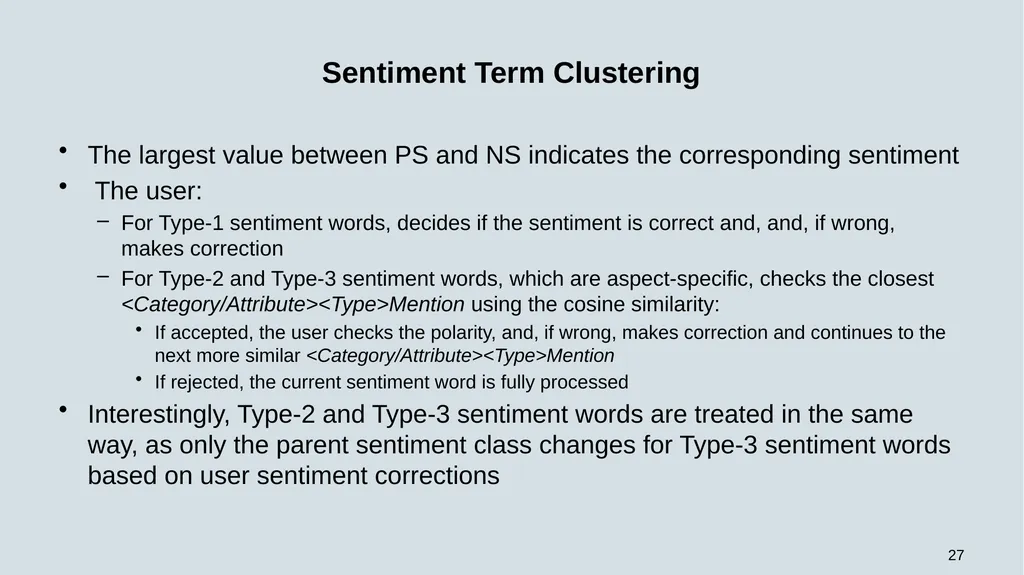
Sentiment Term Clustering The largest value between PS and NS indicates the corresponding sentiment
The user:
For Type-1 sentiment words, decides if the sentiment is correct and, and, if wrong, makes correction
For Type-2 and Type-3 sentiment words, which are aspect-specific, checks the closest <Category/Attribute><Type>Mention using the cosine similarity:
If accepted, the user checks the polarity, and, if wrong, makes correction and continues to the next more similar <Category/Attribute><Type>Mention
If rejected, the current sentiment word is fully processed
Interestingly, Type-2 and Type-3 sentiment words are treated in the same way, as only the parent sentiment class changes for Type-3 sentiment words based on user sentiment corrections 27<br>
The user:
For Type-1 sentiment words, decides if the sentiment is correct and, and, if wrong, makes correction
For Type-2 and Type-3 sentiment words, which are aspect-specific, checks the closest <Category/Attribute><Type>Mention using the cosine similarity:
If accepted, the user checks the polarity, and, if wrong, makes correction and continues to the next more similar <Category/Attribute><Type>Mention
If rejected, the current sentiment word is fully processed
Interestingly, Type-2 and Type-3 sentiment words are treated in the same way, as only the parent sentiment class changes for Type-3 sentiment words based on user sentiment corrections 27<br>
28
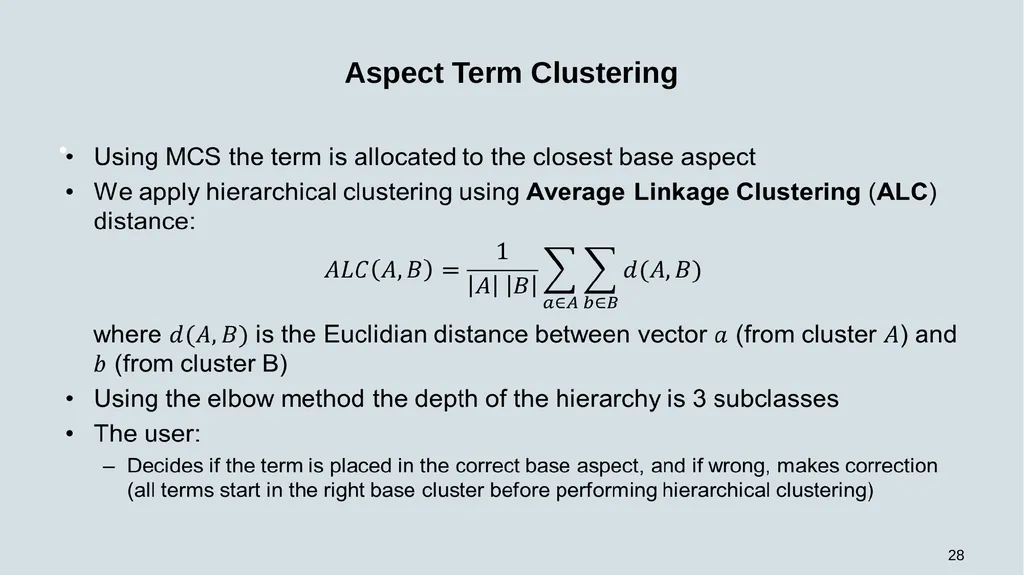
Aspect Term Clustering 28<br>
29
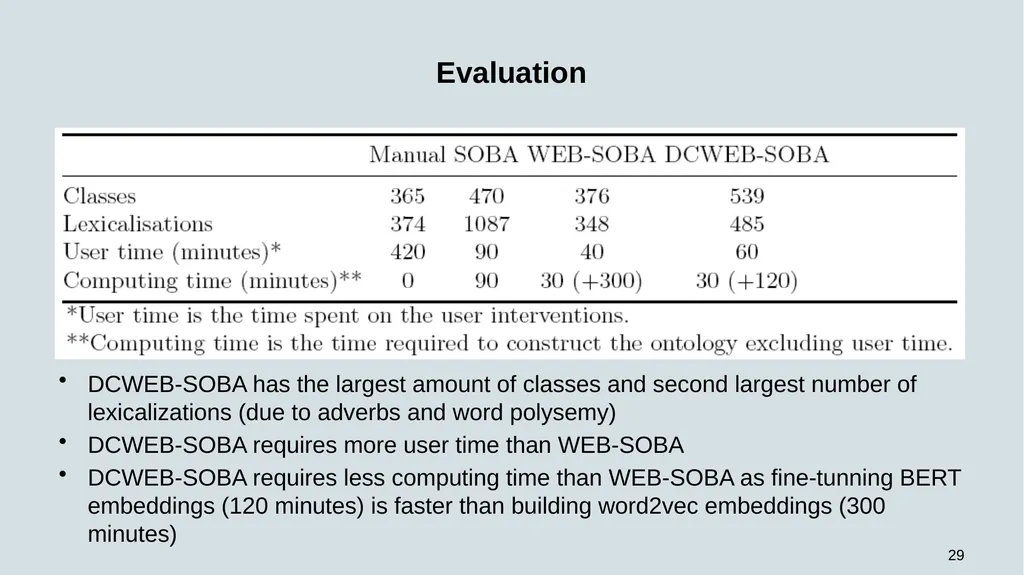
Evaluation DCWEB-SOBA has the largest amount of classes and second largest number of lexicalizations (due to adverbs and word polysemy)
DCWEB-SOBA requires more user time than WEB-SOBA
DCWEB-SOBA requires less computing time than WEB-SOBA as fine-tunning BERT embeddings (120 minutes) is faster than building word2vec embeddings (300 minutes) 29<br>
DCWEB-SOBA requires more user time than WEB-SOBA
DCWEB-SOBA requires less computing time than WEB-SOBA as fine-tunning BERT embeddings (120 minutes) is faster than building word2vec embeddings (300 minutes) 29<br>
30
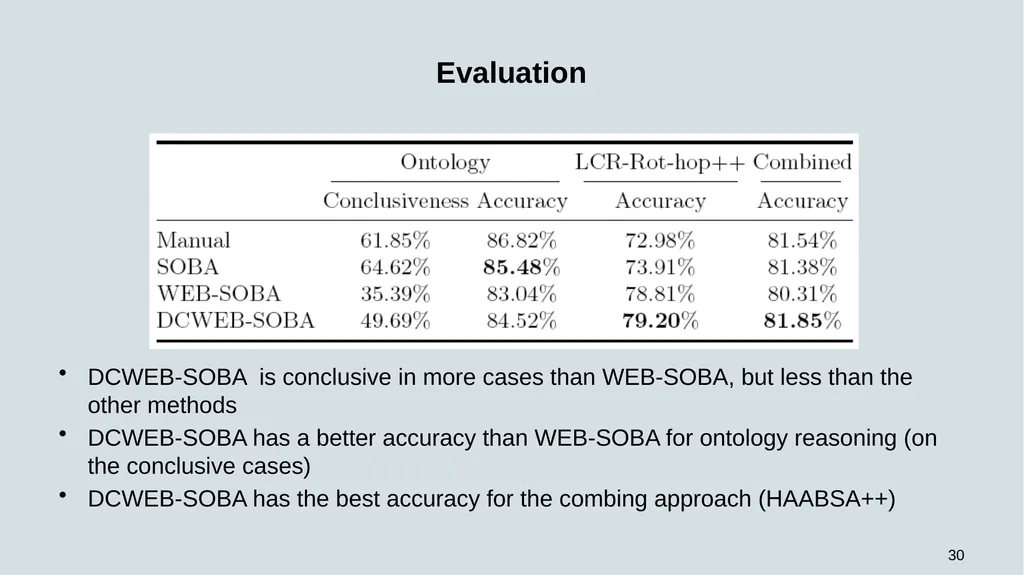
Evaluation DCWEB-SOBA is conclusive in more cases than WEB-SOBA, but less than the other methods
DCWEB-SOBA has a better accuracy than WEB-SOBA for ontology reasoning (on the conclusive cases)
DCWEB-SOBA has the best accuracy for the combing approach (HAABSA++) 30<br>
DCWEB-SOBA has a better accuracy than WEB-SOBA for ontology reasoning (on the conclusive cases)
DCWEB-SOBA has the best accuracy for the combing approach (HAABSA++) 30<br>
31
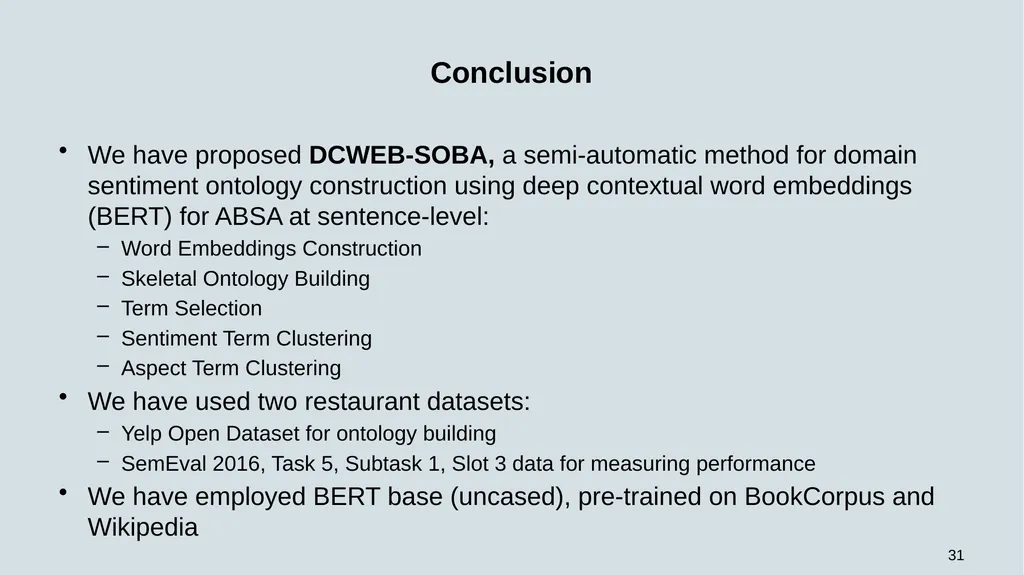
Conclusion We have proposed DCWEB-SOBA, a semi-automatic method for domain sentiment ontology construction using deep contextual word embeddings (BERT) for ABSA at sentence-level:
Word Embeddings Construction
Skeletal Ontology Building
Term Selection
Sentiment Term Clustering
Aspect Term Clustering
We have used two restaurant datasets:
Yelp Open Dataset for ontology building
SemEval 2016, Task 5, Subtask 1, Slot 3 data for measuring performance
We have employed BERT base (uncased), pre-trained on BookCorpus and Wikipedia 31<br>
Word Embeddings Construction
Skeletal Ontology Building
Term Selection
Sentiment Term Clustering
Aspect Term Clustering
We have used two restaurant datasets:
Yelp Open Dataset for ontology building
SemEval 2016, Task 5, Subtask 1, Slot 3 data for measuring performance
We have employed BERT base (uncased), pre-trained on BookCorpus and Wikipedia 31<br>
32
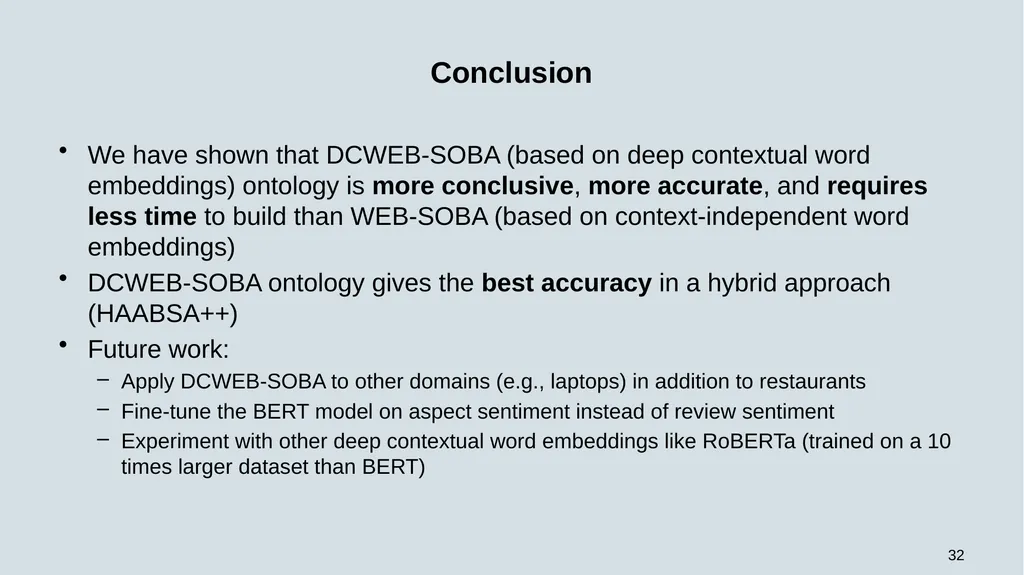
Conclusion We have shown that DCWEB-SOBA (based on deep contextual word embeddings) ontology is more conclusive, more accurate, and requires less time to build than WEB-SOBA (based on context-independent word embeddings)
DCWEB-SOBA ontology gives the best accuracy in a hybrid approach (HAABSA++)
Future work:
Apply DCWEB-SOBA to other domains (e.g., laptops) in addition to restaurants
Fine-tune the BERT model on aspect sentiment instead of review sentiment
Experiment with other deep contextual word embeddings like RoBERTa (trained on a 10 times larger dataset than BERT) 32<br>
DCWEB-SOBA ontology gives the best accuracy in a hybrid approach (HAABSA++)
Future work:
Apply DCWEB-SOBA to other domains (e.g., laptops) in addition to restaurants
Fine-tune the BERT model on aspect sentiment instead of review sentiment
Experiment with other deep contextual word embeddings like RoBERTa (trained on a 10 times larger dataset than BERT) 32<br>
33
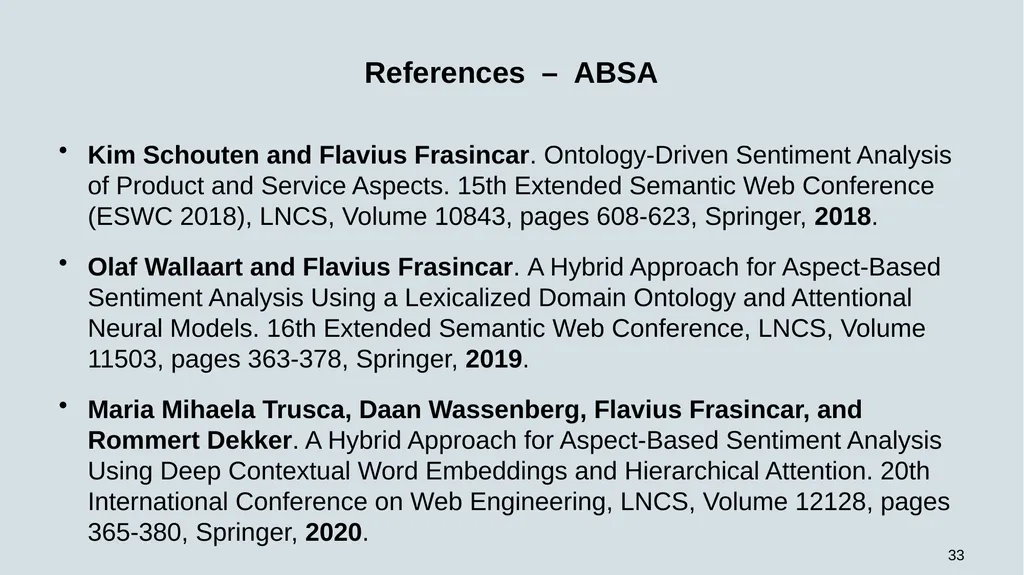
References – ABSA Kim Schouten and Flavius Frasincar. Ontology-Driven Sentiment Analysis of Product and Service Aspects. 15th Extended Semantic Web Conference (ESWC 2018), LNCS, Volume 10843, pages 608-623, Springer, 2018.
Olaf Wallaart and Flavius Frasincar. A Hybrid Approach for Aspect-Based Sentiment Analysis Using a Lexicalized Domain Ontology and Attentional Neural Models. 16th Extended Semantic Web Conference, LNCS, Volume 11503, pages 363-378, Springer, 2019.
Maria Mihaela Trusca, Daan Wassenberg, Flavius Frasincar, and Rommert Dekker. A Hybrid Approach for Aspect-Based Sentiment Analysis Using Deep Contextual Word Embeddings and Hierarchical Attention. 20th International Conference on Web Engineering, LNCS, Volume 12128, pages 365-380, Springer, 2020. 33<br>
Olaf Wallaart and Flavius Frasincar. A Hybrid Approach for Aspect-Based Sentiment Analysis Using a Lexicalized Domain Ontology and Attentional Neural Models. 16th Extended Semantic Web Conference, LNCS, Volume 11503, pages 363-378, Springer, 2019.
Maria Mihaela Trusca, Daan Wassenberg, Flavius Frasincar, and Rommert Dekker. A Hybrid Approach for Aspect-Based Sentiment Analysis Using Deep Contextual Word Embeddings and Hierarchical Attention. 20th International Conference on Web Engineering, LNCS, Volume 12128, pages 365-380, Springer, 2020. 33<br>
34
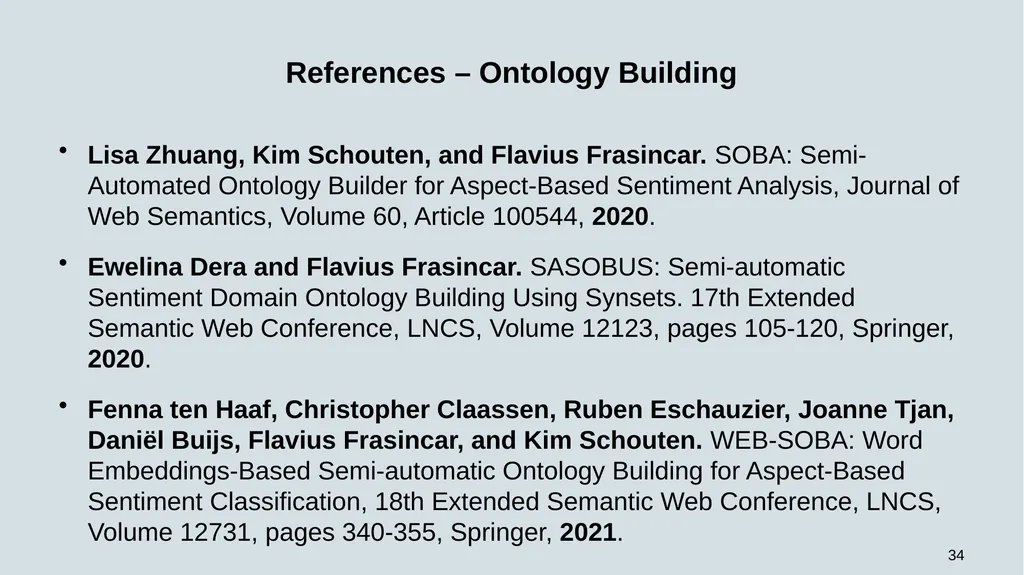
References – Ontology Building Lisa Zhuang, Kim Schouten, and Flavius Frasincar. SOBA: Semi-Automated Ontology Builder for Aspect-Based Sentiment Analysis, Journal of Web Semantics, Volume 60, Article 100544, 2020.
Ewelina Dera and Flavius Frasincar. SASOBUS: Semi-automatic Sentiment Domain Ontology Building Using Synsets. 17th Extended Semantic Web Conference, LNCS, Volume 12123, pages 105-120, Springer, 2020.
Fenna ten Haaf, Christopher Claassen, Ruben Eschauzier, Joanne Tjan, Daniël Buijs, Flavius Frasincar, and Kim Schouten. WEB-SOBA: Word Embeddings-Based Semi-automatic Ontology Building for Aspect-Based Sentiment Classification, 18th Extended Semantic Web Conference, LNCS, Volume 12731, pages 340-355, Springer, 2021. 34<br>
Ewelina Dera and Flavius Frasincar. SASOBUS: Semi-automatic Sentiment Domain Ontology Building Using Synsets. 17th Extended Semantic Web Conference, LNCS, Volume 12123, pages 105-120, Springer, 2020.
Fenna ten Haaf, Christopher Claassen, Ruben Eschauzier, Joanne Tjan, Daniël Buijs, Flavius Frasincar, and Kim Schouten. WEB-SOBA: Word Embeddings-Based Semi-automatic Ontology Building for Aspect-Based Sentiment Classification, 18th Extended Semantic Web Conference, LNCS, Volume 12731, pages 340-355, Springer, 2021. 34<br>