
1 DEFLUORIDATION Defluoridation is defined as,
PC
Published · 45 slides · 0 views
1 / 1







Description
1 DEFLUORIDATION Defluoridation is defined as, the downward adjustment of level of fluoride in drinking water to the optimal level. The recommended optimum level of fluoride in drinking water is 1 ppm (WHO 1963). Optimum level of fluoride
Related Topics
Share
Embed code
Download this presentation From Below
"1 DEFLUORIDATION Defluoridation is defined as," is the property of its rightful owner. Permission is granted to download and print the materials on this website for personal, non-commercial use only, and to display it on your personal computer provided you do not modify the materials and that you retain all copyright notices contained in the materials. By downloading content from our website, you accept the terms of this agreement.
Presentation Transcript
01
1<br>
02
DEFLUORIDATION<br>
03
Defluoridation is defined as, “the downward adjustment of level of fluoride in drinking water to the optimal level‟.<br>
04
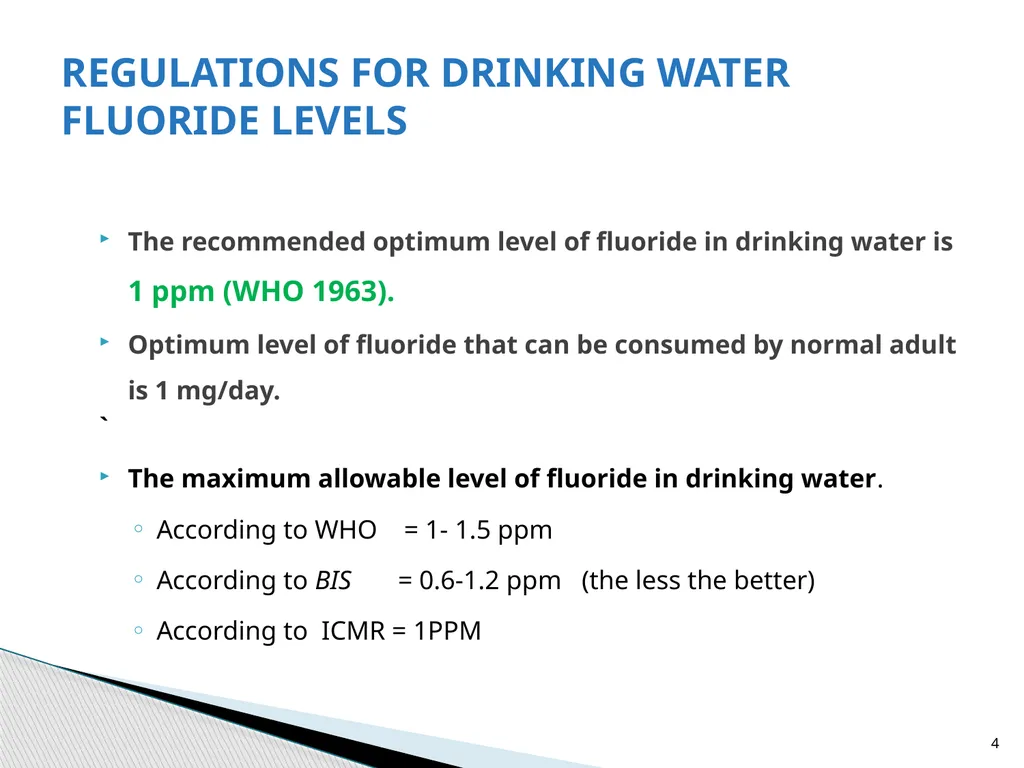
The recommended optimum level of fluoride in drinking water is 1 ppm (WHO 1963).
Optimum level of fluoride that can be consumed by normal adult is 1 mg/day.
`
The maximum allowable level of fluoride in drinking water.
According to WHO = 1- 1.5 ppm
According to BIS = 0.6-1.2 ppm (the less the better)
According to ICMR = 1PPM 4 REGULATIONS FOR DRINKING WATER FLUORIDE LEVELS<br>
Optimum level of fluoride that can be consumed by normal adult is 1 mg/day.
`
The maximum allowable level of fluoride in drinking water.
According to WHO = 1- 1.5 ppm
According to BIS = 0.6-1.2 ppm (the less the better)
According to ICMR = 1PPM 4 REGULATIONS FOR DRINKING WATER FLUORIDE LEVELS<br>
05
The 1984 WHO guidelines suggested that in areas with a warm climate the optimal fluoride concentration in drinking water should remain below 1 mg/l (1ppm or part per million), while in cooler climates it could go up to 1.2 mg/l. 5 Piddennavar Renuka, Krishnappa Pushpanjali. Review on Defluoridation Techniques of Water.The International Journal Of Engineering And Science 2013;2(3):86-94.<br>
06
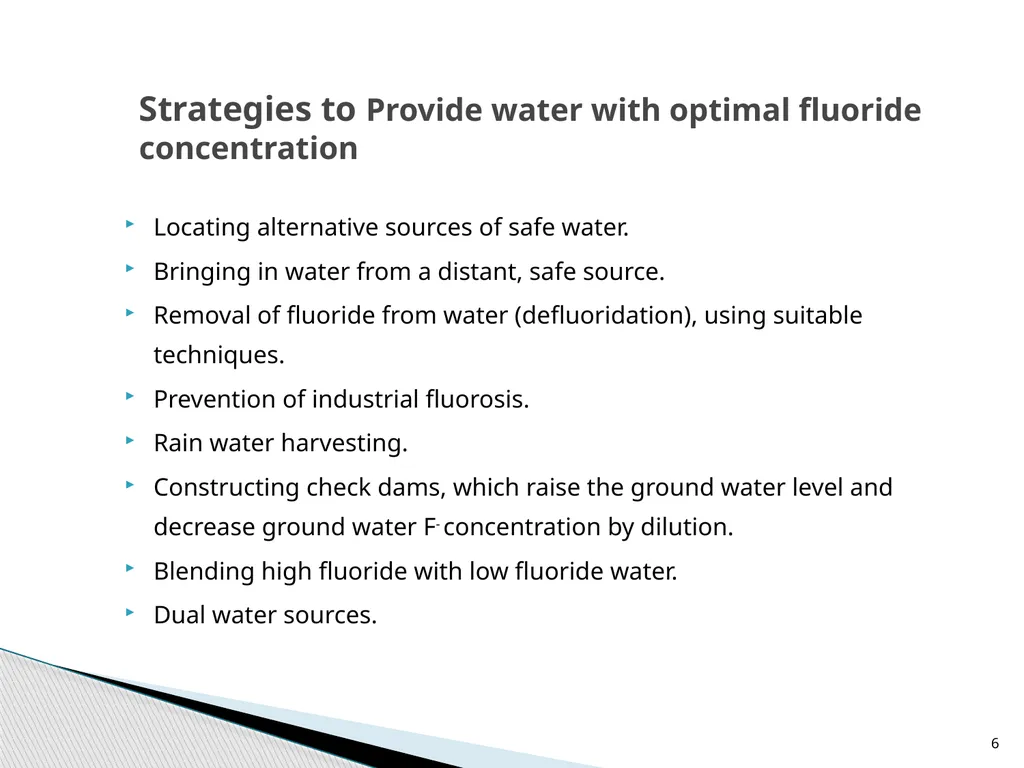
Locating alternative sources of safe water.
Bringing in water from a distant, safe source.
Removal of fluoride from water (defluoridation), using suitable techniques.
Prevention of industrial fluorosis.
Rain water harvesting.
Constructing check dams, which raise the ground water level and decrease ground water F- concentration by dilution.
Blending high fluoride with low fluoride water.
Dual water sources. 6 Strategies to Provide water with optimal fluoride concentration<br>
Bringing in water from a distant, safe source.
Removal of fluoride from water (defluoridation), using suitable techniques.
Prevention of industrial fluorosis.
Rain water harvesting.
Constructing check dams, which raise the ground water level and decrease ground water F- concentration by dilution.
Blending high fluoride with low fluoride water.
Dual water sources. 6 Strategies to Provide water with optimal fluoride concentration<br>
07
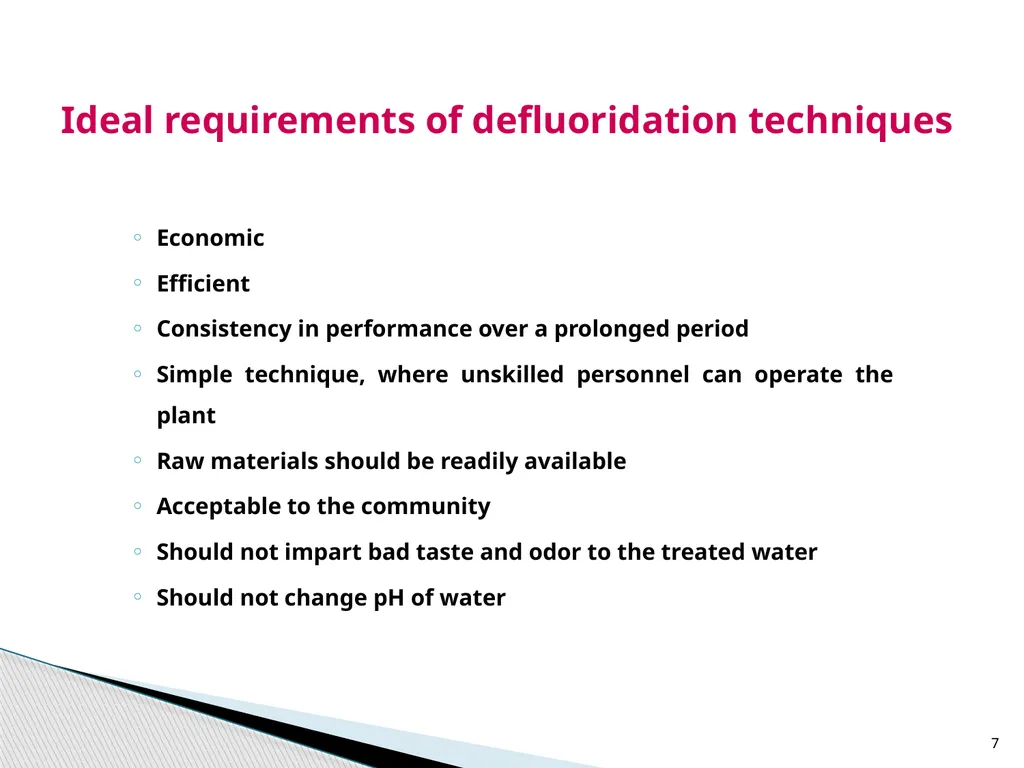
Economic
Efficient
Consistency in performance over a prolonged period
Simple technique, where unskilled personnel can operate the plant
Raw materials should be readily available
Acceptable to the community
Should not impart bad taste and odor to the treated water
Should not change pH of water 7 Ideal requirements of defluoridation techniques<br>
Efficient
Consistency in performance over a prolonged period
Simple technique, where unskilled personnel can operate the plant
Raw materials should be readily available
Acceptable to the community
Should not impart bad taste and odor to the treated water
Should not change pH of water 7 Ideal requirements of defluoridation techniques<br>
08
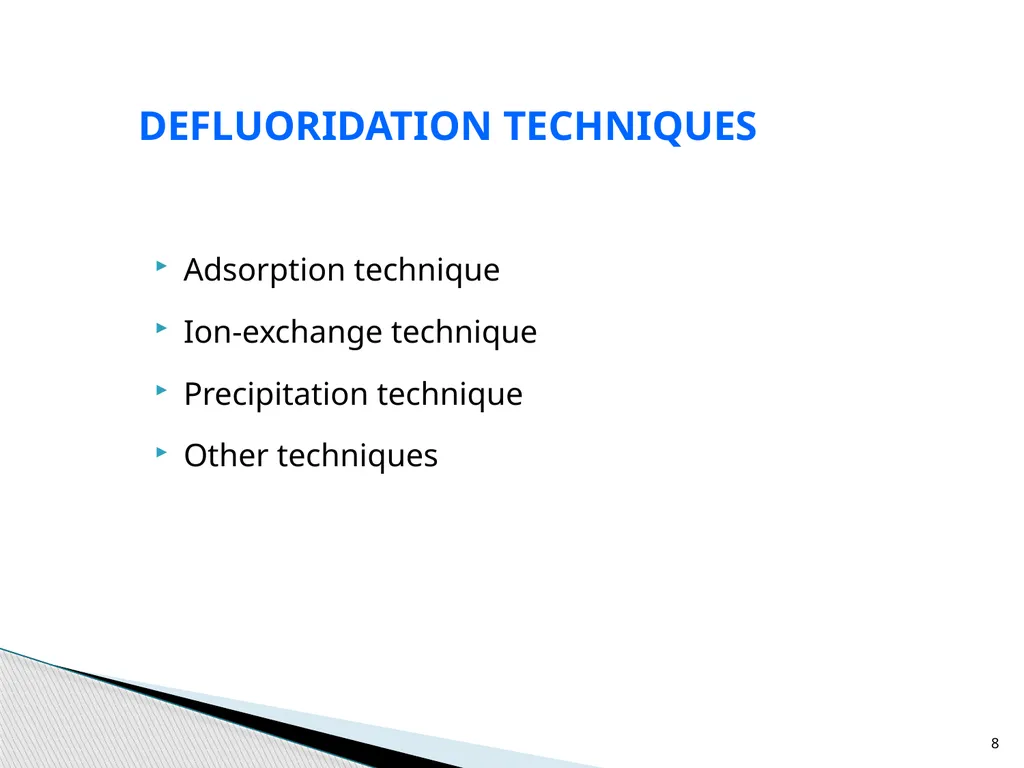
Adsorption technique
Ion-exchange technique
Precipitation technique
Other techniques 8 DEFLUORIDATION TECHNIQUES<br>
Ion-exchange technique
Precipitation technique
Other techniques 8 DEFLUORIDATION TECHNIQUES<br>
09
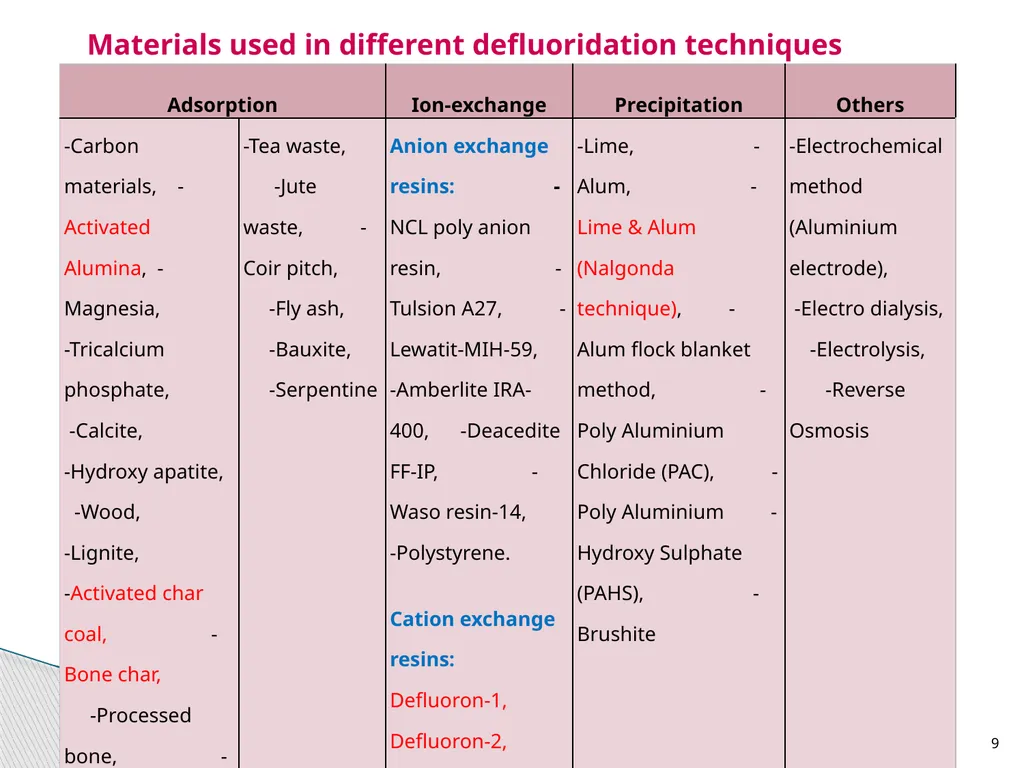
9 Materials used in different defluoridation techniques<br>
10
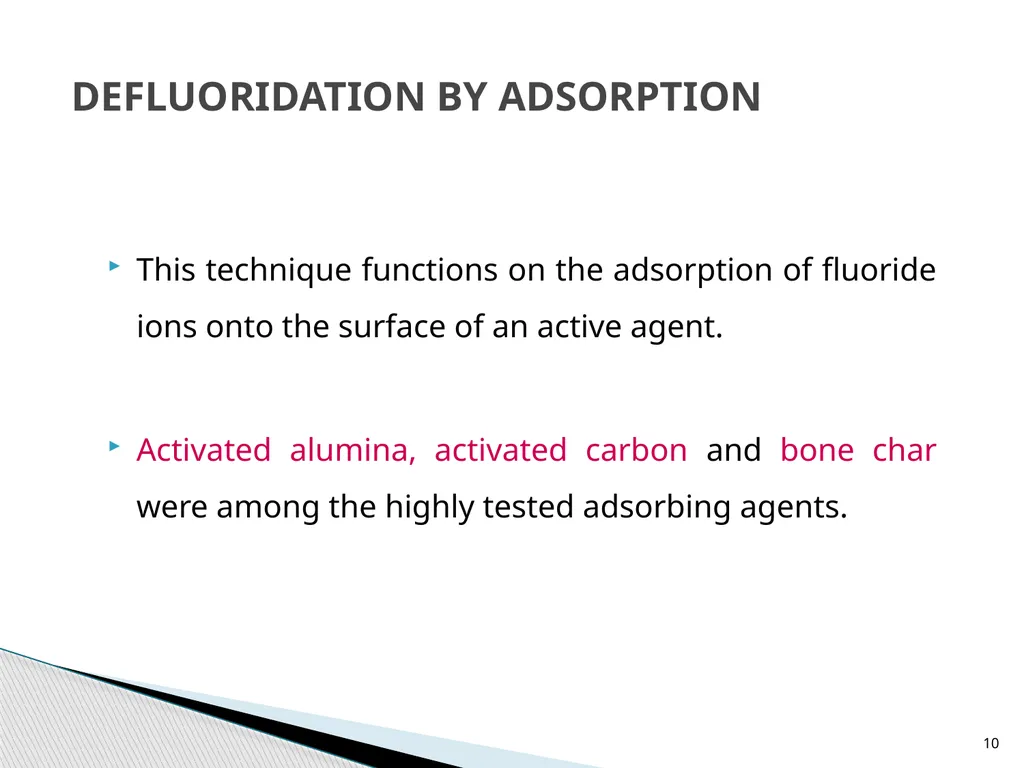
This technique functions on the adsorption of fluoride ions onto the surface of an active agent.
Activated alumina, activated carbon and bone char were among the highly tested adsorbing agents. 10 DEFLUORIDATION BY ADSORPTION<br>
Activated alumina, activated carbon and bone char were among the highly tested adsorbing agents. 10 DEFLUORIDATION BY ADSORPTION<br>
11
1. Activated Alumina
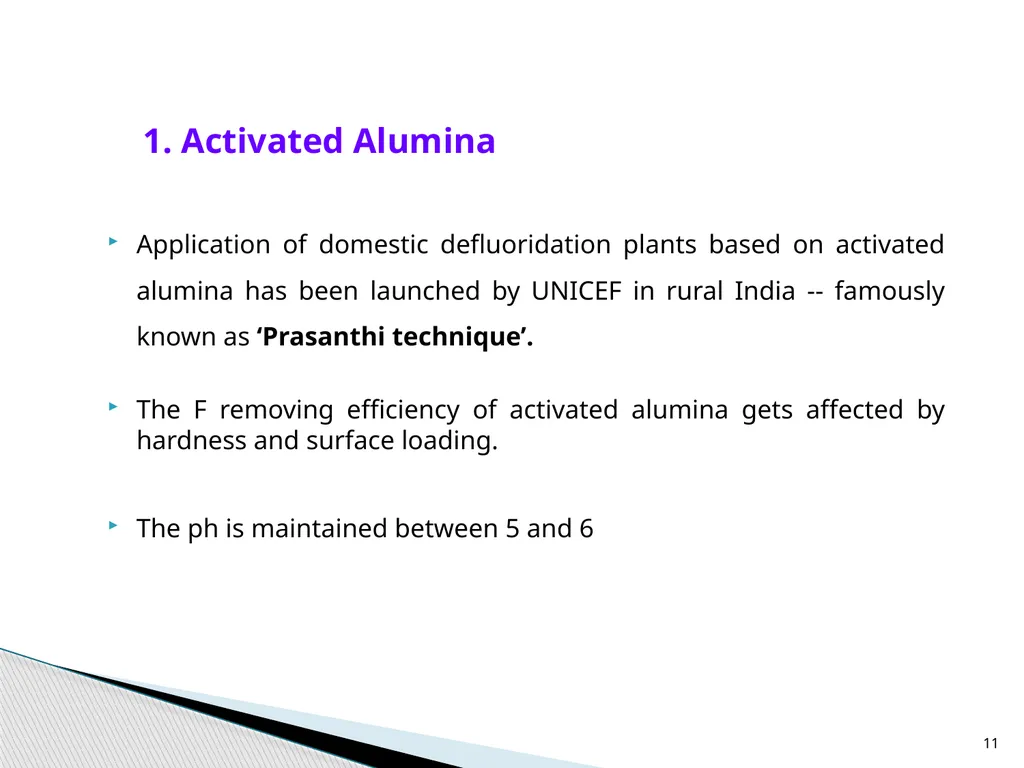
Application of domestic defluoridation plants based on activated alumina has been launched by UNICEF in rural India -- famously known as ‘Prasanthi technique’.
The F removing efficiency of activated alumina gets affected by hardness and surface loading.
The ph is maintained between 5 and 6 11<br>
Application of domestic defluoridation plants based on activated alumina has been launched by UNICEF in rural India -- famously known as ‘Prasanthi technique’.
The F removing efficiency of activated alumina gets affected by hardness and surface loading.
The ph is maintained between 5 and 6 11<br>
12
• This process can remove fluoride up to 90%
• Effective and economical
• It requires minimum contact time for maximum defluoridation
• It is indigenously available and cheap
• Percentage of regeneration is considerably high. Advantages<br>
• Effective and economical
• It requires minimum contact time for maximum defluoridation
• It is indigenously available and cheap
• Percentage of regeneration is considerably high. Advantages<br>
13
Disadvantages :
Adsorption of fluoride is possible only at specific pH range, needing pre-and post- pH adjustment of water.
Frequent activation of Alumina is needed, which make the technique expensive.
Generates concentrated fluoride solution, causing disposal problems.
Disposal of fluoride laden sludge is also a problem
Skilled personnel are required for plant operation 13<br>
Adsorption of fluoride is possible only at specific pH range, needing pre-and post- pH adjustment of water.
Frequent activation of Alumina is needed, which make the technique expensive.
Generates concentrated fluoride solution, causing disposal problems.
Disposal of fluoride laden sludge is also a problem
Skilled personnel are required for plant operation 13<br>
14
Among various treatments used, activated carbon is a powerful adsorbent due to large surface area and pore volume.
It can be prepared from the different raw materials, such as wood, lignite, coal, bone, petroleum residues, nutshells and also from other low cost/waste materials like the rice-husk, saw dust, coconut shell, tree bark, cotton waste etc. 14 2. Activated Carbon<br>
It can be prepared from the different raw materials, such as wood, lignite, coal, bone, petroleum residues, nutshells and also from other low cost/waste materials like the rice-husk, saw dust, coconut shell, tree bark, cotton waste etc. 14 2. Activated Carbon<br>
15
It is a highly economic technique with 62 - 66% defluoridation.
The optimum time for the adsorption to reach saturation is 9 hours and optimum pH of fluoride solution is between 7 - 7.5. 15 3. Bone char<br>
The optimum time for the adsorption to reach saturation is 9 hours and optimum pH of fluoride solution is between 7 - 7.5. 15 3. Bone char<br>
16
The efficacy of the plant depends upon temperature and pH of raw water; duration of contact.
The efficiency can be improved by pre-treating the raw water with Brushite and Calcium hydroxide. 16<br>
The efficiency can be improved by pre-treating the raw water with Brushite and Calcium hydroxide. 16<br>
17
The bone char is unhygienic (harbors bacteria).
Regular fluoride analysis to check whether the material is exhausted.
It is a technique sensitive procedure, charring procedure should be done cautiously.
Cultural and religious objections . 17 Disadvantages:<br>
Regular fluoride analysis to check whether the material is exhausted.
It is a technique sensitive procedure, charring procedure should be done cautiously.
Cultural and religious objections . 17 Disadvantages:<br>
18
BRICK
Principle: same as that of activated alumina.
The soil used for brick manufacturing contains Aluminium oxide. During burning operation in the kiln, it gets activated.
Replacement of filter media is required once in 3 months if fluoride content in raw water is 2.5 mg/l.
The cost of the filter unit is about Rs 600 /-. 18<br>
Principle: same as that of activated alumina.
The soil used for brick manufacturing contains Aluminium oxide. During burning operation in the kiln, it gets activated.
Replacement of filter media is required once in 3 months if fluoride content in raw water is 2.5 mg/l.
The cost of the filter unit is about Rs 600 /-. 18<br>
19
Can not achieve complete defluoridation.
All the soils are not rich in Aluminium oxide.
Possibility of microbial contamination of brick. 19 Limitations:<br>
All the soils are not rich in Aluminium oxide.
Possibility of microbial contamination of brick. 19 Limitations:<br>
20
Economical and readily acceptable for the rural communities.
Disadvantages:
It results a marginal reduction in water fluoride level from 1.8 ppm to 1.5 and 1.4 ppm at the end of 2 days and 4 days respectively, which is practically not significant.
The water pH was raised from 7.7 to 8.11 and 8.14 the end of 2 days and 4 days respectively, which is beyond the acceptable limits of alkalinity. 20 Mud pot<br>
Disadvantages:
It results a marginal reduction in water fluoride level from 1.8 ppm to 1.5 and 1.4 ppm at the end of 2 days and 4 days respectively, which is practically not significant.
The water pH was raised from 7.7 to 8.11 and 8.14 the end of 2 days and 4 days respectively, which is beyond the acceptable limits of alkalinity. 20 Mud pot<br>
21
Seeds of the Drumsticks
Roots of Vetiver grass
Tamarind seeds
Mangosteen fruits
Rooster feathers 21 Natural adsorbents<br>
Roots of Vetiver grass
Tamarind seeds
Mangosteen fruits
Rooster feathers 21 Natural adsorbents<br>
22
Synthetic chemicals, namely, anion and cation exchange resins have been used for fluoride removal.
Used in chloride and hydroxy form.
These are commercially produced resins which are expensive in most circumstances.
a) Carbion :
It is a Cation exchange resin of good durability and can be used both on sodium and hydrogen cycle. 22 DEFLUORIDATION BY ION-EXCHANGE<br>
Used in chloride and hydroxy form.
These are commercially produced resins which are expensive in most circumstances.
a) Carbion :
It is a Cation exchange resin of good durability and can be used both on sodium and hydrogen cycle. 22 DEFLUORIDATION BY ION-EXCHANGE<br>
23
De Fluoron –1: 1964
A sulphonated saw dust impregnated with 2% alum solution
Drawbacks : the medium had poor hydraulic properties
- cost
Defluoran-2:
Developed in 1968. It is sulphonated coal & works on the aluminum cycles.
Life of medium is 2- 4 yrs
The average fluoride removal capacity of the medium is 484mg F/L 23<br>
A sulphonated saw dust impregnated with 2% alum solution
Drawbacks : the medium had poor hydraulic properties
- cost
Defluoran-2:
Developed in 1968. It is sulphonated coal & works on the aluminum cycles.
Life of medium is 2- 4 yrs
The average fluoride removal capacity of the medium is 484mg F/L 23<br>
24
Advantages
• Removes fluoride up to 90-95%
• It helps in the retention of taste and colour of water intact.<br>
• Removes fluoride up to 90-95%
• It helps in the retention of taste and colour of water intact.<br>
25
Waste produced is very large
Expensive.
Regeneration of resin is a problem because it leads to fluoride rich waste, which has to be treated separately before final disposal
Treated water has a very low pH and high levels of chloride
The regeneration and maintenance of plant required skilled operation & personnel which may not be readily available. 25 Disadvantages:<br>
Expensive.
Regeneration of resin is a problem because it leads to fluoride rich waste, which has to be treated separately before final disposal
Treated water has a very low pH and high levels of chloride
The regeneration and maintenance of plant required skilled operation & personnel which may not be readily available. 25 Disadvantages:<br>
26
Major drawbacks of Ion-exchange and adsorption techniques are:
The necessary flow through system is often difficult to arrange where there is no piped water supply
Gradual exhaustion of the active agent is not easily detected. 26<br>
The necessary flow through system is often difficult to arrange where there is no piped water supply
Gradual exhaustion of the active agent is not easily detected. 26<br>
27
Reverse osmosis, electrolysis and electro dialysis are physical methods that are tested for defluoridation of water.
Though they are effective in removing fluoride salts from water, there are certain disadvantages that limit their usage on a large scale. Other techniques<br>
Though they are effective in removing fluoride salts from water, there are certain disadvantages that limit their usage on a large scale. Other techniques<br>
28
In reverse osmosis, the hydraulic pressure is exerted on one side of the semi permeable membrane which forces the water across the membrane leaving the salts behind.
In electro dialysis, the membranes allow the ions to pass but not the water. The driving force is an electric current which carries the ions through the membranes.<br>
In electro dialysis, the membranes allow the ions to pass but not the water. The driving force is an electric current which carries the ions through the membranes.<br>
29
• The process is highly effective for fluoride removal
• It permits the treatment and disinfection of water in one step
• It ensures constant water quality
• No chemicals are required and very little maintenance is
needed
• Life of membrane is sufficiently long, so problem of regeneration or replacement is encountered less frequently
• It works under wide pH range
• No interference by other ions is observed
• The process works in a simple, reliable automated operating
regime with minimal manpower using compact modular model. Advantages<br>
• It permits the treatment and disinfection of water in one step
• It ensures constant water quality
• No chemicals are required and very little maintenance is
needed
• Life of membrane is sufficiently long, so problem of regeneration or replacement is encountered less frequently
• It works under wide pH range
• No interference by other ions is observed
• The process works in a simple, reliable automated operating
regime with minimal manpower using compact modular model. Advantages<br>
30
• It removes all the ions present in water. Since though some minerals are essential for proper growth therefore, remineralisation is required after treatment
• The process is expensive in comparison to other options
• The water becomes acidic and needs pH correction
• Lots of water gets wasted as brine
• Disposal of brine is a problem Disadvantages<br>
• The process is expensive in comparison to other options
• The water becomes acidic and needs pH correction
• Lots of water gets wasted as brine
• Disposal of brine is a problem Disadvantages<br>
31
Addition of chemicals (coagulants and coagulant aids) and the subsequent precipitation of a sparingly soluble fluoride salt as insoluble fluorapatite.
The best example for this technique is Nalgonda technique 31 DEFLUORIDATION BY PRECIPITATION<br>
The best example for this technique is Nalgonda technique 31 DEFLUORIDATION BY PRECIPITATION<br>
32
Nalgonda technique
National Environment Engineering Research Institute (NEERI), Nagpur (1974 )
Nalgonda Technique involves addition of Aluminium salts, lime and bleaching powder.
Economical and simple method.
This technique is extremely useful for both domestic as well as for community water supply. 32<br>
National Environment Engineering Research Institute (NEERI), Nagpur (1974 )
Nalgonda Technique involves addition of Aluminium salts, lime and bleaching powder.
Economical and simple method.
This technique is extremely useful for both domestic as well as for community water supply. 32<br>
33
Aluminium salt responsible for removal of fluoride from water and may be added as Aluminium Sulphate or Aluminium Chloride or Combination.
The dose of Aluminium salt increases with increase in the fluoride and alkalinity levels of the raw water. 33<br>
The dose of Aluminium salt increases with increase in the fluoride and alkalinity levels of the raw water. 33<br>
34
The dose of lime is empirically 1/20th that of the dose of Aluminium salt.
Lime maintains alkalinity of the solution and facilitates formation of dense flocks for rapid settling.
Bleaching powder is added to the raw water at the rate of 3 mg/l for disinfection. 34<br>
Lime maintains alkalinity of the solution and facilitates formation of dense flocks for rapid settling.
Bleaching powder is added to the raw water at the rate of 3 mg/l for disinfection. 34<br>
35
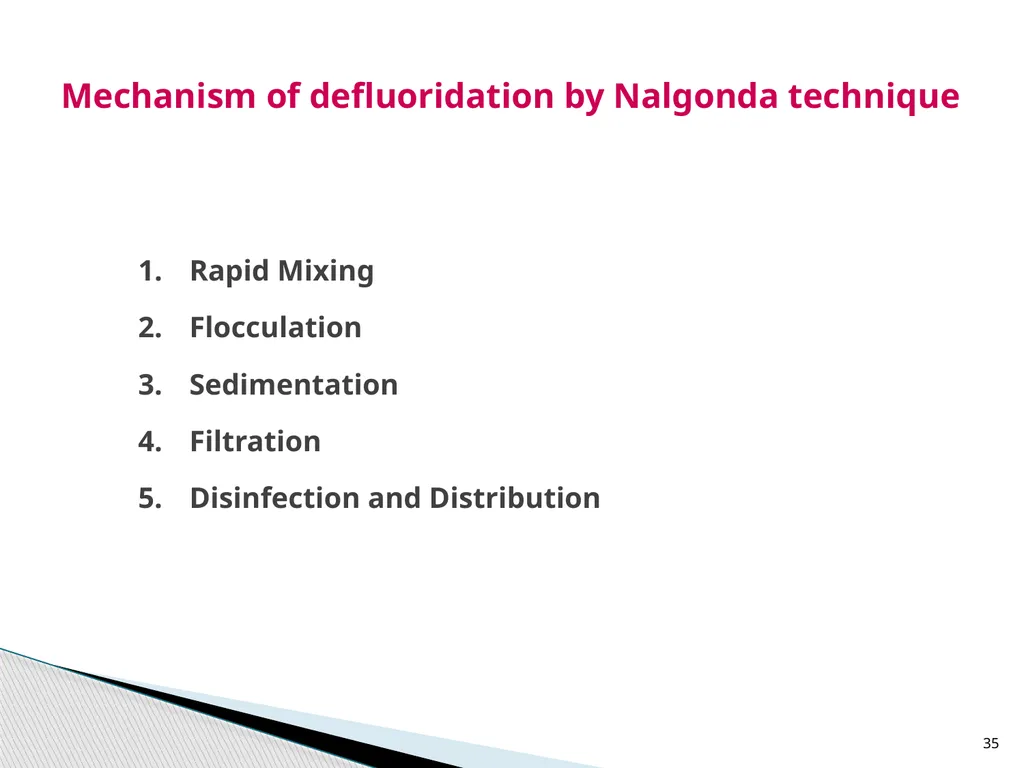
Rapid Mixing
Flocculation
Sedimentation
Filtration
Disinfection and Distribution 35 Mechanism of defluoridation by Nalgonda technique<br>
Flocculation
Sedimentation
Filtration
Disinfection and Distribution 35 Mechanism of defluoridation by Nalgonda technique<br>
36
1)Rapid Mixing:
Rapid mixing is an operation by which the coagulant is rapidly and uniformly dispersed through out a single or multiple phase system.
Duration= 30-60 sec
Speed=10-20 rpm 36<br>
Rapid mixing is an operation by which the coagulant is rapidly and uniformly dispersed through out a single or multiple phase system.
Duration= 30-60 sec
Speed=10-20 rpm 36<br>
37
2) Flocculation:
Settable particles : polymeric aluminium hydroxides (flock) formed.
Achieved by gentle and prolonged mixing for 10-15 mins at 2-4 rpm.
Besides, bacteria, turbidity, colour, odour, pesticides and organics are also removed. 37<br>
Settable particles : polymeric aluminium hydroxides (flock) formed.
Achieved by gentle and prolonged mixing for 10-15 mins at 2-4 rpm.
Besides, bacteria, turbidity, colour, odour, pesticides and organics are also removed. 37<br>
38
3) Sedimentation:
It is separation from the water by gravitational setting of suspended particles that are heavier than water.
Factors that affect sedimentation are:
size , shape , density and nature of particles.
Viscosity , density and temperature of water
Surface over flow rate
Velocity of flow 38<br>
It is separation from the water by gravitational setting of suspended particles that are heavier than water.
Factors that affect sedimentation are:
size , shape , density and nature of particles.
Viscosity , density and temperature of water
Surface over flow rate
Velocity of flow 38<br>
39
4) Filtration:
Rapid gravity sand filters are suggested to receive coagulated and settled water. In these filters unsettled gelatinous flock is retained. Residual fluorides and bacteria are absorbed on the gelatinous flock retained on the filter bed.
The flocculated water is allowed to settle and filter through fullers earth candle overnight.
5) Disinfection and Distribution:
The filtered water collected in the storage water tank is chlorinated with bleaching powder before distribution. 39<br>
Rapid gravity sand filters are suggested to receive coagulated and settled water. In these filters unsettled gelatinous flock is retained. Residual fluorides and bacteria are absorbed on the gelatinous flock retained on the filter bed.
The flocculated water is allowed to settle and filter through fullers earth candle overnight.
5) Disinfection and Distribution:
The filtered water collected in the storage water tank is chlorinated with bleaching powder before distribution. 39<br>
40
No regeneration of media
No handling of caustic acids and alkalis.
Readily available chemicals.
Adaptable to domestic use.
Highly efficient. Effective even when dissolved solids are 1500mg/l and hardness >600 mg/l
Simplicity of design, construction, operation and maintenance.
No energy except muscle power for domestic equipment.
Can be adopted by the common man. 40 Salient features of Nalgonda technique<br>
No handling of caustic acids and alkalis.
Readily available chemicals.
Adaptable to domestic use.
Highly efficient. Effective even when dissolved solids are 1500mg/l and hardness >600 mg/l
Simplicity of design, construction, operation and maintenance.
No energy except muscle power for domestic equipment.
Can be adopted by the common man. 40 Salient features of Nalgonda technique<br>
41
Simultaneous removal of colour, odour, turbidity, bacteria and organic contaminants.
Sludge generated is convertible to alum for use elsewhere.
Little wastage of water and least disposal problems.
Needs minimum of mechanical and electrical equipment.
Can be used as both fill-and-draw and continuous operation system and both at domestic and community level.
Low investment and maintenance costs. 41<br>
Sludge generated is convertible to alum for use elsewhere.
Little wastage of water and least disposal problems.
Needs minimum of mechanical and electrical equipment.
Can be used as both fill-and-draw and continuous operation system and both at domestic and community level.
Low investment and maintenance costs. 41<br>
42
Generation of higher quantity of sludge compared to electrochemical defluoridation.
The large amount of alum needed to remove fluoride.
Careful pH control of treated water is required.
High residual aluminium is reported. 42 Disadvantages :<br>
The large amount of alum needed to remove fluoride.
Careful pH control of treated water is required.
High residual aluminium is reported. 42 Disadvantages :<br>
43
Poly Aluminium chloride: it is evident that for higher concentrations of fluoride, the removal efficiency of fluoride is higher with PAC when compared with Alum.
Poly Aluminium Hydroxy Sulphate: is found to require less flocculation time and setting time. 43 Modifications for Nalgonda technique<br>
Poly Aluminium Hydroxy Sulphate: is found to require less flocculation time and setting time. 43 Modifications for Nalgonda technique<br>
44
Conclusion<br>