
1 High-speed Networks, Cybersecurity, and
OM
Published · 27 slides · 0 views

1 / 1

Description
1 High-speed Networks, Cybersecurity, and Software-defined Networking Workshop Jorge Crichigno University of South Carolina Western Academy Support and Training Center (WASTC) 2020 Summer Conference June 15 -19, 2020 National Science
Related Topics
Share
Embed code
Download this presentation From Below
"1 High-speed Networks, Cybersecurity, and" is the property of its rightful owner. Permission is granted to download and print the materials on this website for personal, non-commercial use only, and to display it on your personal computer provided you do not modify the materials and that you retain all copyright notices contained in the materials. By downloading content from our website, you accept the terms of this agreement.
Presentation Transcript
01
1 High-speed Networks, Cybersecurity, and Software-defined Networking Workshop
Jorge Crichigno
University of South Carolina
Western Academy Support and Training Center (WASTC)
2020 Summer Conference
June 15 -19, 2020 National Science Foundation (NSF), Office of Advanced Cyberinfrastructure (OAC) and
Advanced Technological Education (ATE)<br>
Jorge Crichigno
University of South Carolina
Western Academy Support and Training Center (WASTC)
2020 Summer Conference
June 15 -19, 2020 National Science Foundation (NSF), Office of Advanced Cyberinfrastructure (OAC) and
Advanced Technological Education (ATE)<br>
02
Chapter 1: Introduction 2<br>
03
Software Defined Networks (SDN) What is the SDN?
Much information is available about SDN
Papers
Videos
Books
However, there is no systematic lab series for IT students and practitioners
Background overview
Companion labs 3<br>
Much information is available about SDN
Papers
Videos
Books
However, there is no systematic lab series for IT students and practitioners
Background overview
Companion labs 3<br>
04
Software Defined Networks (SDN) The goal of the SDN Lab Series is to provide a practical experience to students and IT practitioners
The labs provide background information which is reinforced with hands-on activities
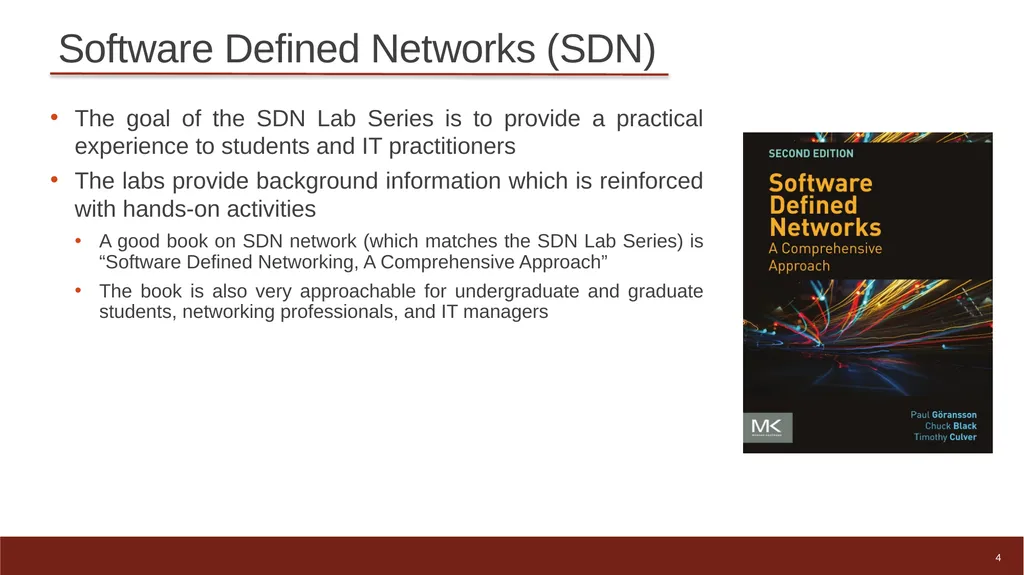
A good book on SDN network (which matches the SDN Lab Series) is “Software Defined Networking, A Comprehensive Approach”
The book is also very approachable for undergraduate and graduate students, networking professionals, and IT managers 4<br>
The labs provide background information which is reinforced with hands-on activities
A good book on SDN network (which matches the SDN Lab Series) is “Software Defined Networking, A Comprehensive Approach”
The book is also very approachable for undergraduate and graduate students, networking professionals, and IT managers 4<br>
05
Section 1.2: Historical Background 5<br>
06
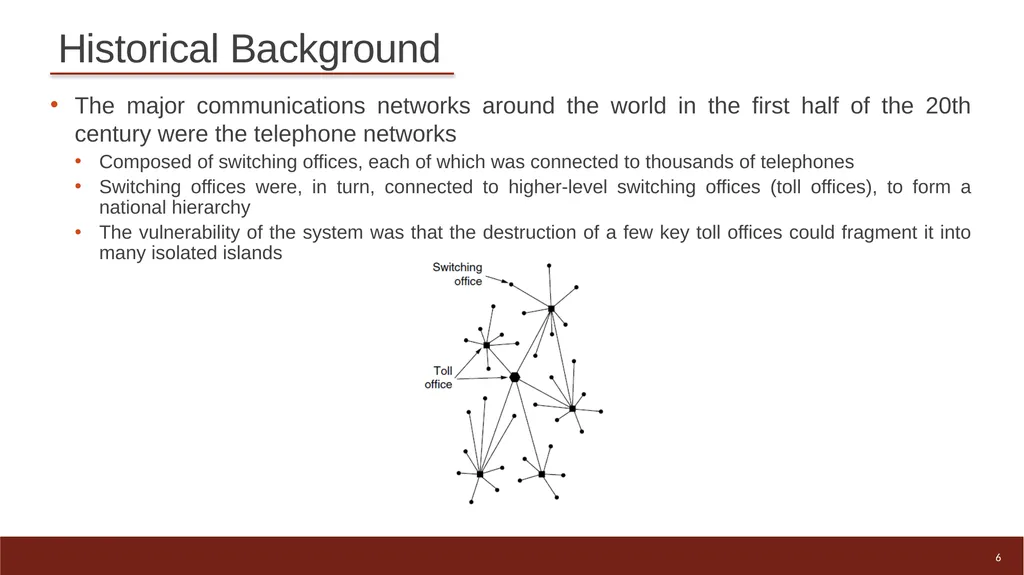
Historical Background The major communications networks around the world in the first half of the 20th century were the telephone networks
Composed of switching offices, each of which was connected to thousands of telephones
Switching offices were, in turn, connected to higher-level switching offices (toll offices), to form a national hierarchy
The vulnerability of the system was that the destruction of a few key toll offices could fragment it into many isolated islands 6<br>
Composed of switching offices, each of which was connected to thousands of telephones
Switching offices were, in turn, connected to higher-level switching offices (toll offices), to form a national hierarchy
The vulnerability of the system was that the destruction of a few key toll offices could fragment it into many isolated islands 6<br>
07
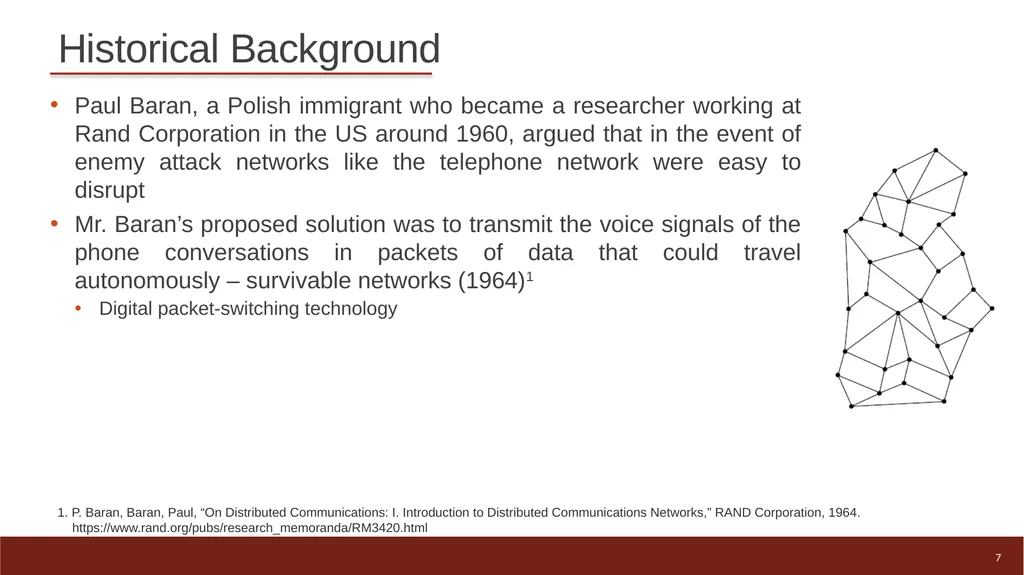
Historical Background Paul Baran, a Polish immigrant who became a researcher working at Rand Corporation in the US around 1960, argued that in the event of enemy attack networks like the telephone network were easy to disrupt
Mr. Baran’s proposed solution was to transmit the voice signals of the phone conversations in packets of data that could travel autonomously – survivable networks (1964)1
Digital packet-switching technology 7 1. P. Baran, Baran, Paul, “On Distributed Communications: I. Introduction to Distributed Communications Networks,” RAND Corporation, 1964. https://www.rand.org/pubs/research_memoranda/RM3420.html<br>
Mr. Baran’s proposed solution was to transmit the voice signals of the phone conversations in packets of data that could travel autonomously – survivable networks (1964)1
Digital packet-switching technology 7 1. P. Baran, Baran, Paul, “On Distributed Communications: I. Introduction to Distributed Communications Networks,” RAND Corporation, 1964. https://www.rand.org/pubs/research_memoranda/RM3420.html<br>
08
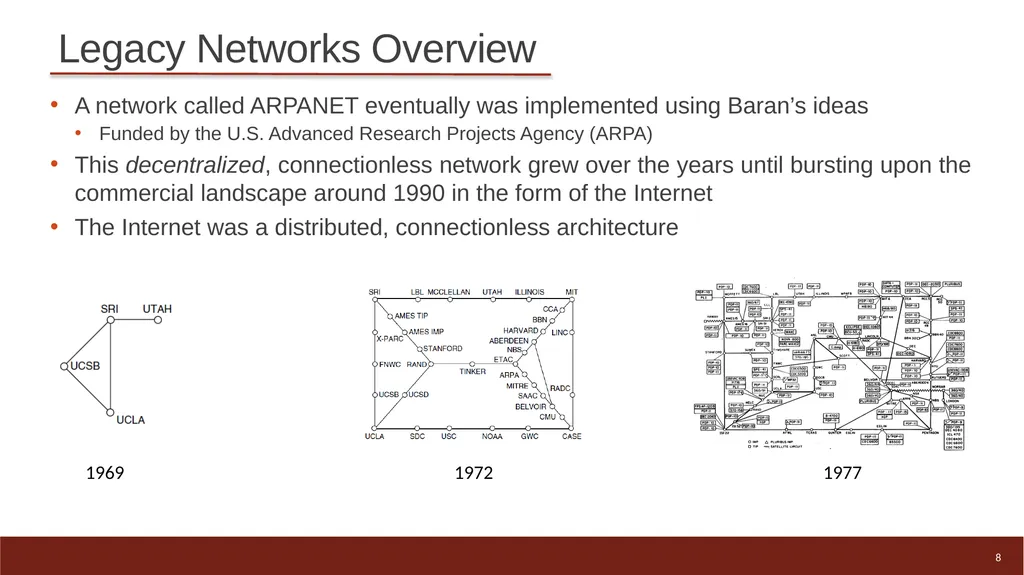
Legacy Networks Overview A network called ARPANET eventually was implemented using Baran’s ideas
Funded by the U.S. Advanced Research Projects Agency (ARPA)
This decentralized, connectionless network grew over the years until bursting upon the commercial landscape around 1990 in the form of the Internet
The Internet was a distributed, connectionless architecture 8 1972 1969 1977<br>
Funded by the U.S. Advanced Research Projects Agency (ARPA)
This decentralized, connectionless network grew over the years until bursting upon the commercial landscape around 1990 in the form of the Internet
The Internet was a distributed, connectionless architecture 8 1972 1969 1977<br>
09
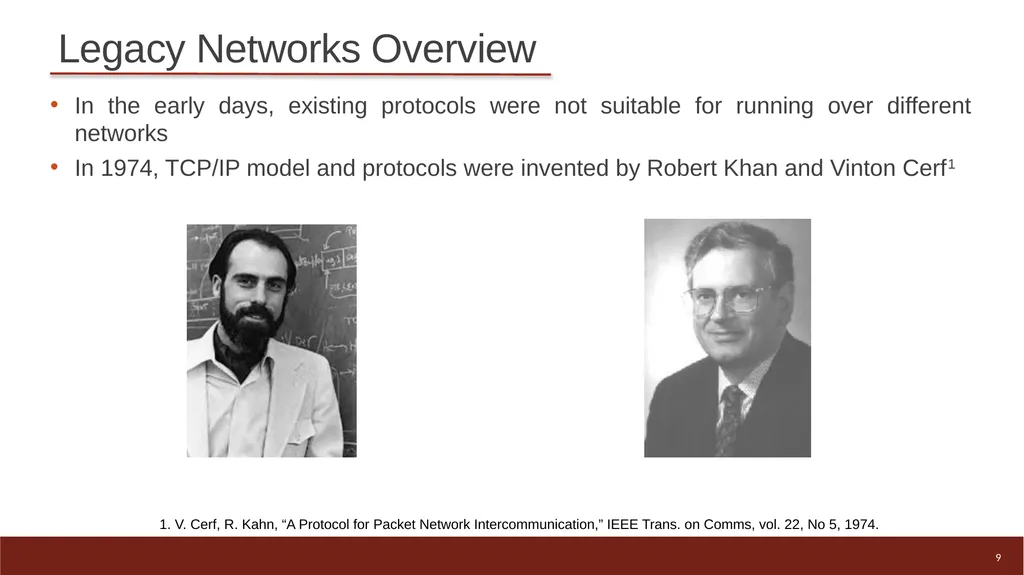
Legacy Networks Overview In the early days, existing protocols were not suitable for running over different networks
In 1974, TCP/IP model and protocols were invented by Robert Khan and Vinton Cerf1 9 1. V. Cerf, R. Kahn, “A Protocol for Packet Network Intercommunication,” IEEE Trans. on Comms, vol. 22, No 5, 1974.<br>
In 1974, TCP/IP model and protocols were invented by Robert Khan and Vinton Cerf1 9 1. V. Cerf, R. Kahn, “A Protocol for Packet Network Intercommunication,” IEEE Trans. on Comms, vol. 22, No 5, 1974.<br>
10
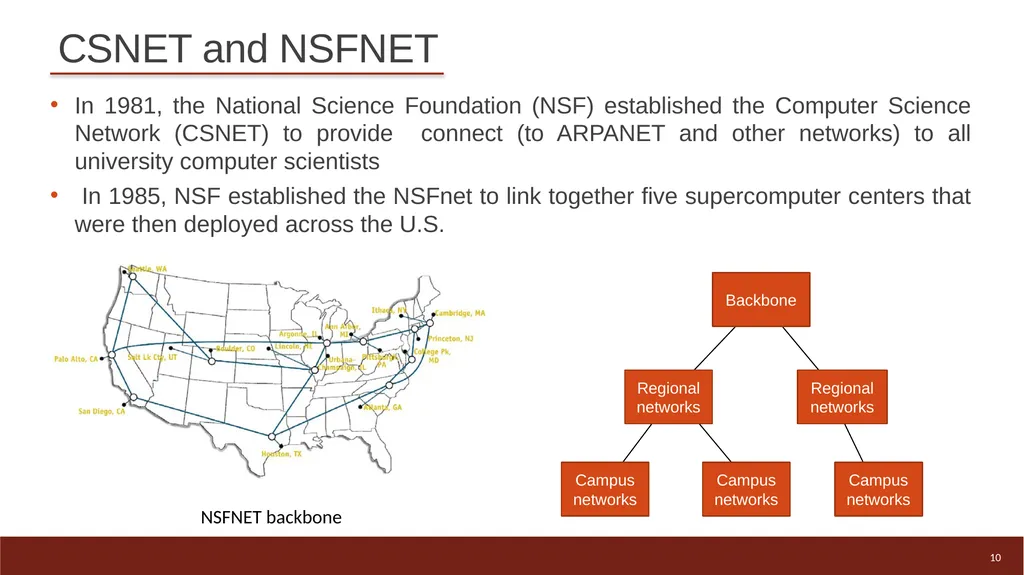
CSNET and NSFNET In 1981, the National Science Foundation (NSF) established the Computer Science Network (CSNET) to provide connect (to ARPANET and other networks) to all university computer scientists
In 1985, NSF established the NSFnet to link together five supercomputer centers that were then deployed across the U.S. 10 NSFNET backbone Backbone Campus networks Regional networks Regional networks Campus networks Campus networks<br>
In 1985, NSF established the NSFnet to link together five supercomputer centers that were then deployed across the U.S. 10 NSFNET backbone Backbone Campus networks Regional networks Regional networks Campus networks Campus networks<br>
11
Section 1.3: The Modern Data Center 11<br>
12
The Modern Data Center In 1991, NSFNET lifted its restrictions on the use of NSFNET for commercial purposes
NSFNET itself would be decommissioned in 1995, with Internet backbone traffic being carried by commercial Internet Service Providers (ISPs)
The main event of the 1990s was to be the emergence of the World Wide Web
Invented at CERN by Tim Berners-Lee between 1989 and 1991
The web brought the Internet into the homes, businesses, millions of people 12<br>
NSFNET itself would be decommissioned in 1995, with Internet backbone traffic being carried by commercial Internet Service Providers (ISPs)
The main event of the 1990s was to be the emergence of the World Wide Web
Invented at CERN by Tim Berners-Lee between 1989 and 1991
The web brought the Internet into the homes, businesses, millions of people 12<br>
13
The Modern Data Center A number of companies emerged as big winners in the Internet space
Microsoft, Cisco, Yahoo, e-Bay, Google, Amazon
The web gave rise to data centers, hosting heavily subscribed web services
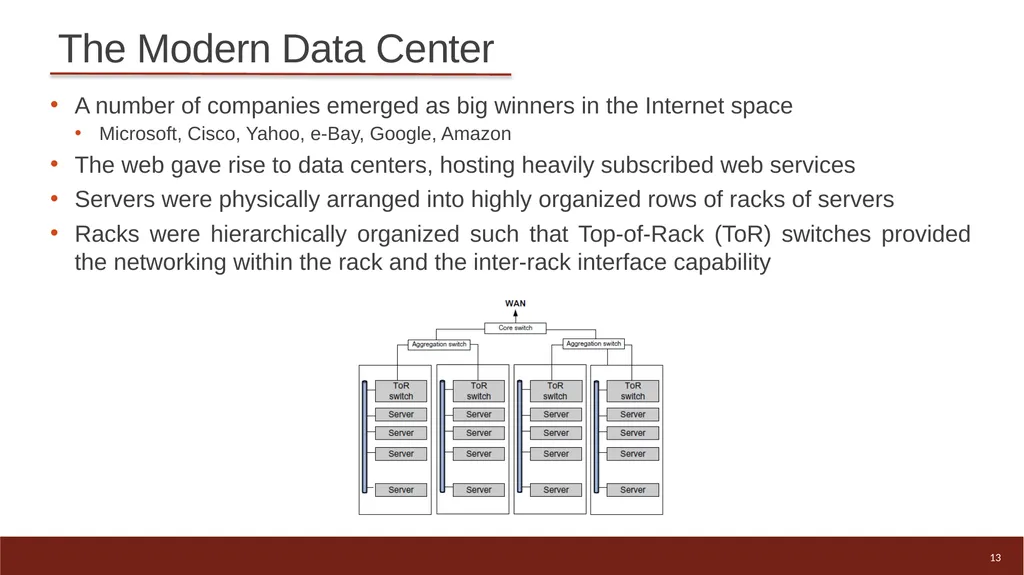
Servers were physically arranged into highly organized rows of racks of servers
Racks were hierarchically organized such that Top-of-Rack (ToR) switches provided the networking within the rack and the inter-rack interface capability 13<br>
Microsoft, Cisco, Yahoo, e-Bay, Google, Amazon
The web gave rise to data centers, hosting heavily subscribed web services
Servers were physically arranged into highly organized rows of racks of servers
Racks were hierarchically organized such that Top-of-Rack (ToR) switches provided the networking within the rack and the inter-rack interface capability 13<br>
14
A modern physical servers can host hundreds of virtual machines (VMs), results in thousands (or even millions) of VMs communicating within the datacenter
These VMs are now communicating via a set of protocols and devices that were optimized to work over a large, disparate geographical area with unreliable links
While still important, survivability was not that relevant (in contrast to 1970s, 1980s WANs) in the emerging data center
Network management systems designed for carrier public networks or large corporate intranets simply cannot scale to these numbers
A new network management paradigm was needed 14 While the modern data center was the premier driver behind the SDN fervor, by no means is SDN only applicable to the data center The Modern Data Center<br>
These VMs are now communicating via a set of protocols and devices that were optimized to work over a large, disparate geographical area with unreliable links
While still important, survivability was not that relevant (in contrast to 1970s, 1980s WANs) in the emerging data center
Network management systems designed for carrier public networks or large corporate intranets simply cannot scale to these numbers
A new network management paradigm was needed 14 While the modern data center was the premier driver behind the SDN fervor, by no means is SDN only applicable to the data center The Modern Data Center<br>
15
Section 1.4: Traditional Switch Architecture 15<br>
16
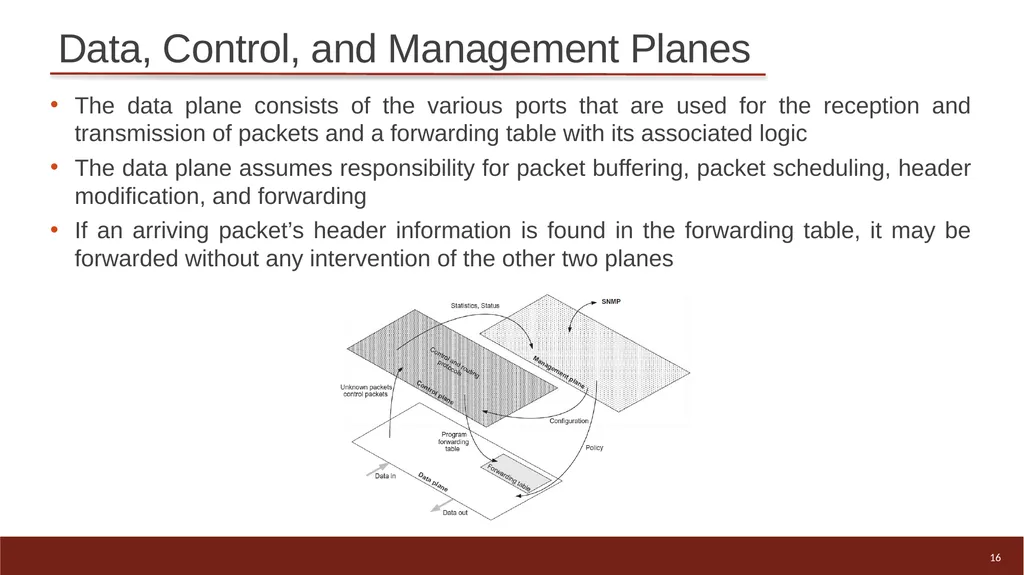
The data plane consists of the various ports that are used for the reception and transmission of packets and a forwarding table with its associated logic
The data plane assumes responsibility for packet buffering, packet scheduling, header modification, and forwarding
If an arriving packet’s header information is found in the forwarding table, it may be forwarded without any intervention of the other two planes 16 Data, Control, and Management Planes<br>
The data plane assumes responsibility for packet buffering, packet scheduling, header modification, and forwarding
If an arriving packet’s header information is found in the forwarding table, it may be forwarded without any intervention of the other two planes 16 Data, Control, and Management Planes<br>
17
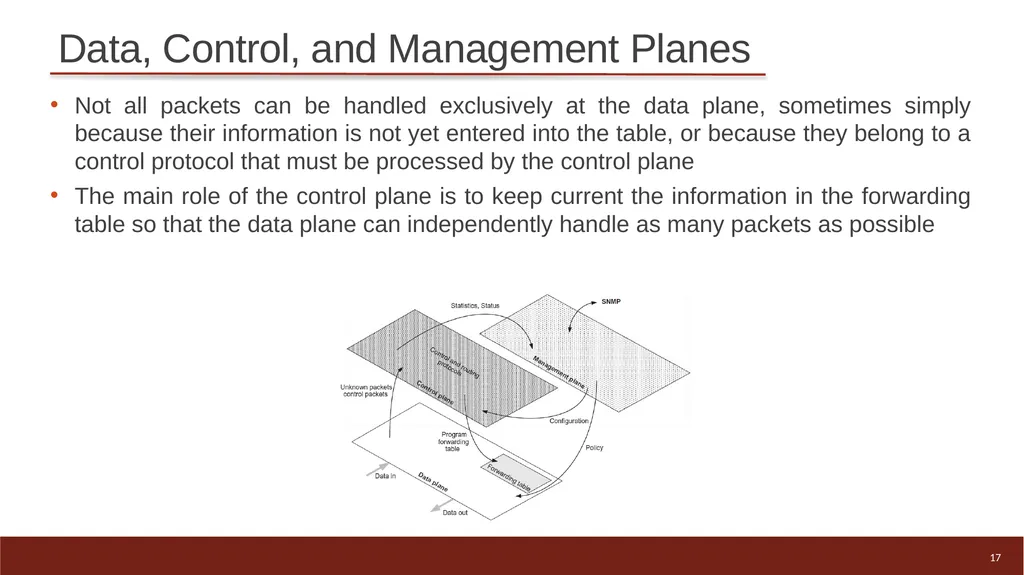
Not all packets can be handled exclusively at the data plane, sometimes simply because their information is not yet entered into the table, or because they belong to a control protocol that must be processed by the control plane
The main role of the control plane is to keep current the information in the forwarding table so that the data plane can independently handle as many packets as possible 17 Data, Control, and Management Planes<br>
The main role of the control plane is to keep current the information in the forwarding table so that the data plane can independently handle as many packets as possible 17 Data, Control, and Management Planes<br>
18
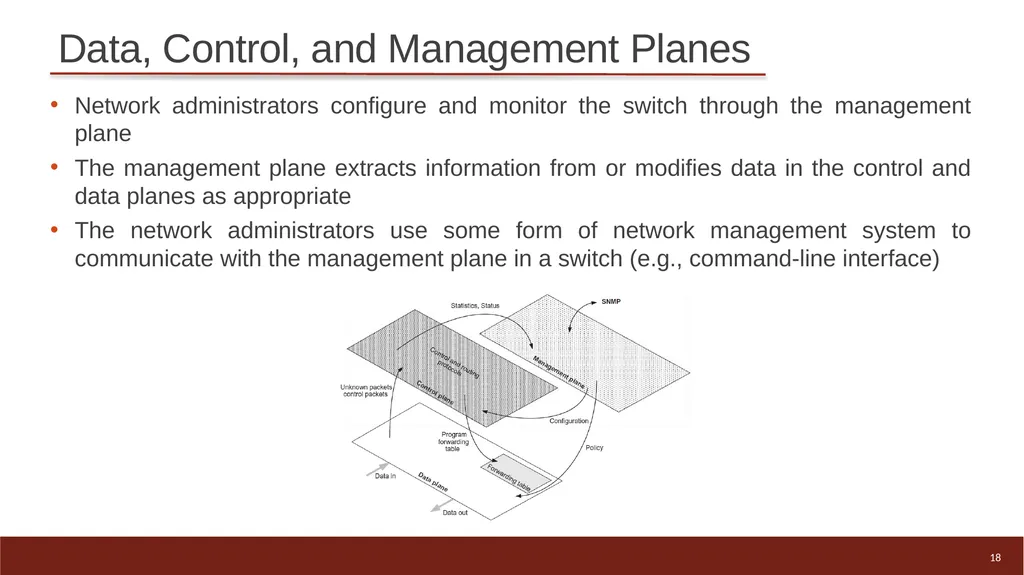
Network administrators configure and monitor the switch through the management plane
The management plane extracts information from or modifies data in the control and data planes as appropriate
The network administrators use some form of network management system to communicate with the management plane in a switch (e.g., command-line interface) 18 Data, Control, and Management Planes<br>
The management plane extracts information from or modifies data in the control and data planes as appropriate
The network administrators use some form of network management system to communicate with the management plane in a switch (e.g., command-line interface) 18 Data, Control, and Management Planes<br>
19
When a packet arrives on an interface, it is forwarded to the control plane where the CPU matches the destination address with an entry in its routing table
The router does this for every packet 19 Software-based Routing and Bridging Control Plane Data Plane CPU Ingress interface Egress interface<br>
The router does this for every packet 19 Software-based Routing and Bridging Control Plane Data Plane CPU Ingress interface Egress interface<br>
20
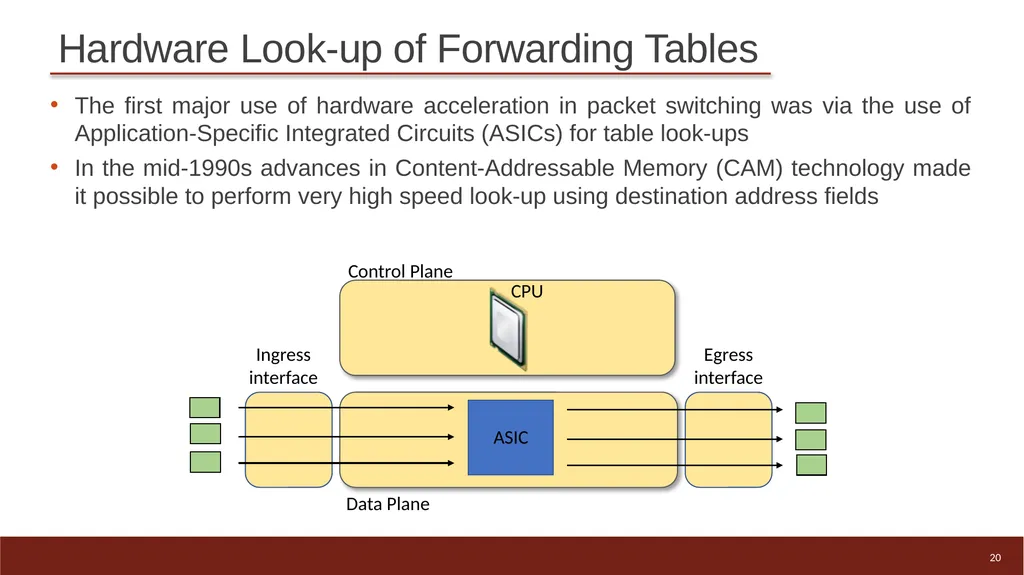
The first major use of hardware acceleration in packet switching was via the use of Application-Specific Integrated Circuits (ASICs) for table look-ups
In the mid-1990s advances in Content-Addressable Memory (CAM) technology made it possible to perform very high speed look-up using destination address fields 20 Hardware Look-up of Forwarding Tables Control Plane Data Plane CPU Ingress interface Egress interface ASIC<br>
In the mid-1990s advances in Content-Addressable Memory (CAM) technology made it possible to perform very high speed look-up using destination address fields 20 Hardware Look-up of Forwarding Tables Control Plane Data Plane CPU Ingress interface Egress interface ASIC<br>
21
Section 1.5: Autonomous and Dynamic Forwarding Tables 21<br>
22
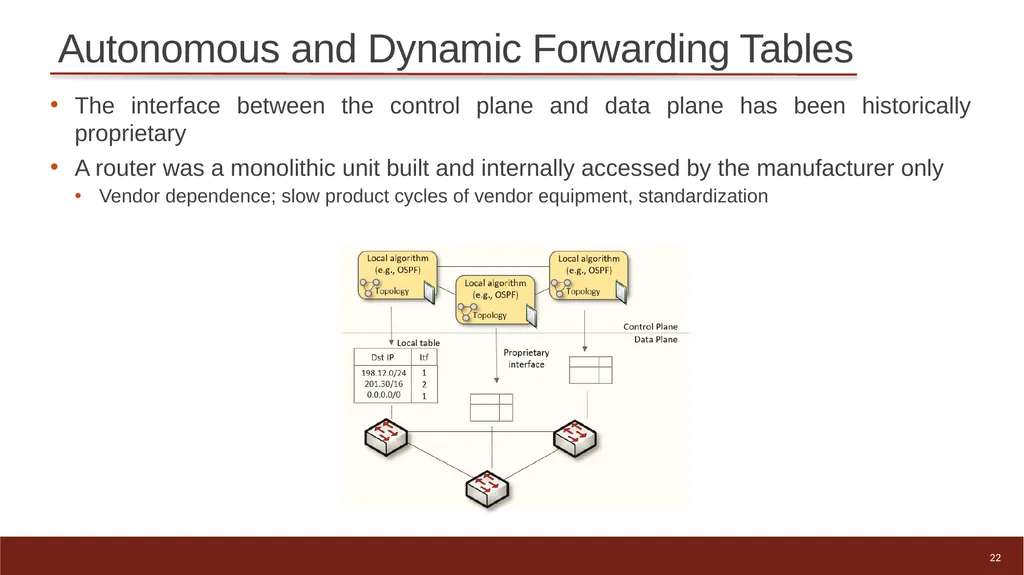
The interface between the control plane and data plane has been historically proprietary
A router was a monolithic unit built and internally accessed by the manufacturer only
Vendor dependence; slow product cycles of vendor equipment, standardization 22 Autonomous and Dynamic Forwarding Tables<br>
A router was a monolithic unit built and internally accessed by the manufacturer only
Vendor dependence; slow product cycles of vendor equipment, standardization 22 Autonomous and Dynamic Forwarding Tables<br>
23
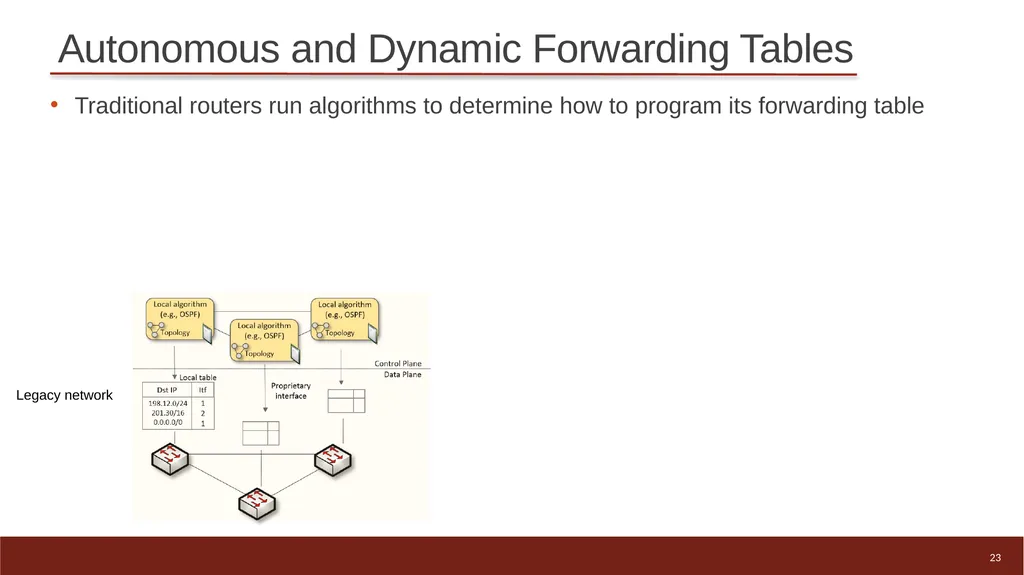
Traditional routers run algorithms to determine how to program its forwarding table 23 Autonomous and Dynamic Forwarding Tables Legacy network<br>
24
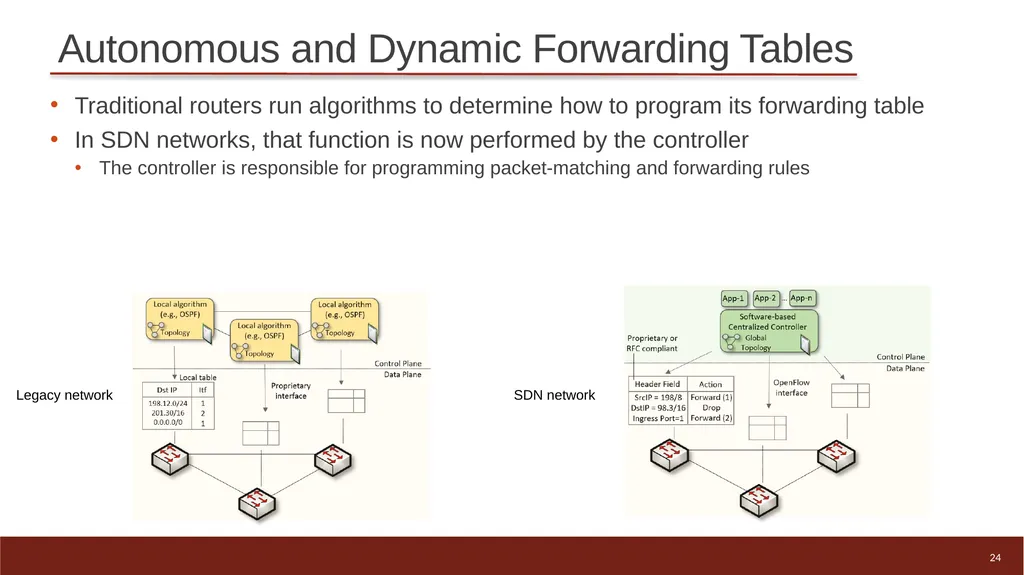
Traditional routers run algorithms to determine how to program its forwarding table
In SDN networks, that function is now performed by the controller
The controller is responsible for programming packet-matching and forwarding rules 24 Autonomous and Dynamic Forwarding Tables Legacy network SDN network<br>
In SDN networks, that function is now performed by the controller
The controller is responsible for programming packet-matching and forwarding rules 24 Autonomous and Dynamic Forwarding Tables Legacy network SDN network<br>
25
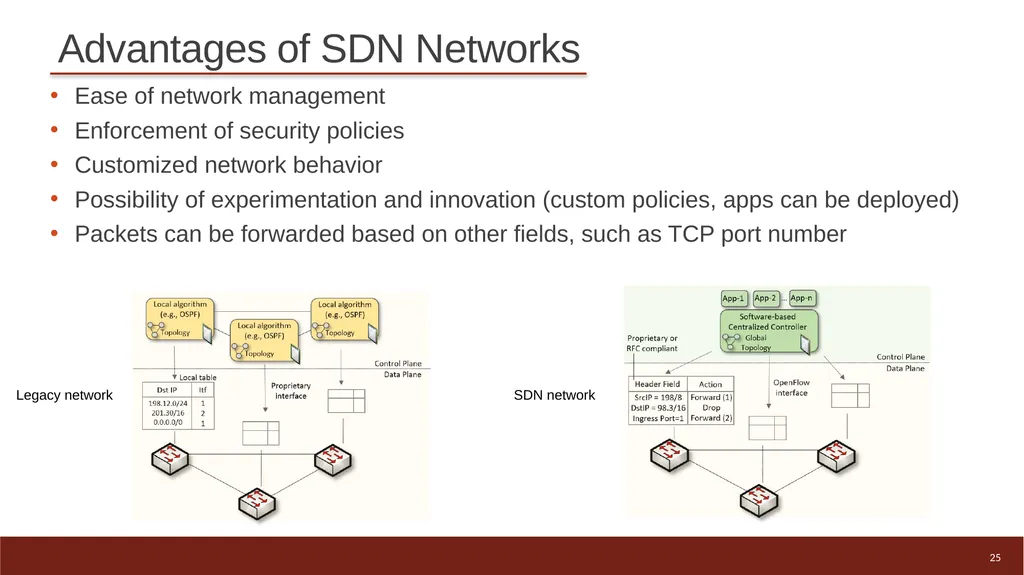
Ease of network management
Enforcement of security policies
Customized network behavior
Possibility of experimentation and innovation (custom policies, apps can be deployed)
Packets can be forwarded based on other fields, such as TCP port number 25 Advantages of SDN Networks Legacy network SDN network<br>
Enforcement of security policies
Customized network behavior
Possibility of experimentation and innovation (custom policies, apps can be deployed)
Packets can be forwarded based on other fields, such as TCP port number 25 Advantages of SDN Networks Legacy network SDN network<br>
26
Section 1.7: Open Source and Technological Shifts 26<br>
27
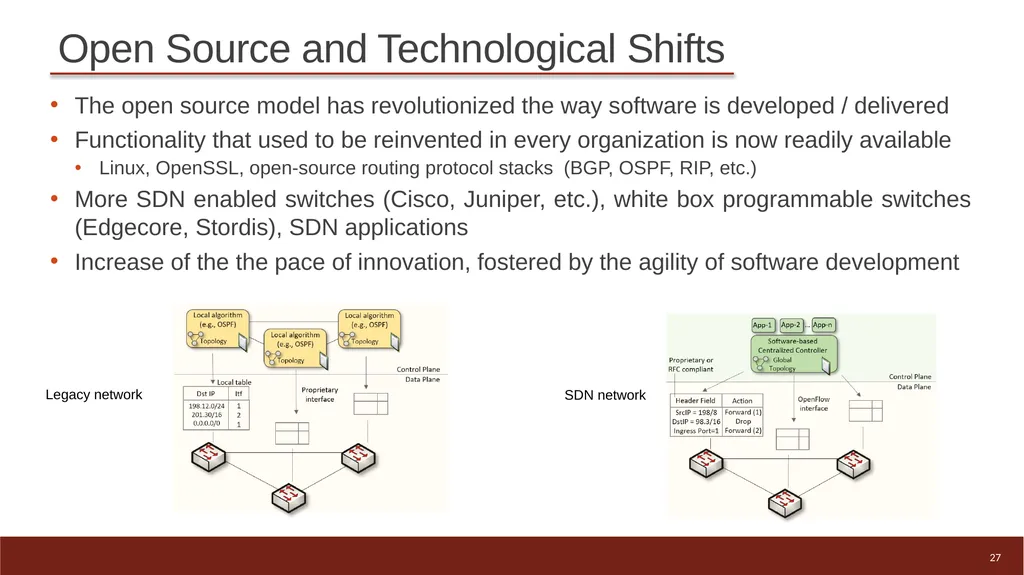
Open Source and Technological Shifts The open source model has revolutionized the way software is developed / delivered
Functionality that used to be reinvented in every organization is now readily available
Linux, OpenSSL, open-source routing protocol stacks (BGP, OSPF, RIP, etc.)
More SDN enabled switches (Cisco, Juniper, etc.), white box programmable switches (Edgecore, Stordis), SDN applications
Increase of the the pace of innovation, fostered by the agility of software development 27 Legacy network SDN network<br>
Functionality that used to be reinvented in every organization is now readily available
Linux, OpenSSL, open-source routing protocol stacks (BGP, OSPF, RIP, etc.)
More SDN enabled switches (Cisco, Juniper, etc.), white box programmable switches (Edgecore, Stordis), SDN applications
Increase of the the pace of innovation, fostered by the agility of software development 27 Legacy network SDN network<br>