
- 1 LESSON 4 (INFLATABLE RUBBERIZED BOAT) ANDOBM -
TG
Published · 61 slides · 0 views

1 / 1




Description
- 1 LESSON 4 (INFLATABLE RUBBERIZED BOAT) ANDOBM - (OUT BOARD MACHINE)ERGENCY Aquatic Disaster Response Course CAPF ADRC INDIA Presented by:- Pavan Dev Gaur, 2IC Upon completion of this lesson, you will be able to: OBJECTIVES
Related Topics
Share
Embed code
Download this presentation From Below
"- 1 LESSON 4 (INFLATABLE RUBBERIZED BOAT) ANDOBM -" is the property of its rightful owner. Permission is granted to download and print the materials on this website for personal, non-commercial use only, and to display it on your personal computer provided you do not modify the materials and that you retain all copyright notices contained in the materials. By downloading content from our website, you accept the terms of this agreement.
Presentation Transcript
01
- 1 LESSON 4
(INFLATABLE RUBBERIZED BOAT) ANDOBM - (OUT BOARD MACHINE)ERGENCY Aquatic Disaster Response Course CAPF | ADRC | INDIA Presented by:- Pavan Dev Gaur, 2IC<br>
(INFLATABLE RUBBERIZED BOAT) ANDOBM - (OUT BOARD MACHINE)ERGENCY Aquatic Disaster Response Course CAPF | ADRC | INDIA Presented by:- Pavan Dev Gaur, 2IC<br>
02
Upon completion of this lesson, you will be able to: OBJECTIVES Introduction
Type of Rescue boat.
IRB
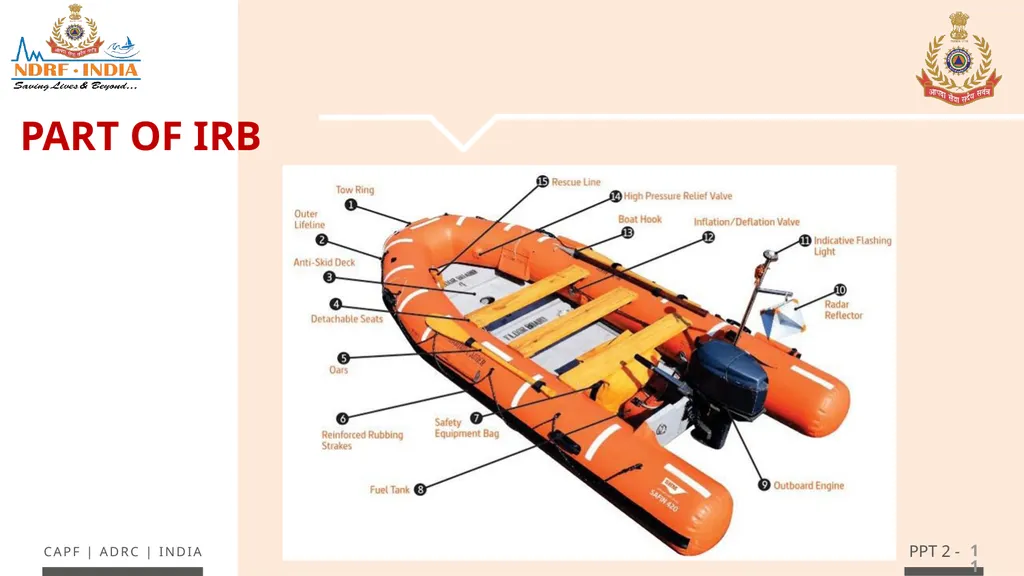
Parts of IRB
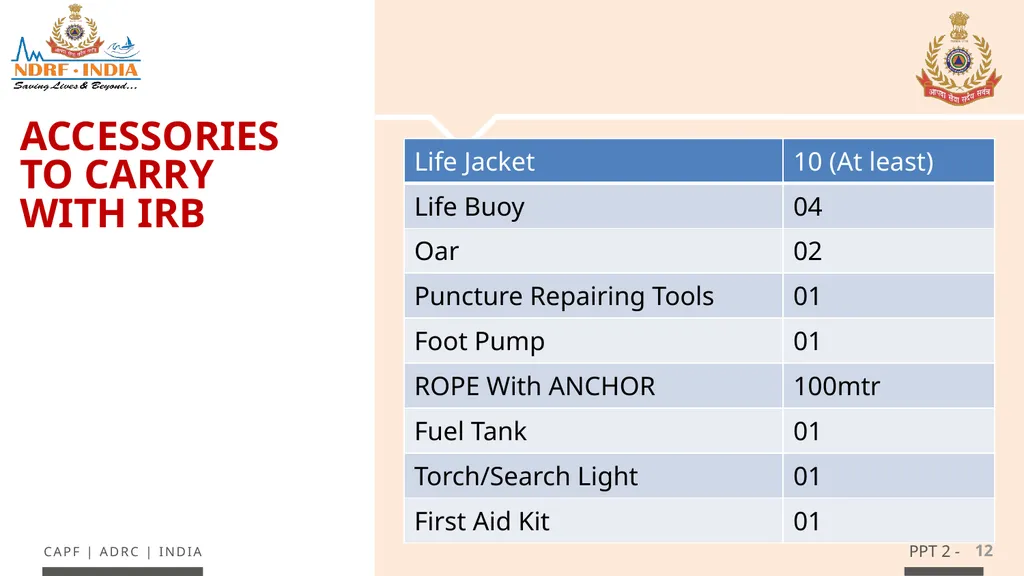
Accessories to carry with IRB
Advantage of IRB 2<br>
Type of Rescue boat.
IRB
Parts of IRB
Accessories to carry with IRB
Advantage of IRB 2<br>
03
Upon completion of this lesson, you will be able to: OBJECTIVES Operating procedure
Maintenance of IRB
Dos and Don'ts
OBM
Trouble Shooting and common failures of OBM
Lifeboat- carrying, embarking, handling, and disembarking 3<br>
Maintenance of IRB
Dos and Don'ts
OBM
Trouble Shooting and common failures of OBM
Lifeboat- carrying, embarking, handling, and disembarking 3<br>
04
An Inflatable Rubber Boat (IRB) is a type of small watercraft designed for use in rescue operations and water safety activities.
These boats are known for their flexibility, maneuverability (adjustability) and ease of transport and storage. PPT 2 - 4 INTRODUCTION<br>
These boats are known for their flexibility, maneuverability (adjustability) and ease of transport and storage. PPT 2 - 4 INTRODUCTION<br>
05
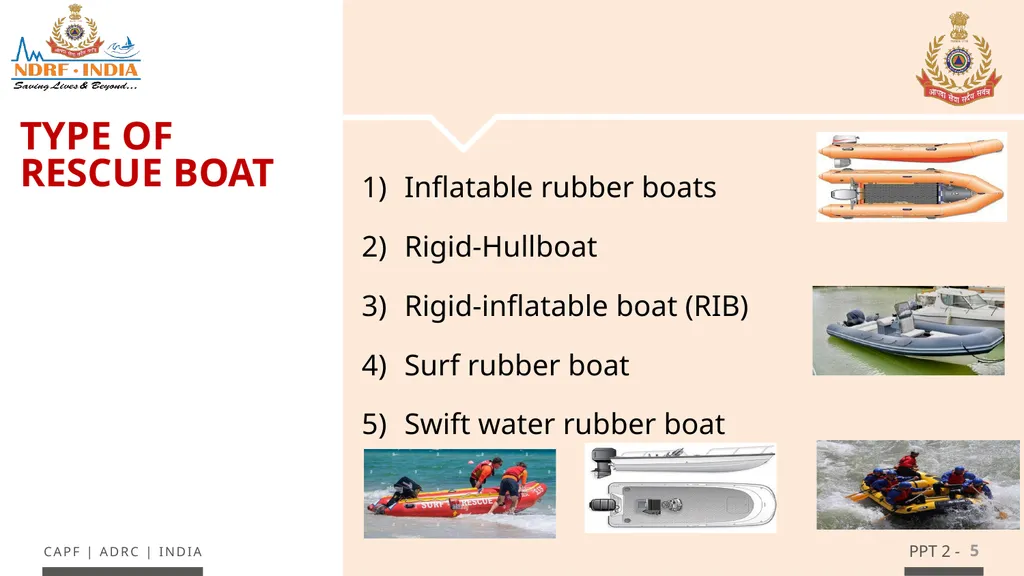
Inflatable rubber boats
Rigid-Hullboat
Rigid-inflatable boat (RIB)
Surf rubber boat
Swift water rubber boat PPT 2 - 5 TYPE OF RESCUE BOAT<br>
Rigid-Hullboat
Rigid-inflatable boat (RIB)
Surf rubber boat
Swift water rubber boat PPT 2 - 5 TYPE OF RESCUE BOAT<br>
06
IRBs are made of rubber and consist of four inflatable tubes - two side tubes, a bow tube and a keelson tube.
They have a rigid floor piece and a rigid transom for fitting an outboard motor (usually 25/30 hp).
This motor is capable of providing a maximum drive speed of between 25–30 knots on flat water. PPT 2 - 6 IRB (INFLATABLE RESCUE BOAT)<br>
They have a rigid floor piece and a rigid transom for fitting an outboard motor (usually 25/30 hp).
This motor is capable of providing a maximum drive speed of between 25–30 knots on flat water. PPT 2 - 6 IRB (INFLATABLE RESCUE BOAT)<br>
07
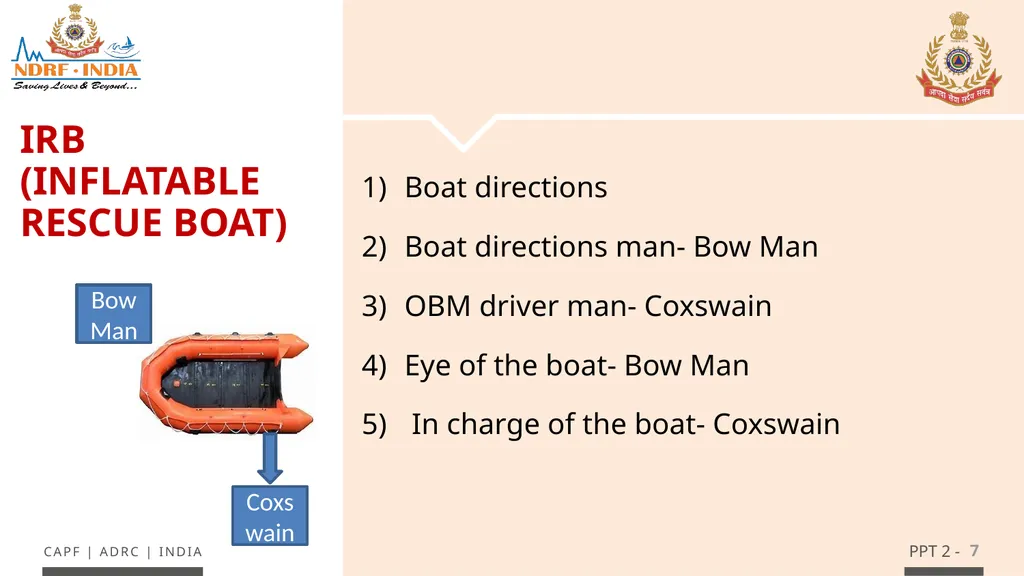
Boat directions
Boat directions man- Bow Man
OBM driver man- Coxswain
Eye of the boat- Bow Man
In charge of the boat- Coxswain PPT 2 - 7 IRB (INFLATABLE RESCUE BOAT) Bow Man Coxswain<br>
Boat directions man- Bow Man
OBM driver man- Coxswain
Eye of the boat- Bow Man
In charge of the boat- Coxswain PPT 2 - 7 IRB (INFLATABLE RESCUE BOAT) Bow Man Coxswain<br>
08
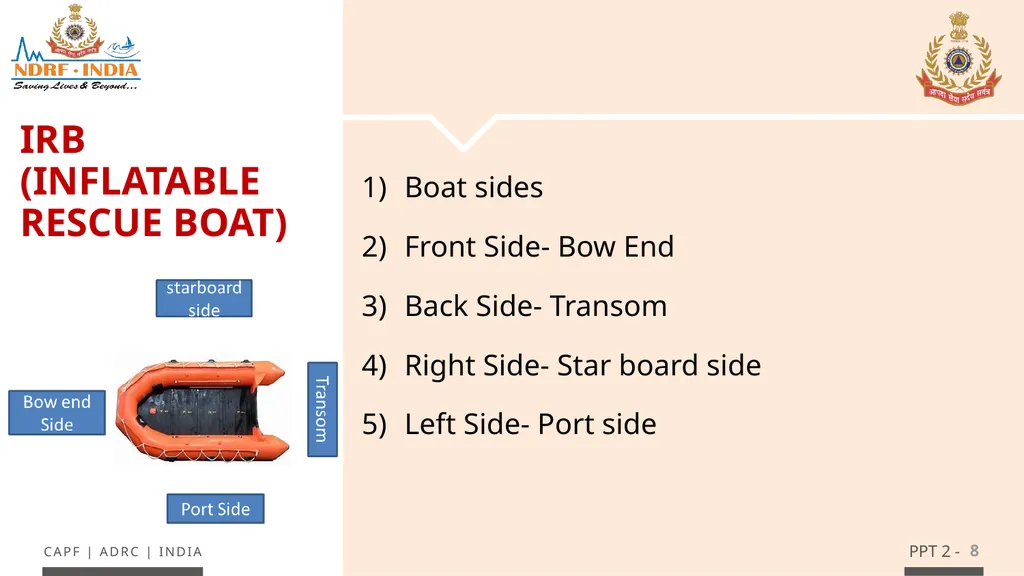
Boat sides
Front Side- Bow End
Back Side- Transom
Right Side- Star board side
Left Side- Port side PPT 2 - 8 IRB (INFLATABLE RESCUE BOAT)<br>
Front Side- Bow End
Back Side- Transom
Right Side- Star board side
Left Side- Port side PPT 2 - 8 IRB (INFLATABLE RESCUE BOAT)<br>
09
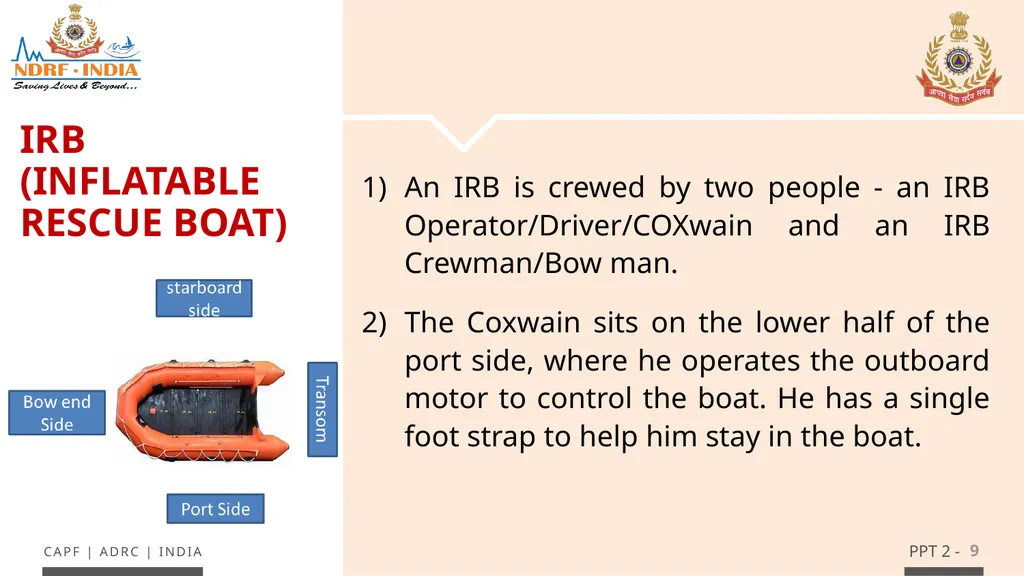
An IRB is crewed by two people - an IRB Operator/Driver/COXwain and an IRB Crewman/Bow man.
The Coxwain sits on the lower half of the port side, where he operates the outboard motor to control the boat. He has a single foot strap to help him stay in the boat. PPT 2 - 9 IRB (INFLATABLE RESCUE BOAT)<br>
The Coxwain sits on the lower half of the port side, where he operates the outboard motor to control the boat. He has a single foot strap to help him stay in the boat. PPT 2 - 9 IRB (INFLATABLE RESCUE BOAT)<br>
10
His left hand can hold on to a strap on the port side and his right hand operates the outboard motor by means of a throttle.
The Bowman sits on the upper half of the starboard side. He balances the boat and allows it to go over large waves before they break without flipping. PPT 2 - 10 IRB (INFLATABLE RESCUE BOAT)<br>
The Bowman sits on the upper half of the starboard side. He balances the boat and allows it to go over large waves before they break without flipping. PPT 2 - 10 IRB (INFLATABLE RESCUE BOAT)<br>
11
PPT 2 - 11 PART OF IRB<br>
12
PPT 2 - 12 ACCESSORIES TO CARRY WITH IRB<br>
13
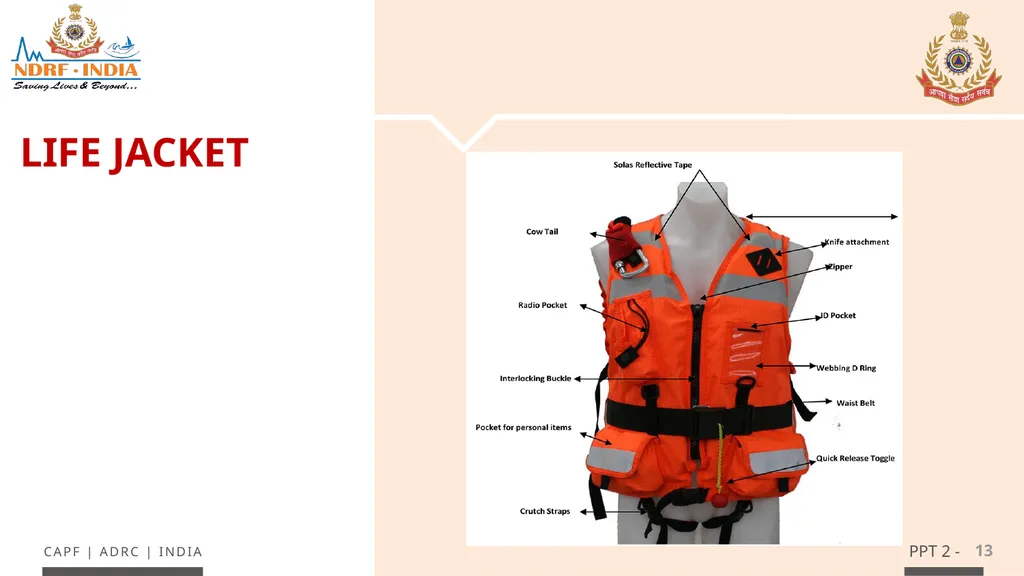
PPT 2 - 13 LIFE JACKET<br>
14
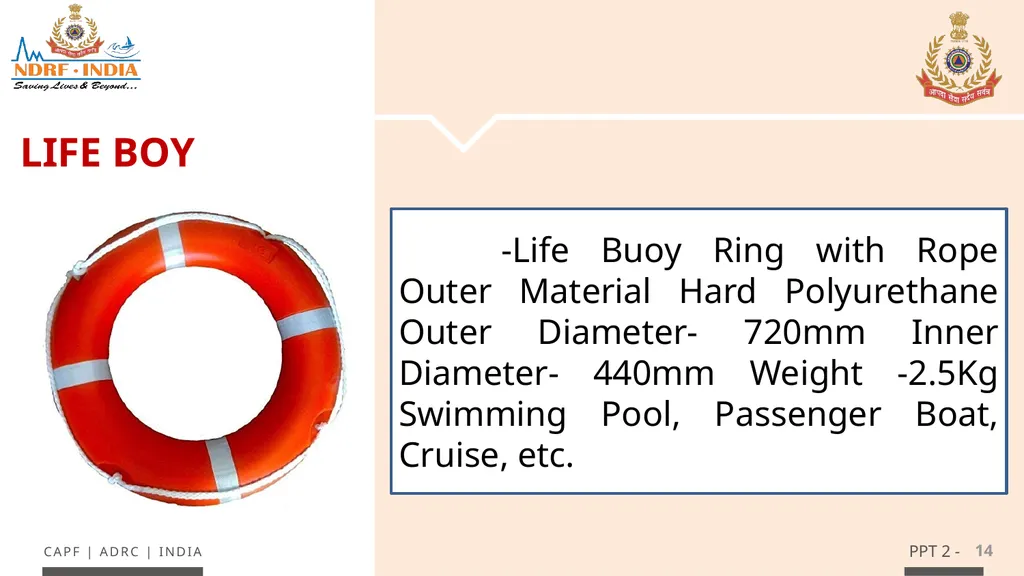
PPT 2 - 14 LIFE boy -Life Buoy Ring with Rope Outer Material Hard Polyurethane Outer Diameter- 720mm Inner Diameter- 440mm Weight -2.5Kg Swimming Pool, Passenger Boat, Cruise, etc.<br>
15
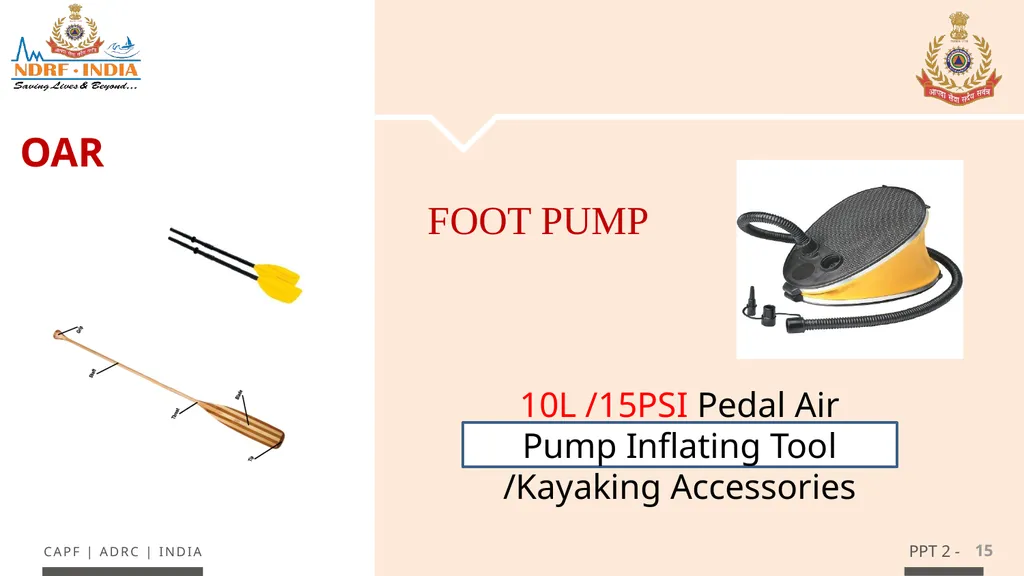
FOOT PUMP PPT 2 - 15 oar 10L /15PSI Pedal Air Pump Inflating Tool /Kayaking Accessories<br>
16
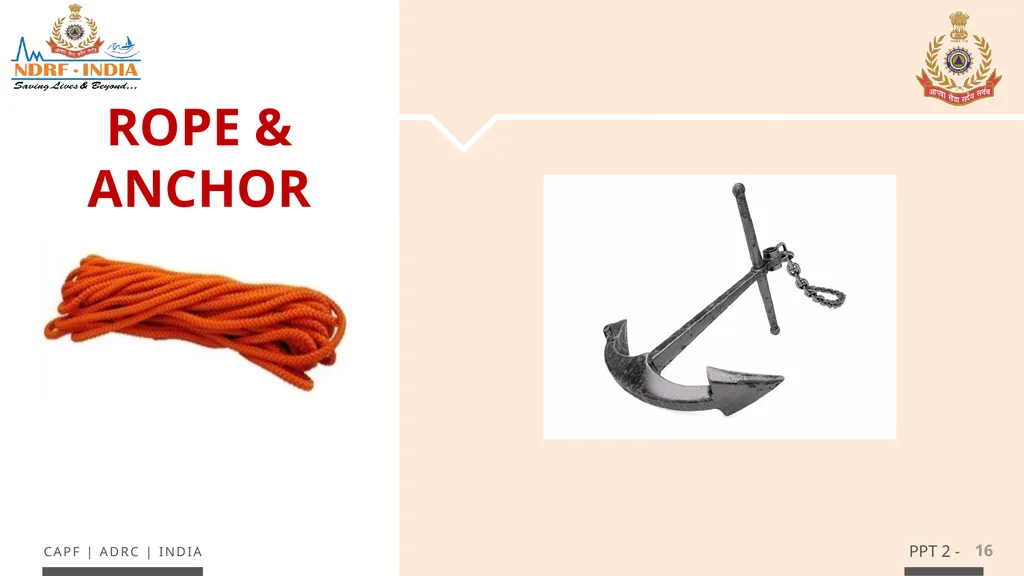
PPT 2 - 16 ROPE & ANCHOR<br>
17
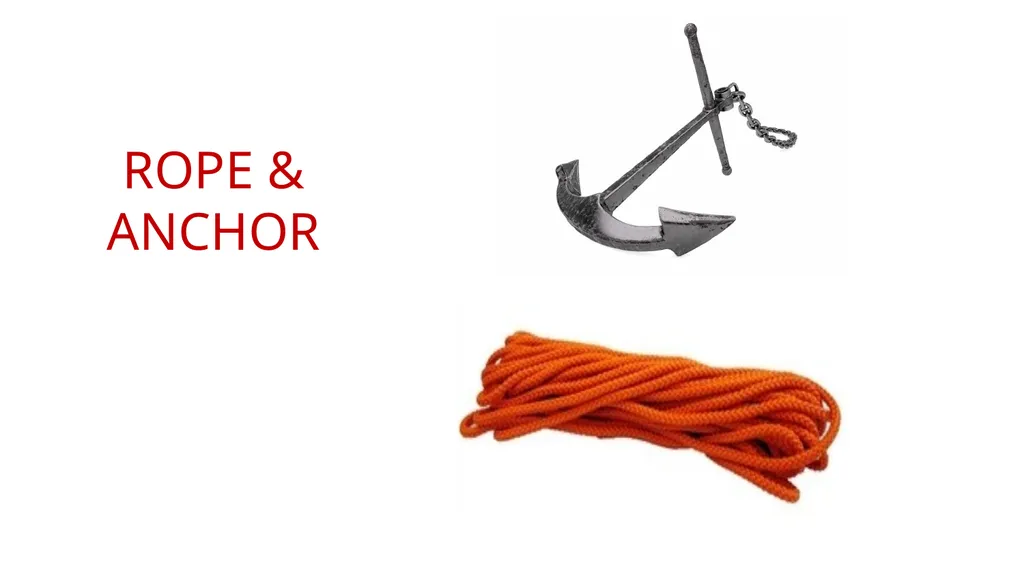
ROPE & ANCHOR<br>
18
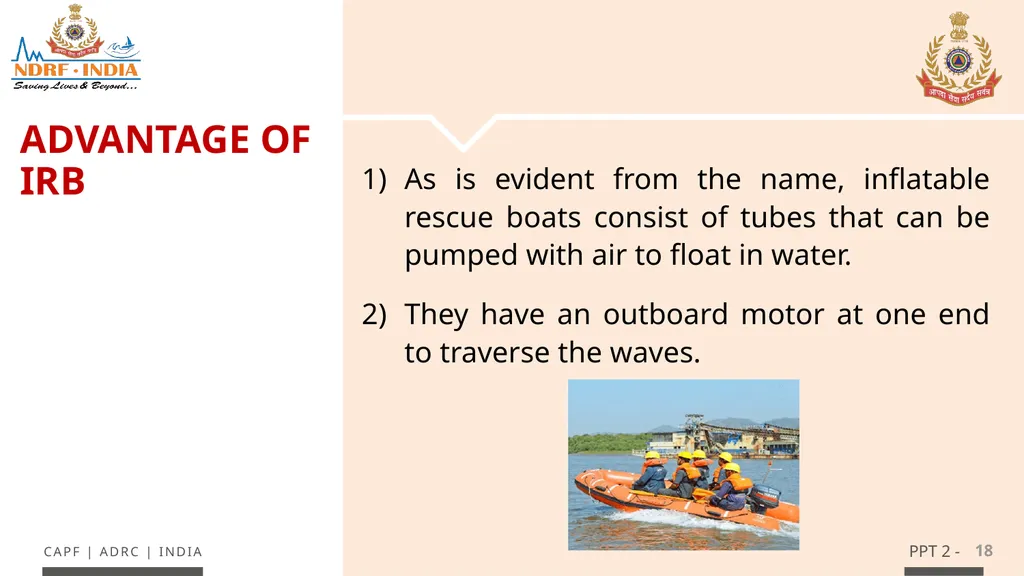
As is evident from the name, inflatable rescue boats consist of tubes that can be pumped with air to float in water.
They have an outboard motor at one end to traverse the waves. PPT 2 - 18 ADVANTAGE OF IRB<br>
They have an outboard motor at one end to traverse the waves. PPT 2 - 18 ADVANTAGE OF IRB<br>
19
There are several advantages of inflatable rescue boats. Some of these include:
Quick Deployment, Swift Transport : - Inflatable rescue boats can be deployed at lightning-fast speeds, have greater maneuverability and have a long life.
There are several advantages of inflatable rescue boats. Some of these include:
Quick Deployment, Swift Transport : - Inflatable rescue boats can be deployed at lightning-fast speeds, have greater maneuverability and have a long life. PPT 2 - 19 ADVANTAGE OF IRB<br>
Quick Deployment, Swift Transport : - Inflatable rescue boats can be deployed at lightning-fast speeds, have greater maneuverability and have a long life.
There are several advantages of inflatable rescue boats. Some of these include:
Quick Deployment, Swift Transport : - Inflatable rescue boats can be deployed at lightning-fast speeds, have greater maneuverability and have a long life. PPT 2 - 19 ADVANTAGE OF IRB<br>
20
Inflation
Preparation(OBM)
Motor start up
Throttle Control
Steering
Safety Precautions
Observe Regulations
Motor Shutdown
Loading
Safety Equipment
Maintenance
Rescue boat stability PPT 2 - 20 OPERATING PROCEDURE<br>
Preparation(OBM)
Motor start up
Throttle Control
Steering
Safety Precautions
Observe Regulations
Motor Shutdown
Loading
Safety Equipment
Maintenance
Rescue boat stability PPT 2 - 20 OPERATING PROCEDURE<br>
21
Wash properly
Inspection
Drying of boat
Use of Talcum powder
Place just above the ground
If inflated boat is not in use, then keep it away from the direct sunlight
Maintain once in a month if not in use PPT 2 - 21 MAINTENANCE<br>
Inspection
Drying of boat
Use of Talcum powder
Place just above the ground
If inflated boat is not in use, then keep it away from the direct sunlight
Maintain once in a month if not in use PPT 2 - 21 MAINTENANCE<br>
22
Check IRB periodically
Always keep IRB in safe place with case
Floor plate should keep with relative IRB
Check all the accessories of IRB while going for ops physically
&
Do not seat without wearing life jacket while performing rescue ops or practices
Do not carry over weighted load
Do not operate boat with inflation/leak
Don’t operate boat if any leakage observed PPT 2 - 22 Dos & DONT’S<br>
Always keep IRB in safe place with case
Floor plate should keep with relative IRB
Check all the accessories of IRB while going for ops physically
&
Do not seat without wearing life jacket while performing rescue ops or practices
Do not carry over weighted load
Do not operate boat with inflation/leak
Don’t operate boat if any leakage observed PPT 2 - 22 Dos & DONT’S<br>
23
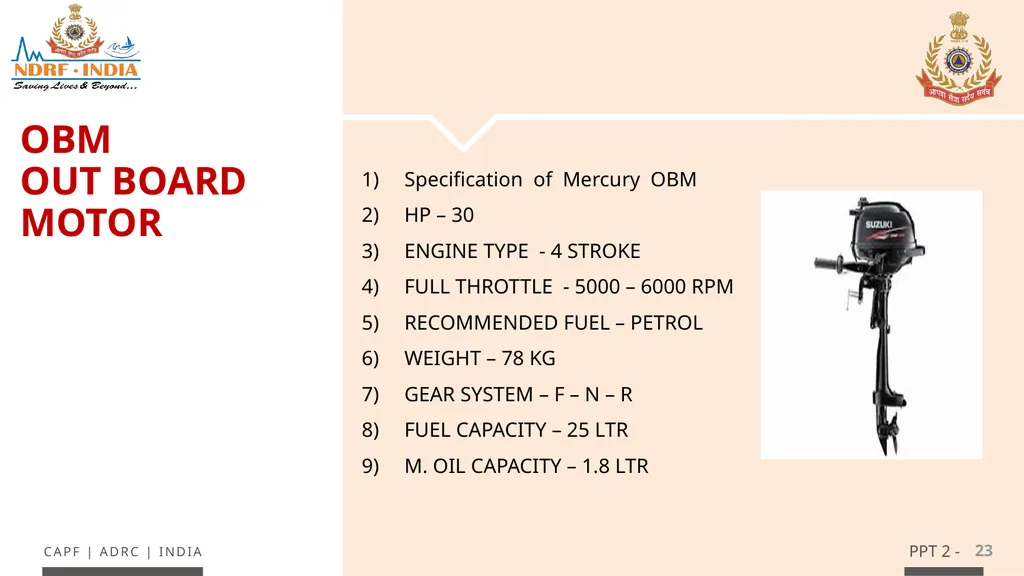
Specification of Mercury OBM
HP – 30
ENGINE TYPE - 4 STROKE
FULL THROTTLE - 5000 – 6000 RPM
RECOMMENDED FUEL – PETROL
WEIGHT – 78 KG
GEAR SYSTEM – F – N – R
FUEL CAPACITY – 25 LTR
M. OIL CAPACITY – 1.8 LTR PPT 2 - 23 OBM OUT BOARD MOTOR<br>
HP – 30
ENGINE TYPE - 4 STROKE
FULL THROTTLE - 5000 – 6000 RPM
RECOMMENDED FUEL – PETROL
WEIGHT – 78 KG
GEAR SYSTEM – F – N – R
FUEL CAPACITY – 25 LTR
M. OIL CAPACITY – 1.8 LTR PPT 2 - 23 OBM OUT BOARD MOTOR<br>
24
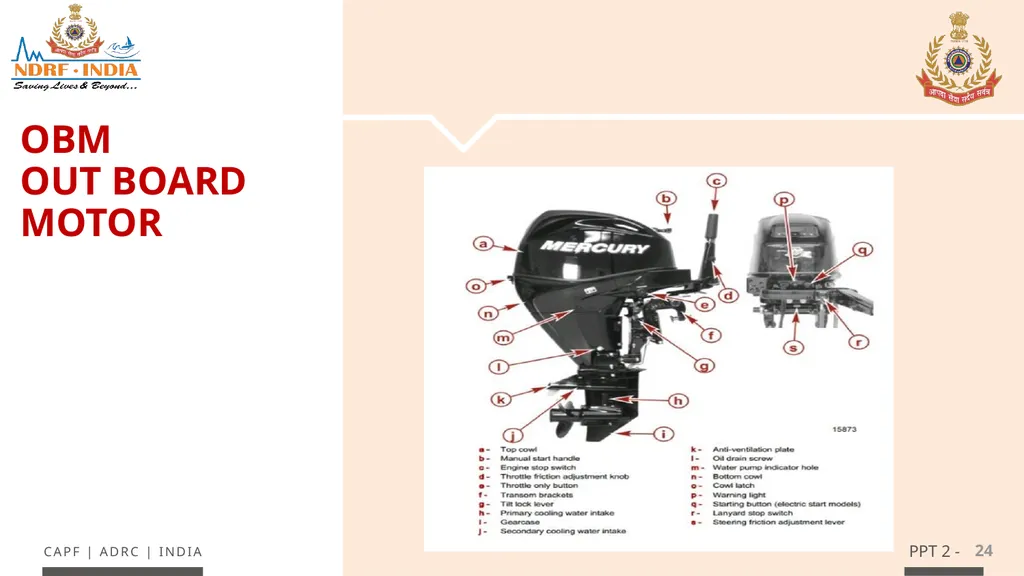
PPT 2 - 24 OBM
OUT BOARD MOTOR<br>
25
FUEL SYSTEM :
Check the amount of fuel
Check for debris or water in the fuel filters
Check the rubber hoses for fuel leakage
2. FUEL TANK CAP :
Check for crack, leakage, damage
Check for leakage at full close PPT 2 - 25 POINTS TO CHECK<br>
Check the amount of fuel
Check for debris or water in the fuel filters
Check the rubber hoses for fuel leakage
2. FUEL TANK CAP :
Check for crack, leakage, damage
Check for leakage at full close PPT 2 - 25 POINTS TO CHECK<br>
26
3. ENGINE OIL :
Check the oil level
4. ELECTRICAL EQUIPMENT :
Check The Main Switch Functions Normally
Check For Loose Connections
Check That The Stop Switch Functions Normally
Check Cords For Loose Connection And Damage
Check The Spark Plug
Check The Warning Buzzer (One Beep) And Warning Led Lamp (On For 5 To 7 Sec) When Start Up PPT 2 - 26 POINTS TO CHECK<br>
Check the oil level
4. ELECTRICAL EQUIPMENT :
Check The Main Switch Functions Normally
Check For Loose Connections
Check That The Stop Switch Functions Normally
Check Cords For Loose Connection And Damage
Check The Spark Plug
Check The Warning Buzzer (One Beep) And Warning Led Lamp (On For 5 To 7 Sec) When Start Up PPT 2 - 26 POINTS TO CHECK<br>
27
5. PROPELLER SYSTEM :
Visually check propeller for bent or damage blades
Check the propeller nut is tightened and the split pin is present.
6.INSTALLATION OF MOTOR:
Check all the bolts attaching the motor to the boat PPT 2 - 27 POINTS TO CHECK<br>
Visually check propeller for bent or damage blades
Check the propeller nut is tightened and the split pin is present.
6.INSTALLATION OF MOTOR:
Check all the bolts attaching the motor to the boat PPT 2 - 27 POINTS TO CHECK<br>
28
7. POWER TILT :
Check working of the tilt up and down of the motor.
8. COOLING WATER :
Check that cooling water is discharged from the cooling water check port after the engine has started.
9. TOOLS AND SPARES:
Check that there are tools and spare parts for replacing spark plugs, the propeller, etc
Check that you have the spare rope PPT 2 - 28 POINTS TO CHECK<br>
Check working of the tilt up and down of the motor.
8. COOLING WATER :
Check that cooling water is discharged from the cooling water check port after the engine has started.
9. TOOLS AND SPARES:
Check that there are tools and spare parts for replacing spark plugs, the propeller, etc
Check that you have the spare rope PPT 2 - 28 POINTS TO CHECK<br>
29
Align OBM vertically & makefast.
Tights clamping screws.
Tie mortar to boat with the help of a rope. Released lever in locked position.
Adjust screw.
Fix fuel tank to the boat. PPT 2 - 29 MOUNTING PROCEDURE<br>
Tights clamping screws.
Tie mortar to boat with the help of a rope. Released lever in locked position.
Adjust screw.
Fix fuel tank to the boat. PPT 2 - 29 MOUNTING PROCEDURE<br>
30
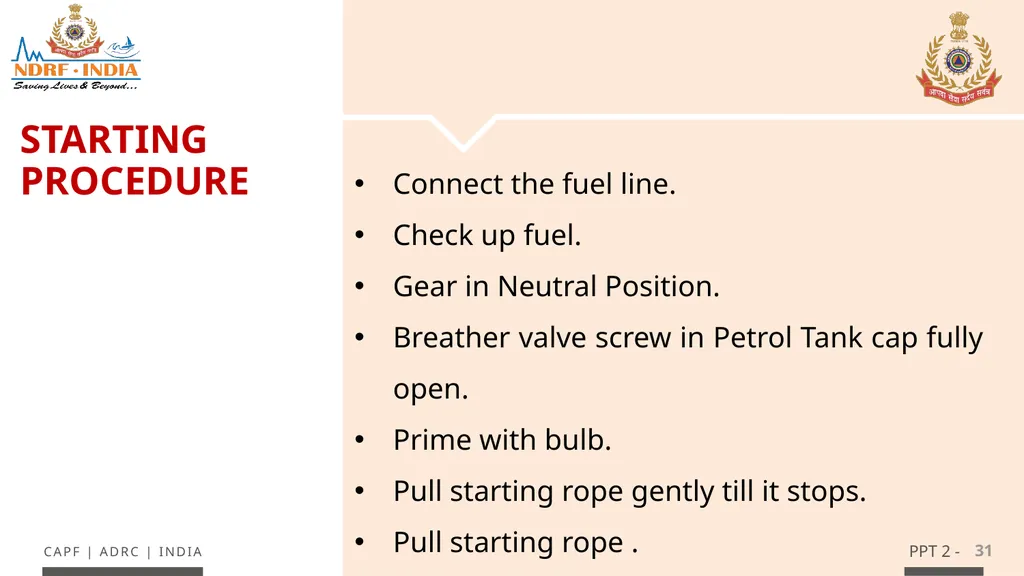
Connect the fuel line.
Check up fuel.
Gear in Neutral Position.
Breather valve screw in Petrol Tank cap fully open.
Prime with bulb.
Pull starting rope gently till it stops.
Pull starting rope . PPT 2 - 30 STARTING PROCEDURE<br>
Check up fuel.
Gear in Neutral Position.
Breather valve screw in Petrol Tank cap fully open.
Prime with bulb.
Pull starting rope gently till it stops.
Pull starting rope . PPT 2 - 30 STARTING PROCEDURE<br>
31
Connect the fuel line.
Check up fuel.
Gear in Neutral Position.
Breather valve screw in Petrol Tank cap fully open.
Prime with bulb.
Pull starting rope gently till it stops.
Pull starting rope . PPT 2 - 31 STARTING PROCEDURE<br>
Check up fuel.
Gear in Neutral Position.
Breather valve screw in Petrol Tank cap fully open.
Prime with bulb.
Pull starting rope gently till it stops.
Pull starting rope . PPT 2 - 31 STARTING PROCEDURE<br>
32
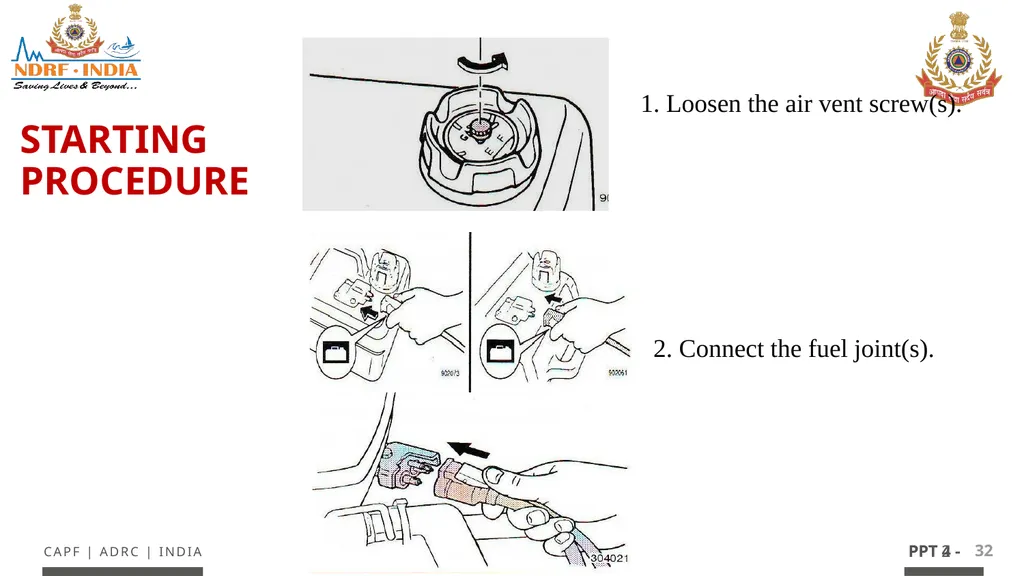
PPT 2 - 32 STARTING PROCEDURE 1. Loosen the air vent screw(s). 2. Connect the fuel joint(s).<br>
33
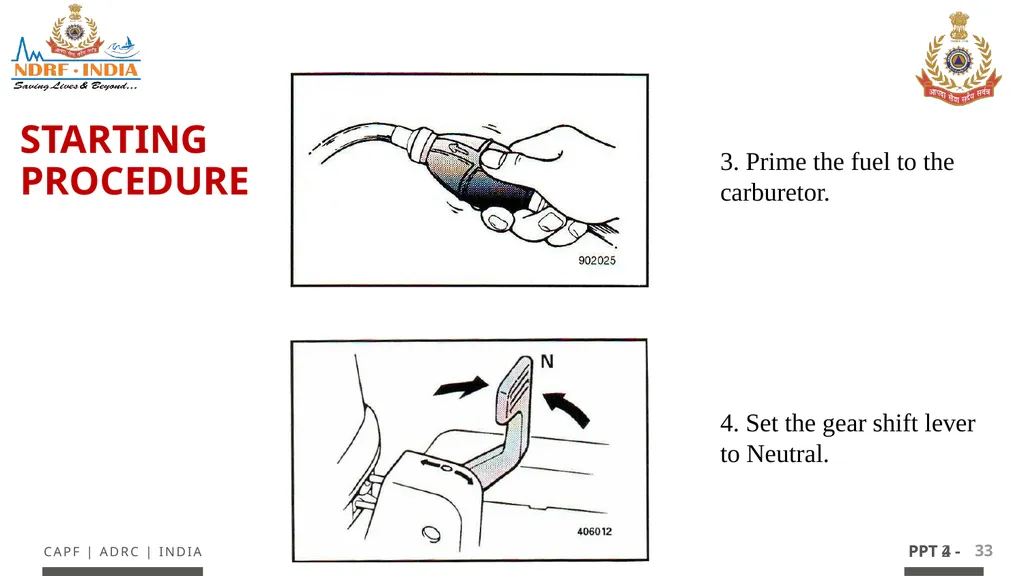
PPT 2 - 33 STARTING PROCEDURE 3. Prime the fuel to the carburetor. 4. Set the gear shift lever to Neutral.<br>
34
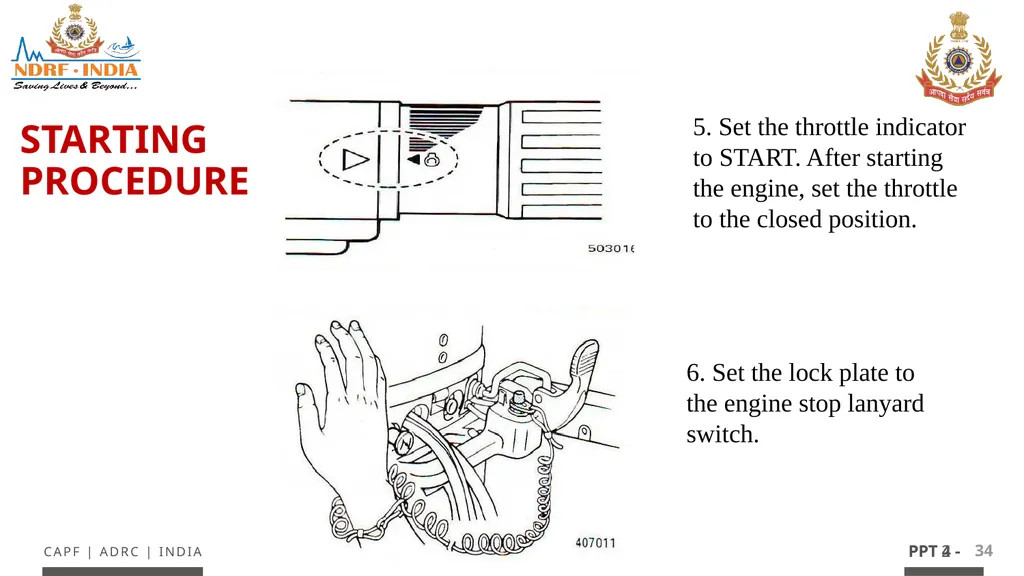
PPT 2 - 34 STARTING PROCEDURE 5. Set the throttle indicator to START. After starting the engine, set the throttle to the closed position. 6. Set the lock plate to the engine stop lanyard switch.<br>
35
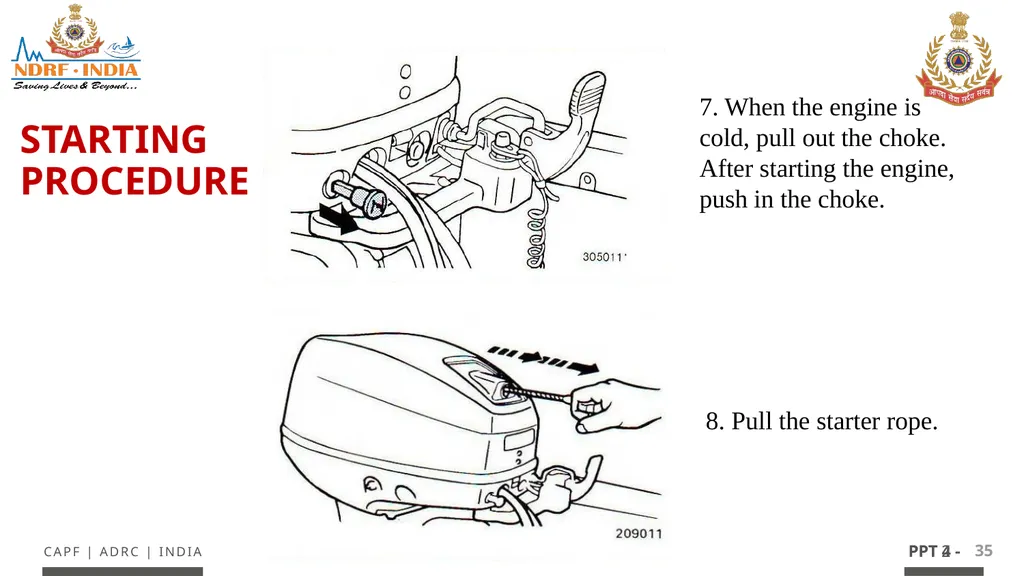
PPT 2 - 35 STARTING PROCEDURE 7. When the engine is cold, pull out the choke. After starting the engine, push in the choke. 8. Pull the starter rope.<br>
36
Ensure water is coming out from warming nipple.
Engage gear sharply.
Accelerate gradually.
Do not change the gear when in motion. Bring the boat to idle speed and then change the gear. PPT 2 - 36 POINTS TO BE REMEMBER AFTER STARTING<br>
Engage gear sharply.
Accelerate gradually.
Do not change the gear when in motion. Bring the boat to idle speed and then change the gear. PPT 2 - 36 POINTS TO BE REMEMBER AFTER STARTING<br>
37
Choose the correct horsepower for the boat. Higher horsepower OBM fitted to a small boat will break the power board or transom, where as a big boat fitted with small hp will not have effective thrust and may drift in current.
OBM is water cooled and hence do not test the engine out side the water. PPT 2 - 37 GENERAL PRECAUTION WHILE USING OBM<br>
OBM is water cooled and hence do not test the engine out side the water. PPT 2 - 37 GENERAL PRECAUTION WHILE USING OBM<br>
38
Secure the handle of the OBM to the mooring ring with a rope, to avoid the engine failing over board while shipping or unshipping.
Always remember the boat fitted with OBM is only for ease of operation, it does not give extra power more than the manual rowing or peddling for which the boat is actually designed. If the OBM fails it will result in a disaster. PPT 2 - 38 GENERAL PRECAUTION WHILE USING OBM<br>
Always remember the boat fitted with OBM is only for ease of operation, it does not give extra power more than the manual rowing or peddling for which the boat is actually designed. If the OBM fails it will result in a disaster. PPT 2 - 38 GENERAL PRECAUTION WHILE USING OBM<br>
39
Start the engine before embarkation and stop after disembarkation.
All safety precautions and rules of the road apply to Mortar boats, in addition avoid going through water weeds and keep a look out for fishing nets. These will foul the propeller if entangled and break shear pin. PPT 2 - 39 GENERAL PRECAUTION WHILE USING OBM<br>
All safety precautions and rules of the road apply to Mortar boats, in addition avoid going through water weeds and keep a look out for fishing nets. These will foul the propeller if entangled and break shear pin. PPT 2 - 39 GENERAL PRECAUTION WHILE USING OBM<br>
40
Do not go fast in unknown water routes shallow waters and submerged rocks may capsize or damage the boat.
Do not change gear liver position with engine running fast and also before coming to neutral for reverse or forward position.
Carry repair tool kit with one or two spare shear pins. PPT 2 - 40 GENERAL PRECAUTION WHILE USING OBM<br>
Do not change gear liver position with engine running fast and also before coming to neutral for reverse or forward position.
Carry repair tool kit with one or two spare shear pins. PPT 2 - 40 GENERAL PRECAUTION WHILE USING OBM<br>
41
Engine fails to start when:
Excessive fuel in the cylinder (rich).
Remedy: Cut off fuel supply, allow the excess fuel to evaporate for some time without opening fuel supply.
Less or no electrical spark. PPT 2 - 41 TROUBLE SHOOTING AND COMMON FAILURES OF OBM.<br>
Excessive fuel in the cylinder (rich).
Remedy: Cut off fuel supply, allow the excess fuel to evaporate for some time without opening fuel supply.
Less or no electrical spark. PPT 2 - 41 TROUBLE SHOOTING AND COMMON FAILURES OF OBM.<br>
42
Remove the spark plug, clean the contacts and observe the sparks by cranking open engine, light blue spark between the terminals is correct rating.
If you do not get correct spark check the connections of the coil assembly.
If the spark is weak , clean the contact points and check the condensers in the coil assembly.
If the fuel and current is correct, the engine must start.
Less fuel or no fuel in the carburetor. PPT 2 - 42 Remedy:<br>
If you do not get correct spark check the connections of the coil assembly.
If the spark is weak , clean the contact points and check the condensers in the coil assembly.
If the fuel and current is correct, the engine must start.
Less fuel or no fuel in the carburetor. PPT 2 - 42 Remedy:<br>
43
Check the fuel supply hose connections at either end for air leaks. Close the fuel tank cover for air tightness. Check free flow from the tank to the fuel adopter by pumping the fuel with thumb operator pump provided at the tank.
If the fuel mixture ratio might have been disturbed, correct it. PPT 2 - 43 Remedy:<br>
If the fuel mixture ratio might have been disturbed, correct it. PPT 2 - 43 Remedy:<br>
44
Check the fuel supply hose connections at either end for air leaks. Close the fuel tank cover for air tightness. Check free flow from the tank to the fuel adopter by pumping the fuel with thumb operator pump provided at the tank.
If the fuel mixture ratio might have been disturbed, correct it. PPT 2 - 44 Remedy:<br>
If the fuel mixture ratio might have been disturbed, correct it. PPT 2 - 44 Remedy:<br>
45
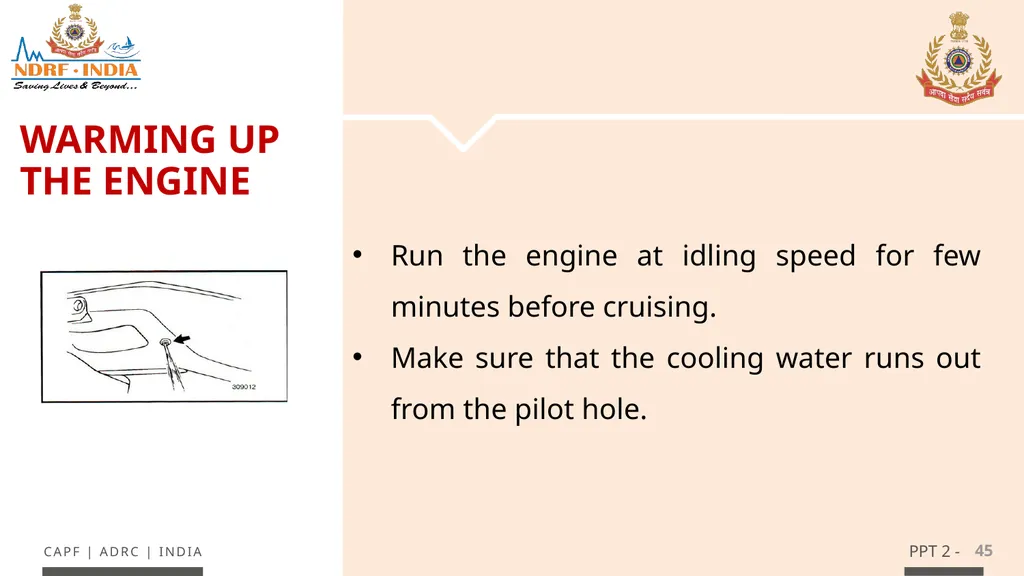
Run the engine at idling speed for few minutes before cruising.
Make sure that the cooling water runs out from the pilot hole. PPT 2 - 45 WARMING UP THE ENGINE<br>
Make sure that the cooling water runs out from the pilot hole. PPT 2 - 45 WARMING UP THE ENGINE<br>
46
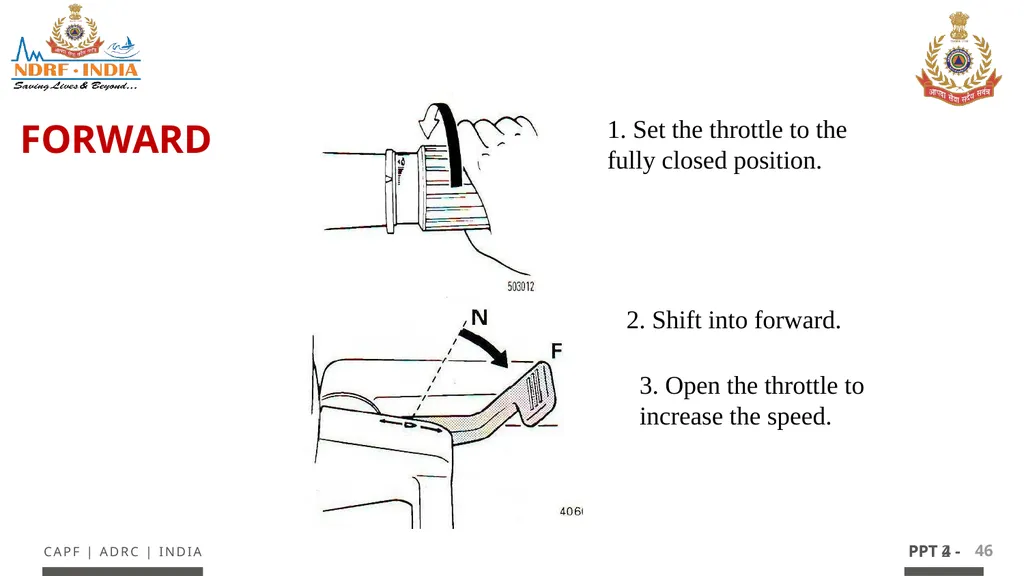
PPT 2 - 46 FORWARD 1. Set the throttle to the fully closed position. 2. Shift into forward. 3. Open the throttle to increase the speed.<br>
47
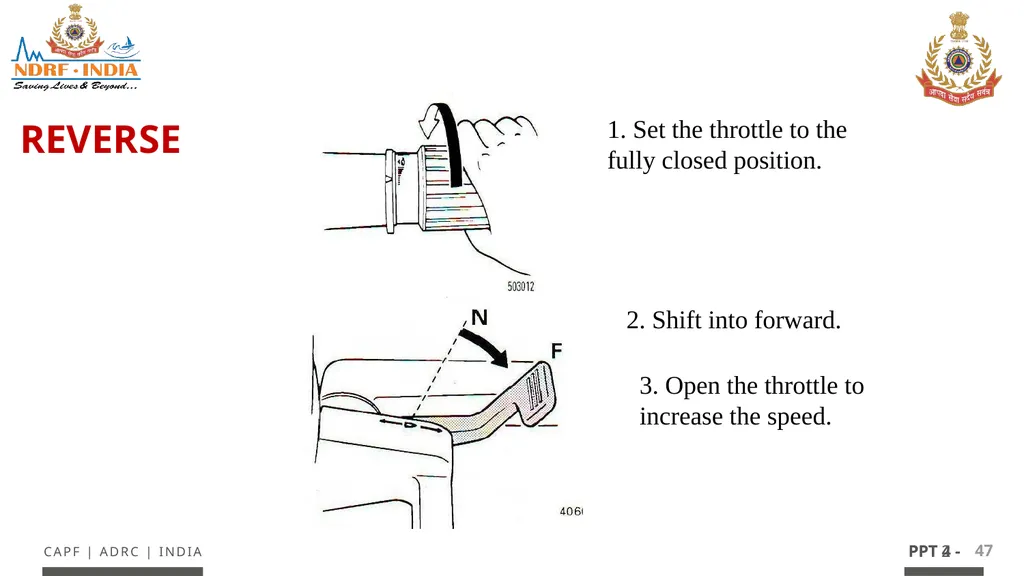
PPT 2 - 47 REVERSE 1. Set the throttle to the fully closed position. 2. Shift into forward. 3. Open the throttle to increase the speed.<br>
48
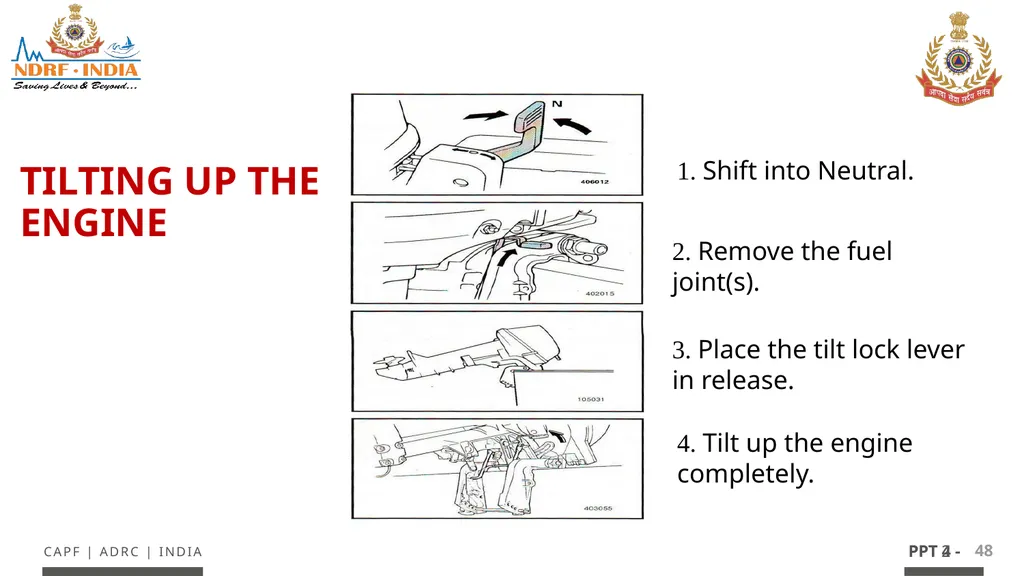
PPT 2 - 48 TILTING UP THE ENGINE 1. Shift into Neutral. 2. Remove the fuel joint(s). 3. Place the tilt lock lever in release. 4. Tilt up the engine completely.<br>
49
Carrying the IRB:- IRBs are typically stored:-Onboard in deflated form or on cradles/racks.
Carrying the OBM:- OBM is usually detached and stored:-In a dry, ventilated locker. Secured on board in an upright position.
Handling Precautions:
a)Avoid dropping or tilting excessively (can leak fuel/oil).
b)Always transport with cowling (engine cover) in place. PPT 2 - 49 LIFEBOAT- CARRYING, EMBARKING, HANDLING, AND DISEMBARKING<br>
Carrying the OBM:- OBM is usually detached and stored:-In a dry, ventilated locker. Secured on board in an upright position.
Handling Precautions:
a)Avoid dropping or tilting excessively (can leak fuel/oil).
b)Always transport with cowling (engine cover) in place. PPT 2 - 49 LIFEBOAT- CARRYING, EMBARKING, HANDLING, AND DISEMBARKING<br>
50
Steps:
IRB is launched and stabilized in water.
OBM is either already attached or attached carefully afloat (usually on smaller IRBs).
One crew member boards first to steady the craft and start the tain balance.
Lifejackets must be worn at all times.
Distribute weight evenly, remain seated, and hold on to safety ropes or handholds. PPT 2 - 50 Embarking (Boarding) Procedures<br>
IRB is launched and stabilized in water.
OBM is either already attached or attached carefully afloat (usually on smaller IRBs).
One crew member boards first to steady the craft and start the tain balance.
Lifejackets must be worn at all times.
Distribute weight evenly, remain seated, and hold on to safety ropes or handholds. PPT 2 - 50 Embarking (Boarding) Procedures<br>
51
Use throttle handle.
Control speed carefully, especially near people or during recovery operations. PPT 2 - 51 Maneuvering:<br>
Control speed carefully, especially near people or during recovery operations. PPT 2 - 51 Maneuvering:<br>
52
Steps:
IRB is brought alongside a safe platform or ladder.
OBM is turned off before people disembark.
One person disembarks at a time while maintaining boat balance.
Remove OBM (if required) and secure it.
Deflate or hoist IRB back onboard. PPT 2 - 52 Disembarking Procedures<br>
IRB is brought alongside a safe platform or ladder.
OBM is turned off before people disembark.
One person disembarks at a time while maintaining boat balance.
Remove OBM (if required) and secure it.
Deflate or hoist IRB back onboard. PPT 2 - 52 Disembarking Procedures<br>
53
Stagnant Water (Still Water)
Examples: Lakes, ponds, harbors, reservoirs
Characteristics:
No current or water movement
Predictable and stable surface
Often sheltered from wind and waves PPT 2 - 53 ROWING BOAT- STAGNANT WATER AND FLOWING WATER<br>
Examples: Lakes, ponds, harbors, reservoirs
Characteristics:
No current or water movement
Predictable and stable surface
Often sheltered from wind and waves PPT 2 - 53 ROWING BOAT- STAGNANT WATER AND FLOWING WATER<br>
54
Rowing Considerations:
Easier control: Ideal for beginners or training
Straight-line rowing is simpler due to lack of drift
Lower effort needed to maintain position or direction
Good for practicing stroke technique and balance
Less risk of drifting into hazards
Risks:
Can be deceptive in shallow areas (weeds, mud)
May have poor water quality or stagnant growth (algae) PPT 2 - 54 ROWING BOAT- STAGNANT WATER AND FLOWING WATER<br>
Easier control: Ideal for beginners or training
Straight-line rowing is simpler due to lack of drift
Lower effort needed to maintain position or direction
Good for practicing stroke technique and balance
Less risk of drifting into hazards
Risks:
Can be deceptive in shallow areas (weeds, mud)
May have poor water quality or stagnant growth (algae) PPT 2 - 54 ROWING BOAT- STAGNANT WATER AND FLOWING WATER<br>
55
Flowing Water (Rivers, Streams, Tidal Currents)
Characteristics:
Water is constantly moving in a single direction (current)
Speed and direction vary with terrain, tides, or rainfall
May include eddies, whirlpools, or rapids PPT 2 - 55 ROWING BOAT- STAGNANT WATER AND FLOWING WATER<br>
Characteristics:
Water is constantly moving in a single direction (current)
Speed and direction vary with terrain, tides, or rainfall
May include eddies, whirlpools, or rapids PPT 2 - 55 ROWING BOAT- STAGNANT WATER AND FLOWING WATER<br>
56
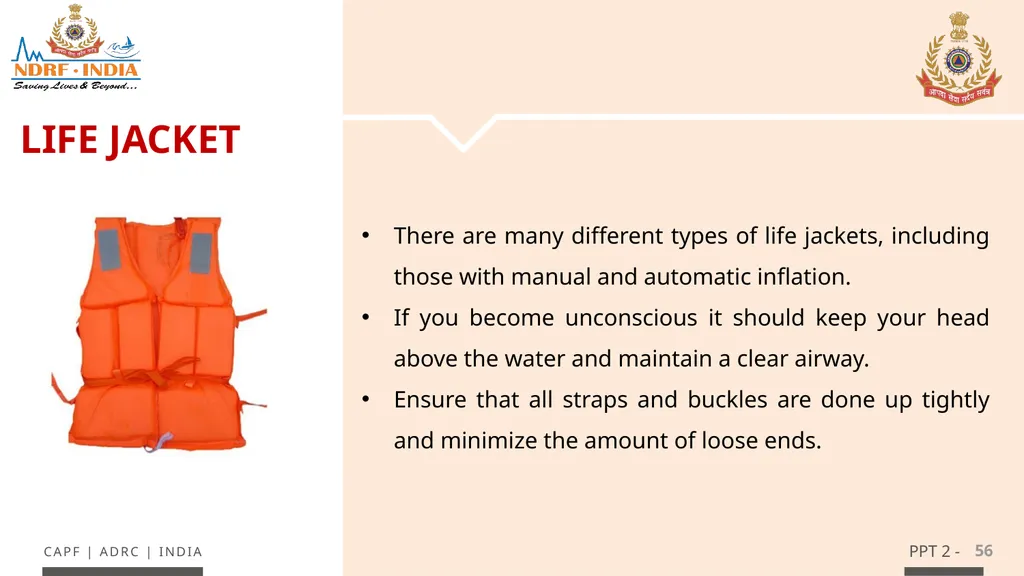
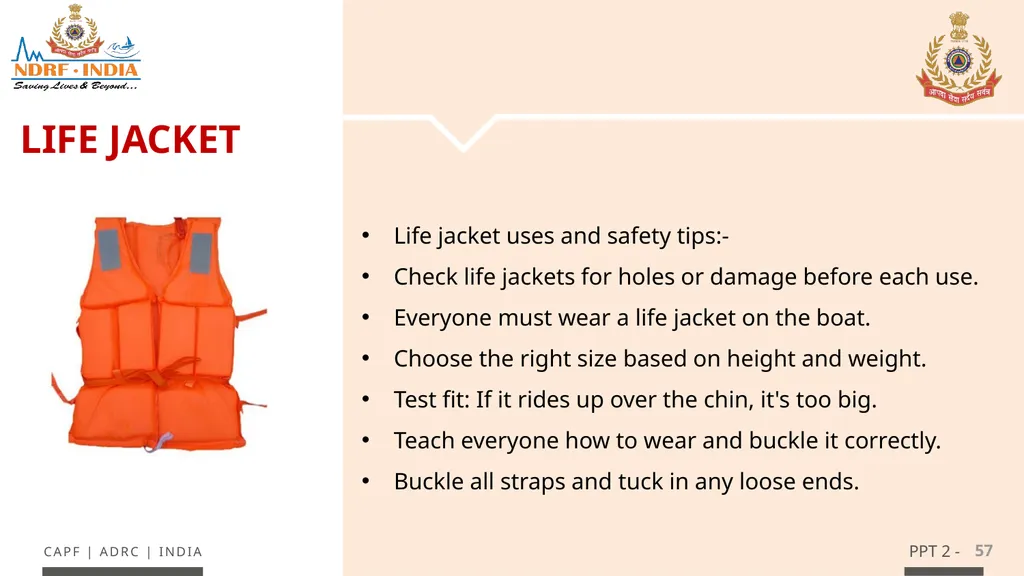
There are many different types of life jackets, including those with manual and automatic inflation.
If you become unconscious it should keep your head above the water and maintain a clear airway.
Ensure that all straps and buckles are done up tightly and minimize the amount of loose ends. PPT 2 - 56 LIFE JACKET<br>
If you become unconscious it should keep your head above the water and maintain a clear airway.
Ensure that all straps and buckles are done up tightly and minimize the amount of loose ends. PPT 2 - 56 LIFE JACKET<br>
57
Life jacket uses and safety tips:-
Check life jackets for holes or damage before each use.
Everyone must wear a life jacket on the boat.
Choose the right size based on height and weight.
Test fit: If it rides up over the chin, it's too big.
Teach everyone how to wear and buckle it correctly.
Buckle all straps and tuck in any loose ends. PPT 2 - 57 LIFE JACKET<br>
Check life jackets for holes or damage before each use.
Everyone must wear a life jacket on the boat.
Choose the right size based on height and weight.
Test fit: If it rides up over the chin, it's too big.
Teach everyone how to wear and buckle it correctly.
Buckle all straps and tuck in any loose ends. PPT 2 - 57 LIFE JACKET<br>
58
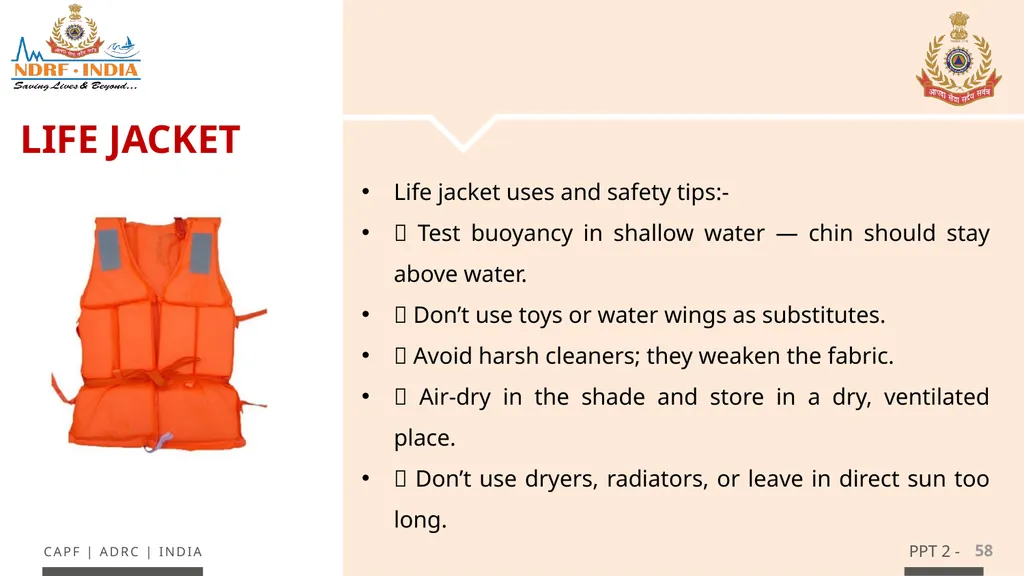
Life jacket uses and safety tips:-
✅ Test buoyancy in shallow water — chin should stay above water.
❌ Don’t use toys or water wings as substitutes.
❌ Avoid harsh cleaners; they weaken the fabric.
✅ Air-dry in the shade and store in a dry, ventilated place.
❌ Don’t use dryers, radiators, or leave in direct sun too long. PPT 2 - 58 LIFE JACKET<br>
✅ Test buoyancy in shallow water — chin should stay above water.
❌ Don’t use toys or water wings as substitutes.
❌ Avoid harsh cleaners; they weaken the fabric.
✅ Air-dry in the shade and store in a dry, ventilated place.
❌ Don’t use dryers, radiators, or leave in direct sun too long. PPT 2 - 58 LIFE JACKET<br>
59
Now You are able to define: Review Introduction
Type of Rescue boat.
IRB
Parts of IRB
Accessories to carry with IRB
Advantage of IRB 59<br>
Type of Rescue boat.
IRB
Parts of IRB
Accessories to carry with IRB
Advantage of IRB 59<br>
60
Now You are able to define: Review Operating procedure
Maintenance of IRB
Dos and Don'ts
OBM
Trouble Shooting and common failures of OBM
Lifeboat- carrying, embarking, handling, and disembarking 60<br>
Maintenance of IRB
Dos and Don'ts
OBM
Trouble Shooting and common failures of OBM
Lifeboat- carrying, embarking, handling, and disembarking 60<br>
61
61 THANK YOU<br>