
1 Montclair State University Department of
DJ
Published · 59 slides · 0 views

1 / 1

Description
1 Montclair State University Department of Anthropology Anth 140: Non Western Contributions to the Western World Dr. Richard W. Franke The Founding (Indian?) Fathers Week 05 Lecture Weatherford chapters 7, 8 and 9 Pages 117174 Second
Related Topics
Share
Embed code
Download this presentation From Below
"1 Montclair State University Department of" is the property of its rightful owner. Permission is granted to download and print the materials on this website for personal, non-commercial use only, and to display it on your personal computer provided you do not modify the materials and that you retain all copyright notices contained in the materials. By downloading content from our website, you accept the terms of this agreement.
Presentation Transcript
01
1 Montclair State University Department of Anthropology
Anth 140: Non Western Contributions to the Western World
Dr. Richard W. Franke The Founding (Indian?) Fathers
Week 05 Lecture
Weatherford chapters 7, 8 and 9
Pages 117–174
Second edition pages 151–223
Last Updated 05 September, 2019<br>
Week 05 Lecture
Weatherford chapters 7, 8 and 9
Pages 117–174
Second edition pages 151–223
Last Updated 05 September, 2019<br>
02
2 Montclair State University Department of Anthropology
Anth 140: Non Western Contributions to the Western World
Dr. Richard W. Franke The Founding (Indian) Fathers?
Native American Contributions to American Democracy
The learning objectives for week 05 are:
to take the first exam and
to critically evaluate the pros and cons of the debate about the influence of Native Americans on the development of democracy in the United States<br>
Native American Contributions to American Democracy
The learning objectives for week 05 are:
to take the first exam and
to critically evaluate the pros and cons of the debate about the influence of Native Americans on the development of democracy in the United States<br>
03
3 Montclair State University Department of Anthropology
Anth 140: Non Western Contributions to the Western World
Dr. Richard W. Franke Native American Contributions to American Democracy
Terms you should know for week 05 are:
anarchy/anarchism
Nambicuara
Thomas Paine
Jean Jacques Rousseau
League of the Iroquois
Seneca Falls, New York
19th Amendment to the US Constitution (1920)<br>
Terms you should know for week 05 are:
anarchy/anarchism
Nambicuara
Thomas Paine
Jean Jacques Rousseau
League of the Iroquois
Seneca Falls, New York
19th Amendment to the US Constitution (1920)<br>
04
4 Montclair State University Department of Anthropology
Anth 140: Non Western Contributions to the Western World: Dr. Richard W. Franke Native American Contributions to American Democracy
Week 05 Sources:
Grinde, Donald A., Jr. 1977. The Iroquois and the Founding of the American Nation. San Francisco: The Indian Historian Press. A Yamasee Native American historian’s account of the role of the Iroquois constitution in shaping American settler concepts of democracy and the American constitution. Includes a complete English text of The Council of the Great Peace of Dekanawidah.
Wagner, Sally Roesch. 1996. The Untold Story of the Iroquois Influence on Early Feminists. Aberdeen, South Dakota: Sky Carrier Press
Zinn, Howard. 1995. A People’s History of the United States: 1492–Present. New York: Harper/Perennial. Esp. pages 102–23.
A debate about Grinde's work and that of colleague Bruce Johansen, appears in the following three sources (thanks to MSU History Prof. Robert Cray for these citations):
Levy, Philip. 1996. Exemplars of taking liberties: the Iroquois influence thesis and the problem of evidence. The William and Mary Quarterly, 3rd Series, 53(3):588–604.
Payne, Samuel B. Jr. 1996. The Iroquois League, the Articles of Confederation, and the Constitution. The William and Mary Quarterly, 3rd Series, 53(3):605–20.
Grinde, Donald A. Jr. and Bruce E. Johansen. 1996. Sauce for the goose: demand and definitions for "proof" regarding the Iroquois and democracy. The William and Mary Quarterly, 3rd Series, 53(3):621–35.<br>
05
5 Montclair State University Department of Anthropology
Anth 140: Non Western Contributions to the Western World
Dr. Richard W. Franke “To an outsider…powwows often appear chaotic…No one is in control…This seems to be typical of Indian community events…leaders can only lead by example…the event unfolds as a collective activity of all the participants.”
Weatherford, page 120; second edition page 155<br>
Weatherford, page 120; second edition page 155<br>
06
6 Montclair State University Department of Anthropology
Anth 140: Non Western Contributions to the Western World
Dr. Richard W. Franke “Indian penchant for respectful individualism”…first explorers wrote about it five centuries ago.
Indian societies operated without…coercive political institutions.”<br>
Indian societies operated without…coercive political institutions.”<br>
07
7 Montclair State University Department of Anthropology
Anth 140: Non Western Contributions to the Western World
Dr. Richard W. Franke Two basic concepts of freedom:
National independence and sovereignty
Personal liberty
Personal liberty version “does not have a long pedigree in the Old World.”
Weatherrford, page 121; second edition page 156<br>
National independence and sovereignty
Personal liberty
Personal liberty version “does not have a long pedigree in the Old World.”
Weatherrford, page 121; second edition page 156<br>
08
8 Montclair State University Department of Anthropology
Anth 140: Non Western Contributions to the Western World
Dr. Richard W. Franke Powwow observations introduce Weatherford’s two part theory of Native American influences on the modern concept of democracy:
Indirect (ideological) influences: widely accepted
Direct (technical) influences on US constitution and the structure and practices of the US government: hotly debated<br>
Indirect (ideological) influences: widely accepted
Direct (technical) influences on US constitution and the structure and practices of the US government: hotly debated<br>
09
9 Montclair State University Department of Anthropology
Anth 140: Non Western Contributions to the Western World
Dr. Richard W. Franke First examine the indirect (ideological) influences that are widely accepted<br>
10
10 Montclair State University Department of Anthropology
Anth 140: Non Western Contributions to the Western World
Dr. Richard W. Franke The American Revolution was heavily based on the ideas of the philosophical and intellectual historical period known as “The Enlightenment,” but…<br>
11
11 Montclair State University Department of Anthropology
Anth 140: Non Western Contributions to the Western World
Dr. Richard W. Franke “Egalitarian democracy and liberty as we know them today owe little to Europe. They are not Greco-Roman derivatives somehow revived by the French in the 18th Century. They entered modern western thought as American Indian notions translated into European language and culture.” (Weatherford page 128;second edition page 166)<br>
12
12 Montclair State University Department of Anthropology
Anth 140: Non Western Contributions to the Western World
Dr. Richard W. Franke The Enlightenment from about 1720–1790
Grew out of the Renaissance
Especially important in France and England
Widespread criticism of traditions of middle ages<br>
Grew out of the Renaissance
Especially important in France and England
Widespread criticism of traditions of middle ages<br>
13
13 Montclair State University Department of Anthropology
Anth 140: Non Western Contributions to the Western World
Dr. Richard W. Franke Some key figures in England:
Thomas More 1478–1535
John Locke 1632–1704
David Hume 1711–1776<br>
Thomas More 1478–1535
John Locke 1632–1704
David Hume 1711–1776<br>
14
14 Montclair State University Department of Anthropology
Anth 140: Non Western Contributions to the Western World
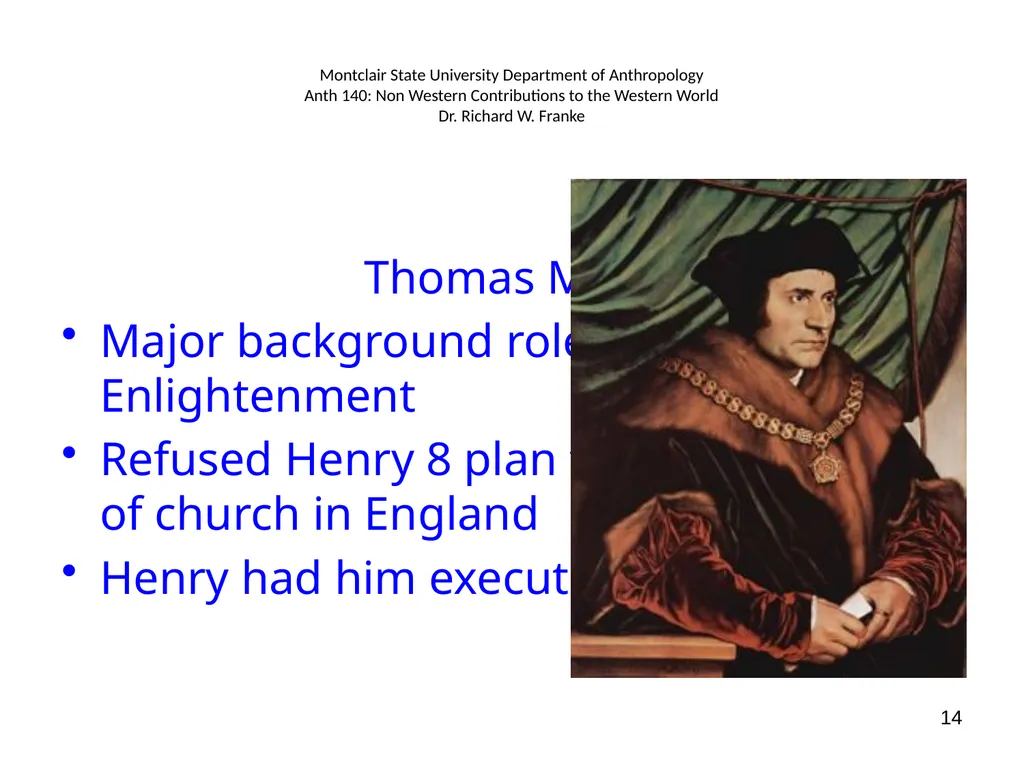
Dr. Richard W. Franke Thomas More
Major background role in Enlightenment
Refused Henry 8 plan to become head of church in England
Henry had him executed<br>
Major background role in Enlightenment
Refused Henry 8 plan to become head of church in England
Henry had him executed<br>
15
15 Montclair State University Department of Anthropology
Anth 140: Non Western Contributions to the Western World
Dr. Richard W. Franke Europeans initially astonished at the democratic, egalitarian ideals and behavior of Native Americans.
Native American ability to carry out collective activities without strong positions of leadership or coercive political institutions was a far cry from the despotic monarchs to which Europeans were accustomed.<br>
Native American ability to carry out collective activities without strong positions of leadership or coercive political institutions was a far cry from the despotic monarchs to which Europeans were accustomed.<br>
16
16 Montclair State University Department of Anthropology
Anth 140: Non Western Contributions to the Western World
Dr. Richard W. Franke 1516: Thomas More's Utopia described a future society of equality without money.
Utopia literally “no place”
More got many of his ideas from travelers' reports on Native Americans.<br>
Utopia literally “no place”
More got many of his ideas from travelers' reports on Native Americans.<br>
17
17 Montclair State University Department of Anthropology
Anth 140: Non Western Contributions to the Western World
Dr. Richard W. Franke John Locke (1632–1704)
Essay on Human Understanding
One of earliest arguments for religious toleration and separation of religion from government
Distinguish legitimate from illegitimate government and argue right of rebellion against illegitimate government<br>
Essay on Human Understanding
One of earliest arguments for religious toleration and separation of religion from government
Distinguish legitimate from illegitimate government and argue right of rebellion against illegitimate government<br>
18
18 Montclair State University Department of Anthropology
Anth 140: Non Western Contributions to the Western World
Dr. Richard W. Franke John Locke
One of earliest to use “social contract” idea of government<br>
One of earliest to use “social contract” idea of government<br>
19
19 Montclair State University Department of Anthropology
Anth 140: Non Western Contributions to the Western World
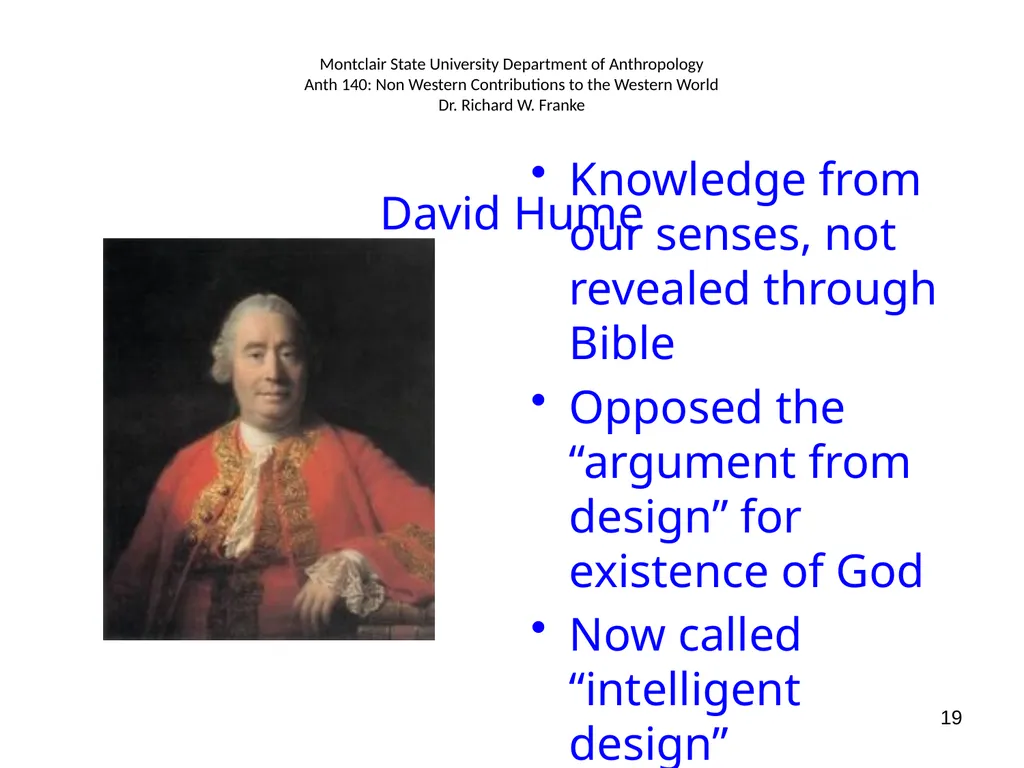
Dr. Richard W. Franke David Hume Knowledge from our senses, not revealed through Bible
Opposed the “argument from design” for existence of God
Now called “intelligent design”<br>
Opposed the “argument from design” for existence of God
Now called “intelligent design”<br>
20
20 Montclair State University Department of Anthropology
Anth 140: Non Western Contributions to the Western World
Dr. Richard W. Franke Key Figures in French Enlightenment:
French Thinkers More Important
Michel de Montaigne 1533 – 1592
René Descartes 1597 – 1650
Louis-Armand de Lom d'Arce 1666 – 1715
Voltaire 1694 – 1778
Jean Jacques Rousseau 1712 – 1778<br>
French Thinkers More Important
Michel de Montaigne 1533 – 1592
René Descartes 1597 – 1650
Louis-Armand de Lom d'Arce 1666 – 1715
Voltaire 1694 – 1778
Jean Jacques Rousseau 1712 – 1778<br>
21
21 Montclair State University Department of Anthropology
Anth 140: Non Western Contributions to the Western World
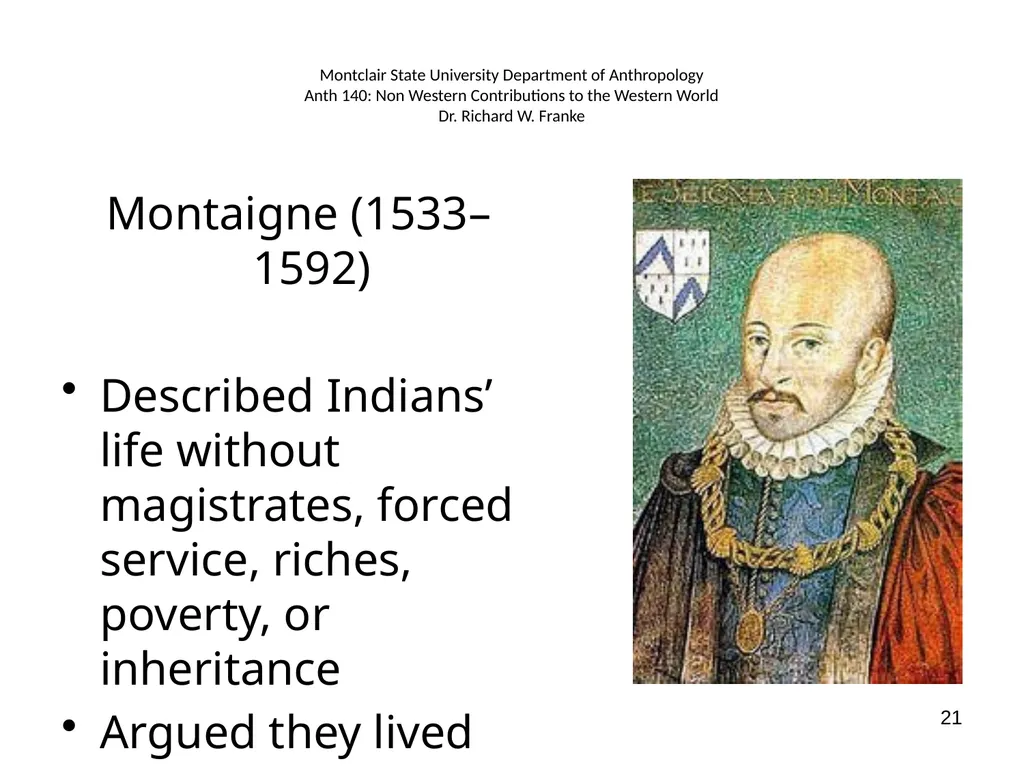
Dr. Richard W. Franke Montaigne (1533–1592)
Described Indians’ life without magistrates, forced service, riches, poverty, or inheritance
Argued they lived better than Europeans<br>
Described Indians’ life without magistrates, forced service, riches, poverty, or inheritance
Argued they lived better than Europeans<br>
22
22 Montclair State University Department of Anthropology
Anth 140: Non Western Contributions to the Western World
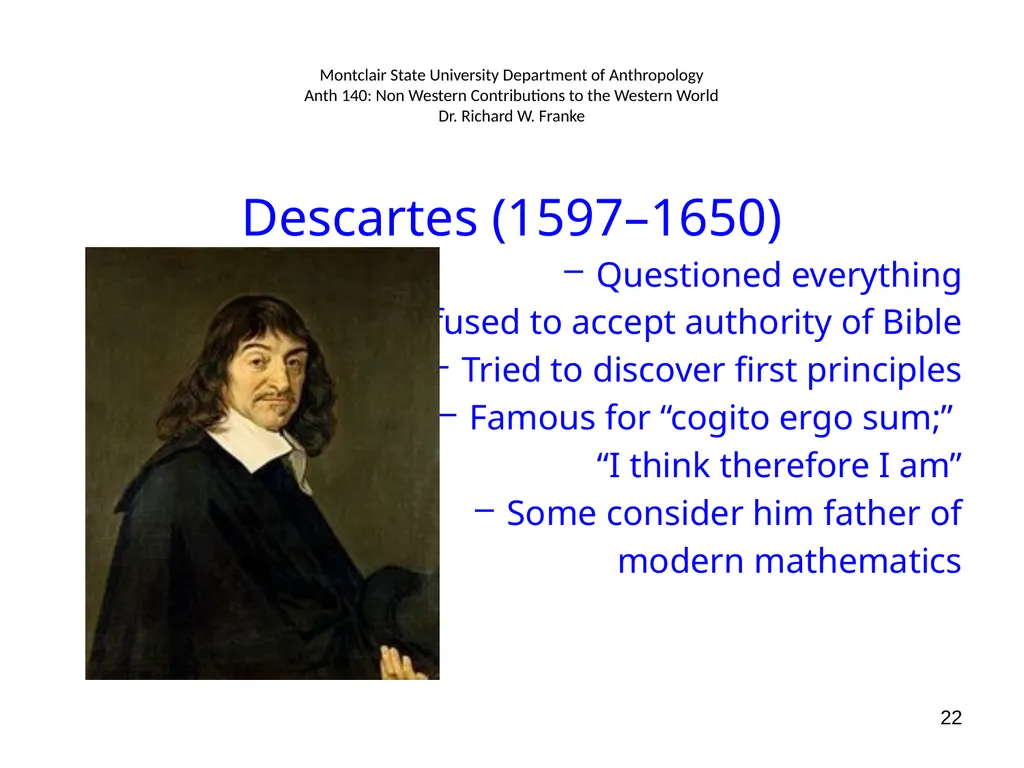
Dr. Richard W. Franke Descartes (1597–1650)
Questioned everything
Refused to accept authority of Bible
Tried to discover first principles
Famous for “cogito ergo sum;”
“I think therefore I am”
Some consider him father of
modern mathematics<br>
Questioned everything
Refused to accept authority of Bible
Tried to discover first principles
Famous for “cogito ergo sum;”
“I think therefore I am”
Some consider him father of
modern mathematics<br>
23
23 Montclair State University Department of Anthropology
Anth 140: Non Western Contributions to the Western World
Dr. Richard W. Franke Louis-Armand de Lom d'Arce
described the Huron Indians
based on his personal stay with them from 1683 to 1694
liberty and equality: no
social classes,
private property, or a
government separate from the kinship system.<br>
described the Huron Indians
based on his personal stay with them from 1683 to 1694
liberty and equality: no
social classes,
private property, or a
government separate from the kinship system.<br>
24
24 Montclair State University Department of Anthropology
Anth 140: Non Western Contributions to the Western World
Dr. Richard W. Franke Louis-Armand de Lom d'Arce
Used the word “anarchy” – “without a ruler” –
to define the Huron political system.<br>
Used the word “anarchy” – “without a ruler” –
to define the Huron political system.<br>
25
25 Montclair State University Department of Anthropology
Anth 140: Non Western Contributions to the Western World
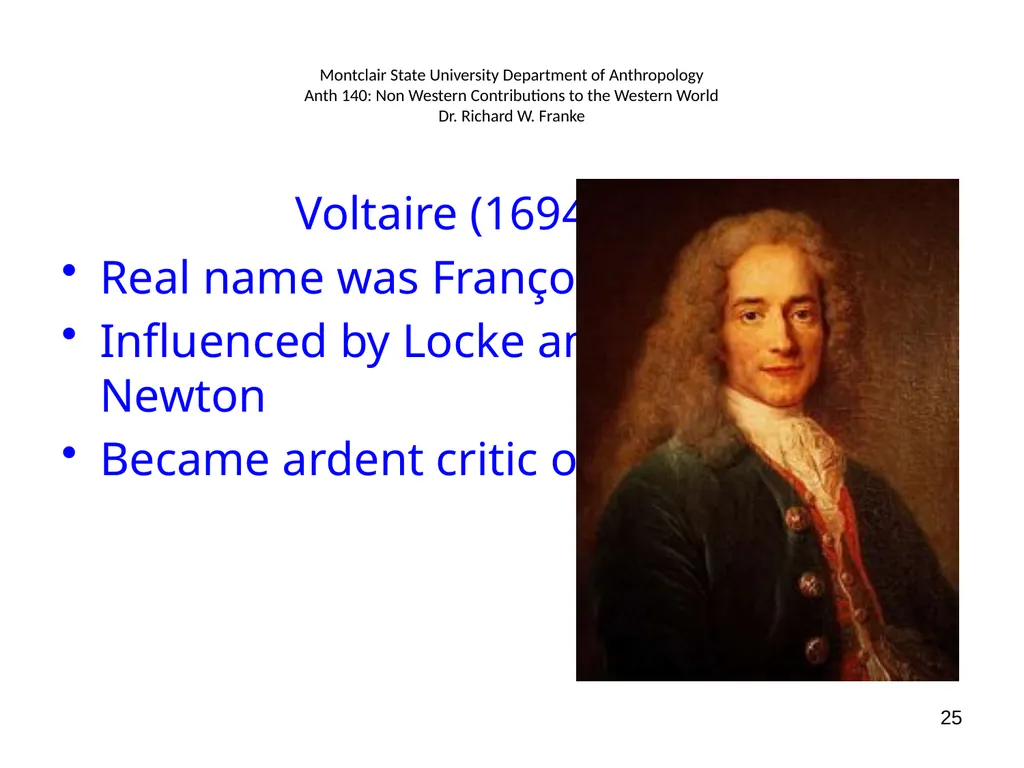
Dr. Richard W. Franke Voltaire (1694–1778)
Real name was François Marie Arouet
Influenced by Locke and by Isaac Newton
Became ardent critic of religion<br>
Real name was François Marie Arouet
Influenced by Locke and by Isaac Newton
Became ardent critic of religion<br>
26
26 Montclair State University Department of Anthropology
Anth 140: Non Western Contributions to the Western World
Dr. Richard W. Franke Voltaire
Candide (1759) one of most famous novels
Despite constant problems and misfortunes the character Pangloss continues to believe this is the best possible world
“Panglossian” now a word for excessive optimism
1956 Leonard Bernstein operetta “Candide”<br>
Candide (1759) one of most famous novels
Despite constant problems and misfortunes the character Pangloss continues to believe this is the best possible world
“Panglossian” now a word for excessive optimism
1956 Leonard Bernstein operetta “Candide”<br>
27
27 Montclair State University Department of Anthropology
Anth 140: Non Western Contributions to the Western World
Dr. Richard W. Franke “Voltairisms”
“I disagree with what you say but I would fight to the death for your right to say it.”
“Common sense is not so common.”
“It is dangerous to be right when the government is wrong.”
“Those who can make you believe absurdities can make you commit atrocities. “<br>
“I disagree with what you say but I would fight to the death for your right to say it.”
“Common sense is not so common.”
“It is dangerous to be right when the government is wrong.”
“Those who can make you believe absurdities can make you commit atrocities. “<br>
28
28 Montclair State University Department of Anthropology
Anth 140: Non Western Contributions to the Western World
Dr. Richard W. Franke Rousseau (1712–1778)
Was the most important French enlightenment philosopher
In 1742 wrote an operetta on the discovery of America contrasting the Indians’ liberty and the lack of it among the Europeans.
Later published his Discourse on the Origins of Inequality and his The Social Contract which both feature Native American societies as models of democracy.<br>
29
29 Montclair State University Department of Anthropology
Anth 140: Non Western Contributions to the Western World
Dr. Richard W. Franke Rousseau
Was probably the main philosopher to popularize the idea of the “noble savage.”
Was particularly influenced by accounts of the Nambicuaras of Brazil.
Thomas Jefferson, Thomas Paine, and Benjamin Franklin were all influenced by Rousseau.<br>
Was probably the main philosopher to popularize the idea of the “noble savage.”
Was particularly influenced by accounts of the Nambicuaras of Brazil.
Thomas Jefferson, Thomas Paine, and Benjamin Franklin were all influenced by Rousseau.<br>
30
30 Montclair State University Department of Anthropology
Anth 140: Non Western Contributions to the Western World
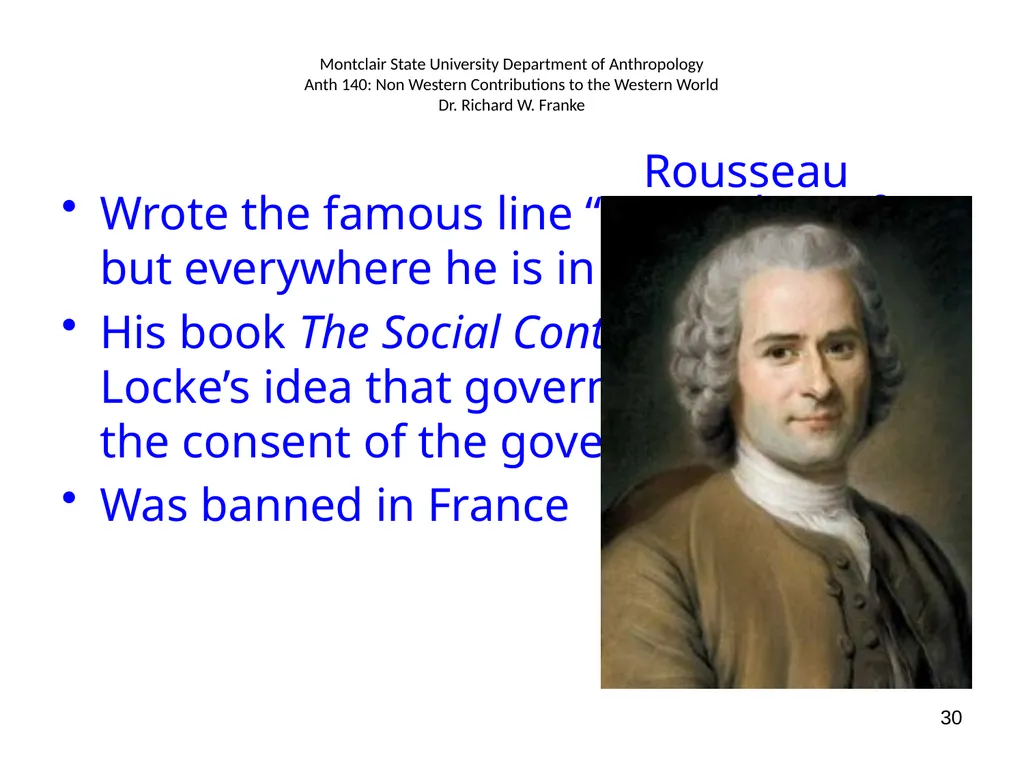
Dr. Richard W. Franke Wrote the famous line “Man is born free but everywhere he is in chains.”
His book The Social Contract expanded Locke’s idea that government requires the consent of the governed
Was banned in France Rousseau<br>
His book The Social Contract expanded Locke’s idea that government requires the consent of the governed
Was banned in France Rousseau<br>
31
31 Montclair State University Department of Anthropology
Anth 140: Non Western Contributions to the Western World
Dr. Richard W. Franke Rousseau
Might be the single most important thinker of the Enlightenment
Was a major influence on the American and French revolutions (French: 1789 – 1794)
Nambicuaras of Brazil still exist<br>
Might be the single most important thinker of the Enlightenment
Was a major influence on the American and French revolutions (French: 1789 – 1794)
Nambicuaras of Brazil still exist<br>
32
32 Montclair State University Department of Anthropology
Anth 140: Non Western Contributions to the Western World
Dr. Richard W. Franke Nambicuara
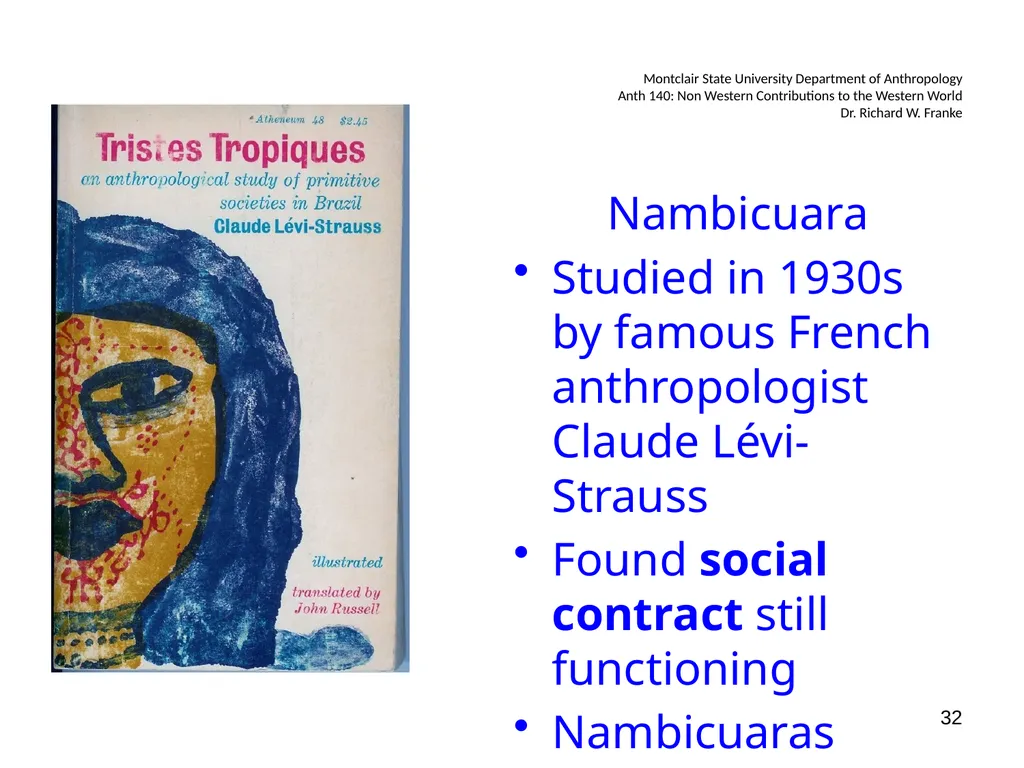
Studied in 1930s by famous French anthropologist Claude Lévi-Strauss
Found social contract still functioning
Nambicuaras voluntarily give up some powers to “chief” in return for his hard work and sacrifice<br>
Studied in 1930s by famous French anthropologist Claude Lévi-Strauss
Found social contract still functioning
Nambicuaras voluntarily give up some powers to “chief” in return for his hard work and sacrifice<br>
33
33 Montclair State University Department of Anthropology
Anth 140: Non Western Contributions to the Western World
Dr. Richard W. Franke Father Joseph François Lafitau:
In 1724 his Customs of the American Savages Compared with Those of Earliest Times described the Mohawks.
Thinking they could only be so democratic if originally descended from the Greeks, he pronounced them refugees of the Trojan Wars who had managed to get to America or somehow bring their ideas there.<br>
34
34 Montclair State University Department of Anthropology
Anth 140: Non Western Contributions to the Western World
Dr. Richard W. Franke Summary: Indirect Influences
Aztec and Inca empires familiar to Europeans – had similar authoritarian style
But Nambicuara and Iroquois unlike anything Europeans had seen<br>
Aztec and Inca empires familiar to Europeans – had similar authoritarian style
But Nambicuara and Iroquois unlike anything Europeans had seen<br>
35
35 Montclair State University Department of Anthropology
Anth 140: Non Western Contributions to the Western World
Dr. Richard W. Franke Summary: Indirect Influences
Historical conjuncture: Europeans made contact with radically democratic Native Americans just as late Renaissance was unfolding
Questioning of medieval world view
Enlightenment brought “radical” theories of democracy
Attacks on organized church because of its authoritarian structure<br>
Historical conjuncture: Europeans made contact with radically democratic Native Americans just as late Renaissance was unfolding
Questioning of medieval world view
Enlightenment brought “radical” theories of democracy
Attacks on organized church because of its authoritarian structure<br>
36
36 Montclair State University Department of Anthropology
Anth 140: Non Western Contributions to the Western World
Dr. Richard W. Franke Summary: Indirect Influences
Historical conjuncture:
Iroquois and Nambicuara based views of Enlightenment influenced US Founding Fathers
Thomas Jefferson spent time in France, read Voltaire and Rousseau
Benjamin Franklin was ambassador to France in 1775-76, had read Locke, Voltaire and Rousseau<br>
Historical conjuncture:
Iroquois and Nambicuara based views of Enlightenment influenced US Founding Fathers
Thomas Jefferson spent time in France, read Voltaire and Rousseau
Benjamin Franklin was ambassador to France in 1775-76, had read Locke, Voltaire and Rousseau<br>
37
37 Montclair State University Department of Anthropology
Anth 140: Non Western Contributions to the Western World
Dr. Richard W. Franke Direct Influences?
Historical conjuncture:
Iroquois as model for US constitution?
Thomas Paine very much influenced by the Iroquois from whom he first learned about democracy in practice., Paine used the Indians as models of how the new American society might be organized.<br>
Historical conjuncture:
Iroquois as model for US constitution?
Thomas Paine very much influenced by the Iroquois from whom he first learned about democracy in practice., Paine used the Indians as models of how the new American society might be organized.<br>
38
38 Montclair State University Department of Anthropology
Anth 140: Non Western Contributions to the Western World
Dr. Richard W. Franke Thomas Paine (1737–1809)
One of the first to call for American independence
First person to propose the name “United States of America” for the country.
His The Age of Reason is one of the premier statements of the Enlightenment, and probably its most influential defense in the English language.<br>
One of the first to call for American independence
First person to propose the name “United States of America” for the country.
His The Age of Reason is one of the premier statements of the Enlightenment, and probably its most influential defense in the English language.<br>
39
39 Montclair State University Department of Anthropology
Anth 140: Non Western Contributions to the Western World
Dr. Richard W. Franke Thomas Paine
Common Sense, published in 1775 was a major call for American independence – thousands printed
The Crisis as series of articles including “These are the times that try men’s souls…”
Washington had it read aloud to troops at Valley Forge<br>
Common Sense, published in 1775 was a major call for American independence – thousands printed
The Crisis as series of articles including “These are the times that try men’s souls…”
Washington had it read aloud to troops at Valley Forge<br>
40
40 Montclair State University Department of Anthropology
Anth 140: Non Western Contributions to the Western World
Dr. Richard W. Franke Thomas Paine
Paine later part of French revolution
One of first white Americans to publicly oppose slavery (as did Benjamin Franklin)<br>
Paine later part of French revolution
One of first white Americans to publicly oppose slavery (as did Benjamin Franklin)<br>
41
41 Montclair State University Department of Anthropology
Anth 140: Non Western Contributions to the Western World
Dr. Richard W. Franke Direct Influences? Benjamin Franklin
Was official printer for the colony of Pennsylvania
Printed speeches and records of the various Indian assemblies and treaty negotiations
Studied the Iroquois structure in detail
Advocated its adoption by the US. Speaking to the Albany Congress in 1754, Franklin called on the delegates to emulate the League of the Iroquois<br>
42
42 Montclair State University Department of Anthropology
Anth 140: Non Western Contributions to the Western World
Dr. Richard W. Franke Direct Influences? Charles Thomson
Secretary to the Continental Congress
Studied the Delaware so much that they adopted him as a full tribal member
Wrote in detail about Indian political ideas and practices at the request of Thomas Jefferson
According to Weatherford Thomson's descriptions of Iroquois and Delaware practices read like a blueprint for the US Constitution<br>
43
43 Montclair State University Department of Anthropology
Anth 140: Non Western Contributions to the Western World
Dr. Richard W. Franke Charles Thomson (1729–1824)
introduced the Iroquois sachems (representatives) concepts that
1. Sachems do not acquire their positions by heredity but by election
2. outsiders can be naturalized and then elected to such offices, and
3. Military and civilian leaders must be separate<br>
introduced the Iroquois sachems (representatives) concepts that
1. Sachems do not acquire their positions by heredity but by election
2. outsiders can be naturalized and then elected to such offices, and
3. Military and civilian leaders must be separate<br>
44
44 Montclair State University Department of Anthropology
Anth 140: Non Western Contributions to the Western World
Dr. Richard W. Franke League of the Iroquois
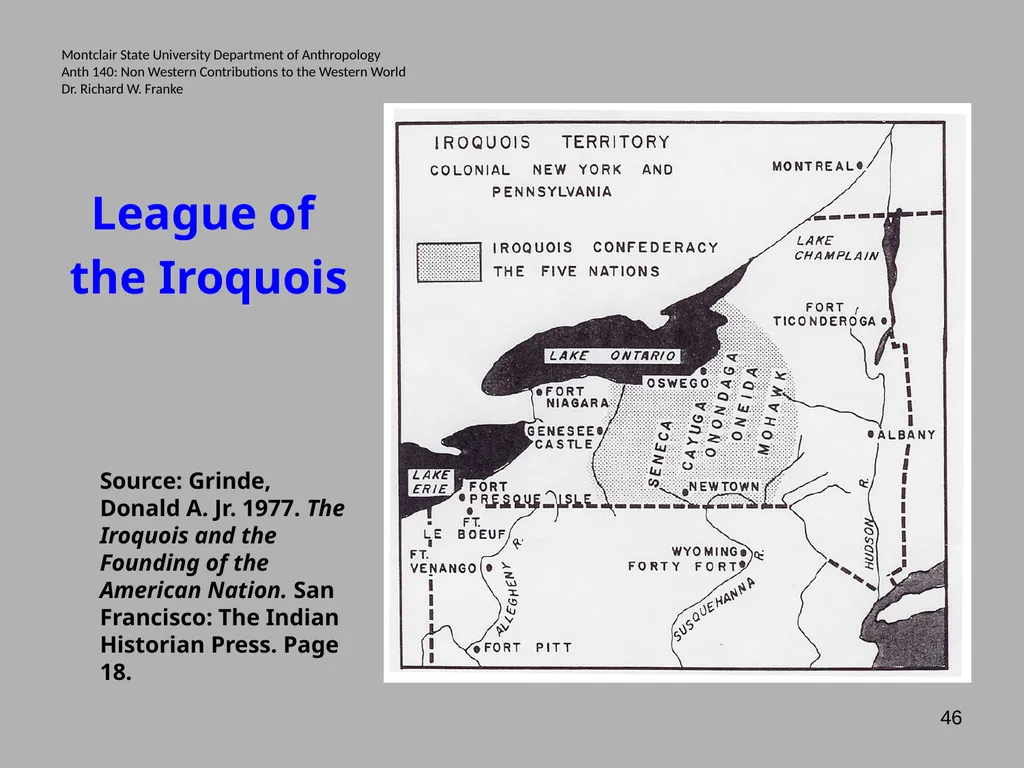
Founded by Hiawatha and Deganwidah between AD 1000 and AD 1450, under a constitution called the "Great Law of Peace"
The League of the Iroquois united 5 Indian nations:<br>
Founded by Hiawatha and Deganwidah between AD 1000 and AD 1450, under a constitution called the "Great Law of Peace"
The League of the Iroquois united 5 Indian nations:<br>
45
45 Montclair State University Department of Anthropology
Anth 140: Non Western Contributions to the Western World
Dr. Richard W. Franke League of the Iroquois
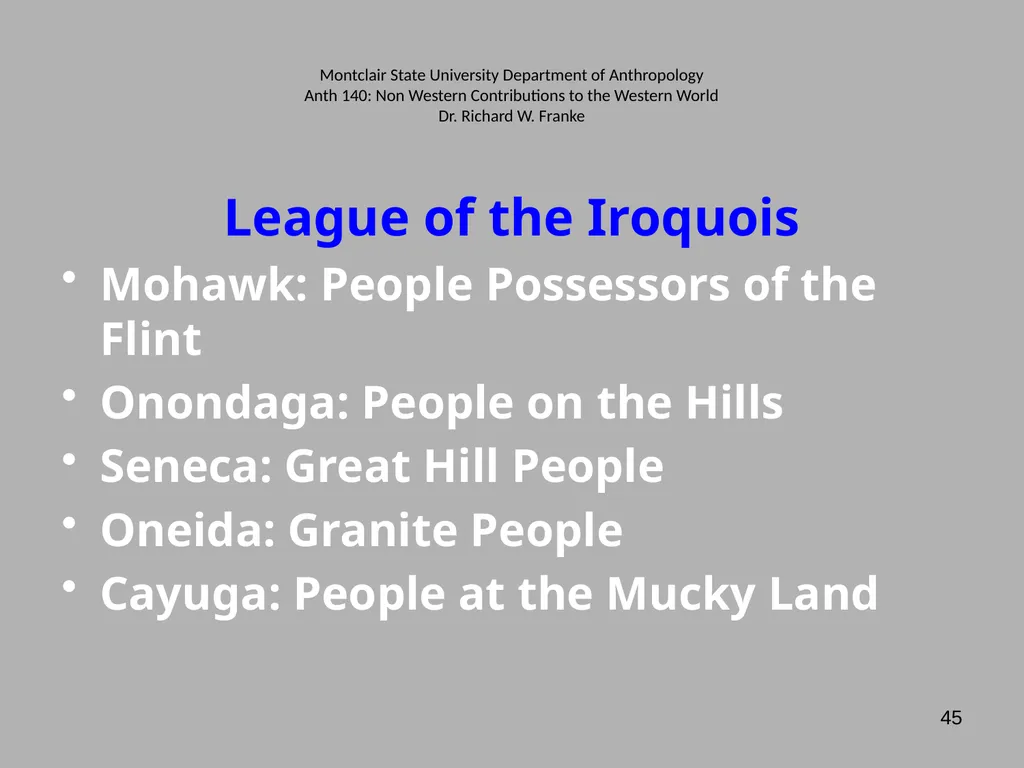
Mohawk: People Possessors of the Flint
Onondaga: People on the Hills
Seneca: Great Hill People
Oneida: Granite People
Cayuga: People at the Mucky Land<br>
Mohawk: People Possessors of the Flint
Onondaga: People on the Hills
Seneca: Great Hill People
Oneida: Granite People
Cayuga: People at the Mucky Land<br>
46
46 Montclair State University Department of Anthropology
Anth 140: Non Western Contributions to the Western World
Dr. Richard W. Franke League of
the Iroquois
Source: Grinde, Donald A. Jr. 1977. The Iroquois and the Founding of the American Nation. San Francisco: The Indian Historian Press. Page 18.<br>
the Iroquois
Source: Grinde, Donald A. Jr. 1977. The Iroquois and the Founding of the American Nation. San Francisco: The Indian Historian Press. Page 18.<br>
47
47 Montclair State University Department of Anthropology
Anth 140: Non Western Contributions to the Western World
Dr. Richard W. Franke League of the Iroquois
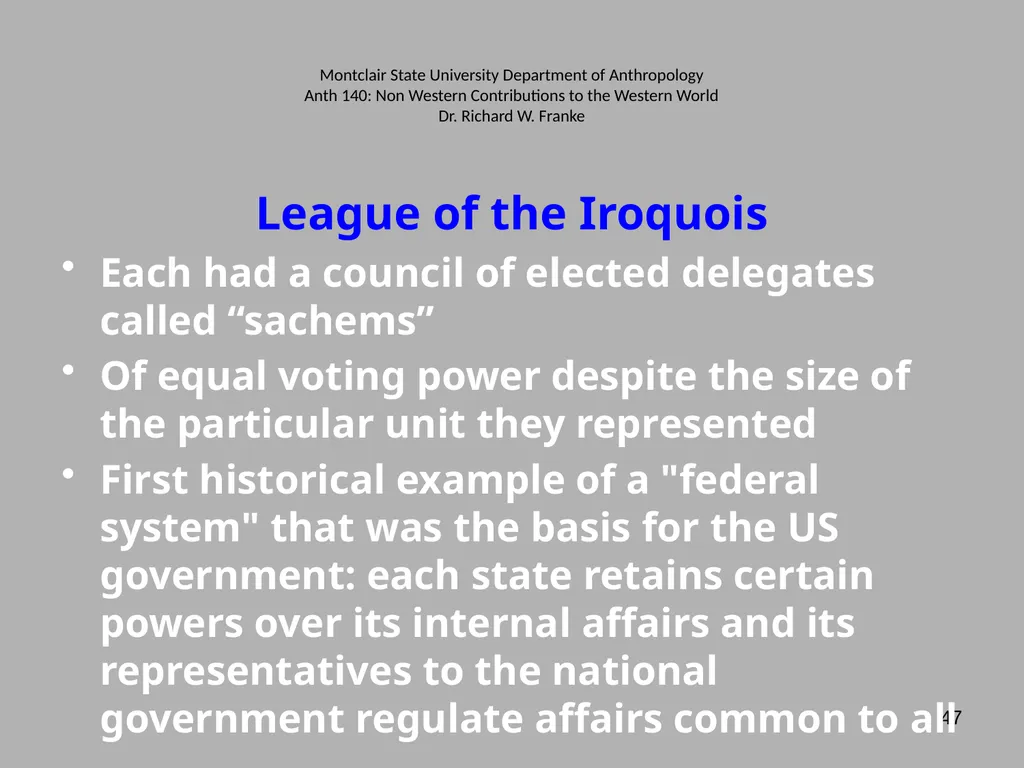
Each had a council of elected delegates called “sachems”
Of equal voting power despite the size of the particular unit they represented
First historical example of a "federal system" that was the basis for the US government: each state retains certain powers over its internal affairs and its representatives to the national government regulate affairs common to all<br>
48
48 Montclair State University Department of Anthropology
Anth 140: Non Western Contributions to the Western World
Dr. Richard W. Franke League of the Iroquois?
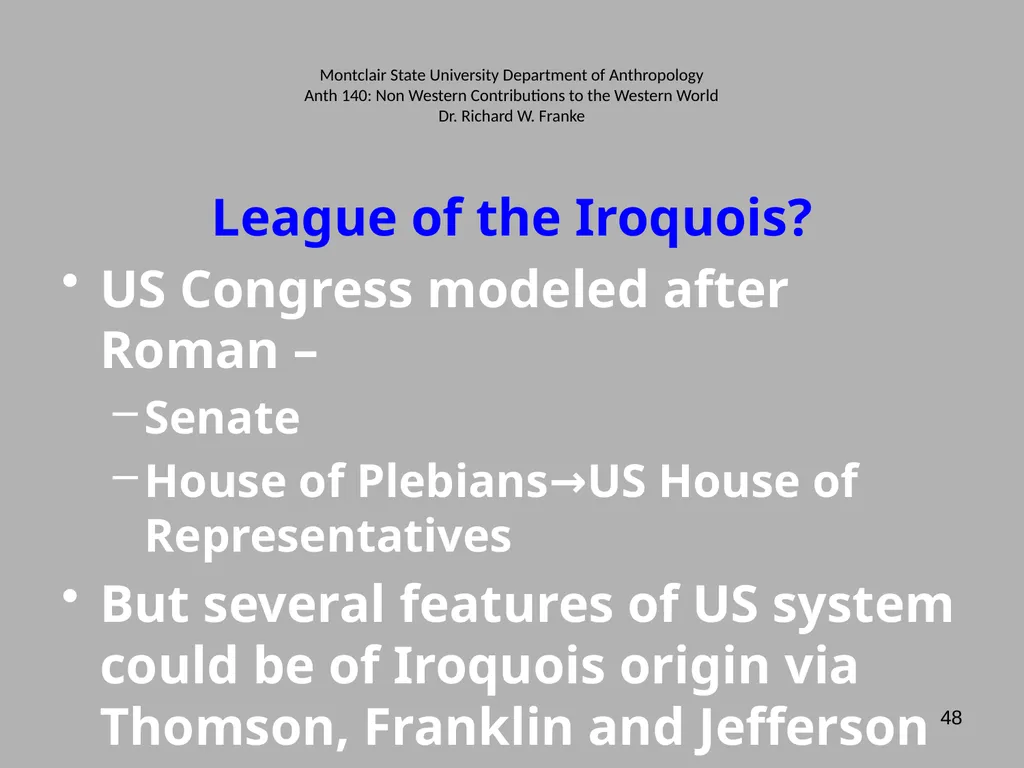
US Congress modeled after Roman –
Senate
House of Plebians→US House of Representatives
But several features of US system could be of Iroquois origin via Thomson, Franklin and Jefferson<br>
US Congress modeled after Roman –
Senate
House of Plebians→US House of Representatives
But several features of US system could be of Iroquois origin via Thomson, Franklin and Jefferson<br>
49
49 Montclair State University Department of Anthropology
Anth 140: Non Western Contributions to the Western World
Dr. Richard W. Franke League of the Iroquois
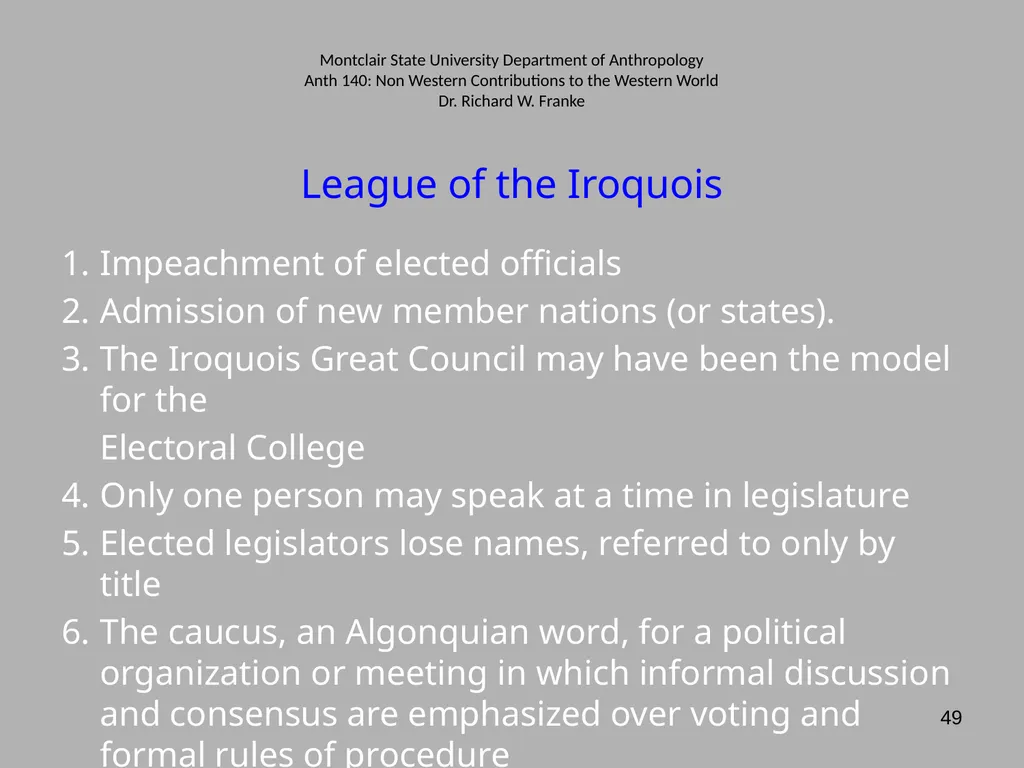
1. Impeachment of elected officials
2. Admission of new member nations (or states).
3. The Iroquois Great Council may have been the model for the
Electoral College
4. Only one person may speak at a time in legislature
5. Elected legislators lose names, referred to only by title
6. The caucus, an Algonquian word, for a political organization or meeting in which informal discussion and consensus are emphasized over voting and formal rules of procedure<br>
50
50 Montclair State University Department of Anthropology
Anth 140: Non Western Contributions to the Western World
Dr. Richard W. Franke League of the Iroquois?
Many historians dispute the direct connections between Iroquois League and US constitution
See the optional supplementary readings for sources including a detailed scholarly debate in The William and Mary Quarterly.<br>
Many historians dispute the direct connections between Iroquois League and US constitution
See the optional supplementary readings for sources including a detailed scholarly debate in The William and Mary Quarterly.<br>
51
51 Montclair State University Department of Anthropology
Anth 140: Non Western Contributions to the Western World
Dr. Richard W. Franke Iroquois and Women’s Rights
Matilda Joslyn Gage (1826–1898)
Lucretia Mott (1793–1880)
Elizabeth Cady Stanton (1815–1902)
organized the Seneca Falls, NY women’s rights convention in 1848. This the first public call by women and their male supporters for women’s right to vote.<br>
Matilda Joslyn Gage (1826–1898)
Lucretia Mott (1793–1880)
Elizabeth Cady Stanton (1815–1902)
organized the Seneca Falls, NY women’s rights convention in 1848. This the first public call by women and their male supporters for women’s right to vote.<br>
52
52 Montclair State University Department of Anthropology
Anth 140: Non Western Contributions to the Western World
Dr. Richard W. Franke Iroquois and Women’s Rights
260 women and 40 men attended
Among the male delegates was Frederick Douglass – the famous antislavery activist and writer
You can read the declaration of women’s rights at:
https://www.fordham.edu/halsall/mod/Senecafalls.html
…”all men and women are created equal.”
Sources: Wagner, Sally Roesch. 1996. The Untold Story of the Iroquois Influence on Early Feminists. Aberdeen, South Dakota: Sky Carrier Press; and Zinn, Howard. 1995. A People’s History of the United States: 1492–Present. New York: Harper/Perennial. Esp. pages 102–23.<br>
53
53 Montclair State University Department of Anthropology
Anth 140: Non Western Contributions to the Western World
Dr. Richard W. Franke Iroquois and Women’s Rights
2012 Update
You can read Sally Wagner’s 1996 essay online as published in the feminist journal “On The Issues”
Click here. Updated 03 April 2012 and 05 September, 2019<br>
You can read Sally Wagner’s 1996 essay online as published in the feminist journal “On The Issues”
Click here. Updated 03 April 2012 and 05 September, 2019<br>
54
54 Montclair State University Department of Anthropology
Anth 140: Non Western Contributions to the Western World
Dr. Richard W. Franke Iroquois and Women’s Rights
Their goal was realized in 1920 with the 19th Amendment to the US Constitution which states:
“The right of citizens of the United States to vote shall not be denied or abridged by the United States or by any State on account of sex.”<br>
Their goal was realized in 1920 with the 19th Amendment to the US Constitution which states:
“The right of citizens of the United States to vote shall not be denied or abridged by the United States or by any State on account of sex.”<br>
55
55 Montclair State University Department of Anthropology
Anth 140: Non Western Contributions to the Western World
Dr. Richard W. Franke Iroquois and Women’s Rights
All three were influenced by the writings of Mary Wollstonecraft in England
Her daughter married the British poet Shelley and also wrote Frankenstein
and by the examples of Iroquois women who lived nearby Stanton in upstate New York.<br>
All three were influenced by the writings of Mary Wollstonecraft in England
Her daughter married the British poet Shelley and also wrote Frankenstein
and by the examples of Iroquois women who lived nearby Stanton in upstate New York.<br>
56
56 Montclair State University Department of Anthropology
Anth 140: Non Western Contributions to the Western World
Dr. Richard W. Franke Iroquois and Women’s Rights
Stanton saw that Iroquois women were equal within the family
Women elected the male sachems and women could impeach them
Iroquois men did not physically abuse their wives
Rape apparently not common in Iroquois life<br>
Stanton saw that Iroquois women were equal within the family
Women elected the male sachems and women could impeach them
Iroquois men did not physically abuse their wives
Rape apparently not common in Iroquois life<br>
57
57 Montclair State University Department of Anthropology
Anth 140: Non Western Contributions to the Western World
Dr. Richard W. Franke Iroquois and Women’s Rights
Iroquois women had equal right to divorce
Women kept their property if divorced
No “illegitimate” children among Iroquois
Women participated equally in major decisions of the Great Council<br>
Iroquois women had equal right to divorce
Women kept their property if divorced
No “illegitimate” children among Iroquois
Women participated equally in major decisions of the Great Council<br>
58
58 Montclair State University Department of Anthropology
Anth 140: Non Western Contributions to the Western World
Dr. Richard W. Franke Women’s Rights: Spring 2019 Update
In 2020 the celebration of the 100th anniversary of the 19th Amendment will spark many debates and discussions –
See the Feb 3, 2019 New York Times Essay on recent historical findings concerning the failure of the white women’s emancipation movement to support the struggles of Black women seeking the right to vote – click on
When the Suffrage Movement Sold Out to White Supremacy<br>
59
59 Montclair State University Department of Anthropology
Anth 140: Non Western Contributions to the Western World
Dr. Richard W. Franke End of Week 05 Lecture on
Native American Contributions to American Democracy<br>
Native American Contributions to American Democracy<br>