
1 NPRG041 Programming in C++ - 2023/2024 David
SN
Published · 12 slides · 0 views
1 / 1
Description
1 NPRG041 Programming in C - 20232024 David Bednárek Values vs. references How does this work in your preferred language? x createbeast(100); print(x.health); 100 y x; does it create a copy or share a reference?
Related Topics
Share
Embed code
Download this presentation From Below
"1 NPRG041 Programming in C++ - 2023/2024 David" is the property of its rightful owner. Permission is granted to download and print the materials on this website for personal, non-commercial use only, and to display it on your personal computer provided you do not modify the materials and that you retain all copyright notices contained in the materials. By downloading content from our website, you accept the terms of this agreement.
Presentation Transcript
01
1 NPRG041 Programming in C++ - 2023/2024 David Bednárek Values vs. references<br>
02
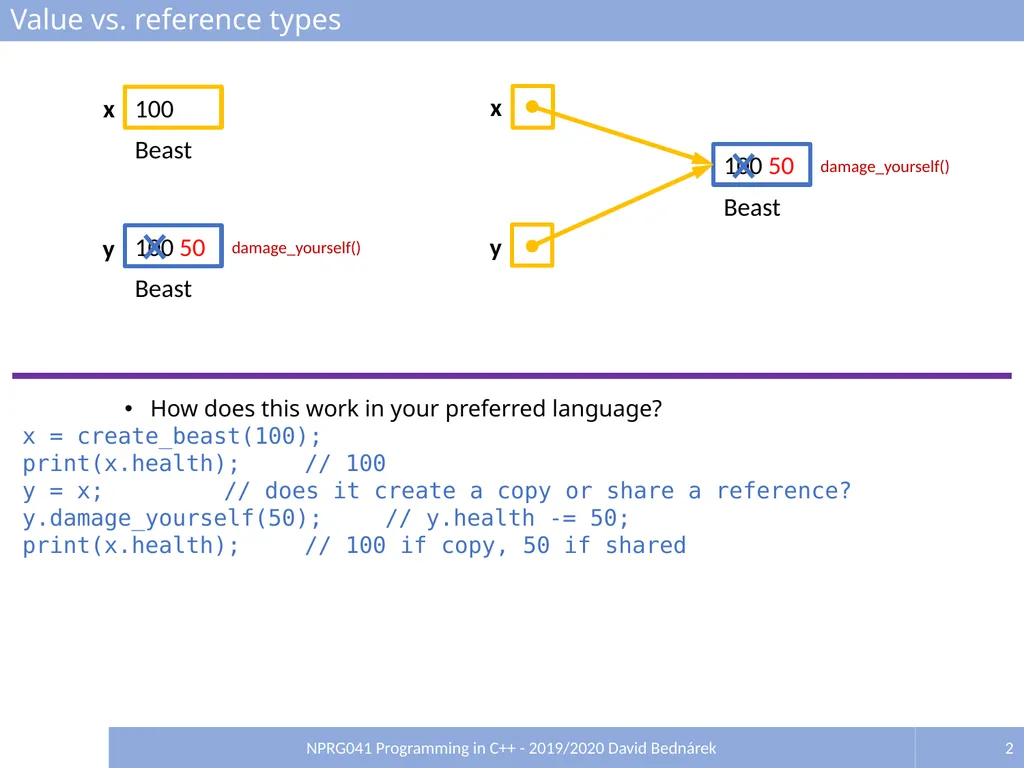
How does this work in your preferred language?
x = create_beast(100);
print(x.health); // 100
y = x; // does it create a copy or share a reference?
y.damage_yourself(50); // y.health -= 50;
print(x.health); // 100 if copy, 50 if shared Value vs. reference types 2 NPRG041 Programming in C++ - 2019/2020 David Bednárek 100 Beast x 100 50 Beast y 100 50 Beast x y damage_yourself() damage_yourself()<br>
03
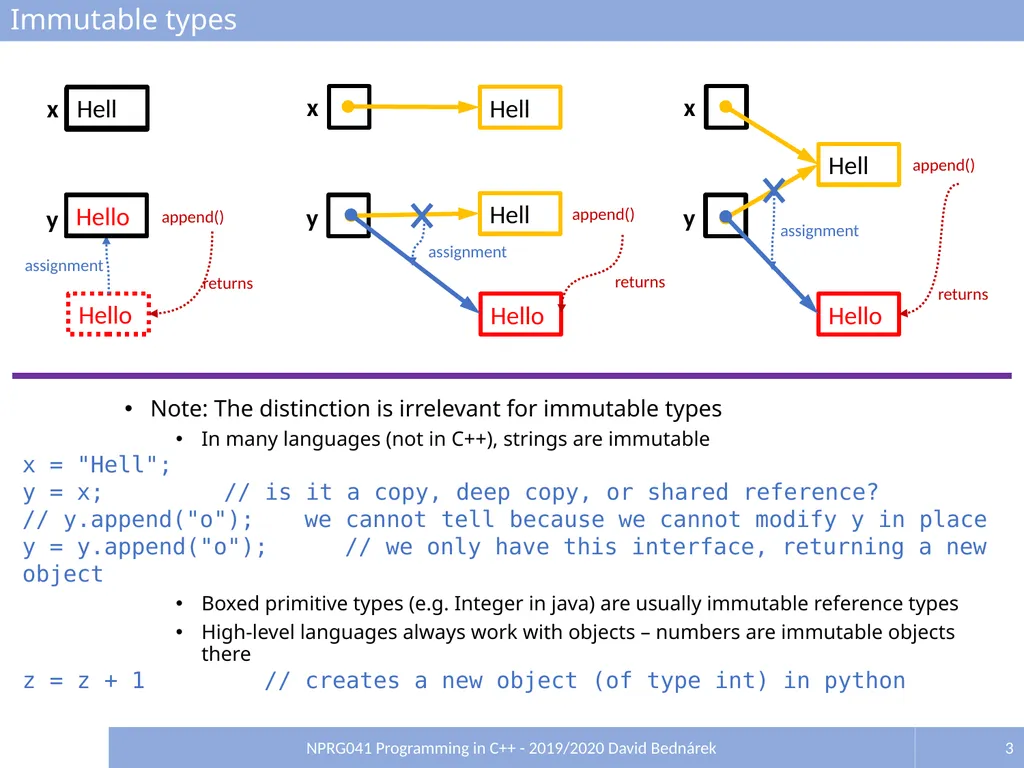
Note: The distinction is irrelevant for immutable types
In many languages (not in C++), strings are immutable
x = "Hell";
y = x; // is it a copy, deep copy, or shared reference?
// y.append("o"); we cannot tell because we cannot modify y in place
y = y.append("o"); // we only have this interface, returning a new object
Boxed primitive types (e.g. Integer in java) are usually immutable reference types
High-level languages always work with objects – numbers are immutable objects there
z = z + 1 // creates a new object (of type int) in python Immutable types 3 NPRG041 Programming in C++ - 2019/2020 David Bednárek Hell x y Hell x y Hell x y Hell Hello Hello Hello append() append() append() returns returns returns assignment assignment assignment Hell Hello<br>
04
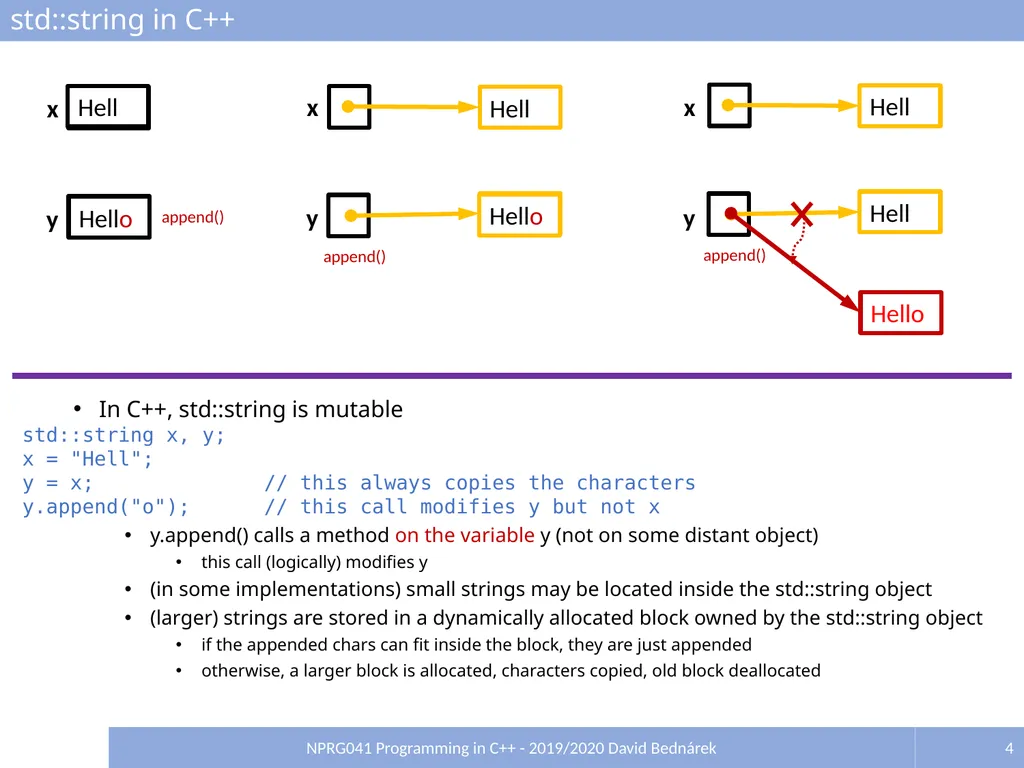
In C++, std::string is mutable
std::string x, y;
x = "Hell";
y = x; // this always copies the characters
y.append("o"); // this call modifies y but not x
y.append() calls a method on the variable y (not on some distant object)
this call (logically) modifies y
(in some implementations) small strings may be located inside the std::string object
(larger) strings are stored in a dynamically allocated block owned by the std::string object
if the appended chars can fit inside the block, they are just appended
otherwise, a larger block is allocated, characters copied, old block deallocated std::string in C++ 4 NPRG041 Programming in C++ - 2019/2020 David Bednárek x y Hell x y Hell append() append() Hell Hell Hello append() Hell Hello Hell Hello x y<br>
05
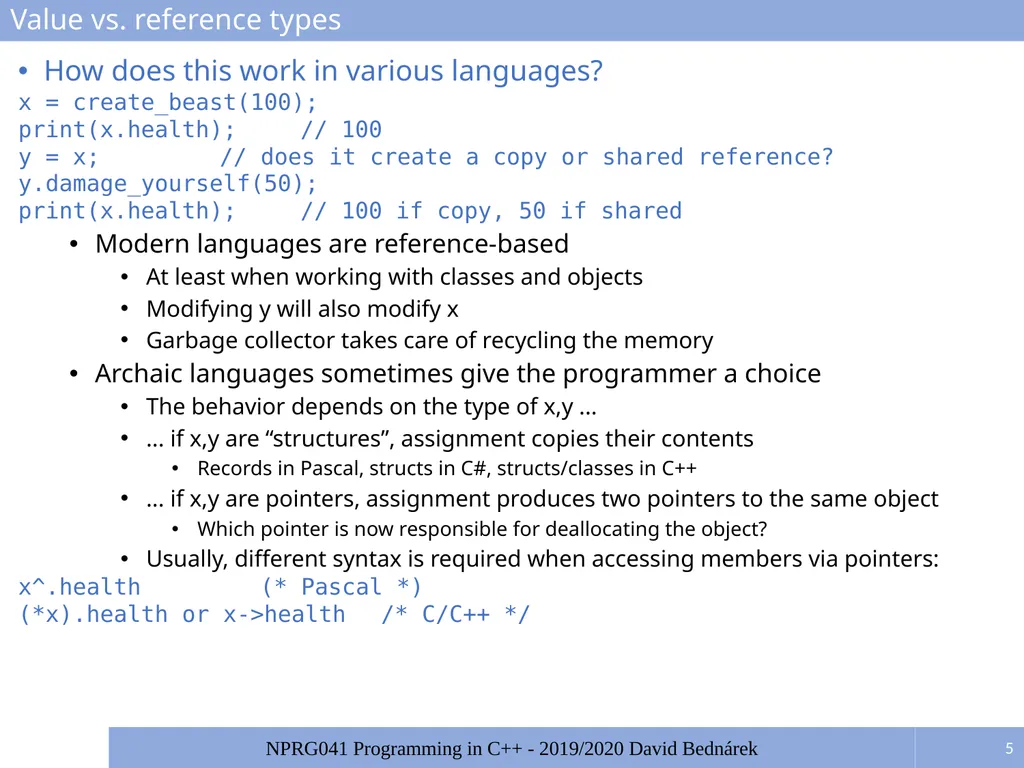
Value vs. reference types How does this work in various languages?
x = create_beast(100);
print(x.health); // 100
y = x; // does it create a copy or shared reference?
y.damage_yourself(50);
print(x.health); // 100 if copy, 50 if shared
Modern languages are reference-based
At least when working with classes and objects
Modifying y will also modify x
Garbage collector takes care of recycling the memory
Archaic languages sometimes give the programmer a choice
The behavior depends on the type of x,y ...
... if x,y are “structures”, assignment copies their contents
Records in Pascal, structs in C#, structs/classes in C++
... if x,y are pointers, assignment produces two pointers to the same object
Which pointer is now responsible for deallocating the object?
Usually, different syntax is required when accessing members via pointers:
x^.health (* Pascal *)
(*x).health or x->health /* C/C++ */ 5 NPRG041 Programming in C++ - 2019/2020 David Bednárek<br>
06
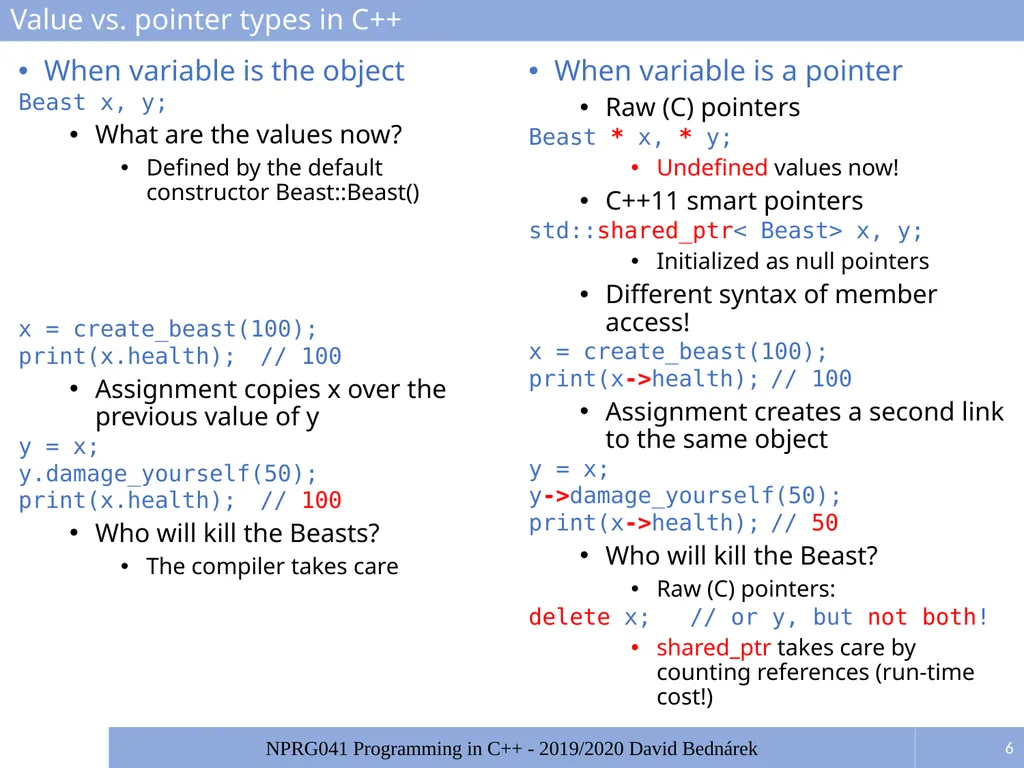
When variable is the object
Beast x, y;
What are the values now?
Defined by the default constructor Beast::Beast()
x = create_beast(100);
print(x.health); // 100
Assignment copies x over the previous value of y
y = x;
y.damage_yourself(50);
print(x.health); // 100
Who will kill the Beasts?
The compiler takes care When variable is a pointer
Raw (C) pointers
Beast * x, * y;
Undefined values now!
C++11 smart pointers
std::shared_ptr< Beast> x, y;
Initialized as null pointers
Different syntax of member access!
x = create_beast(100);
print(x->health); // 100
Assignment creates a second link to the same object
y = x;
y->damage_yourself(50);
print(x->health); // 50
Who will kill the Beast?
Raw (C) pointers:
delete x; // or y, but not both!
shared_ptr takes care by counting references (run-time cost!) Value vs. pointer types in C++ 6 NPRG041 Programming in C++ - 2019/2020 David Bednárek<br>
07
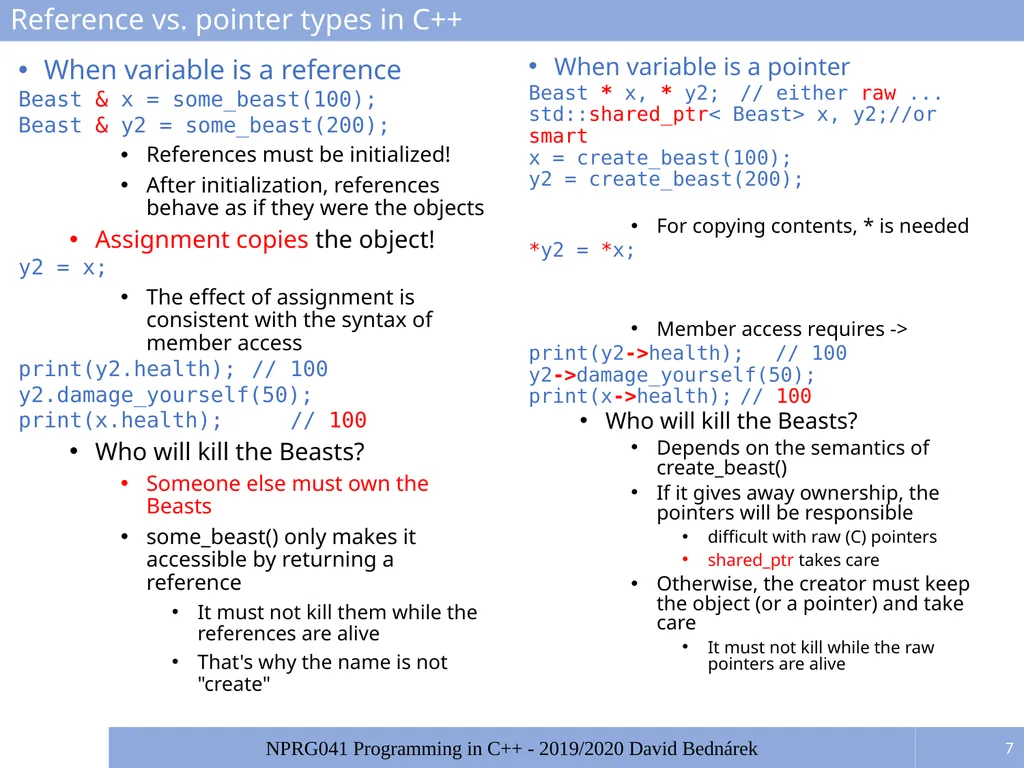
When variable is a reference
Beast & x = some_beast(100);
Beast & y2 = some_beast(200);
References must be initialized!
After initialization, references behave as if they were the objects
Assignment copies the object!
y2 = x;
The effect of assignment is consistent with the syntax of member access
print(y2.health); // 100
y2.damage_yourself(50);
print(x.health); // 100
Who will kill the Beasts?
Someone else must own the Beasts
some_beast() only makes it accessible by returning a reference
It must not kill them while the references are alive
That's why the name is not "create" When variable is a pointer
Beast * x, * y2; // either raw ...
std::shared_ptr< Beast> x, y2;//or smart
x = create_beast(100);
y2 = create_beast(200);
For copying contents, * is needed
*y2 = *x;
Member access requires ->
print(y2->health); // 100
y2->damage_yourself(50);
print(x->health); // 100
Who will kill the Beasts?
Depends on the semantics of create_beast()
If it gives away ownership, the pointers will be responsible
difficult with raw (C) pointers
shared_ptr takes care
Otherwise, the creator must keep the object (or a pointer) and take care
It must not kill while the raw pointers are alive Reference vs. pointer types in C++ 7 NPRG041 Programming in C++ - 2019/2020 David Bednárek<br>
08
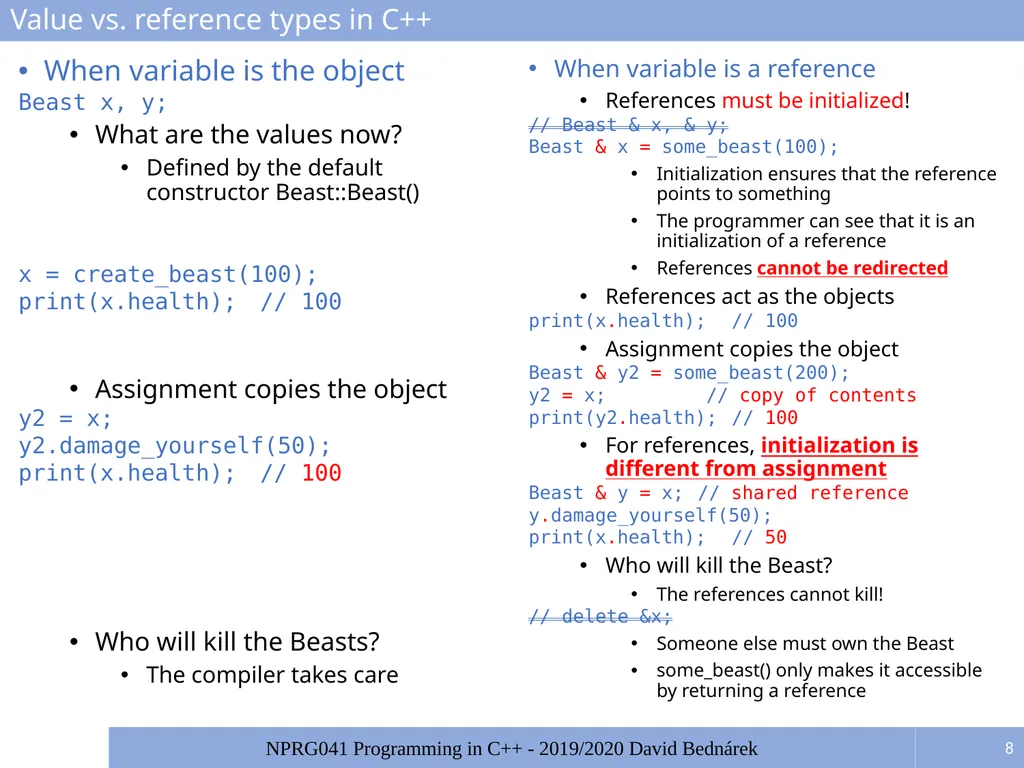
When variable is the object
Beast x, y;
What are the values now?
Defined by the default constructor Beast::Beast()
x = create_beast(100);
print(x.health); // 100
Assignment copies the object
y2 = x;
y2.damage_yourself(50);
print(x.health); // 100
Who will kill the Beasts?
The compiler takes care When variable is a reference
References must be initialized!
// Beast & x, & y;
Beast & x = some_beast(100);
Initialization ensures that the reference points to something
The programmer can see that it is an initialization of a reference
References cannot be redirected
References act as the objects
print(x.health); // 100
Assignment copies the object
Beast & y2 = some_beast(200);
y2 = x; // copy of contents
print(y2.health); // 100
For references, initialization is different from assignment
Beast & y = x; // shared reference
y.damage_yourself(50);
print(x.health); // 50
Who will kill the Beast?
The references cannot kill!
// delete &x;
Someone else must own the Beast
some_beast() only makes it accessible by returning a reference Value vs. reference types in C++ 8 NPRG041 Programming in C++ - 2019/2020 David Bednárek<br>
09
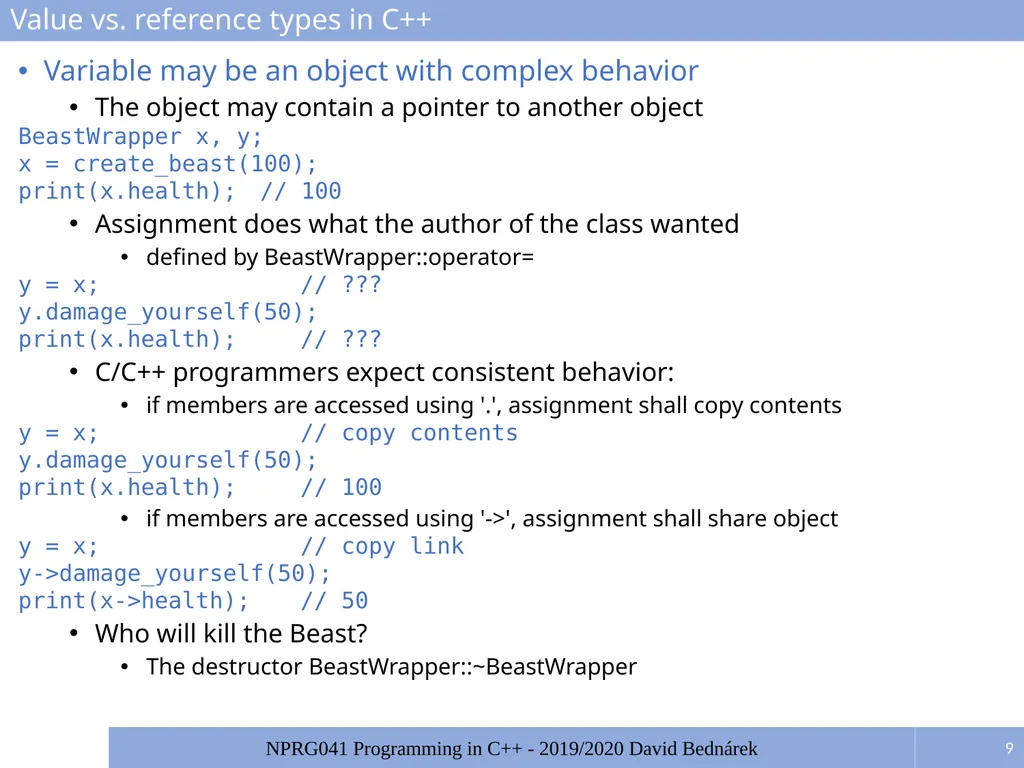
Value vs. reference types in C++ Variable may be an object with complex behavior
The object may contain a pointer to another object
BeastWrapper x, y;
x = create_beast(100);
print(x.health); // 100
Assignment does what the author of the class wanted
defined by BeastWrapper::operator=
y = x; // ???
y.damage_yourself(50);
print(x.health); // ???
C/C++ programmers expect consistent behavior:
if members are accessed using '.', assignment shall copy contents
y = x; // copy contents
y.damage_yourself(50);
print(x.health); // 100
if members are accessed using '->', assignment shall share object
y = x; // copy link
y->damage_yourself(50);
print(x->health); // 50
Who will kill the Beast?
The destructor BeastWrapper::~BeastWrapper 9 NPRG041 Programming in C++ - 2019/2020 David Bednárek<br>
10
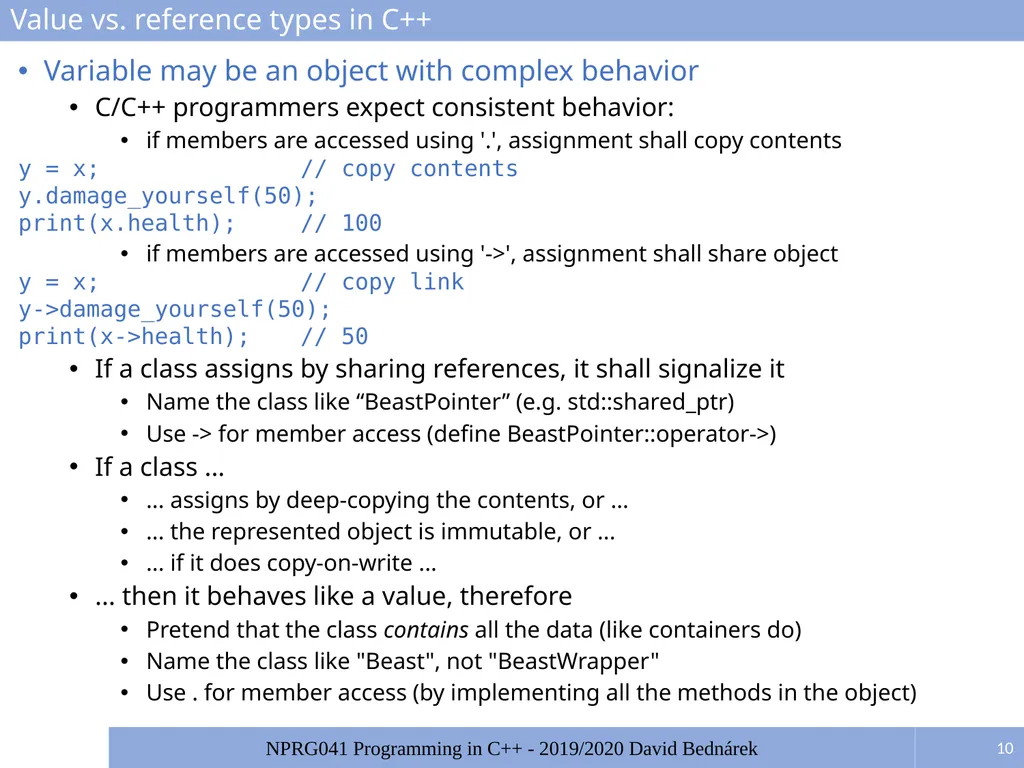
Value vs. reference types in C++ Variable may be an object with complex behavior
C/C++ programmers expect consistent behavior:
if members are accessed using '.', assignment shall copy contents
y = x; // copy contents
y.damage_yourself(50);
print(x.health); // 100
if members are accessed using '->', assignment shall share object
y = x; // copy link
y->damage_yourself(50);
print(x->health); // 50
If a class assigns by sharing references, it shall signalize it
Name the class like “BeastPointer” (e.g. std::shared_ptr)
Use -> for member access (define BeastPointer::operator->)
If a class ...
... assigns by deep-copying the contents, or ...
... the represented object is immutable, or ...
... if it does copy-on-write ...
... then it behaves like a value, therefore
Pretend that the class contains all the data (like containers do)
Name the class like "Beast", not "BeastWrapper"
Use . for member access (by implementing all the methods in the object) 10 NPRG041 Programming in C++ - 2019/2020 David Bednárek<br>
11
Value vs. reference types in C++ If a class ...
... assigns by deep-copying the contents, or ...
... the represented object is immutable, or ...
... if it does copy-on-write ...
... then it behaves like a value, therefore
Pretend that the class contains all the data (like containers do)
Name the class like "Beast", not "BeastWrapper"
Use . for member access (by implementing all the methods in the object)
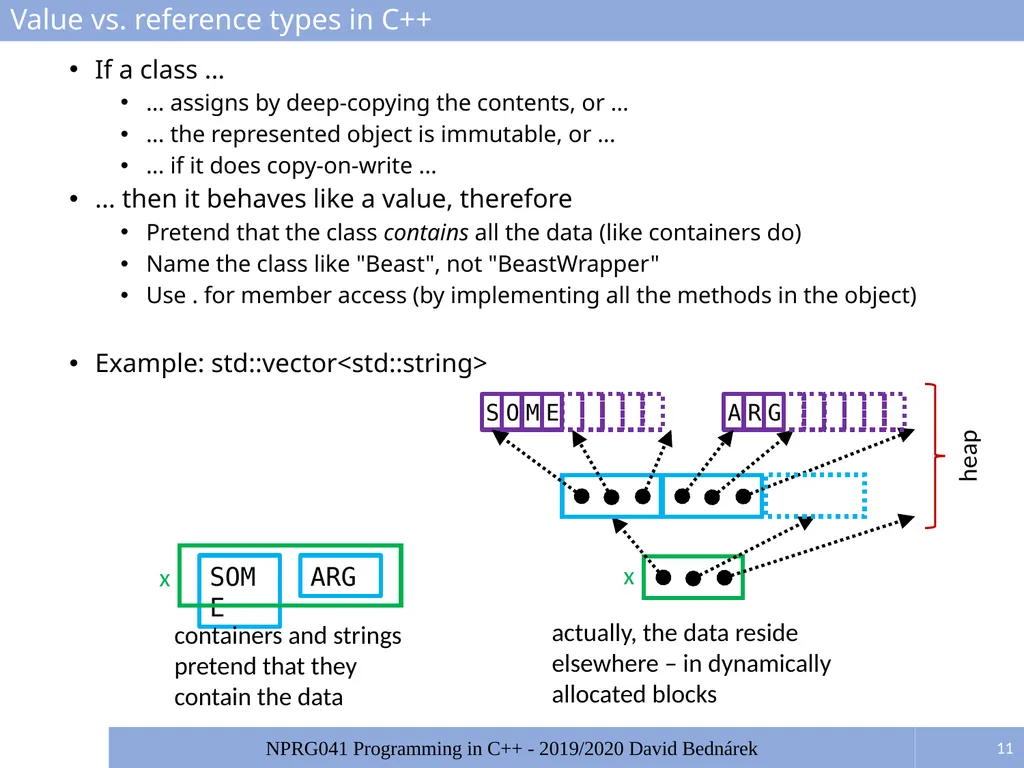
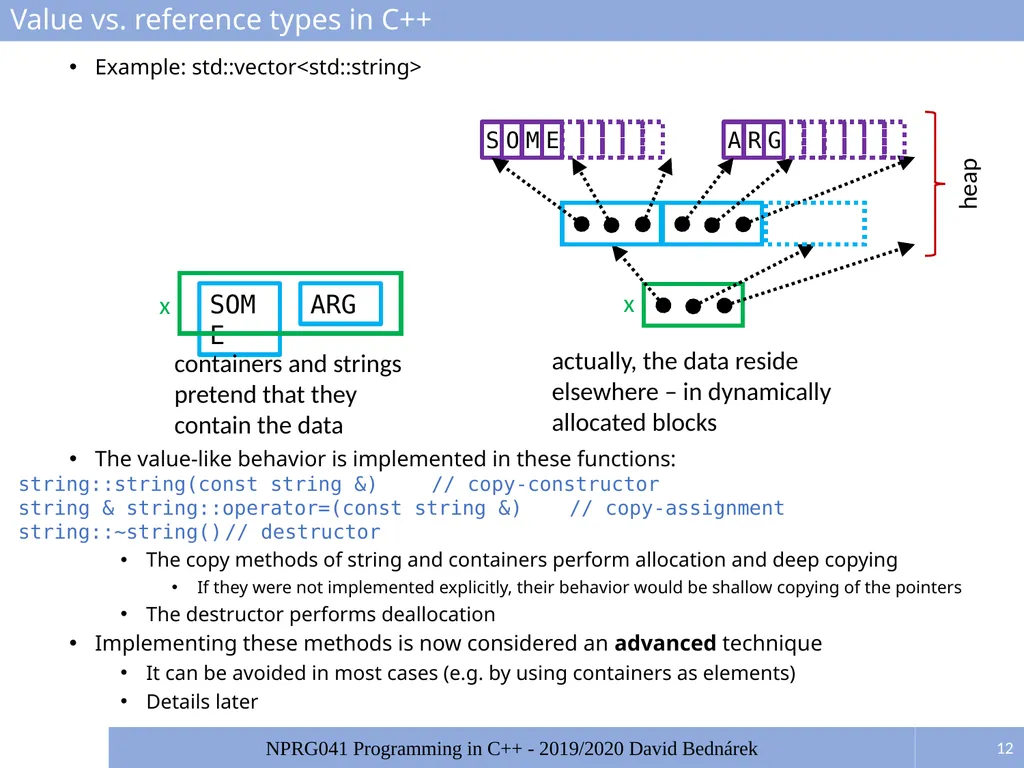
Example: std::vector<std::string> 11 NPRG041 Programming in C++ - 2019/2020 David Bednárek x containers and strings pretend that they contain the data actually, the data reside elsewhere – in dynamically allocated blocks<br>
12
Value vs. reference types in C++ Example: std::vector<std::string>
The value-like behavior is implemented in these functions:
string::string(const string &) // copy-constructor
string & string::operator=(const string &) // copy-assignment
string::~string() // destructor
The copy methods of string and containers perform allocation and deep copying
If they were not implemented explicitly, their behavior would be shallow copying of the pointers
The destructor performs deallocation
Implementing these methods is now considered an advanced technique
It can be avoided in most cases (e.g. by using containers as elements)
Details later 12 NPRG041 Programming in C++ - 2019/2020 David Bednárek x containers and strings pretend that they contain the data actually, the data reside elsewhere – in dynamically allocated blocks<br>