1 Rainbow Decompositions Raphael Yuster University
Description: 1 Rainbow Decompositions Raphael Yuster University of Haifa Proc. Amer. Math. Soc. (2008), to appear. 2 A Steiner system S(2,k,n) is a set X of n points, and a collection of subsets of X of size k (blocks), such that any two points of X are
Related Topics
Download Presentation
"1 Rainbow Decompositions Raphael Yuster University" is the property of its rightful owner. Permission is granted to download and print the materials on this website for personal, non-commercial use only, and to display it on your personal computer provided you do not modify the materials and that you retain all copyright notices contained in the materials. By downloading content from our website, you accept the terms of this agreement.
Presentation Transcript
slide1. 1 Rainbow Decompositions Raphael Yuster University of Haifa Proc. Amer. Math. Soc. (2008), to appear.<br>
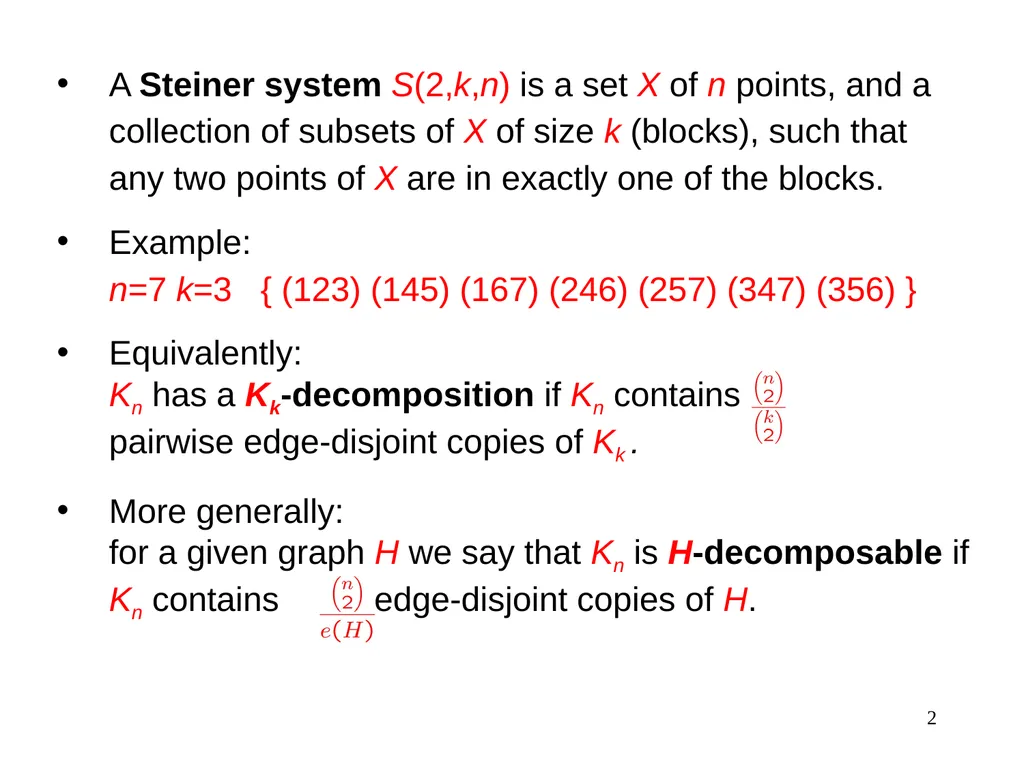
slide2. 2 A Steiner system S(2,k,n) is a set X of n points, and a collection of subsets of X of size k (blocks), such that any two points of X are in exactly one of the blocks.
Example:n=7 k=3 { (123) (145) (167) (246) (257) (347) (356) }
Equivalently:Kn has a Kk-decomposition if Kn contains pairwise edge-disjoint copies of Kk .
More generally:for a given graph H we say that Kn is H-decomposable if Kn contains edge-disjoint copies of H.<br>
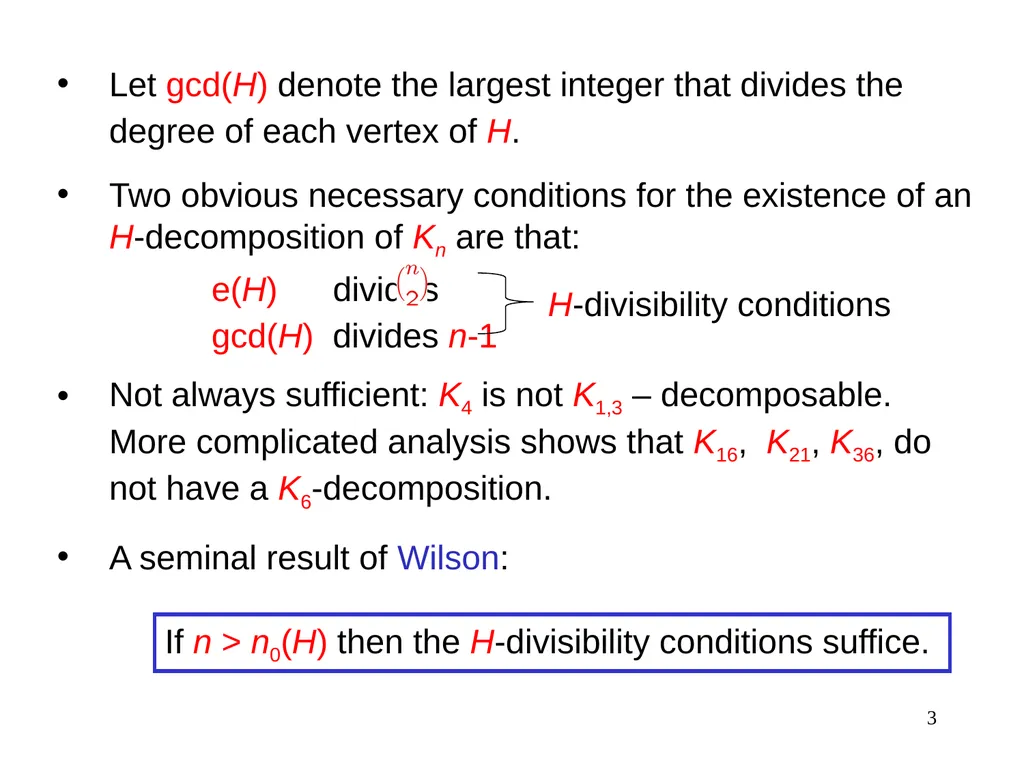
slide3. 3 Let gcd(H) denote the largest integer that divides the degree of each vertex of H.
Two obvious necessary conditions for the existence of an H-decomposition of Kn are that: e(H) divides gcd(H) divides n-1
Not always sufficient: K4 is not K1,3 – decomposable.More complicated analysis shows that K16, K21, K36, do not have a K6-decomposition.
A seminal result of Wilson: If n > n0(H) then the H-divisibility conditions suffice. H-divisibility conditions<br>
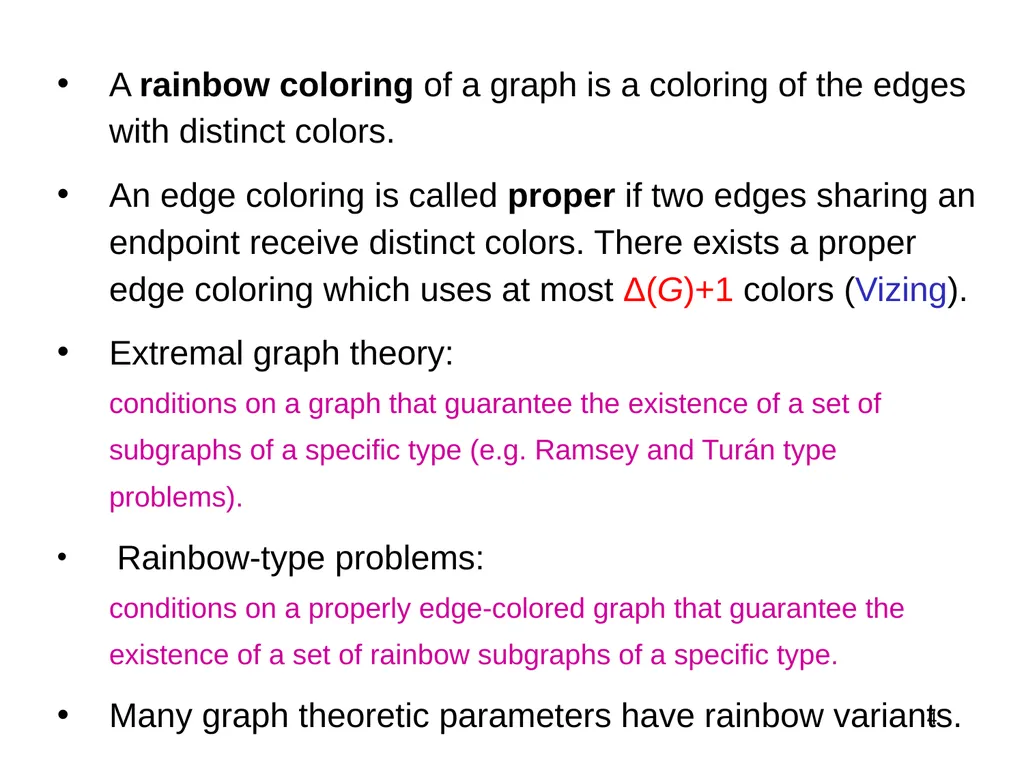
slide4. 4 A rainbow coloring of a graph is a coloring of the edges with distinct colors.
An edge coloring is called proper if two edges sharing an endpoint receive distinct colors. There exists a proper edge coloring which uses at most Δ(G)+1 colors (Vizing).
Extremal graph theory:conditions on a graph that guarantee the existence of a set of subgraphs of a specific type (e.g. Ramsey and Turán type problems).
Rainbow-type problems:conditions on a properly edge-colored graph that guarantee the existence of a set of rainbow subgraphs of a specific type.
Many graph theoretic parameters have rainbow variants.<br>
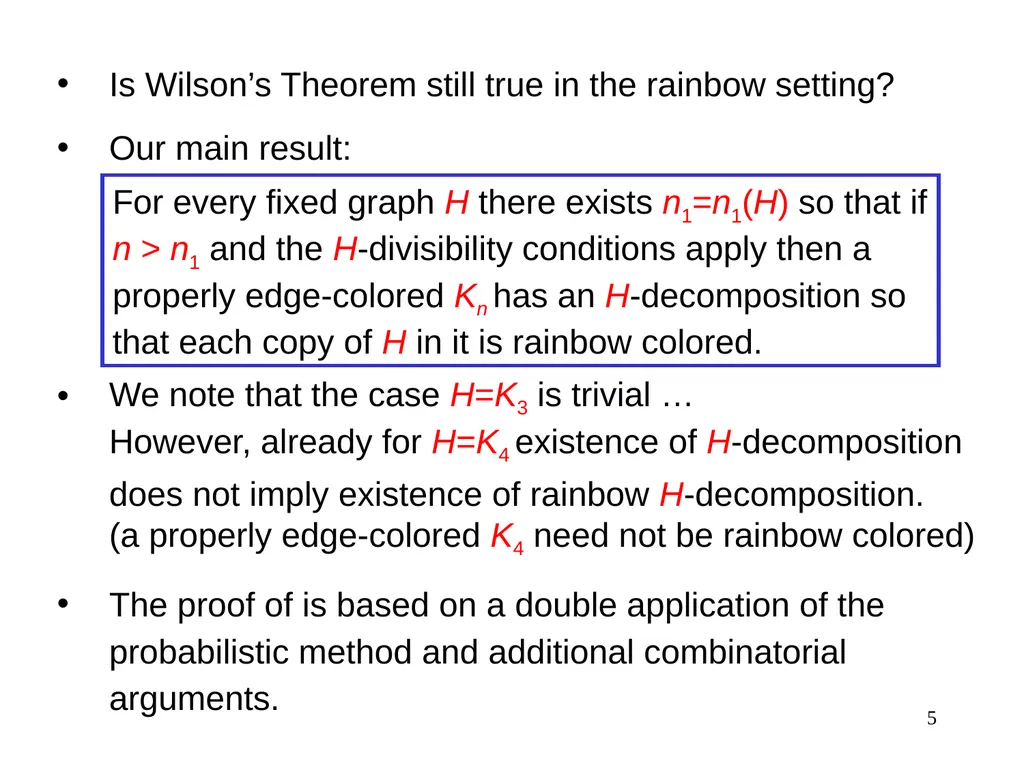
slide5. 5 Is Wilson’s Theorem still true in the rainbow setting?
Our main result:
We note that the case H=K3 is trivial …However, already for H=K4 existence of H-decomposition does not imply existence of rainbow H-decomposition.(a properly edge-colored K4 need not be rainbow colored)
The proof of is based on a double application of the probabilistic method and additional combinatorial arguments. For every fixed graph H there exists n1=n1(H) so that if n > n1 and the H-divisibility conditions apply then a properly edge-colored Kn has an H-decomposition so that each copy of H in it is rainbow colored.<br>
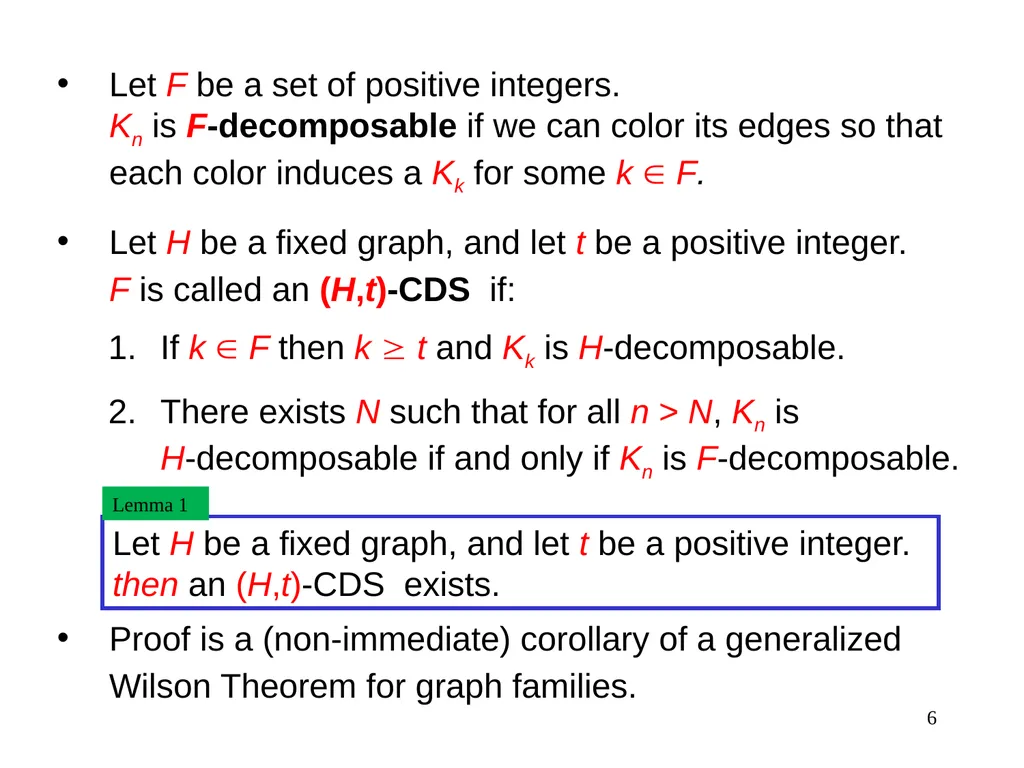
slide6. 6 Let F be a set of positive integers.Kn is F-decomposable if we can color its edges so that each color induces a Kk for some k F.
Let H be a fixed graph, and let t be a positive integer.F is called an (H,t)-CDS if:
If k F then k t and Kk is H-decomposable.
There exists N such that for all n > N, Kn isH-decomposable if and only if Kn is F-decomposable.
Proof is a (non-immediate) corollary of a generalized Wilson Theorem for graph families. Let H be a fixed graph, and let t be a positive integer.then an (H,t)-CDS exists. Lemma 1<br>
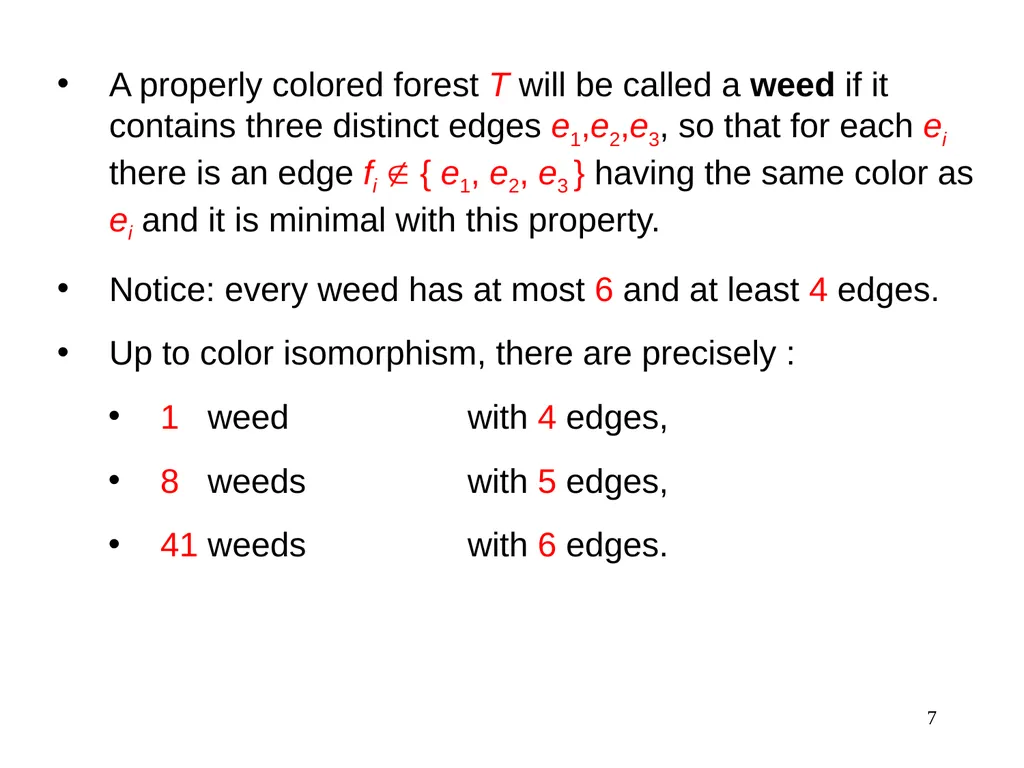
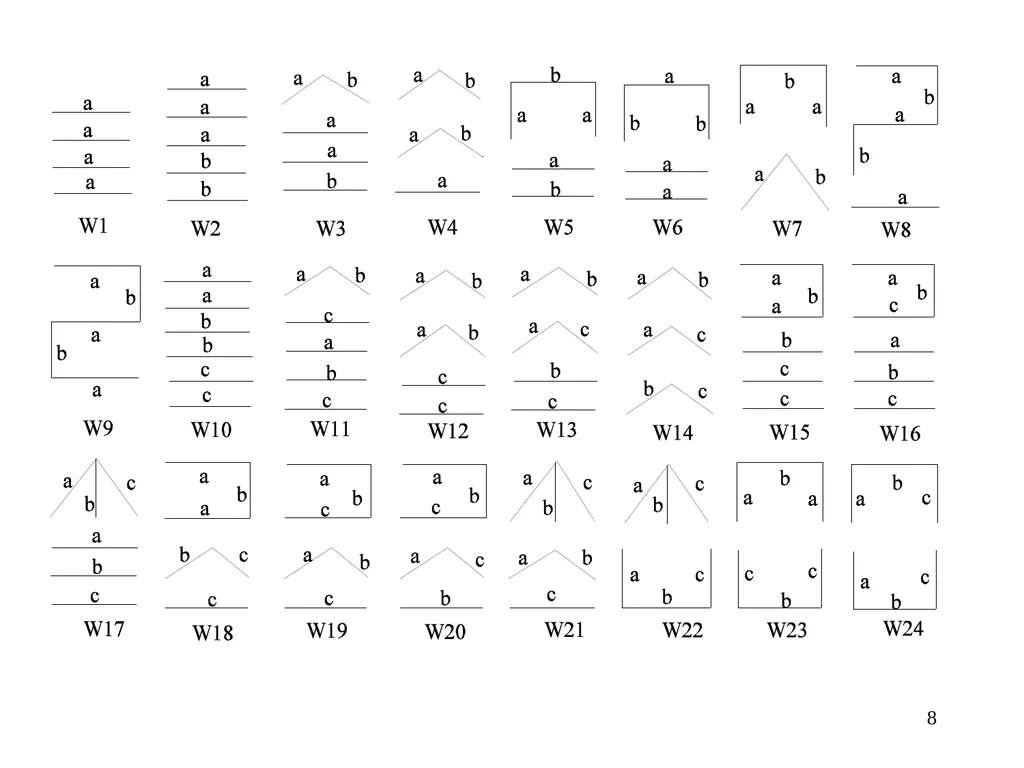
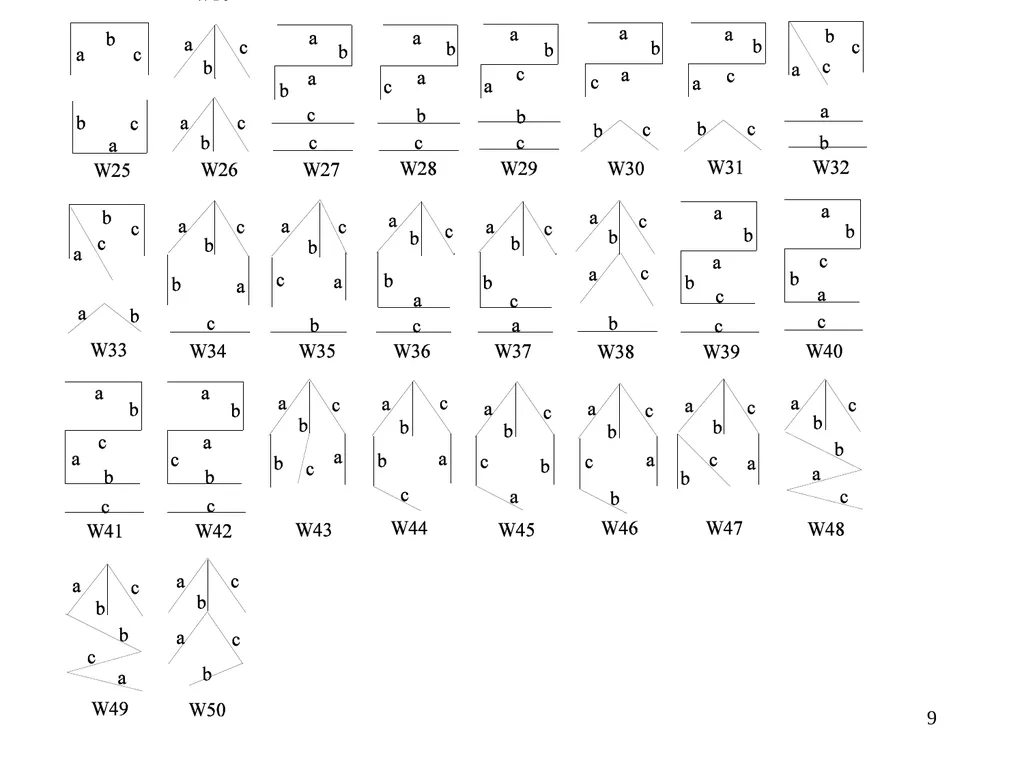
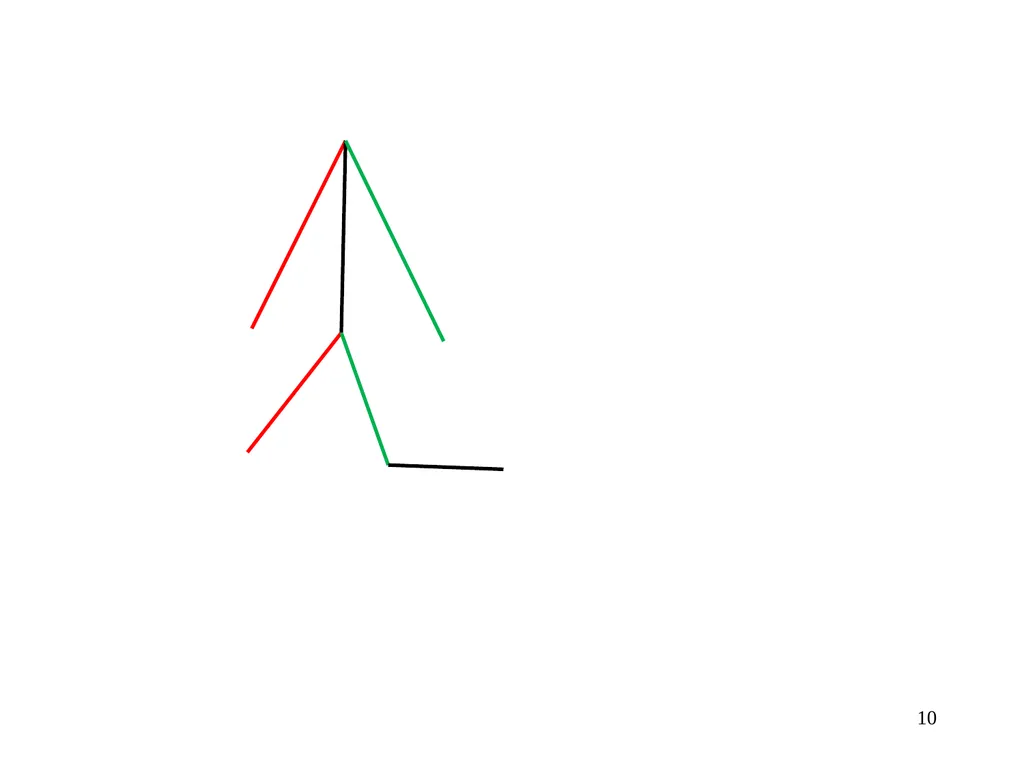
slide7. 7 A properly colored forest T will be called a weed if it contains three distinct edges e1,e2,e3, so that for each ei there is an edge fi { e1, e2, e3 } having the same color as ei and it is minimal with this property.
Notice: every weed has at most 6 and at least 4 edges.
Up to color isomorphism, there are precisely :
1 weed with 4 edges,
8 weeds with 5 edges,
41 weeds with 6 edges.<br>
slide8. 8<br>
slide9. 9<br>
slide10. 10<br>
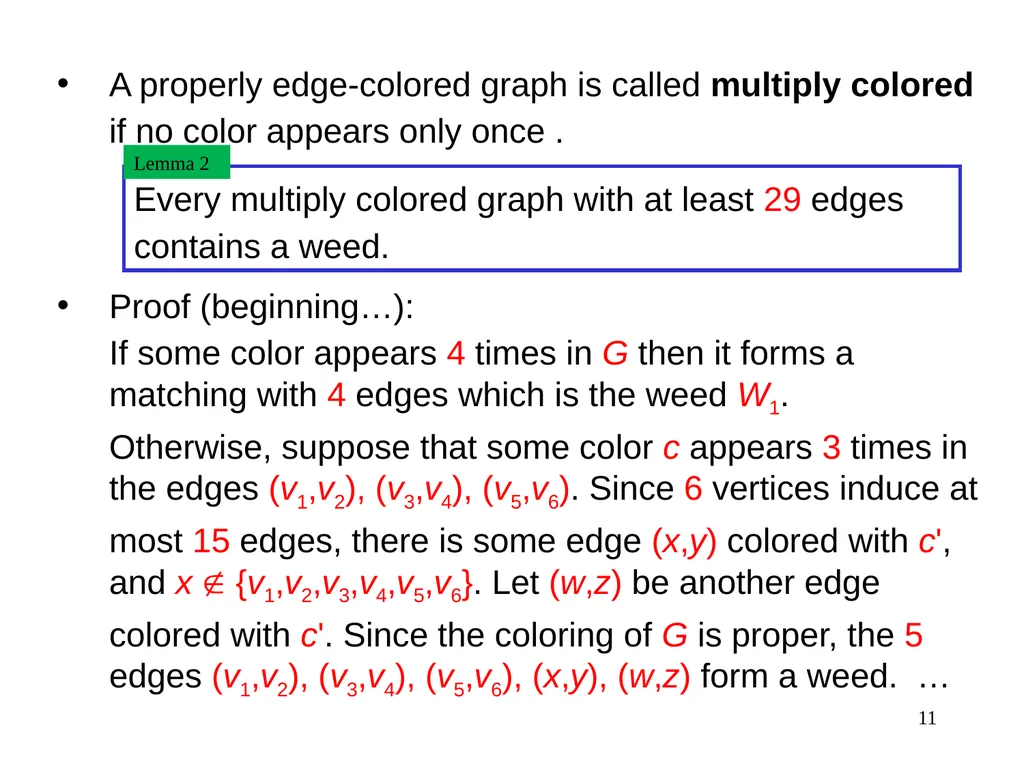
slide11. 11 A properly edge-colored graph is called multiply colored if no color appears only once .
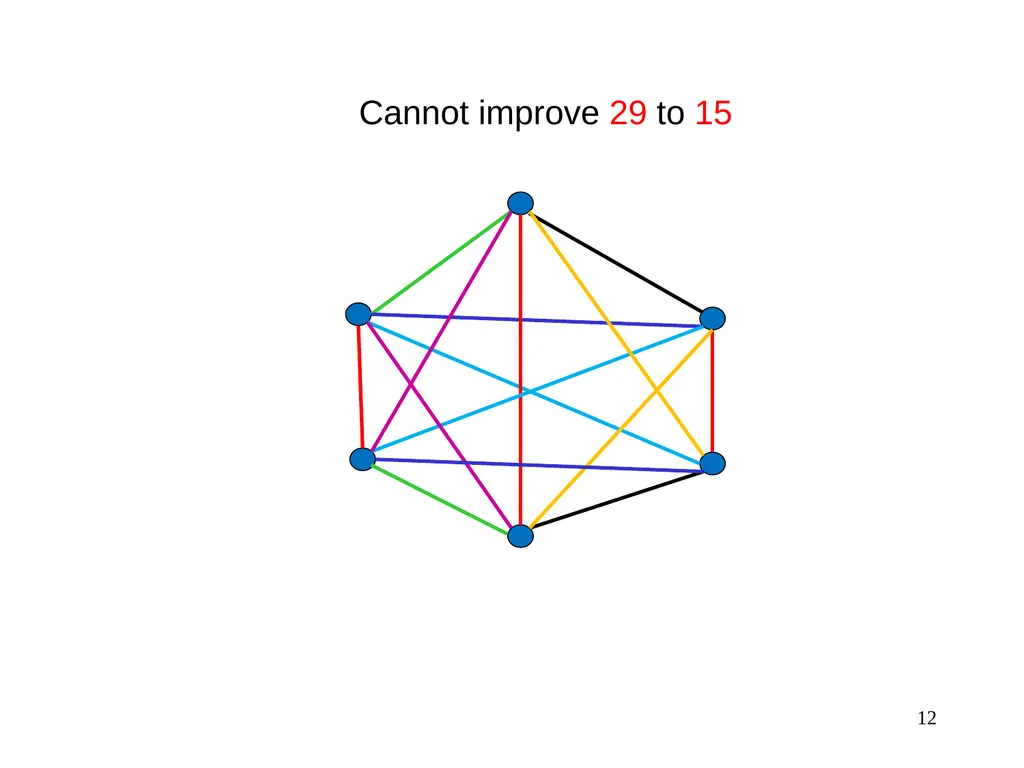
Proof (beginning…): If some color appears 4 times in G then it forms a matching with 4 edges which is the weed W1.Otherwise, suppose that some color c appears 3 times in the edges (v1,v2), (v3,v4), (v5,v6). Since 6 vertices induce at most 15 edges, there is some edge (x,y) colored with c', and x {v1,v2,v3,v4,v5,v6}. Let (w,z) be another edge colored with c'. Since the coloring of G is proper, the 5 edges (v1,v2), (v3,v4), (v5,v6), (x,y), (w,z) form a weed. … Every multiply colored graph with at least 29 edges contains a weed. Lemma 2<br>
slide12. 12 Cannot improve 29 to 15<br>
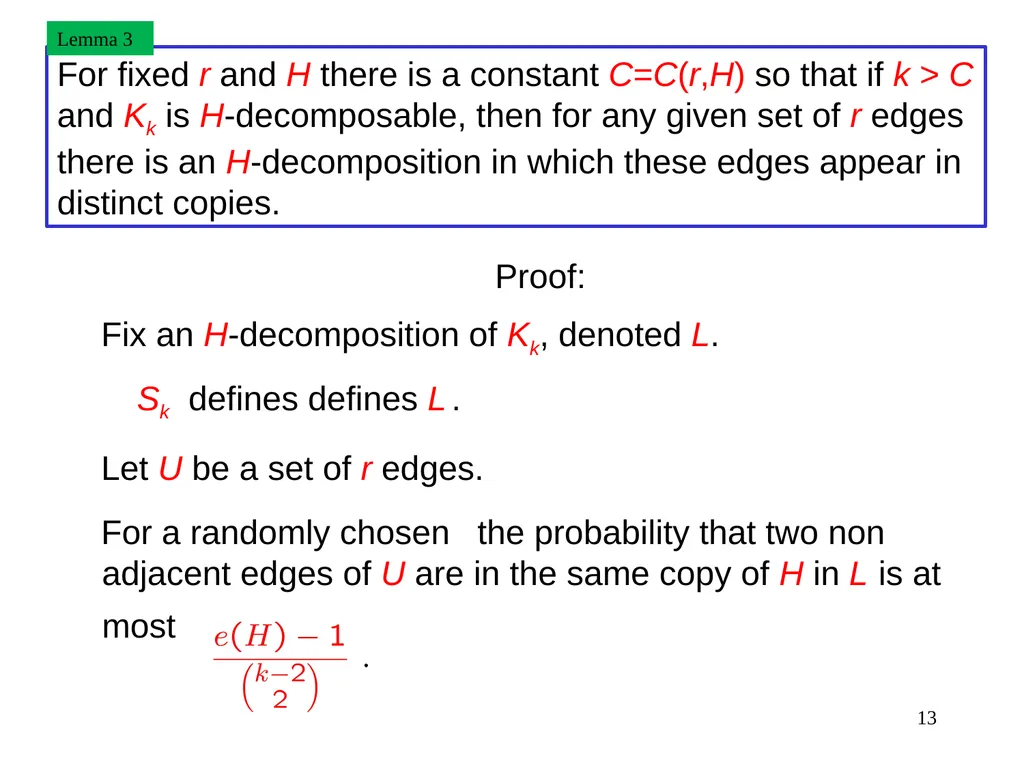
slide13. 13 Proof:
Fix an H-decomposition of Kk, denoted L.
Sk defines defines L.
Let U be a set of r edges.
For a randomly chosen the probability that two non adjacent edges of U are in the same copy of H in L is at most For fixed r and H there is a constant C=C(r,H) so that if k > C and Kk is H-decomposable, then for any given set of r edges there is an H-decomposition in which these edges appear in distinct copies. Lemma 3<br>
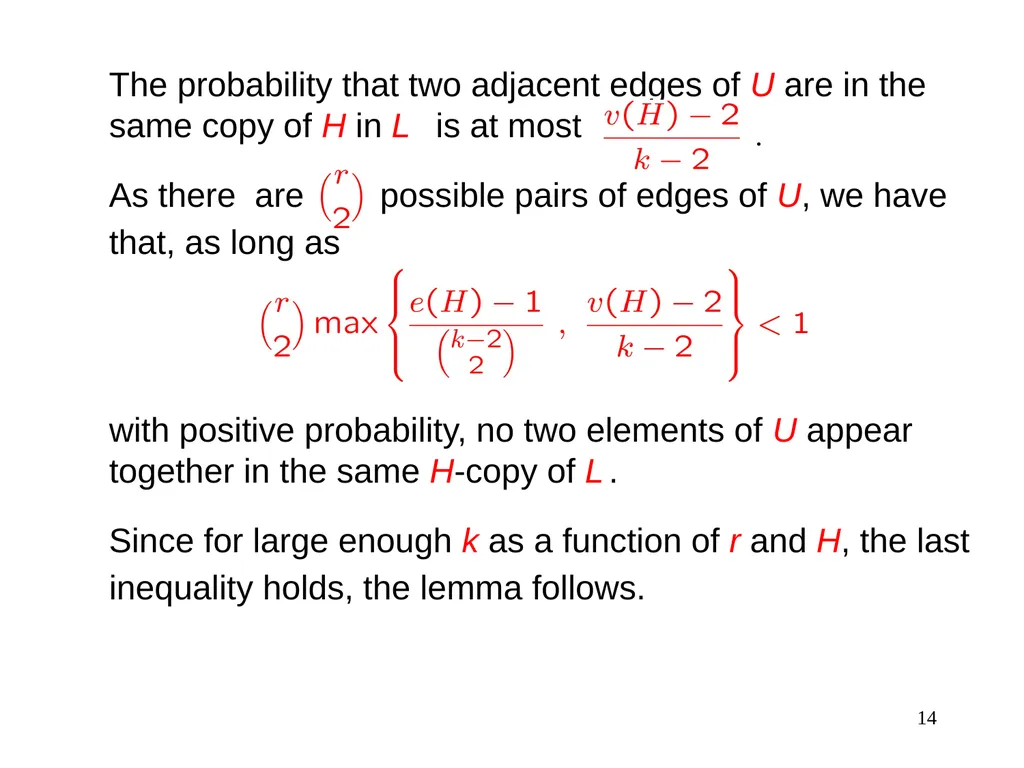
slide14. 14 The probability that two adjacent edges of U are in the same copy of H in L is at most
As there are possible pairs of edges of U, we have that, as long aswith positive probability, no two elements of U appear together in the same H-copy of L.
Since for large enough k as a function of r and H, the last inequality holds, the lemma follows.<br>
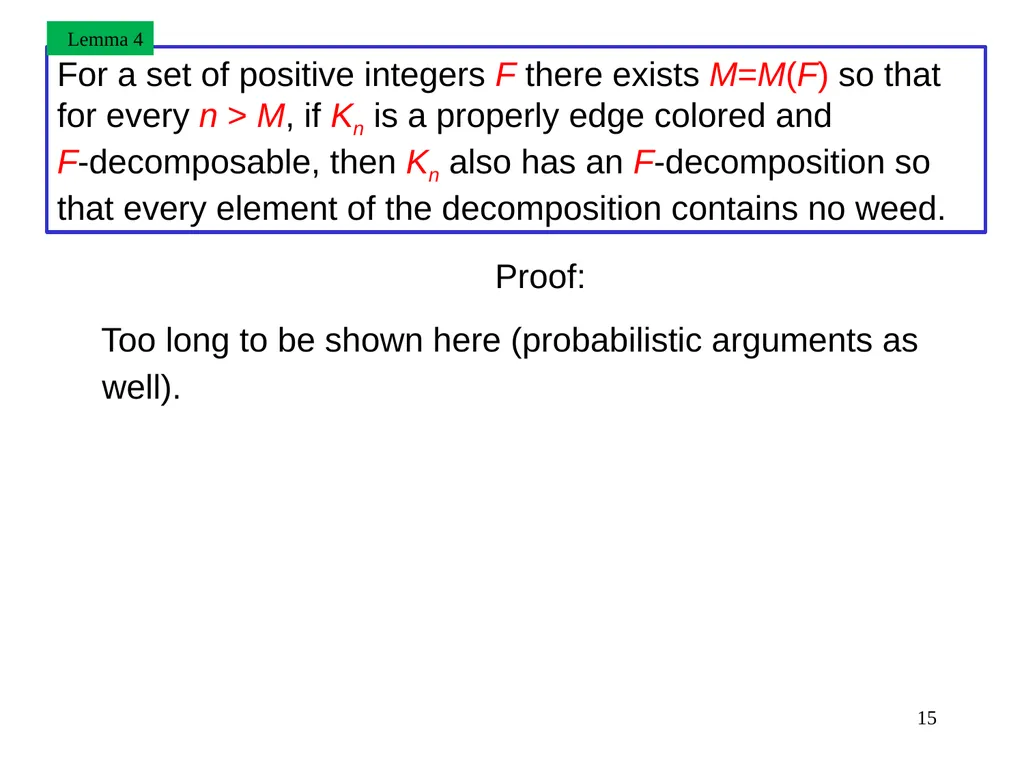
slide15. 15 Proof:
Too long to be shown here (probabilistic arguments as well). For a set of positive integers F there exists M=M(F) so that for every n > M, if Kn is a properly edge colored andF-decomposable, then Kn also has an F-decomposition so that every element of the decomposition contains no weed. Lemma 4<br>
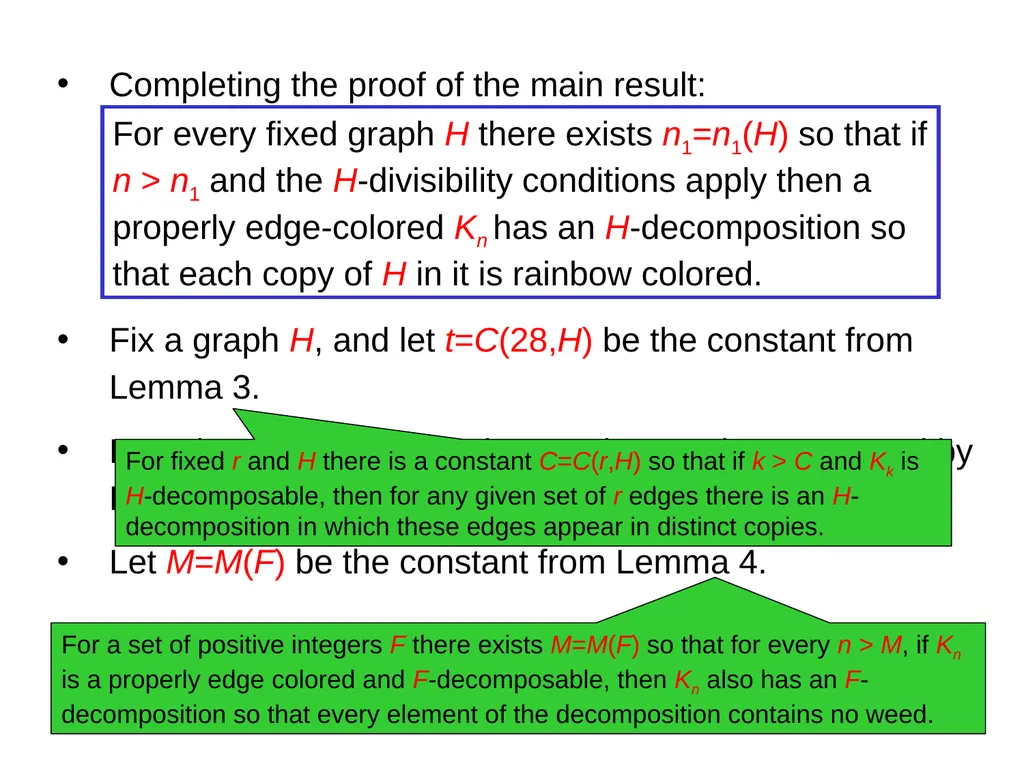
slide16. 16 Completing the proof of the main result:
Fix a graph H, and let t=C(28,H) be the constant from Lemma 3.
Let F be an (H,t)-CDS, whose existence is guaranteed by Lemma 1.
Let M=M(F) be the constant from Lemma 4. For every fixed graph H there exists n1=n1(H) so that if n > n1 and the H-divisibility conditions apply then a properly edge-colored Kn has an H-decomposition so that each copy of H in it is rainbow colored. For a set of positive integers F there exists M=M(F) so that for every n > M, if Kn is a properly edge colored and F-decomposable, then Kn also has an F-decomposition so that every element of the decomposition contains no weed. For fixed r and H there is a constant C=C(r,H) so that if k > C and Kk is H-decomposable, then for any given set of r edges there is an H-decomposition in which these edges appear in distinct copies.<br>
slide17. 17 Since F is an (H,t)-CDS, there exists N=N(F) so that for all n > N, Kn is H-decomposable iff Kn is F-decomposable.
For all n sufficiently large that satisfy the H-divisibility conditions, consider a properly edge-colored Kn.
By Wilson’s Theorem Kn is H-decomposable.
By the definition of F, Kn is also F-decomposable.
By Lemma 4, there is also an F-decomposition so that every element of the decomposition contains no weed.
Consider some Kk element of such an F-decomposition. Thus, k F and hence k t and Kk is H-decomposable.<br>
slide18. 18 Let U be a maximal multiply colored subgraph of Kk.
Since Kk contains no weed, we have, by Lemma 2 that |U| < 29. Since k t = C(28,H) we have, by Lemma 3 that Kk has an H-decomposition so that no two edges of U appear together in the same H-copy of the decomposition.
But this implies that each copy of H in such a decomposition is rainbow colored.
Repeating this process for each element of theF-decomposition yields an H-decomposition of Kn in which each element is rainbow colored.<br>

slide19. 19 Thanks<br>
slide2. 2 A Steiner system S(2,k,n) is a set X of n points, and a collection of subsets of X of size k (blocks), such that any two points of X are in exactly one of the blocks.
Example:n=7 k=3 { (123) (145) (167) (246) (257) (347) (356) }
Equivalently:Kn has a Kk-decomposition if Kn contains pairwise edge-disjoint copies of Kk .
More generally:for a given graph H we say that Kn is H-decomposable if Kn contains edge-disjoint copies of H.<br>
slide3. 3 Let gcd(H) denote the largest integer that divides the degree of each vertex of H.
Two obvious necessary conditions for the existence of an H-decomposition of Kn are that: e(H) divides gcd(H) divides n-1
Not always sufficient: K4 is not K1,3 – decomposable.More complicated analysis shows that K16, K21, K36, do not have a K6-decomposition.
A seminal result of Wilson: If n > n0(H) then the H-divisibility conditions suffice. H-divisibility conditions<br>
slide4. 4 A rainbow coloring of a graph is a coloring of the edges with distinct colors.
An edge coloring is called proper if two edges sharing an endpoint receive distinct colors. There exists a proper edge coloring which uses at most Δ(G)+1 colors (Vizing).
Extremal graph theory:conditions on a graph that guarantee the existence of a set of subgraphs of a specific type (e.g. Ramsey and Turán type problems).
Rainbow-type problems:conditions on a properly edge-colored graph that guarantee the existence of a set of rainbow subgraphs of a specific type.
Many graph theoretic parameters have rainbow variants.<br>
slide5. 5 Is Wilson’s Theorem still true in the rainbow setting?
Our main result:
We note that the case H=K3 is trivial …However, already for H=K4 existence of H-decomposition does not imply existence of rainbow H-decomposition.(a properly edge-colored K4 need not be rainbow colored)
The proof of is based on a double application of the probabilistic method and additional combinatorial arguments. For every fixed graph H there exists n1=n1(H) so that if n > n1 and the H-divisibility conditions apply then a properly edge-colored Kn has an H-decomposition so that each copy of H in it is rainbow colored.<br>
slide6. 6 Let F be a set of positive integers.Kn is F-decomposable if we can color its edges so that each color induces a Kk for some k F.
Let H be a fixed graph, and let t be a positive integer.F is called an (H,t)-CDS if:
If k F then k t and Kk is H-decomposable.
There exists N such that for all n > N, Kn isH-decomposable if and only if Kn is F-decomposable.
Proof is a (non-immediate) corollary of a generalized Wilson Theorem for graph families. Let H be a fixed graph, and let t be a positive integer.then an (H,t)-CDS exists. Lemma 1<br>
slide7. 7 A properly colored forest T will be called a weed if it contains three distinct edges e1,e2,e3, so that for each ei there is an edge fi { e1, e2, e3 } having the same color as ei and it is minimal with this property.
Notice: every weed has at most 6 and at least 4 edges.
Up to color isomorphism, there are precisely :
1 weed with 4 edges,
8 weeds with 5 edges,
41 weeds with 6 edges.<br>
slide8. 8<br>
slide9. 9<br>
slide10. 10<br>
slide11. 11 A properly edge-colored graph is called multiply colored if no color appears only once .
Proof (beginning…): If some color appears 4 times in G then it forms a matching with 4 edges which is the weed W1.Otherwise, suppose that some color c appears 3 times in the edges (v1,v2), (v3,v4), (v5,v6). Since 6 vertices induce at most 15 edges, there is some edge (x,y) colored with c', and x {v1,v2,v3,v4,v5,v6}. Let (w,z) be another edge colored with c'. Since the coloring of G is proper, the 5 edges (v1,v2), (v3,v4), (v5,v6), (x,y), (w,z) form a weed. … Every multiply colored graph with at least 29 edges contains a weed. Lemma 2<br>
slide12. 12 Cannot improve 29 to 15<br>
slide13. 13 Proof:
Fix an H-decomposition of Kk, denoted L.
Sk defines defines L.
Let U be a set of r edges.
For a randomly chosen the probability that two non adjacent edges of U are in the same copy of H in L is at most For fixed r and H there is a constant C=C(r,H) so that if k > C and Kk is H-decomposable, then for any given set of r edges there is an H-decomposition in which these edges appear in distinct copies. Lemma 3<br>
slide14. 14 The probability that two adjacent edges of U are in the same copy of H in L is at most
As there are possible pairs of edges of U, we have that, as long aswith positive probability, no two elements of U appear together in the same H-copy of L.
Since for large enough k as a function of r and H, the last inequality holds, the lemma follows.<br>
slide15. 15 Proof:
Too long to be shown here (probabilistic arguments as well). For a set of positive integers F there exists M=M(F) so that for every n > M, if Kn is a properly edge colored andF-decomposable, then Kn also has an F-decomposition so that every element of the decomposition contains no weed. Lemma 4<br>
slide16. 16 Completing the proof of the main result:
Fix a graph H, and let t=C(28,H) be the constant from Lemma 3.
Let F be an (H,t)-CDS, whose existence is guaranteed by Lemma 1.
Let M=M(F) be the constant from Lemma 4. For every fixed graph H there exists n1=n1(H) so that if n > n1 and the H-divisibility conditions apply then a properly edge-colored Kn has an H-decomposition so that each copy of H in it is rainbow colored. For a set of positive integers F there exists M=M(F) so that for every n > M, if Kn is a properly edge colored and F-decomposable, then Kn also has an F-decomposition so that every element of the decomposition contains no weed. For fixed r and H there is a constant C=C(r,H) so that if k > C and Kk is H-decomposable, then for any given set of r edges there is an H-decomposition in which these edges appear in distinct copies.<br>
slide17. 17 Since F is an (H,t)-CDS, there exists N=N(F) so that for all n > N, Kn is H-decomposable iff Kn is F-decomposable.
For all n sufficiently large that satisfy the H-divisibility conditions, consider a properly edge-colored Kn.
By Wilson’s Theorem Kn is H-decomposable.
By the definition of F, Kn is also F-decomposable.
By Lemma 4, there is also an F-decomposition so that every element of the decomposition contains no weed.
Consider some Kk element of such an F-decomposition. Thus, k F and hence k t and Kk is H-decomposable.<br>
slide18. 18 Let U be a maximal multiply colored subgraph of Kk.
Since Kk contains no weed, we have, by Lemma 2 that |U| < 29. Since k t = C(28,H) we have, by Lemma 3 that Kk has an H-decomposition so that no two edges of U appear together in the same H-copy of the decomposition.
But this implies that each copy of H in such a decomposition is rainbow colored.
Repeating this process for each element of theF-decomposition yields an H-decomposition of Kn in which each element is rainbow colored.<br>
slide19. 19 Thanks<br>