"1 Remaining sections: colligative properties" is the property of its rightful owner. Permission is granted to
download and print the materials on this website for personal, non-commercial use only, and to display it
on your personal computer provided you do not modify the materials and that you retain all copyright
notices contained in the materials. By downloading content from our website, you accept the terms of this
agreement.
Presentation Transcript
01
1 Remaining sections: colligative properties Nonelectrolyte solutions
Vapor-pressure lowering
Fractional Distillation
BP elevation
FP depression
Osmotic pressure
Determining molar mass
Electrolyte solutions
Ion pairs
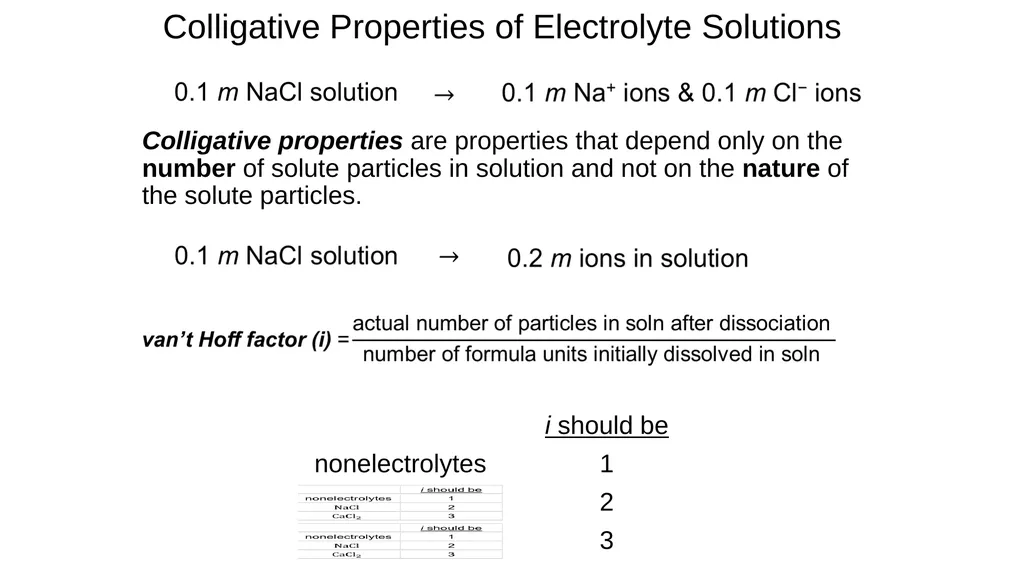
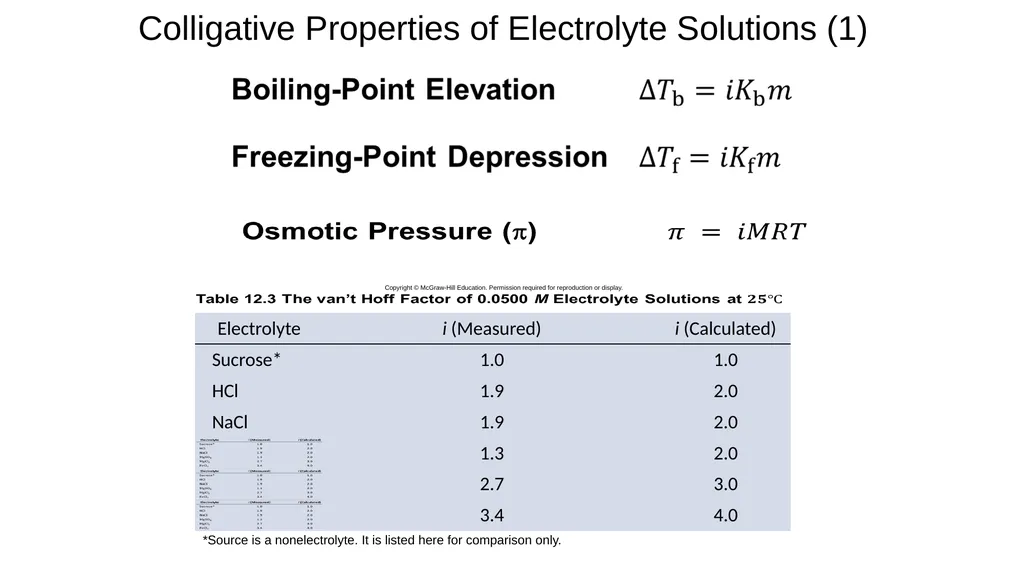
van’t Hoff factor
Colloids<br>
02
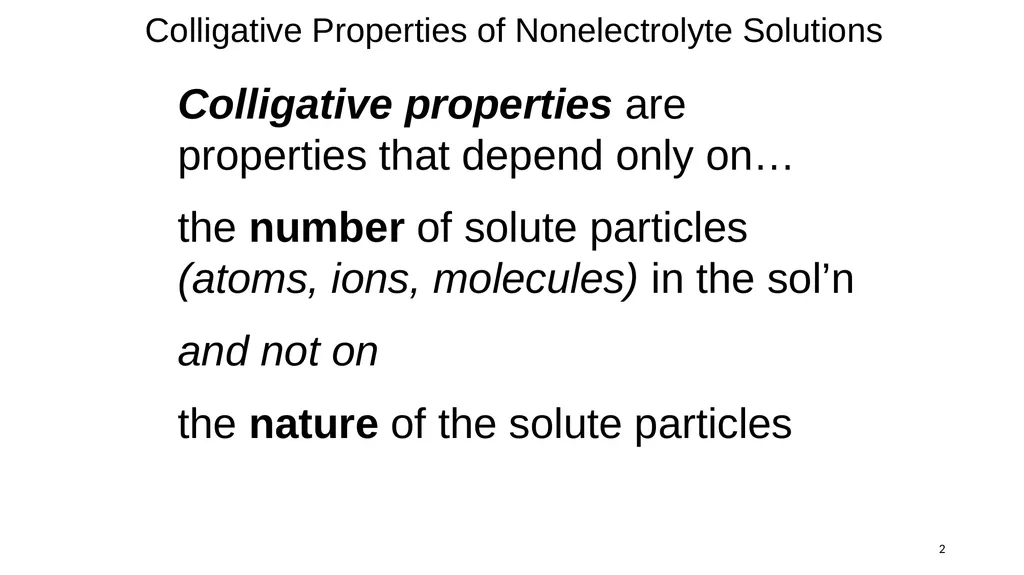
2 Colligative Properties of Nonelectrolyte Solutions Colligative properties are properties that depend only on…
the number of solute particles (atoms, ions, molecules) in the sol’n
and not on
the nature of the solute particles<br>
03
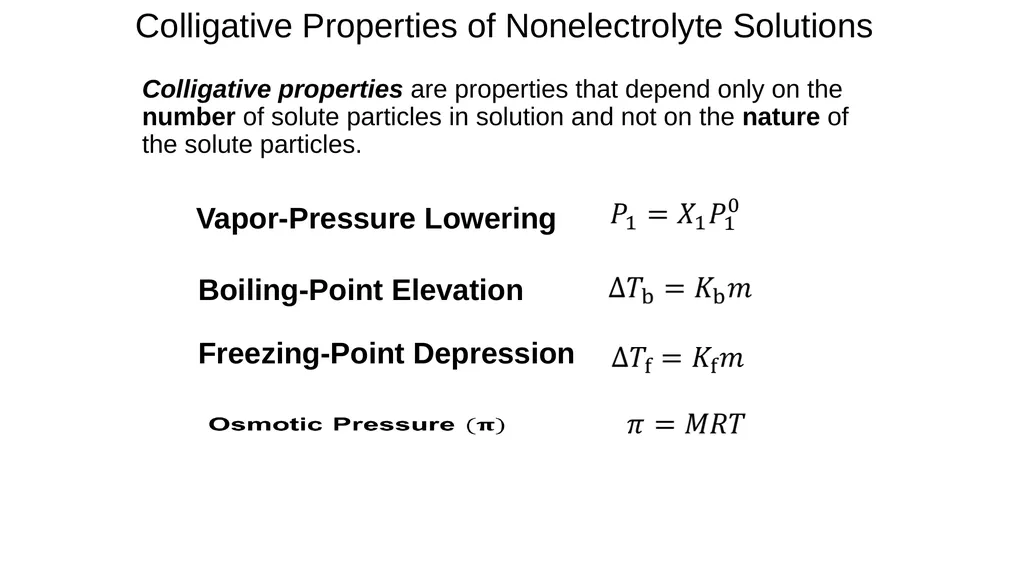
Colligative Properties of Nonelectrolyte Solutions Colligative properties are properties that depend only on the number of solute particles in solution and not on the nature of the solute particles. Vapor-Pressure Lowering Boiling-Point Elevation Freezing-Point Depression<br>
04
Colligative Properties of Electrolyte Solutions Colligative properties are properties that depend only on the number of solute particles in solution and not on the nature of the solute particles.<br>
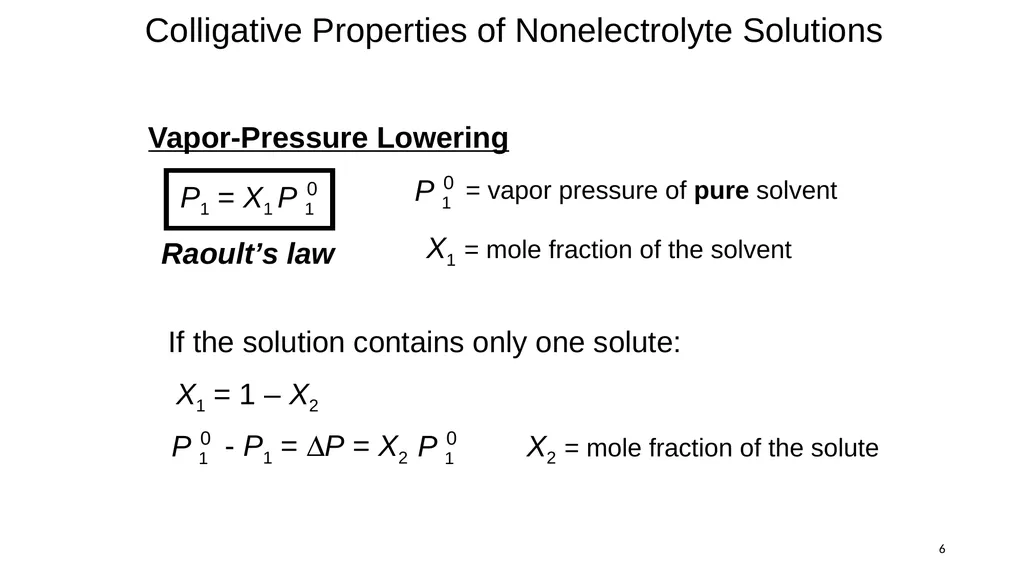
6 Colligative Properties of Nonelectrolyte Solutions Vapor-Pressure Lowering Raoult’s law If the solution contains only one solute: X1 = 1 – X2 X1 = mole fraction of the solvent X2 = mole fraction of the solute<br>
07
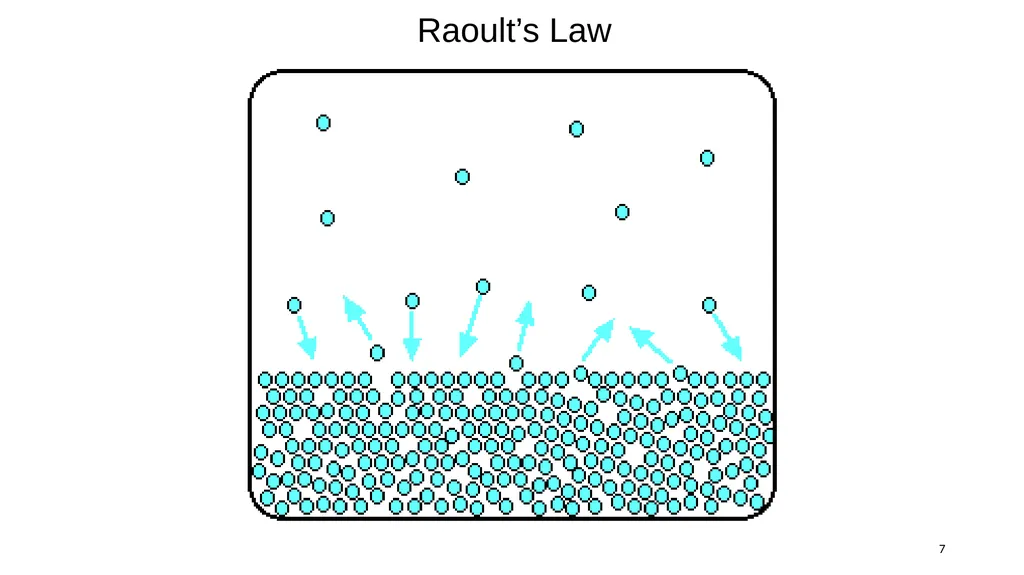
7 Raoult’s Law<br>
08
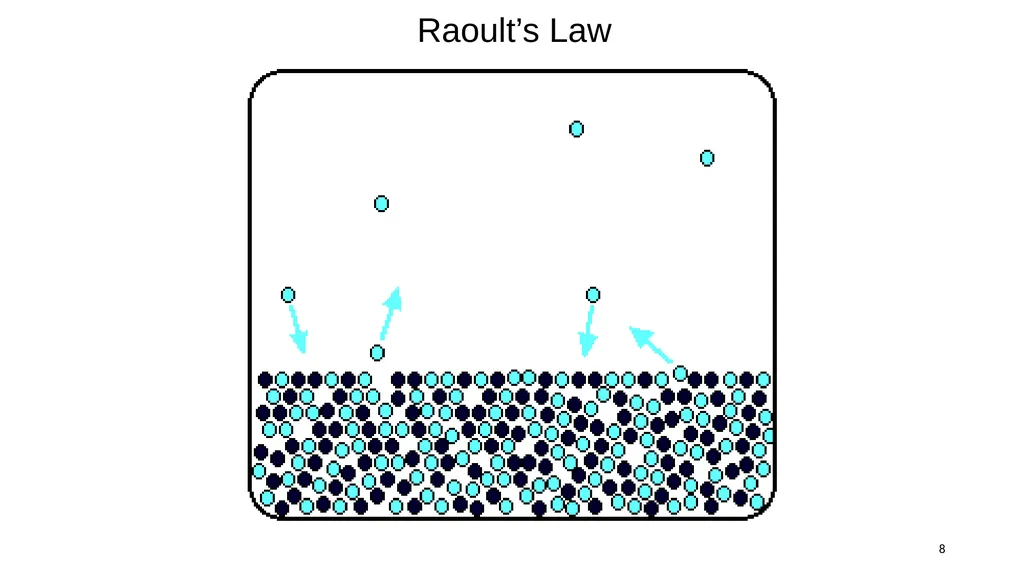
8 Raoult’s Law<br>
09
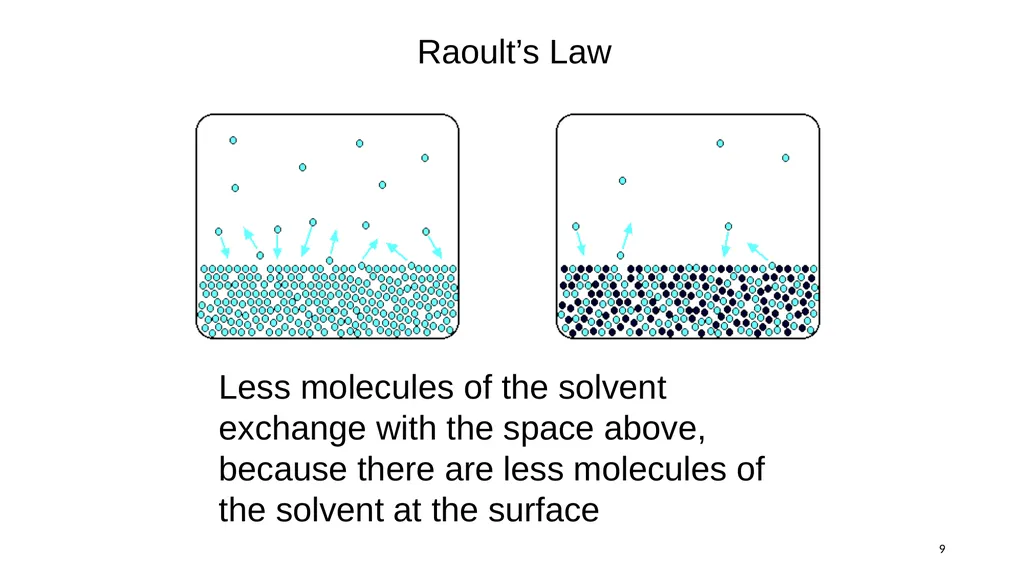
9 Raoult’s Law Less molecules of the solvent exchange with the space above, because there are less molecules of the solvent at the surface<br>
10
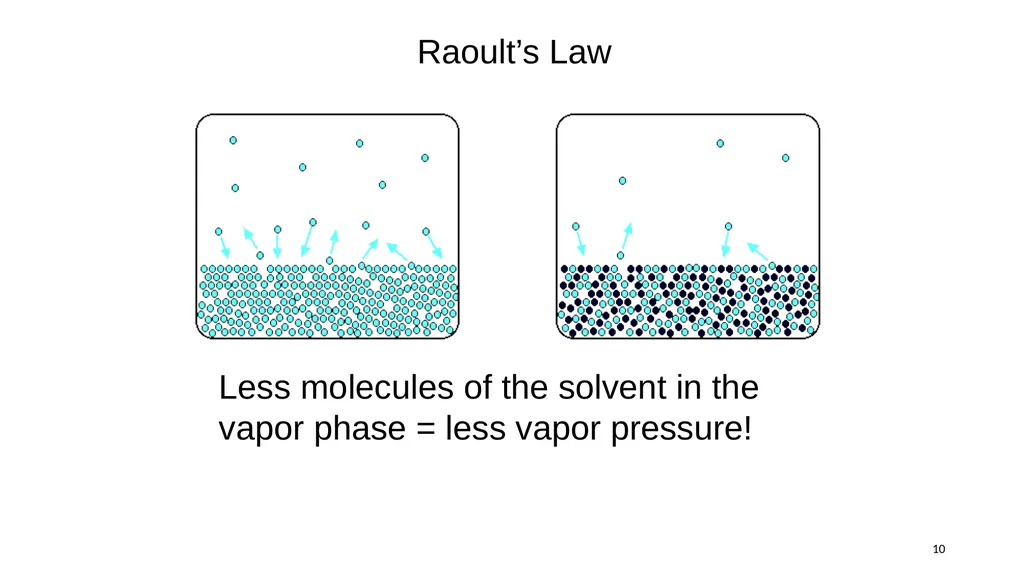
10 Raoult’s Law Less molecules of the solvent in the vapor phase = less vapor pressure!<br>
11
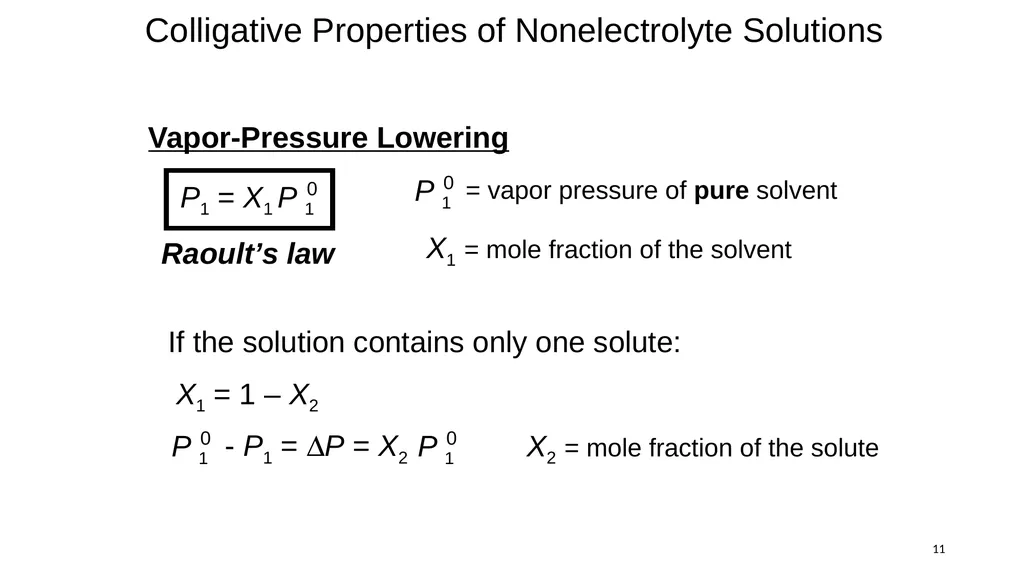
11 Colligative Properties of Nonelectrolyte Solutions Vapor-Pressure Lowering Raoult’s law If the solution contains only one solute: X1 = 1 – X2 X1 = mole fraction of the solvent X2 = mole fraction of the solute<br>
12
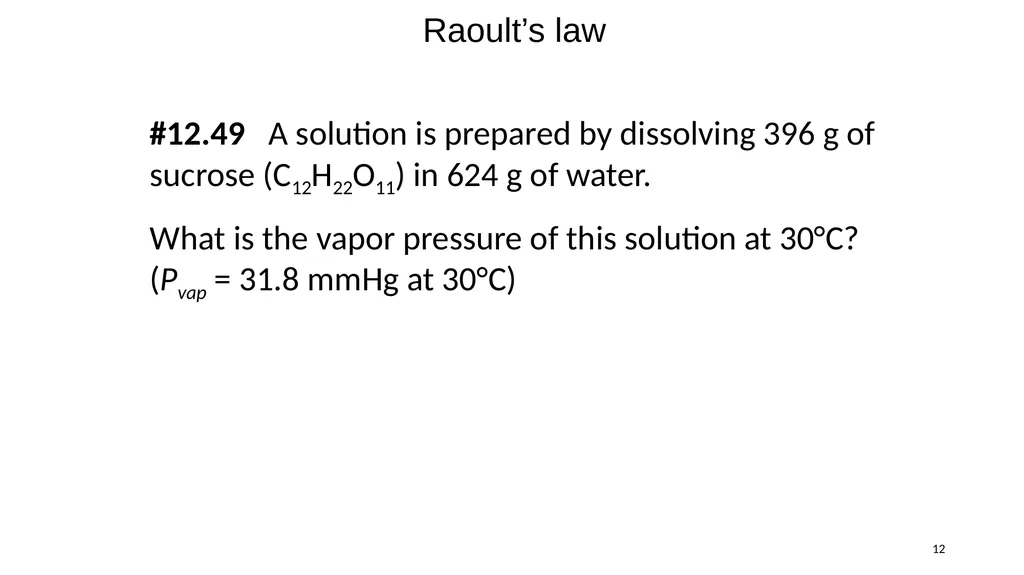
12 Raoult’s law #12.49 A solution is prepared by dissolving 396 g of sucrose (C12H22O11) in 624 g of water.
What is the vapor pressure of this solution at 30°C? (Pvap = 31.8 mmHg at 30°C)<br>
13
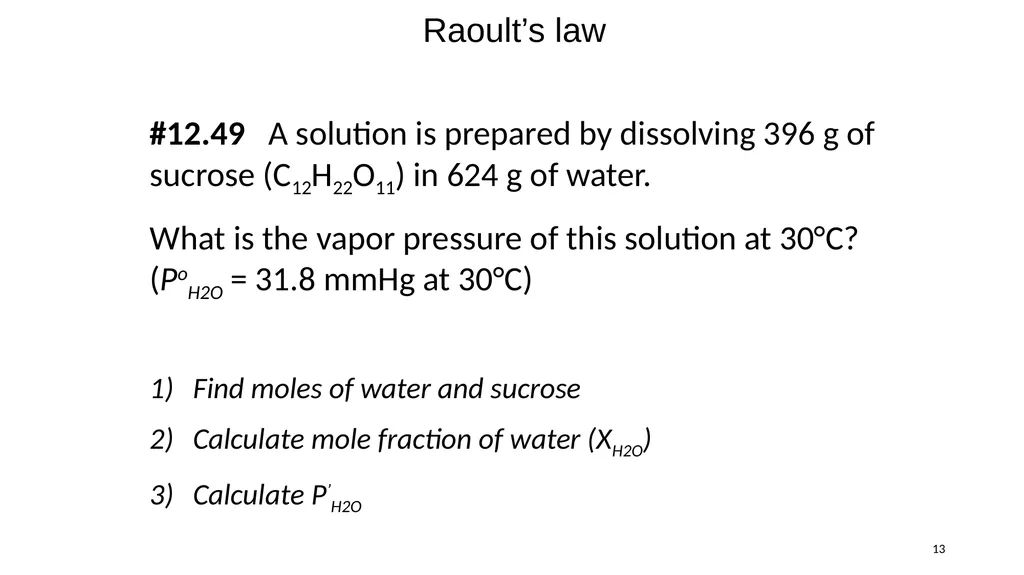
13 Raoult’s law #12.49 A solution is prepared by dissolving 396 g of sucrose (C12H22O11) in 624 g of water.
What is the vapor pressure of this solution at 30°C? (PoH2O = 31.8 mmHg at 30°C)
Find moles of water and sucrose
Calculate mole fraction of water (XH2O)
Calculate P’H2O<br>
14
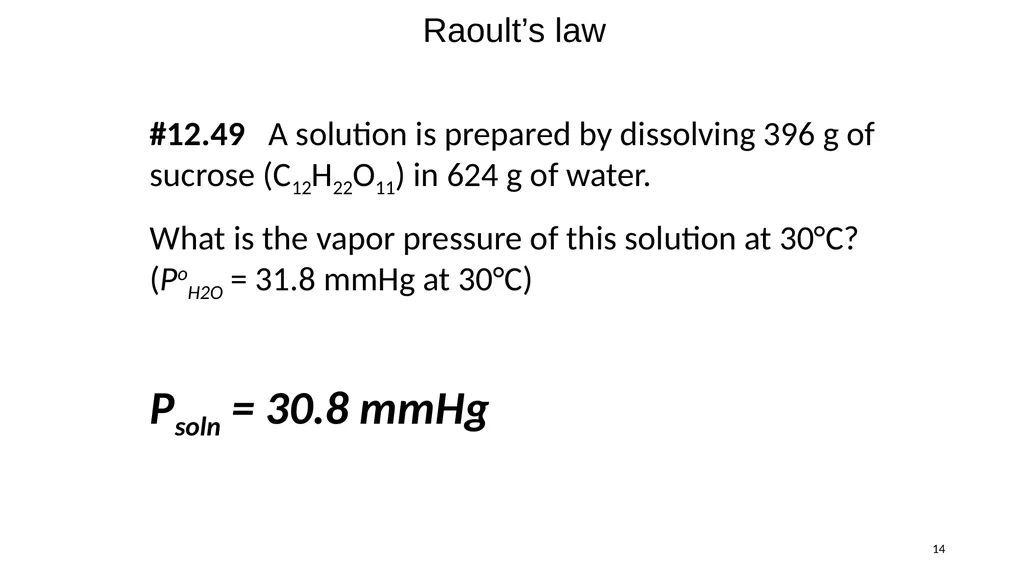
14 Raoult’s law #12.49 A solution is prepared by dissolving 396 g of sucrose (C12H22O11) in 624 g of water.
What is the vapor pressure of this solution at 30°C? (PoH2O = 31.8 mmHg at 30°C)
Psoln = 30.8 mmHg<br>
15
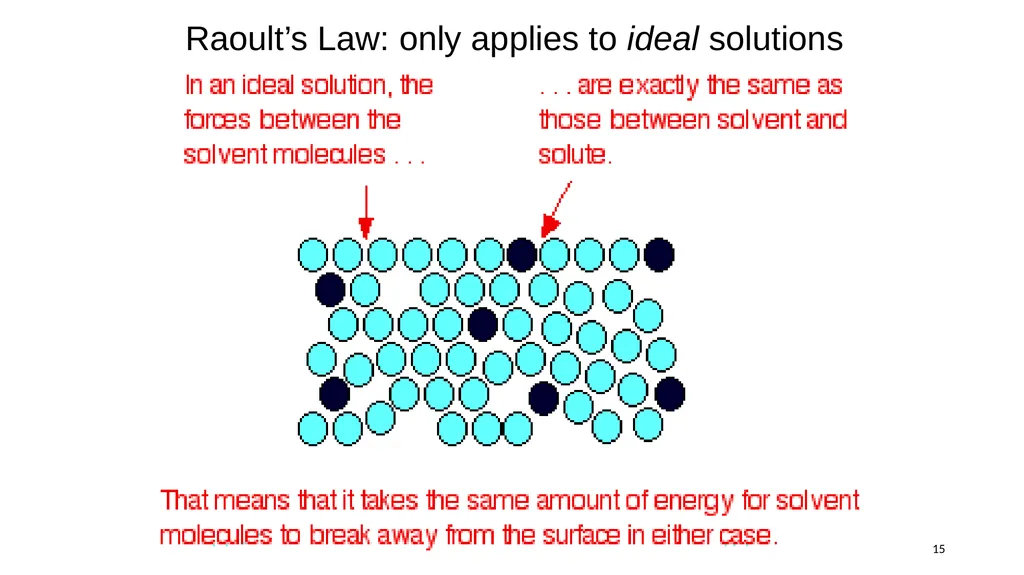
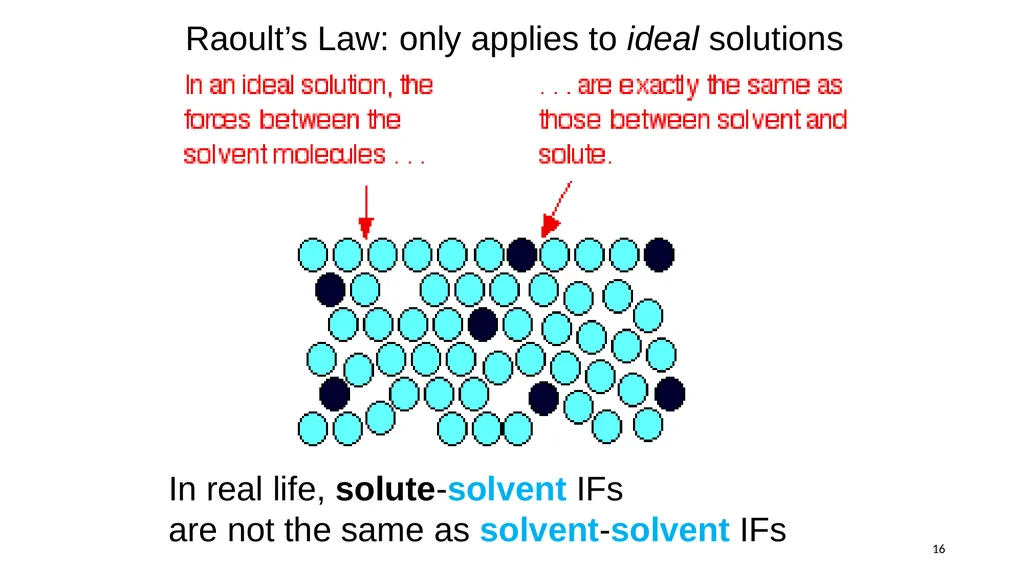
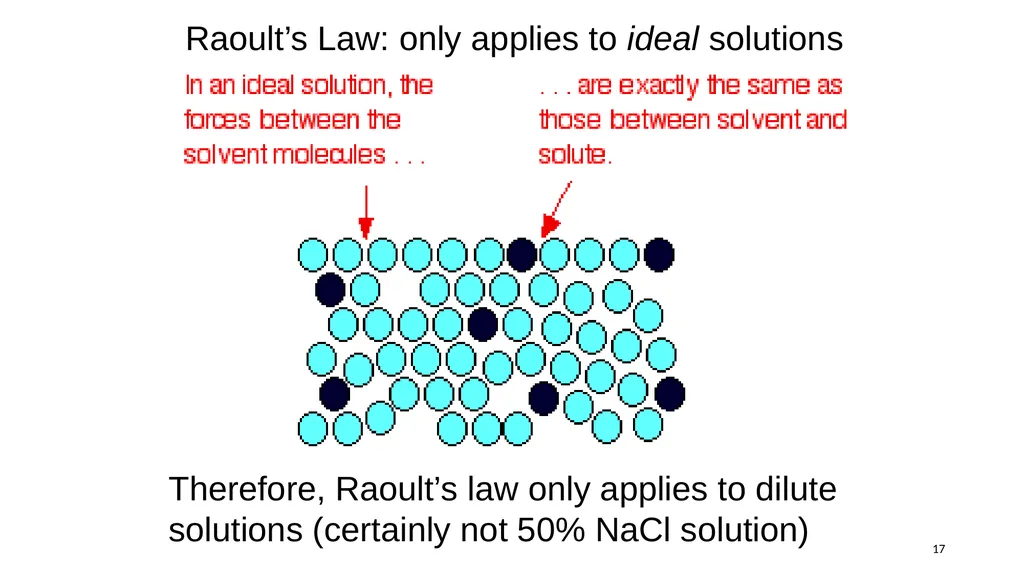
15 Raoult’s Law: only applies to ideal solutions<br>
16
16 Raoult’s Law: only applies to ideal solutions In real life, solute-solvent IFs are not the same as solvent-solvent IFs<br>
17
17 Raoult’s Law: only applies to ideal solutions Therefore, Raoult’s law only applies to dilute solutions (certainly not 50% NaCl solution)<br>
18
18 Raoult’s law What if solution is a mixture of liquids?
Non-volatile solution: vapor pressure depends on the concentration of the solute in the solution
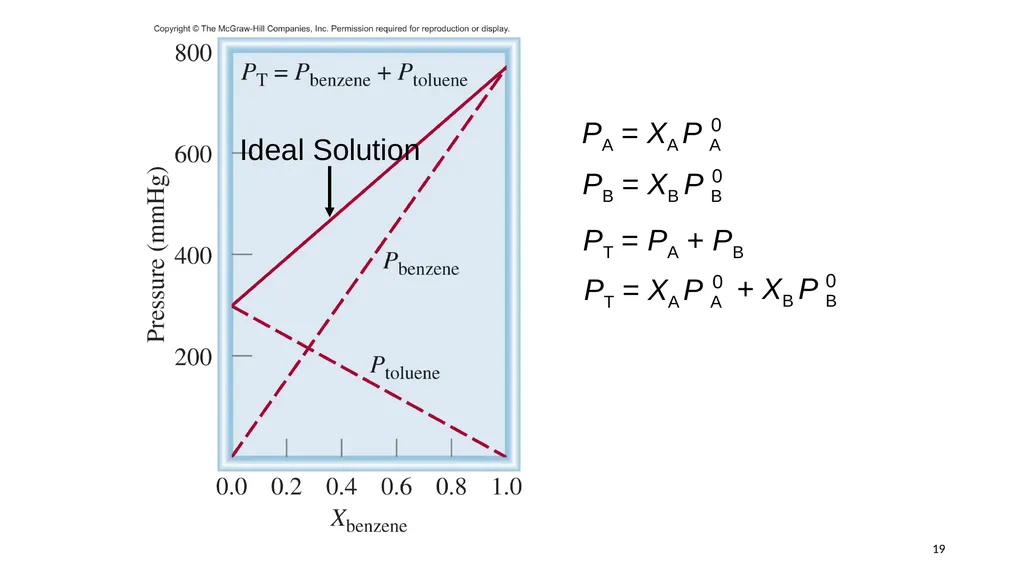
Volatile solution: vapor pressure is the sum of the individual partial pressures (e.g., benzene-toluene)
See page 533-534 for the full explanation<br>
19
19 PT = PA + PB<br>
20
20 Raoult’s law What if it’s not an ideal solution?<br>
21
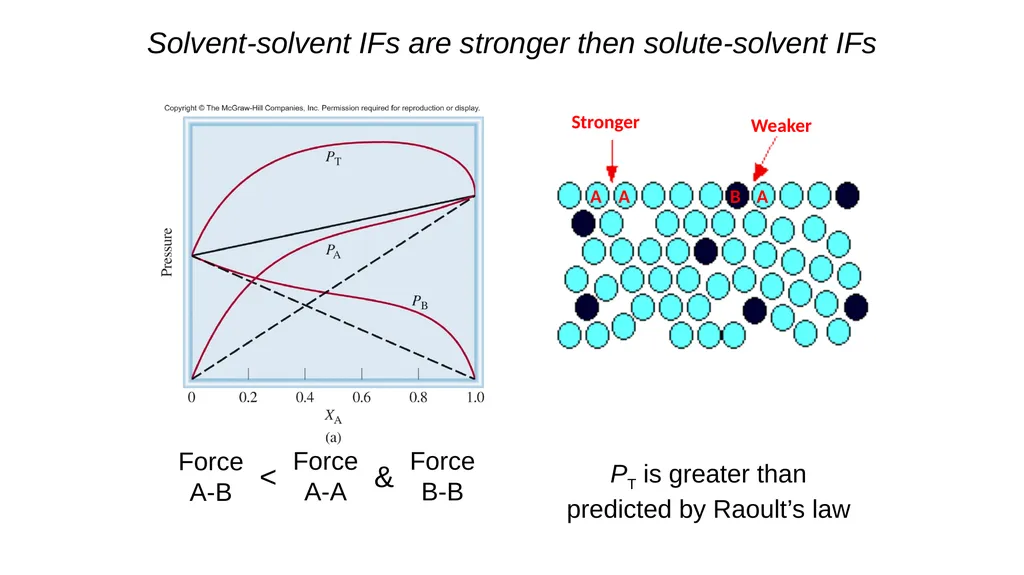
PT is greater than
predicted by Raoult’s law A A B A Stronger Weaker Solvent-solvent IFs are stronger then solute-solvent IFs<br>
22
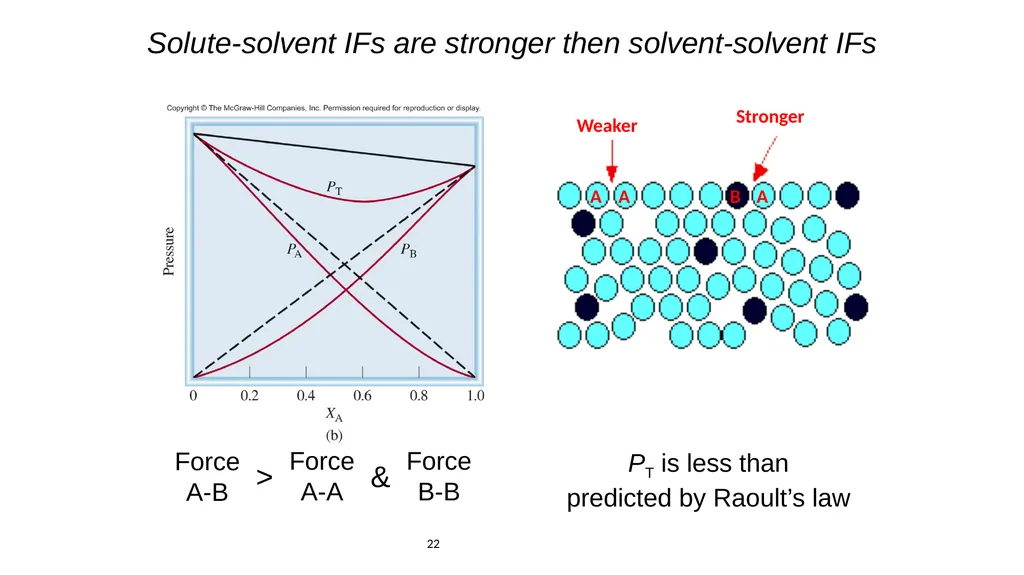
22 PT is less than
predicted by Raoult’s law A A B A Stronger Weaker Solute-solvent IFs are stronger then solvent-solvent IFs<br>
23
23 Colligative properties How do they affect boiling point and freezing point?<br>
24
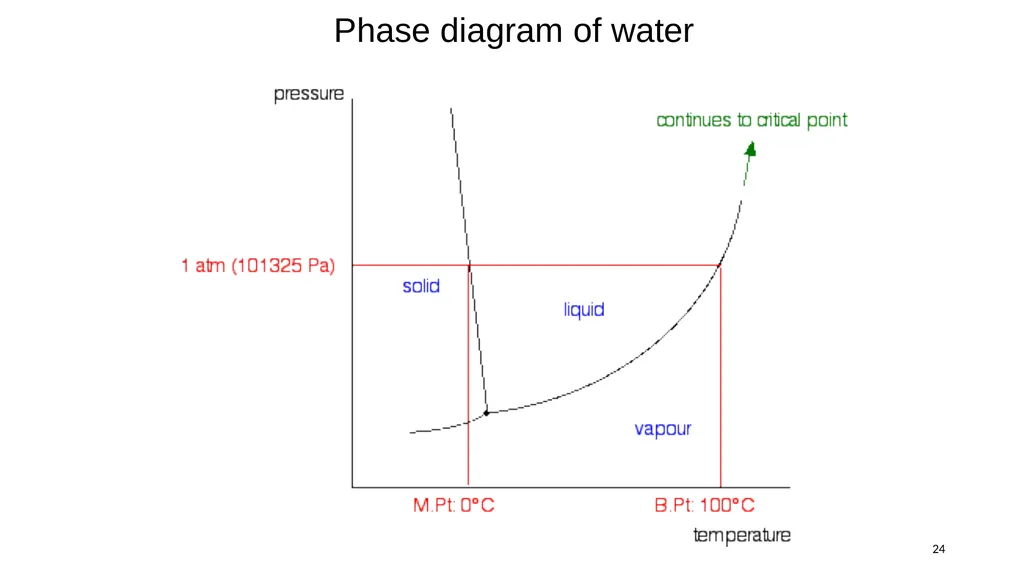
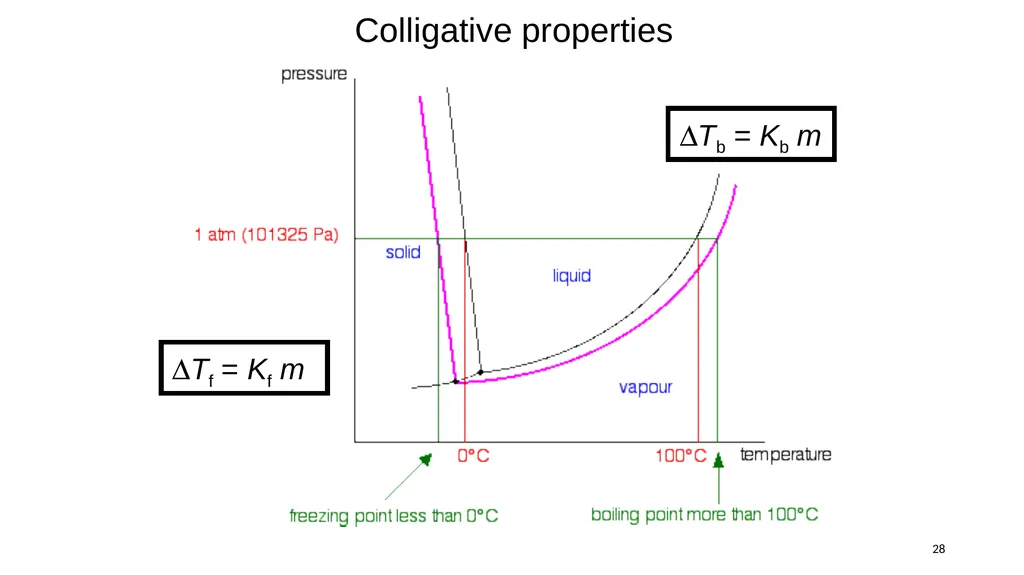
24 Phase diagram of water<br>
25
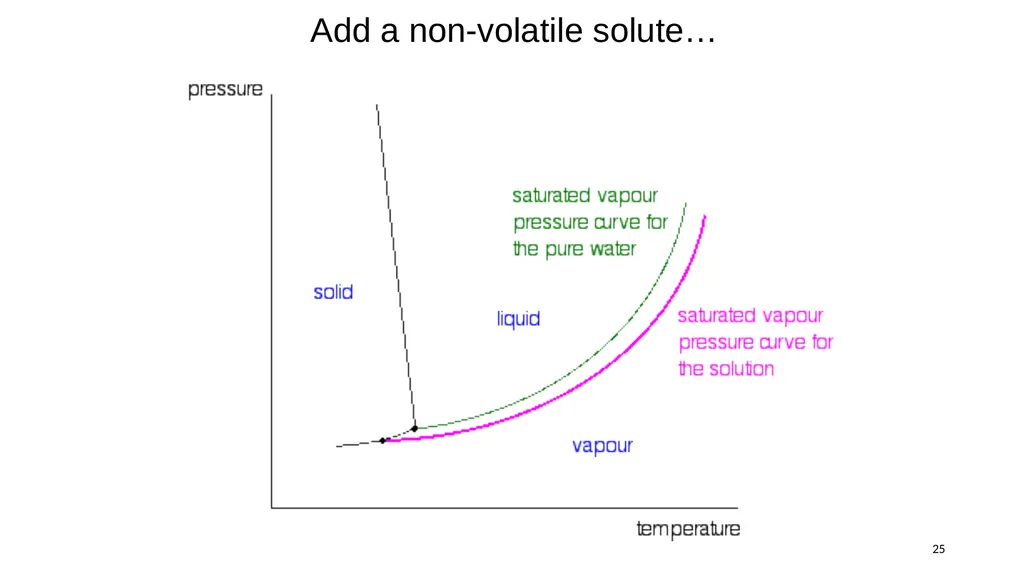
25 Add a non-volatile solute…<br>
26
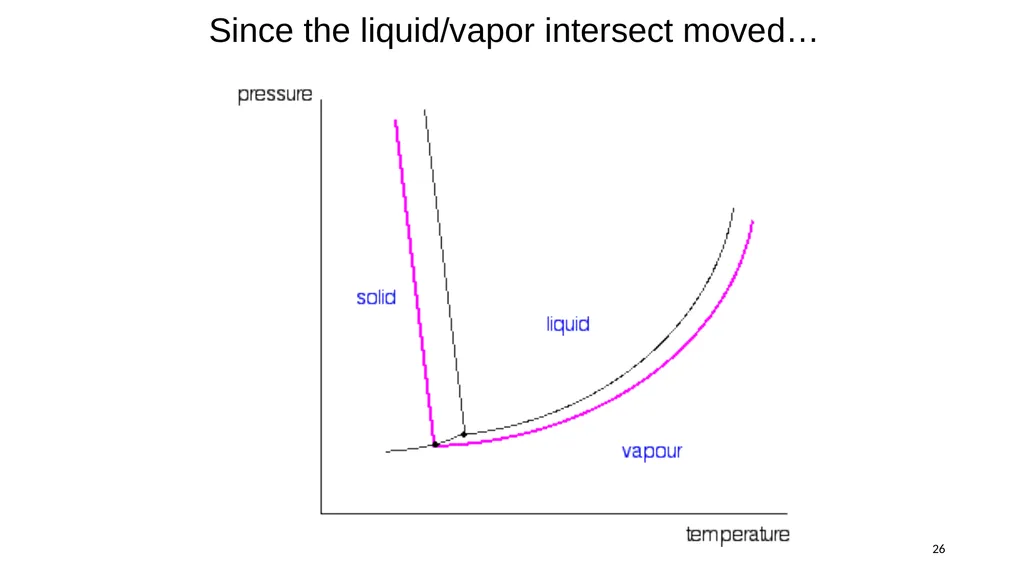
26 Since the liquid/vapor intersect moved…<br>
27
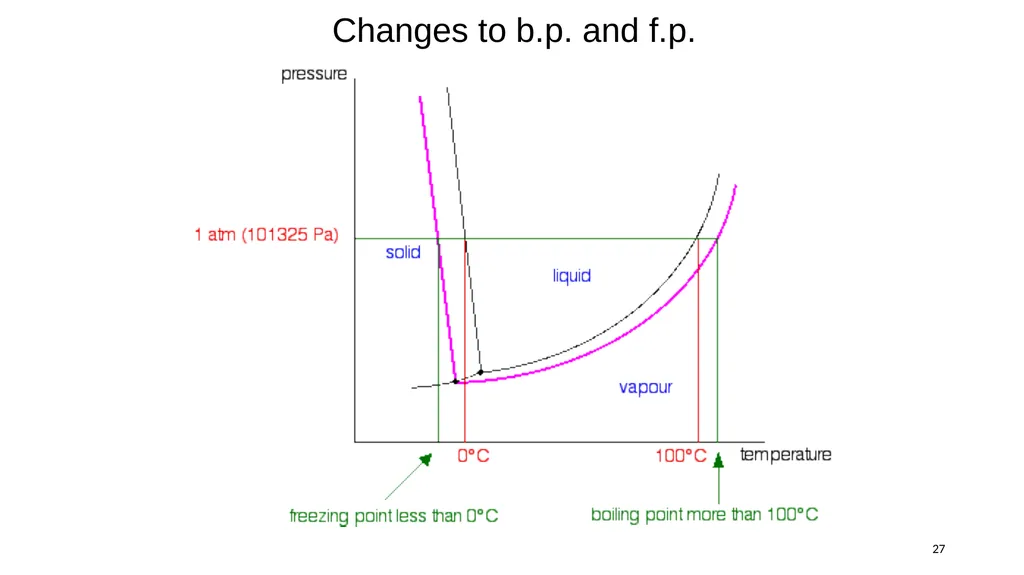
27 Changes to b.p. and f.p.<br>
28
28 Colligative properties<br>
29
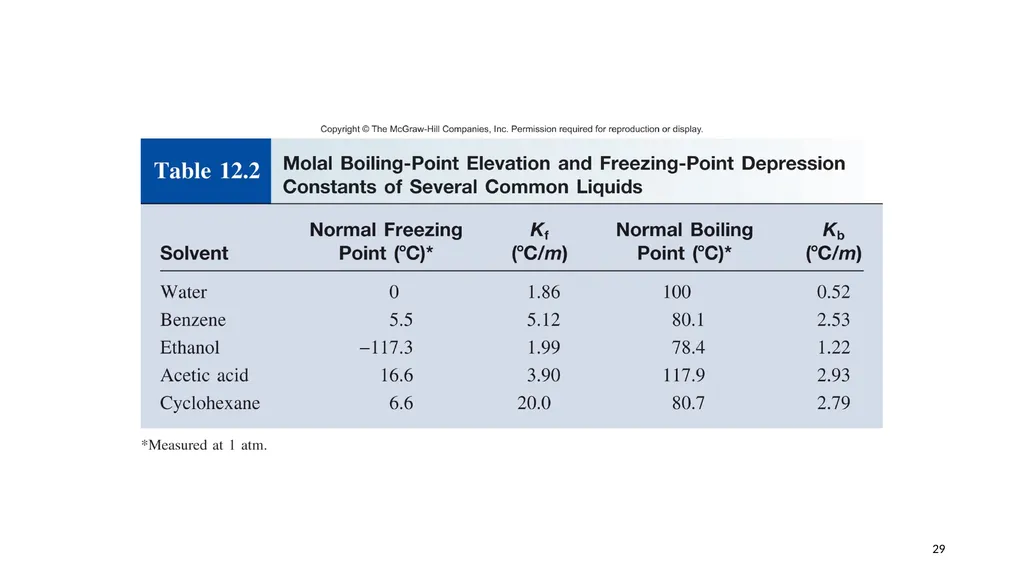
29<br>
30
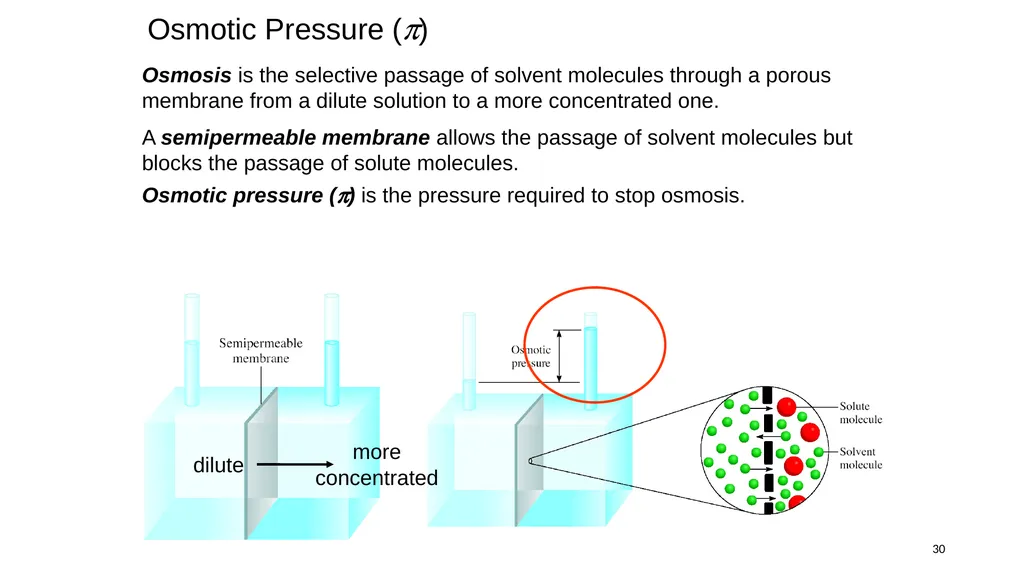
30 Osmotic Pressure (p) Osmosis is the selective passage of solvent molecules through a porous membrane from a dilute solution to a more concentrated one. A semipermeable membrane allows the passage of solvent molecules but blocks the passage of solute molecules. Osmotic pressure (p) is the pressure required to stop osmosis. dilute more
concentrated<br>
31
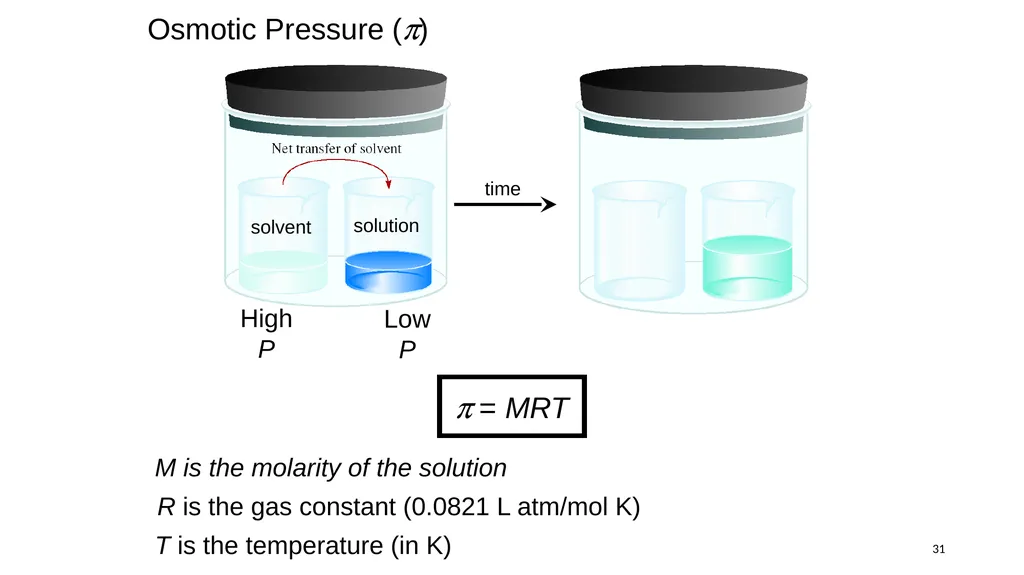
31 High
P Low
P Osmotic Pressure (p) p = MRT M is the molarity of the solution R is the gas constant (0.0821 L atm/mol K) T is the temperature (in K) solvent solution time<br>
32
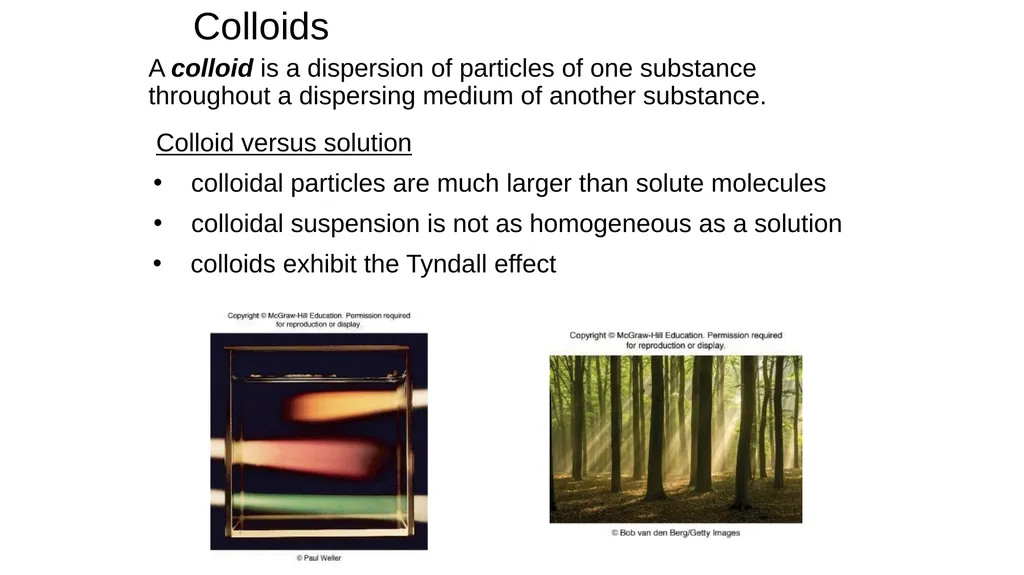
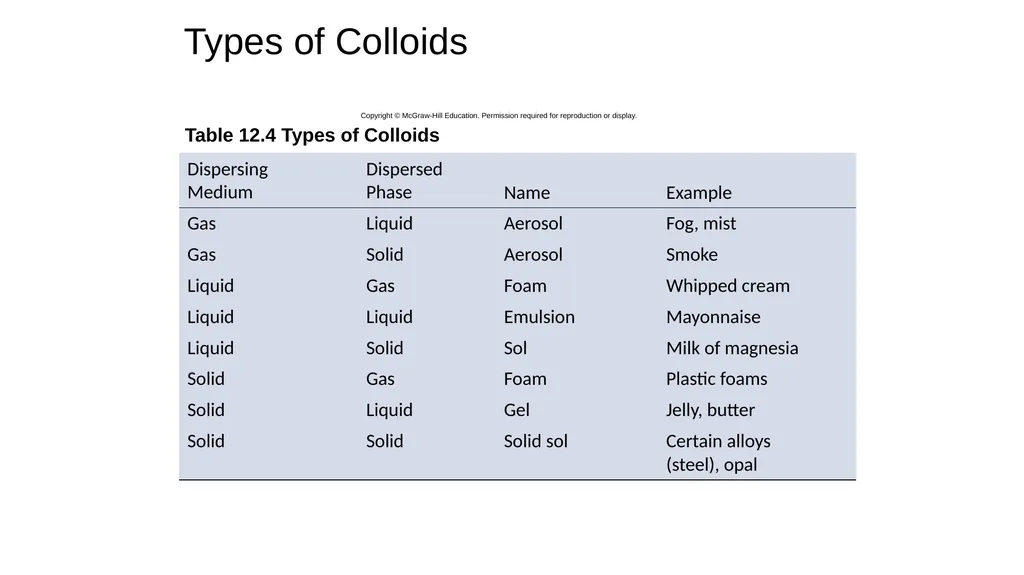
Colloids A colloid is a dispersion of particles of one substance throughout a dispersing medium of another substance.
Colloid versus solution
colloidal particles are much larger than solute molecules
colloidal suspension is not as homogeneous as a solution
colloids exhibit the Tyndall effect<br>
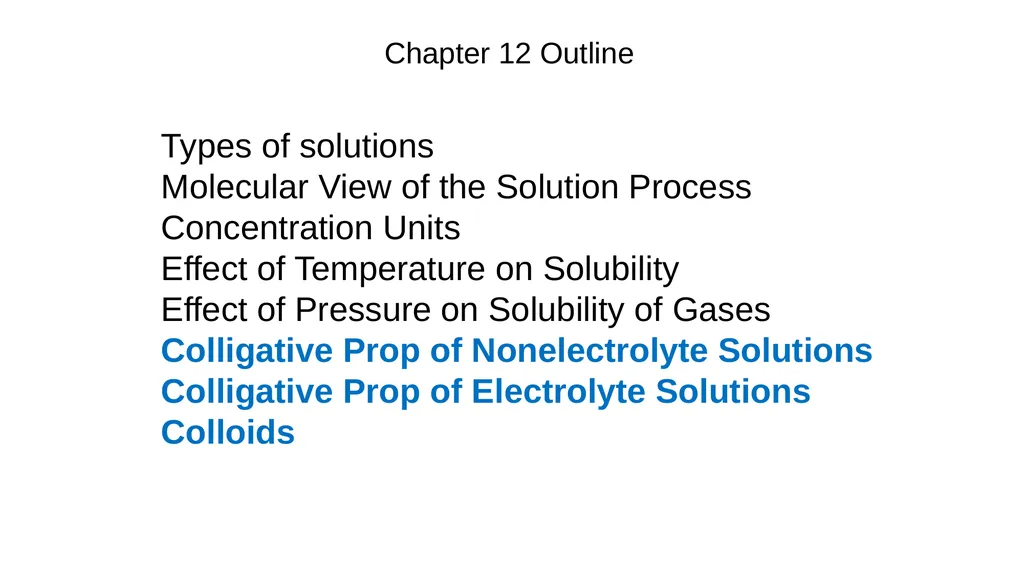
Chapter 12 Outline Types of solutions
Molecular View of the Solution Process
Concentration Units
Effect of Temperature on Solubility
Effect of Pressure on Solubility of Gases
Colligative Prop of Nonelectrolyte Solutions
Colligative Prop of Electrolyte Solutions
Colloids<br>