
1 Session One Creative Translation Poetry Project:
TD
Published · 35 slides · 0 views
1 / 1




Description
1 Session One Creative Translation Poetry Project: Ukrainian Spotlight Prize Insert class year group and date here 3 Example presentation title What is a refugee? A person who has been forced to leave their country in order to escape
Related Topics
Share
Embed code
Download this presentation From Below
"1 Session One Creative Translation Poetry Project:" is the property of its rightful owner. Permission is granted to download and print the materials on this website for personal, non-commercial use only, and to display it on your personal computer provided you do not modify the materials and that you retain all copyright notices contained in the materials. By downloading content from our website, you accept the terms of this agreement.
Presentation Transcript
01
1 Session One<br>
02
Creative Translation Poetry Project:
Ukrainian Spotlight Prize [Insert class / year group and date here]<br>
03
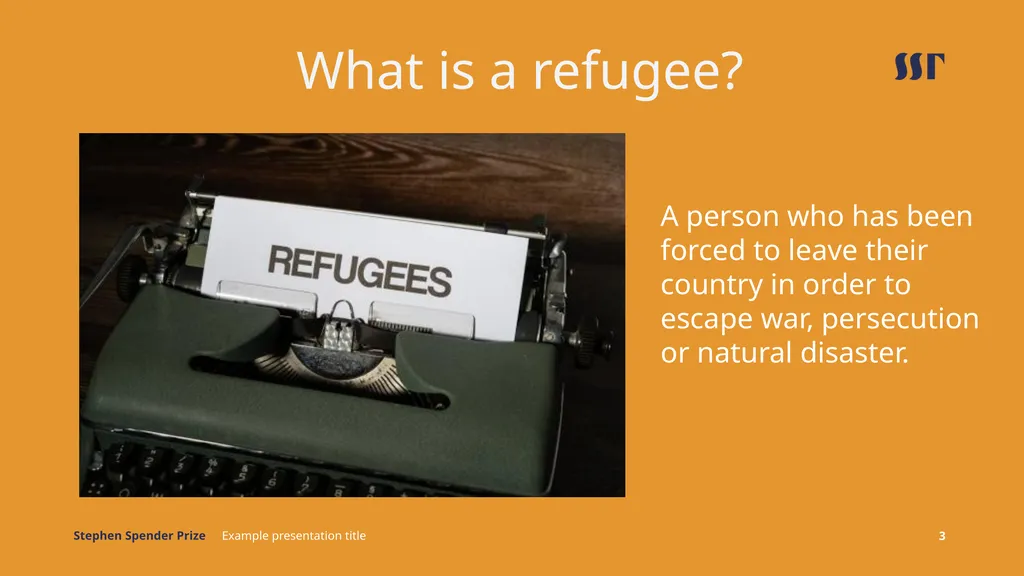
3 Example presentation title What is a refugee? A person who has been forced to leave their country in order to escape war, persecution or natural disaster.<br>
04
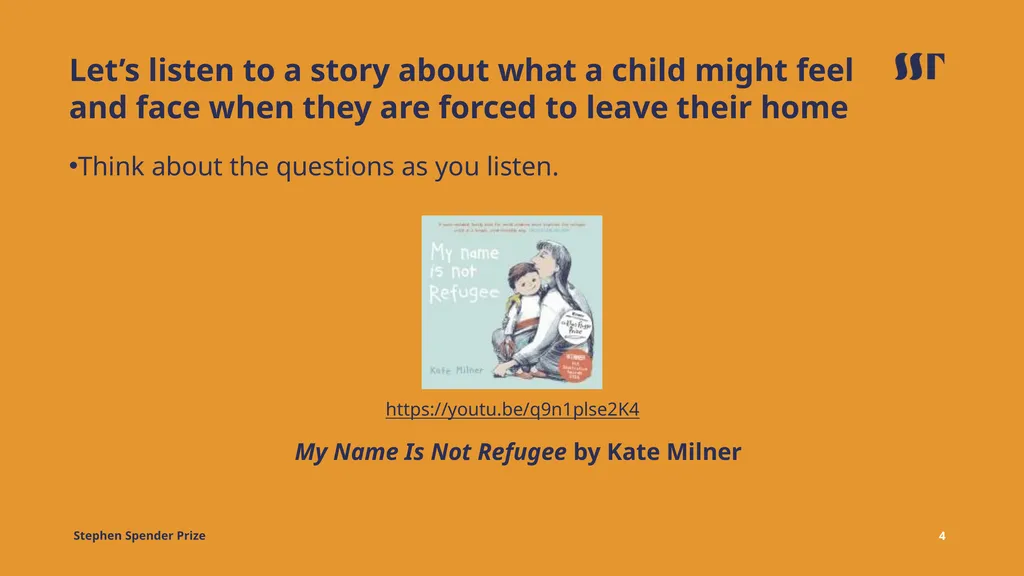
4 https://youtu.be/q9n1plse2K4 Let’s listen to a story about what a child might feel and face when they are forced to leave their home
Think about the questions as you listen. My Name Is Not Refugee by Kate Milner<br>
Think about the questions as you listen. My Name Is Not Refugee by Kate Milner<br>
05
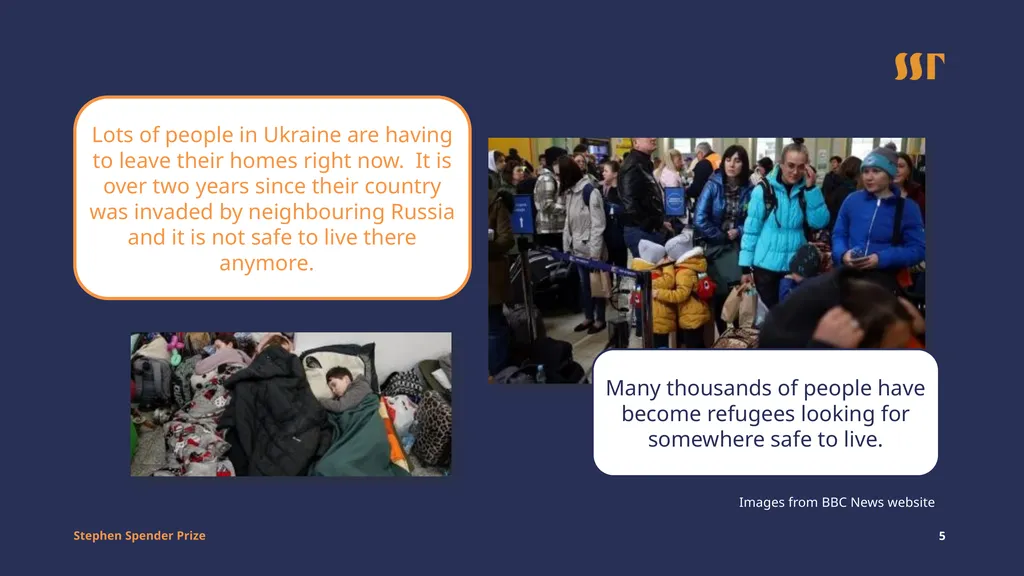
5 Many thousands of people have become refugees looking for somewhere safe to live. Lots of people in Ukraine are having to leave their homes right now. It is over two years since their country was invaded by neighbouring Russia and it is not safe to live there anymore. Images from BBC News website<br>
06
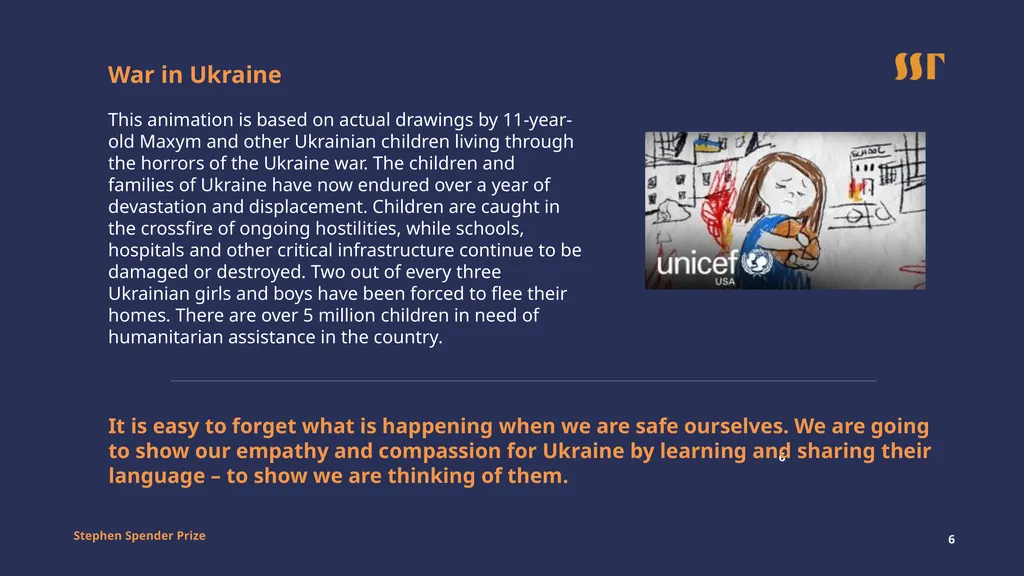
6 This animation is based on actual drawings by 11-year-old Maxym and other Ukrainian children living through the horrors of the Ukraine war. The children and families of Ukraine have now endured over a year of devastation and displacement. Children are caught in the crossfire of ongoing hostilities, while schools, hospitals and other critical infrastructure continue to be damaged or destroyed. Two out of every three Ukrainian girls and boys have been forced to flee their homes. There are over 5 million children in need of humanitarian assistance in the country. https://youtu.be/ufGa4Ml93W0 War in Ukraine It is easy to forget what is happening when we are safe ourselves. We are going to show our empathy and compassion for Ukraine by learning and sharing their language – to show we are thinking of them. 6<br>
07
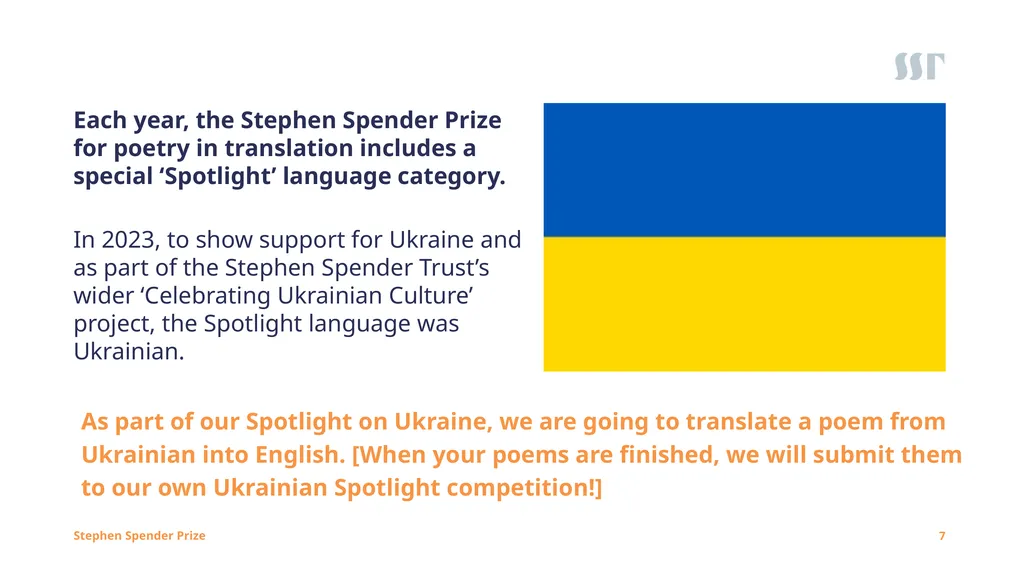
7 Each year, the Stephen Spender Prize for poetry in translation includes a special ‘Spotlight’ language category.
In 2023, to show support for Ukraine and as part of the Stephen Spender Trust’s wider ‘Celebrating Ukrainian Culture’ project, the Spotlight language was Ukrainian. As part of our Spotlight on Ukraine, we are going to translate a poem from Ukrainian into English. [When your poems are finished, we will submit them to our own Ukrainian Spotlight competition!]<br>
In 2023, to show support for Ukraine and as part of the Stephen Spender Trust’s wider ‘Celebrating Ukrainian Culture’ project, the Spotlight language was Ukrainian. As part of our Spotlight on Ukraine, we are going to translate a poem from Ukrainian into English. [When your poems are finished, we will submit them to our own Ukrainian Spotlight competition!]<br>
08
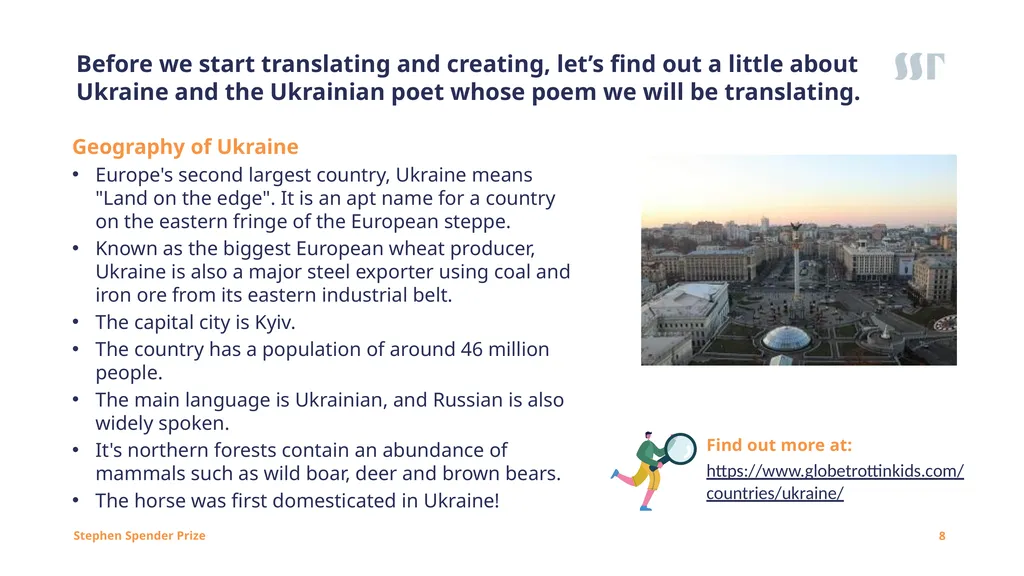
8 Before we start translating and creating, let’s find out a little about Ukraine and the Ukrainian poet whose poem we will be translating. Independence Square, Kyiv, capital city of Ukraine Geography of Ukraine
Europe's second largest country, Ukraine means "Land on the edge". It is an apt name for a country on the eastern fringe of the European steppe.
Known as the biggest European wheat producer, Ukraine is also a major steel exporter using coal and iron ore from its eastern industrial belt.
The capital city is Kyiv.
The country has a population of around 46 million people.
The main language is Ukrainian, and Russian is also widely spoken.
It's northern forests contain an abundance of mammals such as wild boar, deer and brown bears.
The horse was first domesticated in Ukraine! Find out more at:
https://www.globetrottinkids.com/countries/ukraine/<br>
Europe's second largest country, Ukraine means "Land on the edge". It is an apt name for a country on the eastern fringe of the European steppe.
Known as the biggest European wheat producer, Ukraine is also a major steel exporter using coal and iron ore from its eastern industrial belt.
The capital city is Kyiv.
The country has a population of around 46 million people.
The main language is Ukrainian, and Russian is also widely spoken.
It's northern forests contain an abundance of mammals such as wild boar, deer and brown bears.
The horse was first domesticated in Ukraine! Find out more at:
https://www.globetrottinkids.com/countries/ukraine/<br>
09
9 History of Ukraine
Ukraine was settled in ancient times, with colonies of Ancient Rome, Ancient Greece and the Byzantine empire all in the vicinity.
The origins of modern Ukraine can be traced to the Rus people, who settled in an area centred around Kyiv known as Kyivan Rus. During the 10th and 11th centuries, Kyivan Rus - ruled by Vladimir the Great and then his sone Yaroslav the Wise, was arguably the largest and most powerful state in Europe. Many tumultuous centuries followed.
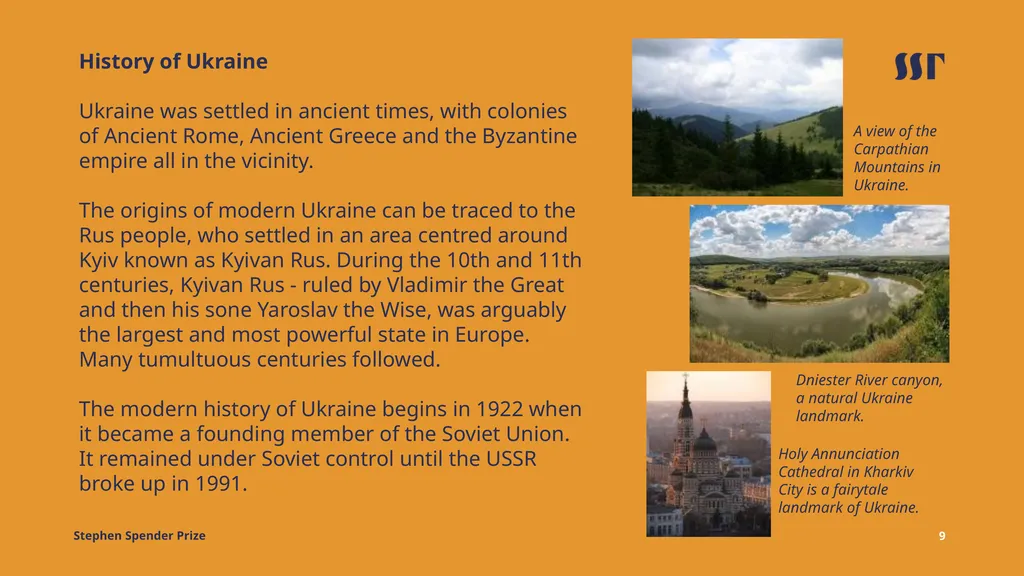
The modern history of Ukraine begins in 1922 when it became a founding member of the Soviet Union. It remained under Soviet control until the USSR broke up in 1991. A view of the Carpathian Mountains in Ukraine. Dniester River canyon, a natural Ukraine landmark. Holy Annunciation Cathedral in Kharkiv City is a fairytale landmark of Ukraine.<br>
Ukraine was settled in ancient times, with colonies of Ancient Rome, Ancient Greece and the Byzantine empire all in the vicinity.
The origins of modern Ukraine can be traced to the Rus people, who settled in an area centred around Kyiv known as Kyivan Rus. During the 10th and 11th centuries, Kyivan Rus - ruled by Vladimir the Great and then his sone Yaroslav the Wise, was arguably the largest and most powerful state in Europe. Many tumultuous centuries followed.
The modern history of Ukraine begins in 1922 when it became a founding member of the Soviet Union. It remained under Soviet control until the USSR broke up in 1991. A view of the Carpathian Mountains in Ukraine. Dniester River canyon, a natural Ukraine landmark. Holy Annunciation Cathedral in Kharkiv City is a fairytale landmark of Ukraine.<br>
10
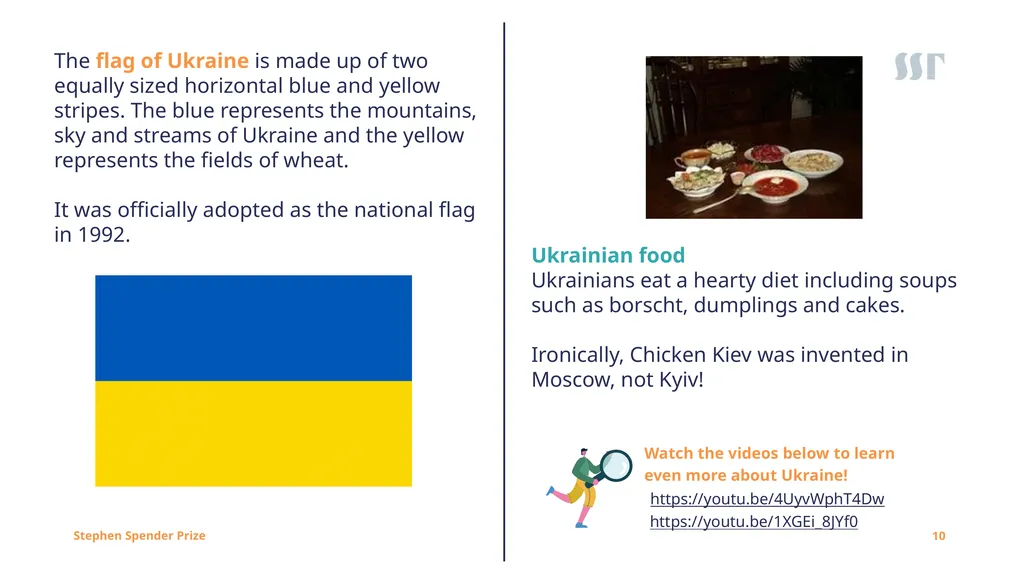
The flag of Ukraine is made up of two equally sized horizontal blue and yellow stripes. The blue represents the mountains, sky and streams of Ukraine and the yellow represents the fields of wheat.
It was officially adopted as the national flag in 1992. https://youtu.be/4UyvWphT4Dw https://youtu.be/1XGEi_8JYf0 Watch the videos below to learn even more about Ukraine! Ukrainian food
Ukrainians eat a hearty diet including soups such as borscht, dumplings and cakes.
Ironically, Chicken Kiev was invented in Moscow, not Kyiv! 10<br>
It was officially adopted as the national flag in 1992. https://youtu.be/4UyvWphT4Dw https://youtu.be/1XGEi_8JYf0 Watch the videos below to learn even more about Ukraine! Ukrainian food
Ukrainians eat a hearty diet including soups such as borscht, dumplings and cakes.
Ironically, Chicken Kiev was invented in Moscow, not Kyiv! 10<br>
11
Григорій Фалькович Hryhoriy Falkovych Poet and advocate for freedom of speech and editorial independence. Hryhoriy Falkovych is a Ukrainian author of Jewish descent who writes books for children and adults. He is committed to civil society, is a member of the PEN Club Ukraine and the National Union of Writers of Ukraine, works as a translator from Bulgarian and Yiddish, is the initiator and founder of the All-Ukrainian Festival of Children's Poetry, Chairman of the Board of the Jewish Sholem-Alejchem Society for culture and education in Kyiv.
In 2019 his collection of poems A Bug Who Wrote to Nobody (Vivat Verlag) was published, in which Hryhoriy Falkovych masterfully uses the techniques of humour and paradox, which is why it is always interesting to discuss his poems with children after reading them.
Based on seven poems by Hryhoriy Falkovych, director Stepan Kowal created the animated series Language Full of Colours in 2020, which was presented at the international animated film festival in Annecy, France, in 2021. Hryhoriy Falkovych is a beloved Ukrainian children’s poet. Now in his eighties, he is the author of dozens of poetry collections for children. Previously based in Kyiv, he was forced to move to Kolomyya after the Russian invasion in February 2022. 11<br>
12
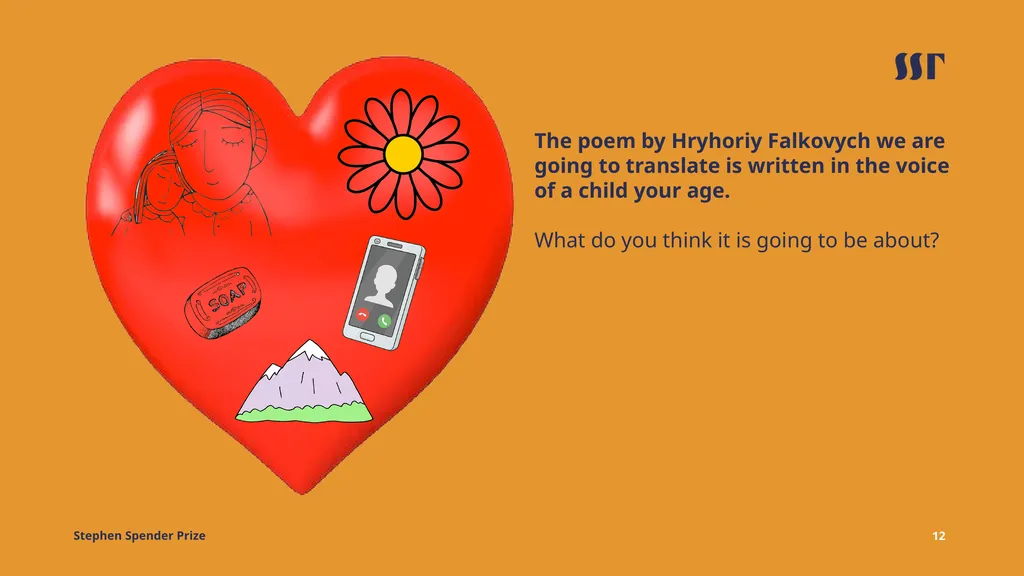
12 The poem by Hryhoriy Falkovych we are going to translate is written in the voice of a child your age.
What do you think it is going to be about?<br>
What do you think it is going to be about?<br>
13
13 Session Two<br>
14
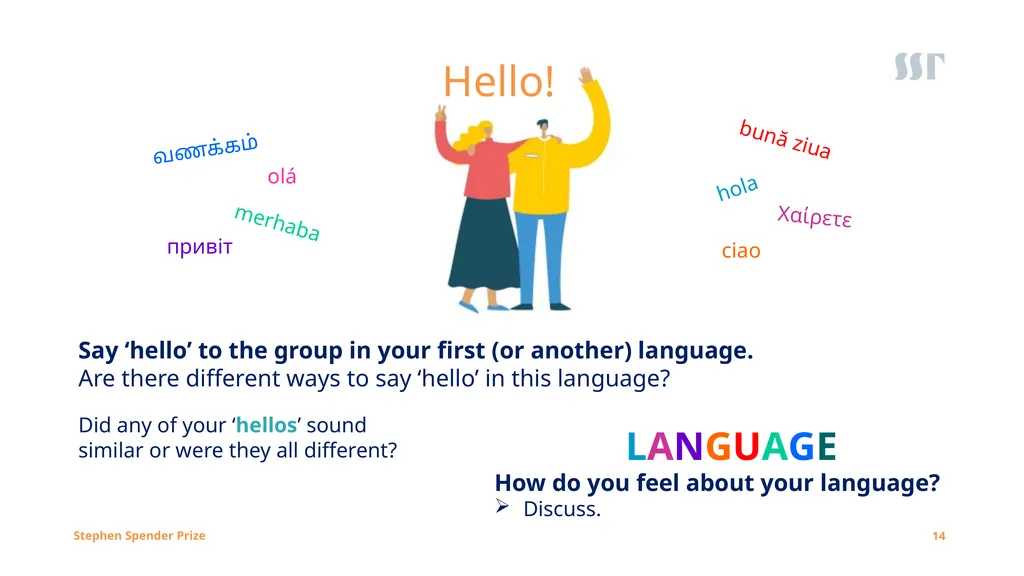
Say ‘hello’ to the group in your first (or another) language.
Are there different ways to say ‘hello’ in this language? LANGUAGE
How do you feel about your language?
Discuss. Did any of your ‘hellos’ sound similar or were they all different? bună ziua வணக்கம் hola olá привіт Χαίρετε ciao merhaba Hello! 14<br>
Are there different ways to say ‘hello’ in this language? LANGUAGE
How do you feel about your language?
Discuss. Did any of your ‘hellos’ sound similar or were they all different? bună ziua வணக்கம் hola olá привіт Χαίρετε ciao merhaba Hello! 14<br>
15
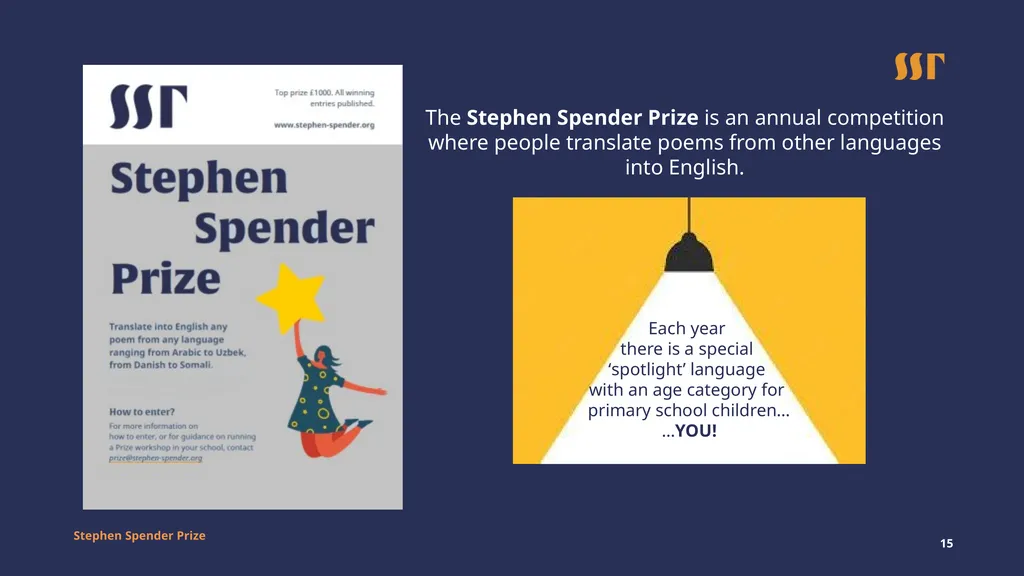
The Stephen Spender Prize is an annual competition where people translate poems from other languages into English. Each year
there is a special
‘spotlight’ language
with an age category for
primary school children…
…YOU! 15<br>
there is a special
‘spotlight’ language
with an age category for
primary school children…
…YOU! 15<br>
16
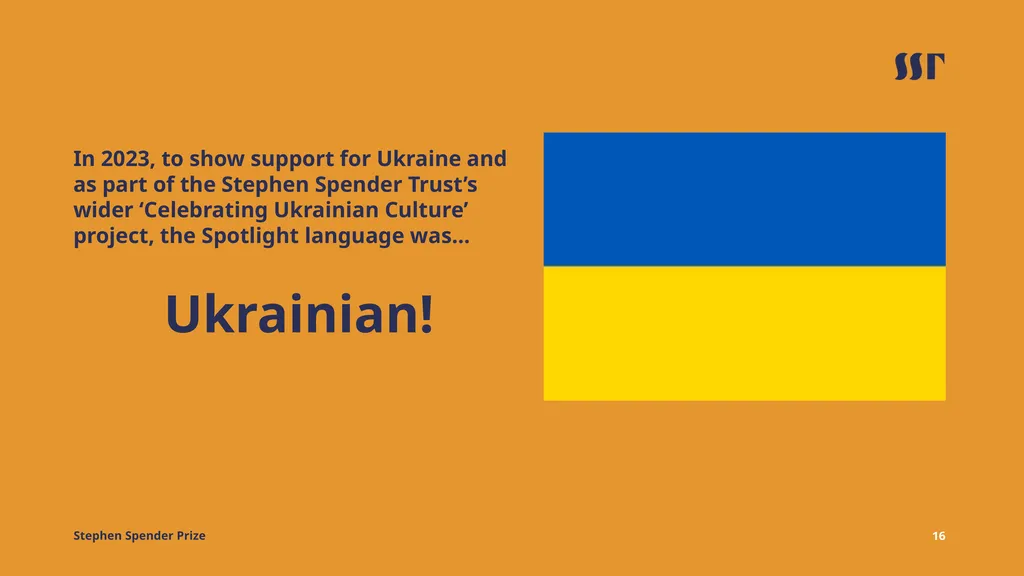
16 In 2023, to show support for Ukraine and as part of the Stephen Spender Trust’s wider ‘Celebrating Ukrainian Culture’ project, the Spotlight language was…
Ukrainian!<br>
Ukrainian!<br>
17
17 As part of our own creative translation project, we are going to translate a poem from Ukrainian into English. [When your poems are finished, we will submit them to our own Ukrainian Spotlight competition!]
You will also have the chance to produce another piece of work to accompany your translated poem, which we will do afterwards.<br>
You will also have the chance to produce another piece of work to accompany your translated poem, which we will do afterwards.<br>
18
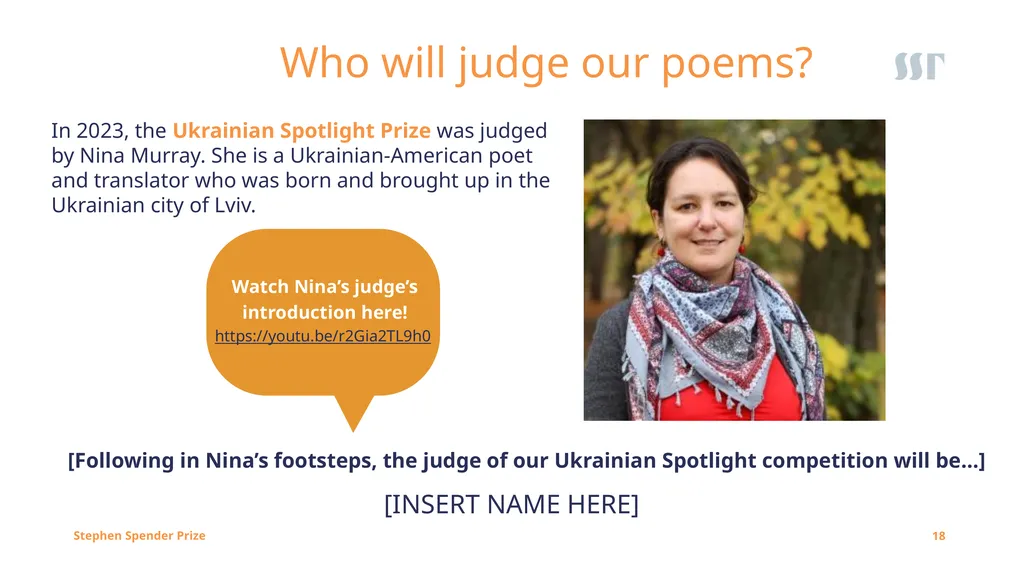
In 2023, the Ukrainian Spotlight Prize was judged by Nina Murray. She is a Ukrainian-American poet and translator who was born and brought up in the Ukrainian city of Lviv. Who will judge our poems? [Following in Nina’s footsteps, the judge of our Ukrainian Spotlight competition will be…] 18 [INSERT NAME HERE] https://youtu.be/r2Gia2TL9h0 Watch Nina’s judge’s introduction here!<br>
19
Commentary and commentary alternatives 19 A commentary
If you choose to submit a commentary, this means you will need to write (or read aloud as a video/audio recording) a few sentences about your experience of translating the poem.
As you are working on your translation think about questions such as: What am I enjoying about this process? What am I finding hard? Why have I chosen this word over that word for my final poem? Translators think very carefully about their language choices! Another type of creative response
If you like, you can submit one of the following as an alternative to a commentary:
An original visual representation of the poem (e.g. a freehand drawing or collage).
An original piece of creative writing, inspired by / building on the themes of the poem (e.g. a short story, an original English-language poem, a non-fiction essay).
An audio or video reading / performance of your translated poem. You can decide later, once you have finished your translation. Your poems will need to be accompanied by either…<br>
If you choose to submit a commentary, this means you will need to write (or read aloud as a video/audio recording) a few sentences about your experience of translating the poem.
As you are working on your translation think about questions such as: What am I enjoying about this process? What am I finding hard? Why have I chosen this word over that word for my final poem? Translators think very carefully about their language choices! Another type of creative response
If you like, you can submit one of the following as an alternative to a commentary:
An original visual representation of the poem (e.g. a freehand drawing or collage).
An original piece of creative writing, inspired by / building on the themes of the poem (e.g. a short story, an original English-language poem, a non-fiction essay).
An audio or video reading / performance of your translated poem. You can decide later, once you have finished your translation. Your poems will need to be accompanied by either…<br>
20
Григорій Фалькович Hryhoriy Falkovych We are going to translate a poem by Hryhoriy Falkovych, a beloved Ukrainian children’s poet who writes poems that are both funny and wise.
Now in his eighties, he is the author of dozens of poetry collections for children as well as writing for adults. 20 https://youtu.be/a4eBUSsriZc (5.37) Here’s a video of him talking about and reading from his work – even if you don’t speak Ukrainian, you can still listen out for the sounds of the language!<br>
Now in his eighties, he is the author of dozens of poetry collections for children as well as writing for adults. 20 https://youtu.be/a4eBUSsriZc (5.37) Here’s a video of him talking about and reading from his work – even if you don’t speak Ukrainian, you can still listen out for the sounds of the language!<br>
21
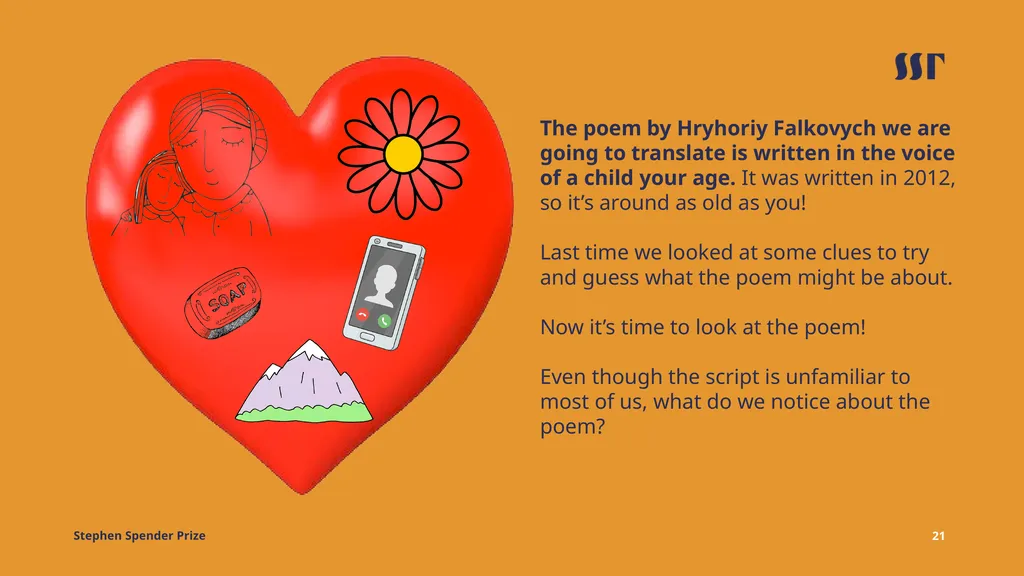
21 The poem by Hryhoriy Falkovych we are going to translate is written in the voice of a child your age. It was written in 2012, so it’s around as old as you!
Last time we looked at some clues to try and guess what the poem might be about.
Now it’s time to look at the poem!
Even though the script is unfamiliar to most of us, what do we notice about the poem?<br>
Last time we looked at some clues to try and guess what the poem might be about.
Now it’s time to look at the poem!
Even though the script is unfamiliar to most of us, what do we notice about the poem?<br>
22
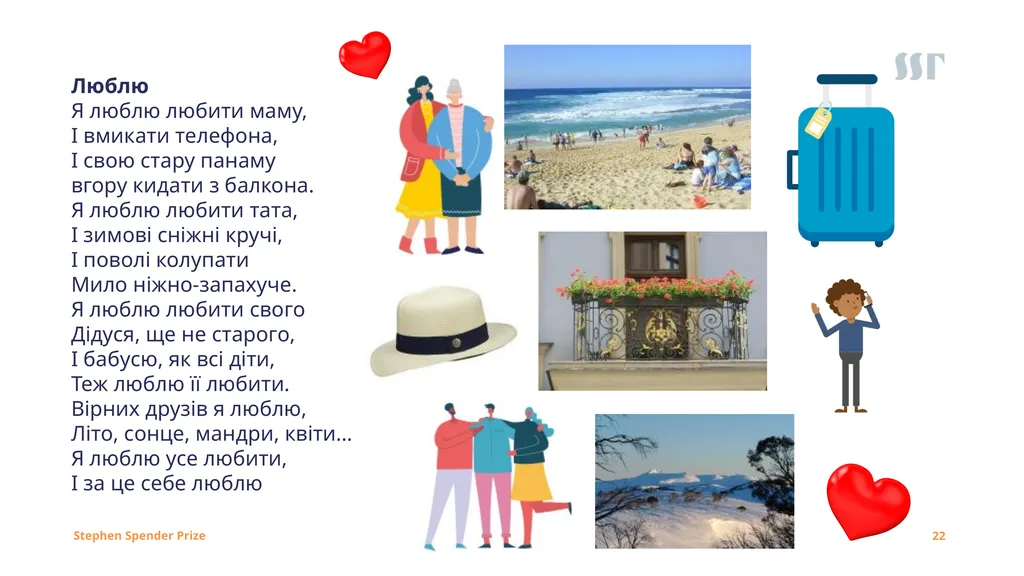
22 Люблю
Я люблю любити маму,
І вмикати телефона,
І свою стару панаму
вгору кидати з балкона.
Я люблю любити тата,
І зимові сніжні кручі,
І поволі колупати
Мило ніжно-запахуче.
Я люблю любити свого
Дідуся, ще не старого,
І бабусю, як всі діти,
Теж люблю її любити.
Вірних друзів я люблю,
Літо, сонце, мандри, квіти…
Я люблю усе любити,
І за це себе люблю<br>
Я люблю любити маму,
І вмикати телефона,
І свою стару панаму
вгору кидати з балкона.
Я люблю любити тата,
І зимові сніжні кручі,
І поволі колупати
Мило ніжно-запахуче.
Я люблю любити свого
Дідуся, ще не старого,
І бабусю, як всі діти,
Теж люблю її любити.
Вірних друзів я люблю,
Літо, сонце, мандри, квіти…
Я люблю усе любити,
І за це себе люблю<br>
23
To translate the poem, we are going to use the Stephen Spender Trust model of creative translation (don’t worry, we’ll do this step-by-step!): 1.DECODE → 2.TRANSLATE → 3.CREATE Step 1
Look at the poem. Work out what it means word-for-word. We can do this by thinking about any similarities with other languages we know, and by using the provided glossary, a Ukrainian-English dictionary, Google Translate and our Ukrainian speaking friends. Remember the image board to help you think about what is going on in the poem. When you have done this, look at the word order of each line, does it make sense yet?
Step 2
Edit your word-for-word translation. Juggle the words so it makes better sense. Rearrange lines. Change words – find synonyms and better words. How many different ways can you write each line – which sounds best and makes the best sense? Are you going to keep the rhyme?
Step 3
Use your creativity to make the poem sound as natural as possible. Make sure you capture the mood and theme of the original poem. Your translation should sound like an original poem written in English, not like a translation. Experiment to find your favourite version. 23<br>
Look at the poem. Work out what it means word-for-word. We can do this by thinking about any similarities with other languages we know, and by using the provided glossary, a Ukrainian-English dictionary, Google Translate and our Ukrainian speaking friends. Remember the image board to help you think about what is going on in the poem. When you have done this, look at the word order of each line, does it make sense yet?
Step 2
Edit your word-for-word translation. Juggle the words so it makes better sense. Rearrange lines. Change words – find synonyms and better words. How many different ways can you write each line – which sounds best and makes the best sense? Are you going to keep the rhyme?
Step 3
Use your creativity to make the poem sound as natural as possible. Make sure you capture the mood and theme of the original poem. Your translation should sound like an original poem written in English, not like a translation. Experiment to find your favourite version. 23<br>
24
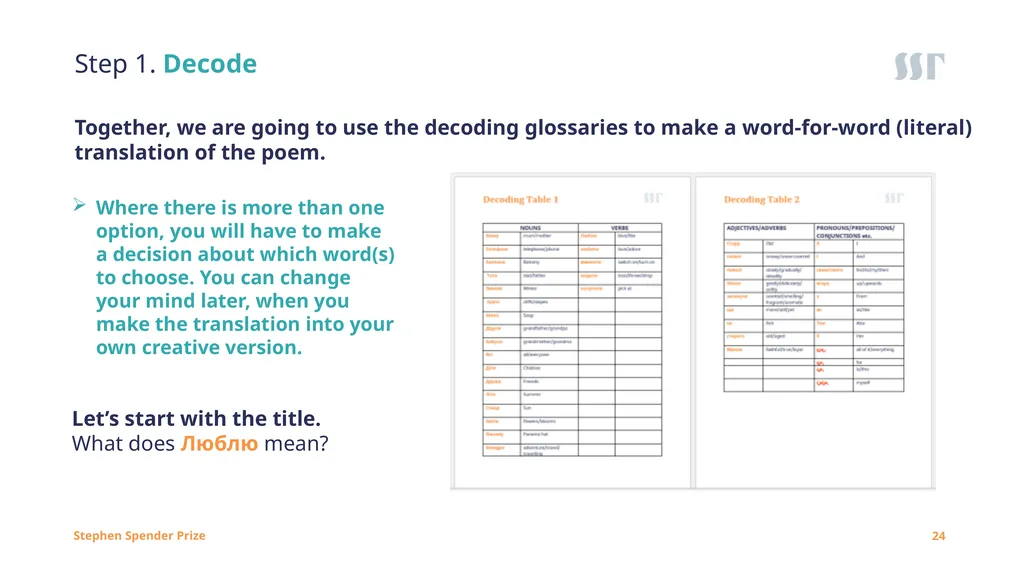
Step 1. Decode 24 Let’s start with the title.
What does Люблю mean? Together, we are going to use the decoding glossaries to make a word-for-word (literal) translation of the poem. Where there is more than one option, you will have to make a decision about which word(s) to choose. You can change your mind later, when you make the translation into your own creative version.<br>
What does Люблю mean? Together, we are going to use the decoding glossaries to make a word-for-word (literal) translation of the poem. Where there is more than one option, you will have to make a decision about which word(s) to choose. You can change your mind later, when you make the translation into your own creative version.<br>
25
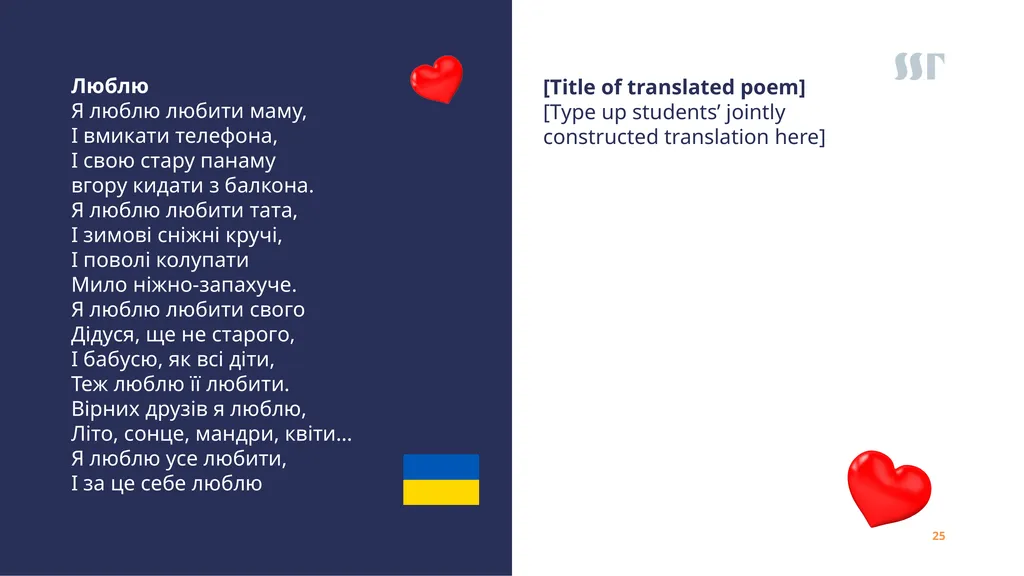
25 Люблю
Я люблю любити маму,
І вмикати телефона,
І свою стару панаму
вгору кидати з балкона.
Я люблю любити тата,
І зимові сніжні кручі,
І поволі колупати
Мило ніжно-запахуче.
Я люблю любити свого
Дідуся, ще не старого,
І бабусю, як всі діти,
Теж люблю її любити.
Вірних друзів я люблю,
Літо, сонце, мандри, квіти…
Я люблю усе любити,
І за це себе люблю [Title of translated poem]
[Type up students’ jointly constructed translation here]<br>
Я люблю любити маму,
І вмикати телефона,
І свою стару панаму
вгору кидати з балкона.
Я люблю любити тата,
І зимові сніжні кручі,
І поволі колупати
Мило ніжно-запахуче.
Я люблю любити свого
Дідуся, ще не старого,
І бабусю, як всі діти,
Теж люблю її любити.
Вірних друзів я люблю,
Літо, сонце, мандри, квіти…
Я люблю усе любити,
І за це себе люблю [Title of translated poem]
[Type up students’ jointly constructed translation here]<br>
26
26 Session Three<br>
27
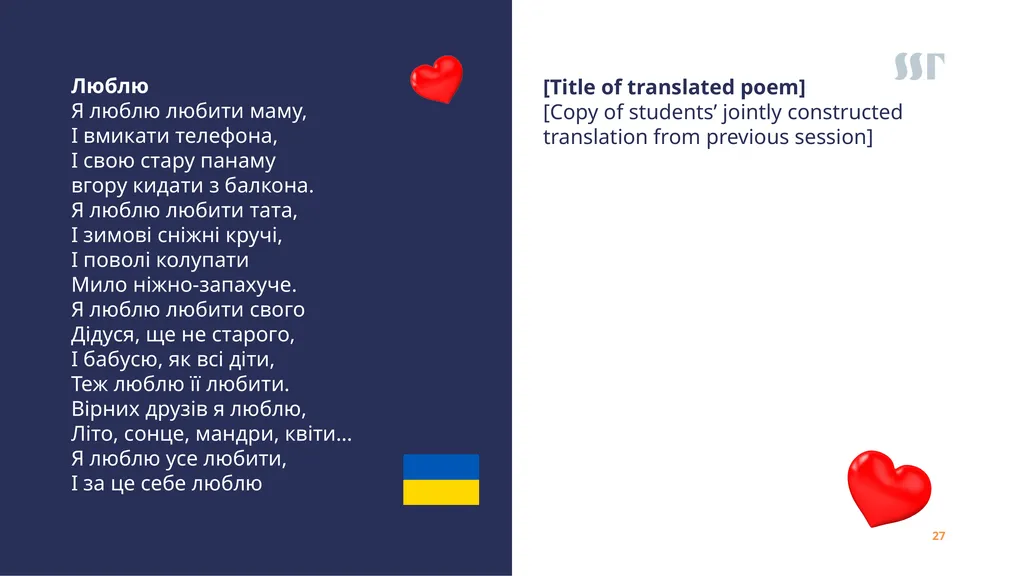
27 Люблю
Я люблю любити маму,
І вмикати телефона,
І свою стару панаму
вгору кидати з балкона.
Я люблю любити тата,
І зимові сніжні кручі,
І поволі колупати
Мило ніжно-запахуче.
Я люблю любити свого
Дідуся, ще не старого,
І бабусю, як всі діти,
Теж люблю її любити.
Вірних друзів я люблю,
Літо, сонце, мандри, квіти…
Я люблю усе любити,
І за це себе люблю [Title of translated poem]
[Copy of students’ jointly constructed translation from previous session]<br>
Я люблю любити маму,
І вмикати телефона,
І свою стару панаму
вгору кидати з балкона.
Я люблю любити тата,
І зимові сніжні кручі,
І поволі колупати
Мило ніжно-запахуче.
Я люблю любити свого
Дідуся, ще не старого,
І бабусю, як всі діти,
Теж люблю її любити.
Вірних друзів я люблю,
Літо, сонце, мандри, квіти…
Я люблю усе любити,
І за це себе люблю [Title of translated poem]
[Copy of students’ jointly constructed translation from previous session]<br>
28
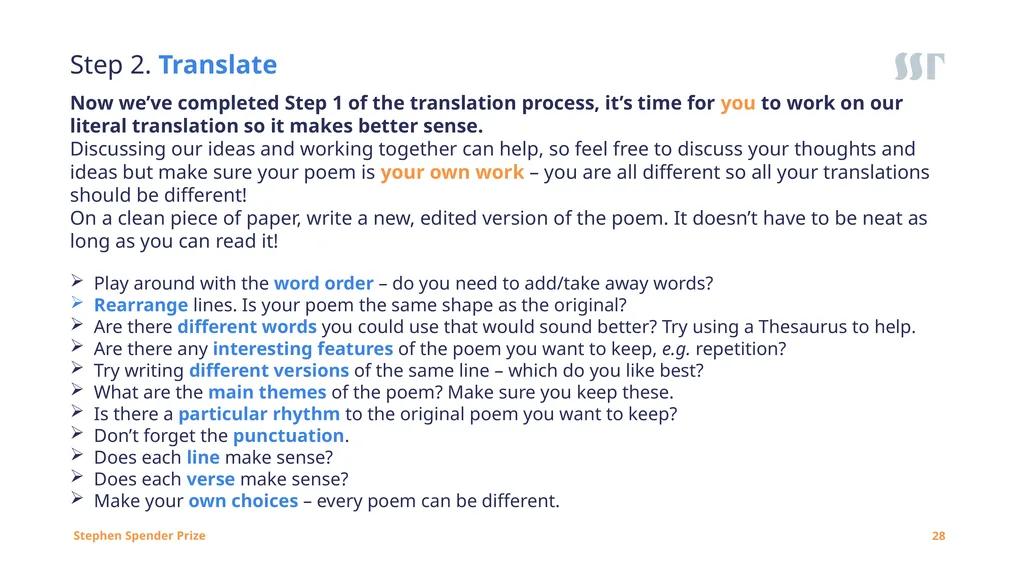
Step 2. Translate Now we’ve completed Step 1 of the translation process, it’s time for you to work on our literal translation so it makes better sense.
Discussing our ideas and working together can help, so feel free to discuss your thoughts and ideas but make sure your poem is your own work – you are all different so all your translations should be different!
On a clean piece of paper, write a new, edited version of the poem. It doesn’t have to be neat as long as you can read it! Play around with the word order – do you need to add/take away words?
Rearrange lines. Is your poem the same shape as the original?
Are there different words you could use that would sound better? Try using a Thesaurus to help.
Are there any interesting features of the poem you want to keep, e.g. repetition?
Try writing different versions of the same line – which do you like best?
What are the main themes of the poem? Make sure you keep these.
Is there a particular rhythm to the original poem you want to keep?
Don’t forget the punctuation.
Does each line make sense?
Does each verse make sense?
Make your own choices – every poem can be different. 28<br>
Discussing our ideas and working together can help, so feel free to discuss your thoughts and ideas but make sure your poem is your own work – you are all different so all your translations should be different!
On a clean piece of paper, write a new, edited version of the poem. It doesn’t have to be neat as long as you can read it! Play around with the word order – do you need to add/take away words?
Rearrange lines. Is your poem the same shape as the original?
Are there different words you could use that would sound better? Try using a Thesaurus to help.
Are there any interesting features of the poem you want to keep, e.g. repetition?
Try writing different versions of the same line – which do you like best?
What are the main themes of the poem? Make sure you keep these.
Is there a particular rhythm to the original poem you want to keep?
Don’t forget the punctuation.
Does each line make sense?
Does each verse make sense?
Make your own choices – every poem can be different. 28<br>
29
Люблю
Я люблю любити маму,
І вмикати телефона,
І свою стару панаму
вгору кидати з балкона.
Я люблю любити тата,
І зимові сніжні кручі,
І поволі колупати
Мило ніжно-запахуче.
Я люблю любити свого
Дідуся, ще не старого,
І бабусю, як всі діти,
Теж люблю її любити.
Вірних друзів я люблю,
Літо, сонце, мандри, квіти…
Я люблю усе любити,
І за це себе люблю Step 3. Create Now, try using your creativity to make sure your translation sounds natural, as if is an original poem written in English.
Read it out loud in your group – how does it sound? How does it look on the page? Are you happy or do you want to make some final adjustments?
Remember, your poem does not have to be an exact copy of the original but it should make the listener feel the same way when they hear it. It should contain the same ideas and themes but you can express these a little differently if you want – just make sure the words you choose fit in with the tone of the original poem. Write out your final draft. You have reached the final stage!
You should have a translated poem in front of you. You’ve kept the meaning of the original poem but edited it so it makes sense. You’ve experimented with different word orders, made word choices and possibly rearranged lines. 29<br>
Я люблю любити маму,
І вмикати телефона,
І свою стару панаму
вгору кидати з балкона.
Я люблю любити тата,
І зимові сніжні кручі,
І поволі колупати
Мило ніжно-запахуче.
Я люблю любити свого
Дідуся, ще не старого,
І бабусю, як всі діти,
Теж люблю її любити.
Вірних друзів я люблю,
Літо, сонце, мандри, квіти…
Я люблю усе любити,
І за це себе люблю Step 3. Create Now, try using your creativity to make sure your translation sounds natural, as if is an original poem written in English.
Read it out loud in your group – how does it sound? How does it look on the page? Are you happy or do you want to make some final adjustments?
Remember, your poem does not have to be an exact copy of the original but it should make the listener feel the same way when they hear it. It should contain the same ideas and themes but you can express these a little differently if you want – just make sure the words you choose fit in with the tone of the original poem. Write out your final draft. You have reached the final stage!
You should have a translated poem in front of you. You’ve kept the meaning of the original poem but edited it so it makes sense. You’ve experimented with different word orders, made word choices and possibly rearranged lines. 29<br>
30
30 Session Four<br>
31
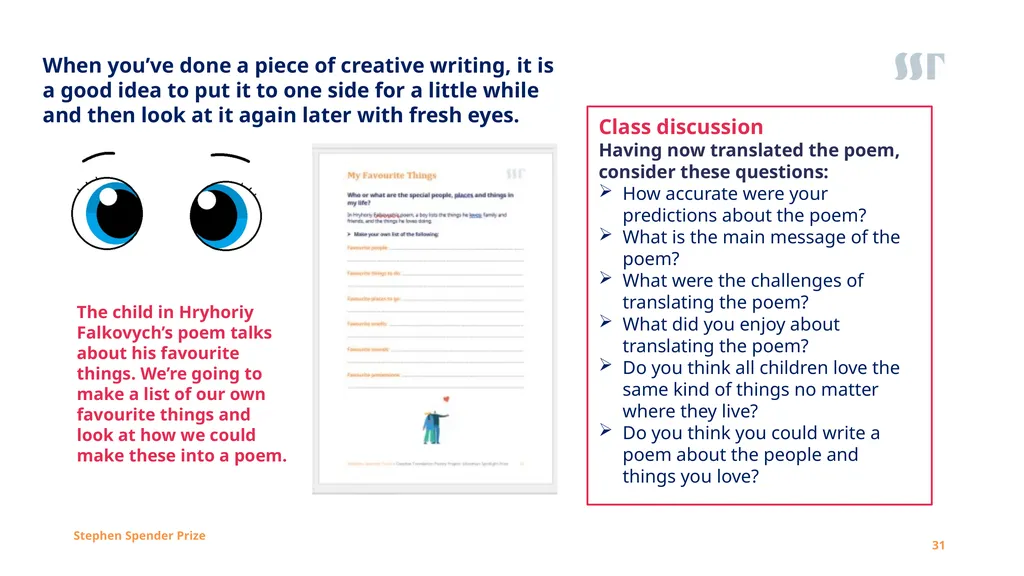
Class discussion
Having now translated the poem, consider these questions:
How accurate were your predictions about the poem?
What is the main message of the poem?
What were the challenges of translating the poem?
What did you enjoy about translating the poem?
Do you think all children love the same kind of things no matter where they live?
Do you think you could write a poem about the people and things you love? When you’ve done a piece of creative writing, it is a good idea to put it to one side for a little while and then look at it again later with fresh eyes. The child in Hryhoriy Falkovych’s poem talks about his favourite things. We’re going to make a list of our own favourite things and look at how we could make these into a poem. 31<br>
Having now translated the poem, consider these questions:
How accurate were your predictions about the poem?
What is the main message of the poem?
What were the challenges of translating the poem?
What did you enjoy about translating the poem?
Do you think all children love the same kind of things no matter where they live?
Do you think you could write a poem about the people and things you love? When you’ve done a piece of creative writing, it is a good idea to put it to one side for a little while and then look at it again later with fresh eyes. The child in Hryhoriy Falkovych’s poem talks about his favourite things. We’re going to make a list of our own favourite things and look at how we could make these into a poem. 31<br>
32
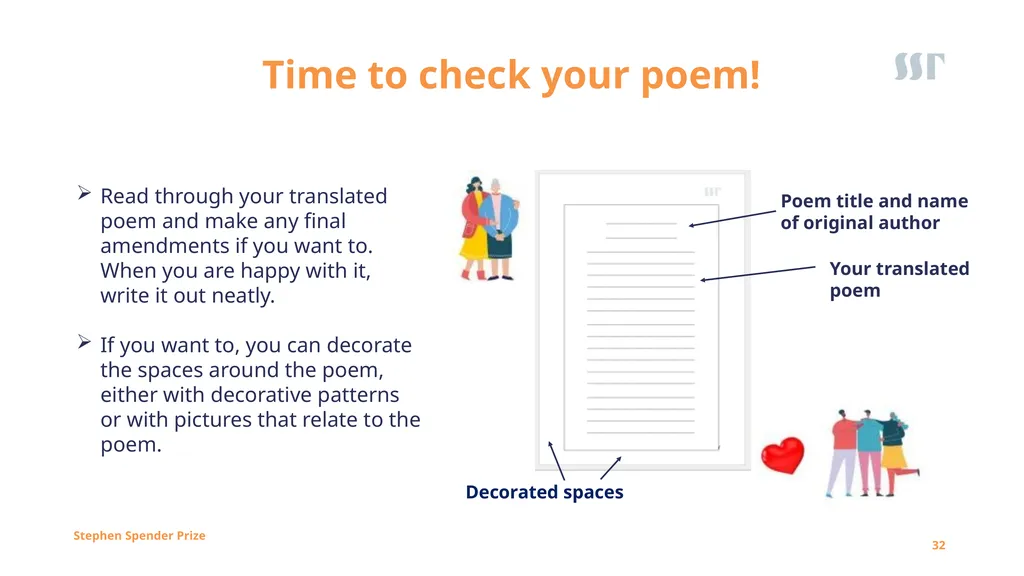
Read through your translated poem and make any final amendments if you want to. When you are happy with it, write it out neatly.
If you want to, you can decorate the spaces around the poem, either with decorative patterns or with pictures that relate to the poem. Time to check your poem! 32<br>
If you want to, you can decorate the spaces around the poem, either with decorative patterns or with pictures that relate to the poem. Time to check your poem! 32<br>
33
Commentary The rules of the Stephen Spender Spotlight Prize state that each entrant must:
submit either a short written or video/audio commentary (max. 300 words / 1 min) or any one of the commentary alternatives. Your choices are:
A written or spoken commentary on your experience of translating the poem.
An artwork (relating to the poem).
A piece of creative writing (relating to the poem). Let’s look at what each of these involves and then you can decide.
Think about what your strengths are as well as which you would enjoy doing.
Remember, the judges will be looking at this as well as your translation, so it needs to be your best work. 33<br>
submit either a short written or video/audio commentary (max. 300 words / 1 min) or any one of the commentary alternatives. Your choices are:
A written or spoken commentary on your experience of translating the poem.
An artwork (relating to the poem).
A piece of creative writing (relating to the poem). Let’s look at what each of these involves and then you can decide.
Think about what your strengths are as well as which you would enjoy doing.
Remember, the judges will be looking at this as well as your translation, so it needs to be your best work. 33<br>
34
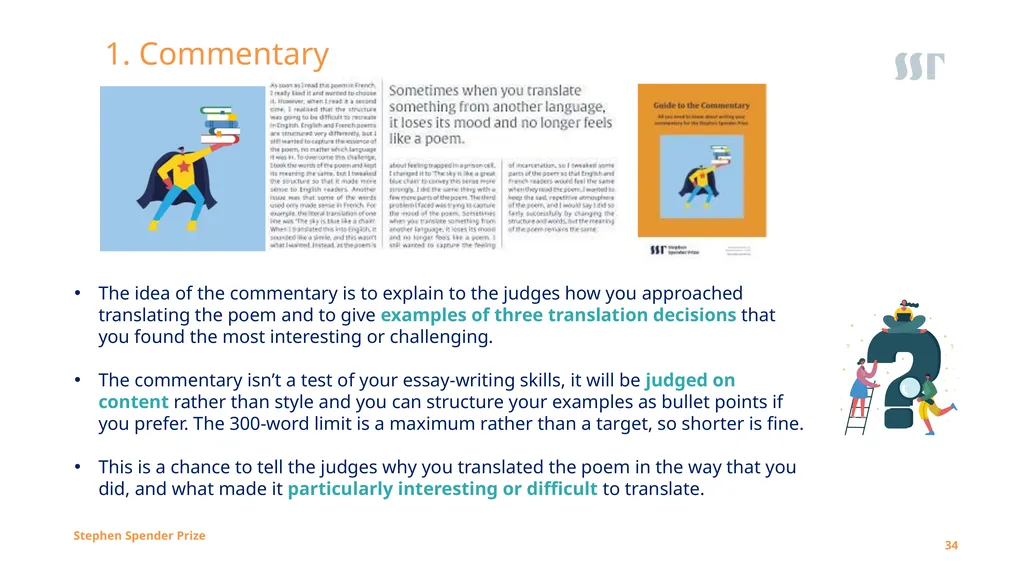
1. Commentary The idea of the commentary is to explain to the judges how you approached translating the poem and to give examples of three translation decisions that you found the most interesting or challenging.
The commentary isn’t a test of your essay-writing skills, it will be judged on content rather than style and you can structure your examples as bullet points if you prefer. The 300-word limit is a maximum rather than a target, so shorter is fine.
This is a chance to tell the judges why you translated the poem in the way that you did, and what made it particularly interesting or difficult to translate. 34<br>
The commentary isn’t a test of your essay-writing skills, it will be judged on content rather than style and you can structure your examples as bullet points if you prefer. The 300-word limit is a maximum rather than a target, so shorter is fine.
This is a chance to tell the judges why you translated the poem in the way that you did, and what made it particularly interesting or difficult to translate. 34<br>
35
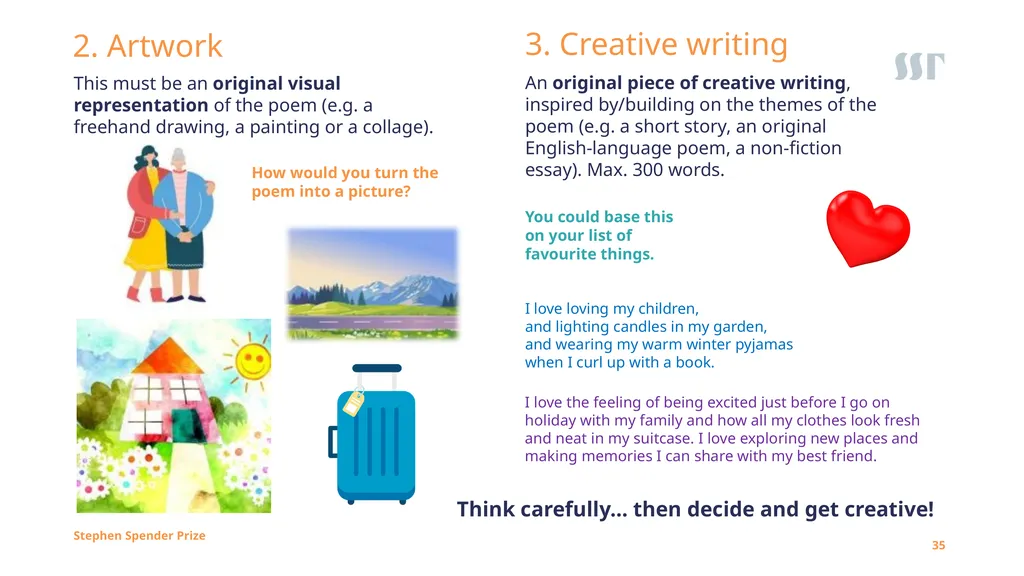
2. Artwork This must be an original visual representation of the poem (e.g. a freehand drawing, a painting or a collage). How would you turn the poem into a picture? 3. Creative writing An original piece of creative writing, inspired by/building on the themes of the poem (e.g. a short story, an original English-language poem, a non-fiction essay). Max. 300 words. You could base this on your list of favourite things. I love loving my children,
and lighting candles in my garden,
and wearing my warm winter pyjamas
when I curl up with a book. I love the feeling of being excited just before I go on holiday with my family and how all my clothes look fresh and neat in my suitcase. I love exploring new places and making memories I can share with my best friend. Think carefully... then decide and get creative! 35<br>
and lighting candles in my garden,
and wearing my warm winter pyjamas
when I curl up with a book. I love the feeling of being excited just before I go on holiday with my family and how all my clothes look fresh and neat in my suitcase. I love exploring new places and making memories I can share with my best friend. Think carefully... then decide and get creative! 35<br>