
1 STANDING COMMITTEE ON APPROPRIATIONS NATIONAL
DJ
Published · 32 slides · 0 views

1 / 1
Description
1 STANDING COMMITTEE ON APPROPRIATIONS NATIONAL DEPARTMENT OF HEALTH Date: 17 July 2020 COVID-19 Special Adjustments Budget Background National Department of Health (NDoH) preliminary Costed Plan (budgetary implications) submitted to
Related Topics
Share
Embed code
Download this presentation From Below
"1 STANDING COMMITTEE ON APPROPRIATIONS NATIONAL" is the property of its rightful owner. Permission is granted to download and print the materials on this website for personal, non-commercial use only, and to display it on your personal computer provided you do not modify the materials and that you retain all copyright notices contained in the materials. By downloading content from our website, you accept the terms of this agreement.
Presentation Transcript
01
1 STANDING COMMITTEE ON APPROPRIATIONS
NATIONAL DEPARTMENT OF HEALTH Date: 17 July 2020 COVID-19 Special Adjustments Budget<br>
NATIONAL DEPARTMENT OF HEALTH Date: 17 July 2020 COVID-19 Special Adjustments Budget<br>
02
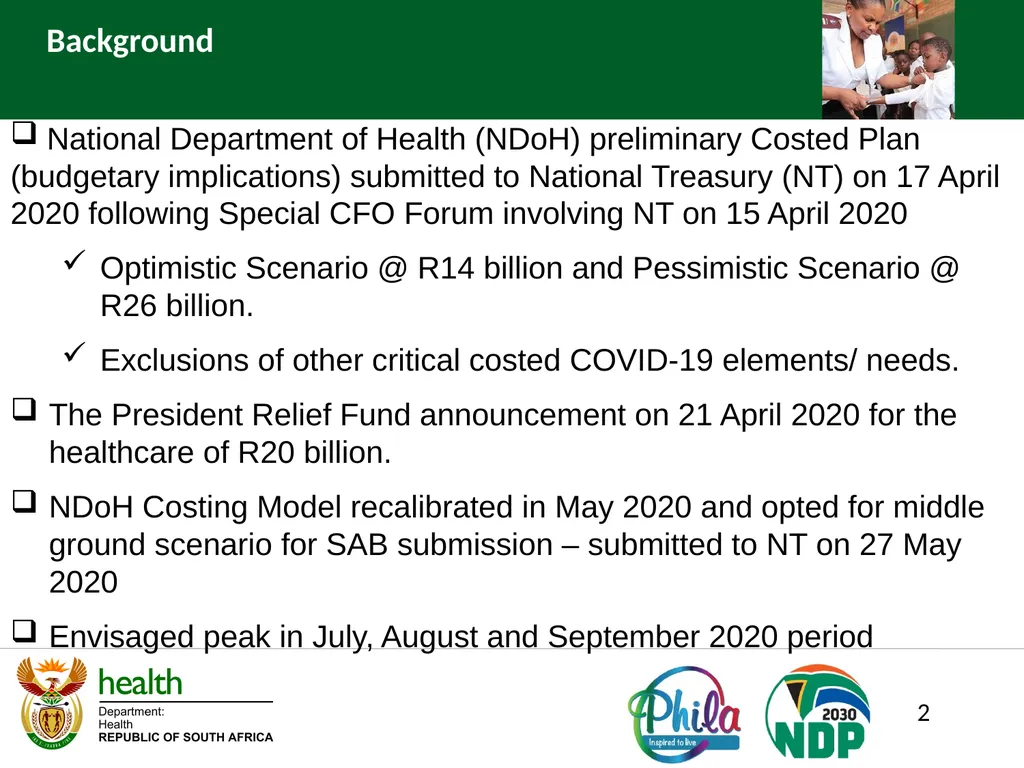
Background National Department of Health (NDoH) preliminary Costed Plan (budgetary implications) submitted to National Treasury (NT) on 17 April 2020 following Special CFO Forum involving NT on 15 April 2020
Optimistic Scenario @ R14 billion and Pessimistic Scenario @ R26 billion.
Exclusions of other critical costed COVID-19 elements/ needs.
The President Relief Fund announcement on 21 April 2020 for the healthcare of R20 billion.
NDoH Costing Model recalibrated in May 2020 and opted for middle ground scenario for SAB submission – submitted to NT on 27 May 2020
Envisaged peak in July, August and September 2020 period 2<br>
Optimistic Scenario @ R14 billion and Pessimistic Scenario @ R26 billion.
Exclusions of other critical costed COVID-19 elements/ needs.
The President Relief Fund announcement on 21 April 2020 for the healthcare of R20 billion.
NDoH Costing Model recalibrated in May 2020 and opted for middle ground scenario for SAB submission – submitted to NT on 27 May 2020
Envisaged peak in July, August and September 2020 period 2<br>
03
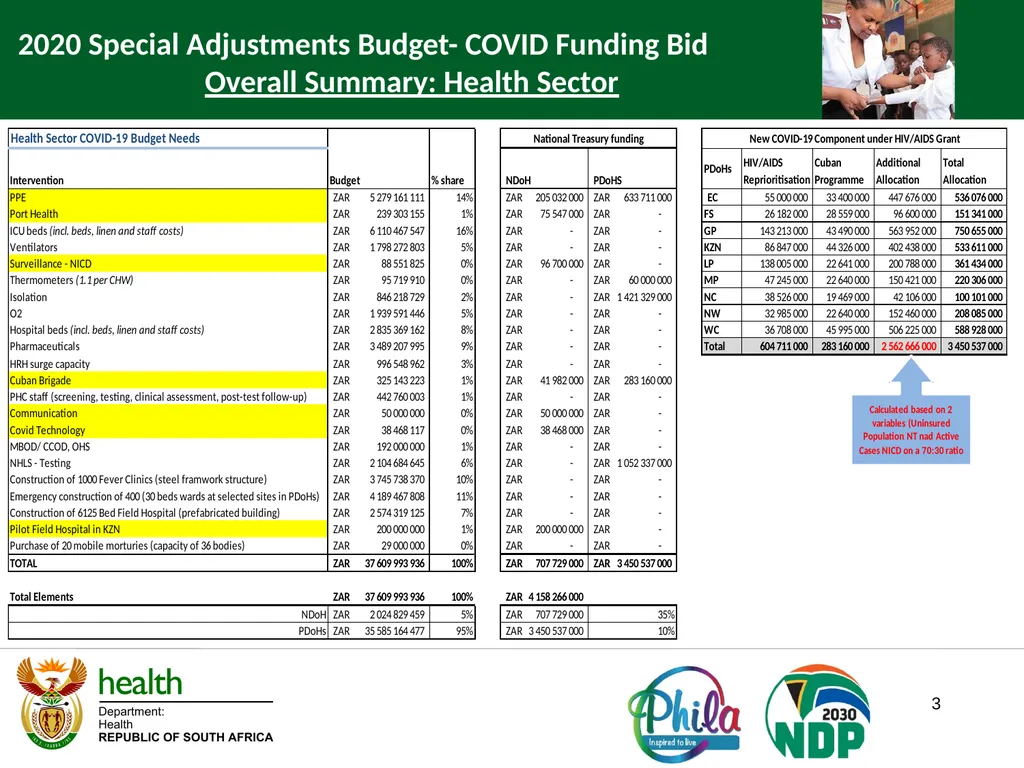
3 2020 Special Adjustments Budget- COVID Funding Bid
Overall Summary: Health Sector<br>
Overall Summary: Health Sector<br>
04
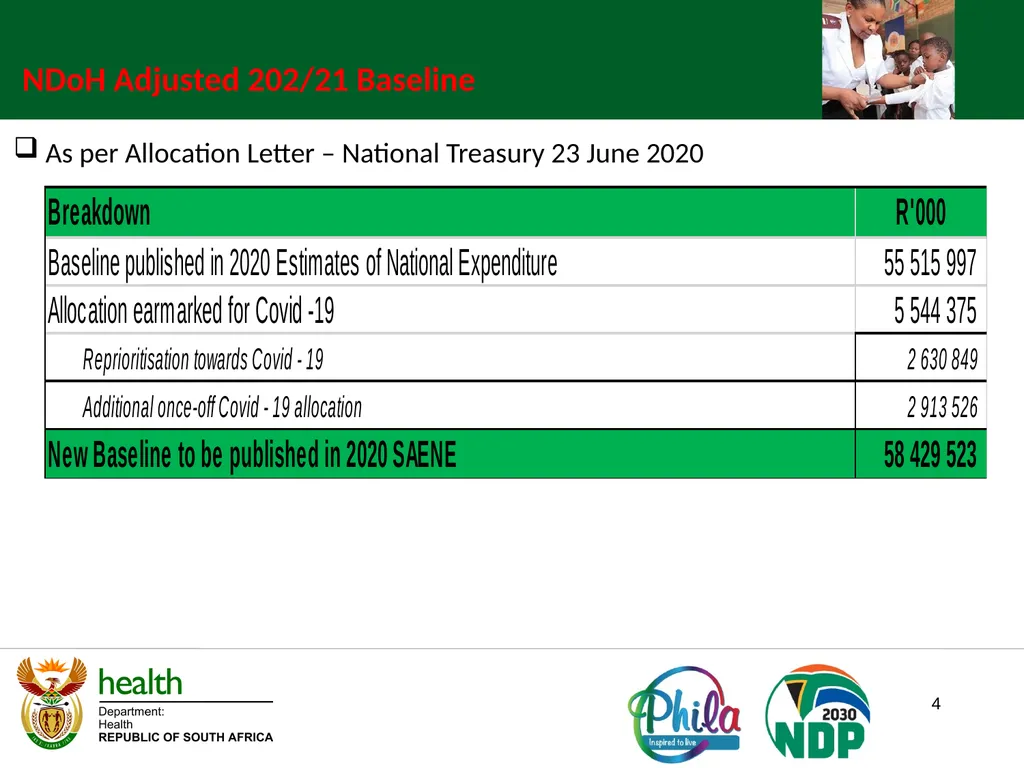
4 NDoH Adjusted 202/21 Baseline As per Allocation Letter – National Treasury 23 June 2020<br>
05
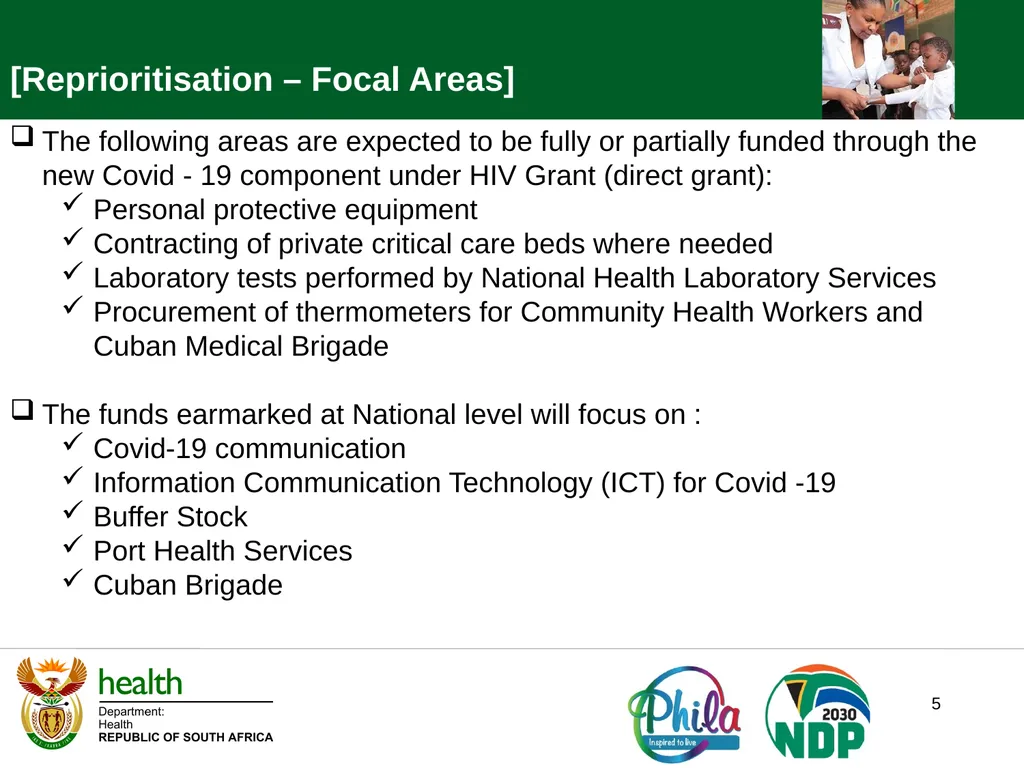
5 [Reprioritisation – Focal Areas] The following areas are expected to be fully or partially funded through the new Covid - 19 component under HIV Grant (direct grant):
Personal protective equipment
Contracting of private critical care beds where needed
Laboratory tests performed by National Health Laboratory Services
Procurement of thermometers for Community Health Workers and Cuban Medical Brigade
The funds earmarked at National level will focus on :
Covid-19 communication
Information Communication Technology (ICT) for Covid -19
Buffer Stock
Port Health Services
Cuban Brigade<br>
Personal protective equipment
Contracting of private critical care beds where needed
Laboratory tests performed by National Health Laboratory Services
Procurement of thermometers for Community Health Workers and Cuban Medical Brigade
The funds earmarked at National level will focus on :
Covid-19 communication
Information Communication Technology (ICT) for Covid -19
Buffer Stock
Port Health Services
Cuban Brigade<br>
06
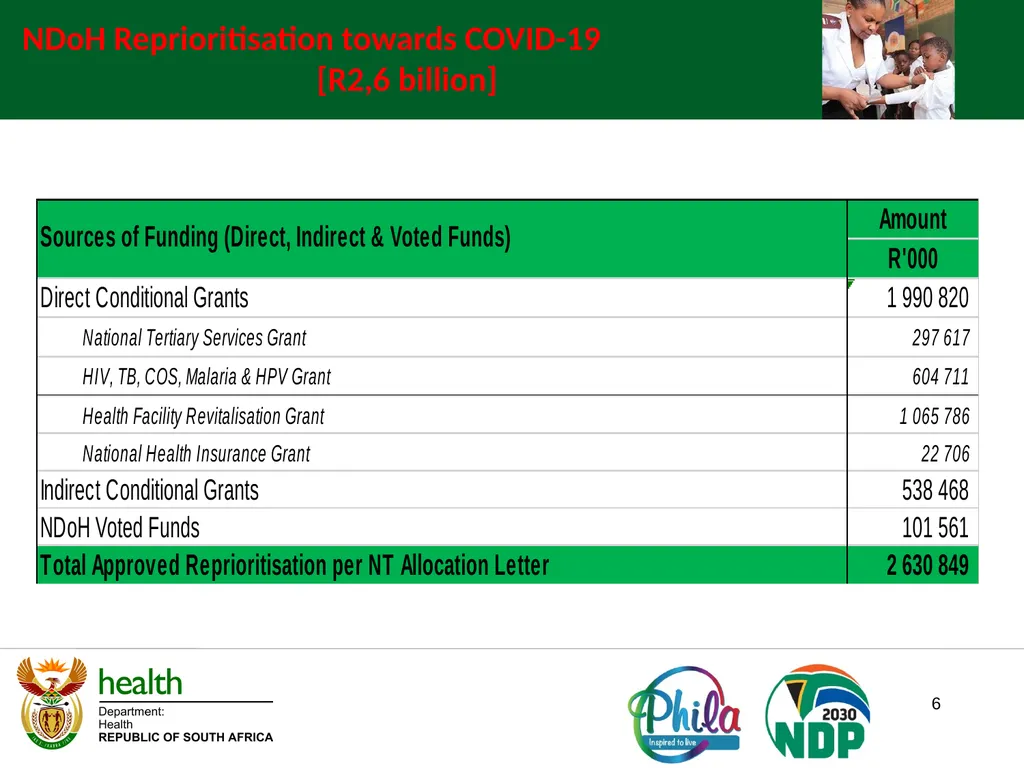
6 NDoH Reprioritisation towards COVID-19
[R2,6 billion]<br>
[R2,6 billion]<br>
07
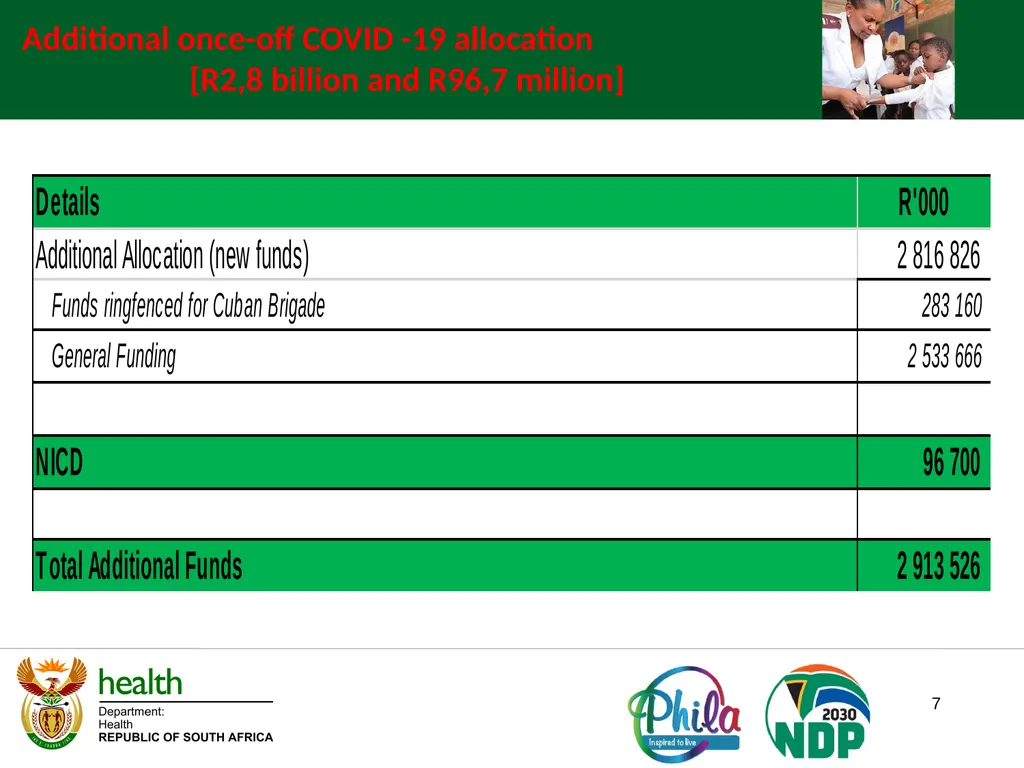
7 Additional once-off COVID -19 allocation
[R2,8 billion and R96,7 million]<br>
[R2,8 billion and R96,7 million]<br>
08
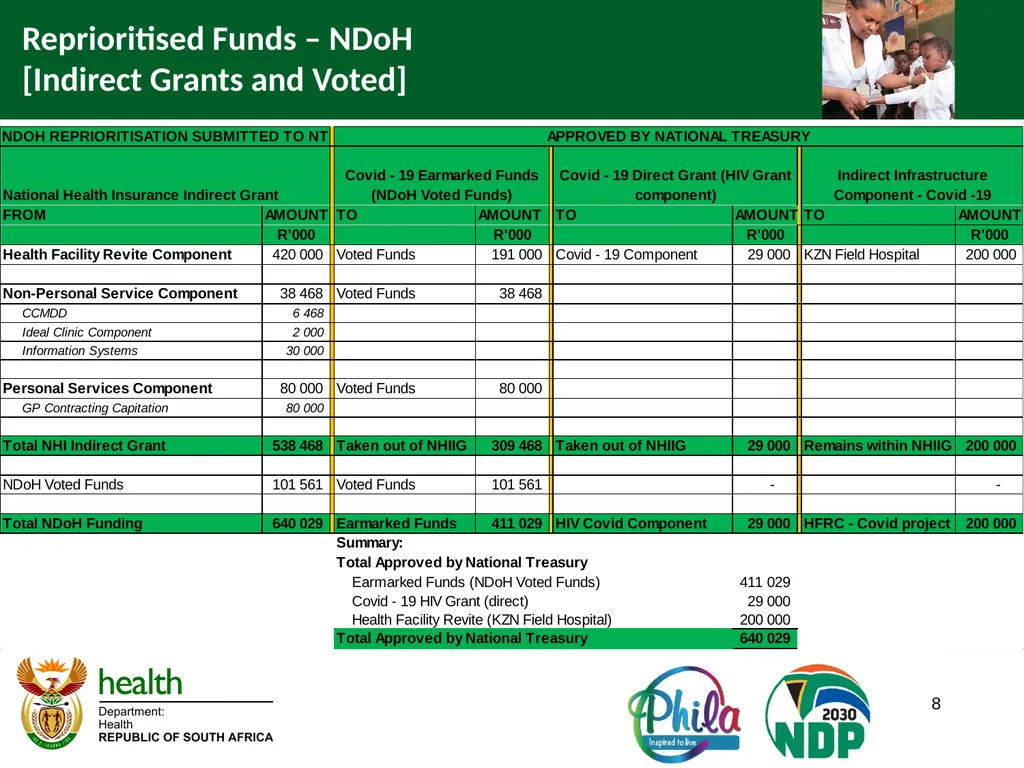
8 Reprioritised Funds – NDoH
[Indirect Grants and Voted]<br>
[Indirect Grants and Voted]<br>
09
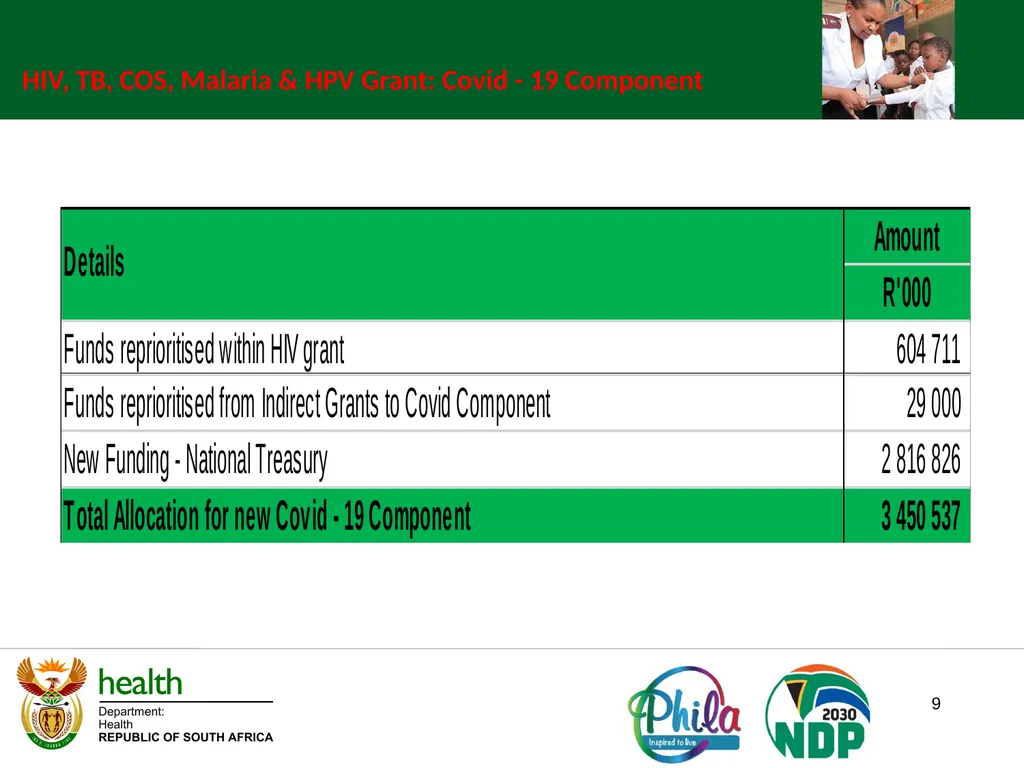
9 HIV, TB, COS, Malaria & HPV Grant: Covid - 19 Component<br>
10
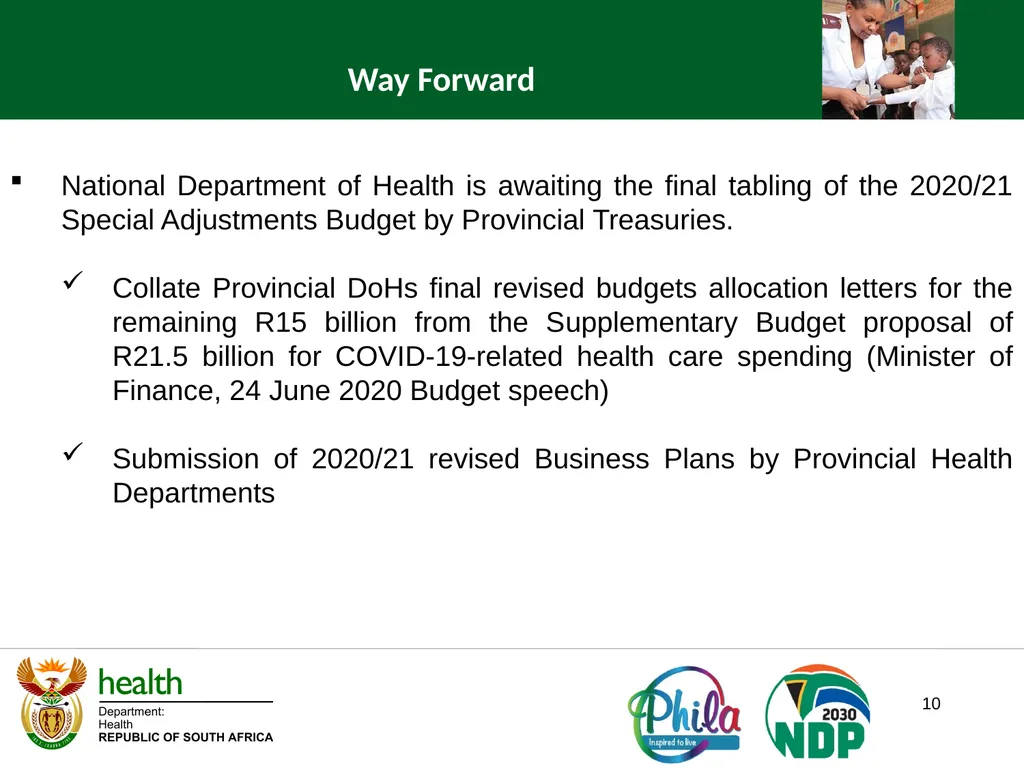
10 Way Forward National Department of Health is awaiting the final tabling of the 2020/21 Special Adjustments Budget by Provincial Treasuries.
Collate Provincial DoHs final revised budgets allocation letters for the remaining R15 billion from the Supplementary Budget proposal of R21.5 billion for COVID‐19‐related health care spending (Minister of Finance, 24 June 2020 Budget speech)
Submission of 2020/21 revised Business Plans by Provincial Health Departments<br>
Collate Provincial DoHs final revised budgets allocation letters for the remaining R15 billion from the Supplementary Budget proposal of R21.5 billion for COVID‐19‐related health care spending (Minister of Finance, 24 June 2020 Budget speech)
Submission of 2020/21 revised Business Plans by Provincial Health Departments<br>
11
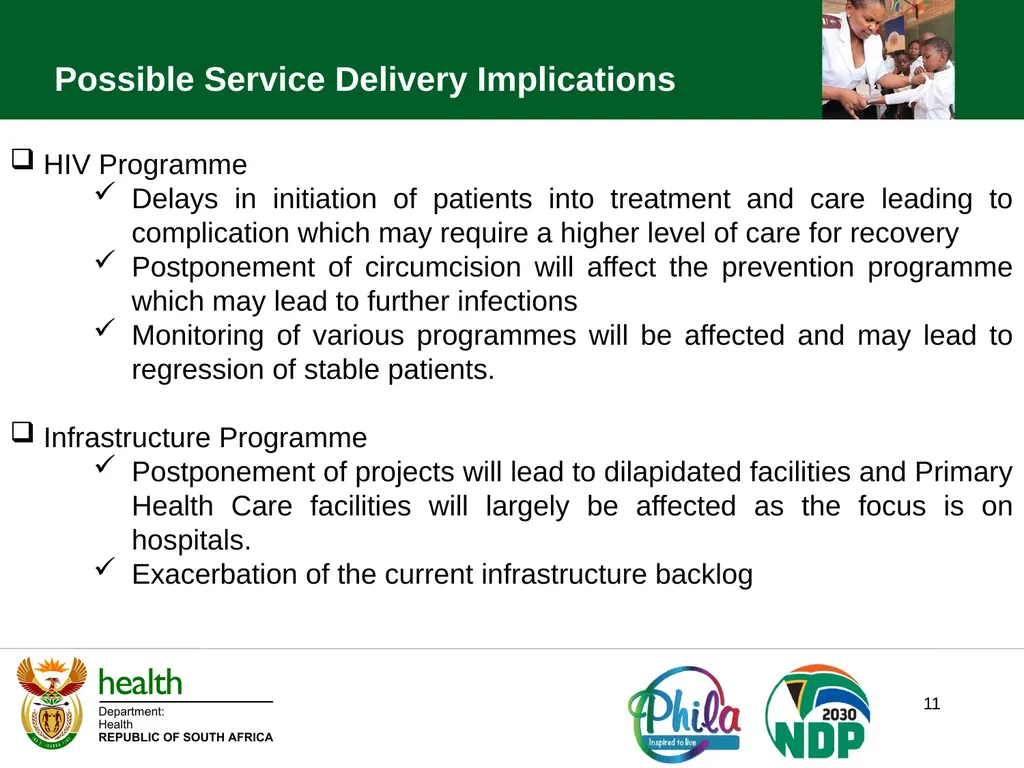
11 Possible Service Delivery Implications HIV Programme
Delays in initiation of patients into treatment and care leading to complication which may require a higher level of care for recovery
Postponement of circumcision will affect the prevention programme which may lead to further infections
Monitoring of various programmes will be affected and may lead to regression of stable patients.
Infrastructure Programme
Postponement of projects will lead to dilapidated facilities and Primary Health Care facilities will largely be affected as the focus is on hospitals.
Exacerbation of the current infrastructure backlog<br>
Delays in initiation of patients into treatment and care leading to complication which may require a higher level of care for recovery
Postponement of circumcision will affect the prevention programme which may lead to further infections
Monitoring of various programmes will be affected and may lead to regression of stable patients.
Infrastructure Programme
Postponement of projects will lead to dilapidated facilities and Primary Health Care facilities will largely be affected as the focus is on hospitals.
Exacerbation of the current infrastructure backlog<br>
12
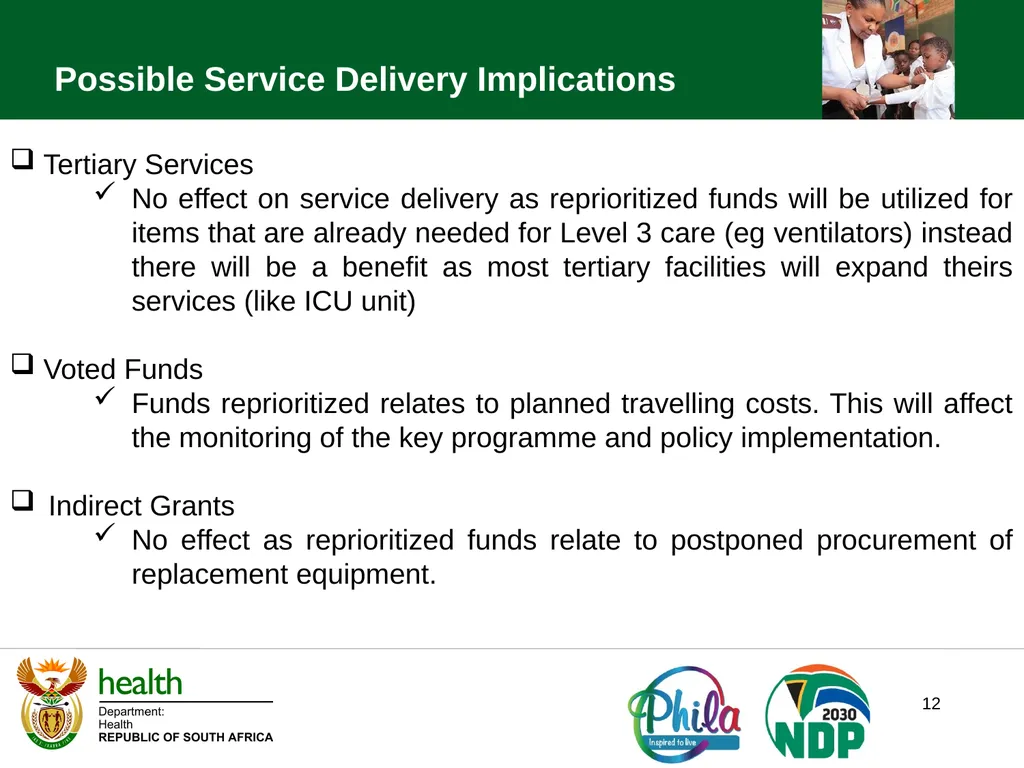
12 Possible Service Delivery Implications Tertiary Services
No effect on service delivery as reprioritized funds will be utilized for items that are already needed for Level 3 care (eg ventilators) instead there will be a benefit as most tertiary facilities will expand theirs services (like ICU unit)
Voted Funds
Funds reprioritized relates to planned travelling costs. This will affect the monitoring of the key programme and policy implementation.
Indirect Grants
No effect as reprioritized funds relate to postponed procurement of replacement equipment.<br>
No effect on service delivery as reprioritized funds will be utilized for items that are already needed for Level 3 care (eg ventilators) instead there will be a benefit as most tertiary facilities will expand theirs services (like ICU unit)
Voted Funds
Funds reprioritized relates to planned travelling costs. This will affect the monitoring of the key programme and policy implementation.
Indirect Grants
No effect as reprioritized funds relate to postponed procurement of replacement equipment.<br>
13
13 Measures to ensure Effective Efficient Economical use of Resources There is a grant framework for Covid-19 guiding provinces on utilization of
the funds
The provinces are in process of developing Business Plans and these will be
reviewed for alignment with grant framework and
performance will be monitored to ensure adherence to the plans
In-Year-Monitoring (IYM) and variance reports will be utilized as monitoring
tools
Grant reviews will be conducted with provincial departments and with
National Treasury in terms of the Division of Revenue Act
Internal Audit will further perform tests to ensure validity of transactions,
value for money and compliance.<br>
the funds
The provinces are in process of developing Business Plans and these will be
reviewed for alignment with grant framework and
performance will be monitored to ensure adherence to the plans
In-Year-Monitoring (IYM) and variance reports will be utilized as monitoring
tools
Grant reviews will be conducted with provincial departments and with
National Treasury in terms of the Division of Revenue Act
Internal Audit will further perform tests to ensure validity of transactions,
value for money and compliance.<br>
14
14 Mitigating strategies for continue Service Delivery There are general savings in Q1 due to reduction of headcounts – patients refraining to visit facilities for fear of Covid-19 infection.
Certain services that were suspended due to increased Covid - 19 cases are gradually being opened to ensure continued services. This is also to avoid
patients regressing leading to increased number of mortalities
costs implications of dealing with complications as these cases are referred to higher levels of care for treatment.
To focus on basic infrastructure maintenance to keep an acceptable
condition of the facility<br>
Certain services that were suspended due to increased Covid - 19 cases are gradually being opened to ensure continued services. This is also to avoid
patients regressing leading to increased number of mortalities
costs implications of dealing with complications as these cases are referred to higher levels of care for treatment.
To focus on basic infrastructure maintenance to keep an acceptable
condition of the facility<br>
15
15 Broad Based Black Empowerment The National Department of Health is currently using Preferential Procurement Policy Framework Act, Act 5 of 2000 with its related revised Preferential Procurement Policy Framework Regulations of 2017, which incorporate Broad-Based Black Economic Empowerment by allocating preference points to companies/service providers according to their level of BEE status as indicated and verified by BEE accredited Verifying agencies South African National Accreditation System (SANAS).
Another strategy used by National Department of Health to advance BBBE empowerment is by using empowerment clauses entrenched in Preferential Procurement Policy Framework Act 5 of 2017 which allows the government departments to prequalify bidders to advance designated groups such as Women, youth, military veterans, companies that are 100% owned by designated groups or where the designated groups are in majority shares and designated groups whose business operates from the rural areas.<br>
Another strategy used by National Department of Health to advance BBBE empowerment is by using empowerment clauses entrenched in Preferential Procurement Policy Framework Act 5 of 2017 which allows the government departments to prequalify bidders to advance designated groups such as Women, youth, military veterans, companies that are 100% owned by designated groups or where the designated groups are in majority shares and designated groups whose business operates from the rural areas.<br>
16
Summary of Non-financial Information: Actions Taken to Improve Performance and APP 2020/21 Revision.<br>
17
Programme 2:
3 381 731 patients enrolled for receiving medicines through the CCMDD programme (cumulative)
3300 clinics; 378 hospitals; 94 other medicine storage sites reporting to the surveillance centre Surveillance system for monitoring resistance accessible to 6 provincial DoH
Early warning system for medicine stockouts implemented
25 facilities with automated ePrescription and eDispensing system implemented
Electronic medicine catalogue implemented
A comprehensive package for District hospitals has been finalized
45 164 501 individuals from the population registered on the NHI Patient Beneficiary Registry
Programme 3
1 Provincial Malaria Elimination Implementation Plan Developed
18 929 648 HIV tests done
Quality Improvement Plans (QIPs) developed; QIPs of 11 regional hospitals implemented
2187 patients receiving radiation oncology
43 076 undiagnosed TB infected persons (new cases) found
5 districts with multidisciplinary rehabilitation teams established
Programme 4
4 DHMO Improvement Plans developed for an additional 4 districts
1906 PHC facilities achieved ideal clinic status
32 District Hospitals conducted ideal hospital baseline assessment
Report and revised EMS improvement plans submitted to DG and disseminated to 9 provincial Heads of Department
Programme 5
37 facilities compliant with Infrastructure Norms and Standards
100 facilities maintained, repaired and/or refurbished through Equitable Share and HFRG in Districts
Programme 6
The National Digital Health Strategy 2019-2024 was published in the Department of Health website
NHI Phase 1 NHI evaluation results disseminated
100% backlog for blood alcohol tests eliminated
100 % of South African Medical interns and Community service personnel who studied at SA Universities allocated for placement by October
HR Regulations for section 52 of the National Health Act of 2003 drafted
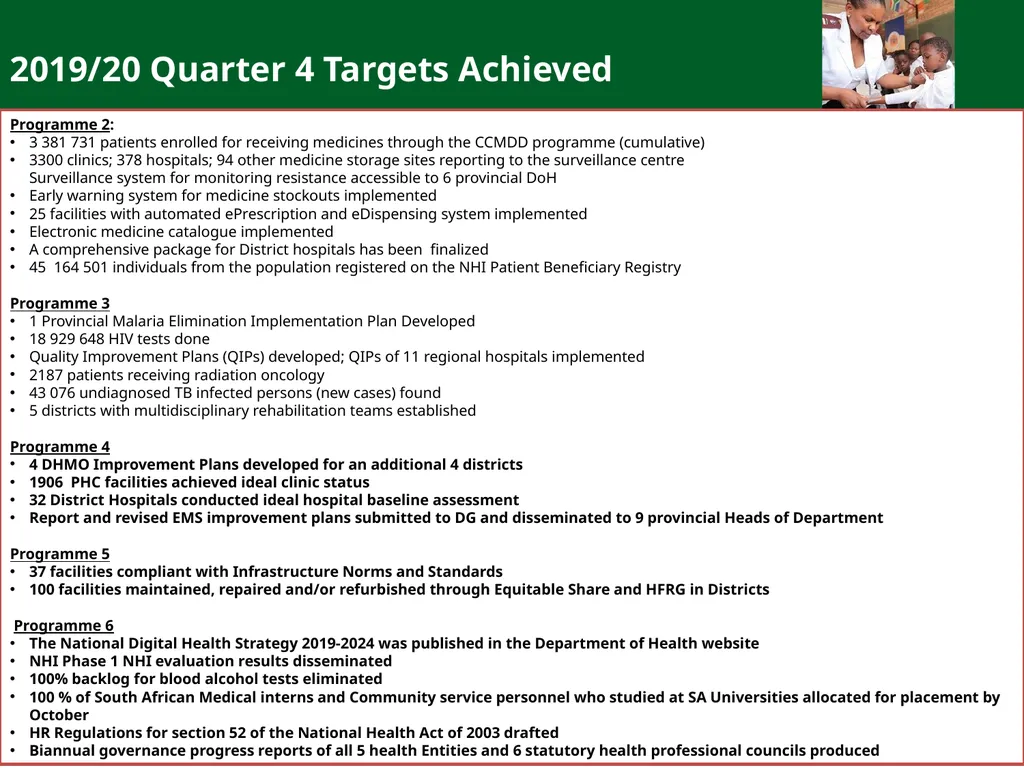
Biannual governance progress reports of all 5 health Entities and 6 statutory health professional councils produced 2019/20 Quarter 4 Targets Achieved<br>
3 381 731 patients enrolled for receiving medicines through the CCMDD programme (cumulative)
3300 clinics; 378 hospitals; 94 other medicine storage sites reporting to the surveillance centre Surveillance system for monitoring resistance accessible to 6 provincial DoH
Early warning system for medicine stockouts implemented
25 facilities with automated ePrescription and eDispensing system implemented
Electronic medicine catalogue implemented
A comprehensive package for District hospitals has been finalized
45 164 501 individuals from the population registered on the NHI Patient Beneficiary Registry
Programme 3
1 Provincial Malaria Elimination Implementation Plan Developed
18 929 648 HIV tests done
Quality Improvement Plans (QIPs) developed; QIPs of 11 regional hospitals implemented
2187 patients receiving radiation oncology
43 076 undiagnosed TB infected persons (new cases) found
5 districts with multidisciplinary rehabilitation teams established
Programme 4
4 DHMO Improvement Plans developed for an additional 4 districts
1906 PHC facilities achieved ideal clinic status
32 District Hospitals conducted ideal hospital baseline assessment
Report and revised EMS improvement plans submitted to DG and disseminated to 9 provincial Heads of Department
Programme 5
37 facilities compliant with Infrastructure Norms and Standards
100 facilities maintained, repaired and/or refurbished through Equitable Share and HFRG in Districts
Programme 6
The National Digital Health Strategy 2019-2024 was published in the Department of Health website
NHI Phase 1 NHI evaluation results disseminated
100% backlog for blood alcohol tests eliminated
100 % of South African Medical interns and Community service personnel who studied at SA Universities allocated for placement by October
HR Regulations for section 52 of the National Health Act of 2003 drafted
Biannual governance progress reports of all 5 health Entities and 6 statutory health professional councils produced 2019/20 Quarter 4 Targets Achieved<br>
18
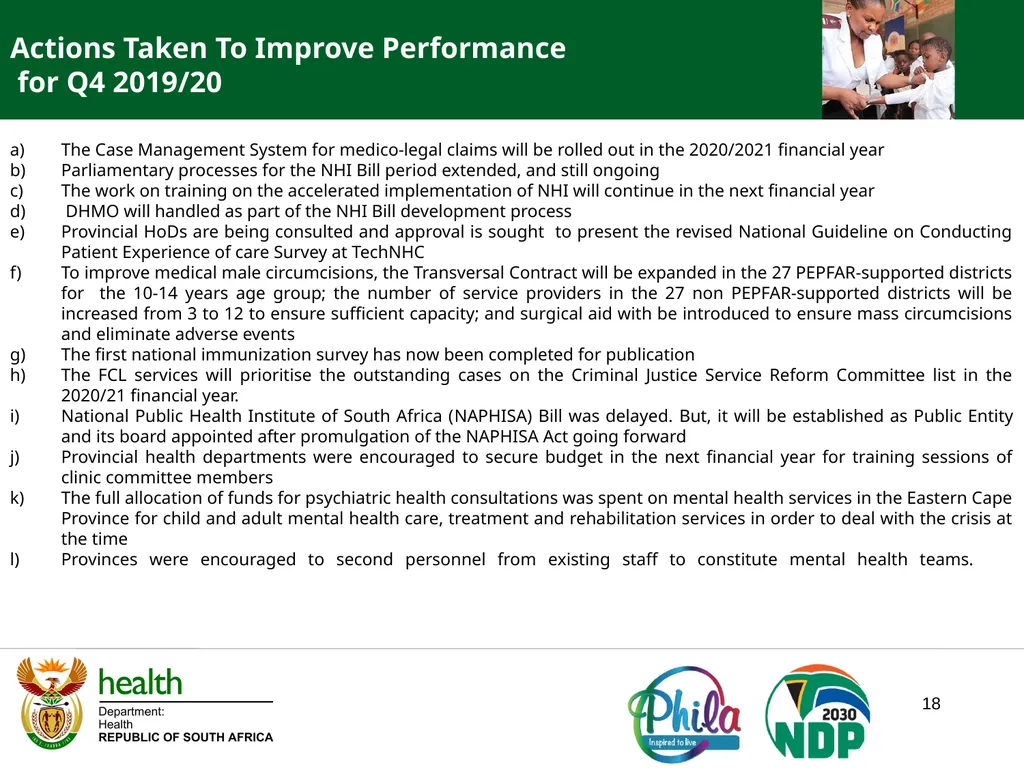
18 Actions Taken To Improve Performance
for Q4 2019/20 The Case Management System for medico-legal claims will be rolled out in the 2020/2021 financial year
Parliamentary processes for the NHI Bill period extended, and still ongoing
The work on training on the accelerated implementation of NHI will continue in the next financial year
DHMO will handled as part of the NHI Bill development process
Provincial HoDs are being consulted and approval is sought to present the revised National Guideline on Conducting Patient Experience of care Survey at TechNHC
To improve medical male circumcisions, the Transversal Contract will be expanded in the 27 PEPFAR-supported districts for the 10-14 years age group; the number of service providers in the 27 non PEPFAR-supported districts will be increased from 3 to 12 to ensure sufficient capacity; and surgical aid with be introduced to ensure mass circumcisions and eliminate adverse events
The first national immunization survey has now been completed for publication
The FCL services will prioritise the outstanding cases on the Criminal Justice Service Reform Committee list in the 2020/21 financial year.
National Public Health Institute of South Africa (NAPHISA) Bill was delayed. But, it will be established as Public Entity and its board appointed after promulgation of the NAPHISA Act going forward
Provincial health departments were encouraged to secure budget in the next financial year for training sessions of clinic committee members
The full allocation of funds for psychiatric health consultations was spent on mental health services in the Eastern Cape Province for child and adult mental health care, treatment and rehabilitation services in order to deal with the crisis at the time
Provinces were encouraged to second personnel from existing staff to constitute mental health teams. me underperformance<br>
for Q4 2019/20 The Case Management System for medico-legal claims will be rolled out in the 2020/2021 financial year
Parliamentary processes for the NHI Bill period extended, and still ongoing
The work on training on the accelerated implementation of NHI will continue in the next financial year
DHMO will handled as part of the NHI Bill development process
Provincial HoDs are being consulted and approval is sought to present the revised National Guideline on Conducting Patient Experience of care Survey at TechNHC
To improve medical male circumcisions, the Transversal Contract will be expanded in the 27 PEPFAR-supported districts for the 10-14 years age group; the number of service providers in the 27 non PEPFAR-supported districts will be increased from 3 to 12 to ensure sufficient capacity; and surgical aid with be introduced to ensure mass circumcisions and eliminate adverse events
The first national immunization survey has now been completed for publication
The FCL services will prioritise the outstanding cases on the Criminal Justice Service Reform Committee list in the 2020/21 financial year.
National Public Health Institute of South Africa (NAPHISA) Bill was delayed. But, it will be established as Public Entity and its board appointed after promulgation of the NAPHISA Act going forward
Provincial health departments were encouraged to secure budget in the next financial year for training sessions of clinic committee members
The full allocation of funds for psychiatric health consultations was spent on mental health services in the Eastern Cape Province for child and adult mental health care, treatment and rehabilitation services in order to deal with the crisis at the time
Provinces were encouraged to second personnel from existing staff to constitute mental health teams. me underperformance<br>
19
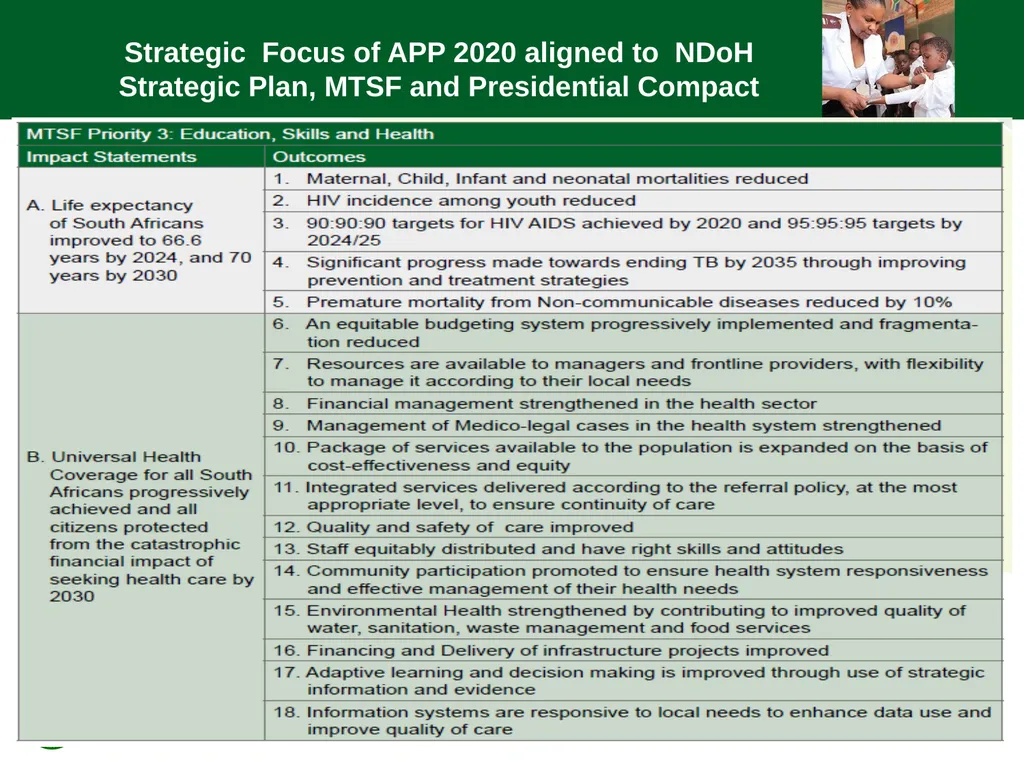
Strategic Focus of APP 2020 aligned to NDoH Strategic Plan, MTSF and Presidential Compact<br>
20
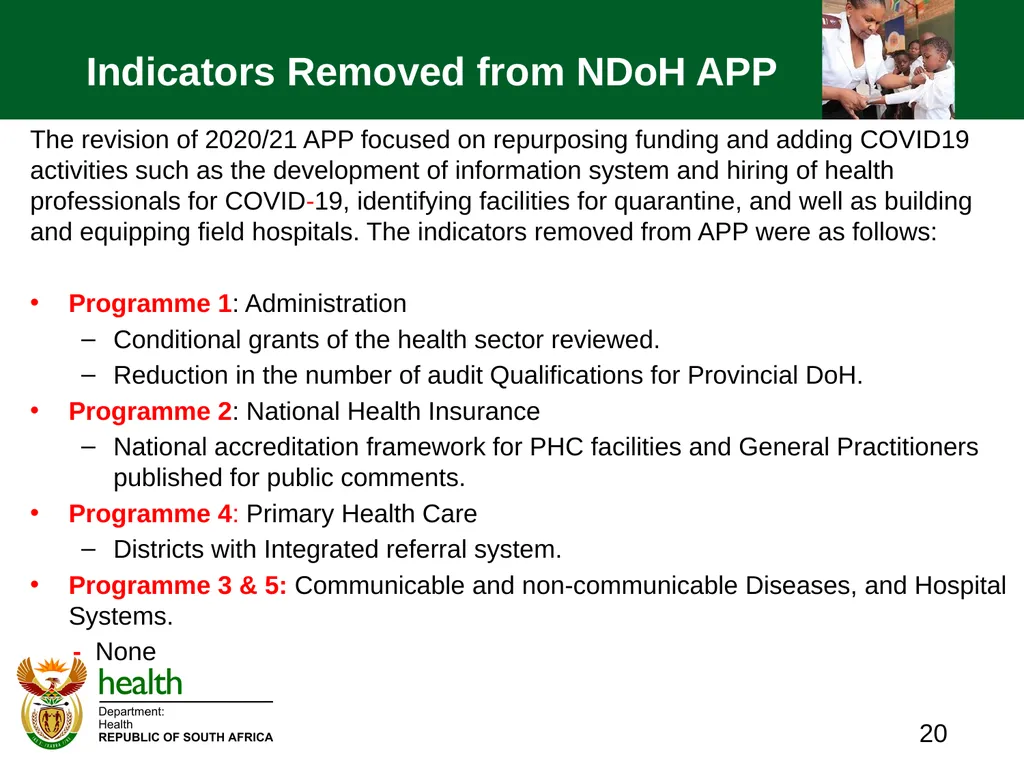
Indicators Removed from NDoH APP The revision of 2020/21 APP focused on repurposing funding and adding COVID19 activities such as the development of information system and hiring of health professionals for COVID-19, identifying facilities for quarantine, and well as building and equipping field hospitals. The indicators removed from APP were as follows:
Programme 1: Administration
Conditional grants of the health sector reviewed.
Reduction in the number of audit Qualifications for Provincial DoH.
Programme 2: National Health Insurance
National accreditation framework for PHC facilities and General Practitioners published for public comments.
Programme 4: Primary Health Care
Districts with Integrated referral system.
Programme 3 & 5: Communicable and non-communicable Diseases, and Hospital Systems.
- None<br>
Programme 1: Administration
Conditional grants of the health sector reviewed.
Reduction in the number of audit Qualifications for Provincial DoH.
Programme 2: National Health Insurance
National accreditation framework for PHC facilities and General Practitioners published for public comments.
Programme 4: Primary Health Care
Districts with Integrated referral system.
Programme 3 & 5: Communicable and non-communicable Diseases, and Hospital Systems.
- None<br>
21
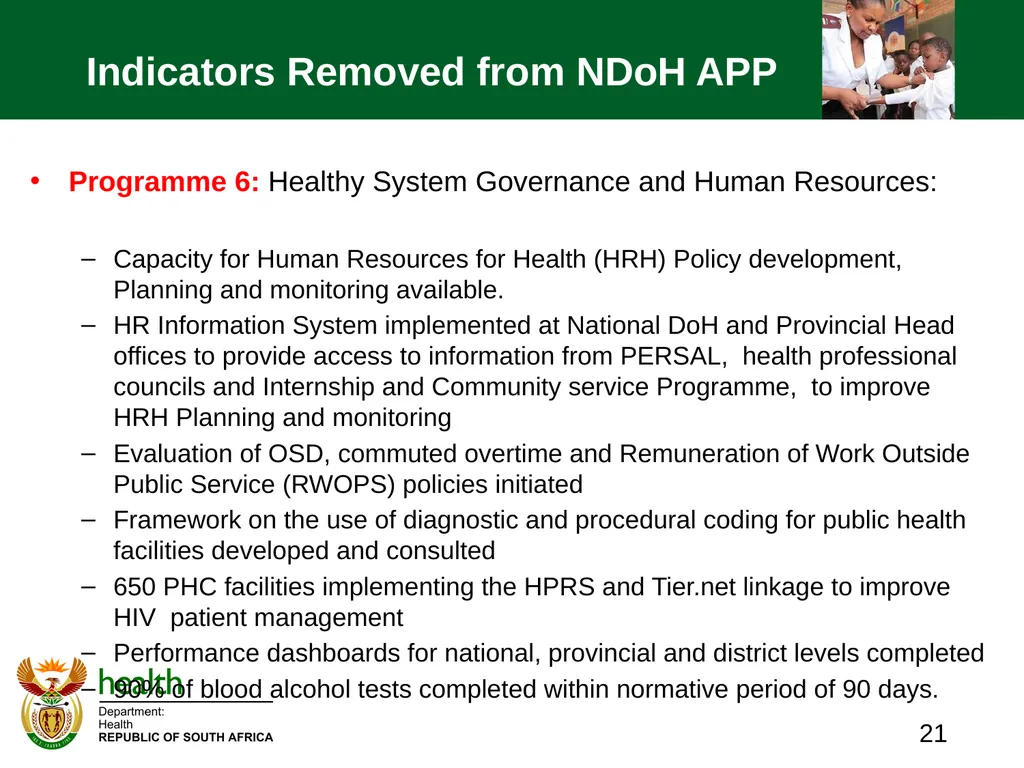
Indicators Removed from NDoH APP Programme 6: Healthy System Governance and Human Resources:
Capacity for Human Resources for Health (HRH) Policy development, Planning and monitoring available.
HR Information System implemented at National DoH and Provincial Head offices to provide access to information from PERSAL, health professional councils and Internship and Community service Programme, to improve HRH Planning and monitoring
Evaluation of OSD, commuted overtime and Remuneration of Work Outside Public Service (RWOPS) policies initiated
Framework on the use of diagnostic and procedural coding for public health facilities developed and consulted
650 PHC facilities implementing the HPRS and Tier.net linkage to improve HIV patient management
Performance dashboards for national, provincial and district levels completed
90% of blood alcohol tests completed within normative period of 90 days.<br>
Capacity for Human Resources for Health (HRH) Policy development, Planning and monitoring available.
HR Information System implemented at National DoH and Provincial Head offices to provide access to information from PERSAL, health professional councils and Internship and Community service Programme, to improve HRH Planning and monitoring
Evaluation of OSD, commuted overtime and Remuneration of Work Outside Public Service (RWOPS) policies initiated
Framework on the use of diagnostic and procedural coding for public health facilities developed and consulted
650 PHC facilities implementing the HPRS and Tier.net linkage to improve HIV patient management
Performance dashboards for national, provincial and district levels completed
90% of blood alcohol tests completed within normative period of 90 days.<br>
22
Summary of Financial Performance 2019/20<br>
23
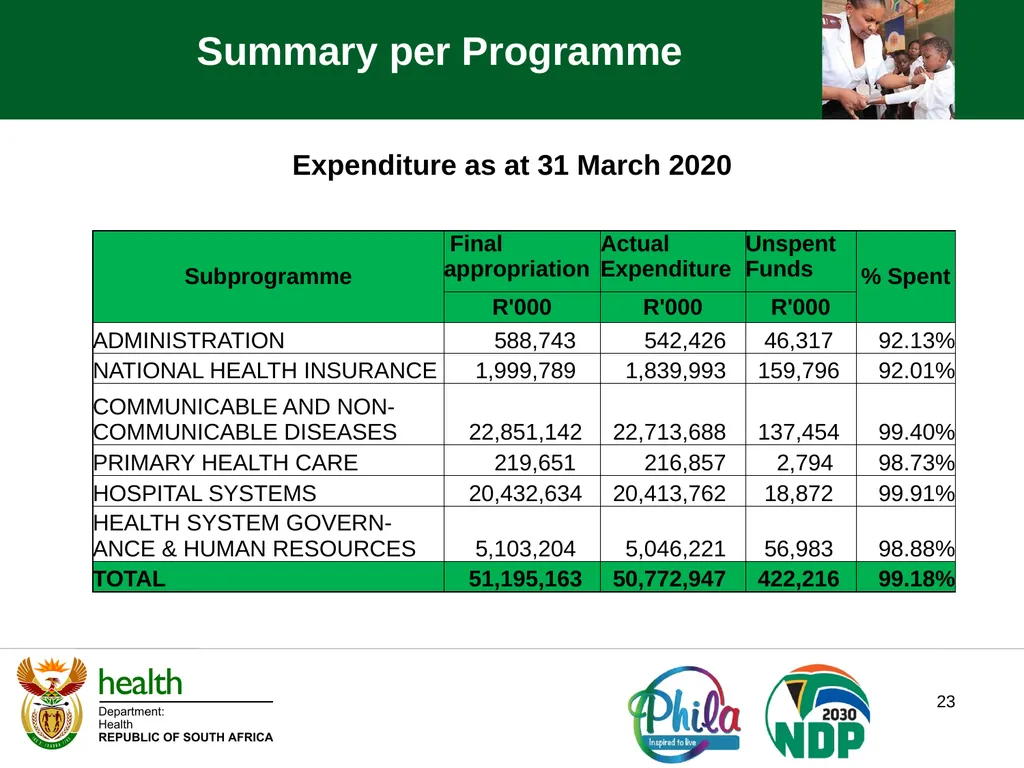
23 Summary per Programme Expenditure as at 31 March 2020<br>
24
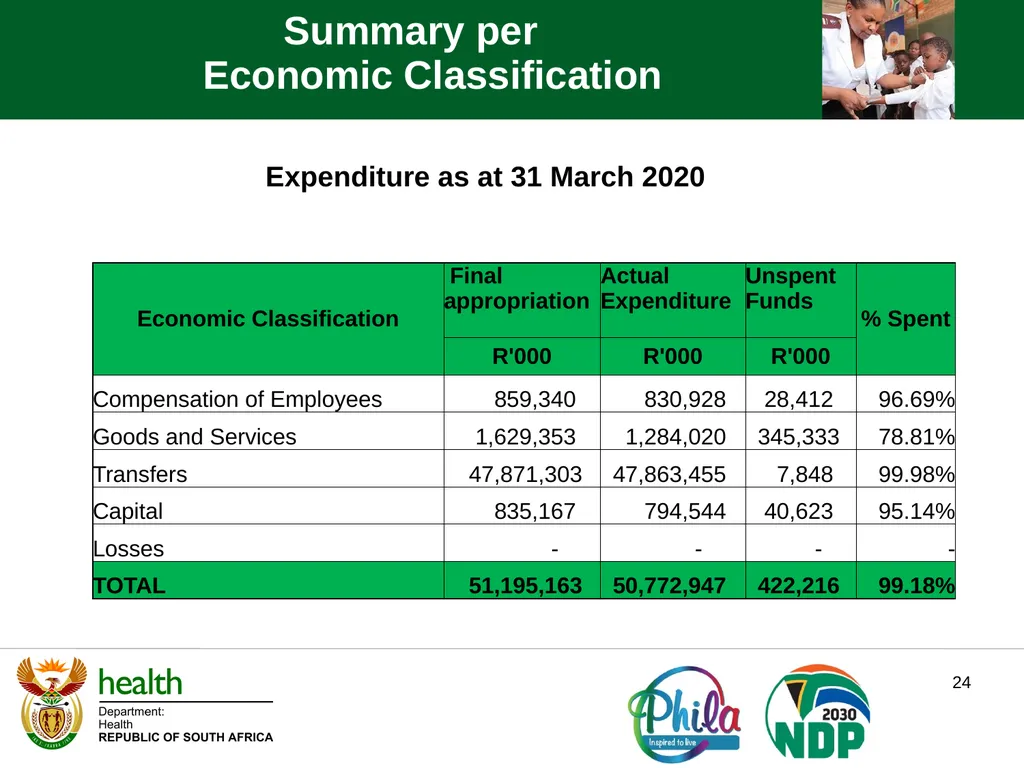
24 Summary per
Economic Classification Expenditure as at 31 March 2020<br>
Economic Classification Expenditure as at 31 March 2020<br>
25
25 Compensation of Employees:
Programmes 2, 3 and 6
Vacant posts were not all filled due to ongoing restructuring process.
Goods & ServicesProgramme 1: Administration
Programme 1:
Saving on annual membership fees due to rand/dollar exchange rate.
The last quarter's DIRCO accounts not received for payment timeously.
Training, travels and events were cancelled due to COVID-19 lockdown.
Microsoft licences and Medico Legal invoices could not be paid in time due to lockdown.
Disputed Property payments invoices and fourth quarter’s leases were not paid.
Programme 2:
GP Contracting Capitation model could not be implemented during the financial year due to challenges experienced with the re-imbursement model.
Implementation of the new Warehouse Management System is in process; difficulties were experienced with bidders, which were resolved in the latter half of 2019/2020. Training was halted due to COVID-19. 50 Percent of the project was finalized, but paid in April 2020. Reasons for Deviations<br>
Programmes 2, 3 and 6
Vacant posts were not all filled due to ongoing restructuring process.
Goods & ServicesProgramme 1: Administration
Programme 1:
Saving on annual membership fees due to rand/dollar exchange rate.
The last quarter's DIRCO accounts not received for payment timeously.
Training, travels and events were cancelled due to COVID-19 lockdown.
Microsoft licences and Medico Legal invoices could not be paid in time due to lockdown.
Disputed Property payments invoices and fourth quarter’s leases were not paid.
Programme 2:
GP Contracting Capitation model could not be implemented during the financial year due to challenges experienced with the re-imbursement model.
Implementation of the new Warehouse Management System is in process; difficulties were experienced with bidders, which were resolved in the latter half of 2019/2020. Training was halted due to COVID-19. 50 Percent of the project was finalized, but paid in April 2020. Reasons for Deviations<br>
26
Reasons for Deviations Goods & Services (continue)
Programme 3
Service provider for health communication campaigns is appointed and invoices are awaited.
Invoices for condoms received late in the financial year.
Annual TB day cancelled due to COVID-19.
Goods ordered regarding COVID-19 could not be delivered due to suppliers being out of stock.
Programme 6
The term of office of the Traditional Health Practitioners Council is pending consultation with Traditional Health Practitioners Association and Stakeholders<br>
Programme 3
Service provider for health communication campaigns is appointed and invoices are awaited.
Invoices for condoms received late in the financial year.
Annual TB day cancelled due to COVID-19.
Goods ordered regarding COVID-19 could not be delivered due to suppliers being out of stock.
Programme 6
The term of office of the Traditional Health Practitioners Council is pending consultation with Traditional Health Practitioners Association and Stakeholders<br>
27
Reasons for Deviations Transfers & Subsidies
Programme 3:
Some NGO's did not apply for funding and one Service level agreement was rejected as NGO was not in agreement with offer made by Department.
Purchase of Capital Assets
Programme 1:
Upgrading of Security Systems of Civitas Building has been cancelled as a result of the anticipated of relocating from Civitas Building.
Programme 2:
The implementation of the National Surveillance Centre is put on hold, pending the relocation plan of the Department from the Civitas building.
Programme 3:
Medical equipment needed for COVID-19 was not received and paid before year-end.
Programme 5:
Refurbishments of health facilities are paid as and when projects reach a certain stage.
Programme 6:
Tender processes are underway at the Forensic Laboratories for the procurement of Laboratory Equipment.
Refurbishments of health facilities are paid as and when projects reach a certain stage.<br>
Programme 3:
Some NGO's did not apply for funding and one Service level agreement was rejected as NGO was not in agreement with offer made by Department.
Purchase of Capital Assets
Programme 1:
Upgrading of Security Systems of Civitas Building has been cancelled as a result of the anticipated of relocating from Civitas Building.
Programme 2:
The implementation of the National Surveillance Centre is put on hold, pending the relocation plan of the Department from the Civitas building.
Programme 3:
Medical equipment needed for COVID-19 was not received and paid before year-end.
Programme 5:
Refurbishments of health facilities are paid as and when projects reach a certain stage.
Programme 6:
Tender processes are underway at the Forensic Laboratories for the procurement of Laboratory Equipment.
Refurbishments of health facilities are paid as and when projects reach a certain stage.<br>
28
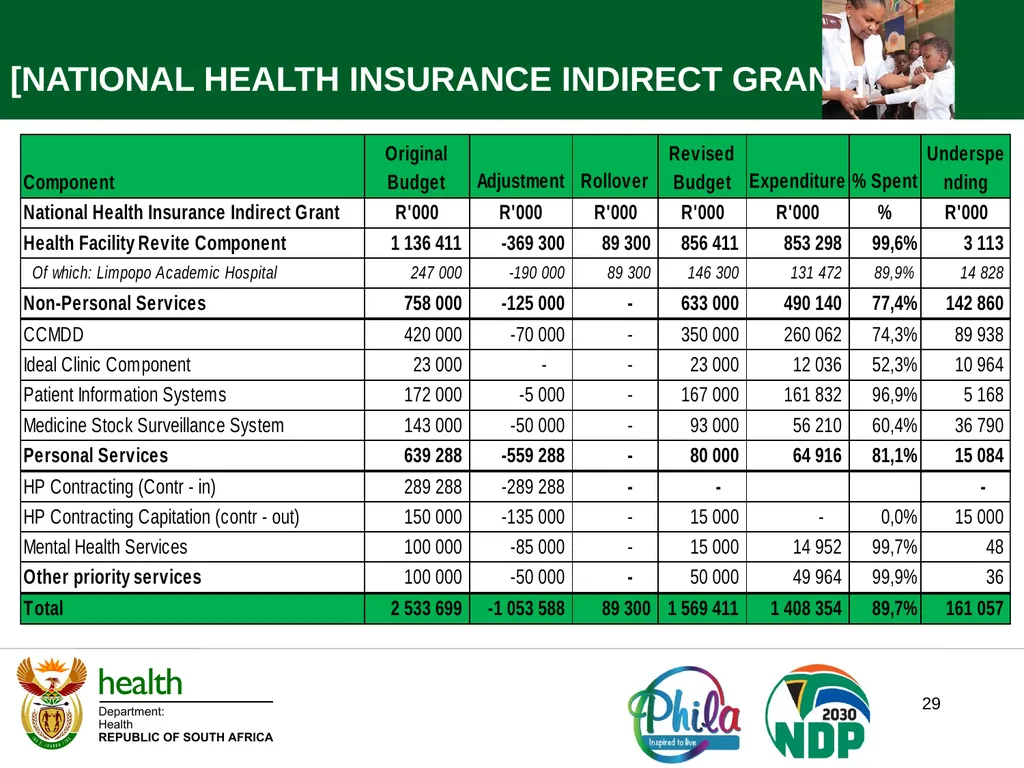
28 Indirect Grant Overview The Conditional Grants exp. as at 31 March 2020
Total CG spending is at 89,5% or R1,4 billion against total adjusted
budget of R1,5 billion.
However, major contributors to under spending are:
Personal Services Component (GP Contr: Capitation) – the model was not implemented during the year due to lack of capacity for reimbursement of the health practitioners.
Non-Personal Services Component:
CCMDD – delays in submission of invoices by service providers
Information systems & Ideal Clinic – expiry of contract for equipment however deviation was obtained later in quarter four and supplier could not deliver within financial year.<br>
Total CG spending is at 89,5% or R1,4 billion against total adjusted
budget of R1,5 billion.
However, major contributors to under spending are:
Personal Services Component (GP Contr: Capitation) – the model was not implemented during the year due to lack of capacity for reimbursement of the health practitioners.
Non-Personal Services Component:
CCMDD – delays in submission of invoices by service providers
Information systems & Ideal Clinic – expiry of contract for equipment however deviation was obtained later in quarter four and supplier could not deliver within financial year.<br>
29
29 [NATIONAL HEALTH INSURANCE INDIRECT GRANT]<br>
30
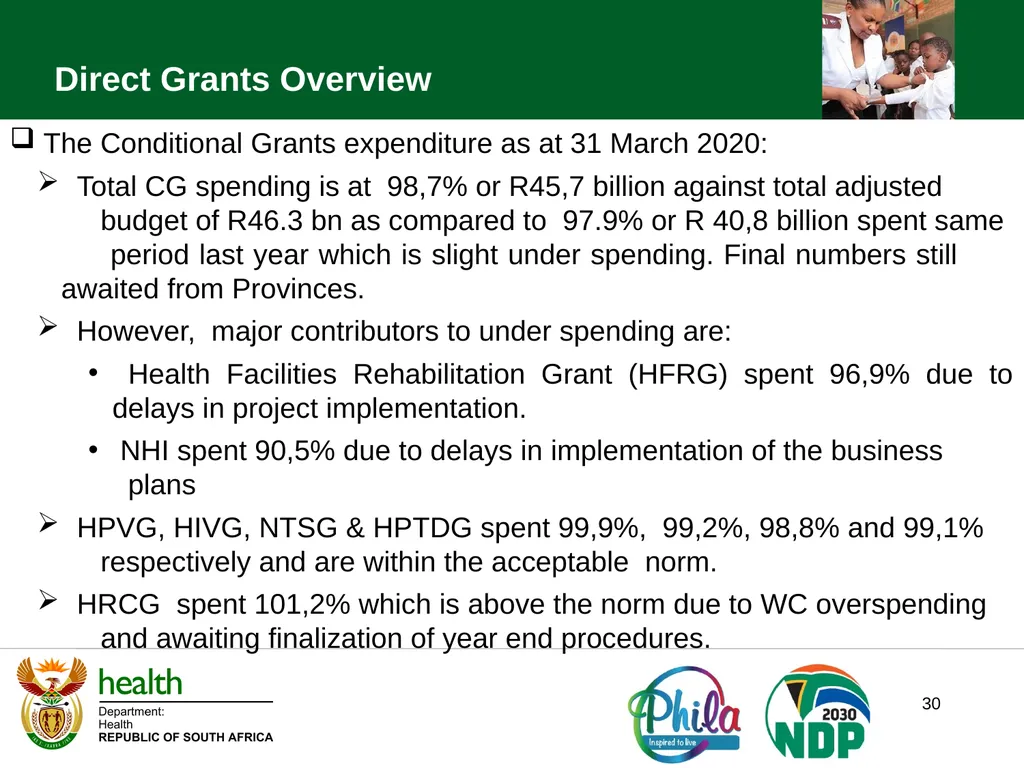
30 Direct Grants Overview The Conditional Grants expenditure as at 31 March 2020:
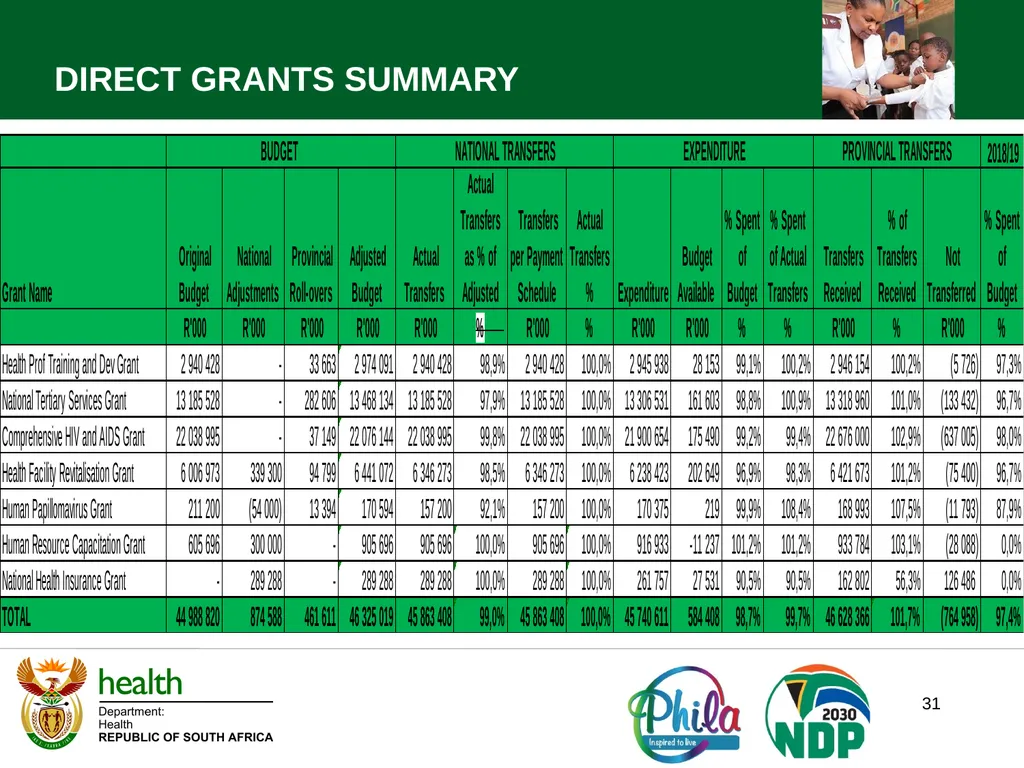
Total CG spending is at 98,7% or R45,7 billion against total adjusted
budget of R46.3 bn as compared to 97.9% or R 40,8 billion spent same
period last year which is slight under spending. Final numbers still awaited from Provinces.
However, major contributors to under spending are:
Health Facilities Rehabilitation Grant (HFRG) spent 96,9% due to delays in project implementation.
NHI spent 90,5% due to delays in implementation of the business
plans
HPVG, HIVG, NTSG & HPTDG spent 99,9%, 99,2%, 98,8% and 99,1%
respectively and are within the acceptable norm.
HRCG spent 101,2% which is above the norm due to WC overspending
and awaiting finalization of year end procedures.<br>
Total CG spending is at 98,7% or R45,7 billion against total adjusted
budget of R46.3 bn as compared to 97.9% or R 40,8 billion spent same
period last year which is slight under spending. Final numbers still awaited from Provinces.
However, major contributors to under spending are:
Health Facilities Rehabilitation Grant (HFRG) spent 96,9% due to delays in project implementation.
NHI spent 90,5% due to delays in implementation of the business
plans
HPVG, HIVG, NTSG & HPTDG spent 99,9%, 99,2%, 98,8% and 99,1%
respectively and are within the acceptable norm.
HRCG spent 101,2% which is above the norm due to WC overspending
and awaiting finalization of year end procedures.<br>
31
31 DIRECT GRANTS SUMMARY<br>
32
THANK YOU<br>