
1 the dti’s SECOND QUARTER REPORT 2019-2020
PC
Published · 45 slides · 0 views

1 / 1


Description
1 the dtis SECOND QUARTER REPORT 2019-2020 PRESENTATION TO THE PORTFOLIO COMMITTEE ON TRADE AND INDUSTRY DATE: 12 November 2019 PRESENTATION OUTLINE STRATEGIC IMPERATIVES ECONOMIC OVERVIEW SUMMARY OF DEPARTMENTAL PERFORMANCE FINANCIAL
Related Topics
Share
Embed code
Download this presentation From Below
"1 the dti’s SECOND QUARTER REPORT 2019-2020" is the property of its rightful owner. Permission is granted to download and print the materials on this website for personal, non-commercial use only, and to display it on your personal computer provided you do not modify the materials and that you retain all copyright notices contained in the materials. By downloading content from our website, you accept the terms of this agreement.
Presentation Transcript
01
1 the dti’s SECOND QUARTER REPORT 2019-2020 PRESENTATION TO THE PORTFOLIO COMMITTEE ON TRADE AND INDUSTRY
DATE: 12 November 2019<br>
DATE: 12 November 2019<br>
02
PRESENTATION OUTLINE STRATEGIC IMPERATIVES
ECONOMIC OVERVIEW
SUMMARY OF DEPARTMENTAL PERFORMANCE
FINANCIAL PERFORMANCE Q2 2019/20 2<br>
ECONOMIC OVERVIEW
SUMMARY OF DEPARTMENTAL PERFORMANCE
FINANCIAL PERFORMANCE Q2 2019/20 2<br>
03
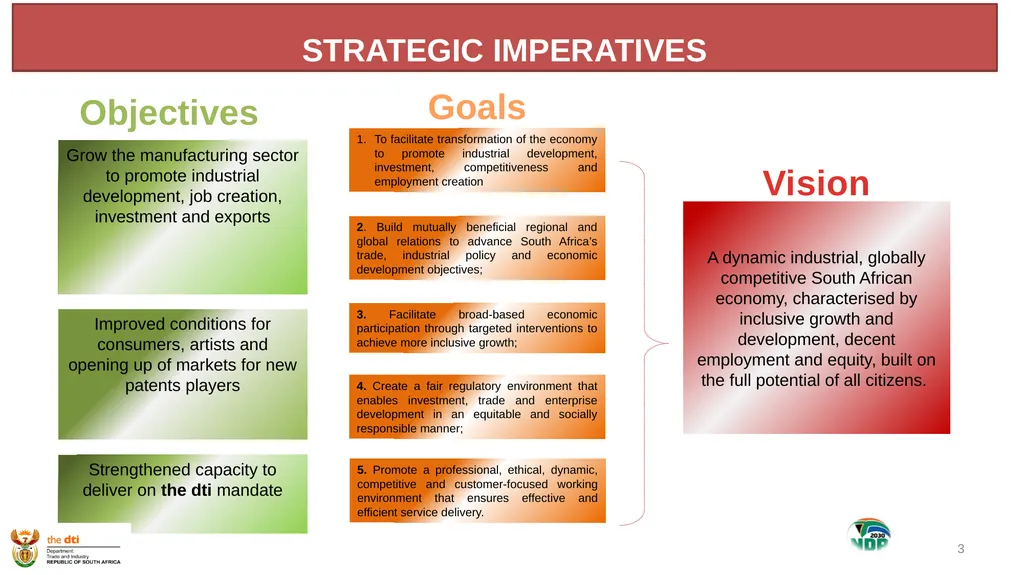
Grow the manufacturing sector to promote industrial development, job creation, investment and exports Improved conditions for consumers, artists and opening up of markets for new patents players Strengthened capacity to deliver on the dti mandate 5. Promote a professional, ethical, dynamic, competitive and customer-focused working environment that ensures effective and efficient service delivery. To facilitate transformation of the economy to promote industrial development, investment, competitiveness and employment creation 2. Build mutually beneficial regional and global relations to advance South Africa’s trade, industrial policy and economic development objectives; 3. Facilitate broad-based economic participation through targeted interventions to achieve more inclusive growth; 4. Create a fair regulatory environment that enables investment, trade and enterprise development in an equitable and socially responsible manner; A dynamic industrial, globally competitive South African economy, characterised by inclusive growth and development, decent employment and equity, built on the full potential of all citizens. Objectives Goals Vision 3 STRATEGIC IMPERATIVES<br>
04
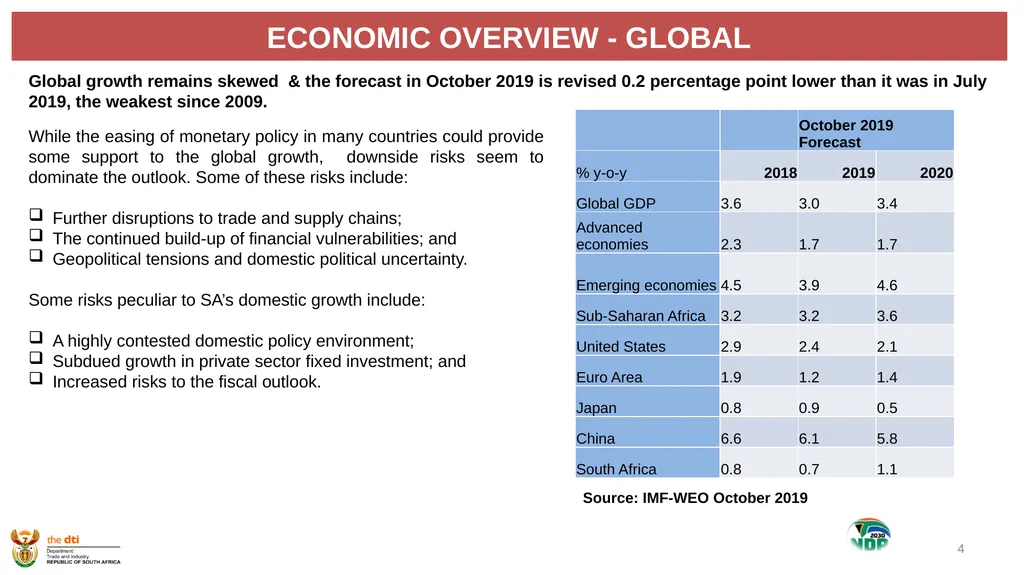
4 2017 2018 ECONOMIC OVERVIEW - GLOBAL Global growth remains skewed & the forecast in October 2019 is revised 0.2 percentage point lower than it was in July 2019, the weakest since 2009. Source: IMF-WEO October 2019 While the easing of monetary policy in many countries could provide some support to the global growth, downside risks seem to dominate the outlook. Some of these risks include:
Further disruptions to trade and supply chains;
The continued build-up of financial vulnerabilities; and
Geopolitical tensions and domestic political uncertainty.
Some risks peculiar to SA’s domestic growth include:
A highly contested domestic policy environment;
Subdued growth in private sector fixed investment; and
Increased risks to the fiscal outlook.<br>
Further disruptions to trade and supply chains;
The continued build-up of financial vulnerabilities; and
Geopolitical tensions and domestic political uncertainty.
Some risks peculiar to SA’s domestic growth include:
A highly contested domestic policy environment;
Subdued growth in private sector fixed investment; and
Increased risks to the fiscal outlook.<br>
05
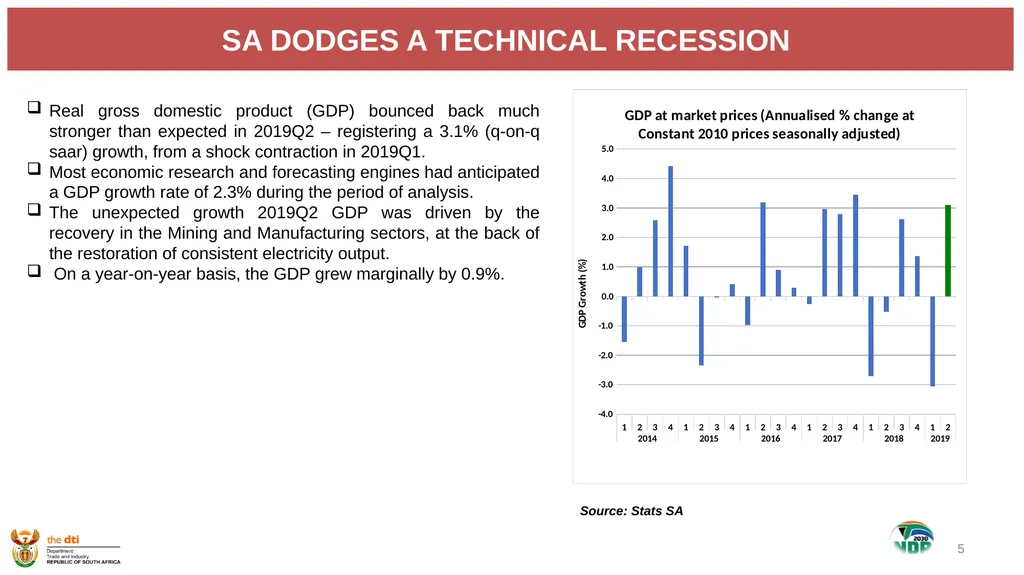
5 SA DODGES A TECHNICAL RECESSION Real gross domestic product (GDP) bounced back much stronger than expected in 2019Q2 – registering a 3.1% (q-on-q saar) growth, from a shock contraction in 2019Q1.
Most economic research and forecasting engines had anticipated a GDP growth rate of 2.3% during the period of analysis.
The unexpected growth 2019Q2 GDP was driven by the recovery in the Mining and Manufacturing sectors, at the back of the restoration of consistent electricity output.
On a year-on-year basis, the GDP grew marginally by 0.9%. Source: Stats SA<br>
Most economic research and forecasting engines had anticipated a GDP growth rate of 2.3% during the period of analysis.
The unexpected growth 2019Q2 GDP was driven by the recovery in the Mining and Manufacturing sectors, at the back of the restoration of consistent electricity output.
On a year-on-year basis, the GDP grew marginally by 0.9%. Source: Stats SA<br>
06
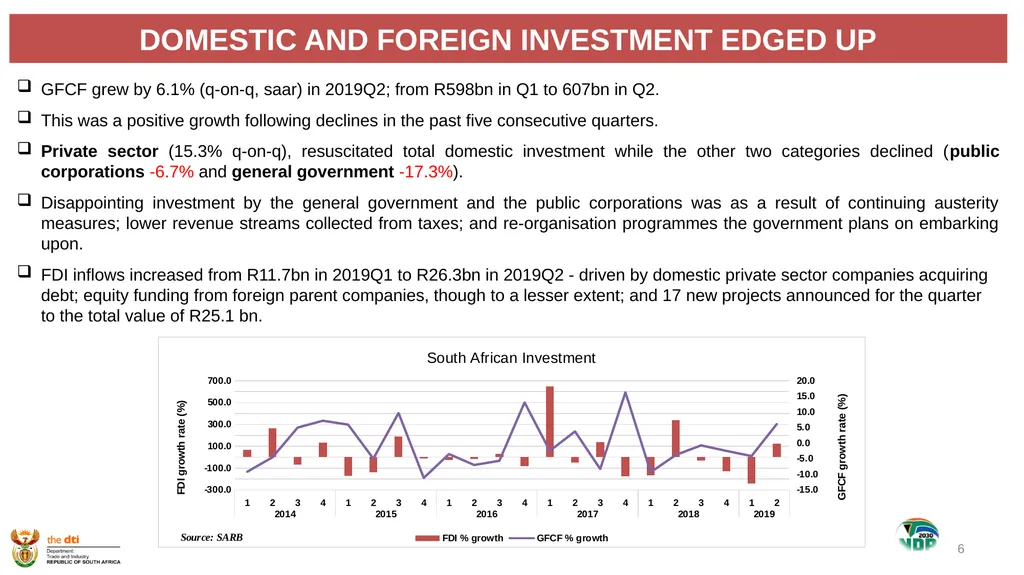
6 DOMESTIC AND FOREIGN INVESTMENT EDGED UP GFCF grew by 6.1% (q-on-q, saar) in 2019Q2; from R598bn in Q1 to 607bn in Q2.
This was a positive growth following declines in the past five consecutive quarters.
Private sector (15.3% q-on-q), resuscitated total domestic investment while the other two categories declined (public corporations -6.7% and general government -17.3%).
Disappointing investment by the general government and the public corporations was as a result of continuing austerity measures; lower revenue streams collected from taxes; and re-organisation programmes the government plans on embarking upon.
FDI inflows increased from R11.7bn in 2019Q1 to R26.3bn in 2019Q2 - driven by domestic private sector companies acquiring debt; equity funding from foreign parent companies, though to a lesser extent; and 17 new projects announced for the quarter to the total value of R25.1 bn.<br>
This was a positive growth following declines in the past five consecutive quarters.
Private sector (15.3% q-on-q), resuscitated total domestic investment while the other two categories declined (public corporations -6.7% and general government -17.3%).
Disappointing investment by the general government and the public corporations was as a result of continuing austerity measures; lower revenue streams collected from taxes; and re-organisation programmes the government plans on embarking upon.
FDI inflows increased from R11.7bn in 2019Q1 to R26.3bn in 2019Q2 - driven by domestic private sector companies acquiring debt; equity funding from foreign parent companies, though to a lesser extent; and 17 new projects announced for the quarter to the total value of R25.1 bn.<br>
07
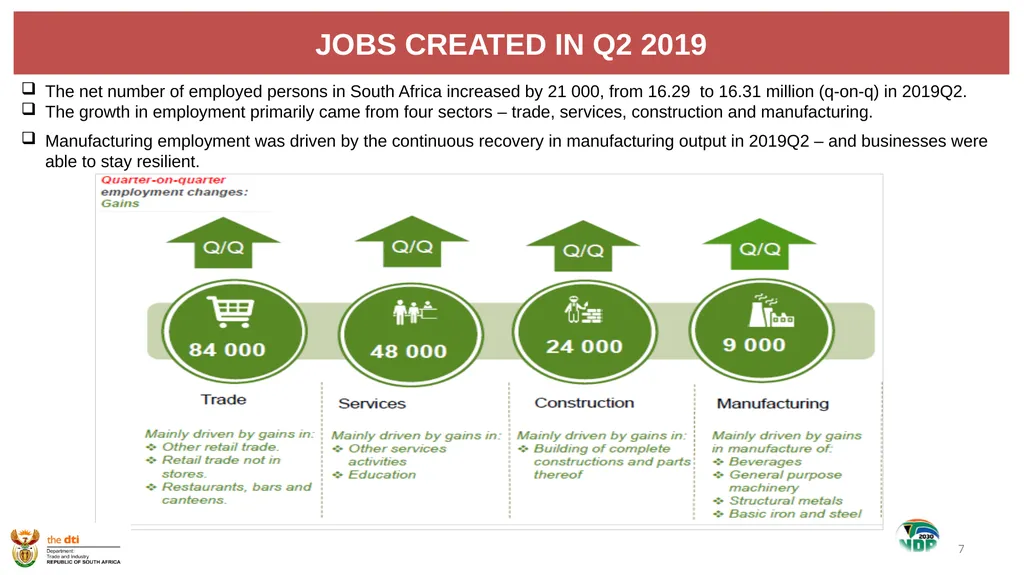
7 The net number of employed persons in South Africa increased by 21 000, from 16.29 to 16.31 million (q-on-q) in 2019Q2.
The growth in employment primarily came from four sectors – trade, services, construction and manufacturing.
Manufacturing employment was driven by the continuous recovery in manufacturing output in 2019Q2 – and businesses were able to stay resilient. JOBS CREATED IN Q2 2019<br>
The growth in employment primarily came from four sectors – trade, services, construction and manufacturing.
Manufacturing employment was driven by the continuous recovery in manufacturing output in 2019Q2 – and businesses were able to stay resilient. JOBS CREATED IN Q2 2019<br>
08
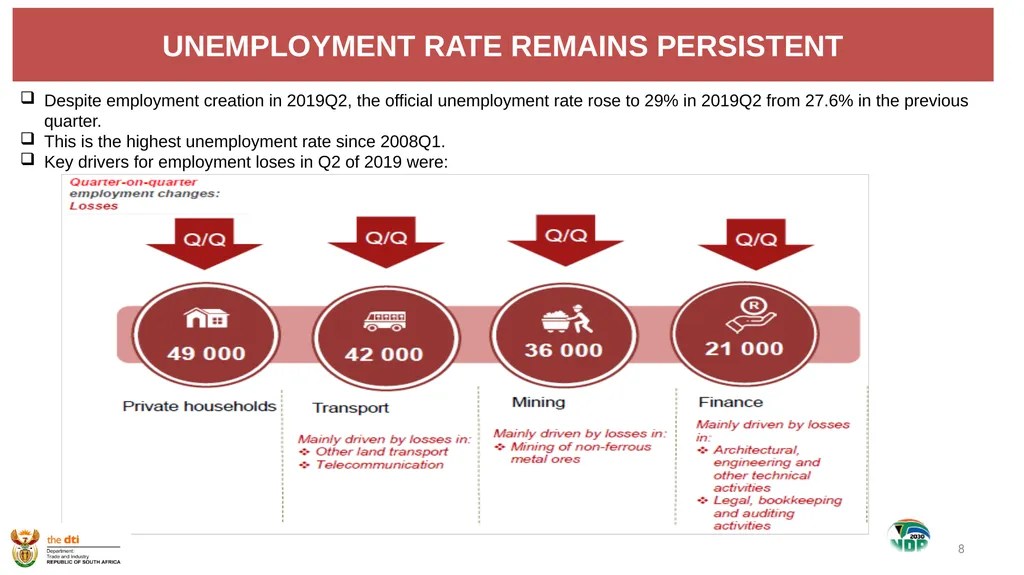
8 Despite employment creation in 2019Q2, the official unemployment rate rose to 29% in 2019Q2 from 27.6% in the previous quarter.
This is the highest unemployment rate since 2008Q1.
Key drivers for employment loses in Q2 of 2019 were: UNEMPLOYMENT RATE REMAINS PERSISTENT<br>
This is the highest unemployment rate since 2008Q1.
Key drivers for employment loses in Q2 of 2019 were: UNEMPLOYMENT RATE REMAINS PERSISTENT<br>
09
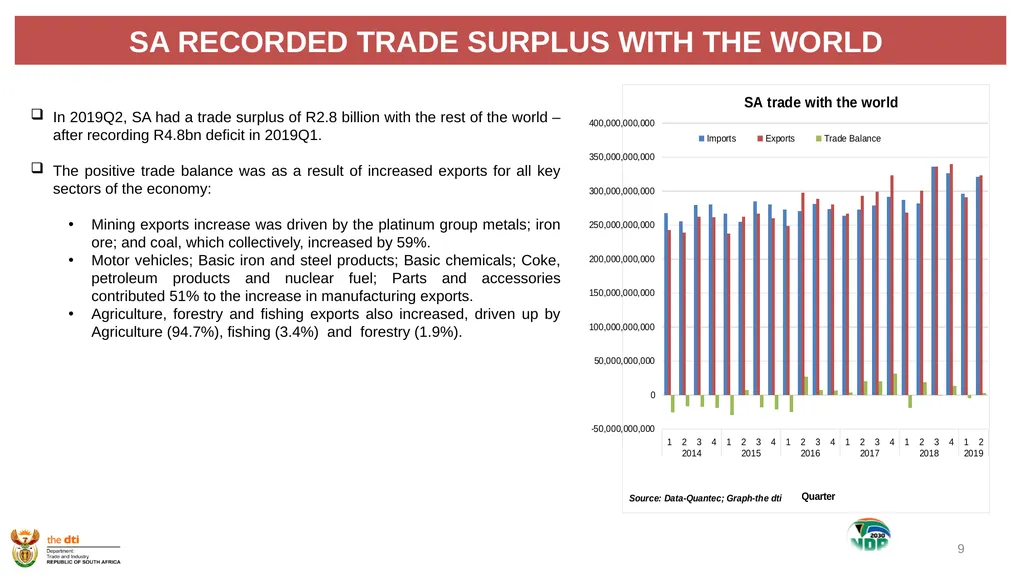
9 SA RECORDED TRADE SURPLUS WITH THE WORLD In 2019Q2, SA had a trade surplus of R2.8 billion with the rest of the world – after recording R4.8bn deficit in 2019Q1.
The positive trade balance was as a result of increased exports for all key sectors of the economy:
Mining exports increase was driven by the platinum group metals; iron ore; and coal, which collectively, increased by 59%.
Motor vehicles; Basic iron and steel products; Basic chemicals; Coke, petroleum products and nuclear fuel; Parts and accessories contributed 51% to the increase in manufacturing exports.
Agriculture, forestry and fishing exports also increased, driven up by Agriculture (94.7%), fishing (3.4%) and forestry (1.9%).<br>
The positive trade balance was as a result of increased exports for all key sectors of the economy:
Mining exports increase was driven by the platinum group metals; iron ore; and coal, which collectively, increased by 59%.
Motor vehicles; Basic iron and steel products; Basic chemicals; Coke, petroleum products and nuclear fuel; Parts and accessories contributed 51% to the increase in manufacturing exports.
Agriculture, forestry and fishing exports also increased, driven up by Agriculture (94.7%), fishing (3.4%) and forestry (1.9%).<br>
10
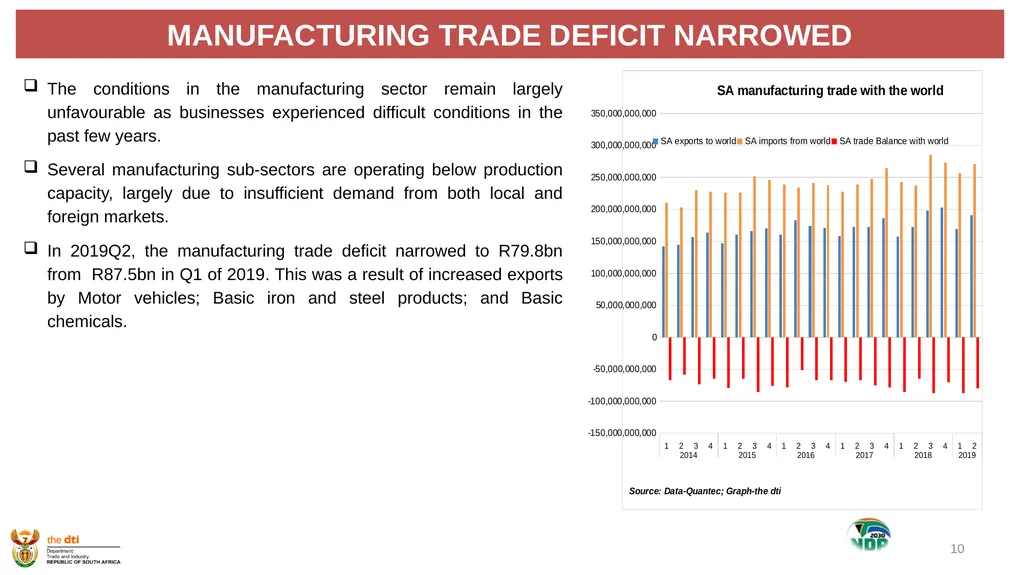
10 MANUFACTURING TRADE DEFICIT NARROWED The conditions in the manufacturing sector remain largely unfavourable as businesses experienced difficult conditions in the past few years.
Several manufacturing sub-sectors are operating below production capacity, largely due to insufficient demand from both local and foreign markets.
In 2019Q2, the manufacturing trade deficit narrowed to R79.8bn from R87.5bn in Q1 of 2019. This was a result of increased exports by Motor vehicles; Basic iron and steel products; and Basic chemicals.<br>
Several manufacturing sub-sectors are operating below production capacity, largely due to insufficient demand from both local and foreign markets.
In 2019Q2, the manufacturing trade deficit narrowed to R79.8bn from R87.5bn in Q1 of 2019. This was a result of increased exports by Motor vehicles; Basic iron and steel products; and Basic chemicals.<br>
11
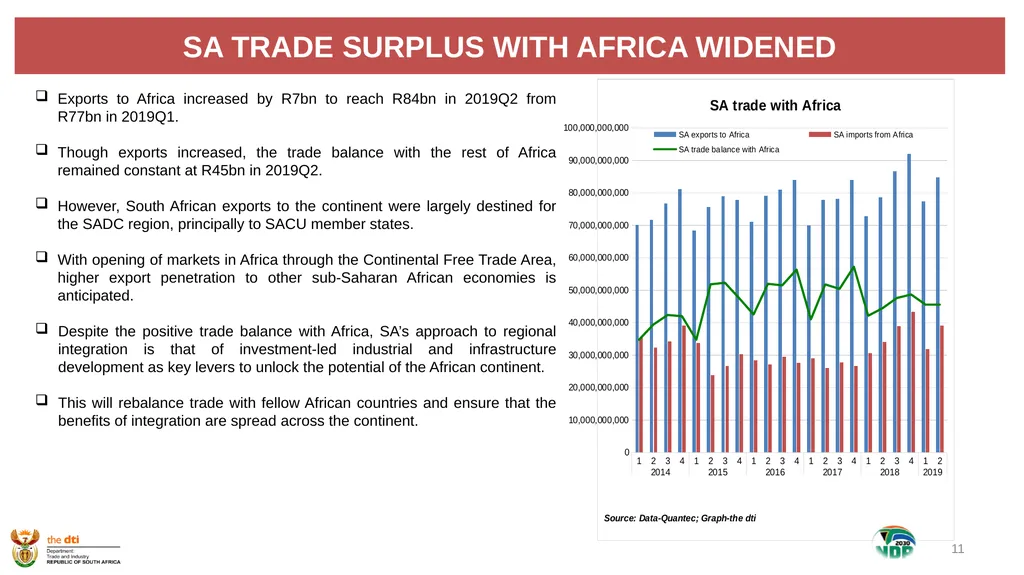
11 SA TRADE SURPLUS WITH AFRICA WIDENED Exports to Africa increased by R7bn to reach R84bn in 2019Q2 from R77bn in 2019Q1.
Though exports increased, the trade balance with the rest of Africa remained constant at R45bn in 2019Q2.
However, South African exports to the continent were largely destined for the SADC region, principally to SACU member states.
With opening of markets in Africa through the Continental Free Trade Area, higher export penetration to other sub-Saharan African economies is anticipated.
Despite the positive trade balance with Africa, SA’s approach to regional integration is that of investment-led industrial and infrastructure development as key levers to unlock the potential of the African continent.
This will rebalance trade with fellow African countries and ensure that the benefits of integration are spread across the continent.<br>
Though exports increased, the trade balance with the rest of Africa remained constant at R45bn in 2019Q2.
However, South African exports to the continent were largely destined for the SADC region, principally to SACU member states.
With opening of markets in Africa through the Continental Free Trade Area, higher export penetration to other sub-Saharan African economies is anticipated.
Despite the positive trade balance with Africa, SA’s approach to regional integration is that of investment-led industrial and infrastructure development as key levers to unlock the potential of the African continent.
This will rebalance trade with fellow African countries and ensure that the benefits of integration are spread across the continent.<br>
12
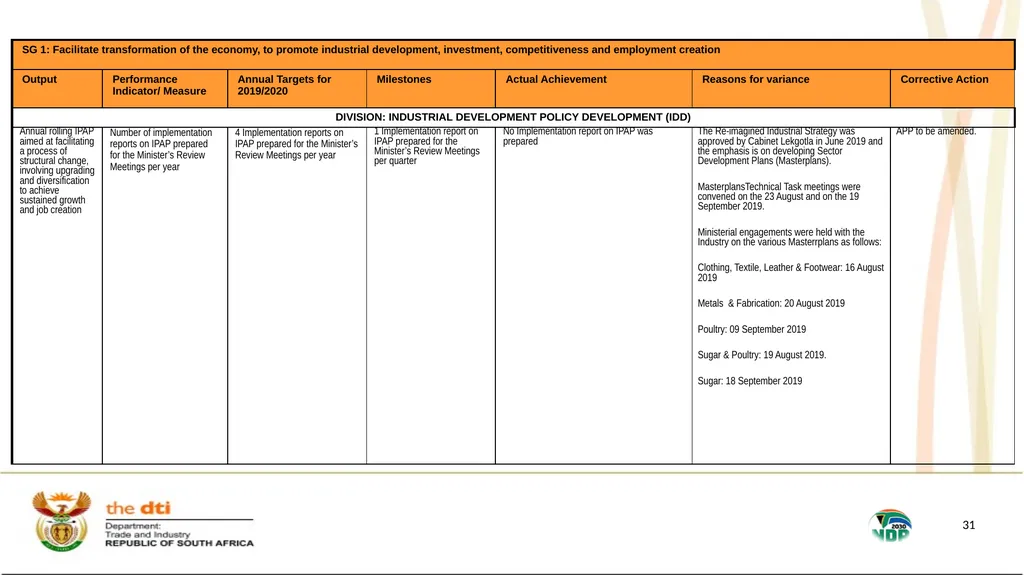
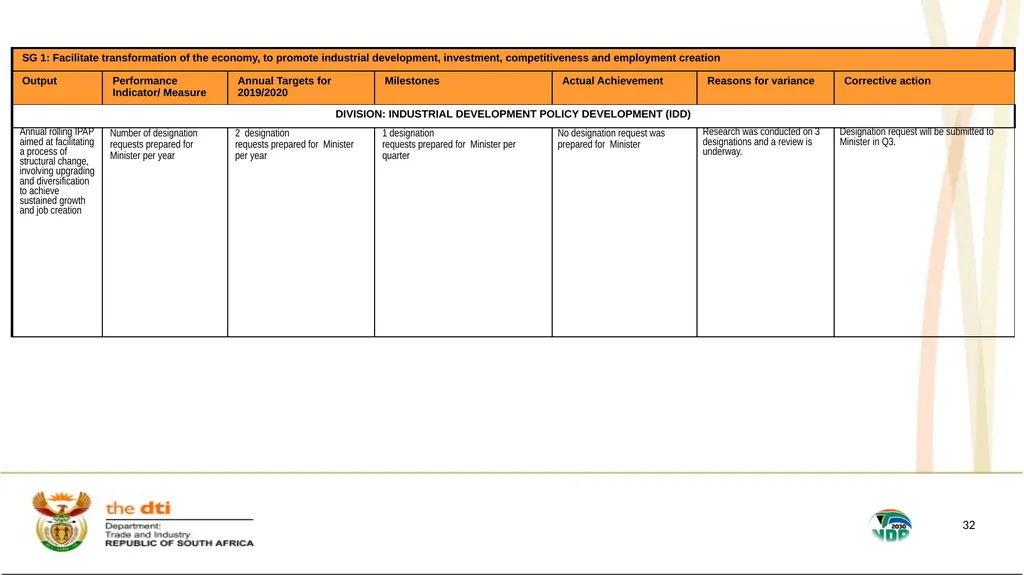
INDUSTRIAL DEVELOPMENT Re-imagined Industrial Strategy
The Re-imagined Industrial Strategy was approved by the Cabinet Lekgotla in June 2019.
The Re-imagined Industrial Strategy is the new guiding strategy that will underpin the work of the dti and has implications across Government.
The emphasis is on developing sector development plans (Masterplans) jointly with all relevant stakeholders.
The first workshop to assist Depts, DFIs and SOCs to develop Masterplans was convened in August.
An inter-dept SteerCo has been established, chaired by the Presidency to oversee the 15 Masterplans, provide research capacity, technical experts and facilitation support. 13 SG 1: Facilitate transformation of the economy to promote industrial development, investment, competitiveness and employment creation<br>
The Re-imagined Industrial Strategy was approved by the Cabinet Lekgotla in June 2019.
The Re-imagined Industrial Strategy is the new guiding strategy that will underpin the work of the dti and has implications across Government.
The emphasis is on developing sector development plans (Masterplans) jointly with all relevant stakeholders.
The first workshop to assist Depts, DFIs and SOCs to develop Masterplans was convened in August.
An inter-dept SteerCo has been established, chaired by the Presidency to oversee the 15 Masterplans, provide research capacity, technical experts and facilitation support. 13 SG 1: Facilitate transformation of the economy to promote industrial development, investment, competitiveness and employment creation<br>
13
INDUSTRIAL DEVELOPMENT Clothing, Textile, Leather & Footwear Masterplan
The process is on track and masterplan is expected to be launched at the end of October/Nov 2019.
Steel & Metal Fabrication Sector Masterplan
The steel industry engagement with the Minister took place on 20 August 2019 to develop a common understanding of the planning process.
Industry was requested to submit inputs and 46 submissions were received and are being reviewed by the task team.
Chemicals and Plastics Masterplan
The chemicals sector has an industrial strategy that was developed in 2017 and endorsed by the Chemicals and Allied Industries Association. The strategy will inform the development of the Masterplan. 14 SG 1: Facilitate transformation of the economy to promote industrial development, investment, competitiveness and employment creation<br>
The process is on track and masterplan is expected to be launched at the end of October/Nov 2019.
Steel & Metal Fabrication Sector Masterplan
The steel industry engagement with the Minister took place on 20 August 2019 to develop a common understanding of the planning process.
Industry was requested to submit inputs and 46 submissions were received and are being reviewed by the task team.
Chemicals and Plastics Masterplan
The chemicals sector has an industrial strategy that was developed in 2017 and endorsed by the Chemicals and Allied Industries Association. The strategy will inform the development of the Masterplan. 14 SG 1: Facilitate transformation of the economy to promote industrial development, investment, competitiveness and employment creation<br>
14
INDUSTRIAL DEVELOPMENT Plastics Masterplan
Consultations with Plastics South Africa have begun and the industry association is in support of the Masterplan process.
Poultry Masterplan
Ministerial engagements on a bilateral level with each of the value chain participants (commercial/emerging producers, feed companies, processors, importers and exporters etc.) are in progress.
Ongoing parallel engagements with big companies such as Astral, Rainbow Chicken, Country Bird, Daybreak etc. underway to understand their long term plans.
Furniture Masterplan
the dti, Proudly SA and the South Africa Furniture Initiative (SAFI) jointly held a furniture sector forum in July 2019 where more than 200 manufacturers and stakeholders came together to have a conversation on buy local. Companies signed the pledge to improve the buy local proportion in their furniture. 15 SG 1: Facilitate transformation of the economy to promote industrial development, investment, competitiveness and employment creation<br>
Consultations with Plastics South Africa have begun and the industry association is in support of the Masterplan process.
Poultry Masterplan
Ministerial engagements on a bilateral level with each of the value chain participants (commercial/emerging producers, feed companies, processors, importers and exporters etc.) are in progress.
Ongoing parallel engagements with big companies such as Astral, Rainbow Chicken, Country Bird, Daybreak etc. underway to understand their long term plans.
Furniture Masterplan
the dti, Proudly SA and the South Africa Furniture Initiative (SAFI) jointly held a furniture sector forum in July 2019 where more than 200 manufacturers and stakeholders came together to have a conversation on buy local. Companies signed the pledge to improve the buy local proportion in their furniture. 15 SG 1: Facilitate transformation of the economy to promote industrial development, investment, competitiveness and employment creation<br>
15
INDUSTRIAL DEVELOPMENT Furniture Masterplan
The work towards the development of the Masterplan has commenced with consultations with big retailers, Timber SA, Saw Milling Association and large leading companies.
the dti, Proudly SA and the South Africa Furniture Initiative (SAFI) jointly held a furniture sector forum in July 2019 where more than 200 manufacturers and stakeholders came together to have a conversation on buy local. Companies signed the pledge to improve the buy local proportion in their furniture.
Sugar Diversification Plan
Ongoing bilateral meetings with each of the upstream/downstream users ongoing.
Engagements with DoE, Tongaat, RCL and Illovo to secure support for diversification of the industry also ongoing. 16 SG 1: Facilitate transformation of the economy to promote industrial development, investment, competitiveness and employment creation<br>
The work towards the development of the Masterplan has commenced with consultations with big retailers, Timber SA, Saw Milling Association and large leading companies.
the dti, Proudly SA and the South Africa Furniture Initiative (SAFI) jointly held a furniture sector forum in July 2019 where more than 200 manufacturers and stakeholders came together to have a conversation on buy local. Companies signed the pledge to improve the buy local proportion in their furniture.
Sugar Diversification Plan
Ongoing bilateral meetings with each of the upstream/downstream users ongoing.
Engagements with DoE, Tongaat, RCL and Illovo to secure support for diversification of the industry also ongoing. 16 SG 1: Facilitate transformation of the economy to promote industrial development, investment, competitiveness and employment creation<br>
16
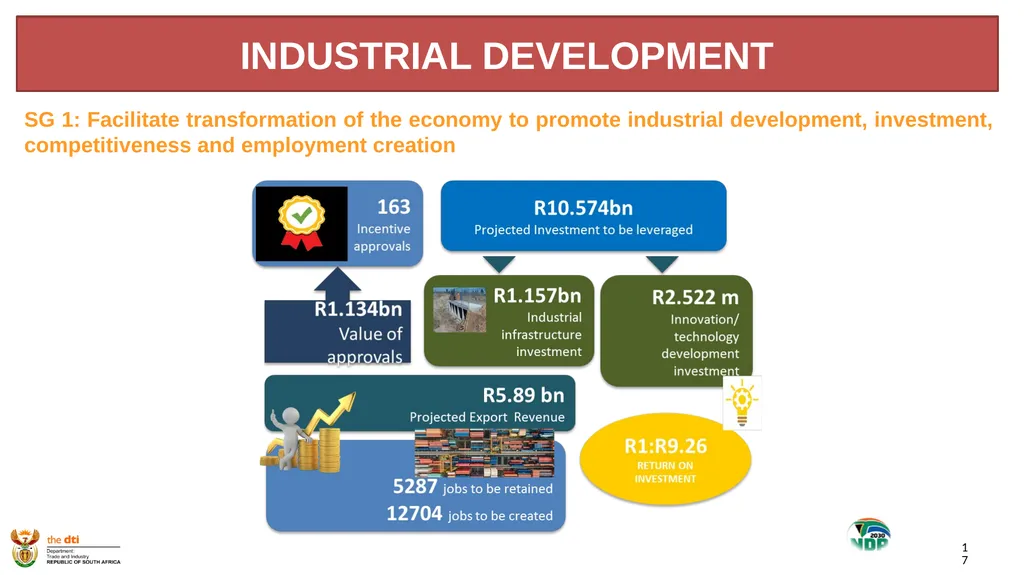
INDUSTRIAL DEVELOPMENT 17 SG 1: Facilitate transformation of the economy to promote industrial development, investment, competitiveness and employment creation<br>
17
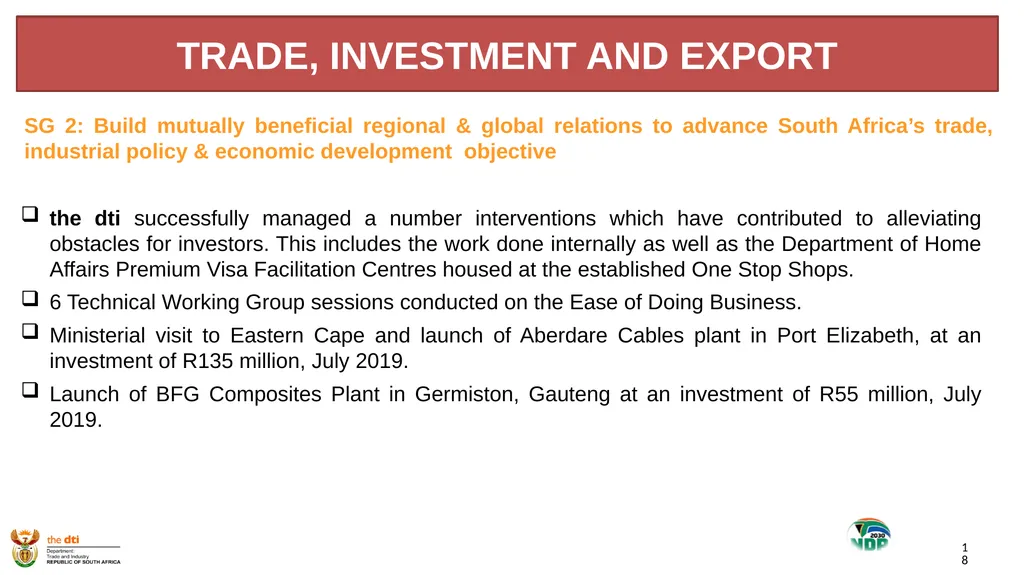
TRADE, INVESTMENT AND EXPORT the dti successfully managed a number interventions which have contributed to alleviating obstacles for investors. This includes the work done internally as well as the Department of Home Affairs Premium Visa Facilitation Centres housed at the established One Stop Shops.
6 Technical Working Group sessions conducted on the Ease of Doing Business.
Ministerial visit to Eastern Cape and launch of Aberdare Cables plant in Port Elizabeth, at an investment of R135 million, July 2019.
Launch of BFG Composites Plant in Germiston, Gauteng at an investment of R55 million, July 2019. 18 SG 2: Build mutually beneficial regional & global relations to advance South Africa’s trade, industrial policy & economic development objective<br>
6 Technical Working Group sessions conducted on the Ease of Doing Business.
Ministerial visit to Eastern Cape and launch of Aberdare Cables plant in Port Elizabeth, at an investment of R135 million, July 2019.
Launch of BFG Composites Plant in Germiston, Gauteng at an investment of R55 million, July 2019. 18 SG 2: Build mutually beneficial regional & global relations to advance South Africa’s trade, industrial policy & economic development objective<br>
18
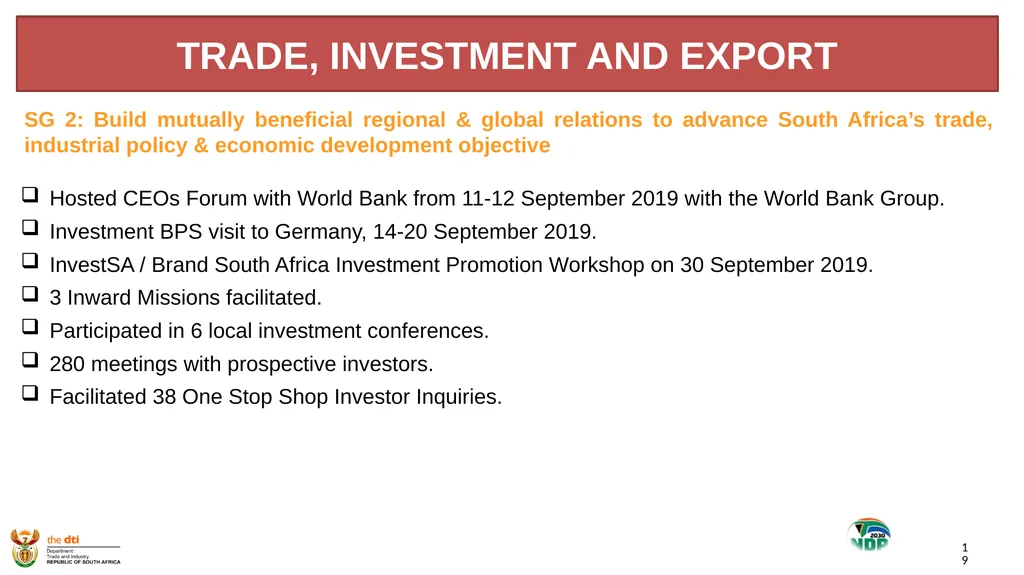
TRADE, INVESTMENT AND EXPORT Hosted CEOs Forum with World Bank from 11-12 September 2019 with the World Bank Group.
Investment BPS visit to Germany, 14-20 September 2019.
InvestSA / Brand South Africa Investment Promotion Workshop on 30 September 2019.
3 Inward Missions facilitated.
Participated in 6 local investment conferences.
280 meetings with prospective investors.
Facilitated 38 One Stop Shop Investor Inquiries. 19 SG 2: Build mutually beneficial regional & global relations to advance South Africa’s trade, industrial policy & economic development objective<br>
Investment BPS visit to Germany, 14-20 September 2019.
InvestSA / Brand South Africa Investment Promotion Workshop on 30 September 2019.
3 Inward Missions facilitated.
Participated in 6 local investment conferences.
280 meetings with prospective investors.
Facilitated 38 One Stop Shop Investor Inquiries. 19 SG 2: Build mutually beneficial regional & global relations to advance South Africa’s trade, industrial policy & economic development objective<br>
19
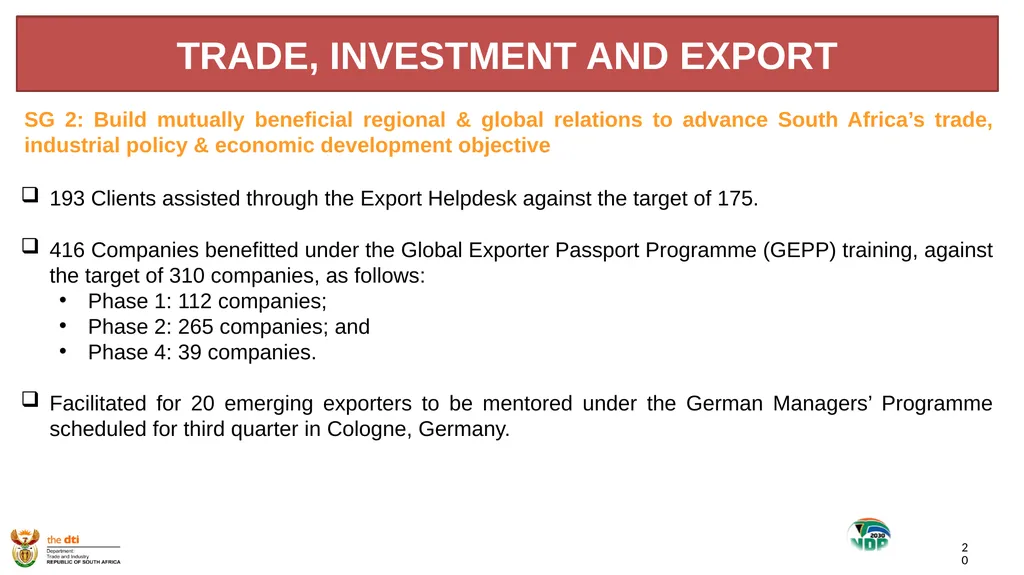
TRADE, INVESTMENT AND EXPORT 193 Clients assisted through the Export Helpdesk against the target of 175.
416 Companies benefitted under the Global Exporter Passport Programme (GEPP) training, against the target of 310 companies, as follows:
Phase 1: 112 companies;
Phase 2: 265 companies; and
Phase 4: 39 companies.
Facilitated for 20 emerging exporters to be mentored under the German Managers’ Programme scheduled for third quarter in Cologne, Germany. 20 SG 2: Build mutually beneficial regional & global relations to advance South Africa’s trade, industrial policy & economic development objective<br>
416 Companies benefitted under the Global Exporter Passport Programme (GEPP) training, against the target of 310 companies, as follows:
Phase 1: 112 companies;
Phase 2: 265 companies; and
Phase 4: 39 companies.
Facilitated for 20 emerging exporters to be mentored under the German Managers’ Programme scheduled for third quarter in Cologne, Germany. 20 SG 2: Build mutually beneficial regional & global relations to advance South Africa’s trade, industrial policy & economic development objective<br>
20
TRADE, INVESTMENT AND EXPORT Europe Desk
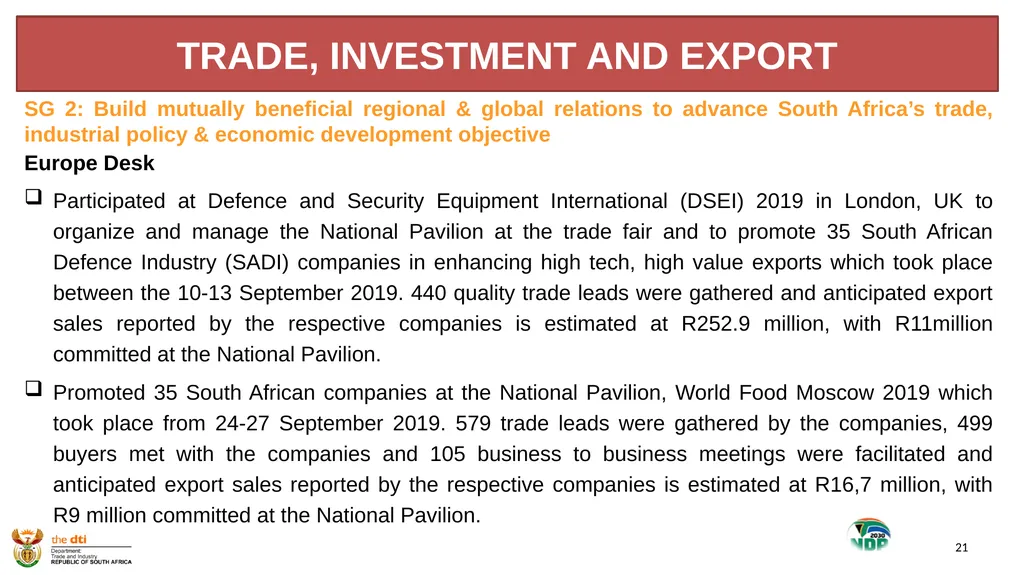
Participated at Defence and Security Equipment International (DSEI) 2019 in London, UK to organize and manage the National Pavilion at the trade fair and to promote 35 South African Defence Industry (SADI) companies in enhancing high tech, high value exports which took place between the 10-13 September 2019. 440 quality trade leads were gathered and anticipated export sales reported by the respective companies is estimated at R252.9 million, with R11million committed at the National Pavilion.
Promoted 35 South African companies at the National Pavilion, World Food Moscow 2019 which took place from 24-27 September 2019. 579 trade leads were gathered by the companies, 499 buyers met with the companies and 105 business to business meetings were facilitated and anticipated export sales reported by the respective companies is estimated at R16,7 million, with R9 million committed at the National Pavilion. 21 SG 2: Build mutually beneficial regional & global relations to advance South Africa’s trade, industrial policy & economic development objective<br>
Participated at Defence and Security Equipment International (DSEI) 2019 in London, UK to organize and manage the National Pavilion at the trade fair and to promote 35 South African Defence Industry (SADI) companies in enhancing high tech, high value exports which took place between the 10-13 September 2019. 440 quality trade leads were gathered and anticipated export sales reported by the respective companies is estimated at R252.9 million, with R11million committed at the National Pavilion.
Promoted 35 South African companies at the National Pavilion, World Food Moscow 2019 which took place from 24-27 September 2019. 579 trade leads were gathered by the companies, 499 buyers met with the companies and 105 business to business meetings were facilitated and anticipated export sales reported by the respective companies is estimated at R16,7 million, with R9 million committed at the National Pavilion. 21 SG 2: Build mutually beneficial regional & global relations to advance South Africa’s trade, industrial policy & economic development objective<br>
21
TRADE, INVESTMENT AND EXPORT Europe Desk
Facilitated and coordinated the roll out of two export seminars in Mpumalanga and Gauteng provinces conducted by Open Trade Gate (OTG) Sweden in collaboration with the Mpumalanga Economic Growth Agency (MEGA), Gauteng Growth and Development Agency (GGDA), SA Embassy in Sweden. OTG offered to conduct these export seminars pro-bono to assist SA potential exporters to penetrate the Swedish market in particular and the EU market in general.
Negotiated the revised Declaration of Intent (DOI) signed in July 2016 between Invest SA and Business France to include cooperation on Export Development and Promotion. Possible future cooperation with Business France will entail export development; technical assistance; sharing of best practices; export promotion including matchmaking. 22 SG 2: Build mutually beneficial regional & global relations to advance South Africa’s trade, industrial policy & economic development objective<br>
Facilitated and coordinated the roll out of two export seminars in Mpumalanga and Gauteng provinces conducted by Open Trade Gate (OTG) Sweden in collaboration with the Mpumalanga Economic Growth Agency (MEGA), Gauteng Growth and Development Agency (GGDA), SA Embassy in Sweden. OTG offered to conduct these export seminars pro-bono to assist SA potential exporters to penetrate the Swedish market in particular and the EU market in general.
Negotiated the revised Declaration of Intent (DOI) signed in July 2016 between Invest SA and Business France to include cooperation on Export Development and Promotion. Possible future cooperation with Business France will entail export development; technical assistance; sharing of best practices; export promotion including matchmaking. 22 SG 2: Build mutually beneficial regional & global relations to advance South Africa’s trade, industrial policy & economic development objective<br>
22
TRADE, INVESTMENT AND EXPORT America
Led South African business representatives on Outward Trade and Investment Missions to Santiago in Chile and Lima in Peru from 23 September – 03 October 2019.
The objective of the missions were to expose South African Mining and Allied Services companies to the Chilean and Peruvian markets, deepen bilateral trade relations, create greater knowledge of South African products and capabilities, as well as create awareness of investment opportunities in these markets.
The structure of the missions included Trade and Investment Seminars, targeted business-to-business meetings and site visits. A total number of 31 South African companies were funded under the EMIA Group Missions Scheme – 17 companies visited Chile and 14 visited Peru, of which one was the South African Capital Equipment Export Council. Rhimak reported on-the-spot sales of US$30,000. 23 SG 2: Build mutually beneficial regional & global relations to advance South Africa’s trade, industrial policy & economic development objective<br>
Led South African business representatives on Outward Trade and Investment Missions to Santiago in Chile and Lima in Peru from 23 September – 03 October 2019.
The objective of the missions were to expose South African Mining and Allied Services companies to the Chilean and Peruvian markets, deepen bilateral trade relations, create greater knowledge of South African products and capabilities, as well as create awareness of investment opportunities in these markets.
The structure of the missions included Trade and Investment Seminars, targeted business-to-business meetings and site visits. A total number of 31 South African companies were funded under the EMIA Group Missions Scheme – 17 companies visited Chile and 14 visited Peru, of which one was the South African Capital Equipment Export Council. Rhimak reported on-the-spot sales of US$30,000. 23 SG 2: Build mutually beneficial regional & global relations to advance South Africa’s trade, industrial policy & economic development objective<br>
23
TRADE, INVESTMENT AND EXPORT Asia
Led the participation of 26 companies in the Outward Selling Mission to New Delhi and Mumbai in India. The delegation comprised companies in the agro-processing, aerospace and defense as well as electro-technical sectors. In terms of demographic composition, it comprised 8 Black Owned, 5 Women Owned, 1 White Woman Owned, 10 SMMEs and 2 Other Sized companies.
The objective of the Missions was to promote SA value added products into the Indian market. The Mission generated 129 trade leads as well as over USD$ 8 mil export sales. The following on the spot deals were signed during the OSM:
SAMO Engineering Group Company TIS Invest secured a contract for USD$ 7million with Eskom for the supply of distribution Class Surge Arresters in partnership with an Indian manufacturer Raychem RPG. Bayede Marketing appointed an agent in Romin Holdings and signed an on the spot deal to supply a container of products to the value of USD$ 43 000.
Jazz Spirit secured a contract to the value of USD$1 million with Max Unk Adventure Sports. 24 SG 2: Build mutually beneficial regional & global relations to advance South Africa’s trade, industrial policy & economic development objective<br>
Led the participation of 26 companies in the Outward Selling Mission to New Delhi and Mumbai in India. The delegation comprised companies in the agro-processing, aerospace and defense as well as electro-technical sectors. In terms of demographic composition, it comprised 8 Black Owned, 5 Women Owned, 1 White Woman Owned, 10 SMMEs and 2 Other Sized companies.
The objective of the Missions was to promote SA value added products into the Indian market. The Mission generated 129 trade leads as well as over USD$ 8 mil export sales. The following on the spot deals were signed during the OSM:
SAMO Engineering Group Company TIS Invest secured a contract for USD$ 7million with Eskom for the supply of distribution Class Surge Arresters in partnership with an Indian manufacturer Raychem RPG. Bayede Marketing appointed an agent in Romin Holdings and signed an on the spot deal to supply a container of products to the value of USD$ 43 000.
Jazz Spirit secured a contract to the value of USD$1 million with Max Unk Adventure Sports. 24 SG 2: Build mutually beneficial regional & global relations to advance South Africa’s trade, industrial policy & economic development objective<br>
24
TRADE, INVESTMENT AND EXPORT Asia
Led a 21 member delegation to Fruit Logistica Hong Kong from 4 – 6 September 2019. Fruit Logistica is one of the foremost International Fresh Fruit and Vegetable Exhibitions in Asia. A total of 285 trade leads were generated. The following on the spot deals were signed by SA companies:
In2fruit signed a contract to the value of R6 million with a Vietnamese company to supply table grapes.
Middle East
Undertook 12 member delegation Outward Selling Mission to Kuwait and Qatar from 13-20 September 2019. Targeted sectors for this Outward Selling Mission were: agro-processing, healthcare and pharmaceutical, automotive, infrastructure development, oil and gas. Project expected exports sales after six month are projected to be R 894 million. 25 SG 2: Build mutually beneficial regional & global relations to advance South Africa’s trade, industrial policy & economic development objective<br>
Led a 21 member delegation to Fruit Logistica Hong Kong from 4 – 6 September 2019. Fruit Logistica is one of the foremost International Fresh Fruit and Vegetable Exhibitions in Asia. A total of 285 trade leads were generated. The following on the spot deals were signed by SA companies:
In2fruit signed a contract to the value of R6 million with a Vietnamese company to supply table grapes.
Middle East
Undertook 12 member delegation Outward Selling Mission to Kuwait and Qatar from 13-20 September 2019. Targeted sectors for this Outward Selling Mission were: agro-processing, healthcare and pharmaceutical, automotive, infrastructure development, oil and gas. Project expected exports sales after six month are projected to be R 894 million. 25 SG 2: Build mutually beneficial regional & global relations to advance South Africa’s trade, industrial policy & economic development objective<br>
25
SPECIAL ECONOMIC ZONES AND
ECONOMIC TRANSFORMATION Applications for the expansion of the OR Tambo Special Economic Zone (ORTIA) and Dube Trade Port (DTP) SEZ were approved by the SEZ Advisory Board in August 2019, and both are on 30-day Public Comment process.
the dti embarked on China – South Africa SEZ investment attraction road show in China, within the Chengdu province in September 2019. Over 150 potential investors attended the road show.
the dti embarked on China, South Africa, Turkey Investment attraction road show in Adana, Turkey in September 2019. A framework agreement for the SEZ capacity building and knowledge sharing between the dti and the Ministry of Trade in Turkey was agreed to, and is still being vetted before signing off. 26 SG3: Facilitate broad-based economic participation through targeted interventions to achieve more inclusive growth<br>
the dti embarked on China – South Africa SEZ investment attraction road show in China, within the Chengdu province in September 2019. Over 150 potential investors attended the road show.
the dti embarked on China, South Africa, Turkey Investment attraction road show in Adana, Turkey in September 2019. A framework agreement for the SEZ capacity building and knowledge sharing between the dti and the Ministry of Trade in Turkey was agreed to, and is still being vetted before signing off. 26 SG3: Facilitate broad-based economic participation through targeted interventions to achieve more inclusive growth<br>
26
SPECIAL ECONOMIC ZONES AND
ECONOMIC TRANSFORMATION The Minister approved Pharma Dynamics EEIP with an investment value of over R130 million in July 2019.
96 company registrations through the Youth Employment Service (Y.E.S) digital portal, 3000 jobs created and 13 companies received Y.E.S B-BBEE Recognition.
Over 27 000 SMMEs made use of the system that the dti created together with CIPC to assist them with B-BBEE compliance.
26 advocacy and educational campaigns on B-BBEE were conducted to ensure standardized implementation. 27 SG3: Facilitate broad-based economic participation through targeted interventions to achieve more inclusive growth<br>
96 company registrations through the Youth Employment Service (Y.E.S) digital portal, 3000 jobs created and 13 companies received Y.E.S B-BBEE Recognition.
Over 27 000 SMMEs made use of the system that the dti created together with CIPC to assist them with B-BBEE compliance.
26 advocacy and educational campaigns on B-BBEE were conducted to ensure standardized implementation. 27 SG3: Facilitate broad-based economic participation through targeted interventions to achieve more inclusive growth<br>
27
SPECIAL ECONOMIC ZONES AND
ECONOMIC TRANSFORMATION the dti engaged with Sasol to explore the opening up of procurement opportunities for Black Industrialists. The possibility of entering into an MOU is being explored by the two parties.
Microsoft EEIP, presented an opportunity for a Digital Transformation program to assist and advance Black Industrialists with transformation from analogue to digital.
Two (2) Black Industrialists (Pharmaceuticals and Agro-processing sectors) attended the Innovation Summit held from 11 to 13 September 2019. 28 SG3: Facilitate broad-based economic participation through targeted interventions to achieve more inclusive growth<br>
Microsoft EEIP, presented an opportunity for a Digital Transformation program to assist and advance Black Industrialists with transformation from analogue to digital.
Two (2) Black Industrialists (Pharmaceuticals and Agro-processing sectors) attended the Innovation Summit held from 11 to 13 September 2019. 28 SG3: Facilitate broad-based economic participation through targeted interventions to achieve more inclusive growth<br>
28
LEGISLATION AND REGULATION The signing into law of the Credit Amendment Act, 2019 by the President.
Implementation Plan on Credit Amendment Act, 2019 presented by Minister to the Portfolio Committee.
Drafted and submitted the Liquor Amendment Regulations.
Drafted amendment regulations on the provisions of Data Extract and notice to advertise for comments. 29 SG 4: Create a fair regulatory environment that enables investment, trade and enterprise development in an equitable and socially responsible manner<br>
Implementation Plan on Credit Amendment Act, 2019 presented by Minister to the Portfolio Committee.
Drafted and submitted the Liquor Amendment Regulations.
Drafted amendment regulations on the provisions of Data Extract and notice to advertise for comments. 29 SG 4: Create a fair regulatory environment that enables investment, trade and enterprise development in an equitable and socially responsible manner<br>
29
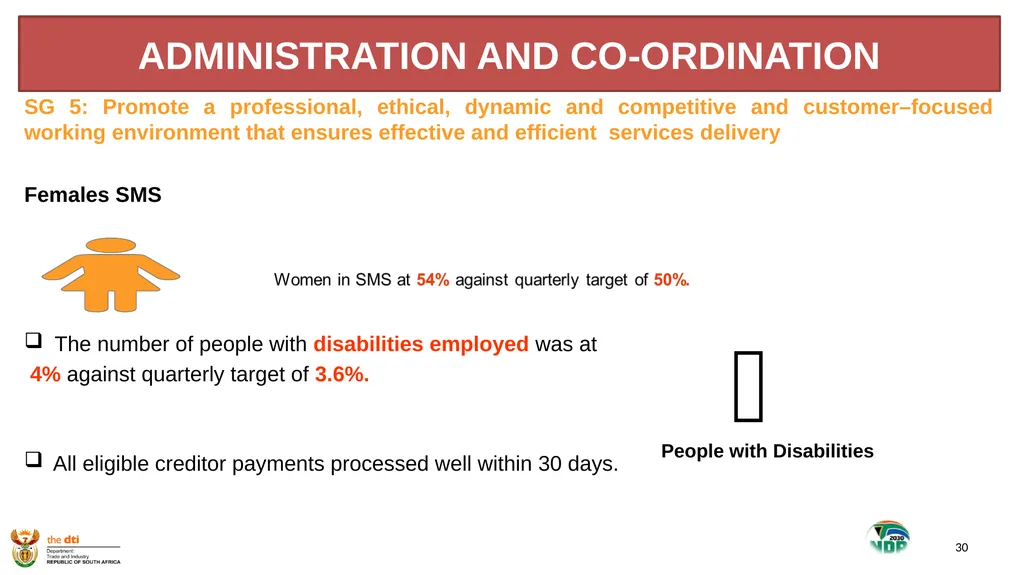
ADMINISTRATION AND CO-ORDINATION Females SMS
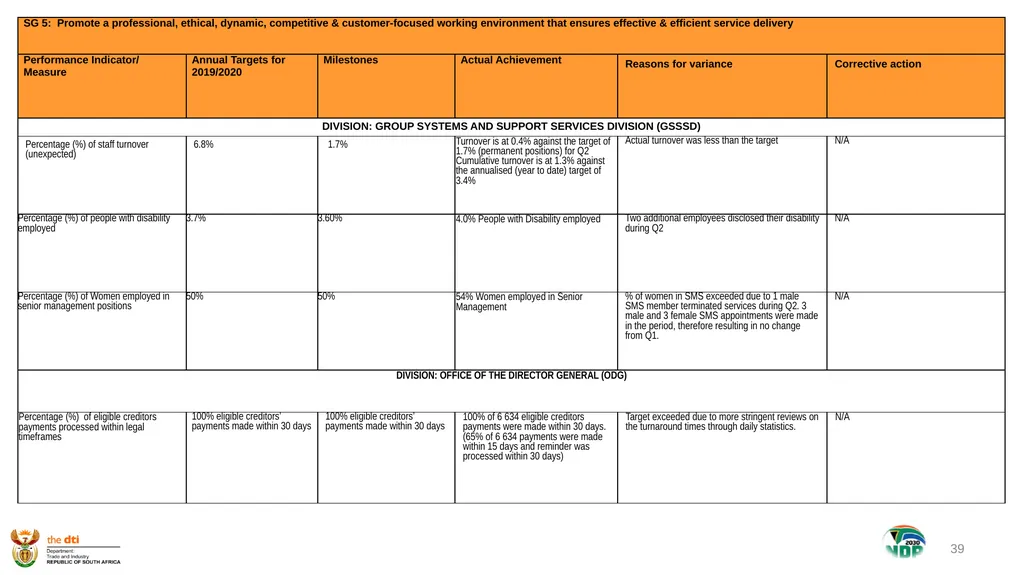
The number of people with disabilities employed was at
4% against quarterly target of 3.6%.
All eligible creditor payments processed well within 30 days. 30 SG 5: Promote a professional, ethical, dynamic and competitive and customer–focused working environment that ensures effective and efficient services delivery People with Disabilities<br>
The number of people with disabilities employed was at
4% against quarterly target of 3.6%.
All eligible creditor payments processed well within 30 days. 30 SG 5: Promote a professional, ethical, dynamic and competitive and customer–focused working environment that ensures effective and efficient services delivery People with Disabilities<br>
30
31<br>
31
32<br>
32
33<br>
33
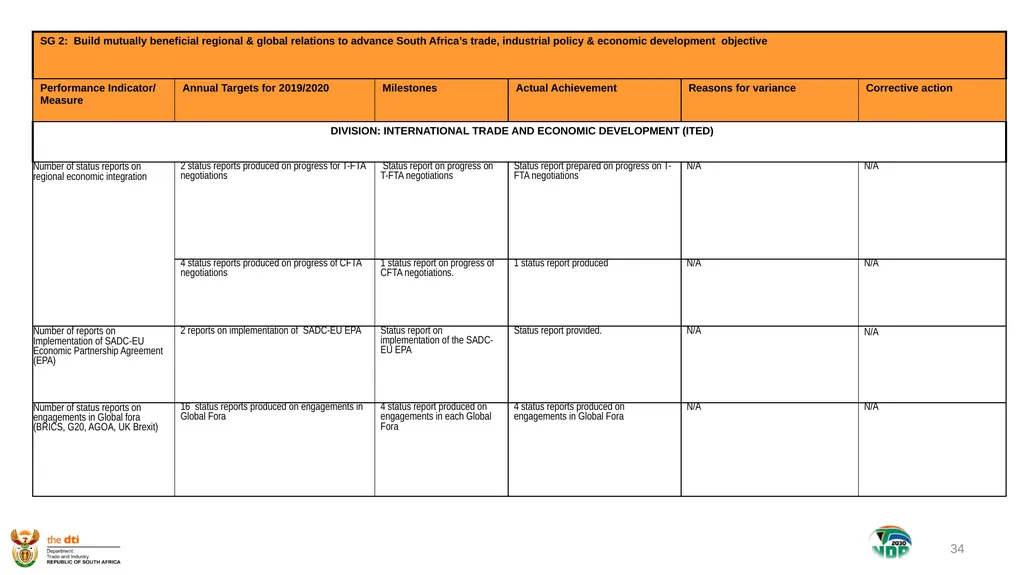
34<br>
34
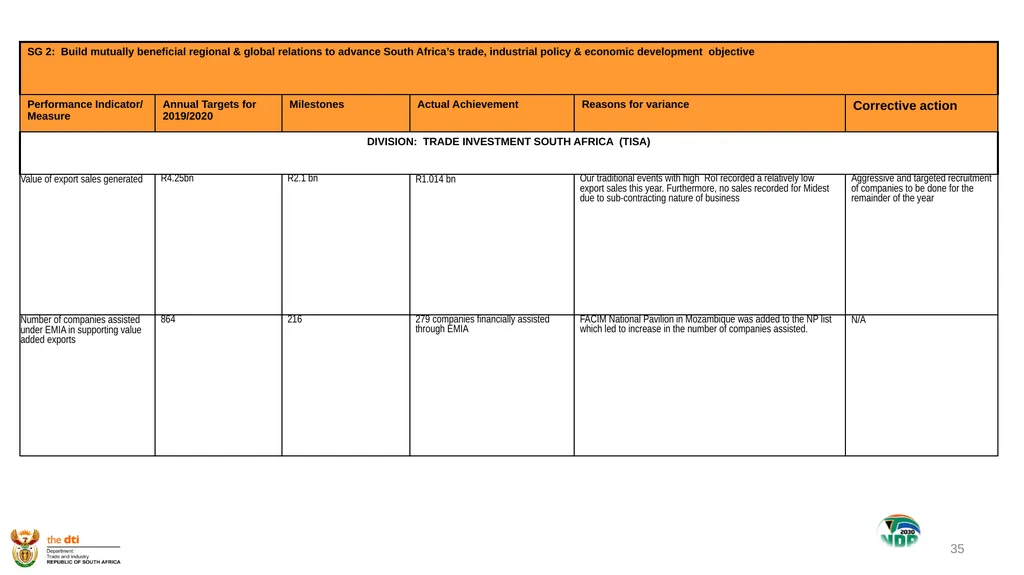
35<br>
35
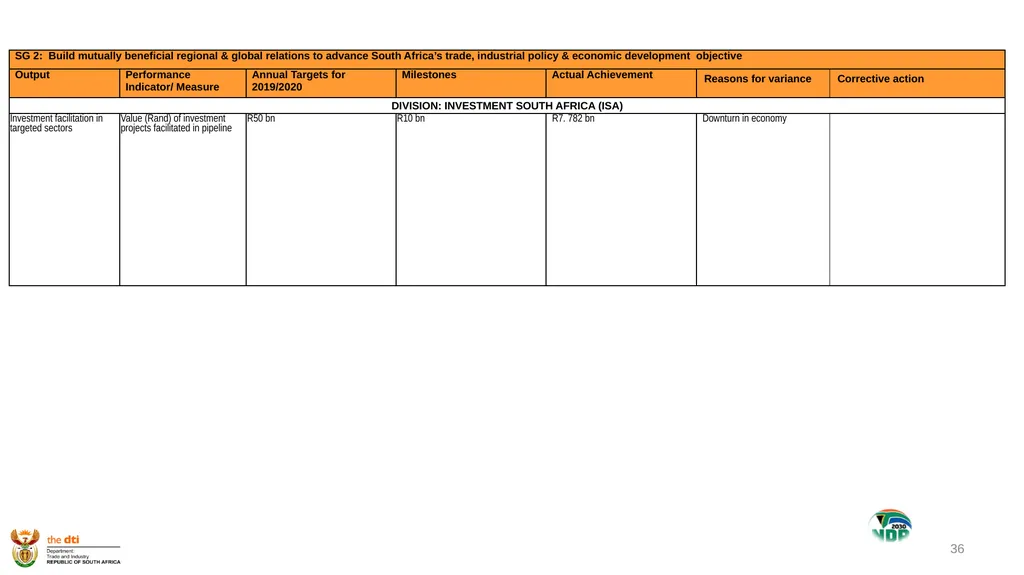
36<br>
36
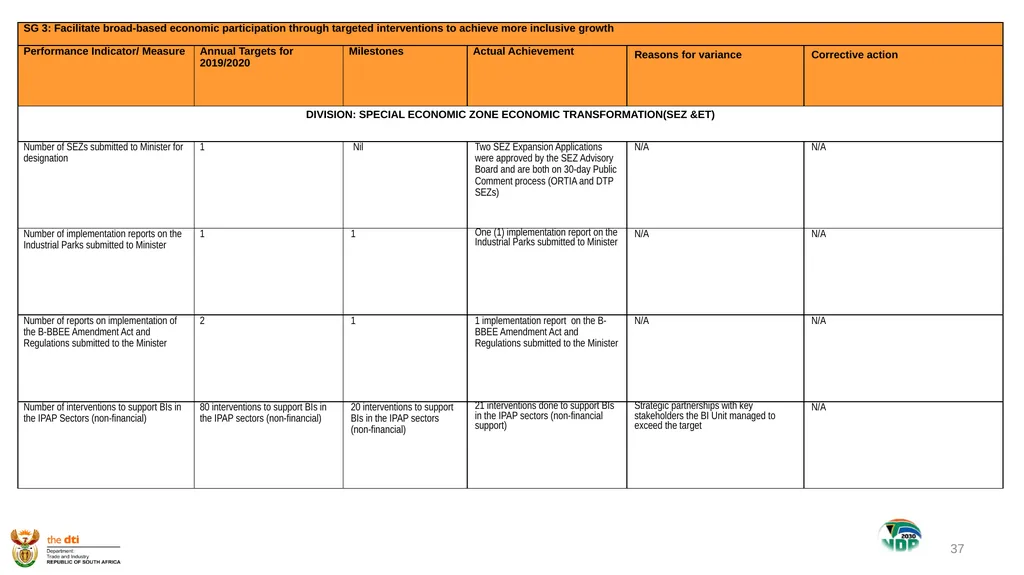
37<br>
37
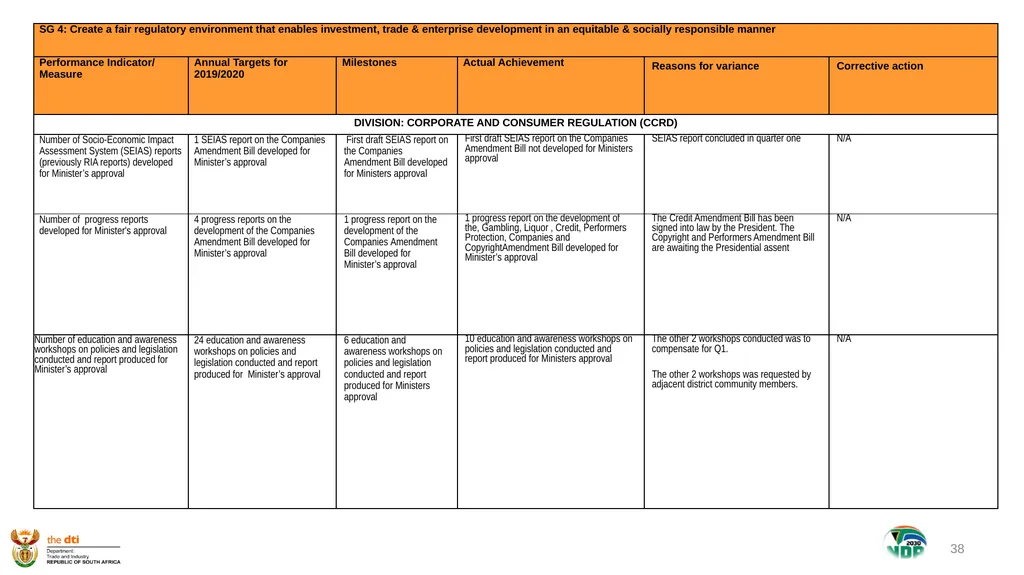
38<br>
38
39<br>
39
40 FINANCIAL PERFORMANCE 30 SEPTEMBER 2019<br>
40
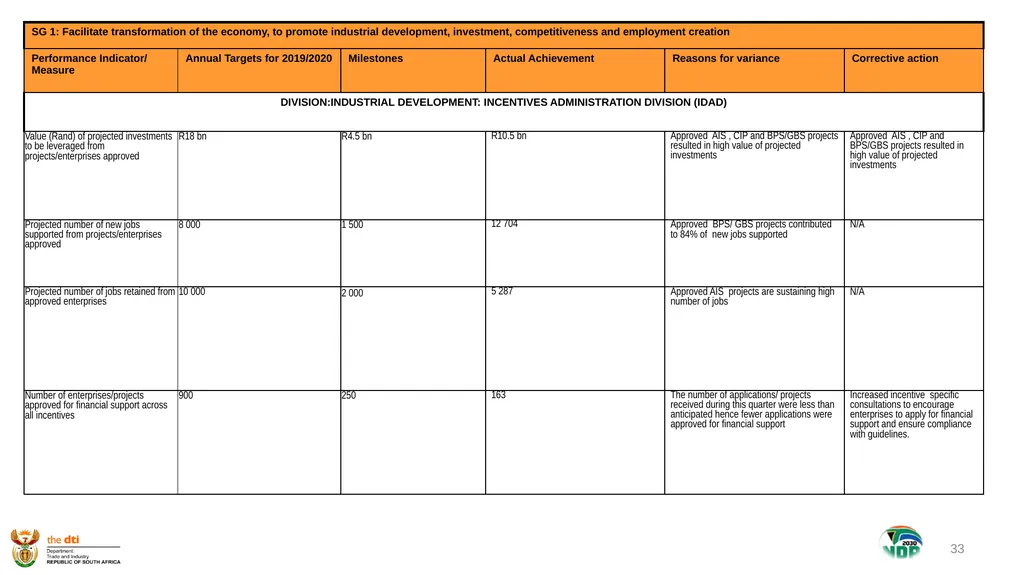
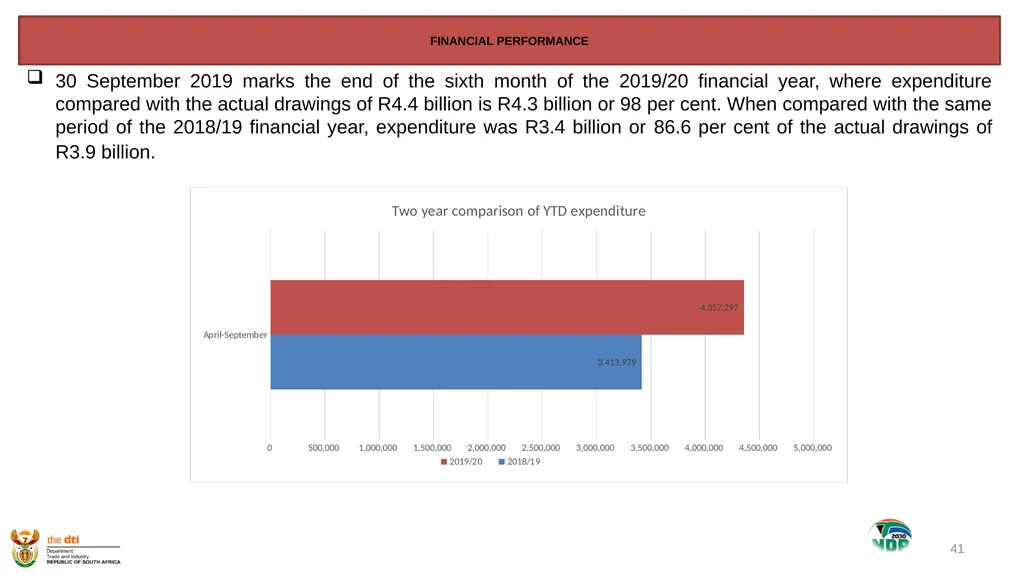
41 30 September 2019 marks the end of the sixth month of the 2019/20 financial year, where expenditure compared with the actual drawings of R4.4 billion is R4.3 billion or 98 per cent. When compared with the same period of the 2018/19 financial year, expenditure was R3.4 billion or 86.6 per cent of the actual drawings of R3.9 billion. FINANCIAL PERFORMANCE<br>
41
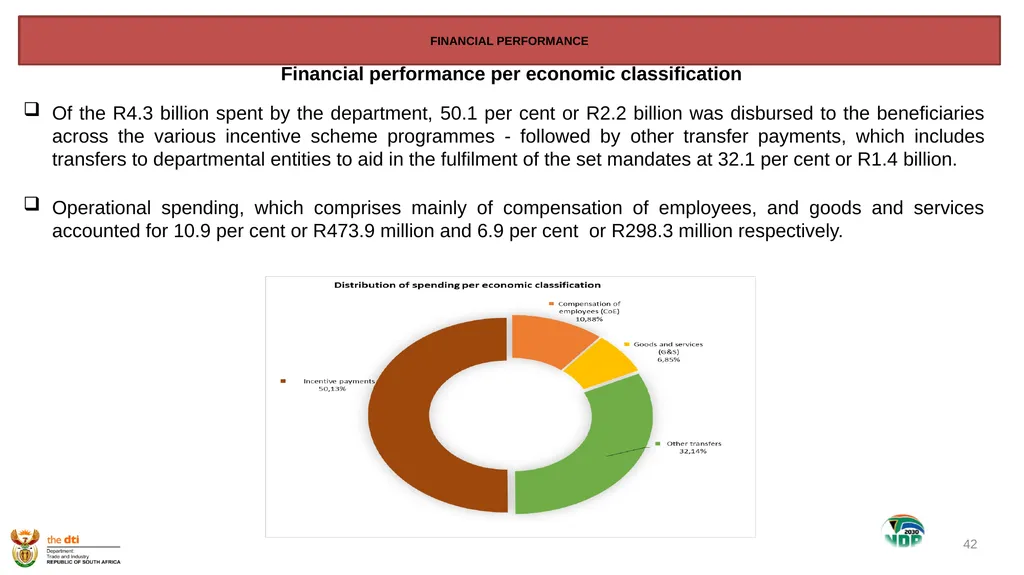
42 Financial performance per economic classification Of the R4.3 billion spent by the department, 50.1 per cent or R2.2 billion was disbursed to the beneficiaries across the various incentive scheme programmes - followed by other transfer payments, which includes transfers to departmental entities to aid in the fulfilment of the set mandates at 32.1 per cent or R1.4 billion.
Operational spending, which comprises mainly of compensation of employees, and goods and services accounted for 10.9 per cent or R473.9 million and 6.9 per cent or R298.3 million respectively. FINANCIAL PERFORMANCE<br>
Operational spending, which comprises mainly of compensation of employees, and goods and services accounted for 10.9 per cent or R473.9 million and 6.9 per cent or R298.3 million respectively. FINANCIAL PERFORMANCE<br>
42
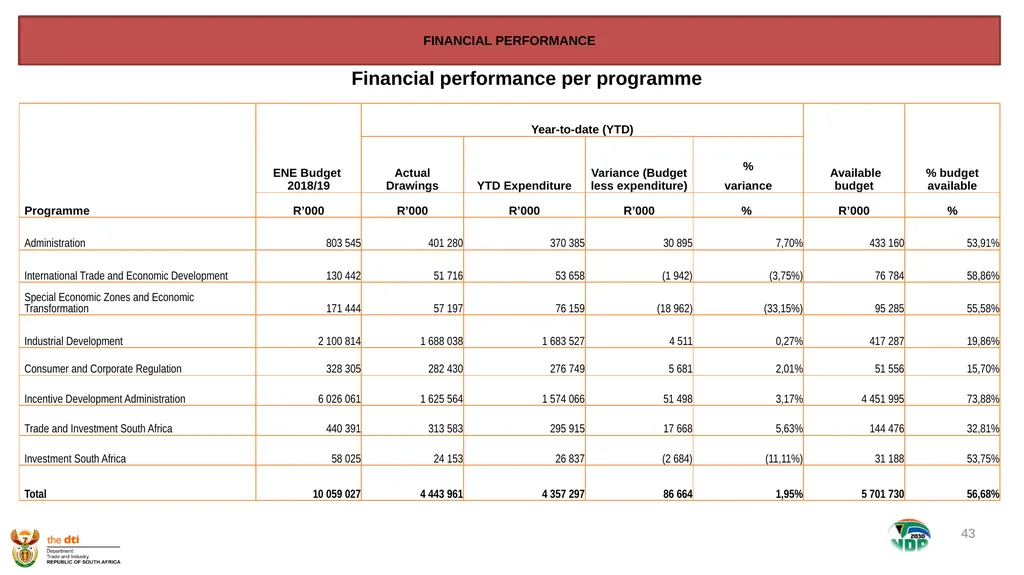
43 Financial performance per programme FINANCIAL PERFORMANCE<br>
43
44 As depicted on previous slides, expenditure is largely on track with most Divisions spending within a 10% variance of actual drawings. This is an improvement as compared with the same period of the 2018/19 financial year.
Recorded expenditure for program 3 is R76 million or 133,2% of the actual drawings. This is due to the projected expenditure which was brought forward from the 3rd Q to the 2nd Q to support the B-BBEE Commission and the National Productivity Institute. The expenditure is however still within the budget for the year.
In line with prior years expenditure trends, spending on the incentive programmes is lower at the beginning of a financial year and improves as the year progresses.
Spending is closely monitored and there are continuous engagements with Divisions to ensure that spending is largely on track in line with performance objectives. FINANCIAL PERFORMANCE<br>
Recorded expenditure for program 3 is R76 million or 133,2% of the actual drawings. This is due to the projected expenditure which was brought forward from the 3rd Q to the 2nd Q to support the B-BBEE Commission and the National Productivity Institute. The expenditure is however still within the budget for the year.
In line with prior years expenditure trends, spending on the incentive programmes is lower at the beginning of a financial year and improves as the year progresses.
Spending is closely monitored and there are continuous engagements with Divisions to ensure that spending is largely on track in line with performance objectives. FINANCIAL PERFORMANCE<br>
44
Thank you
Ngiyathokoza
Ke a leboha
Ke a leboga
Siyabonga
Inkomu
Ndo livhuwa
Enkosi
Ngiyabonga
Dankie 45<br>