
10/9/2018 Internal Memorandum - Confidential
NS
Published · 7 slides · 0 views

1 / 1
Description
1092018 Internal Memorandum - Confidential Information. Do Not Distribute 1 utilizes low concentration of anionic solution (SDS-0.01) to remove donor cells and cellular debris incorporates nuclease treatment resulting in up to 99
Related Topics
Share
Embed code
Download this presentation From Below
"10/9/2018 Internal Memorandum - Confidential" is the property of its rightful owner. Permission is granted to download and print the materials on this website for personal, non-commercial use only, and to display it on your personal computer provided you do not modify the materials and that you retain all copyright notices contained in the materials. By downloading content from our website, you accept the terms of this agreement.
Presentation Transcript
01
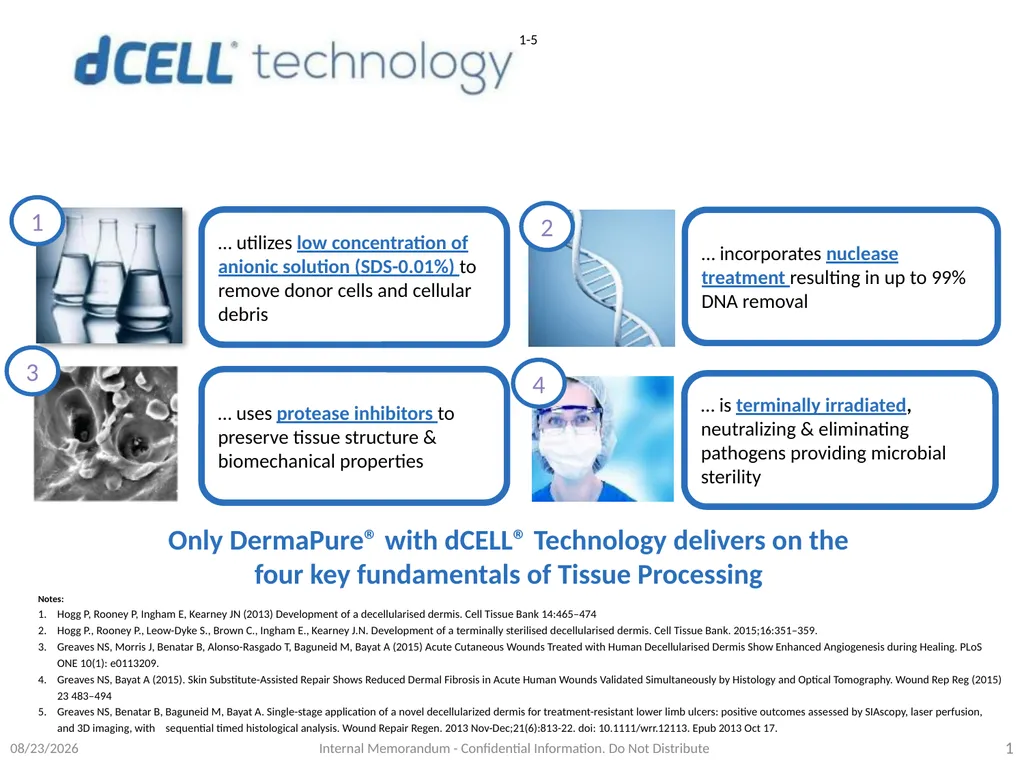
10/9/2018 Internal Memorandum - Confidential Information. Do Not Distribute 1 … utilizes low concentration of anionic solution (SDS-0.01%) to remove donor cells and cellular debris … incorporates nuclease treatment resulting in up to 99% DNA removal … uses protease inhibitors to preserve tissue structure & biomechanical properties … is terminally irradiated, neutralizing & eliminating pathogens providing microbial sterility 1 2 3 4 Only DermaPure® with dCELL® Technology delivers on the
four key fundamentals of Tissue Processing Notes:
Hogg P, Rooney P, Ingham E, Kearney JN (2013) Development of a decellularised dermis. Cell Tissue Bank 14:465–474
Hogg P., Rooney P., Leow-Dyke S., Brown C., Ingham E., Kearney J.N. Development of a terminally sterilised decellularised dermis. Cell Tissue Bank. 2015;16:351–359.
Greaves NS, Morris J, Benatar B, Alonso-Rasgado T, Baguneid M, Bayat A (2015) Acute Cutaneous Wounds Treated with Human Decellularised Dermis Show Enhanced Angiogenesis during Healing. PLoS ONE 10(1): e0113209.
Greaves NS, Bayat A (2015). Skin Substitute-Assisted Repair Shows Reduced Dermal Fibrosis in Acute Human Wounds Validated Simultaneously by Histology and Optical Tomography. Wound Rep Reg (2015) 23 483–494
Greaves NS, Benatar B, Baguneid M, Bayat A. Single-stage application of a novel decellularized dermis for treatment-resistant lower limb ulcers: positive outcomes assessed by SIAscopy, laser perfusion, and 3D imaging, with sequential timed histological analysis. Wound Repair Regen. 2013 Nov-Dec;21(6):813-22. doi: 10.1111/wrr.12113. Epub 2013 Oct 17. 1-5<br>
four key fundamentals of Tissue Processing Notes:
Hogg P, Rooney P, Ingham E, Kearney JN (2013) Development of a decellularised dermis. Cell Tissue Bank 14:465–474
Hogg P., Rooney P., Leow-Dyke S., Brown C., Ingham E., Kearney J.N. Development of a terminally sterilised decellularised dermis. Cell Tissue Bank. 2015;16:351–359.
Greaves NS, Morris J, Benatar B, Alonso-Rasgado T, Baguneid M, Bayat A (2015) Acute Cutaneous Wounds Treated with Human Decellularised Dermis Show Enhanced Angiogenesis during Healing. PLoS ONE 10(1): e0113209.
Greaves NS, Bayat A (2015). Skin Substitute-Assisted Repair Shows Reduced Dermal Fibrosis in Acute Human Wounds Validated Simultaneously by Histology and Optical Tomography. Wound Rep Reg (2015) 23 483–494
Greaves NS, Benatar B, Baguneid M, Bayat A. Single-stage application of a novel decellularized dermis for treatment-resistant lower limb ulcers: positive outcomes assessed by SIAscopy, laser perfusion, and 3D imaging, with sequential timed histological analysis. Wound Repair Regen. 2013 Nov-Dec;21(6):813-22. doi: 10.1111/wrr.12113. Epub 2013 Oct 17. 1-5<br>
02
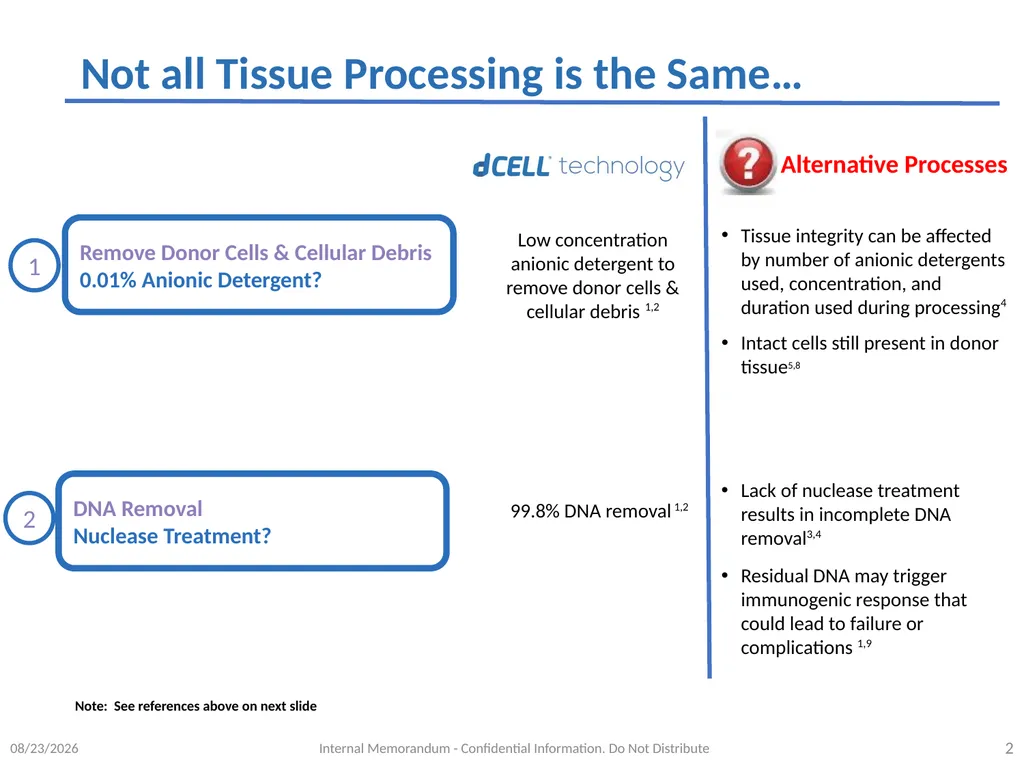
Not all Tissue Processing is the Same… 10/9/2018 Internal Memorandum - Confidential Information. Do Not Distribute 2 DNA Removal
Nuclease Treatment? Remove Donor Cells & Cellular Debris
0.01% Anionic Detergent? 1 2 Tissue integrity can be affected by number of anionic detergents used, concentration, and duration used during processing4
Intact cells still present in donor tissue5,8 Lack of nuclease treatment results in incomplete DNA removal3,4
Residual DNA may trigger immunogenic response that could lead to failure or complications 1,9 99.8% DNA removal 1,2 Low concentration anionic detergent to
remove donor cells & cellular debris 1,2 Alternative Processes Note: See references above on next slide<br>
Nuclease Treatment? Remove Donor Cells & Cellular Debris
0.01% Anionic Detergent? 1 2 Tissue integrity can be affected by number of anionic detergents used, concentration, and duration used during processing4
Intact cells still present in donor tissue5,8 Lack of nuclease treatment results in incomplete DNA removal3,4
Residual DNA may trigger immunogenic response that could lead to failure or complications 1,9 99.8% DNA removal 1,2 Low concentration anionic detergent to
remove donor cells & cellular debris 1,2 Alternative Processes Note: See references above on next slide<br>
03
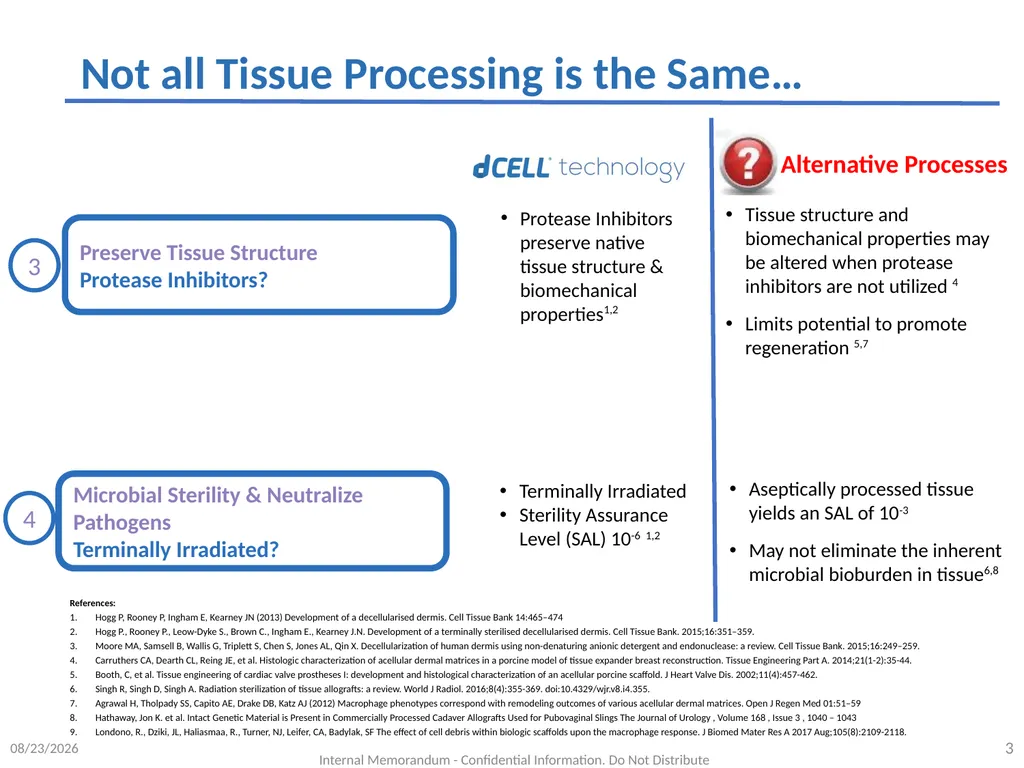
Not all Tissue Processing is the Same… 10/9/2018 Internal Memorandum - Confidential Information. Do Not Distribute 3 Microbial Sterility & Neutralize Pathogens
Terminally Irradiated? Preserve Tissue Structure
Protease Inhibitors? 3 4 Terminally Irradiated
Sterility Assurance Level (SAL) 10-6 1,2 Protease Inhibitors preserve native tissue structure & biomechanical properties1,2 Alternative Processes Tissue structure and biomechanical properties may be altered when protease inhibitors are not utilized 4
Limits potential to promote regeneration 5,7 Aseptically processed tissue yields an SAL of 10-3
May not eliminate the inherent microbial bioburden in tissue6,8 References:
Hogg P, Rooney P, Ingham E, Kearney JN (2013) Development of a decellularised dermis. Cell Tissue Bank 14:465–474
Hogg P., Rooney P., Leow-Dyke S., Brown C., Ingham E., Kearney J.N. Development of a terminally sterilised decellularised dermis. Cell Tissue Bank. 2015;16:351–359.
Moore MA, Samsell B, Wallis G, Triplett S, Chen S, Jones AL, Qin X. Decellularization of human dermis using non-denaturing anionic detergent and endonuclease: a review. Cell Tissue Bank. 2015;16:249–259.
Carruthers CA, Dearth CL, Reing JE, et al. Histologic characterization of acellular dermal matrices in a porcine model of tissue expander breast reconstruction. Tissue Engineering Part A. 2014;21(1-2):35-44.
Booth, C, et al. Tissue engineering of cardiac valve prostheses I: development and histological characterization of an acellular porcine scaffold. J Heart Valve Dis. 2002;11(4):457-462.
Singh R, Singh D, Singh A. Radiation sterilization of tissue allografts: a review. World J Radiol. 2016;8(4):355-369. doi:10.4329/wjr.v8.i4.355.
Agrawal H, Tholpady SS, Capito AE, Drake DB, Katz AJ (2012) Macrophage phenotypes correspond with remodeling outcomes of various acellular dermal matrices. Open J Regen Med 01:51–59
Hathaway, Jon K. et al. Intact Genetic Material is Present in Commercially Processed Cadaver Allografts Used for Pubovaginal Slings The Journal of Urology , Volume 168 , Issue 3 , 1040 – 1043
Londono, R., Dziki, JL, Haliasmaa, R., Turner, NJ, Leifer, CA, Badylak, SF The effect of cell debris within biologic scaffolds upon the macrophage response. J Biomed Mater Res A 2017 Aug;105(8):2109-2118.<br>
Terminally Irradiated? Preserve Tissue Structure
Protease Inhibitors? 3 4 Terminally Irradiated
Sterility Assurance Level (SAL) 10-6 1,2 Protease Inhibitors preserve native tissue structure & biomechanical properties1,2 Alternative Processes Tissue structure and biomechanical properties may be altered when protease inhibitors are not utilized 4
Limits potential to promote regeneration 5,7 Aseptically processed tissue yields an SAL of 10-3
May not eliminate the inherent microbial bioburden in tissue6,8 References:
Hogg P, Rooney P, Ingham E, Kearney JN (2013) Development of a decellularised dermis. Cell Tissue Bank 14:465–474
Hogg P., Rooney P., Leow-Dyke S., Brown C., Ingham E., Kearney J.N. Development of a terminally sterilised decellularised dermis. Cell Tissue Bank. 2015;16:351–359.
Moore MA, Samsell B, Wallis G, Triplett S, Chen S, Jones AL, Qin X. Decellularization of human dermis using non-denaturing anionic detergent and endonuclease: a review. Cell Tissue Bank. 2015;16:249–259.
Carruthers CA, Dearth CL, Reing JE, et al. Histologic characterization of acellular dermal matrices in a porcine model of tissue expander breast reconstruction. Tissue Engineering Part A. 2014;21(1-2):35-44.
Booth, C, et al. Tissue engineering of cardiac valve prostheses I: development and histological characterization of an acellular porcine scaffold. J Heart Valve Dis. 2002;11(4):457-462.
Singh R, Singh D, Singh A. Radiation sterilization of tissue allografts: a review. World J Radiol. 2016;8(4):355-369. doi:10.4329/wjr.v8.i4.355.
Agrawal H, Tholpady SS, Capito AE, Drake DB, Katz AJ (2012) Macrophage phenotypes correspond with remodeling outcomes of various acellular dermal matrices. Open J Regen Med 01:51–59
Hathaway, Jon K. et al. Intact Genetic Material is Present in Commercially Processed Cadaver Allografts Used for Pubovaginal Slings The Journal of Urology , Volume 168 , Issue 3 , 1040 – 1043
Londono, R., Dziki, JL, Haliasmaa, R., Turner, NJ, Leifer, CA, Badylak, SF The effect of cell debris within biologic scaffolds upon the macrophage response. J Biomed Mater Res A 2017 Aug;105(8):2109-2118.<br>
04
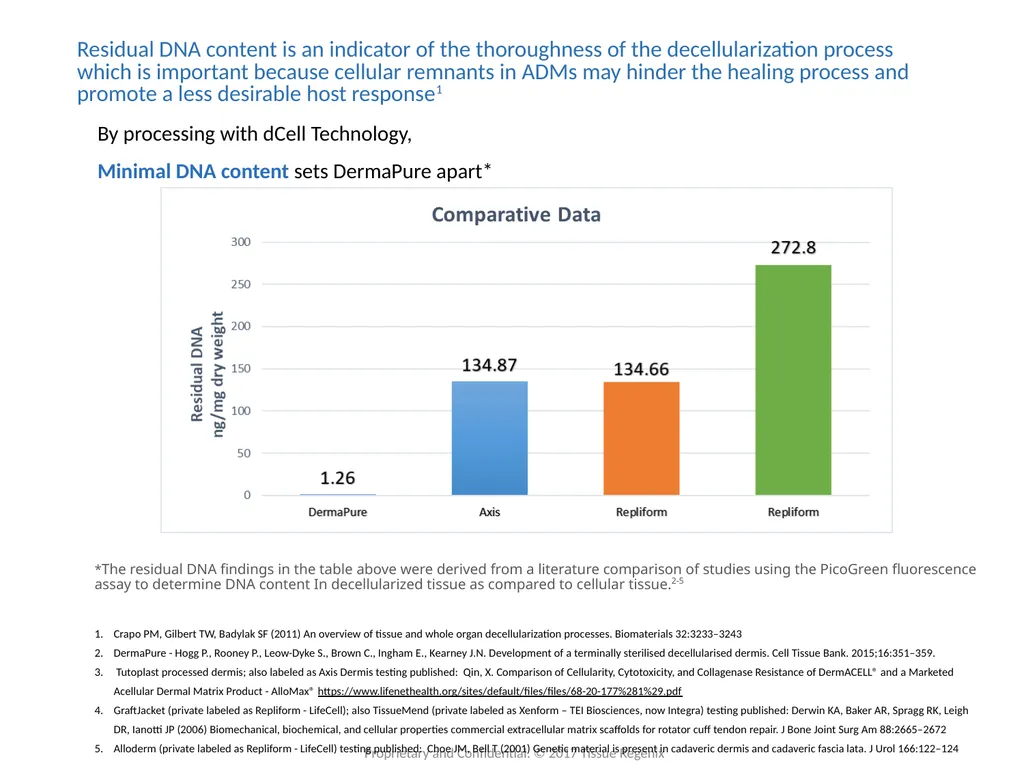
By processing with dCell Technology,
Minimal DNA content sets DermaPure apart* Proprietary and Confidential. © 2017 Tissue Regenix 4 *The residual DNA findings in the table above were derived from a literature comparison of studies using the PicoGreen fluorescence assay to determine DNA content In decellularized tissue as compared to cellular tissue.2-5
Crapo PM, Gilbert TW, Badylak SF (2011) An overview of tissue and whole organ decellularization processes. Biomaterials 32:3233–3243
DermaPure - Hogg P., Rooney P., Leow-Dyke S., Brown C., Ingham E., Kearney J.N. Development of a terminally sterilised decellularised dermis. Cell Tissue Bank. 2015;16:351–359.
Tutoplast processed dermis; also labeled as Axis Dermis testing published: Qin, X. Comparison of Cellularity, Cytotoxicity, and Collagenase Resistance of DermACELL® and a Marketed Acellular Dermal Matrix Product - AlloMax® https://www.lifenethealth.org/sites/default/files/files/68-20-177%281%29.pdf
GraftJacket (private labeled as Repliform - LifeCell); also TissueMend (private labeled as Xenform – TEI Biosciences, now Integra) testing published: Derwin KA, Baker AR, Spragg RK, Leigh DR, Ianotti JP (2006) Biomechanical, biochemical, and cellular properties commercial extracellular matrix scaffolds for rotator cuff tendon repair. J Bone Joint Surg Am 88:2665–2672
Alloderm (private labeled as Repliform - LifeCell) testing published: Choe JM, Bell T (2001) Genetic material is present in cadaveric dermis and cadaveric fascia lata. J Urol 166:122–124 Residual DNA content is an indicator of the thoroughness of the decellularization process which is important because cellular remnants in ADMs may hinder the healing process and promote a less desirable host response1<br>
Minimal DNA content sets DermaPure apart* Proprietary and Confidential. © 2017 Tissue Regenix 4 *The residual DNA findings in the table above were derived from a literature comparison of studies using the PicoGreen fluorescence assay to determine DNA content In decellularized tissue as compared to cellular tissue.2-5
Crapo PM, Gilbert TW, Badylak SF (2011) An overview of tissue and whole organ decellularization processes. Biomaterials 32:3233–3243
DermaPure - Hogg P., Rooney P., Leow-Dyke S., Brown C., Ingham E., Kearney J.N. Development of a terminally sterilised decellularised dermis. Cell Tissue Bank. 2015;16:351–359.
Tutoplast processed dermis; also labeled as Axis Dermis testing published: Qin, X. Comparison of Cellularity, Cytotoxicity, and Collagenase Resistance of DermACELL® and a Marketed Acellular Dermal Matrix Product - AlloMax® https://www.lifenethealth.org/sites/default/files/files/68-20-177%281%29.pdf
GraftJacket (private labeled as Repliform - LifeCell); also TissueMend (private labeled as Xenform – TEI Biosciences, now Integra) testing published: Derwin KA, Baker AR, Spragg RK, Leigh DR, Ianotti JP (2006) Biomechanical, biochemical, and cellular properties commercial extracellular matrix scaffolds for rotator cuff tendon repair. J Bone Joint Surg Am 88:2665–2672
Alloderm (private labeled as Repliform - LifeCell) testing published: Choe JM, Bell T (2001) Genetic material is present in cadaveric dermis and cadaveric fascia lata. J Urol 166:122–124 Residual DNA content is an indicator of the thoroughness of the decellularization process which is important because cellular remnants in ADMs may hinder the healing process and promote a less desirable host response1<br>
05
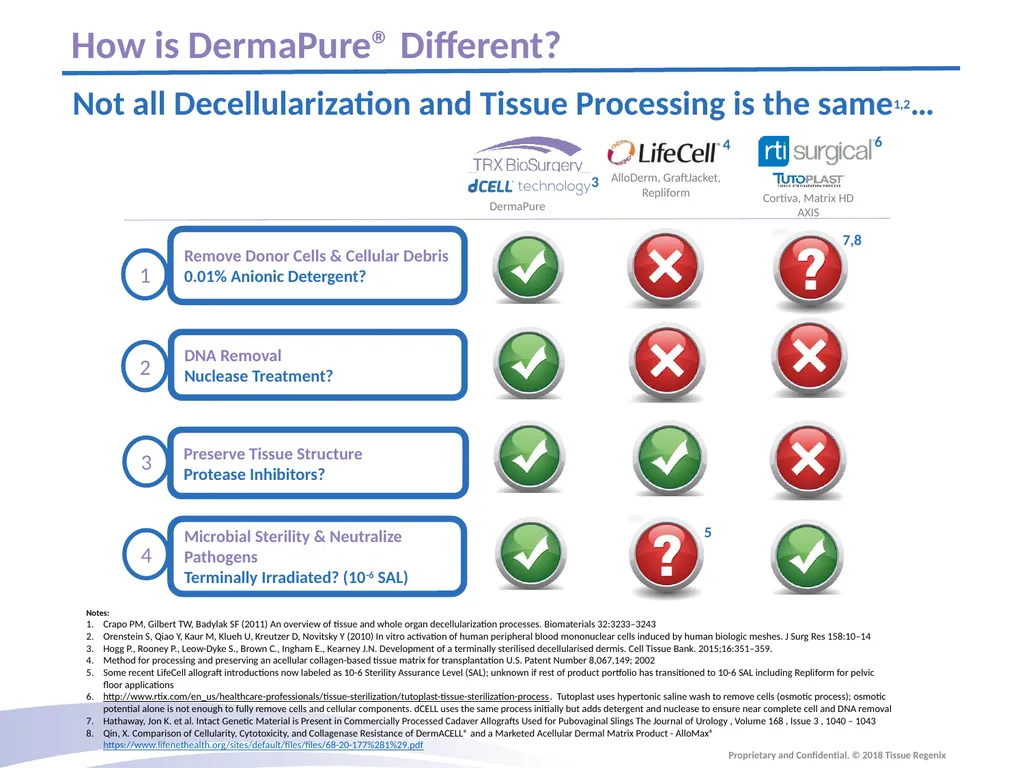
Proprietary and Confidential. © 2018 Tissue Regenix Not all Decellularization and Tissue Processing is the same1,2… How is DermaPure® Different? Cortiva, Matrix HD AXIS Notes:
Crapo PM, Gilbert TW, Badylak SF (2011) An overview of tissue and whole organ decellularization processes. Biomaterials 32:3233–3243
Orenstein S, Qiao Y, Kaur M, Klueh U, Kreutzer D, Novitsky Y (2010) In vitro activation of human peripheral blood mononuclear cells induced by human biologic meshes. J Surg Res 158:10–14
Hogg P., Rooney P., Leow-Dyke S., Brown C., Ingham E., Kearney J.N. Development of a terminally sterilised decellularised dermis. Cell Tissue Bank. 2015;16:351–359.
Method for processing and preserving an acellular collagen-based tissue matrix for transplantation U.S. Patent Number 8,067,149; 2002
Some recent LifeCell allograft introductions now labeled as 10-6 Sterility Assurance Level (SAL); unknown if rest of product portfolio has transitioned to 10-6 SAL including Repliform for pelvic floor applications
http://www.rtix.com/en_us/healthcare-professionals/tissue-sterilization/tutoplast-tissue-sterilization-process. Tutoplast uses hypertonic saline wash to remove cells (osmotic process); osmotic potential alone is not enough to fully remove cells and cellular components. dCELL uses the same process initially but adds detergent and nuclease to ensure near complete cell and DNA removal
Hathaway, Jon K. et al. Intact Genetic Material is Present in Commercially Processed Cadaver Allografts Used for Pubovaginal Slings The Journal of Urology , Volume 168 , Issue 3 , 1040 – 1043
Qin, X. Comparison of Cellularity, Cytotoxicity, and Collagenase Resistance of DermACELL® and a Marketed Acellular Dermal Matrix Product - AlloMax® https://www.lifenethealth.org/sites/default/files/files/68-20-177%281%29.pdf DermaPure 3 4 6<br>
Crapo PM, Gilbert TW, Badylak SF (2011) An overview of tissue and whole organ decellularization processes. Biomaterials 32:3233–3243
Orenstein S, Qiao Y, Kaur M, Klueh U, Kreutzer D, Novitsky Y (2010) In vitro activation of human peripheral blood mononuclear cells induced by human biologic meshes. J Surg Res 158:10–14
Hogg P., Rooney P., Leow-Dyke S., Brown C., Ingham E., Kearney J.N. Development of a terminally sterilised decellularised dermis. Cell Tissue Bank. 2015;16:351–359.
Method for processing and preserving an acellular collagen-based tissue matrix for transplantation U.S. Patent Number 8,067,149; 2002
Some recent LifeCell allograft introductions now labeled as 10-6 Sterility Assurance Level (SAL); unknown if rest of product portfolio has transitioned to 10-6 SAL including Repliform for pelvic floor applications
http://www.rtix.com/en_us/healthcare-professionals/tissue-sterilization/tutoplast-tissue-sterilization-process. Tutoplast uses hypertonic saline wash to remove cells (osmotic process); osmotic potential alone is not enough to fully remove cells and cellular components. dCELL uses the same process initially but adds detergent and nuclease to ensure near complete cell and DNA removal
Hathaway, Jon K. et al. Intact Genetic Material is Present in Commercially Processed Cadaver Allografts Used for Pubovaginal Slings The Journal of Urology , Volume 168 , Issue 3 , 1040 – 1043
Qin, X. Comparison of Cellularity, Cytotoxicity, and Collagenase Resistance of DermACELL® and a Marketed Acellular Dermal Matrix Product - AlloMax® https://www.lifenethealth.org/sites/default/files/files/68-20-177%281%29.pdf DermaPure 3 4 6<br>
06
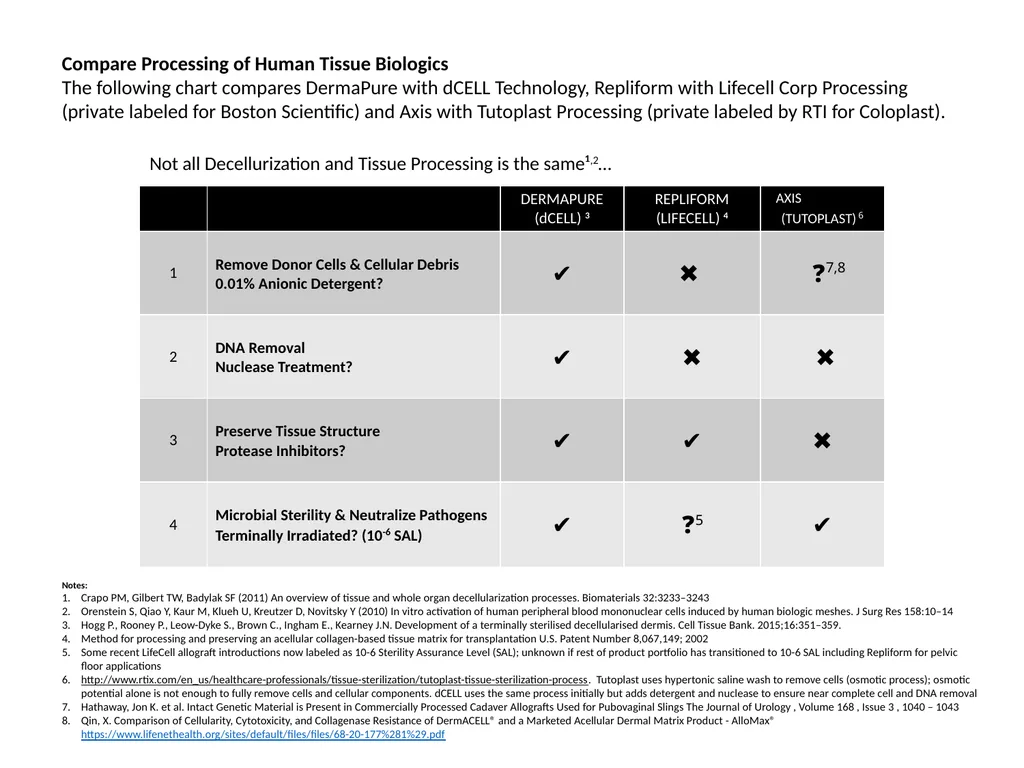
Compare Processing of Human Tissue Biologics
The following chart compares DermaPure with dCELL Technology, Repliform with Lifecell Corp Processing (private labeled for Boston Scientific) and Axis with Tutoplast Processing (private labeled by RTI for Coloplast). Notes:
Crapo PM, Gilbert TW, Badylak SF (2011) An overview of tissue and whole organ decellularization processes. Biomaterials 32:3233–3243
Orenstein S, Qiao Y, Kaur M, Klueh U, Kreutzer D, Novitsky Y (2010) In vitro activation of human peripheral blood mononuclear cells induced by human biologic meshes. J Surg Res 158:10–14
Hogg P., Rooney P., Leow-Dyke S., Brown C., Ingham E., Kearney J.N. Development of a terminally sterilised decellularised dermis. Cell Tissue Bank. 2015;16:351–359.
Method for processing and preserving an acellular collagen-based tissue matrix for transplantation U.S. Patent Number 8,067,149; 2002
Some recent LifeCell allograft introductions now labeled as 10-6 Sterility Assurance Level (SAL); unknown if rest of product portfolio has transitioned to 10-6 SAL including Repliform for pelvic floor applications
http://www.rtix.com/en_us/healthcare-professionals/tissue-sterilization/tutoplast-tissue-sterilization-process. Tutoplast uses hypertonic saline wash to remove cells (osmotic process); osmotic potential alone is not enough to fully remove cells and cellular components. dCELL uses the same process initially but adds detergent and nuclease to ensure near complete cell and DNA removal
Hathaway, Jon K. et al. Intact Genetic Material is Present in Commercially Processed Cadaver Allografts Used for Pubovaginal Slings The Journal of Urology , Volume 168 , Issue 3 , 1040 – 1043
Qin, X. Comparison of Cellularity, Cytotoxicity, and Collagenase Resistance of DermACELL® and a Marketed Acellular Dermal Matrix Product - AlloMax® https://www.lifenethealth.org/sites/default/files/files/68-20-177%281%29.pdf Not all Decellurization and Tissue Processing is the same¹,2…<br>
The following chart compares DermaPure with dCELL Technology, Repliform with Lifecell Corp Processing (private labeled for Boston Scientific) and Axis with Tutoplast Processing (private labeled by RTI for Coloplast). Notes:
Crapo PM, Gilbert TW, Badylak SF (2011) An overview of tissue and whole organ decellularization processes. Biomaterials 32:3233–3243
Orenstein S, Qiao Y, Kaur M, Klueh U, Kreutzer D, Novitsky Y (2010) In vitro activation of human peripheral blood mononuclear cells induced by human biologic meshes. J Surg Res 158:10–14
Hogg P., Rooney P., Leow-Dyke S., Brown C., Ingham E., Kearney J.N. Development of a terminally sterilised decellularised dermis. Cell Tissue Bank. 2015;16:351–359.
Method for processing and preserving an acellular collagen-based tissue matrix for transplantation U.S. Patent Number 8,067,149; 2002
Some recent LifeCell allograft introductions now labeled as 10-6 Sterility Assurance Level (SAL); unknown if rest of product portfolio has transitioned to 10-6 SAL including Repliform for pelvic floor applications
http://www.rtix.com/en_us/healthcare-professionals/tissue-sterilization/tutoplast-tissue-sterilization-process. Tutoplast uses hypertonic saline wash to remove cells (osmotic process); osmotic potential alone is not enough to fully remove cells and cellular components. dCELL uses the same process initially but adds detergent and nuclease to ensure near complete cell and DNA removal
Hathaway, Jon K. et al. Intact Genetic Material is Present in Commercially Processed Cadaver Allografts Used for Pubovaginal Slings The Journal of Urology , Volume 168 , Issue 3 , 1040 – 1043
Qin, X. Comparison of Cellularity, Cytotoxicity, and Collagenase Resistance of DermACELL® and a Marketed Acellular Dermal Matrix Product - AlloMax® https://www.lifenethealth.org/sites/default/files/files/68-20-177%281%29.pdf Not all Decellurization and Tissue Processing is the same¹,2…<br>
07
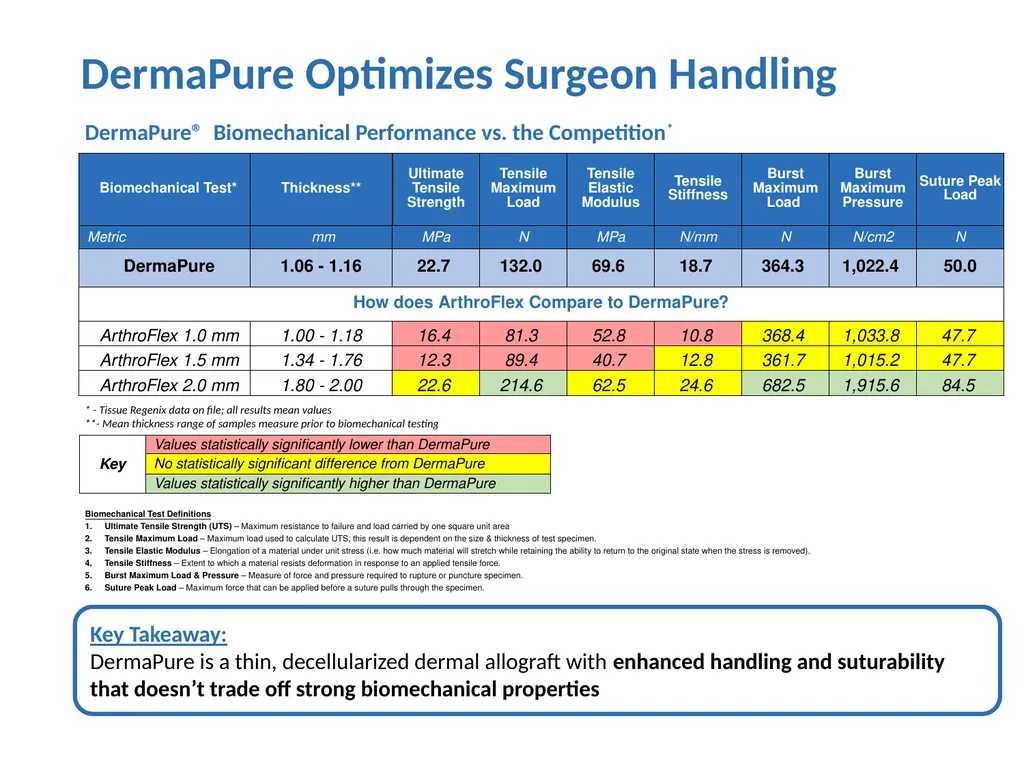
DermaPure Optimizes Surgeon Handling 10/9/2018 Internal Memorandum - Confidential Information. Do Not Distribute 7 Biomechanical Test Definitions
Ultimate Tensile Strength (UTS) – Maximum resistance to failure and load carried by one square unit area
Tensile Maximum Load – Maximum load used to calculate UTS; this result is dependent on the size & thickness of test specimen.
Tensile Elastic Modulus – Elongation of a material under unit stress (i.e. how much material will stretch while retaining the ability to return to the original state when the stress is removed).
Tensile Stiffness – Extent to which a material resists deformation in response to an applied tensile force.
Burst Maximum Load & Pressure – Measure of force and pressure required to rupture or puncture specimen.
Suture Peak Load – Maximum force that can be applied before a suture pulls through the specimen. * - Tissue Regenix data on file; all results mean values
**- Mean thickness range of samples measure prior to biomechanical testing DermaPure® Biomechanical Performance vs. the Competition* Key Takeaway:
DermaPure is a thin, decellularized dermal allograft with enhanced handling and suturability that doesn’t trade off strong biomechanical properties<br>
Ultimate Tensile Strength (UTS) – Maximum resistance to failure and load carried by one square unit area
Tensile Maximum Load – Maximum load used to calculate UTS; this result is dependent on the size & thickness of test specimen.
Tensile Elastic Modulus – Elongation of a material under unit stress (i.e. how much material will stretch while retaining the ability to return to the original state when the stress is removed).
Tensile Stiffness – Extent to which a material resists deformation in response to an applied tensile force.
Burst Maximum Load & Pressure – Measure of force and pressure required to rupture or puncture specimen.
Suture Peak Load – Maximum force that can be applied before a suture pulls through the specimen. * - Tissue Regenix data on file; all results mean values
**- Mean thickness range of samples measure prior to biomechanical testing DermaPure® Biomechanical Performance vs. the Competition* Key Takeaway:
DermaPure is a thin, decellularized dermal allograft with enhanced handling and suturability that doesn’t trade off strong biomechanical properties<br>