
11:15 – 12:30 Trade facilitation: basic concepts,
FD
Published · 67 slides · 0 views
1 / 1



Description
11:15 12:30 Trade facilitation: basic concepts, evolving content and most recent developments: challenges and opportunities for developing countries Outline Evolving concepts on Trade Facilitation International Instruments related to
Related Topics
Share
Embed code
Download this presentation From Below
"11:15 – 12:30 Trade facilitation: basic concepts," is the property of its rightful owner. Permission is granted to download and print the materials on this website for personal, non-commercial use only, and to display it on your personal computer provided you do not modify the materials and that you retain all copyright notices contained in the materials. By downloading content from our website, you accept the terms of this agreement.
Presentation Transcript
01
11:15 – 12:30
Trade facilitation: basic concepts, evolving content and most recent developments: challenges and opportunities for developing countries<br>
02
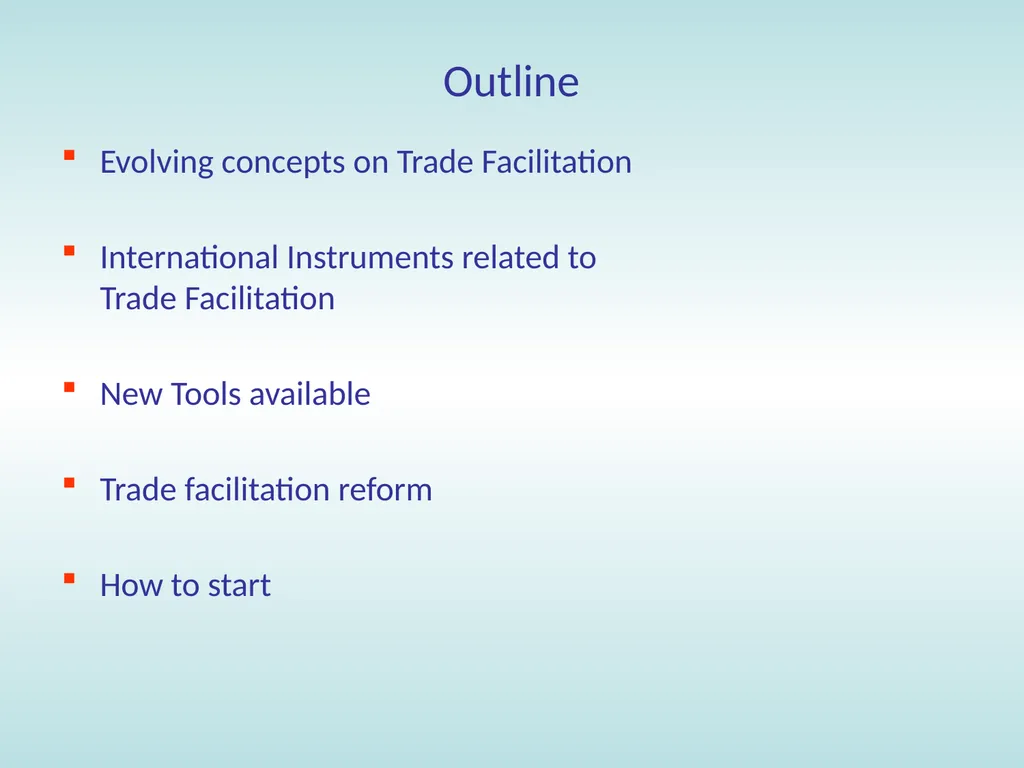
Outline Evolving concepts on Trade Facilitation
International Instruments related to Trade Facilitation
New Tools available
Trade facilitation reform
How to start<br>
International Instruments related to Trade Facilitation
New Tools available
Trade facilitation reform
How to start<br>
03
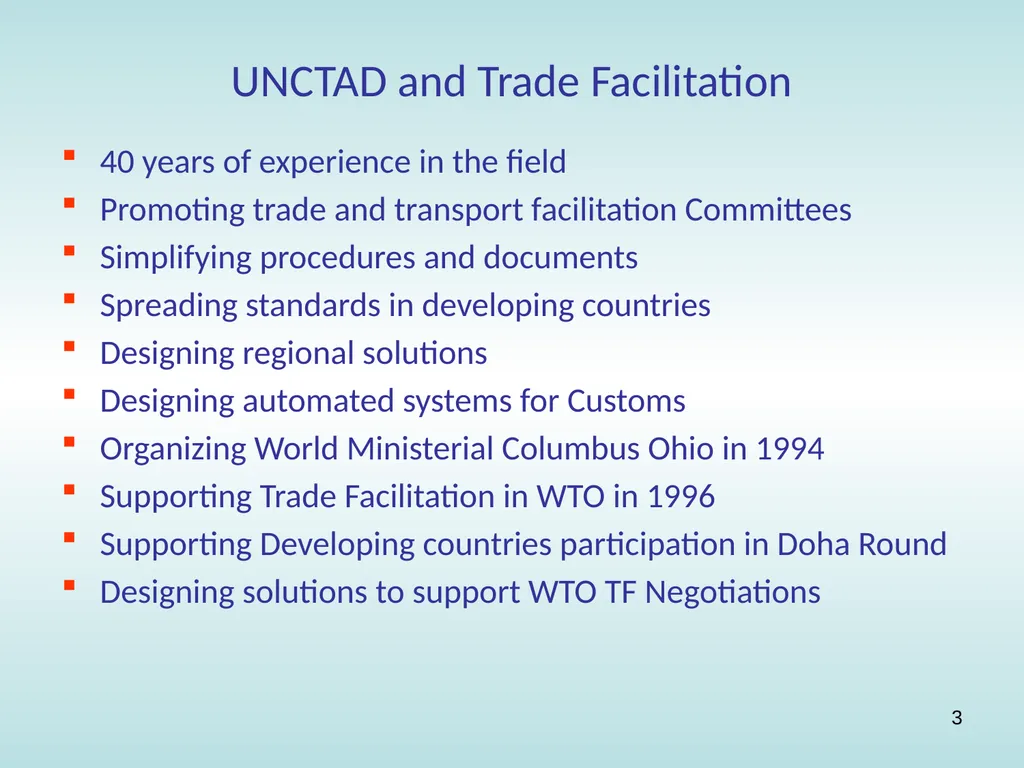
3 UNCTAD and Trade Facilitation 40 years of experience in the field
Promoting trade and transport facilitation Committees
Simplifying procedures and documents
Spreading standards in developing countries
Designing regional solutions
Designing automated systems for Customs
Organizing World Ministerial Columbus Ohio in 1994
Supporting Trade Facilitation in WTO in 1996
Supporting Developing countries participation in Doha Round
Designing solutions to support WTO TF Negotiations<br>
Promoting trade and transport facilitation Committees
Simplifying procedures and documents
Spreading standards in developing countries
Designing regional solutions
Designing automated systems for Customs
Organizing World Ministerial Columbus Ohio in 1994
Supporting Trade Facilitation in WTO in 1996
Supporting Developing countries participation in Doha Round
Designing solutions to support WTO TF Negotiations<br>
04
Evolving concepts<br>
05
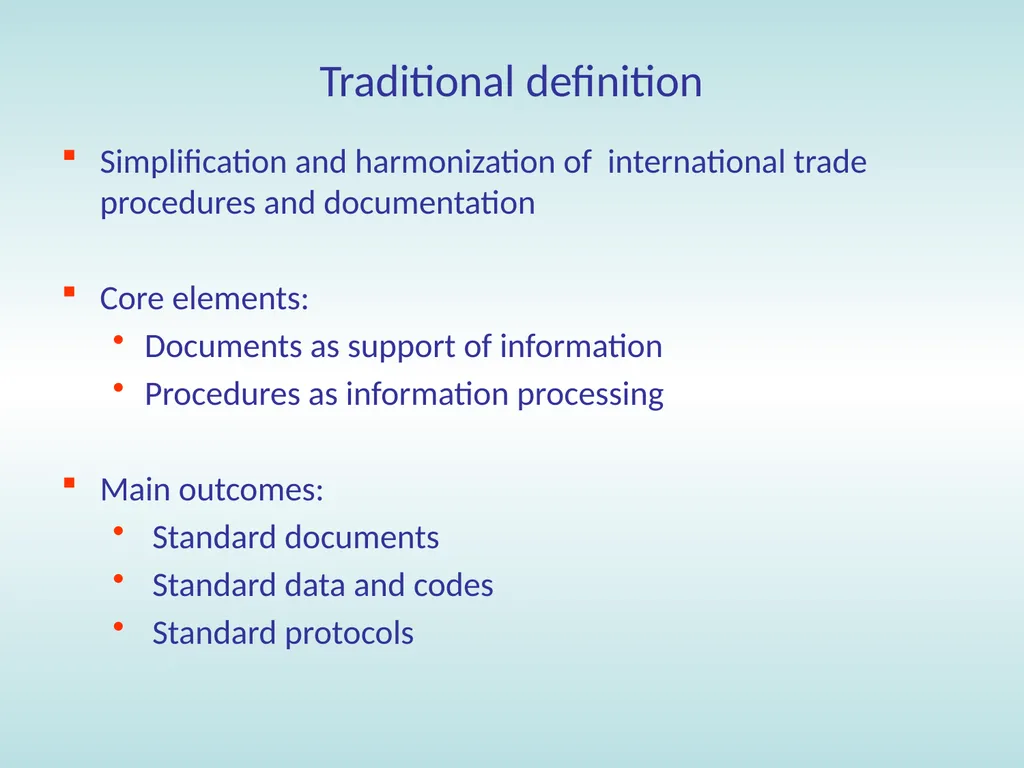
Traditional definition Simplification and harmonization of international trade procedures and documentation
Core elements:
Documents as support of information
Procedures as information processing
Main outcomes:
Standard documents
Standard data and codes
Standard protocols<br>
Core elements:
Documents as support of information
Procedures as information processing
Main outcomes:
Standard documents
Standard data and codes
Standard protocols<br>
06
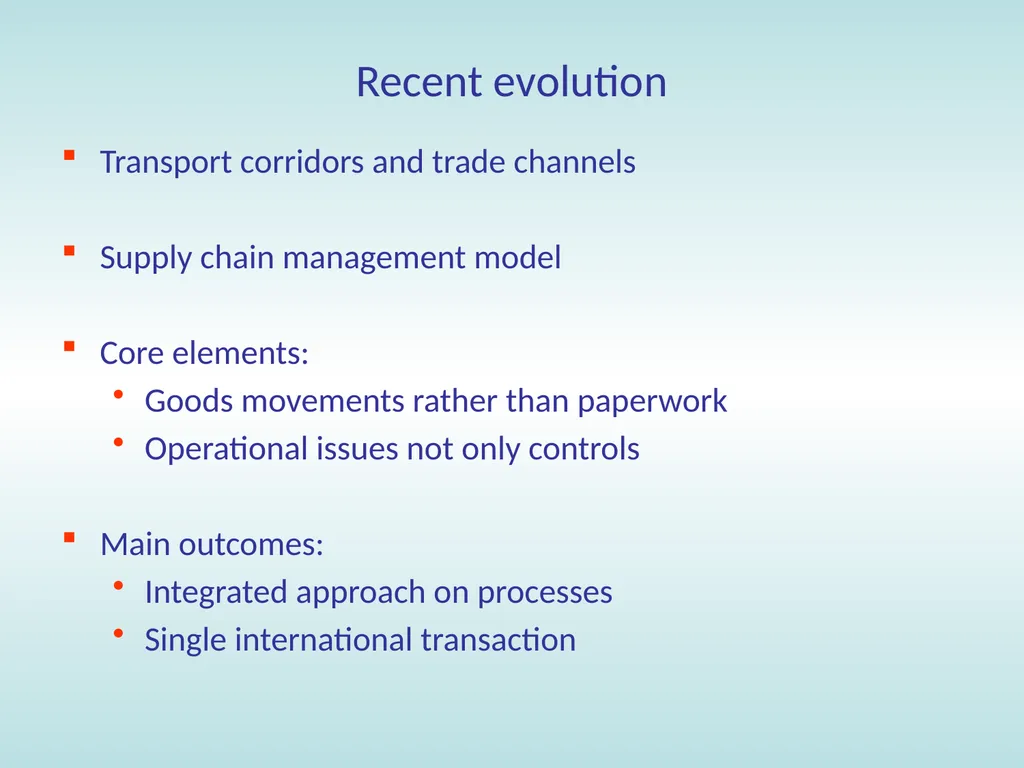
Transport corridors and trade channels
Supply chain management model
Core elements:
Goods movements rather than paperwork
Operational issues not only controls
Main outcomes:
Integrated approach on processes
Single international transaction Recent evolution<br>
Supply chain management model
Core elements:
Goods movements rather than paperwork
Operational issues not only controls
Main outcomes:
Integrated approach on processes
Single international transaction Recent evolution<br>
07
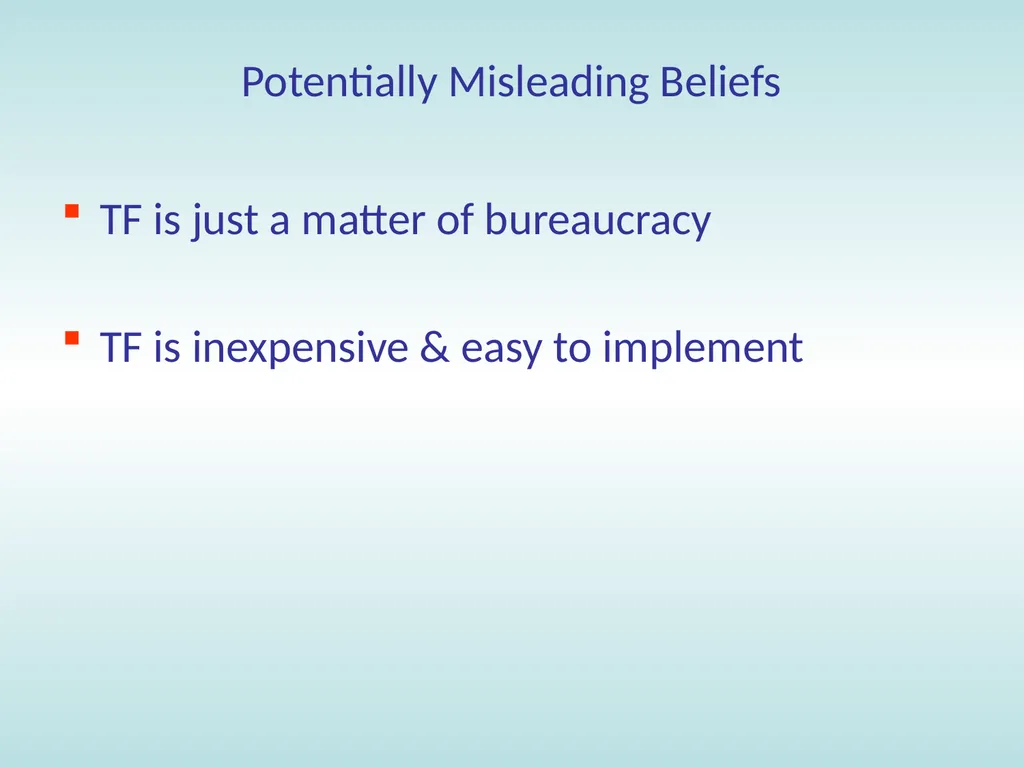
TF is just a matter of bureaucracy
TF is inexpensive & easy to implement Potentially Misleading Beliefs<br>
TF is inexpensive & easy to implement Potentially Misleading Beliefs<br>
08
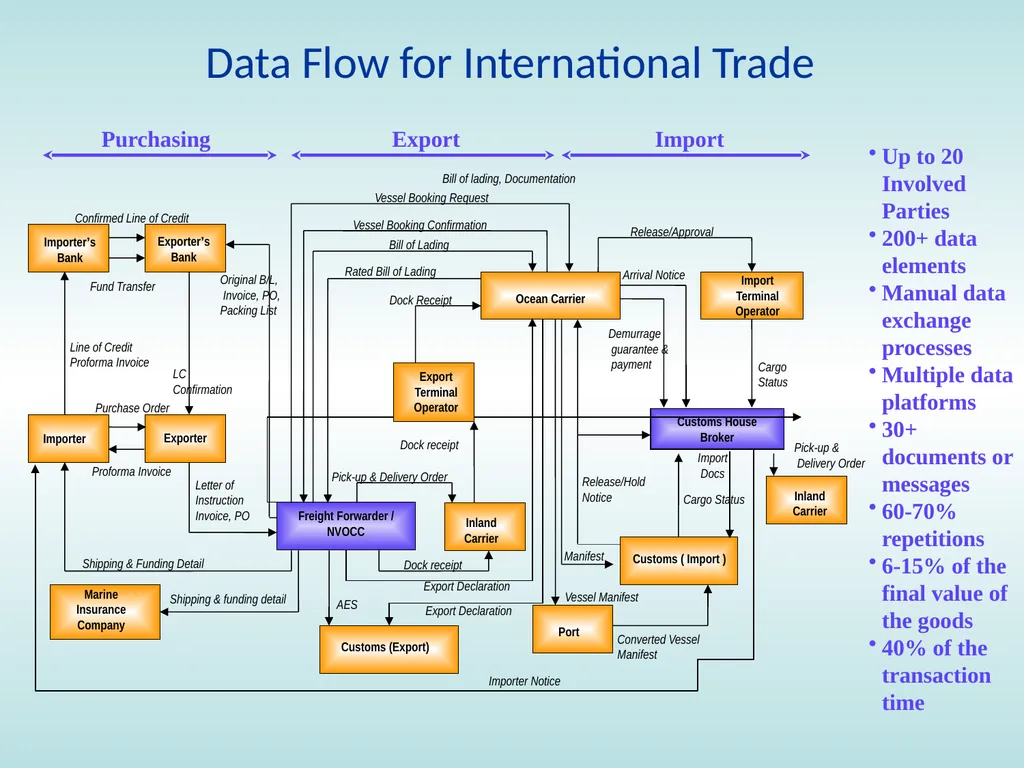
Up to 20 Involved Parties
200+ data elements
Manual data exchange processes
Multiple data platforms
30+ documents or messages
60-70% repetitions
6-15% of the final value of the goods
40% of the transaction time Data Flow for International Trade<br>
200+ data elements
Manual data exchange processes
Multiple data platforms
30+ documents or messages
60-70% repetitions
6-15% of the final value of the goods
40% of the transaction time Data Flow for International Trade<br>
09
Available Trade Facilitation tools<br>
10
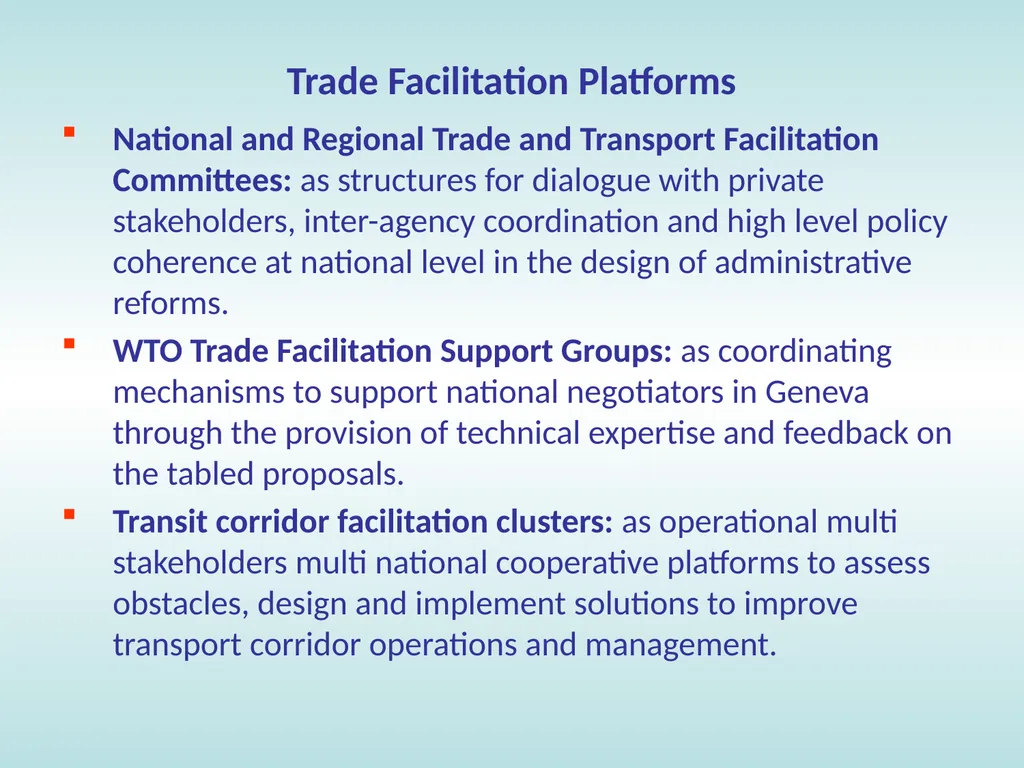
Trade Facilitation Platforms National and Regional Trade and Transport Facilitation Committees: as structures for dialogue with private stakeholders, inter-agency coordination and high level policy coherence at national level in the design of administrative reforms.
WTO Trade Facilitation Support Groups: as coordinating mechanisms to support national negotiators in Geneva through the provision of technical expertise and feedback on the tabled proposals.
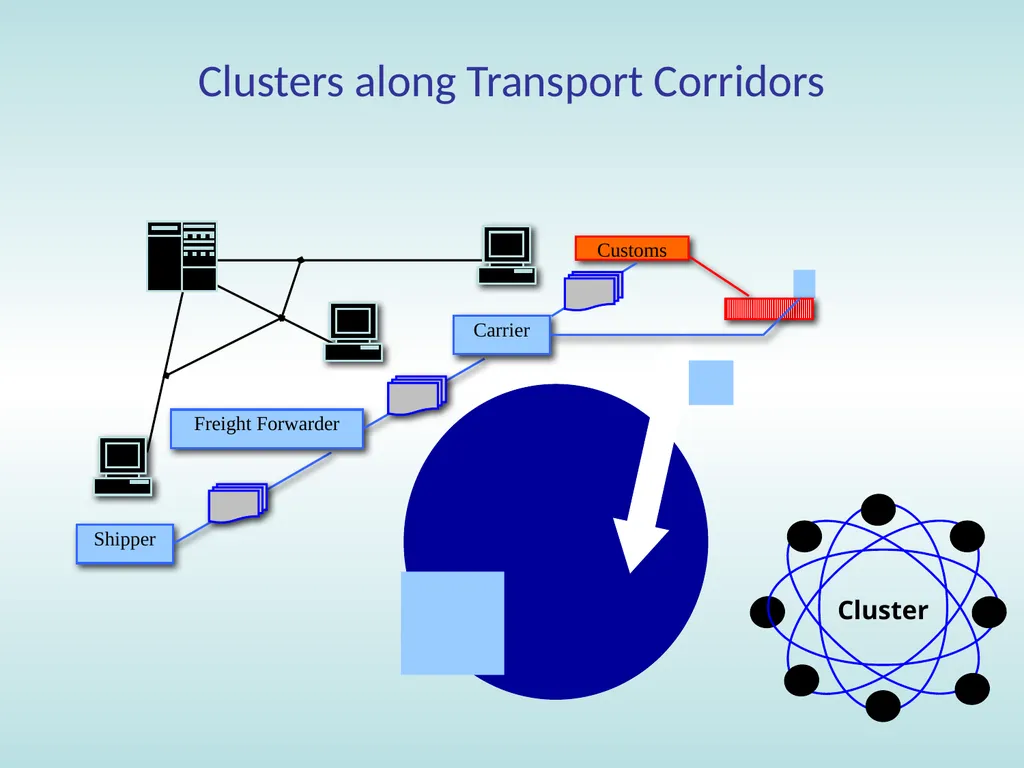
Transit corridor facilitation clusters: as operational multi stakeholders multi national cooperative platforms to assess obstacles, design and implement solutions to improve transport corridor operations and management.<br>
WTO Trade Facilitation Support Groups: as coordinating mechanisms to support national negotiators in Geneva through the provision of technical expertise and feedback on the tabled proposals.
Transit corridor facilitation clusters: as operational multi stakeholders multi national cooperative platforms to assess obstacles, design and implement solutions to improve transport corridor operations and management.<br>
11
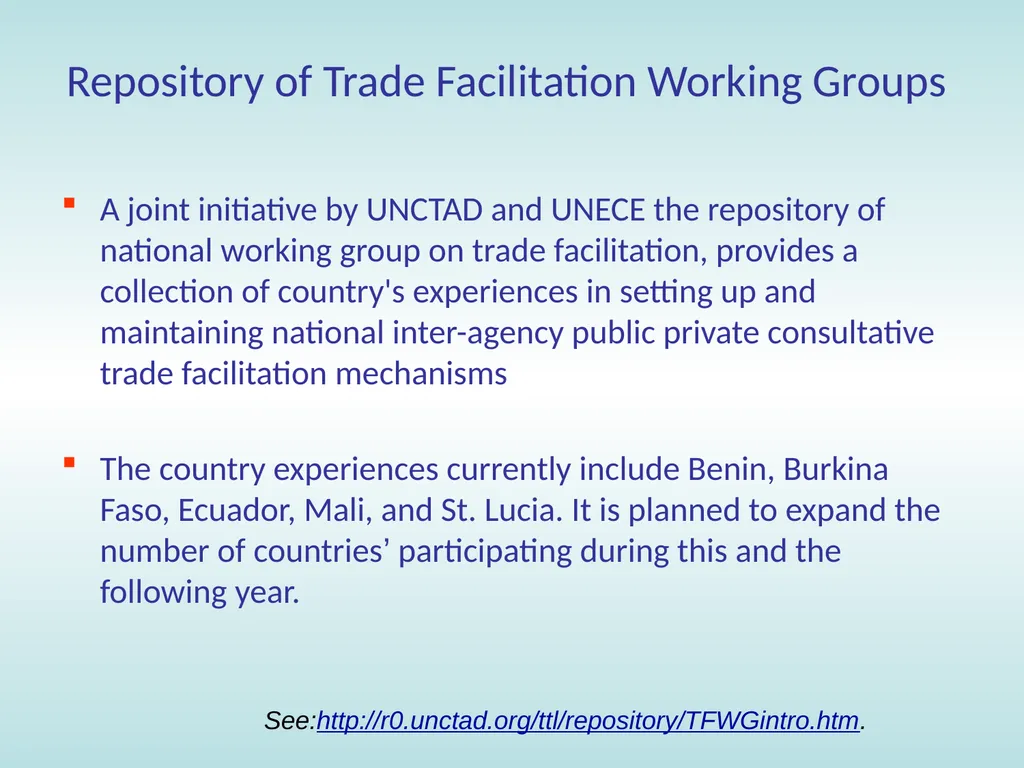
Repository of Trade Facilitation Working Groups A joint initiative by UNCTAD and UNECE the repository of national working group on trade facilitation, provides a collection of country's experiences in setting up and maintaining national inter-agency public private consultative trade facilitation mechanisms
The country experiences currently include Benin, Burkina Faso, Ecuador, Mali, and St. Lucia. It is planned to expand the number of countries’ participating during this and the following year. See:http://r0.unctad.org/ttl/repository/TFWGintro.htm.<br>
The country experiences currently include Benin, Burkina Faso, Ecuador, Mali, and St. Lucia. It is planned to expand the number of countries’ participating during this and the following year. See:http://r0.unctad.org/ttl/repository/TFWGintro.htm.<br>
12
Clusters along Transport Corridors<br>
13
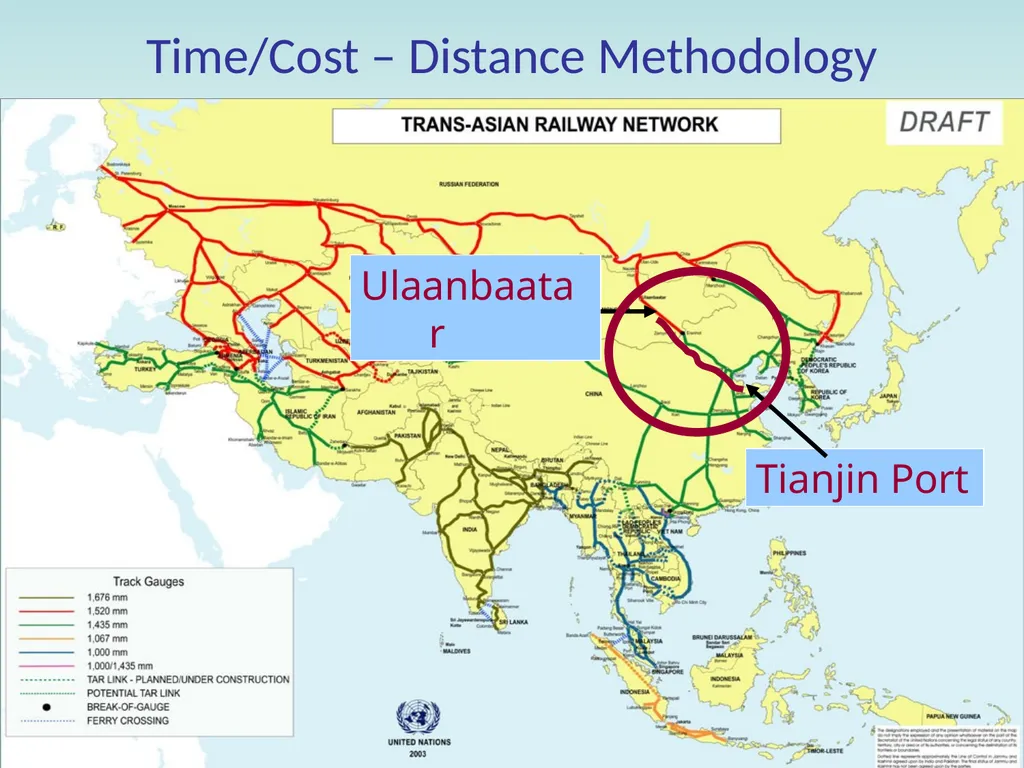
Ulaanbaatar Tianjin Port Time/Cost – Distance Methodology<br>
14
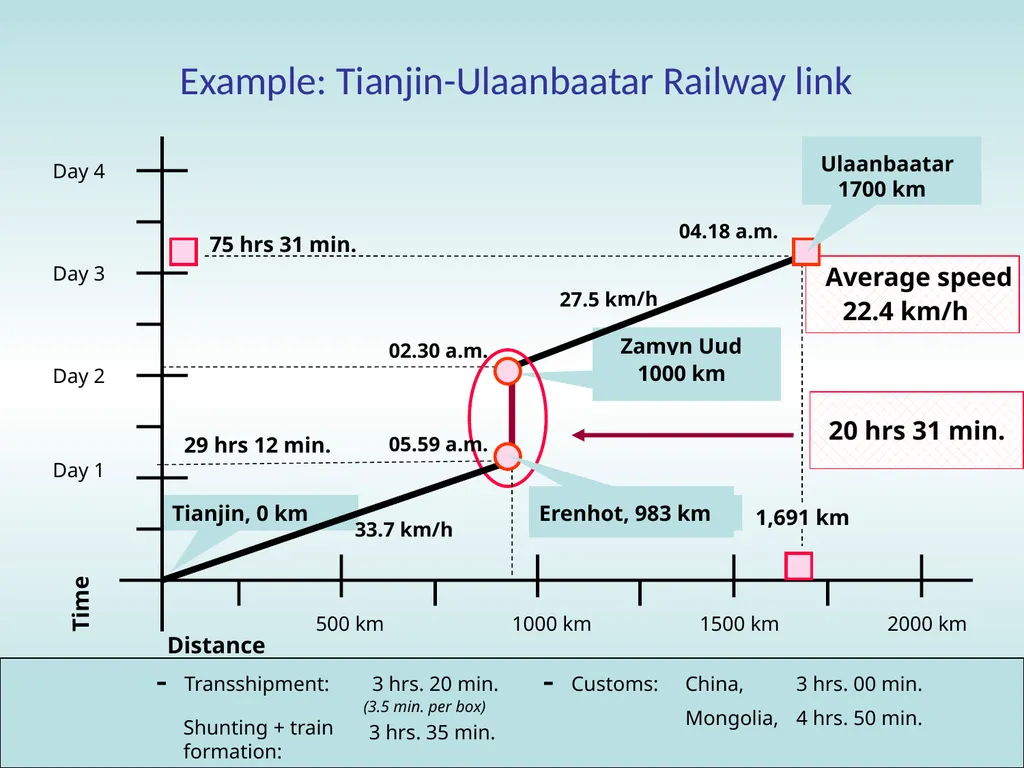
75 hrs 31 min. 500 km 1000 km 2000 km 1500 km Day 4 Distance Time 1,691 km 33.7 km/h 27.5 km/h 04.18 a.m. Day 3 Day 2 Day 1 29 hrs 12 min. 02.30 a.m. 05.59 a.m. Ulaanbaatar 1700 km Shunting + train formation: 3 hrs. 35 min. 4 hrs. 50 min. Mongolia, China, 3 hrs. 00 min. Example: Tianjin-Ulaanbaatar Railway link<br>
15
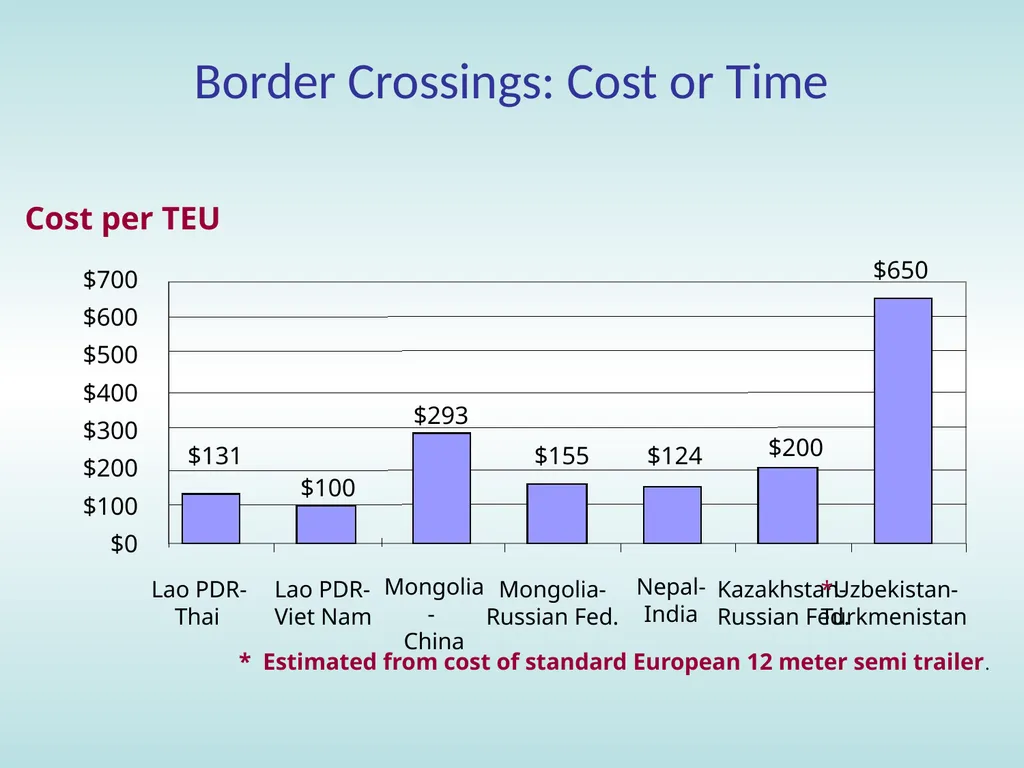
Cost per TEU $131 $100 $293 $155 $124 $200 $650 $0 $100 $200 $300 $400 $500 $600 $700 Lao PDR-
Thai Lao PDR-
Viet Nam Mongolia-
China Mongolia-
Russian Fed. Nepal-
India Kazakhstan-
Russian Fed. *Uzbekistan-
Turkmenistan * Estimated from cost of standard European 12 meter semi trailer. Border Crossings: Cost or Time<br>
Thai Lao PDR-
Viet Nam Mongolia-
China Mongolia-
Russian Fed. Nepal-
India Kazakhstan-
Russian Fed. *Uzbekistan-
Turkmenistan * Estimated from cost of standard European 12 meter semi trailer. Border Crossings: Cost or Time<br>
16
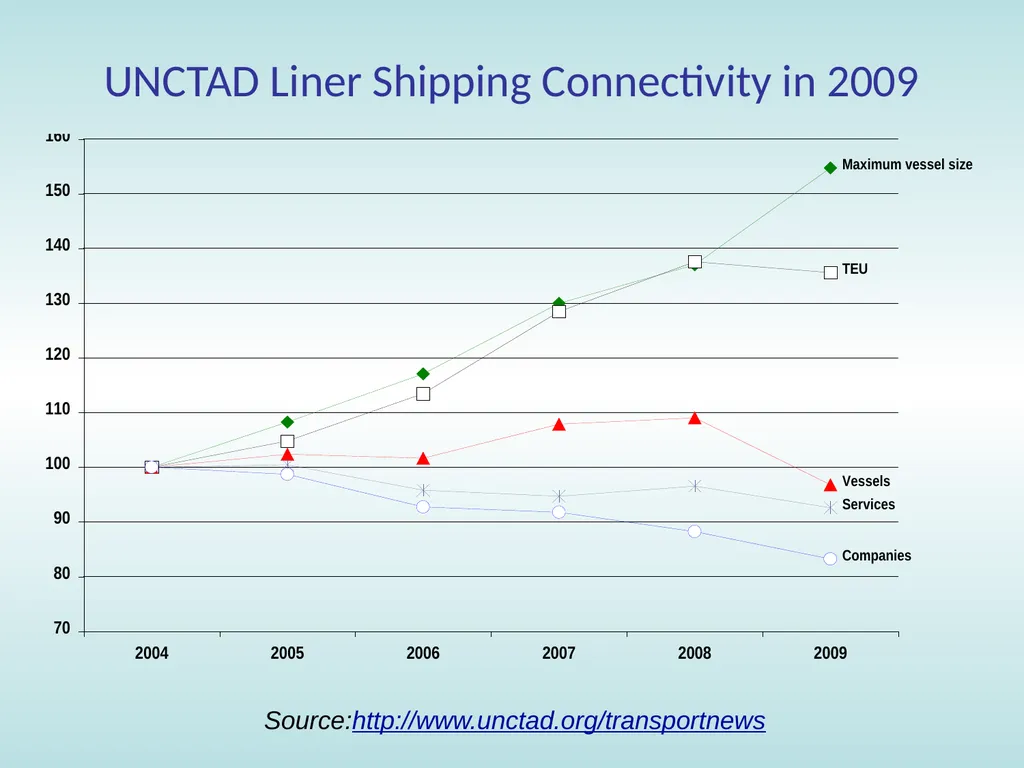
UNCTAD Liner Shipping Connectivity in 2009 Source:http://www.unctad.org/transportnews<br>
17
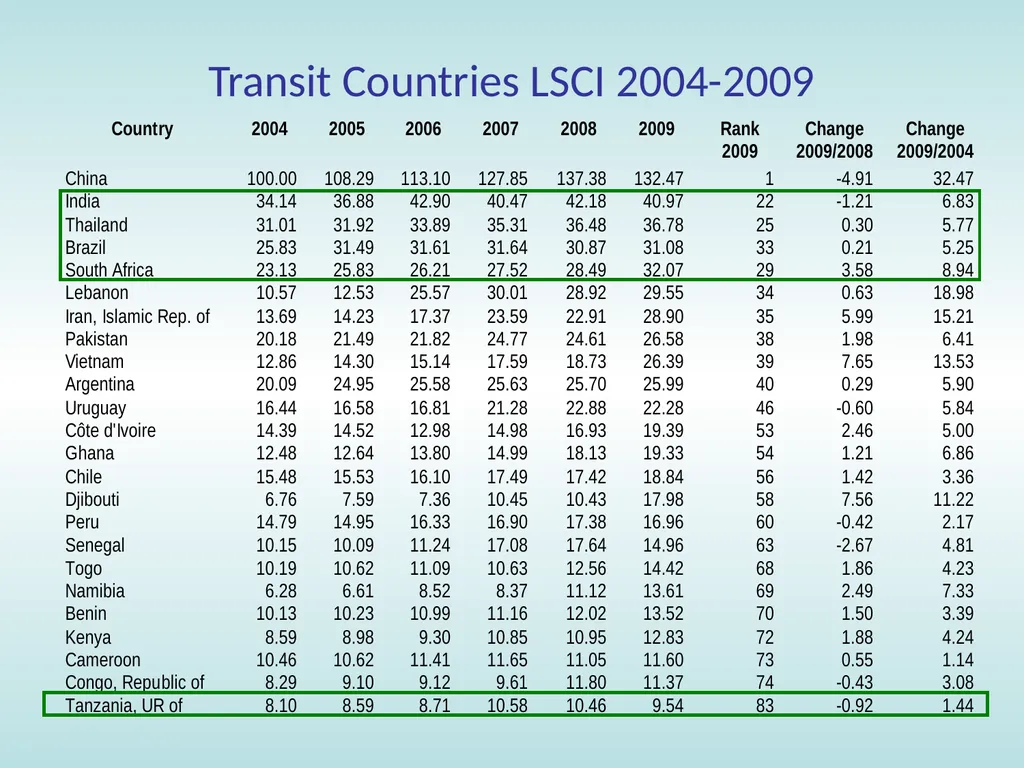
Transit Countries LSCI 2004-2009<br>
18
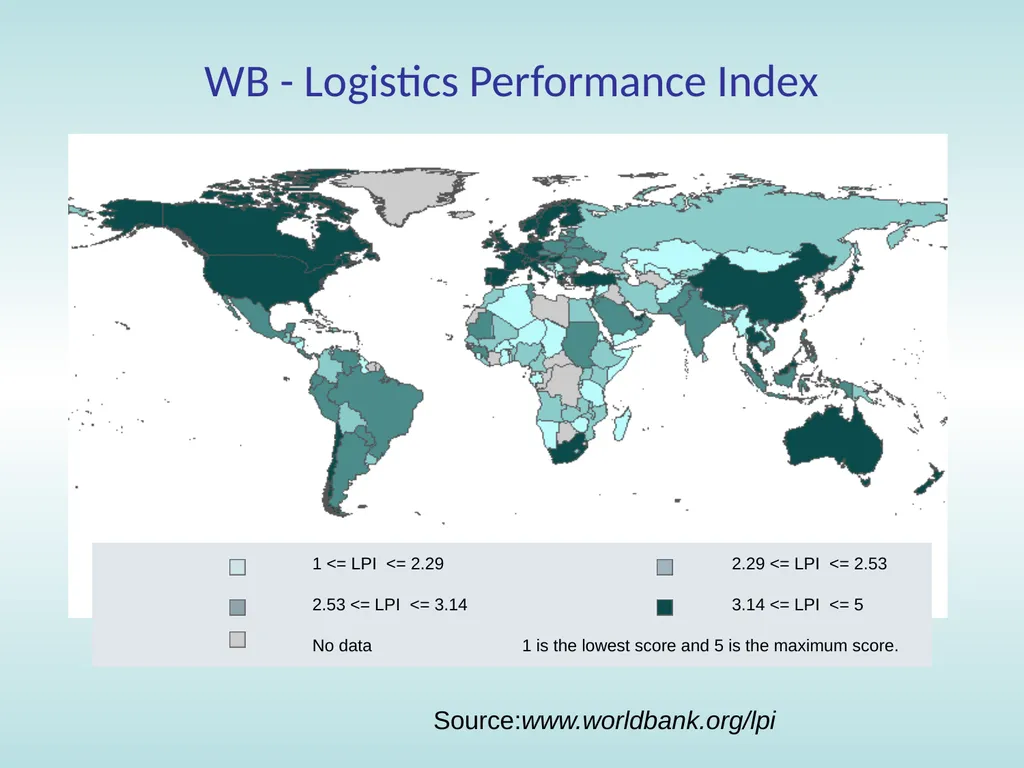
WB - Logistics Performance Index Source:www.worldbank.org/lpi<br>
19
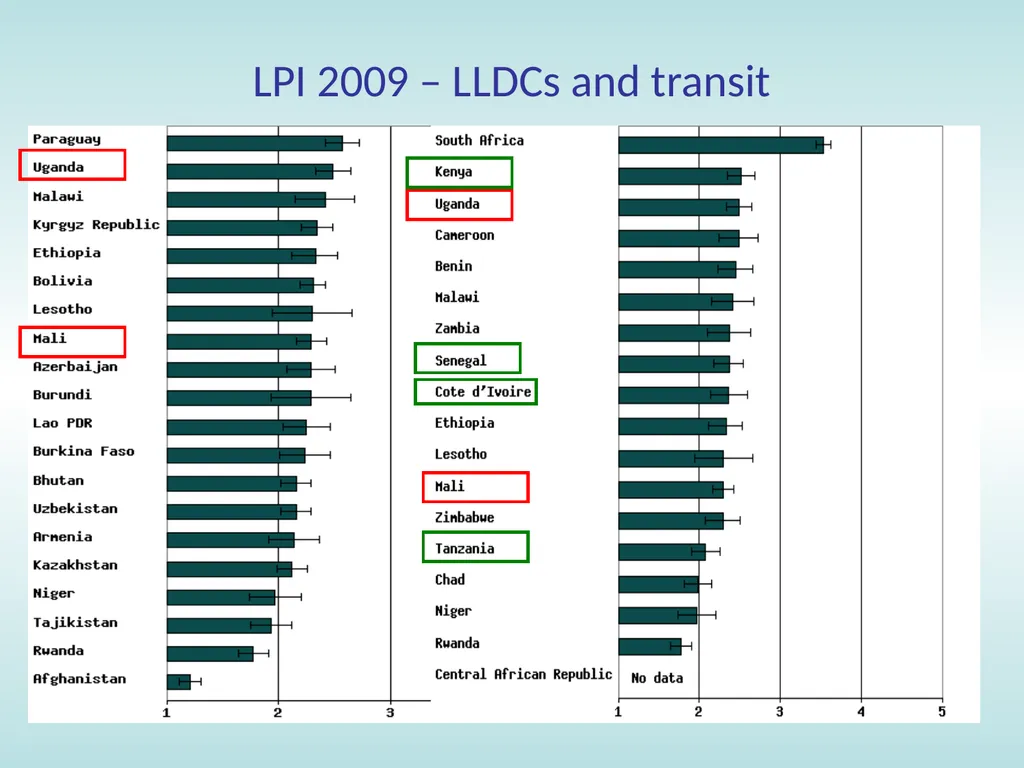
LPI 2009 – LLDCs and transit<br>
20
Trade facilitation reform<br>
21
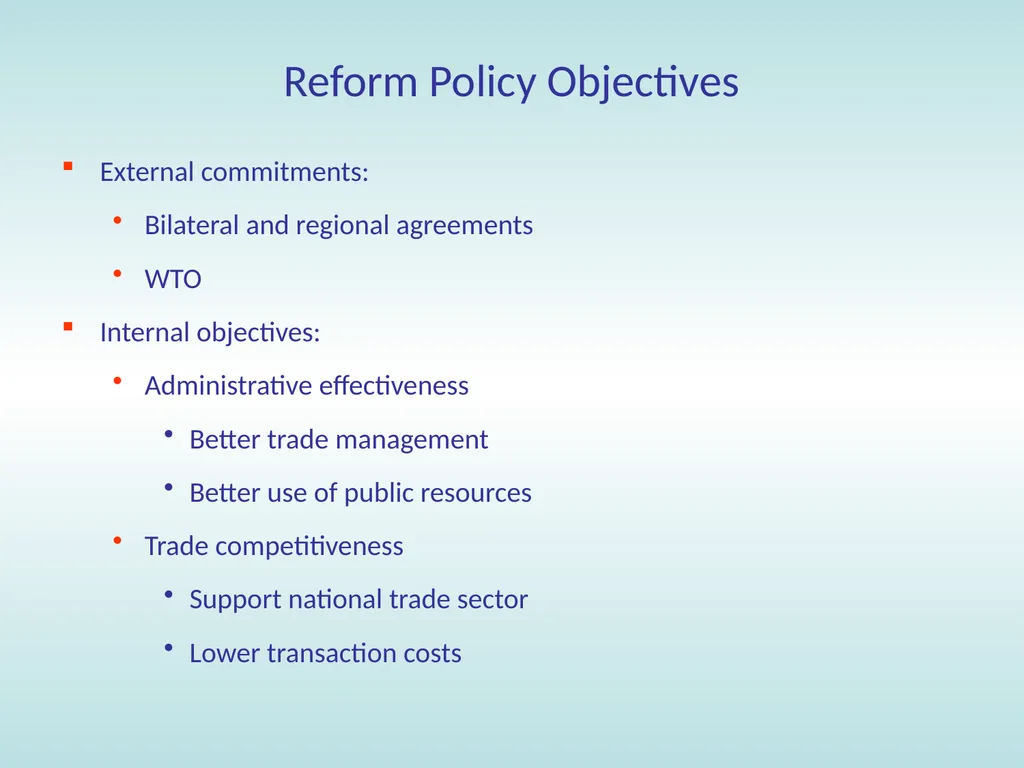
Reform Policy Objectives External commitments:
Bilateral and regional agreements
WTO
Internal objectives:
Administrative effectiveness
Better trade management
Better use of public resources
Trade competitiveness
Support national trade sector
Lower transaction costs<br>
Bilateral and regional agreements
WTO
Internal objectives:
Administrative effectiveness
Better trade management
Better use of public resources
Trade competitiveness
Support national trade sector
Lower transaction costs<br>
22
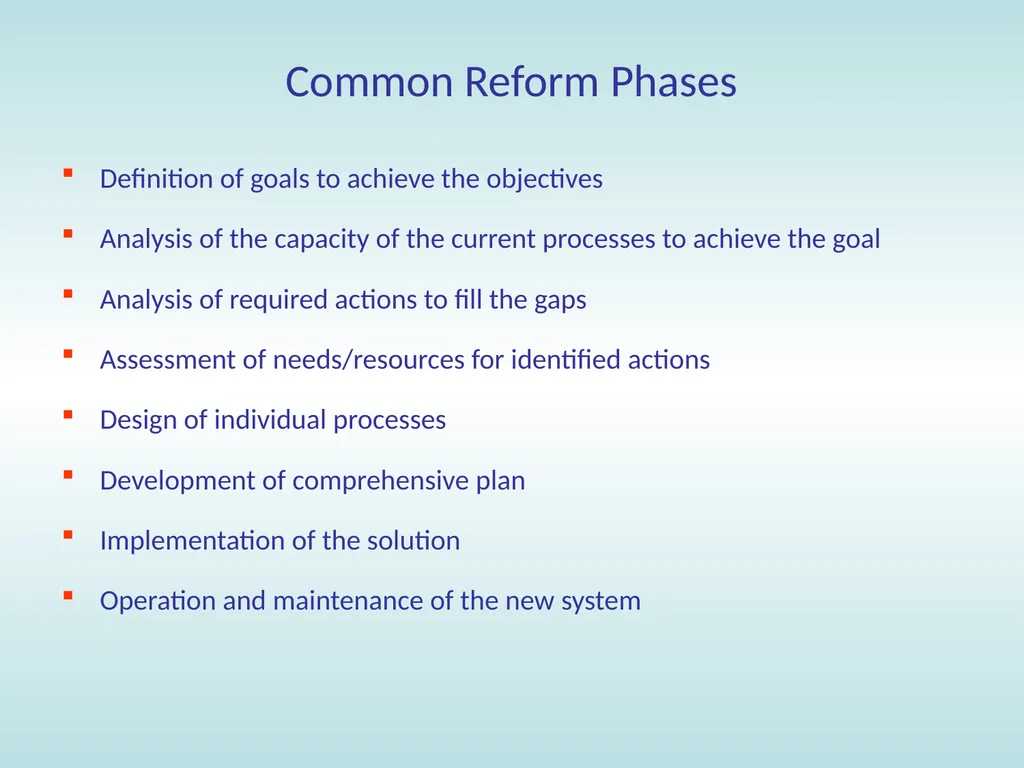
Common Reform Phases Definition of goals to achieve the objectives
Analysis of the capacity of the current processes to achieve the goal
Analysis of required actions to fill the gaps
Assessment of needs/resources for identified actions
Design of individual processes
Development of comprehensive plan
Implementation of the solution
Operation and maintenance of the new system<br>
Analysis of the capacity of the current processes to achieve the goal
Analysis of required actions to fill the gaps
Assessment of needs/resources for identified actions
Design of individual processes
Development of comprehensive plan
Implementation of the solution
Operation and maintenance of the new system<br>
23
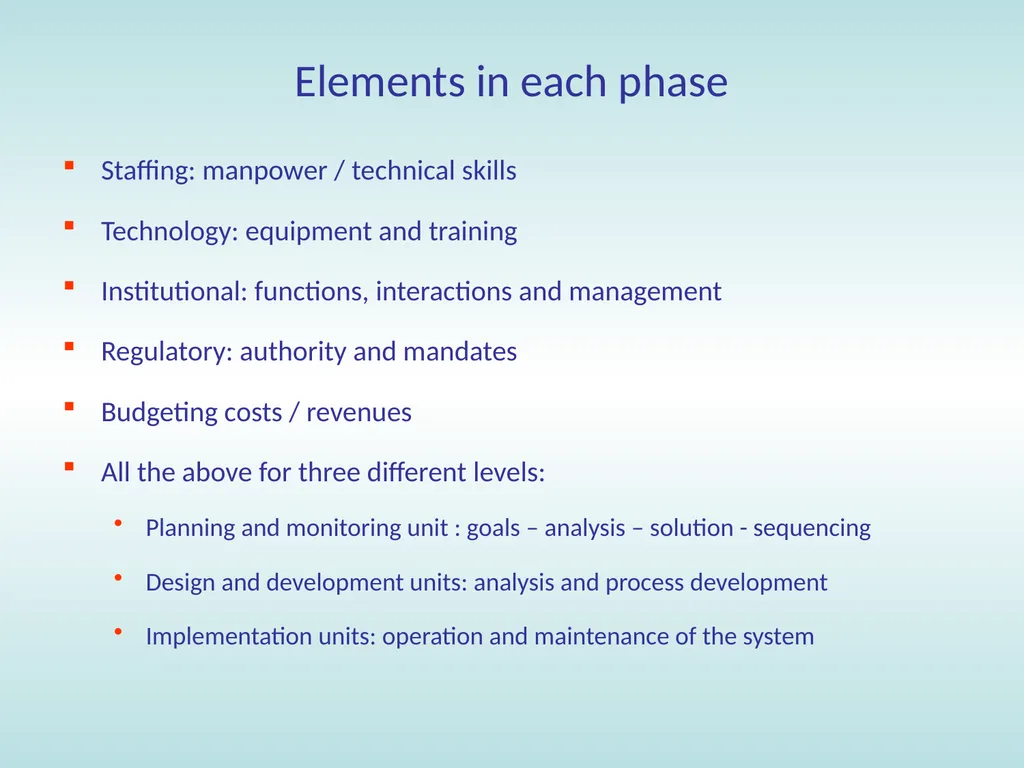
Elements in each phase Staffing: manpower / technical skills
Technology: equipment and training
Institutional: functions, interactions and management
Regulatory: authority and mandates
Budgeting costs / revenues
All the above for three different levels:
Planning and monitoring unit : goals – analysis – solution - sequencing
Design and development units: analysis and process development
Implementation units: operation and maintenance of the system<br>
Technology: equipment and training
Institutional: functions, interactions and management
Regulatory: authority and mandates
Budgeting costs / revenues
All the above for three different levels:
Planning and monitoring unit : goals – analysis – solution - sequencing
Design and development units: analysis and process development
Implementation units: operation and maintenance of the system<br>
24
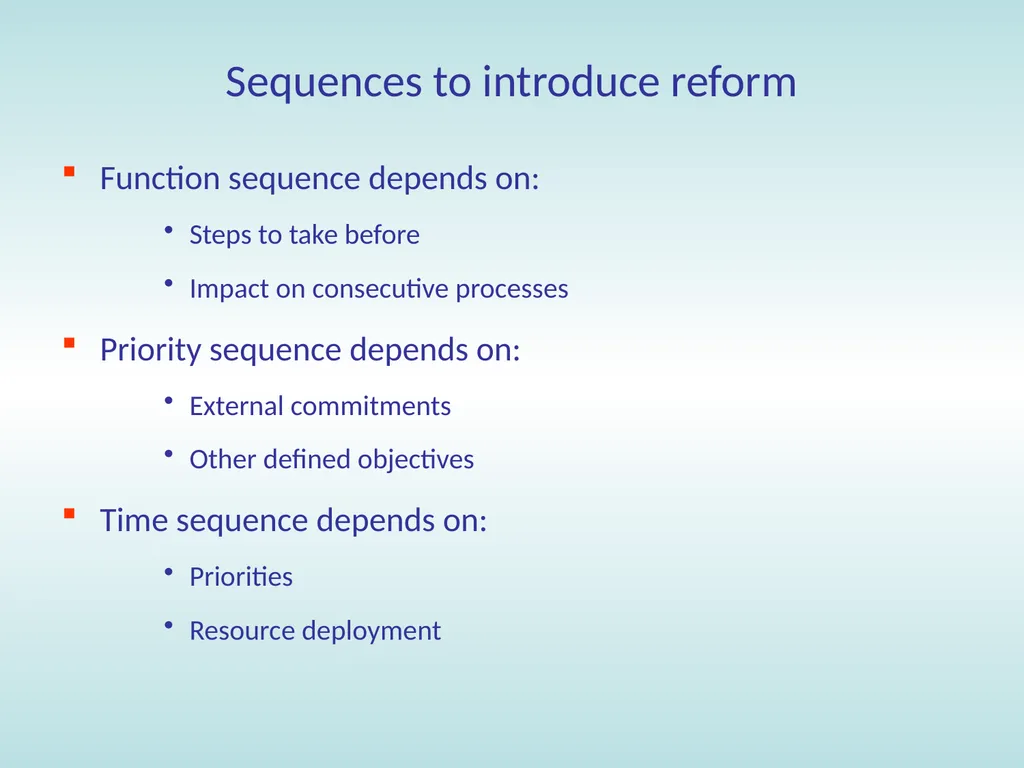
Sequences to introduce reform Function sequence depends on:
Steps to take before
Impact on consecutive processes
Priority sequence depends on:
External commitments
Other defined objectives
Time sequence depends on:
Priorities
Resource deployment<br>
Steps to take before
Impact on consecutive processes
Priority sequence depends on:
External commitments
Other defined objectives
Time sequence depends on:
Priorities
Resource deployment<br>
25
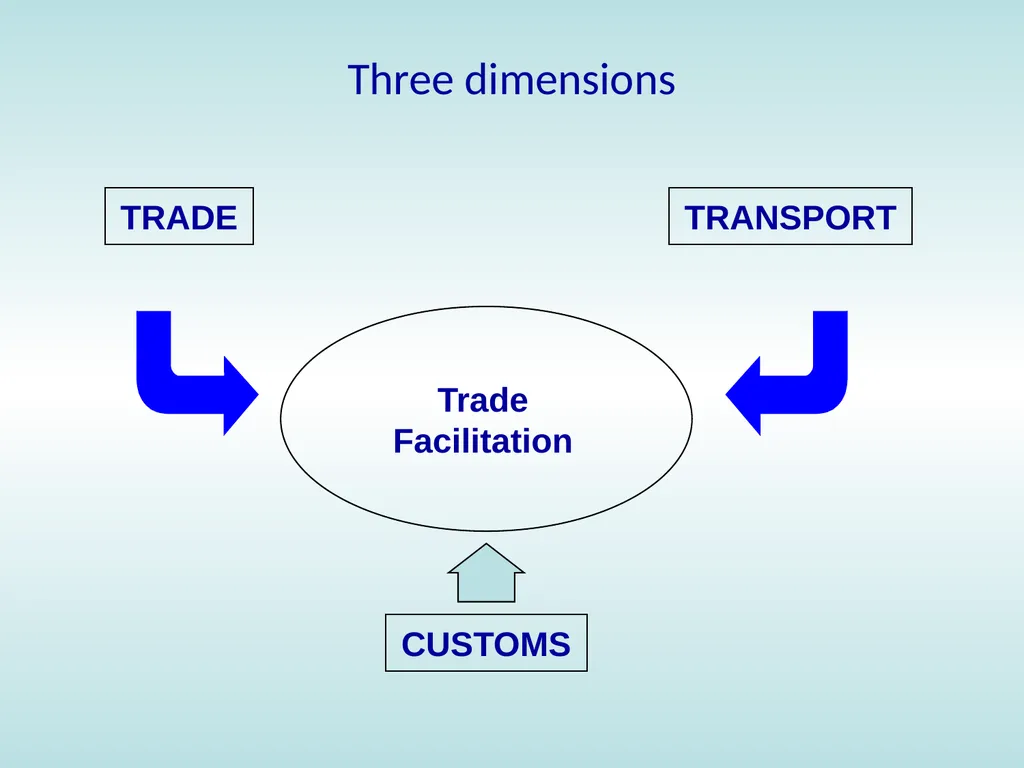
Three dimensions Trade
Facilitation TRADE TRANSPORT CUSTOMS<br>
Facilitation TRADE TRANSPORT CUSTOMS<br>
26
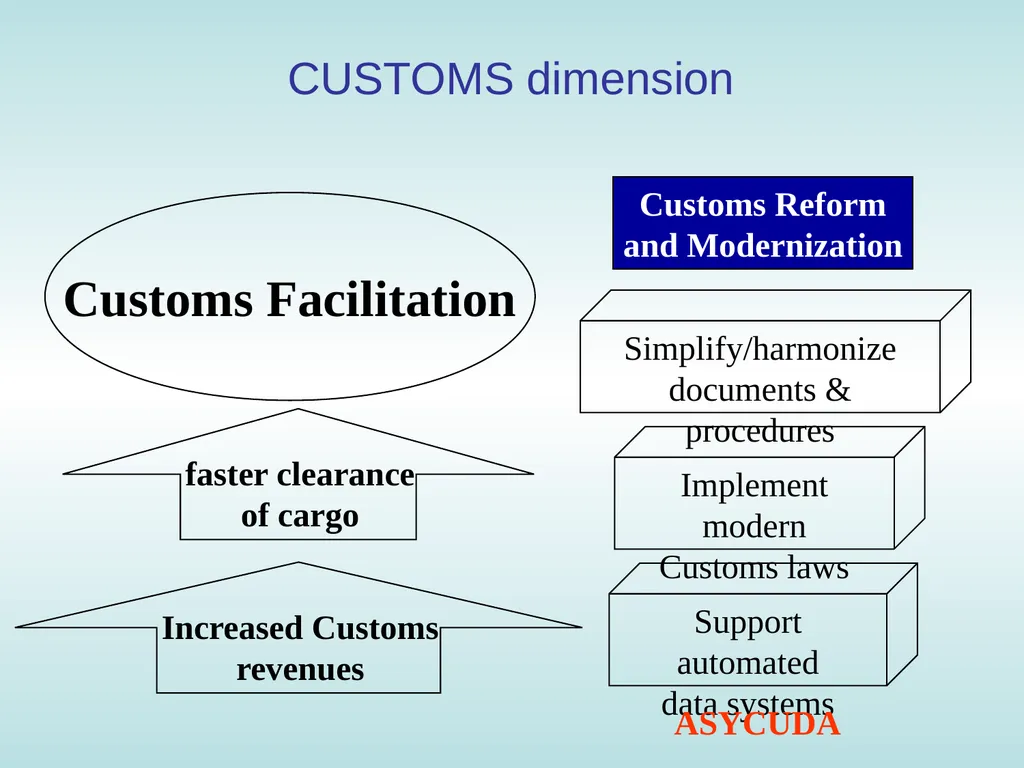
CUSTOMS dimension Customs Reform
and Modernization Support automated
data systems faster clearance
of cargo Increased Customs
revenues Simplify/harmonize
documents & procedures Implement modern
Customs laws ASYCUDA<br>
and Modernization Support automated
data systems faster clearance
of cargo Increased Customs
revenues Simplify/harmonize
documents & procedures Implement modern
Customs laws ASYCUDA<br>
27
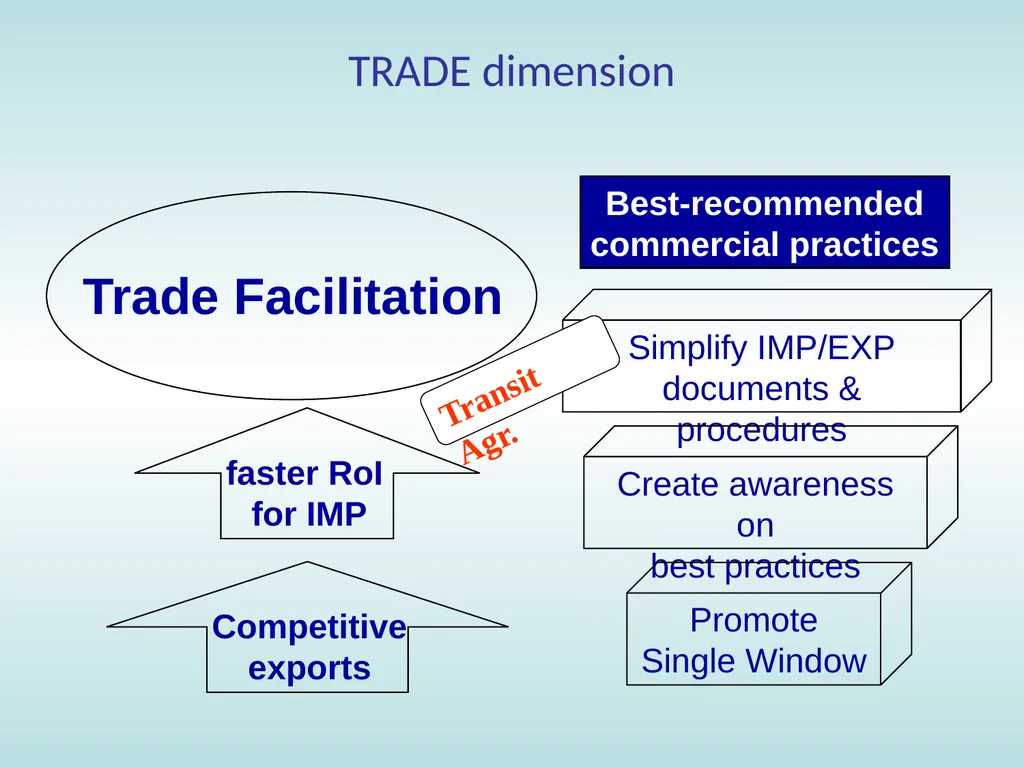
TRADE dimension Best-recommended
commercial practices faster RoI
for IMP Competitive
exports Simplify IMP/EXP
documents & procedures Create awareness on
best practices Promote
Single Window Transit Agr.<br>
commercial practices faster RoI
for IMP Competitive
exports Simplify IMP/EXP
documents & procedures Create awareness on
best practices Promote
Single Window Transit Agr.<br>
28
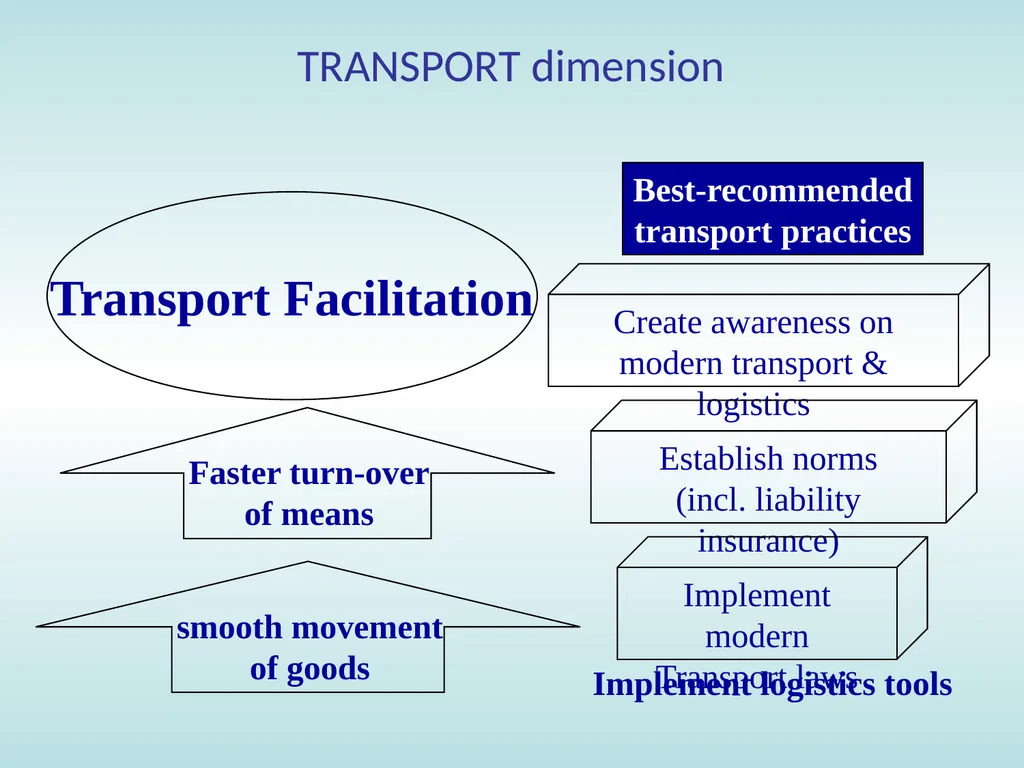
TRANSPORT dimension Faster turn-over
of means smooth movement
of goods Create awareness on
modern transport & logistics Establish norms
(incl. liability insurance) Implement modern
Transport laws Implement logistics tools Best-recommended
transport practices<br>
of means smooth movement
of goods Create awareness on
modern transport & logistics Establish norms
(incl. liability insurance) Implement modern
Transport laws Implement logistics tools Best-recommended
transport practices<br>
29
International Instruments related to
Trade Facilitation<br>
30
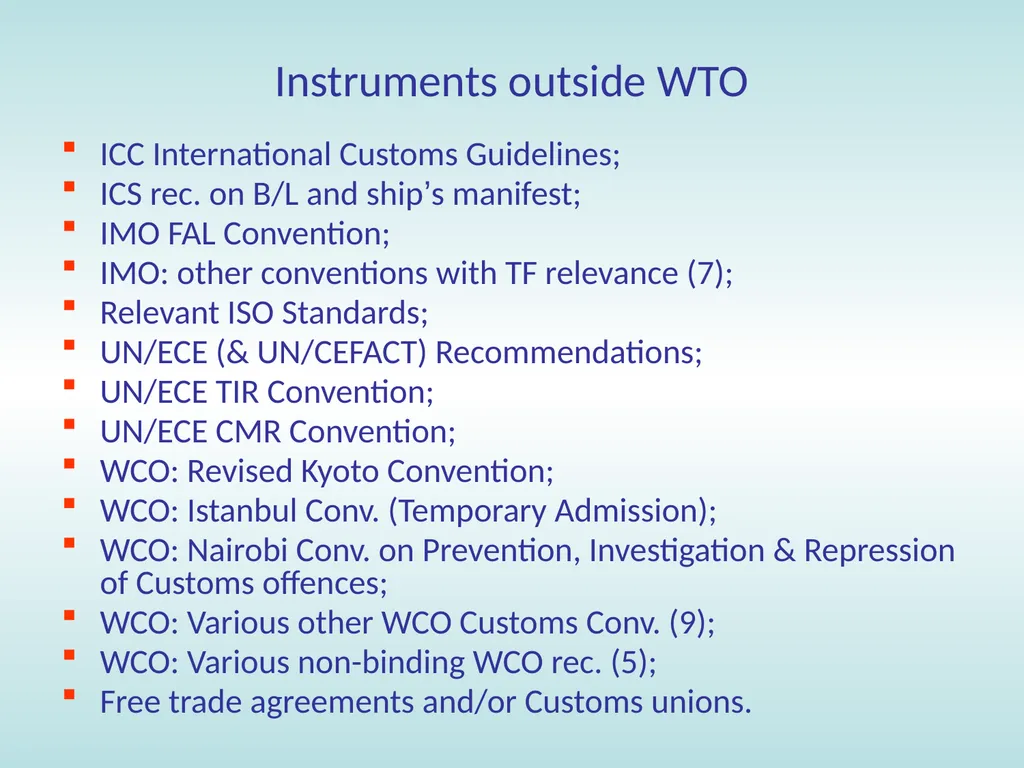
ICC International Customs Guidelines;
ICS rec. on B/L and ship’s manifest;
IMO FAL Convention;
IMO: other conventions with TF relevance (7);
Relevant ISO Standards;
UN/ECE (& UN/CEFACT) Recommendations;
UN/ECE TIR Convention;
UN/ECE CMR Convention;
WCO: Revised Kyoto Convention;
WCO: Istanbul Conv. (Temporary Admission);
WCO: Nairobi Conv. on Prevention, Investigation & Repression of Customs offences;
WCO: Various other WCO Customs Conv. (9);
WCO: Various non-binding WCO rec. (5);
Free trade agreements and/or Customs unions. Instruments outside WTO<br>
ICS rec. on B/L and ship’s manifest;
IMO FAL Convention;
IMO: other conventions with TF relevance (7);
Relevant ISO Standards;
UN/ECE (& UN/CEFACT) Recommendations;
UN/ECE TIR Convention;
UN/ECE CMR Convention;
WCO: Revised Kyoto Convention;
WCO: Istanbul Conv. (Temporary Admission);
WCO: Nairobi Conv. on Prevention, Investigation & Repression of Customs offences;
WCO: Various other WCO Customs Conv. (9);
WCO: Various non-binding WCO rec. (5);
Free trade agreements and/or Customs unions. Instruments outside WTO<br>
31
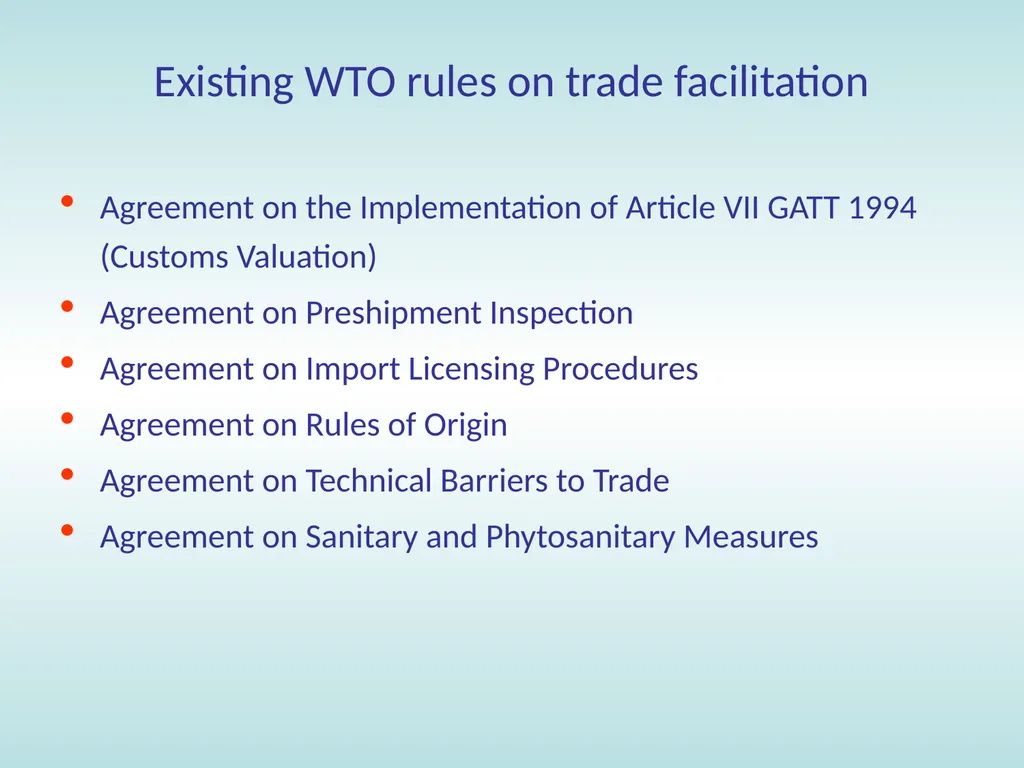
Agreement on the Implementation of Article VII GATT 1994 (Customs Valuation)
Agreement on Preshipment Inspection
Agreement on Import Licensing Procedures
Agreement on Rules of Origin
Agreement on Technical Barriers to Trade
Agreement on Sanitary and Phytosanitary Measures Existing WTO rules on trade facilitation<br>
Agreement on Preshipment Inspection
Agreement on Import Licensing Procedures
Agreement on Rules of Origin
Agreement on Technical Barriers to Trade
Agreement on Sanitary and Phytosanitary Measures Existing WTO rules on trade facilitation<br>
32
Trade facilitation
in Regional Trade Agreements<br>
33
Trade Facilitation in Regional Trade Agreements The number of provisions related to customs and trade facilitation included in Regional Trade Agreements (RTAs ) has increased over time, reflecting the growing importance of trade facilitation at the regional level.
Increasing number of RTAs with customs and other trade facilitation measures (Source: UNCTAD Secretariat based on WTO RTA Database)<br>
Increasing number of RTAs with customs and other trade facilitation measures (Source: UNCTAD Secretariat based on WTO RTA Database)<br>
34
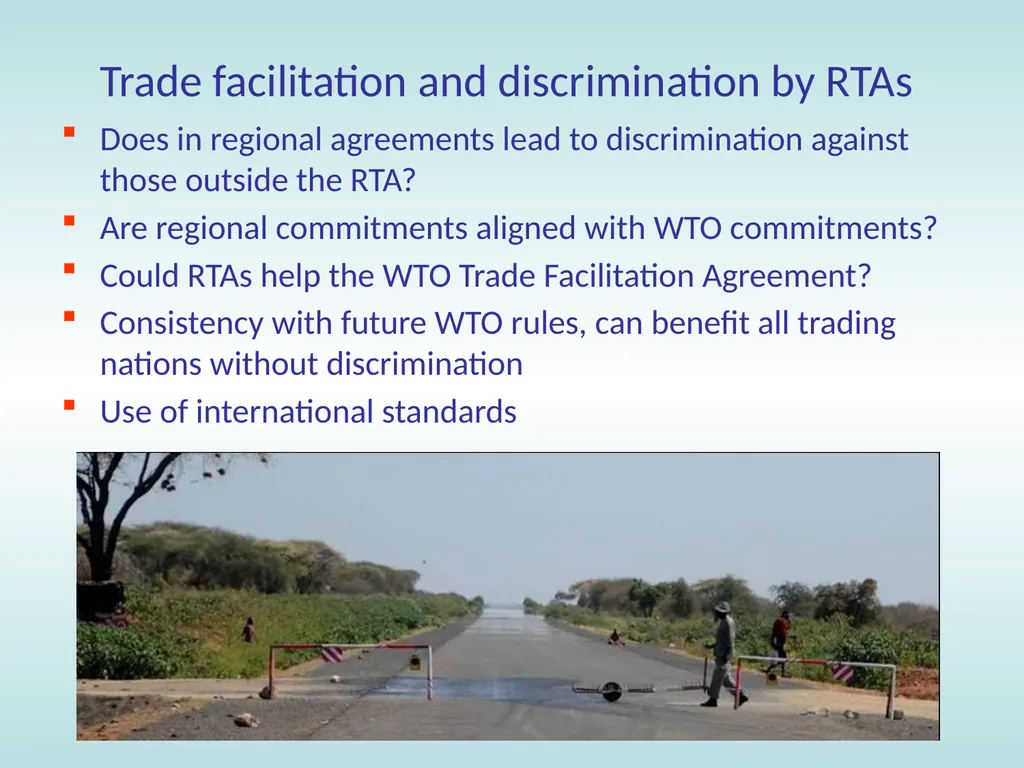
Trade facilitation and discrimination by RTAs Does in regional agreements lead to discrimination against those outside the RTA?
Are regional commitments aligned with WTO commitments?
Could RTAs help the WTO Trade Facilitation Agreement?
Consistency with future WTO rules, can benefit all trading nations without discrimination
Use of international standards<br>
Are regional commitments aligned with WTO commitments?
Could RTAs help the WTO Trade Facilitation Agreement?
Consistency with future WTO rules, can benefit all trading nations without discrimination
Use of international standards<br>
35
118 RTAs reviewed To determine:
the types of trade facilitation measures contained,
the relationship between these measures and the World Trade Organization (WTO) principle of most favoured nation (MFN),
the differences and overlaps among selected trade facilitation measures under different RTAs, and
the benefits and risks brought by being part of multiple RTAs, and actions to be taken to minimise potentially adverse effects.<br>
the types of trade facilitation measures contained,
the relationship between these measures and the World Trade Organization (WTO) principle of most favoured nation (MFN),
the differences and overlaps among selected trade facilitation measures under different RTAs, and
the benefits and risks brought by being part of multiple RTAs, and actions to be taken to minimise potentially adverse effects.<br>
36
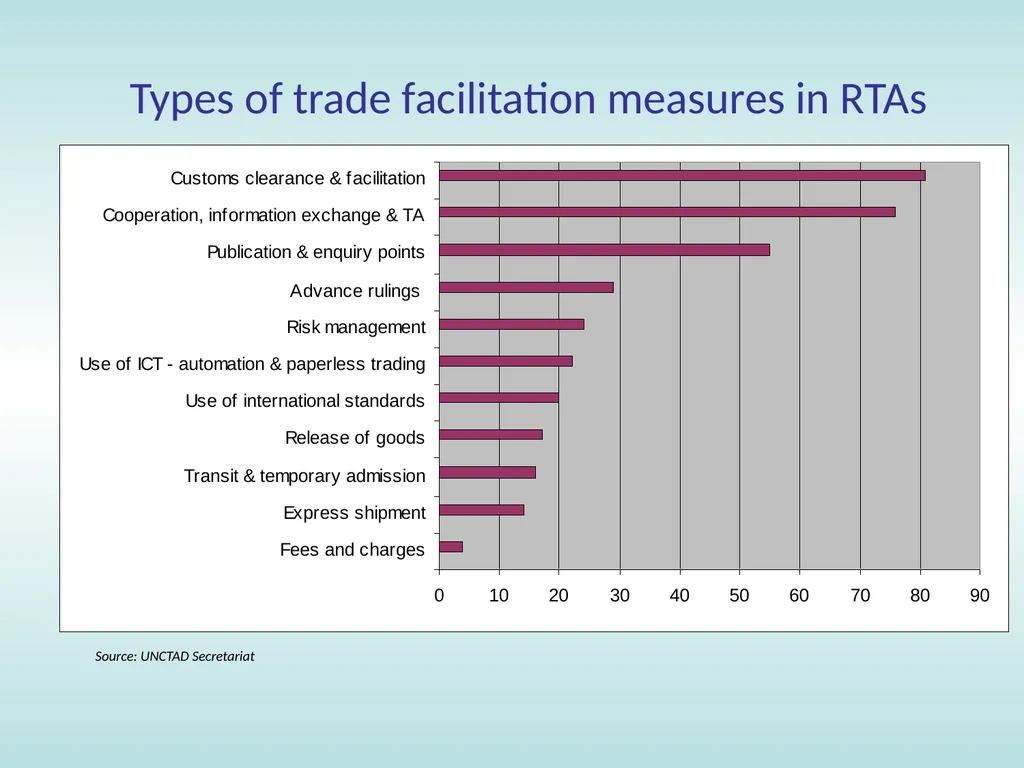
Source: UNCTAD Secretariat Types of trade facilitation measures in RTAs<br>
37
Policy options available to countries Cohesive approach to trade facilitation
Pending the adoption of a WTO agreement, RTAs can help in moving the trade facilitation agenda forward.
Customs and other trade facilitation measures adopted in RTAs have created trade facilitation implementation capacities in many countries and regions.
Most of the provisions existing in RTAs in fact go deeper and broader in terms of trade facilitation benefits than the current WTO provisions under the GATT Articles V, VIII and X.
Policymakers should ensure a coherent approach to the negotiation and implementation of bilateral, regional and multilateral trade facilitation commitments.<br>
Pending the adoption of a WTO agreement, RTAs can help in moving the trade facilitation agenda forward.
Customs and other trade facilitation measures adopted in RTAs have created trade facilitation implementation capacities in many countries and regions.
Most of the provisions existing in RTAs in fact go deeper and broader in terms of trade facilitation benefits than the current WTO provisions under the GATT Articles V, VIII and X.
Policymakers should ensure a coherent approach to the negotiation and implementation of bilateral, regional and multilateral trade facilitation commitments.<br>
38
Trade facilitation
in the pre-Singapore context<br>
39
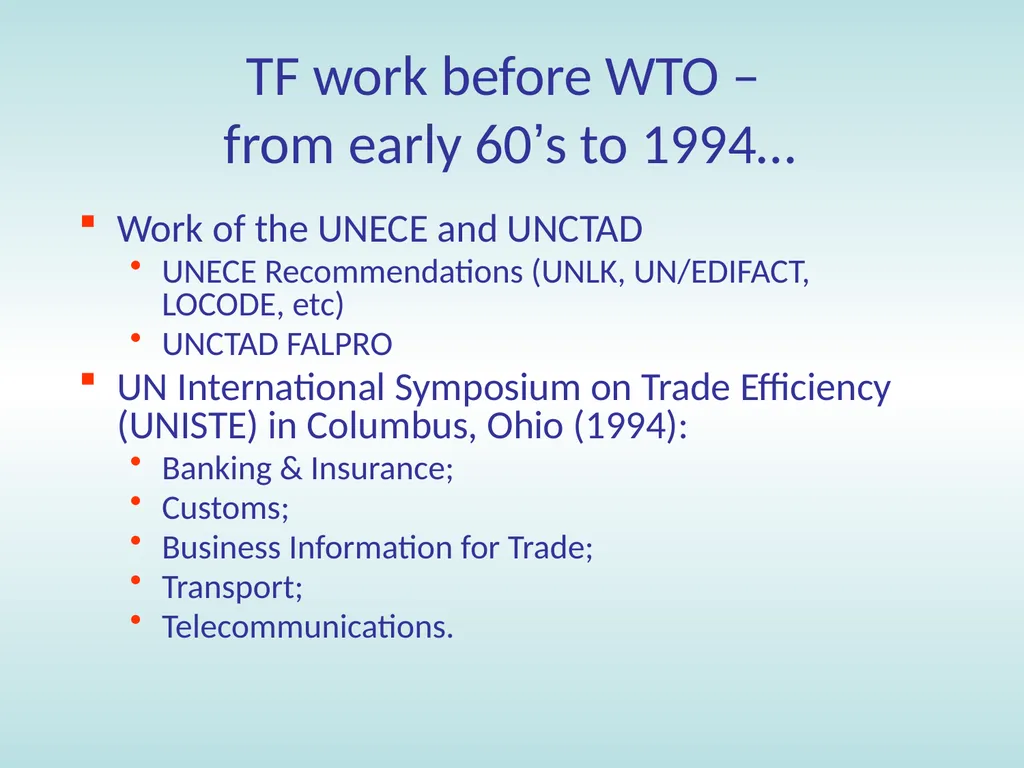
TF work before WTO –
from early 60’s to 1994… Work of the UNECE and UNCTAD
UNECE Recommendations (UNLK, UN/EDIFACT, LOCODE, etc)
UNCTAD FALPRO
UN International Symposium on Trade Efficiency (UNISTE) in Columbus, Ohio (1994):
Banking & Insurance;
Customs;
Business Information for Trade;
Transport;
Telecommunications.<br>
UNECE Recommendations (UNLK, UN/EDIFACT, LOCODE, etc)
UNCTAD FALPRO
UN International Symposium on Trade Efficiency (UNISTE) in Columbus, Ohio (1994):
Banking & Insurance;
Customs;
Business Information for Trade;
Transport;
Telecommunications.<br>
40
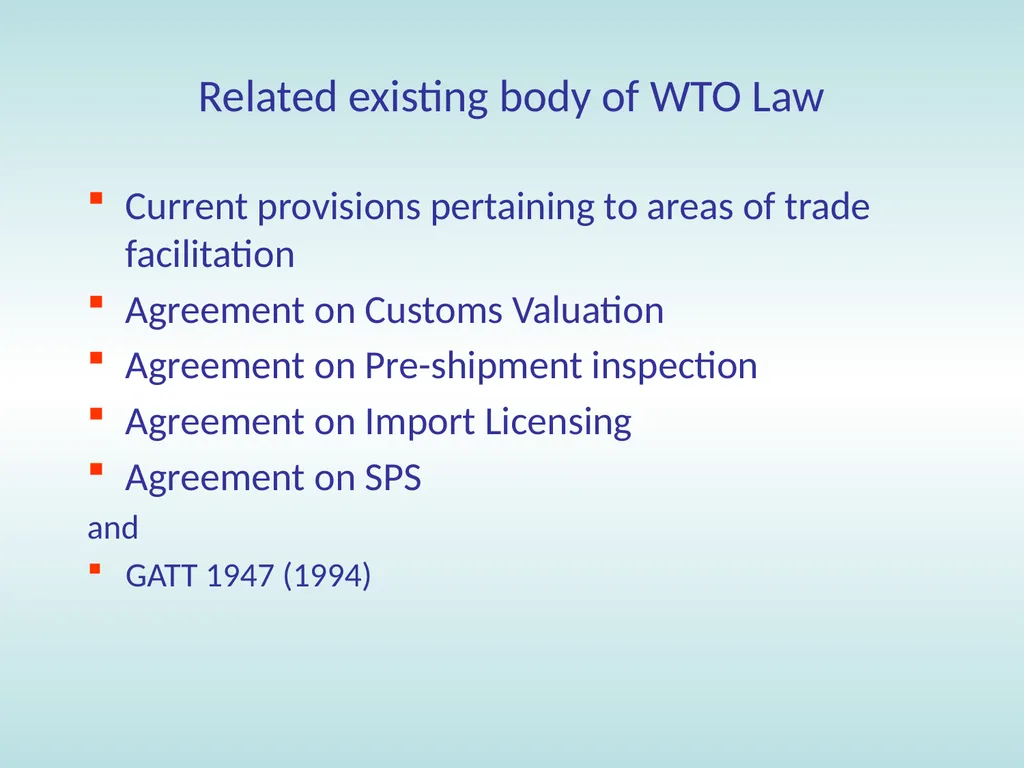
Related existing body of WTO Law Current provisions pertaining to areas of trade facilitation
Agreement on Customs Valuation
Agreement on Pre-shipment inspection
Agreement on Import Licensing
Agreement on SPS
and
GATT 1947 (1994)<br>
Agreement on Customs Valuation
Agreement on Pre-shipment inspection
Agreement on Import Licensing
Agreement on SPS
and
GATT 1947 (1994)<br>
41
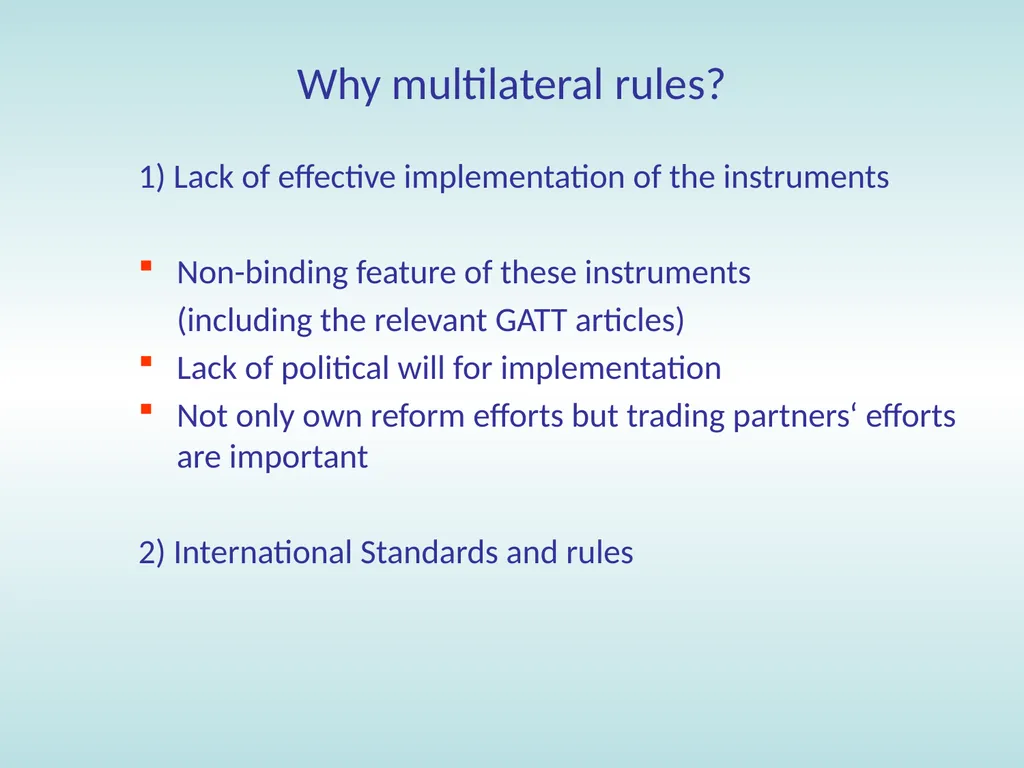
Why multilateral rules? 1) Lack of effective implementation of the instruments
Non-binding feature of these instruments
(including the relevant GATT articles)
Lack of political will for implementation
Not only own reform efforts but trading partners‘ efforts are important
2) International Standards and rules<br>
Non-binding feature of these instruments
(including the relevant GATT articles)
Lack of political will for implementation
Not only own reform efforts but trading partners‘ efforts are important
2) International Standards and rules<br>
42
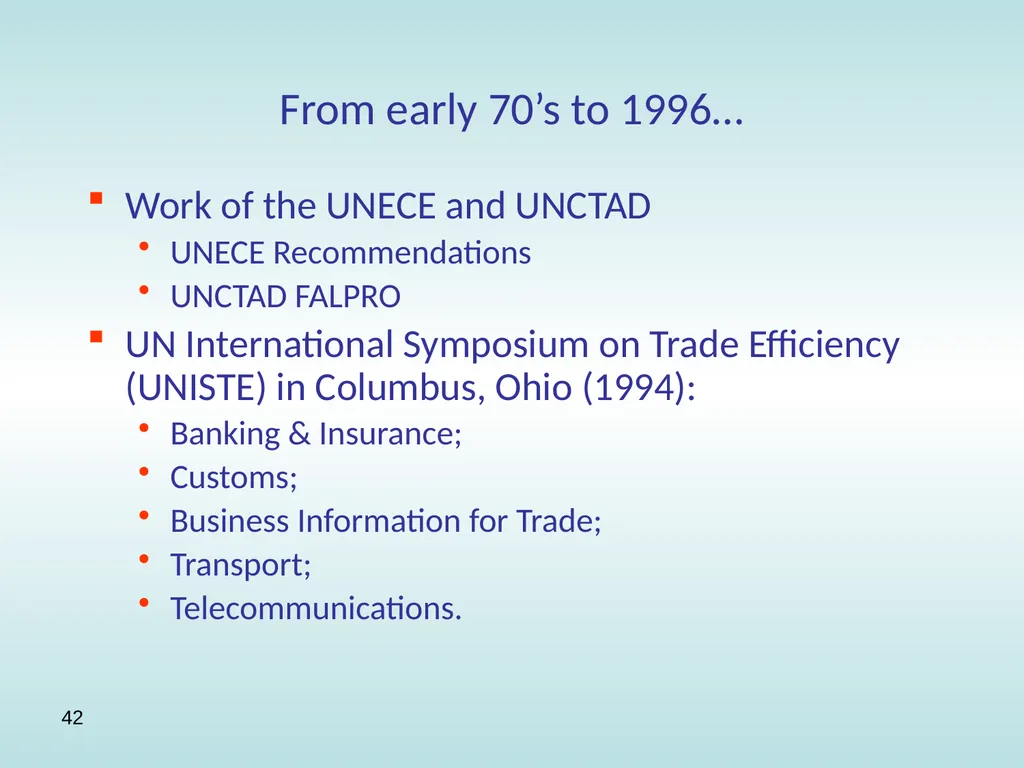
42 From early 70’s to 1996… Work of the UNECE and UNCTAD
UNECE Recommendations
UNCTAD FALPRO
UN International Symposium on Trade Efficiency (UNISTE) in Columbus, Ohio (1994):
Banking & Insurance;
Customs;
Business Information for Trade;
Transport;
Telecommunications.<br>
UNECE Recommendations
UNCTAD FALPRO
UN International Symposium on Trade Efficiency (UNISTE) in Columbus, Ohio (1994):
Banking & Insurance;
Customs;
Business Information for Trade;
Transport;
Telecommunications.<br>
43
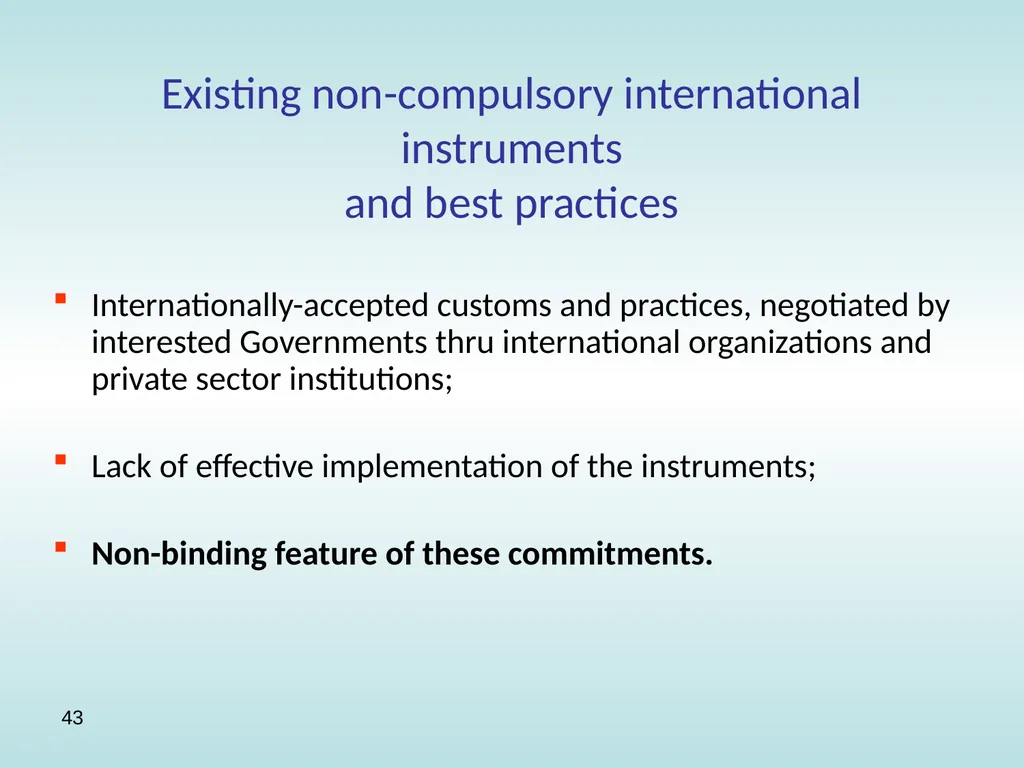
43 Existing non-compulsory international instruments
and best practices Internationally-accepted customs and practices, negotiated by interested Governments thru international organizations and private sector institutions;
Lack of effective implementation of the instruments;
Non-binding feature of these commitments.<br>
Lack of effective implementation of the instruments;
Non-binding feature of these commitments.<br>
44
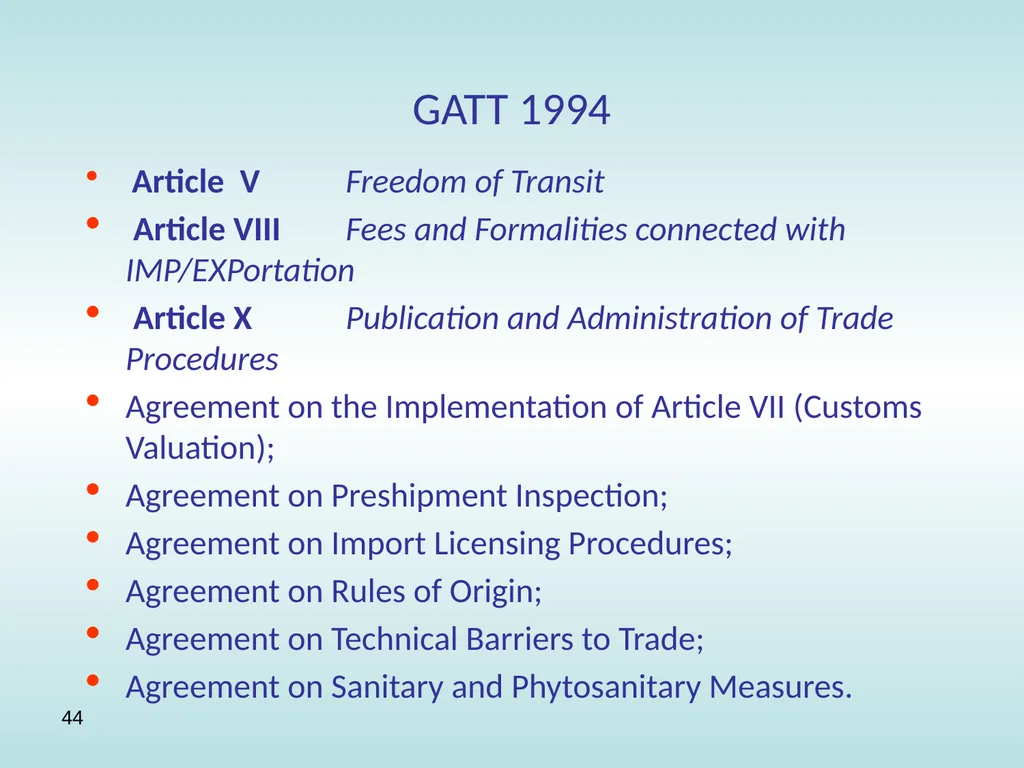
44 GATT 1994 Article V Freedom of Transit
Article VIII Fees and Formalities connected with IMP/EXPortation
Article X Publication and Administration of Trade Procedures
Agreement on the Implementation of Article VII (Customs Valuation);
Agreement on Preshipment Inspection;
Agreement on Import Licensing Procedures;
Agreement on Rules of Origin;
Agreement on Technical Barriers to Trade;
Agreement on Sanitary and Phytosanitary Measures.<br>
Article VIII Fees and Formalities connected with IMP/EXPortation
Article X Publication and Administration of Trade Procedures
Agreement on the Implementation of Article VII (Customs Valuation);
Agreement on Preshipment Inspection;
Agreement on Import Licensing Procedures;
Agreement on Rules of Origin;
Agreement on Technical Barriers to Trade;
Agreement on Sanitary and Phytosanitary Measures.<br>
45
45 Trade facilitation
in the post-Singapore context<br>
46
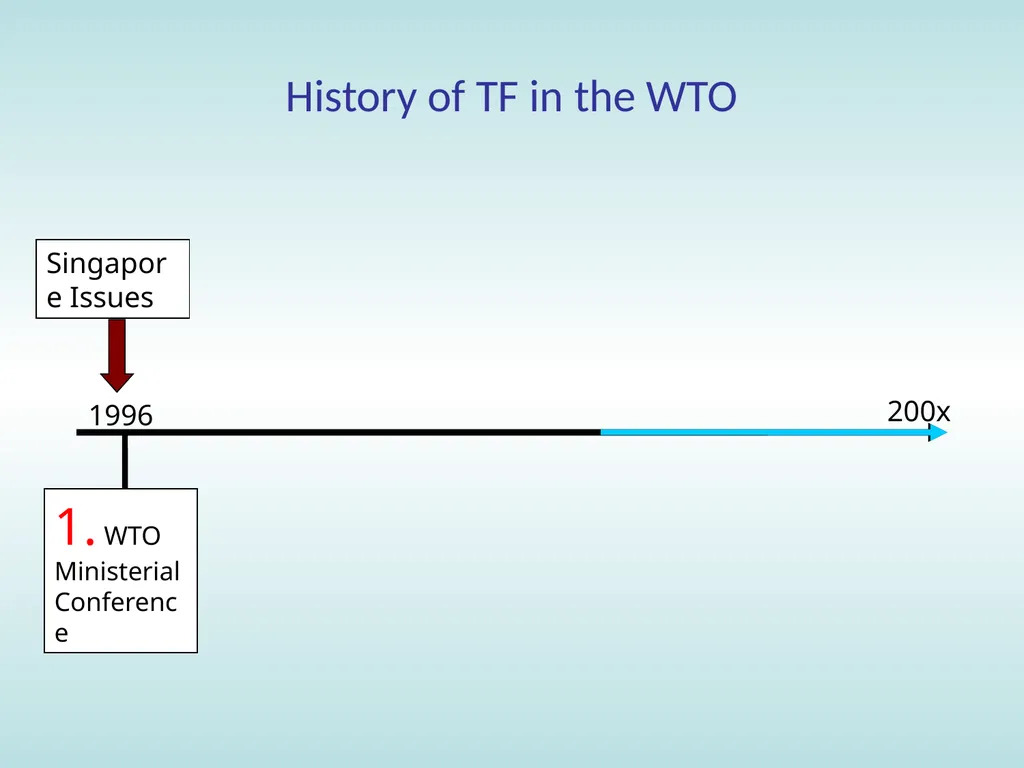
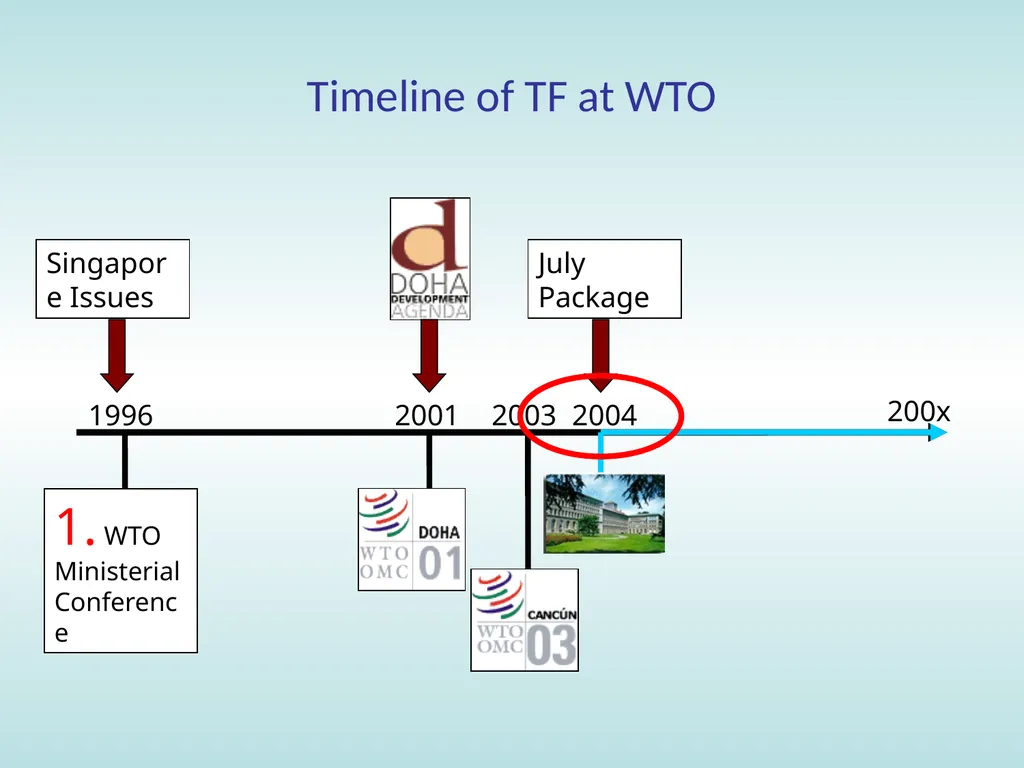
History of TF in the WTO 1. WTO Ministerial Conference 1996 200x Singapore Issues<br>
47
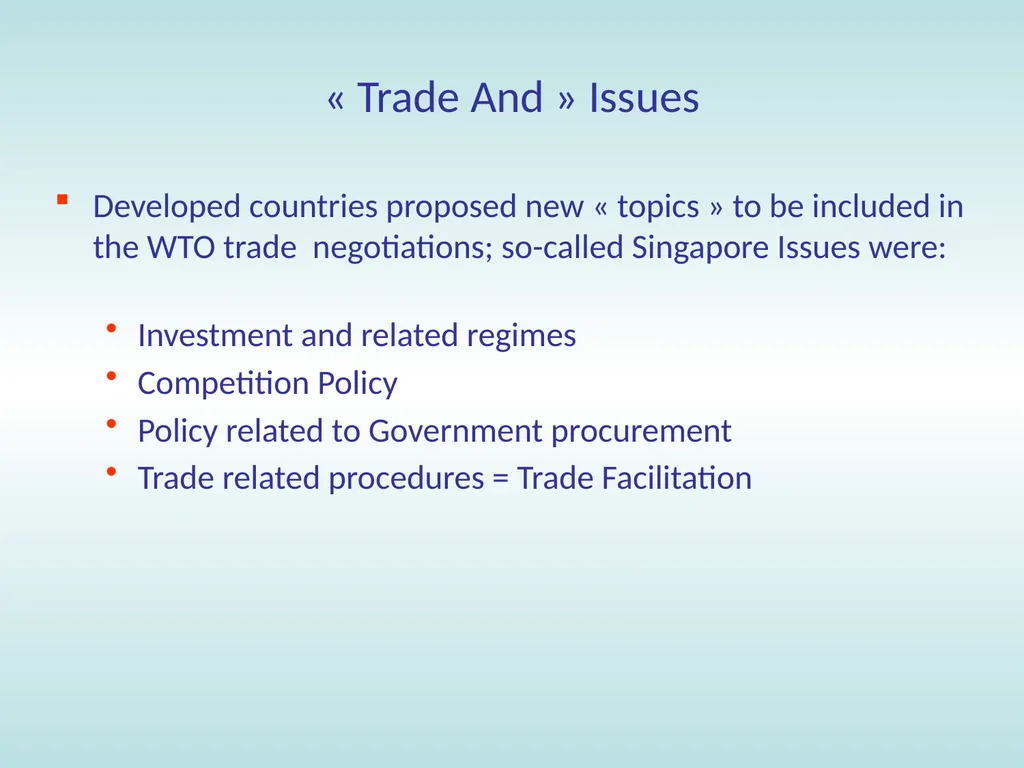
« Trade And » Issues Developed countries proposed new « topics » to be included in the WTO trade negotiations; so-called Singapore Issues were:
Investment and related regimes
Competition Policy
Policy related to Government procurement
Trade related procedures = Trade Facilitation<br>
Investment and related regimes
Competition Policy
Policy related to Government procurement
Trade related procedures = Trade Facilitation<br>
48
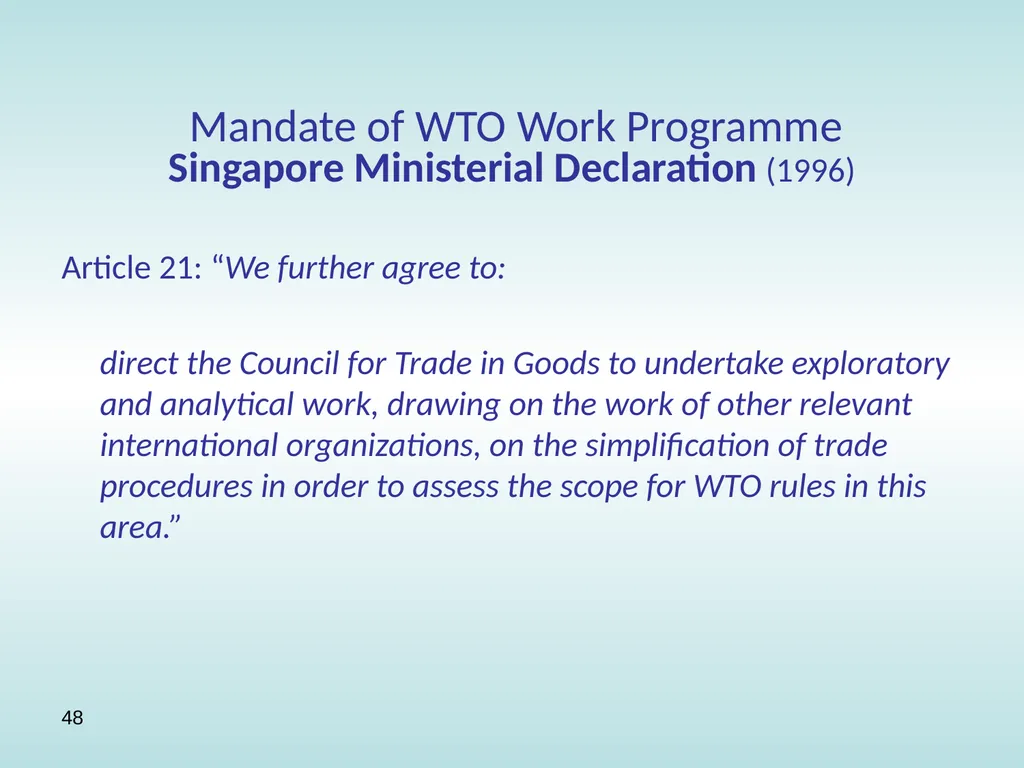
48 Singapore Ministerial Declaration (1996)
Article 21: “We further agree to:
direct the Council for Trade in Goods to undertake exploratory and analytical work, drawing on the work of other relevant international organizations, on the simplification of trade procedures in order to assess the scope for WTO rules in this area.” Mandate of WTO Work Programme<br>
Article 21: “We further agree to:
direct the Council for Trade in Goods to undertake exploratory and analytical work, drawing on the work of other relevant international organizations, on the simplification of trade procedures in order to assess the scope for WTO rules in this area.” Mandate of WTO Work Programme<br>
49
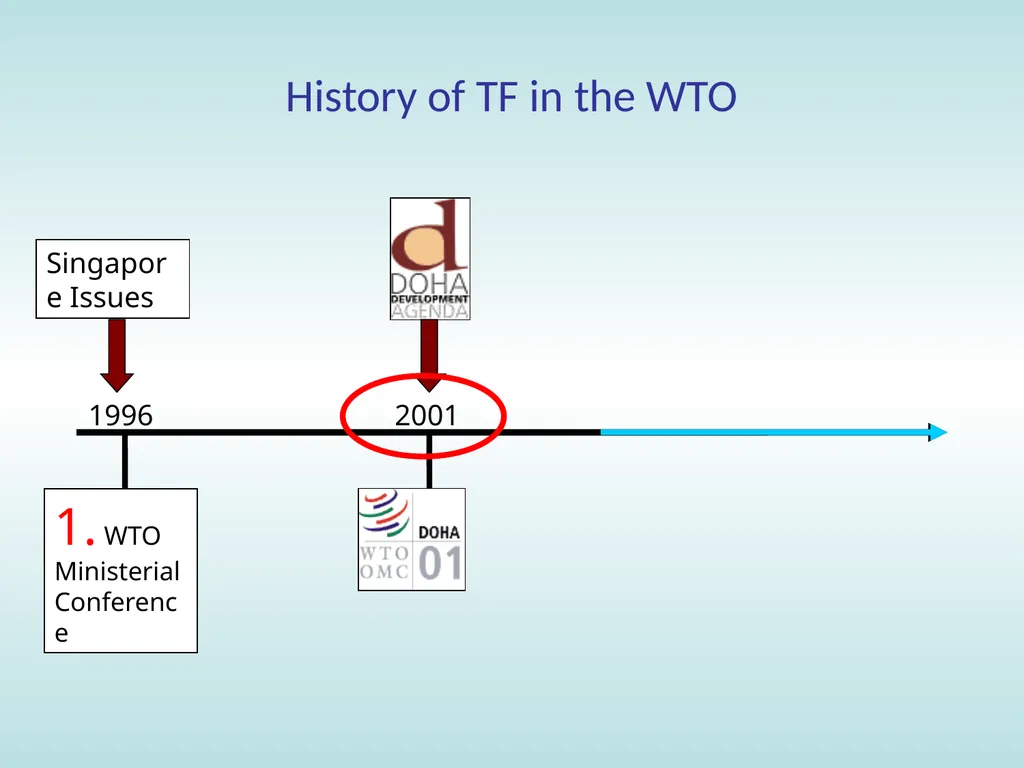
History of TF in the WTO 1. WTO Ministerial Conference 1996 2001 Singapore Issues<br>
50
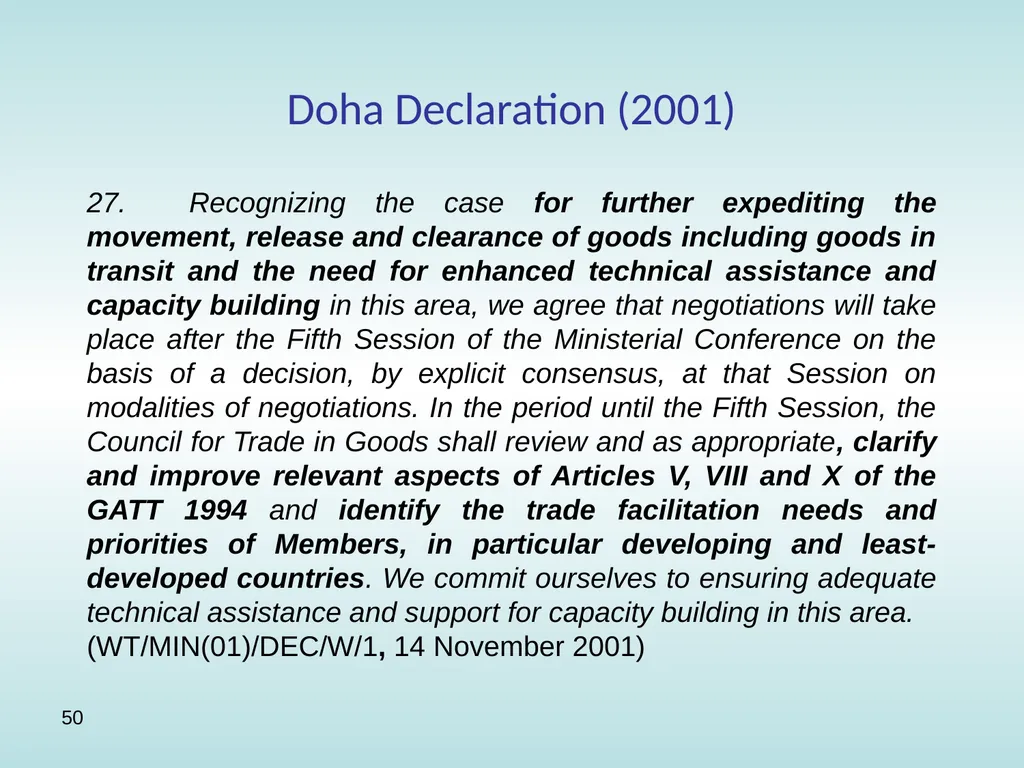
50 Doha Declaration (2001) 27. Recognizing the case for further expediting the movement, release and clearance of goods including goods in transit and the need for enhanced technical assistance and capacity building in this area, we agree that negotiations will take place after the Fifth Session of the Ministerial Conference on the basis of a decision, by explicit consensus, at that Session on modalities of negotiations. In the period until the Fifth Session, the Council for Trade in Goods shall review and as appropriate, clarify and improve relevant aspects of Articles V, VIII and X of the GATT 1994 and identify the trade facilitation needs and priorities of Members, in particular developing and least-developed countries. We commit ourselves to ensuring adequate technical assistance and support for capacity building in this area.
(WT/MIN(01)/DEC/W/1, 14 November 2001)<br>
(WT/MIN(01)/DEC/W/1, 14 November 2001)<br>
51
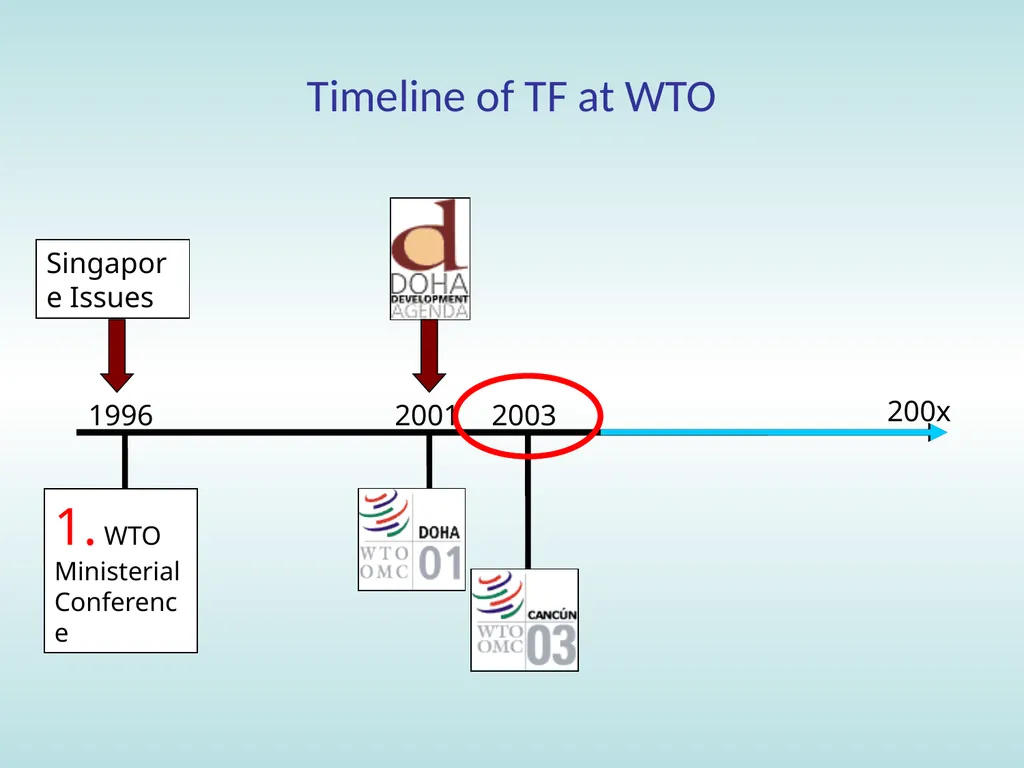
Timeline of TF at WTO 1. WTO Ministerial Conference 1996 2001 2003 200x Singapore Issues<br>
52
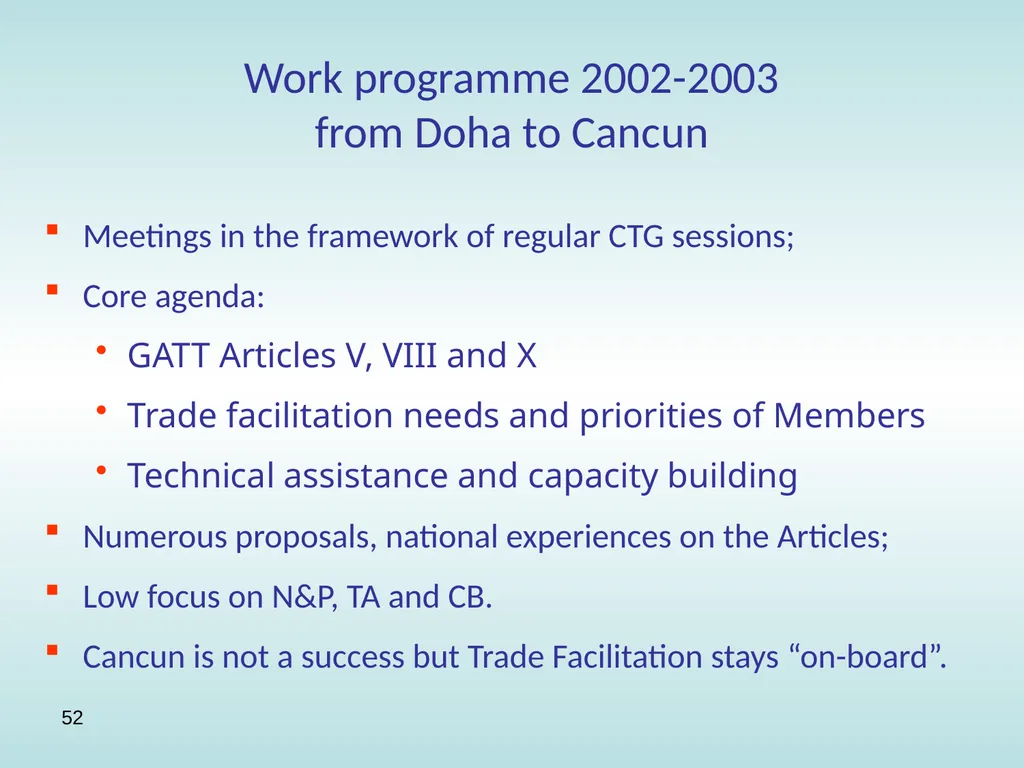
52 Work programme 2002-2003
from Doha to Cancun Meetings in the framework of regular CTG sessions;
Core agenda:
GATT Articles V, VIII and X
Trade facilitation needs and priorities of Members
Technical assistance and capacity building
Numerous proposals, national experiences on the Articles;
Low focus on N&P, TA and CB.
Cancun is not a success but Trade Facilitation stays “on-board”.<br>
Core agenda:
GATT Articles V, VIII and X
Trade facilitation needs and priorities of Members
Technical assistance and capacity building
Numerous proposals, national experiences on the Articles;
Low focus on N&P, TA and CB.
Cancun is not a success but Trade Facilitation stays “on-board”.<br>
53
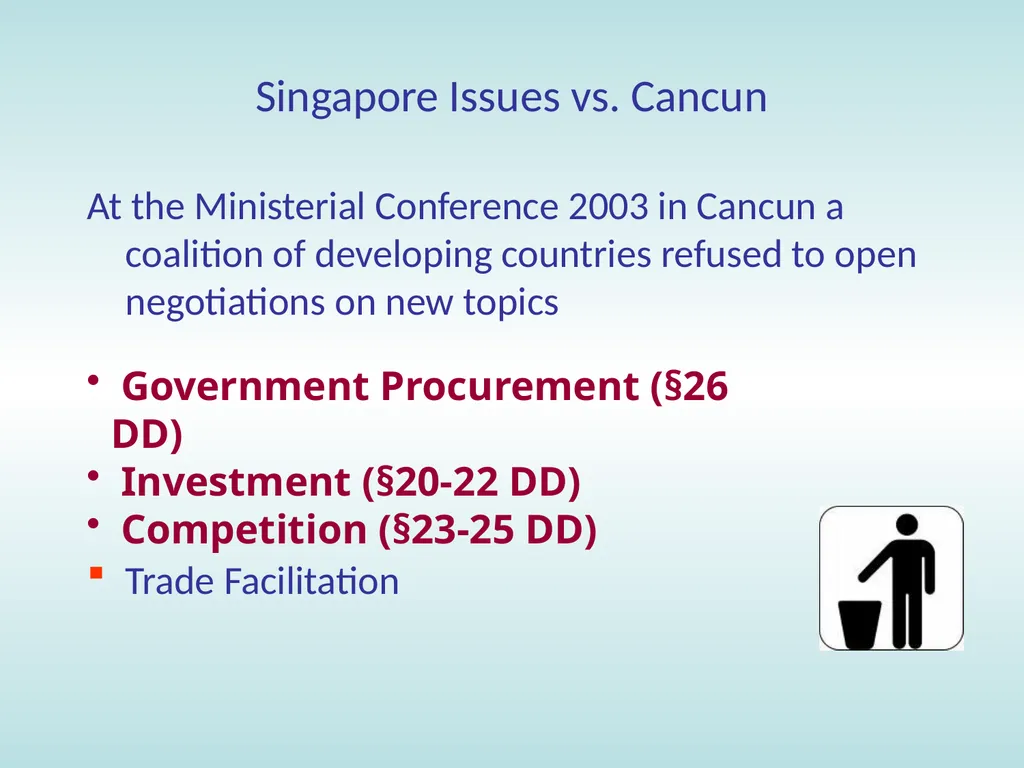
Singapore Issues vs. Cancun At the Ministerial Conference 2003 in Cancun a coalition of developing countries refused to open negotiations on new topics
Trade Facilitation Government Procurement (§26 DD)
Investment (§20-22 DD)
Competition (§23-25 DD)<br>
Trade Facilitation Government Procurement (§26 DD)
Investment (§20-22 DD)
Competition (§23-25 DD)<br>
54
Timeline of TF at WTO 1. WTO Ministerial Conference 1996 2001 2003 2004 200x Singapore Issues July Package<br>
55
55 The WTO July 2004 Package<br>
56
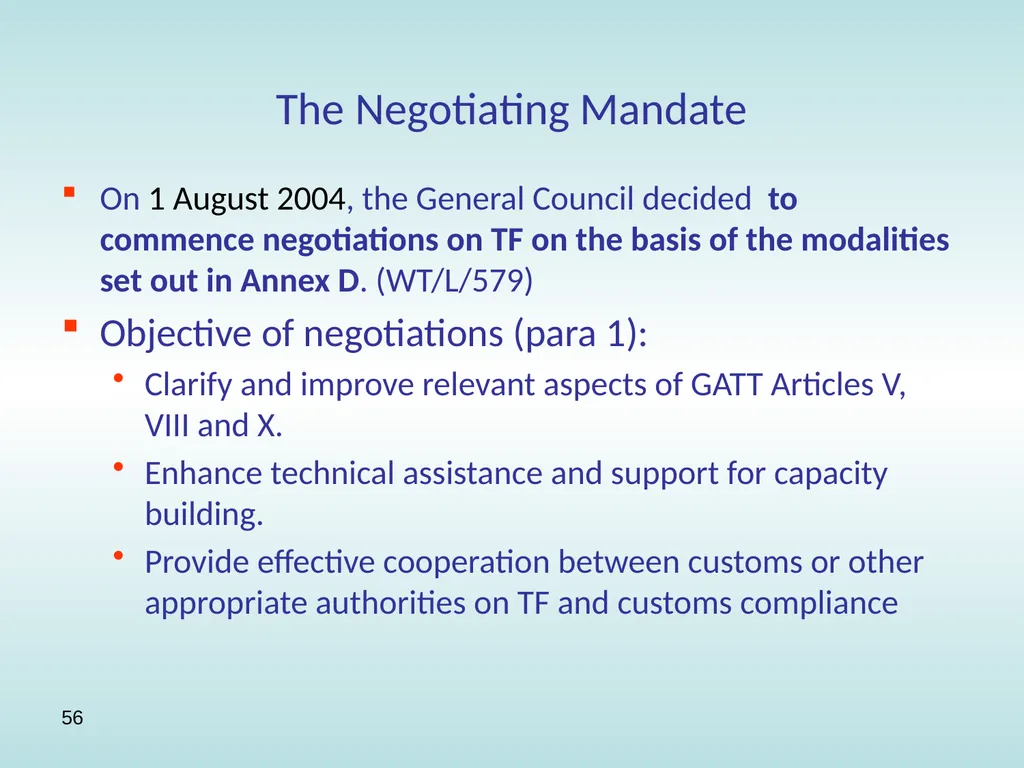
56 The Negotiating Mandate On 1 August 2004, the General Council decided to commence negotiations on TF on the basis of the modalities set out in Annex D. (WT/L/579)
Objective of negotiations (para 1):
Clarify and improve relevant aspects of GATT Articles V, VIII and X.
Enhance technical assistance and support for capacity building.
Provide effective cooperation between customs or other appropriate authorities on TF and customs compliance<br>
Objective of negotiations (para 1):
Clarify and improve relevant aspects of GATT Articles V, VIII and X.
Enhance technical assistance and support for capacity building.
Provide effective cooperation between customs or other appropriate authorities on TF and customs compliance<br>
57
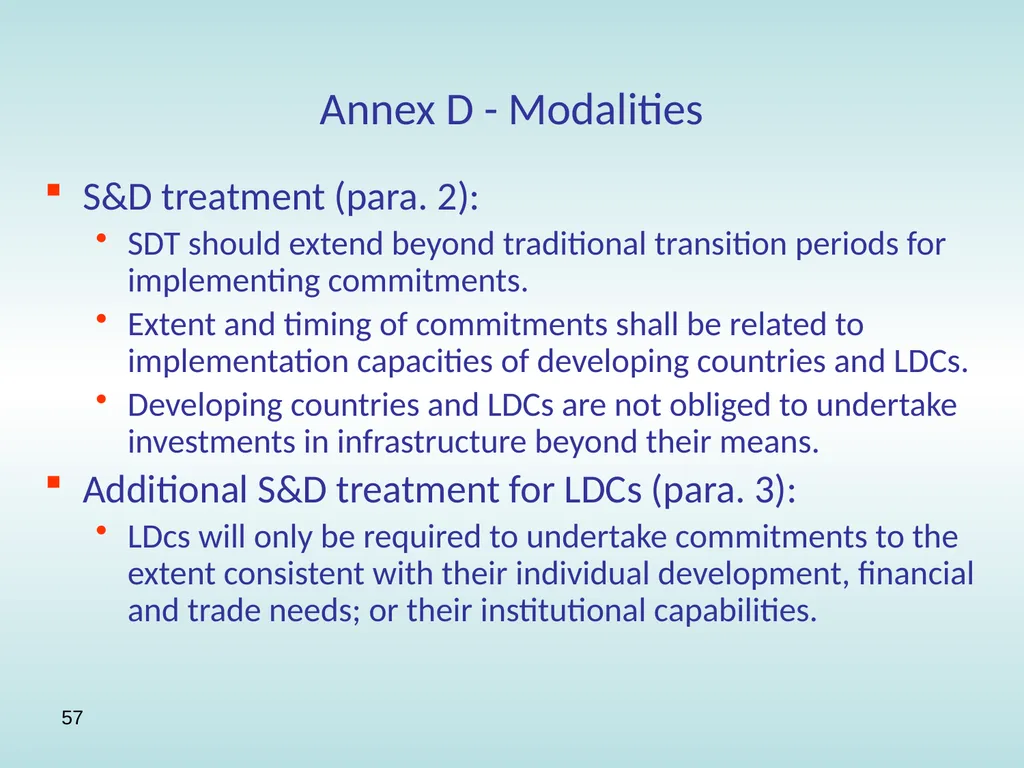
57 S&D treatment (para. 2):
SDT should extend beyond traditional transition periods for implementing commitments.
Extent and timing of commitments shall be related to implementation capacities of developing countries and LDCs.
Developing countries and LDCs are not obliged to undertake investments in infrastructure beyond their means.
Additional S&D treatment for LDCs (para. 3):
LDcs will only be required to undertake commitments to the extent consistent with their individual development, financial and trade needs; or their institutional capabilities. Annex D - Modalities<br>
SDT should extend beyond traditional transition periods for implementing commitments.
Extent and timing of commitments shall be related to implementation capacities of developing countries and LDCs.
Developing countries and LDCs are not obliged to undertake investments in infrastructure beyond their means.
Additional S&D treatment for LDCs (para. 3):
LDcs will only be required to undertake commitments to the extent consistent with their individual development, financial and trade needs; or their institutional capabilities. Annex D - Modalities<br>
58
58 Work on areas of particular interest to developing countries and LDCs (para. 4):
Identification of TF needs and priorities;
Address concerns of developing and LDCs related to cost implications of proposed measures. Annex D - Modalities<br>
Identification of TF needs and priorities;
Address concerns of developing and LDCs related to cost implications of proposed measures. Annex D - Modalities<br>
59
59 TA & CB during the negotiations (para. 5):
Recognized vital for developing and LDCs to fully participate and benefit from negotiations.
Developed countries commit to adequately ensure such support and assistance during negotiations.
TA & CB after the negotiations (para. 6):
Assistance to help implement commitments in accordance with their nature and scope;
Support for infrastructure development in certain cases;
Linkage between provision of assistance and implementation requirement. Annex D - Modalities<br>
Recognized vital for developing and LDCs to fully participate and benefit from negotiations.
Developed countries commit to adequately ensure such support and assistance during negotiations.
TA & CB after the negotiations (para. 6):
Assistance to help implement commitments in accordance with their nature and scope;
Support for infrastructure development in certain cases;
Linkage between provision of assistance and implementation requirement. Annex D - Modalities<br>
60
60 Technical assistance and support for capacity building (para. 7, 8 & 9):
Review of effectiveness of assistance provided and its ability to support implementation of results of negotiations;
Collaborative effort among international organisations to enhance effectiveness of assistance and ensure better coherence. Annex D - Modalities<br>
Review of effectiveness of assistance provided and its ability to support implementation of results of negotiations;
Collaborative effort among international organisations to enhance effectiveness of assistance and ensure better coherence. Annex D - Modalities<br>
61
61 Other elements of the mandate The negotiations on TF and their outcome are part of the “Single undertaking”.
The TNC was instructed to establish a Negotiating Group on TF (NGTF) and to appoint its chair (Amb. Noor, Malaysia, now Amb. Eduardo Spirensen Guatemala).
The NGTF held 15 meetings up to mid-2006;
More than 100 proposals from Members;
Report to the Trade Negotiations Committee (TN/TF/3)
The report was endorsed as Annex E of the Declaration of the Hong Kong Ministerial Conference (Dec.05).<br>
The TNC was instructed to establish a Negotiating Group on TF (NGTF) and to appoint its chair (Amb. Noor, Malaysia, now Amb. Eduardo Spirensen Guatemala).
The NGTF held 15 meetings up to mid-2006;
More than 100 proposals from Members;
Report to the Trade Negotiations Committee (TN/TF/3)
The report was endorsed as Annex E of the Declaration of the Hong Kong Ministerial Conference (Dec.05).<br>
62
62 Where do we stand now ?<br>
63
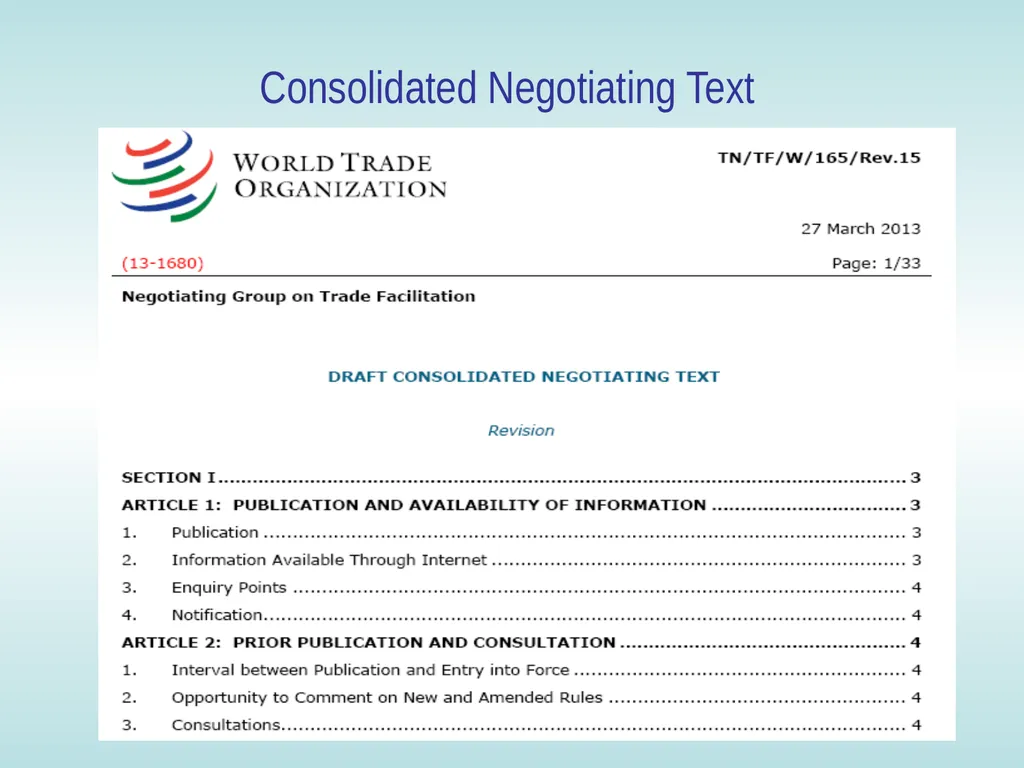
Consolidated Negotiating Text<br>
64
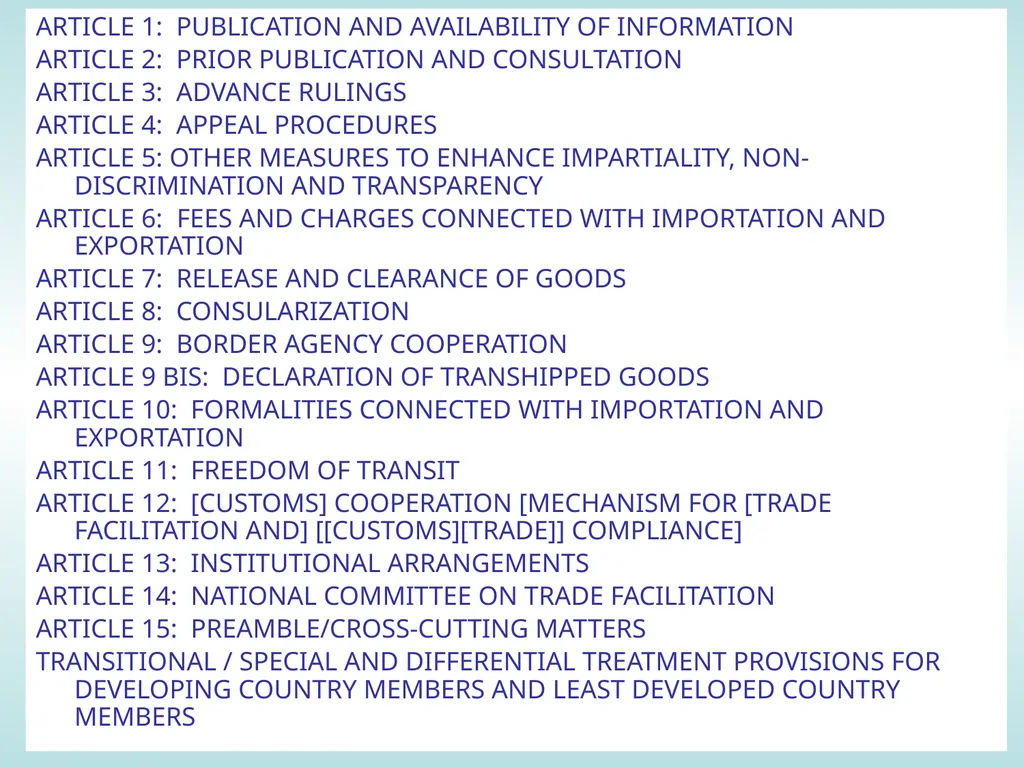
ARTICLE 1: PUBLICATION AND AVAILABILITY OF INFORMATION
ARTICLE 2: PRIOR PUBLICATION AND CONSULTATION
ARTICLE 3: ADVANCE RULINGS
ARTICLE 4: APPEAL PROCEDURES
ARTICLE 5: OTHER MEASURES TO ENHANCE IMPARTIALITY, NON-DISCRIMINATION AND TRANSPARENCY
ARTICLE 6: FEES AND CHARGES CONNECTED WITH IMPORTATION AND EXPORTATION
ARTICLE 7: RELEASE AND CLEARANCE OF GOODS
ARTICLE 8: CONSULARIZATION
ARTICLE 9: BORDER AGENCY COOPERATION
ARTICLE 9 BIS: DECLARATION OF TRANSHIPPED GOODS
ARTICLE 10: FORMALITIES CONNECTED WITH IMPORTATION AND EXPORTATION
ARTICLE 11: FREEDOM OF TRANSIT
ARTICLE 12: [CUSTOMS] COOPERATION [MECHANISM FOR [TRADE FACILITATION AND] [[CUSTOMS][TRADE]] COMPLIANCE]
ARTICLE 13: INSTITUTIONAL ARRANGEMENTS
ARTICLE 14: NATIONAL COMMITTEE ON TRADE FACILITATION
ARTICLE 15: PREAMBLE/CROSS-CUTTING MATTERS
TRANSITIONAL / SPECIAL AND DIFFERENTIAL TREATMENT PROVISIONS FOR DEVELOPING COUNTRY MEMBERS AND LEAST DEVELOPED COUNTRY MEMBERS<br>
ARTICLE 2: PRIOR PUBLICATION AND CONSULTATION
ARTICLE 3: ADVANCE RULINGS
ARTICLE 4: APPEAL PROCEDURES
ARTICLE 5: OTHER MEASURES TO ENHANCE IMPARTIALITY, NON-DISCRIMINATION AND TRANSPARENCY
ARTICLE 6: FEES AND CHARGES CONNECTED WITH IMPORTATION AND EXPORTATION
ARTICLE 7: RELEASE AND CLEARANCE OF GOODS
ARTICLE 8: CONSULARIZATION
ARTICLE 9: BORDER AGENCY COOPERATION
ARTICLE 9 BIS: DECLARATION OF TRANSHIPPED GOODS
ARTICLE 10: FORMALITIES CONNECTED WITH IMPORTATION AND EXPORTATION
ARTICLE 11: FREEDOM OF TRANSIT
ARTICLE 12: [CUSTOMS] COOPERATION [MECHANISM FOR [TRADE FACILITATION AND] [[CUSTOMS][TRADE]] COMPLIANCE]
ARTICLE 13: INSTITUTIONAL ARRANGEMENTS
ARTICLE 14: NATIONAL COMMITTEE ON TRADE FACILITATION
ARTICLE 15: PREAMBLE/CROSS-CUTTING MATTERS
TRANSITIONAL / SPECIAL AND DIFFERENTIAL TREATMENT PROVISIONS FOR DEVELOPING COUNTRY MEMBERS AND LEAST DEVELOPED COUNTRY MEMBERS<br>
65
65<br>
66
66<br>
67
Thank you José María Rubiato
UNCTAD – Trade Logistics Branch
jose.rubiato@unctad.org<br>
UNCTAD – Trade Logistics Branch
jose.rubiato@unctad.org<br>