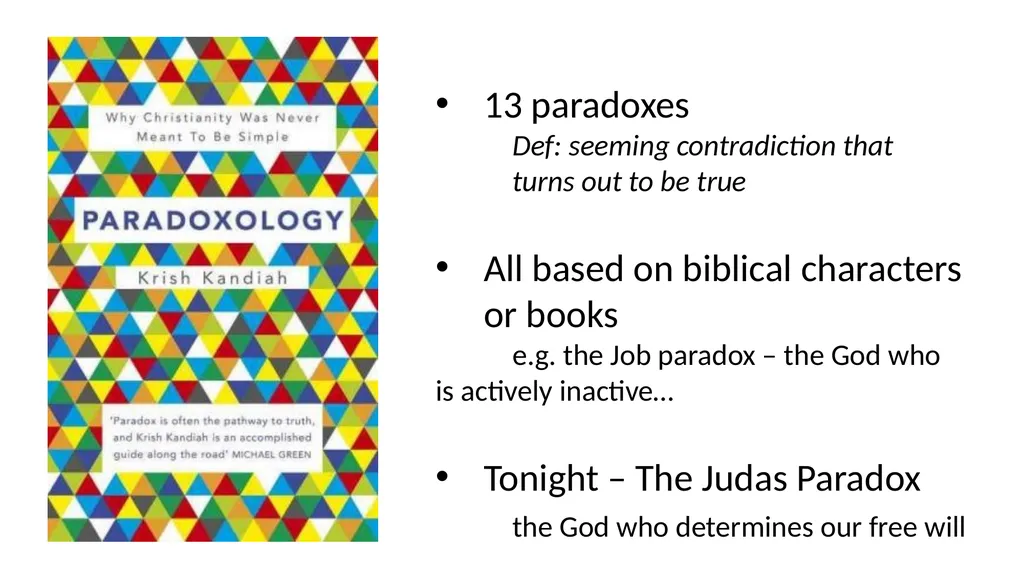
13 paradoxes Def: seeming contradiction that turns out to be true All based on biblical characters or books e.g. the Job paradox the God who is actively inactive Tonight The Judas Paradox the God who determines our free will The God
"13 paradoxes Def: seeming contradiction that turns" is the property of its rightful owner. Permission is granted to
download and print the materials on this website for personal, non-commercial use only, and to display it
on your personal computer provided you do not modify the materials and that you retain all copyright
notices contained in the materials. By downloading content from our website, you accept the terms of this
agreement.
Presentation Transcript
01
13 paradoxes
Def: seeming contradiction that
turns out to be true
All based on biblical characters or books
e.g. the Job paradox – the God who is actively inactive…
Tonight – The Judas Paradox
the God who determines our free will<br>
02
The God who determines our freewill Two principles: God’s sovereignty and Human freewill God’s sovereignty Lord of Lords and King of Kings Creator and Sustainer In control of all things
Nations: Assyria
Governments: Jesus to Pilate
People: our days are numbered, God hardens hearts This is why we pray!<br>
03
The God who determines our freewill Two principles: God’s sovereignty and Human freewill Human Freewill Created able to disobey Held accountable for our sin, so must have had freewill Invitations to come, to follow, to choose. Seems obvious, we’re not robots!<br>
04
The God who determines our freewill Yet, the doctrine of predestination asks questions
of how the two principles relate … Greek word translated ‘predestined’ used 6 times in NT Acts 4:28 - your power and will had decided beforehand to happen Rom 8:28-30 - predestined to be conformed to the likeness of his Son
- and those he predestined, he called … Eph 1:5, 11 - in love he predestined us to be adopted as his sons - in him we were also chosen, having been predestined
according to the plan of him who works out everything in
conformity with the purpose of his will. 1 Cor 2:7 -a wisdom … that God destined for our glory before time began<br>
05
The God who determines our freewill The RSV uses ‘foreordain’ in each of these instances
God is always the subject of sentence. It’s him who predestines.
Meaning: either ‘appoints a person for a situation (eg Christ to the cross)or a situation for a person (us to salvation)’ Brief History: Augustine (C.4th ad)
“Adam was free but used his freedom to turn from God. We inherit a propensity to sin and consequently need divine assistance to choose good.” If God predestines us for salvation or a task, how free are we to refuse?<br>
06
The God who determines our freewill Brief History: Pelagius (C.4th ad)
“Each human being created fresh by God, so no taint of sin from Adam. Therefore it is possible to live a sinless life. Why else would God command us to be holy as he is holy?”<br>
07
The God who determines our freewill Brief History: Augustine’s response
“All have sinned with, in and through Adam. We have lost the liberty not to sin. We are free but our freedom is limited by sin.
God’s grace restores our freedom. It is irresistible grace but doesn’t work against our will, but with it.
God chooses whom he gives grace to, and who not. In his grace, he arranges conditions for a person to act in accordance with His will.
The condemned receive what they deserve.”<br>
08
The God who determines our freewill Brief History: After Augustine’s death
Things went quiet. A milder form of Augustine’s teaching – a middle ground – prevailed, insisting on both God’s grace and human freewill to somehow operate together. Brief History: William of Ockham C.13-14th
“Predestination is based on God’s foreknowledge of what we will do.” Brief History: Thomas Aquinas (C.13th)
Generally Augustinian, but introduced the idea of God’s general and special wills. “His general will is that he wants all to be saved, but in his special will He elects some and rejects others.”<br>
09
The God who determines our freewill Brief History: Martin Luther – 500 years ago this year!
Augustinian: showed from OT that God accepts some and rejects others – e.g. Jacob and Esau, Isaac and Ishmael. Any objections to this doctrine are ‘flesh’ thinking. Brief History: John Calvin (C.16th)
“God is sovereign and does freely choose to save some and not others, but God is wholly blameless and just in this.
T – total depravity – we are unable to respond to grace
U – unconditional election – completely God’s choice, no merit on our part
L – limited atonement – Christ’s death sufficient for all, but limited to elect
I – irresistible grace – if you’re elect, you can’t resist
P – perseverance of the saints – if elect, you will not fall away<br>
10
The God who determines our freewill Brief History: Beza – Calvin’s successor
If God predestines before creation, then logically he creates some to be damned - supralapsarianism Some terms
Election
Reprobation
Double predestination<br>
11
The God who determines our freewill Brief History: Jacobus Arminius(C.16th)
Wanted to disagree with the reformers, didn’t like the picture of God that was being painted.
1st decree – appointment of Jesus Christ as Saviour
2nd decree – all who repent and believe shall be saved
3rd decree – we freely believe or disbelieve
4th decree – God predestines those he foreknows will believe Brief History: John Wesley C.18th
He popularised Arminianism.<br>
12
The God who determines our freewill What we can affirm from scripture All have sinned and are unable to save themselves, Eph 2:1-3;
John 6:44; Rom 3:1-23, esp v9-11; 2 Cor 4:3-4 God is Sovereign and can do as he chooses, e.g. Matt 20:13-15; Rom 9:20-21 God elects and predestines, e.g. Eph 1:4-5; John 6:44; Acts 13:48;
Rom 9:15-16; John 15:16<br>
13
The God who determines our freewill What we can affirm from scripture God wants everyone to be saved, Ezek 33:11; 2 Peter 3:9;
1 Tim 2:3-4; Acts 17:30-31 There are universal invitations, e.g. Isaiah 55:1; Matt 11:28 God’s foreknowledge plays a part, e.g. Rom 8:29; 1 Peter 1:1-2 We are free to choose: John 3:16! But then John 3:17ff!<br>
14
The God who determines our freewill What we can affirm from scripture The bible teaches BOTH predestination and freewill. Indeed some passages seem to contain both. John 1:12-13: yet to all who received him, to those who believed in his name he gave the right to become children of God – children born not of natural descent, nor of human decision, but born of God. Acts 2:41: those who accepted his message were baptised and about three thousand were added to their number that day … then v48, and the Lord added to their number those who were being saved.<br>
15
The God who determines our freewill Questions and comments? The Judas Paradox
Read
Matt 26:14-16 and John 12:4-6
John 13:21-27
Psalm 49:8, John 17:12 Question – who was responsible for Judas’ betrayal – Judas, the Devil or God?<br>
16
The God who determines our freewill Krish Kandiah: we have to hold together that human beings have genuine and accountable freedom AND that God is working out his perfect purposes and plan out.<br>