"13 Symmetry in Crystalline Solids Rotational" is the property of its rightful owner. Permission is granted to
download and print the materials on this website for personal, non-commercial use only, and to display it
on your personal computer provided you do not modify the materials and that you retain all copyright
notices contained in the materials. By downloading content from our website, you accept the terms of this
agreement.
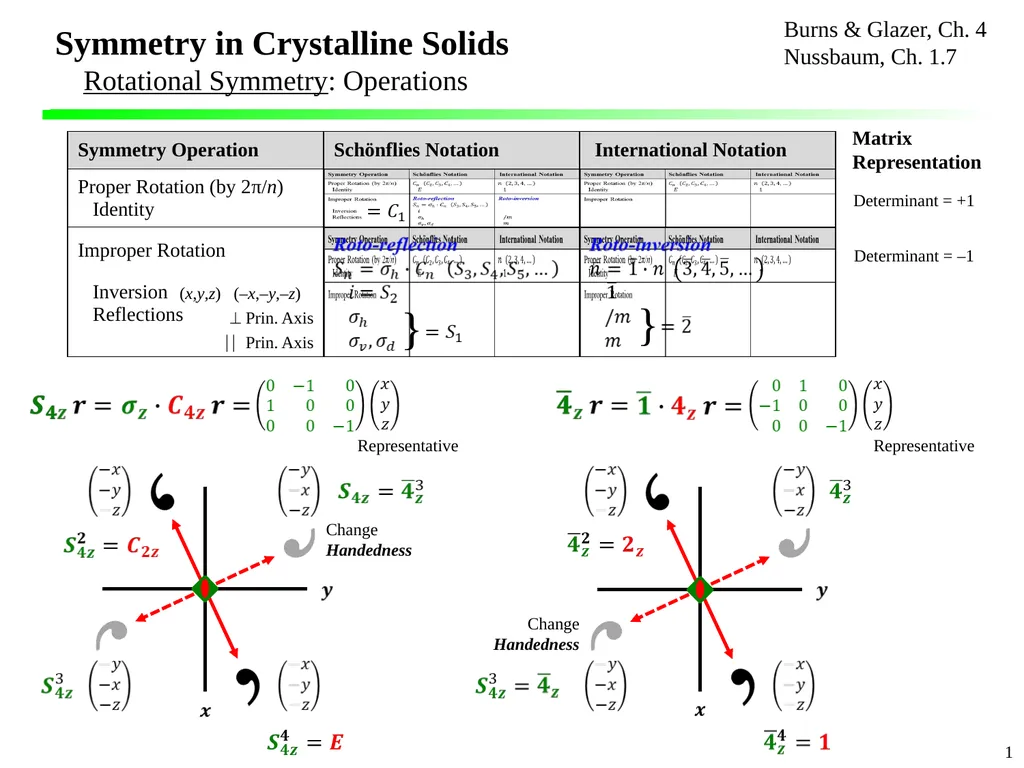
Proper Rotation Proper Rotation =
Improper Rotation Improper Rotation =
Improper Rotation Proper Rotation = Improper Rotation Proper Rotation Proper Rotation = Proper Rotation
Improper Rotation Improper Rotation = Proper Rotation
Improper Rotation Proper Rotation = 14 Symmetry in Crystalline Solids
Rotational Symmetry: Point Groups Burns & Glazer, Ch. 4
Nussbaum, Ch. 1.7 Matrix
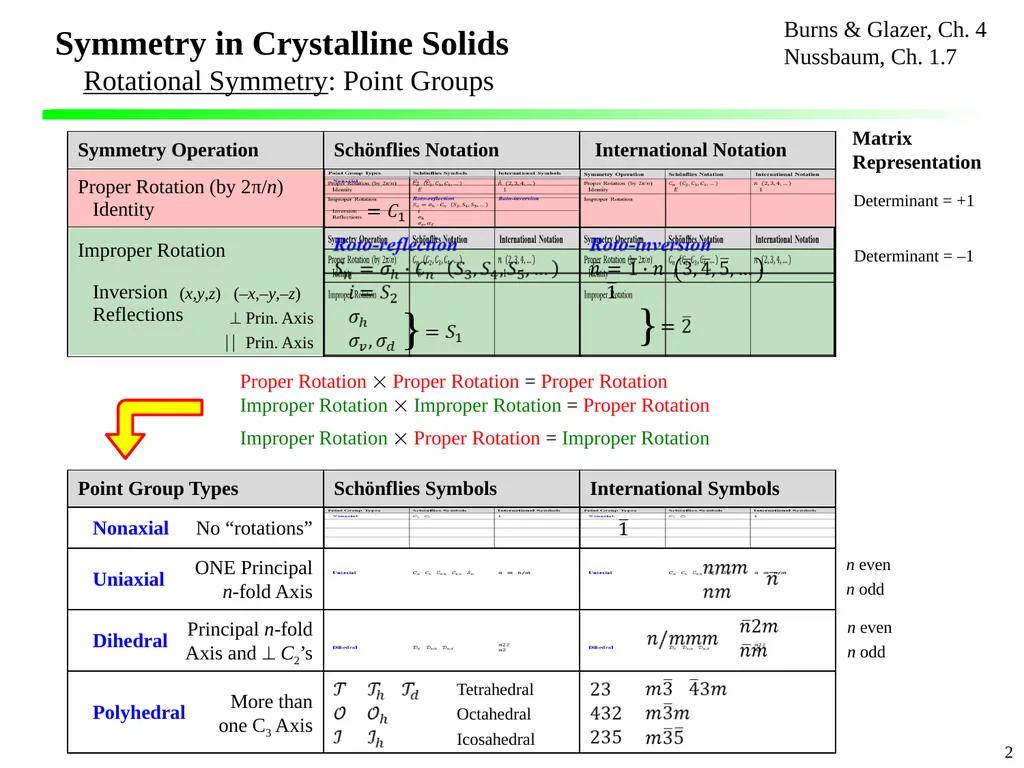
Representation Determinant = +1 Determinant = –1 ONE Principal n-fold Axis n even
n odd No “rotations” n even
n odd Principal n-fold Axis and C2’s More than one C3 Axis Tetrahedral
Octahedral
Icosahedral } } (x,y,z) (–x,–y,–z) Prin. Axis
Prin. Axis Proper Rotation Proper Rotation =
Improper Rotation Improper Rotation =
Improper Rotation Proper Rotation =<br>
03
15 Burns & Glazer, Ch. 4
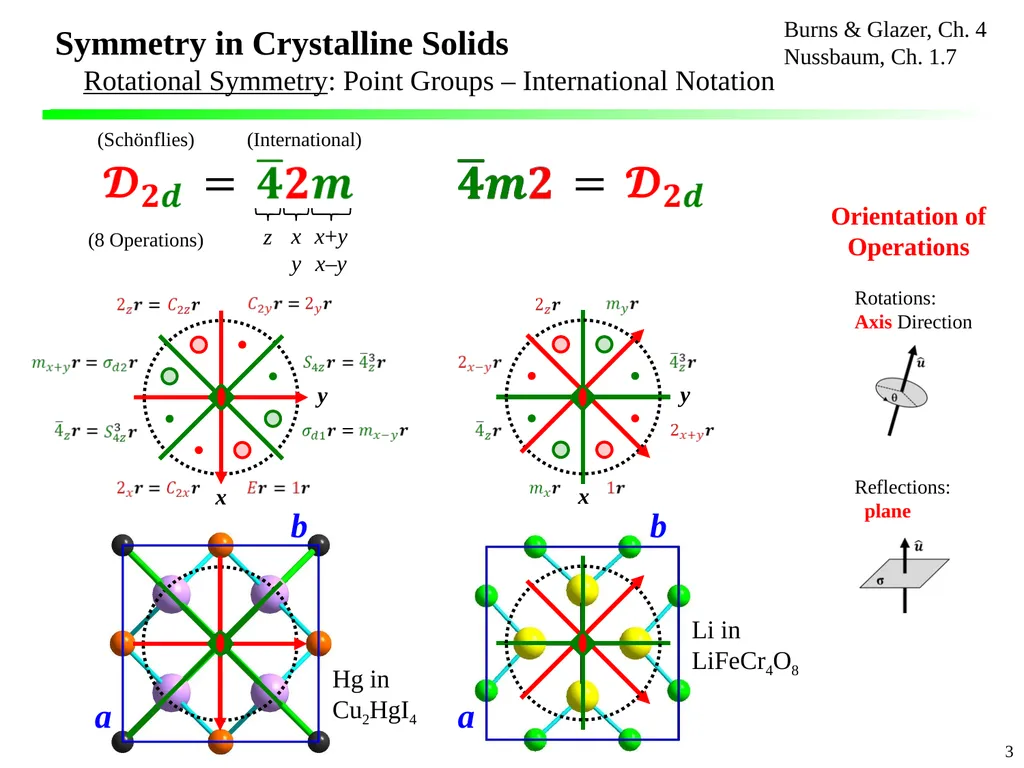
Nussbaum, Ch. 1.7 z x
y x+y
x–y x y x y Rotations:
Axis Direction Reflections:
plane Orientation of Operations Symmetry in Crystalline Solids
Rotational Symmetry: Point Groups – International Notation (Schönflies) (International) (8 Operations) Hg in
Cu2HgI4 Li in
LiFeCr4O8 a a b b<br>
04
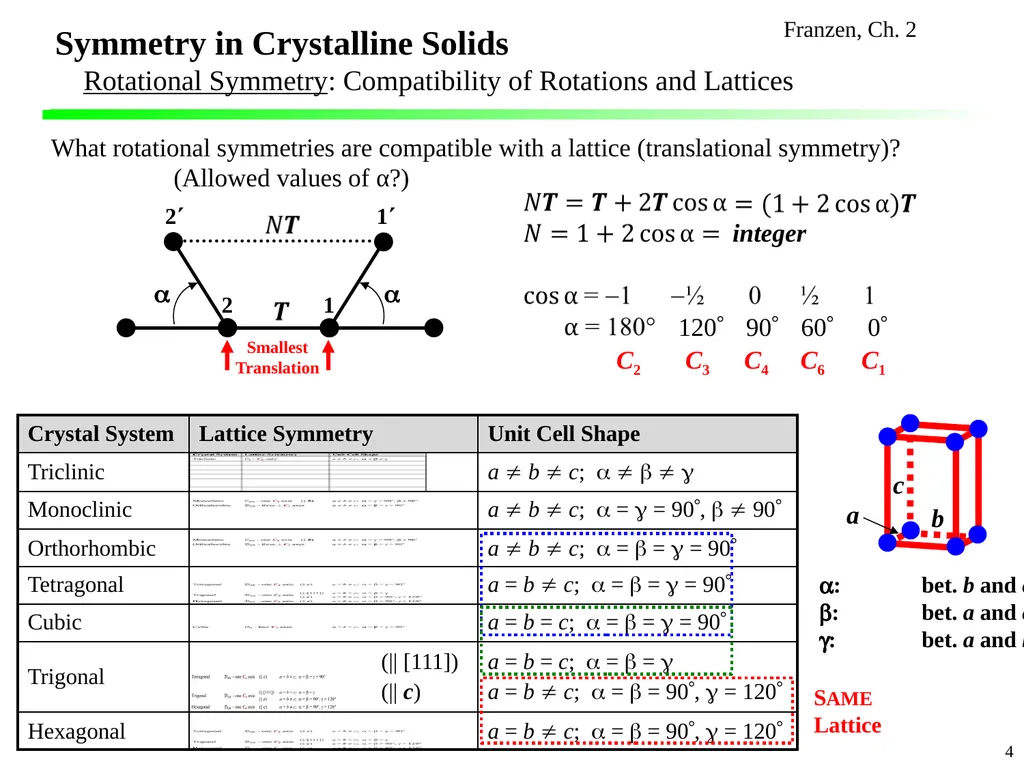
16 Franzen, Ch. 2 a: bet. b and c
b: bet. a and c
g: bet. a and b What rotational symmetries are compatible with a lattice (translational symmetry)? 2 1 2 1 C2 (Allowed values of α?) SAME
Lattice Smallest
Translation 120 90 60 0 C3 C4 C6 C1 Symmetry in Crystalline Solids
Rotational Symmetry: Compatibility of Rotations and Lattices integer<br>
05
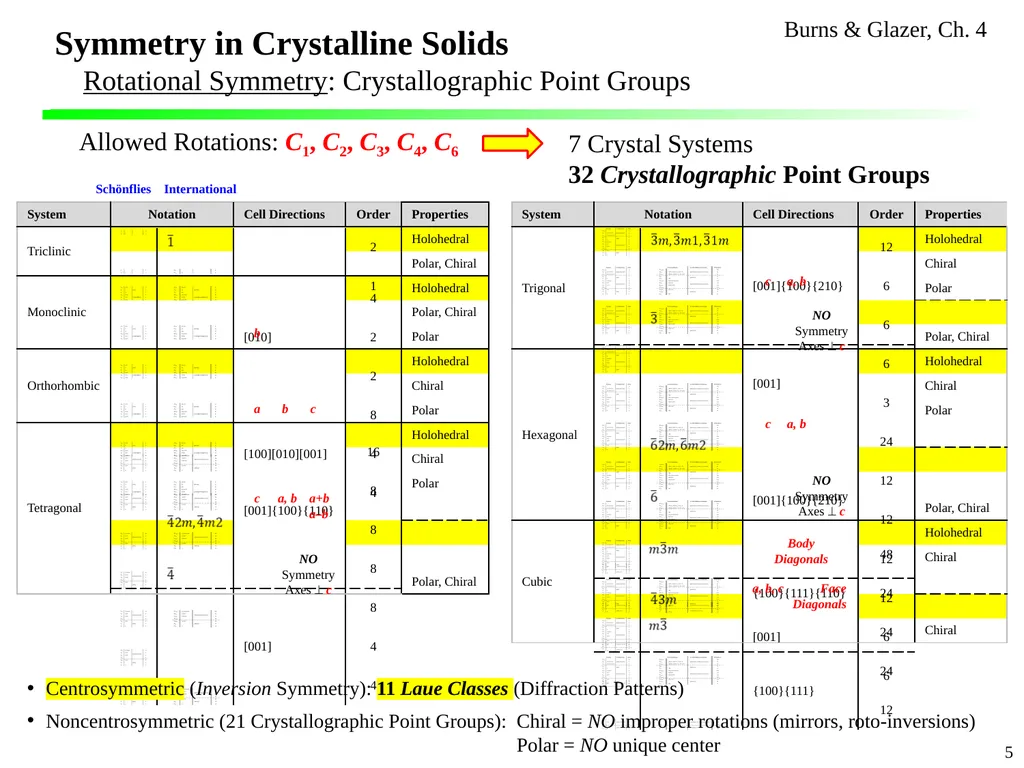
17 Allowed Rotations: C1, C2, C3, C4, C6 7 Crystal Systems
32 Crystallographic Point Groups Centrosymmetric (Inversion Symmetry): 11 Laue Classes (Diffraction Patterns)
Noncentrosymmetric (21 Crystallographic Point Groups): Chiral = NO improper rotations (mirrors, roto-inversions)
Polar = NO unique center Schönflies International b b c a c a, b a+b
a–b NO Symmetry Axes c c a, b c a, b a, b, c NO Symmetry Axes c NO Symmetry Axes c Body Diagonals Face Diagonals Symmetry in Crystalline Solids
Rotational Symmetry: Crystallographic Point Groups Burns & Glazer, Ch. 4<br>
06
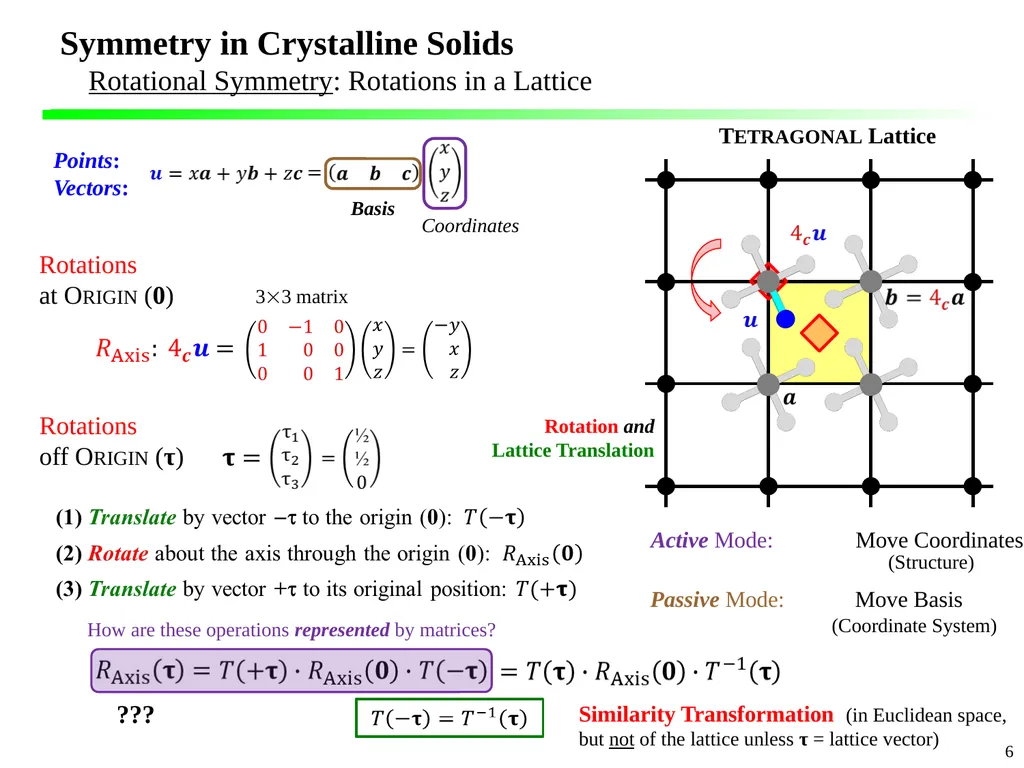
18 TETRAGONAL Lattice Symmetry in Crystalline Solids
Rotational Symmetry: Rotations in a Lattice Coordinates Basis Points:
Vectors: Rotations
at ORIGIN (0) Active Mode: Move Coordinates Passive Mode: Move Basis (Structure) (Coordinate System) 33 matrix Similarity Transformation (in Euclidean space, but not of the lattice unless τ = lattice vector) Rotations
off ORIGIN (τ) Rotation and Lattice Translation How are these operations represented by matrices? ???<br>
07
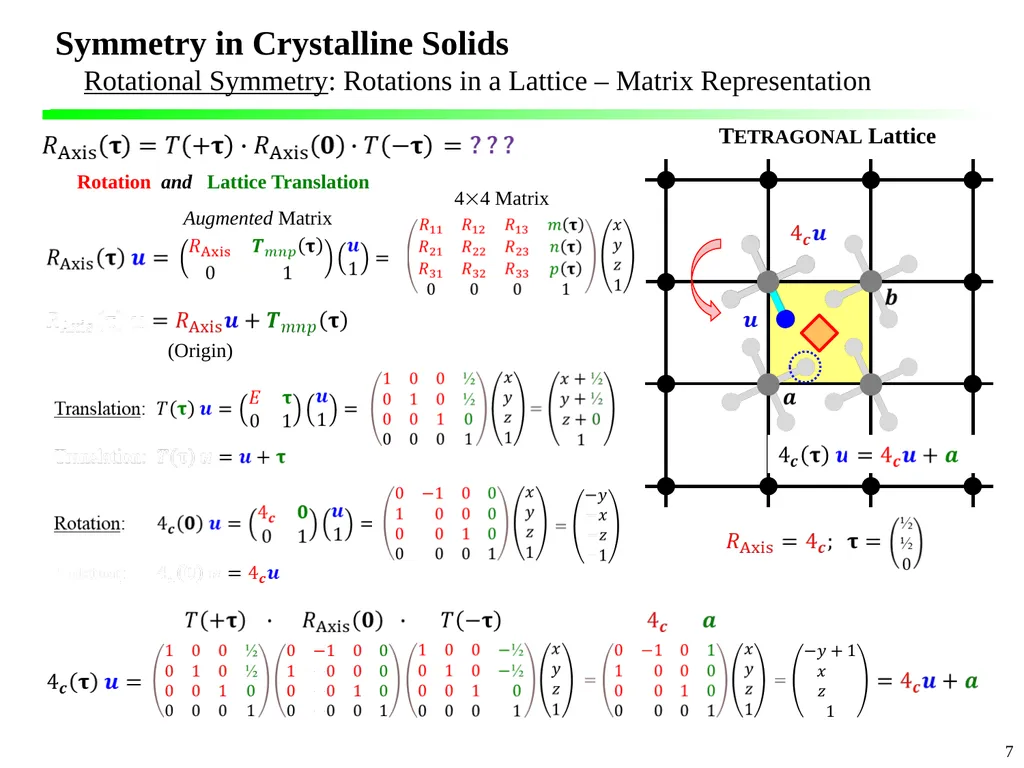
19 TETRAGONAL Lattice Rotation and Lattice Translation Symmetry in Crystalline Solids
Rotational Symmetry: Rotations in a Lattice – Matrix Representation 44 Matrix Augmented Matrix (Origin)<br>
08
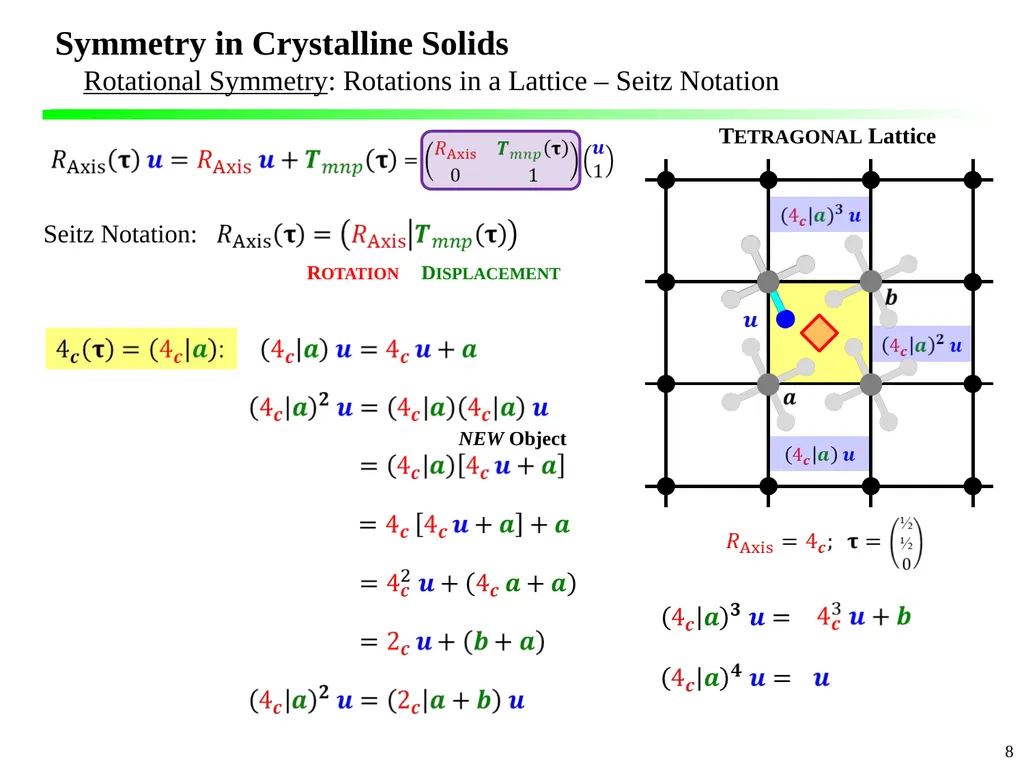
20 TETRAGONAL Lattice Symmetry in Crystalline Solids
Rotational Symmetry: Rotations in a Lattice – Seitz Notation Seitz Notation: NEW Object ROTATION DISPLACEMENT<br>
09
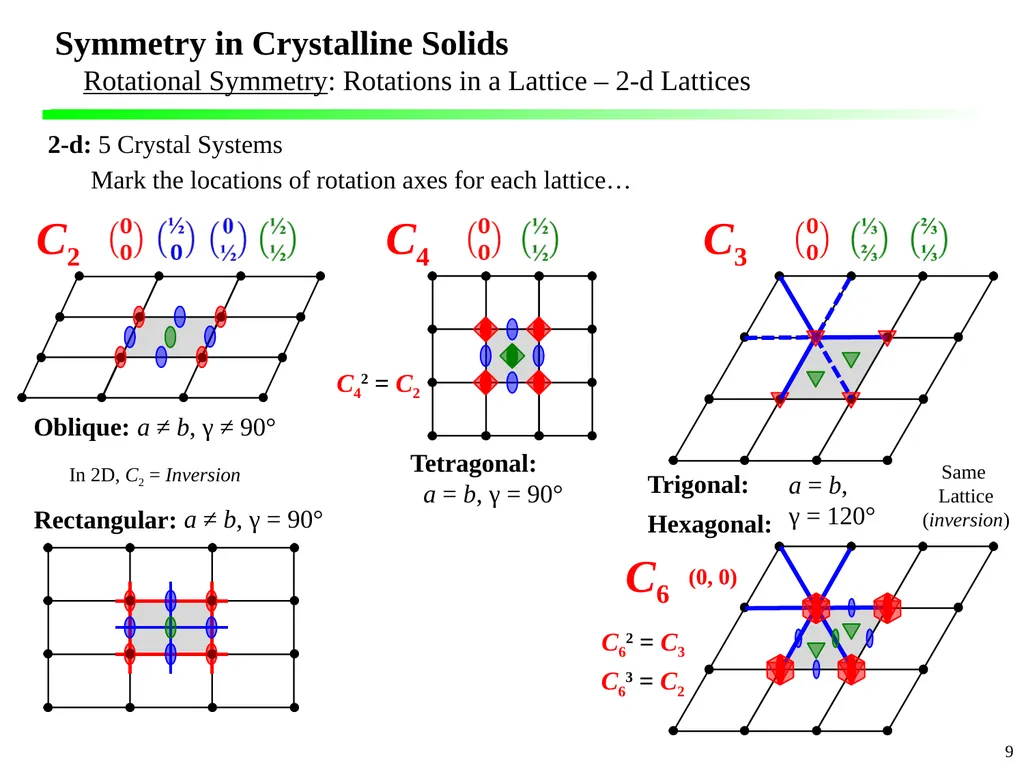
Same
Lattice
(inversion) 21 Tetragonal: Rectangular: Mark the locations of rotation axes for each lattice… Trigonal:
Hexagonal: C2 C4 C42 = C2 In 2D, C2 = Inversion C3 C6 C62 = C3 C63 = C2 (0, 0) 2-d: 5 Crystal Systems Same
Lattice Oblique: a ≠ b, γ ≠ 90° a ≠ b, γ = 90° a = b, γ = 90° a = b,
γ = 120° Symmetry in Crystalline Solids
Rotational Symmetry: Rotations in a Lattice – 2-d Lattices<br>
10
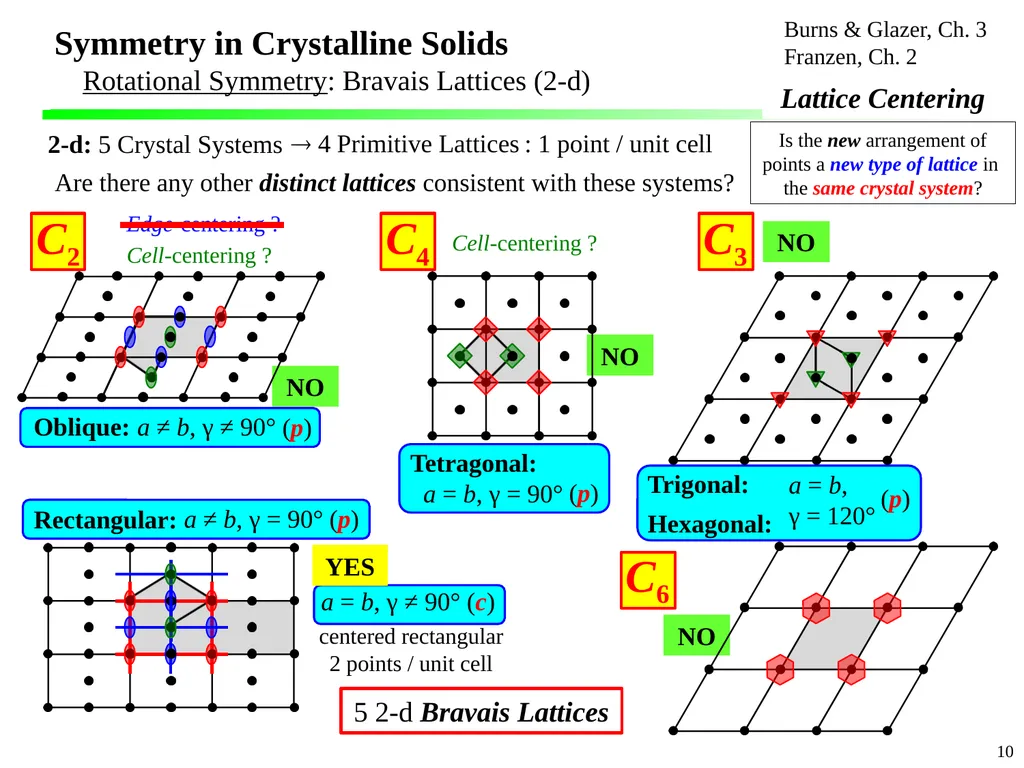
NO NO NO C2 C4 C3 Edge-centering ? Cell-centering ? 22 C6 2-d: 5 Crystal Systems 4 Primitive Lattices Are there any other distinct lattices consistent with these systems? centered rectangular
2 points / unit cell a = b, γ ≠ 90° (c) Is the new arrangement of points a new type of lattice in
the same crystal system? 5 2-d Bravais Lattices Burns & Glazer, Ch. 3
Franzen, Ch. 2 Rectangular: Oblique: a ≠ b, γ ≠ 90° a ≠ b, γ = 90° Tetragonal: Trigonal:
Hexagonal: a = b, γ = 90° a = b,
γ = 120° (p) (p) (p) (p) : 1 point / unit cell YES Cell-centering ? NO Symmetry in Crystalline Solids
Rotational Symmetry: Bravais Lattices (2-d) Lattice Centering<br>
11
23 Burns & Glazer, Ch. 3
Franzen, Ch. 2 Symmetry in Crystalline Solids
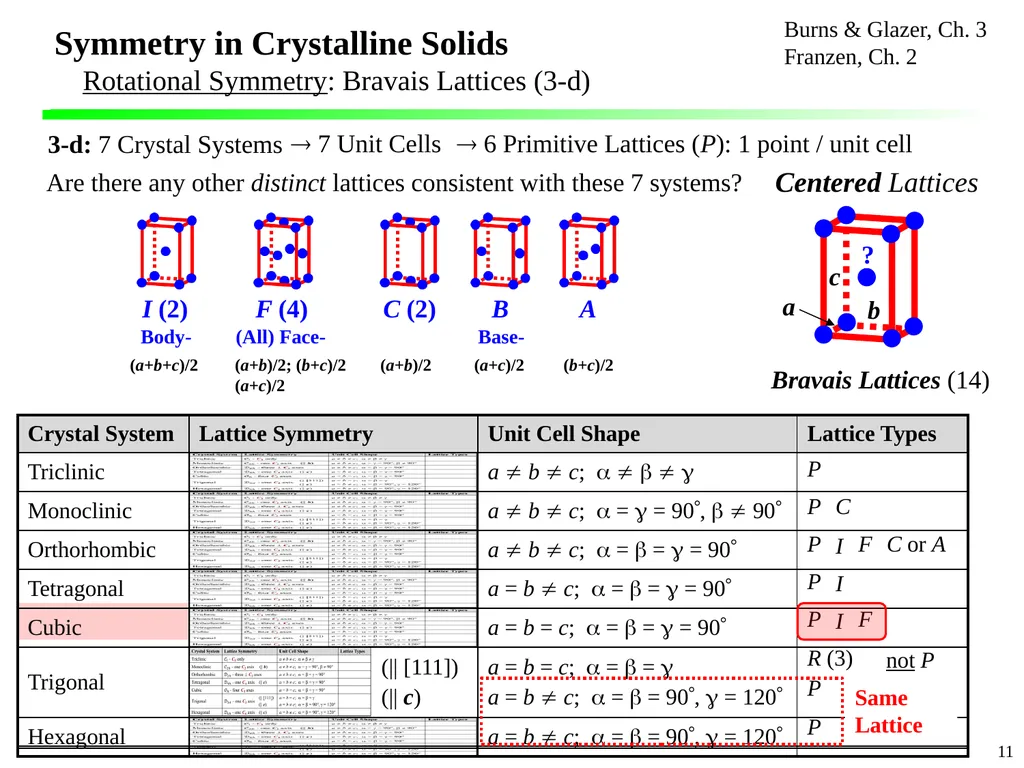
Rotational Symmetry: Bravais Lattices (3-d) 3-d: 7 Crystal Systems c b a ? I (2) F (4) C (2) B A Body- (All) Face- Base- Are there any other distinct lattices consistent with these 7 systems? Bravais Lattices (14) (a+b+c)/2 (a+b)/2; (b+c)/2
(a+c)/2 (a+b)/2 (a+c)/2 (b+c)/2 6 Primitive Lattices (P): 1 point / unit cell Centered Lattices Same
Lattice not P 7 Unit Cells<br>
12
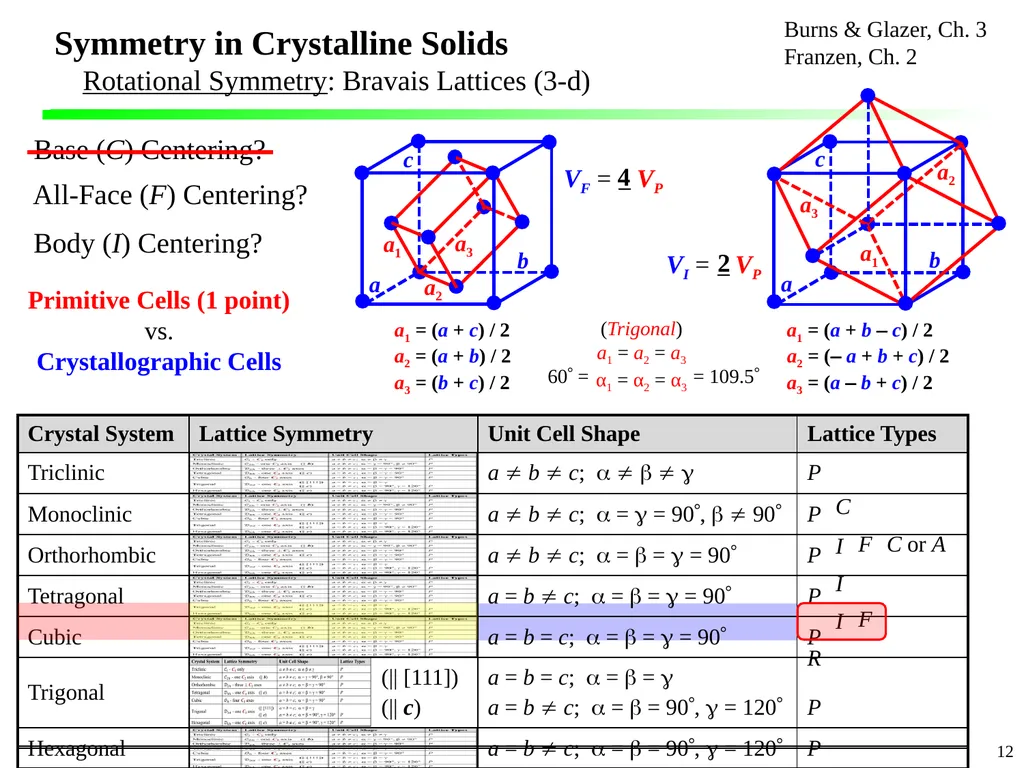
VI = 4 VP 2 VF = 4 VP 4 24 Burns & Glazer, Ch. 3
Franzen, Ch. 2 Symmetry in Crystalline Solids
Rotational Symmetry: Bravais Lattices (3-d) Base (C) Centering? Primitive Cells (1 point)
vs.
Crystallographic Cells a b c a1 a2 a3 a b c a1 a2 a3 All-Face (F) Centering? a1 = (a + c) / 2 a2 = (a + b) / 2 a3 = (b + c) / 2 Body (I) Centering? a1 = (a + b - c) / 2 a2 = (- a + b + c) / 2 a3 = (a - b + c) / 2 (Trigonal)
a1 = a2 = a3
α1 = α2 = α3 60 = = 109.5<br>