
14–2 © 2014 Cengage Learning. All rights reserved.
DJ
Published · 35 slides · 0 views

1 / 1

Description
142 2014 Cengage Learning. All rights reserved. May not be copied, scanned, or duplicated, in whole or in part, except for use as permitted in a license distributed with a certain product or service or otherwise on a password-protected
Related Topics
Share
Embed code
Download this presentation From Below
"14–2 © 2014 Cengage Learning. All rights reserved." is the property of its rightful owner. Permission is granted to download and print the materials on this website for personal, non-commercial use only, and to display it on your personal computer provided you do not modify the materials and that you retain all copyright notices contained in the materials. By downloading content from our website, you accept the terms of this agreement.
Presentation Transcript
01
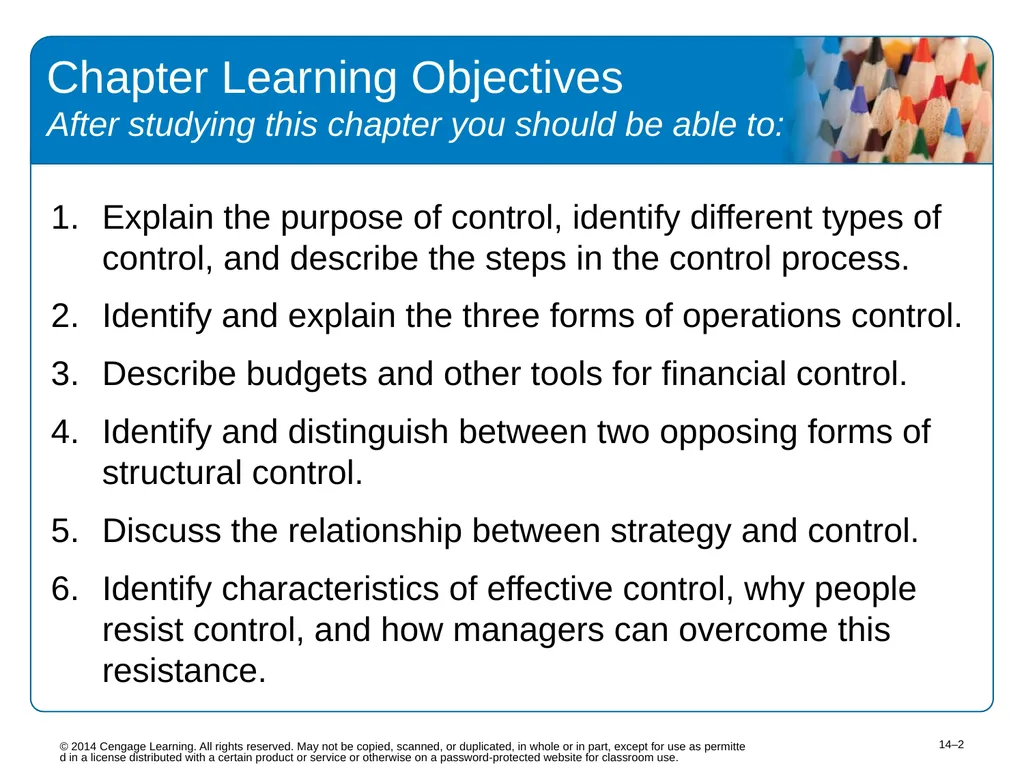
14–2 © 2014 Cengage Learning. All rights reserved. May not be copied, scanned, or duplicated, in whole or in part, except for use as permitted in a license distributed with a certain product or service or otherwise on a password-protected website for classroom use. Chapter Learning Objectives
After studying this chapter you should be able to: Explain the purpose of control, identify different types of control, and describe the steps in the control process.
Identify and explain the three forms of operations control.
Describe budgets and other tools for financial control.
Identify and distinguish between two opposing forms of structural control.
Discuss the relationship between strategy and control.
Identify characteristics of effective control, why people resist control, and how managers can overcome this resistance.<br>
Identify and explain the three forms of operations control.
Describe budgets and other tools for financial control.
Identify and distinguish between two opposing forms of structural control.
Discuss the relationship between strategy and control.
Identify characteristics of effective control, why people resist control, and how managers can overcome this resistance.<br>
02
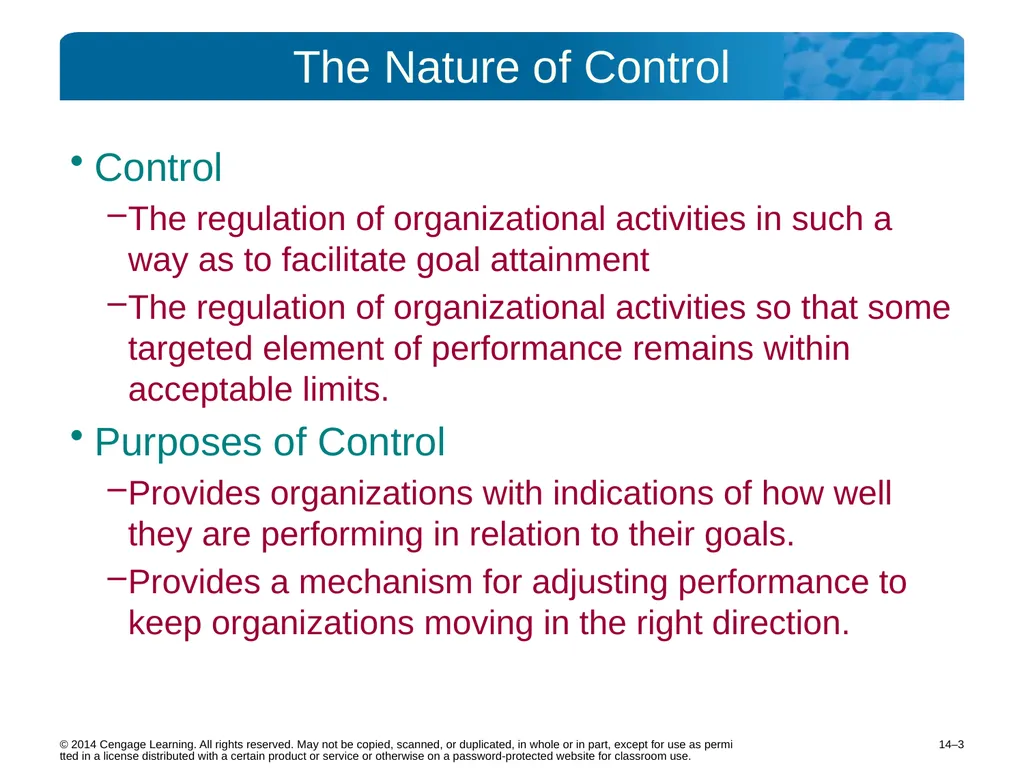
The Nature of Control Control
The regulation of organizational activities in such a way as to facilitate goal attainment
The regulation of organizational activities so that some targeted element of performance remains within acceptable limits.
Purposes of Control
Provides organizations with indications of how well they are performing in relation to their goals.
Provides a mechanism for adjusting performance to keep organizations moving in the right direction. © 2014 Cengage Learning. All rights reserved. May not be copied, scanned, or duplicated, in whole or in part, except for use as permitted in a license distributed with a certain product or service or otherwise on a password-protected website for classroom use. 14–3<br>
The regulation of organizational activities in such a way as to facilitate goal attainment
The regulation of organizational activities so that some targeted element of performance remains within acceptable limits.
Purposes of Control
Provides organizations with indications of how well they are performing in relation to their goals.
Provides a mechanism for adjusting performance to keep organizations moving in the right direction. © 2014 Cengage Learning. All rights reserved. May not be copied, scanned, or duplicated, in whole or in part, except for use as permitted in a license distributed with a certain product or service or otherwise on a password-protected website for classroom use. 14–3<br>
03
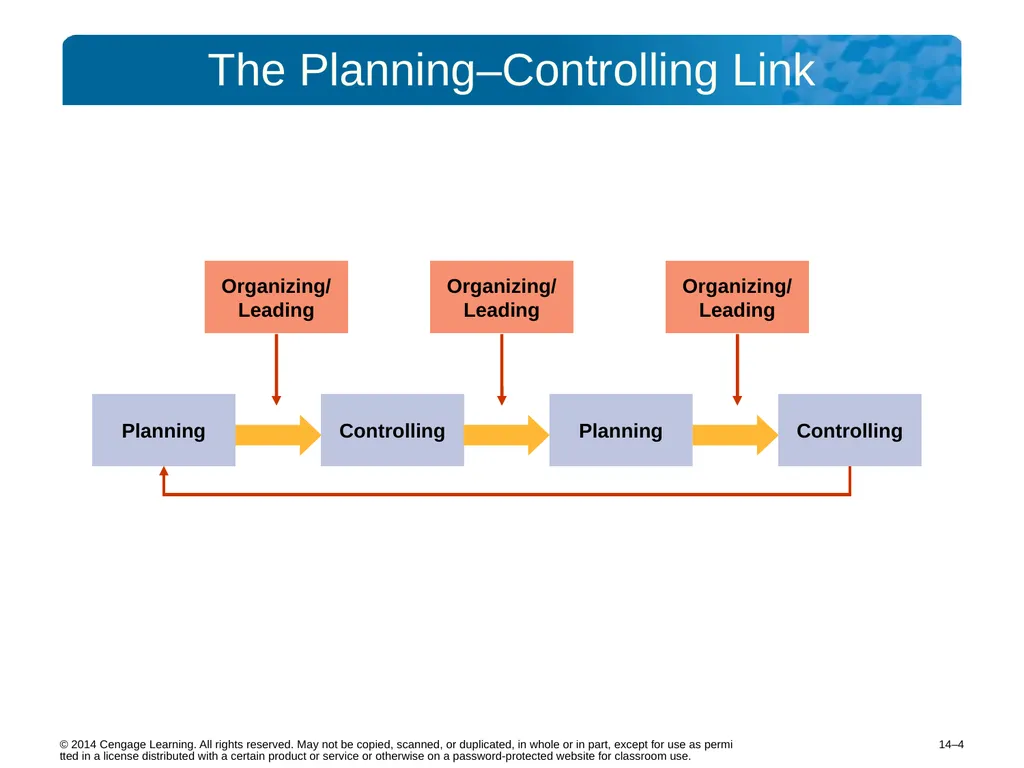
The Planning–Controlling Link © 2014 Cengage Learning. All rights reserved. May not be copied, scanned, or duplicated, in whole or in part, except for use as permitted in a license distributed with a certain product or service or otherwise on a password-protected website for classroom use. 14–4<br>
04
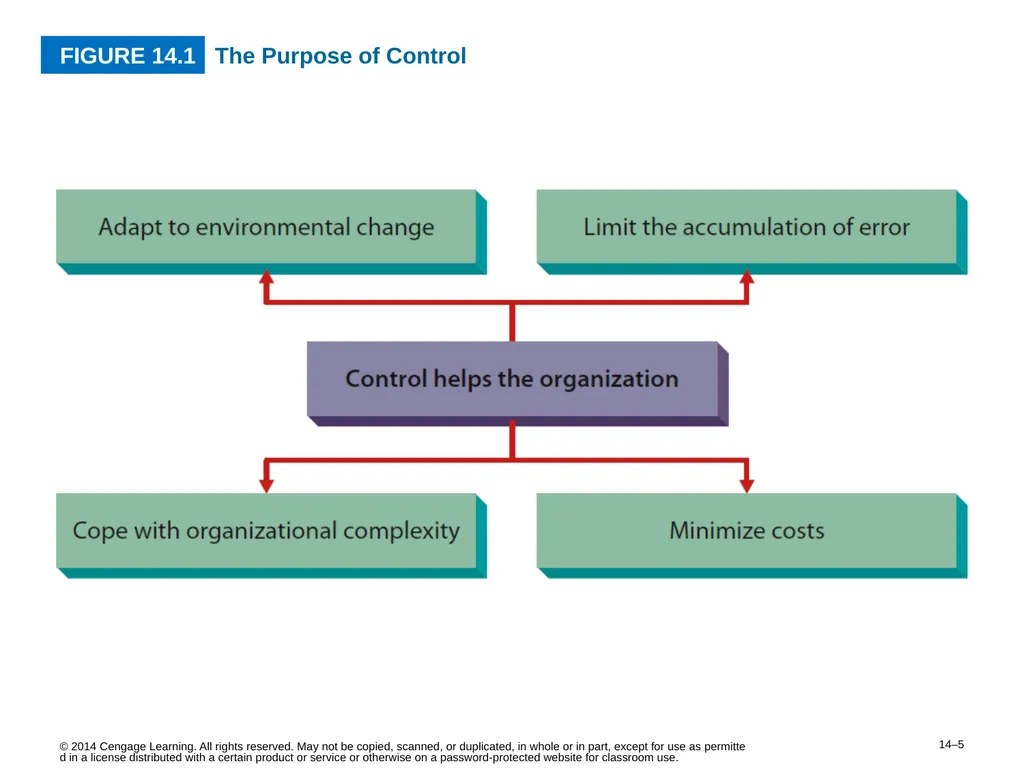
14–5 © 2014 Cengage Learning. All rights reserved. May not be copied, scanned, or duplicated, in whole or in part, except for use as permitted in a license distributed with a certain product or service or otherwise on a password-protected website for classroom use. FIGURE 14.1 The Purpose of Control<br>
05
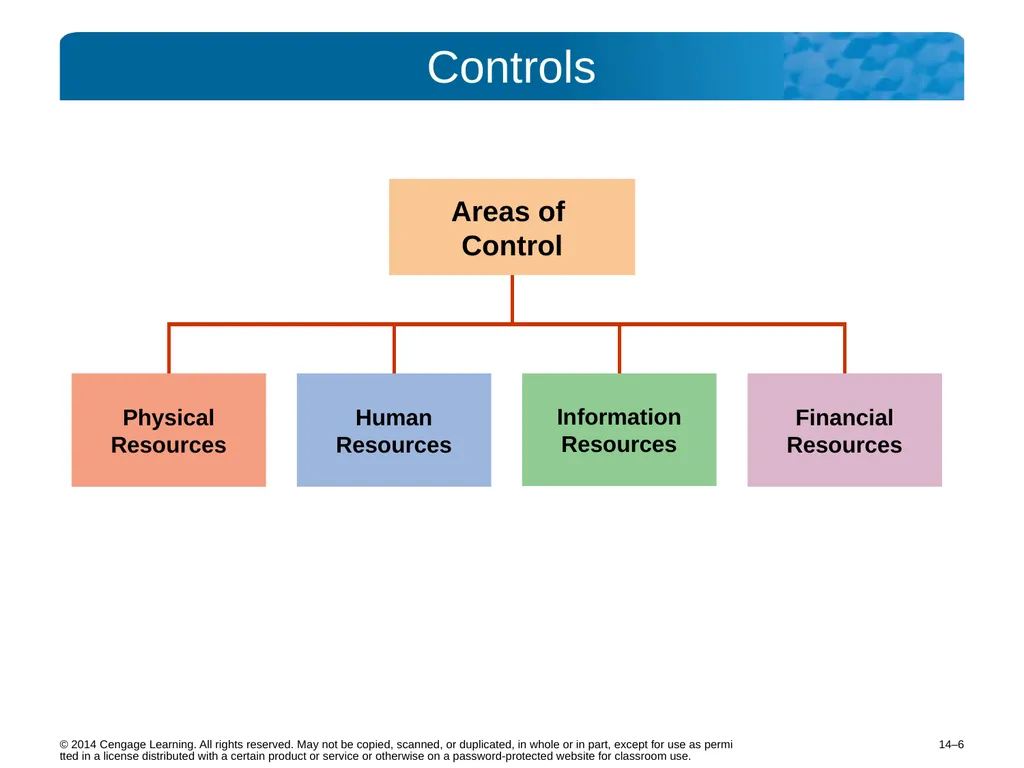
Controls © 2014 Cengage Learning. All rights reserved. May not be copied, scanned, or duplicated, in whole or in part, except for use as permitted in a license distributed with a certain product or service or otherwise on a password-protected website for classroom use. 14–6<br>
06
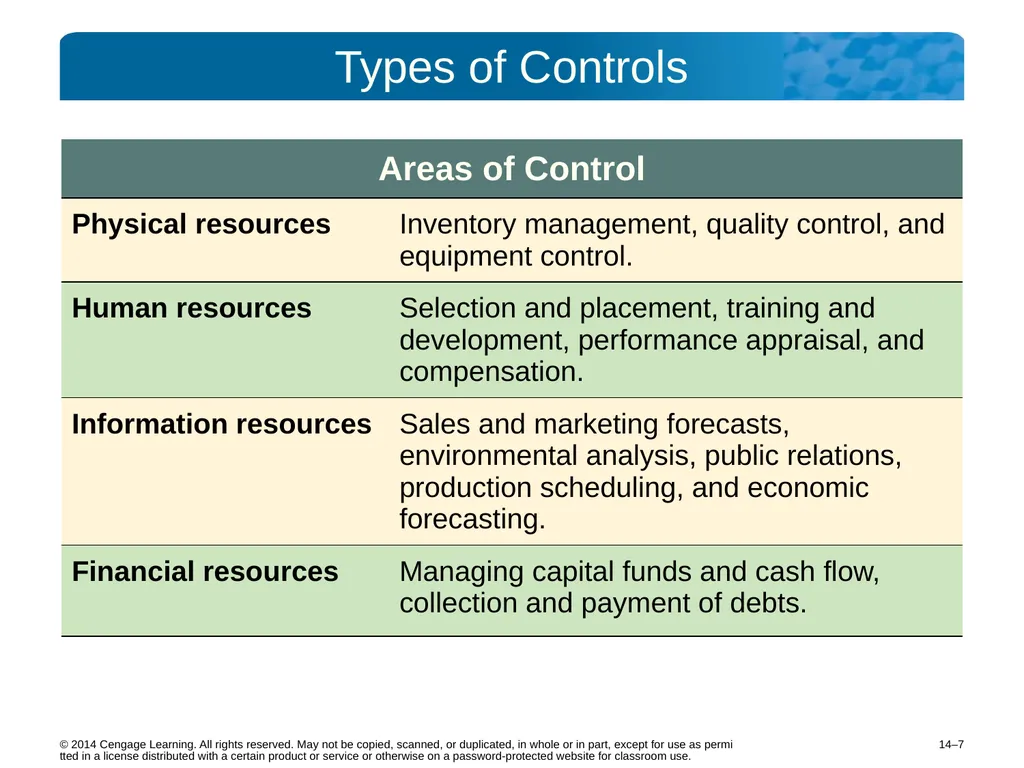
Types of Controls © 2014 Cengage Learning. All rights reserved. May not be copied, scanned, or duplicated, in whole or in part, except for use as permitted in a license distributed with a certain product or service or otherwise on a password-protected website for classroom use. 14–7<br>
07
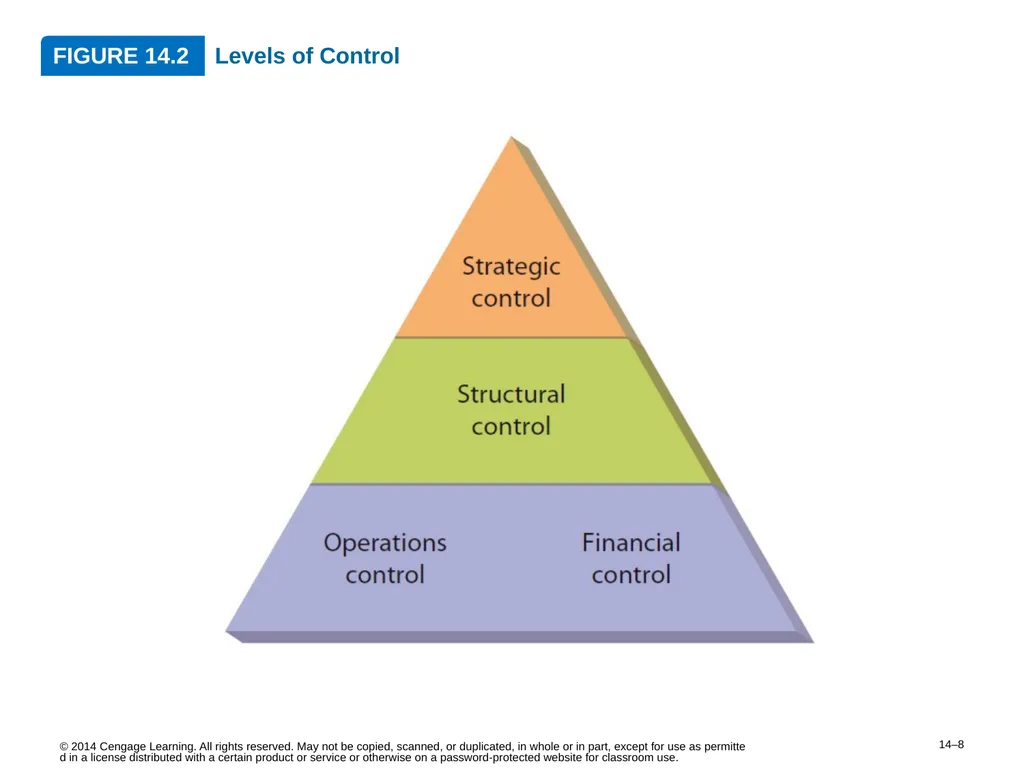
14–8 © 2014 Cengage Learning. All rights reserved. May not be copied, scanned, or duplicated, in whole or in part, except for use as permitted in a license distributed with a certain product or service or otherwise on a password-protected website for classroom use. FIGURE 14.2 Levels of Control<br>
08
Responsibilities for Control Managers are accountable for and involved in activities for which control is their responsibility.
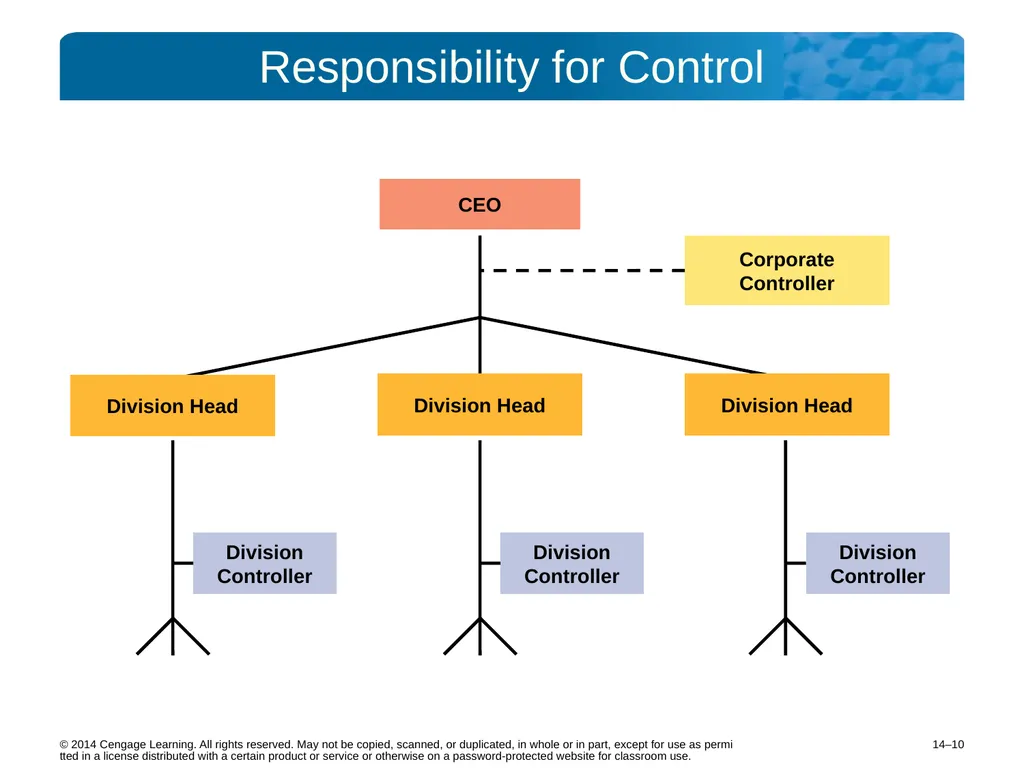
Controller
A position in organizations that helps line managers with their control activities. © 2014 Cengage Learning. All rights reserved. May not be copied, scanned, or duplicated, in whole or in part, except for use as permitted in a license distributed with a certain product or service or otherwise on a password-protected website for classroom use. 14–9<br>
Controller
A position in organizations that helps line managers with their control activities. © 2014 Cengage Learning. All rights reserved. May not be copied, scanned, or duplicated, in whole or in part, except for use as permitted in a license distributed with a certain product or service or otherwise on a password-protected website for classroom use. 14–9<br>
09
Responsibility for Control © 2014 Cengage Learning. All rights reserved. May not be copied, scanned, or duplicated, in whole or in part, except for use as permitted in a license distributed with a certain product or service or otherwise on a password-protected website for classroom use. 14–10<br>
10
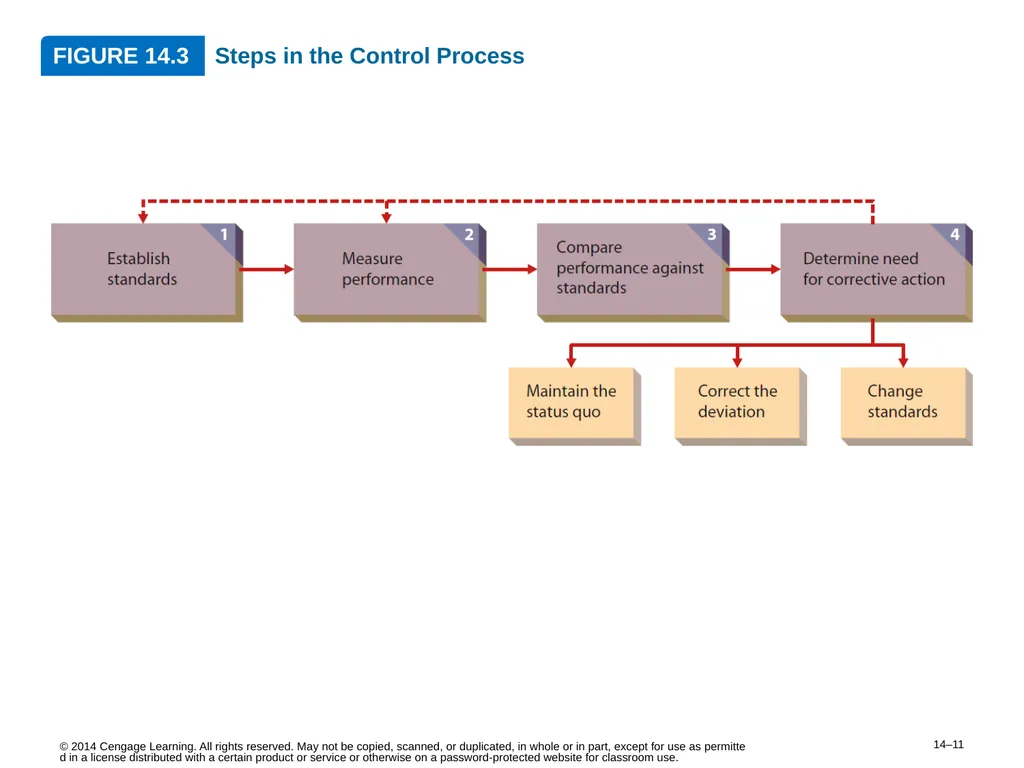
14–11 © 2014 Cengage Learning. All rights reserved. May not be copied, scanned, or duplicated, in whole or in part, except for use as permitted in a license distributed with a certain product or service or otherwise on a password-protected website for classroom use. FIGURE 14.3 Steps in the Control Process<br>
11
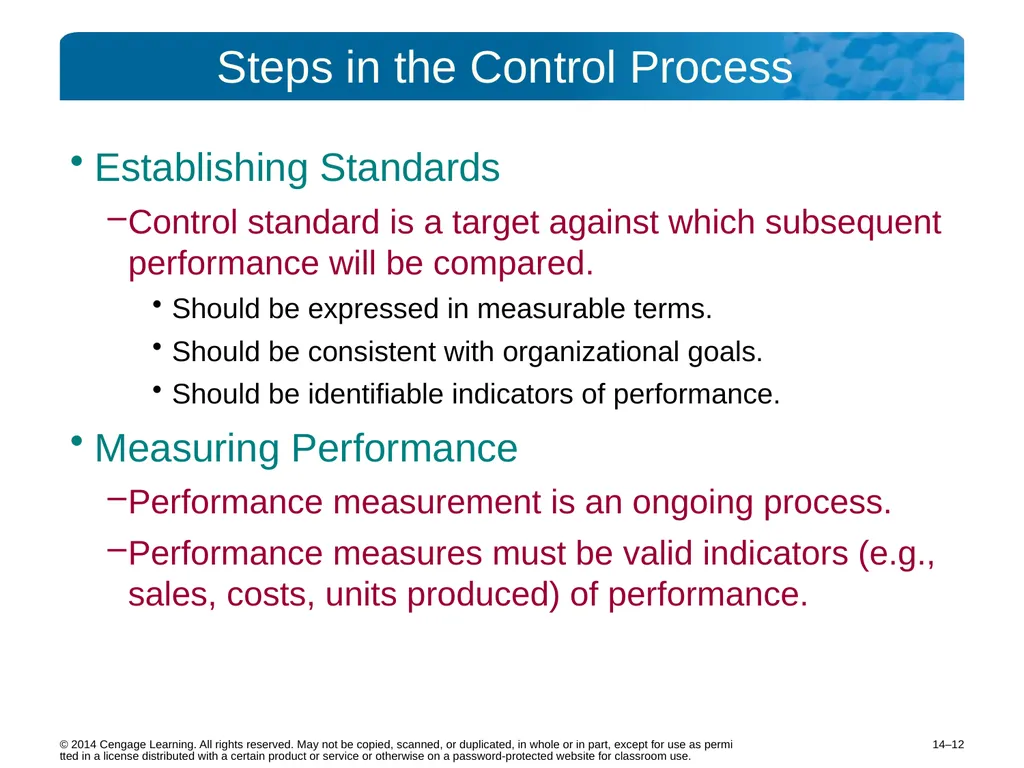
Steps in the Control Process Establishing Standards
Control standard is a target against which subsequent performance will be compared.
Should be expressed in measurable terms.
Should be consistent with organizational goals.
Should be identifiable indicators of performance.
Measuring Performance
Performance measurement is an ongoing process.
Performance measures must be valid indicators (e.g., sales, costs, units produced) of performance. © 2014 Cengage Learning. All rights reserved. May not be copied, scanned, or duplicated, in whole or in part, except for use as permitted in a license distributed with a certain product or service or otherwise on a password-protected website for classroom use. 14–12<br>
Control standard is a target against which subsequent performance will be compared.
Should be expressed in measurable terms.
Should be consistent with organizational goals.
Should be identifiable indicators of performance.
Measuring Performance
Performance measurement is an ongoing process.
Performance measures must be valid indicators (e.g., sales, costs, units produced) of performance. © 2014 Cengage Learning. All rights reserved. May not be copied, scanned, or duplicated, in whole or in part, except for use as permitted in a license distributed with a certain product or service or otherwise on a password-protected website for classroom use. 14–12<br>
12
Steps in the Control Process (cont’d) Comparing Performance Against Standards
Define what is a permissible deviation from the performance standard.
Utilize the appropriate timetable for measurement.
Considering Corrective Action
Maintain the status quo (do nothing).
Correct the deviation to bring operations into compliance with the standard.
Change the standard if it was set too high or too low. © 2014 Cengage Learning. All rights reserved. May not be copied, scanned, or duplicated, in whole or in part, except for use as permitted in a license distributed with a certain product or service or otherwise on a password-protected website for classroom use. 14–13<br>
Define what is a permissible deviation from the performance standard.
Utilize the appropriate timetable for measurement.
Considering Corrective Action
Maintain the status quo (do nothing).
Correct the deviation to bring operations into compliance with the standard.
Change the standard if it was set too high or too low. © 2014 Cengage Learning. All rights reserved. May not be copied, scanned, or duplicated, in whole or in part, except for use as permitted in a license distributed with a certain product or service or otherwise on a password-protected website for classroom use. 14–13<br>
13
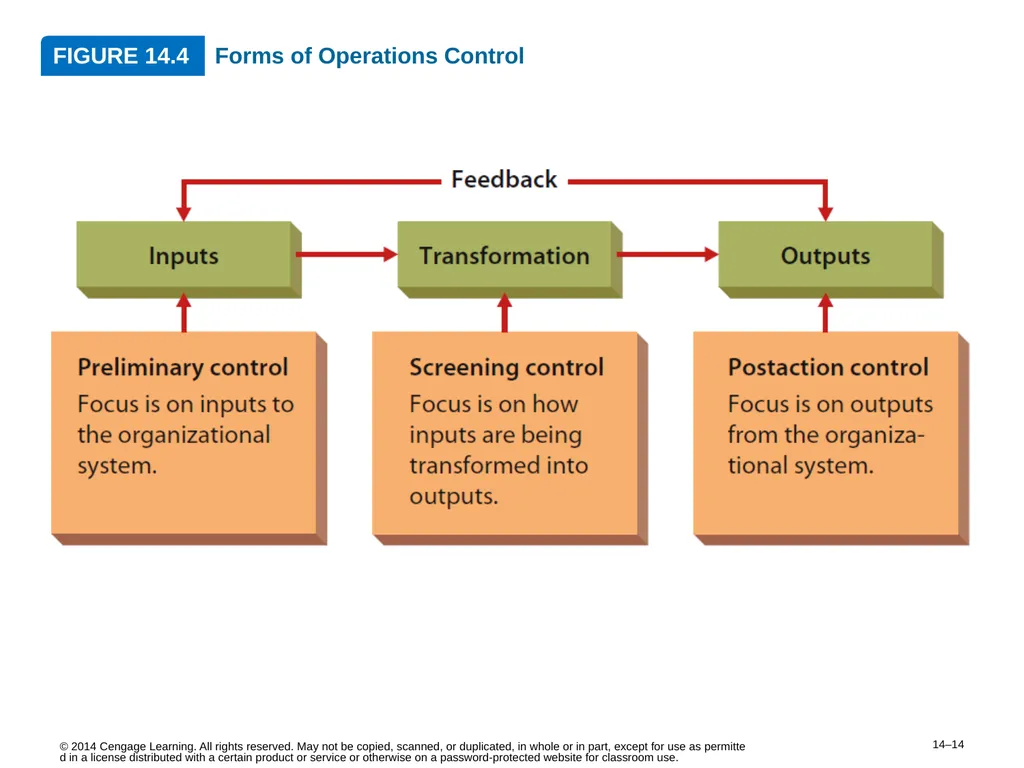
14–14 © 2014 Cengage Learning. All rights reserved. May not be copied, scanned, or duplicated, in whole or in part, except for use as permitted in a license distributed with a certain product or service or otherwise on a password-protected website for classroom use. FIGURE 14.4 Forms of Operations Control<br>
14
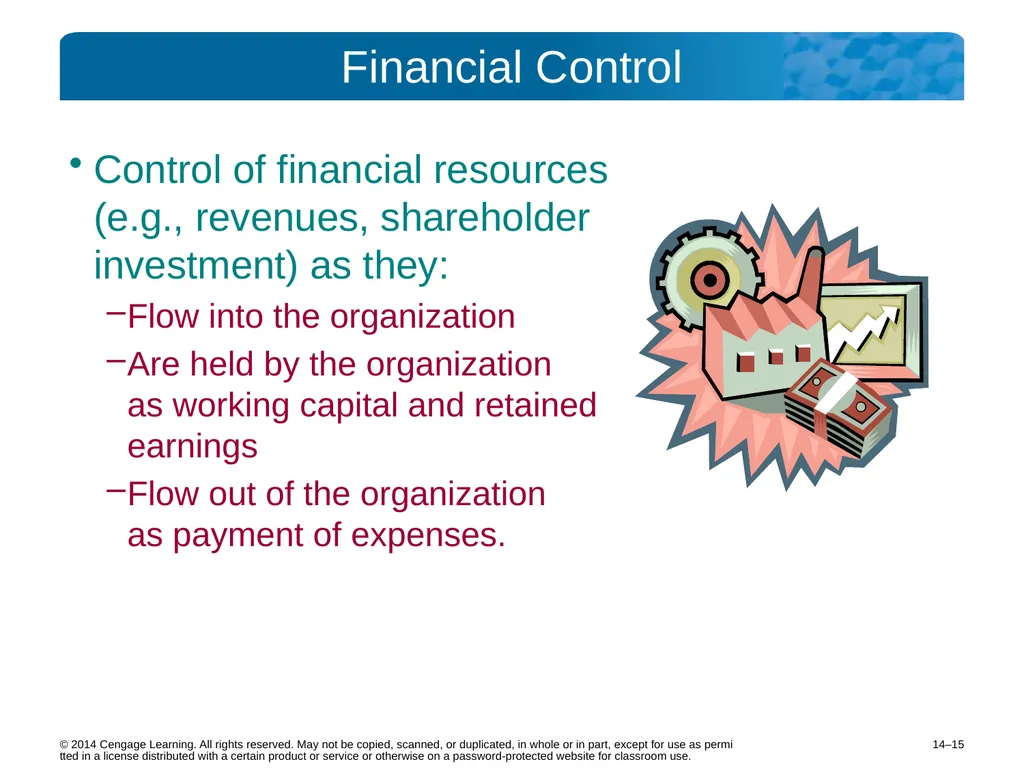
Financial Control Control of financial resources
(e.g., revenues, shareholder investment) as they:
Flow into the organization
Are held by the organization as working capital and retained earnings
Flow out of the organization as payment of expenses. © 2014 Cengage Learning. All rights reserved. May not be copied, scanned, or duplicated, in whole or in part, except for use as permitted in a license distributed with a certain product or service or otherwise on a password-protected website for classroom use. 14–15<br>
Flow into the organization
Are held by the organization as working capital and retained earnings
Flow out of the organization as payment of expenses. © 2014 Cengage Learning. All rights reserved. May not be copied, scanned, or duplicated, in whole or in part, except for use as permitted in a license distributed with a certain product or service or otherwise on a password-protected website for classroom use. 14–15<br>
15
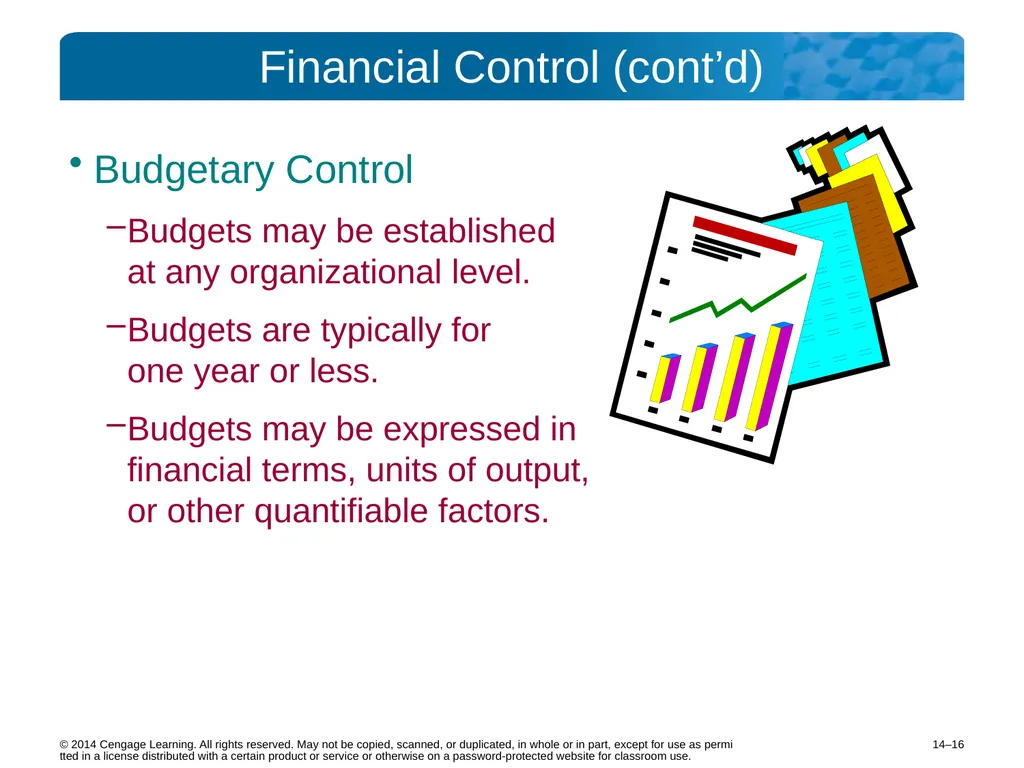
Financial Control (cont’d) Budgetary Control
Budgets may be established at any organizational level.
Budgets are typically for one year or less.
Budgets may be expressed in financial terms, units of output, or other quantifiable factors. © 2014 Cengage Learning. All rights reserved. May not be copied, scanned, or duplicated, in whole or in part, except for use as permitted in a license distributed with a certain product or service or otherwise on a password-protected website for classroom use. 14–16<br>
Budgets may be established at any organizational level.
Budgets are typically for one year or less.
Budgets may be expressed in financial terms, units of output, or other quantifiable factors. © 2014 Cengage Learning. All rights reserved. May not be copied, scanned, or duplicated, in whole or in part, except for use as permitted in a license distributed with a certain product or service or otherwise on a password-protected website for classroom use. 14–16<br>
16
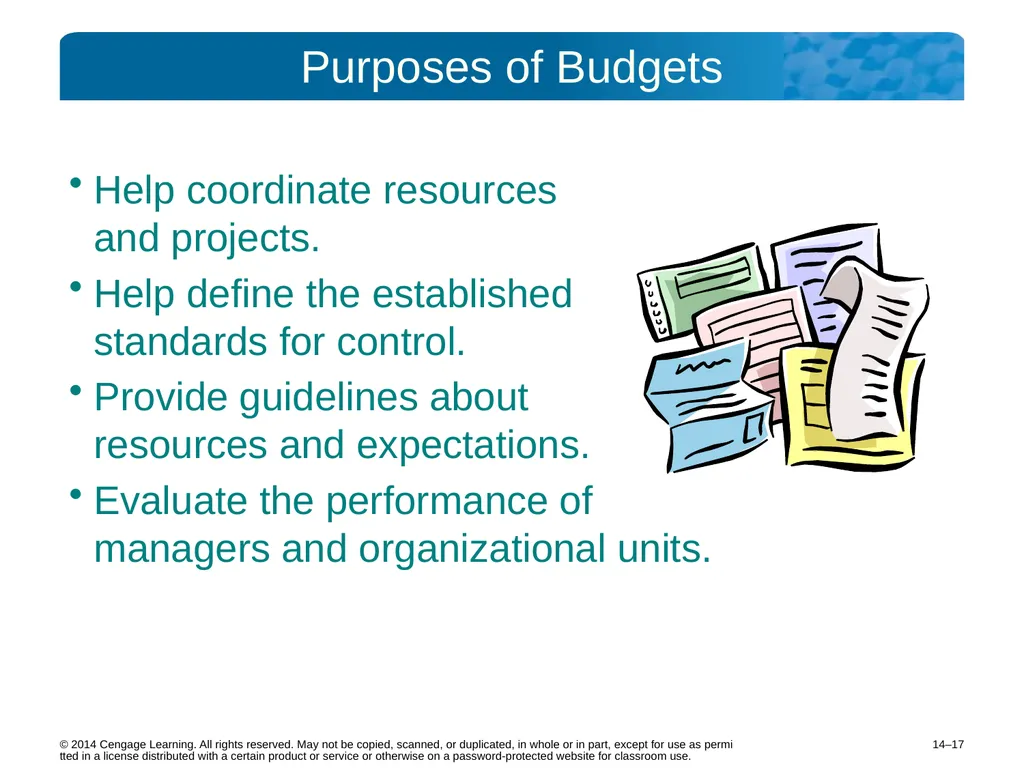
Purposes of Budgets Help coordinate resources
and projects.
Help define the established standards for control.
Provide guidelines about resources and expectations.
Evaluate the performance of managers and organizational units. © 2014 Cengage Learning. All rights reserved. May not be copied, scanned, or duplicated, in whole or in part, except for use as permitted in a license distributed with a certain product or service or otherwise on a password-protected website for classroom use. 14–17<br>
Help define the established standards for control.
Provide guidelines about resources and expectations.
Evaluate the performance of managers and organizational units. © 2014 Cengage Learning. All rights reserved. May not be copied, scanned, or duplicated, in whole or in part, except for use as permitted in a license distributed with a certain product or service or otherwise on a password-protected website for classroom use. 14–17<br>
17
Management Challenge Question How can budgetary controls help prevent conflicts in organizations? © 2014 Cengage Learning. All rights reserved. May not be copied, scanned, or duplicated, in whole or in part, except for use as permitted in a license distributed with a certain product or service or otherwise on a password-protected website for classroom use. 14–18<br>
18
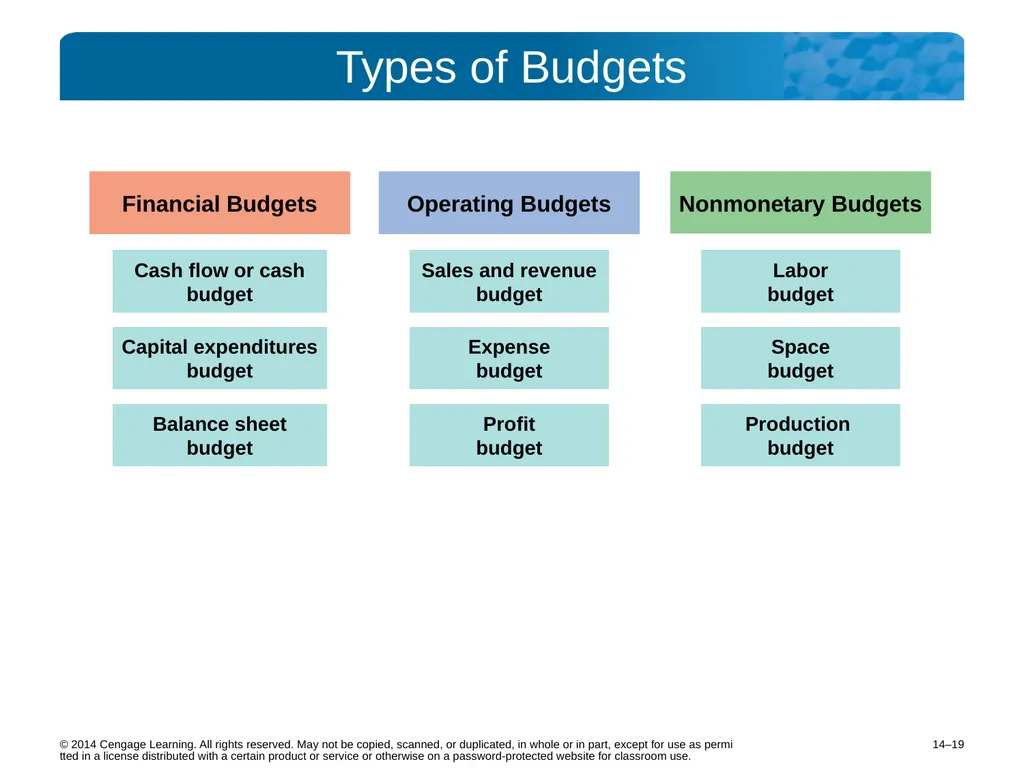
Types of Budgets Financial Budgets Operating Budgets Nonmonetary Budgets Cash flow or cash budget Capital expenditures
budget Balance sheet
budget Sales and revenue budget Expense
budget Profit
budget Labor
budget Space
budget Production
budget © 2014 Cengage Learning. All rights reserved. May not be copied, scanned, or duplicated, in whole or in part, except for use as permitted in a license distributed with a certain product or service or otherwise on a password-protected website for classroom use. 14–19<br>
19
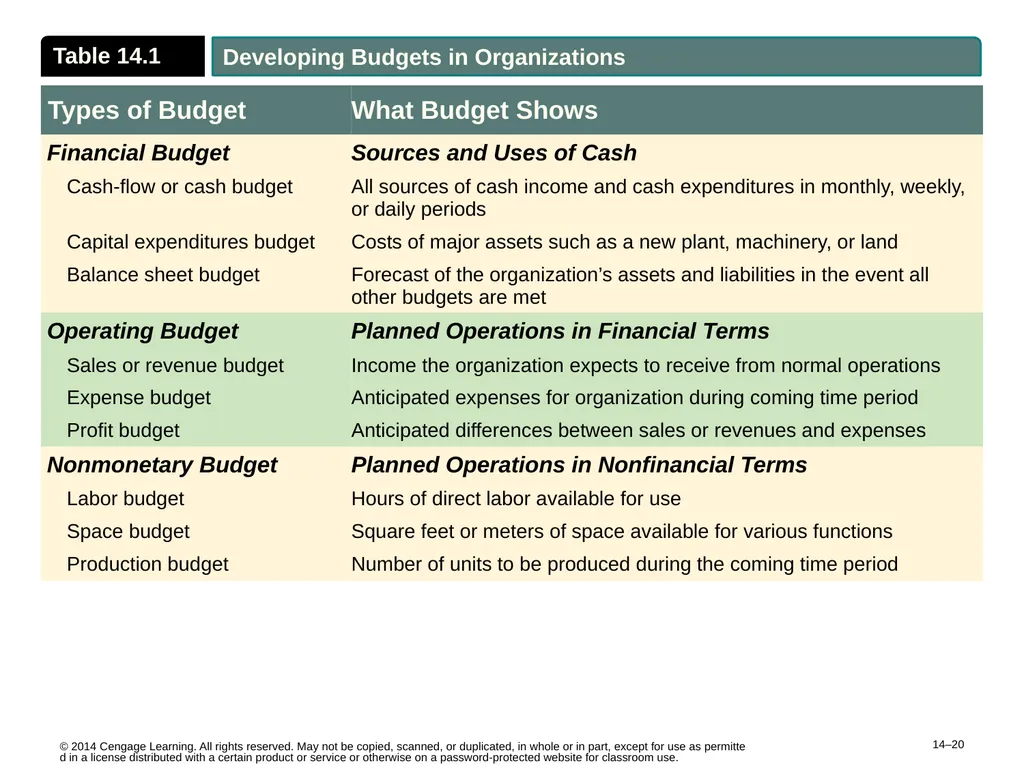
14–20 © 2014 Cengage Learning. All rights reserved. May not be copied, scanned, or duplicated, in whole or in part, except for use as permitted in a license distributed with a certain product or service or otherwise on a password-protected website for classroom use. Table 14.1 Developing Budgets in Organizations<br>
20
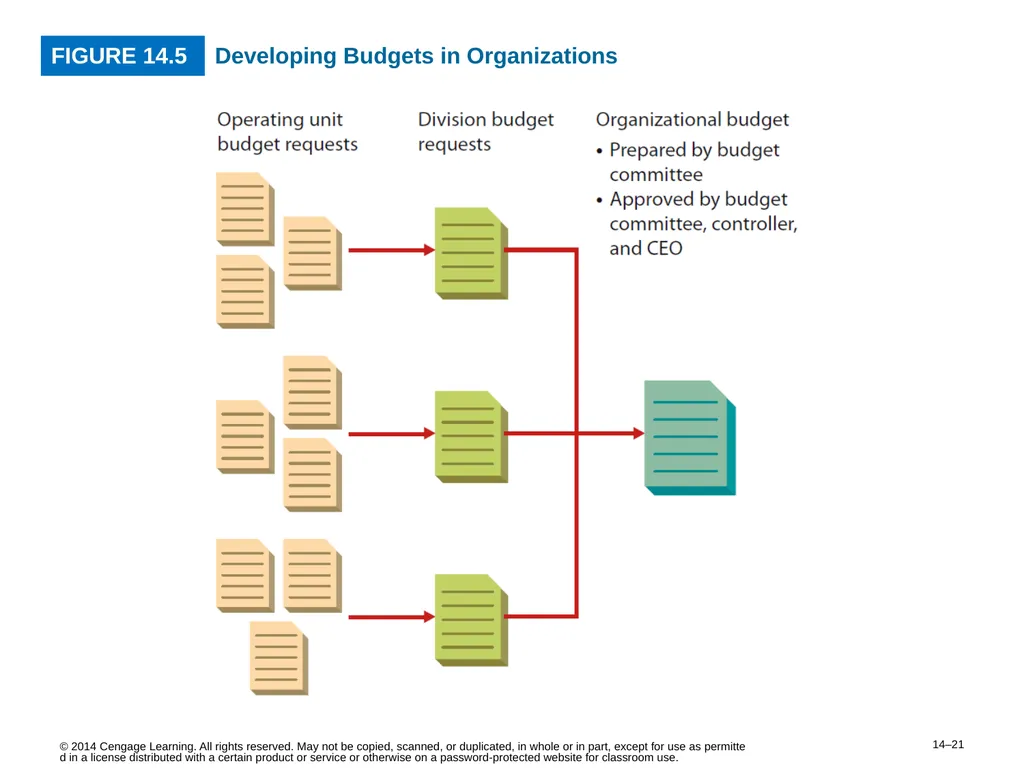
14–21 © 2014 Cengage Learning. All rights reserved. May not be copied, scanned, or duplicated, in whole or in part, except for use as permitted in a license distributed with a certain product or service or otherwise on a password-protected website for classroom use. FIGURE 14.5 Developing Budgets in Organizations<br>
21
Strengths and Weaknesses of Budgeting Strengths
Budgets facilitate effective operational controls.
Budgets facilitate coordination and communication between departments.
Budgets establish records of organizational performance, which can enhance planning. Weaknesses
Budgets can hamper operations if applied too rigidly.
Budgets can be time consuming to develop.
Budgets can limit innovation and change. © 2014 Cengage Learning. All rights reserved. May not be copied, scanned, or duplicated, in whole or in part, except for use as permitted in a license distributed with a certain product or service or otherwise on a password-protected website for classroom use. 14–22<br>
Budgets facilitate effective operational controls.
Budgets facilitate coordination and communication between departments.
Budgets establish records of organizational performance, which can enhance planning. Weaknesses
Budgets can hamper operations if applied too rigidly.
Budgets can be time consuming to develop.
Budgets can limit innovation and change. © 2014 Cengage Learning. All rights reserved. May not be copied, scanned, or duplicated, in whole or in part, except for use as permitted in a license distributed with a certain product or service or otherwise on a password-protected website for classroom use. 14–22<br>
22
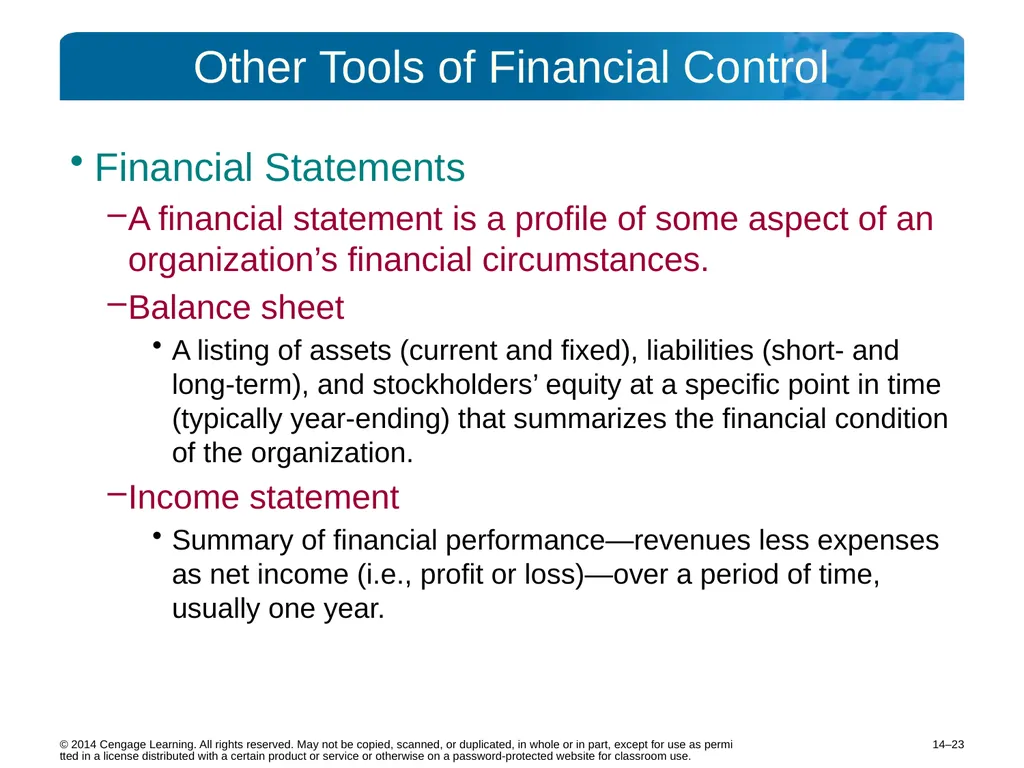
Other Tools of Financial Control Financial Statements
A financial statement is a profile of some aspect of an organization’s financial circumstances.
Balance sheet
A listing of assets (current and fixed), liabilities (short- and long-term), and stockholders’ equity at a specific point in time (typically year-ending) that summarizes the financial condition of the organization.
Income statement
Summary of financial performance—revenues less expenses as net income (i.e., profit or loss)—over a period of time, usually one year. © 2014 Cengage Learning. All rights reserved. May not be copied, scanned, or duplicated, in whole or in part, except for use as permitted in a license distributed with a certain product or service or otherwise on a password-protected website for classroom use. 14–23<br>
A financial statement is a profile of some aspect of an organization’s financial circumstances.
Balance sheet
A listing of assets (current and fixed), liabilities (short- and long-term), and stockholders’ equity at a specific point in time (typically year-ending) that summarizes the financial condition of the organization.
Income statement
Summary of financial performance—revenues less expenses as net income (i.e., profit or loss)—over a period of time, usually one year. © 2014 Cengage Learning. All rights reserved. May not be copied, scanned, or duplicated, in whole or in part, except for use as permitted in a license distributed with a certain product or service or otherwise on a password-protected website for classroom use. 14–23<br>
23
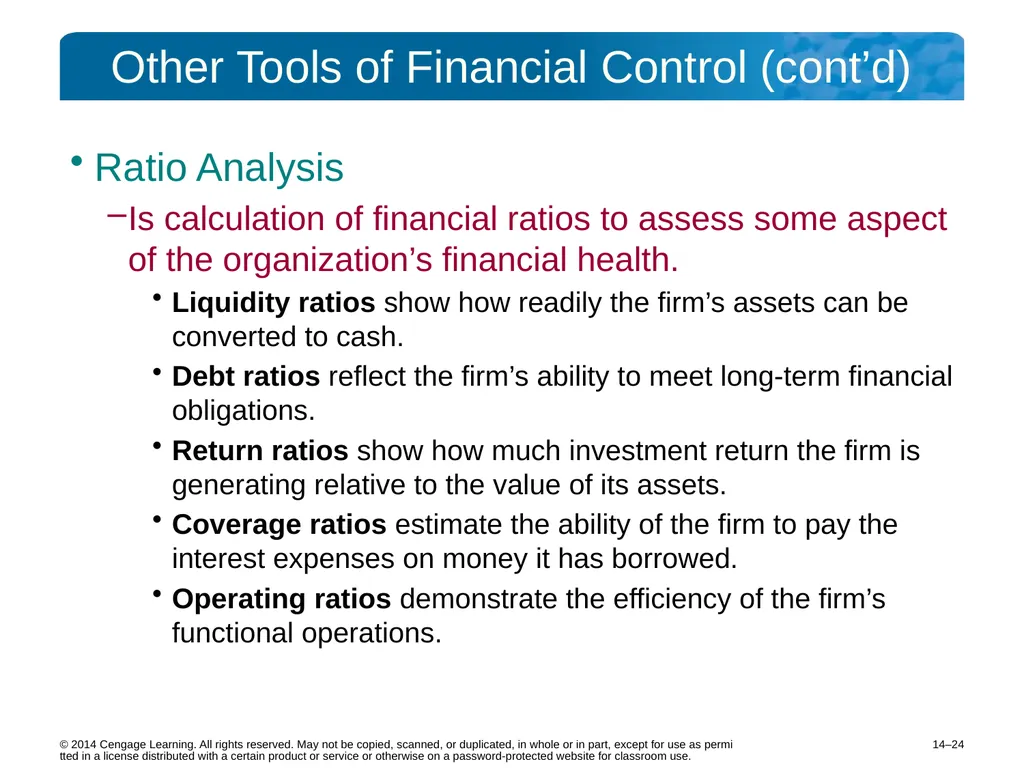
Other Tools of Financial Control (cont’d) Ratio Analysis
Is calculation of financial ratios to assess some aspect of the organization’s financial health.
Liquidity ratios show how readily the firm’s assets can be converted to cash.
Debt ratios reflect the firm’s ability to meet long-term financial obligations.
Return ratios show how much investment return the firm is generating relative to the value of its assets.
Coverage ratios estimate the ability of the firm to pay the interest expenses on money it has borrowed.
Operating ratios demonstrate the efficiency of the firm’s functional operations. © 2014 Cengage Learning. All rights reserved. May not be copied, scanned, or duplicated, in whole or in part, except for use as permitted in a license distributed with a certain product or service or otherwise on a password-protected website for classroom use. 14–24<br>
Is calculation of financial ratios to assess some aspect of the organization’s financial health.
Liquidity ratios show how readily the firm’s assets can be converted to cash.
Debt ratios reflect the firm’s ability to meet long-term financial obligations.
Return ratios show how much investment return the firm is generating relative to the value of its assets.
Coverage ratios estimate the ability of the firm to pay the interest expenses on money it has borrowed.
Operating ratios demonstrate the efficiency of the firm’s functional operations. © 2014 Cengage Learning. All rights reserved. May not be copied, scanned, or duplicated, in whole or in part, except for use as permitted in a license distributed with a certain product or service or otherwise on a password-protected website for classroom use. 14–24<br>
24
Other Tools of Financial Control (cont’d) Financial Audit
Is an independent appraisal of an organization’s accounting, financial, and operational systems.
External audits—financial appraisals conducted by experts who are not employees of the organization.
Internal audits—appraisals conducted by employees of the organization. © 2014 Cengage Learning. All rights reserved. May not be copied, scanned, or duplicated, in whole or in part, except for use as permitted in a license distributed with a certain product or service or otherwise on a password-protected website for classroom use. 14–25<br>
Is an independent appraisal of an organization’s accounting, financial, and operational systems.
External audits—financial appraisals conducted by experts who are not employees of the organization.
Internal audits—appraisals conducted by employees of the organization. © 2014 Cengage Learning. All rights reserved. May not be copied, scanned, or duplicated, in whole or in part, except for use as permitted in a license distributed with a certain product or service or otherwise on a password-protected website for classroom use. 14–25<br>
25
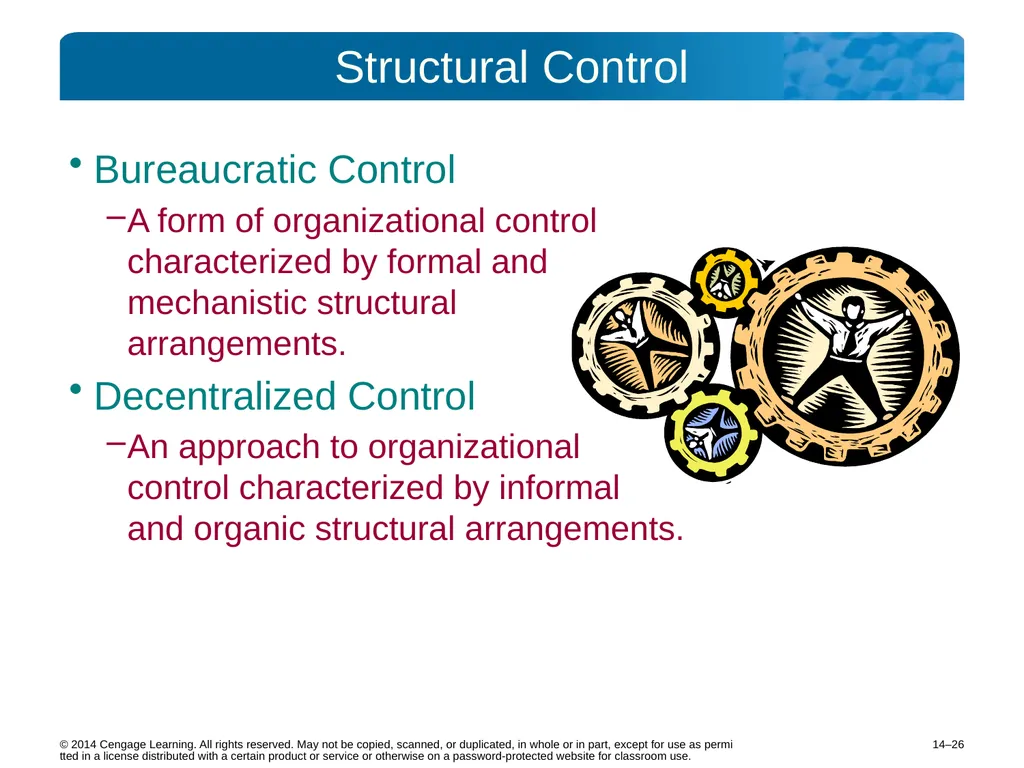
Structural Control Bureaucratic Control
A form of organizational control characterized by formal and mechanistic structural arrangements.
Decentralized Control
An approach to organizational control characterized by informal and organic structural arrangements. © 2014 Cengage Learning. All rights reserved. May not be copied, scanned, or duplicated, in whole or in part, except for use as permitted in a license distributed with a certain product or service or otherwise on a password-protected website for classroom use. 14–26<br>
A form of organizational control characterized by formal and mechanistic structural arrangements.
Decentralized Control
An approach to organizational control characterized by informal and organic structural arrangements. © 2014 Cengage Learning. All rights reserved. May not be copied, scanned, or duplicated, in whole or in part, except for use as permitted in a license distributed with a certain product or service or otherwise on a password-protected website for classroom use. 14–26<br>
26
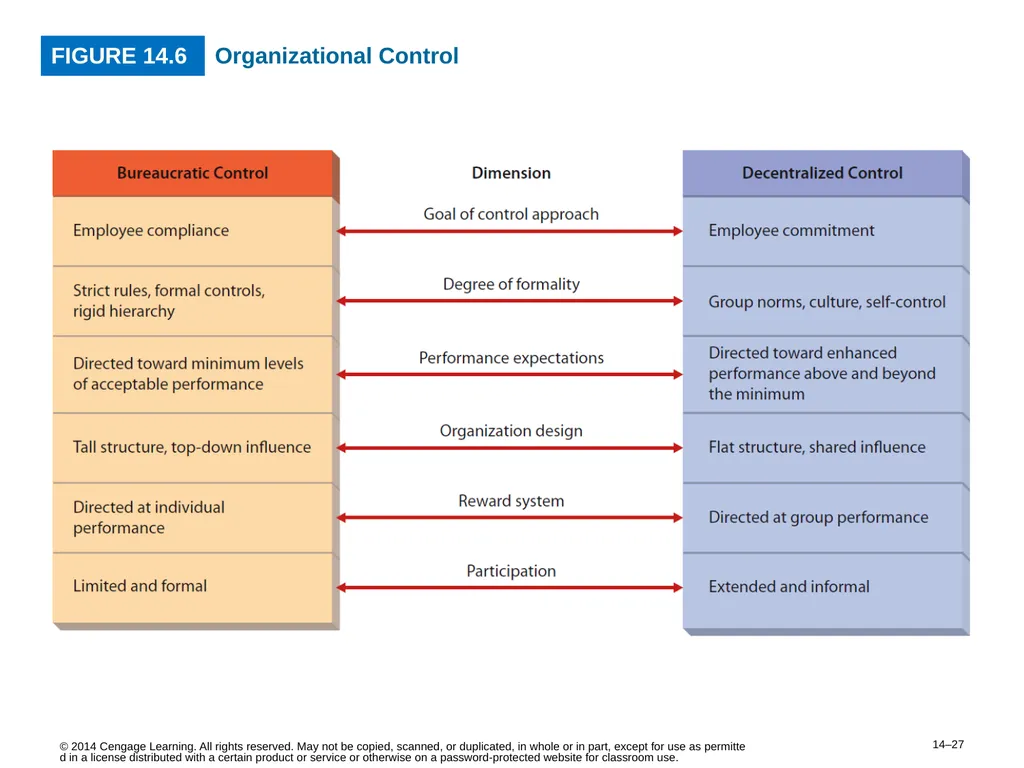
14–27 © 2014 Cengage Learning. All rights reserved. May not be copied, scanned, or duplicated, in whole or in part, except for use as permitted in a license distributed with a certain product or service or otherwise on a password-protected website for classroom use. FIGURE 14.6 Organizational Control<br>
27
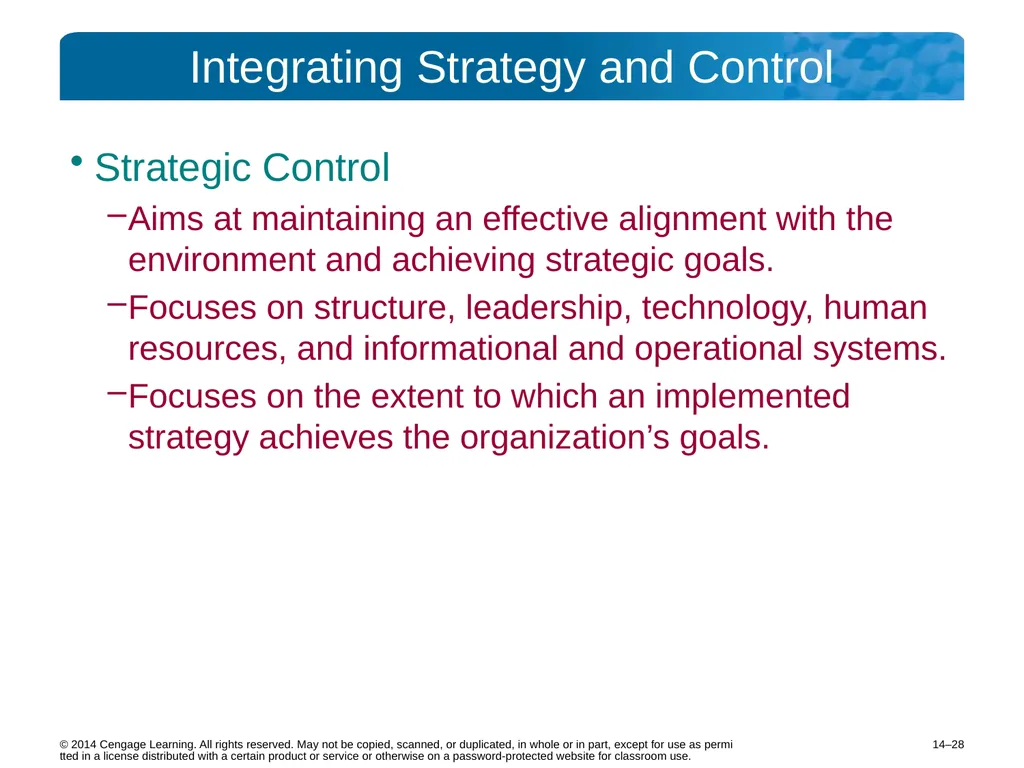
Integrating Strategy and Control Strategic Control
Aims at maintaining an effective alignment with the environment and achieving strategic goals.
Focuses on structure, leadership, technology, human resources, and informational and operational systems.
Focuses on the extent to which an implemented strategy achieves the organization’s goals. © 2014 Cengage Learning. All rights reserved. May not be copied, scanned, or duplicated, in whole or in part, except for use as permitted in a license distributed with a certain product or service or otherwise on a password-protected website for classroom use. 14–28<br>
Aims at maintaining an effective alignment with the environment and achieving strategic goals.
Focuses on structure, leadership, technology, human resources, and informational and operational systems.
Focuses on the extent to which an implemented strategy achieves the organization’s goals. © 2014 Cengage Learning. All rights reserved. May not be copied, scanned, or duplicated, in whole or in part, except for use as permitted in a license distributed with a certain product or service or otherwise on a password-protected website for classroom use. 14–28<br>
28
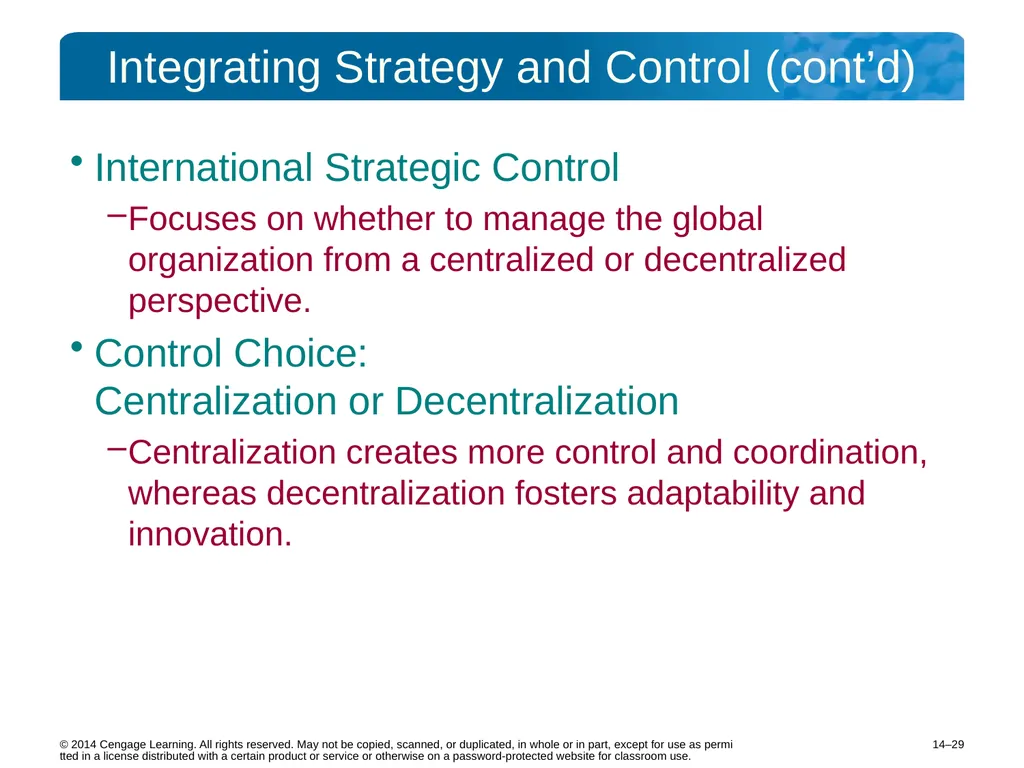
Integrating Strategy and Control (cont’d) International Strategic Control
Focuses on whether to manage the global organization from a centralized or decentralized perspective.
Control Choice: Centralization or Decentralization
Centralization creates more control and coordination, whereas decentralization fosters adaptability and innovation. © 2014 Cengage Learning. All rights reserved. May not be copied, scanned, or duplicated, in whole or in part, except for use as permitted in a license distributed with a certain product or service or otherwise on a password-protected website for classroom use. 14–29<br>
Focuses on whether to manage the global organization from a centralized or decentralized perspective.
Control Choice: Centralization or Decentralization
Centralization creates more control and coordination, whereas decentralization fosters adaptability and innovation. © 2014 Cengage Learning. All rights reserved. May not be copied, scanned, or duplicated, in whole or in part, except for use as permitted in a license distributed with a certain product or service or otherwise on a password-protected website for classroom use. 14–29<br>
29
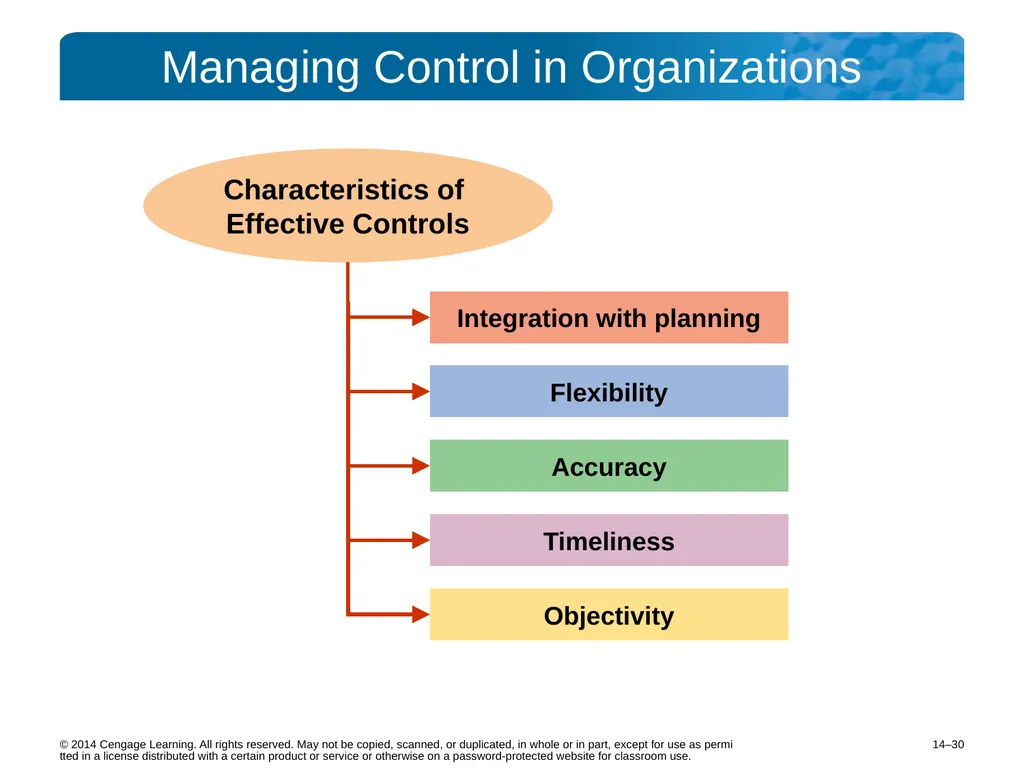
Managing Control in Organizations Integration with planning Flexibility Accuracy Timeliness Characteristics of
Effective Controls Objectivity © 2014 Cengage Learning. All rights reserved. May not be copied, scanned, or duplicated, in whole or in part, except for use as permitted in a license distributed with a certain product or service or otherwise on a password-protected website for classroom use. 14–30<br>
30
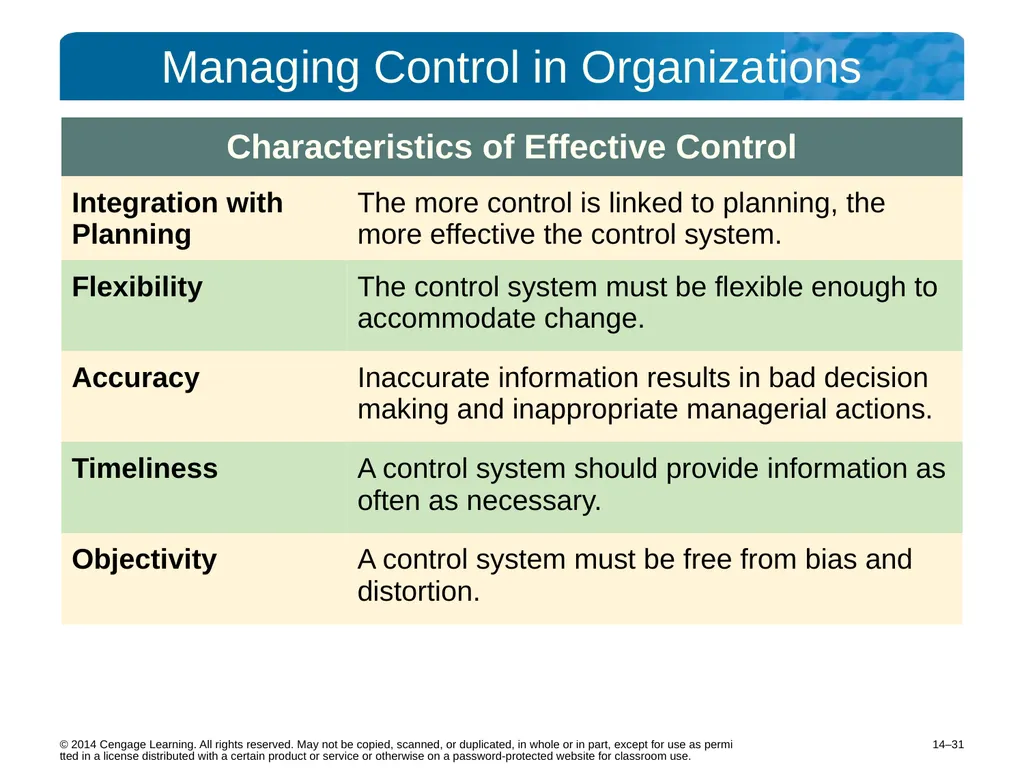
Managing Control in Organizations © 2014 Cengage Learning. All rights reserved. May not be copied, scanned, or duplicated, in whole or in part, except for use as permitted in a license distributed with a certain product or service or otherwise on a password-protected website for classroom use. 14–31<br>
31
Inappropriate
Focus Overcontrol C
o
n
t
r
o
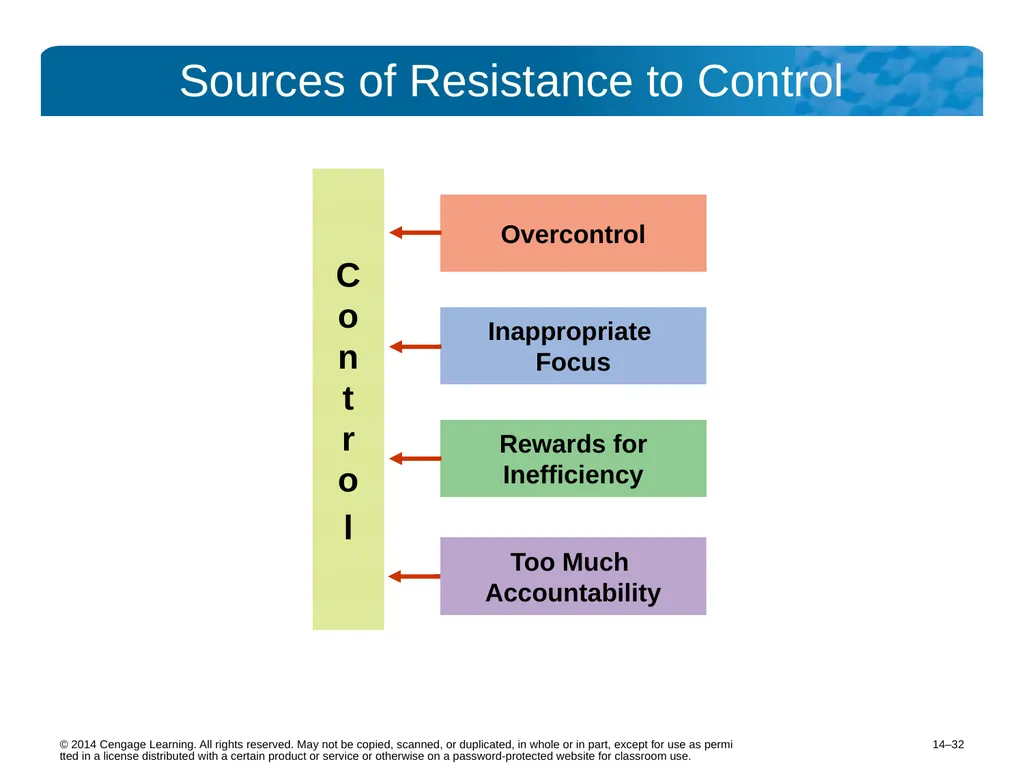
l Too Much Accountability Rewards for Inefficiency Sources of Resistance to Control © 2014 Cengage Learning. All rights reserved. May not be copied, scanned, or duplicated, in whole or in part, except for use as permitted in a license distributed with a certain product or service or otherwise on a password-protected website for classroom use. 14–32<br>
l Too Much Accountability Rewards for Inefficiency Sources of Resistance to Control © 2014 Cengage Learning. All rights reserved. May not be copied, scanned, or duplicated, in whole or in part, except for use as permitted in a license distributed with a certain product or service or otherwise on a password-protected website for classroom use. 14–32<br>
32
Resistance to Control Overcontrol
Trying to control too many details affects employee behavior when employees perceive control attempts as unreasonable.
Inappropriate Focus
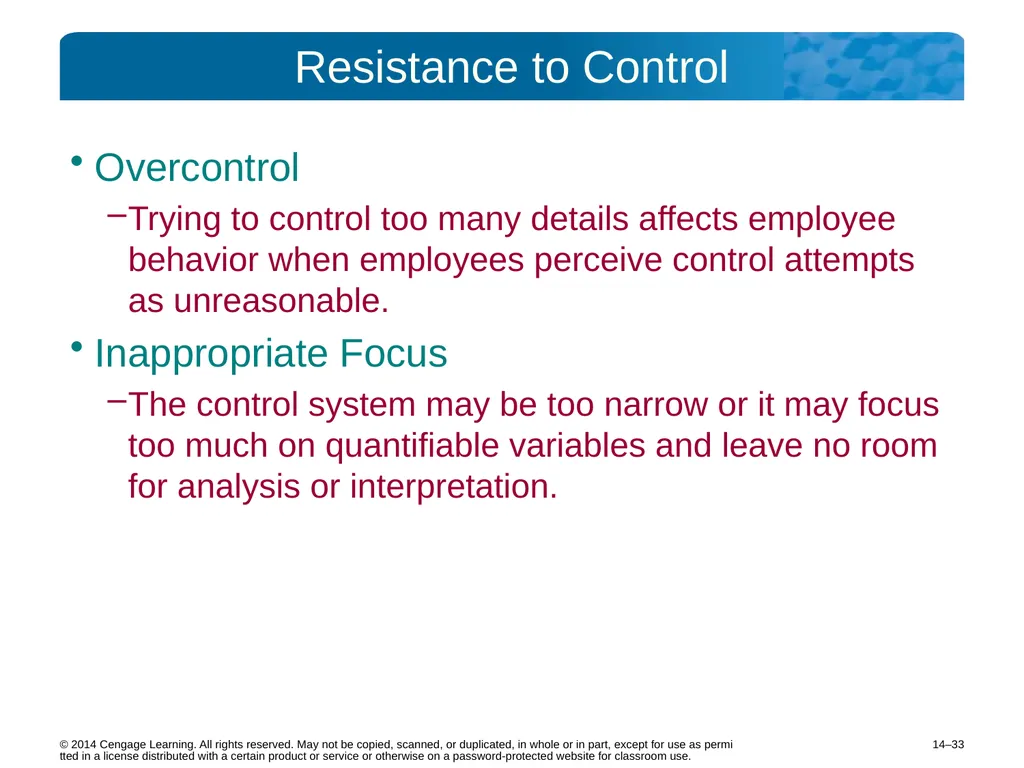
The control system may be too narrow or it may focus too much on quantifiable variables and leave no room for analysis or interpretation. © 2014 Cengage Learning. All rights reserved. May not be copied, scanned, or duplicated, in whole or in part, except for use as permitted in a license distributed with a certain product or service or otherwise on a password-protected website for classroom use. 14–33<br>
Trying to control too many details affects employee behavior when employees perceive control attempts as unreasonable.
Inappropriate Focus
The control system may be too narrow or it may focus too much on quantifiable variables and leave no room for analysis or interpretation. © 2014 Cengage Learning. All rights reserved. May not be copied, scanned, or duplicated, in whole or in part, except for use as permitted in a license distributed with a certain product or service or otherwise on a password-protected website for classroom use. 14–33<br>
33
Resistance to Control (cont’d) Rewards for Inefficiency
Rewarding operational inefficiency can lead employees to behave in ways that are not in the best interests of the organization.
Too Much Accountability
Efficient controls are resisted by poorly performing employees. © 2014 Cengage Learning. All rights reserved. May not be copied, scanned, or duplicated, in whole or in part, except for use as permitted in a license distributed with a certain product or service or otherwise on a password-protected website for classroom use. 14–34<br>
Rewarding operational inefficiency can lead employees to behave in ways that are not in the best interests of the organization.
Too Much Accountability
Efficient controls are resisted by poorly performing employees. © 2014 Cengage Learning. All rights reserved. May not be copied, scanned, or duplicated, in whole or in part, except for use as permitted in a license distributed with a certain product or service or otherwise on a password-protected website for classroom use. 14–34<br>
34
Overcoming Resistance to Control Design controls properly integrated with organizational planning and aligned with the organization’s goals and standards.
Create flexible, accurate, timely, and objective controls.
Avoid overcontrol in implementation of controls.
Guard against controls that reward inefficiencies.
Encourage employee participation in the planning and implementing of control systems.
Develop a system of checks and balances to verify the accuracy of performance indicators. © 2014 Cengage Learning. All rights reserved. May not be copied, scanned, or duplicated, in whole or in part, except for use as permitted in a license distributed with a certain product or service or otherwise on a password-protected website for classroom use. 14–35<br>
Create flexible, accurate, timely, and objective controls.
Avoid overcontrol in implementation of controls.
Guard against controls that reward inefficiencies.
Encourage employee participation in the planning and implementing of control systems.
Develop a system of checks and balances to verify the accuracy of performance indicators. © 2014 Cengage Learning. All rights reserved. May not be copied, scanned, or duplicated, in whole or in part, except for use as permitted in a license distributed with a certain product or service or otherwise on a password-protected website for classroom use. 14–35<br>