
Λ14 Διαδικτυακά Κοινωνικά Δίκτυα και Μέσα Positive


Description: Λ14 Διαδικτυακά Κοινωνικά Δίκτυα και Μέσα Positive and Negative Relationships Chapter 5, from D. Easley and J. Kleinberg book Structural Balance Initially, a complete graph (or clique): every edge either or - Let us first look at
Related Topics
Download Presentation
"Λ14 Διαδικτυακά Κοινωνικά Δίκτυα και Μέσα Positive" is the property of its rightful owner. Permission is granted to download and print the materials on this website for personal, non-commercial use only, and to display it on your personal computer provided you do not modify the materials and that you retain all copyright notices contained in the materials. By downloading content from our website, you accept the terms of this agreement.
Presentation Transcript
slide1. Λ14 Διαδικτυακά Κοινωνικά Δίκτυα και Μέσα Positive and Negative Relationships Chapter 5, from D. Easley and J. Kleinberg book<br>
slide2. Structural Balance Initially, a complete graph (or clique): every edge either + or - Let us first look at individual triangles
Lets look at 3 people => 4 Cases
See if all are equally possible (local property) What about negative edges?<br>
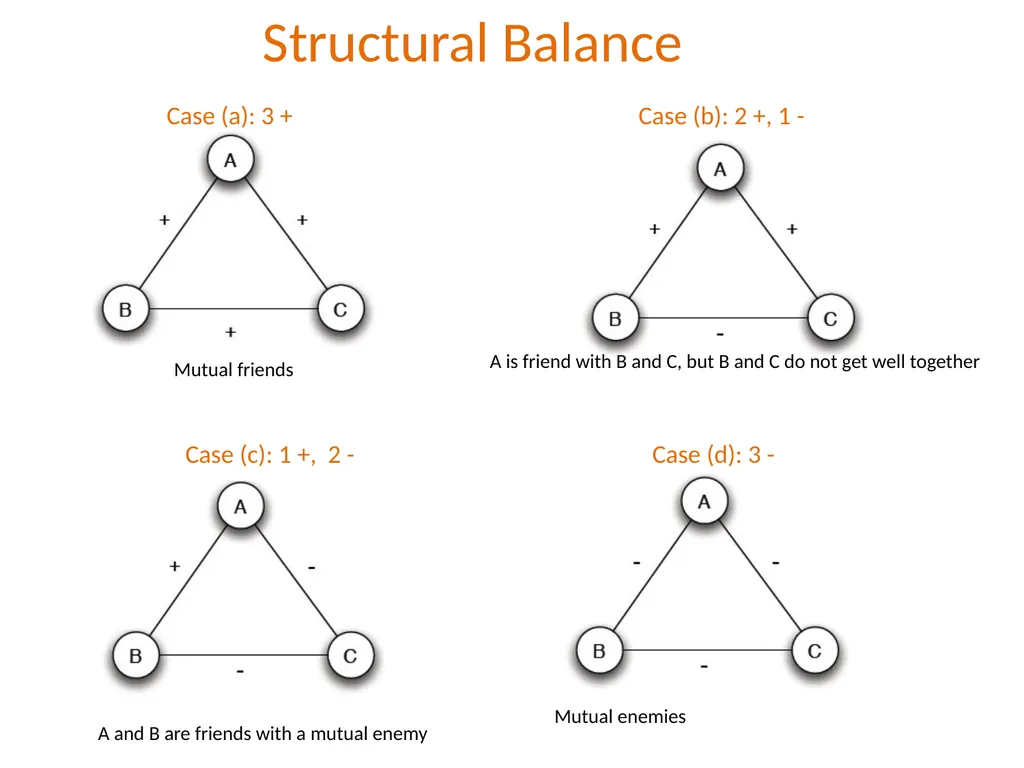
slide3. Structural Balance Case (a): 3 + Mutual friends Case (b): 2 +, 1 - A is friend with B and C, but B and C do not get well together Case (c): 1 +, 2 - Mutual enemies Case (d): 3 - A and B are friends with a mutual enemy<br>
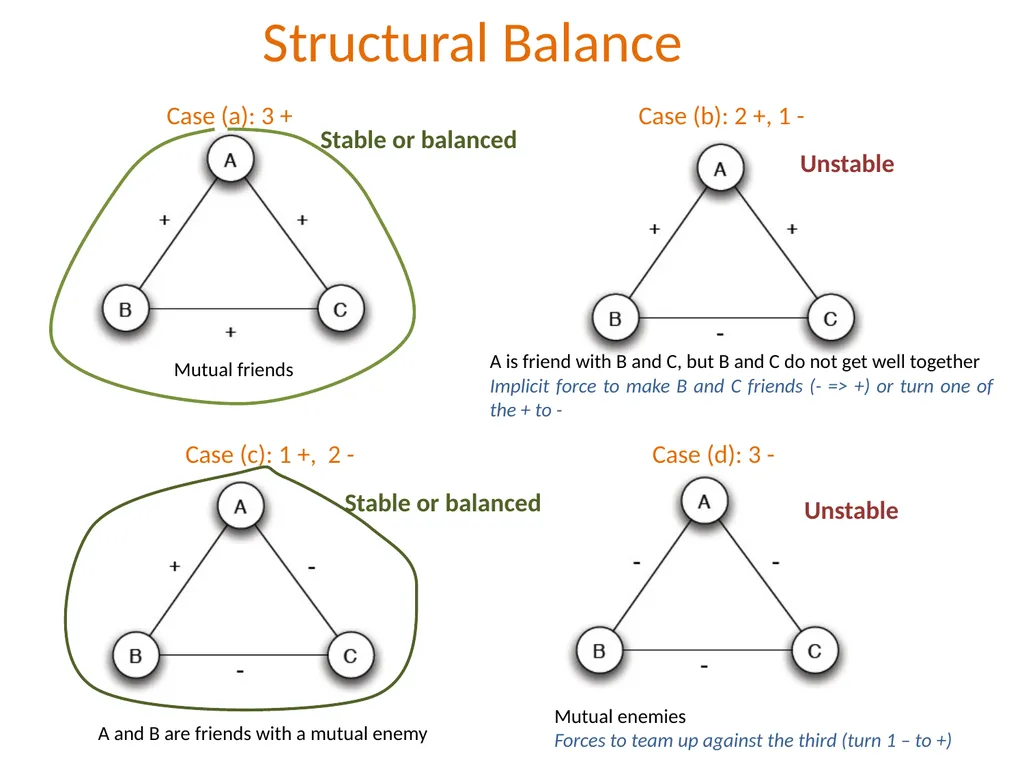
slide4. Structural Balance Case (a): 3 + Mutual friends Case (b): 2 +, 1 - A is friend with B and C, but B and C do not get well together
Implicit force to make B and C friends (- => +) or turn one of the + to - Case (c): 1 +, 2 - Mutual enemies
Forces to team up against the third (turn 1 – to +) Case (d): 3 - A and B are friends with a mutual enemy Stable or balanced Stable or balanced Unstable Unstable<br>
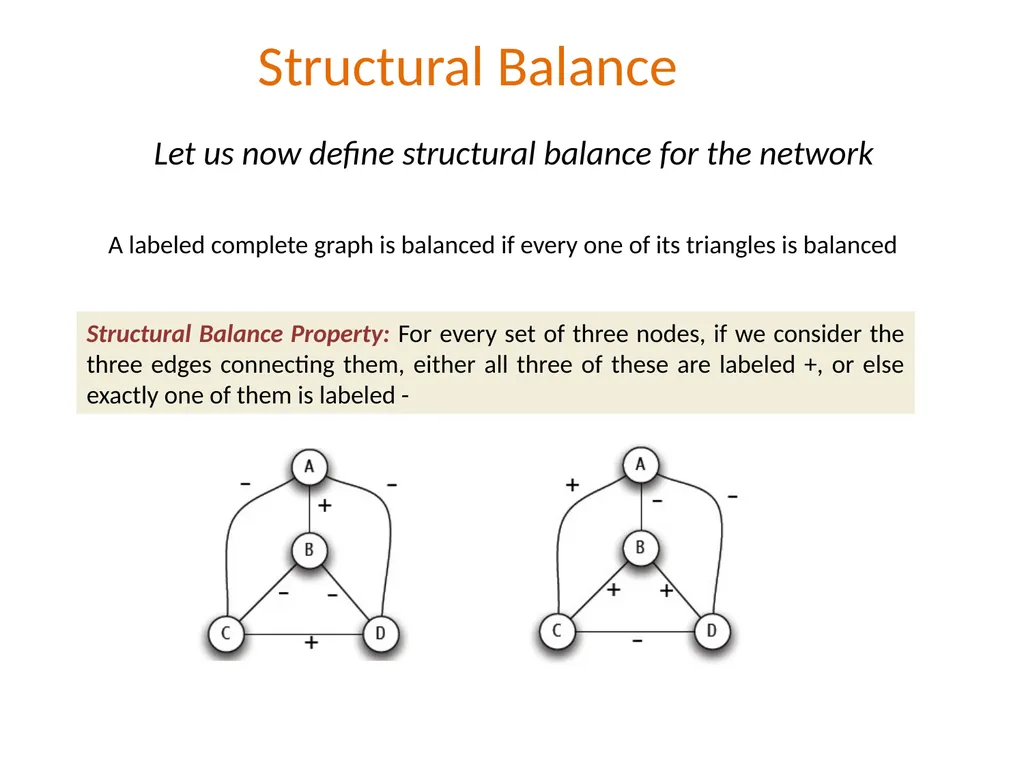
slide5. Structural Balance Let us now define structural balance for the network A labeled complete graph is balanced if every one of its triangles is balanced Structural Balance Property: For every set of three nodes, if we consider the three edges connecting them, either all three of these are labeled +, or else exactly one of them is labeled -<br>
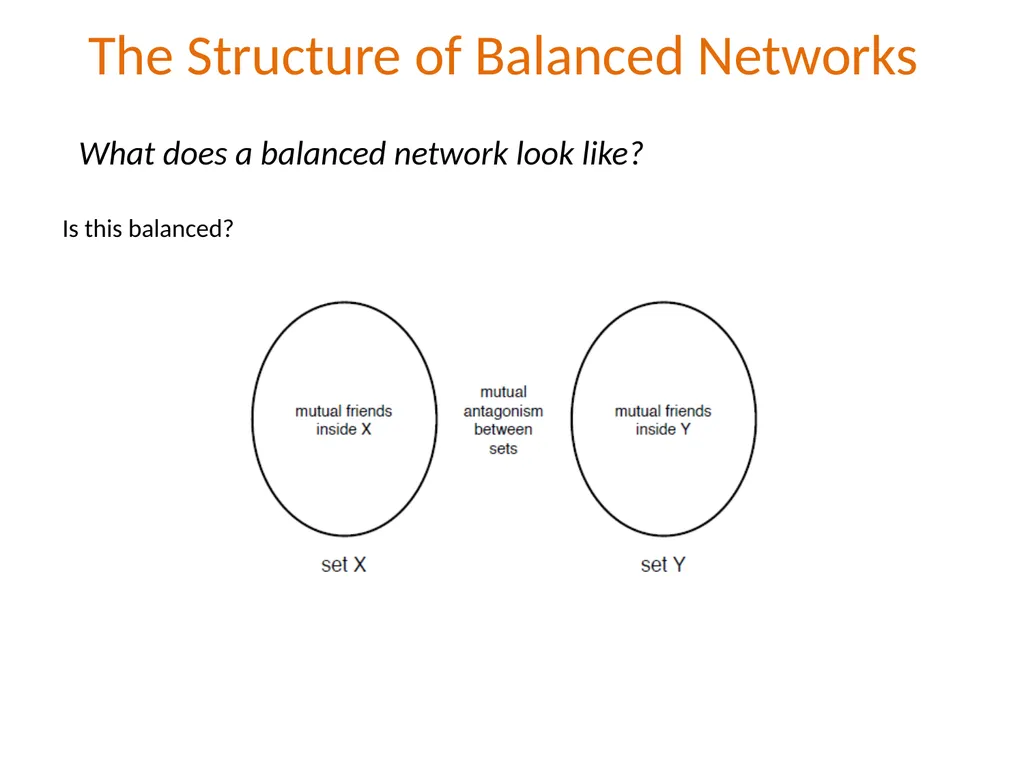
slide6. The Structure of Balanced Networks What does a balanced network look like? Is this balanced?<br>
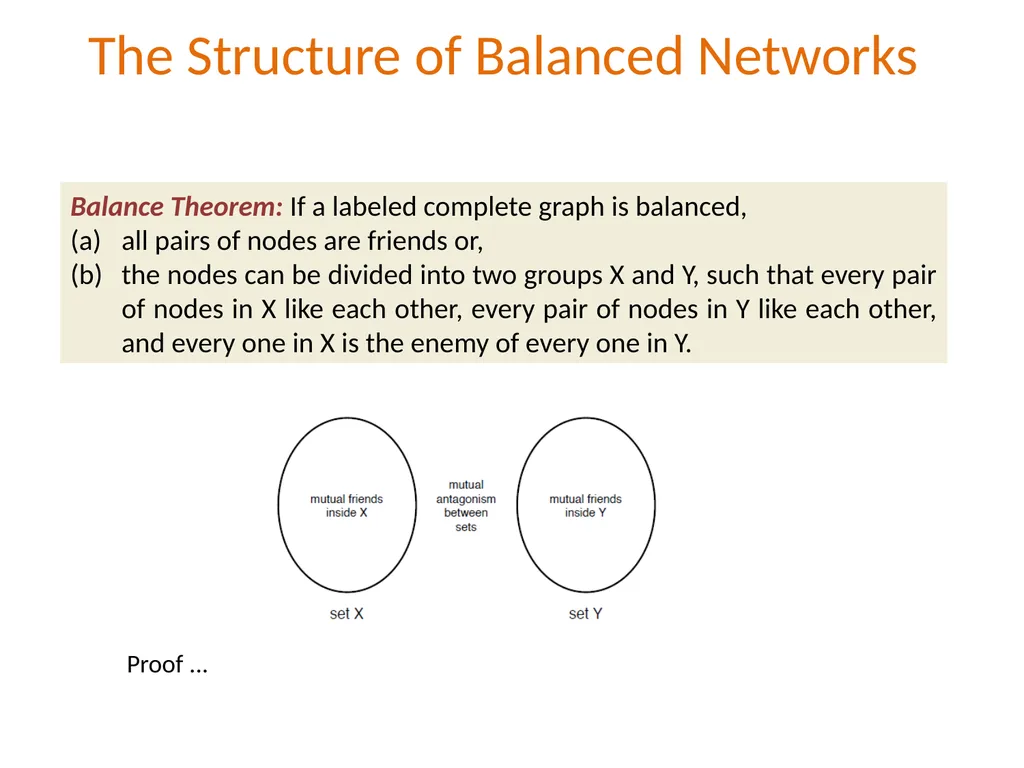
slide7. The Structure of Balanced Networks Balance Theorem: If a labeled complete graph is balanced,
all pairs of nodes are friends or,
the nodes can be divided into two groups X and Y, such that every pair of nodes in X like each other, every pair of nodes in Y like each other, and every one in X is the enemy of every one in Y. Proof ...<br>
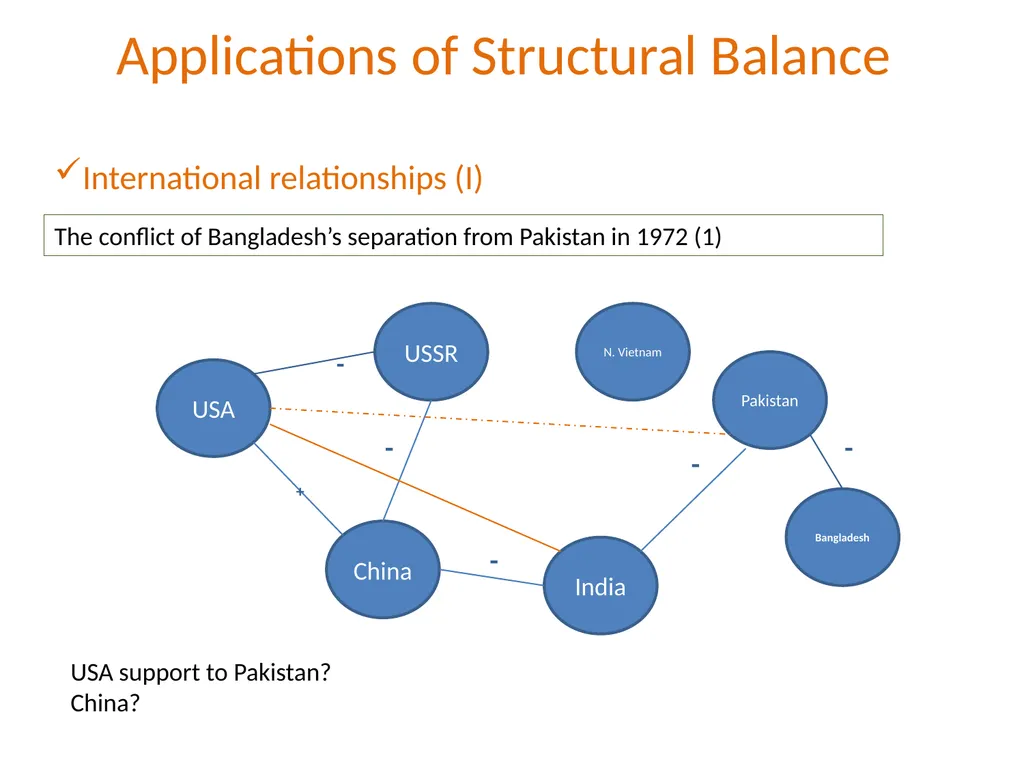
slide8. Applications of Structural Balance International relationships (I) The conflict of Bangladesh’s separation from Pakistan in 1972 (1) USA USSR China India Pakistan Bangladesh N. Vietnam - - + - USA support to Pakistan?
China? - -<br>
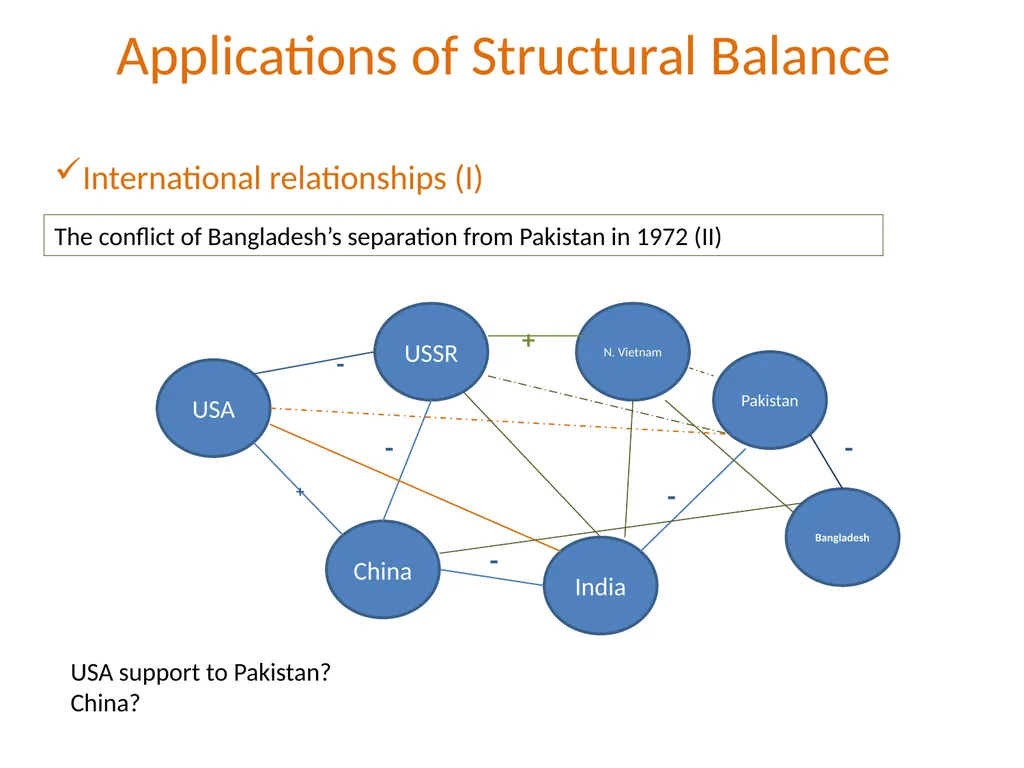
slide9. Applications of Structural Balance International relationships (I) The conflict of Bangladesh’s separation from Pakistan in 1972 (II) USA USSR China India Pakistan Bangladesh N. Vietnam - - + - USA support to Pakistan?
China? - + -<br>
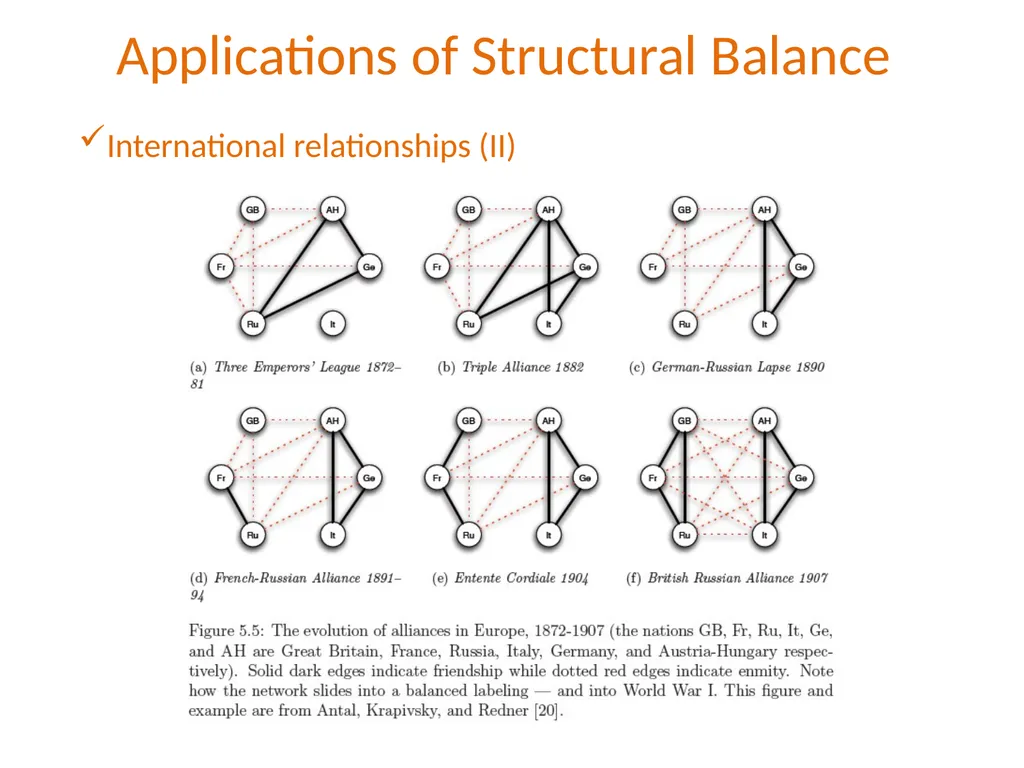
slide10. Applications of Structural Balance International relationships (II)<br>
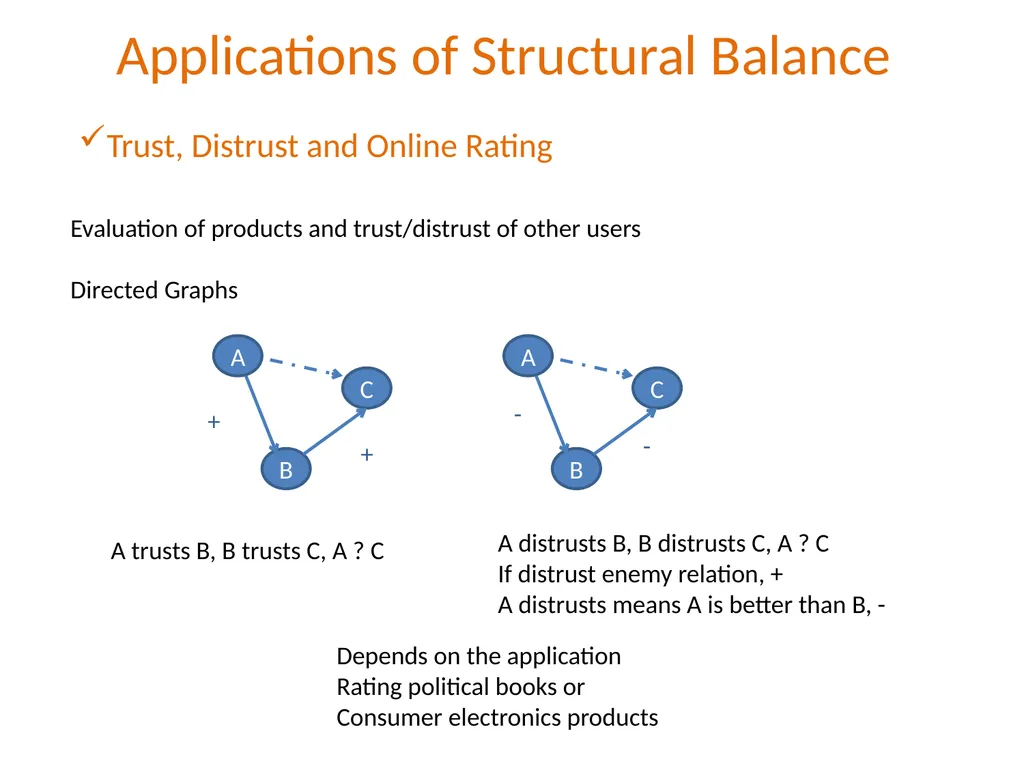
slide11. Applications of Structural Balance Trust, Distrust and Online Rating Evaluation of products and trust/distrust of other users
Directed Graphs A C B A trusts B, B trusts C, A ? C + + A C B - - A distrusts B, B distrusts C, A ? C
If distrust enemy relation, +
A distrusts means A is better than B, - Depends on the application
Rating political books or
Consumer electronics products<br>
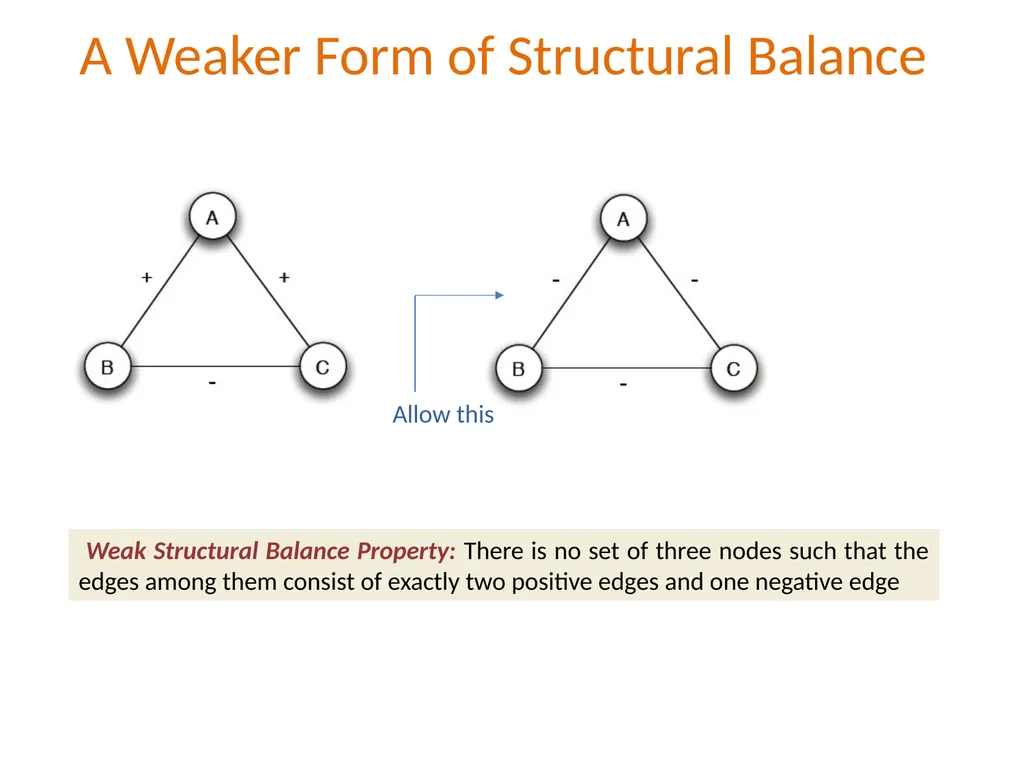
slide12. A Weaker Form of Structural Balance Allow this Weak Structural Balance Property: There is no set of three nodes such that the edges among them consist of exactly two positive edges and one negative edge<br>
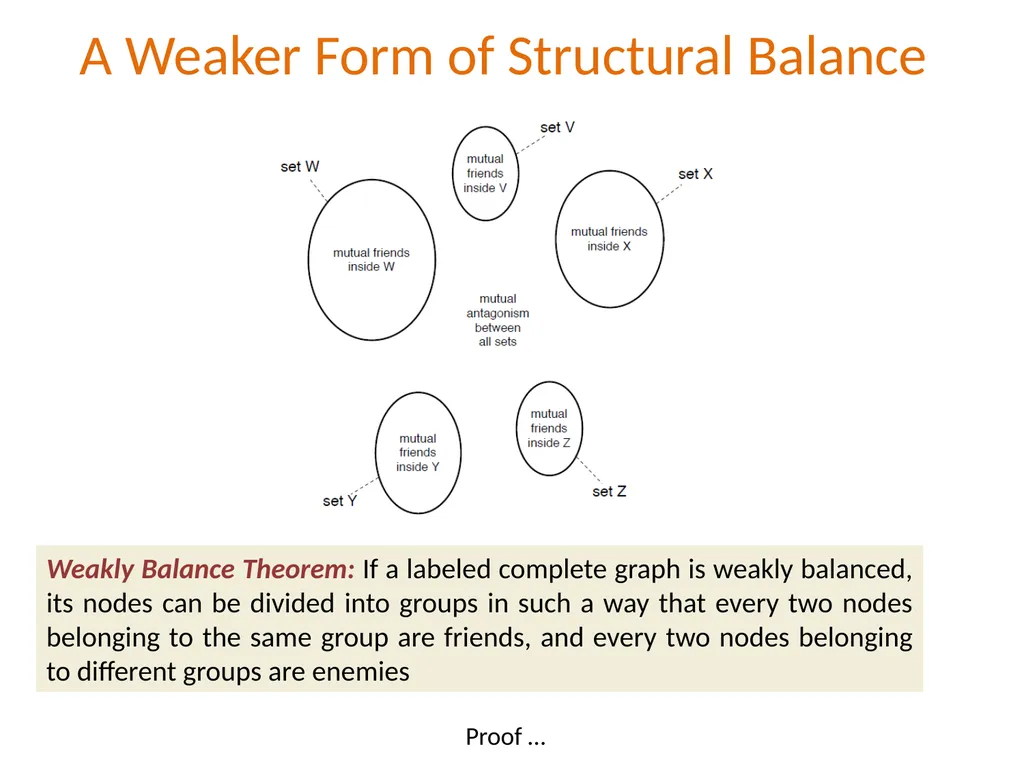
slide13. Weakly Balance Theorem: If a labeled complete graph is weakly balanced, its nodes can be divided into groups in such a way that every two nodes belonging to the same group are friends, and every two nodes belonging to different groups are enemies A Weaker Form of Structural Balance Proof …<br>
slide14. A Weaker Form of Structural Balance Two enemies of A can be either friends or enemies of each other<br>
slide15. Generalizing Non-complete graphs
Instead of all triangles, “most” triangles, approximately divide the graph We shall use the original (“non-weak” definition of structural balance)<br>
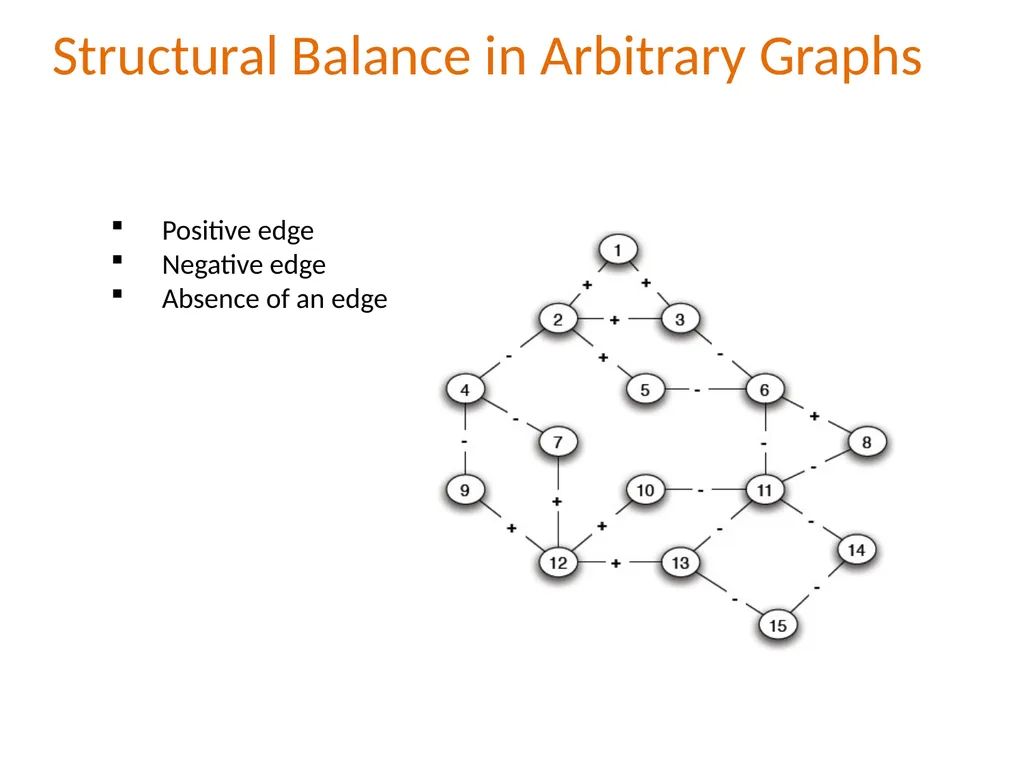
slide16. Structural Balance in Arbitrary Graphs Positive edge
Negative edge
Absence of an edge<br>
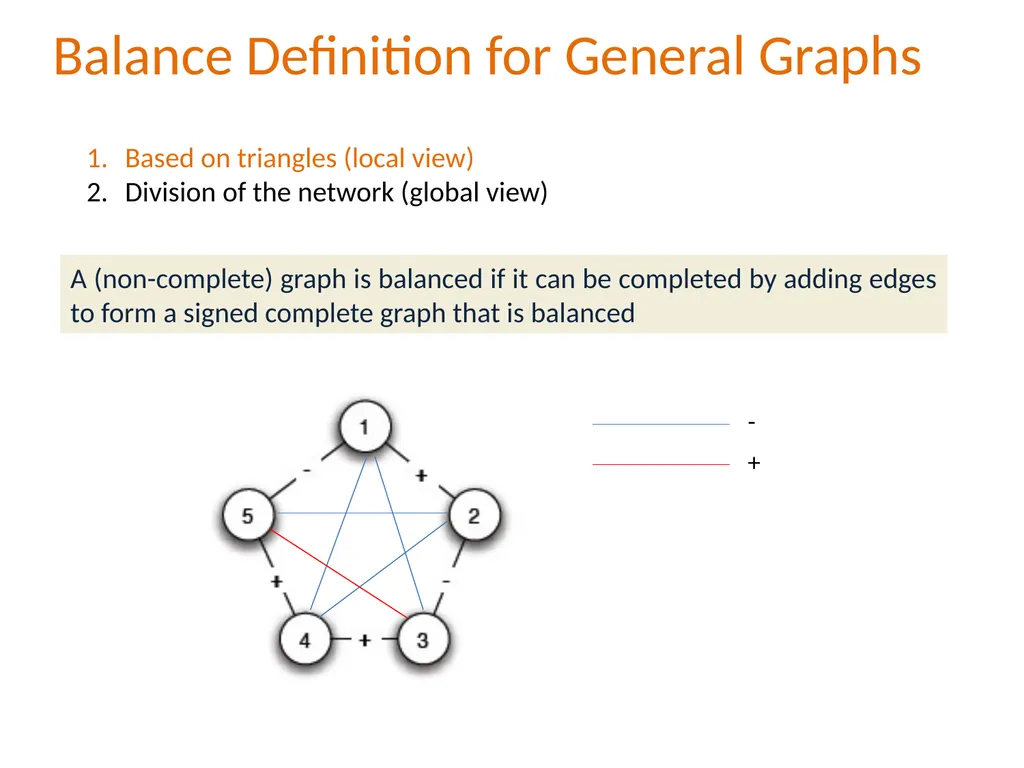
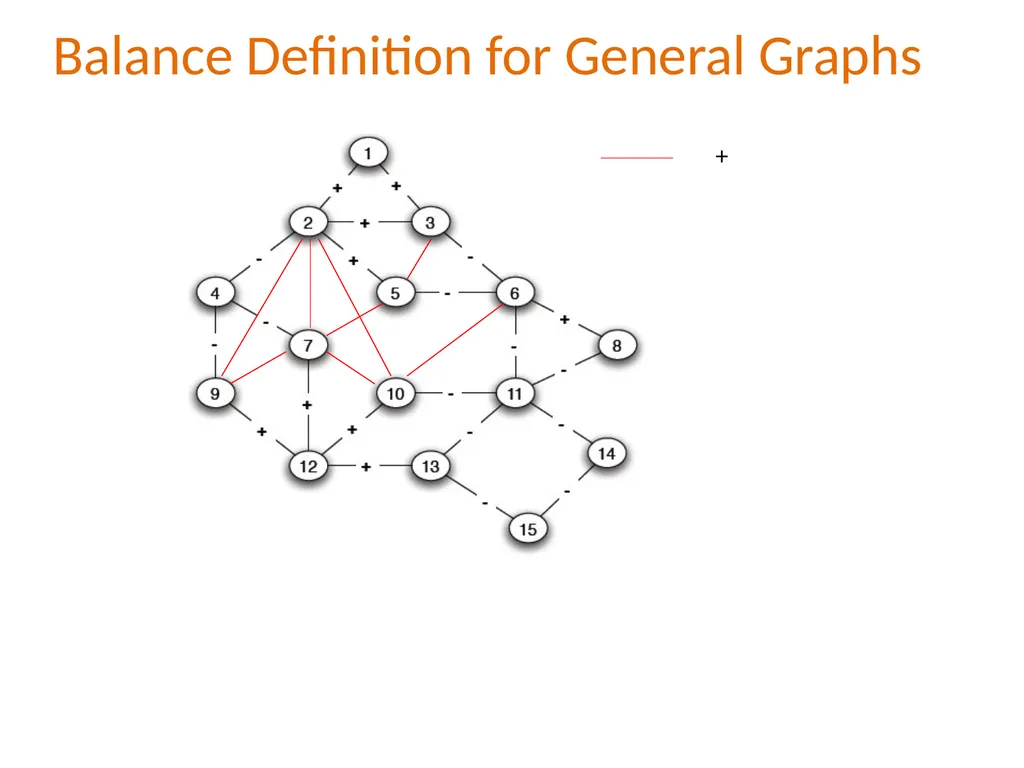
slide17. Balance Definition for General Graphs A (non-complete) graph is balanced if it can be completed by adding edges to form a signed complete graph that is balanced Based on triangles (local view)
Division of the network (global view) - +<br>
slide18. Balance Definition for General Graphs +<br>
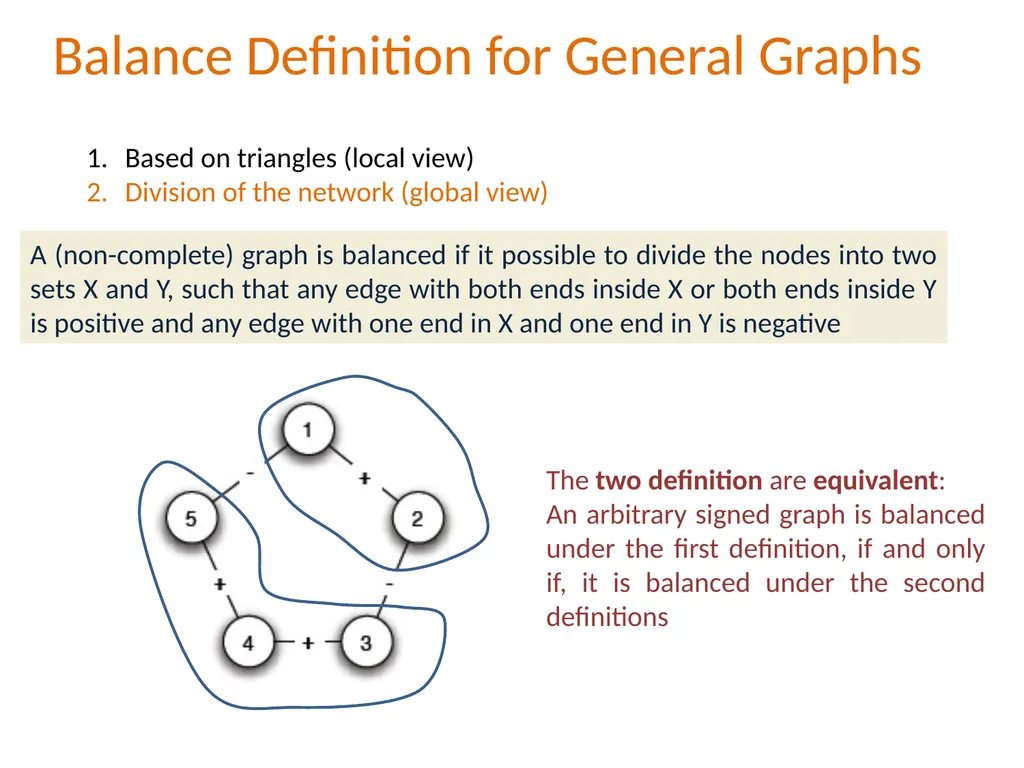
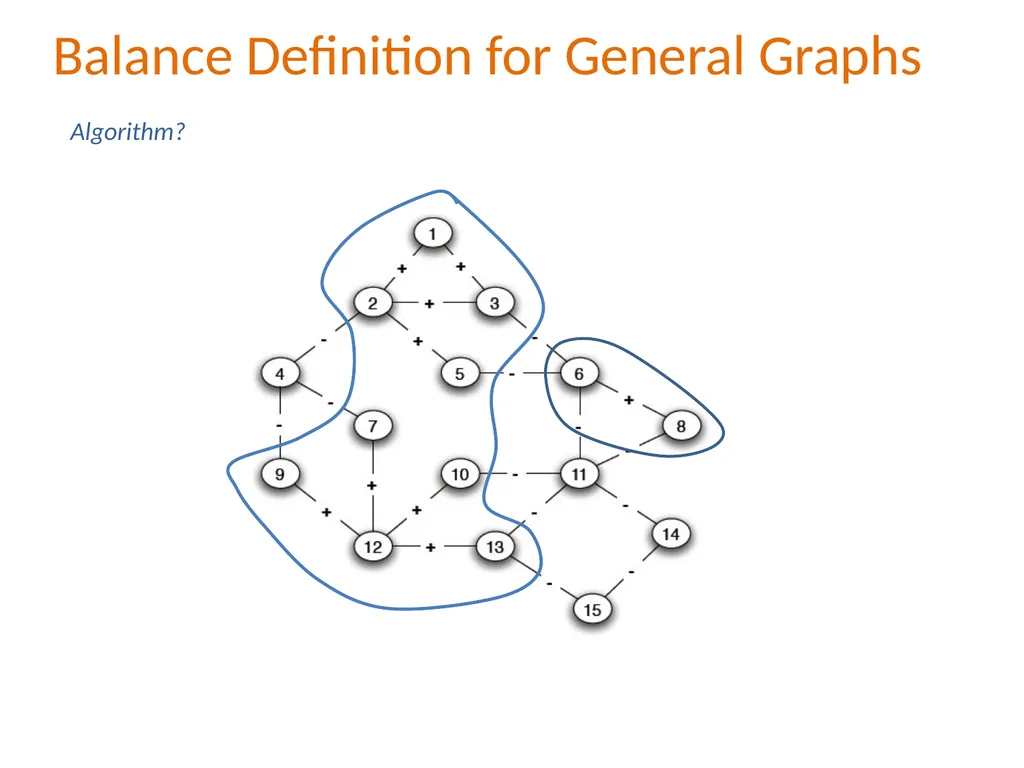
slide19. Balance Definition for General Graphs A (non-complete) graph is balanced if it possible to divide the nodes into two sets X and Y, such that any edge with both ends inside X or both ends inside Y is positive and any edge with one end in X and one end in Y is negative Based on triangles (local view)
Division of the network (global view) The two definition are equivalent:
An arbitrary signed graph is balanced under the first definition, if and only if, it is balanced under the second definitions<br>
slide20. Balance Definition for General Graphs Algorithm?<br>
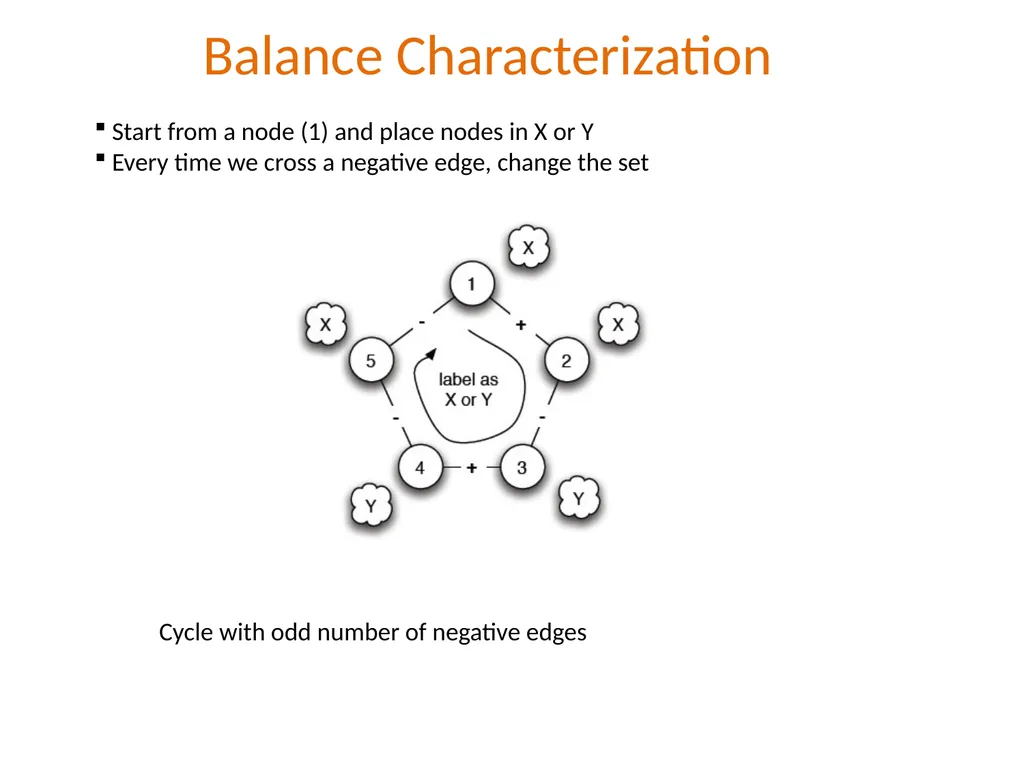
slide21. Balance Characterization Start from a node (1) and place nodes in X or Y
Every time we cross a negative edge, change the set Cycle with odd number of negative edges<br>
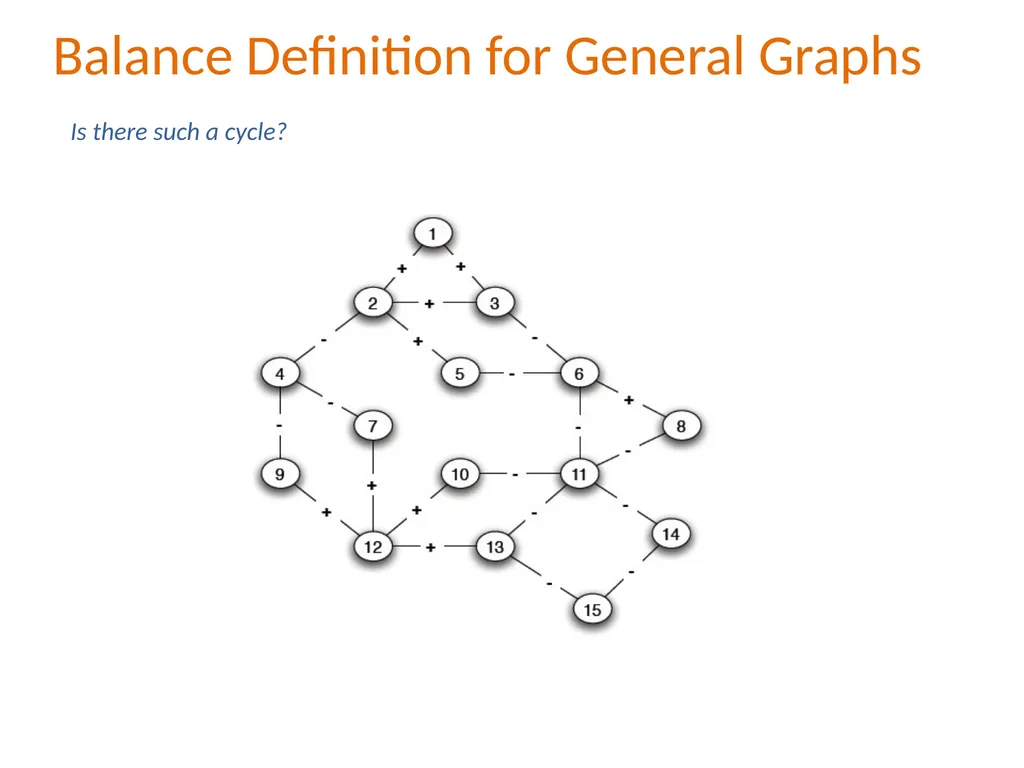
slide22. Balance Definition for General Graphs Is there such a cycle?<br>
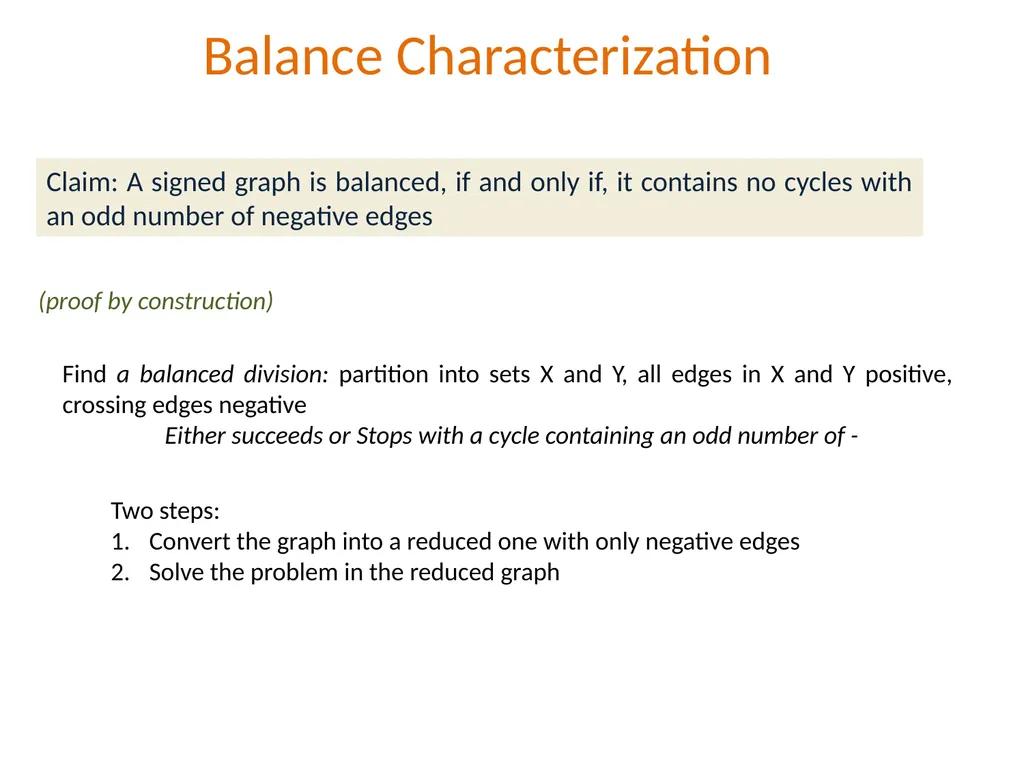
slide23. Balance Characterization Claim: A signed graph is balanced, if and only if, it contains no cycles with an odd number of negative edges Find a balanced division: partition into sets X and Y, all edges in X and Y positive, crossing edges negative
Either succeeds or Stops with a cycle containing an odd number of - Two steps:
Convert the graph into a reduced one with only negative edges
Solve the problem in the reduced graph (proof by construction)<br>
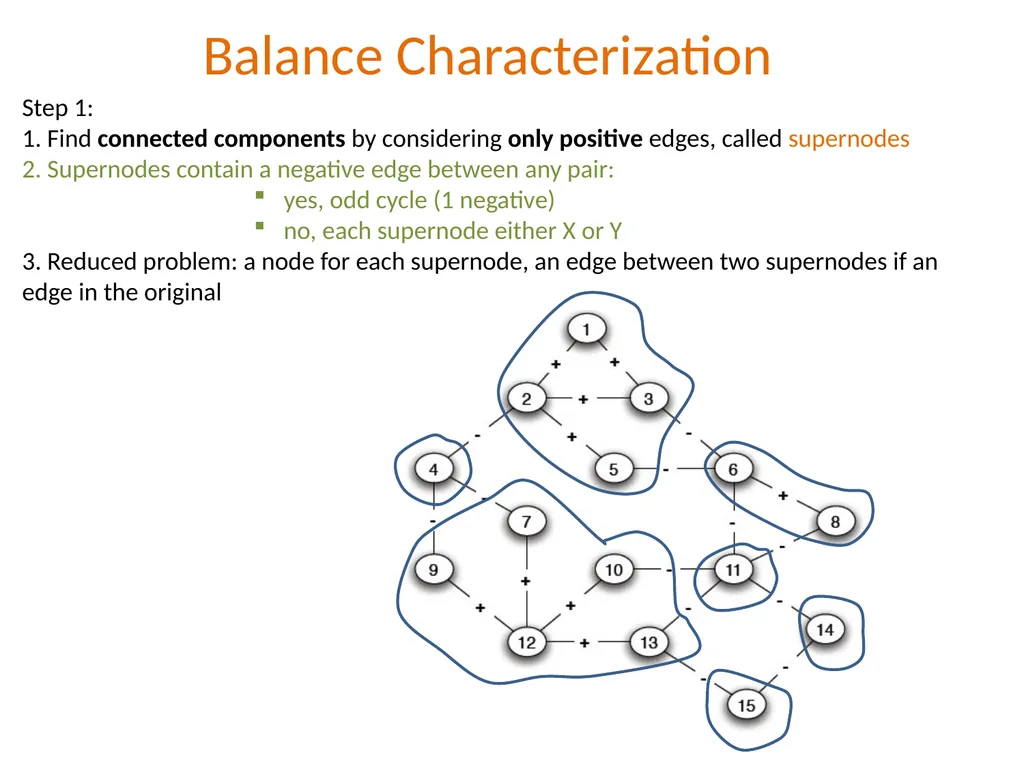
slide24. Balance Characterization Step 1:
1. Find connected components by considering only positive edges, called supernodes
2. Supernodes contain a negative edge between any pair:
yes, odd cycle (1 negative)
no, each supernode either X or Y
3. Reduced problem: a node for each supernode, an edge between two supernodes if an edge in the original<br>
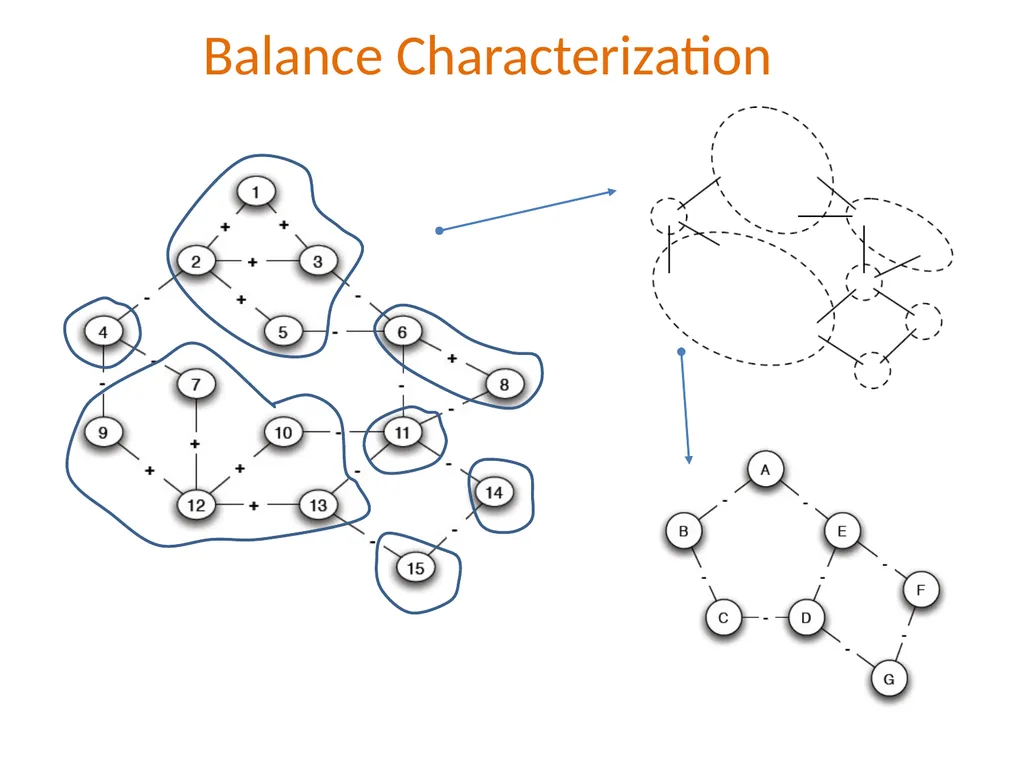
slide25. Balance Characterization<br>
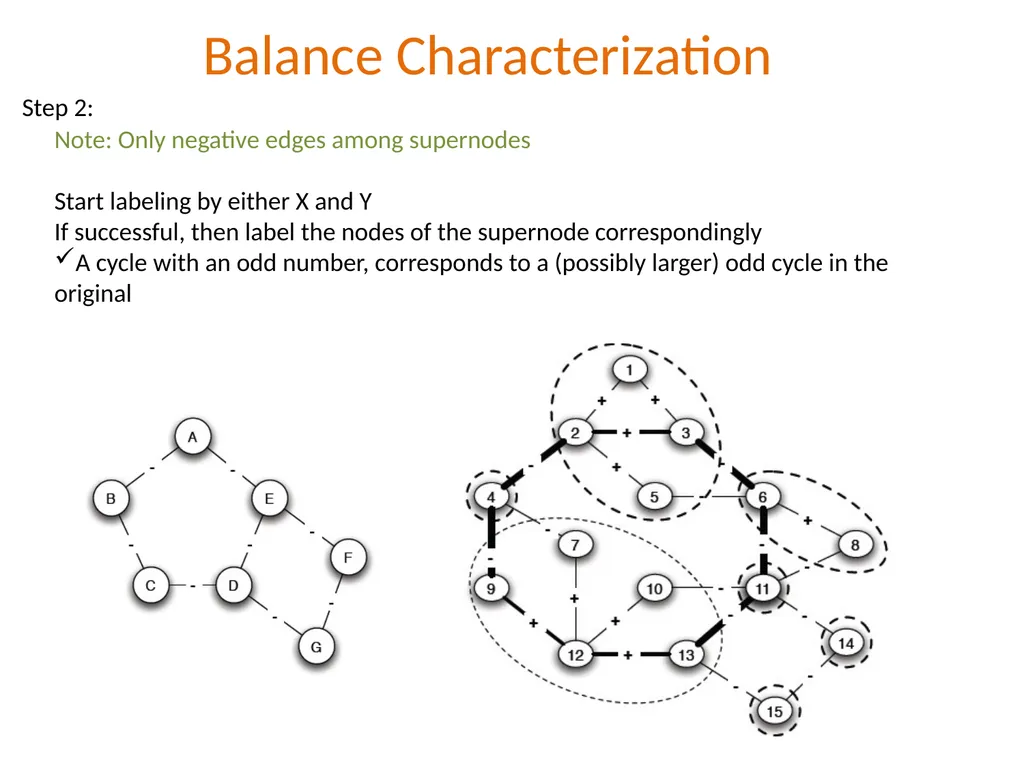
slide26. Balance Characterization Step 2: Note: Only negative edges among supernodes
Start labeling by either X and Y
If successful, then label the nodes of the supernode correspondingly
A cycle with an odd number, corresponds to a (possibly larger) odd cycle in the original<br>
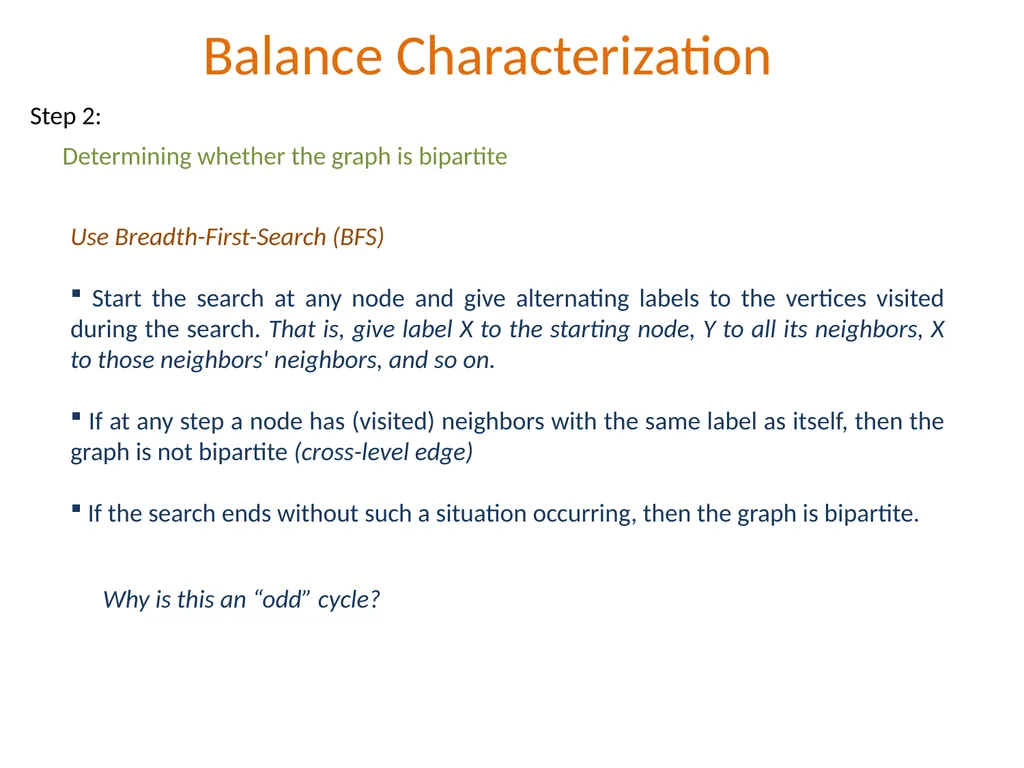
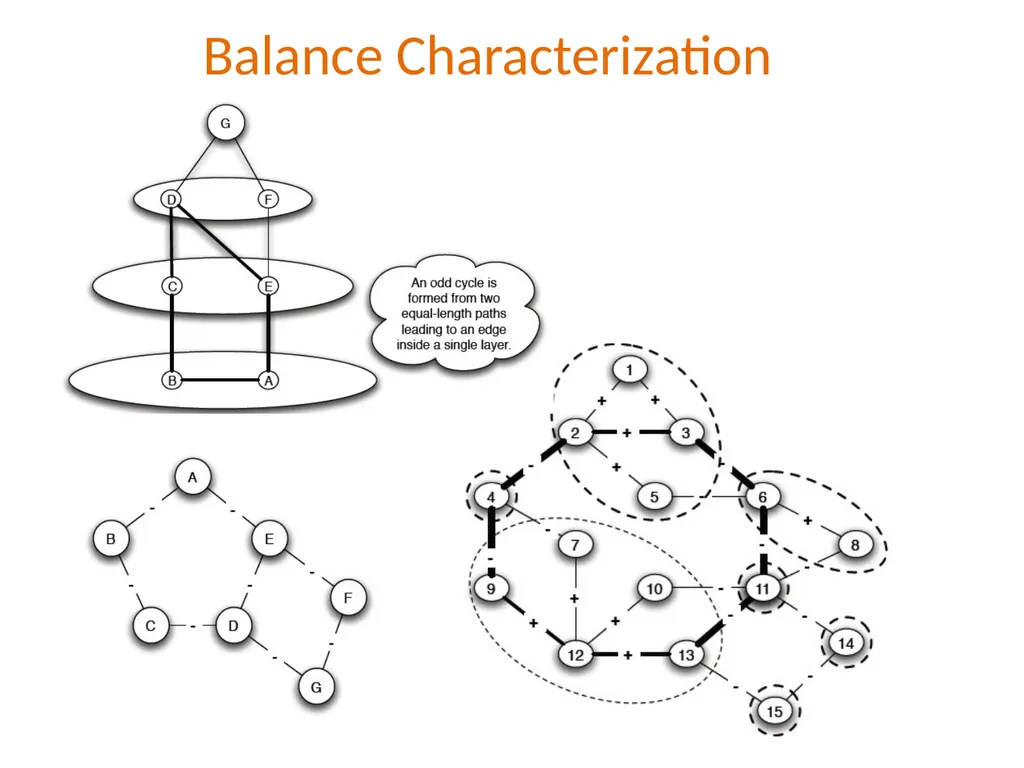
slide27. Balance Characterization Step 2: Determining whether the graph is bipartite Use Breadth-First-Search (BFS)
Start the search at any node and give alternating labels to the vertices visited during the search. That is, give label X to the starting node, Y to all its neighbors, X to those neighbors' neighbors, and so on.
If at any step a node has (visited) neighbors with the same label as itself, then the graph is not bipartite (cross-level edge)
If the search ends without such a situation occurring, then the graph is bipartite. Why is this an “odd” cycle?<br>
slide28. Balance Characterization<br>
slide29. Generalizing Non-complete graphs
Instead of all triangles, “most” triangles, approximately divide the graph<br>
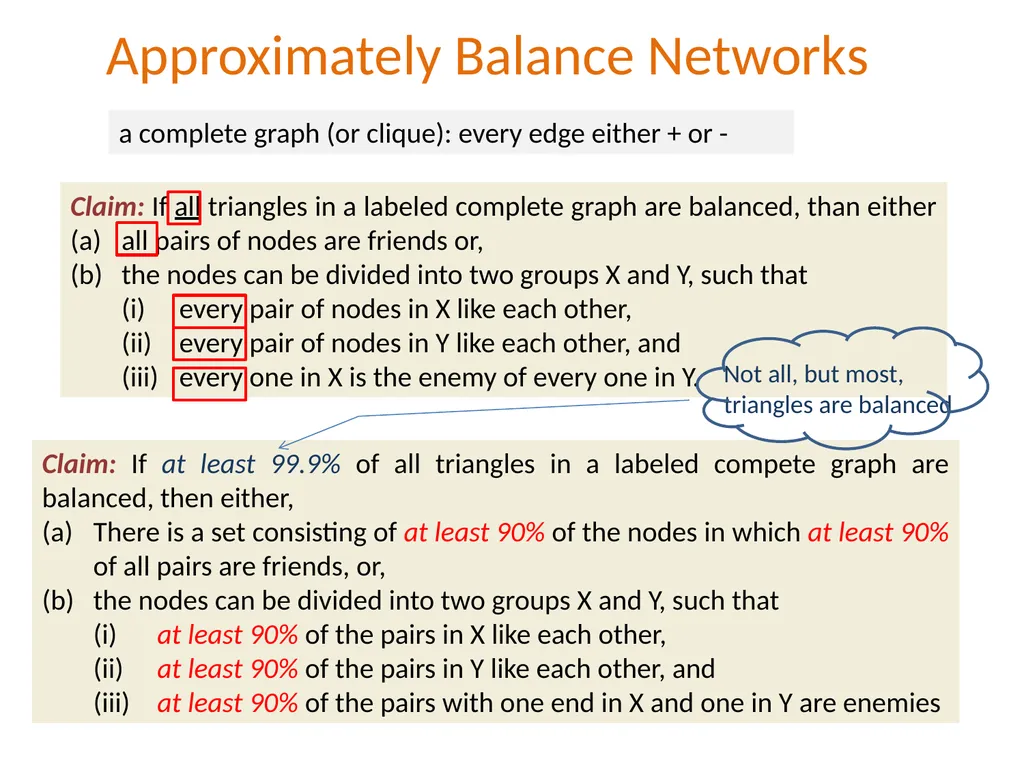
slide30. Approximately Balance Networks a complete graph (or clique): every edge either + or - Claim: If all triangles in a labeled complete graph are balanced, than either
all pairs of nodes are friends or,
the nodes can be divided into two groups X and Y, such that
every pair of nodes in X like each other,
every pair of nodes in Y like each other, and
every one in X is the enemy of every one in Y. Claim: If at least 99.9% of all triangles in a labeled compete graph are balanced, then either,
There is a set consisting of at least 90% of the nodes in which at least 90% of all pairs are friends, or,
the nodes can be divided into two groups X and Y, such that
at least 90% of the pairs in X like each other,
at least 90% of the pairs in Y like each other, and
at least 90% of the pairs with one end in X and one in Y are enemies Not all, but most, triangles are balanced<br>
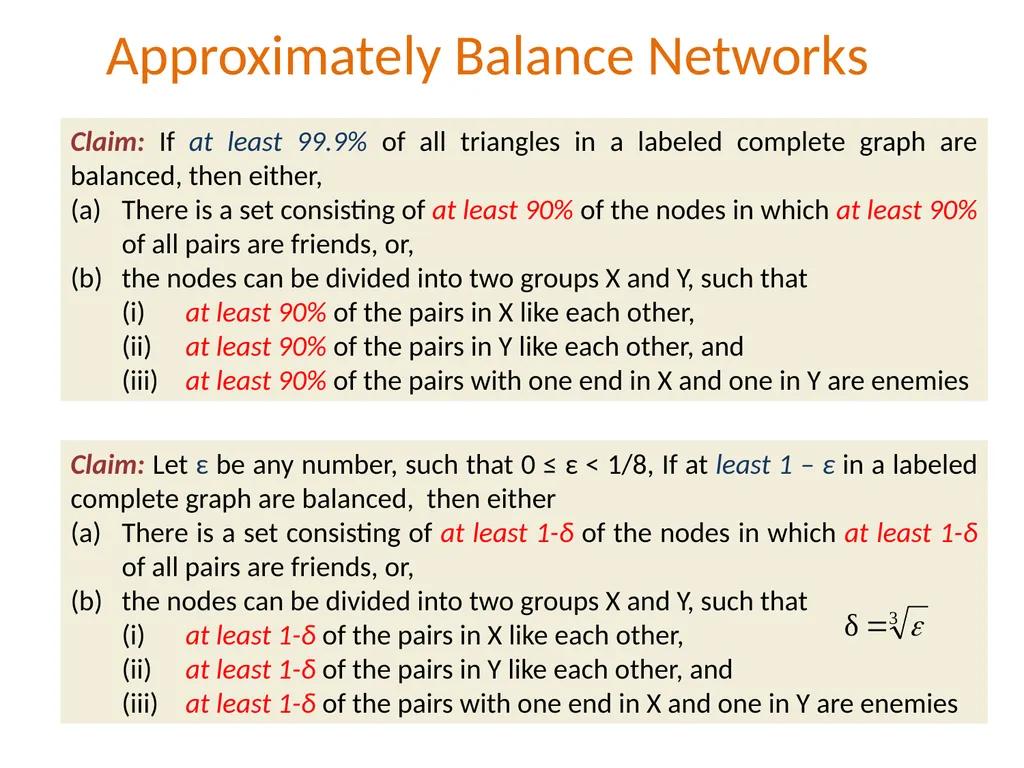
slide31. Approximately Balance Networks Claim: Let ε be any number, such that 0 ≤ ε < 1/8, If at least 1 – ε in a labeled complete graph are balanced, then either
There is a set consisting of at least 1-δ of the nodes in which at least 1-δ of all pairs are friends, or,
the nodes can be divided into two groups X and Y, such that
at least 1-δ of the pairs in X like each other,
at least 1-δ of the pairs in Y like each other, and
at least 1-δ of the pairs with one end in X and one in Y are enemies Claim: If at least 99.9% of all triangles in a labeled complete graph are balanced, then either,
There is a set consisting of at least 90% of the nodes in which at least 90% of all pairs are friends, or,
the nodes can be divided into two groups X and Y, such that
at least 90% of the pairs in X like each other,
at least 90% of the pairs in Y like each other, and
at least 90% of the pairs with one end in X and one in Y are enemies<br>
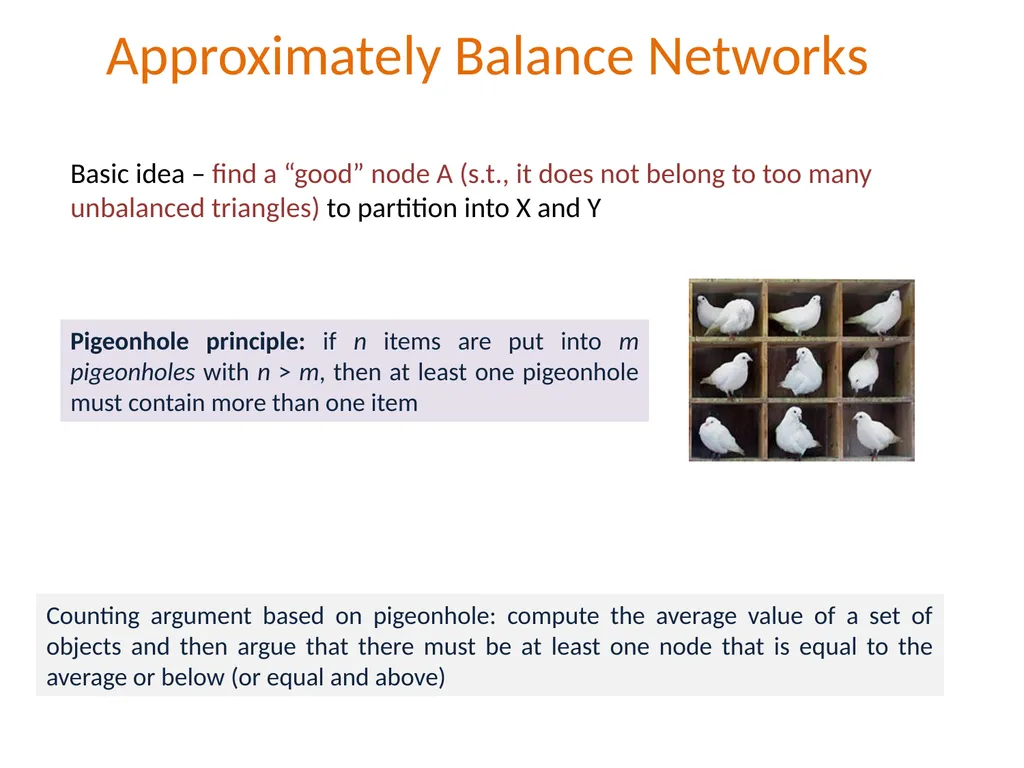
slide32. Approximately Balance Networks Basic idea – find a “good” node A (s.t., it does not belong to too many unbalanced triangles) to partition into X and Y Counting argument based on pigeonhole: compute the average value of a set of objects and then argue that there must be at least one node that is equal to the average or below (or equal and above) Pigeonhole principle: if n items are put into m pigeonholes with n > m, then at least one pigeonhole must contain more than one item<br>
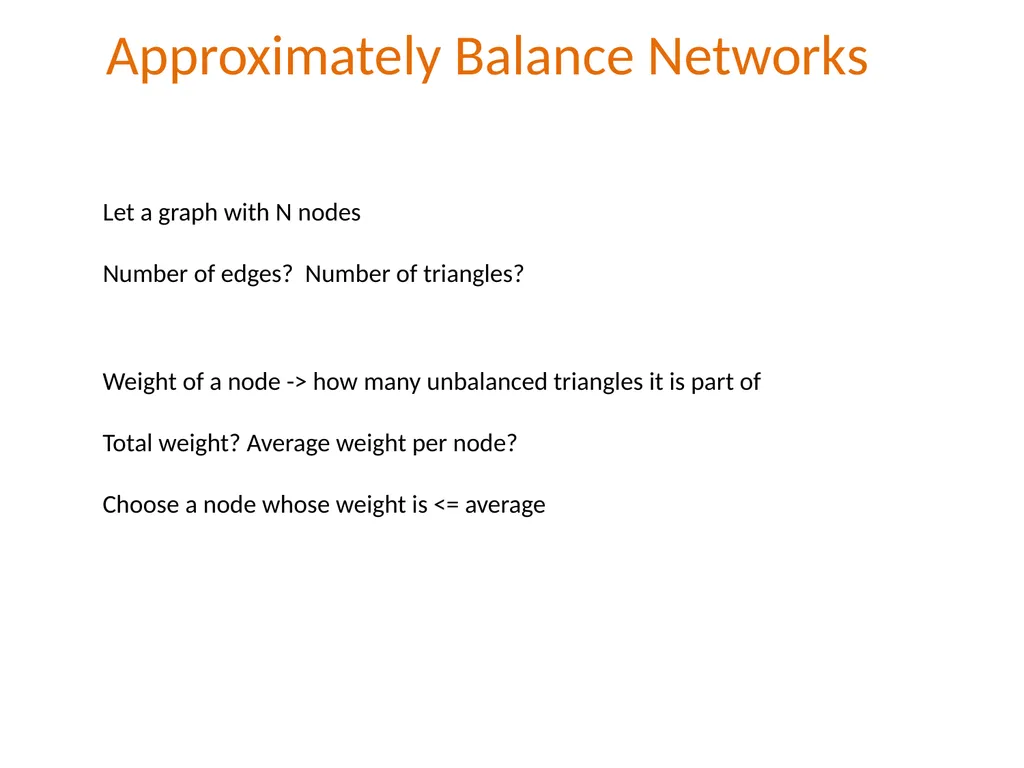
slide33. Approximately Balance Networks Let a graph with N nodes
Number of edges? Number of triangles? Weight of a node -> how many unbalanced triangles it is part of
Total weight? Average weight per node?
Choose a node whose weight is <= average<br>
slide34. Approximately Balance Networks Cases based on the relative size of X and Y
If X and Y too large -> case (a) else case (b)<br>
slide35. End of Chapter 5 Balanced networks in the case of both positive and negative edges<br>
slide2. Structural Balance Initially, a complete graph (or clique): every edge either + or - Let us first look at individual triangles
Lets look at 3 people => 4 Cases
See if all are equally possible (local property) What about negative edges?<br>
slide3. Structural Balance Case (a): 3 + Mutual friends Case (b): 2 +, 1 - A is friend with B and C, but B and C do not get well together Case (c): 1 +, 2 - Mutual enemies Case (d): 3 - A and B are friends with a mutual enemy<br>
slide4. Structural Balance Case (a): 3 + Mutual friends Case (b): 2 +, 1 - A is friend with B and C, but B and C do not get well together
Implicit force to make B and C friends (- => +) or turn one of the + to - Case (c): 1 +, 2 - Mutual enemies
Forces to team up against the third (turn 1 – to +) Case (d): 3 - A and B are friends with a mutual enemy Stable or balanced Stable or balanced Unstable Unstable<br>
slide5. Structural Balance Let us now define structural balance for the network A labeled complete graph is balanced if every one of its triangles is balanced Structural Balance Property: For every set of three nodes, if we consider the three edges connecting them, either all three of these are labeled +, or else exactly one of them is labeled -<br>
slide6. The Structure of Balanced Networks What does a balanced network look like? Is this balanced?<br>
slide7. The Structure of Balanced Networks Balance Theorem: If a labeled complete graph is balanced,
all pairs of nodes are friends or,
the nodes can be divided into two groups X and Y, such that every pair of nodes in X like each other, every pair of nodes in Y like each other, and every one in X is the enemy of every one in Y. Proof ...<br>
slide8. Applications of Structural Balance International relationships (I) The conflict of Bangladesh’s separation from Pakistan in 1972 (1) USA USSR China India Pakistan Bangladesh N. Vietnam - - + - USA support to Pakistan?
China? - -<br>
slide9. Applications of Structural Balance International relationships (I) The conflict of Bangladesh’s separation from Pakistan in 1972 (II) USA USSR China India Pakistan Bangladesh N. Vietnam - - + - USA support to Pakistan?
China? - + -<br>
slide10. Applications of Structural Balance International relationships (II)<br>
slide11. Applications of Structural Balance Trust, Distrust and Online Rating Evaluation of products and trust/distrust of other users
Directed Graphs A C B A trusts B, B trusts C, A ? C + + A C B - - A distrusts B, B distrusts C, A ? C
If distrust enemy relation, +
A distrusts means A is better than B, - Depends on the application
Rating political books or
Consumer electronics products<br>
slide12. A Weaker Form of Structural Balance Allow this Weak Structural Balance Property: There is no set of three nodes such that the edges among them consist of exactly two positive edges and one negative edge<br>
slide13. Weakly Balance Theorem: If a labeled complete graph is weakly balanced, its nodes can be divided into groups in such a way that every two nodes belonging to the same group are friends, and every two nodes belonging to different groups are enemies A Weaker Form of Structural Balance Proof …<br>
slide14. A Weaker Form of Structural Balance Two enemies of A can be either friends or enemies of each other<br>
slide15. Generalizing Non-complete graphs
Instead of all triangles, “most” triangles, approximately divide the graph We shall use the original (“non-weak” definition of structural balance)<br>
slide16. Structural Balance in Arbitrary Graphs Positive edge
Negative edge
Absence of an edge<br>
slide17. Balance Definition for General Graphs A (non-complete) graph is balanced if it can be completed by adding edges to form a signed complete graph that is balanced Based on triangles (local view)
Division of the network (global view) - +<br>
slide18. Balance Definition for General Graphs +<br>
slide19. Balance Definition for General Graphs A (non-complete) graph is balanced if it possible to divide the nodes into two sets X and Y, such that any edge with both ends inside X or both ends inside Y is positive and any edge with one end in X and one end in Y is negative Based on triangles (local view)
Division of the network (global view) The two definition are equivalent:
An arbitrary signed graph is balanced under the first definition, if and only if, it is balanced under the second definitions<br>
slide20. Balance Definition for General Graphs Algorithm?<br>
slide21. Balance Characterization Start from a node (1) and place nodes in X or Y
Every time we cross a negative edge, change the set Cycle with odd number of negative edges<br>
slide22. Balance Definition for General Graphs Is there such a cycle?<br>
slide23. Balance Characterization Claim: A signed graph is balanced, if and only if, it contains no cycles with an odd number of negative edges Find a balanced division: partition into sets X and Y, all edges in X and Y positive, crossing edges negative
Either succeeds or Stops with a cycle containing an odd number of - Two steps:
Convert the graph into a reduced one with only negative edges
Solve the problem in the reduced graph (proof by construction)<br>
slide24. Balance Characterization Step 1:
1. Find connected components by considering only positive edges, called supernodes
2. Supernodes contain a negative edge between any pair:
yes, odd cycle (1 negative)
no, each supernode either X or Y
3. Reduced problem: a node for each supernode, an edge between two supernodes if an edge in the original<br>
slide25. Balance Characterization<br>
slide26. Balance Characterization Step 2: Note: Only negative edges among supernodes
Start labeling by either X and Y
If successful, then label the nodes of the supernode correspondingly
A cycle with an odd number, corresponds to a (possibly larger) odd cycle in the original<br>
slide27. Balance Characterization Step 2: Determining whether the graph is bipartite Use Breadth-First-Search (BFS)
Start the search at any node and give alternating labels to the vertices visited during the search. That is, give label X to the starting node, Y to all its neighbors, X to those neighbors' neighbors, and so on.
If at any step a node has (visited) neighbors with the same label as itself, then the graph is not bipartite (cross-level edge)
If the search ends without such a situation occurring, then the graph is bipartite. Why is this an “odd” cycle?<br>
slide28. Balance Characterization<br>
slide29. Generalizing Non-complete graphs
Instead of all triangles, “most” triangles, approximately divide the graph<br>
slide30. Approximately Balance Networks a complete graph (or clique): every edge either + or - Claim: If all triangles in a labeled complete graph are balanced, than either
all pairs of nodes are friends or,
the nodes can be divided into two groups X and Y, such that
every pair of nodes in X like each other,
every pair of nodes in Y like each other, and
every one in X is the enemy of every one in Y. Claim: If at least 99.9% of all triangles in a labeled compete graph are balanced, then either,
There is a set consisting of at least 90% of the nodes in which at least 90% of all pairs are friends, or,
the nodes can be divided into two groups X and Y, such that
at least 90% of the pairs in X like each other,
at least 90% of the pairs in Y like each other, and
at least 90% of the pairs with one end in X and one in Y are enemies Not all, but most, triangles are balanced<br>
slide31. Approximately Balance Networks Claim: Let ε be any number, such that 0 ≤ ε < 1/8, If at least 1 – ε in a labeled complete graph are balanced, then either
There is a set consisting of at least 1-δ of the nodes in which at least 1-δ of all pairs are friends, or,
the nodes can be divided into two groups X and Y, such that
at least 1-δ of the pairs in X like each other,
at least 1-δ of the pairs in Y like each other, and
at least 1-δ of the pairs with one end in X and one in Y are enemies Claim: If at least 99.9% of all triangles in a labeled complete graph are balanced, then either,
There is a set consisting of at least 90% of the nodes in which at least 90% of all pairs are friends, or,
the nodes can be divided into two groups X and Y, such that
at least 90% of the pairs in X like each other,
at least 90% of the pairs in Y like each other, and
at least 90% of the pairs with one end in X and one in Y are enemies<br>
slide32. Approximately Balance Networks Basic idea – find a “good” node A (s.t., it does not belong to too many unbalanced triangles) to partition into X and Y Counting argument based on pigeonhole: compute the average value of a set of objects and then argue that there must be at least one node that is equal to the average or below (or equal and above) Pigeonhole principle: if n items are put into m pigeonholes with n > m, then at least one pigeonhole must contain more than one item<br>
slide33. Approximately Balance Networks Let a graph with N nodes
Number of edges? Number of triangles? Weight of a node -> how many unbalanced triangles it is part of
Total weight? Average weight per node?
Choose a node whose weight is <= average<br>
slide34. Approximately Balance Networks Cases based on the relative size of X and Y
If X and Y too large -> case (a) else case (b)<br>
slide35. End of Chapter 5 Balanced networks in the case of both positive and negative edges<br>