
2/18/2014 1 screen holder TEACHING WITH TECHNOLOGY
Description: 2182014 1 screen holder TEACHING WITH TECHNOLOGY Good fortune or misfortune 2182014 2 THE FORTUNATE: multiple teaching styles no longer strictly lecture: sound, images, global aspects, learning outside of classroom multiple classroom
Related Topics
Download Presentation
"2/18/2014 1 screen holder TEACHING WITH TECHNOLOGY" is the property of its rightful owner. Permission is granted to download and print the materials on this website for personal, non-commercial use only, and to display it on your personal computer provided you do not modify the materials and that you retain all copyright notices contained in the materials. By downloading content from our website, you accept the terms of this agreement.
Presentation Transcript
slide1. 2/18/2014 1 screen holder<br>
slide2. TEACHING WITH TECHNOLOGY Good fortune or misfortune 2/18/2014 2<br>
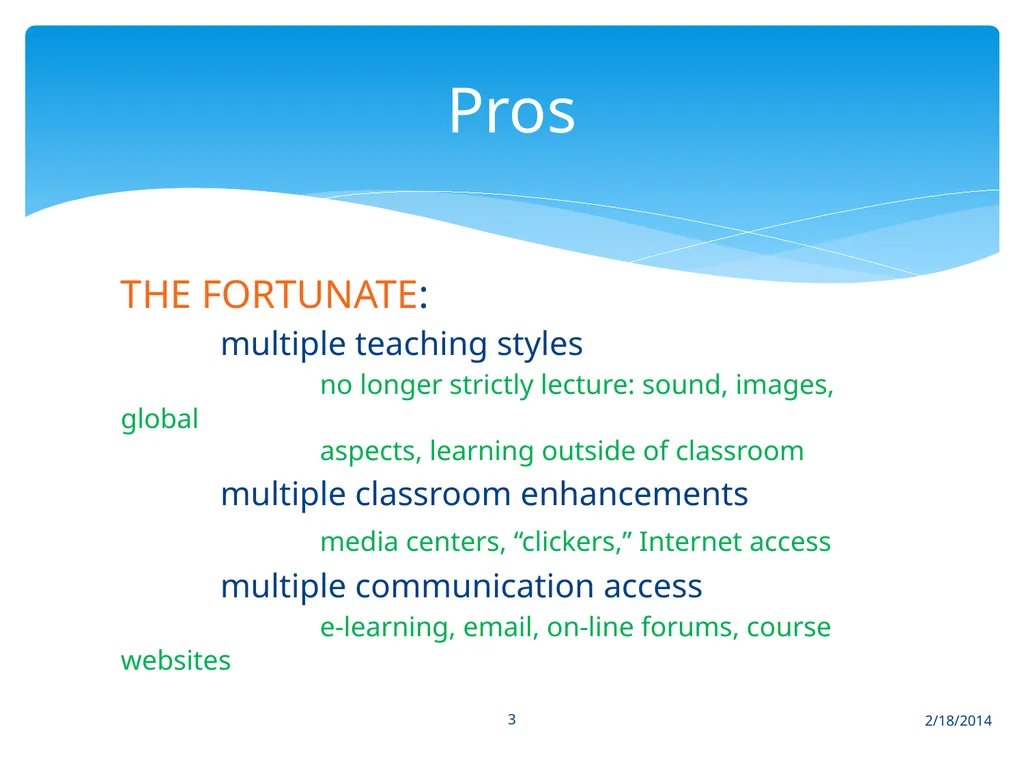
slide3. THE FORTUNATE:
multiple teaching styles no longer strictly lecture: sound, images, global aspects, learning outside of classroom
multiple classroom enhancements
media centers, “clickers,” Internet access
multiple communication access e-learning, email, on-line forums, course websites Pros 2/18/2014 3<br>
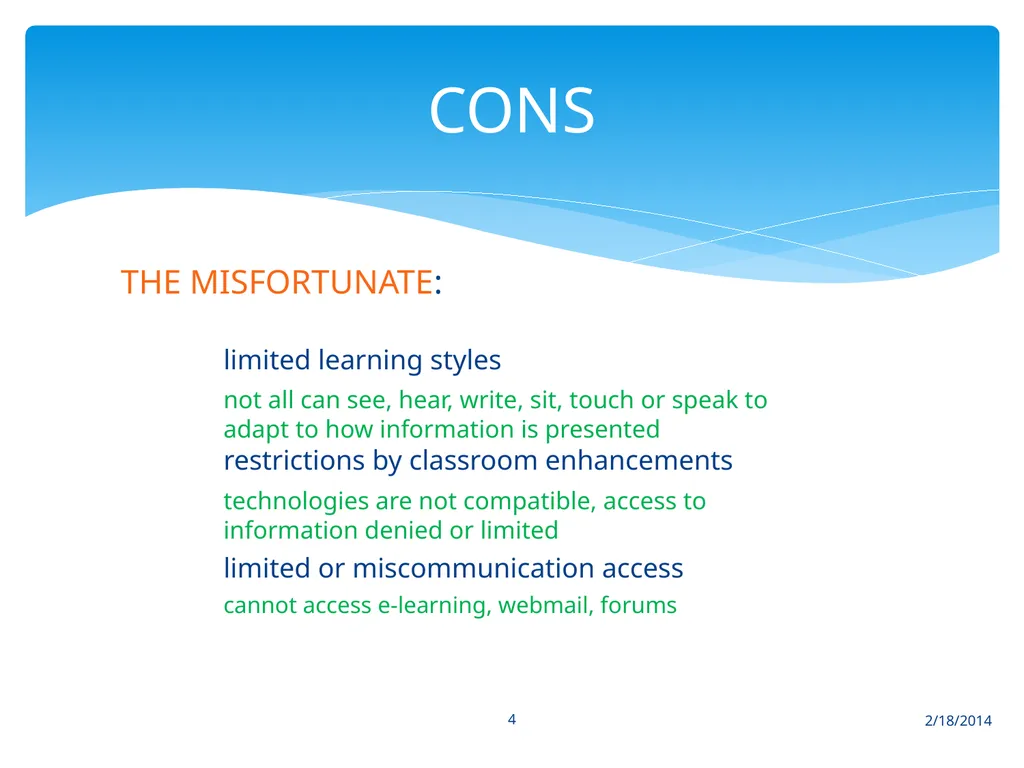
slide4. THE MISFORTUNATE:
limited learning styles
not all can see, hear, write, sit, touch or speak to adapt to how information is presented restrictions by classroom enhancements
technologies are not compatible, access to information denied or limited
limited or miscommunication access
cannot access e-learning, webmail, forums CONS 2/18/2014 4<br>
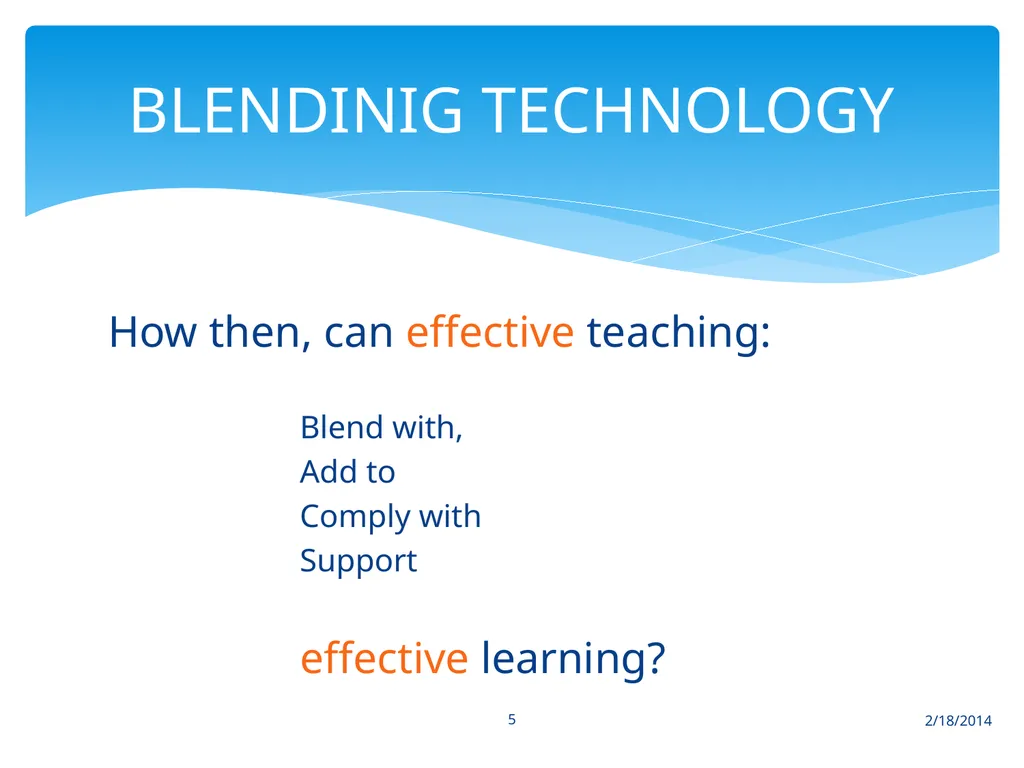
slide5. How then, can effective teaching:
Blend with,
Add to
Comply with
Support
effective learning? BLENDINIG TECHNOLOGY 2/18/2014 5<br>
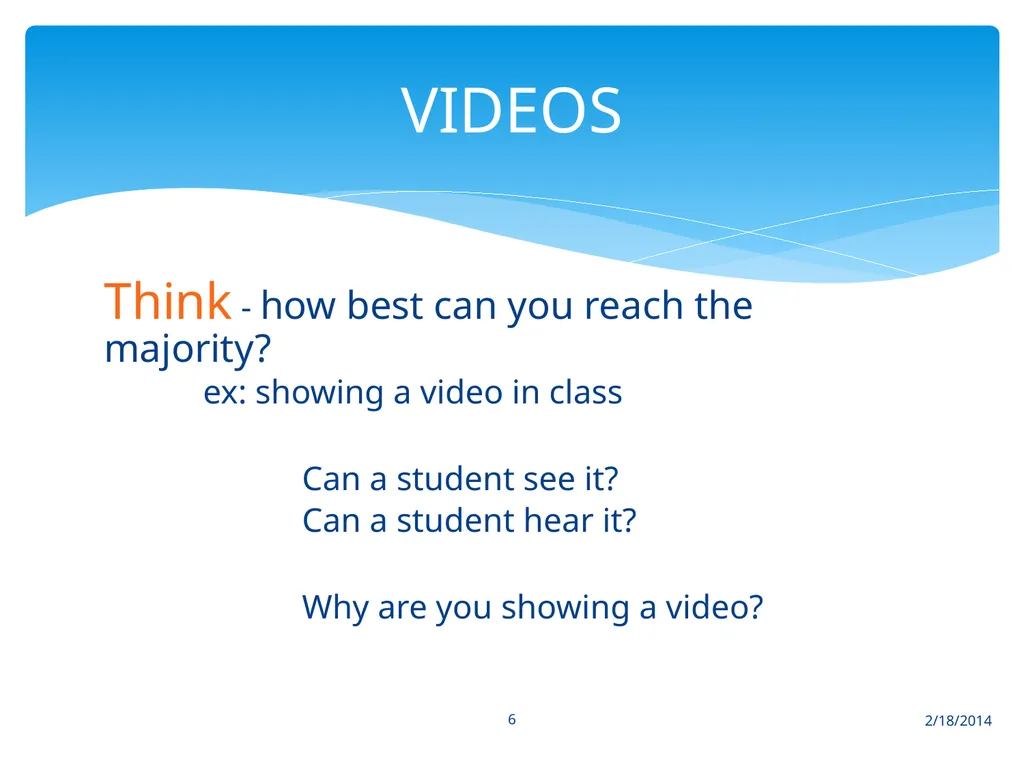
slide6. Think - how best can you reach the majority?
ex: showing a video in class
Can a student see it?
Can a student hear it?
Why are you showing a video? VIDEOS 2/18/2014 6<br>
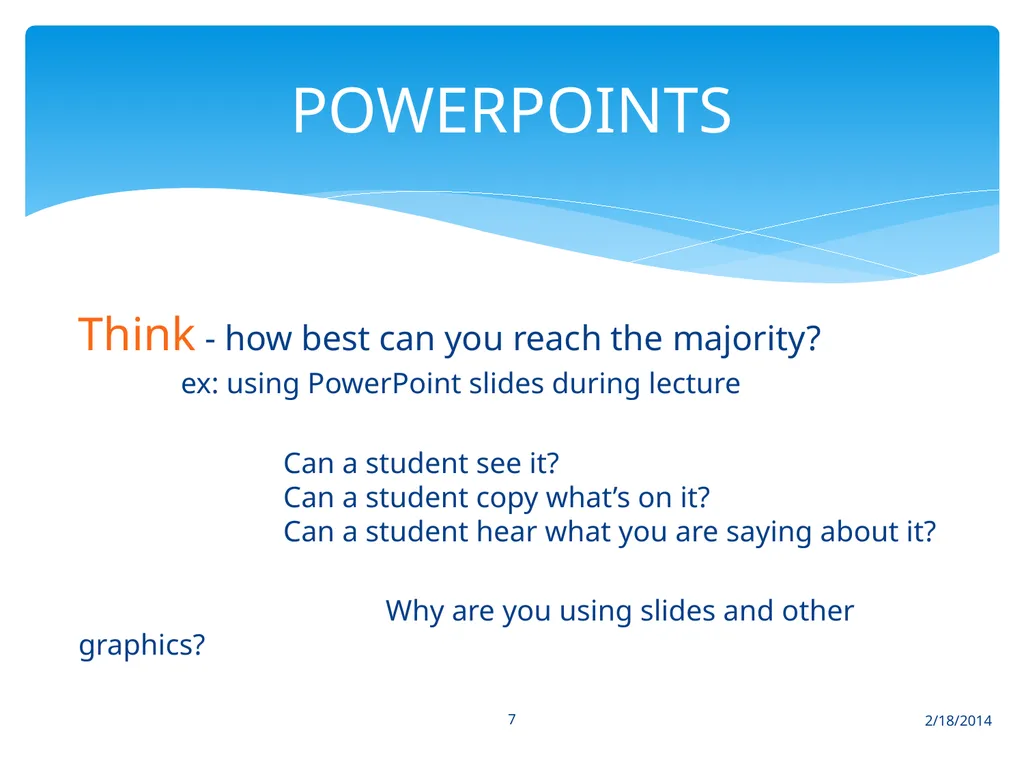
slide7. Think - how best can you reach the majority?
ex: using PowerPoint slides during lecture
Can a student see it? Can a student copy what’s on it? Can a student hear what you are saying about it?
Why are you using slides and other graphics? POWERPOINTS 2/18/2014 7<br>
slide8. Think - how best can you reach the majority?
ex: lecture without transparencies and other projections
Can a student write what you are saying? Can a student hear what you are saying?
How can lecture in and of itself promote learning? LECTURE WITHOUT AIDS 2/18/2014 8<br>
slide9. Think - how best can you reach the majority?
ex: clickers
Can a student hold the clickers? Can a student read the questions projected to answer?
How can clickers promote learning? CLICKERS 2/18/2014 9<br>
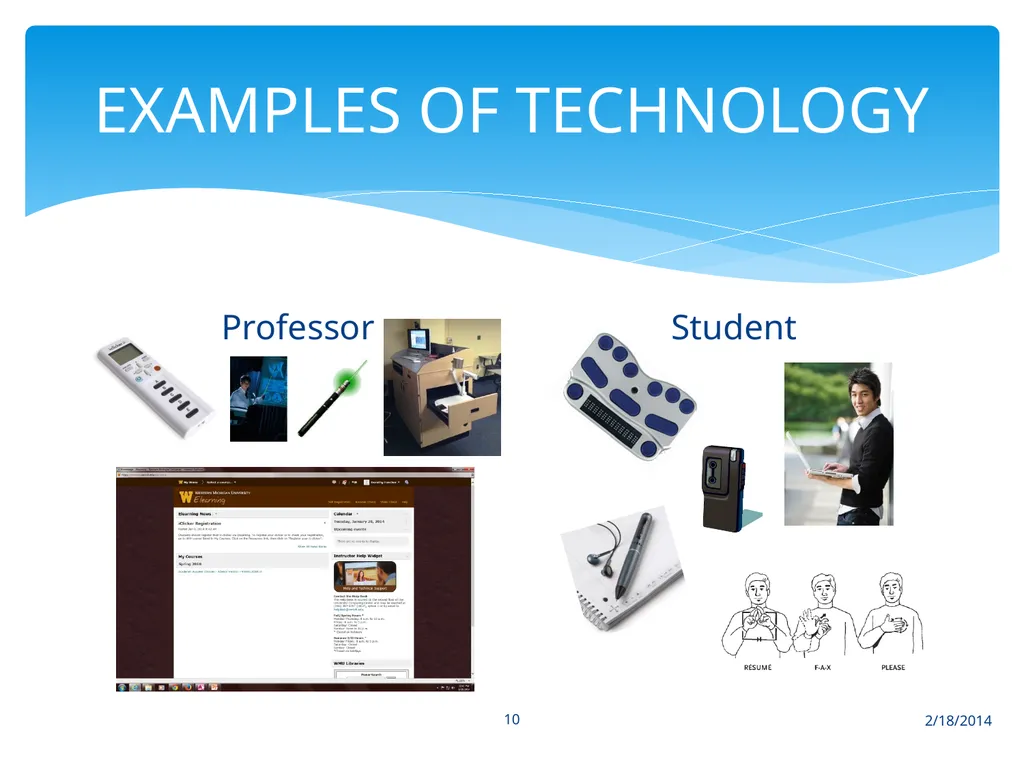
slide10. 2/18/2014 Student 10 Professor EXAMPLES OF TECHNOLOGY<br>
slide11. Types of assistive technology
reading writing
Voice Over (MAC) JAWS
Natural Reader (PC & MAC) Dragon (PC, MAC, Ipads, Iphones, etc)
JAWS (PC) Braille Note
Read & Write Gold (PC)
hearing
Audio Note (Apple products) Livescribe Smart Pen (can connect to PC & Apple) CART ASSISTIVE TECHNOLOGY 2/18/2014 11<br>
slide12. ADAPT
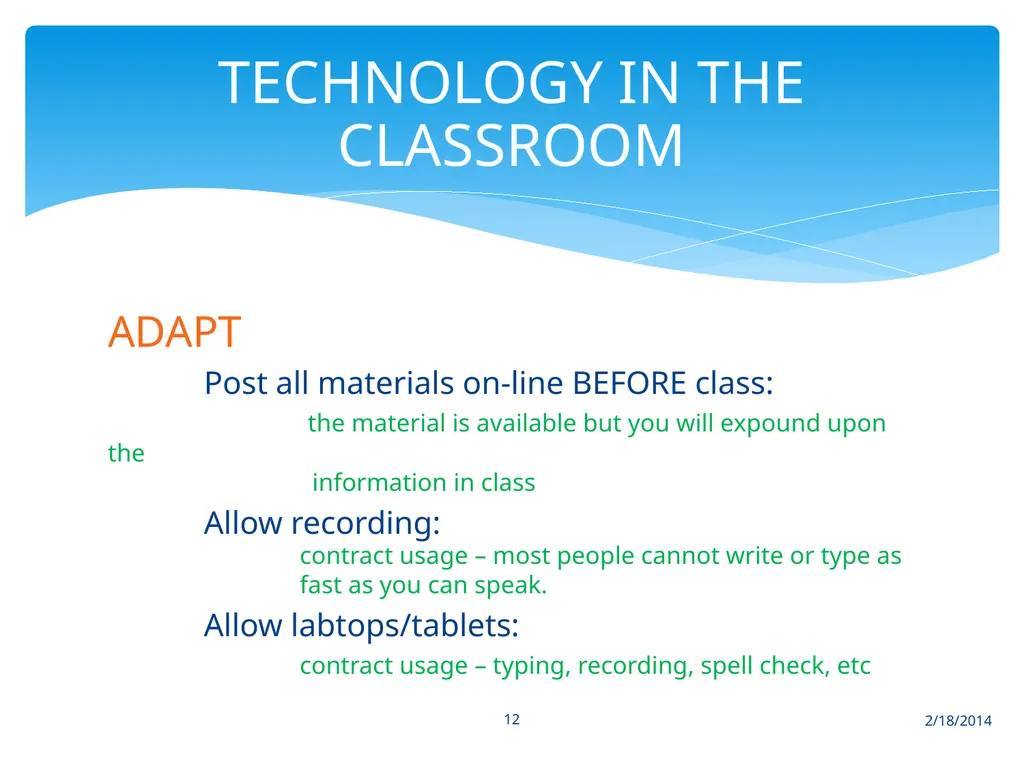
Post all materials on-line BEFORE class: the material is available but you will expound upon the information in class
Allow recording: contract usage – most people cannot write or type as fast as you can speak.
Allow labtops/tablets: contract usage – typing, recording, spell check, etc TECHNOLOGY IN THE CLASSROOM 2/18/2014 12<br>
slide13. ADAPT
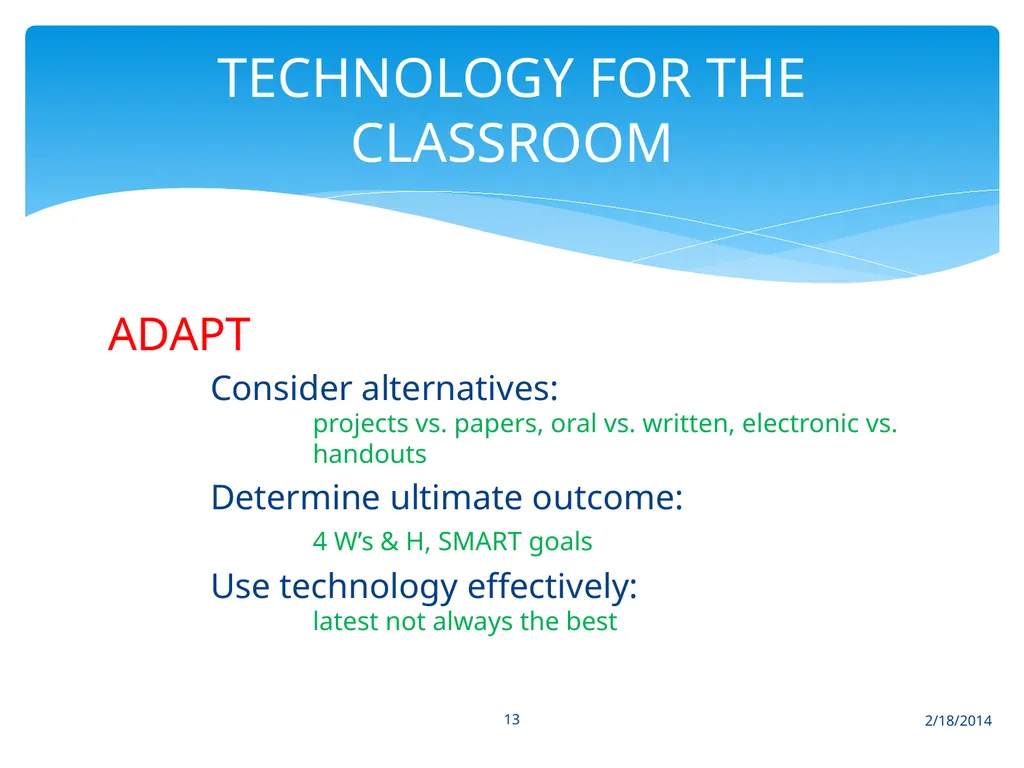
Consider alternatives: projects vs. papers, oral vs. written, electronic vs. handouts
Determine ultimate outcome: 4 W’s & H, SMART goals
Use technology effectively: latest not always the best TECHNOLOGY FOR THE CLASSROOM 2/18/2014 13<br>
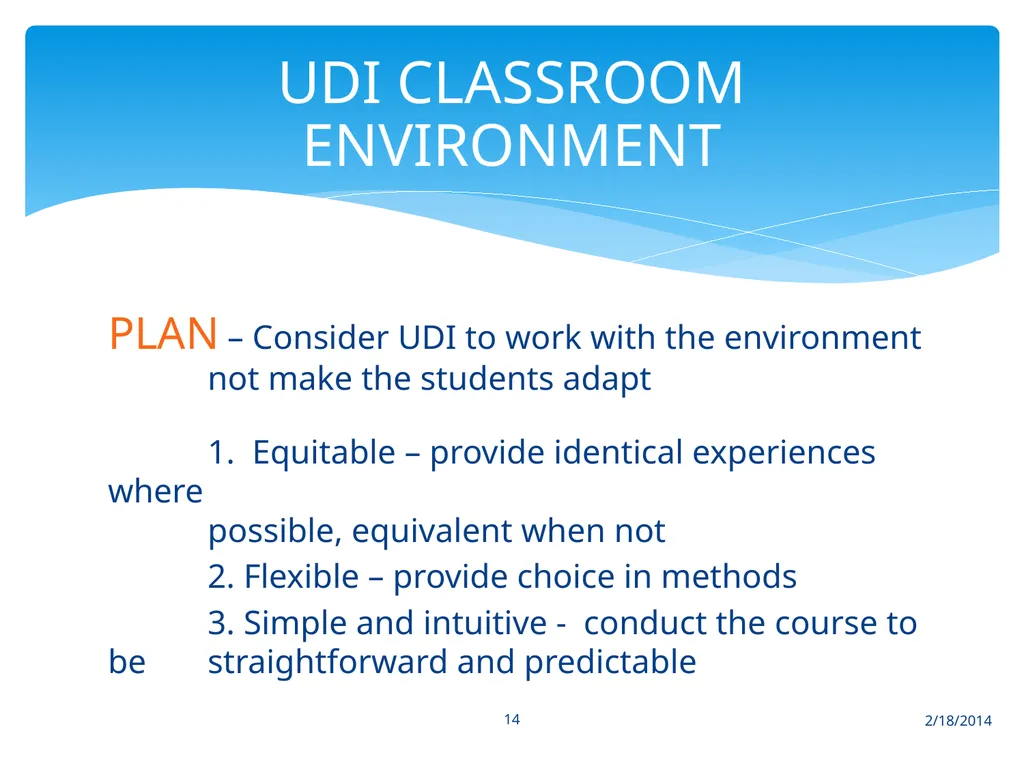
slide14. PLAN – Consider UDI to work with the environment not make the students adapt
1. Equitable – provide identical experiences where possible, equivalent when not
2. Flexible – provide choice in methods
3. Simple and intuitive - conduct the course to be straightforward and predictable UDI CLASSROOM ENVIRONMENT 2/18/2014 14<br>
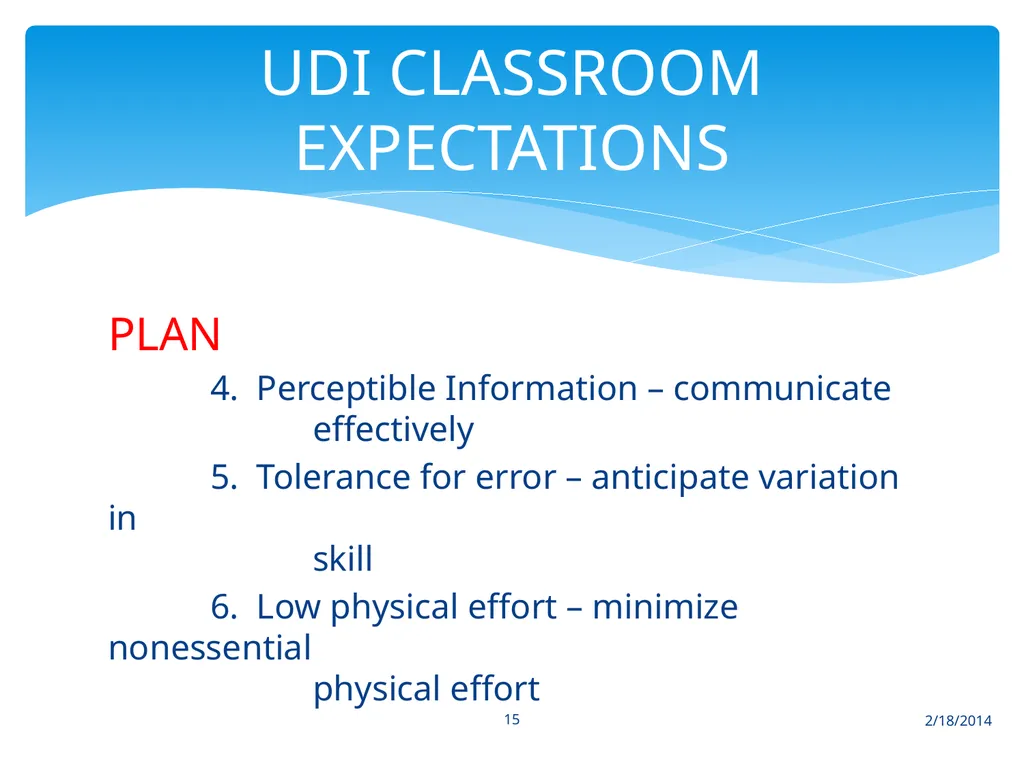
slide15. PLAN
4. Perceptible Information – communicate effectively
5. Tolerance for error – anticipate variation in skill
6. Low physical effort – minimize nonessential physical effort UDI CLASSROOM EXPECTATIONS 2/18/2014 15<br>
slide16. PLAN
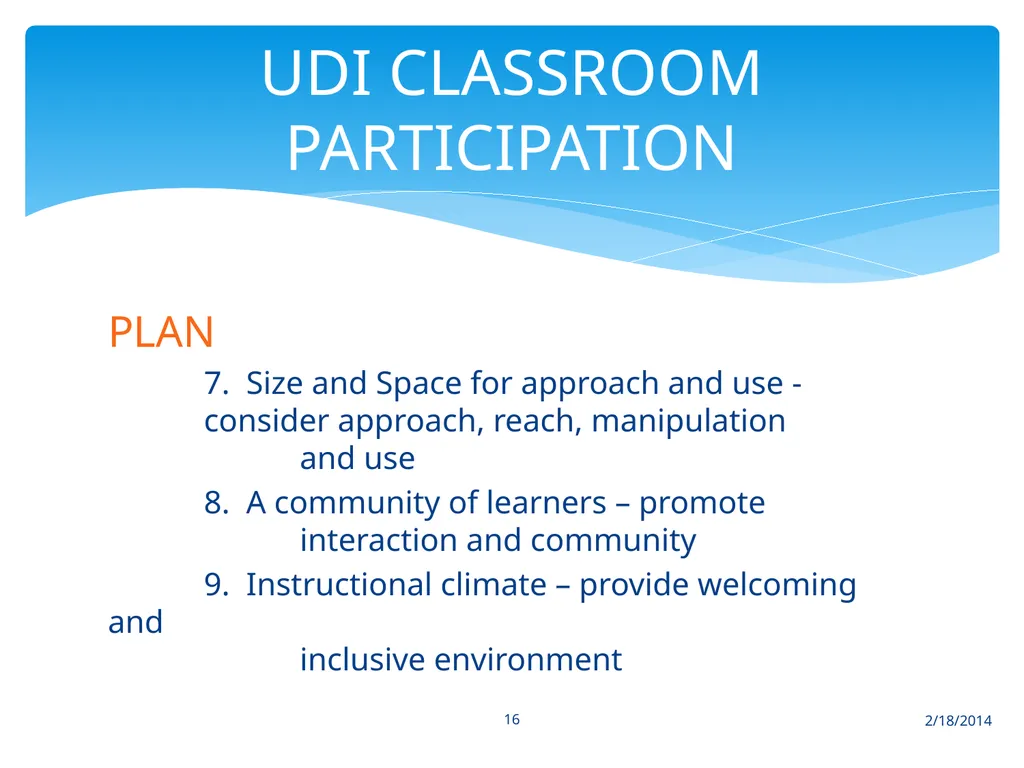
7. Size and Space for approach and use - consider approach, reach, manipulation and use
8. A community of learners – promote interaction and community
9. Instructional climate – provide welcoming and inclusive environment UDI CLASSROOM PARTICIPATION 2/18/2014 16<br>
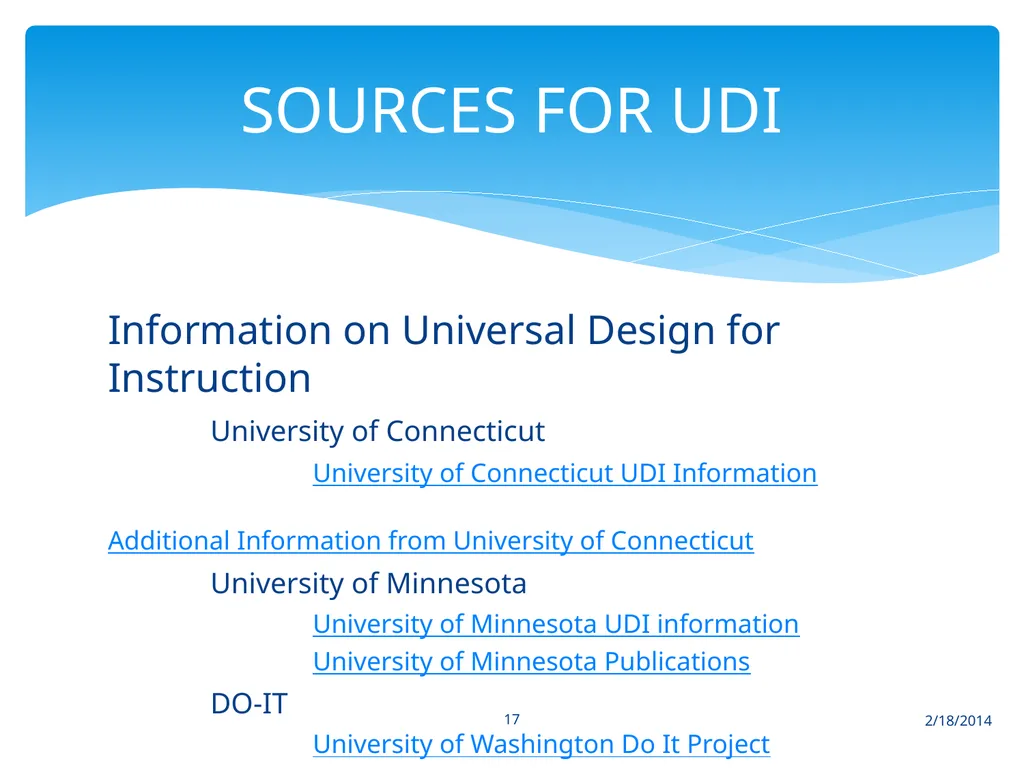
slide17. Information on Universal Design for Instruction
University of Connecticut
University of Connecticut UDI Information
Additional Information from University of Connecticut
University of Minnesota
University of Minnesota UDI information
University of Minnesota Publications
DO-IT
University of Washington Do It Project SOURCES FOR UDI 2/18/2014 17<br>
slide18. 2/18/2014 18 screen holder<br>
slide2. TEACHING WITH TECHNOLOGY Good fortune or misfortune 2/18/2014 2<br>
slide3. THE FORTUNATE:
multiple teaching styles no longer strictly lecture: sound, images, global aspects, learning outside of classroom
multiple classroom enhancements
media centers, “clickers,” Internet access
multiple communication access e-learning, email, on-line forums, course websites Pros 2/18/2014 3<br>
slide4. THE MISFORTUNATE:
limited learning styles
not all can see, hear, write, sit, touch or speak to adapt to how information is presented restrictions by classroom enhancements
technologies are not compatible, access to information denied or limited
limited or miscommunication access
cannot access e-learning, webmail, forums CONS 2/18/2014 4<br>
slide5. How then, can effective teaching:
Blend with,
Add to
Comply with
Support
effective learning? BLENDINIG TECHNOLOGY 2/18/2014 5<br>
slide6. Think - how best can you reach the majority?
ex: showing a video in class
Can a student see it?
Can a student hear it?
Why are you showing a video? VIDEOS 2/18/2014 6<br>
slide7. Think - how best can you reach the majority?
ex: using PowerPoint slides during lecture
Can a student see it? Can a student copy what’s on it? Can a student hear what you are saying about it?
Why are you using slides and other graphics? POWERPOINTS 2/18/2014 7<br>
slide8. Think - how best can you reach the majority?
ex: lecture without transparencies and other projections
Can a student write what you are saying? Can a student hear what you are saying?
How can lecture in and of itself promote learning? LECTURE WITHOUT AIDS 2/18/2014 8<br>
slide9. Think - how best can you reach the majority?
ex: clickers
Can a student hold the clickers? Can a student read the questions projected to answer?
How can clickers promote learning? CLICKERS 2/18/2014 9<br>
slide10. 2/18/2014 Student 10 Professor EXAMPLES OF TECHNOLOGY<br>
slide11. Types of assistive technology
reading writing
Voice Over (MAC) JAWS
Natural Reader (PC & MAC) Dragon (PC, MAC, Ipads, Iphones, etc)
JAWS (PC) Braille Note
Read & Write Gold (PC)
hearing
Audio Note (Apple products) Livescribe Smart Pen (can connect to PC & Apple) CART ASSISTIVE TECHNOLOGY 2/18/2014 11<br>
slide12. ADAPT
Post all materials on-line BEFORE class: the material is available but you will expound upon the information in class
Allow recording: contract usage – most people cannot write or type as fast as you can speak.
Allow labtops/tablets: contract usage – typing, recording, spell check, etc TECHNOLOGY IN THE CLASSROOM 2/18/2014 12<br>
slide13. ADAPT
Consider alternatives: projects vs. papers, oral vs. written, electronic vs. handouts
Determine ultimate outcome: 4 W’s & H, SMART goals
Use technology effectively: latest not always the best TECHNOLOGY FOR THE CLASSROOM 2/18/2014 13<br>
slide14. PLAN – Consider UDI to work with the environment not make the students adapt
1. Equitable – provide identical experiences where possible, equivalent when not
2. Flexible – provide choice in methods
3. Simple and intuitive - conduct the course to be straightforward and predictable UDI CLASSROOM ENVIRONMENT 2/18/2014 14<br>
slide15. PLAN
4. Perceptible Information – communicate effectively
5. Tolerance for error – anticipate variation in skill
6. Low physical effort – minimize nonessential physical effort UDI CLASSROOM EXPECTATIONS 2/18/2014 15<br>
slide16. PLAN
7. Size and Space for approach and use - consider approach, reach, manipulation and use
8. A community of learners – promote interaction and community
9. Instructional climate – provide welcoming and inclusive environment UDI CLASSROOM PARTICIPATION 2/18/2014 16<br>
slide17. Information on Universal Design for Instruction
University of Connecticut
University of Connecticut UDI Information
Additional Information from University of Connecticut
University of Minnesota
University of Minnesota UDI information
University of Minnesota Publications
DO-IT
University of Washington Do It Project SOURCES FOR UDI 2/18/2014 17<br>
slide18. 2/18/2014 18 screen holder<br>