2. Three-Phase Power. 1 Prof. Mack Grady, TAMU Relay Conference Tutorial, Topic 2, March 31, 2015 Instantaneous power p(t) flowing into the box, Circuit in a box, four-wires For a balanced system, Combining terms, Trig. identity yields 2
"2. Three-Phase Power. 1 Prof. Mack Grady, TAMU" is the property of its rightful owner. Permission is granted to
download and print the materials on this website for personal, non-commercial use only, and to display it
on your personal computer provided you do not modify the materials and that you retain all copyright
notices contained in the materials. By downloading content from our website, you accept the terms of this
agreement.
Presentation Transcript
01
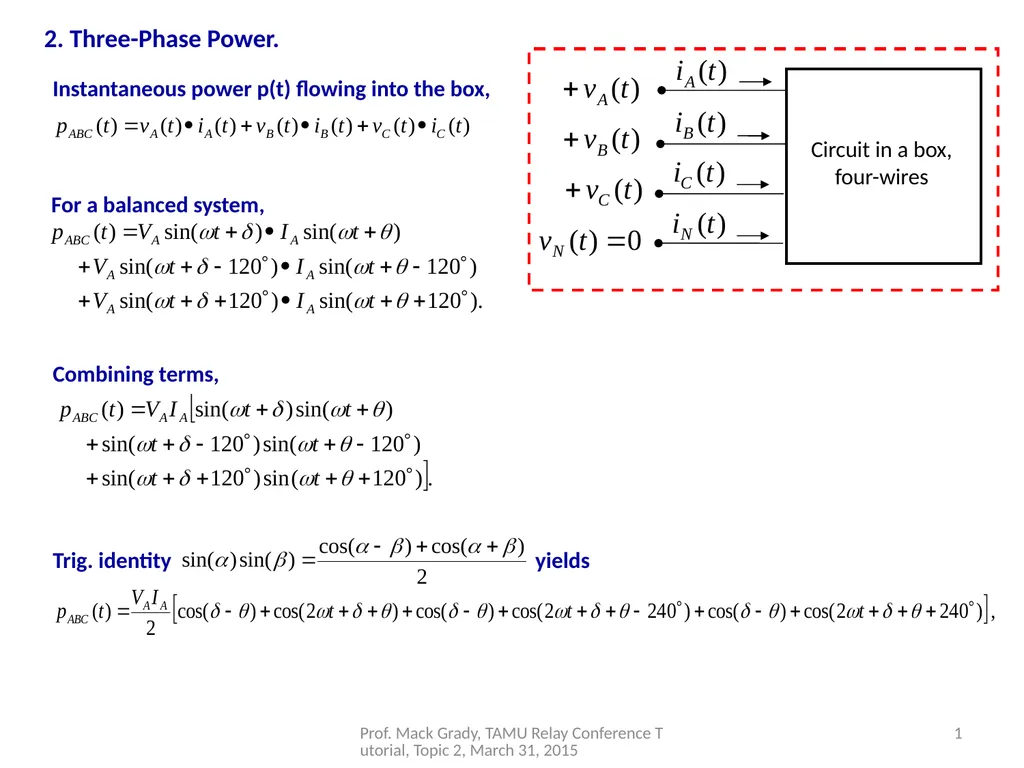
2. Three-Phase Power. 1 Prof. Mack Grady, TAMU Relay Conference Tutorial, Topic 2, March 31, 2015 Instantaneous power p(t) flowing into the box, Circuit in a box, four-wires For a balanced system, Combining terms, Trig. identity yields<br>
02
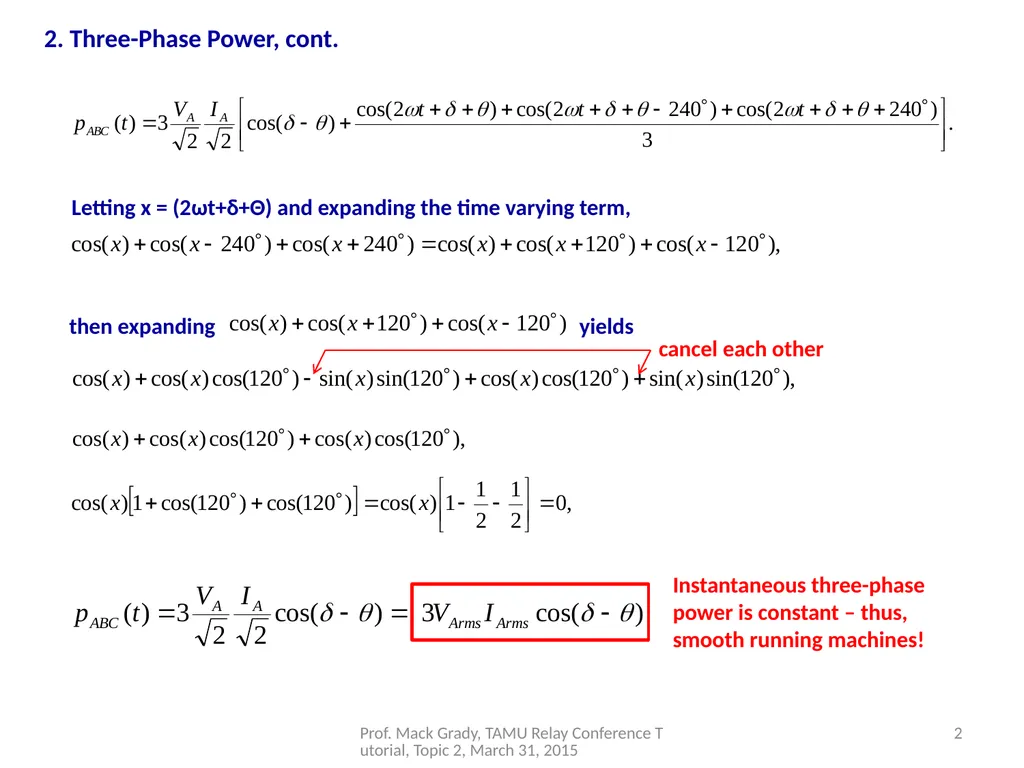
2 Prof. Mack Grady, TAMU Relay Conference Tutorial, Topic 2, March 31, 2015 then expanding yields cancel each other Instantaneous three-phase power is constant – thus, smooth running machines! 2. Three-Phase Power, cont. Letting x = (2ωt+δ+Θ) and expanding the time varying term,<br>
03
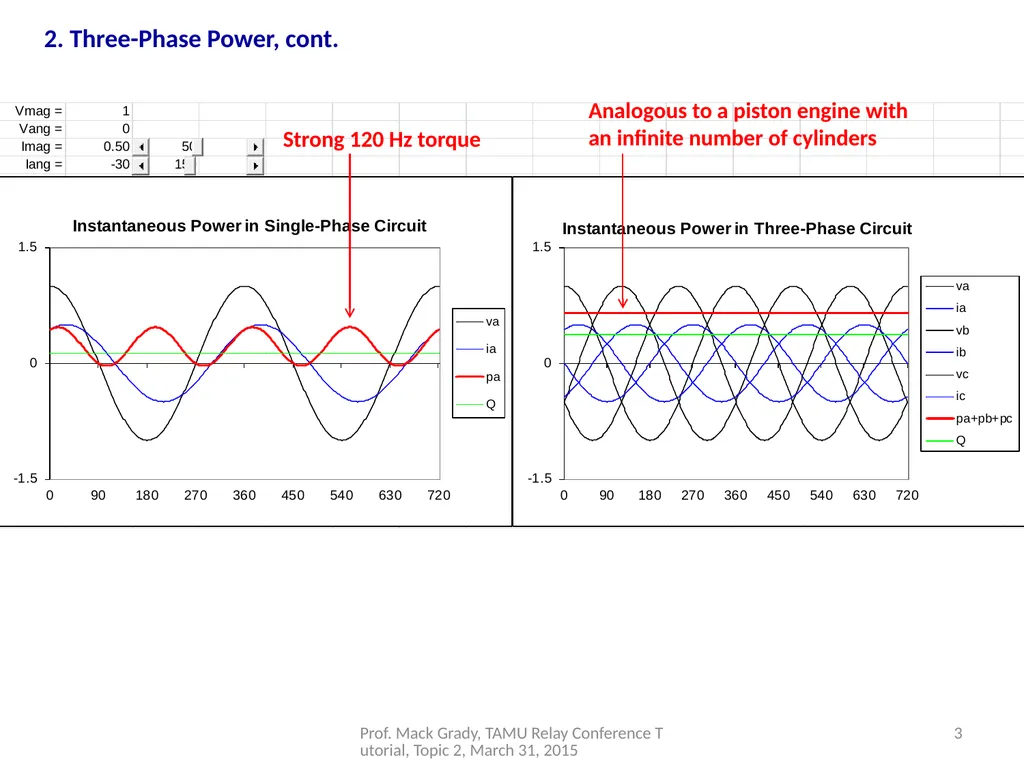
3 Prof. Mack Grady, TAMU Relay Conference Tutorial, Topic 2, March 31, 2015 2. Three-Phase Power, cont. Analogous to a piston engine with an infinite number of cylinders Strong 120 Hz torque<br>
04
Prof. Mack Grady, TAMU Relay Conference Tutorial, Topic 2, March 31, 2015 4 2. Three-Phase Power, cont.<br>
05
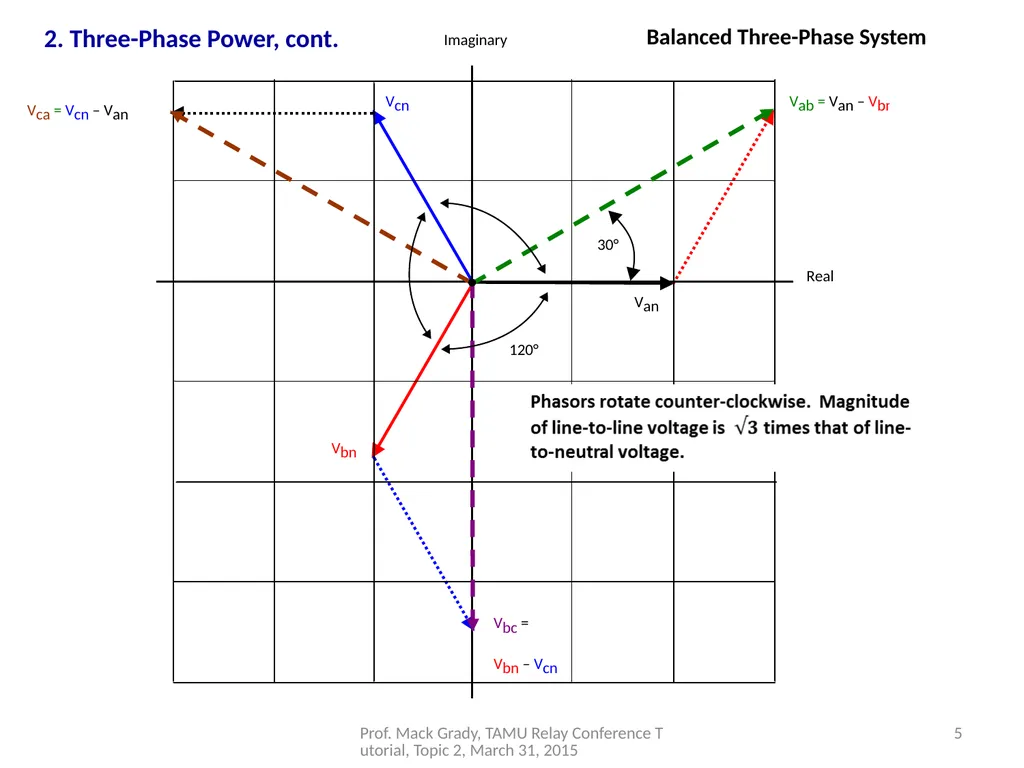
Prof. Mack Grady, TAMU Relay Conference Tutorial, Topic 2, March 31, 2015 5 2. Three-Phase Power, cont. Balanced Three-Phase System<br>
06
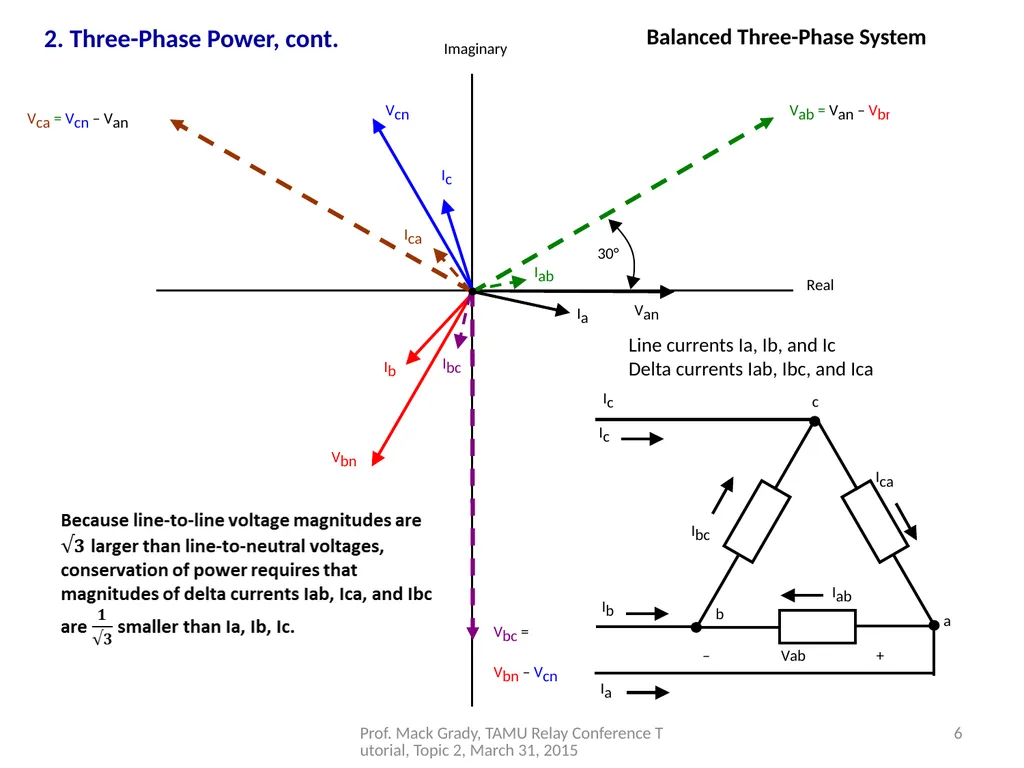
Prof. Mack Grady, TAMU Relay Conference Tutorial, Topic 2, March 31, 2015 6 2. Three-Phase Power, cont. Line currents Ia, Ib, and Ic
Delta currents Iab, Ibc, and Ica Balanced Three-Phase System<br>
07
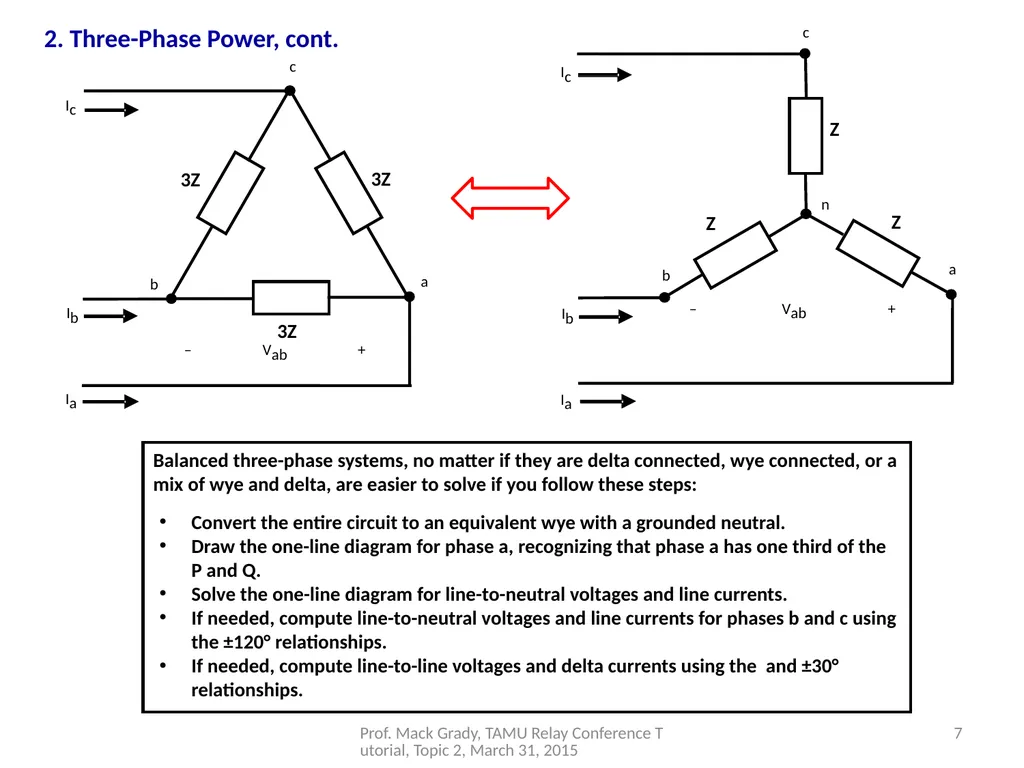
Prof. Mack Grady, TAMU Relay Conference Tutorial, Topic 2, March 31, 2015 7 Balanced three-phase systems, no matter if they are delta connected, wye connected, or a mix of wye and delta, are easier to solve if you follow these steps:
Convert the entire circuit to an equivalent wye with a grounded neutral.
Draw the one-line diagram for phase a, recognizing that phase a has one third of the P and Q.
Solve the one-line diagram for line-to-neutral voltages and line currents.
If needed, compute line-to-neutral voltages and line currents for phases b and c using the ±120° relationships.
If needed, compute line-to-line voltages and delta currents using the and ±30° relationships. 2. Three-Phase Power, cont.<br>
08
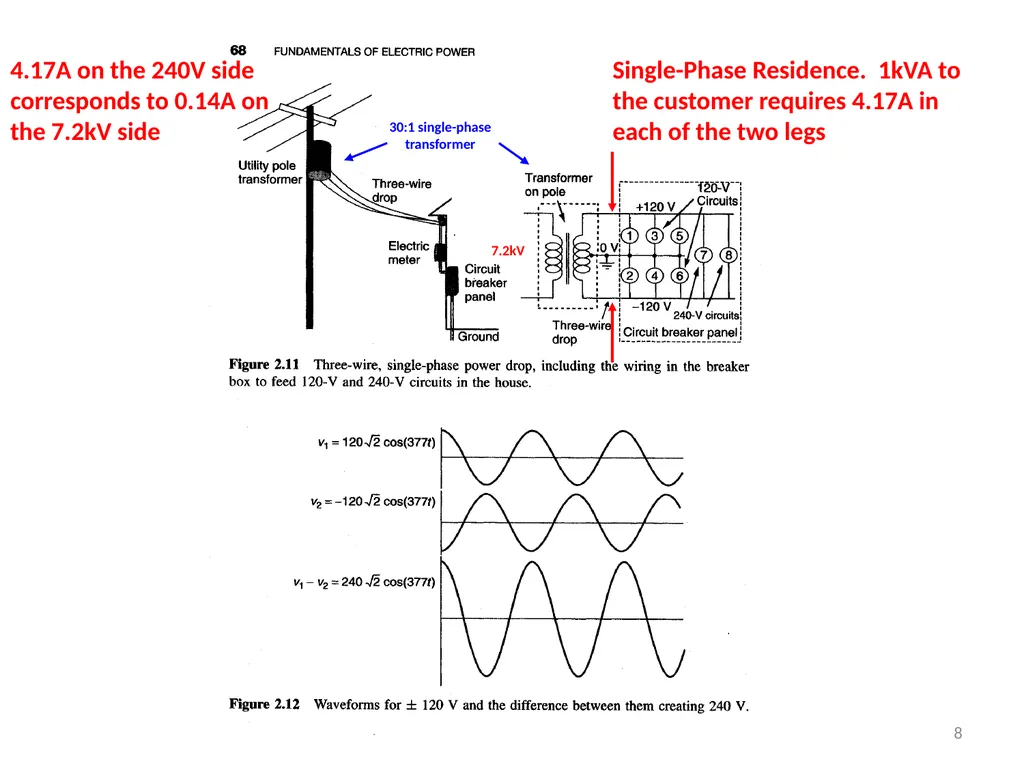
8 Single-Phase Residence. 1kVA to the customer requires 4.17A in each of the two legs 7.2kV 30:1 single-phase transformer 4.17A on the 240V side corresponds to 0.14A on the 7.2kV side<br>
09
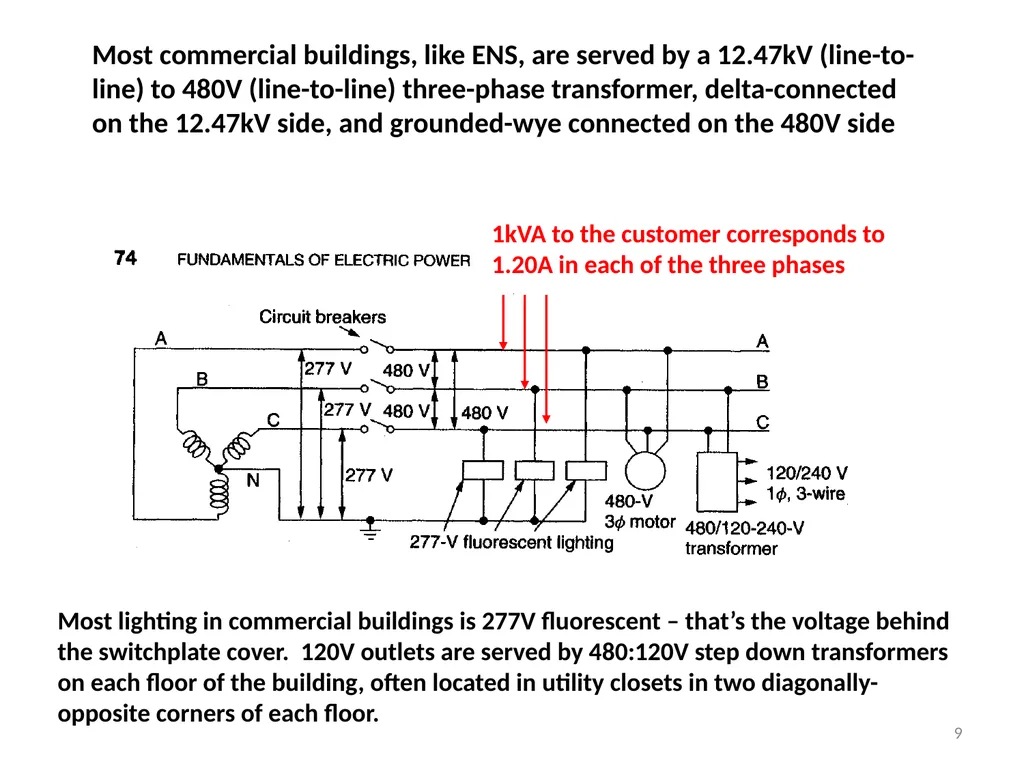
9 1kVA to the customer corresponds to 1.20A in each of the three phases Most commercial buildings, like ENS, are served by a 12.47kV (line-to-line) to 480V (line-to-line) three-phase transformer, delta-connected on the 12.47kV side, and grounded-wye connected on the 480V side Most lighting in commercial buildings is 277V fluorescent – that’s the voltage behind the switchplate cover. 120V outlets are served by 480:120V step down transformers on each floor of the building, often located in utility closets in two diagonally-opposite corners of each floor.<br>