
2015 Progress Report for OE ARRA Smart Grid
MS
Published · 37 slides · 0 views
1 / 1
Description
2015 Progress Report for OE ARRA Smart Grid Demonstration Program Aggregation of RDSI, SGDP, and SGIG Results U.S. Department of Energy National Energy Technology Laboratory May 2015 Table of Contents Smart Grid Business Case Analysis May
Related Topics
Share
Embed code
Download this presentation From Below
"2015 Progress Report for OE ARRA Smart Grid" is the property of its rightful owner. Permission is granted to download and print the materials on this website for personal, non-commercial use only, and to display it on your personal computer provided you do not modify the materials and that you retain all copyright notices contained in the materials. By downloading content from our website, you accept the terms of this agreement.
Presentation Transcript
01
2015 Progress Report for OE ARRA Smart Grid Demonstration Program
Aggregation of RDSI, SGDP, and SGIG Results U.S. Department of Energy
National Energy Technology Laboratory May 2015<br>
Aggregation of RDSI, SGDP, and SGIG Results U.S. Department of Energy
National Energy Technology Laboratory May 2015<br>
02
Table of Contents Smart Grid Business Case Analysis – May 2015 This presentation will show the key takeaways from the 2015 Progress Report for OE ARRA Smart Grid Demonstration Program<br>
03
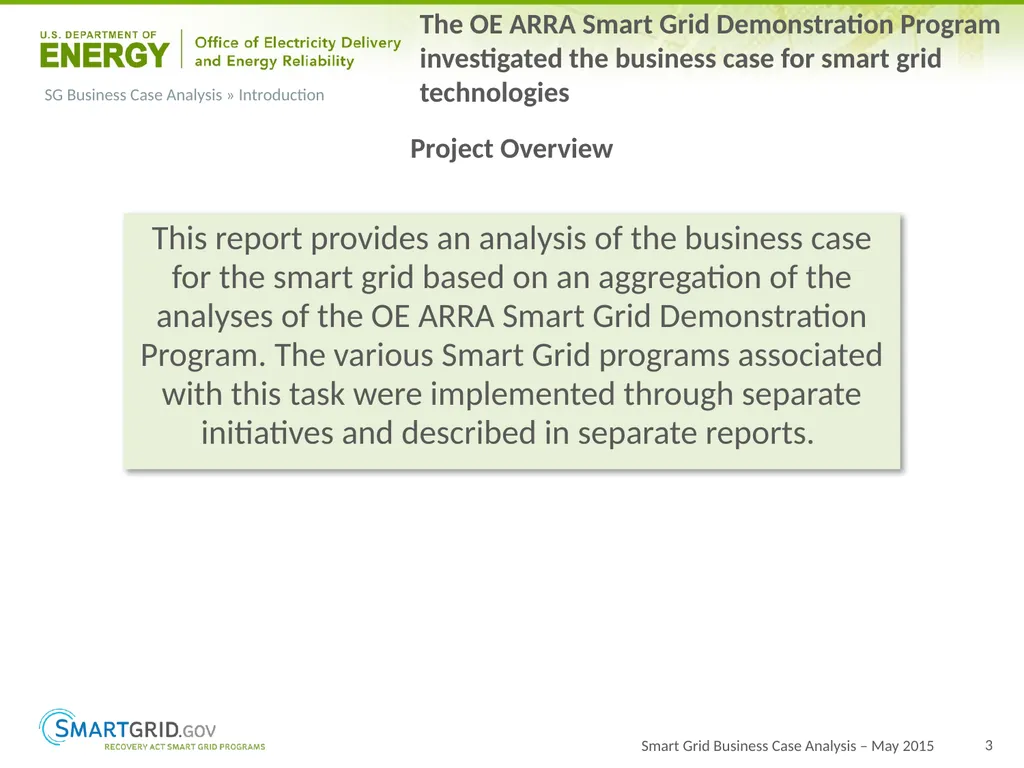
SG Business Case Analysis » Introduction The OE ARRA Smart Grid Demonstration Program investigated the business case for smart grid technologies This report provides an analysis of the business case for the smart grid based on an aggregation of the analyses of the OE ARRA Smart Grid Demonstration Program. The various Smart Grid programs associated with this task were implemented through separate initiatives and described in separate reports. Smart Grid Business Case Analysis – May 2015 Project Overview<br>
04
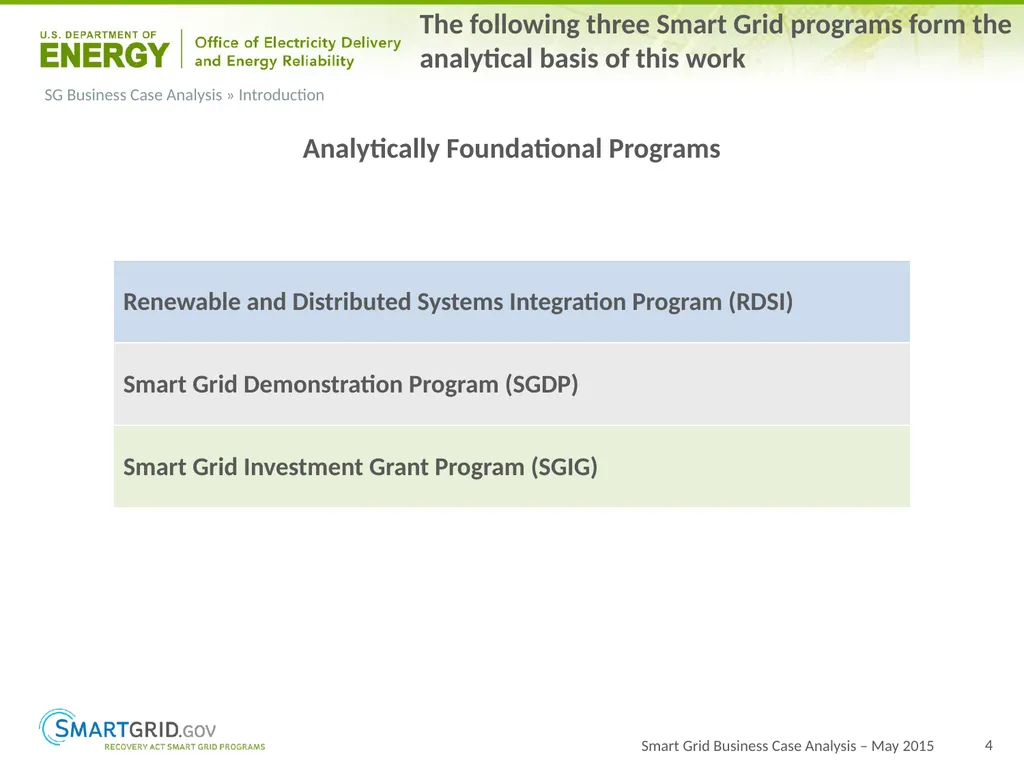
SG Business Case Analysis » Introduction The following three Smart Grid programs form the analytical basis of this work Smart Grid Business Case Analysis – May 2015 Analytically Foundational Programs<br>
05
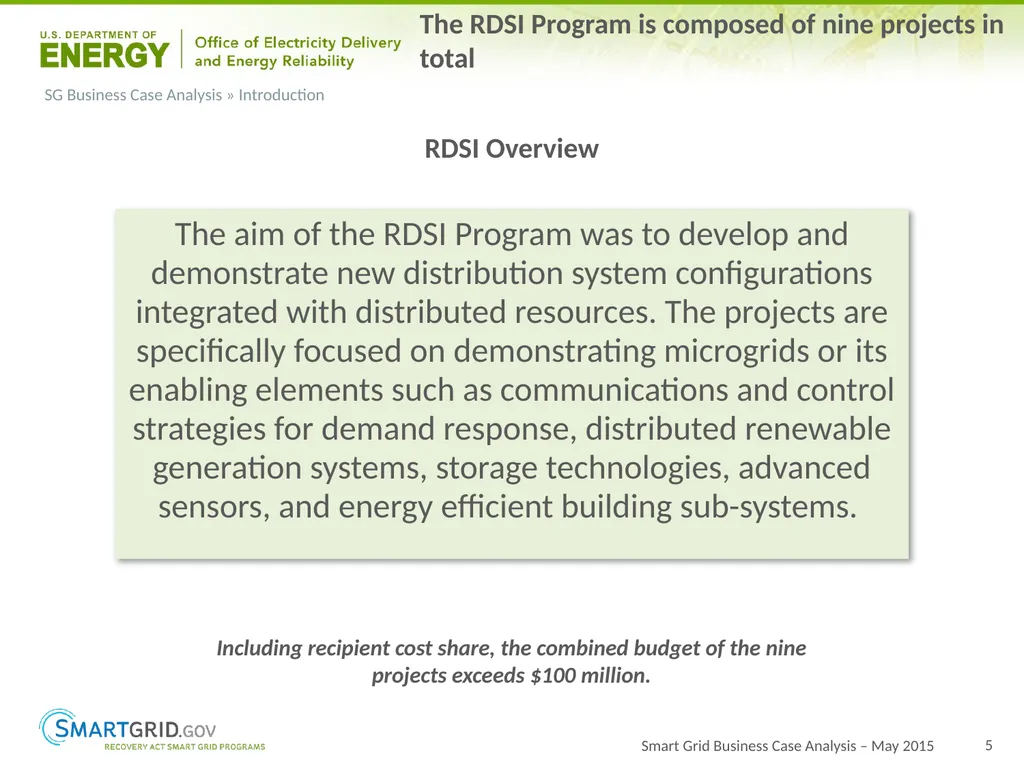
SG Business Case Analysis » Introduction The RDSI Program is composed of nine projects in total The aim of the RDSI Program was to develop and demonstrate new distribution system configurations integrated with distributed resources. The projects are specifically focused on demonstrating microgrids or its enabling elements such as communications and control strategies for demand response, distributed renewable generation systems, storage technologies, advanced sensors, and energy efficient building sub-systems. Including recipient cost share, the combined budget of the nine projects exceeds $100 million. Smart Grid Business Case Analysis – May 2015 RDSI Overview<br>
06
SG Business Case Analysis » Introduction The SGDP includes many more, rounding out at 32 projects total The aim of the SGDP was to demonstrate new and more cost-effective smart grid technologies, tools, techniques, and system configurations that significantly improve on the ones commonly used today. Smart Grid Business Case Analysis – May 2015 SGDP Overview<br>
07
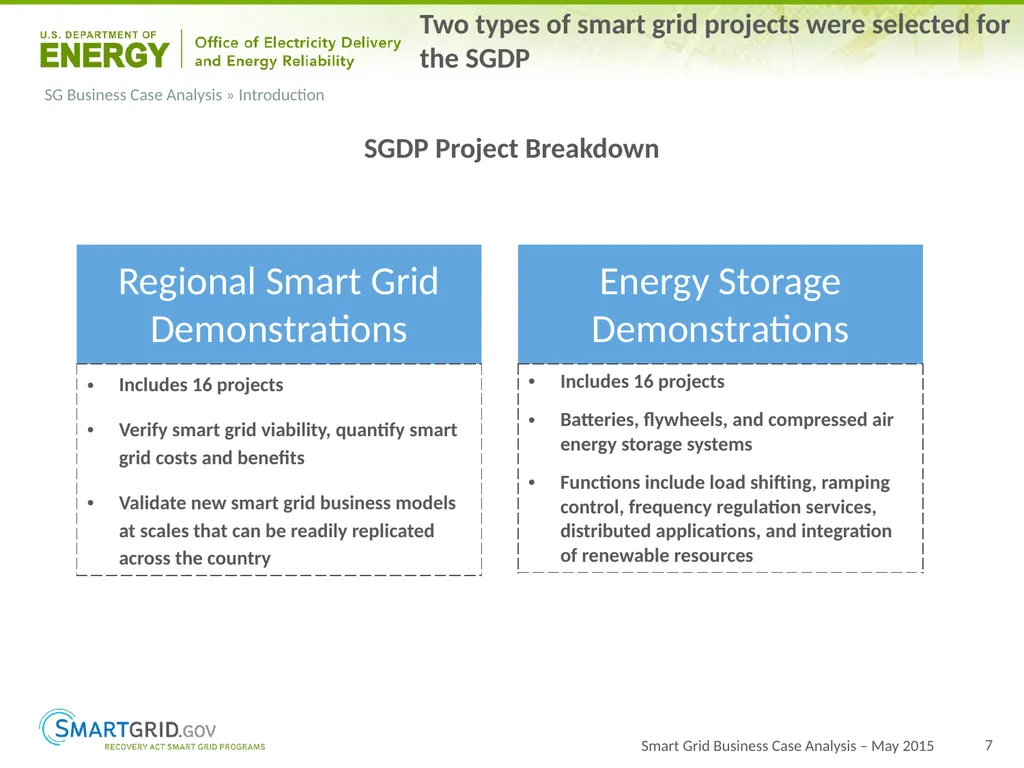
SG Business Case Analysis » Introduction Two types of smart grid projects were selected for the SGDP Smart Grid Business Case Analysis – May 2015 SGDP Project Breakdown Regional Smart Grid Demonstrations Energy Storage Demonstrations<br>
08
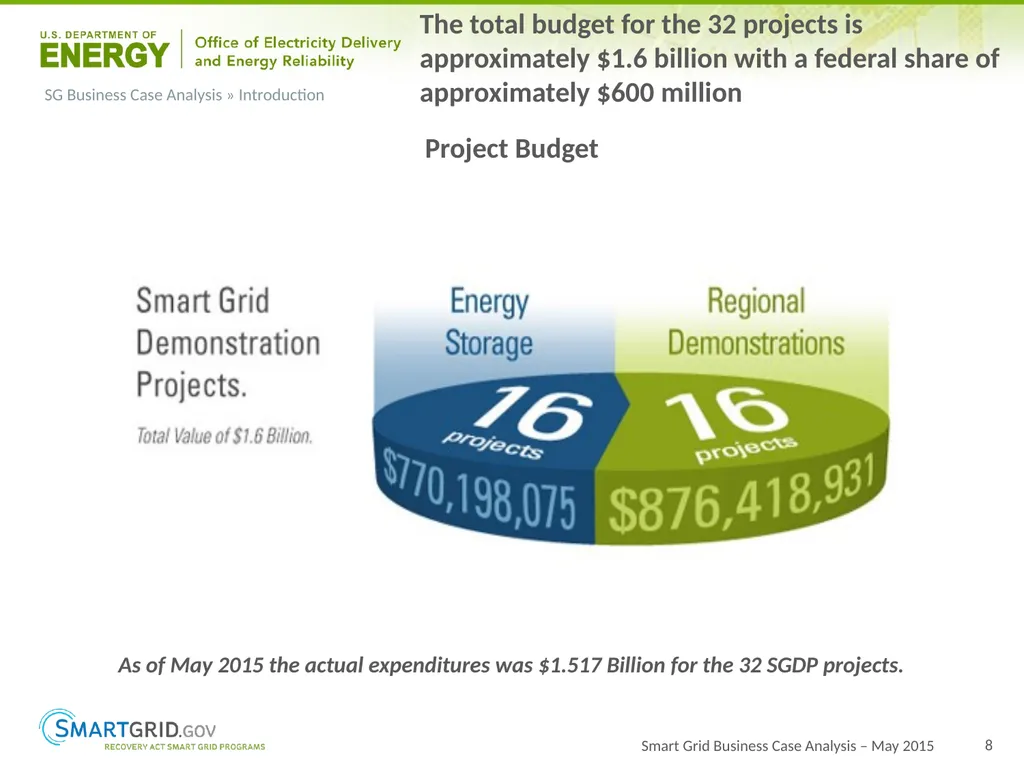
SG Business Case Analysis » Introduction The total budget for the 32 projects is approximately $1.6 billion with a federal share of approximately $600 million As of May 2015 the actual expenditures was $1.517 Billion for the 32 SGDP projects. Smart Grid Business Case Analysis – May 2015 Project Budget<br>
09
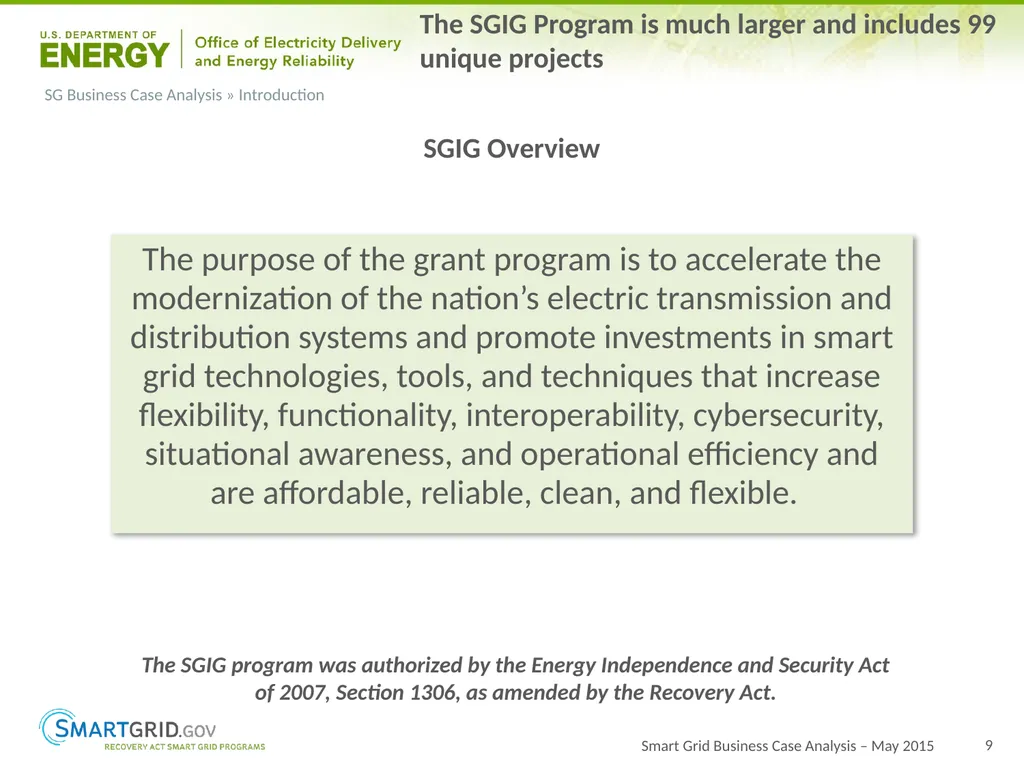
Smart Grid Business Case Analysis – May 2015 The SGIG Program is much larger and includes 99 unique projects The purpose of the grant program is to accelerate the modernization of the nation’s electric transmission and distribution systems and promote investments in smart grid technologies, tools, and techniques that increase flexibility, functionality, interoperability, cybersecurity, situational awareness, and operational efficiency and are affordable, reliable, clean, and flexible. The SGIG program was authorized by the Energy Independence and Security Act of 2007, Section 1306, as amended by the Recovery Act. SGIG Overview SG Business Case Analysis » Introduction<br>
10
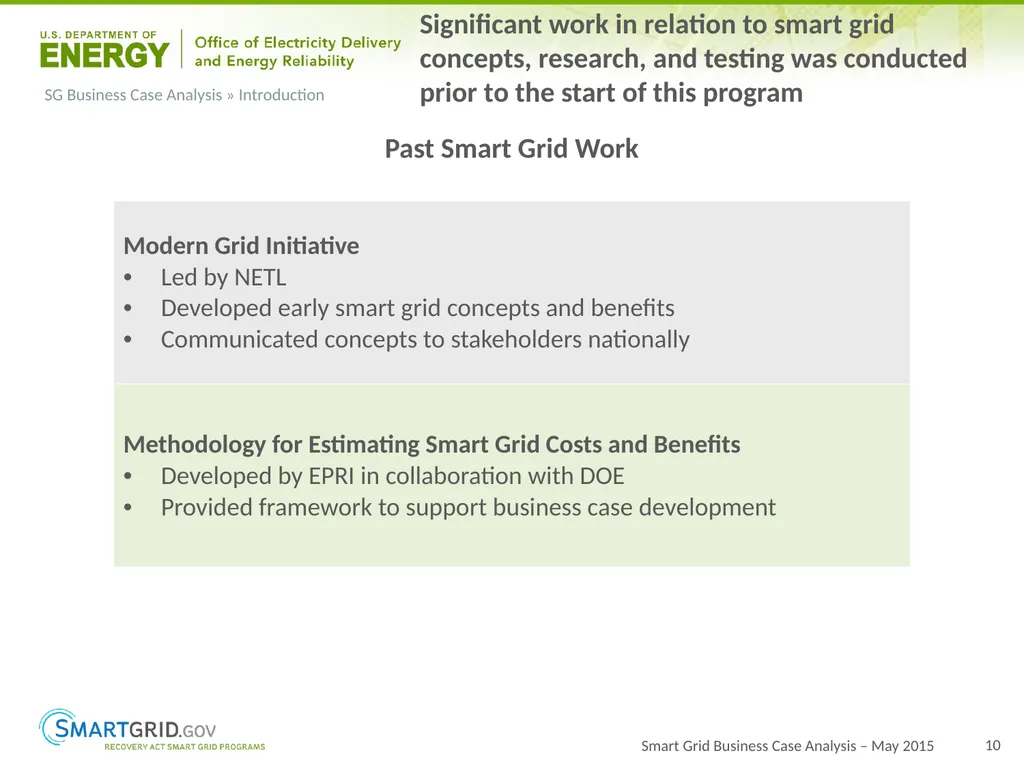
SG Business Case Analysis » Introduction Significant work in relation to smart grid concepts, research, and testing was conducted prior to the start of this program Smart Grid Business Case Analysis – May 2015 Past Smart Grid Work<br>
11
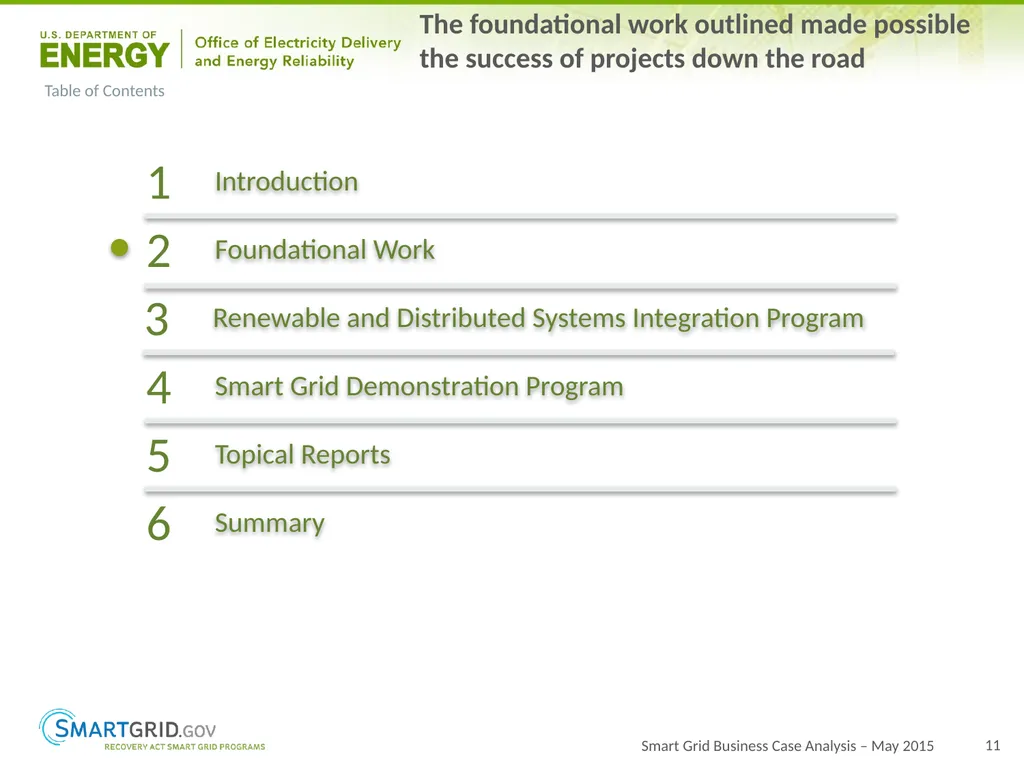
Table of Contents Smart Grid Business Case Analysis – May 2015 The foundational work outlined made possible the success of projects down the road<br>
12
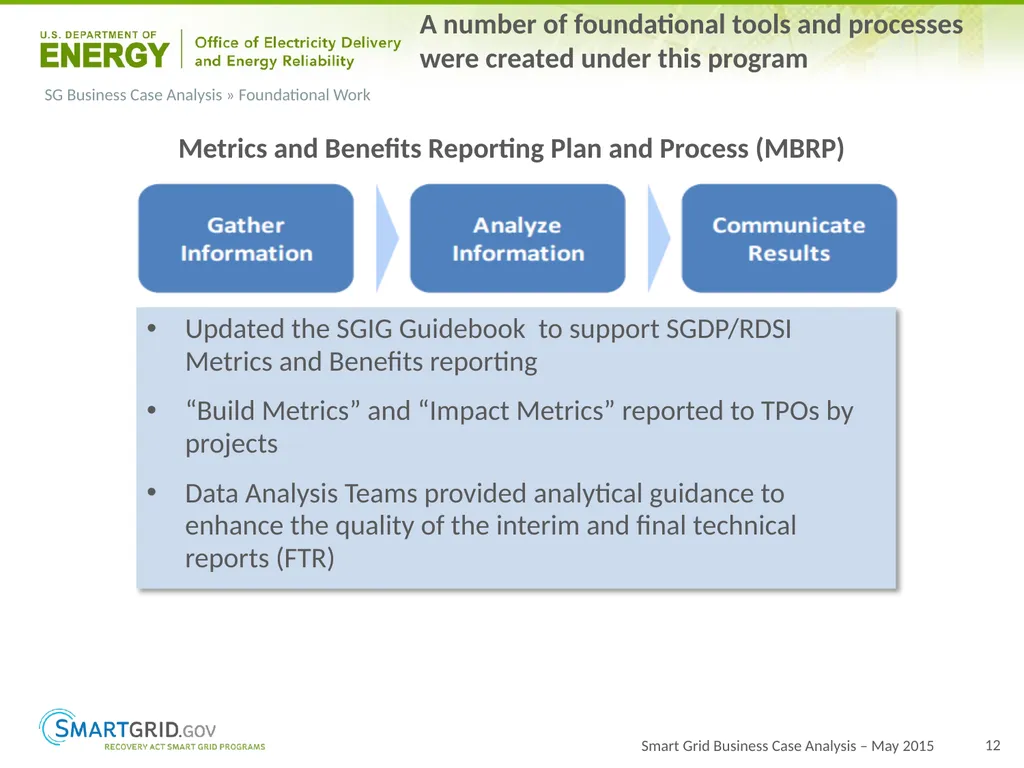
SG Business Case Analysis » Foundational Work A number of foundational tools and processes were created under this program Updated the SGIG Guidebook to support SGDP/RDSI Metrics and Benefits reporting
“Build Metrics” and “Impact Metrics” reported to TPOs by projects
Data Analysis Teams provided analytical guidance to enhance the quality of the interim and final technical reports (FTR) Smart Grid Business Case Analysis – May 2015 Metrics and Benefits Reporting Plan and Process (MBRP)<br>
“Build Metrics” and “Impact Metrics” reported to TPOs by projects
Data Analysis Teams provided analytical guidance to enhance the quality of the interim and final technical reports (FTR) Smart Grid Business Case Analysis – May 2015 Metrics and Benefits Reporting Plan and Process (MBRP)<br>
13
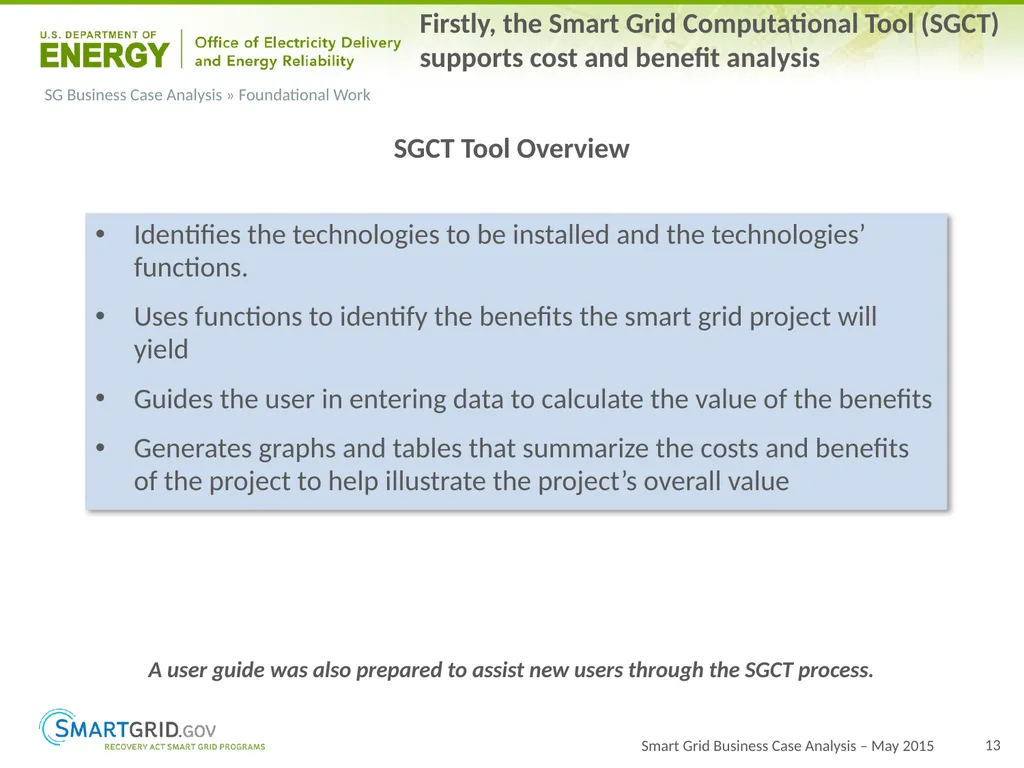
SG Business Case Analysis » Foundational Work Firstly, the Smart Grid Computational Tool (SGCT) supports cost and benefit analysis A user guide was also prepared to assist new users through the SGCT process. Identifies the technologies to be installed and the technologies’ functions.
Uses functions to identify the benefits the smart grid project will yield
Guides the user in entering data to calculate the value of the benefits
Generates graphs and tables that summarize the costs and benefits of the project to help illustrate the project’s overall value Smart Grid Business Case Analysis – May 2015 SGCT Tool Overview<br>
Uses functions to identify the benefits the smart grid project will yield
Guides the user in entering data to calculate the value of the benefits
Generates graphs and tables that summarize the costs and benefits of the project to help illustrate the project’s overall value Smart Grid Business Case Analysis – May 2015 SGCT Tool Overview<br>
14
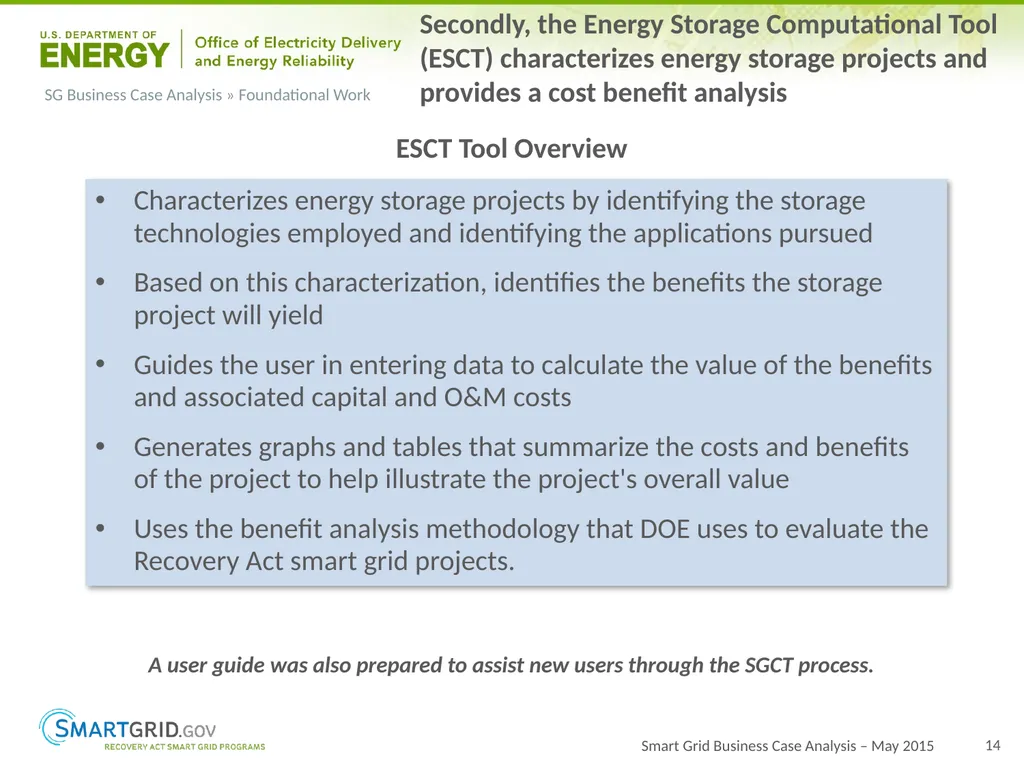
SG Business Case Analysis » Foundational Work Secondly, the Energy Storage Computational Tool (ESCT) characterizes energy storage projects and provides a cost benefit analysis A user guide was also prepared to assist new users through the SGCT process. Characterizes energy storage projects by identifying the storage technologies employed and identifying the applications pursued
Based on this characterization, identifies the benefits the storage project will yield
Guides the user in entering data to calculate the value of the benefits and associated capital and O&M costs
Generates graphs and tables that summarize the costs and benefits of the project to help illustrate the project's overall value
Uses the benefit analysis methodology that DOE uses to evaluate the Recovery Act smart grid projects. Smart Grid Business Case Analysis – May 2015 ESCT Tool Overview<br>
Based on this characterization, identifies the benefits the storage project will yield
Guides the user in entering data to calculate the value of the benefits and associated capital and O&M costs
Generates graphs and tables that summarize the costs and benefits of the project to help illustrate the project's overall value
Uses the benefit analysis methodology that DOE uses to evaluate the Recovery Act smart grid projects. Smart Grid Business Case Analysis – May 2015 ESCT Tool Overview<br>
15
Table of Contents Smart Grid Business Case Analysis – May 2015<br>
16
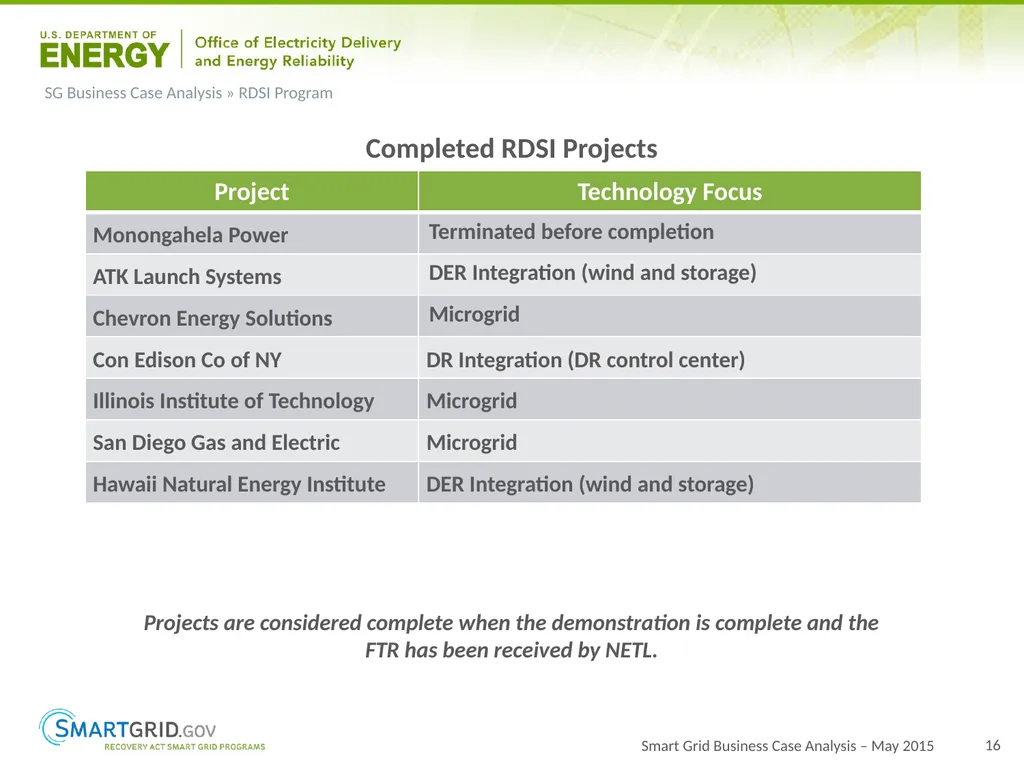
SG Business Case Analysis » RDSI Program Projects are considered complete when the demonstration is complete and the FTR has been received by NETL. Smart Grid Business Case Analysis – May 2015 Completed RDSI Projects<br>
17
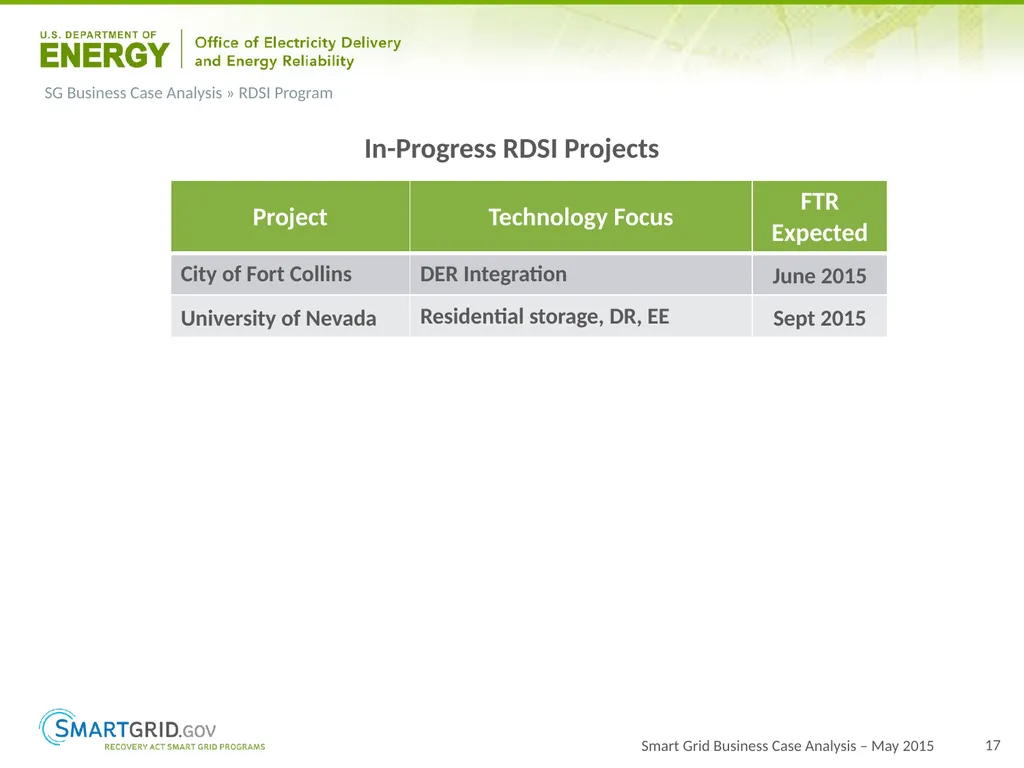
SG Business Case Analysis » RDSI Program Smart Grid Business Case Analysis – May 2015 In-Progress RDSI Projects<br>
18
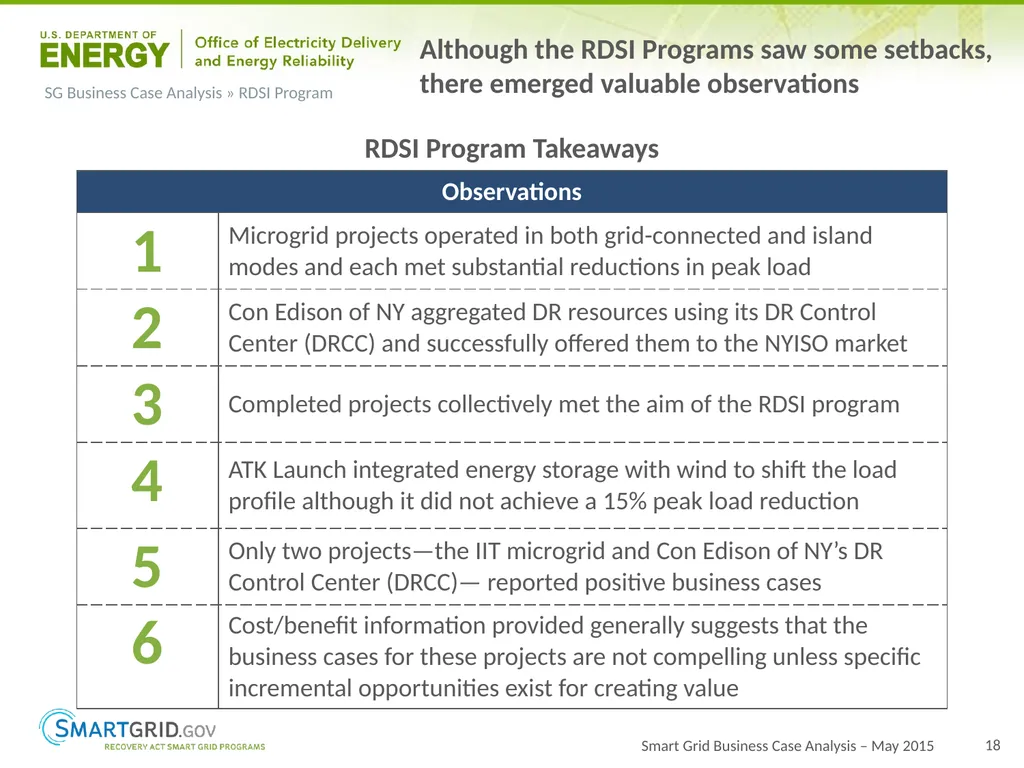
Although the RDSI Programs saw some setbacks, there emerged valuable observations SG Business Case Analysis » RDSI Program Smart Grid Business Case Analysis – May 2015 RDSI Program Takeaways<br>
19
Table of Contents Smart Grid Business Case Analysis – May 2015<br>
20
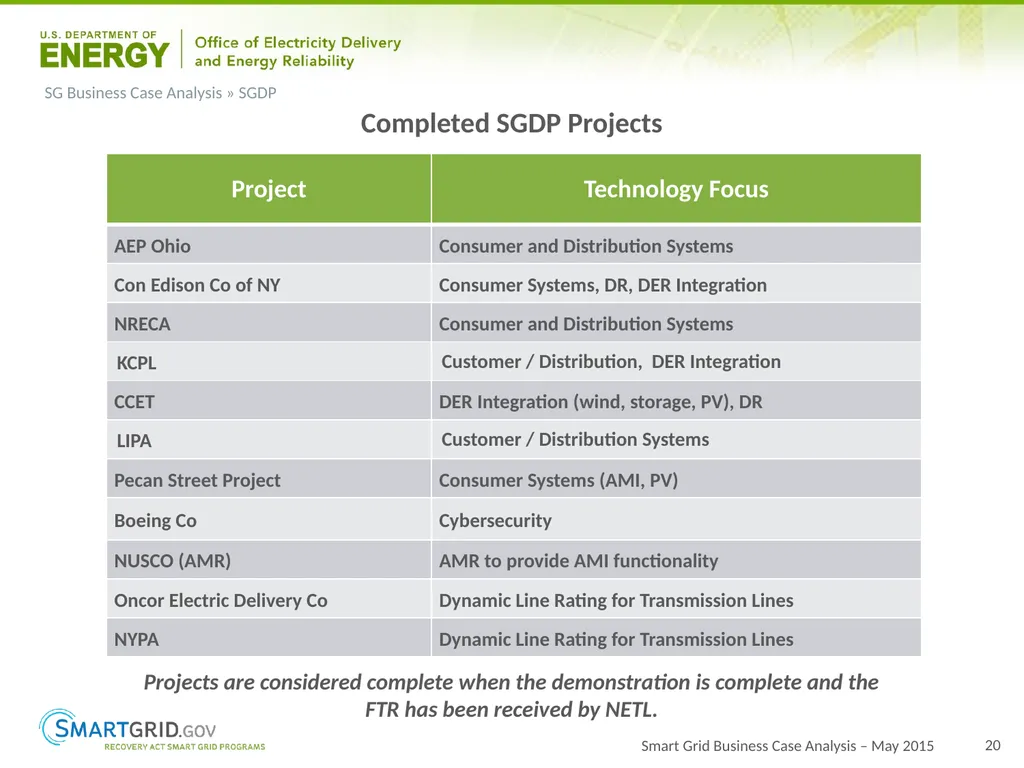
SG Business Case Analysis » SGDP Projects are considered complete when the demonstration is complete and the FTR has been received by NETL. Smart Grid Business Case Analysis – May 2015 Completed SGDP Projects<br>
21
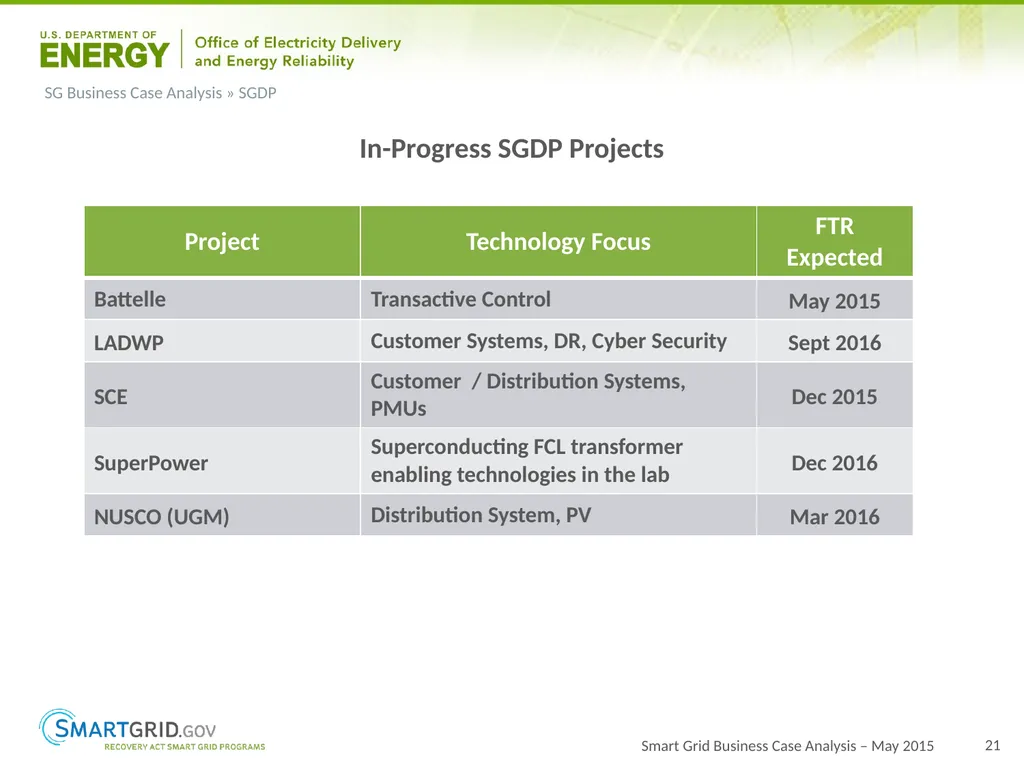
SG Business Case Analysis » SGDP Smart Grid Business Case Analysis – May 2015 In-Progress SGDP Projects<br>
22
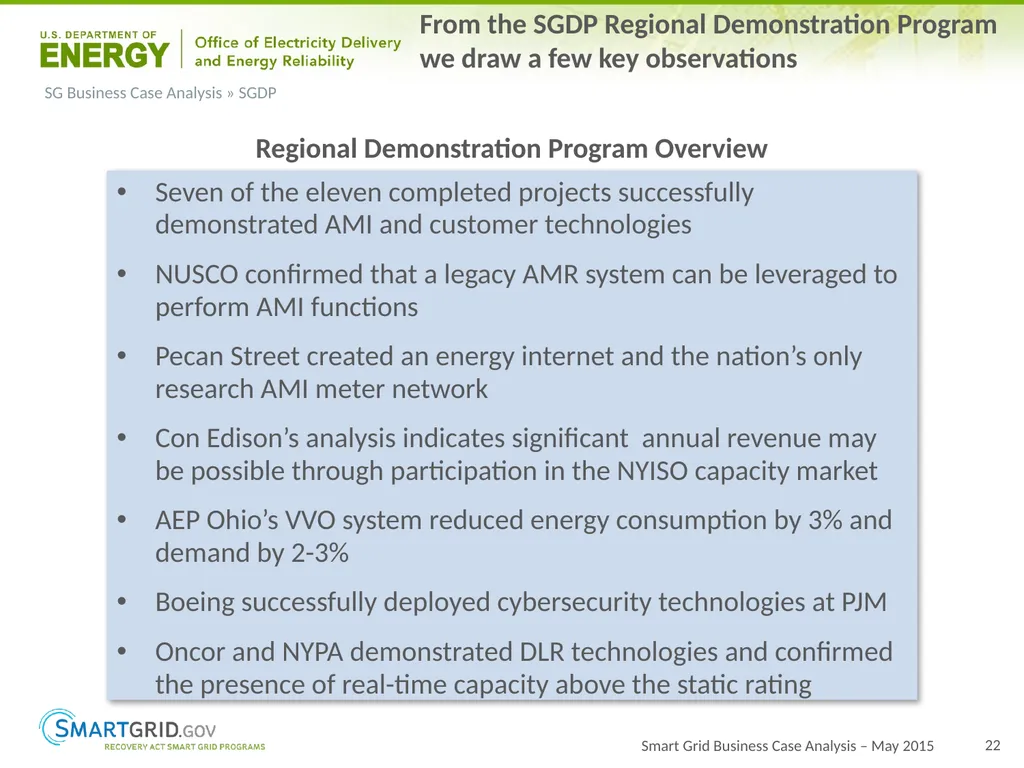
From the SGDP Regional Demonstration Program we draw a few key observations Seven of the eleven completed projects successfully demonstrated AMI and customer technologies
NUSCO confirmed that a legacy AMR system can be leveraged to perform AMI functions
Pecan Street created an energy internet and the nation’s only research AMI meter network
Con Edison’s analysis indicates significant annual revenue may be possible through participation in the NYISO capacity market
AEP Ohio’s VVO system reduced energy consumption by 3% and demand by 2-3%
Boeing successfully deployed cybersecurity technologies at PJM
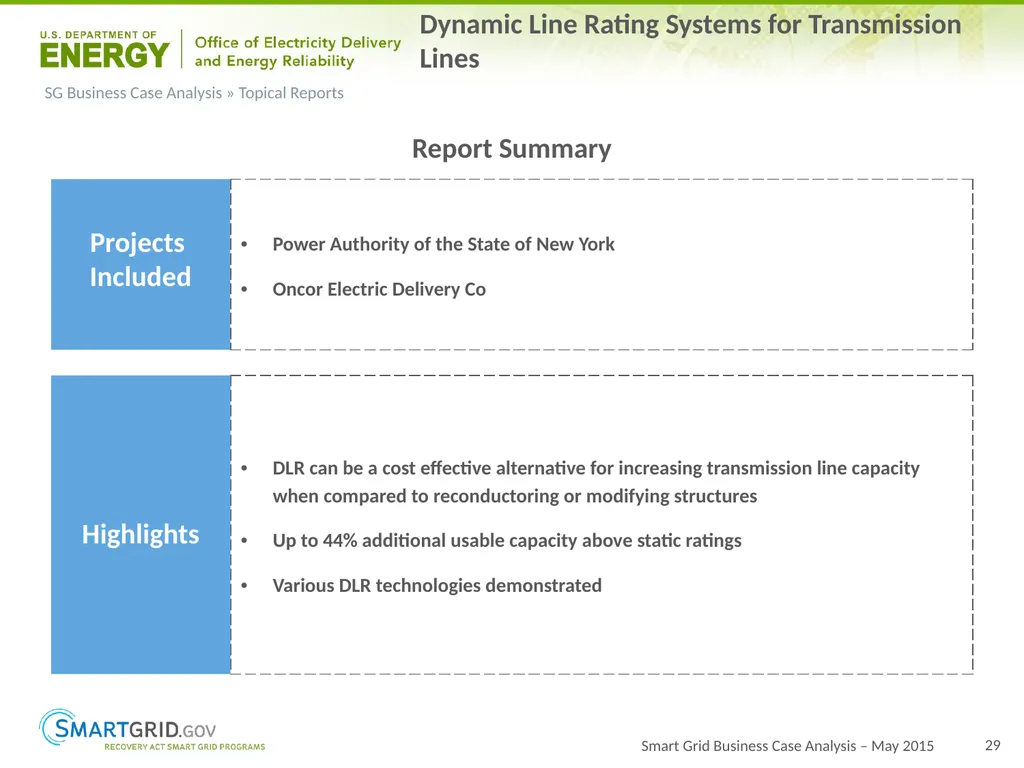
Oncor and NYPA demonstrated DLR technologies and confirmed the presence of real-time capacity above the static rating SG Business Case Analysis » SGDP Smart Grid Business Case Analysis – May 2015 Regional Demonstration Program Overview<br>
NUSCO confirmed that a legacy AMR system can be leveraged to perform AMI functions
Pecan Street created an energy internet and the nation’s only research AMI meter network
Con Edison’s analysis indicates significant annual revenue may be possible through participation in the NYISO capacity market
AEP Ohio’s VVO system reduced energy consumption by 3% and demand by 2-3%
Boeing successfully deployed cybersecurity technologies at PJM
Oncor and NYPA demonstrated DLR technologies and confirmed the presence of real-time capacity above the static rating SG Business Case Analysis » SGDP Smart Grid Business Case Analysis – May 2015 Regional Demonstration Program Overview<br>
23
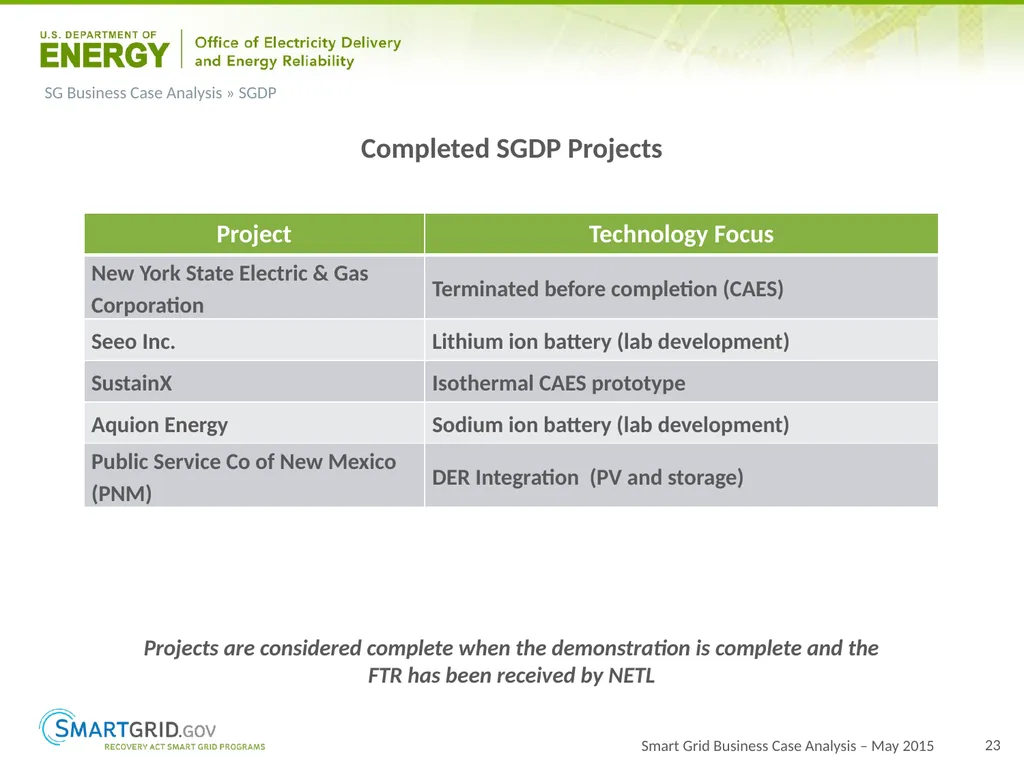
SG Business Case Analysis » SGDP Projects are considered complete when the demonstration is complete and the FTR has been received by NETL Smart Grid Business Case Analysis – May 2015 Completed SGDP Projects<br>
24
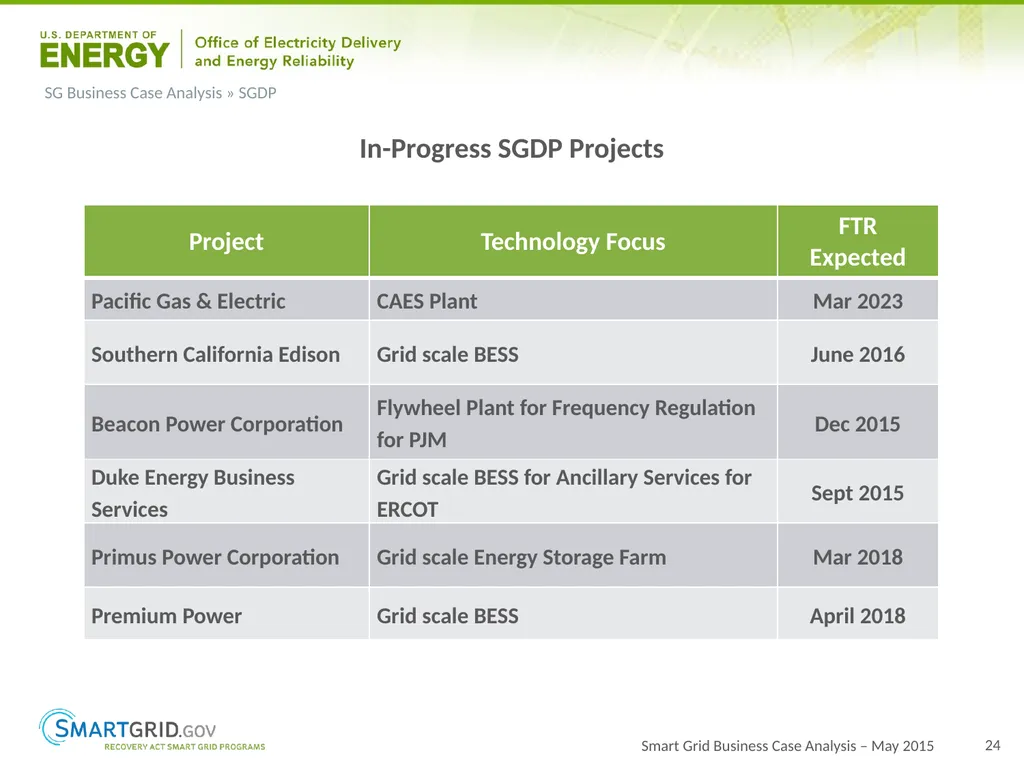
SG Business Case Analysis » SGDP Smart Grid Business Case Analysis – May 2015 In-Progress SGDP Projects<br>
25
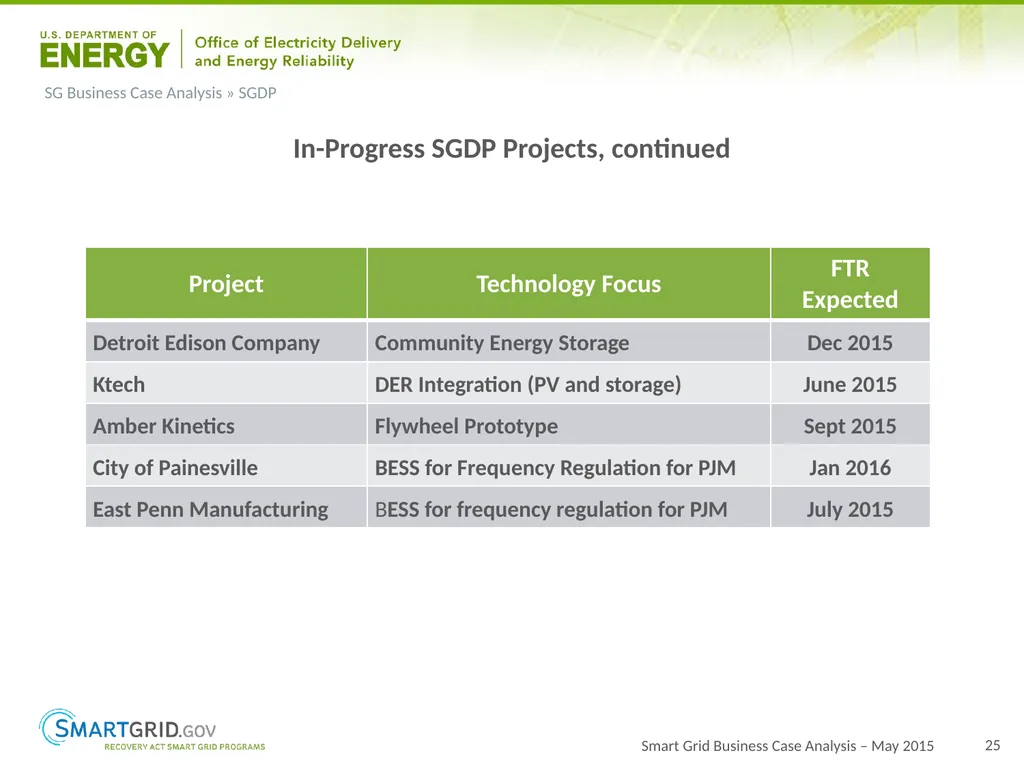
SG Business Case Analysis » SGDP Smart Grid Business Case Analysis – May 2015 In-Progress SGDP Projects, continued<br>
26
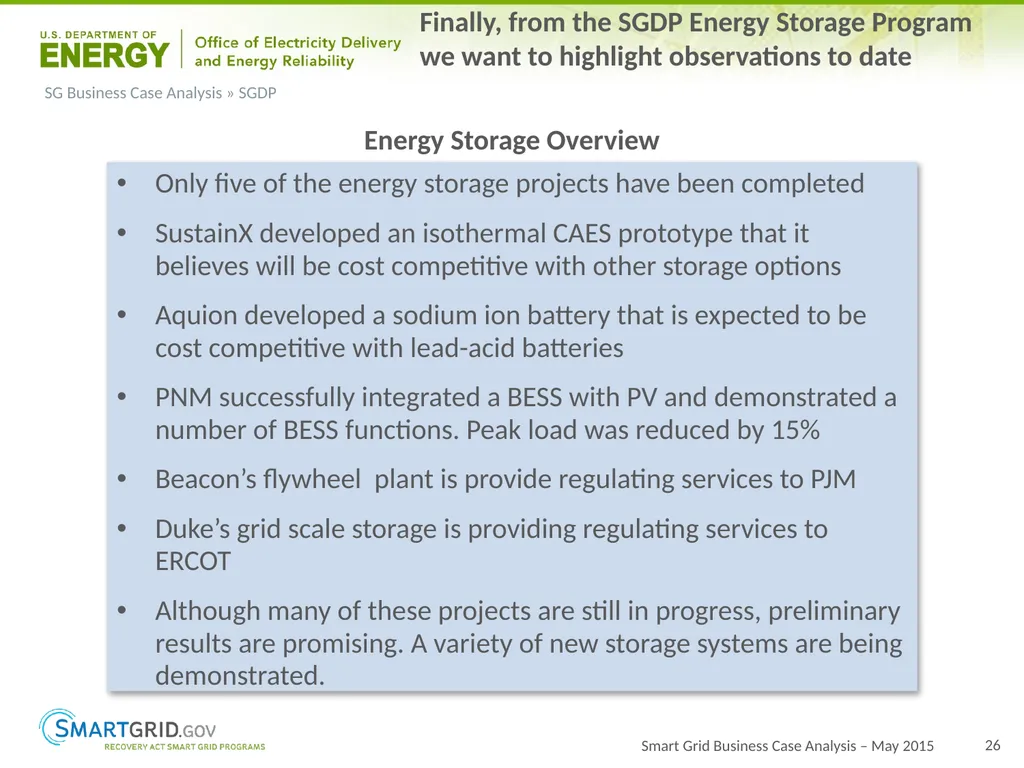
Finally, from the SGDP Energy Storage Program we want to highlight observations to date Only five of the energy storage projects have been completed
SustainX developed an isothermal CAES prototype that it believes will be cost competitive with other storage options
Aquion developed a sodium ion battery that is expected to be cost competitive with lead-acid batteries
PNM successfully integrated a BESS with PV and demonstrated a number of BESS functions. Peak load was reduced by 15%
Beacon’s flywheel plant is provide regulating services to PJM
Duke’s grid scale storage is providing regulating services to ERCOT
Although many of these projects are still in progress, preliminary results are promising. A variety of new storage systems are being demonstrated. SG Business Case Analysis » SGDP Smart Grid Business Case Analysis – May 2015 Energy Storage Overview<br>
SustainX developed an isothermal CAES prototype that it believes will be cost competitive with other storage options
Aquion developed a sodium ion battery that is expected to be cost competitive with lead-acid batteries
PNM successfully integrated a BESS with PV and demonstrated a number of BESS functions. Peak load was reduced by 15%
Beacon’s flywheel plant is provide regulating services to PJM
Duke’s grid scale storage is providing regulating services to ERCOT
Although many of these projects are still in progress, preliminary results are promising. A variety of new storage systems are being demonstrated. SG Business Case Analysis » SGDP Smart Grid Business Case Analysis – May 2015 Energy Storage Overview<br>
27
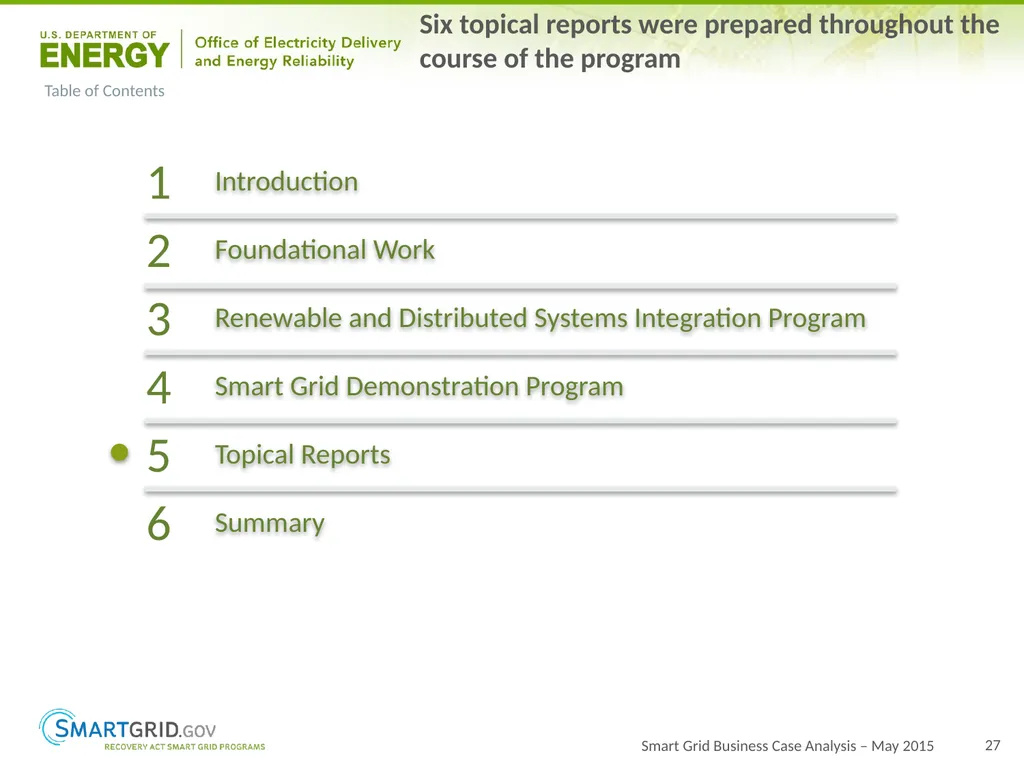
Table of Contents Smart Grid Business Case Analysis – May 2015 Six topical reports were prepared throughout the course of the program<br>
28
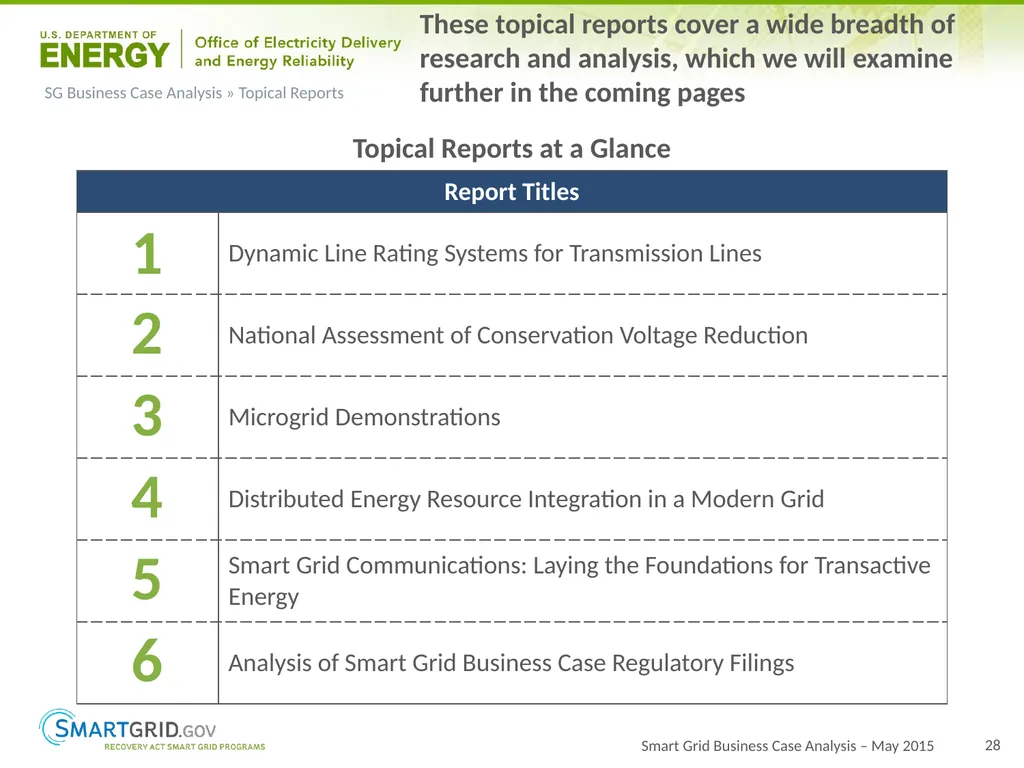
These topical reports cover a wide breadth of research and analysis, which we will examine further in the coming pages SG Business Case Analysis » Topical Reports Smart Grid Business Case Analysis – May 2015 Topical Reports at a Glance<br>
29
Dynamic Line Rating Systems for Transmission Lines SG Business Case Analysis » Topical Reports Smart Grid Business Case Analysis – May 2015 Report Summary Projects
Included Highlights<br>
Included Highlights<br>
30
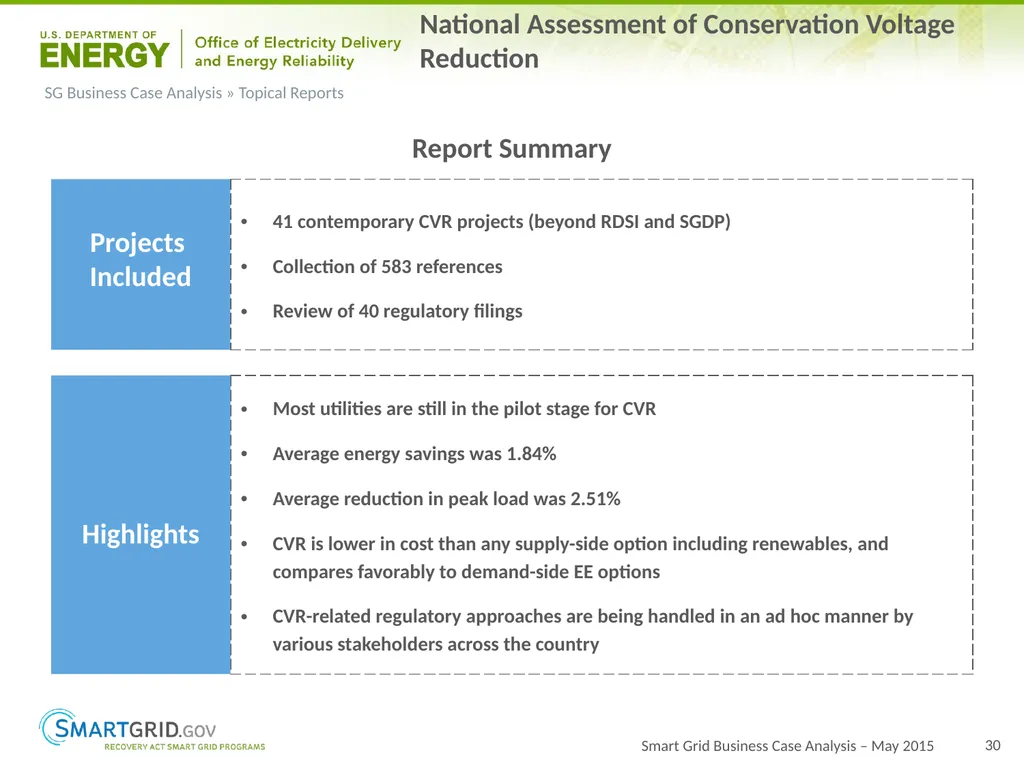
National Assessment of Conservation Voltage Reduction SG Business Case Analysis » Topical Reports Smart Grid Business Case Analysis – May 2015 Report Summary Projects
Included Highlights<br>
Included Highlights<br>
31
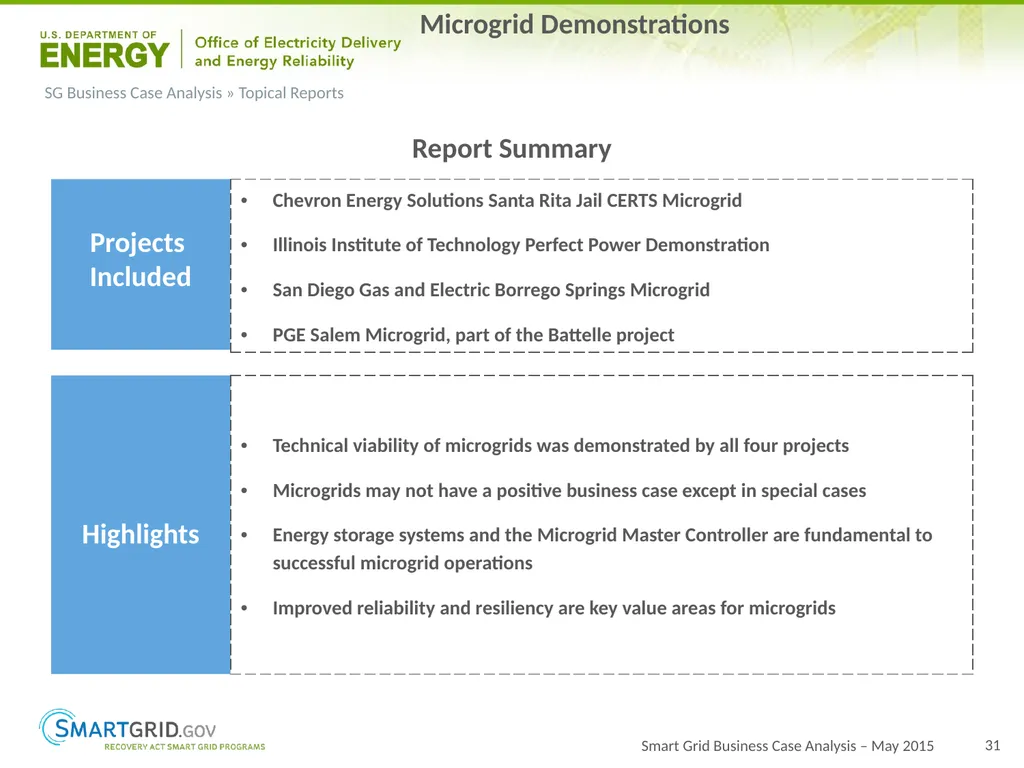
Microgrid Demonstrations SG Business Case Analysis » Topical Reports Smart Grid Business Case Analysis – May 2015 Report Summary Projects
Included Highlights<br>
Included Highlights<br>
32
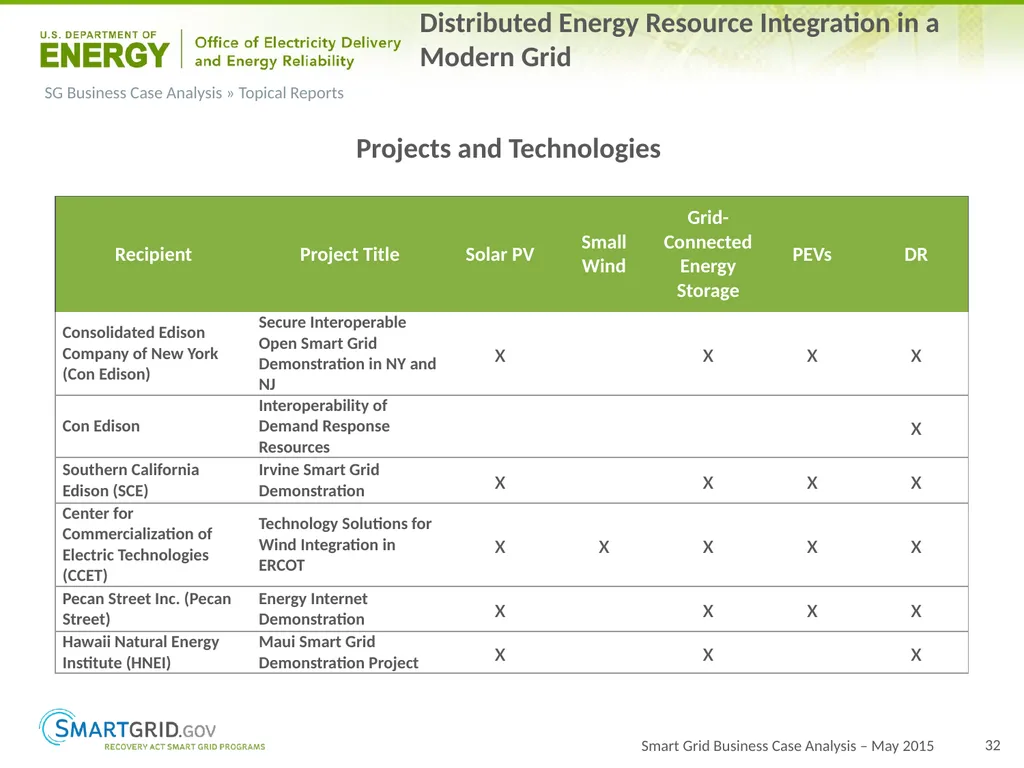
Distributed Energy Resource Integration in a Modern Grid SG Business Case Analysis » Topical Reports Smart Grid Business Case Analysis – May 2015 Projects and Technologies<br>
33
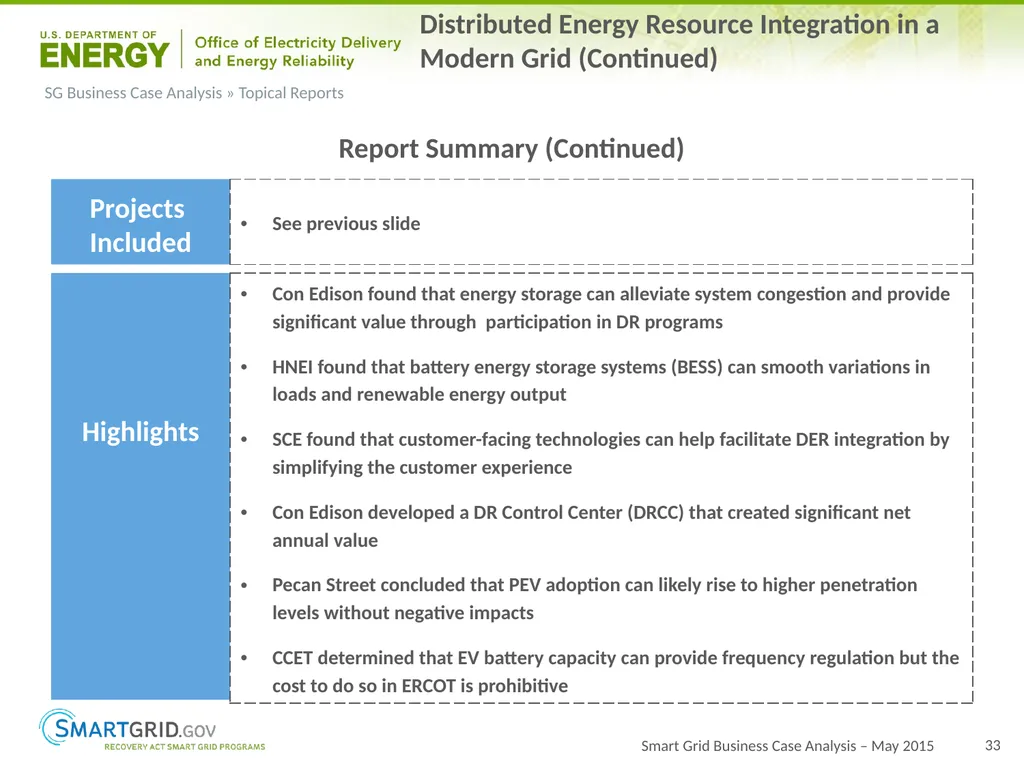
Distributed Energy Resource Integration in a Modern Grid (Continued) SG Business Case Analysis » Topical Reports Smart Grid Business Case Analysis – May 2015 Report Summary (Continued) Projects
Included Highlights<br>
Included Highlights<br>
34
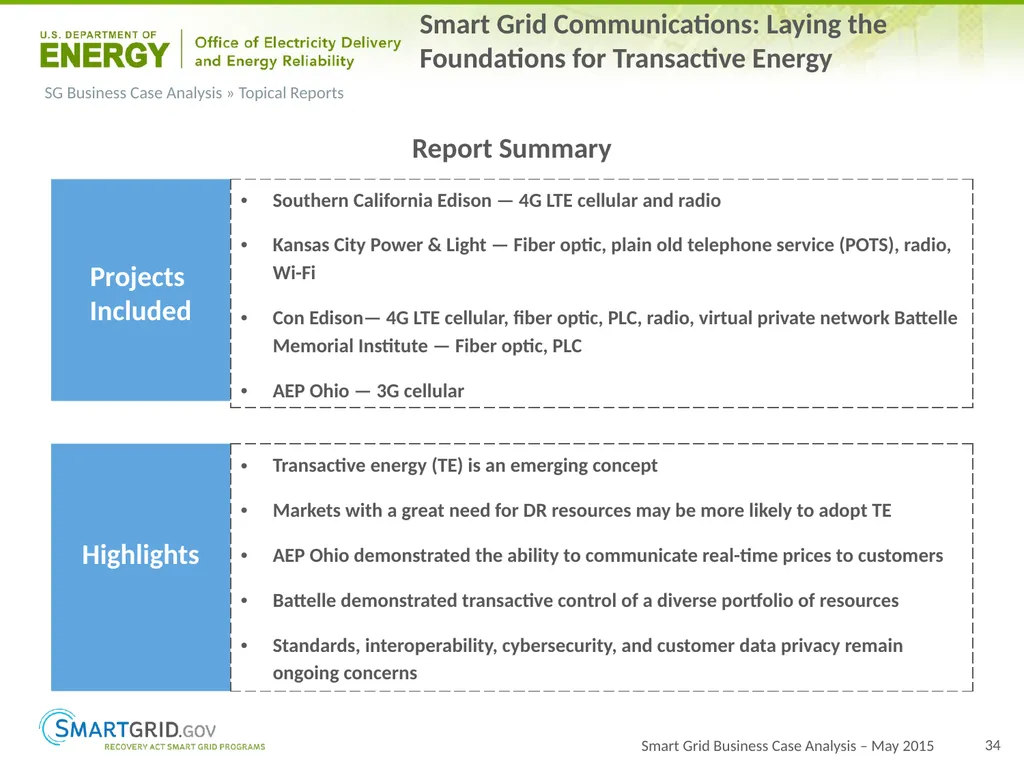
Smart Grid Communications: Laying the Foundations for Transactive Energy SG Business Case Analysis » Topical Reports Smart Grid Business Case Analysis – May 2015 Report Summary Projects
Included Highlights<br>
Included Highlights<br>
35
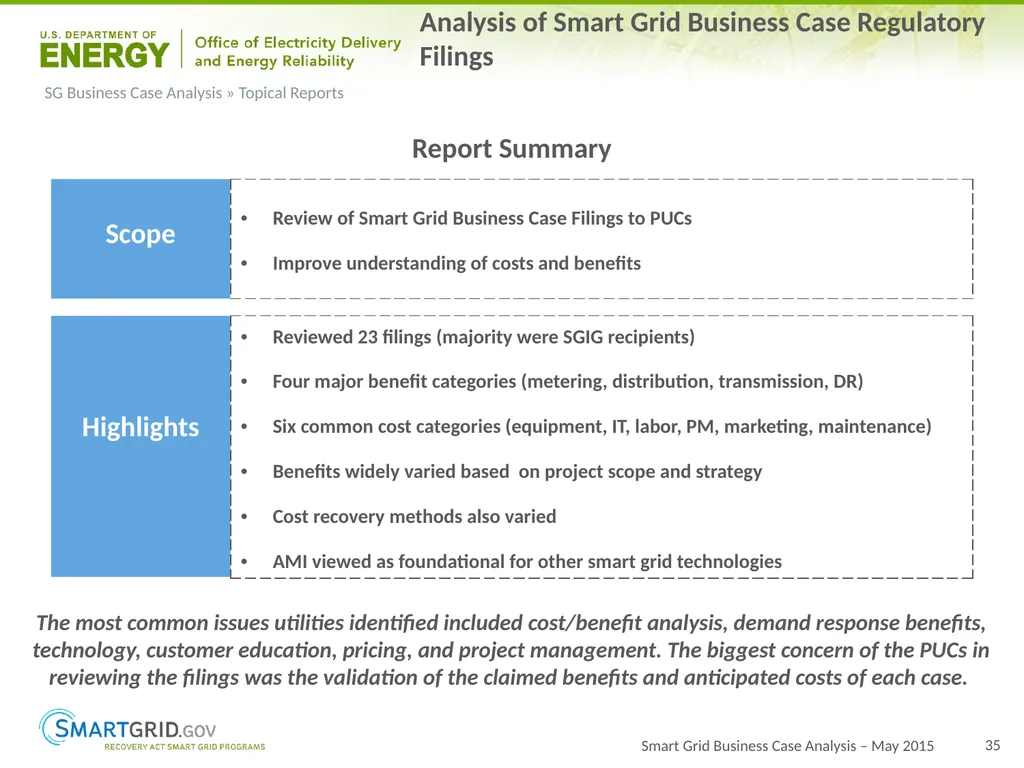
Analysis of Smart Grid Business Case Regulatory Filings SG Business Case Analysis » Topical Reports Smart Grid Business Case Analysis – May 2015 Report Summary Scope Highlights The most common issues utilities identified included cost/benefit analysis, demand response benefits, technology, customer education, pricing, and project management. The biggest concern of the PUCs in reviewing the filings was the validation of the claimed benefits and anticipated costs of each case.<br>
36
Table of Contents Smart Grid Business Case Analysis – May 2015<br>
37
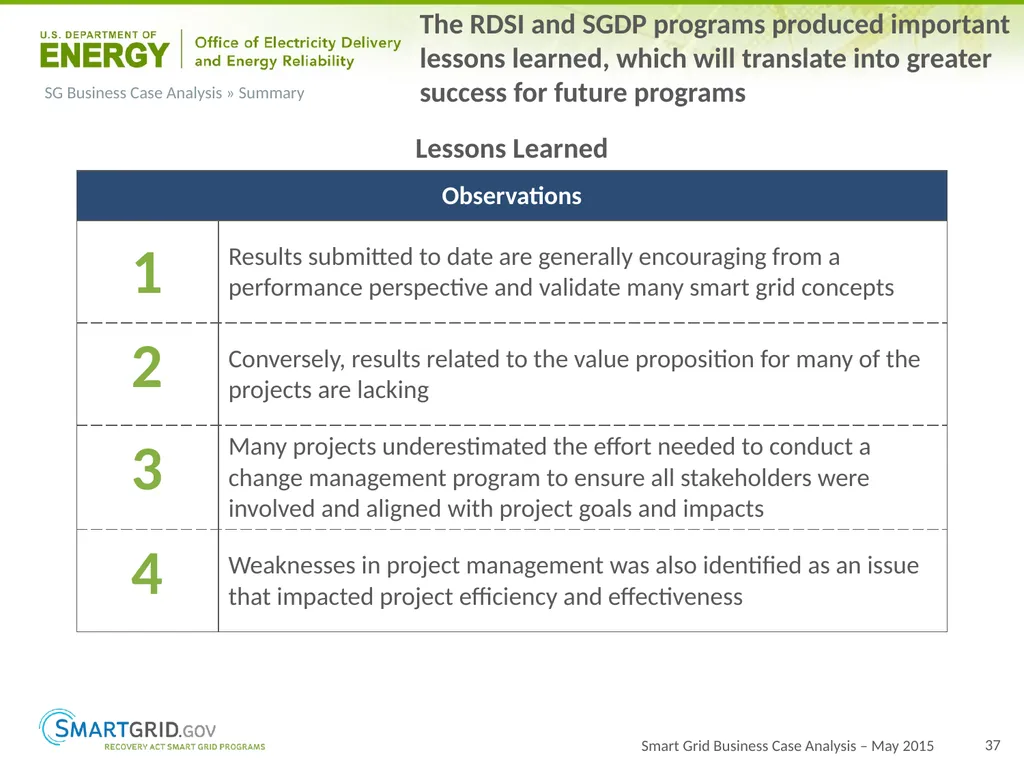
The RDSI and SGDP programs produced important lessons learned, which will translate into greater success for future programs SG Business Case Analysis » Summary Smart Grid Business Case Analysis – May 2015 Lessons Learned<br>