2016 NSF Large Facilities Workshop Making Sense of Audits and Reviews Business Roundtable I May 24, 2016 Anna-Lee Misiano, (amisianonsf.gov) Division of Acquisition and Cooperative Support Florence Rabanal (frabanalnsf.gov), Large
"2016 NSF Large Facilities Workshop Making Sense of" is the property of its rightful owner. Permission is granted to
download and print the materials on this website for personal, non-commercial use only, and to display it
on your personal computer provided you do not modify the materials and that you retain all copyright
notices contained in the materials. By downloading content from our website, you accept the terms of this
agreement.
Presentation Transcript
01
2016 NSF Large Facilities Workshop Making Sense of Audits and Reviews Business Roundtable I May 24, 2016 Anna-Lee Misiano, (amisiano@nsf.gov) Division of Acquisition and Cooperative Support
Florence Rabanal (frabanal@nsf.gov), Large Facilities Office
Eddie Whitehurst, (ewhitehu@nsf.gov) Division of Acquisition and Cooperative Support
Charlie Zeigler, (czeigler@nsf.gov) Division of Institute and Award Support 1 2016 NSF Large Facilities Workshop version 3.4_final<br>
02
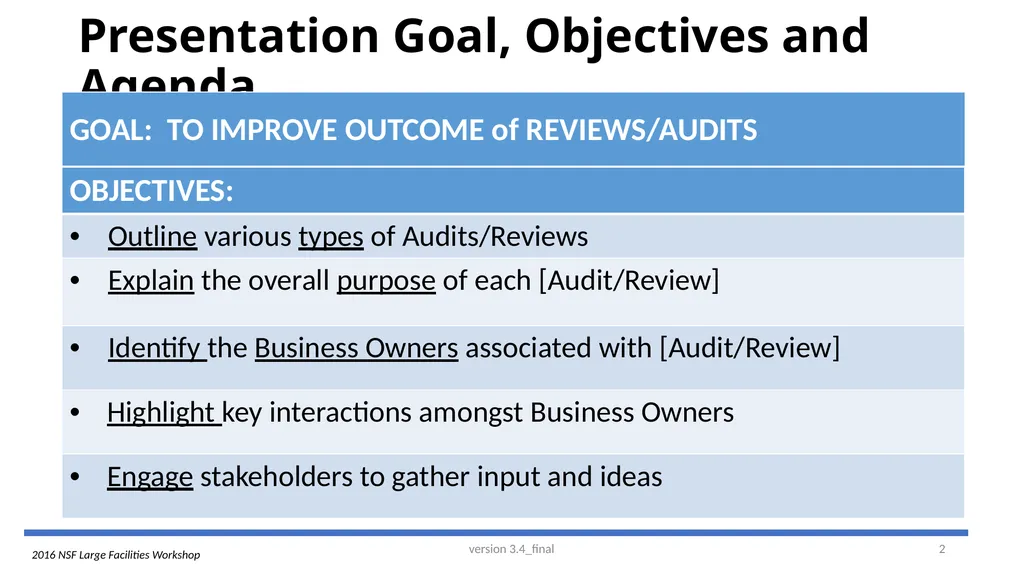
Presentation Goal, Objectives and Agenda 2 2016 NSF Large Facilities Workshop version 3.4_final<br>
03
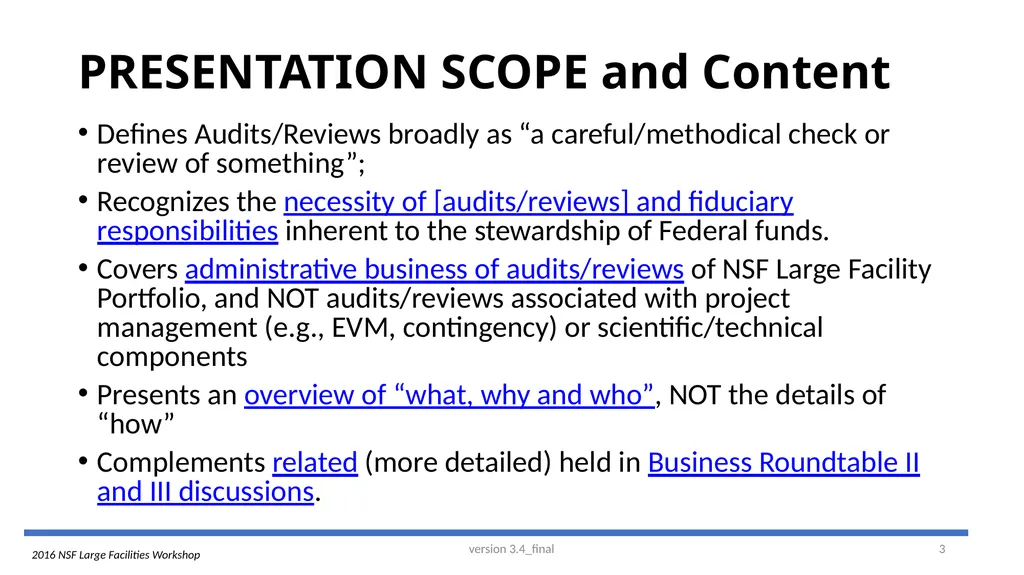
PRESENTATION SCOPE and Content Defines Audits/Reviews broadly as “a careful/methodical check or review of something”;
Recognizes the necessity of [audits/reviews] and fiduciary responsibilities inherent to the stewardship of Federal funds.
Covers administrative business of audits/reviews of NSF Large Facility Portfolio, and NOT audits/reviews associated with project management (e.g., EVM, contingency) or scientific/technical components
Presents an overview of “what, why and who”, NOT the details of “how”
Complements related (more detailed) held in Business Roundtable II and III discussions. 3 2016 NSF Large Facilities Workshop version 3.4_final<br>
04
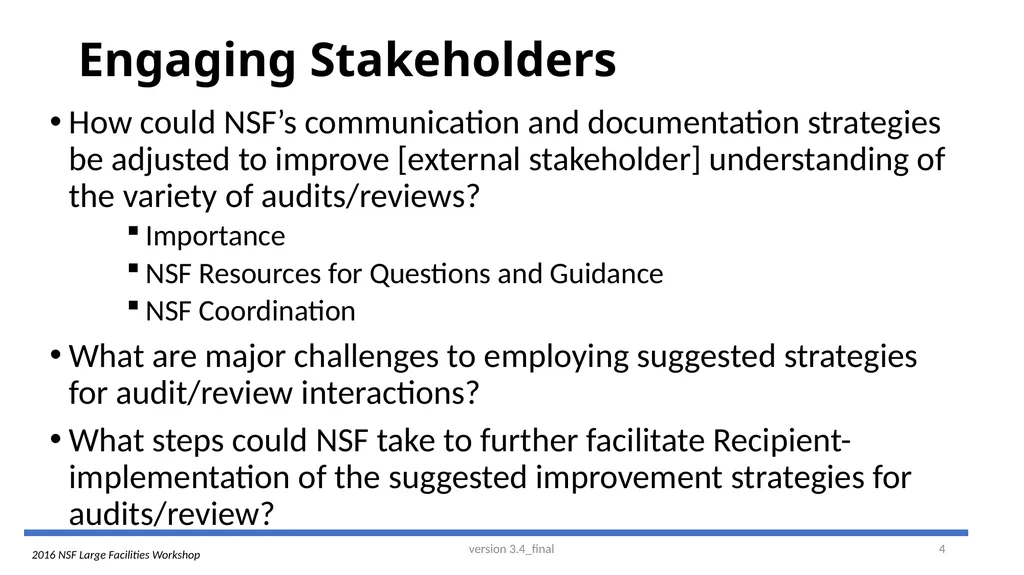
Engaging Stakeholders How could NSF’s communication and documentation strategies be adjusted to improve [external stakeholder] understanding of the variety of audits/reviews?
Importance
NSF Resources for Questions and Guidance
NSF Coordination
What are major challenges to employing suggested strategies for audit/review interactions?
What steps could NSF take to further facilitate Recipient-implementation of the suggested improvement strategies for audits/review? 4 2016 NSF Large Facilities Workshop version 3.4_final<br>
05
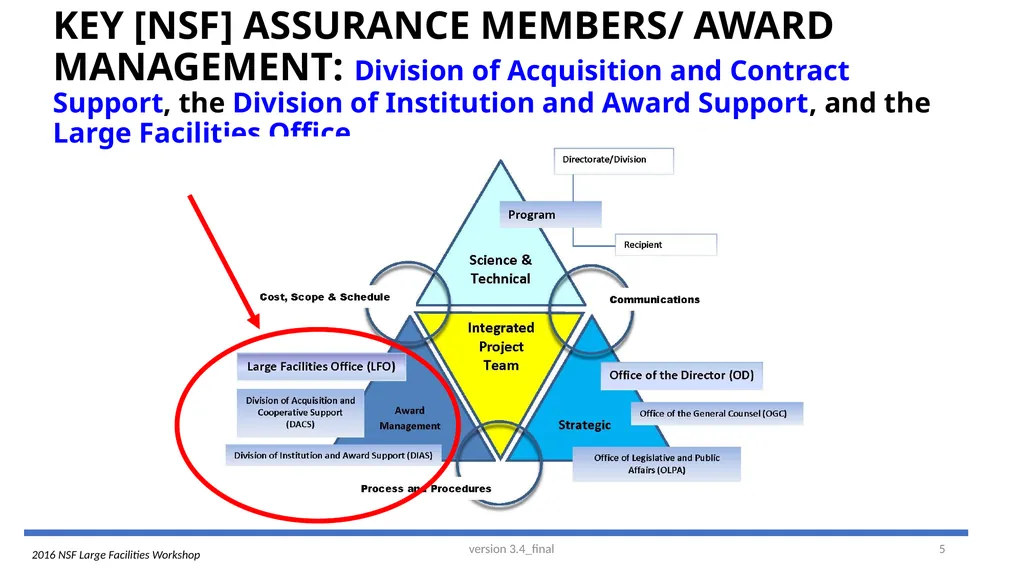
KEY [NSF] ASSURANCE MEMBERS/ AWARD MANAGEMENT: Division of Acquisition and Contract Support, the Division of Institution and Award Support, and the Large Facilities Office 5 2016 NSF Large Facilities Workshop version 3.4_final<br>
06
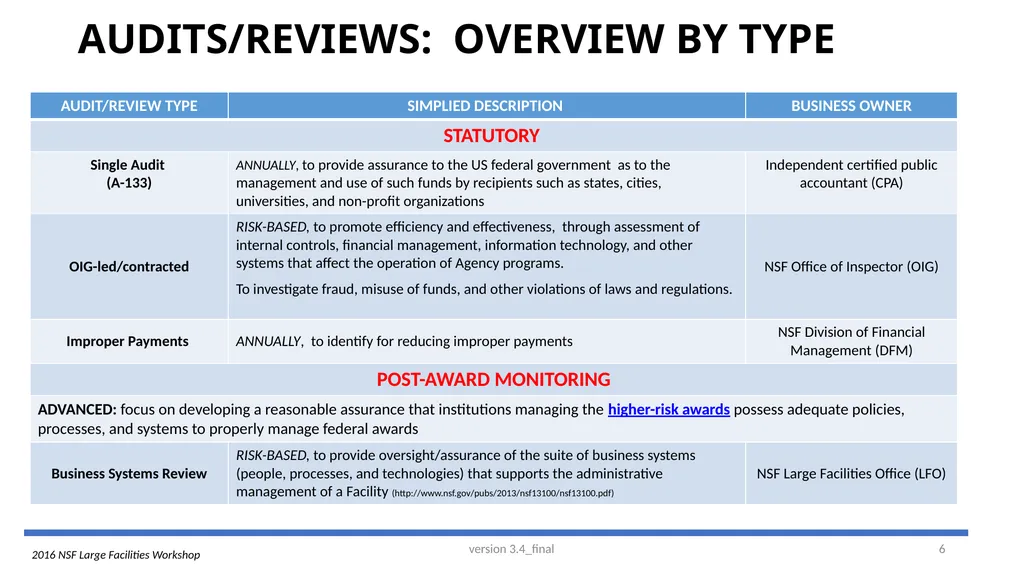
AUDITS/REVIEWS: OVERVIEW BY TYPE 6 2016 NSF Large Facilities Workshop version 3.4_final<br>
07
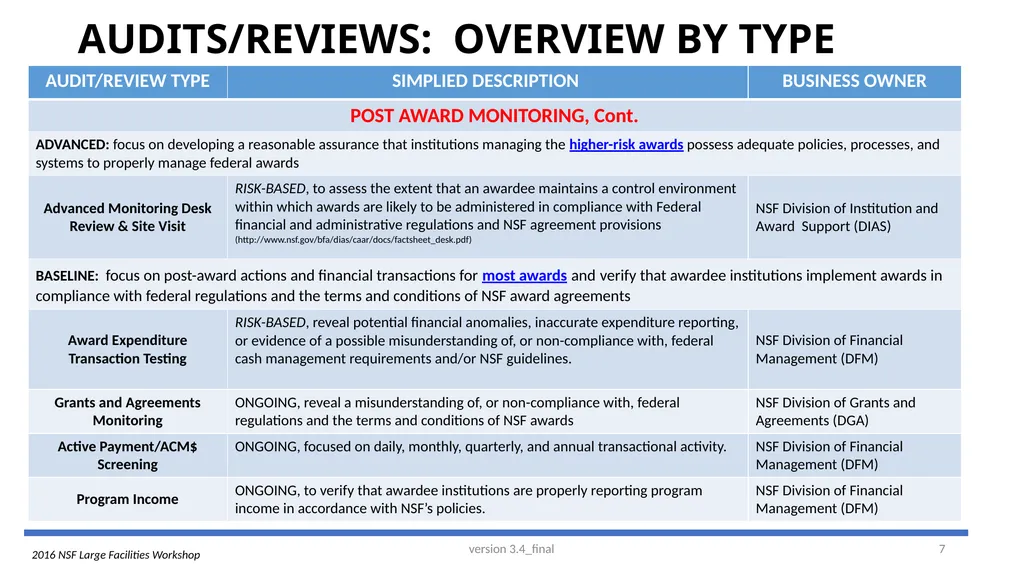
AUDITS/REVIEWS: OVERVIEW BY TYPE 7 2016 NSF Large Facilities Workshop version 3.4_final<br>
08
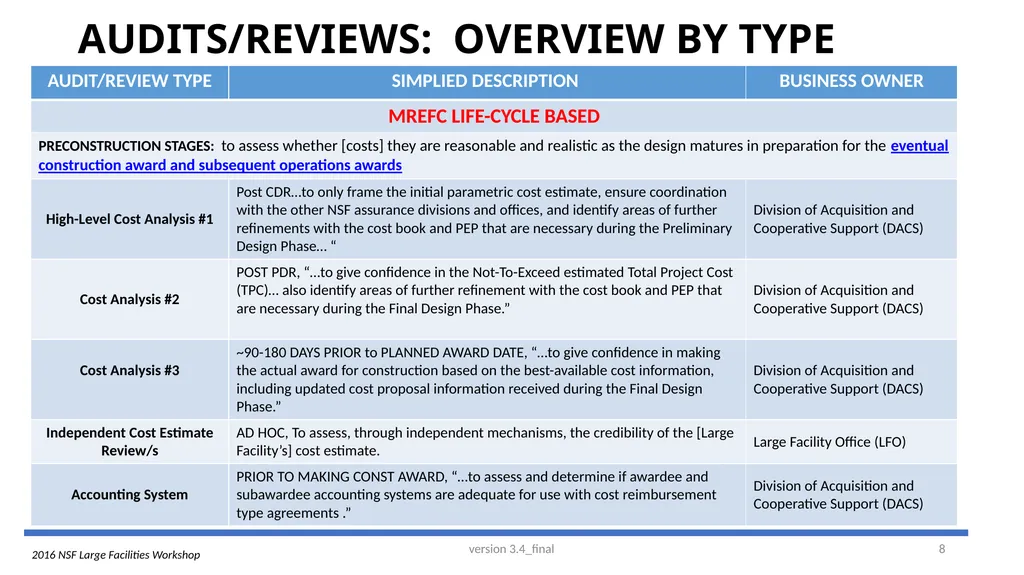
AUDITS/REVIEWS: OVERVIEW BY TYPE 8 2016 NSF Large Facilities Workshop version 3.4_final<br>
09
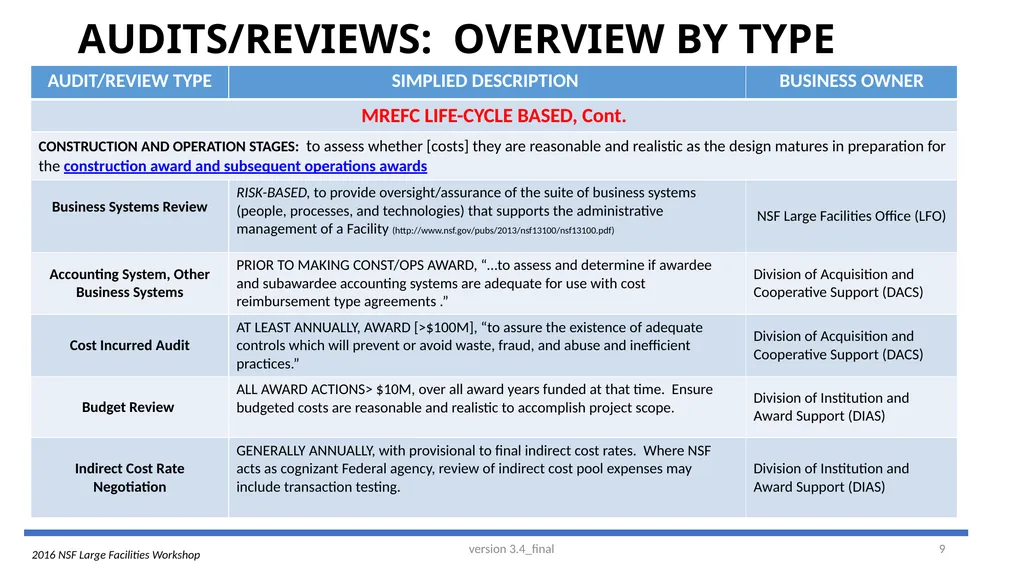
AUDITS/REVIEWS: OVERVIEW BY TYPE 9 2016 NSF Large Facilities Workshop version 3.4_final<br>
10
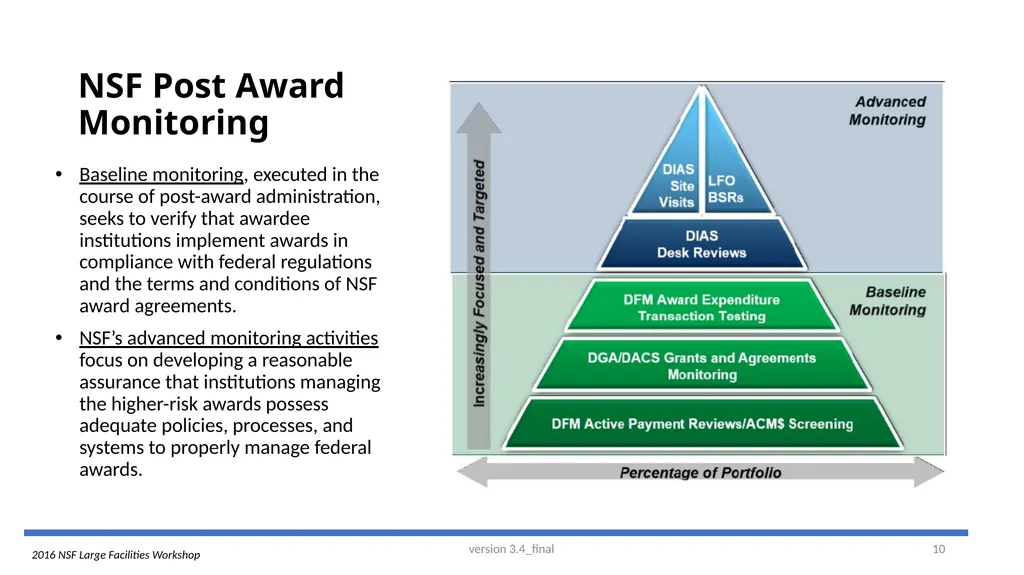
NSF Post Award Monitoring Baseline monitoring, executed in the course of post-award administration, seeks to verify that awardee institutions implement awards in compliance with federal regulations and the terms and conditions of NSF award agreements.
NSF’s advanced monitoring activities focus on developing a reasonable assurance that institutions managing the higher-risk awards possess adequate policies, processes, and systems to properly manage federal awards. 10 2016 NSF Large Facilities Workshop version 3.4_final<br>
11
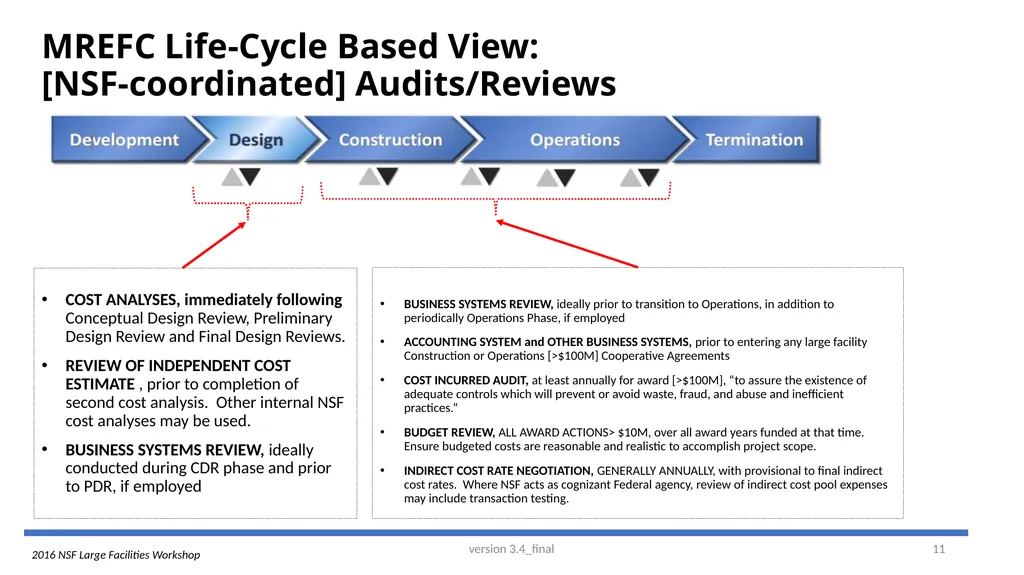
MREFC Life-Cycle Based View: [NSF-coordinated] Audits/Reviews COST ANALYSES, immediately following Conceptual Design Review, Preliminary Design Review and Final Design Reviews.
REVIEW OF INDEPENDENT COST ESTIMATE , prior to completion of second cost analysis. Other internal NSF cost analyses may be used.
BUSINESS SYSTEMS REVIEW, ideally conducted during CDR phase and prior to PDR, if employed BUSINESS SYSTEMS REVIEW, ideally prior to transition to Operations, in addition to periodically Operations Phase, if employed
ACCOUNTING SYSTEM and OTHER BUSINESS SYSTEMS, prior to entering any large facility Construction or Operations [>$100M] Cooperative Agreements
COST INCURRED AUDIT, at least annually for award [>$100M], “to assure the existence of adequate controls which will prevent or avoid waste, fraud, and abuse and inefficient practices.”
BUDGET REVIEW, ALL AWARD ACTIONS> $10M, over all award years funded at that time. Ensure budgeted costs are reasonable and realistic to accomplish project scope.
INDIRECT COST RATE NEGOTIATION, GENERALLY ANNUALLY, with provisional to final indirect cost rates. Where NSF acts as cognizant Federal agency, review of indirect cost pool expenses may include transaction testing. 11 2016 NSF Large Facilities Workshop version 3.4_final<br>
12
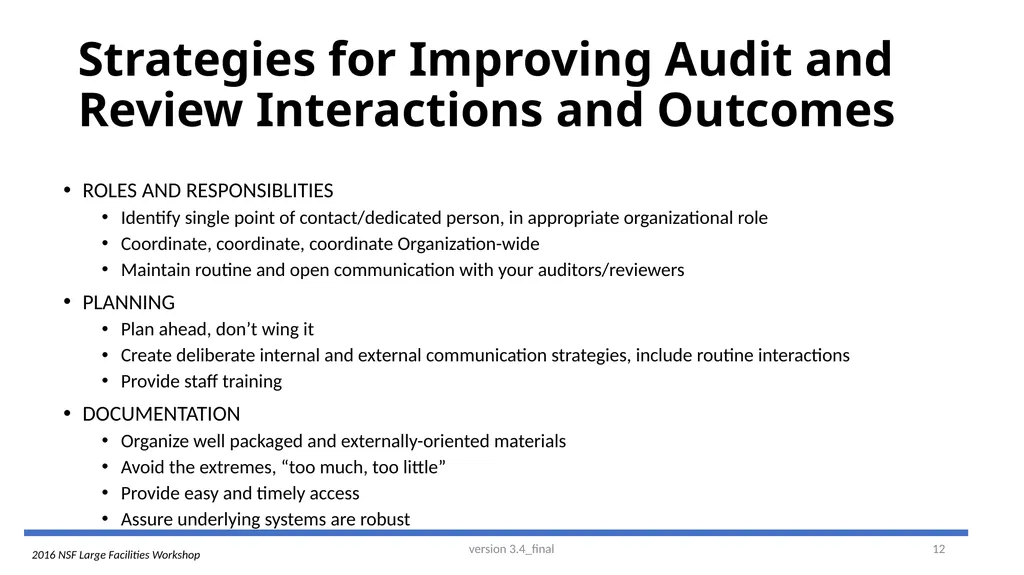
Strategies for Improving Audit and Review Interactions and Outcomes ROLES AND RESPONSIBLITIES
Identify single point of contact/dedicated person, in appropriate organizational role
Coordinate, coordinate, coordinate Organization-wide
Maintain routine and open communication with your auditors/reviewers
PLANNING
Plan ahead, don’t wing it
Create deliberate internal and external communication strategies, include routine interactions
Provide staff training
DOCUMENTATION
Organize well packaged and externally-oriented materials
Avoid the extremes, “too much, too little”
Provide easy and timely access
Assure underlying systems are robust 12 2016 NSF Large Facilities Workshop version 3.4_final<br>
13
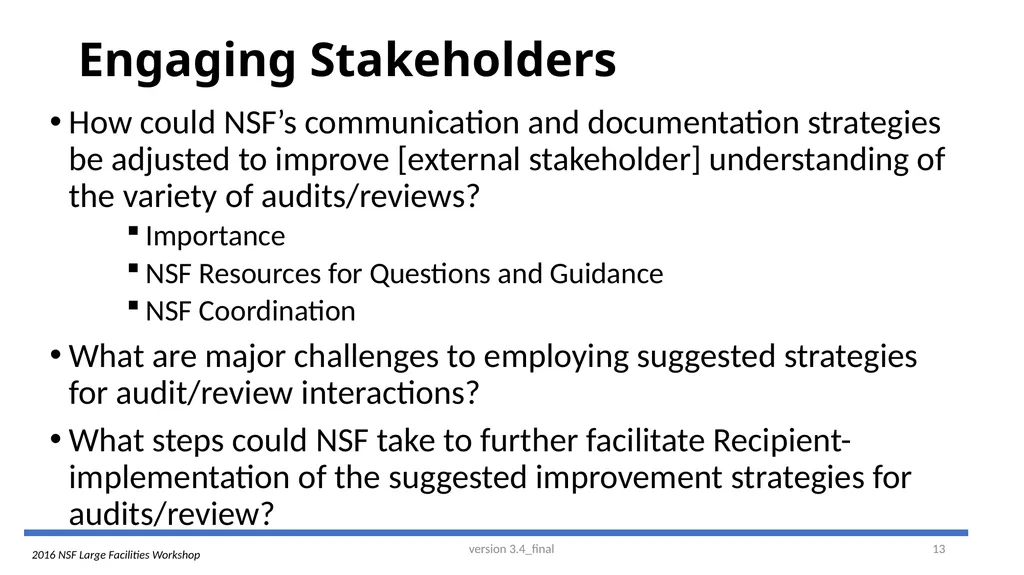
Engaging Stakeholders How could NSF’s communication and documentation strategies be adjusted to improve [external stakeholder] understanding of the variety of audits/reviews?
Importance
NSF Resources for Questions and Guidance
NSF Coordination
What are major challenges to employing suggested strategies for audit/review interactions?
What steps could NSF take to further facilitate Recipient-implementation of the suggested improvement strategies for audits/review? 13 2016 NSF Large Facilities Workshop version 3.4_final<br>