
2017 Physical Therapy Evaluation Codes






























Description: 2017 Physical Therapy Evaluation Codes Train-the-Trainer Slide Deck 2017 American Physical Therapy Association. All rights reserved. INTRODUCTION 2017 American Physical Therapy Association. All rights reserved. Training Agenda 2017
Related Topics
Download Presentation
"2017 Physical Therapy Evaluation Codes" is the property of its rightful owner. Permission is granted to download and print the materials on this website for personal, non-commercial use only, and to display it on your personal computer provided you do not modify the materials and that you retain all copyright notices contained in the materials. By downloading content from our website, you accept the terms of this agreement.
Presentation Transcript
slide2. 2017 Physical Therapy Evaluation Codes
Train-the-Trainer Slide Deck ©2017 American Physical Therapy Association. All rights reserved.<br>
slide3. INTRODUCTION ©2017 American Physical Therapy Association. All rights reserved.<br>
slide4. Training Agenda ©2017 American Physical Therapy Association. All rights reserved.<br>
slide5. Training Learning Objectives ©2017 American Physical Therapy Association. All rights reserved.<br>
slide6. Physical Therapy Evaluation Code Descriptors ©2017 American Physical Therapy Association. All rights reserved.<br>
slide7. The Importance of the Physical Therapist Evaluation The evaluation drives the care and/or management of the care.
A thorough and complete evaluation is critical to success in achieving a positive outcome for the patient’s episode of physical therapist care.
A reflection of the level of complexity of the patient is key to effective management throughout the episode. ©2017 American Physical Therapy Association. All rights reserved.<br>
slide8. Elements of a Physical Therapist Evaluation Consistent with APTA’s Guide to Physical Therapist Practice
Examination (includes history, systems review, and tests and measures)
Evaluation (the thought process leading to identifying impairments, functional limitations, disabilities, and needs for prevention)
Diagnosis (impact of the condition on function)
Prognosis (professional judgment regarding the predicted functional outcome and the estimated duration of services required)
Plan of Care (the culmination of an evaluation) ©2017 American Physical Therapy Association. All rights reserved.<br>
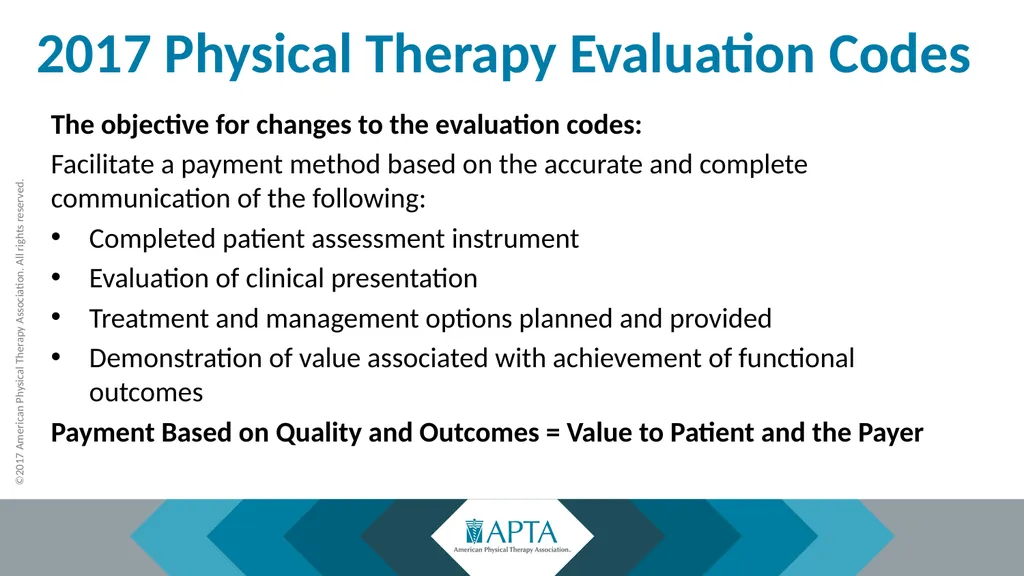
slide9. 2017 Physical Therapy Evaluation Codes The objective for changes to the evaluation codes:
Facilitate a payment method based on the accurate and complete communication of the following:
Completed patient assessment instrument
Evaluation of clinical presentation
Treatment and management options planned and provided
Demonstration of value associated with achievement of functional outcomes
Payment Based on Quality and Outcomes = Value to Patient and the Payer ©2017 American Physical Therapy Association. All rights reserved.<br>
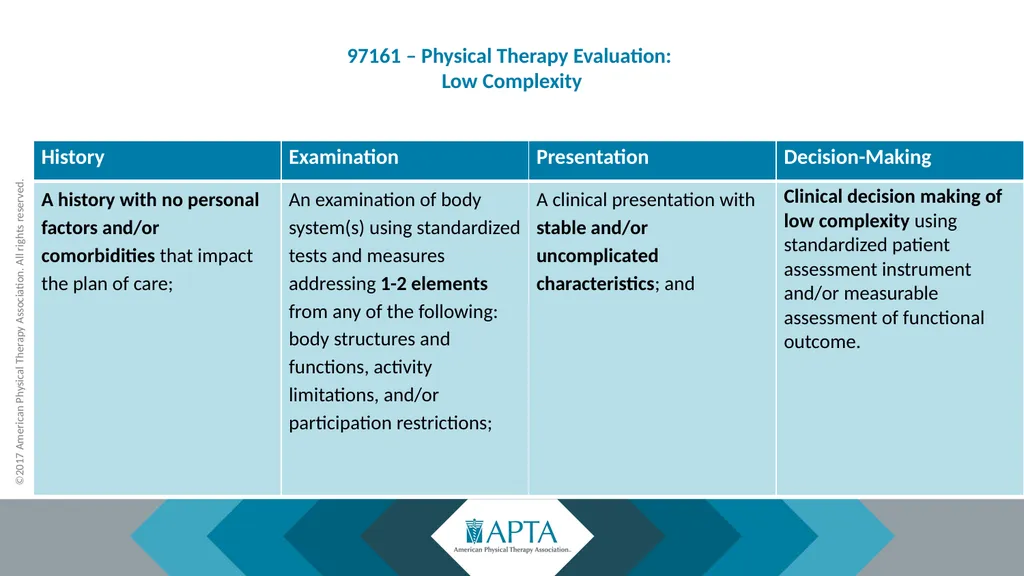
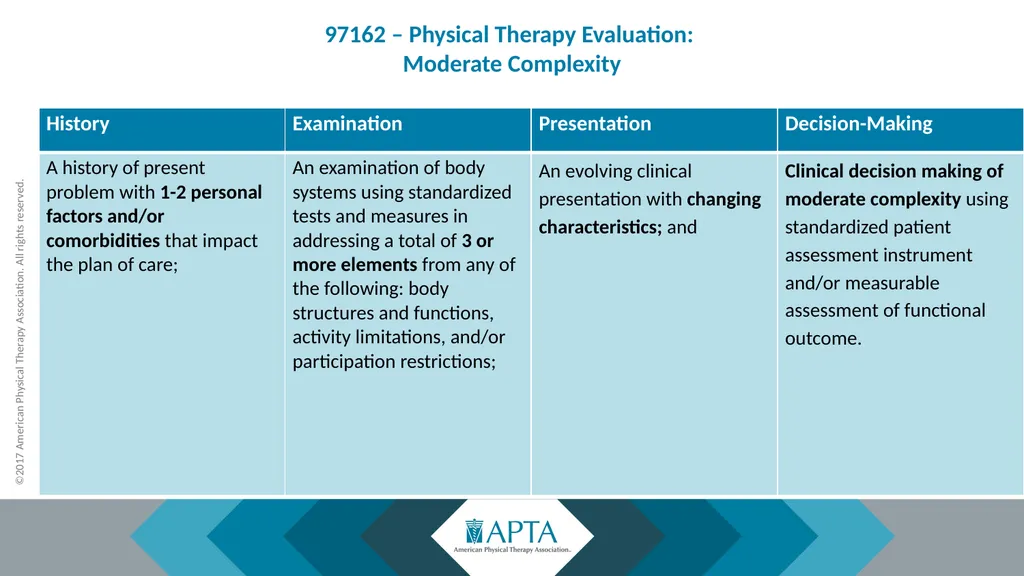
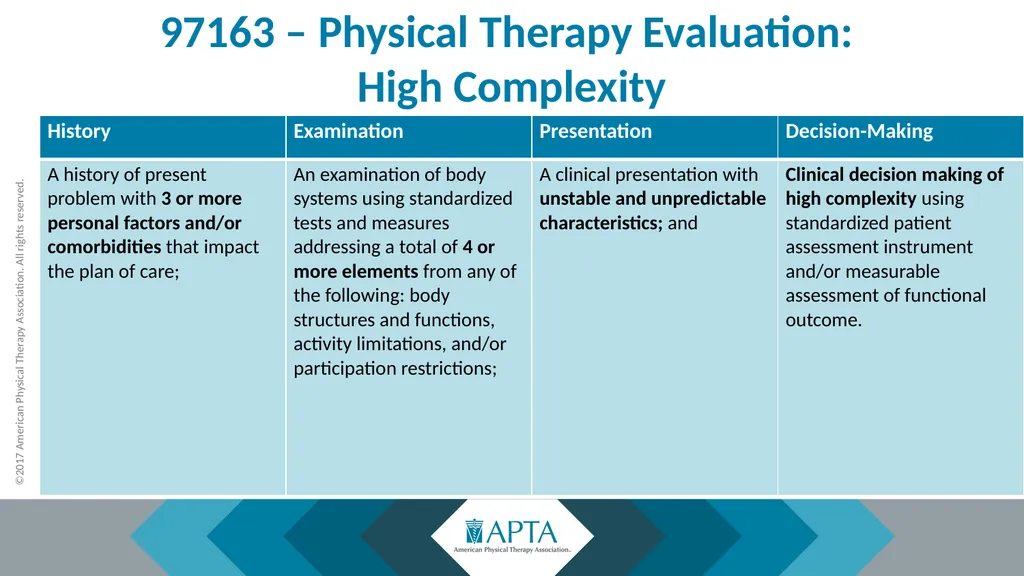
slide10. 2017 Physical Therapy Evaluation Codes 3 Evaluation Codes (97161, 97162, and 97163)
Low complexity, moderate complexity, high complexity
Components:
Patient history (comorbidities, personal factors),
Examination and the use of standardized tests and measures,
Clinical presentation, and
Clinical decision making
1 Reevaluation Code (97164)
Performed when an established patient is being evaluated to update a plan of care
All incorporate use of standardized tests and measures and patient assessment instruments or functional outcome measures ©2017 American Physical Therapy Association. All rights reserved.<br>
slide11. 97161 – Physical Therapy Evaluation: Low Complexity ©2017 American Physical Therapy Association. All rights reserved.<br>
slide12. 97162 – Physical Therapy Evaluation: Moderate Complexity ©2017 American Physical Therapy Association. All rights reserved.<br>
slide13. 97163 – Physical Therapy Evaluation: High Complexity ©2017 American Physical Therapy Association. All rights reserved.<br>
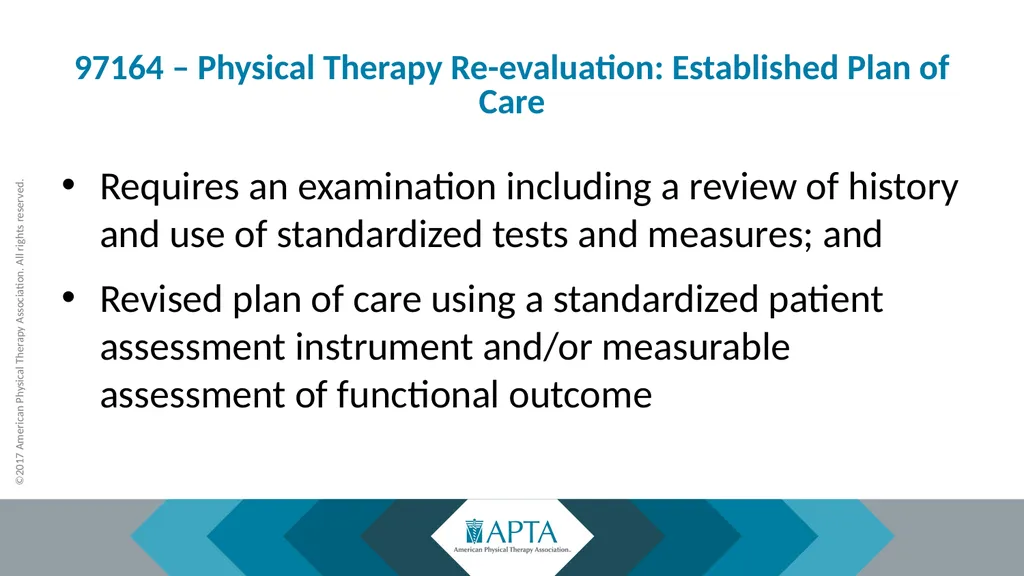
slide14. 97164 – Physical Therapy Re-evaluation: Established Plan of Care Requires an examination including a review of history and use of standardized tests and measures; and
Revised plan of care using a standardized patient assessment instrument and/or measurable assessment of functional outcome ©2017 American Physical Therapy Association. All rights reserved.<br>
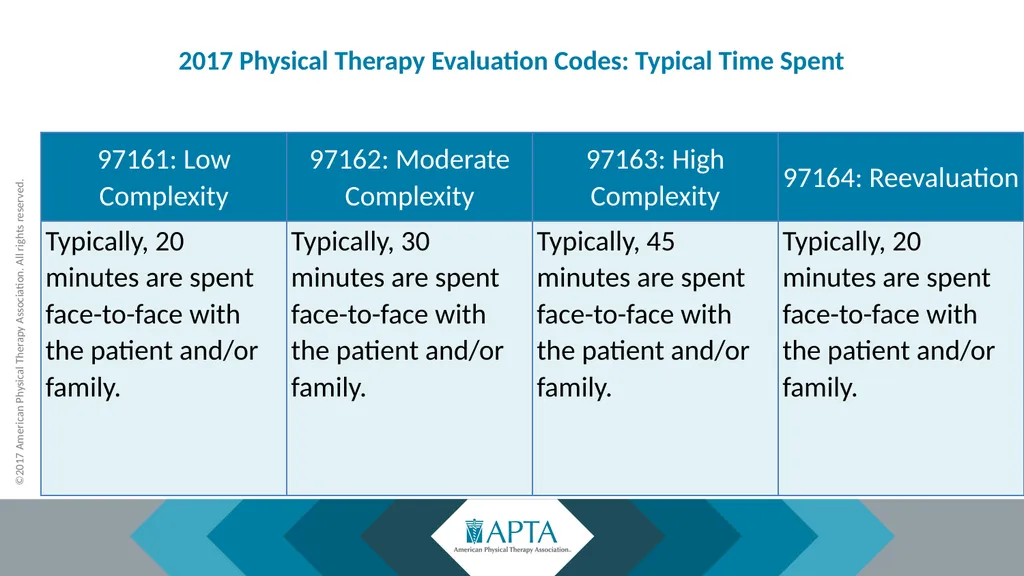
slide15. 2017 Physical Therapy Evaluation Codes: Typical Time Spent ©2017 American Physical Therapy Association. All rights reserved.<br>
slide16. Reporting a Therapy Diagnosis and Reporting Level of Patient Complexity Establishing a therapy diagnosis and
Considering of a patient’s medical comorbidities, functional history, and other personal factors
Demonstrates the value of the clinical decision making required to provide medically necessary care. ©2017 American Physical Therapy Association. All rights reserved.<br>
slide17. Describing the Evaluation Process and Defining Terms for Reporting Evaluation Codes ©2017 American Physical Therapy Association. All rights reserved.<br>
slide18. Introductory Language “Physical therapy evaluations include: patient history, and an examination with the development of a plan of care....which is based on the composite of the patient’s presentation.”
“Coordination, consultation, and collaboration of care with physician, other QHP, or agencies is provided consistent with the nature of problem(s) and the needs of the patient, family, and/or other caregivers.” ©2017 American Physical Therapy Association. All rights reserved.<br>
slide19. Introductory Language (continued) At a minimum, each of the following components noted in the code descriptors must be documented, in order to report the selected level of complexity for an evaluation. ©2017 American Physical Therapy Association. All rights reserved.<br>
slide20. Introductory Language (continued) Physical therapy evaluations include the following components:
History
Examination
Clinical decision making
Development of plan of care ©2017 American Physical Therapy Association. All rights reserved.<br>
slide21. Code Descriptor Language 4 primary elements that will inform selection of evaluation complexity level:
History
Examination
Clinical presentation
Clinical decision making, leading to the development of a plan of care
Must communicate information regarding all 4 elements
All 4 elements must support the selected complexity level ©2017 American Physical Therapy Association. All rights reserved.<br>
slide22. Process: A physical therapy evaluation includes determining the patient’s overall severity and complexity:
History (medical and functional) and impact of “contextual factors”
Examination
Body structures and functions
Activity limitations and/or participation restrictions
Environmental and personal factors
Leads to ability to describe clinical presentation; and
Leads to ability to make clinical judgments to develop a plan for managing the patient through an episode The Evaluation Process ©2017 American Physical Therapy Association. All rights reserved.<br>
slide23. Evaluation complexity: low, moderate, or high
97161, 97162, 97163 Clinical Presentation
Stable, Evolving, Unstable History
Comorbidity and personal factors that impact the plan of care Examination
Body systems: structures and functions
Activity limitations and/or participation restrictions Clinical Decision Making ©2017 American Physical Therapy Association. All rights reserved.<br>
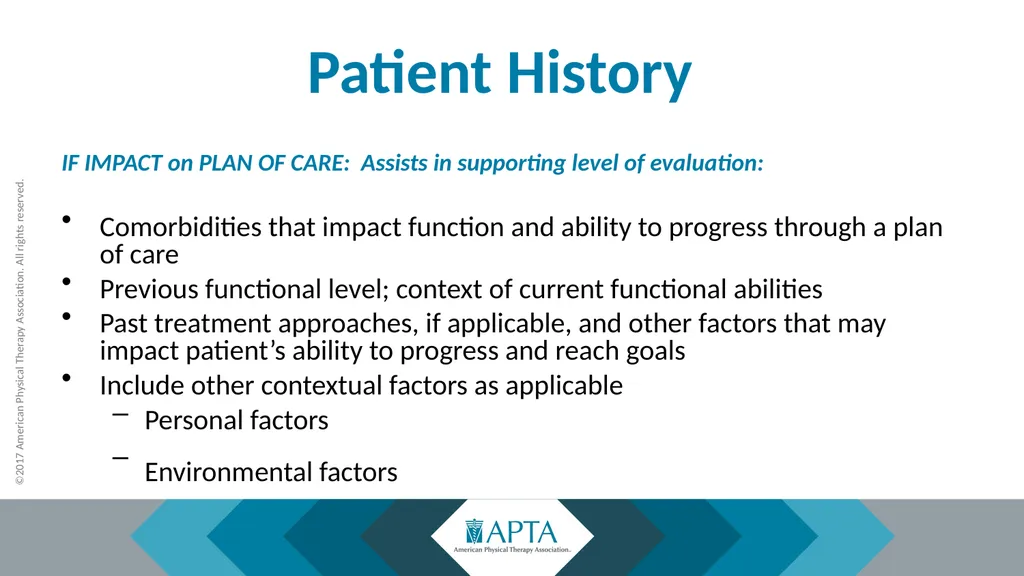
slide24. IF IMPACT on PLAN OF CARE: Assists in supporting level of evaluation:
Comorbidities that impact function and ability to progress through a plan of care
Previous functional level; context of current functional abilities
Past treatment approaches, if applicable, and other factors that may impact patient’s ability to progress and reach goals
Include other contextual factors as applicable
Personal factors
Environmental factors Patient History ©2017 American Physical Therapy Association. All rights reserved.<br>
slide25. Documenting Patient History: Defining Contextual Factors Personal Factors influence how disability is experienced by the individual:
Include sex, age, coping styles, social background, education, profession, past/current experience
Overall behavior patterns, learning styles, adherence to interventions
Personal factors that exist but do not impact the physical therapy plan of care are not to be considered when selecting a level of service.
Environmental Factors
Physical, social, and attitudinal environment in which people live and experience ©2017 American Physical Therapy Association. All rights reserved.<br>
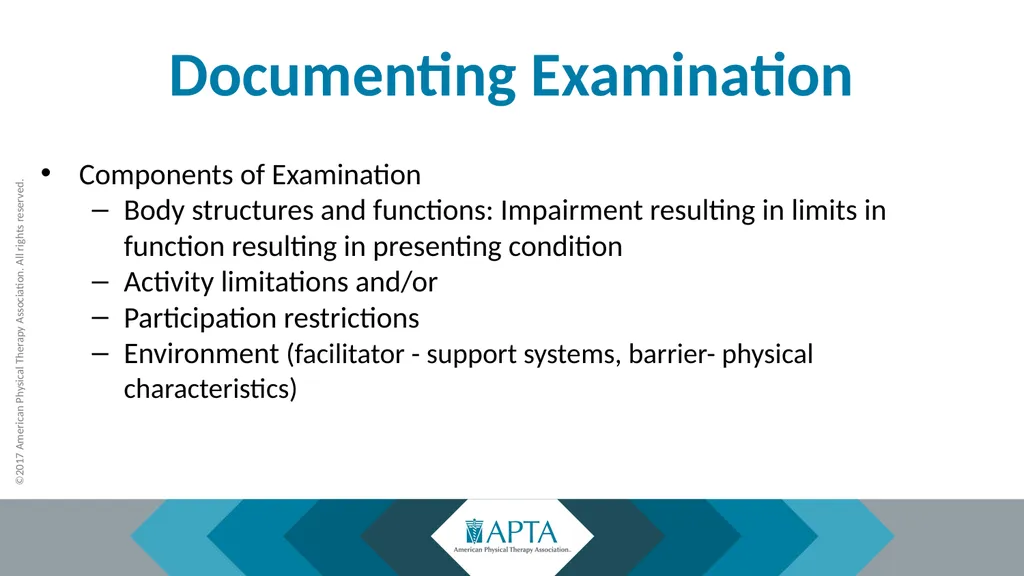
slide26. Documenting Examination Components of Examination
Body structures and functions: Impairment resulting in limits in function resulting in presenting condition
Activity limitations and/or
Participation restrictions
Environment (facilitator - support systems, barrier- physical characteristics) ©2017 American Physical Therapy Association. All rights reserved.<br>
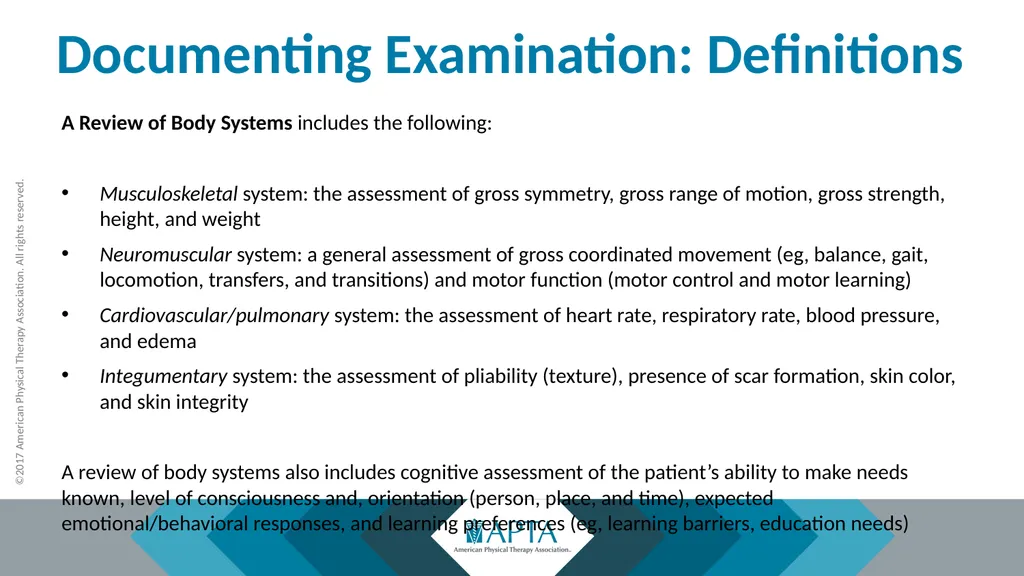
slide27. Documenting Examination: Definitions A Review of Body Systems includes the following:
Musculoskeletal system: the assessment of gross symmetry, gross range of motion, gross strength, height, and weight
Neuromuscular system: a general assessment of gross coordinated movement (eg, balance, gait, locomotion, transfers, and transitions) and motor function (motor control and motor learning)
Cardiovascular/pulmonary system: the assessment of heart rate, respiratory rate, blood pressure, and edema
Integumentary system: the assessment of pliability (texture), presence of scar formation, skin color, and skin integrity
A review of body systems also includes cognitive assessment of the patient’s ability to make needs known, level of consciousness and, orientation (person, place, and time), expected emotional/behavioral responses, and learning preferences (eg, learning barriers, education needs) ©2017 American Physical Therapy Association. All rights reserved.<br>
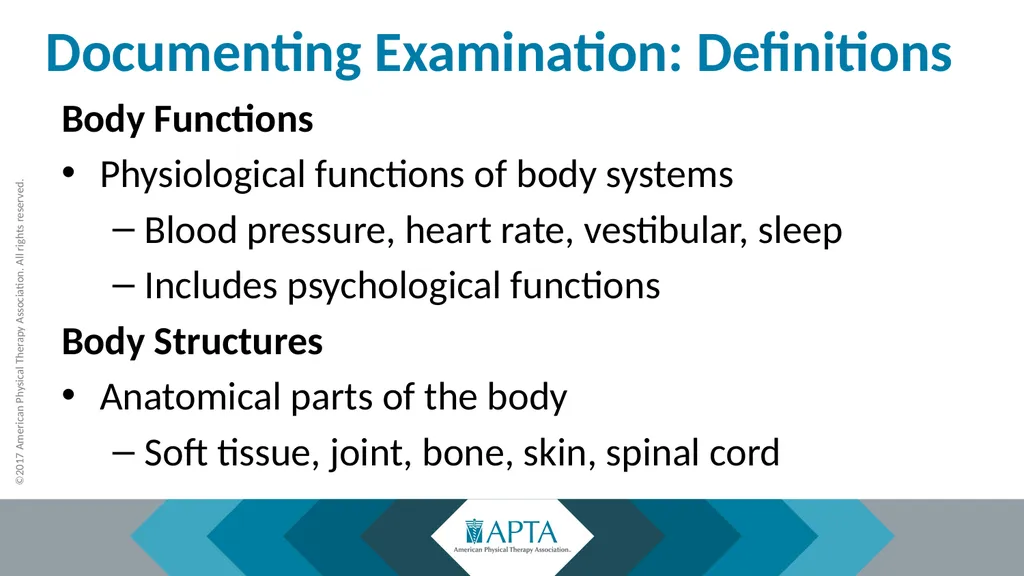
slide28. Body Functions
Physiological functions of body systems
Blood pressure, heart rate, vestibular, sleep
Includes psychological functions
Body Structures
Anatomical parts of the body
Soft tissue, joint, bone, skin, spinal cord Documenting Examination: Definitions ©2017 American Physical Therapy Association. All rights reserved.<br>
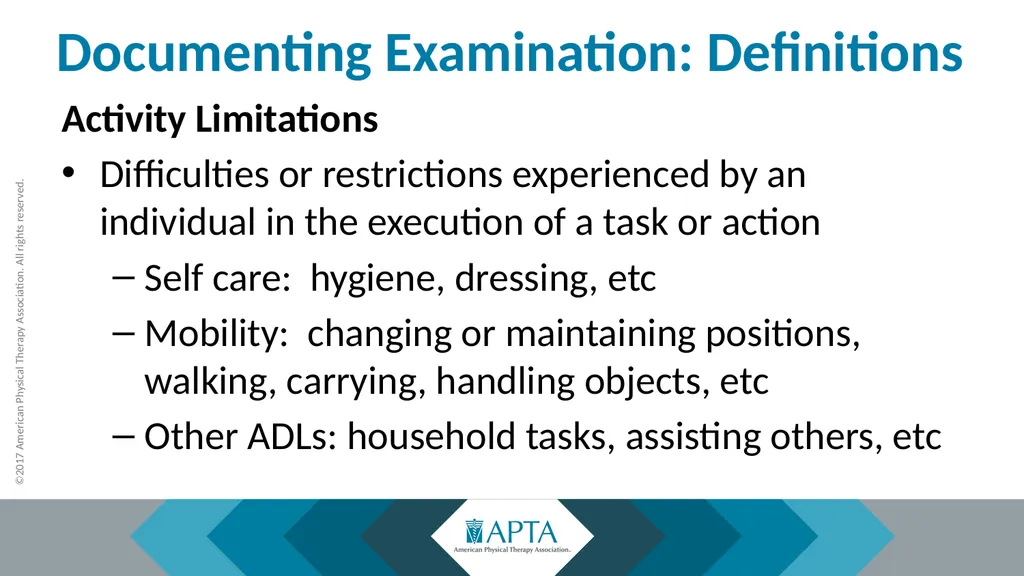
slide29. Activity Limitations
Difficulties or restrictions experienced by an individual in the execution of a task or action
Self care: hygiene, dressing, etc
Mobility: changing or maintaining positions, walking, carrying, handling objects, etc
Other ADLs: household tasks, assisting others, etc Documenting Examination: Definitions ©2017 American Physical Therapy Association. All rights reserved.<br>
slide30. Participation Restrictions
Difficulties or restrictions experienced by an individual in societal aspects of functioning or in life situations
Participating in domestic life
Participating as a student or employee
Participating as a member of a community
Accessing public transportation or other services Documenting Examination: Definitions ©2017 American Physical Therapy Association. All rights reserved.<br>
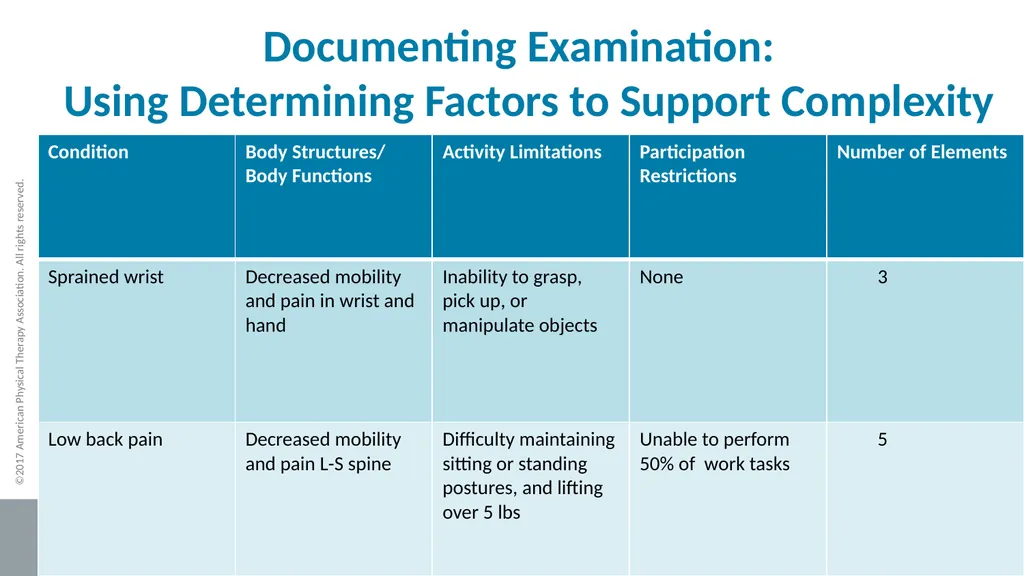
slide31. Documenting Examination: Using Determining Factors to Support Complexity ©2017 American Physical Therapy Association. All rights reserved.<br>
slide32. Documenting Examination: Describing Clinical Presentation Patient interview (nature)
Observing patient response to exam (behavior)
Stable, uncomplicated, straightforward, problem-focused
Evolving, characteristics of patient’s condition are changing, complaints, and/or cognitive deficits
Unstable, characteristics of patient’s condition and are unpredictable, and/or significant cognitive deficits affecting safety ©2017 American Physical Therapy Association. All rights reserved.<br>
slide33. Documenting Examination: Clinical Judgment History + physical exam + clinical presentation contribute to decisions reflecting clinical judgment
To achieve good outcomes, PTs use clinical judgment to determine the overall severity of patients’ complaint/condition and make appropriate decisions for interventions based on their patient assessment, at each encounter or session, supported as much as possible by current best evidence ©2017 American Physical Therapy Association. All rights reserved.<br>
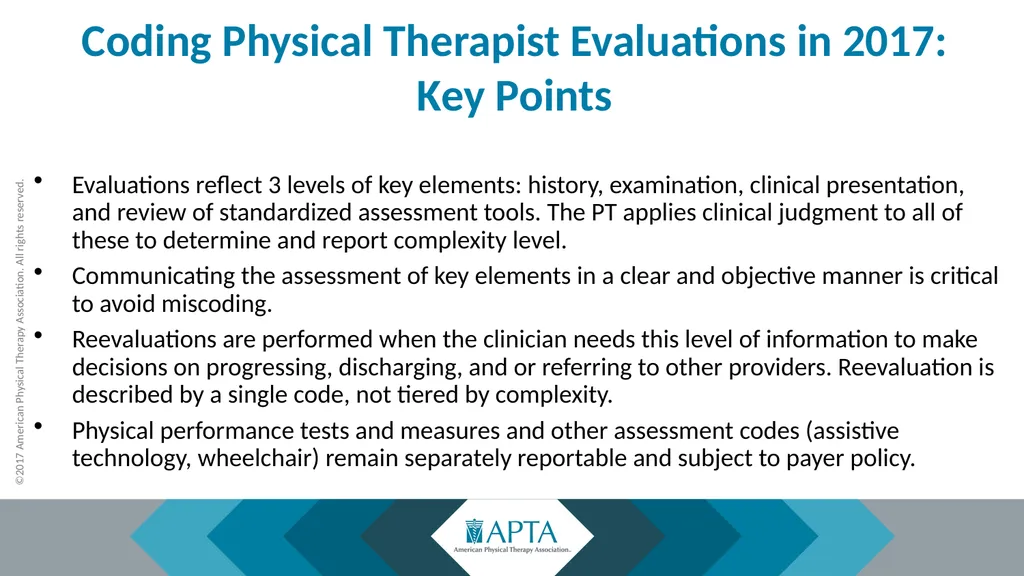
slide34. Coding Physical Therapist Evaluations in 2017: Key Points Evaluations reflect 3 levels of key elements: history, examination, clinical presentation, and review of standardized assessment tools. The PT applies clinical judgment to all of these to determine and report complexity level.
Communicating the assessment of key elements in a clear and objective manner is critical to avoid miscoding.
Reevaluations are performed when the clinician needs this level of information to make decisions on progressing, discharging, and or referring to other providers. Reevaluation is described by a single code, not tiered by complexity.
Physical performance tests and measures and other assessment codes (assistive technology, wheelchair) remain separately reportable and subject to payer policy. ©2017 American Physical Therapy Association. All rights reserved.<br>
slide35. Impact of Reflecting Complexity in Clinical Decision Making Reflect complexity of patient in order to better determine the management path
Assessment tools at the front end and outcomes reported at the back end differentiate how patients are managed for potential development of reformed payment model
Address variation in care ©2017 American Physical Therapy Association. All rights reserved.<br>
slide36. PAYMENT FOR PHYSICAL THERAPY EVALUATIONS ©2017 American Physical Therapy Association. All rights reserved.<br>
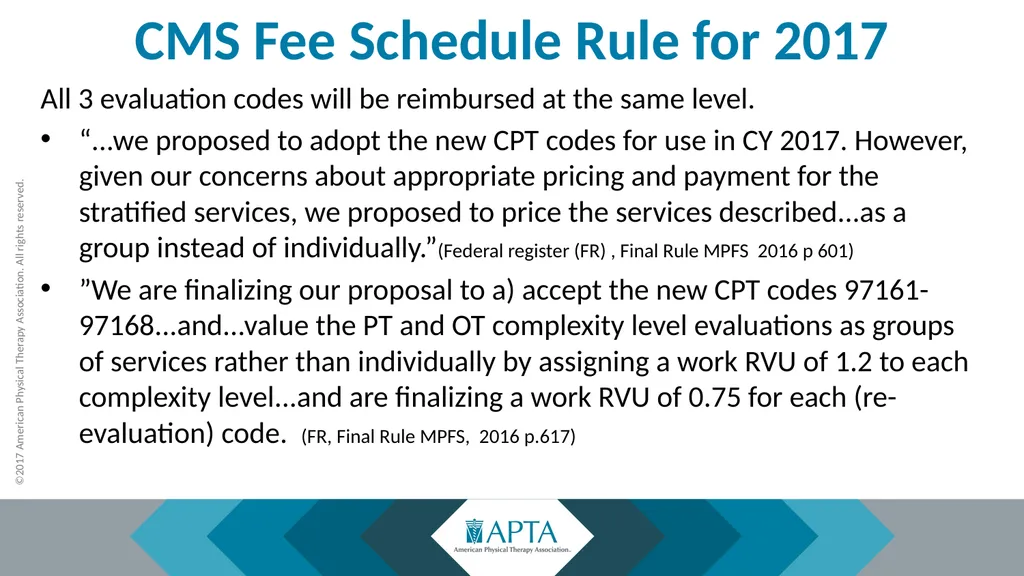
slide37. CMS Fee Schedule Rule for 2017 All 3 evaluation codes will be reimbursed at the same level.
“...we proposed to adopt the new CPT codes for use in CY 2017. However, given our concerns about appropriate pricing and payment for the stratified services, we proposed to price the services described...as a group instead of individually.”(Federal register (FR) , Final Rule MPFS 2016 p 601)
”We are finalizing our proposal to a) accept the new CPT codes 97161-97168...and...value the PT and OT complexity level evaluations as groups of services rather than individually by assigning a work RVU of 1.2 to each complexity level...and are finalizing a work RVU of 0.75 for each (re-evaluation) code. (FR, Final Rule MPFS, 2016 p.617) ©2017 American Physical Therapy Association. All rights reserved.<br>
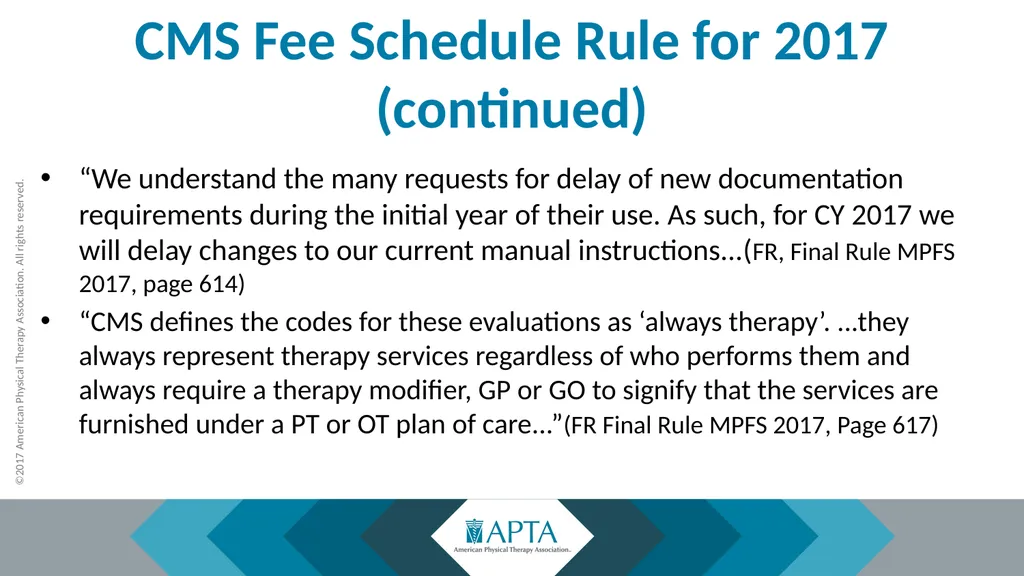
slide38. CMS Fee Schedule Rule for 2017 (continued) “We understand the many requests for delay of new documentation requirements during the initial year of their use. As such, for CY 2017 we will delay changes to our current manual instructions...(FR, Final Rule MPFS 2017, page 614)
“CMS defines the codes for these evaluations as ‘always therapy’. ...they always represent therapy services regardless of who performs them and always require a therapy modifier, GP or GO to signify that the services are furnished under a PT or OT plan of care...”(FR Final Rule MPFS 2017, Page 617) ©2017 American Physical Therapy Association. All rights reserved.<br>
slide39. 2017 Medicare Payment for Evaluation & Reevaluation Codes Summary of MPFS Final Rule:
Work values remain the same for all levels of PT and OT evaluations (1.20 Work RVU)
PT and OT reevaluation work values will be 0.75, an increase from 0.60
CMS will delay changes to the Medicare Benefit Policy Manual (MBPM), Ch 15, Section 220.3 regarding new PT/OT evaluation and reevaluation codes ©2017 American Physical Therapy Association. All rights reserved.<br>
slide40. RESOURCES ©2017 American Physical Therapy Association. All rights reserved.<br>
slide41. Physical Therapy Evaluation & Reevaluation Codes: Resources APTA Website Resources
www.apta.org/PaymentReform/
www.apta.org/PaymentReform/NewEvalReevalCPTCodes/
APTA Guide to Physical Therapist Practice
http://guidetoptpractice.apta.org/
Gordon J, Quinn L. Functional Outcomes Documentation for Rehabilitation. 3rd ed. Saunders; 2016. http://store.elsevier.com/Documentation-for-Rehabilitation/Lori-Quinn/isbn-9780323312332/ ©2017 American Physical Therapy Association. All rights reserved.<br>
slide42. Physical Therapy Evaluation & Reevaluation Codes: Resources Federal Register 2017 Medicare Program https://www.federalregister.gov/documents/2016/07/15/2016-16097/medicare-program-revisions-to-payment-policies-under-the-physician-fee-schedule-and-other-revisions
International Classification of Functioning, Disability and Health, Geneva, 2001 http://www.who.int/classifications/icf/en/ ©2017 American Physical Therapy Association. All rights reserved.<br>
slide43. Clinical scenarios and suggested coding ©2017 American Physical Therapy Association. All rights reserved.<br>
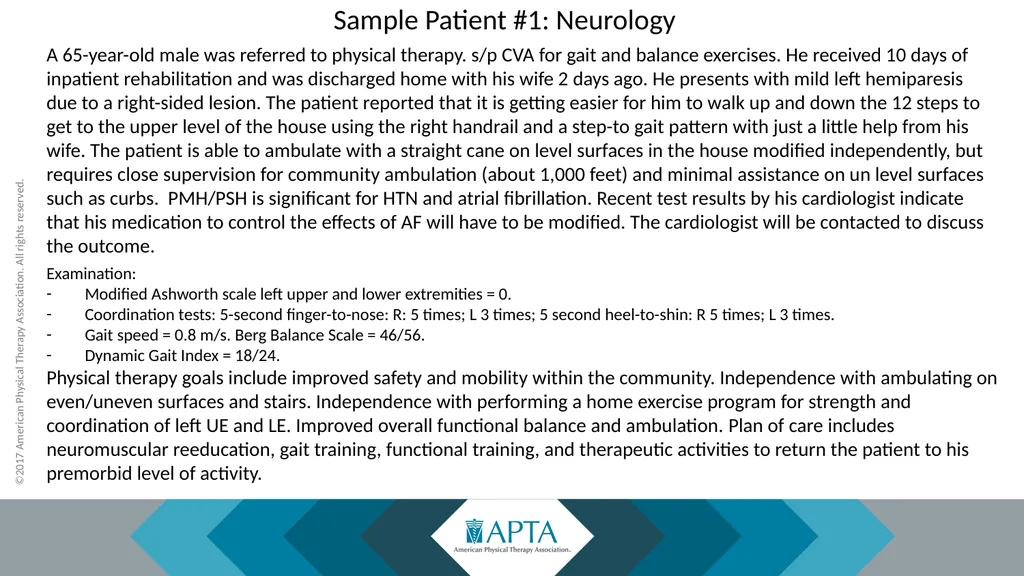
slide44. Sample Patient #1: Neurology A 65-year-old male was referred to physical therapy. s/p CVA for gait and balance exercises. He received 10 days of inpatient rehabilitation and was discharged home with his wife 2 days ago. He presents with mild left hemiparesis due to a right-sided lesion. The patient reported that it is getting easier for him to walk up and down the 12 steps to get to the upper level of the house using the right handrail and a step-to gait pattern with just a little help from his wife. The patient is able to ambulate with a straight cane on level surfaces in the house modified independently, but requires close supervision for community ambulation (about 1,000 feet) and minimal assistance on un level surfaces such as curbs. PMH/PSH is significant for HTN and atrial fibrillation. Recent test results by his cardiologist indicate that his medication to control the effects of AF will have to be modified. The cardiologist will be contacted to discuss the outcome.
Examination:
Modified Ashworth scale left upper and lower extremities = 0.
Coordination tests: 5-second finger-to-nose: R: 5 times; L 3 times; 5 second heel-to-shin: R 5 times; L 3 times.
Gait speed = 0.8 m/s. Berg Balance Scale = 46/56.
Dynamic Gait Index = 18/24.
Physical therapy goals include improved safety and mobility within the community. Independence with ambulating on even/uneven surfaces and stairs. Independence with performing a home exercise program for strength and coordination of left UE and LE. Improved overall functional balance and ambulation. Plan of care includes neuromuscular reeducation, gait training, functional training, and therapeutic activities to return the patient to his premorbid level of activity. ©2017 American Physical Therapy Association. All rights reserved.<br>
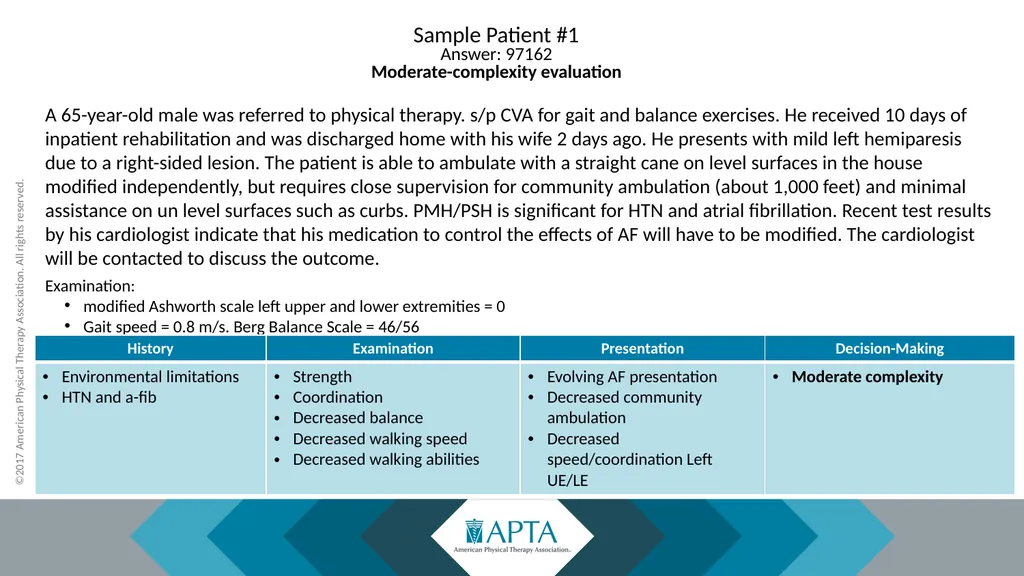
slide45. Sample Patient #1 Answer: 97162 Moderate-complexity evaluation A 65-year-old male was referred to physical therapy. s/p CVA for gait and balance exercises. He received 10 days of inpatient rehabilitation and was discharged home with his wife 2 days ago. He presents with mild left hemiparesis due to a right-sided lesion. The patient is able to ambulate with a straight cane on level surfaces in the house modified independently, but requires close supervision for community ambulation (about 1,000 feet) and minimal assistance on un level surfaces such as curbs. PMH/PSH is significant for HTN and atrial fibrillation. Recent test results by his cardiologist indicate that his medication to control the effects of AF will have to be modified. The cardiologist will be contacted to discuss the outcome.
Examination:
modified Ashworth scale left upper and lower extremities = 0
Gait speed = 0.8 m/s. Berg Balance Scale = 46/56 ©2017 American Physical Therapy Association. All rights reserved.<br>
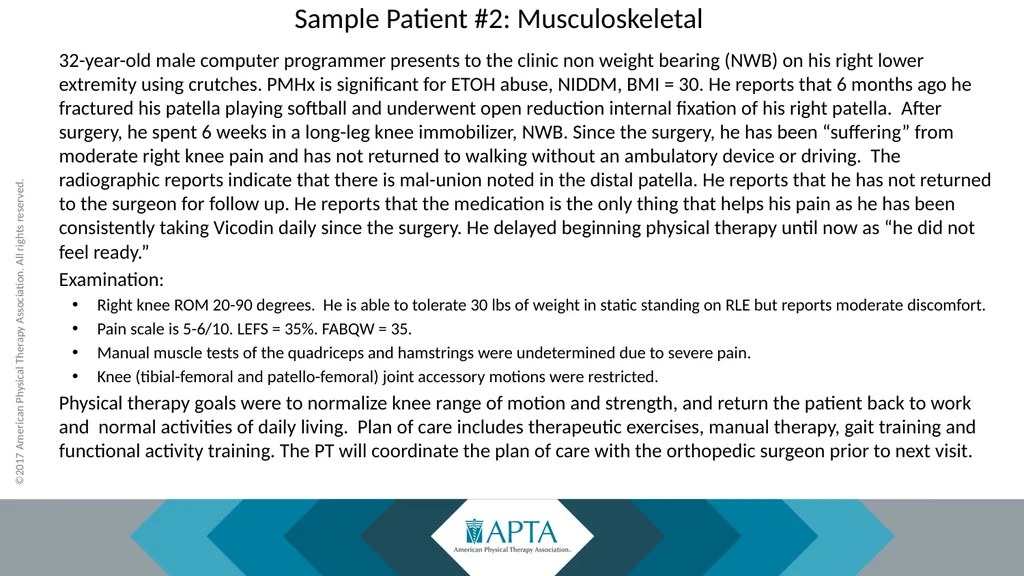
slide46. Sample Patient #2: Musculoskeletal 32-year-old male computer programmer presents to the clinic non weight bearing (NWB) on his right lower extremity using crutches. PMHx is significant for ETOH abuse, NIDDM, BMI = 30. He reports that 6 months ago he fractured his patella playing softball and underwent open reduction internal fixation of his right patella. After surgery, he spent 6 weeks in a long-leg knee immobilizer, NWB. Since the surgery, he has been “suffering” from moderate right knee pain and has not returned to walking without an ambulatory device or driving. The radiographic reports indicate that there is mal-union noted in the distal patella. He reports that he has not returned to the surgeon for follow up. He reports that the medication is the only thing that helps his pain as he has been consistently taking Vicodin daily since the surgery. He delayed beginning physical therapy until now as “he did not feel ready.”
Examination:
Right knee ROM 20-90 degrees. He is able to tolerate 30 lbs of weight in static standing on RLE but reports moderate discomfort.
Pain scale is 5-6/10. LEFS = 35%. FABQW = 35.
Manual muscle tests of the quadriceps and hamstrings were undetermined due to severe pain.
Knee (tibial-femoral and patello-femoral) joint accessory motions were restricted.
Physical therapy goals were to normalize knee range of motion and strength, and return the patient back to work and normal activities of daily living. Plan of care includes therapeutic exercises, manual therapy, gait training and functional activity training. The PT will coordinate the plan of care with the orthopedic surgeon prior to next visit. ©2017 American Physical Therapy Association. All rights reserved.<br>
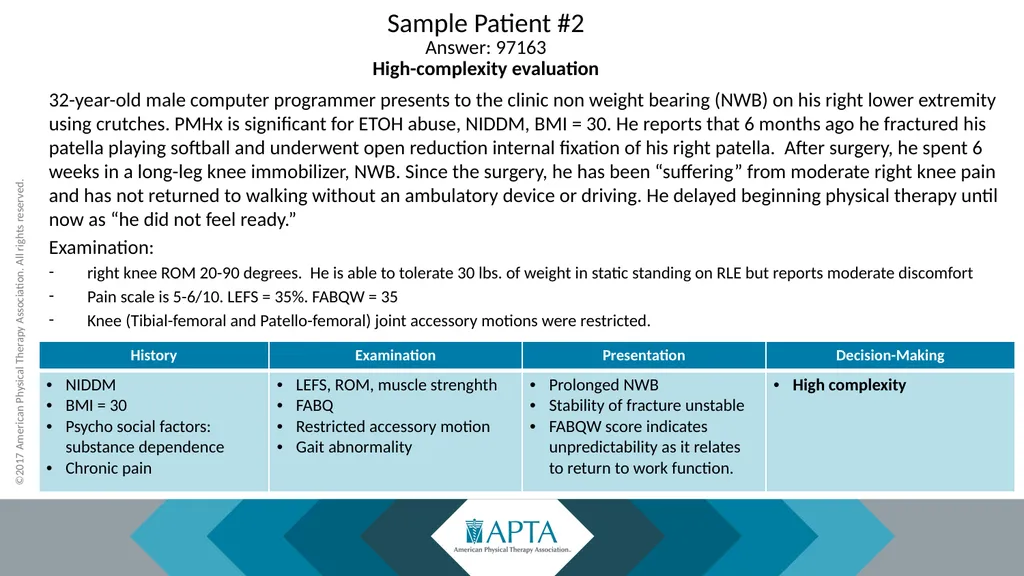
slide47. Sample Patient #2 Answer: 97163 High-complexity evaluation 32-year-old male computer programmer presents to the clinic non weight bearing (NWB) on his right lower extremity using crutches. PMHx is significant for ETOH abuse, NIDDM, BMI = 30. He reports that 6 months ago he fractured his patella playing softball and underwent open reduction internal fixation of his right patella. After surgery, he spent 6 weeks in a long-leg knee immobilizer, NWB. Since the surgery, he has been “suffering” from moderate right knee pain and has not returned to walking without an ambulatory device or driving. He delayed beginning physical therapy until now as “he did not feel ready.”
Examination:
right knee ROM 20-90 degrees. He is able to tolerate 30 lbs. of weight in static standing on RLE but reports moderate discomfort
Pain scale is 5-6/10. LEFS = 35%. FABQW = 35
Knee (Tibial-femoral and Patello-femoral) joint accessory motions were restricted. ©2017 American Physical Therapy Association. All rights reserved.<br>
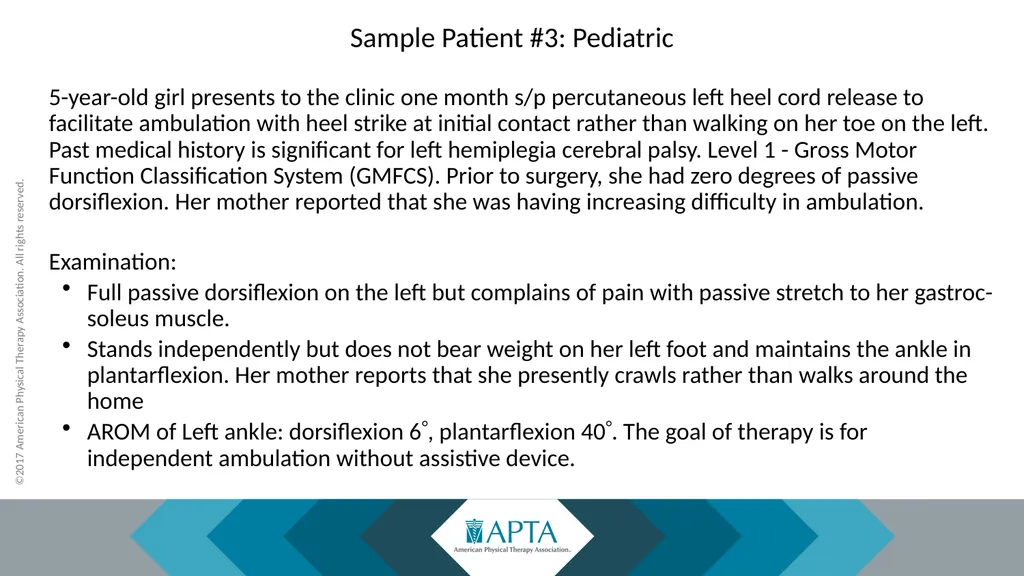
slide48. Sample Patient #3: Pediatric 5-year-old girl presents to the clinic one month s/p percutaneous left heel cord release to facilitate ambulation with heel strike at initial contact rather than walking on her toe on the left. Past medical history is significant for left hemiplegia cerebral palsy. Level 1 - Gross Motor Function Classification System (GMFCS). Prior to surgery, she had zero degrees of passive dorsiflexion. Her mother reported that she was having increasing difficulty in ambulation.
Examination:
Full passive dorsiflexion on the left but complains of pain with passive stretch to her gastroc-soleus muscle.
Stands independently but does not bear weight on her left foot and maintains the ankle in plantarflexion. Her mother reports that she presently crawls rather than walks around the home
AROM of Left ankle: dorsiflexion 6, plantarflexion 40. The goal of therapy is for independent ambulation without assistive device. ©2017 American Physical Therapy Association. All rights reserved.<br>
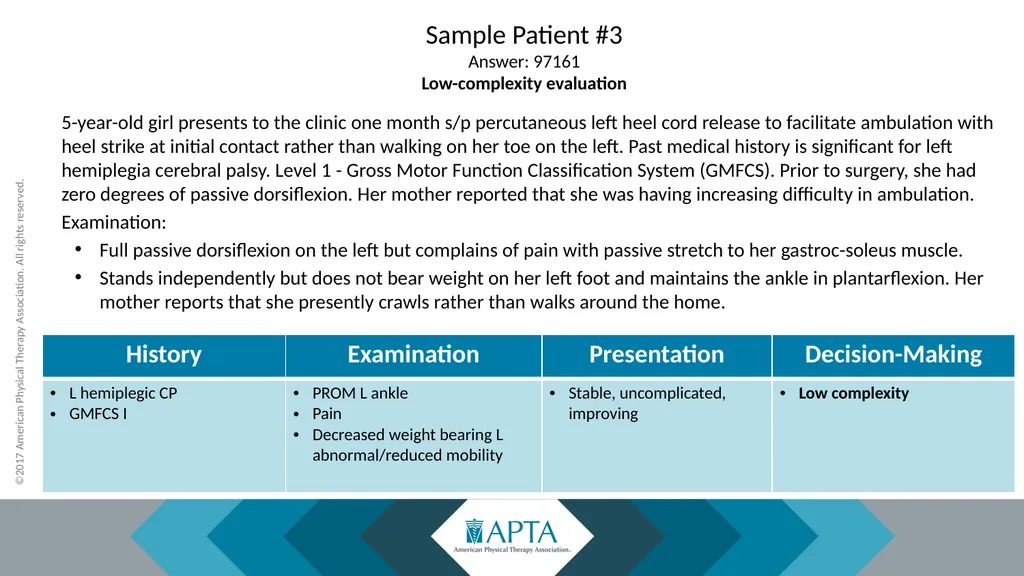
slide49. Sample Patient #3 Answer: 97161 Low-complexity evaluation 5-year-old girl presents to the clinic one month s/p percutaneous left heel cord release to facilitate ambulation with heel strike at initial contact rather than walking on her toe on the left. Past medical history is significant for left hemiplegia cerebral palsy. Level 1 - Gross Motor Function Classification System (GMFCS). Prior to surgery, she had zero degrees of passive dorsiflexion. Her mother reported that she was having increasing difficulty in ambulation.
Examination:
Full passive dorsiflexion on the left but complains of pain with passive stretch to her gastroc-soleus muscle.
Stands independently but does not bear weight on her left foot and maintains the ankle in plantarflexion. Her mother reports that she presently crawls rather than walks around the home. ©2017 American Physical Therapy Association. All rights reserved.<br>
slide50. Sample Patient #4: Geriatrics A 70-year-old male office worker presents to physical therapy with low back pain with a VAS pain = 8/10 after working on his garden and taking a long car ride to pick up his granddaughter from college. He also is now experiencing pain in his right posterior leg and lateral foot. Upon evaluation the physical therapist’s clinical impression is that the patient’s activities of gardening and driving have led to the onset of a new episode of back pain with potential new radicular involvement. PMHx is significant for a recent exacerbation of gout BLE.
Examination:
Impairments were noted in trunk ROM and muscle strength of the lower quarter
Neurologic status: myotomes unremarkable. However, sensation to light touch is diminished over the right lateral leg and foot.
Trunk flexion is markedly limited and is painful. In addition, a lateral shift of the lumbar spine to the left is noted. Trunk extension is limited but repeated trunk extension centralizes his pain
Oswestry Low Back Pain Disability Questionnaire = 42%
The therapist communicates these findings to the patient’s physician and recommends a plan of care for additional physical therapy to manage the symptoms including manual therapy and extension exercises to centralize his complaints of pain. ©2017 American Physical Therapy Association. All rights reserved.<br>
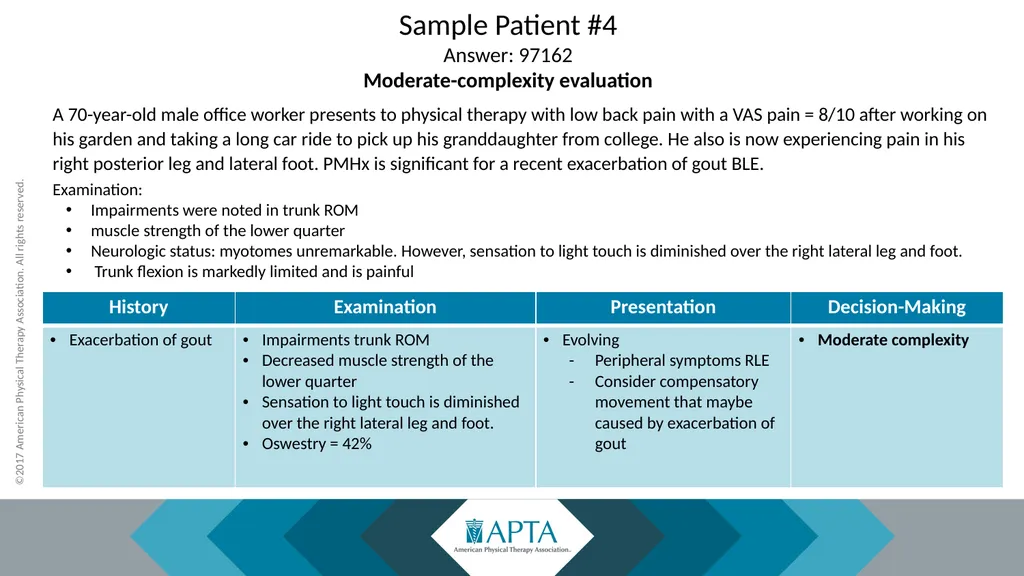
slide51. Sample Patient #4 Answer: 97162 Moderate-complexity evaluation A 70-year-old male office worker presents to physical therapy with low back pain with a VAS pain = 8/10 after working on his garden and taking a long car ride to pick up his granddaughter from college. He also is now experiencing pain in his right posterior leg and lateral foot. PMHx is significant for a recent exacerbation of gout BLE.
Examination:
Impairments were noted in trunk ROM
muscle strength of the lower quarter
Neurologic status: myotomes unremarkable. However, sensation to light touch is diminished over the right lateral leg and foot.
Trunk flexion is markedly limited and is painful ©2017 American Physical Therapy Association. All rights reserved.<br>
slide52. ©2017 American Physical Therapy Association. All rights reserved.<br>
Train-the-Trainer Slide Deck ©2017 American Physical Therapy Association. All rights reserved.<br>
slide3. INTRODUCTION ©2017 American Physical Therapy Association. All rights reserved.<br>
slide4. Training Agenda ©2017 American Physical Therapy Association. All rights reserved.<br>
slide5. Training Learning Objectives ©2017 American Physical Therapy Association. All rights reserved.<br>
slide6. Physical Therapy Evaluation Code Descriptors ©2017 American Physical Therapy Association. All rights reserved.<br>
slide7. The Importance of the Physical Therapist Evaluation The evaluation drives the care and/or management of the care.
A thorough and complete evaluation is critical to success in achieving a positive outcome for the patient’s episode of physical therapist care.
A reflection of the level of complexity of the patient is key to effective management throughout the episode. ©2017 American Physical Therapy Association. All rights reserved.<br>
slide8. Elements of a Physical Therapist Evaluation Consistent with APTA’s Guide to Physical Therapist Practice
Examination (includes history, systems review, and tests and measures)
Evaluation (the thought process leading to identifying impairments, functional limitations, disabilities, and needs for prevention)
Diagnosis (impact of the condition on function)
Prognosis (professional judgment regarding the predicted functional outcome and the estimated duration of services required)
Plan of Care (the culmination of an evaluation) ©2017 American Physical Therapy Association. All rights reserved.<br>
slide9. 2017 Physical Therapy Evaluation Codes The objective for changes to the evaluation codes:
Facilitate a payment method based on the accurate and complete communication of the following:
Completed patient assessment instrument
Evaluation of clinical presentation
Treatment and management options planned and provided
Demonstration of value associated with achievement of functional outcomes
Payment Based on Quality and Outcomes = Value to Patient and the Payer ©2017 American Physical Therapy Association. All rights reserved.<br>
slide10. 2017 Physical Therapy Evaluation Codes 3 Evaluation Codes (97161, 97162, and 97163)
Low complexity, moderate complexity, high complexity
Components:
Patient history (comorbidities, personal factors),
Examination and the use of standardized tests and measures,
Clinical presentation, and
Clinical decision making
1 Reevaluation Code (97164)
Performed when an established patient is being evaluated to update a plan of care
All incorporate use of standardized tests and measures and patient assessment instruments or functional outcome measures ©2017 American Physical Therapy Association. All rights reserved.<br>
slide11. 97161 – Physical Therapy Evaluation: Low Complexity ©2017 American Physical Therapy Association. All rights reserved.<br>
slide12. 97162 – Physical Therapy Evaluation: Moderate Complexity ©2017 American Physical Therapy Association. All rights reserved.<br>
slide13. 97163 – Physical Therapy Evaluation: High Complexity ©2017 American Physical Therapy Association. All rights reserved.<br>
slide14. 97164 – Physical Therapy Re-evaluation: Established Plan of Care Requires an examination including a review of history and use of standardized tests and measures; and
Revised plan of care using a standardized patient assessment instrument and/or measurable assessment of functional outcome ©2017 American Physical Therapy Association. All rights reserved.<br>
slide15. 2017 Physical Therapy Evaluation Codes: Typical Time Spent ©2017 American Physical Therapy Association. All rights reserved.<br>
slide16. Reporting a Therapy Diagnosis and Reporting Level of Patient Complexity Establishing a therapy diagnosis and
Considering of a patient’s medical comorbidities, functional history, and other personal factors
Demonstrates the value of the clinical decision making required to provide medically necessary care. ©2017 American Physical Therapy Association. All rights reserved.<br>
slide17. Describing the Evaluation Process and Defining Terms for Reporting Evaluation Codes ©2017 American Physical Therapy Association. All rights reserved.<br>
slide18. Introductory Language “Physical therapy evaluations include: patient history, and an examination with the development of a plan of care....which is based on the composite of the patient’s presentation.”
“Coordination, consultation, and collaboration of care with physician, other QHP, or agencies is provided consistent with the nature of problem(s) and the needs of the patient, family, and/or other caregivers.” ©2017 American Physical Therapy Association. All rights reserved.<br>
slide19. Introductory Language (continued) At a minimum, each of the following components noted in the code descriptors must be documented, in order to report the selected level of complexity for an evaluation. ©2017 American Physical Therapy Association. All rights reserved.<br>
slide20. Introductory Language (continued) Physical therapy evaluations include the following components:
History
Examination
Clinical decision making
Development of plan of care ©2017 American Physical Therapy Association. All rights reserved.<br>
slide21. Code Descriptor Language 4 primary elements that will inform selection of evaluation complexity level:
History
Examination
Clinical presentation
Clinical decision making, leading to the development of a plan of care
Must communicate information regarding all 4 elements
All 4 elements must support the selected complexity level ©2017 American Physical Therapy Association. All rights reserved.<br>
slide22. Process: A physical therapy evaluation includes determining the patient’s overall severity and complexity:
History (medical and functional) and impact of “contextual factors”
Examination
Body structures and functions
Activity limitations and/or participation restrictions
Environmental and personal factors
Leads to ability to describe clinical presentation; and
Leads to ability to make clinical judgments to develop a plan for managing the patient through an episode The Evaluation Process ©2017 American Physical Therapy Association. All rights reserved.<br>
slide23. Evaluation complexity: low, moderate, or high
97161, 97162, 97163 Clinical Presentation
Stable, Evolving, Unstable History
Comorbidity and personal factors that impact the plan of care Examination
Body systems: structures and functions
Activity limitations and/or participation restrictions Clinical Decision Making ©2017 American Physical Therapy Association. All rights reserved.<br>
slide24. IF IMPACT on PLAN OF CARE: Assists in supporting level of evaluation:
Comorbidities that impact function and ability to progress through a plan of care
Previous functional level; context of current functional abilities
Past treatment approaches, if applicable, and other factors that may impact patient’s ability to progress and reach goals
Include other contextual factors as applicable
Personal factors
Environmental factors Patient History ©2017 American Physical Therapy Association. All rights reserved.<br>
slide25. Documenting Patient History: Defining Contextual Factors Personal Factors influence how disability is experienced by the individual:
Include sex, age, coping styles, social background, education, profession, past/current experience
Overall behavior patterns, learning styles, adherence to interventions
Personal factors that exist but do not impact the physical therapy plan of care are not to be considered when selecting a level of service.
Environmental Factors
Physical, social, and attitudinal environment in which people live and experience ©2017 American Physical Therapy Association. All rights reserved.<br>
slide26. Documenting Examination Components of Examination
Body structures and functions: Impairment resulting in limits in function resulting in presenting condition
Activity limitations and/or
Participation restrictions
Environment (facilitator - support systems, barrier- physical characteristics) ©2017 American Physical Therapy Association. All rights reserved.<br>
slide27. Documenting Examination: Definitions A Review of Body Systems includes the following:
Musculoskeletal system: the assessment of gross symmetry, gross range of motion, gross strength, height, and weight
Neuromuscular system: a general assessment of gross coordinated movement (eg, balance, gait, locomotion, transfers, and transitions) and motor function (motor control and motor learning)
Cardiovascular/pulmonary system: the assessment of heart rate, respiratory rate, blood pressure, and edema
Integumentary system: the assessment of pliability (texture), presence of scar formation, skin color, and skin integrity
A review of body systems also includes cognitive assessment of the patient’s ability to make needs known, level of consciousness and, orientation (person, place, and time), expected emotional/behavioral responses, and learning preferences (eg, learning barriers, education needs) ©2017 American Physical Therapy Association. All rights reserved.<br>
slide28. Body Functions
Physiological functions of body systems
Blood pressure, heart rate, vestibular, sleep
Includes psychological functions
Body Structures
Anatomical parts of the body
Soft tissue, joint, bone, skin, spinal cord Documenting Examination: Definitions ©2017 American Physical Therapy Association. All rights reserved.<br>
slide29. Activity Limitations
Difficulties or restrictions experienced by an individual in the execution of a task or action
Self care: hygiene, dressing, etc
Mobility: changing or maintaining positions, walking, carrying, handling objects, etc
Other ADLs: household tasks, assisting others, etc Documenting Examination: Definitions ©2017 American Physical Therapy Association. All rights reserved.<br>
slide30. Participation Restrictions
Difficulties or restrictions experienced by an individual in societal aspects of functioning or in life situations
Participating in domestic life
Participating as a student or employee
Participating as a member of a community
Accessing public transportation or other services Documenting Examination: Definitions ©2017 American Physical Therapy Association. All rights reserved.<br>
slide31. Documenting Examination: Using Determining Factors to Support Complexity ©2017 American Physical Therapy Association. All rights reserved.<br>
slide32. Documenting Examination: Describing Clinical Presentation Patient interview (nature)
Observing patient response to exam (behavior)
Stable, uncomplicated, straightforward, problem-focused
Evolving, characteristics of patient’s condition are changing, complaints, and/or cognitive deficits
Unstable, characteristics of patient’s condition and are unpredictable, and/or significant cognitive deficits affecting safety ©2017 American Physical Therapy Association. All rights reserved.<br>
slide33. Documenting Examination: Clinical Judgment History + physical exam + clinical presentation contribute to decisions reflecting clinical judgment
To achieve good outcomes, PTs use clinical judgment to determine the overall severity of patients’ complaint/condition and make appropriate decisions for interventions based on their patient assessment, at each encounter or session, supported as much as possible by current best evidence ©2017 American Physical Therapy Association. All rights reserved.<br>
slide34. Coding Physical Therapist Evaluations in 2017: Key Points Evaluations reflect 3 levels of key elements: history, examination, clinical presentation, and review of standardized assessment tools. The PT applies clinical judgment to all of these to determine and report complexity level.
Communicating the assessment of key elements in a clear and objective manner is critical to avoid miscoding.
Reevaluations are performed when the clinician needs this level of information to make decisions on progressing, discharging, and or referring to other providers. Reevaluation is described by a single code, not tiered by complexity.
Physical performance tests and measures and other assessment codes (assistive technology, wheelchair) remain separately reportable and subject to payer policy. ©2017 American Physical Therapy Association. All rights reserved.<br>
slide35. Impact of Reflecting Complexity in Clinical Decision Making Reflect complexity of patient in order to better determine the management path
Assessment tools at the front end and outcomes reported at the back end differentiate how patients are managed for potential development of reformed payment model
Address variation in care ©2017 American Physical Therapy Association. All rights reserved.<br>
slide36. PAYMENT FOR PHYSICAL THERAPY EVALUATIONS ©2017 American Physical Therapy Association. All rights reserved.<br>
slide37. CMS Fee Schedule Rule for 2017 All 3 evaluation codes will be reimbursed at the same level.
“...we proposed to adopt the new CPT codes for use in CY 2017. However, given our concerns about appropriate pricing and payment for the stratified services, we proposed to price the services described...as a group instead of individually.”(Federal register (FR) , Final Rule MPFS 2016 p 601)
”We are finalizing our proposal to a) accept the new CPT codes 97161-97168...and...value the PT and OT complexity level evaluations as groups of services rather than individually by assigning a work RVU of 1.2 to each complexity level...and are finalizing a work RVU of 0.75 for each (re-evaluation) code. (FR, Final Rule MPFS, 2016 p.617) ©2017 American Physical Therapy Association. All rights reserved.<br>
slide38. CMS Fee Schedule Rule for 2017 (continued) “We understand the many requests for delay of new documentation requirements during the initial year of their use. As such, for CY 2017 we will delay changes to our current manual instructions...(FR, Final Rule MPFS 2017, page 614)
“CMS defines the codes for these evaluations as ‘always therapy’. ...they always represent therapy services regardless of who performs them and always require a therapy modifier, GP or GO to signify that the services are furnished under a PT or OT plan of care...”(FR Final Rule MPFS 2017, Page 617) ©2017 American Physical Therapy Association. All rights reserved.<br>
slide39. 2017 Medicare Payment for Evaluation & Reevaluation Codes Summary of MPFS Final Rule:
Work values remain the same for all levels of PT and OT evaluations (1.20 Work RVU)
PT and OT reevaluation work values will be 0.75, an increase from 0.60
CMS will delay changes to the Medicare Benefit Policy Manual (MBPM), Ch 15, Section 220.3 regarding new PT/OT evaluation and reevaluation codes ©2017 American Physical Therapy Association. All rights reserved.<br>
slide40. RESOURCES ©2017 American Physical Therapy Association. All rights reserved.<br>
slide41. Physical Therapy Evaluation & Reevaluation Codes: Resources APTA Website Resources
www.apta.org/PaymentReform/
www.apta.org/PaymentReform/NewEvalReevalCPTCodes/
APTA Guide to Physical Therapist Practice
http://guidetoptpractice.apta.org/
Gordon J, Quinn L. Functional Outcomes Documentation for Rehabilitation. 3rd ed. Saunders; 2016. http://store.elsevier.com/Documentation-for-Rehabilitation/Lori-Quinn/isbn-9780323312332/ ©2017 American Physical Therapy Association. All rights reserved.<br>
slide42. Physical Therapy Evaluation & Reevaluation Codes: Resources Federal Register 2017 Medicare Program https://www.federalregister.gov/documents/2016/07/15/2016-16097/medicare-program-revisions-to-payment-policies-under-the-physician-fee-schedule-and-other-revisions
International Classification of Functioning, Disability and Health, Geneva, 2001 http://www.who.int/classifications/icf/en/ ©2017 American Physical Therapy Association. All rights reserved.<br>
slide43. Clinical scenarios and suggested coding ©2017 American Physical Therapy Association. All rights reserved.<br>
slide44. Sample Patient #1: Neurology A 65-year-old male was referred to physical therapy. s/p CVA for gait and balance exercises. He received 10 days of inpatient rehabilitation and was discharged home with his wife 2 days ago. He presents with mild left hemiparesis due to a right-sided lesion. The patient reported that it is getting easier for him to walk up and down the 12 steps to get to the upper level of the house using the right handrail and a step-to gait pattern with just a little help from his wife. The patient is able to ambulate with a straight cane on level surfaces in the house modified independently, but requires close supervision for community ambulation (about 1,000 feet) and minimal assistance on un level surfaces such as curbs. PMH/PSH is significant for HTN and atrial fibrillation. Recent test results by his cardiologist indicate that his medication to control the effects of AF will have to be modified. The cardiologist will be contacted to discuss the outcome.
Examination:
Modified Ashworth scale left upper and lower extremities = 0.
Coordination tests: 5-second finger-to-nose: R: 5 times; L 3 times; 5 second heel-to-shin: R 5 times; L 3 times.
Gait speed = 0.8 m/s. Berg Balance Scale = 46/56.
Dynamic Gait Index = 18/24.
Physical therapy goals include improved safety and mobility within the community. Independence with ambulating on even/uneven surfaces and stairs. Independence with performing a home exercise program for strength and coordination of left UE and LE. Improved overall functional balance and ambulation. Plan of care includes neuromuscular reeducation, gait training, functional training, and therapeutic activities to return the patient to his premorbid level of activity. ©2017 American Physical Therapy Association. All rights reserved.<br>
slide45. Sample Patient #1 Answer: 97162 Moderate-complexity evaluation A 65-year-old male was referred to physical therapy. s/p CVA for gait and balance exercises. He received 10 days of inpatient rehabilitation and was discharged home with his wife 2 days ago. He presents with mild left hemiparesis due to a right-sided lesion. The patient is able to ambulate with a straight cane on level surfaces in the house modified independently, but requires close supervision for community ambulation (about 1,000 feet) and minimal assistance on un level surfaces such as curbs. PMH/PSH is significant for HTN and atrial fibrillation. Recent test results by his cardiologist indicate that his medication to control the effects of AF will have to be modified. The cardiologist will be contacted to discuss the outcome.
Examination:
modified Ashworth scale left upper and lower extremities = 0
Gait speed = 0.8 m/s. Berg Balance Scale = 46/56 ©2017 American Physical Therapy Association. All rights reserved.<br>
slide46. Sample Patient #2: Musculoskeletal 32-year-old male computer programmer presents to the clinic non weight bearing (NWB) on his right lower extremity using crutches. PMHx is significant for ETOH abuse, NIDDM, BMI = 30. He reports that 6 months ago he fractured his patella playing softball and underwent open reduction internal fixation of his right patella. After surgery, he spent 6 weeks in a long-leg knee immobilizer, NWB. Since the surgery, he has been “suffering” from moderate right knee pain and has not returned to walking without an ambulatory device or driving. The radiographic reports indicate that there is mal-union noted in the distal patella. He reports that he has not returned to the surgeon for follow up. He reports that the medication is the only thing that helps his pain as he has been consistently taking Vicodin daily since the surgery. He delayed beginning physical therapy until now as “he did not feel ready.”
Examination:
Right knee ROM 20-90 degrees. He is able to tolerate 30 lbs of weight in static standing on RLE but reports moderate discomfort.
Pain scale is 5-6/10. LEFS = 35%. FABQW = 35.
Manual muscle tests of the quadriceps and hamstrings were undetermined due to severe pain.
Knee (tibial-femoral and patello-femoral) joint accessory motions were restricted.
Physical therapy goals were to normalize knee range of motion and strength, and return the patient back to work and normal activities of daily living. Plan of care includes therapeutic exercises, manual therapy, gait training and functional activity training. The PT will coordinate the plan of care with the orthopedic surgeon prior to next visit. ©2017 American Physical Therapy Association. All rights reserved.<br>
slide47. Sample Patient #2 Answer: 97163 High-complexity evaluation 32-year-old male computer programmer presents to the clinic non weight bearing (NWB) on his right lower extremity using crutches. PMHx is significant for ETOH abuse, NIDDM, BMI = 30. He reports that 6 months ago he fractured his patella playing softball and underwent open reduction internal fixation of his right patella. After surgery, he spent 6 weeks in a long-leg knee immobilizer, NWB. Since the surgery, he has been “suffering” from moderate right knee pain and has not returned to walking without an ambulatory device or driving. He delayed beginning physical therapy until now as “he did not feel ready.”
Examination:
right knee ROM 20-90 degrees. He is able to tolerate 30 lbs. of weight in static standing on RLE but reports moderate discomfort
Pain scale is 5-6/10. LEFS = 35%. FABQW = 35
Knee (Tibial-femoral and Patello-femoral) joint accessory motions were restricted. ©2017 American Physical Therapy Association. All rights reserved.<br>
slide48. Sample Patient #3: Pediatric 5-year-old girl presents to the clinic one month s/p percutaneous left heel cord release to facilitate ambulation with heel strike at initial contact rather than walking on her toe on the left. Past medical history is significant for left hemiplegia cerebral palsy. Level 1 - Gross Motor Function Classification System (GMFCS). Prior to surgery, she had zero degrees of passive dorsiflexion. Her mother reported that she was having increasing difficulty in ambulation.
Examination:
Full passive dorsiflexion on the left but complains of pain with passive stretch to her gastroc-soleus muscle.
Stands independently but does not bear weight on her left foot and maintains the ankle in plantarflexion. Her mother reports that she presently crawls rather than walks around the home
AROM of Left ankle: dorsiflexion 6, plantarflexion 40. The goal of therapy is for independent ambulation without assistive device. ©2017 American Physical Therapy Association. All rights reserved.<br>
slide49. Sample Patient #3 Answer: 97161 Low-complexity evaluation 5-year-old girl presents to the clinic one month s/p percutaneous left heel cord release to facilitate ambulation with heel strike at initial contact rather than walking on her toe on the left. Past medical history is significant for left hemiplegia cerebral palsy. Level 1 - Gross Motor Function Classification System (GMFCS). Prior to surgery, she had zero degrees of passive dorsiflexion. Her mother reported that she was having increasing difficulty in ambulation.
Examination:
Full passive dorsiflexion on the left but complains of pain with passive stretch to her gastroc-soleus muscle.
Stands independently but does not bear weight on her left foot and maintains the ankle in plantarflexion. Her mother reports that she presently crawls rather than walks around the home. ©2017 American Physical Therapy Association. All rights reserved.<br>
slide50. Sample Patient #4: Geriatrics A 70-year-old male office worker presents to physical therapy with low back pain with a VAS pain = 8/10 after working on his garden and taking a long car ride to pick up his granddaughter from college. He also is now experiencing pain in his right posterior leg and lateral foot. Upon evaluation the physical therapist’s clinical impression is that the patient’s activities of gardening and driving have led to the onset of a new episode of back pain with potential new radicular involvement. PMHx is significant for a recent exacerbation of gout BLE.
Examination:
Impairments were noted in trunk ROM and muscle strength of the lower quarter
Neurologic status: myotomes unremarkable. However, sensation to light touch is diminished over the right lateral leg and foot.
Trunk flexion is markedly limited and is painful. In addition, a lateral shift of the lumbar spine to the left is noted. Trunk extension is limited but repeated trunk extension centralizes his pain
Oswestry Low Back Pain Disability Questionnaire = 42%
The therapist communicates these findings to the patient’s physician and recommends a plan of care for additional physical therapy to manage the symptoms including manual therapy and extension exercises to centralize his complaints of pain. ©2017 American Physical Therapy Association. All rights reserved.<br>
slide51. Sample Patient #4 Answer: 97162 Moderate-complexity evaluation A 70-year-old male office worker presents to physical therapy with low back pain with a VAS pain = 8/10 after working on his garden and taking a long car ride to pick up his granddaughter from college. He also is now experiencing pain in his right posterior leg and lateral foot. PMHx is significant for a recent exacerbation of gout BLE.
Examination:
Impairments were noted in trunk ROM
muscle strength of the lower quarter
Neurologic status: myotomes unremarkable. However, sensation to light touch is diminished over the right lateral leg and foot.
Trunk flexion is markedly limited and is painful ©2017 American Physical Therapy Association. All rights reserved.<br>
slide52. ©2017 American Physical Therapy Association. All rights reserved.<br>