2021-01-28 Nuclear Energy Information Service Arjun Makhijani, Ph.D. President, Institute for Energy and Environmental Research www.ieer.org arjunieer.org Nuclear Weapons and Nuclear Power: The Connections December 19, 2013 Annapolis, MD
"2021-01-28 Nuclear Energy Information Service" is the property of its rightful owner. Permission is granted to
download and print the materials on this website for personal, non-commercial use only, and to display it
on your personal computer provided you do not modify the materials and that you retain all copyright
notices contained in the materials. By downloading content from our website, you accept the terms of this
agreement.
Presentation Transcript
01
2021-01-28
Nuclear Energy Information Service
Arjun Makhijani, Ph.D.
President, Institute for Energy and Environmental Research
www.ieer.org
arjun@ieer.org Nuclear Weapons and Nuclear Power: The Connections December 19, 2013
Annapolis, MD hijani<br>
02
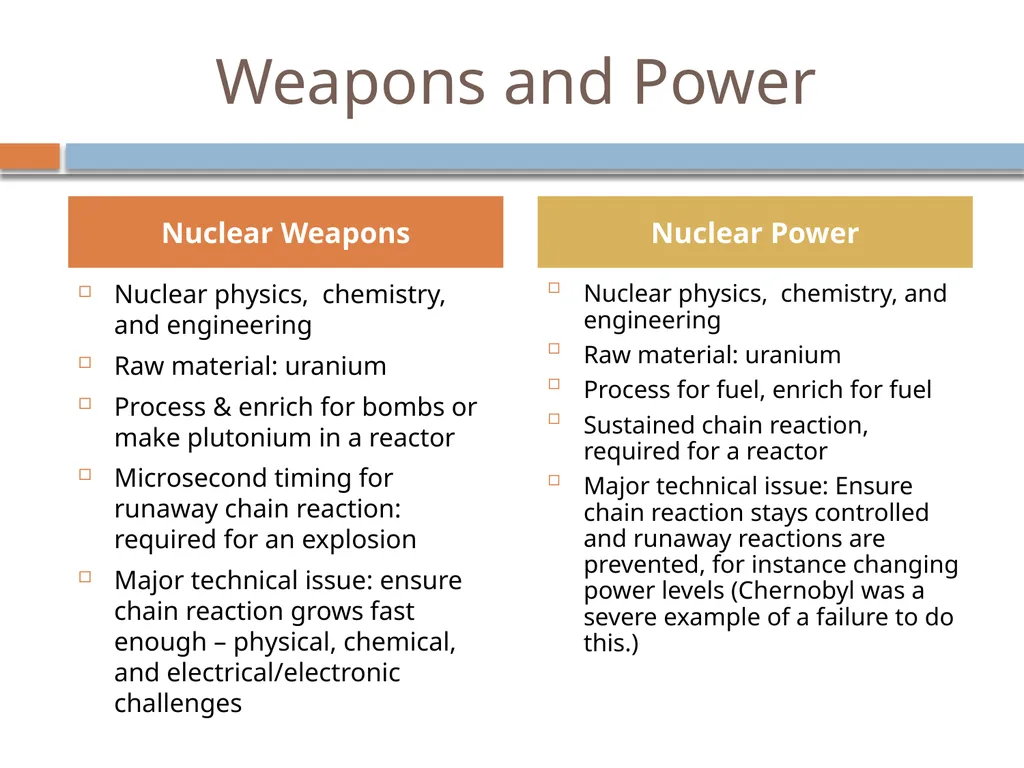
Weapons and Power Nuclear physics, chemistry, and engineering
Raw material: uranium
Process & enrich for bombs or make plutonium in a reactor
Microsecond timing for runaway chain reaction: required for an explosion
Major technical issue: ensure chain reaction grows fast enough – physical, chemical, and electrical/electronic challenges Nuclear physics, chemistry, and engineering
Raw material: uranium
Process for fuel, enrich for fuel
Sustained chain reaction, required for a reactor
Major technical issue: Ensure chain reaction stays controlled and runaway reactions are prevented, for instance changing power levels (Chernobyl was a severe example of a failure to do this.) Nuclear Weapons Nuclear Power<br>
03
3 J. Robert Oppenheimer, 1946 “We know very well what we would do if we signed such a [nuclear weapons] convention: we would not make atomic weapons, at least not to start with, but we would build enormous plants, and we would call them power plants - maybe they would produce power: we would design these plants in such a way that they could be converted with the maximum ease and the minimum time delay to the production of atomic weapons, saying, this is just in case somebody two-times us; we would stockpile uranium; we would keep as many of our developments secret as possible; we would locate our plants, not where they would do the most good for the production of power, but where they would do the most good for protection against enemy attack.”
Source: J. Robert Oppenheimer, "International Control of Atomic Energy," in Morton Grodzins and Eugene Rabinowitch, eds., The Atomic Age: Scientists in National and World Affairs, (New York: Basic Books, 1963), p. 55.<br>
04
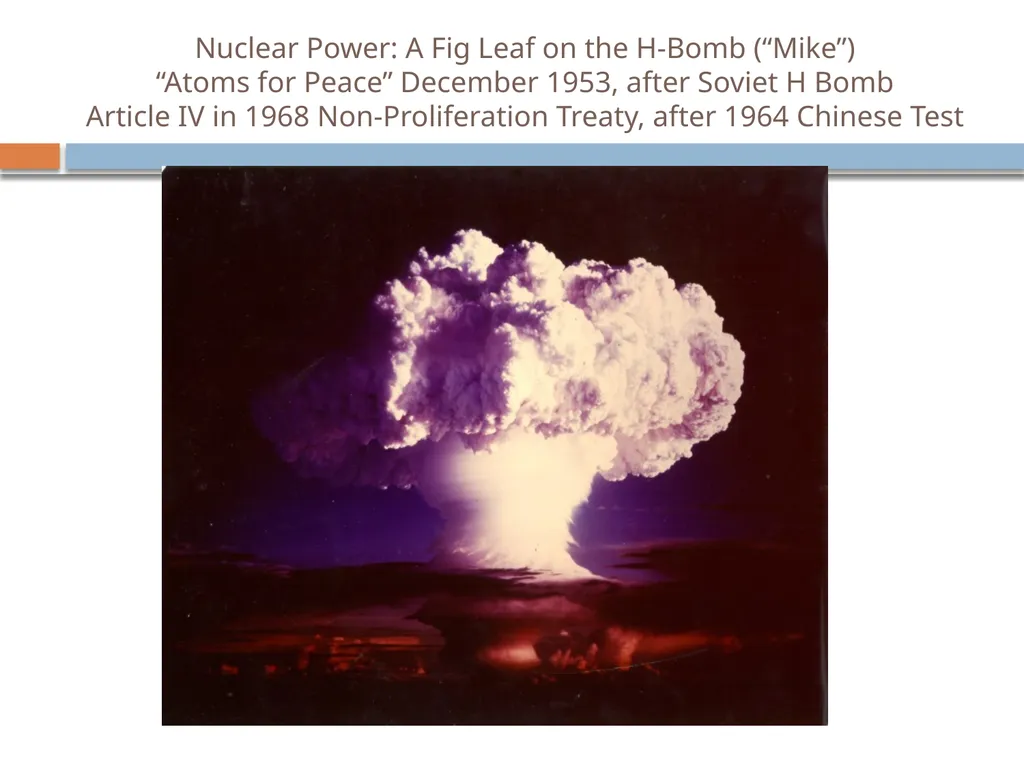
Nuclear Power: A Fig Leaf on the H-Bomb (“Mike”) “Atoms for Peace” December 1953, after Soviet H Bomb Article IV in 1968 Non-Proliferation Treaty, after 1964 Chinese Test<br>
05
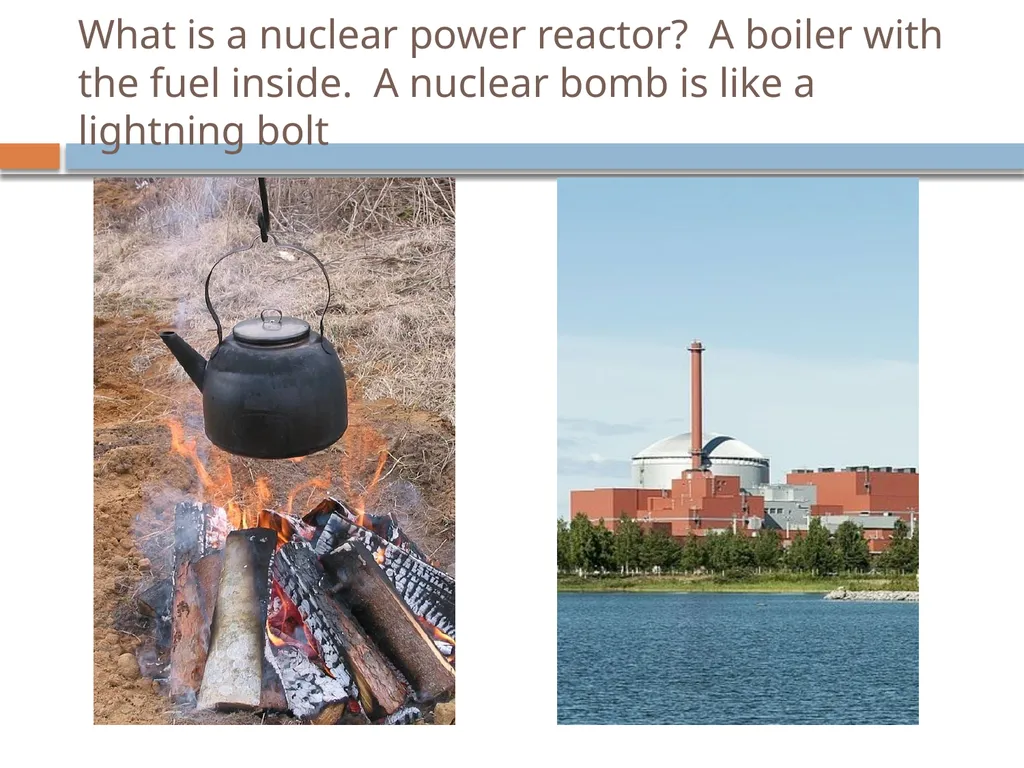
What is a nuclear power reactor? A boiler with the fuel inside. A nuclear bomb is like a lightning bolt<br>
06
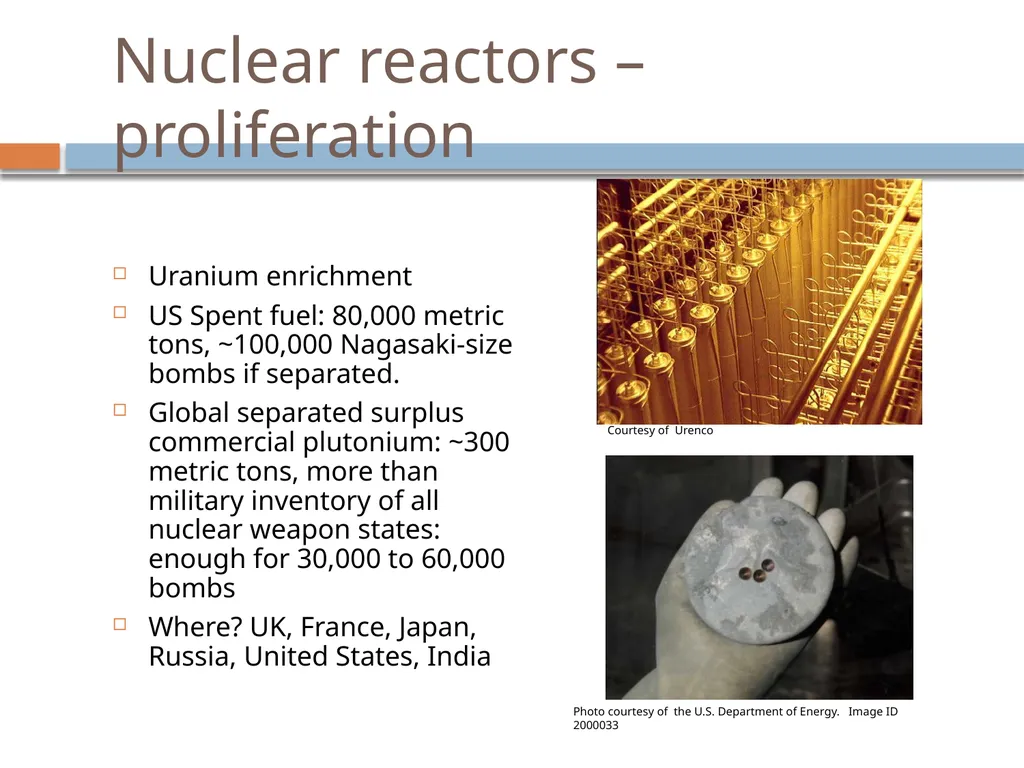
6 Nuclear reactors – proliferation Uranium enrichment
US Spent fuel: 80,000 metric tons, ~100,000 Nagasaki-size bombs if separated.
Global separated surplus commercial plutonium: ~300 metric tons, more than military inventory of all nuclear weapon states: enough for 30,000 to 60,000 bombs
Where? UK, France, Japan, Russia, United States, India Courtesy of Urenco Photo courtesy of the U.S. Department of Energy. Image ID 2000033<br>
07
Weapons hiding behind power “Bombs into Energy: Lawrence Livermore National Lab 1991 concept.
3 plutonium bombs per hour – 1,000 MW underground molten salt reactor
25,000 bombs per year per reactor
About 2.5 million bombs per year to run a system on the present U.S. scale
Compare total bombs made in the US: ~70,000. Soviet Union: ~55,000. Combined average per year during the Cold War – about 3,000 (rounded)
Tritium for weapons has been made in the TVA Watts Bar I reactor since 2003. “It is not a threat. It is an announcement so that there will be no misinterpretation of what we are doing. We are not doing this secretly. We are doing it openly,” he said.
“We want no bombs. Our policy is to have a region free of weapons of mass destruction,” the prince added. “This is why we call on Israel to renounce (nuclear weapons).” The “original sin” was from Israel as it established a nuclear reactor with the only purpose of producing nuclear weapons, Prince Saud said United States: Examples after the Cold War Saudi Foreign Minister, on acquiring civilian nuclear technology<br>
08
Routes to nuclear bombs and power U.S., Soviet Union, Britain, France, China – bombs first; power later.
Israel: bombs only, initially assisted by France.
India: CIRUS, Canadian-supplied research reactor produced plutonium for 1974 nuclear test.
Pakistan: diverted commercial uranium enrichment technology from Holland for its own weapons enrichment program; then power.
North Korea: small power reactor, reprocessing plant then a bomb.<br>
09
Nuclear weapons and power are inherently undemocratic “In a sense, we have established a military priesthood which guards against inadvertent use of nuclear weapons, which maintains what a priori seems to be a precarious balance between readiness to go to war and vigilance against human errors that would precipitate war . . .” “It seems to me (and in this I repeat some views expressed very well by Atomic Energy Commissioner Wilfred Johnson) that peaceful nuclear energy probably will make demands of the same sort on our society, and possibly of even longer duration.”
Alvin Weinberg, first scientific director, Oak Ridge National Laboratory<br>