
2021 ABPI CODE OF PRACTICE FOR THE PHARMACEUTICAL
LV
Published · 89 slides · 0 views
1 / 1


Description
2021 ABPI CODE OF PRACTICE FOR THE PHARMACEUTICAL INDUSTRY Please refer to the Code for the supplementary information Overarching Requirements Clauses 1-10 (Grey Section) Clause 1 Scope of the Code and Definition of Certain Terms 1.1 This
Related Topics
Share
Embed code
Download this presentation From Below
"2021 ABPI CODE OF PRACTICE FOR THE PHARMACEUTICAL" is the property of its rightful owner. Permission is granted to download and print the materials on this website for personal, non-commercial use only, and to display it on your personal computer provided you do not modify the materials and that you retain all copyright notices contained in the materials. By downloading content from our website, you accept the terms of this agreement.
Presentation Transcript
01
2021 ABPI CODE OF PRACTICE FOR THE PHARMACEUTICAL INDUSTRY
Please refer to the Code for the supplementary information<br>
Please refer to the Code for the supplementary information<br>
02
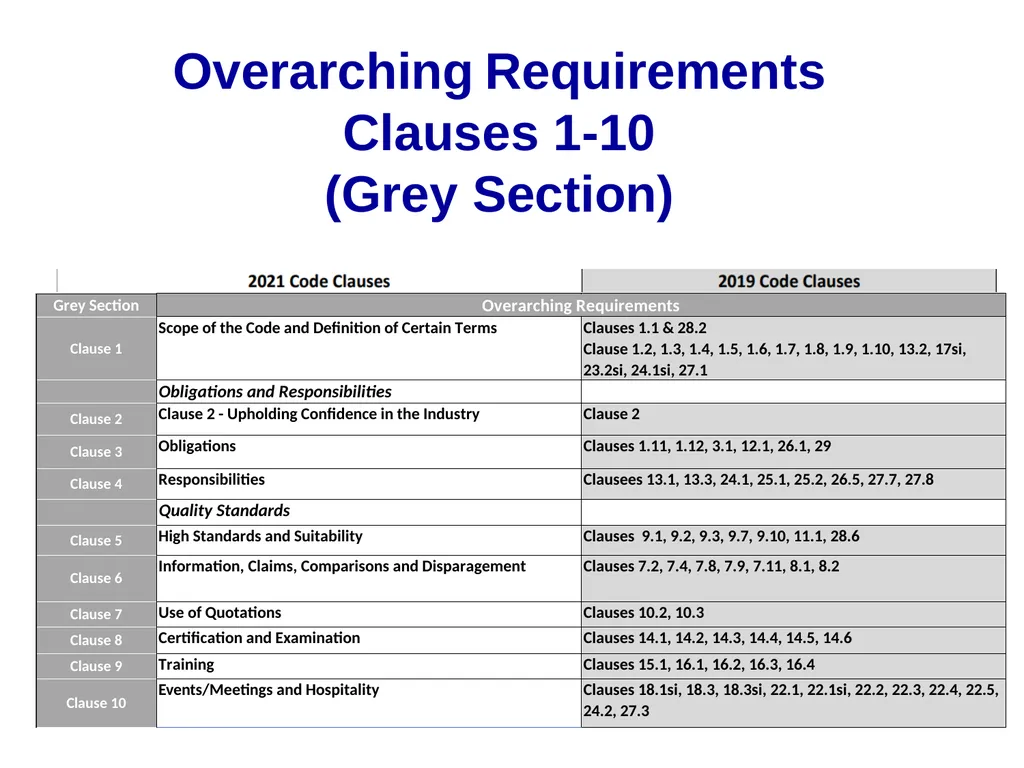
Overarching Requirements
Clauses 1-10
(Grey Section)<br>
Clauses 1-10
(Grey Section)<br>
03
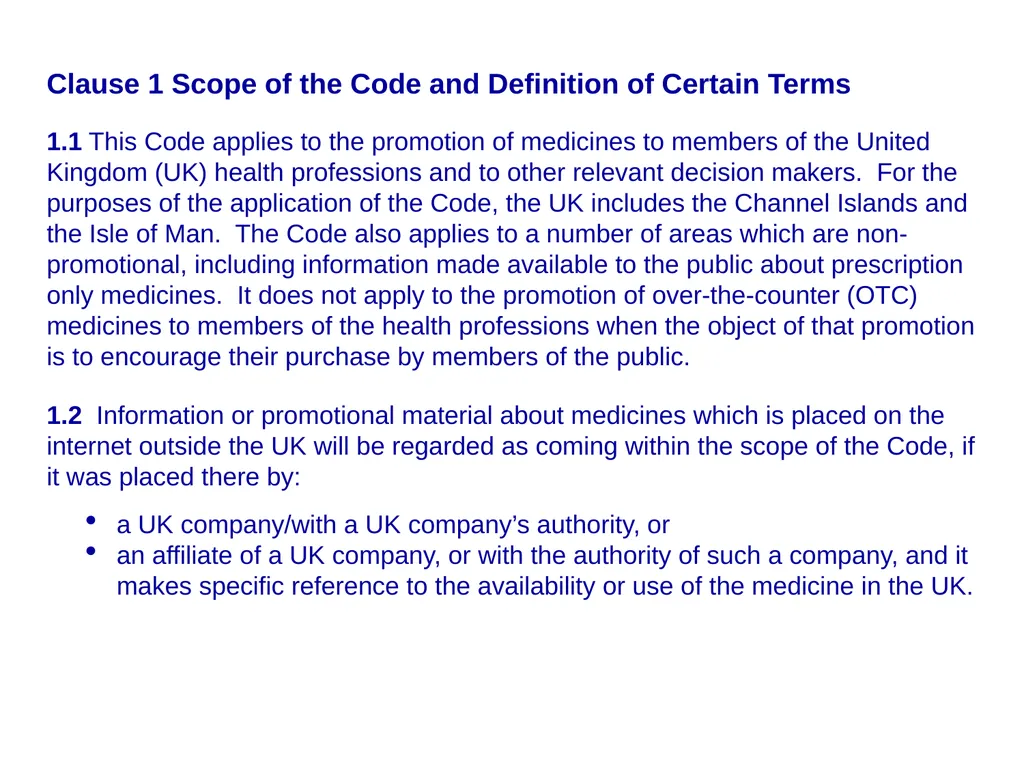
Clause 1 Scope of the Code and Definition of Certain Terms
1.1 This Code applies to the promotion of medicines to members of the United Kingdom (UK) health professions and to other relevant decision makers. For the purposes of the application of the Code, the UK includes the Channel Islands and the Isle of Man. The Code also applies to a number of areas which are non-promotional, including information made available to the public about prescription only medicines. It does not apply to the promotion of over-the-counter (OTC) medicines to members of the health professions when the object of that promotion is to encourage their purchase by members of the public.
1.2 Information or promotional material about medicines which is placed on the internet outside the UK will be regarded as coming within the scope of the Code, if it was placed there by:
a UK company/with a UK company’s authority, or
an affiliate of a UK company, or with the authority of such a company, and it makes specific reference to the availability or use of the medicine in the UK.<br>
04
Clause 1 Scope of the Code and Definition of Certain Terms
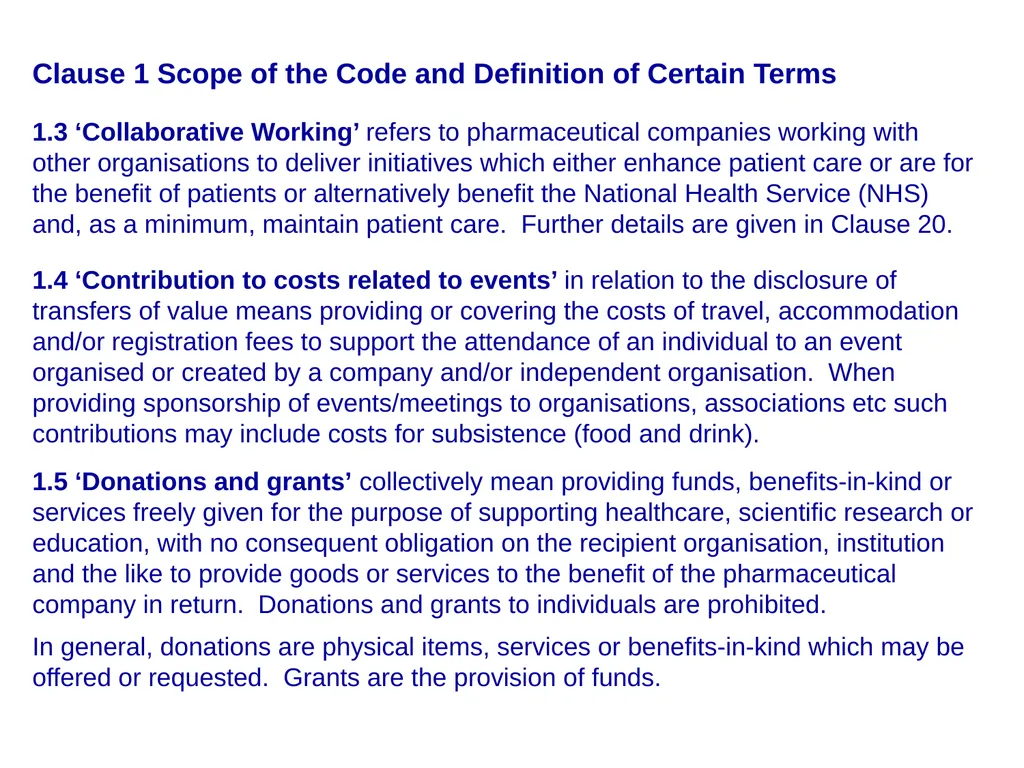
1.3 ‘Collaborative Working’ refers to pharmaceutical companies working with other organisations to deliver initiatives which either enhance patient care or are for the benefit of patients or alternatively benefit the National Health Service (NHS) and, as a minimum, maintain patient care. Further details are given in Clause 20.
1.4 ‘Contribution to costs related to events’ in relation to the disclosure of transfers of value means providing or covering the costs of travel, accommodation and/or registration fees to support the attendance of an individual to an event organised or created by a company and/or independent organisation. When providing sponsorship of events/meetings to organisations, associations etc such contributions may include costs for subsistence (food and drink).
1.5 ‘Donations and grants’ collectively mean providing funds, benefits-in-kind or services freely given for the purpose of supporting healthcare, scientific research or education, with no consequent obligation on the recipient organisation, institution and the like to provide goods or services to the benefit of the pharmaceutical company in return. Donations and grants to individuals are prohibited.
In general, donations are physical items, services or benefits-in-kind which may be offered or requested. Grants are the provision of funds.<br>
05
Clause 1 Scope of the Code and Definition of Certain Terms
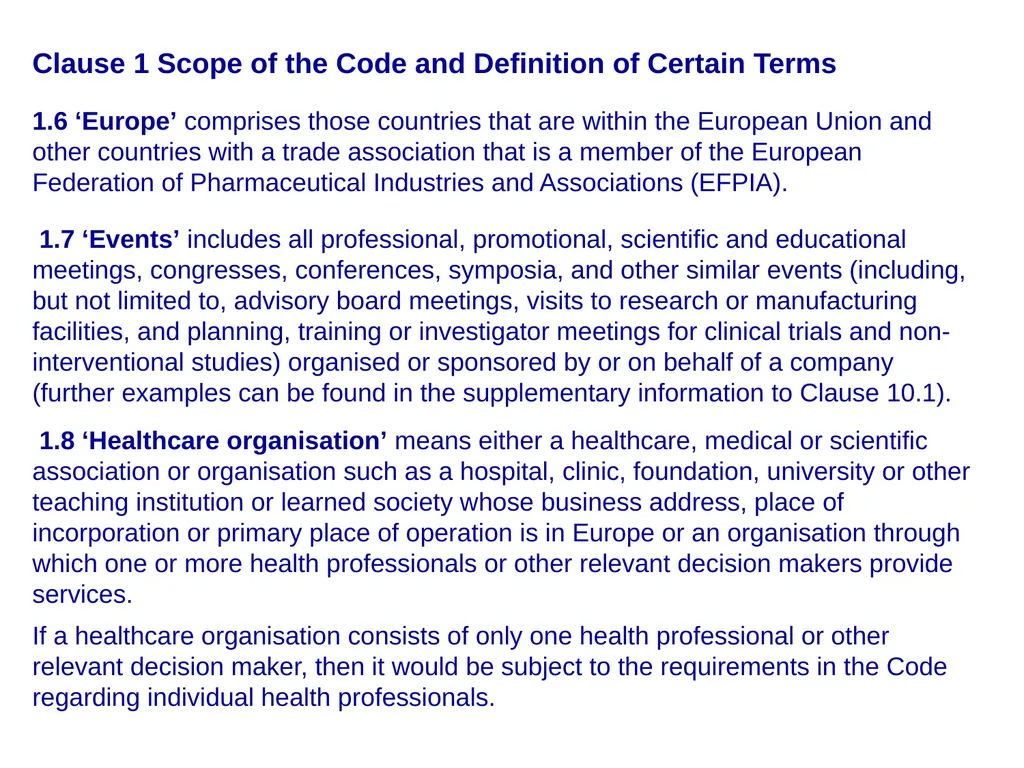
1.6 ‘Europe’ comprises those countries that are within the European Union and other countries with a trade association that is a member of the European Federation of Pharmaceutical Industries and Associations (EFPIA).
1.7 ‘Events’ includes all professional, promotional, scientific and educational meetings, congresses, conferences, symposia, and other similar events (including, but not limited to, advisory board meetings, visits to research or manufacturing facilities, and planning, training or investigator meetings for clinical trials and non-interventional studies) organised or sponsored by or on behalf of a company (further examples can be found in the supplementary information to Clause 10.1).
1.8 ‘Healthcare organisation’ means either a healthcare, medical or scientific association or organisation such as a hospital, clinic, foundation, university or other teaching institution or learned society whose business address, place of incorporation or primary place of operation is in Europe or an organisation through which one or more health professionals or other relevant decision makers provide services.
If a healthcare organisation consists of only one health professional or other relevant decision maker, then it would be subject to the requirements in the Code regarding individual health professionals.<br>
06
Clause 1 Scope of the Code and Definition of Certain Terms
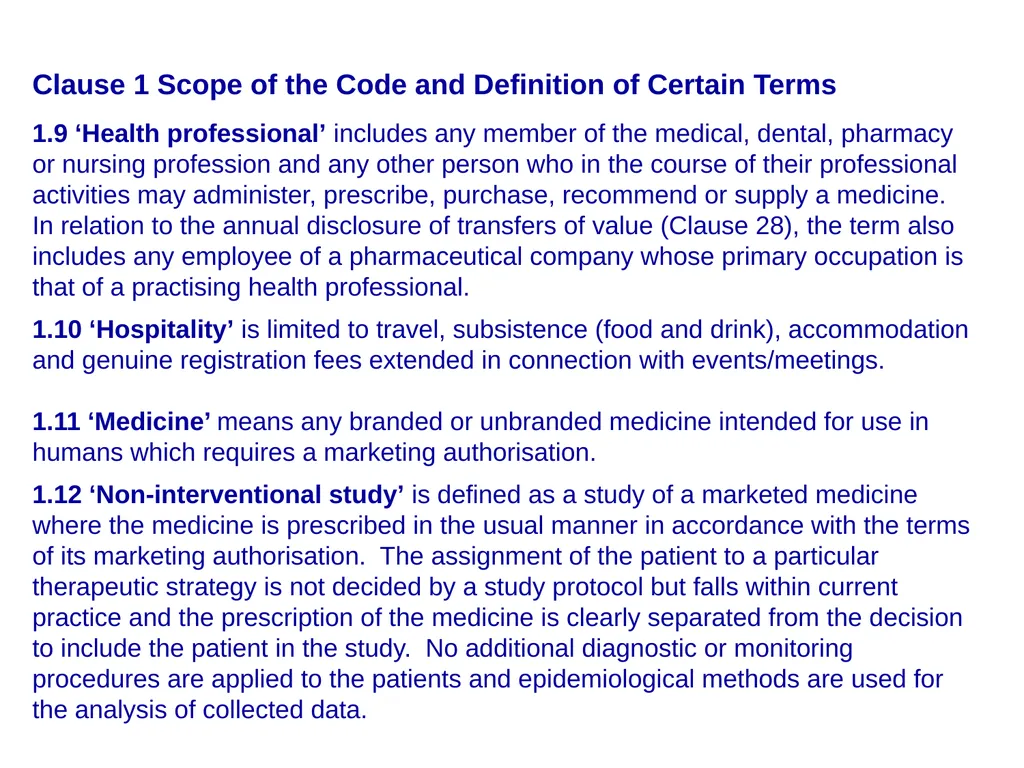
1.9 ‘Health professional’ includes any member of the medical, dental, pharmacy or nursing profession and any other person who in the course of their professional activities may administer, prescribe, purchase, recommend or supply a medicine. In relation to the annual disclosure of transfers of value (Clause 28), the term also includes any employee of a pharmaceutical company whose primary occupation is that of a practising health professional.
1.10 ‘Hospitality’ is limited to travel, subsistence (food and drink), accommodation and genuine registration fees extended in connection with events/meetings.
1.11 ‘Medicine’ means any branded or unbranded medicine intended for use in humans which requires a marketing authorisation.
1.12 ‘Non-interventional study’ is defined as a study of a marketed medicine where the medicine is prescribed in the usual manner in accordance with the terms of its marketing authorisation. The assignment of the patient to a particular therapeutic strategy is not decided by a study protocol but falls within current practice and the prescription of the medicine is clearly separated from the decision to include the patient in the study. No additional diagnostic or monitoring procedures are applied to the patients and epidemiological methods are used for the analysis of collected data.<br>
07
Clause 1 Scope of the Code and Definition of Certain Terms
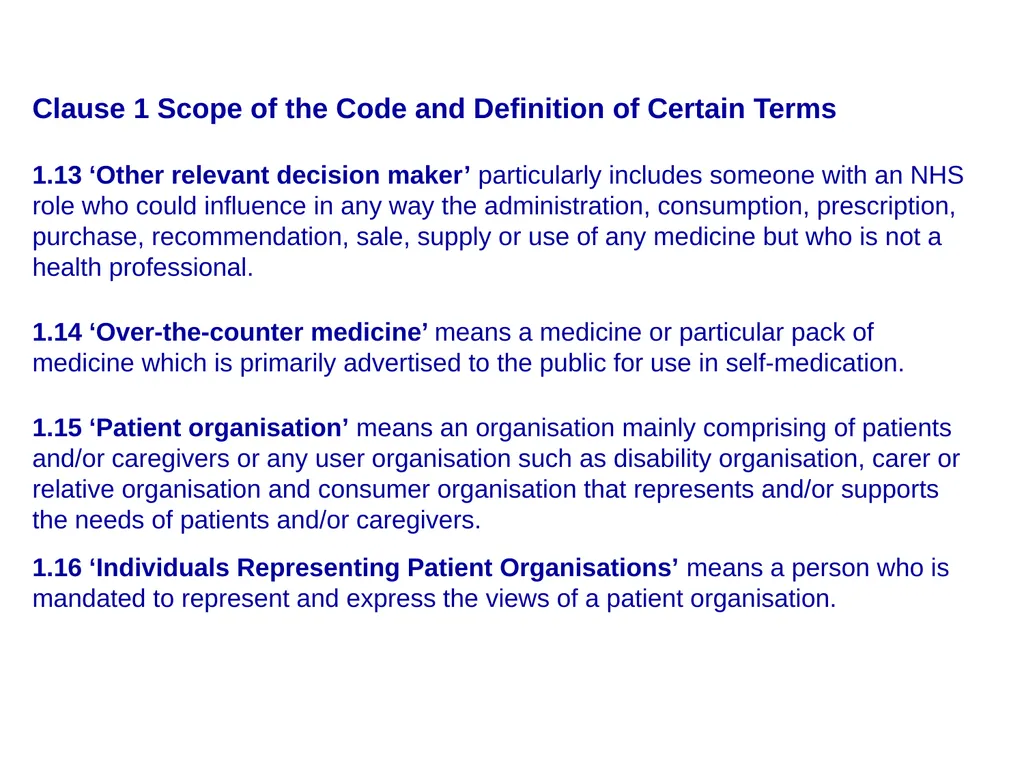
1.13 ‘Other relevant decision maker’ particularly includes someone with an NHS role who could influence in any way the administration, consumption, prescription, purchase, recommendation, sale, supply or use of any medicine but who is not a health professional.
1.14 ‘Over-the-counter medicine’ means a medicine or particular pack of medicine which is primarily advertised to the public for use in self-medication.
1.15 ‘Patient organisation’ means an organisation mainly comprising of patients and/or caregivers or any user organisation such as disability organisation, carer or relative organisation and consumer organisation that represents and/or supports the needs of patients and/or caregivers.
1.16 ‘Individuals Representing Patient Organisations’ means a person who is mandated to represent and express the views of a patient organisation.<br>
08
Clause 1 Scope of the Code and Definition of Certain Terms
1.17 ‘Promotion’ means any activity undertaken by a pharmaceutical company or with its authority which promotes the administration, consumption, prescription, purchase, recommendation, sale, supply or use of its medicines.
It includes:
journal and direct mail advertising
the activities of representatives, including any electronic or printed material used by them
the supply of samples
the provision of inducements to prescribe, supply, administer, recommend, buy or sell medicines by the gift, offer or promise of any benefit or bonus, whether in money or in-kind
the provision of hospitality for promotional purposes
the sponsorship of promotional events/meetings
the sponsorship of scientific events/meetings, including payment of travelling and accommodation expenses in connection therewith
all other promotion.
Cont’d<br>
09
Clause 1 Scope of the Code and Definition of Certain Terms
1.17 ‘Promotion’ means any activity undertaken by a pharmaceutical company or with its authority which promotes the administration, consumption, prescription, purchase, recommendation, sale, supply or use of its medicines.
It does not include:
replies made in response to unsolicited individual enquiries from members of the health professions or other relevant decision makers or in response to specific communications from them whether of enquiry or comment, including letters published in professional journals, but only if they relate solely to the subject matter of the letter or enquiry, are accurate and do not mislead and are not promotional in nature
factual, accurate, informative announcements and reference material concerning licensed medicines and relating, for example, to pack changes, adverse reaction warnings, trade catalogues and price lists, provided they include no product claims
price lists relating to unlicensed medicines, provided they include no product claims and they make clear that the products are unlicensed
Cont’d<br>
10
Clause 1 Scope of the Code and Definition of Certain Terms
1.17 ‘Promotion’ means any activity undertaken by a pharmaceutical company or with its authority which promotes the administration, consumption, prescription, purchase, recommendation, sale, supply or use of its medicines.
It does not include:
information supplied by pharmaceutical companies to national public organisations such as the National Institute for Health and Care Excellence (NICE), the All Wales Medicines Strategy Group (AWMSG) and the Scottish Medicines Consortium (SMC) is exempt from the Code provided the information is factual, accurate and not misleading
measures or trade practices relating to prices, margins or discounts which were in regular use by a significant proportion of the pharmaceutical industry on 1 January 1993
summaries of product characteristics
European public assessment reports
UK public assessment reports
risk minimisation material approved by the Medicines and Healthcare products Regulatory Agency (MHRA)
the labelling on medicines and accompanying package leaflets insofar as they are not promotional for the medicines concerned; the contents of labels and package leaflets are covered by regulations
information relating to human health or diseases provided there is no direct or indirect reference to specific medicines.<br>
11
Clause 1 Scope of the Code and Definition of Certain Terms
1.18 ‘Promotional aid’ means a non-monetary item given for a promotional purpose. Promotional aids may be given to health professionals and other relevant decision makers only in accordance with Clause 10.4. Health professionals may, however, be provided with items which are to be passed on to patients in accordance with Clause 19.2.
1.19 ‘Representative’ means a representative calling on members of the health professions and other relevant decision makers in relation to the promotion of medicines.
1.20 ‘Research and Development Transfers of Value’ means, for the purposes of disclosure, transfers of value to health professionals or healthcare organisations related to the planning or conduct of:
i) non-clinical studies (as defined in the OECD Principles on Good Laboratory Practice)
ii) clinical trials (as defined in Regulation 536/2014)
iii) non-interventional studies that are prospective in nature and that involve the collection of patient data from or on behalf of individual, or groups of, health professionals specifically for the study.<br>
12
Clause 1 Scope of the Code and Definition of Certain Terms
1.21 ‘Sample’ means a small supply of a medicine provided to health professionals so that they may familiarise themselves with it and acquire experience in dealing with it. A sample of a medicine may be provided only to a health professional qualified to prescribe that particular medicine.
1.22 A company can provide sponsorship for an activity to certain organisations. ‘Sponsorship’ means a contribution, financial or otherwise, in whole or in part provided by or on behalf of a company, towards an activity (including an event/meeting or material) performed, organised, created etc by a healthcare organisation, patient organisation or other independent organisation.
1.23 A company can provide support for individual health professionals or other relevant decision makers to attend events/meetings. ‘Support’ in this context is the provision of a financial contribution, in whole or in part, whether paid directly or indirectly to individual health professionals or other relevant decision makers to attend events/meetings.<br>
13
Clause 1 Scope of the Code and Definition of Certain Terms
1.24 ‘Third party’ means a legal person/entity or individual that represents a company or interacts with other parties on behalf of a company or relating to a company’s medicine, such as distributors, wholesalers, consultants, contract research organisations, professional congress organisers, contracted sales forces, market research companies, advertising agencies, media buyers, providers of services related to events, public relations services, non-clinical services, non-interventional studies management services etc.
Companies are responsible under the Code for the acts and omissions of their third parties which come within the scope of the Code, even if they act contrary to the instructions which they have been given.<br>
14
Clause 1 Scope of the Code and Definition of Certain Terms
1.25 ‘Transfer of value’ means a direct or indirect transfer of value, whether in cash, in-kind or otherwise, made, whether for promotional purposes or otherwise, in connection with the development or sale of medicines. A direct transfer of value is one made directly by a company for the benefit of a recipient. An indirect transfer of value is one made on behalf of a company for the benefit of a recipient or through an intermediate and where the company knows or can identify the recipient that will benefit from the transfer of value.
The following are not transfers of value for the purposes of the Code:
transfers of value that are solely related to over-the-counter medicines
ordinary course purchases and sales of medicines by and between a company and a health professional or a healthcare organisation
samples of medicines provided in accordance with Clause 21
transfers of value provided in accordance with Clauses 10.4, 10.5 and 19.2
subsistence provided to health professionals and other relevant decision makers in accordance with Clause 10.1.<br>
15
OBLIGATIONS
AND
RESPONSIBILITIES
Clauses 2 - 4<br>
AND
RESPONSIBILITIES
Clauses 2 - 4<br>
16
Clause 2 Upholding Confidence in the Industry
Activities or materials must never be such as to bring discredit upon, or reduce confidence in, the pharmaceutical industry.<br>
Activities or materials must never be such as to bring discredit upon, or reduce confidence in, the pharmaceutical industry.<br>
17
Clause 3 Obligations
3.1 A medicine must not be promoted prior to the grant of the marketing authorisation which permits its sale or supply.
3.2 Prescription only medicines must not be advertised to the public. This prohibition does not apply to vaccination and other campaigns carried out by companies and approved by the health ministers.
3.3 When an undertaking has been given in relation to a ruling under the Code, the company concerned must ensure that it complies with that undertaking.
3.4 Companies must comply with all applicable codes, laws and regulations to which they are subject.<br>
18
Clause 3 Obligations
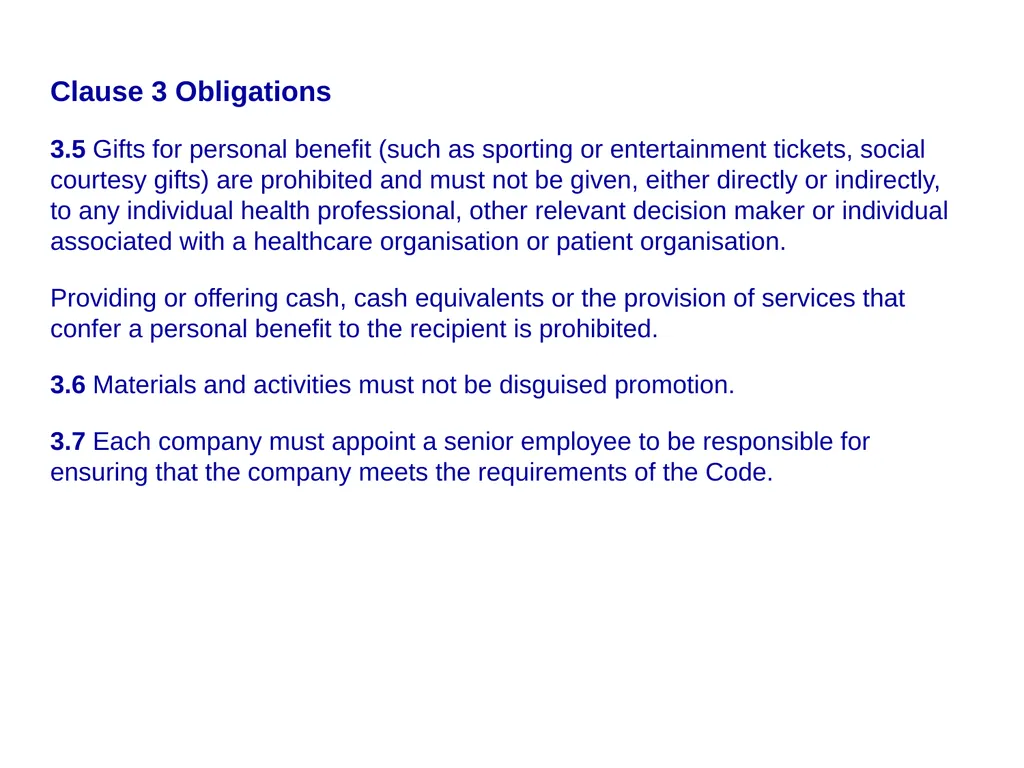
3.5 Gifts for personal benefit (such as sporting or entertainment tickets, social courtesy gifts) are prohibited and must not be given, either directly or indirectly, to any individual health professional, other relevant decision maker or individual associated with a healthcare organisation or patient organisation.
Providing or offering cash, cash equivalents or the provision of services that confer a personal benefit to the recipient is prohibited.
3.6 Materials and activities must not be disguised promotion.
3.7 Each company must appoint a senior employee to be responsible for ensuring that the company meets the requirements of the Code.<br>
19
Clause 4 Responsibilities
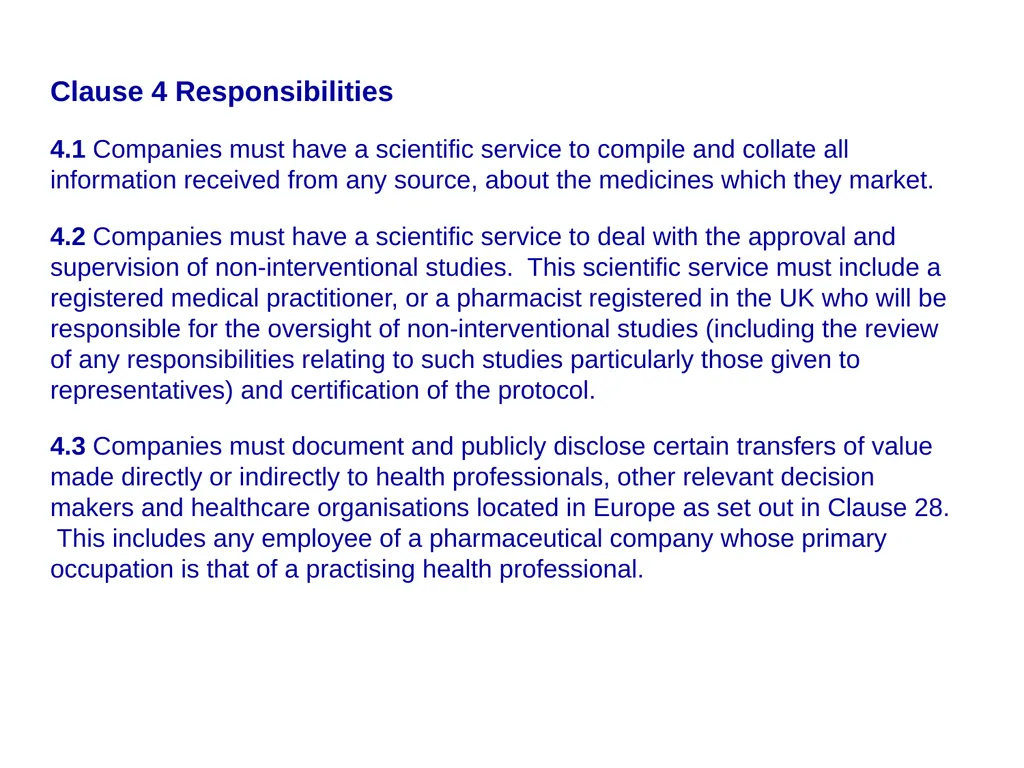
4.1 Companies must have a scientific service to compile and collate all information received from any source, about the medicines which they market.
4.2 Companies must have a scientific service to deal with the approval and supervision of non-interventional studies. This scientific service must include a registered medical practitioner, or a pharmacist registered in the UK who will be responsible for the oversight of non-interventional studies (including the review of any responsibilities relating to such studies particularly those given to representatives) and certification of the protocol.
4.3 Companies must document and publicly disclose certain transfers of value made directly or indirectly to health professionals, other relevant decision makers and healthcare organisations located in Europe as set out in Clause 28. This includes any employee of a pharmaceutical company whose primary occupation is that of a practising health professional.<br>
20
Clause 4 Responsibilities
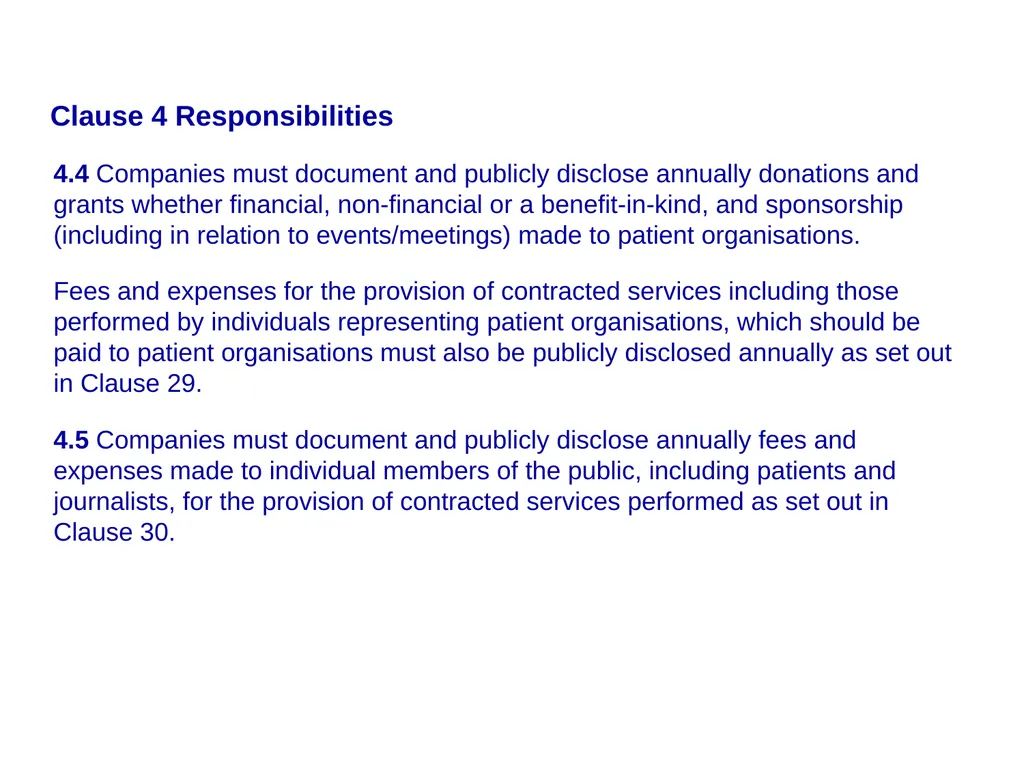
4.4 Companies must document and publicly disclose annually donations and grants whether financial, non-financial or a benefit-in-kind, and sponsorship (including in relation to events/meetings) made to patient organisations.
Fees and expenses for the provision of contracted services including those performed by individuals representing patient organisations, which should be paid to patient organisations must also be publicly disclosed annually as set out in Clause 29.
4.5 Companies must document and publicly disclose annually fees and expenses made to individual members of the public, including patients and journalists, for the provision of contracted services performed as set out in Clause 30.<br>
21
Clause 4 Responsibilities
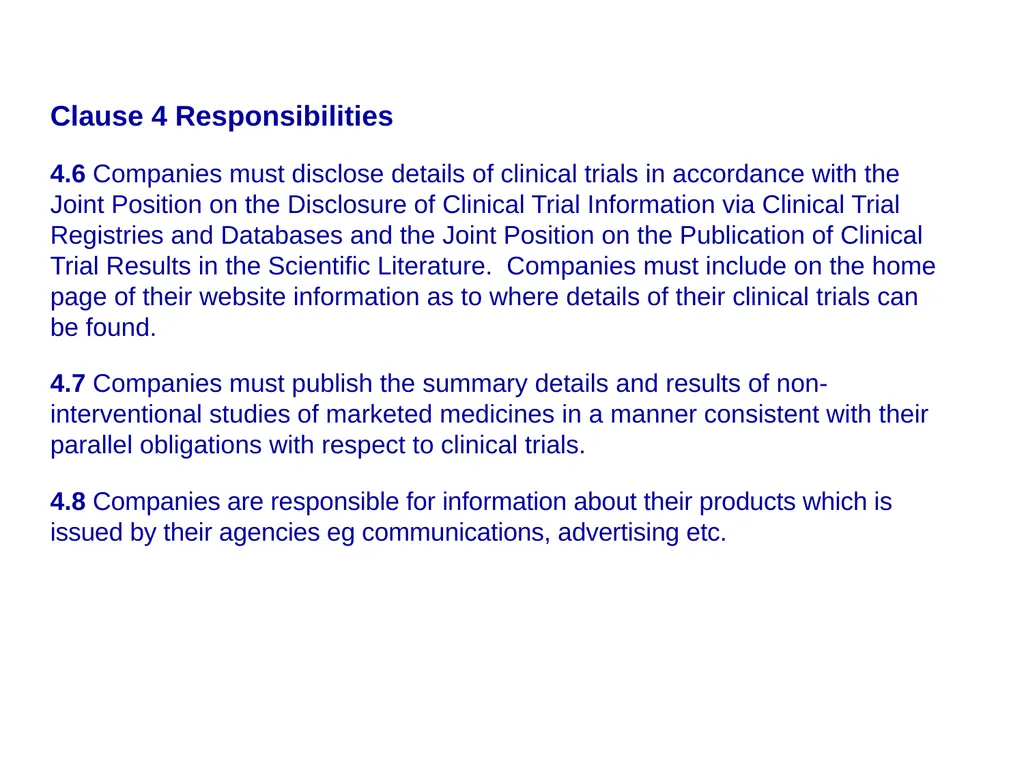
4.6 Companies must disclose details of clinical trials in accordance with the Joint Position on the Disclosure of Clinical Trial Information via Clinical Trial Registries and Databases and the Joint Position on the Publication of Clinical Trial Results in the Scientific Literature. Companies must include on the home page of their website information as to where details of their clinical trials can be found.
4.7 Companies must publish the summary details and results of non-interventional studies of marketed medicines in a manner consistent with their parallel obligations with respect to clinical trials.
4.8 Companies are responsible for information about their products which is issued by their agencies eg communications, advertising etc.<br>
22
QUALITY STANDARDS
Clauses 5 - 10<br>
Clauses 5 - 10<br>
23
Clause 5 High Standards and Suitability
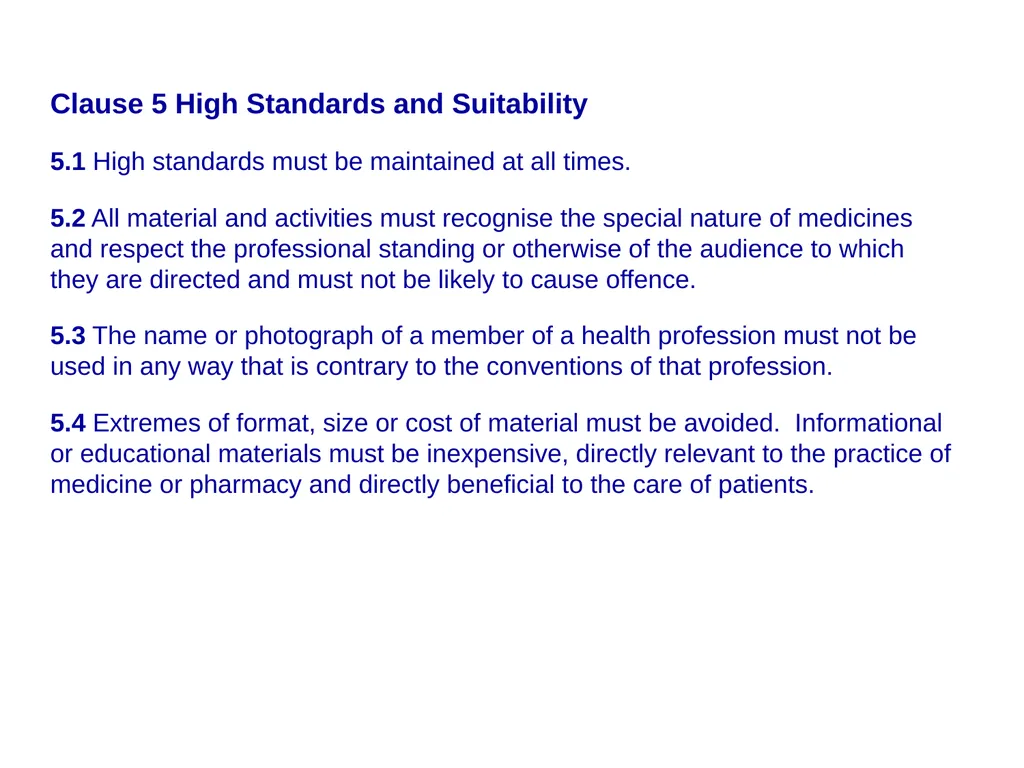
5.1 High standards must be maintained at all times.
5.2 All material and activities must recognise the special nature of medicines and respect the professional standing or otherwise of the audience to which they are directed and must not be likely to cause offence.
5.3 The name or photograph of a member of a health profession must not be used in any way that is contrary to the conventions of that profession.
5.4 Extremes of format, size or cost of material must be avoided. Informational or educational materials must be inexpensive, directly relevant to the practice of medicine or pharmacy and directly beneficial to the care of patients.<br>
24
Clause 5 High Standards and Suitability
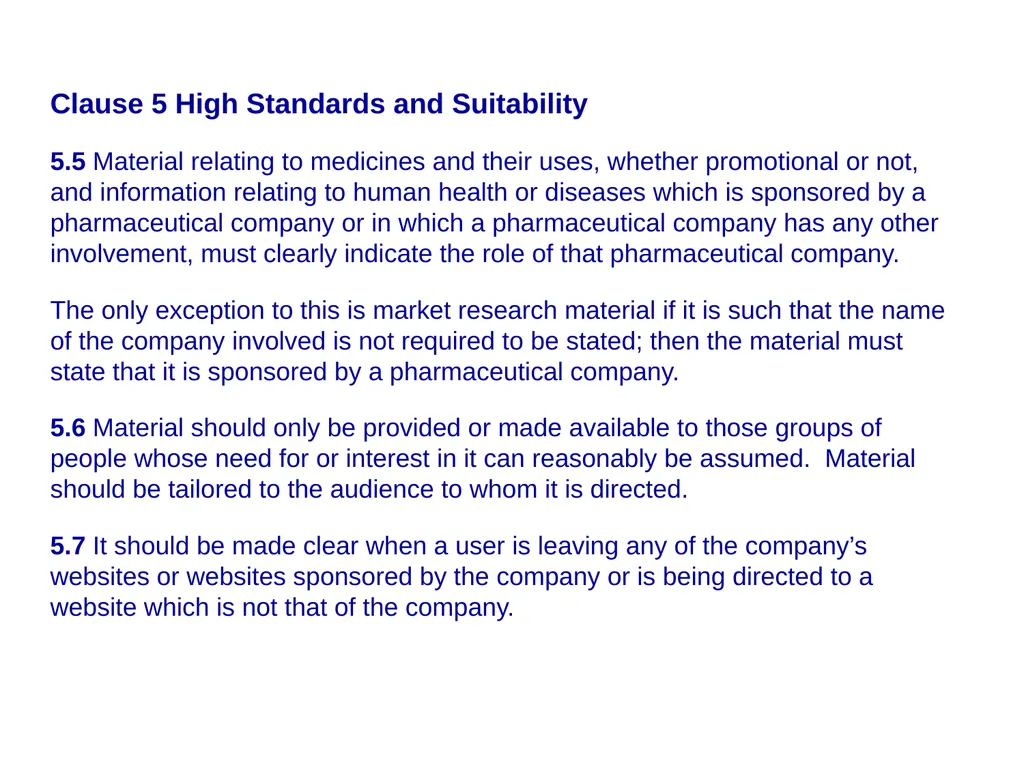
5.5 Material relating to medicines and their uses, whether promotional or not, and information relating to human health or diseases which is sponsored by a pharmaceutical company or in which a pharmaceutical company has any other involvement, must clearly indicate the role of that pharmaceutical company.
The only exception to this is market research material if it is such that the name of the company involved is not required to be stated; then the material must state that it is sponsored by a pharmaceutical company.
5.6 Material should only be provided or made available to those groups of people whose need for or interest in it can reasonably be assumed. Material should be tailored to the audience to whom it is directed.
5.7 It should be made clear when a user is leaving any of the company’s websites or websites sponsored by the company or is being directed to a website which is not that of the company.<br>
25
Clause 6 Information, Claims, Comparisons and Disparagement
Clauses 14 and 18 may also be relevant
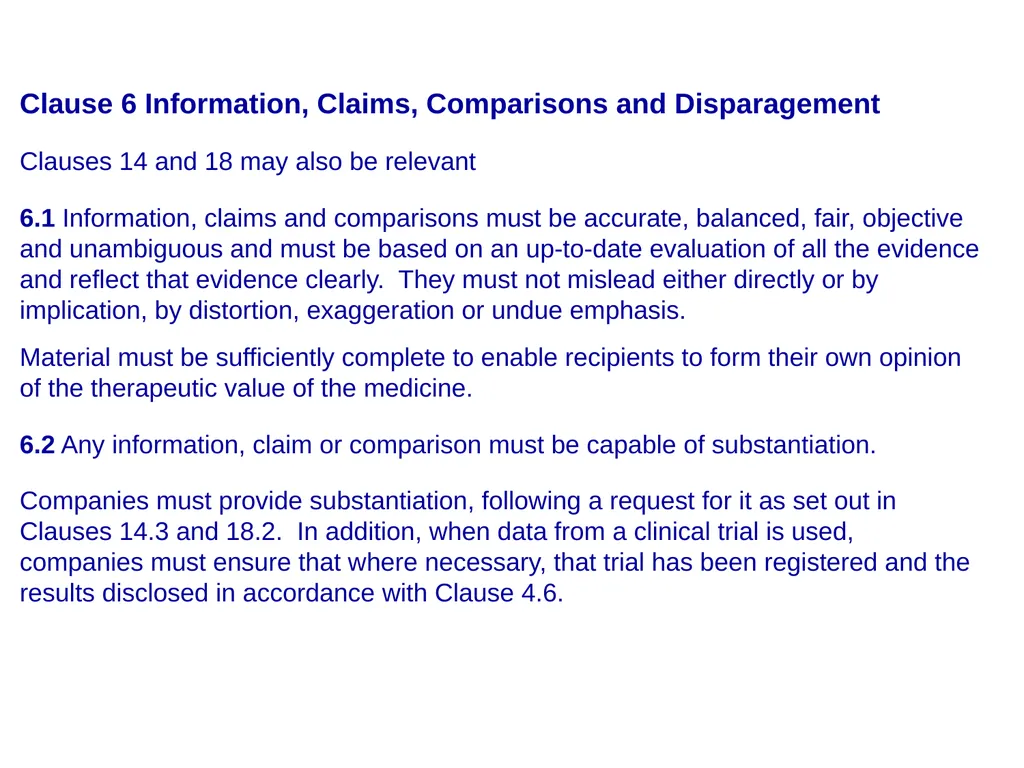
6.1 Information, claims and comparisons must be accurate, balanced, fair, objective and unambiguous and must be based on an up-to-date evaluation of all the evidence and reflect that evidence clearly. They must not mislead either directly or by implication, by distortion, exaggeration or undue emphasis.
Material must be sufficiently complete to enable recipients to form their own opinion of the therapeutic value of the medicine.
6.2 Any information, claim or comparison must be capable of substantiation.
Companies must provide substantiation, following a request for it as set out in Clauses 14.3 and 18.2. In addition, when data from a clinical trial is used, companies must ensure that where necessary, that trial has been registered and the results disclosed in accordance with Clause 4.6.<br>
26
Clause 6 Information, Claims, Comparisons and Disparagement
Clauses 14 and 18 may also be relevant
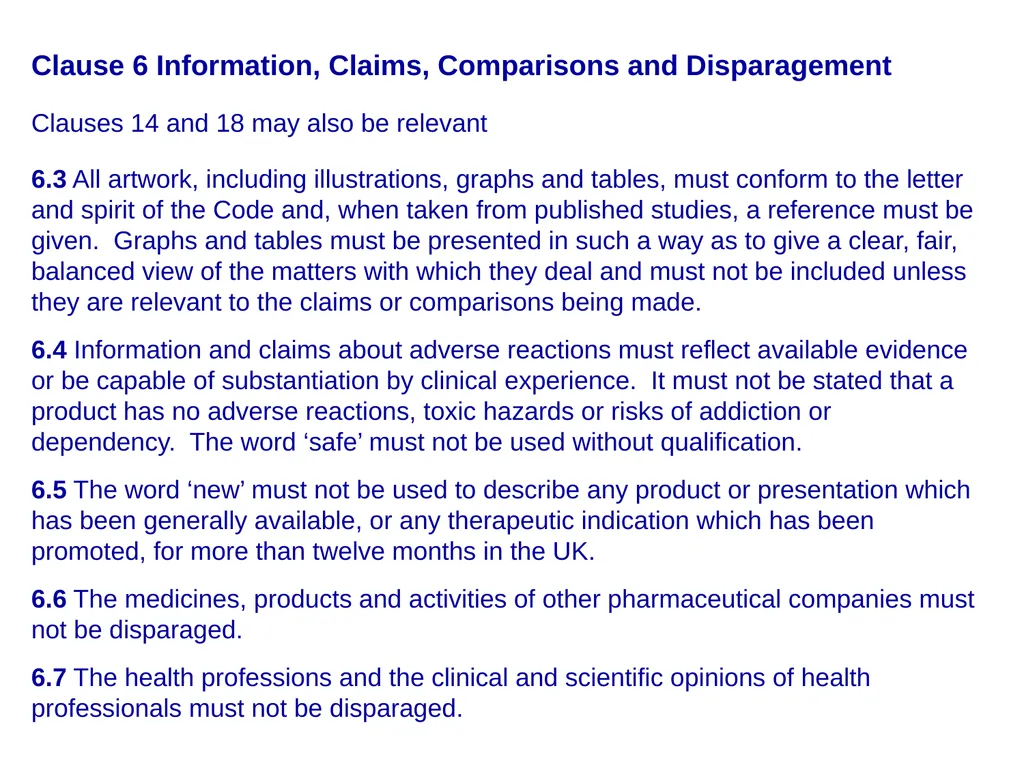
6.3 All artwork, including illustrations, graphs and tables, must conform to the letter and spirit of the Code and, when taken from published studies, a reference must be given. Graphs and tables must be presented in such a way as to give a clear, fair, balanced view of the matters with which they deal and must not be included unless they are relevant to the claims or comparisons being made.
6.4 Information and claims about adverse reactions must reflect available evidence or be capable of substantiation by clinical experience. It must not be stated that a product has no adverse reactions, toxic hazards or risks of addiction or dependency. The word ‘safe’ must not be used without qualification.
6.5 The word ‘new’ must not be used to describe any product or presentation which has been generally available, or any therapeutic indication which has been promoted, for more than twelve months in the UK.
6.6 The medicines, products and activities of other pharmaceutical companies must not be disparaged.
6.7 The health professions and the clinical and scientific opinions of health professionals must not be disparaged.<br>
27
Clause 7 Use of Quotations
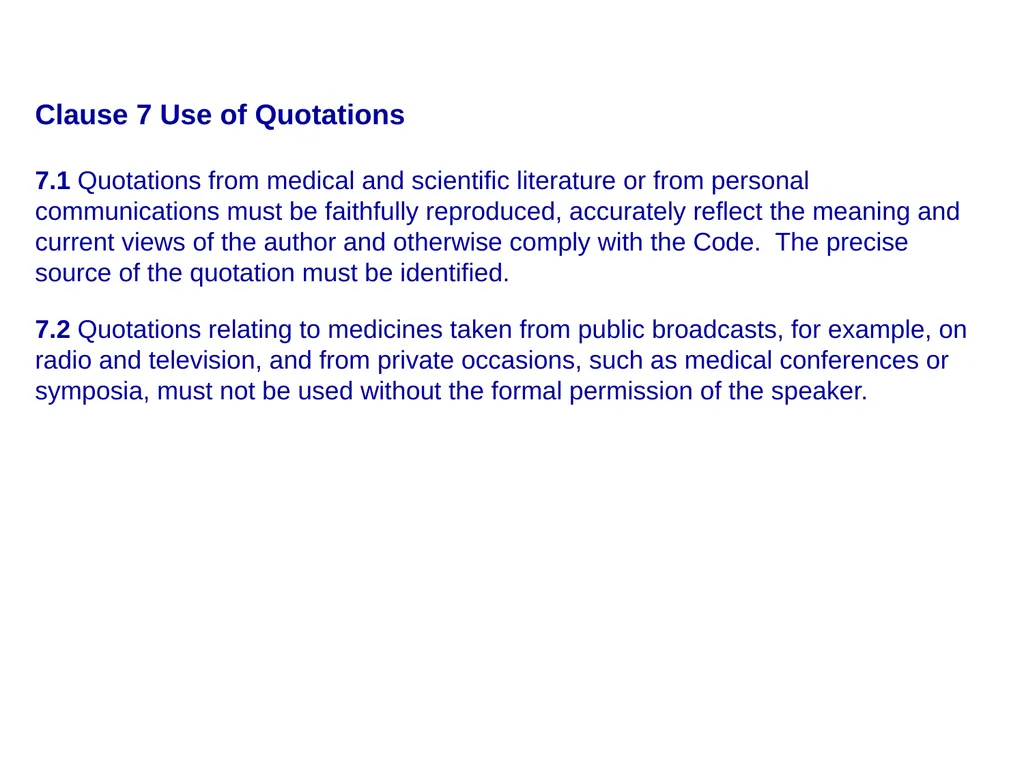
7.1 Quotations from medical and scientific literature or from personal communications must be faithfully reproduced, accurately reflect the meaning and current views of the author and otherwise comply with the Code. The precise source of the quotation must be identified.
7.2 Quotations relating to medicines taken from public broadcasts, for example, on radio and television, and from private occasions, such as medical conferences or symposia, must not be used without the formal permission of the speaker.<br>
28
Clause 8 Certification and Examination
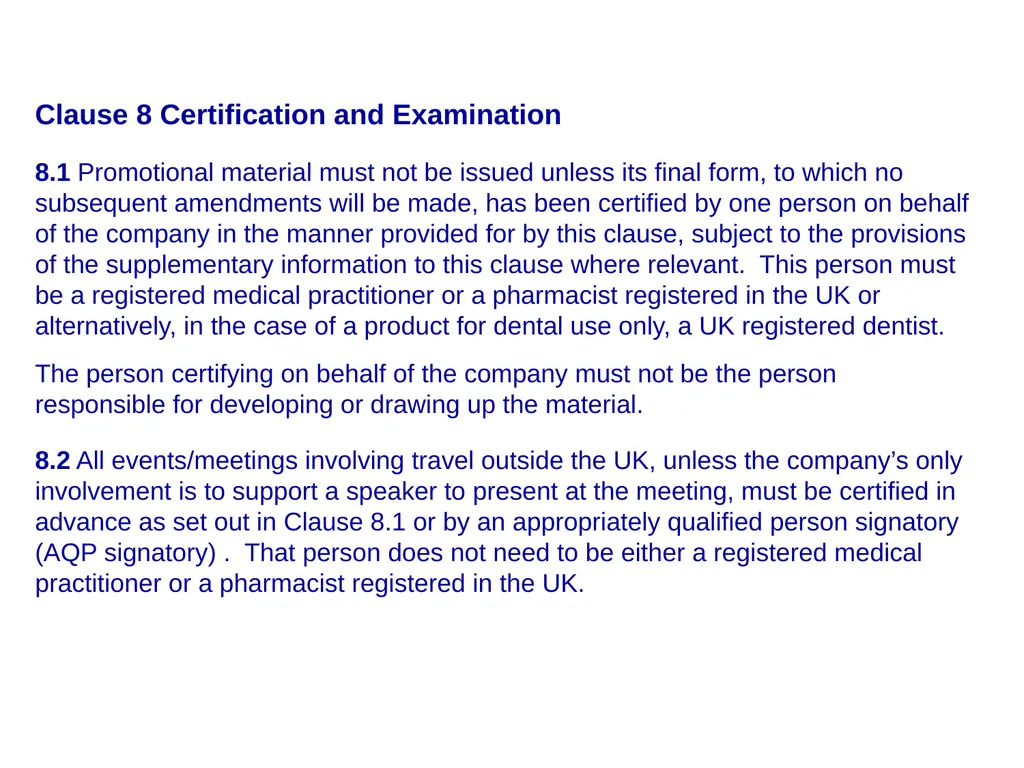
8.1 Promotional material must not be issued unless its final form, to which no subsequent amendments will be made, has been certified by one person on behalf of the company in the manner provided for by this clause, subject to the provisions of the supplementary information to this clause where relevant. This person must be a registered medical practitioner or a pharmacist registered in the UK or alternatively, in the case of a product for dental use only, a UK registered dentist.
The person certifying on behalf of the company must not be the person responsible for developing or drawing up the material.
8.2 All events/meetings involving travel outside the UK, unless the company’s only involvement is to support a speaker to present at the meeting, must be certified in advance as set out in Clause 8.1 or by an appropriately qualified person signatory (AQP signatory) . That person does not need to be either a registered medical practitioner or a pharmacist registered in the UK.<br>
29
Clause 8 Certification and Examination
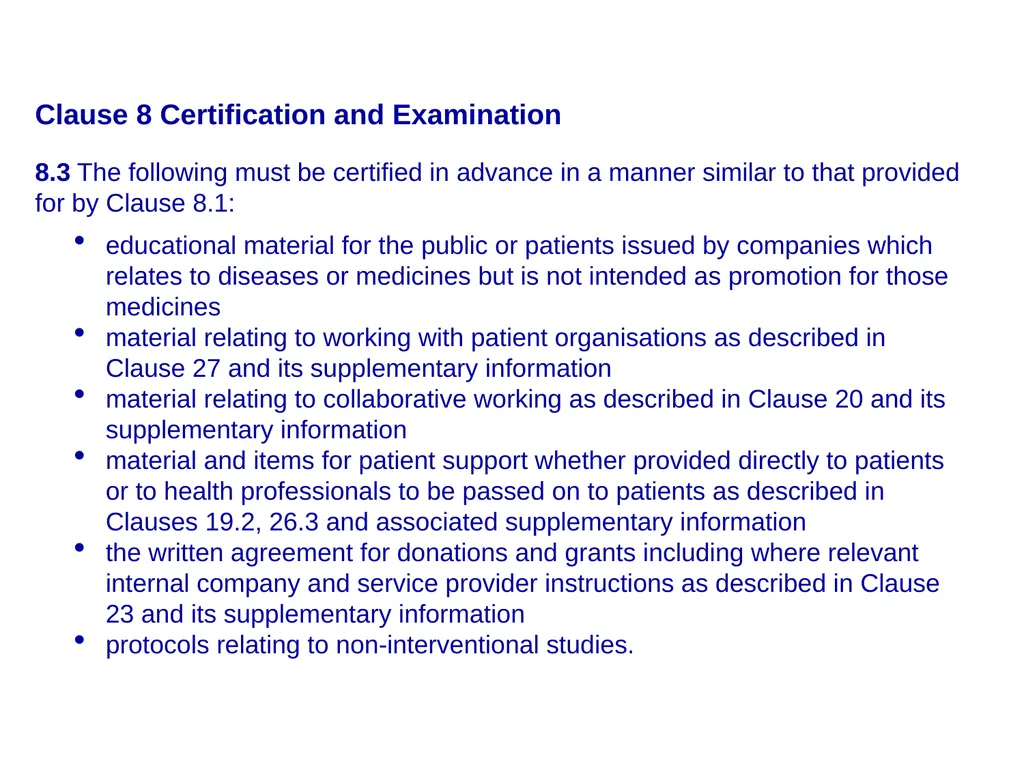
8.3 The following must be certified in advance in a manner similar to that provided for by Clause 8.1:
educational material for the public or patients issued by companies which relates to diseases or medicines but is not intended as promotion for those medicines
material relating to working with patient organisations as described in Clause 27 and its supplementary information
material relating to collaborative working as described in Clause 20 and its supplementary information
material and items for patient support whether provided directly to patients or to health professionals to be passed on to patients as described in Clauses 19.2, 26.3 and associated supplementary information
the written agreement for donations and grants including where relevant internal company and service provider instructions as described in Clause 23 and its supplementary information
protocols relating to non-interventional studies.<br>
30
Clause 8 Certification and Examination
8.4 The names of those nominated as signatories as set out in Clauses 8.1 and 8.2, together with their qualifications, must be notified in advance to the Advertising Standards and Outreach Unit, Vigilance and Risk Management of Medicines Division of the Medicines and Healthcare products Regulatory Agency (MHRA) and to the Prescription Medicines Code of Practice Authority (PMCPA). Changes in the names of nominees must be promptly notified.
8.5 The certificate for promotional material must certify that the signatory has examined the final form of the material to ensure that in their belief it is:
in accordance with the requirements of the relevant regulations relating to advertising and this Code
not inconsistent with the marketing authorisation and the summary of product characteristics
a fair and truthful presentation of the facts about the medicine.
The certificate for material covered by Clause 8.3 above must certify that the signatory has examined the final form of the material to ensure that in their belief it complies with the Code.
Material which is still in use must be recertified at intervals of no more than two years to ensure that it continues to conform with the relevant regulations relating to advertising and the Code.
The certificate for events/meetings involving travel outside the UK must certify that the signatory has examined all the proposed arrangements and that, in their belief, they are in accordance with the relevant regulations relating to advertising and the Code.<br>
31
Clause 8 Certification and Examination
8.6 Companies must preserve certificates. Material in the form certified and information indicating the persons to whom it was addressed, the method of dissemination and the date of first dissemination must also be preserved. In relation to certificates for events/meetings involving travel outside the UK, details of the programme, the venue, the reasons for using the venue, the audience, the anticipated and actual costs and the nature of the hospitality and the like must also be preserved.
Companies must preserve certificates and the relevant accompanying information for not less than three years after the final use of the material or the date of the event/meeting and produce them on request from the MHRA or the PMCPA.<br>
32
Clause 9 Training
9.1 All relevant personnel, including representatives, and members of staff, and others retained by way of contract, concerned in any way with the preparation or approval of material or activities covered by the Code must be fully conversant with the Code and the relevant laws and regulations.
9.2 All personnel (and others retained by way of contract) must be fully conversant with pharmacovigilance requirements relevant to their work and, this must be documented.
9.3 Representatives must be given adequate training and have sufficient scientific knowledge to enable them to provide full and accurate information about the medicines which they promote.<br>
33
Clause 9 Training
9.4 Representatives must take an appropriate examination within their first year of employment as a representative and must pass it within two years of starting such employment. To be acceptable, an appropriate examination must have been accredited to at least Level 3 or its equivalent by an external awarding body recognised by Ofqual.
An appropriate examination for medical representatives is one that requires a broad understanding of body systems, diseases and treatments, the development of new medicines and the structure and function of the NHS and of the pharmaceutical industry. Such an examination must be a Diploma (equivalent to at least 480 hours Total Qualification Time).
An appropriate examination for generic sales representatives is one that requires a broad understanding of body systems and the structure and function of the NHS and of the pharmaceutical industry. Such an examination must be a Certificate (equivalent to at least 330 hours Total Qualification Time).
An appropriate examination can be either the relevant ABPI examination (for medical or generic sales representatives) or an examination of at least the same standard which covers similar content and learning material as the corresponding ABPI examination.
9.5 Details of the numbers of representatives who have passed an examination, together with the examination status of others, must be provided to the PMCPA on request.<br>
34
Clause 10 Events/Meetings and Hospitality
10.1 Pharmaceutical companies may hold, sponsor, or support delegates to attend a wide range of events/meetings, providing such events/meetings meet the requirements of the Code. This may include support of health professionals not known to the company via a healthcare organisation by way of registration fees, accommodation, and travel.
Companies must not provide hospitality to health professionals, other relevant decision makers etc except in association with scientific meetings, promotional meetings, scientific congresses and other such meetings and training.
Cont’d<br>
35
Clause 10 Events/Meetings and Hospitality
10.1 cont’d
The content and arrangements for any event or meeting must also, to the extent relevant to the particular event/meeting, fulfil the following criteria:
the event/meeting must have a clear educational content; it should be the programme that attracts delegates to attend and not the associated hospitality or venue
the content must be appropriate and relevant to attendees
the venue must be appropriate and conducive to the main purpose of the event/meeting; lavish, extravagant or deluxe venues must not be used
any associated subsistence (food and drink), accommodation and travel costs must be strictly limited to the main purpose of the event/meeting, must be of secondary consideration and must be appropriate and not out of proportion to the occasion (see Clause 10.7)
companies must not sponsor, support or organise entertainment (such as sporting or leisure activities, etc)
any hospitality provided must not extend to an accompanying person unless that person qualifies as a proper delegate or participant at the meeting in their own right. In exceptional cases of established clear health needs of the delegate (eg disability or injury), similar hospitality may be provided for an accompanying person.
Cont’d<br>
36
Clause 10 Events/Meetings and Hospitality
10.2 No payment may be offered or paid to individuals to compensate merely for the time spent in attending events/meetings.
10.3 Sponsorship of patient organisations (including individuals representing patient organisations to attend events/meetings) must have a written agreement in place setting out what has been agreed including, where possible, a breakdown of agreed costs. (The requirements for the written agreement are set out in Clause 27.2).
10.4 Attendees of company organised events/meetings may be provided with inexpensive pens, pencils and notepads when required for use at those events/meetings. They must not bear the name of any medicine or any information about medicines but may bear the name of the company providing them. No individual attendee should receive more than one pen or pencil or one notepad.
The total cost to the donor company of all such items provided to an individual attending an event/meeting must not exceed £6, excluding VAT. The perceived value to the recipient must be similar.<br>
37
Clause 10 Events/Meetings and Hospitality
10.5 Pens/pencils and notepads provided in conference bags at independently organised meetings must not include the name of the donor company, the name of any medicine or any information about medicines.
The total cost to the donor company of all such items provided to an individual attending an event/meeting must not exceed £6, excluding VAT. The perceived value to the recipient must be similar.
Pens/pencils and notepads must not be given out from exhibition stands.
10.6 Quizzes which are intended to gauge attendees’ understanding of the subject matter of a meeting are acceptable provided that such quizzes are non-promotional and genuine tests of skill or knowledge; they must respect the professional standing or otherwise of the audience and no prizes can be offered. To be acceptable, a quiz must form part of the meeting’s formal proceedings. Quizzes must not be conducted from or on exhibition stands.
The use of competitions, quizzes and suchlike are unacceptable methods of promotion.<br>
38
Clause 10 Events/Meetings and Hospitality
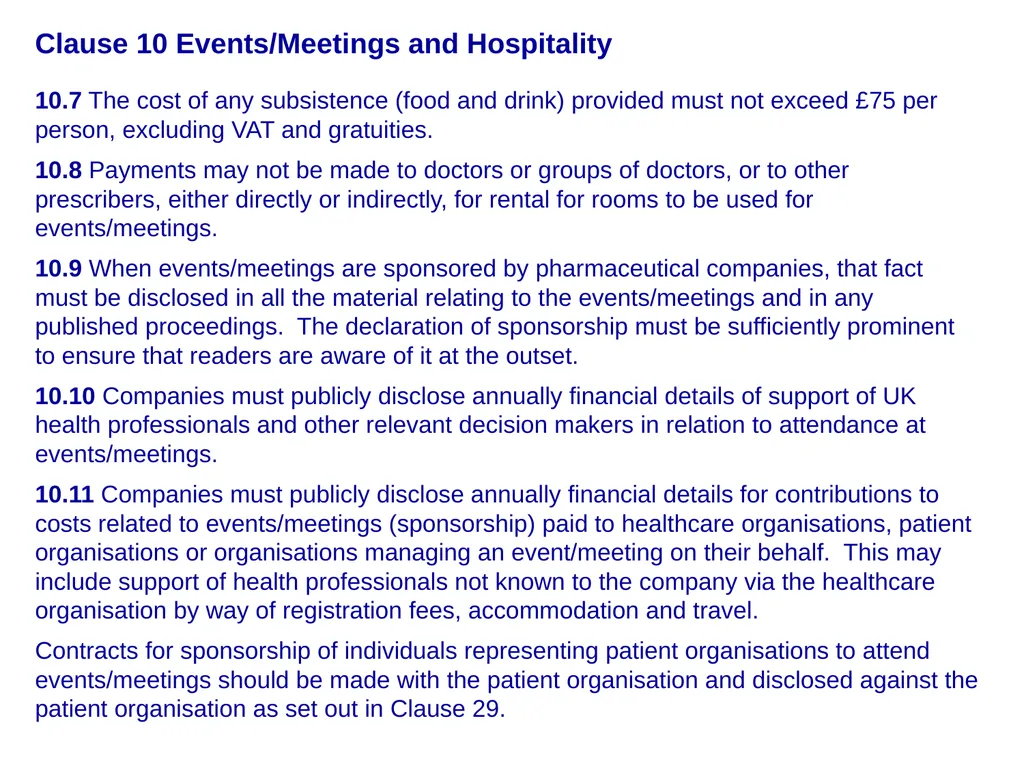
10.7 The cost of any subsistence (food and drink) provided must not exceed £75 per person, excluding VAT and gratuities.
10.8 Payments may not be made to doctors or groups of doctors, or to other prescribers, either directly or indirectly, for rental for rooms to be used for events/meetings.
10.9 When events/meetings are sponsored by pharmaceutical companies, that fact must be disclosed in all the material relating to the events/meetings and in any published proceedings. The declaration of sponsorship must be sufficiently prominent to ensure that readers are aware of it at the outset.
10.10 Companies must publicly disclose annually financial details of support of UK health professionals and other relevant decision makers in relation to attendance at events/meetings.
10.11 Companies must publicly disclose annually financial details for contributions to costs related to events/meetings (sponsorship) paid to healthcare organisations, patient organisations or organisations managing an event/meeting on their behalf. This may include support of health professionals not known to the company via the healthcare organisation by way of registration fees, accommodation and travel.
Contracts for sponsorship of individuals representing patient organisations to attend events/meetings should be made with the patient organisation and disclosed against the patient organisation as set out in Clause 29.<br>
39
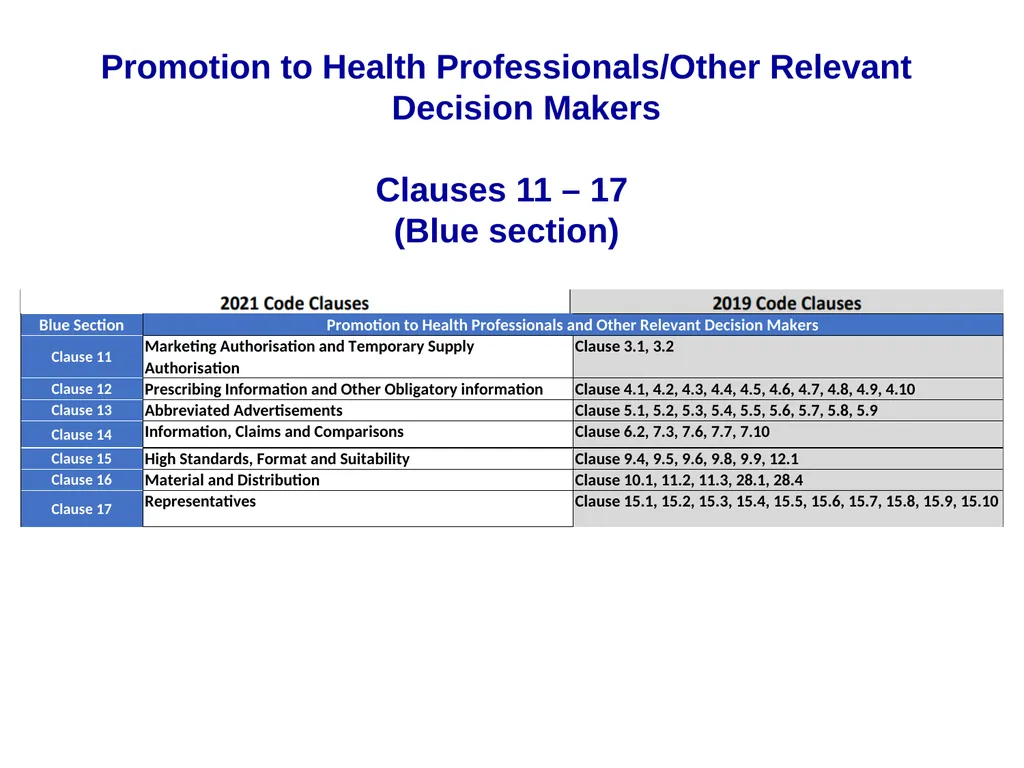
Promotion to Health Professionals/Other Relevant Decision Makers
Clauses 11 – 17
(Blue section)<br>
Clauses 11 – 17
(Blue section)<br>
40
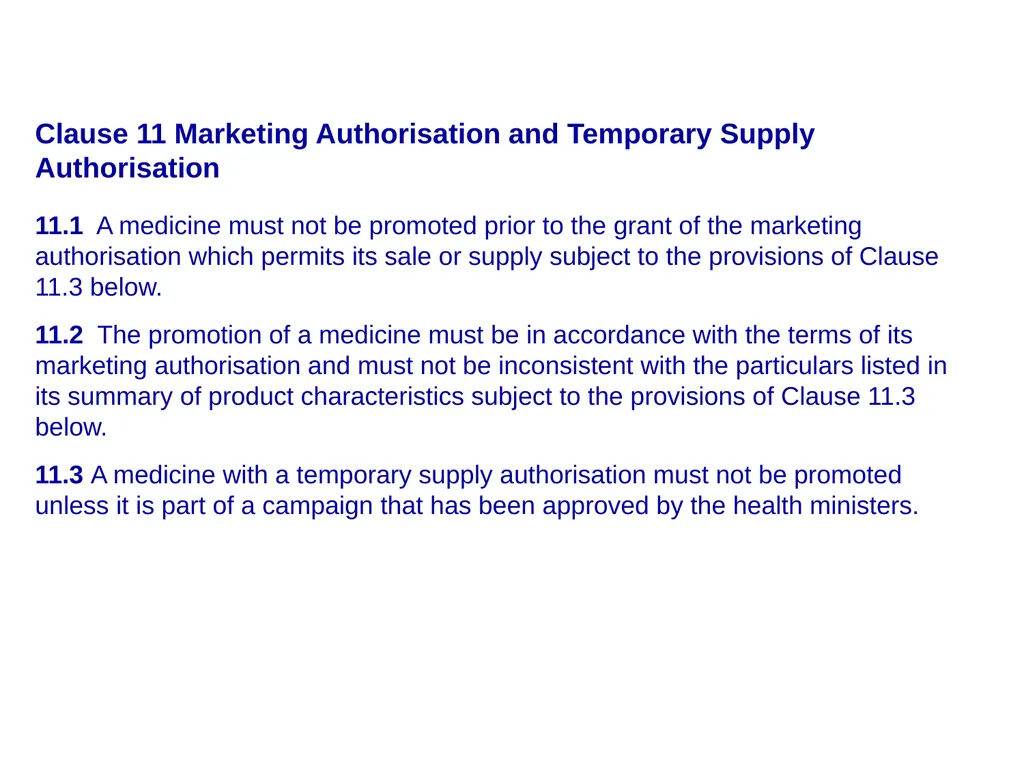
Clause 11 Marketing Authorisation and Temporary Supply Authorisation
11.1 A medicine must not be promoted prior to the grant of the marketing authorisation which permits its sale or supply subject to the provisions of Clause 11.3 below.
11.2 The promotion of a medicine must be in accordance with the terms of its marketing authorisation and must not be inconsistent with the particulars listed in its summary of product characteristics subject to the provisions of Clause 11.3 below.
11.3 A medicine with a temporary supply authorisation must not be promoted unless it is part of a campaign that has been approved by the health ministers.<br>
41
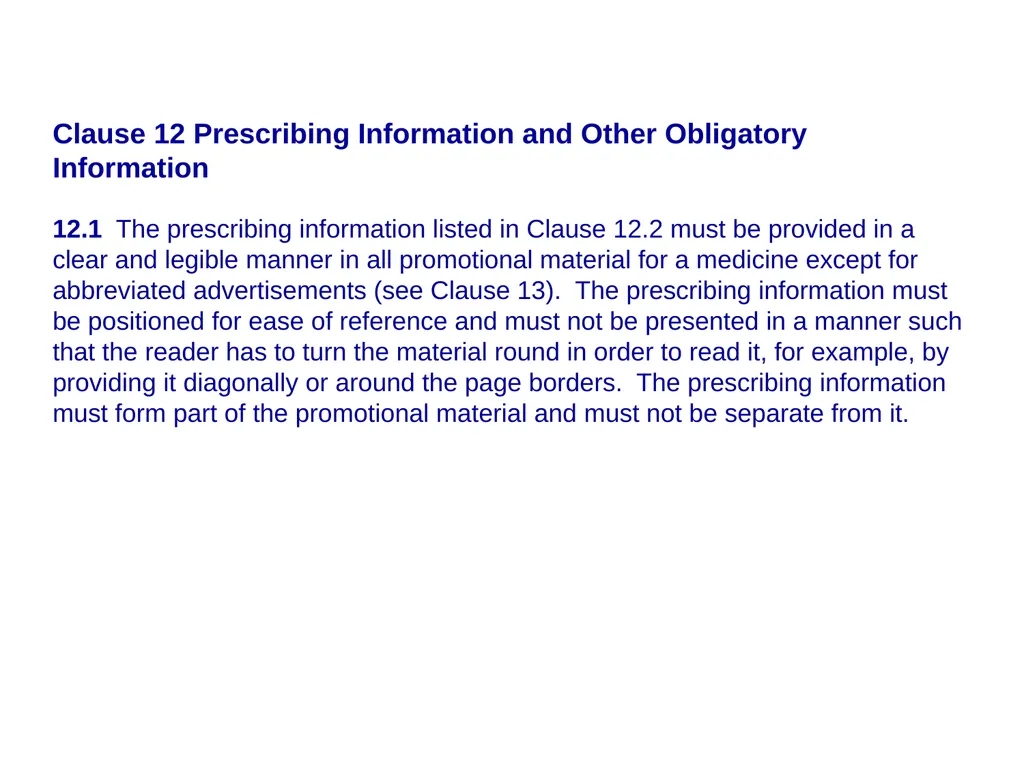
Clause 12 Prescribing Information and Other Obligatory Information
12.1 The prescribing information listed in Clause 12.2 must be provided in a clear and legible manner in all promotional material for a medicine except for abbreviated advertisements (see Clause 13). The prescribing information must be positioned for ease of reference and must not be presented in a manner such that the reader has to turn the material round in order to read it, for example, by providing it diagonally or around the page borders. The prescribing information must form part of the promotional material and must not be separate from it.<br>
12.1 The prescribing information listed in Clause 12.2 must be provided in a clear and legible manner in all promotional material for a medicine except for abbreviated advertisements (see Clause 13). The prescribing information must be positioned for ease of reference and must not be presented in a manner such that the reader has to turn the material round in order to read it, for example, by providing it diagonally or around the page borders. The prescribing information must form part of the promotional material and must not be separate from it.<br>
42
Clause 12 Prescribing Information and Other Obligatory Information
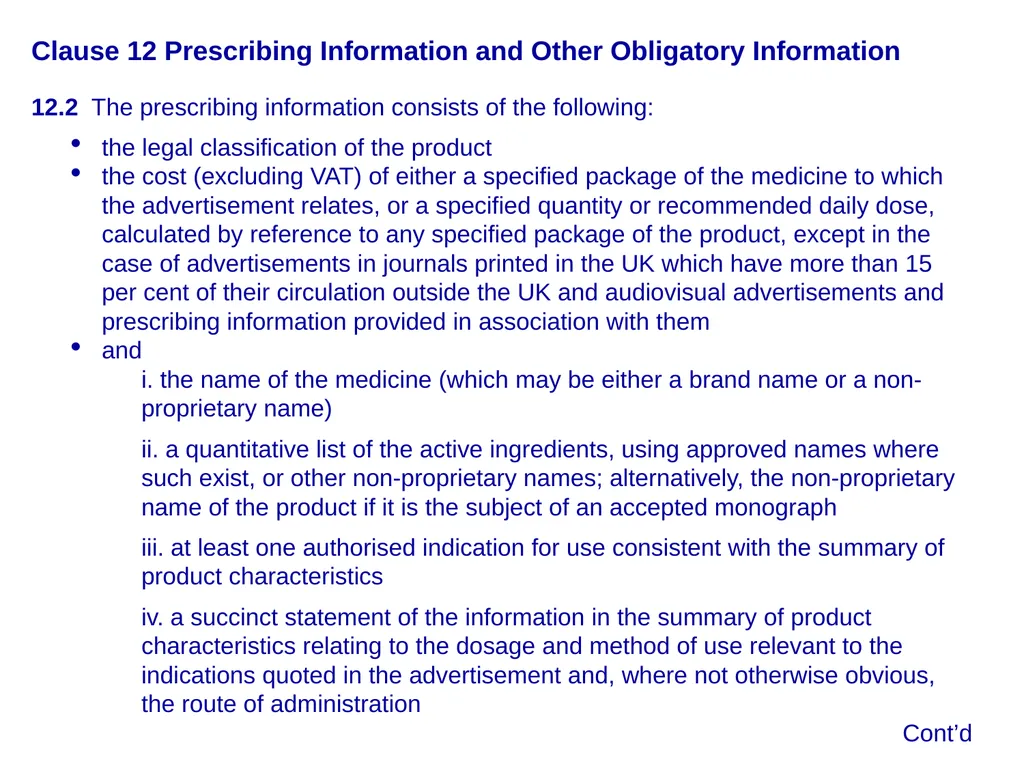
12.2 The prescribing information consists of the following:
the legal classification of the product
the cost (excluding VAT) of either a specified package of the medicine to which the advertisement relates, or a specified quantity or recommended daily dose, calculated by reference to any specified package of the product, except in the case of advertisements in journals printed in the UK which have more than 15 per cent of their circulation outside the UK and audiovisual advertisements and prescribing information provided in association with them
and
i. the name of the medicine (which may be either a brand name or a non-proprietary name)
ii. a quantitative list of the active ingredients, using approved names where such exist, or other non-proprietary names; alternatively, the non-proprietary name of the product if it is the subject of an accepted monograph
iii. at least one authorised indication for use consistent with the summary of product characteristics
iv. a succinct statement of the information in the summary of product characteristics relating to the dosage and method of use relevant to the indications quoted in the advertisement and, where not otherwise obvious, the route of administration
Cont’d<br>
43
Clause 12 Prescribing Information and Other Obligatory Information
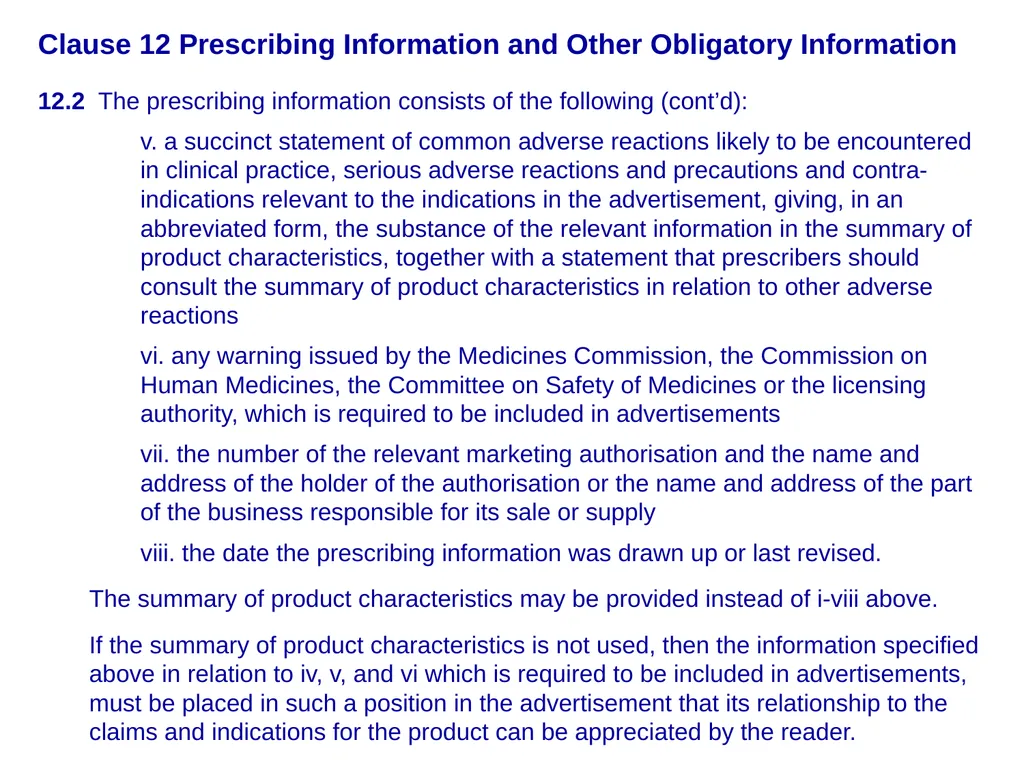
12.2 The prescribing information consists of the following (cont’d):
v. a succinct statement of common adverse reactions likely to be encountered in clinical practice, serious adverse reactions and precautions and contra-indications relevant to the indications in the advertisement, giving, in an abbreviated form, the substance of the relevant information in the summary of product characteristics, together with a statement that prescribers should consult the summary of product characteristics in relation to other adverse reactions
vi. any warning issued by the Medicines Commission, the Commission on Human Medicines, the Committee on Safety of Medicines or the licensing authority, which is required to be included in advertisements
vii. the number of the relevant marketing authorisation and the name and address of the holder of the authorisation or the name and address of the part of the business responsible for its sale or supply
viii. the date the prescribing information was drawn up or last revised.
The summary of product characteristics may be provided instead of i-viii above.
If the summary of product characteristics is not used, then the information specified above in relation to iv, v, and vi which is required to be included in advertisements, must be placed in such a position in the advertisement that its relationship to the claims and indications for the product can be appreciated by the reader.<br>
44
Clause 12 Prescribing Information and Other Obligatory Information
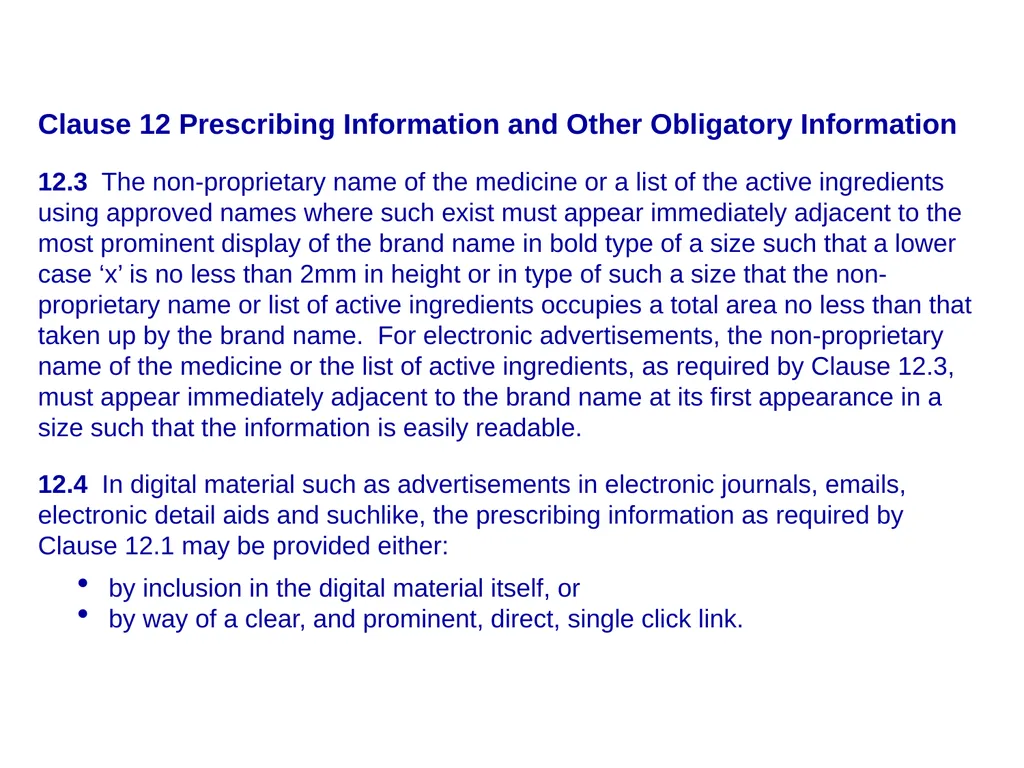
12.3 The non-proprietary name of the medicine or a list of the active ingredients using approved names where such exist must appear immediately adjacent to the most prominent display of the brand name in bold type of a size such that a lower case ‘x’ is no less than 2mm in height or in type of such a size that the non-proprietary name or list of active ingredients occupies a total area no less than that taken up by the brand name. For electronic advertisements, the non-proprietary name of the medicine or the list of active ingredients, as required by Clause 12.3, must appear immediately adjacent to the brand name at its first appearance in a size such that the information is easily readable.
12.4 In digital material such as advertisements in electronic journals, emails, electronic detail aids and suchlike, the prescribing information as required by Clause 12.1 may be provided either:
by inclusion in the digital material itself, or
by way of a clear, and prominent, direct, single click link.<br>
45
Clause 12 Prescribing Information and Other Obligatory Information
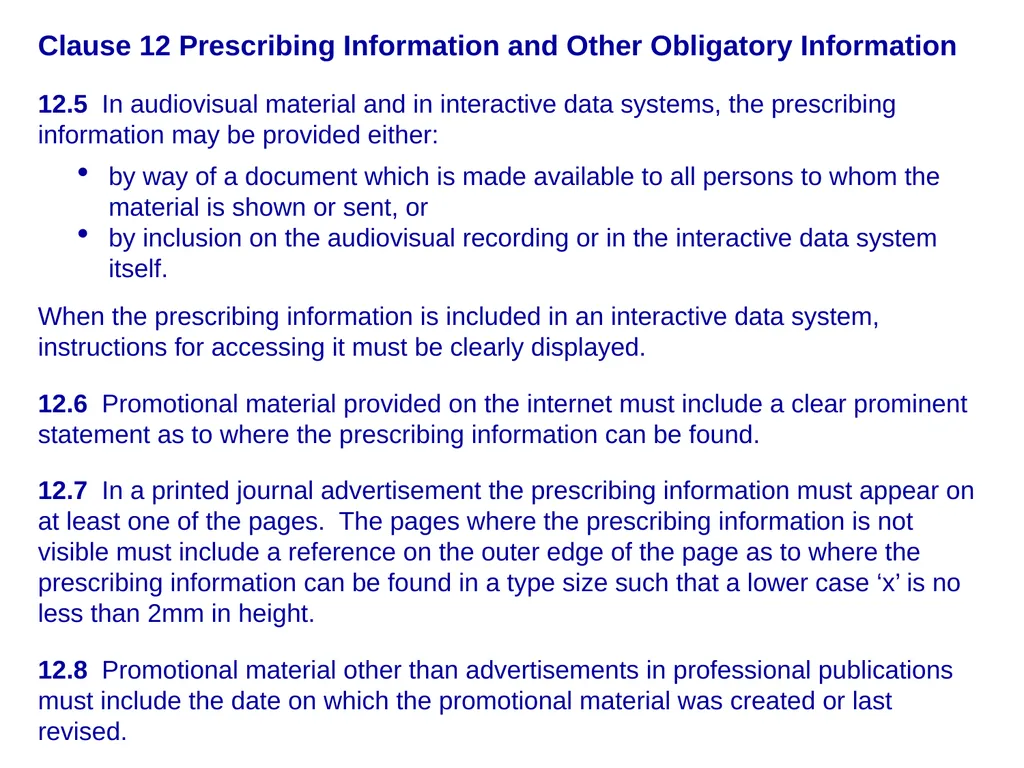
12.5 In audiovisual material and in interactive data systems, the prescribing information may be provided either:
by way of a document which is made available to all persons to whom the material is shown or sent, or
by inclusion on the audiovisual recording or in the interactive data system itself.
When the prescribing information is included in an interactive data system, instructions for accessing it must be clearly displayed.
12.6 Promotional material provided on the internet must include a clear prominent statement as to where the prescribing information can be found.
12.7 In a printed journal advertisement the prescribing information must appear on at least one of the pages. The pages where the prescribing information is not visible must include a reference on the outer edge of the page as to where the prescribing information can be found in a type size such that a lower case ‘x’ is no less than 2mm in height.
12.8 Promotional material other than advertisements in professional publications must include the date on which the promotional material was created or last revised.<br>
46
Clause 12 Prescribing Information and Other Obligatory Information
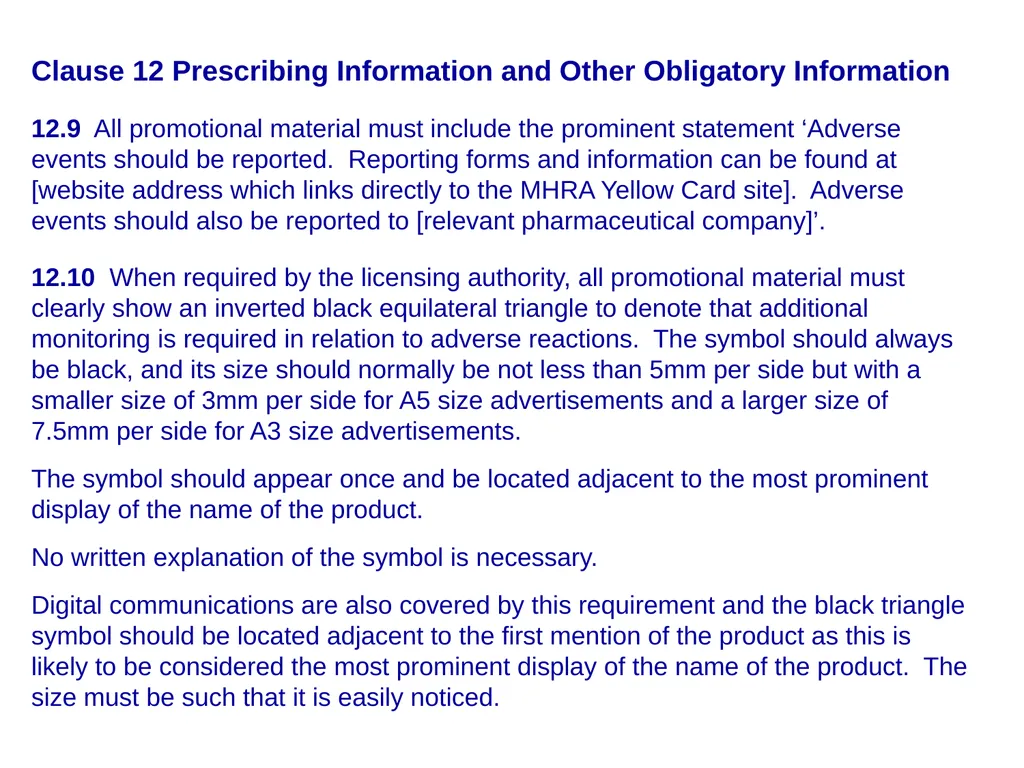
12.9 All promotional material must include the prominent statement ‘Adverse events should be reported. Reporting forms and information can be found at [website address which links directly to the MHRA Yellow Card site]. Adverse events should also be reported to [relevant pharmaceutical company]’.
12.10 When required by the licensing authority, all promotional material must clearly show an inverted black equilateral triangle to denote that additional monitoring is required in relation to adverse reactions. The symbol should always be black, and its size should normally be not less than 5mm per side but with a smaller size of 3mm per side for A5 size advertisements and a larger size of 7.5mm per side for A3 size advertisements.
The symbol should appear once and be located adjacent to the most prominent display of the name of the product.
No written explanation of the symbol is necessary.
Digital communications are also covered by this requirement and the black triangle symbol should be located adjacent to the first mention of the product as this is likely to be considered the most prominent display of the name of the product. The size must be such that it is easily noticed.<br>
47
Clause 13 Abbreviated Advertisements
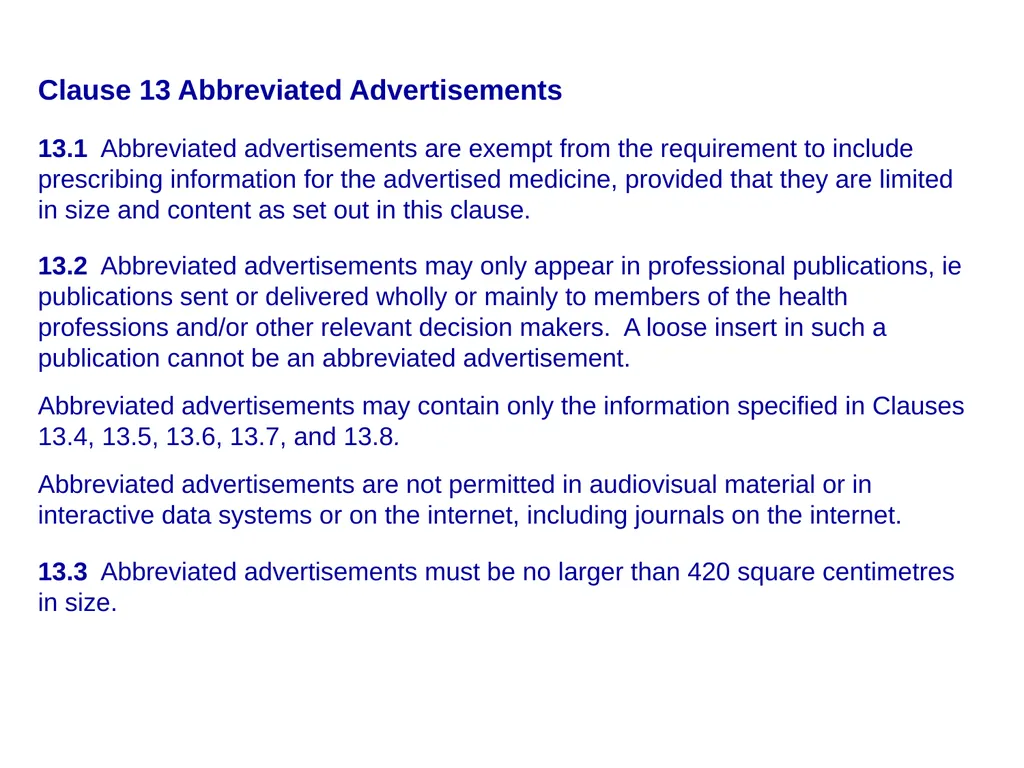
13.1 Abbreviated advertisements are exempt from the requirement to include prescribing information for the advertised medicine, provided that they are limited in size and content as set out in this clause.
13.2 Abbreviated advertisements may only appear in professional publications, ie publications sent or delivered wholly or mainly to members of the health professions and/or other relevant decision makers. A loose insert in such a publication cannot be an abbreviated advertisement.
Abbreviated advertisements may contain only the information specified in Clauses 13.4, 13.5, 13.6, 13.7, and 13.8.
Abbreviated advertisements are not permitted in audiovisual material or in interactive data systems or on the internet, including journals on the internet.
13.3 Abbreviated advertisements must be no larger than 420 square centimetres in size.<br>
48
Clause 13 Abbreviated Advertisements
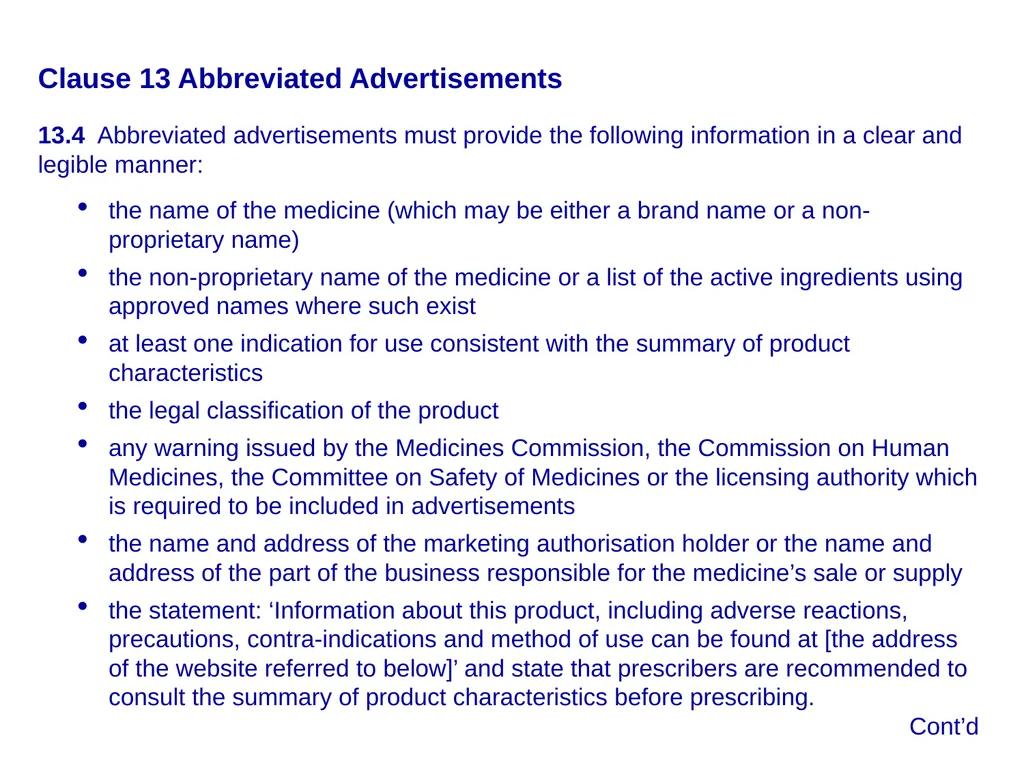
13.4 Abbreviated advertisements must provide the following information in a clear and legible manner:
the name of the medicine (which may be either a brand name or a non-proprietary name)
the non-proprietary name of the medicine or a list of the active ingredients using approved names where such exist
at least one indication for use consistent with the summary of product characteristics
the legal classification of the product
any warning issued by the Medicines Commission, the Commission on Human Medicines, the Committee on Safety of Medicines or the licensing authority which is required to be included in advertisements
the name and address of the marketing authorisation holder or the name and address of the part of the business responsible for the medicine’s sale or supply
the statement: ‘Information about this product, including adverse reactions, precautions, contra-indications and method of use can be found at [the address of the website referred to below]’ and state that prescribers are recommended to consult the summary of product characteristics before prescribing.
Cont’d<br>
49
Clause 13 Abbreviated Advertisements
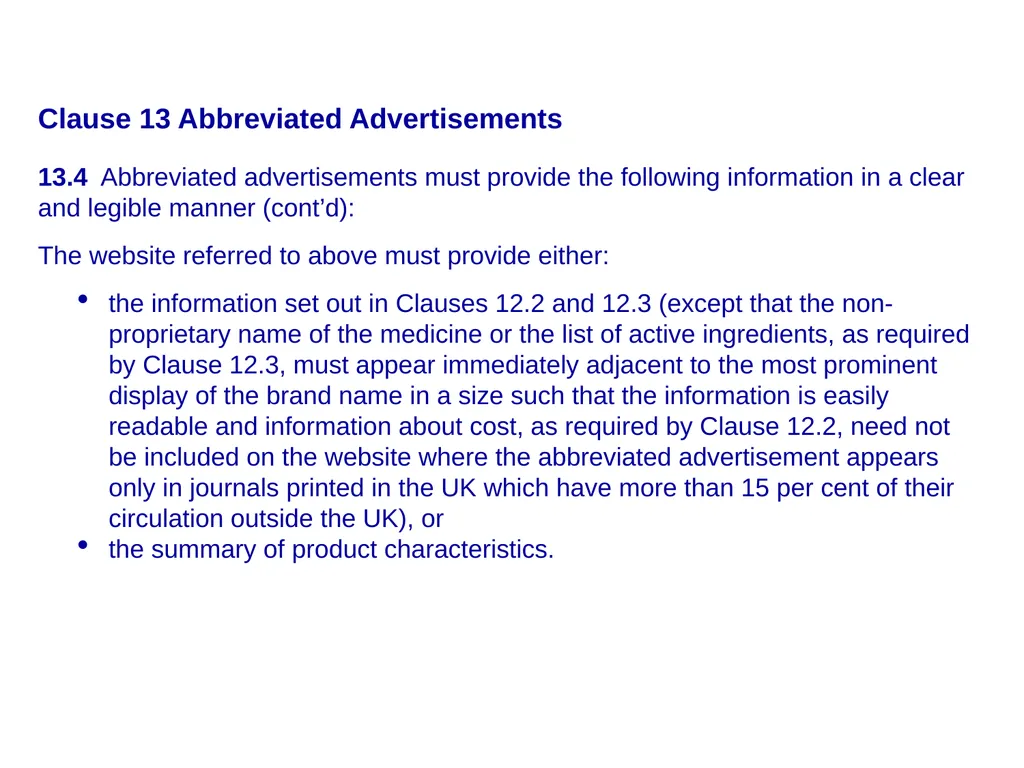
13.4 Abbreviated advertisements must provide the following information in a clear and legible manner (cont’d):
The website referred to above must provide either:
the information set out in Clauses 12.2 and 12.3 (except that the non-proprietary name of the medicine or the list of active ingredients, as required by Clause 12.3, must appear immediately adjacent to the most prominent display of the brand name in a size such that the information is easily readable and information about cost, as required by Clause 12.2, need not be included on the website where the abbreviated advertisement appears only in journals printed in the UK which have more than 15 per cent of their circulation outside the UK), or
the summary of product characteristics.<br>
50
Clause 13 Abbreviated Advertisements
13.5 The non-proprietary name of the medicine or a list of the active ingredients using approved names where such exist must appear immediately adjacent to the most prominent display of the brand name in bold type of a size such that a lower case ‘x’ is no less than 2mm in height or in type of such a size that the non-proprietary name or list of active ingredients occupies a total area no less than that taken up by the brand name.
13.6 Abbreviated advertisements must include the prominent statement ‘Adverse events should be reported. Reporting forms and information can be found at [website address which links directly to the MHRA Yellow Card site]. Adverse events should also be reported to [relevant pharmaceutical company]’.
13.7 When required by the licensing authority, abbreviated advertisements must clearly show an inverted black equilateral triangle to denote that additional monitoring is required in relation to adverse reactions.
It should be borne in mind that abbreviated advertisements must be no larger than 420 square centimetres in size. In abbreviated advertisements of no more than 310.8 square centimetres (A5) each side of the triangle should be no less than 3mm. In abbreviated advertisements larger than A5 (but no larger than 420 square centimetres) each side should be no less than 5mm. The other relevant requirements of Clause 12.10 apply equally to the use of the black triangle symbol on abbreviated advertisements.
13.8 Abbreviated advertisements may contain a concise statement consistent with the summary of product characteristics, giving the reason why the medicine is recommended for the indication or indications given.
13.9 Marketing authorisation numbers and references must not be included in abbreviated advertisements.<br>
51
Clause 14 Information, Claims and Comparisons
Clauses 6 and 18 may also be relevant
14.1 A comparison is only permitted in promotional material if:
it is not misleading
medicines or services for the same needs or intended for the same purpose are compared
one or more material, relevant, substantiable and representative features are compared
no confusion is created between the medicine advertised and that of a competitor or between the advertiser’s trademarks, brand names, other distinguishing marks and those of a competitor
the trademarks, brand names, other distinguishing marks, medicines, services, activities or circumstances of a competitor are not discredited or denigrated
no unfair advantage is taken of the reputation of a trademark, brand name or other distinguishing marks of a competitor
medicines or services are not presented as imitations or replicas of goods or services bearing a competitor’s trademark or brand name.<br>
52
Clause 14 Information, Claims and Comparisons
14.2 When promotional material refers to published studies, clear references must be given.
14.3 When promotional material refers to data on file, the relevant part of that data must be provided as soon as possible, and certainly within ten working days, in response to a request from a health professional or other relevant decision maker.
14.4 Promotion must encourage the rational use of a medicine by presenting it objectively and without exaggerating its properties. Exaggerated or all-embracing claims must not be made and superlatives must not be used except for those limited circumstances where they relate to a clear fact about a medicine. Claims should not imply that a medicine or an active ingredient has some special merit, quality or property unless this can be substantiated.
14.5 None of the individual screens or pages etc of a multi screen/page advertisement must be false or misleading when read in isolation.<br>
53
Clause 15 High Standards, Format and Suitability
15.1 Promotional material must not imitate the devices, copy, slogans or general layout adopted by other companies in a way that is likely to mislead or confuse.
15.2 Promotional material must not include any reference to the Commission on Human Medicines, the Medicines and Healthcare products Regulatory Agency (MHRA) or the licensing authority, unless this is specifically required by the licensing authority.
15.3 Reproductions of official documents must not be used for promotional purposes unless permission has been given in writing by the appropriate body.
15.4 Postcards, other exposed mailings, envelopes or wrappers must not carry matter which might be regarded as advertising to the public, contrary to Clause 26.1.
15.5 The telephone, text messages, email, faxes, automated calling systems and other digital communications must not be used for promotional purposes, except with the prior permission of the recipient.
15.6 Promotional material and activities must not be disguised.<br>
54
Clause 16 Material and Distribution
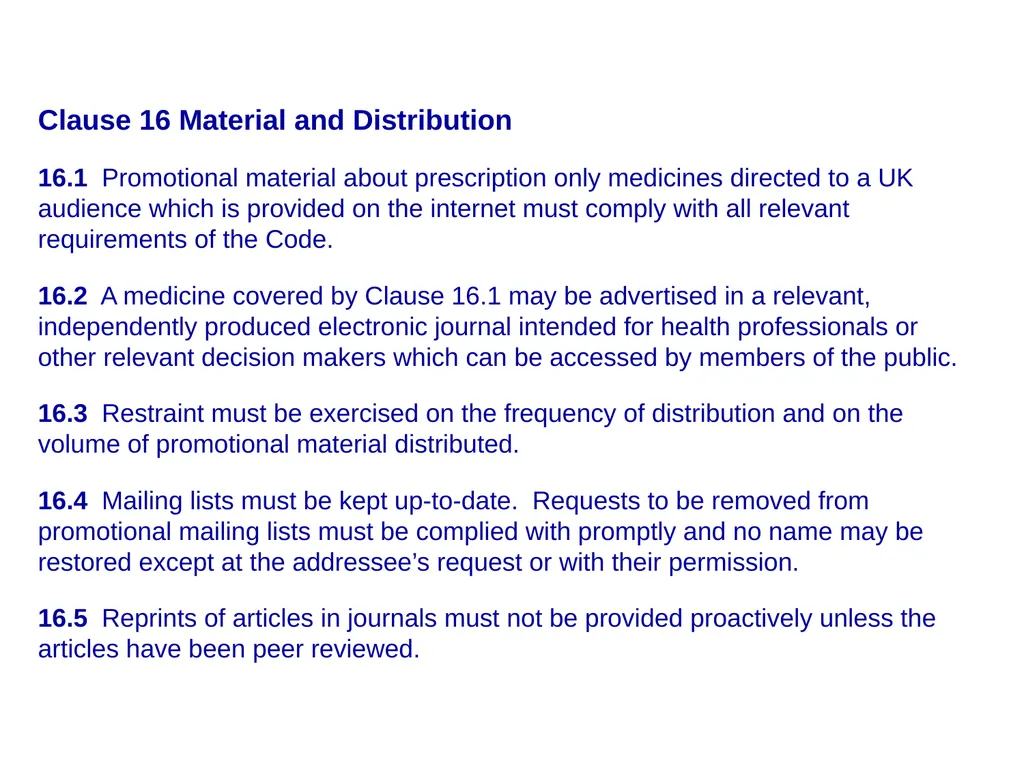
16.1 Promotional material about prescription only medicines directed to a UK audience which is provided on the internet must comply with all relevant requirements of the Code.
16.2 A medicine covered by Clause 16.1 may be advertised in a relevant, independently produced electronic journal intended for health professionals or other relevant decision makers which can be accessed by members of the public.
16.3 Restraint must be exercised on the frequency of distribution and on the volume of promotional material distributed.
16.4 Mailing lists must be kept up-to-date. Requests to be removed from promotional mailing lists must be complied with promptly and no name may be restored except at the addressee’s request or with their permission.
16.5 Reprints of articles in journals must not be provided proactively unless the articles have been peer reviewed.<br>
55
Clause 17 Representatives
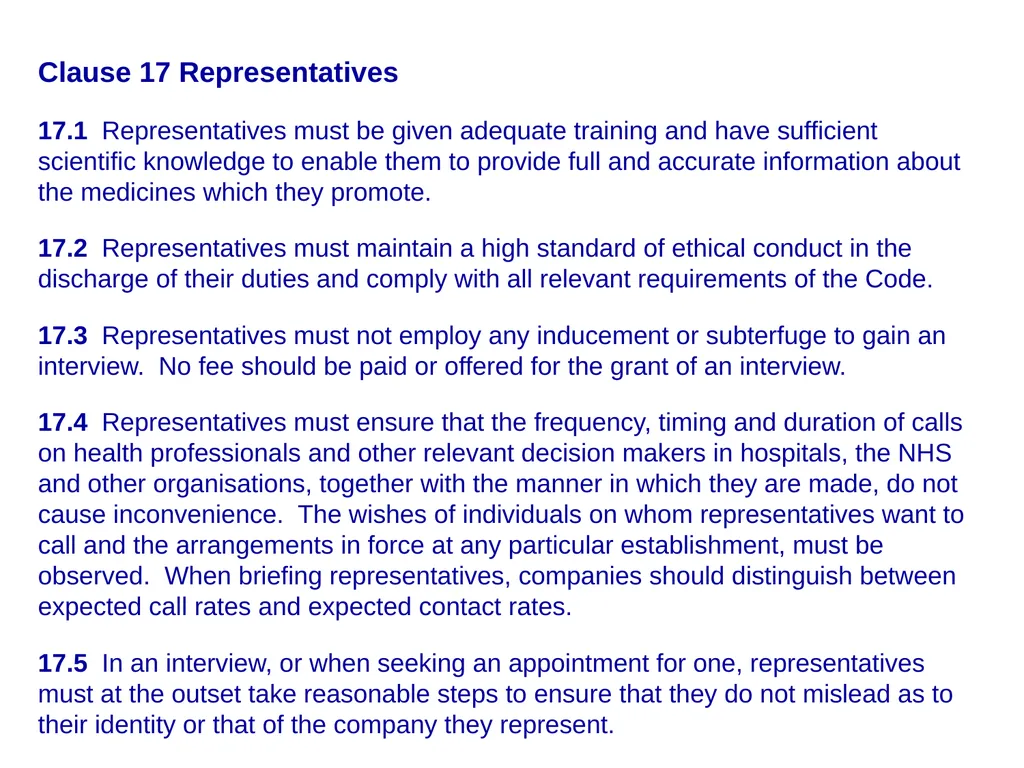
17.1 Representatives must be given adequate training and have sufficient scientific knowledge to enable them to provide full and accurate information about the medicines which they promote.
17.2 Representatives must maintain a high standard of ethical conduct in the discharge of their duties and comply with all relevant requirements of the Code.
17.3 Representatives must not employ any inducement or subterfuge to gain an interview. No fee should be paid or offered for the grant of an interview.
17.4 Representatives must ensure that the frequency, timing and duration of calls on health professionals and other relevant decision makers in hospitals, the NHS and other organisations, together with the manner in which they are made, do not cause inconvenience. The wishes of individuals on whom representatives want to call and the arrangements in force at any particular establishment, must be observed. When briefing representatives, companies should distinguish between expected call rates and expected contact rates.
17.5 In an interview, or when seeking an appointment for one, representatives must at the outset take reasonable steps to ensure that they do not mislead as to their identity or that of the company they represent.<br>
56
Clause 17 Representatives
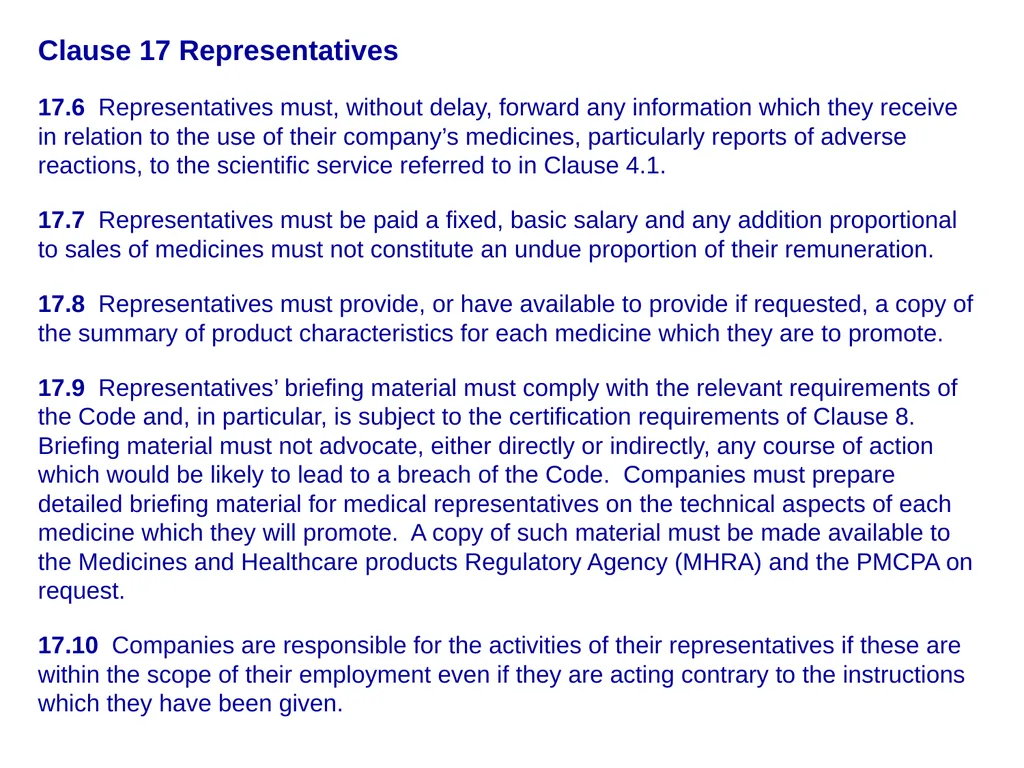
17.6 Representatives must, without delay, forward any information which they receive in relation to the use of their company’s medicines, particularly reports of adverse reactions, to the scientific service referred to in Clause 4.1.
17.7 Representatives must be paid a fixed, basic salary and any addition proportional to sales of medicines must not constitute an undue proportion of their remuneration.
17.8 Representatives must provide, or have available to provide if requested, a copy of the summary of product characteristics for each medicine which they are to promote.
17.9 Representatives’ briefing material must comply with the relevant requirements of the Code and, in particular, is subject to the certification requirements of Clause 8. Briefing material must not advocate, either directly or indirectly, any course of action which would be likely to lead to a breach of the Code. Companies must prepare detailed briefing material for medical representatives on the technical aspects of each medicine which they will promote. A copy of such material must be made available to the Medicines and Healthcare products Regulatory Agency (MHRA) and the PMCPA on request.
17.10 Companies are responsible for the activities of their representatives if these are within the scope of their employment even if they are acting contrary to the instructions which they have been given.<br>
57
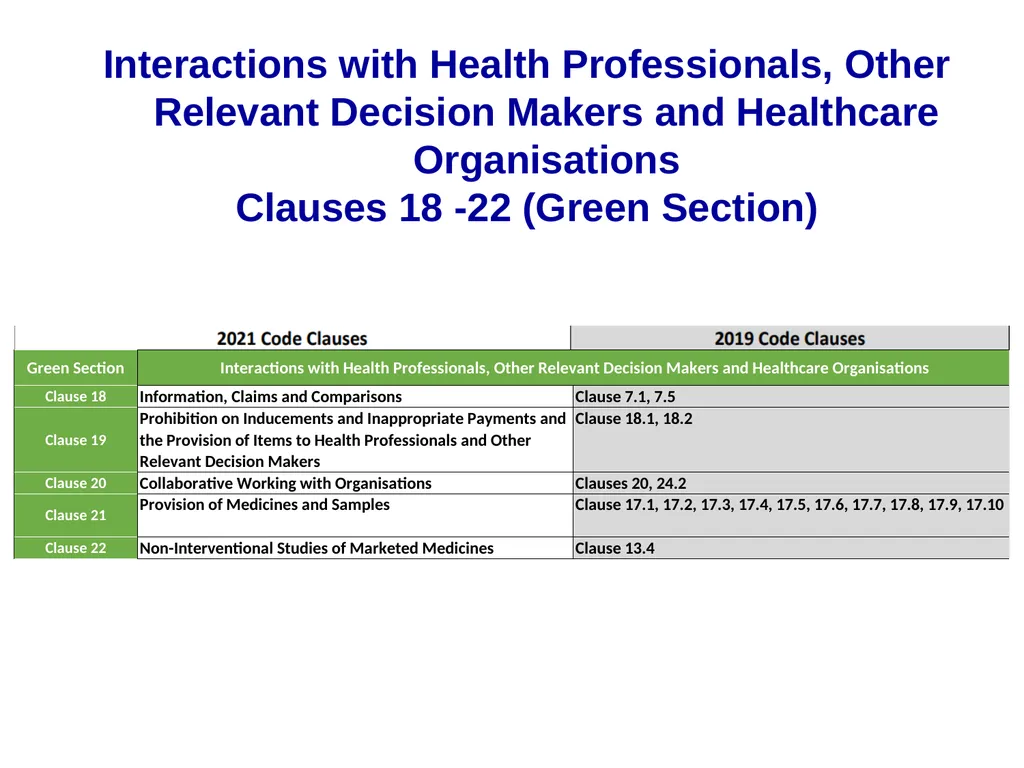
Interactions with Health Professionals, Other Relevant Decision Makers and Healthcare Organisations
Clauses 18 -22 (Green Section)<br>
Clauses 18 -22 (Green Section)<br>
58
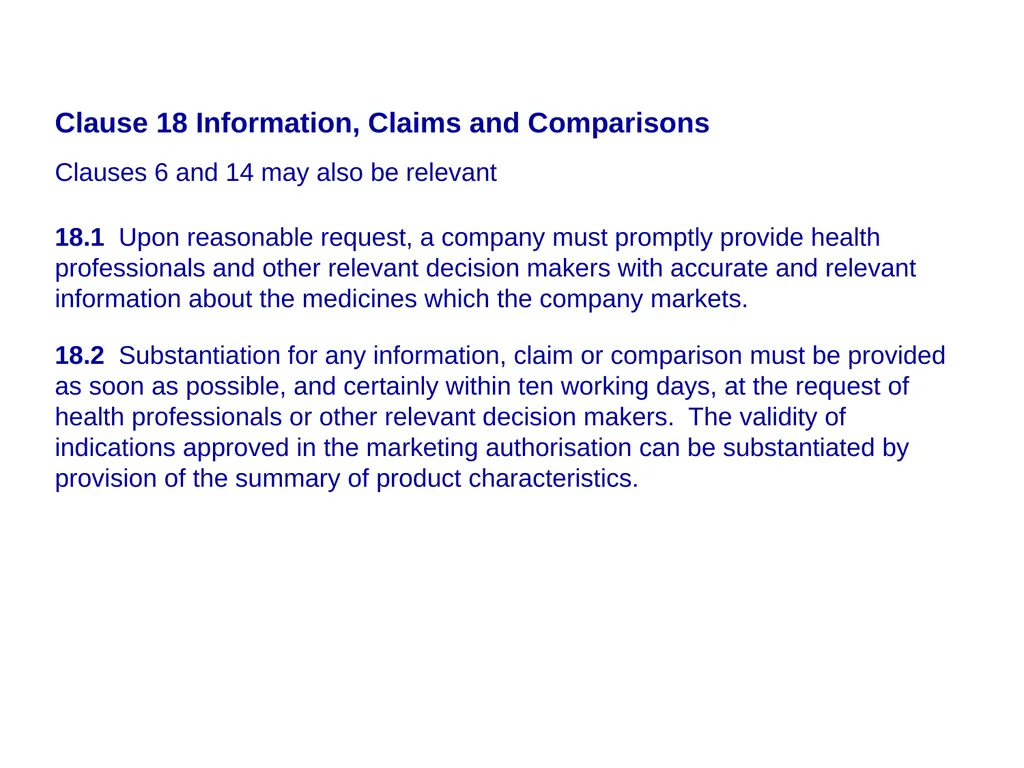
Clause 18 Information, Claims and Comparisons
Clauses 6 and 14 may also be relevant
18.1 Upon reasonable request, a company must promptly provide health professionals and other relevant decision makers with accurate and relevant information about the medicines which the company markets.
18.2 Substantiation for any information, claim or comparison must be provided as soon as possible, and certainly within ten working days, at the request of health professionals or other relevant decision makers. The validity of indications approved in the marketing authorisation can be substantiated by provision of the summary of product characteristics.<br>
59
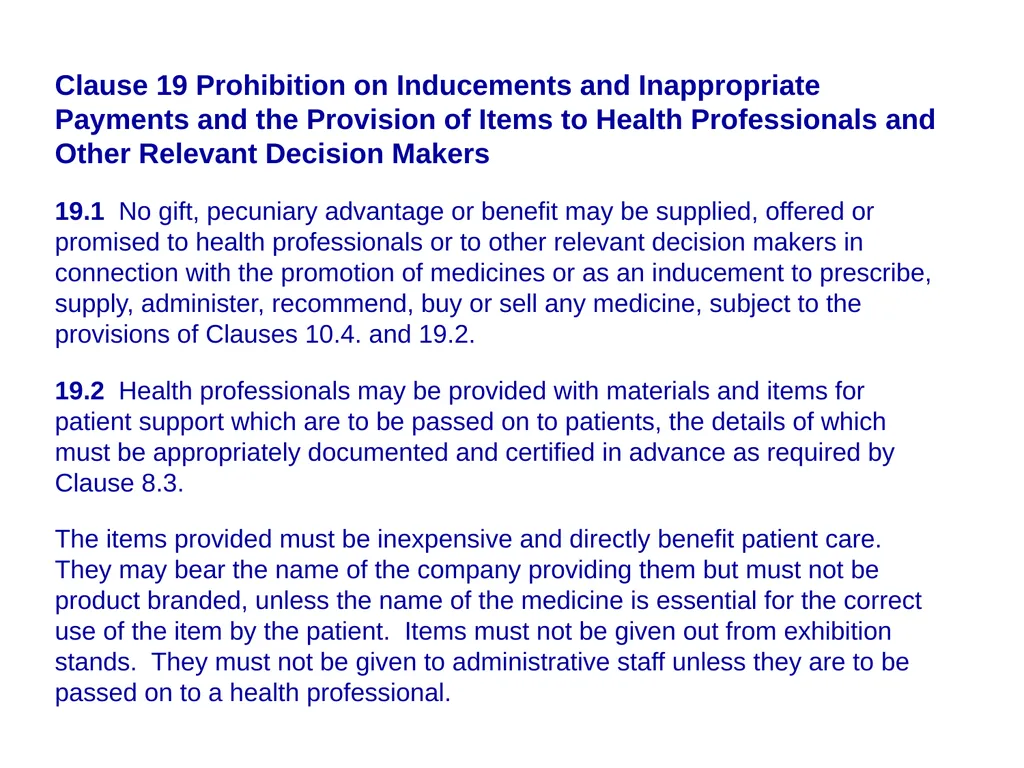
Clause 19 Prohibition on Inducements and Inappropriate Payments and the Provision of Items to Health Professionals and Other Relevant Decision Makers
19.1 No gift, pecuniary advantage or benefit may be supplied, offered or promised to health professionals or to other relevant decision makers in connection with the promotion of medicines or as an inducement to prescribe, supply, administer, recommend, buy or sell any medicine, subject to the provisions of Clauses 10.4. and 19.2.
19.2 Health professionals may be provided with materials and items for patient support which are to be passed on to patients, the details of which must be appropriately documented and certified in advance as required by Clause 8.3.
The items provided must be inexpensive and directly benefit patient care. They may bear the name of the company providing them but must not be product branded, unless the name of the medicine is essential for the correct use of the item by the patient. Items must not be given out from exhibition stands. They must not be given to administrative staff unless they are to be passed on to a health professional.<br>
60
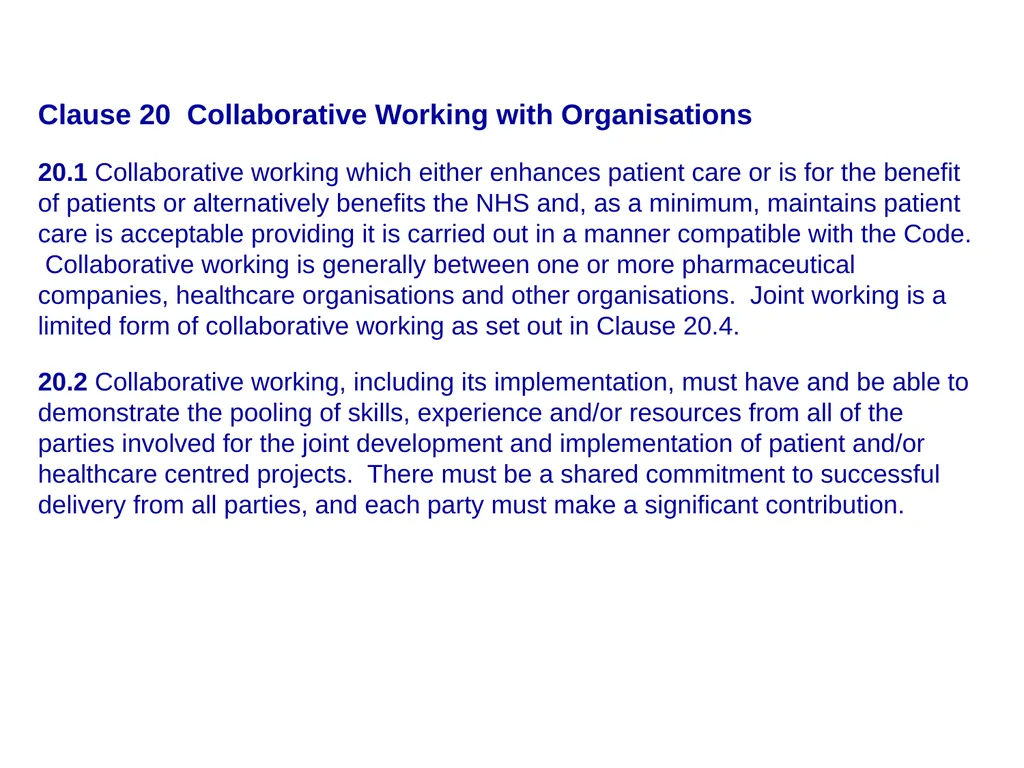
Clause 20 Collaborative Working with Organisations
20.1 Collaborative working which either enhances patient care or is for the benefit of patients or alternatively benefits the NHS and, as a minimum, maintains patient care is acceptable providing it is carried out in a manner compatible with the Code. Collaborative working is generally between one or more pharmaceutical companies, healthcare organisations and other organisations. Joint working is a limited form of collaborative working as set out in Clause 20.4.
20.2 Collaborative working, including its implementation, must have and be able to demonstrate the pooling of skills, experience and/or resources from all of the parties involved for the joint development and implementation of patient and/or healthcare centred projects. There must be a shared commitment to successful delivery from all parties, and each party must make a significant contribution.<br>
61
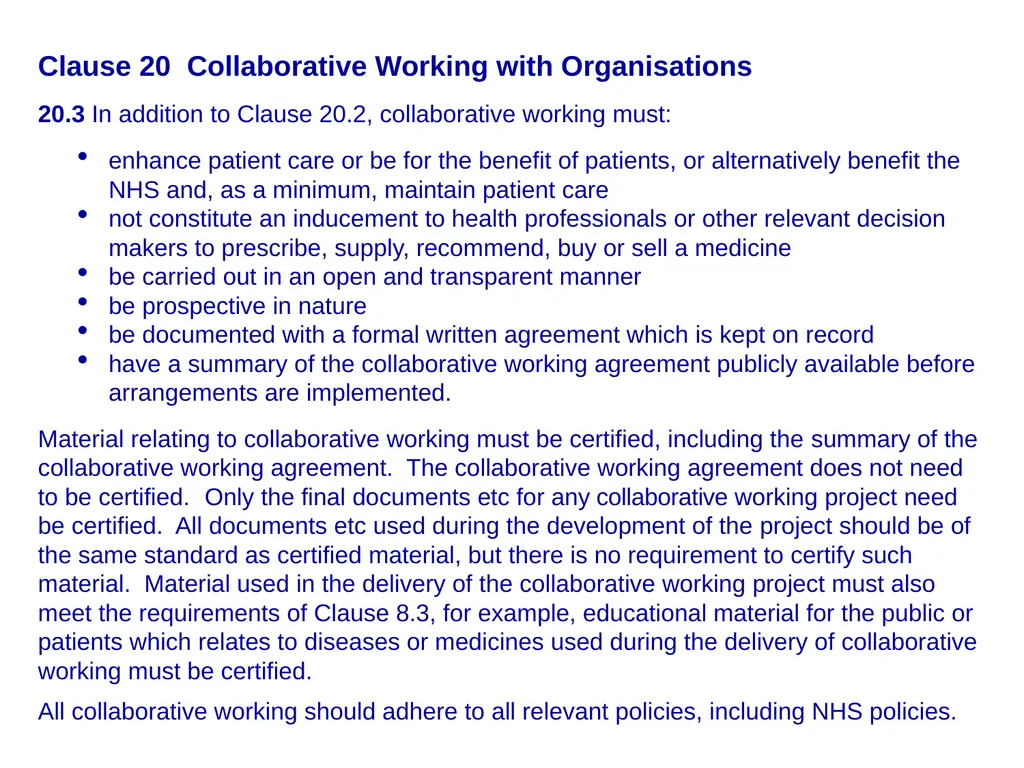
Clause 20 Collaborative Working with Organisations
20.3 In addition to Clause 20.2, collaborative working must:
enhance patient care or be for the benefit of patients, or alternatively benefit the NHS and, as a minimum, maintain patient care
not constitute an inducement to health professionals or other relevant decision makers to prescribe, supply, recommend, buy or sell a medicine
be carried out in an open and transparent manner
be prospective in nature
be documented with a formal written agreement which is kept on record
have a summary of the collaborative working agreement publicly available before arrangements are implemented.
Material relating to collaborative working must be certified, including the summary of the collaborative working agreement. The collaborative working agreement does not need to be certified. Only the final documents etc for any collaborative working project need be certified. All documents etc used during the development of the project should be of the same standard as certified material, but there is no requirement to certify such material. Material used in the delivery of the collaborative working project must also meet the requirements of Clause 8.3, for example, educational material for the public or patients which relates to diseases or medicines used during the delivery of collaborative working must be certified.
All collaborative working should adhere to all relevant policies, including NHS policies.<br>
62
Clause 20 Collaborative Working with Organisations
20.4 Joint working between one or more pharmaceutical companies and the NHS and others which is patient centred and always benefits patients is an acceptable form of collaborative working, providing it is carried out in a manner compatible with Clause 20 and other relevant requirements of the Code.
It must be clear in the documentation that the project is a joint working project and account must be taken of relevant best practice guidance on joint working between the NHS, the pharmaceutical industry and other relevant commercial organisations.
20.5 Transfers of value made by companies in connection with collaborative working must be publicly disclosed annually.<br>
63
Clause 21 Provision of Medicines and Samples
21.1 Samples of a product may be provided only to a health professional qualified to prescribe that product. They must not be provided to other relevant decision makers.
21.2 No more than four samples of a particular medicine may be provided to an individual health professional during the course of a year.
Samples of a particular medicine may be provided to a health professional for no longer than two years after that health professional first requested samples of it.
Notwithstanding the above, when a new medicine is marketed which is an extension of an existing product, samples of that new medicine can be provided as above. A ‘new medicine’ in this context is a product for which a new marketing authorisation has been granted, either following the initial application or following an extension application for a new indication that includes new strengths and/or dosage forms. Extension of a marketing authorisation to include additional strengths and/or dosage forms for existing indications or to include additional pack sizes is not regarded as leading to a new medicine.<br>
64
Clause 21 Provision of Medicines and Samples
21.3 Samples may only be supplied in response to written requests which have been signed and dated. An electronic signature is acceptable. All signed and dated written requests for samples should be retained for not less than one year.
21.4 A sample of a medicine must be no larger than the smallest presentation of the medicine on the market in the UK.
21.5 Each sample must be marked ‘free medical sample – not for resale’ or words to that effect and must be accompanied by a copy of the summary of product characteristics.
21.6 The provision of samples is not permitted for any medicine which contains a substance listed in any of Schedules I, II or IV to the Narcotic Drugs Convention (where the medicine is not a preparation listed in Schedule III to that Convention) or a substance listed in any of Schedules I to IV to the Psychotropic Substances Convention (where the medicine is not a preparation which may be exempted from measures of control in accordance with Paragraphs 2 and 3 of Article 3 of that Convention).
21.7 Companies must have adequate systems of control and accountability for samples which they distribute and for all medicines handled by representatives. Systems must clearly establish, for each health professional, the number of samples supplied in accordance with Clause 21.2.<br>
65
Clause 21 Provision of Medicines and Samples
21.8 Medicines which are sent by post must be packed so as to be reasonably secure against being opened by young children. No unsolicited medicine must be sent through the post.
21.9 Medicines may not be sold or supplied to members of the public for promotional purposes.
21.10 Samples must not be provided simply as an inducement to prescribe, supply, administer, recommend, buy or sell any medicine. Samples must not be given for the sole purpose of treating patients.<br>
66
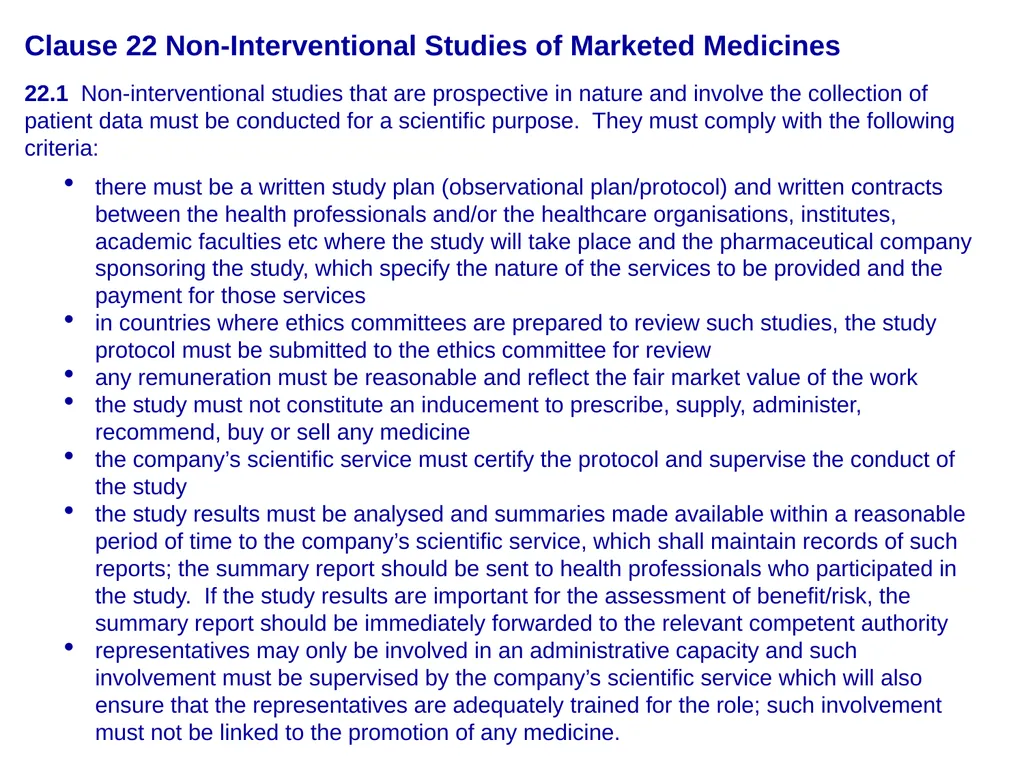
Clause 22 Non-Interventional Studies of Marketed Medicines
22.1 Non-interventional studies that are prospective in nature and involve the collection of patient data must be conducted for a scientific purpose. They must comply with the following criteria:
there must be a written study plan (observational plan/protocol) and written contracts between the health professionals and/or the healthcare organisations, institutes, academic faculties etc where the study will take place and the pharmaceutical company sponsoring the study, which specify the nature of the services to be provided and the payment for those services
in countries where ethics committees are prepared to review such studies, the study protocol must be submitted to the ethics committee for review
any remuneration must be reasonable and reflect the fair market value of the work
the study must not constitute an inducement to prescribe, supply, administer, recommend, buy or sell any medicine
the company’s scientific service must certify the protocol and supervise the conduct of the study
the study results must be analysed and summaries made available within a reasonable period of time to the company’s scientific service, which shall maintain records of such reports; the summary report should be sent to health professionals who participated in the study. If the study results are important for the assessment of benefit/risk, the summary report should be immediately forwarded to the relevant competent authority
representatives may only be involved in an administrative capacity and such involvement must be supervised by the company’s scientific service which will also ensure that the representatives are adequately trained for the role; such involvement must not be linked to the promotion of any medicine.<br>
67
Clause 22 Non-Interventional Studies of Marketed Medicines
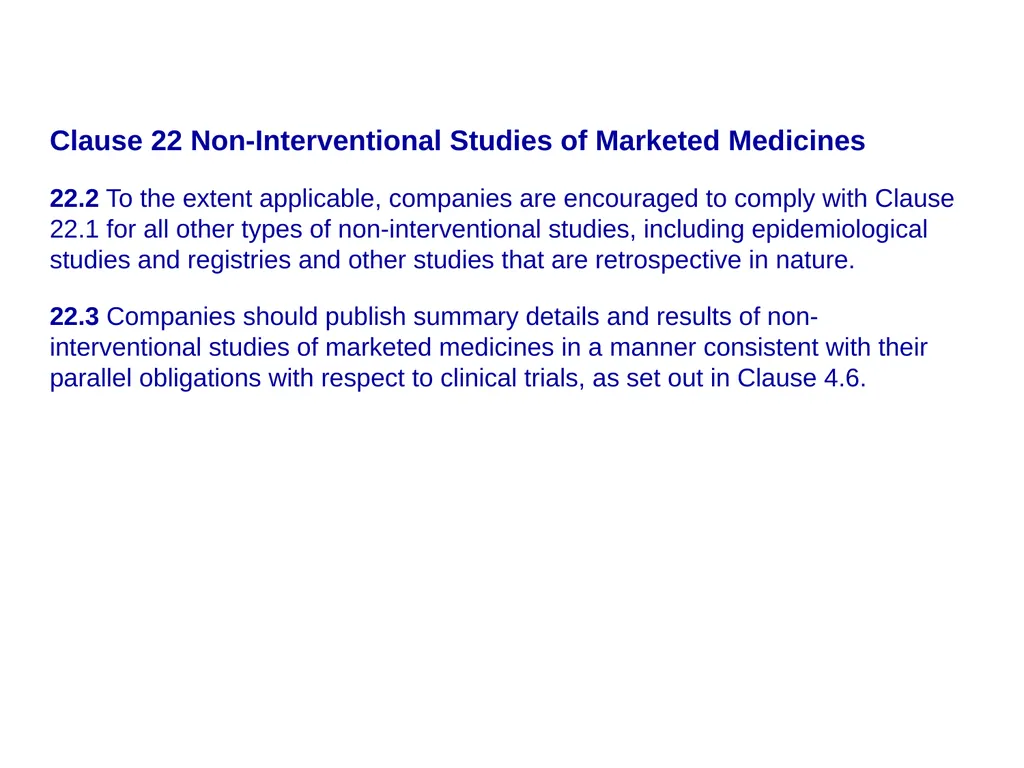
22.2 To the extent applicable, companies are encouraged to comply with Clause 22.1 for all other types of non-interventional studies, including epidemiological studies and registries and other studies that are retrospective in nature.
22.3 Companies should publish summary details and results of non-interventional studies of marketed medicines in a manner consistent with their parallel obligations with respect to clinical trials, as set out in Clause 4.6.<br>
68
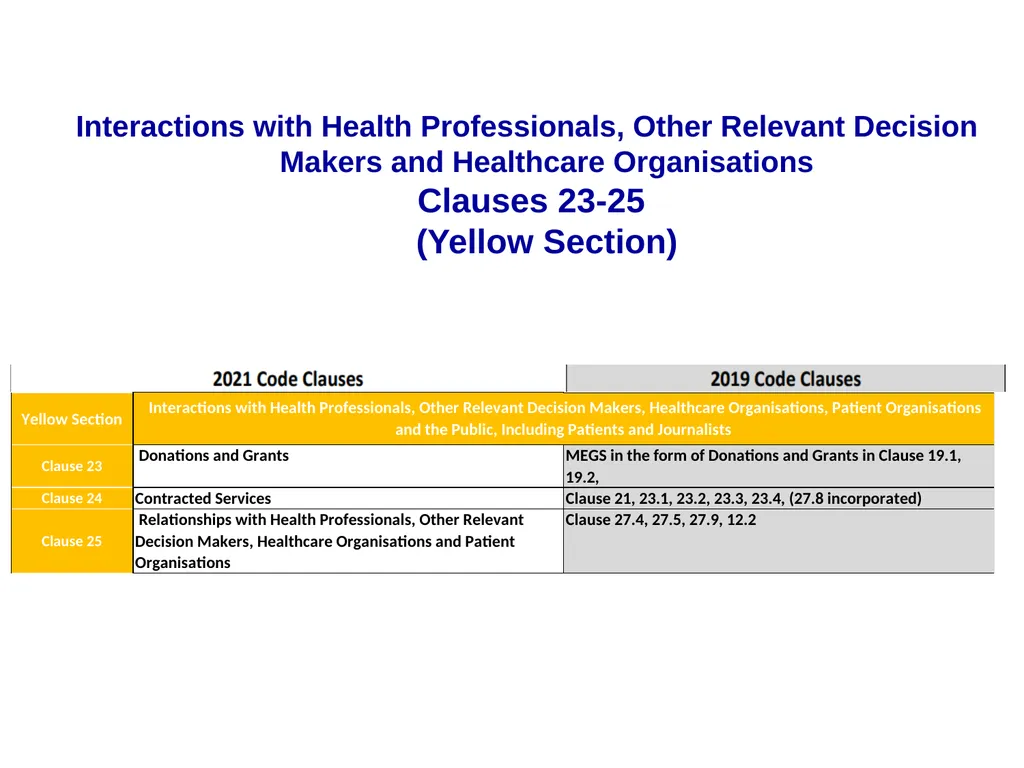
Interactions with Health Professionals, Other Relevant Decision Makers and Healthcare Organisations
Clauses 23-25 (Yellow Section)<br>
Clauses 23-25 (Yellow Section)<br>
69
Clause 23 Donations and Grants
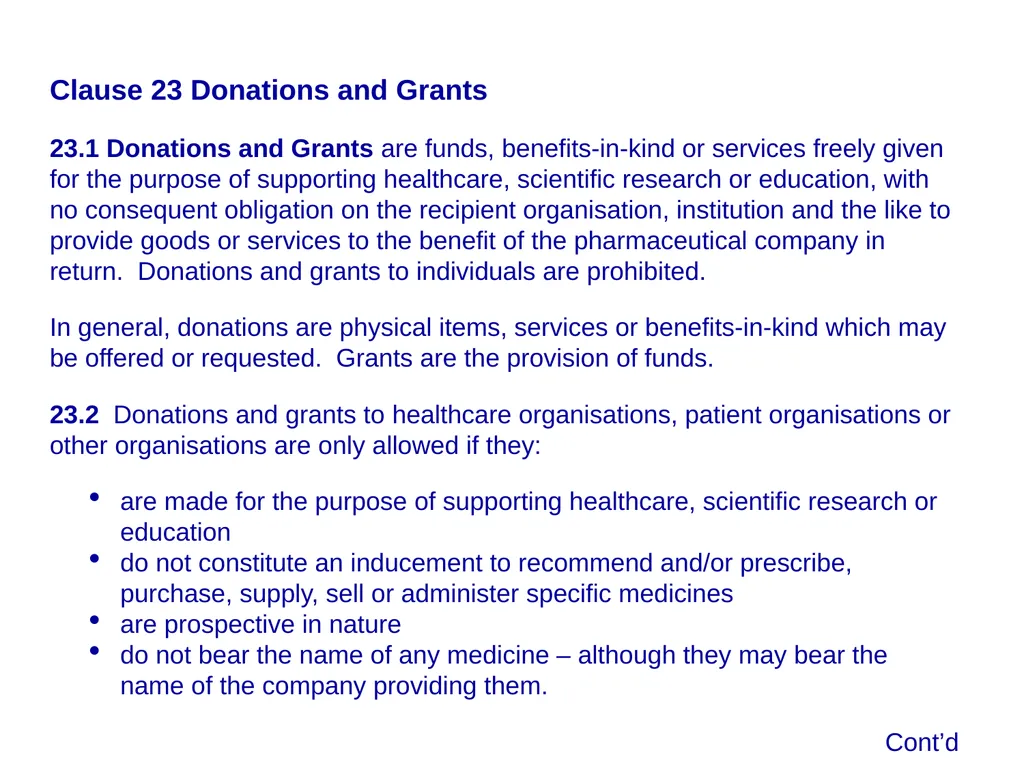
23.1 Donations and Grants are funds, benefits-in-kind or services freely given for the purpose of supporting healthcare, scientific research or education, with no consequent obligation on the recipient organisation, institution and the like to provide goods or services to the benefit of the pharmaceutical company in return. Donations and grants to individuals are prohibited.
In general, donations are physical items, services or benefits-in-kind which may be offered or requested. Grants are the provision of funds.
23.2 Donations and grants to healthcare organisations, patient organisations or other organisations are only allowed if they:
are made for the purpose of supporting healthcare, scientific research or education
do not constitute an inducement to recommend and/or prescribe, purchase, supply, sell or administer specific medicines
are prospective in nature
do not bear the name of any medicine – although they may bear the name of the company providing them.
Cont’d<br>
70
Clause 23 Donations and Grants
23.2 Donations and grants (cont’d)
In addition:
there must be a written agreement in place for each donation or grant. The arrangements for the written agreement for donations and grants to patient organisations are set out in Clause 27.2 and for other organisations in the supplementary information to Clause 23.2
the written agreement, and where relevant, internal company and service provider instructions must be certified in advance as set out in Clause 8.3
all information relating to the donation or grant should be kept on record by the company
donations and grants must be publicly disclosed annually as set out in Clauses 28 and 29 .
Company involvement should be made clear for donations and grants to the extent possible.<br>
71
Clause 24 Contracted Services
24.1 Health professionals, other relevant decision makers or their employers on their behalf, healthcare organisations, patient organisations, individuals representing patient organisations, and members of the public, including patients and journalists, may be used as consultants and advisors, whether in groups or individually, for services such as speaking at and chairing meetings, involvement in medical/scientific studies, clinical trials or training services, writing articles and/or publications, participation at advisory board meetings, and participation in market research where such participation may involve remuneration and/or hospitality.<br>
24.1 Health professionals, other relevant decision makers or their employers on their behalf, healthcare organisations, patient organisations, individuals representing patient organisations, and members of the public, including patients and journalists, may be used as consultants and advisors, whether in groups or individually, for services such as speaking at and chairing meetings, involvement in medical/scientific studies, clinical trials or training services, writing articles and/or publications, participation at advisory board meetings, and participation in market research where such participation may involve remuneration and/or hospitality.<br>
72
Clause 24 Contracted Services
24.2 The arrangements which cover genuine consultancy or other services must, to the extent relevant to the particular arrangement, fulfil all the following criteria:
a written contract or agreement must be agreed in advance of the commencement of the services which specifies the nature of the services to be provided and the basis for payment of those services
a legitimate need for the services must be clearly identified and documented in advance of requesting the services and entering into arrangements
the criteria for selection must be directly related to the identified need and the persons responsible for selection must have the expertise necessary to evaluate whether the particular contracted individuals and/or organisations meet those criteria
the number of contracted individuals and/or organisations retained and the extent of the service must not be greater than the number reasonably necessary to achieve the identified need
the contracting company must maintain records concerning, and make appropriate use of, the services provided
the hiring of the contracted party to provide the relevant service must not be an inducement to prescribe, supply, administer, recommend, buy or sell any medicine
Cont’d<br>
73
Clause 24 Contracted Services
24.2 The arrangements which cover genuine consultancy or other services must, to the extent relevant to the particular arrangement, fulfil all the following criteria (cont’d):
the remuneration for the services must be reasonable and reflect the fair market value of the services provided. Token consultancy arrangements must not be used to justify compensating the contracted party
in their written contracts or agreements, companies must include provisions regarding the obligation of the individual to:
declare that they are a contracted individual to the company whenever they write or speak in public about a matter that is the subject of the agreement or any other issue relating to that company
similarly, companies that employ, on a part-time basis, health professionals that are still practising their profession, must ensure that such persons are obliged to declare their employment arrangement with the company whenever they write or speak in public about a matter that is the subject of the employment or any other issue relating to that company.<br>
74
Clause 24 Contracted Services
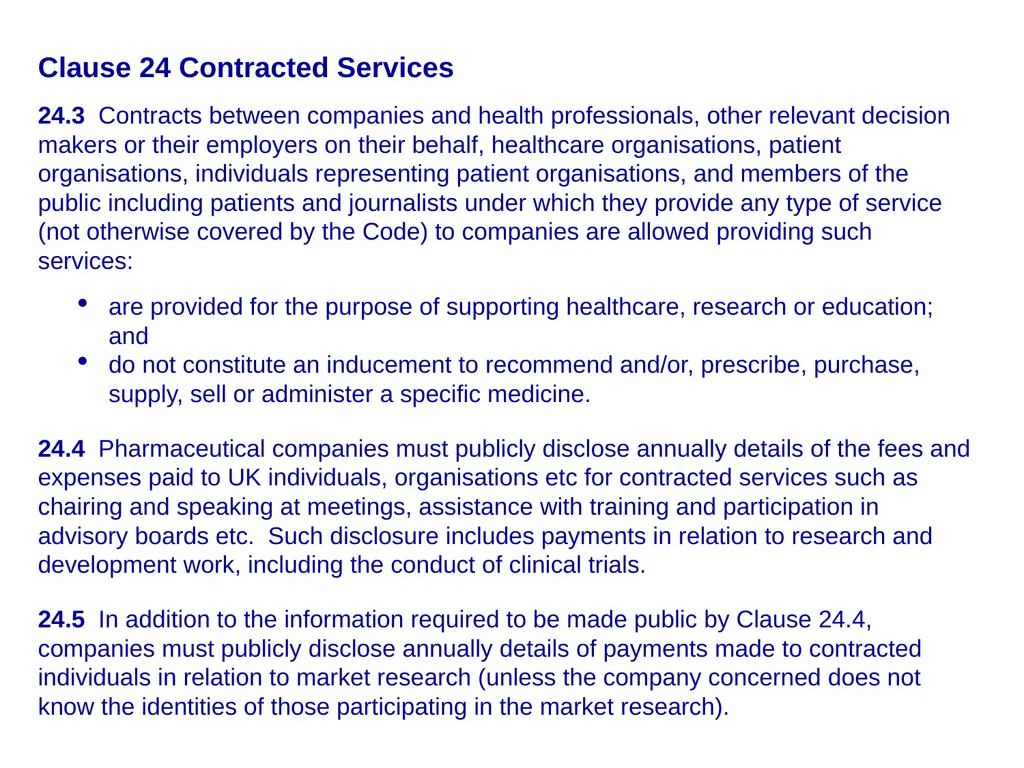
24.3 Contracts between companies and health professionals, other relevant decision makers or their employers on their behalf, healthcare organisations, patient organisations, individuals representing patient organisations, and members of the public including patients and journalists under which they provide any type of service (not otherwise covered by the Code) to companies are allowed providing such services:
are provided for the purpose of supporting healthcare, research or education; and
do not constitute an inducement to recommend and/or, prescribe, purchase, supply, sell or administer a specific medicine.
24.4 Pharmaceutical companies must publicly disclose annually details of the fees and expenses paid to UK individuals, organisations etc for contracted services such as chairing and speaking at meetings, assistance with training and participation in advisory boards etc. Such disclosure includes payments in relation to research and development work, including the conduct of clinical trials.
24.5 In addition to the information required to be made public by Clause 24.4, companies must publicly disclose annually details of payments made to contracted individuals in relation to market research (unless the company concerned does not know the identities of those participating in the market research).<br>
75
Clause 24 Contracted Services
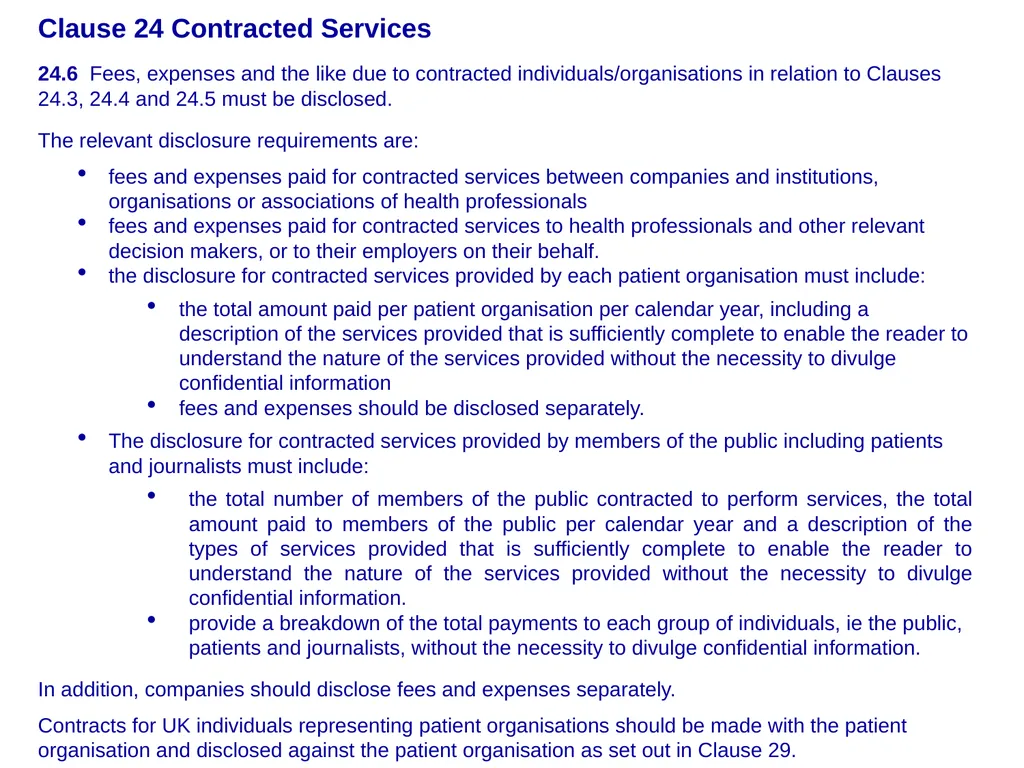
24.6 Fees, expenses and the like due to contracted individuals/organisations in relation to Clauses 24.3, 24.4 and 24.5 must be disclosed.
The relevant disclosure requirements are:
fees and expenses paid for contracted services between companies and institutions, organisations or associations of health professionals
fees and expenses paid for contracted services to health professionals and other relevant decision makers, or to their employers on their behalf.
the disclosure for contracted services provided by each patient organisation must include:
the total amount paid per patient organisation per calendar year, including a description of the services provided that is sufficiently complete to enable the reader to understand the nature of the services provided without the necessity to divulge confidential information
fees and expenses should be disclosed separately.
The disclosure for contracted services provided by members of the public including patients and journalists must include:
the total number of members of the public contracted to perform services, the total amount paid to members of the public per calendar year and a description of the types of services provided that is sufficiently complete to enable the reader to understand the nature of the services provided without the necessity to divulge confidential information.
provide a breakdown of the total payments to each group of individuals, ie the public, patients and journalists, without the necessity to divulge confidential information.
In addition, companies should disclose fees and expenses separately.
Contracts for UK individuals representing patient organisations should be made with the patient organisation and disclosed against the patient organisation as set out in Clause 29.<br>
76
Clause 25 Relationships with Health Professionals, Other Relevant Decision Makers, Healthcare Organisations and Patient Organisations
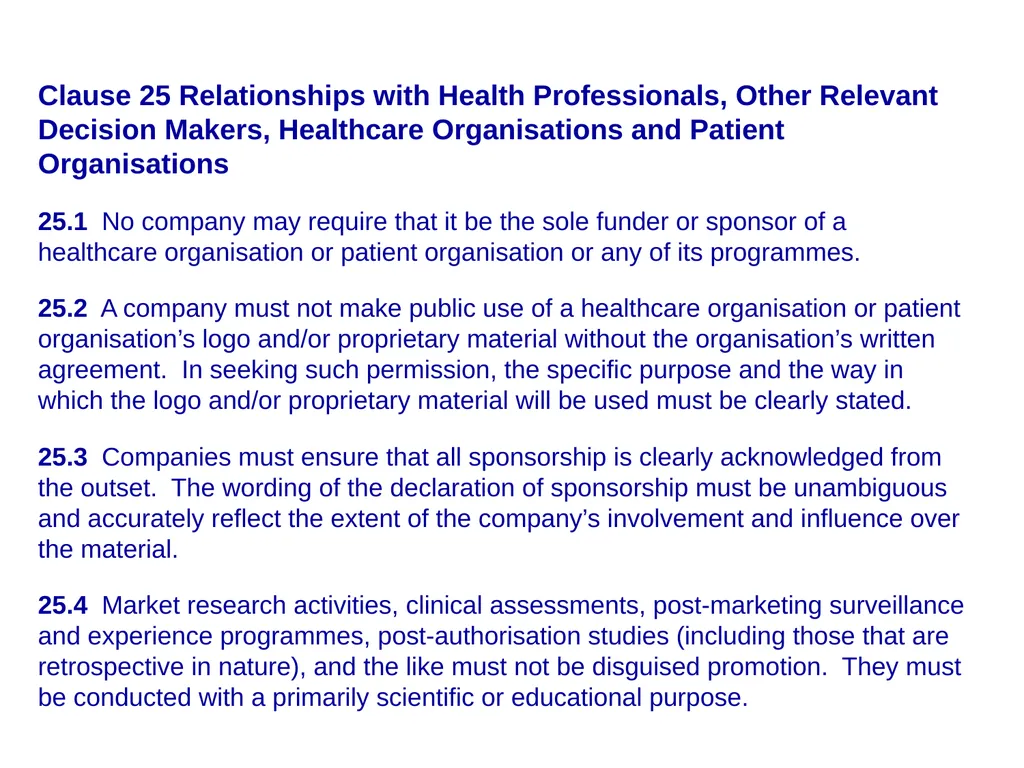
25.1 No company may require that it be the sole funder or sponsor of a healthcare organisation or patient organisation or any of its programmes.
25.2 A company must not make public use of a healthcare organisation or patient organisation’s logo and/or proprietary material without the organisation’s written agreement. In seeking such permission, the specific purpose and the way in which the logo and/or proprietary material will be used must be clearly stated.
25.3 Companies must ensure that all sponsorship is clearly acknowledged from the outset. The wording of the declaration of sponsorship must be unambiguous and accurately reflect the extent of the company’s involvement and influence over the material.
25.4 Market research activities, clinical assessments, post-marketing surveillance and experience programmes, post-authorisation studies (including those that are retrospective in nature), and the like must not be disguised promotion. They must be conducted with a primarily scientific or educational purpose.<br>
77
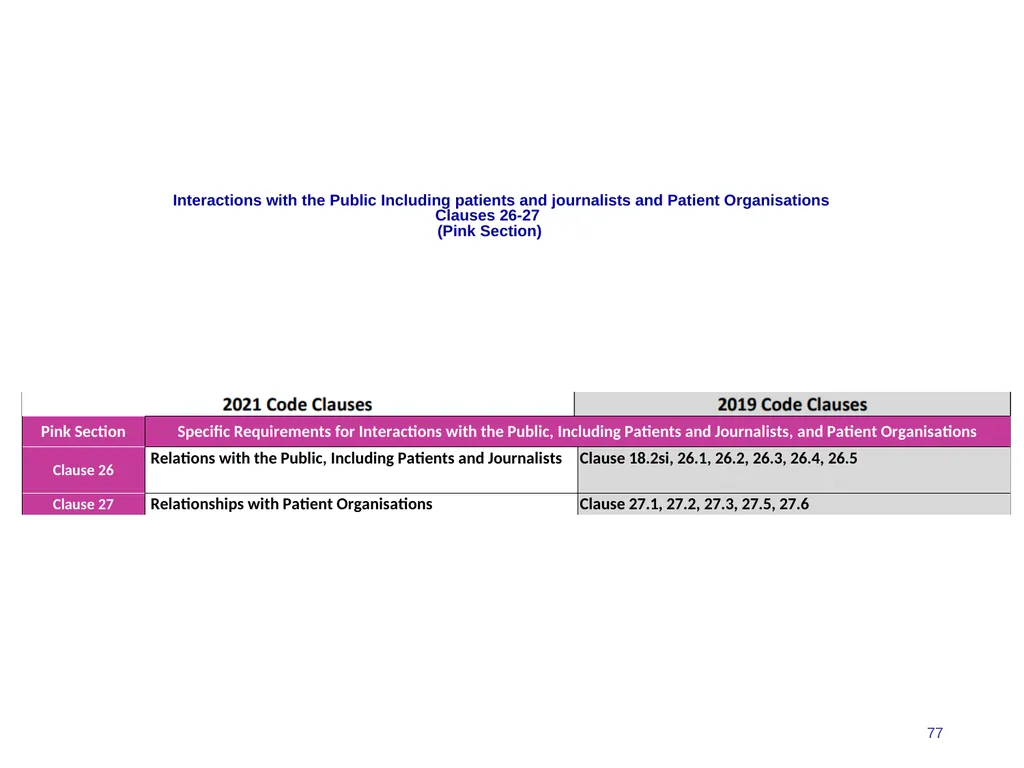
Interactions with the Public Including patients and journalists and Patient Organisations
Clauses 26-27
(Pink Section) 77<br>
78
Clause 26 Relations with the Public, Including Patients and Journalists
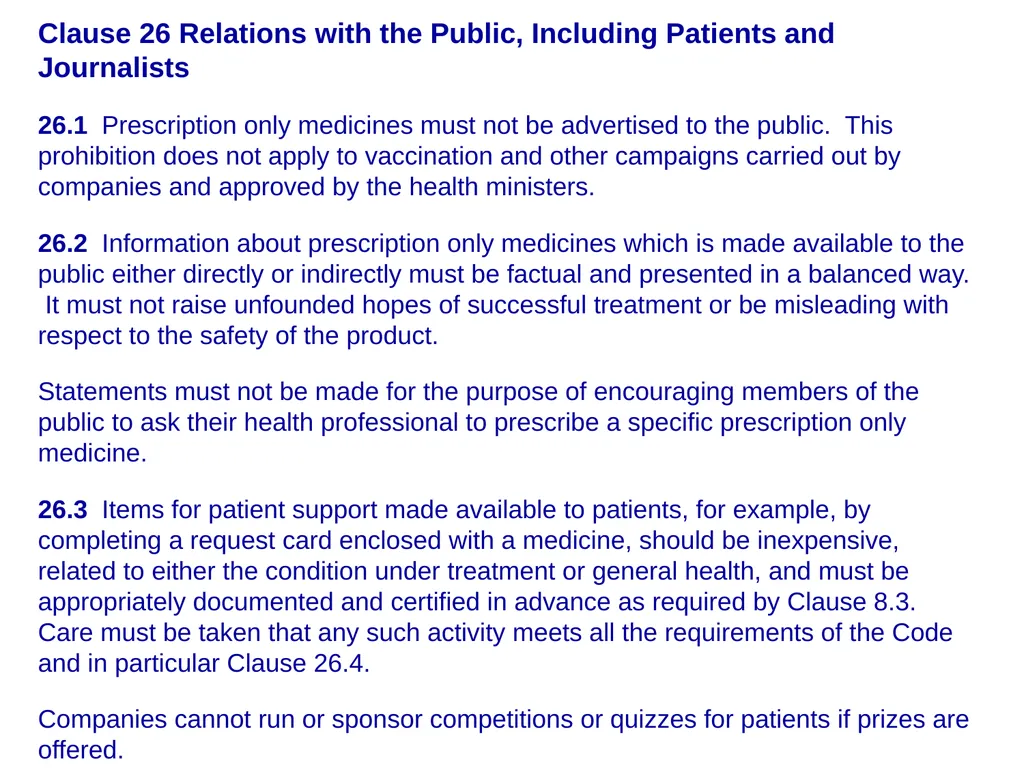
26.1 Prescription only medicines must not be advertised to the public. This prohibition does not apply to vaccination and other campaigns carried out by companies and approved by the health ministers.
26.2 Information about prescription only medicines which is made available to the public either directly or indirectly must be factual and presented in a balanced way. It must not raise unfounded hopes of successful treatment or be misleading with respect to the safety of the product.
Statements must not be made for the purpose of encouraging members of the public to ask their health professional to prescribe a specific prescription only medicine.
26.3 Items for patient support made available to patients, for example, by completing a request card enclosed with a medicine, should be inexpensive, related to either the condition under treatment or general health, and must be appropriately documented and certified in advance as required by Clause 8.3. Care must be taken that any such activity meets all the requirements of the Code and in particular Clause 26.4.
Companies cannot run or sponsor competitions or quizzes for patients if prizes are offered.<br>
79
Clause 26 Relations with the Public, Including Patients and Journalists
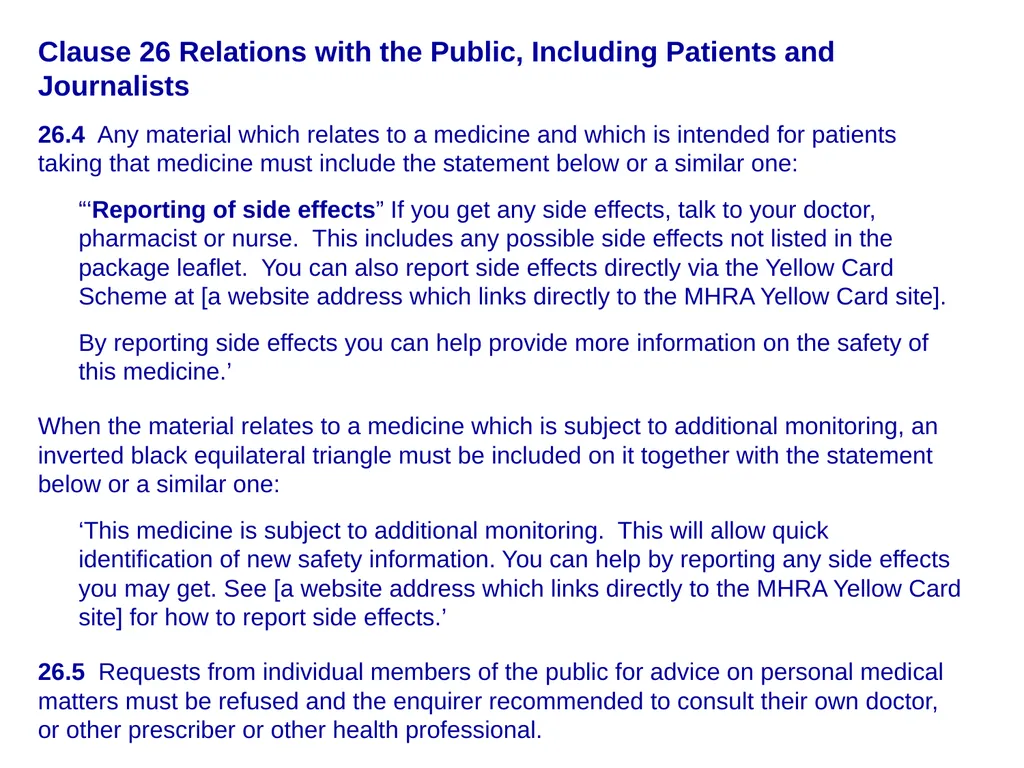
26.4 Any material which relates to a medicine and which is intended for patients taking that medicine must include the statement below or a similar one:
“‘Reporting of side effects” If you get any side effects, talk to your doctor, pharmacist or nurse. This includes any possible side effects not listed in the package leaflet. You can also report side effects directly via the Yellow Card Scheme at [a website address which links directly to the MHRA Yellow Card site].
By reporting side effects you can help provide more information on the safety of this medicine.’
When the material relates to a medicine which is subject to additional monitoring, an inverted black equilateral triangle must be included on it together with the statement below or a similar one:
‘This medicine is subject to additional monitoring. This will allow quick identification of new safety information. You can help by reporting any side effects you may get. See [a website address which links directly to the MHRA Yellow Card site] for how to report side effects.’
26.5 Requests from individual members of the public for advice on personal medical matters must be refused and the enquirer recommended to consult their own doctor, or other prescriber or other health professional.<br>
80
Clause 27 Relationships with Patient Organisations
27.1 When pharmaceutical companies interact with patient organisations or any user organisations such as disability organisations, carer or relative organisations and consumer organisations, companies must:
respect the independence of the organisations
assure the independence of the organisations, in terms of their political judgement, policies and activities
ensure relationships are based on mutual respect, with the views and decisions of each partner having equal value
not promote or request the promotion of a particular prescription only medicine
ensure the objectives and scope are transparent and support provided by companies must always be clearly acknowledged.<br>
81
Clause 27 Relationships with Patient Organisations
27.2 When companies provide donations, grants or sponsorship (including in relation to events/meetings) to patient organisations as set out in Clause 23.2 and 10, companies must have a written agreement in place for each donation, grant or sponsorship setting out exactly what has been provided.
The written agreement must include:
a description of the donation, grant or sponsorship
the objective of the donation, grant or sponsorship, including how it will support healthcare, scientific research or education
the names of the organisations/parties involved (pharmaceutical company, patient organisations and any other parties) and their respective roles
the type of activity and the nature of the company’s contribution (eg donation, grant, sponsorship of a specific meeting or publication etc)
the time frame
the amount of funding and/or a description of indirect/non-financial, in-kind donation and the nature of that donation (eg the donation of agency time or free training courses). Where possible, a full breakdown of costs should be included
a statement that all parties are fully aware that the donation, grant or sponsorship must be clearly acknowledged and apparent from the start
the signatories to the agreement
the date of the agreement.
This written agreement must be certified as set out in Clause 8.3. A company must ensure that any materials, activities etc resulting from working with patient organisations are also certified where these are covered in Clause 8.3.
Donations, grants and sponsorships (including in relation to events/meetings) must be publicly disclosed annually as set out in Clause 29.<br>
82
Clause 27 Relationships with Patient Organisations
27.3 When providing donations, grants or sponsorship (including in relation to events/meetings) to patient organisations, companies must ensure:
they comply with the prohibition on advertising prescription only medicines to the public
that the involvement of the company is made clear and that all of the arrangements comply with the Code. This includes the need to declare the provision, and the wording of the declaration must accurately reflect the nature of the company’s involvement.
27.4 A company must not seek to influence the text of patient organisation material in a manner favourable to its own commercial interests. This does not preclude a company from correcting factual inaccuracies.
27.5 Companies can contract with patient organisations or individuals representing patient organisations under which they provide any type of service to companies providing these comply with Clause 24. Companies must publicly disclose annually fees and expenses paid to patient organisations as set out in Clause 29. In their written contracts with patient organisations, companies are strongly encouraged to include provisions regarding an obligation of the patient organisation to declare that they have provided paid services to the company whenever those concerned write or speak in public about a matter that is the subject of the agreement or any other issue relating to that company.
Where companies contract with individuals representing patient organisations to provide services, such contracts should be made with the patient organisation, and payment should be disclosed as a payment to the patient organisation.<br>
83
Annual Disclosure Requirements
Clauses 28 – 31
(Teal Section)<br>
Clauses 28 – 31
(Teal Section)<br>
84
Clause 28 Annual Disclosure of Transfers of Value to Health Professionals, Other Relevant Decision Makers and Healthcare Organisations
28.1 Companies must document and publicly disclose annually certain transfers of value made directly or indirectly to health professionals, other relevant decision makers and healthcare organisations located in Europe. This includes any employee of a pharmaceutical company whose primary occupation is that of a practising health professional.
28.2 The transfers of value covered by Clause 28.1 are:
collaborative working, including joint working, in accordance with Clause 20
donations and grants provided to healthcare organisations, institutions and other organisations in accordance with Clause 23
fees and expenses paid for contracted services between companies and institutions, organisations or associations of health professionals, in accordance with Clause 24.6
support of attendance by health professionals and other relevant decision makers at events/meetings whether paid directly, indirectly or via another party in accordance with Clause 10.10
fees and expenses paid for contracted services to health professionals and other relevant decision makers, or to their employers on their behalf, in relation to Clause 24.6
sponsorship, including contributions to costs related to events/meetings paid to healthcare organisations or to organisations managing events on their behalf, which may include support of health professionals not known to the company via the healthcare organisation by way of registration fees, accommodation and travel, in accordance with Clause 10.11<br>
85
Clause 28 Annual Disclosure of Transfers of Value to Health Professionals, Other Relevant Decision Makers and Healthcare Organisations
28.3 Different categories of transfers of value to individual health professionals or other relevant decision makers can be aggregated on a category by category basis, provided that itemised disclosure would be made available upon request to the relevant recipient or the relevant authorities. Payments to healthcare organisations are required to be disclosed on a per activity basis.
28.4 Where a transfer of value is made to an individual health professional or other relevant decision maker indirectly via a healthcare organisation, such a transfer should be disclosed once only, preferably as being a transfer to the individual concerned.
28.5 Where recipients of transfers of value cannot be identified for legal reasons, the amount attributable to such transfers must be disclosed on an aggregate basis. The number of recipients involved must be stated together with the percentage of all recipients that they represent and the aggregate amount attributable to transfers of value to such recipients.
28.6 Each company providing transfers of value must publish a note summarising the methodologies used by it in preparing the disclosures and identifying each category of transfer of value. The note, including a general summary and/or country specific considerations, must describe the recognition methodologies applied and should include the treatment of multi-year contracts, VAT and other tax aspects, currency aspects and other issues relating to the timing and amount of transfers of value for the purposes of this Code.<br>
86
Clause 29 Annual Disclosure of Contracted Services, Donations, Grants and Sponsorship (including in relation to events/meetings) Provided to Patient Organisations
29.1 Companies must make publicly available annually, a list of patient organisations to which it provides donations, grants or sponsorship (including in relation to events/meetings) or with whom it has engaged to provide contracted services over the reporting period. This information must be disclosed on the company website either on a national or European level. Each reporting period shall cover a full calendar year.
Each company must include a note of methodologies used by it in preparing the disclosures and identifying support and contracted services provided.<br>
87
Clause 29 Annual Disclosure of Contracted Services, Donations, Grants and Sponsorship (including in relation to events/meetings) Provided to Patient Organisations
29.2 The disclosure for the provision of donations, grants or sponsorship (including in relation to events/meetings) to a patient organisation must include:
the monetary value of each financial contribution (grant or sponsorship) to include a description that is sufficiently complete to enable the reader to understand the nature of that support or the arrangements in accordance with Clauses 23 and 10
the monetary value for each non-financial and/or indirect support (donation); the published information must also include a clear description of each donation that is sufficiently complete to enable the reader to understand the nature of the support or the arrangements. If the non-financial and/or indirect support (donation) cannot be assigned a meaningful monetary value, the published information must describe clearly the non-monetary value that the organisation receives that is sufficiently complete to enable the reader to understand the nature of the support or the arrangements in accordance with Clause 23.
The disclosure for contracted services provided by each patient organisation, in accordance with Clause 24, must include:
the total amount paid per patient organisation per calendar year including a description of the services provided that is sufficiently complete to enable the reader to understand the nature of the services provided without the necessity to divulge confidential information
fees and expenses should be disclosed separately.<br>
88
Clause 30 Annual Disclosure of Contracted Services Provided by the Public, Including Patients and Journalists
30.1 Companies must make publicly available annually details of the fees for certain contracted services paid to members of the UK public, including patients and journalists. These services include speaking at meetings, assistance with training, writing articles and/or publications, participating in advisory boards, advising on the design etc of clinical trials, participating in market research where such participation involves remuneration and/or travel.
The disclosure for contracted services provided by members of the public, in accordance with Clause 24, must include:
the total number of members of the public, including patients and journalists contracted to perform services and the total amount paid per calendar year, and a description of the types of services provided that is sufficiently complete to enable the reader to understand the nature of the services provided without the necessity to divulge confidential information
companies should provide a breakdown of the total payments to each group of individuals, ie the public, patients and journalists without the necessity to divulge confidential information
fees and expenses should be disclosed separately.
Each company must include a note summarising the methodologies used by it in preparing the disclosures and identifying support and services provided.<br>
89
Clause 31 Timings, Duration and Retention of Disclosure Information
31.1 Disclosures must be made annually in respect of each calendar year and must be in the first six months after the end of the calendar year in which the transfers of value/payments were made.
31.2 The information disclosed must remain in the public domain for at least three years from the time of first disclosure.
31.3 Companies must document all disclosures and retain the records for at least five years after the end of the calendar year to which they relate.<br>