
2025-26 NFHS Basketball Rules PowerPoint Rules



Description: 2025-26 NFHS Basketball Rules PowerPoint Rules Changes Editorial Changes Mechanical Changes Points of Emphasis 2025-26 NFHS Basketball Rules Changes GOALTENDING 4-22-1 Goaltending occurs when a defensive player touches the ball during a try
Related Topics
Download Presentation
"2025-26 NFHS Basketball Rules PowerPoint Rules" is the property of its rightful owner. Permission is granted to download and print the materials on this website for personal, non-commercial use only, and to display it on your personal computer provided you do not modify the materials and that you retain all copyright notices contained in the materials. By downloading content from our website, you accept the terms of this agreement.
Presentation Transcript
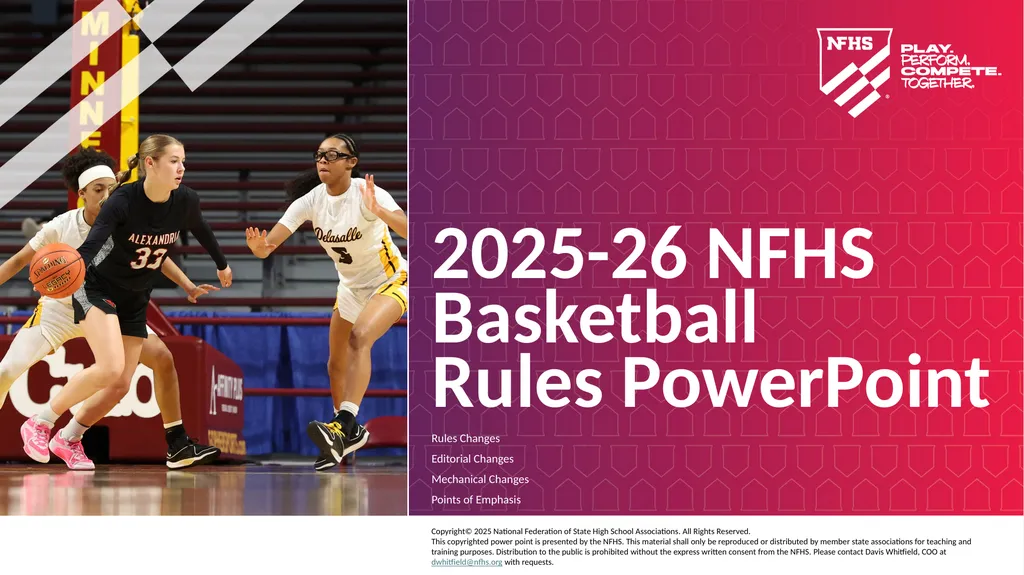
slide1. 2025-26 NFHS
Basketball
Rules PowerPoint Rules Changes
Editorial Changes
Mechanical Changes
Points of Emphasis<br>
slide2. 2025-26 NFHS Basketball Rules Changes<br>
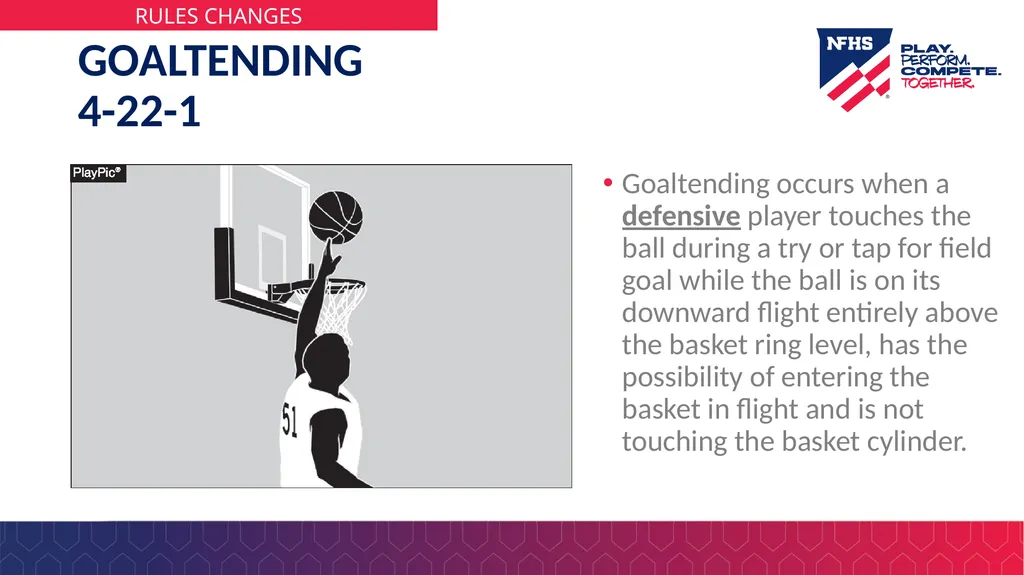
slide3. GOALTENDING 4-22-1 Goaltending occurs when a defensive player touches the ball during a try or tap for field goal while the ball is on its downward flight entirely above the basket ring level, has the possibility of entering the basket in flight and is not touching the basket cylinder.<br>
slide4. GOALTENDING 4-22-2 Goaltending occurs when a defensive player touches the ball outside the cylinder during a free-throw attempt.<br>
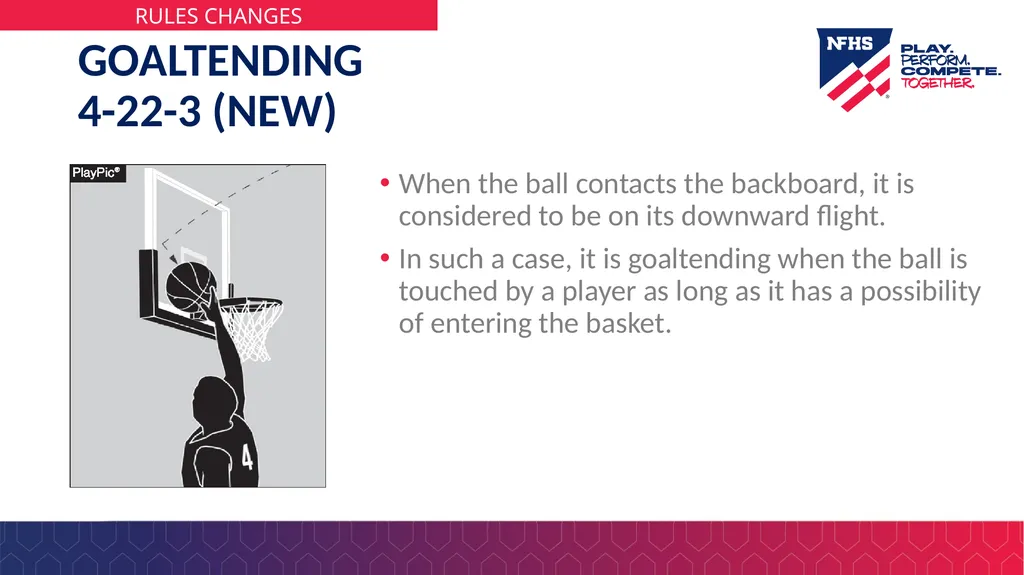
slide5. GOALTENDING 4-22-3 (NEW) When the ball contacts the backboard, it is considered to be on its downward flight.
In such a case, it is goaltending when the ball is touched by a player as long as it has a possibility of entering the basket.<br>
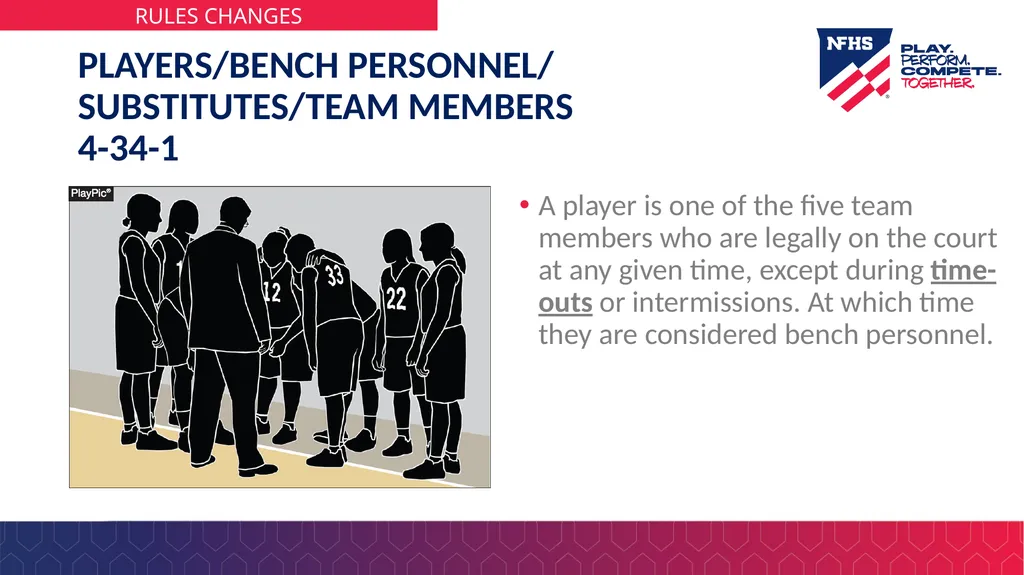
slide6. PLAYERS/BENCH PERSONNEL/ SUBSTITUTES/TEAM MEMBERS 4-34-1 A player is one of the five team members who are legally on the court at any given time, except during time-outs or intermissions. At which time they are considered bench personnel.<br>
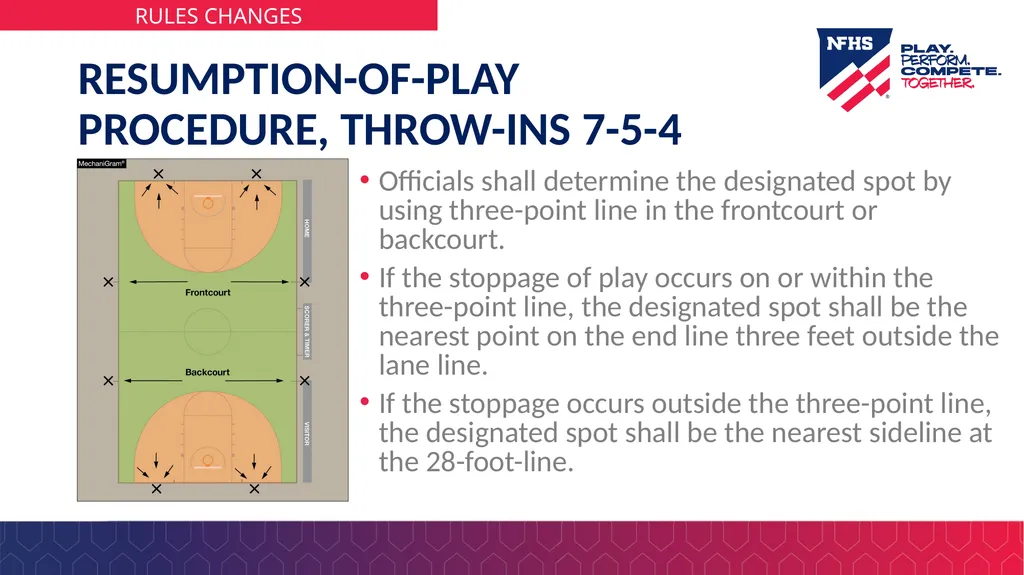
slide7. RESUMPTION-OF-PLAY PROCEDURE, THROW-INS 7-5-4 Officials shall determine the designated spot by using three-point line in the frontcourt or backcourt.
If the stoppage of play occurs on or within the three-point line, the designated spot shall be the nearest point on the end line three feet outside the lane line.
If the stoppage occurs outside the three-point line, the designated spot shall be the nearest sideline at the 28-foot-line.<br>
slide8. THROW-IN PROVISIONS 9-2-11 (NEW) The thrower shall not purposely and/or deceitfully delay returning after legally being out of bounds and then become the first player to touch the ball after returning to the playing court.<br>
slide9. OUT OF BOUNDS 9-3-4 (NEW) A player shall not purposely and/or deceitfully delay returning after legally being out of bounds and then become the first player to touch the ball after returning to the playing court.<br>
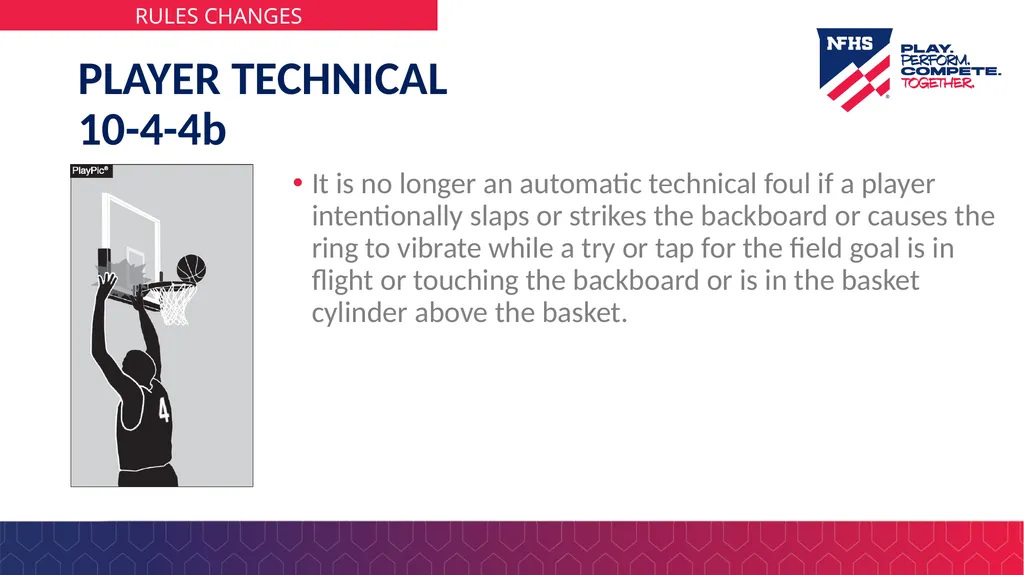
slide10. PLAYER TECHNICAL 10-4-4b It is no longer an automatic technical foul if a player intentionally slaps or strikes the backboard or causes the ring to vibrate while a try or tap for the field goal is in flight or touching the backboard or is in the basket cylinder above the basket.<br>
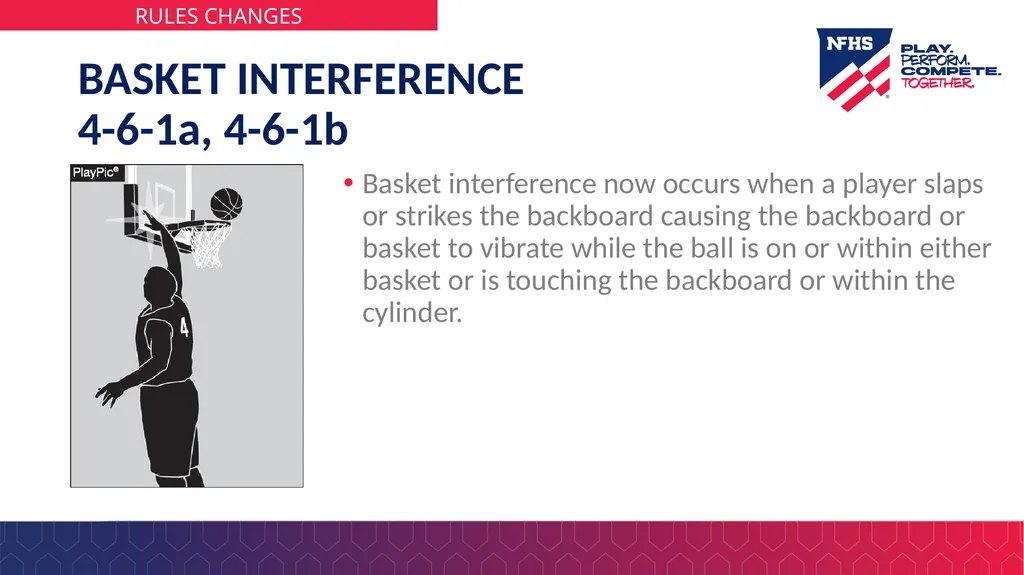
slide11. BASKET INTERFERENCE 4-6-1a, 4-6-1b Basket interference now occurs when a player slaps or strikes the backboard causing the backboard or basket to vibrate while the ball is on or within either basket or is touching the backboard or within the cylinder.<br>
slide12. 2025-26 NFHS Basketball Editorial Changes<br>
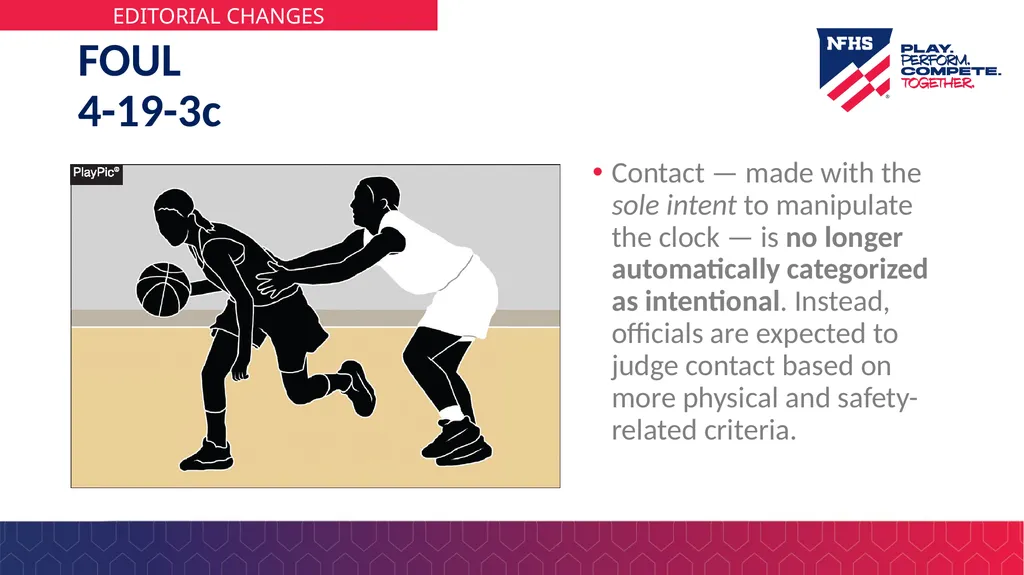
slide13. FOUL 4-19-3c Contact — made with the sole intent to manipulate the clock — is no longer automatically categorized as intentional. Instead, officials are expected to judge contact based on more physical and safety-related criteria.<br>
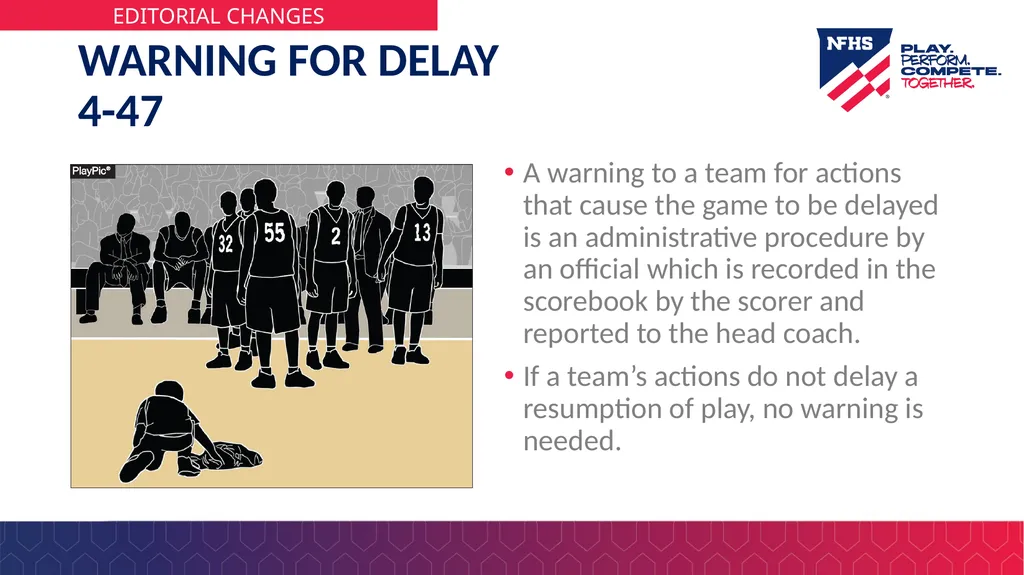
slide14. WARNING FOR DELAY 4-47 A warning to a team for actions that cause the game to be delayed is an administrative procedure by an official which is recorded in the scorebook by the scorer and reported to the head coach.
If a team’s actions do not delay a resumption of play, no warning is needed.<br>
slide15. THREE-POINT TRY 5.2.1 SITUATION C If the offense throws the ball from beyond the three-point line, when there is no possibility of the ball entering the basket from above and touching/deflection by another player causes the goal to be successful, it shall be a two-point goal.<br>
slide16. JUMP-BALL ADMINISTRATION 6-3-2a, 6-3-5b Prior to the ball being tossed for a jump ball, nonjumpers shall not move onto the center restraining circle (within three feet).
Until the tossed ball is touched by one or both jumpers, nonjumpers shall not take a position in any occupied space within three feet of the center restraining circle.<br>
slide17. 2025-26 NFHS Basketball Other Changes<br>
slide18. CONTINUOUS MOTION 4.11.2 SITUATION (NEW) Under NFHS rules, a player who is pivoting or stepping when fouled is considered to have begun the try attempt.
The player should be considered in the act of shooting if the player continues the motion and releases the ball on a try.<br>
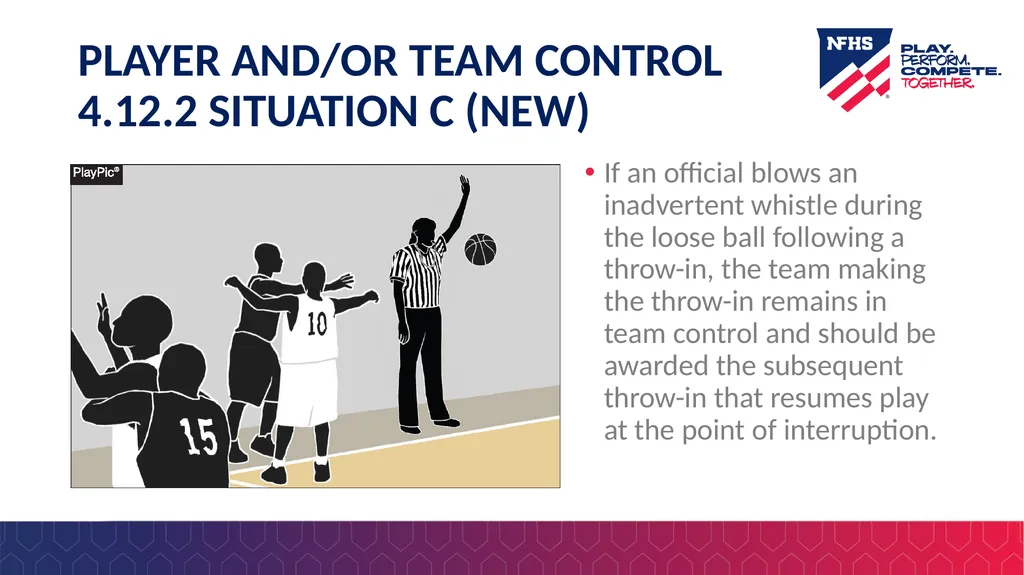
slide19. PLAYER AND/OR TEAM CONTROL 4.12.2 SITUATION C (NEW) If an official blows an inadvertent whistle during the loose ball following a throw-in, the team making the throw-in remains in team control and should be awarded the subsequent throw-in that resumes play at the point of interruption.<br>
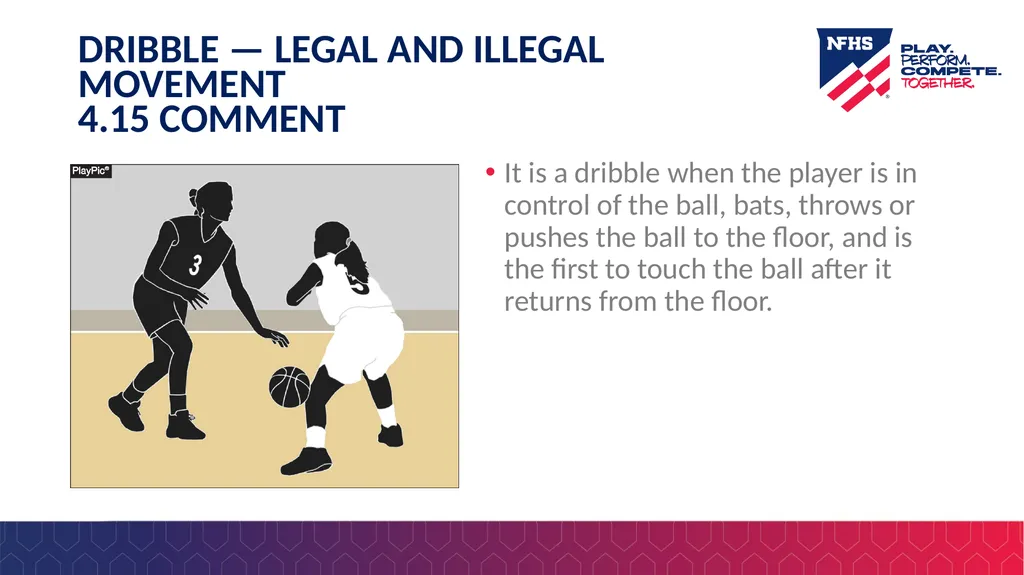
slide20. DRIBBLE — LEGAL AND ILLEGAL MOVEMENT 4.15 COMMENT It is a dribble when the player is in control of the ball, bats, throws or pushes the ball to the floor, and is the first to touch the ball after it returns from the floor.<br>
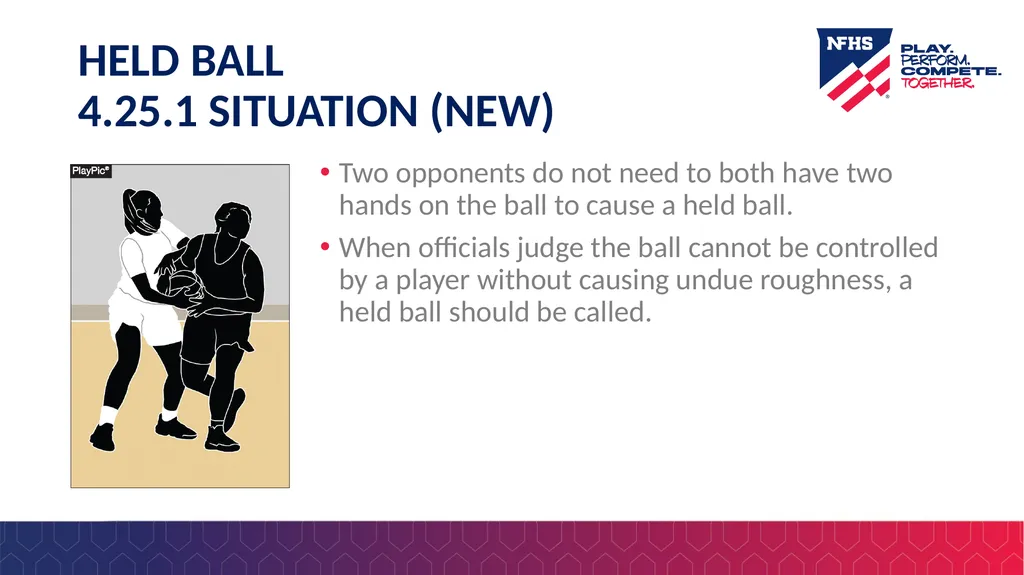
slide21. HELD BALL 4.25.1 SITUATION (NEW) Two opponents do not need to both have two hands on the ball to cause a held ball.
When officials judge the ball cannot be controlled by a player without causing undue roughness, a held ball should be called.<br>
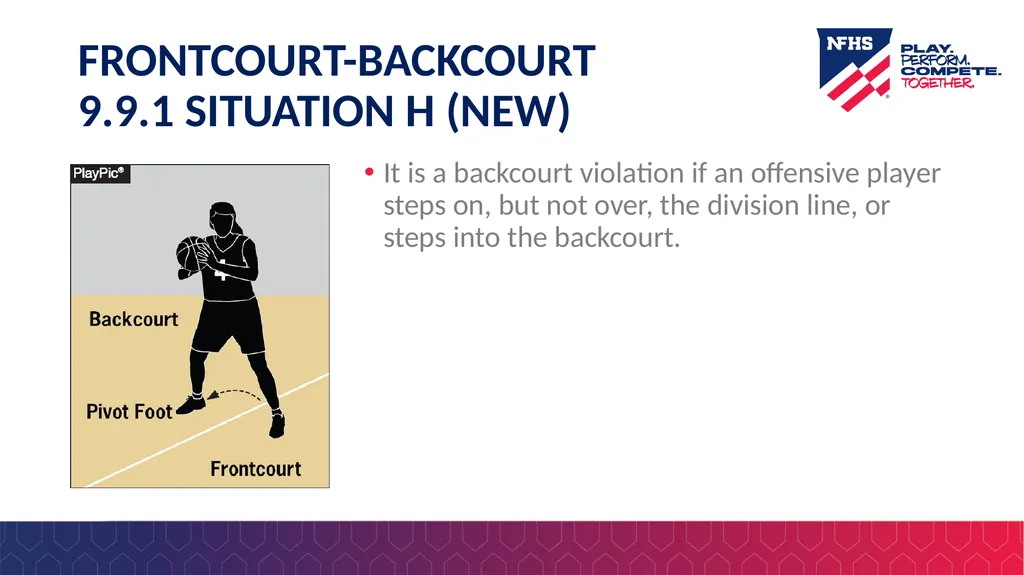
slide22. FRONTCOURT-BACKCOURT 9.9.1 SITUATION H (NEW) It is a backcourt violation if an offensive player steps on, but not over, the division line, or steps into the backcourt.<br>
slide23. DELAY RETURNING TO COURT, TEAM TECHNICAL 10.4.2 SITUATION B, 10-2-5 If all five offensive players fail to return to the court at approximately the same time, the offensive team is charged with a team technical foul.<br>
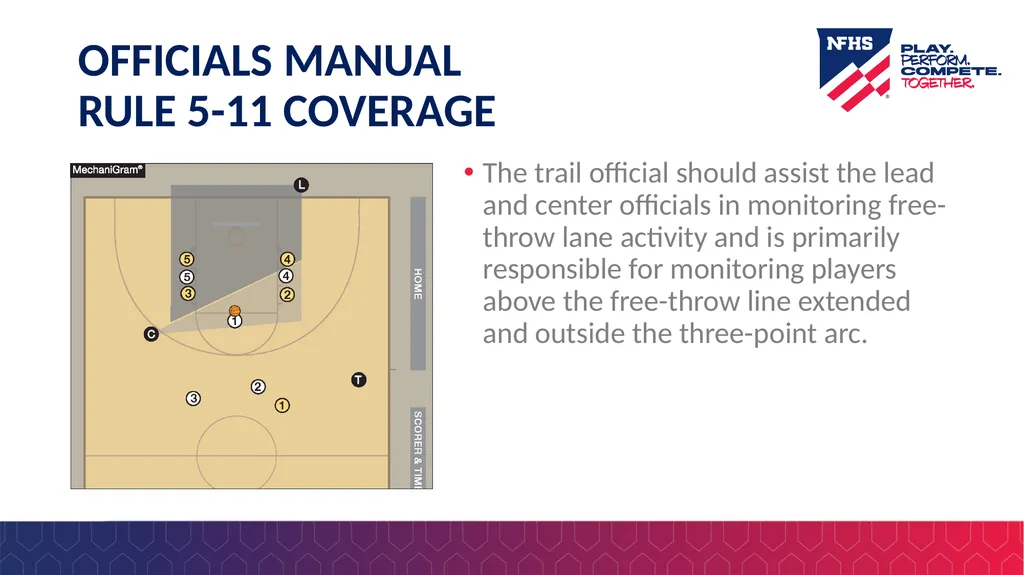
slide24. OFFICIALS MANUAL RULE 5-11 COVERAGE The trail official should assist the lead and center officials in monitoring free-throw lane activity and is primarily responsible for monitoring players above the free-throw line extended and outside the three-point arc.<br>
slide25. 2025-26 NFHS Basketball Points of Emphasis<br>
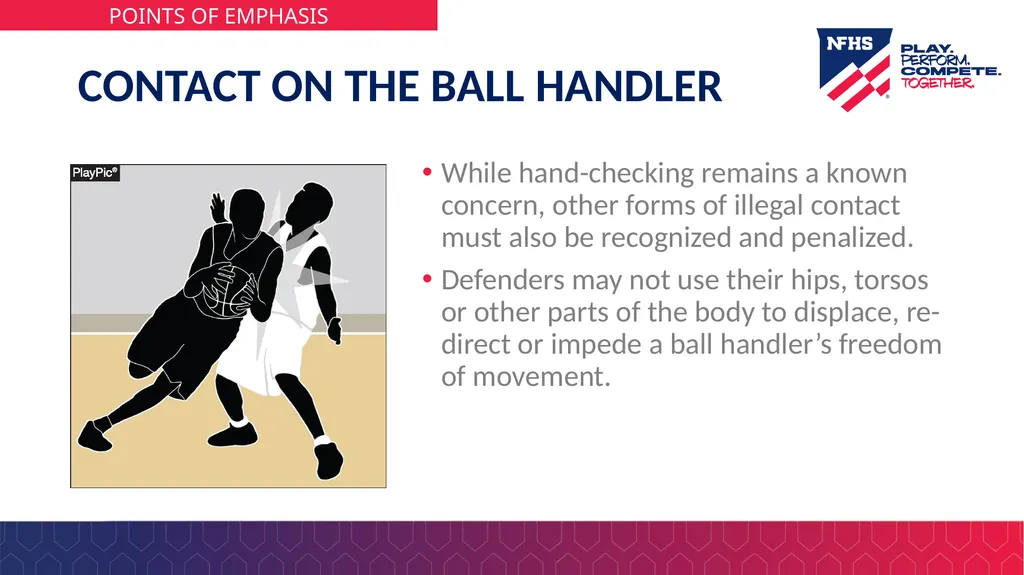
slide26. CONTACT ON THE BALL HANDLER While hand-checking remains a known concern, other forms of illegal contact must also be recognized and penalized.
Defenders may not use their hips, torsos or other parts of the body to displace, re-direct or impede a ball handler’s freedom of movement.<br>
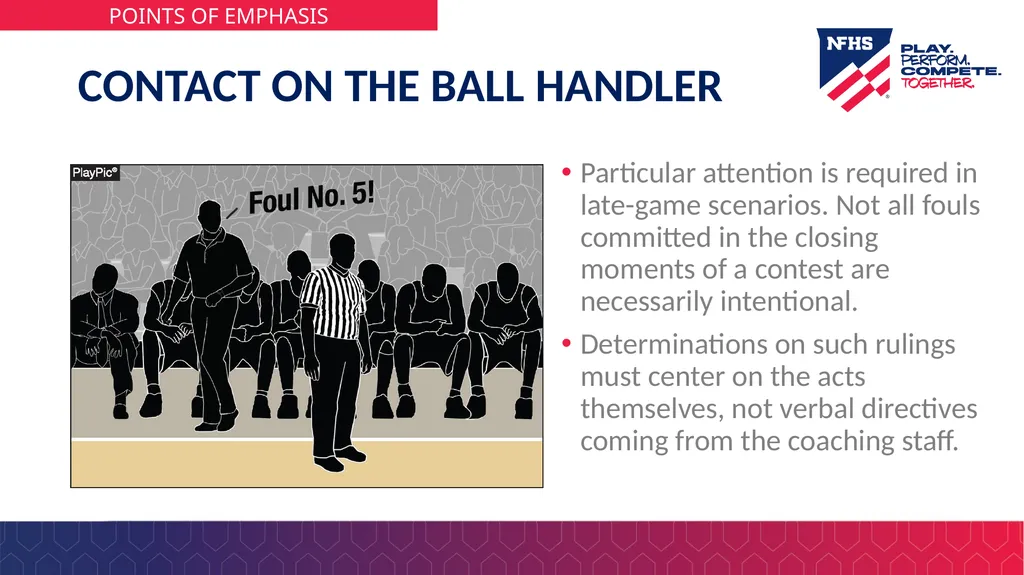
slide27. CONTACT ON THE BALL HANDLER Particular attention is required in late-game scenarios. Not all fouls committed in the closing moments of a contest are necessarily intentional.
Determinations on such rulings must center on the acts themselves, not verbal directives coming from the coaching staff.<br>
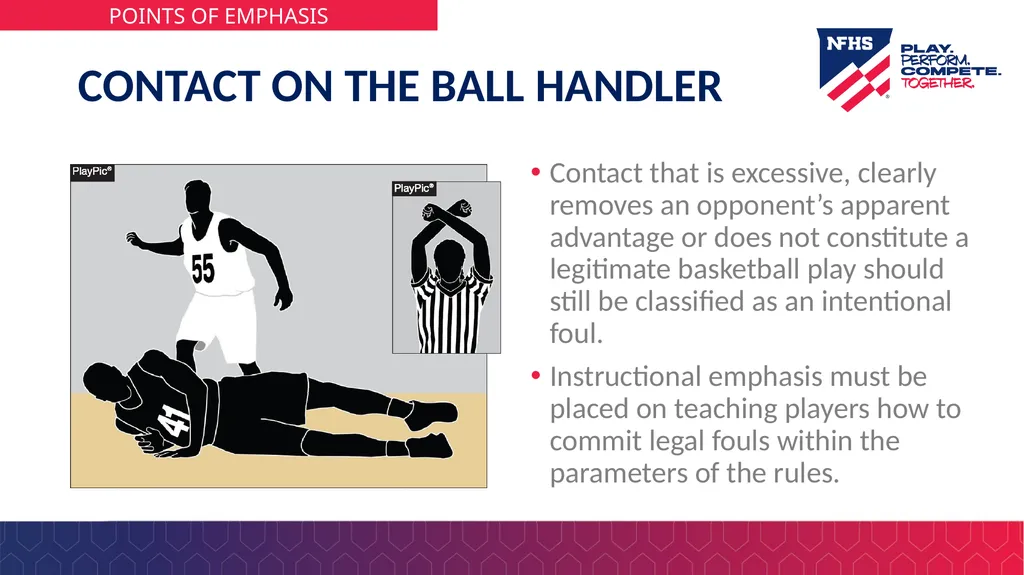
slide28. CONTACT ON THE BALL HANDLER Contact that is excessive, clearly removes an opponent’s apparent advantage or does not constitute a legitimate basketball play should still be classified as an intentional foul.
Instructional emphasis must be placed on teaching players how to commit legal fouls within the parameters of the rules.<br>
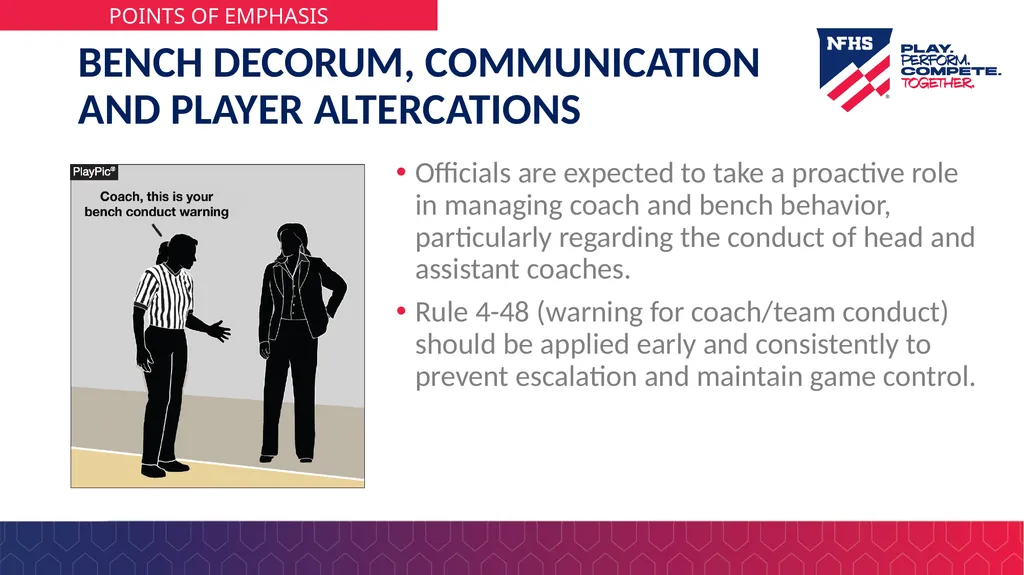
slide29. BENCH DECORUM, COMMUNICATION AND PLAYER ALTERCATIONS Officials are expected to take a proactive role in managing coach and bench behavior, particularly regarding the conduct of head and assistant coaches.
Rule 4-48 (warning for coach/team conduct) should be applied early and consistently to prevent escalation and maintain game control.<br>
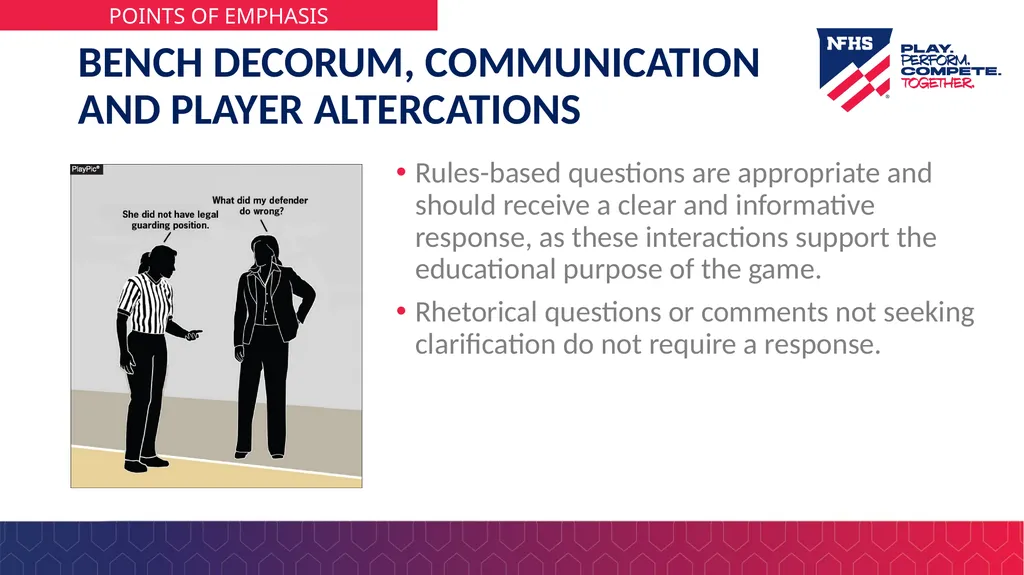
slide30. BENCH DECORUM, COMMUNICATION AND PLAYER ALTERCATIONS Rules-based questions are appropriate and should receive a clear and informative response, as these interactions support the educational purpose of the game.
Rhetorical questions or comments not seeking clarification do not require a response.<br>
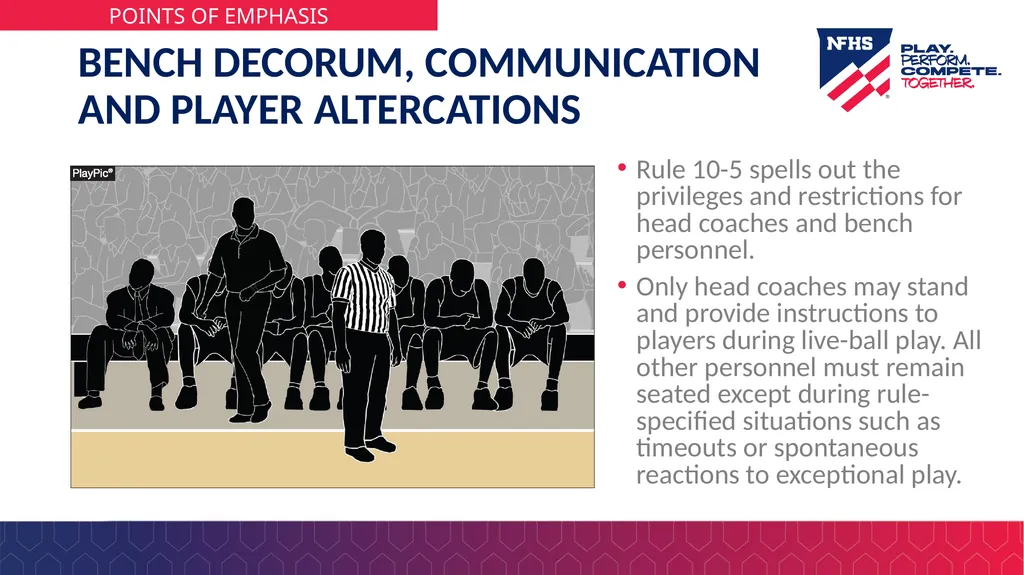
slide31. BENCH DECORUM, COMMUNICATION AND PLAYER ALTERCATIONS Rule 10-5 spells out the privileges and restrictions for head coaches and bench personnel.
Only head coaches may stand and provide instructions to players during live-ball play. All other personnel must remain seated except during rule-specified situations such as timeouts or spontaneous reactions to exceptional play.<br>
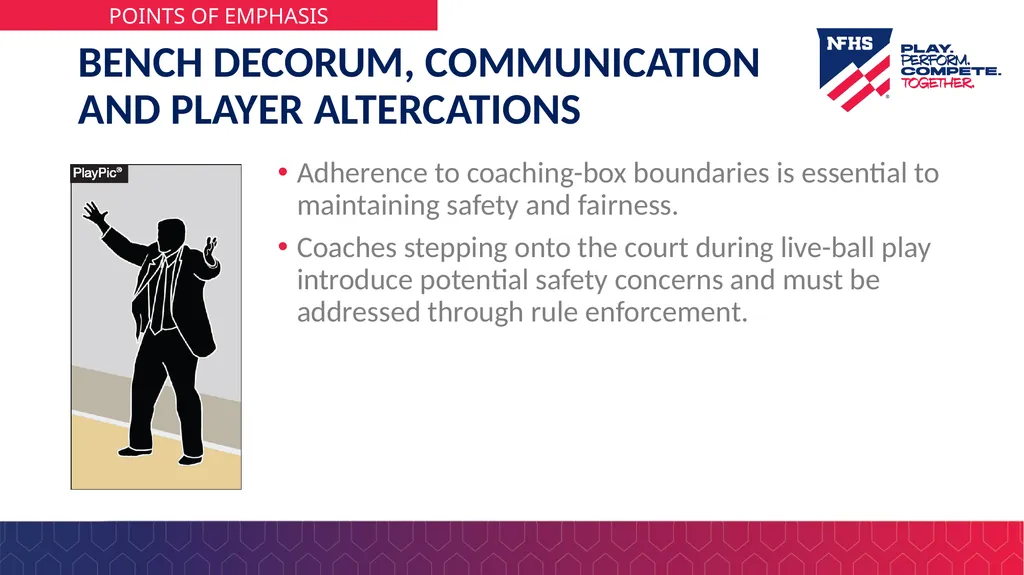
slide32. BENCH DECORUM, COMMUNICATION AND PLAYER ALTERCATIONS Adherence to coaching-box boundaries is essential to maintaining safety and fairness.
Coaches stepping onto the court during live-ball play introduce potential safety concerns and must be addressed through rule enforcement.<br>
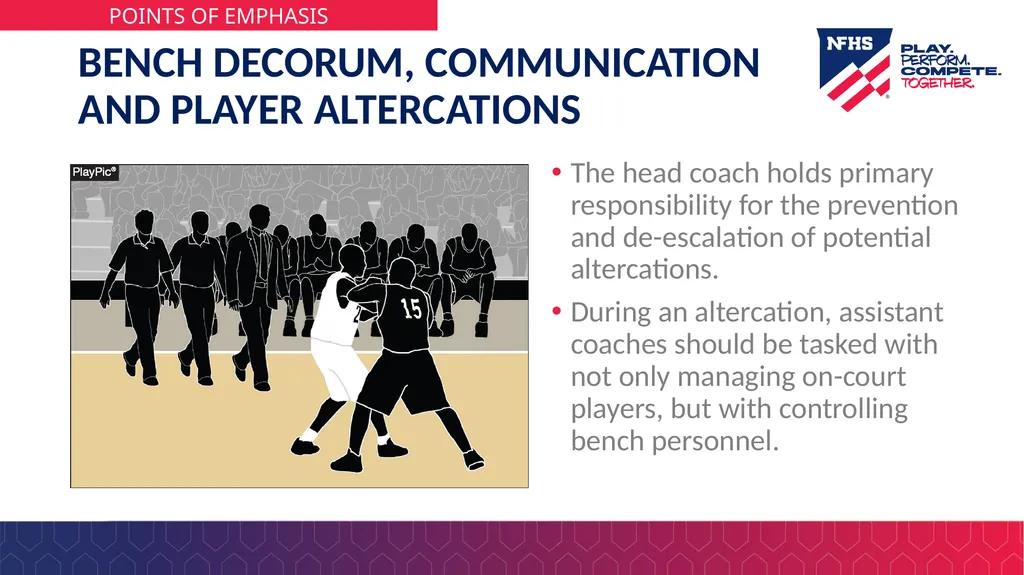
slide33. BENCH DECORUM, COMMUNICATION AND PLAYER ALTERCATIONS The head coach holds primary responsibility for the prevention and de-escalation of potential altercations.
During an altercation, assistant coaches should be tasked with not only managing on-court players, but with controlling bench personnel.<br>
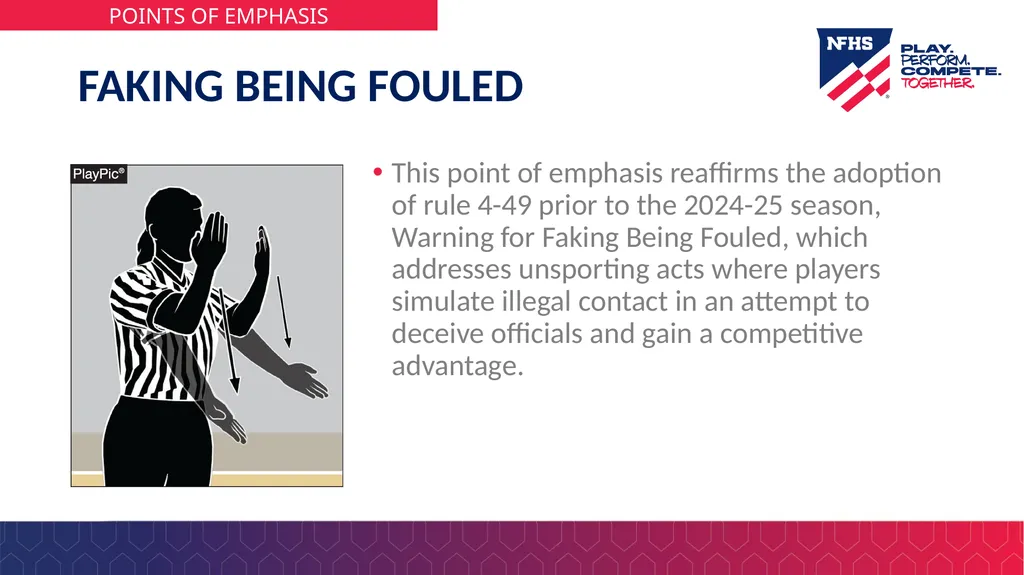
slide34. FAKING BEING FOULED This point of emphasis reaffirms the adoption of rule 4-49 prior to the 2024-25 season, Warning for Faking Being Fouled, which addresses unsporting acts where players simulate illegal contact in an attempt to deceive officials and gain a competitive advantage.<br>
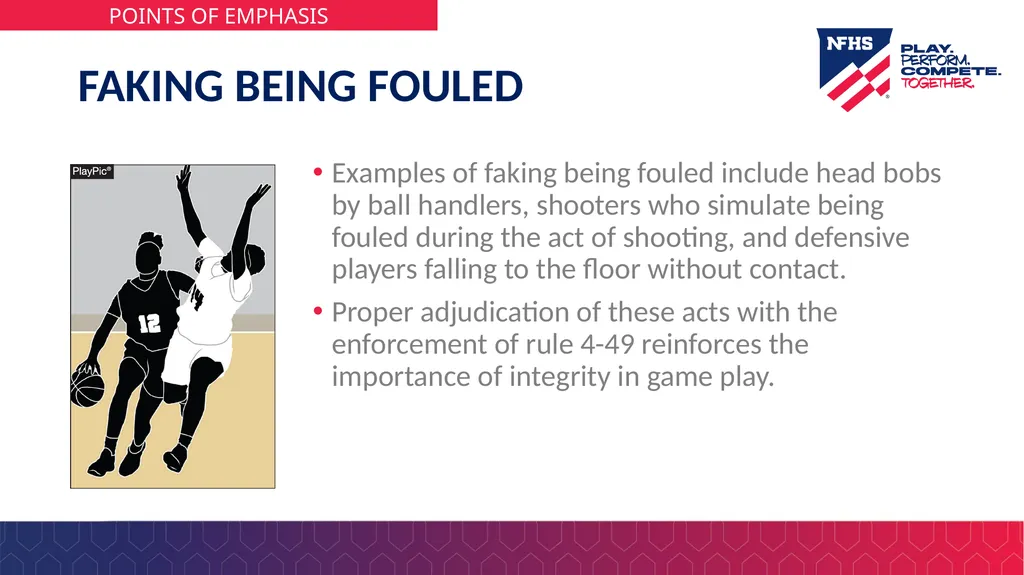
slide35. FAKING BEING FOULED Examples of faking being fouled include head bobs by ball handlers, shooters who simulate being fouled during the act of shooting, and defensive players falling to the floor without contact.
Proper adjudication of these acts with the enforcement of rule 4-49 reinforces the importance of integrity in game play.<br>
slide36. NFHS.org Phone # Email<br>
Editorial Changes
Mechanical Changes
Points of Emphasis<br>
slide2. 2025-26 NFHS Basketball Rules Changes<br>
slide3. GOALTENDING 4-22-1 Goaltending occurs when a defensive player touches the ball during a try or tap for field goal while the ball is on its downward flight entirely above the basket ring level, has the possibility of entering the basket in flight and is not touching the basket cylinder.<br>
slide4. GOALTENDING 4-22-2 Goaltending occurs when a defensive player touches the ball outside the cylinder during a free-throw attempt.<br>
slide5. GOALTENDING 4-22-3 (NEW) When the ball contacts the backboard, it is considered to be on its downward flight.
In such a case, it is goaltending when the ball is touched by a player as long as it has a possibility of entering the basket.<br>
slide6. PLAYERS/BENCH PERSONNEL/ SUBSTITUTES/TEAM MEMBERS 4-34-1 A player is one of the five team members who are legally on the court at any given time, except during time-outs or intermissions. At which time they are considered bench personnel.<br>
slide7. RESUMPTION-OF-PLAY PROCEDURE, THROW-INS 7-5-4 Officials shall determine the designated spot by using three-point line in the frontcourt or backcourt.
If the stoppage of play occurs on or within the three-point line, the designated spot shall be the nearest point on the end line three feet outside the lane line.
If the stoppage occurs outside the three-point line, the designated spot shall be the nearest sideline at the 28-foot-line.<br>
slide8. THROW-IN PROVISIONS 9-2-11 (NEW) The thrower shall not purposely and/or deceitfully delay returning after legally being out of bounds and then become the first player to touch the ball after returning to the playing court.<br>
slide9. OUT OF BOUNDS 9-3-4 (NEW) A player shall not purposely and/or deceitfully delay returning after legally being out of bounds and then become the first player to touch the ball after returning to the playing court.<br>
slide10. PLAYER TECHNICAL 10-4-4b It is no longer an automatic technical foul if a player intentionally slaps or strikes the backboard or causes the ring to vibrate while a try or tap for the field goal is in flight or touching the backboard or is in the basket cylinder above the basket.<br>
slide11. BASKET INTERFERENCE 4-6-1a, 4-6-1b Basket interference now occurs when a player slaps or strikes the backboard causing the backboard or basket to vibrate while the ball is on or within either basket or is touching the backboard or within the cylinder.<br>
slide12. 2025-26 NFHS Basketball Editorial Changes<br>
slide13. FOUL 4-19-3c Contact — made with the sole intent to manipulate the clock — is no longer automatically categorized as intentional. Instead, officials are expected to judge contact based on more physical and safety-related criteria.<br>
slide14. WARNING FOR DELAY 4-47 A warning to a team for actions that cause the game to be delayed is an administrative procedure by an official which is recorded in the scorebook by the scorer and reported to the head coach.
If a team’s actions do not delay a resumption of play, no warning is needed.<br>
slide15. THREE-POINT TRY 5.2.1 SITUATION C If the offense throws the ball from beyond the three-point line, when there is no possibility of the ball entering the basket from above and touching/deflection by another player causes the goal to be successful, it shall be a two-point goal.<br>
slide16. JUMP-BALL ADMINISTRATION 6-3-2a, 6-3-5b Prior to the ball being tossed for a jump ball, nonjumpers shall not move onto the center restraining circle (within three feet).
Until the tossed ball is touched by one or both jumpers, nonjumpers shall not take a position in any occupied space within three feet of the center restraining circle.<br>
slide17. 2025-26 NFHS Basketball Other Changes<br>
slide18. CONTINUOUS MOTION 4.11.2 SITUATION (NEW) Under NFHS rules, a player who is pivoting or stepping when fouled is considered to have begun the try attempt.
The player should be considered in the act of shooting if the player continues the motion and releases the ball on a try.<br>
slide19. PLAYER AND/OR TEAM CONTROL 4.12.2 SITUATION C (NEW) If an official blows an inadvertent whistle during the loose ball following a throw-in, the team making the throw-in remains in team control and should be awarded the subsequent throw-in that resumes play at the point of interruption.<br>
slide20. DRIBBLE — LEGAL AND ILLEGAL MOVEMENT 4.15 COMMENT It is a dribble when the player is in control of the ball, bats, throws or pushes the ball to the floor, and is the first to touch the ball after it returns from the floor.<br>
slide21. HELD BALL 4.25.1 SITUATION (NEW) Two opponents do not need to both have two hands on the ball to cause a held ball.
When officials judge the ball cannot be controlled by a player without causing undue roughness, a held ball should be called.<br>
slide22. FRONTCOURT-BACKCOURT 9.9.1 SITUATION H (NEW) It is a backcourt violation if an offensive player steps on, but not over, the division line, or steps into the backcourt.<br>
slide23. DELAY RETURNING TO COURT, TEAM TECHNICAL 10.4.2 SITUATION B, 10-2-5 If all five offensive players fail to return to the court at approximately the same time, the offensive team is charged with a team technical foul.<br>
slide24. OFFICIALS MANUAL RULE 5-11 COVERAGE The trail official should assist the lead and center officials in monitoring free-throw lane activity and is primarily responsible for monitoring players above the free-throw line extended and outside the three-point arc.<br>
slide25. 2025-26 NFHS Basketball Points of Emphasis<br>
slide26. CONTACT ON THE BALL HANDLER While hand-checking remains a known concern, other forms of illegal contact must also be recognized and penalized.
Defenders may not use their hips, torsos or other parts of the body to displace, re-direct or impede a ball handler’s freedom of movement.<br>
slide27. CONTACT ON THE BALL HANDLER Particular attention is required in late-game scenarios. Not all fouls committed in the closing moments of a contest are necessarily intentional.
Determinations on such rulings must center on the acts themselves, not verbal directives coming from the coaching staff.<br>
slide28. CONTACT ON THE BALL HANDLER Contact that is excessive, clearly removes an opponent’s apparent advantage or does not constitute a legitimate basketball play should still be classified as an intentional foul.
Instructional emphasis must be placed on teaching players how to commit legal fouls within the parameters of the rules.<br>
slide29. BENCH DECORUM, COMMUNICATION AND PLAYER ALTERCATIONS Officials are expected to take a proactive role in managing coach and bench behavior, particularly regarding the conduct of head and assistant coaches.
Rule 4-48 (warning for coach/team conduct) should be applied early and consistently to prevent escalation and maintain game control.<br>
slide30. BENCH DECORUM, COMMUNICATION AND PLAYER ALTERCATIONS Rules-based questions are appropriate and should receive a clear and informative response, as these interactions support the educational purpose of the game.
Rhetorical questions or comments not seeking clarification do not require a response.<br>
slide31. BENCH DECORUM, COMMUNICATION AND PLAYER ALTERCATIONS Rule 10-5 spells out the privileges and restrictions for head coaches and bench personnel.
Only head coaches may stand and provide instructions to players during live-ball play. All other personnel must remain seated except during rule-specified situations such as timeouts or spontaneous reactions to exceptional play.<br>
slide32. BENCH DECORUM, COMMUNICATION AND PLAYER ALTERCATIONS Adherence to coaching-box boundaries is essential to maintaining safety and fairness.
Coaches stepping onto the court during live-ball play introduce potential safety concerns and must be addressed through rule enforcement.<br>
slide33. BENCH DECORUM, COMMUNICATION AND PLAYER ALTERCATIONS The head coach holds primary responsibility for the prevention and de-escalation of potential altercations.
During an altercation, assistant coaches should be tasked with not only managing on-court players, but with controlling bench personnel.<br>
slide34. FAKING BEING FOULED This point of emphasis reaffirms the adoption of rule 4-49 prior to the 2024-25 season, Warning for Faking Being Fouled, which addresses unsporting acts where players simulate illegal contact in an attempt to deceive officials and gain a competitive advantage.<br>
slide35. FAKING BEING FOULED Examples of faking being fouled include head bobs by ball handlers, shooters who simulate being fouled during the act of shooting, and defensive players falling to the floor without contact.
Proper adjudication of these acts with the enforcement of rule 4-49 reinforces the importance of integrity in game play.<br>
slide36. NFHS.org Phone # Email<br>